A dozen googlers quit over Google’s military drone contract
boing boing | May 15, 2018
Google’s “Project Maven” is supplying machine-learning tools to the Pentagon to support drone strikes; the project has been hugely divisive within Google, with employees pointing out that the company is wildly profitable and doesn’t need to compromise on its ethics to keep its doors open; that the drone program is a system of extrajudicial killing far from the battlefield; and that the firm’s long-term health depends on its ability to win and retain the trust of users around the world, which will be harder if Google becomes a de facto wing of the US military.
A dozen googlers have put their money where their mouths are, publicly resigning over the contract; 4,000 more googlers have signed an open letter to the company’s CEO asking him to cancel the contract.
Companies have an emergent property of profit-seeking without regard to ethics or human flourishing, but individuals within companies retain their human sense of decency; that’s why we need to include techies in our plan for fixing tech.
A dozen Google employees quit over military drone project [Ron Amadeo/Ars Technica]
One resigning employee questioned why Google is even bothering with such a controversial program when it is already so massive. “It’s not like Google is this little machine-learning startup that’s trying to find clients in different industries,” the anonymous employee told Gizmodo. “It just seems like it makes sense for Google and Google’s reputation to stay out of that.”
“Actions speak louder than words, and that’s a standard I hold myself to as well,” another resigning employee told Gizmodo. “I wasn’t happy just voicing my concerns internally. The strongest possible statement I could take against this was to leave.”
Washington and NATO Are Escalating to Conflict
By Brian CLOUGHLEY | Strategic Culture Foundation | 16.05.2018
The Trump Administration in Washington is ramping up confrontation and preparing for war all over the globe, from the South China Sea to the Baltic via the Persian Gulf. The countries of the US-NATO military alliance have vastly increased their military spending and are boosting deployment of their forces in Europe in accordance with the policy of Enhanced Forward Presence — the positioning of strike aircraft, missile-armed ships and armoured formations as close as possible to Russia’s border.
In March 2018 NATO’s Deputy Secretary General, former US Under Secretary of State Rose Gottemoeller, spoke to the media at Warsaw’s military airport and was effusive about the forward movement of US-NATO troops. She “wanted to say what an honour it was to visit the battlegroup that is deployed here in Poland today… I have had the opportunity… over the past few months to visit all four of the battlegroups, and I can see that that promise made among all Allies in Warsaw in 2016 has resulted in certified, effective battlegroups that are training every single day of the week, to provide for the deterrence and defence of this Alliance. So I was very proud to be here.”
It is hugely expensive to move and maintain military forces in foreign countries and the Stockholm International Peace Research Institute (SIPRI) records that in 2016 “NATO’s collective military expenditure rose to $881 billion” while “European NATO members spent $254 billion in 2016 — over 3 times more than Russia.”
Russia’s $69.2 billion defence outlay in 2016 was one twelfth of US-NATO’s spending on armaments and preparations for war.
In January 2018 the US Department of Defence published its National Defence Strategy which conveyed the message that “the central challenge to US prosperity and security is re-emergence of long-term strategic competition” from Russia and China who are “revisionist powers” and a “growing threat” requiring a vast surge in US military expenditure. The Pentagon’s Mission involves “restoring America’s competitive military advantage to deter Russia and China from challenging the United States, its allies or seeking to overturn the international order that has served so well since the end of World War II.”
That is the US-enforced “international order” that involved its disastrous war in Vietnam, the invasion of Iraq that propelled the Middle East to its current state of chaos, and a continuing, sixteen-year catastrophe in Afghanistan, all of which military forays by the global gendarme caused massive destruction and the deaths of uncountable numbers of innocent citizens.
And now the US has some 1.3 million people in the army, navy, air force and Marine Corps, with about 200,000 stationed in over 800 overseas military bases, in order to continue enforcement of “international order.”
The Nuclear Posture Review that was published on February 2, 2018, just after the defence strategy paper (January 19) also makes it clear who the Pentagon considers to be its enemies, mentioning China 47 times, Iran 39 times and Russia 127 times, which makes nonsense of the claim by the State Department that “we do not want to consider Russia an adversary . . . This not a Russia-centric NPR.”
Trump’s “America First” policy has alienated longtime US allies and increased distrust by the many countries being confronted militarily. The irony about this drum-thumping slogan is the US claim that “It is increasingly clear that China and Russia want to shape a world consistent with their authoritarian model, gaining veto authority over other nations’ economic, diplomatic, and security decisions,” because this is precisely what “America First” is about : military domination and total ascendancy over the economies of the entire world.
A further irony became apparent just two months after notification of the Nuclear Posture and the equally confrontational National Defence Strategy, when SIPRI published its statistics concerning international military expenditure. There was extensive cover of most of its findings in the Western media, but strangely enough little mention was made of the fact that “at $66.3 billion, Russia’s military spending in 2017 was 20 per cent lower than in 2016.”
SIPRI reported that in the year in which Russia reduced its defence expenditure by twenty per cent, “military spending in both Central and Western Europe increased by 12 and 1.7 per cent, respectively . . . total military spending by all 29 NATO members was $900 billion in 2017, accounting for 52 per cent of world spending.”
SIPRI further noted that “The United States continues to have the highest military expenditure in the world. In 2017 the USA spent more on its military than the next seven highest-spending countries combined.”
The Western media’s reporting of President Putin’s speech to Russia’s Federal Assembly on March 1 was intriguing. It concentrated almost entirely on Russia’s weapons’ developments, with the New York Times, for example, reporting that the President “used the speech to reassure Russians that the military buildup was taking place.” The 1,500 words of that report were almost entirely devoted to his description of Russian weapons designed to deter US-NATO adventurism, and a mere 65 covered the social improvement programmes he described.
In outlining his priorities the President declared that “the main, key development factor is the well-being of the people and the prosperity of Russian families. Let me remind you that in 2000, 42 million people lived below the poverty line, which amounted to nearly 30 percent – 29 percent of the population. In 2012, this indicator fell to 10 percent. Poverty has increased slightly against the backdrop of the economic crisis. Today, 20 million Russian nationals live in poverty. Of course, this is much fewer than the 42 million people in 2000, but it is still way too many.”
Of course Russia wants to improve the lives of its citizens, and intends to do this, no matter the military buildup round its borders. But it isn’t going to stand back and do nothing while the US-NATO military bloc expands and accelerates towards conflict. Certainly there has been a massive reduction in Russia’s defence budget, while the US and the rest of NATO are vastly increasing military expenditure, but it remains necessary for Russia to maintain its defence capabilities to counter the provocations of the US-NATO’s Enhanced Forward Presence menacing its borders.
As noted by the US independent platform Veterans Today, President Putin stated that “American submarines are on permanent alert off the Norwegian coast; they are equipped with missiles that can reach Moscow in 17 minutes. But we dismantled all of our bases in Cuba a long time ago, even the non-strategic ones. And you would call us aggressive?”
Yes, they do, in spite of all the aggression being displayed by US-NATO military deployments and manoeuvres in eastern Europe.
For example, Exercise Siil 2018 was held in Estonia from 2-13 May 2018, involving over 15,000 troops from 10 NATO countries — the UK, US, Belgium, Canada, Denmark, France, Germany, Latvia, Lithuania and Poland — and the five supposedly neutral countries of Finland, Georgia, Ireland, Sweden and Ukraine.
There could not be a plainer signal that the Pentagon and its sub-branch in Brussels are escalating to conflict.
Iran Deal Abandoned, INF Next. US Steadily Dismantling Arms Control
By Alex GORKA | Strategic Culture Foundation | 16.05.2018
The US has just pulled out of the Iran deal. The INF Treaty is next. The campaign to render defunct yet another major arms-control agreement is already gaining momentum. On May 10, the House Armed Services Committee endorsed a measure authorizing President Donald Trump to decide the fate of the INF Treaty with Russia. This addition to a draft defense bill states that the agreement is no longer binding. The bill includes funds for developing a ground-launched cruise missile (GLCM), which, if tested, will violate the treaty terms.
The US has accused Russia of noncompliance but has never publicly provided any evidence to back up its claim. The alleged violations are used to justify the hawks’ newest favorite thing — low–yield nuclear munitions installed on SLBMs and sea-based long-range cruise missiles. And this isn’t just an empty wish or fantasy but an actual recommendation from the 2018 Nuclear Posture Review. Actually, the idea to abandon the treaty is not new; that’s something that’s been floated for some time, pushing that landmark agreement toward the brink of oblivion.
The plan for a nuclear-tipped cruise missile is another example of how the US is chipping away at the arms-control regime — the Presidential Nuclear Initiatives (PNI). These initiatives are not agreements, but rather commitments that have done much to deter the potential threat of sea-based tactical nuclear weapons, including intermediate-range cruise missiles. The initiatives have been more efficient and more important than any of the agreements that have been approved or ratified by parliaments. Once they have been unraveled, the genie will be out of the bottle, triggering an unprecedented arms race.
It won’t exactly make the US safer if Russia puts nuclear warheads on its technologically advanced Kalibr naval missiles. So why provoke it? The PNIs have been a success story, a good example of what can be achieved if both sides want it. But no, Gen. John Hyten, commander of U.S. Strategic Command, “strongly agrees” that the Pentagon should procure the above-mentioned weapons, including the sea-based cruise missile.
A low-yield warhead on an SLBM may not be strategic but since there is no way to know, any launch would probably trigger a response from the entire Russian nuclear arsenal, sending them hurtling toward US shores. Such a warhead would be a very destabilizing weapon, especially given the overall superiority of US and NATO conventional forces. There is no reasonable explanation why the US would need non-strategic munitions installed on strategic delivery vehicles, when it has air-based tactical nuclear weapons already in its Air Force inventory? It has “mothers” and “fathers” of all bombs, bunker busters, and other conventional weapons that are able to work wonders, so why should it use a nuclear weapon, low-yield or high-yield, when the same missions can be carried out without any nukes at all?
Another angle worth mentioning here is that the desire for low-yield weapons reflects the US readiness to use nukes against non-nuclear adversaries. Just imagine how irresistibly tempting it might be to strike Iran’s key infrastructure sites with low-yield munitions! And what if N. Korea becomes a problem again?
According to Gen. Robert Brown, commander of the US Army Pacific, the American military needs ground-based missiles with a range of over 500 km, the range prohibited by the bilateral agreement. “I know there’s the INF Treaty … but we need to push beyond that,” he says. “The INF Treaty today unfairly puts the United States at a disadvantage and places our forces at risk because China is not a signatory,” claims Admiral Phil Davidson, the incoming commander of Pacific Command. “Deploying conventionally-armed ground-launched intermediate-range missiles may be key to reasserting US military superiority in East Asia,” emphasizes Eric Sayers, a CSIS expert.
The Army is working on long-range artillery rockets that can exceed the 500 km range. This weapon could be easily stationed in Europe. There would be no way to know whether or not it is nuclear or the extent of its operational range. If a projectile does not fall into the category of intermediate missiles, it is not covered by any treaty, but the effect is the same as if a medium-range missile were fired.
Actually, the INF Treaty is being violated right now in broad daylight. There is no need to declassify any hush-hush information to prove it. The Aegis Ashore Mk-41 launchers, which have already been installed in Romania and are soon to be deployed in Poland (2020), are also being used by the Navy to fire intermediate-range weapons as well as air-to-surface interceptors. This is an undeniable fact. The discussions that have been held under the auspices of the INF Treaty’s Special Verification Commission have not led anywhere.
If the INF Treaty is no longer binding, Russia would be free to deploy intermediate-range missiles to compensate for the West’s superiority in other weapons. The Iskander-M launchers can be used for firing intermediate-range missiles. This will include targets in Europe, although the US will be out of their range. This could lead to another rift among the allies at a time when that relationship is at a nadir because of trade wars and the rift over the Iran deal.
Finally, the unraveling of the INF Treaty will greatly complicate if not eliminate, any prospects, for the New START. And without the latter, there will be no agreement to curb the arms race at all. Arms control will be dead. We’ll be back to where we were in the late 1950s-early 60s. And if a spark should kindle a fire, we’ll all find ourselves back in the Stone Age.
Europe drags feet on guaranteeing trade with Iran
Press TV – May 16, 2018
The European Union’s top policy chief has said that she cannot talk about giving Iran guarantees for the economic benefits of the 2015 agreement, but that she can give assurances that the EU will deepen the dialog with Iran and will immediately start work to arrive at practical solutions. Still a number of European firms have already started winding down business in Iran in an attempt to protect themselves from secondary US sanctions.
Iran’s Foreign Minister Mohammad Javad Zarif warned ahead of a meeting with his British, French and German counterparts in Brussels on Tuesday that there was not much time for them to deliver those assurances.
“Guarantees of benefits of the JCPOA should be given to Iran. We will have to see whether those remaining in the JCPOA can deliver those benefits to Iran,” he was quoted as saying upon arrival in the Belgian capital.
However, the Europeans only pledged to keep the Joint Comprehensive Plan of Action (JCPOA) alive without the United States by trying to keep Iran’s oil and investment flowing.
“We all agreed that we have a relative in intensive care and we all want to get him or her out of intensive care as quickly as possible,” EU foreign policy chief Federica Mogherini told reporters after the 90-minute meeting.
Mogherini emphasized that the lifting of nuclear-related sanctions and the normalization of trade and economic relations with Iran constitute an essential part of the nuclear deal.
She said Iran and the Europeans will be working over the coming weeks to find practical solutions which will include continuing to sell Iran’s oil and gas products, maintaining effective banking transactions and protecting European investments in Iran.
As for the assurances, Mogherini said, “I cannot talk about legal or economic guarantees but I can talk about serious, determined, immediate work from the European side.”
The US has given companies a 180-day wind-down period before the sanctions are reimposed on Iran. That has prompted some European companies to start planning their exit from Iran’s market in the absence of guarantees from their governments.
Danish shipping companies Maersk Tankers and Torm were reported on Tuesday to have stopped taking new orders in Iran.
Even before Trump’s withdrawal, Iran had repeatedly complained to the Europeans about their failure to persuade companies into dealing with Tehran because banks in Europe are generally unwilling to handle transactions with the Islamic Republic.
On Tuesday, German insurer Allianz said it was preparing to wind down Iran-related business due to possible US sanctions.
“We are analyzing our portfolio to identify Iran-related business,” Reuters quoted an Allianz spokesman as saying.
“This analysis is ongoing and we are developing wind-down plans for relevant business to ensure appropriate termination within the defined periods,” he said.
Forget the NHS, spend on defense – US ambassador tells UK
RT | May 15, 2018
Woody Johnson, the US ambassador to the UK, has said that Britain should spend more on military defense at the expense of the NHS, insisting there needs to be ‘trade-offs’ to ensure security and to remain a strong US ally.
Johnson seemed to indicate to journalists assembled in London that, if increasing spending on defense was to the detriment of national treasures such as the NHS, then that was a price worth paying. He said: “Healthcare is always going to be an issue, education is always going to be an issue, transportation and infrastructure are always going to be issues, etc. But how important is it to defend yourself?”
The current owner of American Football team, the New York Jets, Johnson has been serving as Donald Trump’s US ambassador to the UK since January this year. Parroting a Trumpian trope, Johnson warned that his boss doesn’t want to bankroll fellow NATO countries such as Britain to safeguard their security – claiming they needed to pay their way on the world stage.
The US ambassador was talking in relation to Britain’s ambition to buy 138 of the F-35 Lightning II next generation warplanes, as reported in The Times. Some 15 jets have reportedly been bought so far, with military officials committing to an additional 33 by 2025.
It may not come as a surprise to some in the UK that an official from the US, a country which views good healthcare not as a right, but something that should be determined by financial capability, is advising its ‘close ally’ to ditch increased spending on the NHS to ward off supposed threats to national security from ‘enemies’ such as Russia.
Johnson added: “You’re going to have to make trade-offs and go through the emotional and practical and philosophical arguments in terms of what you want to do, what you want to be, how important is defense? How you want to be perceived, by the US, but also by Russia and others?”
The ambassador’s intervention comes on the back of suggestions that there is a black hole in the region of £20 billion ($27 billion) in the UK Ministry of Defence’s budget over the next decade, reports Forces Network.
Trump served legal notice warning of Israeli false flag operation
MEMO | May 15, 2018
US President Donald Trump has been served with a legal notice reminding him of his Constitutional duties with regard to the situation in the Middle East, especially his decision to move the US Embassy to Jerusalem, and warning him of an impending Israeli false flag operation likely to threaten the lives of US citizens. America’s responsibilities as a permanent member of the UN Security Council are also pointed out by the signatories to the notice, who are British journalist Sarah Jane (Lauren) Booth; former CIA Operations Officer Phil Geraldi; ex-Pentagon official Michael Maloof; Scott Bennett, a former US Army Officer and State Department Coordinator for Counterterrorism; ex-US Diplomat and Attorney J. Michael Springmann; and Edward C Corrigan, a Canadian Barrister and Solicitor.
Their formal letter has been sent to Trump with copies going to the International Criminal Court, Turkish President Recep Tayyip Erdogan and Russian leader Vladimir Putin, among others. The signatories give the US President “legal notice” of “a massacre beginning at the time of the Nakba anniversary in order for you to register a response and call upon the Israelis to cease and desist in your capacity as President of the United States and a Permanent Member of the Security Council and NATO.” The address for receipt of the notice to be acknowledged is given as International Delegates of the New Horizons Conference in Tehran.
The US President is reminded that he is expected to advise the US Congress, the UN Security Council and the International Criminal Court in The Hague) about this legal matter. He is warned “that ‘false flag’ attacks may be used by Israeli agents in order to assign blame to Palestinian factions and escalate the ongoing protests in Gaza and the West Bank into a larger conflict in order to falsely draw the United States and American military personnel into this artificially created conflict.” Such an attack, claim those behind the legal notice, “represents a clear and present danger to the citizens of the United States of America, because it may be designed to trigger and escalate American military actions against Turkey, Syria, Lebanon, Iran, and Russia, since these nations are opposed to the transfer of the US Embassy to Jerusalem; and rising tensions already exacerbated by the US withdrawal from the [nuclear deal with Iran].”
The initiation of this impending attack, Trump has been told, will involve a new and higher level massacre of Palestinian civilians protesting against the move of the US Embassy to Jerusalem. Furthermore, the letter serves as “Legal Notice [that] the United States can have no military alliance due to the fact that Israel has no internationally recognised fixed territorial borders which are required to be defined in such an agreement.” This notice, it is pointed out, will be “EXHIBIT 1 in any war crimes investigation and prosecution (past, present, future) relating to this matter.” There are, it is claimed, “national and international legal violations” involved.
The signatories cite a number of publications as evidence of the seriousness of their claims and warning to the President, and seek legal protection for themselves against “any retaliation, detainment, investigation, sequestration, interrogation, discrimination, imprisonment, torture, financial consequences, or any other negative or prejudicial consequences or actions taken against them.” Indeed, the former government and military officers and officials seek “whistle-blower protection” because they are “fulfilling [their] oaths to the US Constitution.”
When Is a Massacre Not a Massacre?
By Craig Murray | May 14, 2018
On the day the Israeli Defence Force massacred dozens of unarmed Palestinians in Gaza and maimed over 400 more, our media has carefully avoided the use of the word massacre. Here is a Google search of News I did five minutes ago on the word “massacre”.

A massacre occurred today in which more people were killed than at Glencoe. All of them were unarmed and the majority were well over a hundred yards from the border fence. It says everything about the kind of nightmare fascist state Israel now is, that if you look through those news results for “massacre”, the only mention you get of Palestinians is a claim by the Israeli Defence Force that the Palestinian Defence Forces were planning a massacre of Israelis.
The Turkish government have now come out with a statement condemning the massacre, and in the UK the Daily Express and the Daily Star have both reported that; but both have chosen to put the word “massacre” in the Turkish statement into inverted commas, as though it were not true.
The Western media far prefers the word “clashes” to “massacre”. Because those terrible Palestinians insist upon demonstrating against the continuing theft of all their land and resources, and keep attacking innocent Israeli bullets with their heads and bodies. If you look through the Google search of News this time for “clashes”, you discover that the western and Israeli media peculiarly have precisely the same preference for this entirely inappropriate word. That, again, is fascinating.

The gross injustice of the apartheid state of Israel appears immutable. The overwhelming force of the political and financial Establishment is behind Israel in the West, in the Russian oligarchy and even in most of the horribly corrupt leadership of Arab states. But the situation is not as dire as it seems, because the hold of those Establishment elites on the people they exploit has never been more shaky. Israel remains a touchstone issue. In order to help redress the terrible agony of the Palestinians, we must first effect a change in our own system of elite exploitation of the people at home. That change is coming.
Russia welcomes Egypt’s refusal to send troops to Syria on US proposal
Al-Masdar News – 14/05/2018
Russia views positively Egypt’s decision against sending its troops to Syria as was proposed by Washington, Russia’s Foreign Minister Sergey Lavrov said after negotiations between Russian and Egyptian foreign and defense ministers in the 2+2 format on Monday.
“We touched upon this issue in the context of discussing the Syria situation, in the context of discussing actions of the so-called foreign players, including, of course, the United States, because it is precisely its idea to invite Arab countries to send their contingents to the Syrian Arab Republic,” the Russian foreign minister said.
“As I understand, this is done for the dual purpose: on the one hand, to share responsibility for the direct and gross violation of the sovereignty and the territorial integrity of Syria, which did not invite the United States and other participants of the US-led coalition to its territory, and the second goal is to share the financial burden,” Russia’s top diplomat said.
“Washington is talking directly and openly about this. I believe everyone understands what stands behind this invitation and we appreciate the position assumed by Egypt,” Lavrov said.
“We discussed this issue as part of the general discussion. Egypt has numerously stressed that it will not send its troops outside its territory as the Egyptian military doctrine stipulates that Egypt’s armed forces must defend only the borders. We discuss such issues only from the theoretical point of view as possible steps,” Egyptian Foreign Minister Sameh Shoukry said.
Some Western media outlets earlier reported about a possible dispatch of Arab armed forces, including from Egypt, to Syrian districts controlled by the United States instead of the US military contingent present there for the purpose of assisting stabilization in the country’s northern part after the defeat of the Islamic State terrorist organization (outlawed in Russia).
ALSO READ Syrian Army on the verge of liberating all of Hajar Al-Aswad from ISIS
Commenting on this information, Shoukry stated that Egypt did not consider sending a military contingent to Syria as part of the US initiative.
US, Sweden and Finland Boost Military Cooperation to Form New Alliance
By Alex GORKA | Strategic Culture Foundation | 14.05.2018
The US, Swedish, and Finnish defense ministers signed a trilateral Statement of Intent (SOI) to expand defense cooperation on all fronts. The signing ceremony took place in Washington on May 8. In 2016, the two Scandinavian nations finalized separate defense SOIs with America. Now they have signed a joint document to unify those previous agreements and enhance their interoperability.
The Scandinavian visitors claimed this was just a starting point for a more mature relationship. The agreement emphasizes the countries’ combined joint exercises and streamlines the procedures that have been established to manage them.
Other issues covered by the SOI include regular trilateral meetings at all levels, the exchange of information (including about weapons systems), increased practical interaction, cooperation in multinational operations, improved communications, and the promotion of the EU-NATO strategic partnership. The latter issue will transform the Scandinavians into a connecting link that will eliminate the chance of any European deterrent that could operate with any real independence from its North American “big brother.” Washington wants to make sure that the PESCO agreement will not protect Europe’s defense industry from US companies.
Sweden hosted the Aurora military exercise in September 2017, the largest such event on its soil. The US supplied most of the visiting troops. The American military has also taken part in a number of drills in Finland recently. That country will host a large-scale NATO exercise as early as 2020 or 2021. The US has already been invited. The militarization of the Scandinavian Peninsula is moving full speed ahead.
The recently signed SOI actually transforms the bilateral agreements into enhanced trilateral cooperation. For Stockholm and Helsinki, joining NATO is not an option for domestic political reasons. At least not for now. Instead, a new US-led defense alliance has emerged.
The increased tempo of exercises anticipates a larger US presence. It has far-reaching implications. With American military personnel rotating in and out of Sweden and Finland, any offensive action against one of those states would officially be an attack on a NATO member. It would trigger a response as envisaged by Article 5 of the Washington Treaty. Russia considers any American military presence there as provocative. The US is not a Scandinavian country. If an incident took place that resulted in a clash between Russian and US forces, the two Scandinavian nations would be pulled against their will into a conflict they may have nothing to do with. The American soldiers on their soil will never be under the control of their national commands. More US presence means less sovereignty and more risk.
Actually, since they are EU members they don’t even need Article 5, because Article 42.7 of the EU treaty also contains a binding mutual-assistance clause. France invoked it after the 2015 Paris terror attacks.
Last year Sweden and Finland joined the UK-led Joint Expeditionary Force (JEF). All other participants in the nine-nation formation are NATO members. It means that in an emergency their armed forces will operate under NATO command, becoming parties to a conflict they could avoid if they were really neutral. The two also cooperate with Washington through the Northern Group (NG), which consists of 12 countries, although Sweden and Finland are the only non-NATO participants. That organization holds its own dialog with the US. Another venue is the five-nation Nordic Countries group, that includes these two non-aligned members.
In reality, Sweden and Finland have already joined NATO through other groups and agreements. They did so informally, avoiding referendums and the relevant parliamentary procedures at home. This should be viewed as part of a broader picture. In early April, the first-ever US-Baltic States summit took place in Washington. It was an unprecedented event that somehow was kept out of the media spotlight.
The leaders of NATO’s “frontline states” called for a permanent US military presence in the region. They want that to be much larger than just American participation in multinational battalions. They are asking for a permanent presence on a much wider scale. Washington, which already has forces deployed in Norway and Poland, is considering rotating American troops through the Baltic nations as well. Poland and the Baltic states are a focus of NATO’S bellicose preparations. One might as well forget about the 1997 Russia-NATO Founding Act (1997), which states that no substantial forces should be deployed in the proximity of the borders. That document has already been breached by NATO.
The US guests have provided advice on how to promote American influence (they call it “democracy”) in Georgia, Moldova, and Ukraine, the members of a newly formed anti-Russian alliance. And it’s not just the defense sector. Last year, Lithuania began importing liquefied natural gas (LNG) from America. Poland has also built an LNG terminal to expand the shipments of American gas to Europe, which compete with Russia’s energy supplies.
The withdrawal from the Iran deal is not the only time a US position on an issue has been opposed by the leading European nations. There are many more points of disagreement. Old Europe is gradually creating an independent deterrent. A rift between the EU and the US is deepening. But as one can see, Washington is building another pro-American alliance on the continent. It does not mean it will replace the North Atlantic alliance. Certainly not. On the contrary, it will strengthen the US position in the bloc.
But aside from NATO, Washington also leads an informal alliance of “frontline states” that are intimidated by a nonexistent threat. The idea of the Russia bogeyman is being exploited by the US in order to reach its foreign-policy goals. Northern Europe is being turned into a hornet’s nest, with its good-neighbor policy gradually being replaced with confrontation that benefits the US but makes the region less secure.
CIA Memo: Brazil’s Dictator Geisel Authorized Extrajudicial Executions
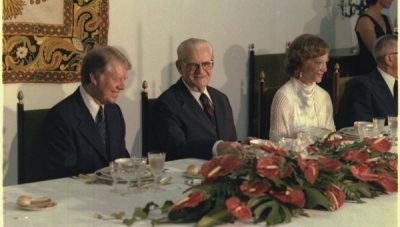
Ernesto Geisel, President of Brazil, hosts a State Dinner for Jimmy Carter and Rosalynn Carter. March 29, 1978 | Photo: U.S. National Archives and Records Administration
teleSUR | May 13, 2018
A declassified memo from the U.S. Department of State revealed that Brazilian dictator Ernesto Geisel (1974-1979) approved summary executions of “dangerous subversive” people personally, continuing with the extrajudicial methods of his predecessors.
The document was made public back in 2015, but it wasn’t until a few days ago that Matias Spektor, an international relations professor at the Getulio Vargas Foundation (FGV) and a columnist at Brazilian newspaper Folha, found it as part of his research work and posted it on social media, along with a picture of Geisel and Joao Baptista Figueiredo, who later became his successor.
The document narrates a meeting between President Geisel, General Milton Tavares de Souza and General Confucio Danton de Paula Avelino, respectively outgoing and incoming chiefs of the Army Intelligence Center (CIE), along with Figueiredo, who at that time was Chief of the National Intelligence Service (SNI).
“This is the most disturbing document I’ve read in 20 years of research: Just after being sworn in, Geisel authorized the continuation of the regime’s killing policies, but it requires the Army Intelligence Center previous authorization from the Planalto Palace.”
General Milton briefed Geisel about the role of the Army Intelligence Center (CIE) against “the internal subversive target” during the presidency of Emilio Garrastazu Medici, and said that “extrajudicial methods should continue to be employed against dangerous subversives.”
He also informed Geisel that about 104 people falling under this category had been executed by the CIE in the previous year. Figueiredo supported this policy and urged Geisel to continue with it.
According to the memo, Geisel “commented on the seriousness and potentially prejudicial aspects of this policy,” and said he wanted to think about it over the weekend. He decided to go along with it, but to limit the executions to “only dangerous subversives,” and required the CIE to consult Figueiredo for approval before any execution.
The entire CIE would then be under Figueiredo’s control, blurring the line between the CIE and the SNI.
“I didn’t know Geisel had given the Planalto Palace the responsibility over summary execution decision. The government’s leadership was not only aware of the executions but also ordered them. That’s impressive, unheard of,” said Spektor.
The memo was sent by William Colby, who was then Director of Central Intelligence Agency, to then U.S. Secretary of State Henry Kissinger, who also played a key role in promoting military coups against democratically elected governments in Latin America, under the subject “Decision by Brazilian President Ernesto Geisel To Continue the Summary Execution of Dangerous Subversives Under Certain Conditions” and dated April 11, 1974.
First and second paragraphs of the document (7 and 12 and a half lines) are still classified.
After the documents were picked up by Spektor, the Brazilian army stated that any classified documents that could prove Colby’s allegations of the events had been destroyed as it was stipulated by the laws of that period.
Featured Video

Revive Iran’s MOU Deal or Face a Forever War
or go to
Aletho News Archives – Video-Images
From the Archives
China names world’s ‘hacking empire’
RT | March 15, 2022
Calling the US a “hacking empire” of the world, the Chinese Foreign Ministry urged Washington to stop “malicious” cyber activities following reports that American hackers subverted a network in China to launch attacks on Russia and Belarus.
“China is gravely concerned about cyberattacks against other countries that originate from the US and use China as a springboard,” Foreign Ministry spokesperson Zhao Lijian told reporters at a press briefing on Monday.
Zhao was commenting on recent Chinese media reports that hackers, mainly from the US but also from NATO allies Germany and the Netherlands, recently hijacked a Chinese computer network for cyberattacks, 87% of which targeted Russia.
“Against the background of the Ukraine situation, such a move may produce the negative effect of misleading the international community and spreading disinformation,” Zhao said, pointing out that “a former US senior official called publicly for launching cyberattacks on Russia not long ago.”
This appeared to be a reference to Hillary Clinton, former US secretary of state and presidential candidate, who made the calls in an MSNBC interview at the end of February. … continue
Blog Roll
 Aletho News
- Iran-Linked Ships Spotted Hovering over Subsea Cables: Report
- New attack on Iran could devastate ‘Israel’, IOF general warns
- Nuclear deterrence: The US-Israeli military aggression against Iran made the unthinkable legitimate
- U.S. Midterms – a Referendum on Israel and Zionist Power
- Twice as many Canadian Jews serve in Israeli military as Canada’s armed forces: Report
- Thousands of Syrian troops set to join Saudi war on Yemen
- Jared Kushner’s Diplomacy for Hire
- Russia backs Tehran’s conditions in talks with US, Iran’s envoy says
- Irish ‘fake news’ expert exposed as fake
- China expresses strong opposition to Dutch report alleging Chinese cyberattacks
- If Americans Knew
- An error has occurred; the feed is probably down. Try again later.
- No Tricks Zone
- Zonal Asymmetry of Temperature Change in the Antarctic Circumpolar Current
- New Study: The Net Fossil Fuel Contribution To Rising Atmospheric CO2 Has Been Zero For 500 Years
- Germany’s Green Energy Transition Becoming Increasingly Expensive…Another 6 Trillion Euros!
- Sudden Stratospheric Warming, Powerful El Niño Combination May Lead To Extreme Europe Cold, Energy Crisis!
- Two New Studies Find Thwaites Glacier Melt Cannot Be Driven By Human Activity Or A Warming Ocean
- E-Cars Reduce CO2 Emissions By Only 41% Compared To Internal Combustion Engine Vehicles
- Predictions Made By Renowned Climate Professor Over Past Decades Have Been Proven To Be Poor
- New Study Suggests Large Regions Of The Pacific Ocean Have Been Cooling For The Last 80 Years
- Germany’s Green Energy Debacle: High Energy Costs Force Kahla Porzellan to Close After 182 Years!
- New Study: 50 Years Of The Most Aggressive ‘Net Zero’ Policies Can Only Affect The Global Climate By 0.03°C

