Putin: Russians Accused of Meddling in US Election Might Work for US Firms
Sputnik – March 9, 2018
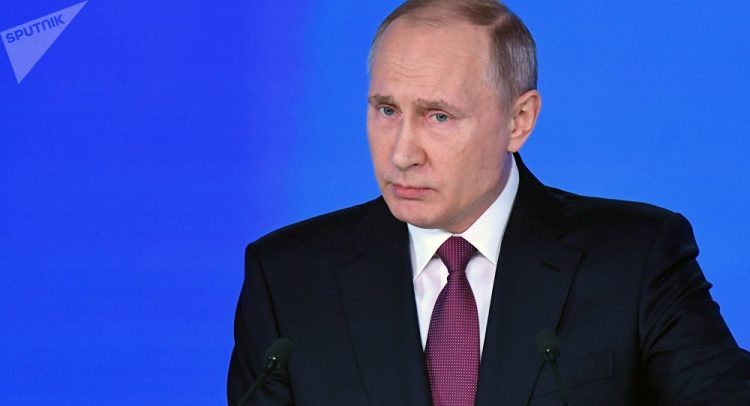
Russian President Vladimir Putin told NBC in an interview that those Russians accused by the United States in meddling in the 2016 presidential vote might as well have been Russians working for US companies or any presidential candidates.
“The world is very large and very diverse, and there is a fairly complicated relationship between the United States and the Russian Federation. And some of our people have their own opinion about this relationship. You mentioned a number of names, some individuals. And you are telling me that they are Russians. So what? Maybe being Russian, they are actually working for some kind of American company. Perhaps one of them used to work for one of the candidates? I have no idea. These are not my problems,” Putin said.
He noted that those people blamed for interfering in the election might as well have been US citizens.
“Why have you decided the Russian authorities, myself included, gave anybody permission to do this? Nothing has changed since you and I talked last time in St. Petersburg [June 2017]. Some names have popped up, so what? They could just as easily have been the names of some Americans who are sitting here and interfering in your own political process,” Putin added.
In February, the US Justice Department revealed in court documents that the United States accused 13 Russian nationals and three entities of trying to interfere in the 2016 presidential vote. The 27-page indictment, a product of Special Counsel Robert Mueller’s probe, alleged that those accused used fake personas to try to influence the outcome of the elections in US President Donald Trump’s favor.
Hamas gets one step ahead of ‘deal of the century’ with five-point strategy

Head of the Political Bureau of Hamas, Ismail Haniyeh delivers a speech during a press conference in Gaza City, Gaza on 23 January 2017 [Ali Jadallah/Anadolu Agency]
MEMO | March 9, 2018
Palestinian sources said that the Chief of the Political Bureau of Hamas movement, Ismail Haniyeh, outlined a five pronged strategy to counter the US-led ‘deal of the century’, in a meeting of various Palestinian factions in Cairo.
The first principle of this strategy is to take on the ‘deal of the century’ by holding all Palestinian factions together – including Fatah movement – to a unified position.
The second prong is “the implementation of reconciliation agreements,” especially the comprehensive agreement which was signed on 4 May 2011, and the executive agreement which was signed on 12 October, 2017.
The third axis is “building strength and resistance until the liberation of Palestine.”
The fourth element is based on “establishing open political relations” with the Arab and Islamic countries to develop an Arab-Islamic safety network that includes especially “Egypt, Saudi Arabia, Jordan, Iran, Turkey” as well as other countries.
The fifth aspect consists of “holding an inclusive national conference” following which there would be “an agreement to adopt a joint political program,” then organising the presidential and legislative elections (inside Palestine) and the National Council.
The sources also stated that the representatives of factions present, including those of Fatah, agreed on two points, confronting the ‘deal of the century’ and the need for reconciliation and national unity.
US university demands Palestinian academic not criticise Israel in speech

Palestinian academic Hatem Bazian says Arizona State University asked him to sign a contract in which he pledges not to criticise Israel at a university event [File photo]
MEMO | March 9, 2018
Arizona State University is reported to have asked Palestinian academic Hatem Bazian to sign a contract in which he pledges not to criticise Israel at an event organised by the Muslim Students’ Association next month.
Chair of American Muslims for Palestine and lecturer at the University of California at Berkeley, Bazian said Arizona State University asked him to sign the university’s speaker agreement which included a clause that prohibits criticising Israel or engaging with the BDS movement.
Bazian refused to sign the agreement, saying agents loyal to Israel, constitute a real obstacle to freedom of expression and academic freedom in American universities.
He added that asking him to sign an agreement which includes a clause that prevents criticism and boycott of Israel is to ignore the freedom of thought and academic autonomy.
“I think that Israel ignores international law and puts pressure on the Palestinian people,” he said, adding that there are many pro-Israel organisations throughout the United States which try to prevent programmes and events that are organised in favour of the Palestinian cause by putting pressure on university administrations.
Last week, the Council on American-Islamic Relations (CAIR) filed a lawsuit against Arizona State University on behalf of American Muslims for Palestine and Hatem Bazian.
Washington’s Moment of Truth For Korea Peace
Strategic Culture Foundation | 09.03.2018
US President Trump claims to be an imaginative deal-maker. We will soon see. His announcement this week that he is willing to meet North Korean leader Kim Jong-un for direct talks is stunningly good news.
The next few weeks will be make-or-break for a historic peace settlement to the decades-old Korean conflict. Washington’s next moves and words are crucial.
Kim made the offer in a letter to Trump conveyed by a South Korean delegation to Washington DC. Trump has responded positively, and a possible meeting is to take place in May. That would be the first time a sitting American president has ever met a North Korean leader.
Trump must forgo the temptation for macho posturing, and summon the maturity to act responsibly in the interests of regional and indeed world peace.
Washington bears a heavy responsibility for the conflict that has racked the Korean Peninsula since the 1950-53 civil war, in which the US backed its South Korean ally against the Communist North.
It is futile for American leaders to point the finger at Pyongyang as a “rogue state” while denying Washington’s own baleful role in the legacy of conflict and insecurity.
The quickening pace of inter-Korean peace diplomacy is a much welcome change from the war rhetoric that was endangering world security only a few months ago. This week it was reported that the North and South Korean leaders are ready to meet next month in what would be the biggest dialogue event in more than a decade for the Peninsula. Now President Trump has also agreed to talks with North Korea’s Kim.
North Korea’s reported willingness this week to freeze its nuclear weapons program is ground-breaking. It should be reciprocated by Washington moving, at long last, to sign an armistice to definitively end the 1950-53 Korean War.
North Korea – the Democratic People’s Republic of Korea – has long maintained, with sound reason, that its nuclear weapons program has been impelled by the existential fear of a US-led war being thrust on it. Given the horrendous devastation inflicted on the people of North Korea during the 1950-53 war in which millions died from American aerial bombing campaigns, it is incumbent on Washington to commit to a full peace treaty to finally and formally end that war. Why not?
If, however, Washington insists on unilateral North Korean disarmament then the prospect for a peaceful settlement is doomed.
It is counterproductive to look back at past failed negotiations with recrimination about one side or the other reneging on obligations.
Surely, the imperative of the present hour is to seize the opportunity for peace by both sides making a mutual commitment to resolving grievances through solely peaceful means.
This is the diplomatic process which Russia and China have been urging all sides to embrace. North and South Korean leaders have stepped up to the plate and shown an admirable willingness to engage in earnest dialogue.
Since the beginning of this year, North and South Korean delegates have held several rounds of sincere talks to find a way forward for the security and peace of all the Korean people who share the one Peninsular homeland. The results have been promising and underscore the vital need for mutual engagement.
It is evident from the respective leaderships in Pyongyang and Seoul that the people of Korea, North and South, yearn for a peaceful coexistence.
What the Trump administration needs to do is listen to the wishes of the Korean people. Washington’s bellicose rhetoric towards North Korea must be somehow replaced with humility to genuinely resolve the Korean conflict – a conflict which Washington is a protagonist in.
These are far from unreasonable demands on Washington, as several former American diplomats and leaders such as President Jimmy Carter have recognized and endorsed.
Washington is insisting on imposing new punitive sanctions on Pyongyang, as well as carrying out forthcoming military exercises which have continually offended North Korea’s national pride and security.
Washington is acting like the master of the situation issuing ultimatums instead of pursing diplomacy.
There is a pragmatic way forward to achieve a peaceful resolution over Korea. Russia and China must prevail on the US to meet its international obligations of peaceful diplomacy.
Is Washington a law-abiding peaceful state, as it so often claims to be, or is it a rogue state that sees itself above the law and international moral consensus? A moment of truth is at hand.
Tell Me More About How Google Isn’t Part Of The Government And Can Therefore Censor Whoever It Wants?
By Caitlyn Johnstone | March 8, 2018
When you tell an establishment Democrat that Google’s hiding and removal of content is a dangerous form of censorship, they often magically transform into Ayn Rand right before your eyes.
“It’s a private company and they can do what they like with their property,” they will tell you. “It’s insane to say that a private company regulating its own affairs is the same as government censorship!”
This is absurd on its surface, because Google is not separate from the government in any meaningful way. It has been financially intertwined with US intelligence agencies since its very inception when it received research grants from the CIA and NSA for mass surveillance, pours massive amounts of money into federal lobbying and DC think tanks, has a cozy relationship with the NSA and multiple defense contracts.
“Some of Google’s partnerships with the intelligence community are so close and cooperative, and have been going on for so long, that it’s not easy to discern where Google Inc ends and government spook operations begin,” wrote journalist Yasha Levine in a 2014 Pando Daily article titled “Oakland emails give another glimpse into the Google-Military-Surveillance Complex”.
“The purchase of Keyhole was a major milestone for Google, marking the moment the company stopped being a purely consumer-facing Internet company and began integrating with the US government,” Levine wrote in a recent blog post about his book Surveillance Valley. “While Google’s public relations team did its best to keep the company wrapped in a false aura of geeky altruism, company executives pursued an aggressive strategy to become the Lockheed Martin of the Internet Age.”
And now we learn from Gizmodo that Google has also been helping with AI for the Pentagon’s drone program.
A Google spokesperson reportedly told Gizmodo that the innovations it is bringing to the Defense Department’s Project Maven are “for non-offensive uses only,” which is kind of like saying the beer kegs you delivered to the frat house are for “non-intoxicating use only.” The DoD and its drone program exist to find and kill enemies of the US empire, and Google will be helping them do it.
“The department announced last year that the AI initiative, just over six months after being announced, was used by intelligence analysts for drone strikes against ISIS in an undisclosed location in the Middle East,” reports The Intercept on this story.
Google is not any more separable from the US government than Lockheed Martin or Raytheon are, yet it has been given an unprecedented degree of authority over human speech and the way people communicate and share information. Would you feel comfortable allowing Northrop Grumman or Boeing to determine what political speech is permissible and giving them the authority to remove political Youtube content and hide leftist and anti-establishment outlets from visibility like Google does?
How is this a thing? How is it considered acceptable for a force which has intimately interwoven itself with government power to censor and manipulate political speech in ways the official government would never be allowed to?
The notion that Google is a private company, separate from the government and thus unburdened by obligations of free speech, is not a legitimate one. You don’t get to create a power system where money translates directly into political influence and privatization creates symbiotic relationships between corporations and government agencies, create a beefed up Silicon Valley giant with research grants and contracts to prevent any competition from ever having a chance against it, involve that Silicon Valley giant in the agendas of the US war machine after you’ve helped it dominate the globe, and then legitimately claim it’s just a poor widdle private business that shouldn’t be subject to the legal limitations placed on the US government.
If you believe the government shouldn’t be able to regulate speech, then there’s no legitimate reason to believe that Google should be, because Google is part of the government. You shouldn’t want there to be a loophole where government power can get around constitutional restrictions on its ability to silence dissent by funneling all speech into institutions it created and collaborates with and then quash anti-establishment voices under the pretense of protecting the public from “fake news” and “Russian propaganda”.
There needs to be some sort of measure in place which protects the public from such manipulations. Either remove corporate power from government power or acknowledge that they are fully meshed and expand constitutional protections to the users of any media giant which has enmeshed itself in government power. Pretending corporate power and government power are separate when they are not while exploiting that inseparable symbiosis to silence political dissent is not acceptable.
Government should be a tool of the people to help the people, not a tool of the powerful to oppress and exploit the people. Something’s going to have to change, and we’re going to have to stop asking nicely.
All-Seeing Eye: Google working with Pentagon on using AI for drone improvement

MQ-9 Reaper Drone. FILE PHOTO: © Gene Blevins / Global Look Press
RT | March 7, 2018
Ubiquitous IT giant Google has silently inked a partnership with the Department of Defense to militarize artificial intelligence and machine learning technologies, reinvigorating fears of a Terminator-style apocalyptic scenario.
Google has been secretly working with the Pentagon in order to help its 1,100-strong fleet of drones to detect images, faces, and behavioral patterns, and plans to scour through massive amounts of video footage in order to improve bombing accuracy for autonomous drones. The endgame is to improve combat performance by automating the decision-making process in locating and targeting combatants, The Intercept reported on Tuesday.
Project Maven was launched in April 2017 to establish an “Algorithmic Warfare Cross-Functional Team,” which advocates using sophisticated algorithm-based technologies to combat rising “competitors and adversaries”.
According to a Pentagon memo, dated April 26, 2017, its objective is to accelerate the process of using big data and machine learning together during combat situations and speed up the process of analyzing collected data. Former Secretary of Defense Robert Work signed off on the initiative.
Project Maven also aims to “augment or automate Processing, Exploitation and Dissemination (PED) for unmanned aerial vehicles (UAVs)” in order to “reduce the human factors burden of [full motion video] analysis, increase actionable intelligence, and enhance military decision-making,” he wrote.
The Pentagon has become increasingly worried that it will become displaced as the world’s top AI developer. At a February 13 hearing, Senators Jack Reed (D-Rhode Island), Mark Warner (D-Virginia) and others lamented Chinese efforts to develop artificial intelligence (AI) and quantum computing, leaving the US behind.
Another DOD report, “Unmanned Systems Integrated Roadmap”, notes that there are three primary impetuses driving the push towards AI, which are “department budgetary challenges, evolving security requirements, and a changing military environment.” The report reflects another US Government Accountability Office (GAO) report which addressed problems with human-piloted drones, including fatigue, human error, and demoralization.
“Downward economic forces will continue to constrain Military Department budgets for the foreseeable future. Achieving affordable and cost-effective technical solutions is imperative in this fiscally constrained environment,” it also pointed out.
“People and computers will work symbiotically to increase the ability of weapon systems to detect objects,” Marine Corps Colonel Drew Cukor said during a 2017 Defense One Tech summit. “Eventually we hope that one analyst will be able to do twice as much work, potentially three times as much, as they’re doing now. That’s our goal.”
Cukor also mentioned the program would help to identify 38 classes of objects essential to detect in warfare, especially when “fighting” Islamic State militants. He also addressed plans to carry out Project Maven by the end of last year.
“We are in an AI arms race […] It’s happening in industry [and] the big five Internet companies are pursuing this heavily. Many of you will have noted that Eric Schmidt […] is calling Google an AI company now, not a data company,” he said.
Google is no stranger to the Department of Defense. Eric Schmidt, former CEO of its parent company Alphabet, chaired the DOD Defense Innovation Board under the Obama administration.
Some Google employees were outraged that the company would share its technology with the military, according to Gizmodo, while others said the project raised ethical questions about machine learning.
A company spokeswoman told Bloomberg that Google was sharing TensorFlow API with the military for “non-offensive uses only.”
“Military use of machine learning naturally raises valid concerns. We’re actively discussing this important topic internally and with others,” the unnamed spokeswoman said.
Read more:
‘A Fishing Expedition’: Mueller Now Just ‘Trying to Find Dirt on Trump’
Sputnik – 08.03.2018
US Department of Justice special counsel Robert Mueller’s investigation into the alleged ties between the campaign of Donald Trump and Russian actors has taken a turn, as he announced an investigation into George Nader, a Lebanese-American businessman who lobbied in Washington on behalf of the United Arab Emirates.
Brian Becker and John Kiriakou of Radio Sputnik’s Loud & Clear were joined by Jim Kavanagh, a progressive journalist and editor of ThePolemicist.net, to discuss the ramifications of the investigation into Nader.
”It means, first of all, that the special prosecutor’s investigation has gone way beyond meddling in the elections,” said Kavanagh. “All of these meetings they’re talking about with this guy Nader took place after the election. In the original story a few days ago last week, when The New York Times started to cover this, they said that ‘the special counsel investigation has broadened beyond Russia election meddling to include Emirati influence on the Trump administration. The focus on Nader could also include an examination of how money from multiple countries flowed through and influenced Washington during the Trump era.'”
“So this is about Emirati influence peddling — standard operating procedure in Washington. But it’s about influence peddling from the United Arab Emirates during the Trump era, which is one year and one country. So if you’re going to go down that road of how leaders of other countries and wealthy individuals get meetings in the White House, get to pitch their their positions to the president personally and to his team, well, you’re going to have to have an investigation of all of Washington for the past 50 years,’ Kavanagh observed.
“But no, it’s about Emirati influence peddling during the Trump era, so it’s kind of bizarre that anybody think this is anything but a fishing expedition trying to find dirt on Trump. Who’s trying to peddle influence? This has been going on for decades,” Kavanagh said.
Becker pointed to an informal January 2017 meeting by a Russian businessman with Erik Prince, the founder and former CEO of infamous private military contractor Blackwater (now known as Academi) who is now head of the investment management firm Frontier Resource Group. Prince was not directly involved in the Trump campaign, save a visit to the transition team offices in December 2016.
Nevertheless, this meeting with a Russian businessman has been treated by mainstream outlets as a definitive tie between the Trump team and Russia. As MSNBC personality Stephanie Ruhle put it: “[Prince] went on to tell me he had no idea that that guy would have ties to [Russian President] Vladimir Putin. Let me make something clear: all Russian investors had ties to Vladimir Putin.”
“It is probably is true that Putin knows that guy, because he probably knows a lot of people,” laughed Kavanagh. “Just like Barack Obama knows George Soros or knows Warren Buffett, that doesn’t mean every meeting Warren Buffet takes is on behalf of Barack Obama. This is craziness, a stereotypical, cartoonish notion that every Russian investor is a spy for Vladimir Putin.”
The Healthcare Bait-and-Switch: From the Clintons to Obama and Back Again
By Glen Ford | Black Agenda Report | March 8, 2018
On the campaign trail in January of 2016, Hillary Clinton told Iowa voters that Bernie Sanders’ single payer health care proposal was an idea whose time would never come. “People who have health emergencies can’t wait for us to have a theoretical debate about some better idea that will never, ever come to pass ,” said the presumed shoo-in for president. Two years later, one-third of Democrats in the Senate have endorsed Sanders’ Medicare for All Act and half the Democrats in the U.S. House have signed on to Rep. John Conyers’ Expanded and Improved Medicare for All Act, HR 676 . Polls show 75 percent of Democrats favor “expanding Medicare to provide health insurance to every American,” and 31 percent of the public at-large wants health care to be the first problem the Democrats tackled if they win the White House in 2020.
Predictably, however, Hillary Clinton’s favorite think tank is still trying to make sure single payer health care never happens. The lavishly funded Center for American Progress (CAP) last week unveiled their counterfeit, sound-alike health care plan, dubbed Medicare Extra for All, whose sole purpose is to distract and confuse a public that is demonstrably “ready” for single payer. The CAP scheme, like Obamacare, keeps the private insurance corporations at the center of the money-stream, doesn’t cover everyone, charges fees, co-pays and premiums, doesn’t save much money, and would fail to provide millions with adequate coverage. “CAP’s plan maintains the current tiered system in which some people have private health insurance, those with the greatest needs have public health insurance, some people will have inadequate coverage and others will have no coverage at all,” writes Dr. Margaret Flowers , of Health Over Profit. “By offering a solution that sounds good to the uninformed — ‘Medicare Extra for All’ –but continues to benefit their Wall Street donors,” said Flowers, “Democrats hope to fool people or buy enough support to undermine efforts for NIMA,” or National Improved Medicare for All, the comprehensive single payer plan supported by the activists like Flowers.
National Improved Medicare for All would save half a trillion dollars a year on administrative costs and another $100 billion on reduced drug costs, according to Flowers. “The CAP plan maintains the complicated multi-payer system that we have today,” she said. “At best, it will only achieve 16% of the administrative savings of a single payer system and it will have less power to reign in the high costs of care.”
The CAP scheme would leave the link between employment and health coverage intact, keeping workers ultimately dependent on the whims of their bosses for healthcare coverage. “When people who have private health insurance lose their job or move, they risk losing their health insurance,” said Flowers. “NIMA creates a health system that covers everyone no matter where they are in the United States and its territories.”
The Obama-Scam, Repackaged
The Center for American Progress is running the same bait-and-switch con that Barack Obama played in the set-up to his Affordable Care Act. Bruce Dixon and I were introduced to Obama’s healthcare scam in June of 2003 when we engaged the then candidate for the U.S. Senate in a month-long telephone and email conversation, at The Black Commentator . At the time, Obama was trailing the field of candidates and in need of every Black vote in Illinois. Dixon and I had just learned that Obama had joined the Democratic Leadership Council (DLC), the corporate money-bag operation for the right wing of the party founded by white southern Democrats including Bill Clinton and Al Gore. On top of that, he’d recently removed his 2002 (mildly) anti-war speech from his campaign website, apparently to get in line with George Bush’s triumphal “Mission Accomplished ” speech, the previous month. Obama denied that he’d become a member of the DLC, and claimed his website was undergoing “routine” updating. (Years later, when the war was clearly lost, Obama’s team would resurrect “The Speech” as proof of his early anti-war credentials.)
Dixon and I decided that the best way to determine if Obama should be in the DLC or not, would be to put him to a three-question “bright line” test on the issues of war, health care and U.S. membership in the NAFTA, the North American Free Trade Agreement. If the candidate answered all three questions correctly, then he should not be a member of the DLC. If he failed, then the DLC was where he belonged, and voters should make their decisions, accordingly.
We presented our bright line questions to Obama in the June 19, 2003 , Cover Story of the publication:
1. Do you favor the withdrawal of the United States from NAFTA? Will you in the Senate introduce or sponsor legislation toward that end?
2. Do you favor the adoption of a single payer system of universal health care to extend the availability of quality health care to all persons in this country? Will you in the Senate introduce or sponsor legislation toward that end?
3. Would you have voted against the October 10 congressional resolution allowing the president to use unilateral force against Iraq?
Note that we specified “a single payer system of universal health care.”
Obama used weasel-language to fudge his answers to the Iraq War and NAFTA questions. On health care, he wrote:
“I favor universal health care for all Americans, and intend to introduce or sponsor legislation toward that end in the U.S. Senate, just as I have at the state level. My campaign is also developing a series of interim proposals – such as an expansion of the successful SCHIP program – so that we can immediately provide more coverage to uninsured children and their families.”
Obama left out the words “single payer.” Only after he became president, six years later, would it become clear that his definition of “universal” health care meant only that all Americans would be required to enroll in an insurance program – just as states require that all drivers be insured.
Despite his use of weasel-wording in all three answers, we at The Black Commentator gave Obama a passing grade. “BC is not seeking to martyr Barack Obama on a left-leaning cross,” we wrote.
(Our actual motive in 2003 was fear of being labeled “crabs in a barrel” for undermining the prospects of such an attractive, progressive-sounding, young Black up-and-coming politician—a failure of political nerve for which I will forever be ashamed.)
A year and a half later, in the week before Obama was sworn into the Senate, he told me that the country was not “ready” for single payer. But, if he really believed that, he would not have spent the next four years misleading the people through his calculated misuse of the term “universal.”
“Universal” was Obama’s bait-and-switch to confuse the public, much of which continued to wishfully assumed that he favored some kind of single payer plan. Once he got in office—and after announcing that “all entitlements, including Social Security, Medicaid and Medicare, would be “on the table” for cutting under his administration—Obama banished single payer advocates like Rep. Conyers from the White House and quite publicly allowed the for-profit healthcare corporations to write his Affordable Care Act, with its “universal” mandate that added many of millions of new “customers” for the industry.
The Democratic Leadership Council disbanded near the end of Obama’s first term in office. Faux-progressives claimed a victory. “One of the things that’s happening right now in Democratic politics is that progressives are winning the battle for the party,” said Progressive Congress president Darcy Burner. “The corporate-focused DLC type of politics isn’t working inside the Democratic party.”
That was nonsense. The DLC went out of business because it had won its battle for corporate hegemony in the party. By 2011, Obama had revealed himself as a full-blooded austerity (and war) president, and was still seeking his “Grand Bargain” with the Republicans. The “progressives” were defenestrated (thrown out of the White House windows) and humiliated in his first year, and were not to rise again until Bernie Sanders, the nominally non-Democrat, made his bid for the White House in 2016—with single payer healthcare at the tip of his spear.
Sanders’ version of single payer is “highly flawed ,” said Health Over Profit’s Margaret Flowers, who is also co-director of Popular Resistance , but, “the fact that the Democrats are proposing something that sounds like NIMA means we are gaining power.” The legislation “calls for a four-year transition period, during which the newly improved Medicare would first insure all children and adults 55 or older, then expand gradually to cover all adults,” writes the Huffington Post .
The Sanders bill’s endorsers in the Senate include a number of obvious Trojan Horses, such as Cory Booker, a deeply reactionary politician who could have been the “first Obama” had he won prominent office just a few years sooner (see The Black Commentator, April 4, 2002, “Fruit of the Poisoned Tree .”) He was among 13 Democrats that voted against creating a reserve fund to allow Americans to import cheaper drugs from Canada, lamely claiming that it didn’t address consumer protection issues. Booker and others are joining the pro-single payer bandwagon to weaken it from the inside, while his allies in the Clinton camp and their Center for American Progress scheme to extend the life of for-profit healthcare under the Medicare brand.
Meanwhile, Donald Trump is the greatest negative motivator for single payer. He last month proposed new rules that would allow sale of short-term insurance policies that omit “essential health benefits”—what Sen. Ron Wyden calls “junk insurance”—to allow the market to work its miracles. But the people are learning that the market will kill you.
BAR executive editor Glen Ford can be contacted at Glen.Ford@BlackAgendaReport.com
Establishment alarmed as Trump threatens to gut US ‘democracy promotion’ racket
RT | March 7, 2018
The foreign policy establishment in Washington is crying foul after the Trump administration proposed to cut funding for organizations responsible for “promoting democracy abroad,” often in the guise of color revolutions.
The 2019 State Department budget request cuts the National Endowment for Democracy (NED) budget and separates it from the National Democratic Institute (NDI) and the International Republican Institute (IRI). Funding for the institutes would be moved to the State Department, where NDI and IRI would have to compete with private contractors, according to the Washington Post columnist Josh Rogin, who described the proposal as “an assault not only on their organizations but also on the pro-democracy mission they are dedicated to.”
“If implemented, the proposal would gut the program, force crippling layoffs and the symbolic meaning would also be shattering, sending a signal far and wide that the United States is turning its back on supporting brave people who share our values,” NED President Carl Gershman told Rogin.
“The work our government does to promote democratic values abroad is at the heart of who we are as a country,” Senator John McCain (R-Arizona), chairman of the IRI’s board of directors, told Rogin. The NDI board is chaired by former Secretary of State Madeleine Albright.
McCain actually wrote a letter protesting the proposal to the Office of Management and Budget in December. It was signed by four other senators, including McCain’s close ally Lindsey Graham (R-South Carolina) and Marco Rubio (R-Florida).
Trump’s people “just don’t believe it’s America’s business to push democracy abroad,” Rogin concluded.
His article quickly made the rounds of the Washington establishment circles, where it received praise from former CIA agent and failed presidential candidate Evan McMullin and New Republic columnist Jeet Heer. Nicholas Burns, who served as State Department spokesman under Albright, said the revelations will “make your blood boil.”
.@joshrogin: The Trump administration’s assault on democracy promotion can be expected to continue. Dictatorships are presenting their model as preferable for the developing world. Human rights abuses are rising. Basic freedoms are under attack. https://t.co/IRDT91JZAt
— Evan McMullin (@Evan_McMullin) March 5, 2018
2. Democracy promotion in foreign policy had genuine bipartisan support from Carter to Obama. Trump has broken that consensus.
— Jeet Heer (@HeerJeet) March 6, 2018
This will also make your blood boil. The State Department is giving up on our historic support for democracy promotion that none other than Ronald Reagan pioneered. https://t.co/uQOpWnolme
— Nicholas Burns (@RNicholasBurns) March 5, 2018
It was Burns’s tweet in particular that attracted derision from critics of US foreign policy, such as journalists Glenn Greenwald, Chris Floyd and Jon Schwarz, and former diplomat Peter Van Buren:
This is the kind of blatant, jingoistic historical revisionism that the Trump era has made fashionable again. The idea that the US had been devoted to “democracy promotion” before Trump – and that this was pioneered by tyrant-hugging Reagan – is simply laughable: https://t.co/JrVqWt3CP7
— Glenn Greenwald (@ggreenwald) March 6, 2018
Oh, Mr. Burns, do tell us more about Reagan’s “democracy promotion” with Rios Montt. And did Reagan have a special aide to follow behind him and mop up the innocent blood dripping – pouring – from his hands? Oh, tell us the glorious story, Mr. Burns!
— Chris Floyd (@empireburlesque) March 6, 2018
The confusing thing about Harvard, Yale, etc. is that the job of people working there in the hard sciences actually is to describe reality accurately, whereas the job of many humanities professors like Nicholas Burns is to lie about reality https://t.co/e5EQhQfL5O
— Jon Schwarz (@schwarz) March 6, 2018
Nicky, Nicky… no more day drinking unless you’re going on CNN. Democracy promotion in Nicaragua, Salvador, Guatemala, Lebanon… or maybe Iraq 3x, Afghanistan, Somalia, Pakistan, Libya? What ARE you talking about? https://t.co/D3t2TknjzS
— Peter Van Buren (@WeMeantWell) March 6, 2018
As well as a number of rank-and-file Twitterati:
Libya thanks you for their US installed democracy. The slave market was a bit of a surprise and the fact that there are three waring factions all claiming to be the government, but I’m sure you know what’s best.
— Kropotkin (@DoctorKropotkin) March 7, 2018
Democracy! Promoted! pic.twitter.com/hXnhJsHuxi
— B (@balvertos) March 7, 2018
The NED was founded in 1983, under the Reagan administration. It is theoretically a non-governmental organization, though the bulk of its funding is provided by the US government and American taxpayers. The status has given NED and its institutes plausible deniability against accusations that the US has been meddling in the politics of other countries.
“A lot of what we do today was done covertly 25 years ago by the CIA,” one of the endowment’s founders, Allen Weinstein, told the Washington Post in September 1991.
One example is the wave of “color revolutions,” starting from Serbia in 2000 to the “Arab Spring” revolts of 2011. Ukraine was subjected to this twice, in 2004 and in 2014. During the unrest in Kiev in November 2004, The Guardian’s Ian Traynor described the process, while heaping praise on the people behind it.
“The operation – engineering democracy through the ballot box and civil disobedience – is now so slick that the methods have matured into a template for winning other people’s elections,” Traynor wrote. “The Democratic party’s National Democratic Institute, the Republican party’s International Republican Institute, the US state department and USAid are the main agencies involved in these grassroots campaigns as well as the Freedom House NGO and billionaire George Soros’s open society institute.”
Though campaigns funded by all these external actors are more astroturf than grassroots, there were few objections, as it was all in the name of democracy.
Traynor concluded his 2004 story by saying the “places to watch” were Moldova and Central Asia. Sure enough, the former Soviet republic of Kyrgyzstan went through a “Pink revolution” in February 2005, while the “Grape revolution” took place in Moldova in April 2009.
The Washington establishment’s obsession with democracy may also be explained by the belief that any non-democratic government is automatically anti-Western, as Luis Fleischman of the neoconservative Center for Security Policy argued last month.
If the regime is pro-American, however, it doesn’t matter whether it’s actually democratic or not. On Tuesday, the director of the Foundation for Defense of Democracies Mark Dubowitz tweeted that “inclusive authoritarianism” might be a better fit for Middle Eastern countries, as long as they were “tolerant, respectful of individual liberties & minority rights & pro-American.”
Btw, I said a more “inclusive authoritarianism” *might* be better alternative. Tolerant, respectful of individual liberties & minority rights & pro-American. I suggested should be discussed. So spare me the invective & explain why worse than failed M/E democracies. https://t.co/yQJWKQ5V3z
— Mark Dubowitz (@mdubowitz) March 7, 2018
Read more:
Why Russia’s New Strategic Capabilities Come As a Shock to US Intelligence Community
By Philip M. GIRALDI | Strategic Culture Foundation | 08.03.2018
The United States of America spends something like $80 billion annually on intelligence gathering and analysis. When the CIA was founded by the National Security Act in 1947 the intention was to create a mechanism that would warn about an imminent threat. The memory of Pearl Harbor in 1941, when Japan attacked the U.S. naval base was still fresh, and the legislation was popularized by the slogan “no more Pearl Harbors.”
In spite of the dedication of considerable resources and manpower, there have been some major intelligence failures in the past seventy years, starting with the inability to anticipate the breakout of the Korean War and including the embrace of false intelligence on Saddam Hussein’s alleged weapons of mass destruction. But the most recent failure is perhaps more consequential than either Korea or Iraq.
On March 1st, Russian President Vladimir Putin spoke before his country’s Federal Assembly plus a large group of both local and foreign journalists, outlining his plans for the economy and also dealing with other domestic issues should he be reelected later this month. The final third of the presentation was on national defense and, in its substance, was clearly directed at a global audience, particularly the United States.
He explained:
“During all these years since the unilateral U.S. withdrawal from the ABM Treaty [in 2001] we have been working intensively on advanced equipment and arms, which allowed us to make a breakthrough in developing new models of strategic weapons.”
He was referring to the RS-28 Sarmat ballistic missile, which has almost unlimited range and ultra-high speed, enabling it to employ trajectories including strikes coming over the South Pole that can defeat existing American Anti-Ballistic Defense systems. Russia has also produced and deployed a hypersonic glider weapon system Avangard.
But the real game changer is the Russian ability to negate America’s ability to project power through its navy. The already deployed air-launched Kinzhal anti-ship missile has a range of 2000 kilometers and a hyper-sonic speed that makes it nearly impossible to intercept. The development has made America’s thirteen aircraft carrier groups obsolete. President Putin made clear that Russia now has an overwhelming military advantage in cruise and ballistic missiles that are capable of penetrating U.S. defenses.
The new reality may or may not impel policymakers in Washington to approach Moscow and seek a new round of negotiations for arms control, but the real shock deriving from the Putin announcement is the failure of the intelligence community to anticipate the developments and advise their significance. Some of the new systems were hardly secret, with development of the Sarmat, for example, known to western governments for a number of years.
There will no doubt be a blame game in Washington over the inability to learn of Russia’s arms programs, but the questions that probably will not be asked relate to the intelligence agencies themselves and their capabilities, or lack thereof. It is no secret that organizations like the Central Intelligence Agency (CIA) have seen their basic missions change since 2001. An organization that used to pride itself on its ability to conduct classic espionage operations involving recruiting and running spies suddenly heard from policymakers that those skills were no longer in demand. Many officers who were made redundant or forced to retire were precisely those individuals who had cut their teeth on running operations directed against the old Soviet Union. They had the language and cultural skills necessary to collect information on Russia. With their departure, those capabilities also largely vanished.
Instead of spying, American intelligence agencies working mostly against what was broadly described as “terrorism,” used technology to locate potential targets and kill them. The CIA’s Clandestine Services, once the haven of its spies, became under President Barack Obama, a largely paramilitary operation focused on military solutions rather than espionage. This process was accelerated under Obama’s CIA Director John Brennan, who worked assiduously to reduce the influence of the former spies within the Agency. Brennan reportedly had once wanted to become a spy but was kicked out of the training program as “unsuitable.”
So, has America learned that its intelligence agencies are doing all the wrong things and that the national defense strategy is unsustainable because the Russian-American relationship is now on a new footing? Possibly, but it is perhaps more likely that Washington will avoid asking the hard questions.
Featured Video

Nima R. Alkhorshid: US military bombs multiple targets on Iran’s Qeshm Island
or go to
Aletho News Archives – Video-Images
From the Archives
British Intel Tried to Make N Irish Gang ‘Shoot Up’ School, Documentary Claims
Sputnik – 23.02.2019
A new documentary, based on an interview with a self-confessed member of the Glennane Gang, gives some insights into allegations that British military intelligence was behind a shocking murder plot to cause the situation in Northern Ireland to “spiral out of control”.
In a documentary, Unquiet Graves: The Story of the Glennane Gang, John Weir, a former officer from the Royal Ulster Constabulary (RUC), alleges that British intelligence tried to persuade paramilitary group Ulster Volunteer Force (UVF) to attack a Catholic primary school at Belleeks in County Armagh.
Weir claimed that the UVF was urged to kill children and teachers in retaliation for the 1976 Kingsmill massacre, in which gunmen stopped a minibus carrying twelve workmen and shot them; only one person survived despite having been shot 18 times.
“The plan that was decided on was to shoot up a school in Belleeks”, he said, adding that the British intelligence plot was to make the situation in Northern Ireland “spiral out of control”. … continue
Blog Roll
 Aletho News
- Rhode Island Staffer Could Be Reinstated After Firing Over Ceasefire Post
- Will Republicans Learn Their Lesson from the ‘Disastrous’ Midterms?
- Wrong, Newswise, Irresponsible Climate Messaging, Not Climate Change Itself, Is Fueling Student Anxiety
- Zelensky’s Critics Vanish Into Ukrainian Secret Prisons – Source
- Nima R. Alkhorshid: U.S. Military Bombs Multiple Targets on Iran’s Qeshm Island
- Iran-Linked Ships Spotted Hovering over Subsea Cables: Report
- New attack on Iran could devastate ‘Israel’, IOF general warns
- Nuclear deterrence: The US-Israeli military aggression against Iran made the unthinkable legitimate
- U.S. Midterms – a Referendum on Israel and Zionist Power
- Twice as many Canadian Jews serve in Israeli military as Canada’s armed forces: Report
- If Americans Knew
- An error has occurred; the feed is probably down. Try again later.
- No Tricks Zone
- Zonal Asymmetry of Temperature Change in the Antarctic Circumpolar Current
- New Study: The Net Fossil Fuel Contribution To Rising Atmospheric CO2 Has Been Zero For 500 Years
- Germany’s Green Energy Transition Becoming Increasingly Expensive…Another 6 Trillion Euros!
- Sudden Stratospheric Warming, Powerful El Niño Combination May Lead To Extreme Europe Cold, Energy Crisis!
- Two New Studies Find Thwaites Glacier Melt Cannot Be Driven By Human Activity Or A Warming Ocean
- E-Cars Reduce CO2 Emissions By Only 41% Compared To Internal Combustion Engine Vehicles
- Predictions Made By Renowned Climate Professor Over Past Decades Have Been Proven To Be Poor
- New Study Suggests Large Regions Of The Pacific Ocean Have Been Cooling For The Last 80 Years
- Germany’s Green Energy Debacle: High Energy Costs Force Kahla Porzellan to Close After 182 Years!
- New Study: 50 Years Of The Most Aggressive ‘Net Zero’ Policies Can Only Affect The Global Climate By 0.03°C


