In the past, the North Atlantic Treaty Organization (NATO) justified its militarization of large swaths of Eastern Europe by pointing to the omnipresent threat of terrorism, or some ‘rogue’ foreign state, inherently understood to be Iran. Today the mask has slipped and it is no longer denied that NATO’s primary target is Russia.
But first, a trip down nightmare lane. The road to ruin – at least as far as US-Russia relations were concerned – began immediately following the 9/11 terror attacks. Three months after that fateful day, in December 2001, George W. Bush informed Vladimir Putin that the US was withdrawing from the Anti-Ballistic Missile Treaty, a strange move considering that the treaty had kept the peace between the nuclear superpowers since 1972. This geopolitical “mistake,” as Putin rightly defined it, allowed the US to begin the process of deploying a missile defense system, smack on the border with Russia, allegedly to shield the continent against an attack by Iran. Never mind the fact that Tehran had absolutely no reason, not to mention the wherewithal, to carry out such a suicidal mission. But Washington has never been one to let facts get in the way of a forced move on the global chess board.
Thus, the Bush administration advocated on behalf of a land-based missile defense system with interceptors based in Poland and a radar station in the Czech Republic. However, due to serious objections from Russia, not to mention the apprehensive citizens of the host countries, the plan had reached an impasse in 2008 – just as Obama was replacing Bush in the White House. Some would call that impeccable timing. What happened next can only be described as a devious sleight of hand on the part of Washington.
In September 2009, the Nobel Peace Prize winner, Barack Obama, announced to great fanfare that the US would “shelve” the Bush plan. This announcement was received in Moscow and beyond as a sign that America’s first black president was truly the real deal when it came to working on behalf of global peace. Suddenly, it appeared that the Bush reign of error had been an ugly anomaly, a bad eight-year dream. That grand illusion lasted for about as long as it took to read that sentence.
Barack Obama, the man who had seduced the global masses with his velvety albeit teleprompted delivery, shifted gears the very next day, announcing that the US would be deploying, in four phases, sea-based SM-3 interceptor missiles in Eastern Europe instead. An opinion piece in the New York Times, penned by then Secretary of Defense Robert M. Gates, provided all the information to understand that the world had been hoodwinked.
“Steady technological advances in our missile defense program — from kill vehicles to the abilities to network radars and sensors — give us confidence in this plan,” Gates wrote. “The SM-3 has had eight successful tests since 2007, and we will continue to develop it to give it the capacity to intercept long-range missiles like ICBMs. It is now more than able to deal with the threat from multiple short- and medium-range missiles — a very real threat to our allies and some 80,000 American troops based in Europe that was not addressed by the previous plan.”
“We are strengthening — not scrapping — missile defense in Europe,” he concluded.
With the benefit of hindsight and common sense, it seems that Washington’s plan from the start was to move forward with the sophisticated SM-3 system; the bulky Bush initiative just provided the necessary distraction to usher in the advanced Obama plan, which presents a major threat to the global strategic balance.
But all that is ancient history compared to what is happening today. Under the guise of ‘Russia aggression,’ a concept that was peddled to the unsuspecting masses based on the fake news of a Russian ‘invasion’ of Ukraine and Crimea, compounded by claims that Russia somehow swayed the 2016 US presidential elections, US-led NATO has dropped all pretensions and declared open season on Russia. Combined with Donald Trump’s empty threat that the US would exit NATO if member states did not start spending more on defense (2 percent of annual GDP), Eastern Europe has become a veritable hothouse of paranoia-driven militarization.
In what the Kremlin has described as the greatest amassing of military assets on its border since World War II, NATO troops and hardware have set up camp from as far north as Estonia, down through Latvia and Lithuania, into Romania and Poland, where the rotation of US troops is now standard operating procedure.
Meanwhile, massive military games aimed at deterring the Russian bogeyman continue unabated on Russia’s border. In April, British journalist Neil Clark described just one of these exercises, dubbed Summer Shield. The NATO military exercises “got underway at the Adazi military base. Soldiers from Latvia, the US, Bulgaria, Estonia, Canada, Lithuania, the UK, Luxembourg, Romania, Slovakia, Germany and also non-NATO member Sweden are taking part in the drills,” Clark wrote.
He then went on to make a rather unsettling yet accurate observation: “Today’s mantra regarding ‘Russian aggression’ is the 2003 equivalent of ‘Saddam’s Weapons of Mass Destruction,’ to be repeated ad nauseum by anyone supporting NATO’s Drang nach Osten. And like the WMD claim, it’s based on zero evidence.”
Such reckless behavior would have been difficult to fathom less than a decade ago.
But these are brave new times, and American madness has settled upon the realm of foreign relations like a noxious cloud, forcing client states to crack open their tattered wallets or be left out in the cold when the big, bad Russian bear comes a knocking.
Consider the case of Romania, one of Europe’s poorest countries. Prompted by Donald Trump’s warning that North Atlantic Treaty Organization (NATO) members must fork over 2 percent of their GDP on military spending, Bucharest just made a down payment on a $1 billion American-made M142 HIMARS (High Mobility Artillery Rocket System), as well as four new multi-function corvettes.
Romanian Defence Minister Mihai Fifor told Jane’s that these exorbitant purchases would “improve Romania’s national and allied defense capability” and emphasized that Romania’s commitment to the 2% of GDP spending cap “for the next 10 years is strong”.
Prime Minister Viorica Dancila said, “We want those procurement programs to also strengthen our defence industry based on offset arrangements where possible”.
This was not the first American military incursion into Romania under the guise of guarding against Iran and other alleged rogue players.
In May 2016, the US activated its $800 million missile shield in Romania, which Russia obviously views as a direct threat.
“At the moment the interceptor missiles installed have a range of 500 kilometers, soon this will go up to 1000 kilometers, and worse than that, they can be rearmed with 2400km-range offensive missiles even today, and it can be done by simply switching the software, so that even the Romanians themselves won’t know,” Vladimir Putin told reporters during a visit to Greece in May 2016.
“We have been saying since the early 2000s that we will have to react somehow to your moves to undermine international security. No one is listening to us,” Putin warned.
It remains to be seen how long NATO tone deafness will continue before the militarization of Eastern Europe gets completely out of control and the situation becomes untenable. Or perhaps the point of no return has already come to pass and, fait accompli, we are merely enjoying an illusory calm before the storm.
February 26, 2018
Posted by aletho |
Deception, Militarism, Timeless or most popular | NATO, Obama, United States |
Leave a comment
On Feb.23, the US Treasury Department announced the introduction of sanctions on 56 shipping vessels and entities accused of illicit trading with North Korea. The pressure intensification pursues the goal of compelling Pyongyang to give up its nuclear program. Today, almost all ships used for trade with that country are under the restrictive measures, including ship-to-ship transfers.
It’s timing that is important. The move is taken at a time the Winter Olympics are being hosted by South Korea. The event is used for easing tensions and launching dialogue between Seoul and Pyongyang.
Gradually, Washington is edging closer to the imposition of an economic blockade enforced by the US Navy. “If the sanctions don’t work, we’ll have to go Phase 2,” President Trump said, obviously meaning the use of force. “Phase 2 may be a very rough thing,” he warned.
Washington appears to be serious about its intent to go really far. In December, 2017, the US tried to insert a provision into the resolution on Pyongyang that would permit to hail and board North Korean ships in international waters. In January, Defense Secretary James Mattis said the US military had prepared a North Korea war plan. According to leading American experts on nuclear issues, Pyongyang may have as many as 20 nuclear warheads.
US Treasury Secretary Steven Mnuchin says his country will sanction anyone who does not comply with the restrictive measures it imposes. But only the UN-endorsed sanctions are mandatory. If Russia or China imposed sanctions against a country the US maintains trade ties with, would it agree to comply?
There is another aspect of the problem to be paid attention to. US lawmakers are not biding time. The legislation has already passed the House of Representatives. This is a very dangerous legislation that few people remember about. It not only the calls for being as tough as can be but also includes «inspection authorities» over the sea ports of Russia, China, Iran and Syria (Section 104). The legislation mentions the Russian ports of Vladivostok, Nakhodka and Vanino. It authorizes US Secretary of Homeland Security to search any vessel or aircraft that have used North Korean airports or seaports to make them subject to nothing less than “seizure and forfeiture”! The bill openly dictates that other countries must comply with US laws.
And the proposed surveillance of sovereign ports in the Russian Far East! If enforced, it would not only grossly violate international law but also constitute an act of war. But how could lawmakers approve it? Will US senators be wise enough to realize that Russia, China or Iran compliance with these provisions is as realistic as a dog observing a barking ban?
One more thing to emphasize. There had been no real bipartisan debate before the Act was voted by the House. It was handled under a “suspension of the rules” procedure, which is normally applied to noncontroversial bills. It helped to make it pass with only one “no” vote.
The UN Security Council has never delegated the authority to inspect other countries’ vessels or seaports to the US. The 1994 Memorandum of Understanding on Port State Control in the Asia-Pacific Region describes in detail the procedures in question. No country has special rights to get onboard of other countries’ ships.
An attempt to board a foreign ship would be a hostile act with unpredictable consequences. Russia and China will certainly counter such activities. But the US Navy will have to do it, once the legislation becomes law. The representatives who endorsed it were fully aware of what it might lead to but they did what they did. It reflects the mentality of those who are responsible for shaping US foreign policy as members of Congress.
And the new sanctions just announced by the administration, who are they aimed at? Probably, ordinary people instead of those who are responsible for the nuclear tests.
The problem is the reluctance of American politicians to perceive reality. The days when the US could do it alone are gone. Only an international effort can solve the North Korean problem. Unilateral actions are fraught with provoking conflicts not because other countries sympathize with or support North Korea but because they have no choice but stand up to the US challenge to remain sovereign nations. It’s time for the US to change mentality and stop behaving like a bull in a china shop.
February 26, 2018
Posted by aletho |
Economics, Militarism, War Crimes | North Korea, United States |
Leave a comment
It was refreshing to hear then aspirant to the GOP nomination for president Donald Trump tell a gathering of Republican Jews in New York City that he didn’t need their money. It was, of course, a lie, like so many other lies that came out of the electoral campaign, but it seemed to open the door on a new era for American foreign policy. Combined with Trump’s pledge that he would not rush headlong into any new wars in the Middle East, linked to a robust condemnation of what had gone wrong in Iraq, it seemed to indicate that the Israel Lobby would no longer be defining the playing field for U.S. engagement in the region and that a Trump presidency just might take office with considerable wariness about Jewish power in the United States. Or so it seemed.
Two years later, how things have changed. The real Donald Trump has emerged as a dedicated supporter of the most hardline elements in Israel, whose aspirations are fueled by the money flowing from American Jewish billionaires. And nowhere in sight is any actual American national interest.
Trump’s A-team in the Middle East is headed by his son-in-law Jared Kushner who is being advised by a group of Orthodox Jews. The Ambassador to Israel is David Friedman, a former bankruptcy lawyer, who is a passionate supporter of the illegal Israeli settlements and his chief “international negotiator” for the Middle East is Jason Greenblatt, the former Trump Organization lawyer. Both are Orthodox Jews with strong ties to Israel and Friedman has already distinguished himself by condemning the Palestinians at every opportunity.
Israeli Prime Minister Benjamin Netanyahu, who is facing criminal charges for corruption, is reportedly delighted with Trump and his “team.” To be sure, Israel has benefited from the White House’s reconstruction of what might be referred to as U.S. Middle East policy to favor Israel even more strongly than did George W. Bush and Barack Obama. The decision to move the U.S. Embassy from Tel Aviv to Jerusalem is a de facto affirmation of Israel’s “right” to annex and control of all of the city and its surroundings, a violation of the United Nations resolutions that established Israel in 1948. Having received what is perceived to be a green light from the White House, the expansion of Israel’s equally illegal settlements in the West Bank has been accelerating in expectation that Netanyahu will eventually move to incorporate nearly all of what might have become a Palestinian state.
Trump is also making Israel happy in other ways, to include Ambassador Nikki Haley’s Jeremiads at the United Nations and the withholding of U.S. funding to assist Palestinian refugees. Beyond that, the pressure on what Netanyahu perceives as his arch-enemy, the state of Iran, has been unrelenting both from Washington and Jerusalem, with Donald Trump repeatedly asserting that he will tear up the “terrible” nuclear agreement. Some pretext for war will surely follow with the United States having to bear much of the burden as well as most of the consequences, including what is likely to be a large casualty list as the Iranians will surely fight back.
And then there is Syria, where the U.S. looks the other way as Israel bombs targets that it claims to be Iranian or Hezbollah based on alleged intelligence that only it seems to have obtained, while Washington maintains an active presence on the ground to further destabilize the country, a major Israeli objective.
But all of the above pales beside the recent news coming from the bought-and-paid-for politician front, a congenital feature of American democracy capitalist style that Donald Trump promised to end. Jewish- Israeli mega billionaire and casino magnate Sheldon Adelson, who contributed $25 million to the Trump campaign and $5 million to his inauguration ceremony, is calling in his markers. It is widely believed that Adelson is the man who pressured the White House into making the embassy shift in the first place, and now he is offering to help pay for the new building, which will take several years to construct, to accelerate and institutionalize the process. The White House has folded, declaring that a temporary embassy will now be opening in May, to celebrate the 70th anniversary of the founding of the State of Israel and the dispossession and scattering of the Palestinians. Trump had previously declared that the opening of the embassy would take some time, but money talks, apparently.
Even the New York Times, citing some “Adelson allies,” expressed concern that the gesture “could be seen as a well-heeled financial contributor effectively privatizing – and politicizing – American foreign policy.” Bingo.
For those who are unfamiliar with Adelson and his obsession with Israel, it is possible to gain some insights from the following reports concerning his views and behavior. Adelson served in the U.S. Army in World War 2 but has since declared that he is ashamed of that service and would much prefer having served in the Israel Defense Forces. He and his wife Miriam, an IDF veteran, have stated that they would like to raise a son who would become an Israeli sniper. Adelson has declared that his primary goal in life is to obtain 100% U.S. support for Israel, to include annexation of all of historic Palestine and expulsion of its Arab inhabitants. He has referred to Palestinians as “fake people.” Regarding Iran, Adelson has recommended that Washington drop a nuclear bomb on it in a desert area with a warning that the next one would be in the middle of Tehran.
So, it turns out that Donald Trump was not so rich that he could not be bought by Adelson, worth an estimated $40 billion, who had to spend less than one-thousandth of that to ensnare an American president. It was a bargain for Israel but a very bad deal for those of us who wish to see a United States government promoting policies that benefit the American people rather than a badly-behaved tiny client-state five thousand miles away.
February 26, 2018
Posted by aletho |
Ethnic Cleansing, Racism, Zionism, Timeless or most popular, Wars for Israel | Iran, Israel, Middle East, Palestine, United States, Zionism |
Leave a comment
As President Donald Trump prepares to host Israeli Prime Minister Benjamin Netanyahu next week, a group of U.S. intelligence veterans offers corrections to a number of false accusations that have been levelled against Iran.
MEMORANDUM FOR: The President
FROM: Veteran Intelligence Professionals for Sanity (VIPS)
SUBJECT: War With Iran
INTRODUCTION
In our December 21st Memorandum to you, we cautioned that the claim that Iran is currently the world’s top sponsor of terrorism is unsupported by hard evidence. Meanwhile, other false accusations against Iran have intensified. Thus, we feel obliged to alert you to the virtually inevitable consequences of war with Iran, just as we warned President George W. Bush six weeks before the U.S. attack on Iraq 15 years ago.
In our first Memorandum in this genre we told then-President Bush that we saw “no compelling reason” to attack Iraq, and warned “the unintended consequences are likely to be catastrophic.” The consequences will be far worse, should the U.S. become drawn into war with Iran. We fear that you are not getting the straight story on this from your intelligence and national security officials.
After choosing “War With Iran” for the subject-line of this Memo, we were reminded that we had used it before, namely, for a Memorandum to President Obama on August 3, 2010 in similar circumstances. You may wish to ask your staff to give you that one to read and ponder. It included a startling quote from then-Chairman of President Bush Jr.’s Intelligence Advisory Board (and former national security adviser to Bush Sr.) Gen. Brent Scowcroft, who told the Financial Times on October 14, 2004 that Israeli Prime Minister Ariel Sharon had George W. Bush “mesmerized;” that “Sharon just has him wrapped around his little finger.” We wanted to remind you of that history, as you prepare to host Israeli Prime Minister Benjamin Netanyahu next week.
* * *
Rhetoric vs. Reality
We believe that the recent reporting regarding possible conflict with nuclear-armed North Korea has somewhat obscured consideration of the significantly higher probability that Israel or even Saudi Arabia will take steps that will lead to a war with Iran that will inevitably draw the United States in. Israel is particularly inclined to move aggressively, with potentially serious consequences for the U.S., in the wake of the recent incident involving an alleged Iranian drone and the shooting down of an Israeli aircraft.
There is also considerable anti-Iran rhetoric in U.S. media, which might well facilitate a transition from a cold war-type situation to a hot war involving U.S. forces. We have for some time been observing with some concern the growing hostility towards Iran coming out of Washington and from the governments of Israel and Saudi Arabia. National Security Adviser H.R. McMaster is warning that the “time to act is now” to thwart Iran’s aggressive regional ambitions while U.S. United Nations Ambassador Nikki Haley sees a “wake-up” call in the recent shooting incident involving Syria and Israel. Particular concern has been expressed by the White House that Iran is exploiting Shi’a minorities in neighboring Sunni dominated states to create unrest and is also expanding its role in neighboring Iraq and Syria.
While we share concerns over the Iranian government’s intentions vis-à-vis its neighbors, we do not believe that the developments in the region, many of which came about through American missteps, have a major impact on vital U.S. national interests. Nor is Iran, which often sees itself as acting defensively against surrounding Sunni states, anything like an existential threat to the United States that would mandate the sustained military action that would inevitably result if Iran is attacked.
Iran’s alleged desire to stitch together a sphere of influence consisting of an arc of allied nations and proxy forces running from its western borders to the Mediterranean Sea has been frequently cited as justification for a more assertive policy against Tehran, but we believe this concern to be greatly exaggerated. Iran, with a population of more than 80 million, is, to be sure, a major regional power but militarily, economically and politically it is highly vulnerable.
Limited Military Capability
Tehran’s Revolutionary Guard is well armed and trained, but much of its “boots on the ground” army consists of militiamen of variable quality. Its Air Force is a “shadow” of what existed under the Shah and is significantly outgunned by its rivals in the Persian Gulf, not to mention Israel. Its navy is only “green water” capable in that it consists largely of smaller vessels responsible for coastal defense supplemented by the swarming of Revolutionary Guard small speedboats.
When Napoleon had conquered much of continental Europe and was contemplating invading Britain it was widely believed that England was helpless before him. British Admiral Earl St Vincent was unperturbed: “I do not say the French can’t come, I only say they can’t come by sea.” We likewise believe that Iran’s apparent threat is in reality decisively limited by its inability to project power across the water or through the air against neighboring states that have marked superiority in both respects.
The concern over a possibly developing “Shi’ite land bridge,” also referred to as an “arc” or “crescent,” is likewise overstated. It ignores the reality that Iraq, Syria, and Lebanon all have strong national identities and religiously mixed populations. They are influenced — some of them strongly — by Iran but they are not puppet states. And there is also an ethnic division that the neighboring states’ populations are very conscious of– they are Arabs and Iran is Persian, which is also true of the Shi’a populations in Saudi Arabia and the Emirates.
Majority Shi’a Iraq, for example, is now very friendly to Iran but it has to deal with considerable Kurdish and Sunni minorities in its governance and in the direction of its foreign policy. It will not do Iran’s bidding on a number of key issues, including Baghdad’s relationship with Washington, and would be unwilling to become a proxy in Tehran’s conflicts with Israel and Saudi Arabia. Iraqi Vice President Osama al-Nujaifi, the highest-ranking Sunni in the Prime Minister Haider al-Abadi government, has, for example, recently called for the demobilization of the Shi’ite Popular Mobilization Forces or militias that have been fighting ISIS because they “have their own political aspirations, their own [political] agendas. … They are very dangerous to the future of Iraq.”
Nuclear Weapons Thwarted
A major concern that has undergirded much of the perception of an Iranian threat is the possibility that Tehran will develop a nuclear weapon somewhere down the road. We believe that the current Joint Comprehensive Plan of Action, even if imperfect, provides the best response to that Iranian proliferation problem. The U.N. inspections regime is strict and, if the agreement stands, there is every reason to believe that Iran will be unable to take the necessary precursor steps leading to a nuclear weapons program. Iran will be further limited in its options after the agreement expires in nine years. Experts believe that, at that point, Iran its not likely to choose to accumulate the necessary highly enriched uranium stocks to proceed.
The recent incident involving the shoot-down of a drone alleged to be Iranian, followed by the downing of an Israeli fighter by a Syrian air defense missile, resulted in a sharp response from Tel Aviv, though reportedly mitigated by a warning from Russian President Vladimir Putin that anything more provocative might inadvertently involve Russia in the conflict. Israeli Prime Minister Benjamin Netanyahu is said to have moderated his response but his government is clearly contemplating a more robust intervention to counter what he describes as a developing Iranian presence in Syria.
In addition, Netanyahu may be indicted on corruption charges, and it is conceivable that he might welcome a “small war” to deflect attention from mounting political problems at home.
Getting Snookered Into War
We believe that the mounting Iran hysteria evident in the U.S. media and reflected in Beltway groupthink has largely been generated by Saudi Arabia and Israel, who nurture their own aspirations for regional political and military supremacy. There are no actual American vital interests at stake and it is past time to pause and take a step backwards to consider what those interests actually are in a region that has seen nothing but disaster since 2003. Countering an assumed Iranian threat that is minimal and triggering a war would be catastrophic and would exacerbate instability, likely leading to a breakdown in the current political alignment of the entire Middle East. It would be costly for the United States.
Iran is not militarily formidable, but its ability to fight on the defensive against U.S. naval and air forces is considerable and can cause high casualties. There appears to be a perception in the Defense Department that Iran could be defeated in a matter of days, but we would warn that such predictions tend to be based on overly optimistic projections, witness the outcomes in Afghanistan and Iraq. In addition, Tehran would be able again to unleash terrorist resources throughout the region, endangering U.S. military and diplomats based there as well as American travelers and businesses. The terrorist threat might easily extend beyond the Middle East into Europe and also the United States, while the dollar costs of a major new conflict and its aftermath could break the bank, literally.
Another major consideration before ratcheting up hostilities should be that a war with Iran might not be containable. As the warning from President Vladimir Putin to Netanyahu made clear, other major powers have interests in what goes on in the Persian Gulf, and there is a real danger that a regional war could have global consequences.
In sum, we see a growing risk that the U.S. will become drawn into hostilities on pretexts fabricated by Israel and Saudi Arabia for their actual common objective (“regime change” in Iran). A confluence of factors and misconceptions about what is at stake and how such a conflict is likely to develop, coming from both inside and outside the Administration have, unfortunately, made such an outcome increasingly likely.
We have seen this picture before, just 15 years ago in Iraq, which should serve as a warning. The prevailing perception of threat that the Mullahs of Iran allegedly pose directly against the security of the U.S. is largely contrived. Even if all the allegations were true, they would not justify an Iraq-style “preventive war” violating national as well as international law. An ill-considered U.S. intervention in Iran is surely not worth the horrific humanitarian, military, economic, and political cost to be paid if Washington allows itself to become part of an armed attack.
FOR THE STEERING GROUP, VETERAN INTELLIGENCE PROFESSIONALS FOR SANITY
William Binney, former NSA Technical Director for World Geopolitical & Military Analysis; Co-founder of NSA’s Signals Intelligence Automation Research Center (ret.)
Kathleen Christison, CIA, Senior Analyst on Middle East (ret.)
Graham E. Fuller, Vice-Chair, National Intelligence Council (ret.)
Philip Giraldi, CIA, Operations Officer (ret.)
Matthew Hoh, former Capt., USMC Iraq; Foreign Service Officer, Afghanistan (associate VIPS)
Larry C. Johnson, former CIA and State Department Counter Terrorism officer
Michael S. Kearns, Captain, USAF; ex-Master SERE Instructor for Strategic Reconnaissance Operations (NSA/DIA) and Special Mission Units (JSOC) (ret.)
John Brady Kiesling, Foreign Service Officer; resigned Feb. 27, 2003 as Political Counselor, U.S. Embassy, Athens, in protest against the U.S. attack on Iraq (ret.)
John Kiriakou, Former CIA Counterterrorism Officer and former senior investigator, Senate Foreign Relations Committee
Edward Loomis, Jr., former NSA Technical Director for the Office of Signals Processing (ret.)
David MacMichael, National Intelligence Council, National Intelligence Estimates Officer (ret.)
Ray McGovern, former US Army infantry/intelligence officer & CIA analyst; CIA Presidential briefer (ret.)
Elizabeth Murray, Deputy National Intelligence Officer for Near East (ret.)
Todd E. Pierce, MAJ, US Army Judge Advocate (ret.)
Coleen Rowley, FBI Special Agent and former Minneapolis Division Legal Counsel (ret.)
Greg Thielmann, former Director of the Strategic, Proliferation, and Military Affairs Office, State Department Bureau of Intelligence & Research (INR), and former senior staffer on Senate Intelligence Committee (ret.)
Kirk Wiebe, former Senior Analyst, SIGINT Automation Research Center, NSA ret.)
Lawrence Wilkerson, Colonel (USA, ret.), former Chief of Staff for Secretary of State; Distinguished Visiting Professor, College of William and Mary (associate VIPS)
Sarah G. Wilton, CDR, USNR, (ret.); Defense Intelligence Agency (ret.)
Robert Wing, former Foreign Service Officer (associate VIPS)
Ann Wright, Colonel, US Army (ret.); also Foreign Service Officer who, like Political Counselor John Brady Kiesling, resigned in opposition to the war on Iraq
February 26, 2018
Posted by aletho |
Militarism, Timeless or most popular, Wars for Israel | Iran, Israel, Middle East, Saudi Arabia, United States |
Leave a comment
A suspected new chemical attack has reportedly hit the Damascus suburb of Eastern Ghouta just after Russia warned that militants were planning a gas attack there to pin it on the Syrian government.
Militant sources were quoted as saying that several people suffered symptoms consistent with exposure to chlorine gas in the al-Shayfouniya area on Sunday, and one child was killed.
The so-called Syrian Observatory for Human Rights, which is sympathetic to militants, said 14 civilians had suffered breathing difficulties after a Syrian warplane struck the village in the Eastern Ghouta region.
The London-based center quoted victims, ambulance drivers and others as saying that they had smelt chlorine after “an enormous explosion” in the area.
“At least 18 victims were treated with oxygen nebulizing sessions,” Reuters news agency quoted an unidentified militant source as saying.
The Syrian government has consistently denied using chemical weapons in the war that will soon enter its eighth year.
For years, foreign-backed militants have appeared to release chemical substances in the areas close to the site of government airstrikes and capture the aftermath on videos.
On Sunday, videos released by militants depicted a child’s corpse wrapped in a blue shroud, and several bare chested men and young boys appearing to struggle for breath, with some holding nebulizers to their mouths and noses.
The suspected gas attack came just after the Russian Defense Ministry warned Sunday that militants were preparing to use toxic agents in Eastern Ghouta so they could later accuse Damascus of employing chemical weapons.
Last April, the United States fired 59 Tomahawk cruise missiles at Syria in response to what it claimed was a chemical weapons attack that killed more than 100 people.
The Syrian army is currently in the midst of an operation to drive violent Takfiri militants out of Eastern Ghouta from where they launch mortar attacks on Damascus.
A ceasefire announced by the UN Security Council on Saturday does not apply to the areas held by Daesh, al-Qaeda and al-Nusra Front along with “individuals, groups, undertakings and entities” associated with the terrorist groups.
On Sunday, Iran’s Chief of Staff Major General Mohammad Baqeri said that the architects of the ceasefire had it passed at the UN in order to forestall the Syrian army’s eradication of terrorists in the Damascus suburbs.
“The West and supporters of the terrorists insisted that this ceasefire be put in place,” he said of the resolution which demands a 30-day ceasefire across Syria to allow for humanitarian aid deliveries and medical evacuations.
“We will adhere to the ceasefire resolution; Syria will also adhere,” Baqeri said, while noting that parts of the suburbs of Damascus, which are held by the terrorists, are not covered by the ceasefire and clean-up operations will continue there.
The Syrian government surrendered its stockpiles of chemical weapons in 2014 to a joint mission led by the UN and the Organization for the Prohibition of Chemical Weapons (OPCW), which oversaw the destruction of the weaponry.
Western governments and their allies however have never stopped pointing the finger at Damascus whenever an apparent chemical attack has taken place.
In April, a suspected sarin gas attack hit the town of Khan Shaykhun in the northwestern Syrian province of Idlib, taking at least 80 lives. Accusing Damascus, the US then launched several dozen Tomahawk cruise missiles at a Syrian air base.
Earlier in February, French President Emmanuel Macron said if the use of chemical weapons against civilians were proven in Syria, “France will strike.”
February 26, 2018
Posted by aletho |
Deception, Fake News, False Flag Terrorism, Mainstream Media, Warmongering | al-Qaeda, Da’esh, Middle East, Syria, United States |
Leave a comment
The Center for American Progress (CAP), a Washington-based Democratic Party think tank funded by Wall Street, including private health insurers and their lobbying group, unveiled a new healthcare proposal designed to confuse supporters of Medicare for All and protect private health insurance profits. It is receiving widespread coverage in ‘progressive’ media outlets. We must be aware of what is happening so that we are not fooled into another ‘public option’ dead end.*
The fact that CAP is using Medicare for All language is both a blessing and a curse. It means Medicare for All is so popular that they feel a need to co-opt it, and it means that they are trying to co-opt it, which will give Democrats an opportunity to use it to confuse people.
This effort could be preparation for the possibility that Democrats win a majority in Congress in 2018 or 2020. It is normal for the pendulum to swing to the party opposite the President’s party during the first term in office. If Democrats win a majority, they will be expected to deliver on health care, but they face a dilemma of having to please their campaign donors, which includes the health insurance industry, or pleasing their voters, where 75% support single payer health care.
The public is aware that the Affordable Care Act (ACA) protects the profits of the medical-industrial complex (private health insurers, Big Pharma and for-profit providers) and not the healthcare needs of the public. “Fixing the ACA” is not popular. Last year during repeal attempts, people made it clear at town halls and rallies that they want a single payer healthcare system such as National Improved Medicare for All (NIMA). By offering a solution that sounds good to the uninformed, “Medicare Extra for All,” but continues to benefit their Wall Street donors, Democrats hope to fool people or buy enough support to undermine efforts for NIMA.
This is an expected development. If we look at the phases of stage six of successful social movements by Bill Moyer (see slide 8), we see that as a movement nears victory, the power holders appear to get in line with the public’s solution while actually attacking it. If the movement recognizes what is happening, that this is a false solution and not what the movement is demanding, then we have a chance to win NIMA. If the movement falls for the false solution, it loses.
Our tasks at this moment are to understand what the power holders are offering, recognize why it is a false solution and reject it.
“Medicare Extra for All” versus National Improved Medicare for All
The basic outline for the new proposal is that people would be able to buy a Medicare plan, a form of ‘public option,’ including the Medicare Advantage plans offered by private health insurers. People who choose to buy a Medicare plan would pay premiums and co-pays, as they do now for private health insurance. The new Medicare system would replace Medicaid for people with low incomes.
Private health insurance would still exist for employers, who currently cover the largest number of people, federal employees and the military. While workers would have the option to buy a Medicare plan, it is unclear how many would do so given that most employers who provide health insurance have their own plans and that private health insurers are experts at marketing their plans to the public.
NIMA, as embodied in HR 676: “The Expanded and Improved Medicare for All Act,” would create a single national healthcare system, paid for up front through taxes, that covers every person from birth to death and covers all medically-necessary care. NIMA relegates private insurance to the sidelines where it could potentially provide supplemental coverage for those who want extras, but it would no longer serve as a barrier for people who need care.
Here are the flaws in the CAP proposal:
- CAP’s plan will continue to leave people without health insurance. Instead of being a universal system of national coverage like NIMA, coverage under the CAP plan relies on people’s ability to afford health insurance. Only people with low incomes would not pay, as they do now under Medicaid. Just as it is today, those who do not qualify as low income, but still can’t afford health insurance premiums, would be left out. Almost 30 million are without coverage today. There is no guarantee that health insurance premiums will be affordable.
- CAPS’s plan will continue to leave people with inadequate coverage. Under NIMA, all people have the same comprehensive coverage without financial barriers to care. The CAP plan allows private health insurers to do what they do best – restrict where people can seek health care, shift the cost of care onto patients and deny payment for care. This is the business model of private health insurers because they are financial instruments designed to make profits for their investors. People with health insurance will face the same bureaucratic nightmare of our current system and out-of-pocket costs that force them to delay or avoid health care or risk bankruptcy when they have high health care needs.
- CAP’s plan will continue the high costs of health care. NIMA has been proven over and over to have the best cost efficiency because it is one plan with one set of rules. It is estimated that NIMA will save $500 billion each year on administrative costs and over $100 billion each year on reduced prices for pharmaceuticals. As a single purchaser of care, NIMA has powerful leverage to lower the costs of goods and services. The CAP plan maintains the complicated multi-payer system that we have today. At best, it will only achieve 16% of the administrative savings of a single payer system and it will have less power to reign in the high costs of care.
- CAP’s plan will allow private health insurers to continue to rip off the government. NIMA is a publicly-financed program without the requirement of creating profits for investors. With a low overhead, most of the dollars are used to pay for health care. The CAP plan maintains the same problems that exist with Medicare today. Private Medicare providers cherry pick the healthiest patients and those who have or develop healthcare needs wind up in the public Medicare plan. This places a financial burden on the public Medicare plan, which has to pay for the most care, while private health insurers rake in huge profits from covering the healthy with a guaranteed payor, the government.
- CAP’s plan will continue to perpetuate health disparities. NIMA provides a single standard of care to all people. Because all people, rich and poor (and lawmakers), are in the same system, there are strong incentives to make it a high quality program. CAP’s plan maintains the current tiered system in which some people have private health insurance, those with the greatest needs have public health insurance, some people will have inadequate coverage and others will have no coverage at all.
- CAP’s plan will continue to restrict patients’ choices. NIMA creates a nationwide network of coverage and consistent coverage from year-to-year so that patients choose where they seek care and have the freedom to stay with a health professional or leave if they are dissatisfied. CAP’s plan continues private health insurers and their restricted networks that dictate where patients can seek care. Private plans change from year-to-year and employers change the plans they offer, so patients will still face the risk of losing access to a health professional due to changes in their plan.
- CAP’s plan does not guarantee portability. NIMA creates a health system that covers everyone no matter where they are in the United States and its territories. CAP’s plan maintains the link between employment and health coverage. When people who have private health insurance lose their job or move, they risk losing their health insurance.
- CAP’s plan will perpetuate physician burn-out. NIMA creates a healthcare system that is simple for both patients and health professionals to use. Under the current system, which the CAP plan will perpetuate, health professionals spend more time on paperwork than they do with patients and physician offices spend hours fighting with health insurers for authorization for care and for payment for their services. This is driving high rates of physician burnout. Suicides among physicians and physicians-in-training are higher than the general population.
The new proposal is a ‘public option’ wrapped in a “Medicare for All” cloak. It is a far cry from National Improved Medicare for All. And, contrary to what CAP and its allies will tell you, the CAP plan will delay and prevent the achievement of NIMA.
Co-founders of Physicians for a National Health Program**, Drs. Steffie Woolhandler and David Himmelstein, explained why the public option would not work in the last health reform effort:
“The ‘public plan option’ won’t work to fix the health care system for two reasons.
“1. It forgoes at least 84 percent of the administrative savings available through single payer. The public plan option would do nothing to streamline the administrative tasks (and costs) of hospitals, physicians offices, and nursing homes, which would still contend with multiple payers, and hence still need the complex cost tracking and billing apparatus that drives administrative costs. These unnecessary provider administrative costs account for the vast majority of bureaucratic waste. Hence, even if 95 percent of Americans who are currently privately insured were to join the public plan (and it had overhead costs at current Medicare levels), the savings on insurance overhead would amount to only 16 percent of the roughly $400 billion annually achievable through single payer — not enough to make reform affordable.
“2. A quarter century of experience with public/private competition in the Medicare program demonstrates that the private plans will not allow a level playing field. Despite strict regulation, private insurers have successfully cherry picked healthier seniors, and have exploited regional health spending differences to their advantage. They have progressively undermined the public plan — which started as the single payer for seniors and has now become a funding mechanism for HMOs — and a place to dump the unprofitably ill. A public plan option does not lead toward single payer, but toward the segregation of patients, with profitable ones in private plans and unprofitable ones in the public plan.”
What we must do
The movement for National Improved Medicare for All experienced tremendous growth in the past few years. All of the flaws of the Affordable Care Act are becoming reality as people are forced to pay high health insurance premiums, face high out-of-pocket costs before they can receive care and have their access to health professionals or services denied. There is a strong demand for NIMA that has resulted in more than half of the Democrats in the House of Representatives signing on to HR 676 and a third of the Democratic Senators endorsing the Senate Medicare for All bill. Medicare for All is becoming a litmus test for the 2018 elections and 2020 Democratic presidential nomination.
Power holders are feeling threatened by support for NIMA. They are looking for ways to throw the movement off track and allow lawmakers who don’t support NIMA to support something that sounds like NIMA. This is why they invented “Medicare Extra for All.” It is common for the opposition to adopt our language when we have strong support.
This is the time when the movement for NIMA needs to remain focused on our goal of NIMA, resist compromising and escalate our pressure for NIMA. We are closer to winning, it’s time to increase our efforts to pass the finish line.
Here are our tasks:
- We need to expose the reasons for CAP’s proposal. It is designed to protect health insurance industry profits.
- We need to educate ourselves and others about the reasons why CAP’s proposal is flawed and deficient.
- We need to educate and challenge lawmakers and candidates who speak in favor of CAP’s proposal and push them to support NIMA.
- We need to be loud and vocal in our demand for nothing less than NIMA, as described in HR 676.
- We need to make support for HR 676 a litmus test in the upcoming elections.
We need to practice “ICU” – being independent of political party on this issue by not tying our agenda to the corporate agenda of major political parties, being clear about what will and what will not solve our healthcare crisis, and being uncompromising in our demand for National Improve Medicare for All.
With a concentrated effort for NIMA, we can overcome this distraction*** and win National Improved Medicare for All. This is the time for all supporters of single payer health care to focus on federal lawmakers from both parties. Movements never realize how close they are to winning and victory often feels far away when it is actually close at hand.
The fact that the Democrats are proposing something that sounds like NIMA means we are gaining power. Let’s use it to finally solve the healthcare crisis in the United States and join many other countries in providing health care for everyone. NIMA is the smallest step we can take to head down the path of saving lives and improving health in our country.
*The ‘public option’ dead end occurred during the health reform process of 2009-10. Faced with widespread public support for National Improved Medicare for All, and 80% support by Democratic Party voters, the power holders had to find a way to suppress that support. They created the idea of a ‘public option,’ a public health insurance for part of the population, and convinced progressives that this was more politically-feasible and a back door to a single payer healthcare system. Tens of millions of dollars were donated to create a new coalition, Health Care for America Now (similar in name to Healthcare-Now, a national single payer organization – this was intentional), that organized progressives to fight for this public option and suppress single payer supporters (they were openly hostile when we raised single payer). Many single payer supporters fell for it, and the movement was successfully divided and weakened. Kevin Zeese and I wrote about this in more detail in “Obamacare: The Biggest Health Insurance Scam in History.”
** Read more about this from Dr. Don McCanne of Physicians for a National Health Program in his Quote-of-the-Day.
*** Read more about intentional distractions through incremental approaches to prevent National Improved Medicare for All in this presentation.
February 25, 2018
Posted by aletho |
Corruption, Deception, Economics, Solidarity and Activism, Timeless or most popular | Democratic Party, Human rights, United States |
Leave a comment
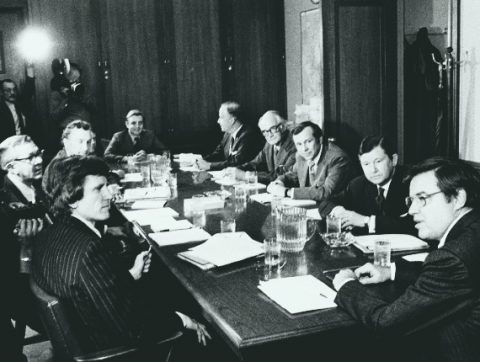
Dear Congress, Mr. President and the American public,
In 1975 the public learned that the National Security Agency had been collecting and analyzing international telegrams of U.S. citizens since the 1940s under secret agreements with all the major telegram companies. Years later, the NSA instituted another watch list program to intercept the international communications of key figures in the civil rights and anti–Vietnam War movements among other prominent citizens. Innocent Americans were targeted by their government. These actions were uncovered — and stopped — only because of a special Senate investigative committee known as the United States Senate Select Committee to Study Governmental Operations with Respect to Intelligence Activities, commonly known as the Church Committee.
We are former Church Committee members and staffers and write today as witnesses to history and as citizens with decades of collective experience in Congress, the federal courts, the executive branch and the intelligence community. We write today to encourage Congress to create a Church Committee for the 21st century — a special investigatory committee to undertake a thorough and public examination of current intelligence community practices affecting the rights of Americans and to make specific recommendations for future oversight and reform. Such a committee would work in good faith with the president, hold public and private hearings and be empowered to obtain documents. Such congressional action is urgently needed to restore the faith of citizens in the intelligence community and in our federal government.
The actions uncovered by the Church Committee in the 1970s bear striking similarities to the actions we’ve learned about over the past year. In the early 1970s, allegations of impropriety and illegal activity concerning the intelligence community spurred Congress to create committees to investigate those allegations. Our committee, chaired by Sen. Frank Church, was charged with investigating illegal and unethical conduct of the intelligence community and with making legislative recommendations to govern the intelligence community’s conduct. The bipartisan committee’s reports remain one of the most searching reviews of intelligence agency practices in our nation’s history.
Our findings were startling. Broadly speaking, we determined that sweeping domestic surveillance programs, conducted under the guise of foreign intelligence collection, had repeatedly undermined the privacy rights of U.S. citizens. A number of reforms were implemented as a result, including the creation of permanent intelligence oversight committees in Congress and the passage of the Foreign Intelligence Surveillance Act.
Even though our work was over 30 years ago, our conclusions seem eerily prescient today. For example, our final report noted:
We have seen a consistent pattern in which programs initiated with limited goals, such as preventing criminal violence or identifying foreign spies, were expanded to what witnesses characterized as “vacuum cleaners,” sweeping in information about lawful activities of American citizens. The tendency of intelligence activities to expand beyond their initial scope is a theme, which runs through every aspect of our investigative findings.
The need for another thorough, independent and public congressional investigation of intelligence activity practices that affect the rights of Americans is apparent. There is a crisis of public confidence. Misleading statements by agency officials to Congress, the courts and the public have undermined public trust in the intelligence community and in the capacity of the branches of government to provide meaningful oversight.
The scale of domestic communications surveillance the NSA engages in today dwarfs the programs revealed by the Church Committee. Thirty years ago, the NSA’s surveillance practices raised similar concerns as those today. For instance, Church explained:
In the case of the NSA, which is of particular concern to us today, the rapid development of technology in this area of electronic surveillance has seriously aggravated present ambiguities in the law. The broad sweep of communications interception by NSA takes us far beyond the previous Fourth Amendment controversies where particular individuals and specific telephone lines were the target.
As former members and staffers of the Church Committee, we can authoritatively say the erosion of public trust currently facing our intelligence community is not novel, nor is its solution. A Church Committee for the 21st century — a special congressional investigatory committee that undertakes a significant and public re-examination of intelligence community practices that affect the rights of Americans and the laws governing those actions — is urgently needed. Nothing less than the confidence of the American public in our intelligence agencies and, indeed, the federal government, is at stake.
Sincerely,
Counsel, advisers and professional staff members of the Church Committee, including
Chief Counsel Frederick A.O. Schwarz Jr.
Loch Johnson
John T. Elliff
Burt Wides
Jim Dick
Frederick Baron
Joseph Dennin
Peter Fenn
Anne Karalekas
Michael Madigan
Elliot Maxwell
Gordon Rhea
Eric Richard
Athan Theoharis
Christopher Pyle
February 25, 2018
Posted by aletho |
Civil Liberties, Corruption, Deception, Timeless or most popular | CIA, NSA, United States |
Leave a comment
Pyongyang has accused Washington of bringing “clouds of war” to the region by imposing “the largest-ever” sanctions during the Olympic Games, but says it is still open to direct talks with the US.
A statement published by state news agency KCNA hailed North Korea’s leadership for their “strong determination for peace, long-awaited inter-Korean dialogue and cooperation,” which began to surface during the 2018 Pyeongchang Winter Olympics. The statement went on to say that Washington is violating the Korean Olympics truce and “is running amok to bring another dark cloud of confrontation and war over the Korean peninsula” by announcing new wave of sanctions against the North.
“We came to possess nuclear weapons, the treasured sword of justice, in order to defend ourselves from such threats from the United States,” the statement read, adding that “we will consider any type of blockade an act of war against us.”
On Friday, Washington announced “the largest-ever set of new sanctions on the North Korean regime,” targeting the country’s industries and exports.
Twenty-seven foreign companies, 28 ships, and one person – mainly based in China, Hong Kong, Taiwan, and Singapore – were sanctioned, according to the US Treasury. US President Donald Trump has said that “if the sanctions don’t work, we will have to go to phase two, and phase two may be a very rough thing, may be very, very unfortunate for the world.”
The president did not specify what exactly he meant by “phase two,” but qualified the statement by saying he did not think he was “going to exactly play that card.”
Still, Pyongyang says it is open for direct talks with Washington and continues negotiations with Seoul. On Sunday, South Korean President Moon Jae-in hosted Kim Yong-chol, vice chairman of the Central Committee of North Korea’s ruling Workers’ Party, in Pyeongchang, Yonhap reports. This was President Moon’s second meeting with top-tier North Korean officials in just two weeks.
Previously, he held talks with a delegation which included Kim Jong-un’s sister, Kim Yo-jong, who delivered a special message from her brother, inviting Moon to Pyongyang in future. Moon is yet to accept the invitation, and if he does, it would be the first visit by a South Korean head of state since 2007, when then-President Roh Moo-hyun met with Kim Jong-il in Pyongyang.
The Trump administration seems to be wary of the ongoing inter-Korean détente which started earlier this year with high-level contacts between the two countries’ officials. Notwithstanding some promising statements by US Vice President Mike Pence, Washington is continuing its policy of sanctions and military pressure.
This spring, the US and South Korea will resume massive military drills – Foal Eagle and Key Resolve. Though Washington and Seoul maintain that the exercises are critical to prepare for a North Korean attack, Pyongyang views the wargames as a rehearsal for invasion, and has threatened retaliatory strikes.
Russia and China have consistently urged caution in the matter. In January, the two countries put forward a ‘double freeze’ initiative that envisaged the US and its allies ceasing all major military exercises in the region in exchange for North Korea suspending its nuclear and ballistic missile program. The initiative was rejected by Washington.
February 25, 2018
Posted by aletho |
Militarism, War Crimes | North Korea, United States |
Leave a comment
Syria’s Permanent Representative at the UN Bashar al-Jaafari said that ending the suffering of Syrians doesn’t require showboating sessions or forming UN committees; it only requires applying the 30 resolutions issued by the UN.
In a speech after the Security Council voted on a resolution calling for the cessation of combat activities in Syria for at least 30 days, Jaafari said that the people in Damascus are truly suffering due to the acts of the terrorists positioned in the Eastern Ghouta, adding “the appeals of 8 million Syrians do not reach the General Secretariat or the mailboxes of Britain and France’s representatives, but the appeals of terrorists do reach them.”
He noted that the Syrian Arab Red Crescent HQ in Damascus was targeted by 10 shells fired by the so-called “moderate” terrorists located in Ghouta, killing and injuring people including a doctor.
Jaafari stressed meanwhile, that the Syrian government has dealt in a serious manner with all initiatives and was committed to them due to its care for the lives of Syrian citizens, and that the government has called on armed groups in the Eastern Ghouta to lay down their weapons and provided safe corridors for civilians to exit it.
Syria’s Representative said that the Astana agreement had stipulated for committing the armed groups to break any ties to ISIL and Nusra Front terrorist groups, and gave the Syrian government the right to retaliate to any attack.
“We practice a sovereign right of self-defense and we will continue to fight terrorism wherever it is found on Syrian soil,” Jaafari affirmed, adding that the Syrian government reserves the full right to retaliate against armed terrorist groups if they target civilians with even a single shell.
The Syrian diplomat asserted that the new resolution should be applied to the entirety of Syrian territory, including Afrin, and areas occupied by US forces, and the occupied Syrian Golan.
He also said that what is required is for the governments of the United States, Britain, and France to stop holding meetings and making strategic plans that bring to mind the age of colonialism and that seek to divide Syria and change the governing system in it by force.
February 25, 2018
Posted by aletho |
Illegal Occupation | France, Syria, UK, United Nations, United States |
Leave a comment
The outcome of the UN Security Council meeting does not bode well for the people of Palestine. Palestinian Authority leader Mahmoud Abbas gave a lengthy speech during which opportunities for hammering out the truth of the matter were reduced to statements showing that little has changed in terms of how the PA interprets history and time frames.
Abbas declared that Israel “has transformed the occupation from a temporary situation as per international law into a situation of permanent settlement colonisation.” He also described the PA as having become “an Authority without authority.” The inaccuracy of these statements is the suggestion that their claims have just become obvious, highlighting the refusal to recognise that the facts of the matter have been very clear since the start of the occupation — Zionism is an expansionist ideology forever seeking “Greater Israel” — and the creation of the PA, whose sole role is to serve Israeli interests. Having allocated enough space in order to portray the alleged deterioration of the situation as opposed to current circumstances being the result of a premeditated plan of colonisation and collaboration, Abbas is entrenching a poor bargaining position for Palestinians.
This deficiency has been recognised by the US. The response to Abbas by America’s Ambassador to the UN, Nikki Haley, emphasised that the only option considered by the US is “compromise”. In Haley’s words: “You can choose to put aside your anger about the location of our embassy and move forward with us towards a negotiated compromise that holds great potential for improving the lives of the Palestinian people.” In other words, forget about a state; you can have the crumbs off the table, which is better than no crumbs at all.
Haley’s response cannot be read solely within the context of a diatribe against Abbas. It is a direct attack on Palestinians rights and aspirations for liberation. Indeed, this exchange portrays the consequences which Palestinians suffer as a result of political isolation. The rhetoric within international institutions takes place in such a detached manner that it is possible to discern a narrative for UN forums that only skims the surface of what is deemed acceptable to discuss. The choice of discourse has been determined away from Palestinian reality.
The diverging narratives are imbued with recognition and repudiation, with the latter reserved for Palestinians. Haley is emphasising this discrepancy and exploiting it at a time when Israel and the US are working overtly to accelerate the colonisation process so that “Greater Israel” becomes more of a reality day by day. Recognising the colonial narrative at an international level is aided by the fact that Abbas is not speaking for all Palestinians. His calculated discourse, which should generate outrage at the way decades of Israeli violations are being recognised by himself and the PA so belatedly — particularly after US President Donald Trump’s unilateral declaration on Jerusalem — is a blatant example of pandering to colonial complicity.
Haley’s statement on Palestinians’ limitations unfortunately rings true. Whether or not the US is involved in negotiations, the damage to the Palestinians and their cause is immense. Turning to international organisations with weak leadership for solutions will ultimately result in the diminished power of the people. The fact that Abbas continues to engage with the international community without acknowledging its role in isolating Palestinian voices can only mean an extension of the current situation, with long-term benefits for Israel. Engaging with the US after the measures it has taken to hinder the legitimate claims of Palestinians on their territory to the point of elimination should not be an option.
Whatever Abbas chooses, and recent history has shown many examples of how the PA fluctuates from one degenerative option to another, it is important to remember that the decisions are not Palestinian choices. The people of Palestine have been experimented upon from all sides — even militarily — and options offered by parties across the political spectrum ignore the fact that the genuine possibilities for Palestinians can only be generated from within; Abbas knows this only too well. It is with calculated intent that the entire world has been allowed to impose anything and everything upon the Palestinians apart from their legitimate rights. The added indignity is having these same impositions articulated in the name of the Palestinian people by someone like Mahmoud Abbas.
February 24, 2018
Posted by aletho |
Corruption, Deception, Ethnic Cleansing, Racism, Zionism | Israel, Palestine, United Nations, United States, Zionism |
Leave a comment
Fads and scandals often follow a set trajectory. They grow big, bigger, and then, finally, too big, at which point they topple over and collapse under the weight of their own internal contradictions. This was the fate of the “Me too” campaign, which started out as an exposé of serial abuser Harvey Weinstein but then went too far when Babe.net published a story about one woman’s bad date with comedian Aziz Ansari. Suddenly, it became clear that different types of behavior were being lumped together in a dangerous way, and a once-explosive movement began to fizzle.
So, too, with Russiagate. After dominating the news for more than a year, the scandal may have at last reached a tipping point with last week’s indictment of thirteen Russian individuals and three Russian corporations on charges of illegal interference in the 2016 presidential campaign. But the indictment landed with a decided thud for three reasons:
— It failed to connect the Internet Research Agency (IRA), the alleged St. Petersburg troll factory accused of political meddling, with Vladimir Putin, the all-purpose evil-doer who the corporate media say is out to destroy American democracy.
— It similarly failed to establish a connection with the Trump campaign and indeed went out of its way to describe contacts with the Russians as “unwitting.”
— It described the meddling itself as even more inept and amateurish than many had suspected.
After nine months of labor, Special Prosecutor Robert Mueller thus brought forth a mouse. Even if all the charges are true – something we’ll probably never know since it’s unlikely that any of the accused will be brought to trial – the indictment tells us virtually nothing that’s new.
Yes, IRA staffers purchased $100,000 worth of Facebook ads, 56 percent of which ran after Election Day. Yes, they persuaded someone in Florida to dress up as Hillary Clinton in a prison uniform and stand inside a cage mounted on a flatbed truck. And, yes, they also got another “real U.S. person,” as the indictment terms it, to stand in front of the White House with a sign saying, “Happy 55th Birthday Dear Boss,” a tribute, apparently, to IRA founder Yevgeniy Prigozhin, the convicted robber turned caterer whose birthday was three days away. Instead of a super-sophisticated spying operation, the indictment depicts a bumbling freelance operation that is still giving Putin heartburn months after the fact.
Not that this has stopped the media from whipping itself into a frenzy. “Russia is at war with our democracy,” screamed a headline in the Washington Post. “Trump is ignoring the worst attack on America since 9/11,” blared another. “… Russia is engaged in a virtual war against the United States through 21st-century tools of disinformation and propaganda,” declared the New York Times, while Daily Beast columnist Jonathan Alter tweeted that the IRA’s activities amounted to nothing less than a “tech Pearl Harbor.”
All of which merely demonstrates, in proper backhanded fashion, how grievously Mueller has fallen short. Proof that the scandal had at last overstayed its welcome came five days later when the Guardian, a website that had previously flogged Russiagate even more vigorously than the Post, the Times, or CNN, published a news analysis by Cas Mudde, an associate professor at the University of Georgia, admitting that it was all a farce – and a particularly self-defeating one at that.
Mudde’s article made short work of hollow pieties about a neutral and objective investigation. Rather than an effort to get at the truth, Russiagate was a thinly-veiled effort at regime change. “[I]n the end,” he wrote, “the only question everyone really seems to care about is whether Donald Trump was involved – and can therefore be impeached for treason.
With last week’s indictment, the article went on, “Democratic party leaders once again reassured their followers that this was the next logical step in the inevitable downfall of Trump.” The more Democrats play the Russiagate card, in other words, the nearer they will come to their goal of riding the Orange-Haired One out of town on a rail.
This makes the Dems seem crass, unscrupulous, and none too democratic. But then Mudde gave the knife a twist. The real trouble with the strategy, he said, is that it isn’t working:
“While there is no doubt that the Trump camp was, and still is, filled with amoral and fraudulent people, and was very happy to take the Russians help during the elections, even encouraging it on the campaign, I do not think Mueller will be able to find conclusive evidence that Donald Trump himself colluded with Putin’s Russia to win the elections. And that is the only thing that will lead to his impeachment as the Republican party is not risking political suicide for anything less.”
Other Objectives of “Russiagate”
No collusion means no impeachment and hence no anti-Trump “color revolution” of the sort that was so effective in Georgia or the Ukraine. Moreover, while 53 percent of Americans believe that investigating Russiagate should be a top or at least an important priority according to a recent poll, figures for a half-dozen other issues ranging from Medicare and Social Security reform to tax policy, healthcare, infrastructure, and immigration are actually a good deal higher – 67 percent, 72 percent, or even more.
Summed up Mudde: “… the Russia-Trump collusion story might be the talk of the town in Washington, but this is not the case in much of the rest of the country.” Out in flyover country, rather, Americans can’t figure out why the political elite is more concerned with a nonexistent scandal than with things that really count, i.e. de-industrialization, infrastructure decay, the opioid epidemic, and school shootings. As society disintegrates, the only thing Democrats have accomplished with all their blathering about Russkis under the bed is to demonstrate just how cut off from the real world they are.
But Russiagate is not just about regime change, but other things as well. One is repression. Where once Democrats would have laughed off Russian trolls and the like, they’re now obsessed with making a mountain out of a molehill in order to enforce mainstream opinion and marginalize ideas and opinions suspected of being un-American and hence pro-Russian. If the RT (Russia Today) news network is now suspect – the Times described it not long ago as “the slickly produced heart of a broad, often covert disinformation campaign designed to sow doubt about democratic institutions and destabilize the West” – then why not the BBC or Agence France-Presse ? How long until foreign books are banned or foreign musicians?
“I’m actually surprised I haven’t been indicted,” tweets Bloomberg columnist Leonid Bershidsky. “I’m Russian, I was in the U.S. in 2016 and I published columns critical of both Clinton and Trump w/o registering as a foreign agent.” When the Times complains that Facebook “still sees itself as the bank that got robbed, rather than the architect who designed a bank with no safes, and no alarms or locks on the doors, and then acted surprised when burglars struck,” then it’s clear that the goal is to force Facebook to rein in its activities or stand by and watch as others do so instead.
Add to this the classic moral panic promoted by #MeToo – to believe charges of sexual harassment and assault without first demanding evidence “is to disbelieve, and deny due process to, the accused,” notes Judith Levine in the Boston Review – and it’s clear that a powerful wave of cultural conservatism is crashing down on the United States, much of it originating in a classic neoliberal-Hillaryite milieu. Formerly the liberal alternative, the Democratic Party is now passing the Republicans on the right.
But Russiagate is about something else as well: war. As National Security Adviser H.R. McMaster warns that the “time is now” to act against Iran, the New York Times slams Trump for not imposing sanctions on Moscow, and a spooky “Nuclear Posture Review” suggests that the US might someday respond to a cyber attack with atomic weapons, it’s plain that Washington is itching for a showdown that will somehow undo the mistakes of the previous administration. The more Trump drags his feet, the more Democrats conclude that a war drive is the best way to bring him to his knees.
Thus, low-grade political interference is elevated into a casus belli while Vladimir Putin is portrayed as a supernatural villain straight out of Harry Potter. But where does it stop? Libya has been set back decades, Syria, the subject of yet another US regime-change effort, has been all but destroyed, while Yemen – which America helps Saudi Arabia bomb virtually around the clock – is now a disaster area with some 9,000 people killed, 50,000 injured, a million-plus cholera cases, and more than half of all hospitals and clinics destroyed.
The more Democrats pound the war drums, the more death and destruction will ensue. The process is well underway in Syria, the victim of Israeli bombings and a US-Turkish invasion, and it will undoubtedly spread as Dems turn up the heat. If the pathetic pseudo-scandal known as Russiagate really is collapsing under its own weight, then it’s not a moment too soon.
Daniel Lazare is the author of several books including The Frozen Republic: How the Constitution Is Paralyzing Democracy (Harcourt Brace).
February 24, 2018
Posted by aletho |
Civil Liberties, Fake News, Full Spectrum Dominance, Mainstream Media, Warmongering, Militarism, Progressive Hypocrite, Russophobia, Timeless or most popular | Human rights, United States |
Leave a comment
The world’s financial watchdog has extended a waiver for punitive measures against Iran for another six months but refused to remove the country from its blacklist.
The Paris-based the Financial Action Task Force (FATF) had been weighing Tehran’s request for the lifting of so-called countermeasures for some time but a flurry of recent visits by a top US official to France and other European countries thwarted the bid.
Change of heart
Iran’s removal from the blacklist had gained support in European capitals in recognition of the steps Tehran has taken in recent years to enact legislation barring terrorist financing and money laundering.
However, the US sent the official to France, Germany, the Netherlands and Belgium ahead of a plenary meeting of the task force Friday to warn that keeping Iran on the FATF blacklist was a top priority, and that Washington would aggressively pursue that policy.
As a result, the FATF decided to continue the suspension of countermeasures, taking into account the fact that Iran has draft legislation currently before Parliament, but did not remove the country from the list in a decision which many believe is political.
The FATF suspended its punitive measures for a year in 2016 when Iran reached a landmark nuclear deal and promised to step up its fight on money-laundering. The task force extended the waiver last July and again on Friday.
The Iranian government hopes that the exit from the FATF blacklist would remove one hurdle to foreign investment. Critics of the government, however, say membership in the Financial Action Task Force has not only failed to attract investment, but it has also exposed various institutions to extraterritorial regulations and penalties.
Iranian institutions targeted
In its Friday decision, the FATF threatened Iran with new penalties in June if it doesn’t bolster oversight of alleged terrorism financing and money laundering within its borders.
Some in Iran believe the US is using the FATF to target key organizations such as the Islamic Revolution Guards Corps (IRGC) which has both a role in the Iranian economy and supports groups such as Lebanon’s Hezbollah regarded as legitimate “resistance” entities by the Islamic Republic.
The FATF cited nine “action items” which Iran had to fully address before the body considers its bid for removal from the blacklist.
“Until Iran implements the measures required to address the deficiencies identified in the Action Plan, the FATF will remain concerned with the terrorist financing risk emanating from Iran and the threat this poses to the international financial system,” it said.
“The FATF, therefore, calls on its members and urges all jurisdictions to continue to advise their financial institutions to apply enhanced due diligence to business relationships and transactions with natural and legal persons from Iran, consistent with FATF Recommendation 19,” it added.
Countries that do not follow FATF are often labeled as high-risk or uncooperative jurisdictions by the West, making international trade costly and difficult.
US threats
Iran agreed to scale back its nuclear energy program in return for the lifting of sanctions which would facilitate business with the world and pave the way for foreign investment. However, US pressures on bodies such as FATF and its threats have driven away banks, investors and companies.
Earlier this week, Iran’s Deputy Foreign Minister Abbas Araqchi said Tehran will withdraw from the nuclear deal if there is no economic benefit and major banks continue to shun the Islamic Republic.
Big banks are afraid of falling foul of remaining US sanctions.
Araqchi said even if US President Donald Trump relents and issues fresh “waivers” to continue suspending sanctions on Tehran, the existing situation is unacceptable for Iran.
“The deal would not survive this way even if the ultimatum is passed and waivers are extended,” Araqchi, Iran’s lead nuclear negotiator, said in a speech at the Chatham House think tank in London.
“If the same policy of confusion and uncertainties about the JCPOA (Joint Comprehensive Plan of Action) continues, if companies and banks are not working with Iran, we cannot remain in a deal that has no benefit for us,” he said. “That’s a fact.”
February 24, 2018
Posted by aletho |
Economics, Wars for Israel | Hezbollah, Sanctions against Iran, United States, Zionism |
Leave a comment
 Aletho News

