A Coming Russia-Ukraine War?
By Gilbert Doctorow | Consortium News | January 21, 2018
While much of America’s – and the world’s – attention focused this weekend reflecting on Donald Trump’s first year in the Oval Office, holding one-year anniversary events for the historic Women’s March and drawing up balance sheets of his promises and achievements, Russia has had a rather different issue on the front-burner: a possible war with Ukraine.
The situation in the Donbass region of south-eastern Ukraine has been a feature of Russia’s political talk shows for the past couple years, along with the military campaign in Syria and more recently the stages in the preparation for presidential elections on March 18.
Focus on the Donbass conflict increased in the closing weeks of 2017 as military action on the front lines separating the forces of the self-proclaimed republics of Donetsk and Lugansk enjoying Russian support from Ukrainian militias and armed forces reached an intensity not seen for more than a year. This is despite the heralded exchange of military prisoners by both sides before New Year’s under talks supervised by the Patriarch of the Russian Orthodox Church Kirill.
Then, this past Thursday came a wholly new development – a draft law passed by the Ukrainian Parliament that could effectively end Kiev’s participation in the conflict resolution process known as the Minsk Accords. Although observers in the United States and Western Europe may have missed it, many Russians believe this development amounts to a declaration of war.
Dmitri Kiselyov, head of all Russian television and radio news services, offered a sober analysis of the emotionally charged development on his Sunday evening news wrap-up today.
According to Kiselyov, the new law, which awaits Poroshenko’s signature, makes preparations for war and includes language indicating a bellicose new approach to the conflict. The mission in Donbass is no longer described as an “anti-terrorist operation.” Rather, the mission now is to send armed forces against “military formations of the Russian Federation” in Donbass.
Military headquarters are established to coordinate the operation to be waged in Donbass. While up until now the self-declared republics of Donetsk and Lugansk were considered under the Minsk Accords as negotiating parties, now there are only “occupation administrations” of the Russian Federation on these territories, with Russia identified as an “aggressor.”
“This makes it all the more convenient for Ukraine to start a war,” Kiselyov says, noting that it could have the added benefit of enabling Ukraine not to pay its foreign debts and to ensure Poroshenko’s continued grip on power.
A Vesti reporter on the ground in Donetsk confirmed with local residents their view that the law means war. They see the current moment on the front line as “the calm before the storm.” Donetsk soldiers at their trenches say they are fully ready to engage with the enemy.
While Kiselyov acknowledges that the draft law might not ultimately be implemented, it nevertheless reveals a growing mood in the Ukrainian capital in favor of escalation. The facts speak for themselves, Kiselyov says, with Poroshenko failing to adhere to the Minsk Accords – for example by organizing local elections in Donbass – or to observe ceasefires along the lines of contact. There are attacks and deaths every day and only counter force has pushed back recent Ukrainian attempts to gain territory.
Kiev has seemingly written off the population of the two self-proclaimed republics – cutting off all transport and telecoms links and failing to pay pensions and assistance to the needy. It closed the banking system and there are no commercial ties. For Kiev the two provinces are merely territory to take back from the occupiers, with the wellbeing of the local populations at best a secondary concern.
On the economic front, the European Union has refused to extend 600 million euros of credit to Ukraine due to corruption. The International Monetary Fund recently refused a tranche of $800 million over failure to introduce reforms. Meanwhile, in 2019 Ukraine is due to start repaying earlier loans. This will come to $14 billion a year, which amounts to half the state budget of Ukraine.
Due to dire economic conditions, Poroshenko and other government officials in Kiev have become deeply unpopular, and with diminished chances for electoral success may see war as politically advantageous.
And although there are indications that some Western leaders are fed up with Kiev, the United States has doubled down in its support for a military solution to the conflict. With military trainers now on the ground and the U.S. budgeting $350 million for security assistance to Ukraine, Washington has also recently started delivering lethal weapons including the Javelin anti-tank missile system free of charge to Kiev.
In contrast to the image of Trump administration policies being dictated by Moscow, as portrayed by proponents of Russia-gate conspiracy theories, the United States is instead moving towards deeper confrontation with the Kremlin in the geopolitical hotspot of Ukraine.
For its part, the Kremlin has very little to gain and a great deal to lose economically and diplomatically from a campaign now against Kiev. If successful, as likely would be the case given the vast disparity in military potential of the two sides, it could easily become a Pyrrhic victory.
But notwithstanding Kiselyov’s reassuring words on his Sunday evening news wrap-up, it may well be the case that Moscow feels it has no choice. Moves by Kiev to exacerbate the conflict must be quickly countered to prevent deeper intervention by the United States and its NATO allies and prevent the conditions for WWIII from taking hold.
Gilbert Doctorow is an independent political analyst based in Brussels. His latest book, Does the United States Have a Future? was published in October 2017.
Palestinian-American Groups Withdraw from Women’s March in Protest of Pro-Israel Speaker, Scarlett Johannson

Palestine Chronicle | January 21, 2018
NBC reported that three Palestinian human rights groups pulled out of the Los Angeles Women’s March Saturday after it was announced that one of the featured speakers was actress Scarlett Johannson, who promoted SodaStream, a beverage company that owns a factory in an Israeli settlement in the West Bank.
A former OXFAM ambassador, Johannson resigned her position with the humanitarian organization after criticism for supporting and promoting the support of Israeli settlements built on stolen Palestinian land.
The Southern California branch of the Palestinian Women’s Organization made a statement on their Facebook page about the decision to pull out of the march:
“PAWA recently became aware of LA March’s decision to include Scarlett Johansson in their lineup of special guest speakers. Johansson has expressed her unapologetic support of illegal settlements in the West Bank, a human rights violation recognized by the international community whose calls only led to a reaffirmation of her position, sending a clear message that Palestinian voices and human rights for Palestinians do not matter. While her position may not be reflective of all organizers at the Women’s March Los Angeles Foundation, PAWA cannot in good conscience partner itself with an organization that fails to genuinely and thoughtfully recognize when their speaker selection contradicts their message.
“Currently, 16 year old Ahed Tamimi is being held in custody for standing up to two Israeli combat soldiers who raided her family home in the middle of the night on illegally occupied land. Her story, one among hundreds of Palestinian children being abused and imprisoned by Israeli military, has been heard across the globe with calls to #FreeAhed, making the decision to invite Scarlett Johansson speak at an event highlighting “the struggles of marginalized communities and all attacks on human rights” all the more tone deaf.
“We join Al-Awda: The Palestine Right to Return Coalition, Jewish Voice for Peace, Code Pink, BDS-LA, Jews for Palestinian Right of Return and other organizations who have signed the petition below in boycott of the January 20 march in Los Angeles.”
Hassan Nasrallah answers Trump on Hezbollah’s drug trafficking
Speech by Hezbollah Secretary General Sayed Hassan Nasrallah on January 19, 2018, on the occasion of the commemoration of the death of Fayez Moghniyeh, father of martyrs Jihad, Fouad and Imad Moghniyeh
In case this video is censored by Youtube, find it on Dailymotion, Vimeo or Rutube. See Kafka 2.0: How Youtube’s Political Censorship is Exercised
Hassan Nasrallah answers Trump on Hezbollah’s drug trafficking from Sayed Hasan on Vimeo
Transcript by Sayed Hasan | January 21, 2018:
In recent weeks, US accusations were made. They are not new but they are taking a new dimension. The US Department of Justice created a commission of inquiry that will come to Lebanon – I do not know if it is already there, the media have not made it clear – to meet with officials and Lebanese parties and to investigate. About what ? The Hezbollah links with drug trafficking.
A story was concocted in the US, that Obama would have prevented any investigation on the issue of Hezbollah drug trafficking, but Trump, being more intransigent, formed this Inquiry. The same approach is being carried out by France, and it seems there have been arrests of people linked to drug trafficking, money laundering, etc.
Anyway, I will not dwell at length on this subject, but I want to remind our unchanging position of principle. I want to tell you and all the spectators, categorically, that these are fabrications and false accusations which are not based on any fact and have no truth. Hezbollah, regarding this issue, has a clear religious, legal and ethical position. For us, the drug trade is illegal, prohibited, and is even among the major sins. And we prohibit drug trafficking even in the society of the enemy. Perhaps someone will say what is wrong with selling drugs to Israeli society to destroy it (from within)? Even the drug trade with Israeli society to destroy it is illicit in our view. The drug trafficking and spread are by principle illicit (whatever the circumstances) even to an enemy society. This has nothing to do with (warfare). Such are our ethics, such is our commitment, which stands absolutely.
And therefore, all (the accusations) have no basis of truth. The real question is: in what framework are these accusations made? I have already said and I repeat: as regards trade, and not just the issue of drugs, I have already reminded on more than one occasion, O people, that even the legal trade, we in Hezbollah are not doing. Even legitimate trade. All kinds of commercial or lucrative activity, we are completely detached from them. It is not by asceticism or because it would be illegal, I speak of legitimate trade. On the contrary, trade is a recommended action. Trade, from the standpoint of the (Islamic) law and rulings, is a recommended action. But as regards Hezbollah as a party, as a peculiar political and jihadist entity, we took the decision to make no trade.
And this decision is motivated by the sanctions, so that they will not harm the Lebanese traders, otherwise tomorrow all Lebanese traders would be accused of having Hezbollah money or of making it fructify. We conduct absolutely no lucrative activity. We do not invest our money (neither by trade, loans, bank interest …). The money we have at our disposal is only one that is sufficient for us, for our expenses on the various fields where we are, primarily the armed battles we lead. And therefore, we have no money fructifying, we have no business, and we do not have any member or office making any benefit from our money.
And also, incidentally, I have said it before and I repeat it today, for now, thanks God, after the victory in Iraq and the almost complete victory in Syria, the return of peace and reconstruction, there are companies and Lebanese traders who go to work in Iraq, Syria and other countries, I want to say to everyone: there is no one, no action project of this type belonging to Hezbollah. Hezbollah has nothing (like it). Hezbollah has nowhere any money invested, and is not involved nor a partner in any profit or commercial project.
Of course, we do not ban it. There are traders who are on the line of Hezbollah, who are our brothers, there may be rich, people who have abilities, but they work individually. We do not prohibit the Lebanese people to trade. If someone has money and does business, it is as as an individual, with his own money. These are individual companies. Hezbollah as Hezbollah hasn’t designated nor authorized anyone to speak in his name and conduct personal profit projects. For there is no such lucrative action. I say that to confirm this point.
On the issue of drugs, it is clearly an (unlawful) question for us, as I said, but (such accusations) are part of the war against us. It is part of the war being waged against us. And that’s a natural thing. When (former US ambassador) Feltman acknowledged that the US Embassy in Lebanon alone spent 5 billion – sorry, 5 million to sully the image of Hezbollah and keep young people away from it. This is part of the (enemy) effort to discredit us.
The Americans have done their best to convince the world that Hezbollah is a terrorist organization. Some countries went along, others not. And even some countries that have agreed to register us officially on the list of terrorist organizations, behind the scenes, they contact us and work with us and would (almost) be willing to die to preserve their relationship with us. The idea to (identify us as a) terrorist organization did not work. It is not logical.
Hezbollah has proved, especially in recent years, that it is one of the most important forces – not the largest, but one of the most important forces – fighting against terrorism and terrorist groups in the region. How could they describe us as terrorists while we fight the terrorists? Those that the world unanimously designates as terrorists (ISIS)?
This is why the Americans are trying something else. They want to present Hezbollah as a criminal organization. I hope that the public will pay attention to this. There’s designation as a terrorist organization and designation as a criminal organization. What is a criminal organization? An organization that makes drug trafficking, steals cars, made of gangsters, mercenaries and assassins, etc. They try to describe us as a criminal organization.
Very good. If they want to make an inquiry in Lebanon, they are welcome. I invite the Commission of the US Ministry of Justice to come do their investigation in Lebanon. And we hope that the Lebanese who will meet the members of this Commission will tell the truth and be honest. Let no one lie to incite against us. There are (unfortunately) people like that in Lebanon. In Lebanon, it is well known who has a tough stance on drug trafficking, drug traffickers and all of this. It’s well known. If someone has something against us, let him come forward. We hope they will tell the truth, even if I know that the Americans are not looking for the truth. They will look for anything to support that accusation and place Hezbollah on the list of criminal organizations.
Anyway, I said enough on this topic and I declare that we reject this accusation. On this issue, our position is firm and unchanging. We accept no charge. There is nothing dirty inside Hezbollah. Instead, they should first consider their own situation, investigate how the Americans, the CIA, the security agencies (FBI, etc.) themselves are trafficking drugs and destroying societies by spreading drugs there. So you should rather make a Commission on your own actions, investigate drug trafficking of your own officials and security agencies. […]
Court rejects school’s effort to dismiss free speech lawsuit
By Tyler Cochran | Campus Reform | January 19, 2018
Pierce College will have to defend the constitutionality of its policies restricting speech to just 0.003 percent of campus after a judge rejected its motion to dismiss a student’s lawsuit.
With help from attorneys at the Foundation for Individual Rights in Education (FIRE), student Kevin Shaw sued the school in March after administrators refused to let him distribute copies of the Constitution outside of the school’s “free speech zone,” which encompasses just 616 square feet of the 426-acre campus.
Shaw was also told he must fill out a permit application to use the free speech zone, and that he would have to leave campus if he refused to comply, which the school’s defense attorneys have sought to justify by arguing that the campus is a “non-public forum.”
According to the court order, the motion was dismissed in part because “given the traditional purpose of the open, outdoor areas of universities, such as the ‘Mall’ on Pierce’s campus, the Court finds that these areas are traditional public fora, regardless of Pierce’s regulations naming them non-public fora.”
At issue was the school’s contention that rules established by the Los Angeles Community College District designate all areas of the district’s campuses “non-public fora” except for those that are specifically set aside as “Free Speech Areas.”
Shaw, however, pointed out that the California Education Code contradicts that policy, requiring community colleges to allow all lawful forms of free expression that do not substantially disrupt normal operations, thereby rendering them, at the very least, “designated public fora.”
“The court’s ruling sends an important message to colleges nationwide that still restrict student speech to free speech zones,” FIRE Director of Litigation Marieke Tuthill Beck-Coon remarked in a press release. “The campus is a college student’s public square. It’s their space to be engaged citizens. The public recognizes this. So do courts across the country. Now it’s time for LACCD to follow suit.”
“This decision sends a clear signal to all university administrators that mistakenly believe they can create rules that supersede the Constitution,” concurred Young Americans for Liberty (YAL) Director of Free Speech Alexander Staudt. “I see this as a victory in the fight for free speech.”
“To walk completely across this campus would take hours and it is absurd that there is only a small space on that walk where free speech is allowed,” added Alex Murphy, president of the YAL chapter at Pierce College. “This case is not just about Pierce College, but every public university in the nation that has unconstitutional free speech policies.”
The LACCD is the largest community college district in the country, and Shaw’s lawsuit has the potential to affect the free speech rights of more than 150,000 students.
Pierce College spokesperson Yusef Robb told Campus Reform that “we do not comment on pending litigation,” but insisted that the school is not hostile to free speech.
“We are fully committed to free expression on our campuses,” Robb said. “As a community college district, promoting the free exchange of ideas and knowledge is at the core of what we do, every day.”
Follow the author of this article on Twitter: @tylercochran54
Erdogan accuses allies of sending ‘thousands of planeloads’ and ‘truckloads of arms’ to Kurds
RT | January 21, 2018
Turkish President Recep Tayyip Erdogan has turned on Ankara’s allies, insinuating that the US in particular has been providing massive military support to Kurdish YPG in Syria.
In a speech to his ruling AK Party Erdogan said that ‘some allies’ of Turkey had provided the YPG Syrian Kurdish militia with 2,000 planeloads and 5,000 truckloads of weapons.
“Now, apart from 5,000 trucks, there are weapons and ammunition from around 2,000 planes.” the Turkish leader said. He also accused Ankara’s allies of dishonesty when they say that they do not provide weapons for “terrorists,” referring to Kurdish-linked YPG forces.
The president also vowed to hand over Afrin to its “real owners,” explaining that he aims to return 3.5 million refugees back to Syria from Turkey as soon as possible.
This weekend, Turkey began operation ‘Olive Branch’ against Kurdish forces in Afrin, deploying jets and land forces.
Oligarch Jeff Bezos
By Margaret Kimberley | Black Agenda Report | January 17, 2018
Amazon CEO Jeff Bezos has a net worth of $105 billion and is the richest man in the world. But he is not just the richest man at this moment in history. He is the richest person who has ever lived. As of 2017 he and seven other billionaires had a collective net worth equal to that of the poorest 3.6 billion people on earth.
These figures have been in the news of late but without much useful analysis. The corporate media refuse to state what is obvious. Namely that inequality is worse around the world precisely because these super rich people demand it.
While pundits and politicians go on breathlessly about oligarchs in Russia, they seldom take a look at the wealthiest in their own backyard and the control they exert over the lives of millions of people. When Amazon announced it would choose a site for its new headquarters, cities across the country began a furious race to the bottom. Amazon is not alone in the thievery department. Major corporations like Walmart always request and receive public property and public funds in order to do business.
Some 235 cities have put themselves in the running for this dubious venture. Chicago is willing to give Amazon $1.3 billion in payroll taxes that prospective employees would ordinarily pay that city. If Chicago wins this booby prize, Amazon employees would pay taxes to their employer and not to the government. This is truly cutting out the middle man and makes real the rule of, by, and for the wealthiest.
The potential for public outrage isn’t lost on unprincipled politicians. Some cities now refuse to reveal how much they plan to give away. But the news to date is disheartening with Boston offering $75 million while Houston is willing to part with $268 million. Amazon says it will hire 50,000 people but their business model already pays employees so little that many of them qualify for public assistance, despite being employed.
The United States is as much of an oligarchy as countries it usually disparages but it is far more dishonest about its true nature. All talk of democracy is a lie as the rich get richer, by an additional $1 trillion in 2017, and wield more and more power over the lives of everyone else.
The Bezos juggernaut is not restricted to theft of public money. He is also the sole owner of the Washington Post, one of the most influential newspapers in the country. Bezos owns a newspaper that is an organ of the ruling elite and he also has a $600 million contract to provide the Central Intelligence Agency with cloud computing services.
The Washington Post was the force behind Propaganda or Not, an effort to destroy left wing voices like those at Black Agenda Report. Under the guise of fighting Russia and so-called fake news, the Bezos owned Post began the censorship campaign that has put the left’s presence on the Internet in such jeopardy.
Politicians outdo one another giving away public resources to the richest man on the planet who also owns a major newspaper and services the surveillance state. If it can be said that any one person rules the world, Bezos would be obvious choice. No one in Chicago, Boston, Houston or any of the other cities giving away the store ever voted for Jeff Bezos. All talk of democracy is a sham as long as the richest people take from the rest of humanity.
The effort to make government an irrelevance is thoroughly bipartisan. Republicans and Democrats alike are willing to turn over government coffers to Bezos and his ilk and the rights of the people be damned.
Whoever wins this tarnished brass ring ought to be consigned to political defeat. The mayor, aldermen, city council members or whoever else brings disaster to their locality should be punished for aiding and abetting the theft. If these cities can give to the richest man who ever lived, they can surely use public money to help their residents right now. But they will never do that because they are all bought off and compromised. They are either cynical or afraid to go against the real rulers of the country.
Bezos may look like the villain in a James Bond movie but there is nothing funny about him. He is deadly serious and so are his intentions. In a Bezos run world, every worker will be impoverished, every level of government will subsidize corporations, and anyone who speaks out will be discredited and under surveillance.
The last thing any city needs is a new Amazon headquarters. We need an end to billionaire rule in this country and around the world. That will be the salvation of the people, not more sweatshops run by wealthy people who steal from everyone else.
This Does Not Represent the Views of the University
By Maximilian Forte | Zero Anthropology | January 20, 2018
I know that I am not the first person to ask this, but when did universities start having “views”? When some professors indulge their rights to free speech or put academic freedom into practice, they can sometimes express views that some members of the public find controversial, distasteful, or reprehensible. In such cases, one frequently reads their university administrations publishing memos to the effect that, “Professor X’s views on Subject Y do not represent the views of the university”. What does that mean? Has “the university” studied the subject to the same degree as the professor, thus allowing it to conclude its views are the correct ones? Was the professor supposed to be instructed on the correct views to represent, since the job of professor apparently means not having an independent mind? Does it mean that Professor X does not represent the views of all professors and students at the university? How could anyone ever assume that one professor spoke for all others? Does it instead mean that the professor does not represent the views of those in the administration? The support staff? If so, who cares? And where exactly did the university administration publish its “party line”? When I was twice hired for tenure-track positions, the one thing I recall no Dean ever telling me was: “Here is a list of the views of the university. Only if you uphold these views can you consider working here. Should you ever express any differing views, you may be subjected to disciplinary action”. Nonetheless, the attitude of some university administrations in North America is that they have a right to publicly castigate faculty for not toeing the line. It is as if “the university” has been reduced to working as a mere cell of a ruling political party.
One could ask similar questions as above, only in reverse. What entitles administrators to speak for the university as a whole? How do they know that Professor X’s statements really do not reflect the views of the university? Did they ever consult faculty and students? Where is all the survey data that reveal the views of faculty on any subject? How is “the university” defined? Is it just the board of governors? Whose views does the university represent? Since I work in a public university—Canada only has public universities, with maybe one or two little exceptions—can we then assume that the “views of the university” neatly align with the broad majority of the public that we presumably are meant to serve? Is it the job of professors to simply reflect the views of others? Since when did it fall to professors to “represent” their universities—and will they get paid extra for doing PR work?
Three transformations have happened more or less simultaneously, and relatively recently, which may explain these bizarre communiqués from university administrators. One has to do with the politicization of university directorates, especially as even public universities have turned to support from private donors, most of whom have big axes to grind. Private donors are keen to buy support, and silence. Few are the donors who give generously just because they are thrilled by learning—that would be too countercultural in the North American context in which we lionize our meat packers and vilify intellectuals. From this first point, where private donors act as lobbyists for special interests, almost all else follows. To assure donors that universities are being run in a “smart” fashion, administrators have multiplied administrative positions and stacked them with persons from the private sector, who draft “strategic plans” and design what are essentially corporate business models. In other words, politicization stems from privatization and corporatization—this is the neoliberal transformation of the public university. To be clear, this transformation has its origins neither in university administrations nor the private sector, both of which lack the political power and authority necessary to effect such a transformation. Instead, governments are the ones that actively took the decision to cut back on funding for public universities, which is their responsibility, even as taxation levels either remained the same or continued to rise. They chose to redirect public funding away from universities, just as they did with education as a whole, as well as healthcare, social welfare, and so on. Governments pressed universities to raise funds from private sources, just as they pressed them to expand their governance by including more individuals from the private sector.
The second change has to do with universities seeking to raise their public profile, to gain visibility, and advance in the rankings through enhanced public recognition. To gain recognition, university websites have shed their traditional dull and dour functionality, and have become replicas of CNN. Even the university shields have been tossed, in favour of some terrible, and terribly expensive, brand logos produced by private consultants and graphic designers. Universities now also have “media relations” units, with expert staff that spend their days in Twitter and Facebook, and writing up newsy articles about what select faculty members and students are achieving (more on the political functions of “media relations” units, below). These same media units then do the rounds of the departments, advising faculty on how best to interact with journalists. To the laughter of everyone in my Department, one team showed us a video that advised us to dumb down our research so that “even your grandmother could understand it”. I still have no idea why they focused on grandmothers, not grandfathers, and why they assume that all grandmothers are ignorant rubes—perhaps theirs are? In addition, the media units encourage us to list ourselves as experts, for any journalists perusing the university website, by listing the presumably edgy and sexy topics we have mastered with our unrivalled expertise. Not enough, they then invite professors to do professional photo shoots in which they pose playfully for the camera, with a single short sentence in huge print next to them which somehow encapsulates their decades of research: “Do humans really like food?”
The third major change has to do with how university administrations understand academic freedom, and separately, freedom of speech. One might say they understand these concepts very poorly, or not at all, but I think that misses the above points. The desire by administrators to chill speech, to counter the embarrassingly contrary statements made by publicly outspoken professors, has to do with assuaging private donors as the public university is realigned with the political interests of the so-called top 1%. The immense irony of this is that it is university administrations themselves that actively pushed faculty into the public limelight in the first place, under the strategic rubrics of “knowledge mobilization” and “community outreach”. My university has posted banners around campus that urge us to “mix it up,” “get your hands dirty,” and “embrace the city, embrace the world”—vapid commercialist fluff. Even Hollywood took notice. Bleak Ben Stiller bleakly walked past some of these same bleak posters in his recent bleak film, “Brad’s Status,” which apparently was partly shot on the campus of Concordia University (not that the university is listed in the credits of the film—in fact, the movie credits claim the film was shot either in Hawaii or Boston, Montreal itself is not even mentioned):
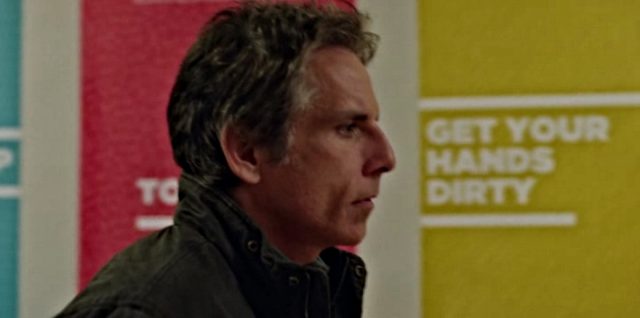
Having urged us to “get out there,” university administrators then later express regret when they feel compelled to counter a given professor’s statements with press releases affirming that “this does not represent the views of the university”. This is an “own goal” on the part of university administrators. They have worked assiduously to make the university into a media organization, to turn professors into celebrity advocacy-journalists, and to make the institution responsive to market audiences to such an extent that the autonomy of the university becomes untenable.
Firings of tenured professors by university administrations, over a difference of opinion, are still relatively rare in Canada, when compared with the US or the UK. In fact, it is not an easy option: tenured professors have not only the protection of their tenure, but of their union, and a legally binding contract negotiated with the union on behalf of faculty which ensures academic freedom and due process. Faculty unions in turn belong to a national umbrella organization, CAUT, which boasts a multi-million dollar academic freedom fund and gets actively involved in supporting faculty. Canadian universities are also deeply fearful of lawsuits which could easily demolish their already frail budgets, most of which are running deficits already. Poor financial management and the backlash of legal damage often results in the top administrators being toppled. Rather than go the messy route which, heaven forbid, could also give rise to “bad press”—good lord, not “bad press,” that’s the other court which administrations fear—administrators have had to develop quieter, more insidious and subtle forms of suppression. The way to send “the right message” to the outside world, to properly convey the unspoken “views of the university,” is to publicly promote and praise certain select professors, the ones whose views and whose work best align with those of private individual and corporate donors, or with the ruling party, or the military. To take a recent example: as Donald Trump neared electoral victory, articles were published on the university website, in its magazine and elsewhere, that featured the expert analysis of select faculty—strangely enough, all of whom were clearly pro-Hillary Clinton, anti-Trump, a number of them American expatriates, and who evinced a certain Liberal Party affinity. Unlike in a real university, there was no debate among this small cluster of people bewailing the dawn of the “post-truth” world.
The paradox is that neoliberal university administrators have adopted a policy of containment, at the same time as they seek to publicly advertise themselves. Not wanting “the wrong views” to get notice, they engage in restricting speech by selecting that speech which suits their purposes. Speech is thus not just restricted, it is regulated, by promoting only those persons whose views are safe and deemed worthy of recognition. Speech is thus effectively restricted to those academics that the administrators judge to be “qualified” to speak, thereby limiting not only what is said, but who can say it. Media relations departments have the primary responsibility of inventing online rituals around speech, practicing containment through promotion. In some cases such departments actively tutor budding young “public intellectuals” through seminars and by shadowing them online, always ready for the opportune time for that strategic “retweet”. As weak, vain, and ineffective as these policies are, they serve as a useful reminder of how liberal authoritarianism works. In this case, liberal authoritarianism produces fictional representations of “the views of the university,” by thinning out the work actually done by faculty, spreading out the words of a few to represent the words of all.
Another method of indirect silencing is for the university to “celebrate” the media “accomplishments” of select faculty only, by listing stories of faculty who have appeared in the media… only in select media, depending on the “prestige” of the outlet. This is a way to ensure that professors whose views are worthy of being courted by the corporate, neoliberal imperialist media are the only ones featured. In other words, a professor mentioned in a story on CNN is deemed to be worthy of note; a professor who appears on RT, is ignored, as if the event never happened. Selective pride is a way of signalling selective shame. It has the effect of rendering silent the actual media accomplishments of faculty, in order to produce a false picture of where faculty stand, thus assuring the egos of financial donors and politicians. The policy is implemented with the naïve hope that misaligned professors will quietly yearn for that elusive little place on the university website, a place that amounts to nothing more than a few ephemeral pixels seen by few and forgotten by all.
On a range of other issues, near and dear to regime changers, liberal imperialists, and the pro-Israel lobby, one sees the pattern being reproduced, as I can affirm after close scrutiny that has endured for over a decade. If the topics are Iran, Libya, Syria, refugees, wars, nationalism, and so on, one sees the selectivity being actively enforced, even if it means publishing, praising and promoting the same two or three professors time after time. Rather than a university of hundreds of professors, added to tens of thousands students, we become a university of three individuals. Rarely, probably never, do we see university articles dealing with the working class, with poverty and inequality, critical of neoliberalism, globalization and imperialism. Thus the university presents its “views,” of such a one-sided nature and so bereft of any healthy dissent and disagreement as one would find on no university campus that ever took itself seriously.
Viewed from afar, there might even be something comical about a university administration busying itself with inventing a secret university, one that covertly lurks beneath the chosen public representation of the university. That is the point of creating “signature areas” that determine “strategic hiring”: lifting hiring decisions from the hands of Departments, now it is university executives who impose the parameters on what constitutes a desirable candidate, and decide which areas need to be filled. Slowly they thus invent for themselves the university they desire, as opposed to the real one that actually exists. Finally, they will have something they can sell with confidence. One has to almost feel sympathy for the administrators, who feel the keen pressure of public politics and special interest lobbies, into whose arms they have been driven by governments that renege on their obligation to support public universities.
The “views” of the university are a mercantile fiction, a falsehood designed to mislead the public and to caress donors and politicians, the kinds of individuals who are apparently empty and infantile enough to believe that the winning arguments are those that are advanced in the absence of criticism. What if we taught our students that the best way to learn is to ignore whatever they do not like to hear? That is indeed what is being pushed, ironically under the signs of “tolerance” and “inclusion,” the usual neoliberal claptrap. Thus we witness the university turned into a mere echo chamber for the comfortable, a safe space for moneyed elites to flatter themselves, creating a virtual world of unrivalled ideological purity, contrived harmony, and eternal hegemony.
Finally, messages from university administrators along the lines of “this does not represent the views of the university,” might serve an additional function, but I am just speculating. This might be a polite way of telling rabid members of the public to lay off. We heard you, yes it’s all quite disconcerting, and here is our little statement, now move along. Had universities with their bloated administrations and overt political leanings not wished to enhance their public profiles and represent themselves as quasi-media outlets, they would spare themselves such unnecessary exercises. In the end, pronouncements about “the views of the university” end up multiplying the damage to the university, both as a self-inflicted wounds within the university, and as a sign of intellectual cowardice in the face of bullies. A university administration that engages in such conduct has failed its first and most basic function: to administer university resources in order to facilitate teaching and learning.
US caught in a cleft stick in northern Syria
By M K Bhadrakumar | Indian Punchline | January 20, 2018
The Syrian war is taking a momentous turn with a full-fledged Turkish military operation on the northern Syrian town of Afrin having begun on Saturday. President Recep Erdogan announced today that a ground operation has also been launched alongside artillery bombardment and air strikes. He said an operation against the town of Manbij, some 140 miles to the east, will follow later. (See the Google map here.)
Afrin and Manbij are presently controlled by the Syrian Kurdish forces aligned with the US. The US, which has 5 bases in northern Syria in the territories controlled by the Kurdish militia, has directly helped the occupation of Manbij by the Kurdish militia in 2016. Thus, the Turkish operation signifies a strategic defiance of the US. Washington had repeatedly urged Ankara against making any military moves against the Kurdish militia.
But what finally proved decisive seems to be the US plan to create a 30,000-strong Kurdish force in northern Syria with the intention to use it as a proxy. Erdogan senses that the US is going ahead with the project to create a Kurdish enclave in northern Syria along the Turkish border as a strategic hub for its future interventions in Syria and Iraq. Of course, such a Kurdistan enclave will pose a long-term national security threat to Turkey by giving fillip to Kurdish separatists in Turkey. Erdogan kept pleading with Washington not to align with the Kurds but to no avail and has now decided to take matters into his own hands.
Today’s development may well lead to a confrontation between the US and Turkey. The White House spokesperson had explicitly called on Turkey on Thursday not to undertake any military operations. State Secretary Rex Tillerson telephoned his Turkish counterpart Mevlut Cavusoglu on Saturday no sooner than it appeared that operations were imminent.
The stance of Iran and Russia is going to be crucial. Iran shares Turkey’s concerns about the US’ alliance with Kurds (who also have links with Israel) and regarding any Kurdistan in the region. Therefore, while Iran may express reservations about the Turkish operation (which is a violation of Syria’s sovereignty notionally), it is unlikely to act against Turkey.
Iran’s focus is on the ongoing Syrian government operations in the northwestern province of Idlib, which is hugely strategic, given its coastline along the Eastern Mediterranean. Russia too is currently focusing on the operations in Idlib, which is adjacent to Latakia province (also along the Eastern Mediterranean) where the Russian naval base at Tartus and the air base at Hmeimim are situated.
Conceivably, there is a tacit understanding that Turkey may not object (except, of course, verbally) to the Syrian operations (supported by the Iran-backed militia and Russia) to crush the al-Qaeda affiliates present in Idlib and secure the big province. The Iranian media reported today that Syrian government forces have captured the strategic Abu al-Dhohour airbase in southeastern Idlib from the al-Nusra Front (al-Qaeda affiliate) on Saturday afternoon.
As for the Russian stance, significantly, Erdogan deputed the Turkish Chief of General Staff Gen. Hulusi Akar and the head of the National Intelligence Organization Hakan Fidan to fly to Moscow on Wednesday to meet the Russian Chief of Staff Valery Gerasimov and the Russian intelligence. Clearly, a high degree of coordination between Moscow and Ankara went into Erdogan’s decision to order the Turkish military operation. Moscow has expressed concern about the Turkish operations and called for restraint but simultaneously also pulled back the Russian personnel in the vicinity of Afrin out of harm’s way.
There is no conceivable reason why Moscow should help the Americans — against the backdrop of the New Cold War. Interestingly, Russian Foreign Minister Sergey Lavrov hit hard at the US on Friday alleging that the US is balkanizing Syria. He said this at a press conference at the UN Headquarters in New York. To quote Lavrov, “US has been actually setting up alternative government bodies in large parts of Syria, which is contrary to the obligations in relation to Syria’s territorial integrity they have reaffirmed, committed to, particularly at the Security Council’s meetings. We are concerned about that.”
On January 15 at a news conference in Moscow, Lavrov did some plain-speaking:
We can see the aspirations not for settling the (Syrian) conflict as soon as possible, but for assisting those who would want to launch practical steps to change the regime… The actions, we can see now, demonstrate that the United States does not want to keep territorially integrated Syria. It was only yesterday that we heard a new initiative that the US wants to help the so called forces of democratic Syria to organize some border security zones. In fact, that means separation of a huge territory along the borders with Turkey and Iraq.
How does all this add up? To my mind, both Russia and Iran will simply sit back and watch as Erdogan goes about crushing the US’ main proxy (Kurdish militia) in northern Syria. Indeed, they have nothing to lose if a nasty showdown ensues between the US and Turkey, two big NATO powers. On the other hand, if Turkey succeeds in vanquishing the Kurdish militia, the US will have no option but to vacate northern Syria, which will also work to the advantage of Russia and Iran. Succinctly put, the Trump administration has bitten more than it could chew by its unwise decision to keep the US military presence in Syria indefinitely “to counter Assad, Iran.” Tehran knows fully well that if the US is forced to vacate Syria, the US-Israeli project against Iran will become a joke in the Middle East bazaar.
The coming weeks are going to be crucial. If the US appears helpless while Turkey crushes its allies in Syria, it will be a huge loss of face for the Trump administration regionally. Meanwhile, Turkey is actively cooperating with Russia in preparations for holding a Syrian National Dialogue (of government and opposition representatives) in Sochi on January 29-30. Russia now gets another opportunity to speed up the Syrian settlement.
Slapping an Israeli Soldier More Newsworthy Than Shooting a Palestinian Child in the Face
Coverage of Ahed Tamimi obscures Israeli violence and occupation
Gregory Shupak | FAIR | January 17, 2018
Israeli soldiers shot 14-year-old Palestinian Mohammad Tamimi point-blank in the face with a rubber-jacketed bullet on December 14, 2017, in Nabi Saleh, a small village in the occupied West Bank. The boy had to undergo six hours of surgery and was placed in a medically induced coma.
An hour later, Mohammad’s cousin, Ahed Tamimi, slapped and kicked at an armed Israeli soldier. Early the next week, after video of Ahed’s actions went viral, Israeli soldiers raided the Tamimi home at 3 a.m., arresting Ahed and confiscating the family’s phones, computers and laptops.
Ahed has been denied bail and could face years in prison. (Nour Tamimi, a 16-year-old cousin of Ahed’s who is also in the video, was also arrested and has been released on bail. Ahed’s mother Nariman was arrested later that day when she inquired about her daughter, and she remains in custody.)
Erasing the shooting
A January 1 Newsweek article described the incident as Ahed “assaulting Israeli soldiers,” “threatening two Israeli soldiers and then hitting them in the face,” “pushing the soldiers as well as kicking them, hitting them in the face and throwing stones at them.” The piece referred to Ahed’s actions as “assaults” and an “attack.” It failed to report that Israeli soldiers had just shot and severely injured her 14-year-old cousin.
CNN (1/8/18) also ran a piece that left out the most serious act of violence that day, as did Reuters (12/28/17, 1/1/18). An Associated Press report (12/28/17) had the same deficiency, leaving the false impression that the soldier was attacked without provocation.
The Newsweek piece also failed to note that the Israeli soldiers are members of a military force that has been occupying the West Bank for 50 years. Nor does CBS’s December 21 account mention the occupation, which structures every interaction between Palestinians and Israelis. (The fact that occupied people have a legal right to resist occupation is left out of all of the articles discussed in this piece.)
A report in the New York Times (12/22/17) does not mention that Mohammad Tamimi was shot in the face with a rubber bullet until the 13th paragraph, as though this fact is of minimal importance. The Times describes Nabi Saleh as having “long-running disputes with a nearby Israeli settlement, Halamish, that Nabi Saleh residents say has stolen their land and water.” The Times does not note that, as a colony on occupied territory, Halamish is illegal under international law.
Normalizing military tribunals
The Newsweek piece says Tamimi “has now been indicted on five counts of assaulting security forces,” and that she is “charged with interfering with the soldiers’ duties by preventing them from returning to their post.” It notes that “in May, she was charged with interfering with soldiers who were trying to arrest a protester throwing stones,” and refers to her indictment two other times, including in the headline. At no point does the article mention that the proceedings are taking place in a military court. Similarly, an Associated Press (1/9/18) report refers to “Israel’s hard-charging prosecution” and “the charges” against Tamimi, without mentioning that she is being tried by the same occupying military that shot her cousin.
Omitting that information makes it sound like Tamimi will receive a fair legal process, but the evidence suggests the opposite. According to the Association for Civil Rights in Israel, Palestinians in the occupied West Bank are subjected to a military court system that “does not grant the right to due process and the rights derived from it,” whereas Israelis illegally colonizing the Occupied Territories have the rights and privileges of a civilian legal system.
In the military courts, the age of majority is 16, which means that Palestinian teenagers can be tried as adults, while 18 is the age of majority for Israelis. Defence for Children International Palestine (DCIP), a group that has consultative status with the UN, reports that Israeli military court judges, who are either active duty or reserve officers in the Israeli military, “rarely exclude evidence obtained by coercion or torture, including confessions drafted in Hebrew, a language most Palestinian children do not understand.” The Israeli military courts’ conviction rate of greater than 99 percent underscores how stacked they are against Palestinians.
Framing Resistance as PR Stunts
The New York Times’ framing of Tamimi’s story suggests that the case’s central issue is whether Palestinians or Israelis would have been better off if the soldier had reacted more violently to being slapped. The Times’ David Halbfinger says
that Israelis could not decide whether the soldiers were virtuous pillars of forbearance and strength . . . or an embarrassing advertisement of national paralysis and vulnerability.
Palestinians, meanwhile,
debated whether the video might have damaged their cause, by showing their oppressors behaving gently, or helped it, by showing that resistance can be effective even when one is unarmed.
The paper even implied that Palestinians may be happy that Tamimi was arrested, writing that “the scene of the young woman being hauled away may have given Palestinians the clear-cut propaganda coup they had been denied by the original confrontation.”
CNN similarly trivialized Tamimi’s arrest, noting that Israelis call her “Shirley Temper” because of “her long ginger curls” and because they accuse her of “starring in carefully choreographed ‘Pallywood’ videos, a dismissive characterization of protests considered staged for the camera.”
While the Times and CNN provide a forum for speculation about whether Palestinians want their own children to suffer because it makes for good public relations, there is much this framing overlooks. For example, none of the above-mentioned articles mention the risk of Tamimi being seriously harmed in Israeli jails. Yet UNICEF charges Israel with subjecting Palestinian youth to “practices that amount to cruel, inhuman or degrading treatment or punishment, according to the Convention on the Rights of the Child and the Convention against Torture.” These include children “being aggressively awakened in the middle of the night by many armed soldiers and being forcibly brought to an interrogation center tied and blindfolded, sleep-deprived,” and “threatened with death, physical violence, solitary confinement and sexual assault, against themselves or a family member.”
Israel’s well-documented mistreatment of Palestinian youth is ignored in these reports, which suggests it is not Palestinian parents but Western reporters who are interested in crafting a public relations spectacle.
Featured Video
Ukraine Already Carved Up… Before Talks Begin? /Prof. Richard Sakwa
or go to
Aletho News Archives – Video-Images
New Book
The Vaccine Mafia: Pfizer’s Former Chief Toxicologist Proves How Toxic Substances Were Unlawfully Sold to Us as a Solution for COVID-19
By Helmut Sterz
Former Pfizer chief toxicologist Helmut Sterz presents a critical examination of the development, approval, and global rollout of mRNA COVID-19 vaccines—particularly those produced by Pfizer/BioNTech. The Vaccine Mafia details the failure of pharmaceutical companies, regulatory authorities, politicians, and international organizations to follow established scientific and ethical standards during the pandemic. Drawing on the author’s decades of experience in pharmaceutical toxicology, Sterz reveals the many ways the vaccines’ inadequate or omitted preclinical safety testing put the world’s population at risk.
Sterz demonstrates how “emergency” approvals allowed manufacturers to bypass long-standing international guidelines governing toxicity testing, especially with regard to reproductive and cancer risks. They also allowed governments and health authorities to ignore or conceal evidence of serious adverse effects that occurred, including myocarditis, reproductive harm, and other long-term health risks.
Blog Roll
 Aletho News
- Ukraine Already Carved Up… Before Talks Begin? /Prof. Richard Sakwa
- The vindication of Marjorie Taylor Greene
- Nearly 80% of Britons consider Israel a threat to world peace and security: Survey
- Rhode Island Staffer Could Be Reinstated After Firing Over Ceasefire Post
- Will Republicans Learn Their Lesson from the ‘Disastrous’ Midterms?
- Wrong, Newswise, Irresponsible Climate Messaging, Not Climate Change Itself, Is Fueling Student Anxiety
- Zelensky’s Critics Vanish Into Ukrainian Secret Prisons – Source
- Nima R. Alkhorshid: U.S. Military Bombs Multiple Targets on Iran’s Qeshm Island
- Iran-Linked Ships Spotted Hovering over Subsea Cables: Report
- New attack on Iran could devastate ‘Israel’, IOF general warns
- If Americans Knew
- An error has occurred; the feed is probably down. Try again later.
- No Tricks Zone
- Zonal Asymmetry of Temperature Change in the Antarctic Circumpolar Current
- New Study: The Net Fossil Fuel Contribution To Rising Atmospheric CO2 Has Been Zero For 500 Years
- Germany’s Green Energy Transition Becoming Increasingly Expensive…Another 6 Trillion Euros!
- Sudden Stratospheric Warming, Powerful El Niño Combination May Lead To Extreme Europe Cold, Energy Crisis!
- Two New Studies Find Thwaites Glacier Melt Cannot Be Driven By Human Activity Or A Warming Ocean
- E-Cars Reduce CO2 Emissions By Only 41% Compared To Internal Combustion Engine Vehicles
- Predictions Made By Renowned Climate Professor Over Past Decades Have Been Proven To Be Poor
- New Study Suggests Large Regions Of The Pacific Ocean Have Been Cooling For The Last 80 Years
- Germany’s Green Energy Debacle: High Energy Costs Force Kahla Porzellan to Close After 182 Years!
- New Study: 50 Years Of The Most Aggressive ‘Net Zero’ Policies Can Only Affect The Global Climate By 0.03°C

