NYT Trumpwashes 70 Years of US Crimes
By Adam Johnson | FAIR | December 30, 2017
Trumpwashing—defined as whitewashing, obscuring or rewriting the broader US record by presenting Donald Trump as an aberration (FAIR, 6/3/16)—was on full display Thursday in a nominally straight news report from the New York Times’ Mark Landler (12/28/17) on how Trump has reshaped US foreign policy. Buried in the otherwise banal analysis was this gem of US imperial agitprop:
Above all, Mr. Trump has transformed the world’s view of the United States from a reliable anchor of the liberal, rules-based international order into something more inward-looking and unpredictable. That is a seminal change from the role the country has played for 70 years, under presidents from both parties, and it has lasting implications for how other countries chart their futures.
There’s lots of ideology to unpack here, but let’s start with the empirically false assertion that the “world” viewed the United States as a “reliable anchor of the liberal, rules-based international order.” Poll (Guardian, 6/15/06) after poll (Pew, 3/14/07) after poll (PRI, 1/3/14) throughout the years has shown that much of the world views the United States as threat to peace, often taking the top spot as the single greatest threat. What evidence Landler has for the world viewing the US as a sort of good-natured global babysitter is unclear, as he cites nothing to support this hugely important claim (since if Trump’s cynical disregard for “human rights” is nothing new, then there’s no real story here). It’s just thrown out with the assumption the Times readership is sufficiently nationalistic and/or amnesiac to either not notice or not care. It’s designed to flatter, not to elucidate.

The US invasion of Iraq in defiance of international law
The second dubious assertion is the idea that the US is “viewed” as being (or, by implication, objectively is) concerned with “liberal, rules-based international order.” Perhaps Landler missed the part where the US runs offshore penal colonies for untried political prisoners, and a decade-long drone war that’s killed thousands—both entirely outside the scope of international law. Or the time the US invaded and destroyed Iraq without any international authorization, killing hundreds of thousands. Or perhaps he missed the part where the United States refuses to sign “liberal, rules-based international order” treaties such as the International Criminal Court or the ban on bombs and or a prohibition on nuclear weapons. Or the part where the US not only doesn’t recognize the International Criminal Court, but has a law on its books (dubbed “the Hague Invasion Act,” passed in 2002) that if an American is ever held by the ICC for committing war crimes, the US is obligated to literally invade the Hague and free them.
And this is just in the past 15 years. Landler, even more laughably, starts the clock in 1947, which would include dozens of non-“liberal,” non-“rules-based” coups, invasions, bombing campaigns, assassinations, extrajudicial murders and so forth. The number of actions carried out by the US not sanctioned by even the thinnest pretext of “international order” is too long to list.
What exactly is this “liberal, rules-based international order,” and when did “the world” view the United States as its most reliable anchor? Landler doesn’t say, he simply asserts this highly contestable and ideological claim, and moves on to pearl-clutch about Trump ruining the US’s hard-won moral authority. He has some 100 percent uncut pro-US ideology to push under the guise of criticizing Trump, and no amount of basic historical facts will get in his way.
IRAN PROTEST CRISIS: Everything you need to know
By Joaquin Flores – Fort Russ news – December 30, 2017
Across the websites of the Associated Press, Reuters, and the U.S establishment’s own ‘Twitter’ and ‘Facebook’, news stories covering apparent violence in Iran and a radical change in the demands of protests have today sprang up, with a tone of extreme urgency.
So what’s the problem? And why are Iranians protesting?
Problematic, however, has been any way to independently verify these claims. The Iranian government has generally been clear that there are two unrelated types of protests going on, simultaneously. However, these claims can only be juxtaposed to claims from Iranian ‘activists’ associated with the radical reformist Green Movement, originally of former Iranian PM Mousavi. But today are themselves divided, and a branch exists today aiding in organizing the smaller protests and ‘stunts’, which is organized in connection with US support.
But the other branch was actually reeled in, absorbed, tamed, and redirected by Rouhani under the auspices of the Ayatollah Khamenei. At the same time, this had the effect of bringing elements of radical reformism closer to vectors of power than they had been since the mid 1990’s.
The elected government’s official view, as reported internationally and by Iranian state media, is actually supportive of the legitimate demands of the mainstream protests. They have already announced this to the protesters, and are working at the level of civil society intervention to de-escalate the protests and usher in a series of new policies and programs aimed at ameliorating some of the legitimate concerns. Meanwhile, government supporters have also turned out en mass to counter the international image being projected by Western media.
With official unemployment at 12% and negative economic growth for a number of years until the 2016 GDP boom that saw 12% growth, without these gains properly trickling down, and a whole period of inflation which hasn’t been recovered from yet (as sellers saw what price maximums were possible), what we are also seeing in Iran are real people protesting about real problems.
To be clear – the government of Iran is not blaming the legitimate protesters as ‘Western agents’. They have said that the protests, correctly, are chiefly related to inflation and other economic related concerns. Rouhani himself has publicly stated that he shares precisely these concerns.
Are Iran’s problems its own doing? Or are there global factors at play?
It isn’t so easy simply to dismiss these complaints from the mainstream of protesters, and dismissively point instead to the economic encirclement the west has placed upon Iran. Iran is nevertheless still a class society with a wide and growing disparity between income groups. There are Iranian billionaires, private owners of firms and joint stock companies, who while operating within the parameters of Iranian sovereignty, also acquire their economic success on the backs of countless Iranians. Their wealth and stature in Iranian society grew significantly under Rafsanjani’s tenure.
That some of these firms themselves are, or had been, the subject of sanctions, is not entirely relevant to the fact that the economic policies of some of the reformists have led to the enrichment of a few at the expense of many. And this is the discourse we are seeing and hearing from Iranians today. What therefore is being presented in Western media, is an inversion of reality.
If anything, a plurality of protesters would likely want to see a return to the policies of Ahmadinejad. Unemployment, for instance, was lowest under his administration. He also placed price controls, and subsidized other goods, in response to the spiraling inflation caused by western imposed sanctions.
Is there anything more we should say about this?
Indeed, opposition to the privatizing and anti-social policies of Rafsanjani, is where the Alliance of Builders of Islamic Iran comes from. Rafsanjani, president in the late 80’s through mid 90’s, was of course not entirely unsuccessful in any number of projects important to Iran, including increasing ties with post-Soviet central Asian countries. But significant to the average Iranian laborer or small shop keeper, were his anti-popular measures. So the economic leftism of the Alliance of Builders of Islamic Iran is a response to this, and Ahmadinejad rose to prominence in large part through this movement, which he leads.
All this leads to only one conclusion – the Western media is manufacturing a story, with little basis in Iran’s reality and recent history.
So there is something very clear now we must understand about the legitimate mass protests, however, which is that they have nothing substantively to do with the solution set proposed by the Green Movement or, for example, the National Trust party of Karroubi (another prominent reformist). Western media would have you believe that all of this, what you are seeing, is homogeneous in its message, and reformist or even Green, in nature.
Now, understanding the political composition of the mass protests is not so easy – some of course are critical of Rouhani for not being reformist enough, and not open enough. They may parallel some of the demands and concerns of both wings of the Green Movement, or of Karroubi’s National Trust.
What’s the history here?
The Green’s spiritual leader, who was also a leader of the 1979 Revolution, but later fell out of favor in the mid 80’s for reasons we will mention now, is Montazeri. Montazeri himself was demoted and finally pushed out of leadership circles for having liberal criticisms of the Iranian Revolution, and also opposed the regionalization or exporting of the revolution.
So these are themes from the 80’s, which still in some prominent ways are dominating the internal debate within Iranian society today.
So who is protesting?
The vast majority of protesters are either not particularly partisan, or they are – contrary to how the western media blitzkrieg over the last 48 hours has painted it – sympathetic to Ahmadinejad’s criticisms of reformist economic and foreign policy, insofar as this is a policy which has favored an increased polarization of the distribution of wealth and opportunities in the Islamic Republic. So their chief issues are economic concerns, corruption, and distribution of wealth and human services. There is enough sophistication in Iran to understand that in terms of regional politics, everything Iran does in Syria and Iraq is an important move to counter and contain Israel. This is a ‘popular militancy’ that is carried on from the revolution of 1979 itself.
So to understand Rouhani, he has pursued a very similar foreign policy – in effect – as the conservatives and ‘revolution exporters’, as seen in the way that Iran today supports Shiite brigades in Iraq and Syria, and also has their own special forces fighting there in Syria and Iraq, as well as very close support and funding for Hezbollah in Lebanon. Again, these are contrary to what both the Green movement reformists, National Trust reformists, and run-of-the-mill moderate reformists want.
But the economic policy pursued by Rouhani – with a following proviso – has been that of the reformists. That policy has been to have warm economic relations with the west. While there are some divisions there about whether Europe or the US would be a better partner, nevertheless this has been pursued, and for that we saw the government of Rouhani enter into the anti-nuclear agreement that was supposed to be the pathway out of sanctions – one that has, with mixed results, generally worked.
And internally, that policy, again, favors the individual rights of owners and bosses against the middling and lower classes.
Yet the proviso we must insert here, is that the economic policy of the reformists, in their eyes, isn’t responsible for the economic crisis – they view and criticize Rouhani for not in fact succeeding in opening up ties as much as they could be.
Sanctions is a somewhat misleading framework to understand an underlying fact, which is that there is no mechanism or impetus to force seller and buyers in two countries to come to terms, and there are plenty of mechanisms within a country hostile to Iran to nudge its firms not to trade with Iran, even if ‘sanctions’ are not in place. In this way, we can understand the significance of sanctions, but also understand all of the more complex realities that may fall under that general concept, while not being in fact ‘sanctions’ per se.
Membership in the WTO, for example, would work to overcome the problem of this de facto category of sanctions, but the US has blocked Iran’s entrance since reformists pushed for its application in 1996. But just a few months back in September 2017, Iran announced it was officially withdrawing its application. This was a major turning point, and a very ‘anti-reformist’ move by the ostensibly reformist Rouhani.
Two unrelated protest movements happening
In other words, there are at least two sets of protests going on, and while they are mirroring some similar talking points and general descriptions of grievances, their solutions are wildly at odds. We should note that in the north-west of the country, where there have been numerous but small protests, among the demands are a mixture of populist and left economic demands, with greater autonomy demands which mirror the reformists – the later of which the US would very much support as it creates opportunities and pretexts, the likes we have seen in places as far and away from each other as the former Yugoslavia and Syria re the Kurdish question.
To understand this: imagine genuine socialists and genuine libertarians both protesting in the U.S. about the failures of the public education system, with socialists urging greatly more funding, and libertarians urging that the system be abolished — literally opposite solutions to the same identified problem.
That’s how we might better understand what we are seeing today with the various protests in Iran.
CIA and Soros stunts, and Astroturfing
With the more radical wing of the Green Movement (et al, and similar), we see them pulling off various stunts. These are stunts, and not protests as such, because they involve at most several dozen ‘activists’ using camera angles, and unpopular chants, to simulate a larger protest with, what we are told are, popular radical chants.
This simulation of reality is only possible using a combination of western media hyperventilated coverage surrounding demonstrably isolated events carried out by less than a dozen individuals. A ‘twitter storm’, is being used – this is a centrally planned weaponized information method – and is essentially what one would conceive it to be, by its designation.
These are astroturf, not grass-roots type demonstrations. … Full article
Immigration and Capital
By Maximilian Forte | Zero Anthropology | August 3, 2016
Immigration, rightly or wrongly, has been marched to the frontline of current political struggles in Europe and North America. Whether exaggerated or accurate, the role of immigration is situated as a central factor in the Brexit referendum in the UK, and the rise of the “America First” Trump movement in the US. It seems impossible that one can have a calm discussion about immigration today, without all sorts of agendas, assumptions, insinuations and recriminations coming into play. Staking a claim in immigration debates are a wide range of actors and interests, with everything from national identity and national security to multiculturalism, human rights, and cosmopolitan globalism. However, what is relatively neglected in the public debates is discussion of the political economy of immigration, and especially a critique of the role of immigration in sustaining capitalism.
Before going forward, we have to first dismiss certain diversionary tactics commonly used in public debate, that unfortunately misdirect too many people. First, being “anti-immigration” does not make one a “racist”. One does not follow from the other. Being a racist means adopting a racial view of humanity as being ordered according to what are imagined to be superior and inferior, biologically-rooted differences. Preferring “one’s own kind” (whatever that means) might be the basis for ethnocentrism, but not necessarily racism as such. It’s important not to always lunge hysterically for the most inflammatory-sounding terms, just because your rhetorical polemics demand an instant “win” (because you don’t win anything; you just sound like someone who doesn’t know what he or she is talking about). Also, xenophobia neither implies racism nor ethnocentrism, because it can exceed both by being a fear or dislike of anyone who is “foreign” or “strange”. Conversely, one can be entirely racist, and quite pro-immigration at the same time, as long as immigration is restricted to members of one’s own race. Other forms of racist pro-immigration policies would include slavery itself, indentured labour, down to the casual racism of “let’s have Mexicans, they make such wonderful gardeners”. Furthermore, the available survey data in the US suggests that, “far from being rooted in racism, opposition to immigration in the U.S. seems to be rooted in concerns about the ability of less-skilled immigrants to support themselves without Medicaid, SNAP, the earned-income tax credit, and various other supports” (Salam, 2016b). Salam adds this point: “My guess is that if immigration policy were not viewed through a racial lens, opposition to immigration would in fact increase substantially”. Also, there is a distinction to be drawn between opinions that are anti-immigrant and policies that are anti-immigration, even if there can be overlap between the two. Finally, all of this obscures the basic questions that are seemingly never asked today in most public debates: 1) Are questions about racism, identity, and openness the most important ones to be asked about immigration? And, 2) Why must workers be pro-immigration?
When we turn our attention to the current political economy of immigration in Europe and North America, and the relationship between immigration and capital, we might discover two odd absences. One is that those on the left who in past years were vocal critics of mass immigration, especially of the illegal kind, have either been silent on the topic in current debates, or have reversed positions without any explanation. Second, you may find Marxist writers who, armed with all of the necessary conceptual and empirical tools, avoid drawing explicit connections in their own work that could be the basis for a critique of immigration. My guess is that what explains both absences is this fear of being stigmatized as xenophobic, or worse yet, racist—but as shown above, such fear is illogical and should be pushed aside.
From the Left: Past Public Criticism of Immigration
In the not-too-distant past, leftist activists and politicians, such as Naomi Klein and Bernie Sanders, have both gone public in criticizing immigration for its role in depressing wages, increasing unemployment, deepening proletarian dependency and despair, and fostering an elitist form of cosmopolitan detachment from place. For the record, let’s review the two.
Naomi Klein argued that “rooted people” are “the biggest threat” to neoliberal capitalism because they have “roots and stories,” so the global capitalists prefer to “hire mobile people”. Klein also recognized that this “economic model creates armies of surplus labour,” and migrant labourers are useful in “keeping wages very, very low”. Naomi Klein also spoke of the rebuilding of New Orleans after Hurricane Katrina, where those who lost their homes, mostly African-Americans, did not get the jobs—instead, “a migrant workforce” was used.
Second, Bernie Sanders, who would later denounce “open borders” as a plot by the right-wing oligarchs, the Koch brothers, told Lou Dobbs the following in 2007:
“If poverty is increasing and if wages are going down, I don’t know why we need millions of people to be coming into this country as guest workers who will work for lower wages than American workers and drive wages down, even lower than they are right now.”
Dobbs added,
“And as we know, the principle industries which hire the bulk of illegal aliens—that is construction, landscaping, leisure, hospitality—those are all industries in which wages are declining….I don’t hear that discussed on the Senate floor by the proponents of this amnesty legislation.”
To which Sanders responded:
“That’s right. They have no good response.”
You can view/listen to the complete exchange here:
I am not playing this out here to rub salt into the wounds of Sanders supporters. Instead, it is simply to point how far back the left has retreated when it comes to a critique of the political economy of immigration, such that they can hardly have any legitimate complaint that the ground they vacated has been taken up by the Trump movement in the US, or by right-wing advocates of Brexit in the UK. As the Bloomberg article pointed out, “it’s Sanders’s rhetoric against guest-worker programs for legal immigrants that has brought him trouble with the left”. Should it have? Should Sanders have gone back on his record, and adopted his enthusiastically pro-immigrant stance (embracing even those who entered illegally)?
Yet Sanders is not the focus of this article; instead my broad purpose here is to argue for the negative in answering these questions. I will do so first by revisiting the work of a Marxist writer, David Harvey, even though he seems to evade the critique of immigration in his 2014 book on the contradictions of capitalism. While the writings of Marxist scholars can be useful for understanding how immigration works to uphold capitalism, and especially its neoliberal form, the writers themselves seem reluctant to draw out those connections too clearly, creating an eerie silence around what should be obvious.
Immigration: Serving the Owners of Capital
Those who consider themselves leftist and anti-capitalist while being pro-immigration with few if any restrictions, might be on the wrong side of the argument in one way or another. In David Harvey’s 2014 book, Seventeen Contradictions and the End of Capitalism, there are some useful insights about immigration’s role in propping up capital. However, the material is scattered throughout the book (I gathered the relevant elements below), and one might wonder if Harvey thus missed the eighteenth contradiction—the contradiction between unrestricted capitalism and the anti-immigration politics of working class movements. At least capitalists would think of the contradiction as an important one, given their now extreme public panic over the working class gaining the political upper hand, under the leadership of populist nationalists.
In Seventeen Contradictions Harvey notes that for many Marxists the contradiction between capital and labour is the primary contradiction of capitalism, not that Harvey (himself a Marxist) agrees that this contradiction can stand alone as an explanation for all capitalist crises (p. 65). Harvey’s own definitions of capital, and the way he distinguishes it from capitalism, leave much to be desired (see pps. 7, 73).1 Having fixed the place of labour in the unfolding history of capitalism—whether paramount or not it remains central—Harvey in his usual anthropomorphosis of capital says that “capital strives to produce a geographical landscape favourable to its own reproduction and subsequent evolution” (p. 146)—although it’s actual capitalists who do that, and not capital as such. What he could have added is that reworking the geographical landscape means how humans fit into landscapes, and moving workers around the planet is a definite reworking of “geography”. Having established the centrality of the capital-labour contradiction, and having introduced the significance of geographic changes, Harvey adds the third key component of his analysis: “that an economy based on dispossession lies at the heart of what capital is foundationally about” (p. 54). How are workers dispossessed?
The usefulness of immigration in the capitalist system lies in the ability of capitalists to use immigration to break the monopoly power of labour (p. 120). Simply put, labourers can assert a virtual monopoly over their work, especially when such work is specialized and the number of labourers is contained. The inflow of immigrants can thus help to break the labourers’ monopoly, by creating competition among the ranks of workers. Harvey explains this in detail—but without speaking of immigration—using an example which ends up being very relevant to the present in the US:
“What is on capital’s agenda is not the eradication of skills per se but the abolition of monopolisable skills. When new skills become important, such as computer programming, then the issue for capital is not necessarily the abolition of those skills (which it may ultimately achieve through artificial intelligence) but the undermining of their potential monopoly character by opening up abundant avenues for training in them. When the labour force equipped with programming skills grows from relatively small to super-abundant, then this breaks monopoly power and brings down the cost of that labour to a much lower level than was formerly the case. When computer programmers are ten-a-penny, then capital is perfectly happy to identify this as one form of skilled labour in its employ…” (pp. 119-120).
Now we can update that explanation by factoring in immigration. Harvey highlights increased access to training as means of increasing the numbers of skilled workers, but he misses—and this is odd, because he has worked in universities for most of his life—the fact that another key way to increase the numbers is by bringing in foreign students to undergo such training, and then retaining those foreign students, or otherwise importing specialists from abroad through formal immigration. This is in fact a central plank in the platform of Hillary Clinton in her 2016 presidential run—around which silence generally prevails thanks to the diversionary tactics of political correctness that I mentioned above. Thus in Hillary Clinton’s Initiative on Technology & Innovation, we can read the following:
“Attract and Retain the Top Talent from Around the World: Our immigration system is plagued by visa backlogs and other barriers that prevent high-skilled workers and entrepreneurs from coming to, staying in, and creating jobs in America. Far too often, we require talented persons from other countries who are trained in U.S. universities to return home, rather than stay in here and continue to contribute to our economy. As part of a comprehensive immigration solution, Hillary would ‘staple’ a green card to STEM masters and PhDs from accredited institutions—enabling international students who complete degrees in these fields to move to green card status. Hillary will also support ‘start-up’ visas that allow top entrepreneurs from abroad to come to the United States, build companies in technology-oriented globally traded sectors, and create more jobs and opportunities for American workers. Immigrant entrepreneurs would have to obtain a commitment of financial support from U.S. investors before obtaining the visa, and would have to create a certain number of jobs and reach performance benchmarks in order to pursue a green card”.
Thus US students who acquired massive debts to gain degrees in STEM disciplines, will find it increasingly harder to get their heads above water when they have to compete with immigrants for a finite number of positions, or when their salaries drop as the availability of replacement workers increases. What Clinton is proposing is nothing very new: she would be formalizing and making more efficient the already existing realities of competition from foreign white-collar workers (see Munro, 2016).
At the root of capitalists’ power to depress wage levels, is the depression of employment opportunities. In the US case, it is not just the fact that immigrant workers are competing for jobs, it’s that they are also getting a disproportionate share of the available employment opportunities. Thus while foreign-born workers make up only 15% of all workers, they gained 31% of new jobs (see Kummer, 2015).
In Marx’s analysis, the interest of capitalists is in possessing a vast “industrial reserve army” in order to contain the ambitions of the employed (Harvey, 2014, pp. 79-80). And, as Harvey adds, “if such a labour surplus did not exist, then capital would need to create one” (p. 80). How would it do that? Harvey identifies two ways to create a labour surplus: technologically induced unemployment (automation), and opening access to new labour supplies (such as outsourcing to China) (p. 80). It is again peculiar that Harvey does not list another obvious option: expand the “domestic” supply of labour by importing labourers (immigration). Since immigration can play an important role in creating a labour surplus, then why not mention it?
So far we have talked about how immigration is used to break the monopoly power of labour, by expanding the domestic supply of labour, or by outsourcing. Harvey does mention in passing that immigration can serve as a spatial fix for the capitalist system, by redistributing surplus labour where it is needed most (p. 152). But spatial fixes of a contemporary kind appear in two forms—one of them is what we call outsourcing or offshoring (p. 148). Offshoring essentially makes workers subsidize capital—it is one of the absurdities of contemporary “free trade” that all sorts of government subsidies to workers are banned, but workers can be super-exploited at atrociously low wage levels that account for the competitive global cheapness of their products. That is a subsidy, just not a voluntary one, and not a state subsidy. However, offshoring, where jobs go overseas, is just one way to increase competition among workers. A second method is what we might call onshoring: it’s not the jobs that go to meet workers overseas, it’s workers overseas who migrate to meet the jobs—immigration. Unfortunately, Harvey does not mention onshoring as part of a pair of options along with offshoring.
Historically, immigration has been used to depress the wages of workers in the receiving nation. This is especially true in the US case. As Paul Street recently explained,
“The ever-shifting supply and demand for labor power is a factor that holds no small relevance to the triumphs, trials and tribulations of the American working class past and present. As the leading left U.S. economist Richard Wolff explains, the long historical rise in real wages in the United States ended more than thirty years ago thanks to ‘the combination of computerization, exported jobs, women surging into the labor market, and a new wave of immigration… this time mainly from Latin America, especially Mexico and Central America…. Capitalists from Main Street to Wall Street quickly realized that employers could slow or stop wage increases, given that supply now exceeded demand in the labor market…’
“If you don’t believe immigration is used by employers to depress living and working standards in the U.S., then take a job in any U.S. factory that has a significant number of unpleasant low-skill tasks. You will see your capitalist bosses keeping wages down and workers cowed and oppressed by (among other things) hiring immigrants whose experience of extreme poverty, violence, and other forms of misery in their lands of origin make them more than ready to work obediently and without outward complaint for $10 an hour or less in ‘modern manufacturing’”.
Nonetheless, “expert opinion” persists in creating the myth that immigration has no negative impact on workers.
Another key way that immigration can sustain capital has to do with the purchasing power of wages. As we have seen, it’s in the interest of capitalists to keep wages as low as possible. However, the contradiction that arises—and Harvey devotes considerable attention to this—is that lower wages means less money available to purchase goods, which shrinks market size, and reduces the profit gained by capitalists. So if workers all have less money, what to do to sustain demand? One option is to increase wages—bad. Another option is to increase credit, as is being done. A third option is to increase the total mass of workers—as is also being done. Workers may all have less money to spend, but by importing more workers, you have a greater number of people spending (however little). Thus immigration can help to sustain or even increase demand, without increasing wages (see p. 82).
“A phenomenal rate of growth in the total labour force,” Harvey writes, “would augment the mass of capital being produced even though the individual rate of return was falling” (p. 107). However, Harvey does not mention that one way to engineer a phenomenal growth in the total labour force is by fostering mass immigration, or tacitly allowing for large numbers of people to enter illegally. What Harvey does say is that immigration can help to support future economic growth, but it’s not clear how as soon after he says that, in the US case, “job creation since 2008 has not kept pace with the expansion of the labour force” and that the seeming decline in the unemployment rate instead reflects “a shrinkage in the proportion of working-age population seeking to participate in the labour force” (pp. 230-231). Again, he fails to consider the impact of millions entering the work force from abroad.
Why David Harvey would appear reticent about producing a focused critique of immigration, might be explained by one very peculiar line in his book, where he seems to blame the working class itself, and its attitudes toward others, for its own unemployment through offshoring:
“When a rising anti-immigrant fervour among the working classes grabbed hold, capital migrated to the Mexican maquilas, the Chinese and Bangladeshi factories, in a mass movement to wherever surplus labour was to be had”. (Harvey, 2014, p. 174)
What a disappointing statement. Suddenly, capital is no longer in charge, in this abrupt deviation from Harvey’s central narrative. It is the working classes that have somehow “grabbed hold”. How did they achieve such power as to grab hold of the very production processes that they never owned? And if the working classes had a cheerier view of competition from immigrant labour, would those jobs not have still gone overseas? Do capitalists make their decisions on where to gain the most profit, by first consulting workers on what they feel about others? I don’t know that there is any evidence at all that can remotely validate such an absurd conclusion.
Where Harvey might have found a more fruitful point of entry, in his own discussion, is where he wrote that “three of the most lucrative businesses in contemporary capitalism” are “trafficking women, peddling drugs or clandestinely selling arms” (p. 32). Trafficking “women”? Why not trafficking workers—as is the case with illegal immigration, which is exploited by human traffickers in far greater numbers than the trade in women alone? Either way, “open” or weak borders are a boon to the “three most lucrative businesses” of contemporary capitalism. The best way to maximize the growth in the total labour force is precisely by illegal means, because as should be obvious “illegal” means that the movement is: (a) unregulated by the state, and not subject to political debate; (b) unrestricted in volume; and, (c) the situation where workers cannot avail themselves of rights under labour laws.
In the frame of current political debates in the US, Harvey reminds us of some important points. One is that it was under the administration of President Bill Clinton that the US saw a vast increase in the number of poverty-ridden unemployed workers. In return, Harvey points out, “Clinton has been handsomely rewarded since by business organisations, earning some $17 million in 2012 from speaker’s fees mainly from business groups” (p. 176). One of the many things shared in common between Bill and Hillary Clinton is therefore a consistent set of policy-making designed to ensure the growth of the “reserve army” of workers. Otherwise, with current debates in mind, there is little in the book to explain how Mexico, as an example, gains from the outflow of migrants to the US (producing remittances) along with the production of cheap goods for export. One would think this was important, because it disturbs established neo-Marxist models of the one-way flow of capital from the periphery to the centre—or maybe it doesn’t, but that is why further discussion would be useful.
Otherwise, Harvey does have some useful insights into how we are witnessing a conflict between “politics” and “economics” over migration policies (p. 156). By politics, he means the state, and the territoriality of state power, and by economics he means the interests of capital. As Harvey observes, “the constructed loyalty of citizens to their states conflicts in principle with capital’s singular loyalty to making money and nothing else” (p. 157). In what again should have been an opening for Harvey to reflect on immigration, he writes that, “affections and loyalties to particular places and cultural forms are viewed as anachronisms” which he follows by asking: “Is this not what the spread of the neoliberal ethic proposed and eventually accomplished?” (p. 277). Here we might revisit Naomi Klein’s comments above.
A less charitable argument about Seventeen Contradictions would be that the persistent reluctance of David Harvey in allowing his critiques to incorporate the realities of immigration is troubling, in part because it suggests a weakness not just in the analytical frame, but also in the ability or willingness to analyze. A more charitable argument would say that Harvey explicitly admits to leaving out race and gender among the contradictions he studies (p. 7), and therefore immigration might just be another of the contradictions he did not address. His reasoning is that race and gender conflicts are not specific to capitalism—and one might say that mass migrations of human populations long preceded capitalism too. However, contemporary inter-state migration definitely is a phenomenon of the modern capitalist system, and thus his logic of exclusion would not apply, and I might add that his argument is also on particularly shaky grounds when it comes to racism (which is not a prehistoric form of labour discipline and discrimination).
Immigration: Serving the Owners of Votes
If you agree with Marx, that it’s in the interest of capitalists to possess a large reserve army of unemployed workers to keep wage levels down and to possibly break the back of collective labour organization, then you would not think that the creation of disposable workers was in any way new. (You also do not need to be a Marxist to agree with what is in fact an observation of reality.) However, it should also be clear that in the US, Canada, and parts of Europe, deindustrialization that stems from free-trade deals has left many more unemployed than previously. The phenomenon of increased job loss due to globalized free trade is particular to neoliberal capitalism. Clearly for those benefiting from this state of affairs—the political and economic elites who rule this system to their own advantage—a crisis has set it in for them now that they experience a backlash from those they dispossessed. Liberal democracy, a system of power, was only permitted once politics were divorced from economics, and voting did not appear to threaten the economic system (Macpherson, 1965, pp. 12, 13, 51). However, once dispossessed workers find a way to register their protests through elections, then that boundary begins to break down. No wonder then that liberal democratic elites now routinely proclaim that what we are witnessing today is the “suicide of democracy,” writing even in apocalyptic terms that “the end is nigh” and that “tyranny” is coming. What is at an end—because it had to be, it was so obviously irrational and unsustainable—is the “democratic elitist” system the rulers created that they hoped would preserve the economic system by removing popular politics (Bachrach, 1980). Instead, voters now realize that in exceptional cases they can, in effect, cast a vote on globalization, free trade, and neoliberalism—as in the case of the UK’s Brexit vote and in the case of the Trump movement in the US.
(But who knew that the elites could be so delicate, and hysterical, that now when they are richer than ever before in human history any talk of a reduction in their ability to take more is conceived in terms of suicide and apocalypse?)
Otherwise liberal democracy never makes such questions about free-trade or immigration available for popular decision-making. It never meant to, as workers are held in deep disdain (see Krugman, 2016; Confessore, 2016). In the case of Brexit, there has been open disregard for democracy by those who voted for Remain—everything from calling on parliament to simply ignore the result of the referendum, to calling for a second referendum with a higher threshold for victory for Brexit to be possible, and both efforts have failed. Members of the metropolitan left have turned on the working class. That some of the advocates of Remain were motivated by the prospects of new quantities of cheap labour, is something that did not escape attention. The oligarchs are in deep trouble, and they would like the rest of us to save them.
An oligarchic system that is in trouble, looks for solutions of course. Having rendered the majority of existing workers disposable, the key lies in finding ways to also make them disposable as voters. Fortunately for the oligarchs, history offers them solutions. On the US State Department’s own website, there are lessons for regime survival from politicians who imported grateful immigrants as a new supply of voters. One of these cases concerns Guyana under the rule of Forbes Burnham and the People’s National Congress (PNC). With a working class divided between Afro- and Indo-Guyanese, with the latter supporting the opposition party and having greater numbers, what Burnham did was to import black immigrants from some of the nearby smaller islands of the Caribbean, who would vote PNC in thanks for Burnham’s patronage. Similar things happened in Trinidad & Tobago, under the US-allied government of Eric Williams and the People’s National Movement (PNM). In this it was widely suspected that the large growth in the immigrant population from Grenada and St. Vincent boosted the PNM voter base.
In the US, there seems to be relief bordering on glee when Democrats can pronounce the decline in the number of white working class voters, and the rise in number of Hispanic voters—thanks to both immigration, both legal and illegal, which their policies helped to support. I would not argue that the current rulers of the US directly took hints on regime survival from states that used immigration to engineer new demographic bases of support—nor do I think that the logic is so exotic that it needs to be imported. Instead, the point is to understand how immigration is used as a tool for regime survival in an ethnically-divided nation. An unusually wise insight came from one of the right-wing talk radio hosts in the US who, in mocking the political correctness of calling illegal immigrants “undocumented workers,” he instead called them “undocumented Democrats”.
“Open borders” provide the opportunity for extending the lifespan of an unpopular regime. The ruling elites realize that: (a) disposable workers are disposable voters, and, (b) that they can always import a new voter base, grateful for their patronage—as long as they can make their pro-immigration talk stick. This is where they turn to identity politics, the neo-tribal lobby, and righteous moral narcissism that exploits calculated expressions of outrage. As the oligarchs turn to the rest of us to save them, many have fallen for the seductive, exploitative politics of identity and moral outrage. Some do so under the illusion that they are in some age-old fight against “fascism,” and they come to the fight appropriately armed with photos posted to social media of the classic Marxist texts from the 1800s and early 1900s that they are proudly reading. Others do so because once again they let instant emotional reactions guide them toward aims they barely perceive.
What is instructive is that the real Fascism did not take root in a nation that was experiencing high levels of immigration. Instead, it emerged in one of the world’s leading producers of emigrants: Italy, where the very concept of fascism was invented. Indeed, actually existing historical Fascism included a plan for colonization in order to settle and employ a burgeoning population at home—none of which describes Trump’s positions.
While immigration can sustain regime survival at home, it can also be a destabilizing factor when it stems from regime change abroad. Immigration was a leading factor motivating the recent Brexit victory in the UK (see Kummer, 2016a, for details). As some have explained, “British society has been transformed by a wave of immigration unprecedented in its history”: since the advent of Tony Blair’s government, “roughly twice as many immigrants arrived in the United Kingdom as had arrived in the previous half-century” (Salam, 2016a). As a result, some have argued that Brexit is a victory for Britain’s working class.


In the European case, the aftermath of the massive inflow of refugees and migrants during the past two years, traveling via Turkey, Greece, and Libya, has not promoted stability for the dominant political class. Here we see European governments, some of which actively supported/support US regime change campaigns in Iraq, Afghanistan, Libya, and Syria, reaping the blowback of a refugee influx. Having created weakened states or virtual non-states in Afghanistan, Iraq and Libya, while severely undermining the Syrian state, the unprecedented levels of violence in those nations have generated massive refugee populations. For a while, it was possible to transfer the burden to nations little or least able to afford hosting refugees, such as Jordan, Turkey, and even a badly crippled Greece. Syria itself hosted hundreds of thousands of Iraqis after the US invasion. Once a portion of the region’s refugee populations began to move northward, into the European Union, the ruling political elites effectively transferred the costs to the working class, by crowding them out of already reduced social services that have shrunk under austerity, and expecting them to be accommodating. Protests from the working class were then labelled “racist” and “xenophobic,” especially by supposed “progressives”. The point here ought not to have been whether those who can least afford making room for refugees and migrants should be welcoming or hostile—the point is that Western nations should not have created those refugee populations in the first place, as they did with their invasions, occupations, and bombing campaigns.
Conclusion: The Vanishing Left?
Thus far we have witnessed a number of cases where the left, broadly speaking, has abandoned any effort to articulate a critical perspective on immigration. We see it in cases such as,
- the retreat of leftist politicians and activists from critiques of immigration, as with Naomi Klein and Bernie Sanders, who have either gone silent or reversed themselves;
- the clear reluctance of Marxist academics like David Harvey in drawing obvious connections within their own work;
- leftists denouncing working classes resisting the added austerity of losing access to health, education, and social services to make room for migrants; and,
- political elites who try to appeal to the left, claiming to be progressives who support migrants from Mexico and Central America.
However, given the way immigration has been enmeshed in sustaining neoliberal capitalism, and given the current collapse of neoliberal rule, the left is threatening itself with extinction by following along the tracks of neoliberal politicians. “I won’t vote for a racist or bigot” can easily be translated as “I am saving the oligarchy”. What we may be witnessing in the West then is an even bigger historical turning point than some of us might have previously imagined—where the future will be shaped by the left’s absence from the future. Even if one is less pessimistic, the left could amount to little more than a residue, a legacy, that occasionally appears in the form of various surface appearances or a series of phrases and motifs, rather than a substantial social force.
Without a left, current left-right distinctions (which are already blurred and evaporating, on all sides) will become increasingly meaningless, especially as the right begins to take over key issues and concerns that were once the domain of the left. Taken a few steps further, in the US case what could happen is a new reversal: the Democrats will be more clearly positioned as the Party of Big Business, while the Republicans will become the Party of Workers, but in no absolute fashion as both parties are essentially multi-class alliances. Whatever left there may be, whatever left may mean, it will have to rework its alignments accordingly and write new core texts for itself.
The most important thing we should do now, in broad political terms, is to subject immigration to democratic decision-making. It needs to be debated thoroughly, and there should be broad public consultation. Simply shaming people into silence, with the aid of facile and sometimes hypocritical charges of “racism,” will not do as a substitute for democracy. The public needs to know how immigration can impact wages, prices, employment opportunities, social services, and union organizing—given that the subject is so deeply tied to economic, welfare, and trade policy. At present in the US I suspect that, for too many on the left, the US should be held more answerable to non-US citizens for its immigration policy than to US citizens, and this is a harmful and irrational approach. In addition, too often immigration policy-making has been sequestered behind the closed doors of committees that are laced with influence from private interests, producing twisted and shady immigration programs, and deflecting debate until momentous turning points—by which time the political field has become so polarized, that debate proceeds only in the most absolute terms. Finally, in terms of US foreign policy, what needs to be reversed is the decades-long practice of promoting the US internationally as a beacon, a model, the highest point of human achievement in wealth and development, that makes it the automatic choice of destination for so many, who choose it with little question and without knowing better.
Notes
- I confess that sometimes I find Harvey’s explanations and definitions to be murky—for example, at one point he defines capital in a manner that seems to include everything economic: capital is money, land, resources, factories, and labourers labouring (p. 73). If labour is capital, then how can there be a contradiction between capital and labour? At other moments, his distinction between capital and capitalism becomes cloudy, such that we may not know if he means a contradiction of capital, or a contradiction in capitalism—and the title of his book (“the end of capitalism”) does not help to make the case for the former. He says he is making a clear distinction between capital and capitalism, and where he says he does that he only offers his definition of capitalism (p. 7). So no distinction is actually offered, and nearly 70 pages later capital is defined basically as a thing or maybe as processes for making things—and since things do not make history, and processes are processes of something, it would seem that capitalism is what makes sense of capital. As I confessed, it was quite confusing. However, given the routine anthropomorphosis of capital in Harvey’s work, such that “capital” takes on human qualities of initiative, decision-making, and action, this suggests that he too might not be all that clear on when to write “capital” and when to write “capitalists”.
References
Bachrach, Peter. (1980). The Theory of Democratic Elitism: A Critique. Lanham, MD: University Press of America.
Clinton, Hillary. (2016). Hillary Clinton’s Initiative on Technology & Innovation. HillaryClinton.com, June 27.
Confessore, Nicholas. (2016). “How the G.O.P. Elite Lost Its Voters to Donald Trump”. The New York Times, March 28.
Editors, Globe and Mail. (2016). “The end is nigh: Donald Trump, and other signs of the apocalypse”. The Globe and Mail, July 24.
Encyclopedia.com. (2007). Trinidad and Tobago. Worldmark Encyclopedia of Nations.
Forte, Maximilian C. (2016a). “The Wall: A Monument to the Nation-State”. Zero Anthropology, April 17.
Forte, Maximilian C. (2016b). “Social Imperialism and New Victorian Identity Politics”. Zero Anthropology, July 30.
Gilens, Martin, & Page, Benjamin I. (2014). “Testing Theories of American Politics: Elites, Interest Groups, and Average Citizens”. Pre-publication draft, April 9.
Greenfield, Jeff. (2016). “Doubts Start Creeping In for Democrats”. Politico Magazine, August 1.
Guyana Times. (2015). “Letter to the Editor: Kamaluddin Mohamed did greater damage than good”. Guyana Times, December 14.
John, Arit. (2015). “Bernie Sanders Has an Immigration Problem With the Left”. Bloomberg, November 13.
Harvey, David. (2014). Seventeen Contradictions and the End of Capitalism. London: Profile Books Ltd.
Krugman, Paul. (2016). “Republican Elite’s Reign of Disdain”. The New York Times, March 18.
Kummer, Larry. (2015). “The numbers about immigration that fuel Trump’s campaign”. Fabius Maximus, September 17.
Kummer, Larry. (2016a). “Immigration: a cause of Brexit, denied by the Left”. Fabius Maximus, June 28.
Kummer, Larry. (2016b). “A Harvard Professor explains the populist revolt against immigration & globalization”. Fabius Maximus, July 14.
Kummer, Larry. (2016c). “A UK engineer explains: elites oppose Brexit because they import cheap workers”. Fabius Maximus, July 1.
Limbaugh, Rush. (2015). “I’ve Been Properly Credited for Coining the Term ‘Undocumented Democrats’”. The Rush Limbaugh Show, December 22.
Macpherson, C.B. (1965). The Real World of Democracy. Toronto: House of Anansi Press Inc.
Munro, Neil. (2016). “Hillary Clinton’s Vow To College Grads: I’ll Outsource Your Jobs To Foreign Graduates” Breitbart, June 28.
Romney, Mitt. (2016). Full transcript: Mitt Romney’s remarks on Donald Trump and the 2016 race. Politico, March 3.
Sadiq, Nauman. (2016). “Brexit: a Victory for Britain’s Working Class”. CounterPunch, June 24.
Salam, Reihan. (2016a). “Why Immigration Pushed Britons to Brexit: It’s not only about race”. Slate, June 24.
Salam, Reihan, (2016b). “Why Are Immigration Advocates So Quick to Play the Race Card?” National Review, July 1.
Savransky, Rebecca. (2016). “Trump: My GOP will be a ‘worker’s party’”. The Hill, May 26.
Street, Paul. (2016). “Political Correctness: Handle with Care”. CounterPunch, July 22.
Sullivan, Andrew. (2016). “Democracies end when they are too democratic. And right now, America is a breeding ground for tyranny”. New York Magazine, May 1.
Survival International. (1975). News from Survival International, 10, April.
US Department of State. (2009). Foreign Relations, 1964-1968, Volume XXXII, Dominican Republic; Cuba; Haiti; Guyana.
West, Patrick. (2016). “The post-Brexit ugliness of the left: Money-obsessed and anti-working class – the liberal left has revealed its ugly side”. Spiked, July 8.
Iraq-Raping Neocons Are Suddenly Posing As Woke Progressives To Gain Support
By Caitlin Johnstone | Medium | December 28, 2017
The invasion of Iraq was unforgivable. It remains unforgivable. It will always be unforgivable. Its architects should be tried in The Hague and imprisoned, and nobody who helped inflict that unfathomable evil upon our world should ever be employed anywhere they could do any more damage or mislead anyone else. All behaviors of the mainstream media, US intelligence agencies and US defense agencies should be viewed through the lens of those unforgivable lies and murders forevermore, and nobody should ever take them at their word about anything ever again.
Instead what has actually happened is that nothing whatsoever has changed since the invasion, Americans still take it on faith that Vladimir Putin, Bashar al-Assad and Kim Jong Un are world-threatening enemies in sore need of ousting, and bloodthirsty psychopaths like Max Boot who have been consistently wrong about everything are still hailed as experts worth listening to.
Oh yeah, and now they’re being adored as progressive heroes.
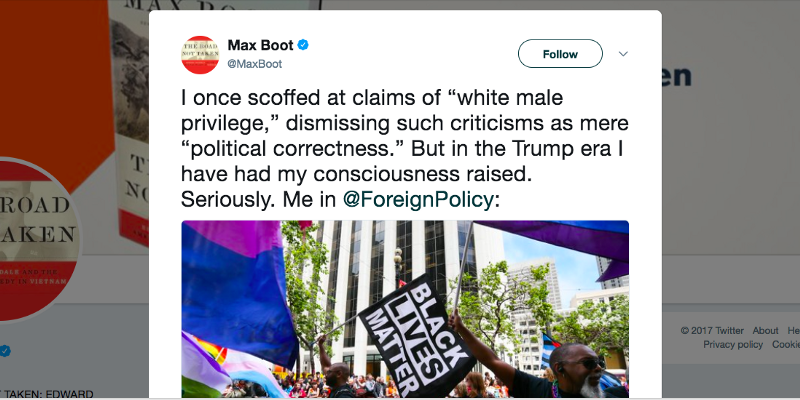
Boot, who is a PNAC signatory and senior fellow at the Council on Foreign Relations, published an article yesterday in Foreign Affairs which perfectly matches the newfound love of progressivism in his neocon soulmate Bill Kristol. The article, titled “2017 Was the Year I Learned About My White Privilege”, details in halting, equivocation-laden prose the months-long journey into awakening that this lying warmonger claims to have experienced during the Trump administration.
This spectacularly evil man, who wrote an essay titled “The Case for American Empire” just weeks after 9/11 in which he called in plain English for America to “unambiguously to embrace its imperial role,” is now seeing his latest essay shared eagerly by Democrats everywhere enthusiastically exclaiming “Look! See? This conservative gets it!”
I’m seeing some progressives arguing that Boot’s sudden public recognition of his white male privilege is intrinsically worthy of praise and acceptance, and that the proper response is to applaud him for it, not spit in his face. These people are wrong. Max Boot did not have some personal epiphany about race and gender dynamics which he felt like sharing in Foreign Policy magazine (the obvious place everyone goes for publication of their enlightening insights into privilege and inequality); Max Boot is courting Democrats because his war-hungry ideology is being increasingly rejected by Republicans.
If you want to see why neocons are courting Democrats with increasing desperation, check out the response to Boot’s latest essay by Fox’s Tucker Carlson, who has come to align with the popular anti-interventionist sentiments of Trump’s base, or Carlson’s debate with Boot on his show back in July:
Max Boot will say anything if they just let him invade Iran. https://t.co/M6MxBpr8oW
— Tucker Carlson (@TuckerCarlson) December 27, 2017
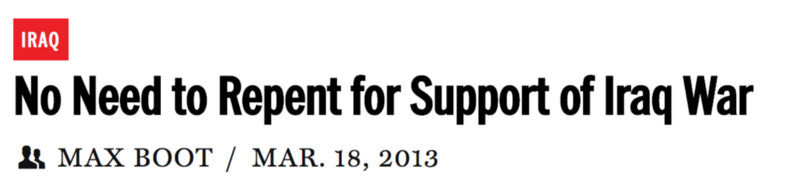
Meanwhile what have Democrats been doing? Supporting escalations with Russia based on accusations with no evidence that are reported as fact by the mainstream media in the exact sort of manic, violent, fact-free climate we saw in the lead up to the Iraq invasion (an invasion that Max Boot says nobody needs to repent for). Resistance hero Keith Olbermann says he owes George W Bush and John McCain an apology for the times he disagreed with them, and MSNBC’s Joy Reid openly admitted that she prefers people like Boot as allies instead of actual leftists and progressives:
One of the most amazing outcomes of the Trump administration is the number of neo-conservatives that are now my friends and I am aligned with. I found myself agreeing on a panel with Bill Kristol. I agree more with Jennifer Rubin, David Frum, and Max Boot than I do with some people on the far left. I am shocked at the way that Donald Trump has brought people together. [Laughs.]
~ Joy Reid
Reid’s comments are typical of the way the cult of anti-Trumpism has mainstream Democrats swooning over Bush-era neocons like they’re the Kennedys reincarnated instead of a bunch of child-butchering war profiteers. Just check out the top comments under this “Gosh I’m so woke all of a sudden!” tweet by neocon psychopath Bill Kristol.
In reality, nothing Trump has done in his administration so far is anywhere remotely close to as evil as the invasion of Iraq. The fact that hatred of the sitting president has Democrats so desperate they’re not only forgiving the crimes of vestigial Bush neocons but also helping them in their agenda to sabotage any movements toward detente with Russia shows just how brutally efficient the psychological manipulations of the establishment propaganda machine have become.
It was just in 2012 that these same Democrats were laughing along with their president at the Russia fearmongering of Mitt Romney.
Romney, who calls Russia our “No. 1 geopolitical foe,” doesn’t seem to realize it’s the 21st century. #RomneyNotReady http://t.co/xcvhOAFS
— The Democrats (@TheDemocrats) October 22, 2012
Neoconservatism first rose to prominence in the 1970s, and right off the bat one of its key principles was an opposition to detente with the USSR. This never changed. Not when neocons moved from the Democratic party to the Republican party, not when the Soviet Union fell, and not when neocons began migrating back from the Republican party to their old home in the Democratic party. Neocons have always been fixated on the world-threatening agenda of aggressively crushing Russia, and today the Democrats have picked up that flag and run with it right alongside them.
Which is why now we have depraved psychopaths like Max Boot and Bill Kristol acting out the bizarre performance of suddenly woke progressives. Their new Democratic buddies have already helped them resurrect the cold war on the same amount of evidence as was needed to manufacture support for the Iraq invasion, and with a little tweaking they hope to eventually convince them to help satiate their bloodlust in Iran and Syria as well.
The neocons don’t oppose Trump because he is evil, they oppose Trump because he isn’t evil enough. The slight bit of inertia he’s been placing on their death cult has been enough for them to pivot full-scale toward the Democratic party, which they hope to rebuild and lead into power with full sympathy for all the wars on their infernal wish list.
Don’t trust “woke Bill Kristol.” And don’t make a truce with him. https://t.co/cwE9Z7iSA4
— Vox (@voxdotcom) December 11, 2017
It’s not so accurate to say that, in 2017, Bill Kristol became a Democrat. It’s more accurate to say that in 2017, Democrats became Bill Kristol.
— Glenn Greenwald (@ggreenwald) December 26, 2017
The extremely influential neocon think tank Project for a New American Century’s most well-known publication, “Rebuilding America’s Defenses: Strategies, Forces, and Resources For a New Century”, argued extensively in the year 2000 that America’s victory in the Cold War against the USSR means the US must step into a planetary leadership role and maintain that leadership role by any means necessary, including military force.
“As the 20th century draws to a close,” PNAC’s 1997 Statement of Principles reads, “the United States stands as the world’s preeminent power. Having led the West to victory in the Cold War, America faces an opportunity and a challenge: Does the United States have the vision to build upon the achievements of past decades? Does the United States have the resolve to shape a new century favorable to American principles and interests?”
The answer to this question came after 9/11: yes, yes it does. The New American Century has seen an immense increase in military interventionism across the globe to ensure the hegemony of the US dollar and prevent Russia and China from climbing the global power ladder unchecked.
That’s all we’re seeing here in Woke Max Boot and Woke Bill Kristol. Neoconservatism has always been an ideology/military-industrial complex war profiteering scheme which advocates bullying and sabotaging all governments that could pose a threat to the planetary dominance of the US power establishment, and lately rank-and-file Republicans have been proving less useful in facilitating that agenda than rank-and-file Democrats. So they’re saying and doing whatever they need to in order to win the approval of the Dems.
The good thing to have come out of #Brexit and #Trump? Discovering new alliances with people you might once have thought only adversaries https://t.co/dDhhXGTwpB
— Peter Jukes (@peterjukes) December 28, 2017
Brave piece and thank you @MaxBoot:
“ People like me, in other words. Whether I realize it or not, I have benefitted from my skin color and my gender — and those of a different gender or sexuality or skin color have suffered because of it.” https://t.co/XqLSIinwOy— Amy Siskind (@Amy_Siskind) December 27, 2017
It’s always admirable when people evolve & have the courage to say where they were wrong. https://t.co/AfEKy07AbI
— Jill Filipovic (@JillFilipovic) December 28, 2017
And by golly, it sure looks like it’s working.
It’s not okay to be a neoconservative. In a healthy world, being a neocon would carry as much social weight as being a child molester or a serial killer. These people should not be embraced, they should be recoiled from. Always.
Until Democrats turn away from neoconservatism, the fact that they don’t should be pointed to at every opportunity. The correct response when any Democrat tries to tell you about Russia or Syria is “Get out of here with that Saddam-has-WMDs filth, neocon.”
That omnicidal death cult deserves nothing but our most sincere revulsion.
__________
Making the 2018 Elections a Struggle for Peace, Jobs and Justice
Voters’ search for political revolution continues
By Wayne Nealis | Dissident Voice | December 28, 2017
As we head into a pivotal mid-term election year, it is clear the Democratic Party establishment has not learned a key lesson from the 2016 election. That is, that many of the party’s former and current constituents reject the party’s establishment leadership and its lackluster program. These voters are looking for alternatives. In 2016, en masse they deserted the party for a new kind of politics they found in Bernie Sanders and some saw in Donald Trump.
Voters passed judgment on the leading figures of both parties. Distrust and discontent disrupted politics as usual. The opportunity to fill this void with left-of-center electoral initiatives abound. It starts with building on the momentum of Bernie Sanders’s campaign that resonated with tens of millions. In some fashion or another, ready or not, the 2018 midterm elections must become an arena of struggle for peace, economic security and racial justice.
Sanders’ leadership in 2016, and still today, falls short in two key areas to meet this challenge. First, during his campaign he did not offer Americans a bold new foreign policy. To start with, a plan to end the war on terrorism and the foreign military adventures that have made us less safe and destabilized and laid waste to a dozen nations. Secondly, after November, instead of calling for discussion on forming a new political party he and his advisors chose to form yet another 501c entity, Our Revolution, primarily as a vehicle to move the Democratic Party to the left. It would behoove Sanders to reconsider both choices. The Democratic Party’s electoral structure is certainly a vehicle for advancing progressive and even left candidates, but the party’s owners are not likely to hand over its bank accounts to Sanders, labor unions and people’s organizations.
Months after the elections the Clinton-Obama-Pelosi centrists still hold the reins and drive a shameless hubris as they scramble to blame someone for the party’s declining appeal and its 2016 losses. No, it was not Obama and Clinton’s support of the Trans Pacific Partnership (TPP) or Bill Clinton’s betrayal of labor unions on NAFTA. It was not due to Hillary’s use of the term “super predators” in 1996 to describe black youth involved in criminal activity. No, it was not the shortcomings of the bureaucratic, insurer-friendly Obamacare.
No, it was the Russian television network Russia Today brainwashing its 8 million American viewers. No, it was Russian cyber meddling in the election, for which months later we have zero evidence. Same goes for alleged Russian collusion with the Trump campaign. No, the loss was due to FBI director James Comey’s late in the game letter to congress about Clinton’s emails. No, it was WikiLeaks alleged release, in collaboration with Russia, of emails showing the Democratic National Committee (DNC) sought to derail Bernie Sanders’ campaign. Which, as we learned was the case.
After a full-court media campaign to convince Americans of Russian meddling, many remain skeptical. In a May 2017 CBS poll, 55 percent of Americans considered the allegations a distraction that “get in the way of getting things done.” In October, 41 percent still agree they were a distraction.1
Clinton again blamed Bernie Sanders in her post-election book tour, dubbed by some The Denial Tour. “His attacks caused lasting damage, making it harder to unify progressives in the general election….” Not exactly the kind of message designed to heal and unify the party going into 2018 elections. Since polls show Bernie is the most admired politician in America, topping 70 percent, to say her grumbling is a political misstep for the party is an understatement.
Yet, even as Clinton’s own poll ratings dropped to 30 percent, she continued to maintain the loss was due to something other than an uninspiring campaign and the neo-liberal, anti-working class politics the Democratic Party’s centrist leadership has pedaled for 30-plus years. Clinton even blamed the Democratic National Committee (DNC), led by a loyal Clinton supporter, Debbie Wasserman Schulz, saying it “…was on the verge of insolvency. Its data was mediocre to poor, nonexistent, wrong.”2
A crisis of legitimacy
Both Sanders and Trump’s campaigns rode on a crisis of legitimacy in the two parties. Today, only 18 percent of voters consider themselves strong Democrats. The no longer Grand Old Party is slightly worse off at 15 percent. So far, Trump maintains most of his loyal voter support, which we should keep in mind, is only around 25 percent of the total electorate.
The attendant political volatility arising from the 2016 election combined with numerous international crises, presents an opportunity for demagogic appeals to patriotism, xenophobia and racism to deepen and spread. At the same time, it is an opening to advance a working-class political and economic program to provide meaningful, concrete solutions to address people’s grievances and discontents. A program, we might call a Sanders plus program, the plus being a plan for peace.
The Sanders wing of the Democrats is hesitant, waiting. Will Sanders break with the party? Be sidelined? Clearly, Sanders is taking on the establishment, pushing his economic program of social benefits, but it appears his aim is to reform or take over the party. A tough job when those hanging on to power, did not mention Sander’s program until September, when 15 Democratic senators finally endorsed single-payer national health insurance. In the House, progressive Democrats have signed on Bernie’s program for free post-secondary education, paid parental leave and expanding social security. However, there is little evidence of serious actions being taken on the part of the leadership to rally Americans behind the legislation. After Sanders introduced his single-payer bill, Hillary Clinton and other Democratic leaders, notably Rep. Nancy Pelosi and Sen. Chuck Schumer, told voters they do not support single-payer. Again, the failure of the leadership to learn the lessons of 2016.
Understandably then, Americans give the leadership low marks when it comes to presenting alternatives to Trump’s reactionary program. A Washington Post – ABC News poll in late October this year found only 28 percent of voters thought the Democrats were offering real alternatives.3 Nearly one half of Democratic responders and 65 percent of independents said the leadership was just criticizing Trump. One attempt to launch an alternative program failed miserably.
The Democrats “Better Deal” falls flat
In July, a Pelosi–Schumer road show unveiled the party’s alternative to the Trump-GOP program: “A Better Deal: Better Jobs, Better Wages, Better Future.” In a Washington Post, Op-ed, Pelosi said the Deal, “represents a renewed Democratic commitment to the hard-working men and women across the United States who have been left out and left behind for too long.” It rained hard in Berryville, Virginia that day, the site of show. Reviews rained even harder on the Democrat’s proposal. It made no mention of Sanders’ far-reaching social benefit program that would lift up the left out. Their effort to make a splash with the working class was drowned in empty words, rhetorical promises and contrived apologies for abandoning working-class voters.
If Schumer, Pelosi, Clinton et al wanted to rebuild the party they only need reach out to the millions who responded to Sanders program for expanding social benefits at the expense of the billionaire class. Instead all we hear is Russia, Russia, Russia. Some pundits allege the Democratic leadership is tone-deaf to political reality, but their silence is due to an unwillingness to break with their corporate sponsors any more than are the masters of the once Grand Old Party. Instead both parties, and institutions in their orbits, are worried Americans are losing faith in the long-standing institutions of the limited “democracy of the few” embodied by the two-party capitalist system.
In January, Linda Chavez, a former Reagan cabinet member turned media pundit, put it this way in her New York Post column: “Democracy can only exist as long as the people trust its institutions. The greatest calamity of this election cycle has been the weakening of that trust.” Another reading of her statement is both Sanders and Trump upset the well painted façade of democratic governance. Neither candidate could be trusted to be loyal administrators of the bi-partisan imperialist foreign policy and neo-liberal economic program of capitalism.
While Chavez may lament this decline, those seeking a more just, peaceful society have an opportunity to step into this vacuum and begin building a new political party responsive to, and with, our nation’s multi-national working class, white and blue collar, youth and students. The massive discontent with politics as usual offers fertile ground. The first step is to agree on a working-class program for economic security, peace and racial justice. The next is to bring it into the 2018 mid-term election and beyond.
Resolutions at the AFL-CIO Convention in October showed emerging sentiment among labor union leaders for independence from the two parties and for renewing the idea of a Labor Party. A resolution calling for a pro-worker agenda and “an independent political voice,” stated: “The time has passed when we can passively settle for the lesser of two evils.”4
According to the People’s World reporting from the convention, 50 delegates met for a discussion on the idea of a Labor Party.5 Postal Workers President Mark Dimondstein led a convention floor discussion and roused an applause when he said: “The Democratic Party was not delivering anything even when it had control of the White House, the Congress and the Senate.” This echoed the position of another resolution on electoral politics that concluded that: “continuing to follow the same model, expecting different results, is not an effective strategy for labor.”6
Help wanted: political leaders who stand for something
Propelling the urgency for bold alternatives in 2018 and beyond is that another capitalist economic crisis is looming on the horizon. Absent an alternative such a crisis will enlarge the opening for demagogic solutions like those offered by Trump’s GOP, as well as, austerity measures authored by the corporate allies of both parties. Might it be possible that Our Revolution will find an independent political footing to meet this challenge? Might progressive labor unions unite with people’s movements and Our Revolution to meet this challenge? These possibilities deserve urgent attention if we are to prevent Trump’s new GOP from consolidating power.7
Single-payer advocates welcomed senate Democrats finally getting behind Medicare for all legislation, but there is a steep hill to climb to win over skeptical workers fed up with just about every establishment Democrat. Democratic Representative Tim Ryan of Ohio said, in a New York Times interview in June, following the loss of Jon Ossoff in Georgia, that the party had become “toxic” in much of the country as voters see Democrats as “not being able to connect with the issues they care about.”8
In the same article D. Taylor, the president of the union Unite Here, representing hospitality workers across the country said, “Millions of Americans are desperate to be led by political leaders who stand for something, are willing to take risks, and are willing to tell the truth and engage Americans where they live. That just isn’t happening.” Labor unions and people’s movements who wait for the Democratic Party to make it happen will still be waiting in 2024. Now is the time to build and organize the mass sentiments revealed by the Sanders’ campaign. It’s no time to hesitate or go slow. It is time to take bold risks with confidence and trust that people will respond.
Although the Tim Ryans of the Democratic Party are not likely to call their own foreign policy “toxic,” 2016 showed millions of voters were concerned about Hillary Clinton’s aggressive support of military interventions. Sanders’ repeated criticism of her record resonated broadly with young people, progressives and among the working class. In the fall, Trump even told his voters at rallies that a vote for Hillary would be a vote for more war.
Yet, since the election the Democratic leadership has lent tacit support to Trump’s military budget increases and his ratcheting up of aggression against Venezuela, Iran, North Korea and China. Particularly egregious is the support of both parties’ leaders, for Saudi Arabia’s murderous war against the people of Yemen. Aggression that began with support from the Obama Administration. Not a word of criticism, except for a handful of progressive Democratic officials.
An electoral counter to such dangerous jingoism requires fielding dozens of congressional candidates on a program for peace. This is the glimmer of rationality that peace-loving, oppressed and war-torn peoples around world desperately await U.S. activists to initiate in the citadel of imperialism. Left and progressive organizations that avoid this work shirk their international responsibilities.
A good place to start is to press candidates and incumbents to support a new direction in foreign policy as advanced by AFL-CIO resolution: War is not the Answer.9 It calls on the president and congress “to bring the war dollars home and make our priority as a nation rebuilding this country’s crumbling infrastructure, creating millions of living wage jobs and addressing human needs such as education, health care, housing, retirement security and jobs. Furthermore, it calls “for a foreign policy based on international solidarity of all workers, mutual respect of all nations and national sovereignty…”
If candidates won’t sign on, challenge them. Pressure them. Americans are tired of war. The AFL-CIO resolution reflects this sentiment. Make 2018 a struggle for peace. General election and primary challengers running on a plan for peace may not win, but such a presence is urgently needed to elevate the struggle for peace, economic security and racial justice.
- “Americans worried about Russian influence on elections,” October 30, 2017. SurveyMonkey poll conducted from October 23 to October 26
- CNN, Chris Cillizza, Editor-at-large. “In election blame game, it’s time for Hillary Clinton to take her share,” June 1, 2017.
- Washington Post. “Trump’s approval rating remains historically low and confidence has declined.” Washington Post-ABC News poll, October 29-November 1, 2017. November 13, 2017.
- Resolution 2: “An independent political voice.” Resolutions, 2017 AFL-CIO Convention.
- John Wojcik and Mark Gruenberg. People’s World, “AFL-CIO calls for a break with “lesser of two evils” politics,” October 25, 2017.
- Resolution 48: “Exploring new directions for labor in electoral politics.”
- See my analysis of this danger in the December 2017, Adonde Press pamphlet, “The 2016 Election: Analysis, Lessons and Task Ahead.”
- Alexander Burns and Jonathan Martin. New York Times. “Democrats Seethe After Georgia Loss: ‘Our Brand Is Worse Than Trump.’”, June 21, 2017.
- Resolution 50: “War is not the Answer.” Resolutions, 2017 AFL-CIO Convention.
Mattis: US will send more ‘diplomats’, contractors to Syria
Press TV – December 29, 2017
Defense Secretary Jim Mattis says he is expecting to see a larger US civilian presence in Syria, where there are already 2,000 American troops without the authorization of the Syrian government.
Mattis said Friday that the US would deploy more contractors and diplomats to the war-torn country, with which Washington has suspended diplomatic relations.
“What we will be doing is shifting from what I would call an offensive, shifting from an offensive terrain-seizing approach to a stabilizing… you’ll see more US diplomats on the ground,” Mattis told reporters at the Pentagon.
“Well when you bring in more diplomats, they are working that initial restoration of services, they bring in the contractors, that sort of thing,” he added.
“There is international money that has got to be administered, so it actually does something, it doesn’t go into the wrong people’s pockets.”
He also claimed that the diplomats and contractors might train local forces in parts of the country retaken from Daesh to clear improvised explosive devices (IEDs) and hold territory to help ensure that Daesh does not take back territory.
“It is an attempt to move towards the normalcy and that takes a lot of support,” said Mattis.
He did not give any specific information about the number of US diplomats who would serve in Syria and when.
Daesh unleashed a campaign of bloodshed and destruction in Syria in 2014, overrunning considerable expanses of territory.
The same year saw the United States launch a so-called campaign against the terrorists together with a coalition of its allies.
The military alliance had done little in the fight against Daesh, and has instead been repeatedly accused of targeting and killing civilians and hampering Syrian government operations against the Takfiri group.
The so-called Syrian Observatory for Human Rights (SOHR) reported on November 23 that 2,759 civilians, including 644 minors and 470 women, had been killed in US-led aerial attacks against civilian areas in Syria over the past 38 months.
The American forces support the anti-Damascus Kurdish militants in the north, who have, according to Syria, been seeking to gain more territory under the pretext of fighting terror.
All Is Not Quiet on the Syrian Front: US to Launch Another War
By Alex GORKA | Strategic Culture Foundation | 29.12.2017
This is a classic example of flip-flop policy. In November, the US promised Turkey to stop arming Kurdish militias in Syria after the Islamic State was routed. Brett McGurk, the US Special Presidential Envoy to the Global Coalition to Defeat Islamic State, explained that after the urban fighting in Raqqa was over “adjustments in the level of military support” would be made. “We had to give some equipment – and it’s limited, extremely limited – all of which was very transparent to our NATO ally, Turkey,” he said during a special briefing on December 21. In June, the US told Turkey it would take back weapons supplied to the Kurdish the People’s Protection Units (YPG) militia in northern Syria after the defeat of Islamic State.
But sophisticated weapons will continue to be sent to Syria in 2018, including thousands of anti-tank rocket launchers, heat seeking missiles and rocket launchers. The list of weaponry and equipment was prepared by US Department of Defense as part of the 2018 defense budget and signed by Trump of Dec. 12. It includes more than 300 non-tactical vehicles, 60 nonstandard vehicles, and 30 earth-moving vehicles to assist with the construction of outposts or operations staging areas. The US defense spending bill for 2018 (“Justification for FY 2018 Overseas Contingency Operations / Counter-Islamic State of Iraq and Syria Train and Equip Fund”) includes providing weapons worth $393 million to US partners in Syria. Overall, $500 million, roughly $70 million more than last year, are to be spent on Syria Train and Equip requirements. The partners are the Kurds-dominated Syria Democratic Forces (SDF). The YPG – the group that is a major concern of Turkey – is the backbone of this force.
The budget does not refer to Syrian Democratic Forces (SDF) but instead says “Vetted Syrian Opposition”. According to the budget list, there are 25,000 opposition forces supported as a part of the train and equip program in Syria. That number is planned to be increased to 30,000 in 2018. The arming of Kurdish militants with anti-tank rockets is a sensitive topic because of Turkey’s reliance on its armored Leopard tanks in northern Syria.
Talal Sillo, a former high-ranking commander and spokesperson of the US-backed SDF, who defected from the group last month to go to Turkey, divulged details of the US arming the Kurdish group.
The list does not detail which vetted Syrian groups will receive certain pieces of equipment. In northern Syria, there is the SDF, including the YPG, and the Syria Arab Coalition — a group of Arab fighters incorporated into the SDF. The Maghawir al-Thawra and Shohada al-Quartayn groups are operating in the southeastern part of Syria. They are being trained by US and British instructors at the al-Tanf border crossing between Syria and Iraq.
Besides the SDF and the groups trained at al-Tanf, the US is in the process of creating the New Syria Army to fight the Syrian government forces. The training is taking place at the Syrian Hasakah refugee camp located 70 kilometers from the border of Turkey and 50 kilometers from the border of Iraq.
Around 40 Syria opposition groups on Dec. 25 rejected to attend the planned Sochi conference on Syria scheduled to take place in January. They said Moscow, which organizes the conference, was seeking to bypass the UN-based Geneva peace process, despite the fact that UN Syria envoy Staffan de Mistura said that Russia’s plan to convene the congress should be assessed by its ability to contribute to and support the UN-led Geneva talks on ending the war in Syria. If fighting starts, these groups are likely to join the formations created by the US.
So, the United States not only maintains its illegal military presence in Syria and creates new forces to fight against the Syrian government, it appears to be preparing for a new war to follow the Islamic State’s defeat. The continuation of arming and training Kurdish militias will hardly improve Washington’s relations with Ankara, while saying one thing and doing another undermines the credibility of the United States as a partner.
Featured Video

Ukraine Already Carved Up… Before Talks Begin? /Prof. Richard Sakwa
or go to
Aletho News Archives – Video-Images
New Book
The Vaccine Mafia: Pfizer’s Former Chief Toxicologist Proves How Toxic Substances Were Unlawfully Sold to Us as a Solution for COVID-19
By Helmut Sterz
Former Pfizer chief toxicologist Helmut Sterz presents a critical examination of the development, approval, and global rollout of mRNA COVID-19 vaccines—particularly those produced by Pfizer/BioNTech. The Vaccine Mafia details the failure of pharmaceutical companies, regulatory authorities, politicians, and international organizations to follow established scientific and ethical standards during the pandemic. Drawing on the author’s decades of experience in pharmaceutical toxicology, Sterz reveals the many ways the vaccines’ inadequate or omitted preclinical safety testing put the world’s population at risk.
Sterz demonstrates how “emergency” approvals allowed manufacturers to bypass long-standing international guidelines governing toxicity testing, especially with regard to reproductive and cancer risks. They also allowed governments and health authorities to ignore or conceal evidence of serious adverse effects that occurred, including myocarditis, reproductive harm, and other long-term health risks.
Blog Roll
 Aletho News
- Ukraine Already Carved Up… Before Talks Begin? /Prof. Richard Sakwa
- The vindication of Marjorie Taylor Greene
- Nearly 80% of Britons consider Israel a threat to world peace and security: Survey
- Rhode Island Staffer Could Be Reinstated After Firing Over Ceasefire Post
- Will Republicans Learn Their Lesson from the ‘Disastrous’ Midterms?
- Wrong, Newswise, Irresponsible Climate Messaging, Not Climate Change Itself, Is Fueling Student Anxiety
- Zelensky’s Critics Vanish Into Ukrainian Secret Prisons – Source
- Nima R. Alkhorshid: U.S. Military Bombs Multiple Targets on Iran’s Qeshm Island
- Iran-Linked Ships Spotted Hovering over Subsea Cables: Report
- New attack on Iran could devastate ‘Israel’, IOF general warns
- If Americans Knew
- An error has occurred; the feed is probably down. Try again later.
- No Tricks Zone
- Zonal Asymmetry of Temperature Change in the Antarctic Circumpolar Current
- New Study: The Net Fossil Fuel Contribution To Rising Atmospheric CO2 Has Been Zero For 500 Years
- Germany’s Green Energy Transition Becoming Increasingly Expensive…Another 6 Trillion Euros!
- Sudden Stratospheric Warming, Powerful El Niño Combination May Lead To Extreme Europe Cold, Energy Crisis!
- Two New Studies Find Thwaites Glacier Melt Cannot Be Driven By Human Activity Or A Warming Ocean
- E-Cars Reduce CO2 Emissions By Only 41% Compared To Internal Combustion Engine Vehicles
- Predictions Made By Renowned Climate Professor Over Past Decades Have Been Proven To Be Poor
- New Study Suggests Large Regions Of The Pacific Ocean Have Been Cooling For The Last 80 Years
- Germany’s Green Energy Debacle: High Energy Costs Force Kahla Porzellan to Close After 182 Years!
- New Study: 50 Years Of The Most Aggressive ‘Net Zero’ Policies Can Only Affect The Global Climate By 0.03°C

