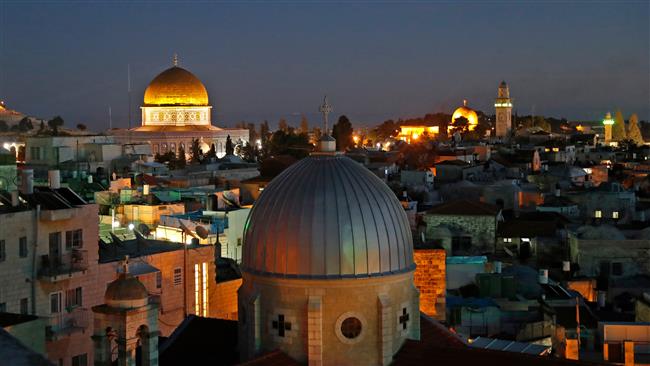
Ahead of a vote in the United Nations’ General Assembly on a resolution condemning US recognition of Jerusalem as Israel’s capital, president Donald Trump and UN ambassador Nikki Haley threatened states voting for the resolution with the loss of US financial aid. “We’re watching those votes” said Trump. “Let them vote against us, we’ll save a lot. We don’t care. But this isn’t like it used to be where they could vote against you and then you pay them hundreds of millions of dollars and nobody knows what they’re doing.”
A good call on Trump’s part. Now it’s time to follow through. Not because the US lost the UN vote, but because US foreign aid is an inherently disastrous budget item that needs to go. Trump seems to understand that. This is an issue he’s already begun to address with his 2018 budget proposal, which if adopted as written would have cut the US foreign aid budget from $30 billion to $25 billion per year. The more quickly that number moves toward $0, the better for America and the better for recipients of largess from the American government.
Supporters of foreign aid love to point out that it constitutes less than 1% of the federal budget. True, but that 1% comes with lots of strings attached for both parties.
When the US government throws money at another country’s government, it instantly becomes entangled in that country’s problems — internal and external, economic and military, every problem of every sort. For every action there’s an equal and opposite reaction — when America tries to be the good guy for Country A, America also ends up being the bad guy for Country B, and/or for domestic opponents of Country A’s political establishment. The potential negative consequences of such entanglements include, but aren’t limited to, terrorism and war.
On the receiving side, well, there’s no such thing as a free lunch. Washington wants things for its money — things ranging from support for its military adventures to distortions on the recipients’ economies imposed through politics for the benefit of this or that set of corporate cronies. In many cases, the lunch is not just un-free, but insanely over-priced.
Even at current levels, the US foreign aid budget comes to less than $10 per year per American. That’s not an argument for keeping it. It’s an argument for leaving foreign aid to the private charitable “market.” Americans spend one hundred times as much on coffee each year!
If you or I want to “support Israel” or “donate to Kenya” or “fight starvation in India,” we can easily afford to do so in like or greater amounts than the federal government does, individually or as members of voluntary organizations, and without those terrible strings attached.
Drain the swamp’ was a popular Donald Trump campaign slogan that referred to reducing the influence of Washington lobbyists. While the three words reflect an extreme lack of ecological consciousness — wetlands need to be protected and recreated, not destroyed — the image of politicians slogging their way through lobbyist infected, tangled, dense vegetation and deep oozing mud is a useful one.
Like the US capital, much of Ottawa was also built on mosquitoes’ favourite habitat and both cities today have an ongoing pest problem: blood sucking influence peddlers swarming the countries’ decision makers. That image helps explain why there is little deviation from Canada’s official foreign policy positions even amongst social democratic members of Parliament.
The recently re-established Canada-Palestine Parliamentary Friendship Group (CPPFG) offers a window into the dearth of opposition, notably from the NDP, to the foreign policy establishment. Chaired by Liberal MP Marwan Tabbara, CPPFG has nine MPs representing all the parties in the House of Commons except the Conservatives. But, CPPFG isn’t one of 17 official parliamentary associations or groups so it doesn’t receive public financial or administrative support, unlike the Canada-Israel Interparliamentary group.
In an equitable world the Palestinian parliamentary group — not the Israeli one — would be subsidized to offer MPs a counterpoint to Canada’s pro-Israel ideological climate. Supporters of Israel have established a slew of programs at high schools and universities, as well as media ‘flak’ organizations and advocacy groups, to promote that country’s viewpoint. Additionally, the dominant media favours the Israeli perspective and the Centre for Israel and Jewish Affairs is among the most aggressive lobbyists on Parliament Hill so MPs are not lacking for access to this outlook.
The Israel vs. Palestine parliamentarian bodies offer a unique window into how international power relations are reflected in House of Commons associations. But, the parliamentary association system more broadly reflects inequities in global power and wealth.
Nearly half the 17 associations that share a $4.5 million public envelope are focused on Europe. There is a Canada-Europe Parliamentary Association and an associated Canadian Delegation to the Organization for Security and Co-operation in Europe Parliamentary Assembly as well as country-specific groups for France, Germany, Italy, Ireland and the United Kingdom. Alongside Canada’s European G7 allies, there are Japan and US parliamentary associations.
Though it is a competitor to the US-led geopolitical order, China’s economic might warrants a parliamentary group. There are also associations promoting the Francophone and Commonwealth, which are rooted in European colonialism (previously it was called the Empire Parliamentary Association).
The only two associations focused on the Global South are the Canadian Section of ParlAmericas Bilateral Associations, representing 35 countries in the Western hemisphere, and the Canada-Africa Parliamentary Association, representing 53 countries on the continent. (As is usual with Africa-related bodies, that association’s mission statement includes ‘benevolent Canada’ paternalism. It says “Canadian parliamentarians also have the opportunity to witness the local impact of programs funded by the Canadian International Development Agency (CIDA) and to learn about Canada’s efforts in Africa from Canadian officials in the field.”)
There is no Cuba or Venezuela parliamentary association. Nor are there any focused on 1.3 billion Indians or 180 million Nigerians or a parliamentary association devoted to the counterhegemonic Non-Aligned Movement or ALBA (Bolivarian Alliance for the Peoples of Our America).
Another way the Ottawa swamp forms MPs’ international views is through events and parties put on by diplomats. In The Blaikie Report long time NDP defence and foreign critic Bill Blaikie describes “enjoying many fine evenings” at the home of the British High Commissioner. Wealthier countries are more likely to have representation in Ottawa and have greater capacity to organize events promoting their country’s international positions.
Sometimes connected to diplomatic postings in the capital, MPs regularly travel on international trips organized and paid for by third parties. While the Globe and Mail has recently devoted significant attention to China sponsored trips, Israel and Taiwan have long been the principal destinations. A 2014 calculation found that a quarter of all federal MPs had been to Israel with an Israeli nationalist organization.
Opposition MPs are absorbed into the foreign policy establishment in other ways. At the start of year B.C. NDP MP Wayne Stetski participated in a House of Commons Standing Committee on Foreign Affairs and International Development mission to Ukraine, Latvia, Poland and Kazakhstan while last month Tom Mulcair went on a Committee mission to Beijing, Hong Kong, Hanoi and Jakarta. Last year NDP foreign critic Hélène Laverdière traveled to Israel with representatives of the other parties and in 2014 then NDP foreign critic Paul Dewar joined foreign minister John Baird and Liberal MP Marc Garneau on a visit to Iraq. Global Affairs Canada and diplomats in the field usually organize these visits.
The Canadian Group of the Inter-Parliamentary Union and the Canadian NATO Parliamentary Association are the final officially recognized parliamentary associations. A presentation at a NATO meeting convinced Bill Blaikie to support the organization’s bombing of the former Yugoslavia in 1999. “I myself”, Blaikie writes, “had been affected by the presentation at a 1998 NATO parliamentary meeting in Barcelona of an Albanian woman from Kosovo, who tearfully pleaded for an intervention to stop the anticipated wholesale slaughter of Kosovar Albanians.”
No official parliamentary association is devoted to de-militarization.
Beyond the NATO Parliamentary Association, MPs are drawn into the military’s orbit in a variety of other ways. Military officials regularly brief MPs. Additionally, the slew of ‘arms length’ military organizations/think tanks I detail in A Propaganda System: How Government, Corporations, Media and Academia Sell War and Exploitation speak at defence and international affairs committee meetings.
The Canadian Forces Parliamentary Program is, according to the Globe and Mail, a “valuable public-relations tool.” Set up by the Department of National Defence’s Director of External Communications and Public Relations in 2000, the Parliamentary Program embeds MPs in military training (Army in Action or Experience the Navy). According to the Canadian Parliamentary Review, the MPs “learn how the equipment works, they train with the troops, and they deploy with their units on operations. Parliamentarians are integrated into the unit by wearing the same uniform, living on bases, eating in messes, using CF facilities and equipment.” As part of the program, the military even flew MPs to the Persian Gulf to join a naval vessel on patrol.
Alongside the military, the arms industry lobbies MPs. Lockheed Martin’s name appeared 39 times in a “12-Month Lobbying Activity Search” of the Office of the Commissioner of Lobbying of Canada. CAE, General Dynamics, Raytheon, BAE and Airbus Defence were also listed dozens of times in the lobbyist registry. The Canadian Association of Defence and Security Industries has four registered lobbyists in Ottawa. Many of CADSI’s 800 members are also part of the Canadian Manufacturers & Exporters, Council of Chief Executives, Canadian Chamber of Commerce or Aerospace Industries Association of Canada. These groups also promote militarism and a pro-US foreign policy to government officials, though rarely do they speak in favour of withdrawing from military alliances or bucking Washington on an international issue.
Other corporations with international interests also have a significant presence on Parliament Hill. In a high-profile example, registered lobbyists representing Barrick Gold, Vale Canada, IAMGOLD, Goldcorp, Mining Association of Canada and Prospectors and Developers Association of Canada launched a ferocious campaign in 2010 to derail An Act Respecting Corporate Accountability for the Activities of Mining, Oil or Gas Corporations in Developing Countries (Bill C300), which would have restricted some public support for firms found responsible for significant abuses abroad.
Canada’s international banking, engineering, oil, etc. firms also shape attitudes in Ottawa. SNC Lavalin, CIBC, Bombardier and other Canadian-based multinationals’ names appear repeatedly in a “12-Month Lobbying Activity Search”.
The corporate/military/Global Affairs nexus predominates on foreign policy because there is little in terms of a countervailing force in Ottawa. Non-Governmental Organizations are sometimes considered critics of Canadian foreign policy, but NGOs are not well placed to challenge the federal government. Reliance on government aid and charitable status hampers their political independence.
On many domestic issues organized labour represents a countervailing force to the corporate agenda or state policies. But, unions rarely lobby MPs on international affairs.
The influence peddlers in the Ottawa foreign policy swamp represent a narrow range of interests.
So how do Canadians who want this country to be a force for good in the world effect change? Step one is to understand the system, then challenge the foreign policy establishment’s grip in Ottawa.
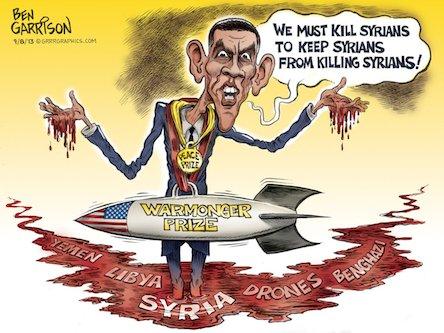
Did Barack Obama arm ISIS? The question strikes many people as absurd, if not offensive. How can anyone suggest something so awful about a nice guy like the former president? But a stunning report by an investigative group known as Conflict Armament Research (CAR) leaves us little choice but to conclude that he did.
CAR, based in London and funded by Switzerland and the European Union, spent three years tracing the origin of some 40,000 pieces of captured ISIS arms and ammunition. Its findings, made public last week, are that much of it originated in former Warsaw Pact nations in Eastern Europe, where it was purchased by United States and Saudi Arabia and then diverted, in violation of various rules and treaties, to Islamist rebels seeking to overthrow Syrian President Bashar al-Assad. The rebels, in turn, somehow caused or allowed the equipment to be passed on to Islamic State, which is also known by the acronyms ISIS or ISIL, or just the abbreviation IS.
This is damning stuff since it makes it clear that rather than fighting ISIS, the U.S. government was feeding it.
But CAR turns vague when it comes to the all-important question of precisely how the second leg of the transfer worked. Did the rebels turn the weapons over voluntarily, involuntarily, or did they somehow drop them when ISIS was in close proximity and forget to pick them up? All CAR will say is that “background information … indicates that IS [Islamic State] forces acquired the materiel through varied means, including battlefield capture and the amalgamation of disparate Syrian opposition groups.” It adds that it “cannot rule out direct supply to IS forces from the territories of Jordan and Turkey, especially given the presence of various opposition groups, with shifting allegiances, in cross-border supply locations.” But that’s it.
If so, this suggests an astonishing level of incompetence on the part of Washington. The Syrian rebel forces are an amazingly fractious lot as they merge, split, attack one another and then team up all over again. So how could the White House have imagined that it could keep weapons tossed into this mix from falling into the wrong hands? Considering how each new gun adds to the chaos, how could it possibly keep track? The answer is that it couldn’t, which is why ISIS wound up reaping the benefits.
But here’s the rub. The report implies a level of incompetence that is not just staggering, but too staggering. How could such a massive transfer occur without field operatives not having a clue as to what was going on? Was every last one of them deaf, dumb, and blind?
Not likely. What seems much more plausible is that once the CIA established “plausible deniability” for itself, all it cared about was that the arms made their way to the most effective fighting force, which in Syria happened to be Islamic State.
This is what had happened in Afghanistan three decades earlier when the lion’s share of anti-Soviet aid, some $600 million in all, went to a brutal warlord named Gulbuddin Hekmatyar. Hekmatyar was a raging bigot, a sectarian, and an anti-western xenophobe, qualities that presumably did not endear him to his CIA handlers. But as Steve Coll notes in Ghost Wars, his bestselling 2004 account of the CIA’s love affair with Islamic holy war, he “was the most efficient at killing Soviets” and that was the only thing that mattered. As one CIA officer put it, “analytically, the best fighters – the best-organized fighters – were the fundamentalists” that Hekmatyar led. Consequently, he ended up with the most money.
After all, if you’re funding a neo-medieval uprising, it makes sense to steer the money to the darkest reactionaries of them all. Something similar occurred in March 2015 when Syrian rebels launched an assault on government positions in the northern province of Idlib. The rebel coalition was under the control of Jabhat al-Nusra, as the local branch of Al Qaeda was known at the time, and what Al-Nusra needed most of all were high-tech TOW missiles with which to counter government tanks and trucks.
Arming Al Qaeda
So the Obama administration arranged for Nusra to get them. To be sure, it didn’t provide them directly. To ensure deniability, rather, it allowed Raytheon to sell some 15,000 TOWs to Saudi Arabia in late 2013 and then looked the other way when the Saudis transferred large numbers of them to pro-Nusra forces in Idlib. [See Consortiumnews.com’s “Climbing into bed with Al-Qaeda.”] Al-Nusra had the toughest fighters in the area, and the offensive was sure to send the Assad regime reeling. So even though its people were compatriots with those who destroyed the World Trade Center, Obama’s White House couldn’t say no.
“Nusra have always demonstrated superior planning and battle management,” Yezid Sayigh, a senior associate at the Carnegie Middle East Center in Beirut, said a few weeks later. If the rebel coalition was successful as a whole, it “was entirely due to their willingness to work with Nusra, who have been the backbone in all of this.”
Scruples, assuming they existed in the first place, fell by the wayside. A senior White House official toldThe Washington Post that the Obama administration was “not blind to the fact that it is to some extent inevitable” that U.S. weapons would wind up in terrorist hands, but what could you do? It was all part of the game of realpolitik. A senior Washington official crowed that “the trend lines for Assad are bad and getting worse” while The New York Times happily noted that “[t]he Syrian Army has suffered a string of defeats from re-energized insurgents.” So, for the master planners in Washington, it was worth it.
Then there is ISIS, which is even more beyond the pale as most Americans are concerned thanks to its extravagant displays of barbarism and cruelty – its killing of Yazidis and enslavement of Yazidi women and girls, its mass beheadings, its fiery execution of Jordanian fighter pilot Moaz al-Kasasbeh, and so on.
Yet U.S. government attitudes were more ambivalent than most Americans realized. Indeed, the U.S. government was strictly neutral as long as ISIS confined itself to attacking Assad. As a senior defense official told the Wall Street Journal in early 2015: “Certainly, ISIS has been able to expand in Syria, but that’s not our main objective. I wouldn’t call Syria a safe haven for ISIL, but it is a place where it’s easier for them to organize, plan, and seek shelter than it is in Iraq.”
In other words, Syria was a safe haven because, the Journal explained, the U.S. was reluctant to interfere in any way that might “tip the balance of power toward Syrian President Bashar al-Assad, who is fighting Islamic State and other rebels.” So the idea was to allow ISIS to have its fun as long as it didn’t bother anyone else. For the same reason, the U.S. refrained from bombing the group when, shortly after the Idlib offensive, its fighters closed in on the central Syrian city of Palmyra, 80 miles or so to the east. This was despite the fact that the fighters would have made perfect targets while “traversing miles of open desert roads.”
As The New York Times explained: “Any airstrikes against Islamic State militants in and around Palmyra would probably benefit the force of President Bashar al-Assad. So far, United States-led airstrikes in Syria have largely focussed on areas far outside government control, to avoid the perception of aiding a leader whose ouster President Obama has called for.” [See Consortiumnews.com’s “How US-Backed War on Syria Helped ISIS.”]
Looting Palmyra
The United States thus allowed ISIS to capture one of the most archeologically important cities in the world, killing dozens of government soldiers and decapitating 83-year-old Khalid al-Asaad, the city’s retired chief of antiquities. (After looting and destroying many of the ancient treasures, ISIS militants were later driven from Palmyra by a Russian-backed offensive by troops loyal to President Assad.)
Obama’s bottom line was: ISIS is very, very bad when it attacks the U.S.-backed regime in Iraq, but less so when it wreaks havoc just over the border in Syria. In September 2016, John Kerry clarified what the administration was up to in a tape-recorded conversation at the U.N. that was later made public. Referring to Russia’s decision to intervene in Syria against ISIS, also known by the Arabic acronym Daesh, the then-Secretary of State told a small knot of pro-rebel sympathizers:
“The reason Russia came in is because ISIL was getting stronger. Daesh was threatening the possibility of going to Damascus and so forth, and that’s why Russia came in, because they didn’t want a Daesh government and they supported Assad. And we know this was growing. We were watching. We saw that Daesh was growing in strength, and we thought Assad was threatened. We thought, however, we could probably manage, that Assad might then negotiate. Instead of negotiating, he got … Putin in to support him. So it’s truly complicated.” (Quote starts at 26:10.)
“We were watching.” Kerry said. So, by giving ISIS free rein, the administration hoped to use it as a lever with which to dislodge Assad. As in Afghanistan, the United States thought it could use jihad to advance its own imperial interests. Yet the little people – Syrian soldiers, three thousand office workers in lower Manhattan, Yazidis, the Islamic State’s beheading of Western hostages, etc. – made things “truly complicated.”
Putting this all together, a few things seem clear. One is that the Obama administration was happy to see its Saudi allies use U.S.-made weapons to arm Al Qaeda. Another is that it was not displeased to see ISIS battle Assad’s government as well. If so, how unhappy could it have been if its allies then passed along weapons to the Islamic State so it could battle Assad all the more? The administration was desperate to knock out Assad, and it needed someone to do the job before Vladimir Putin stepped in and bombed ISIS instead.
It was a modern version of Henry II’s lament, “Who will rid me of this meddlesome priest?” The imperative was to get rid of Assad; Obama and his team had no interest in the messy details.
None of which proves that Obama armed ISIS. But unless one believes that the CIA is so monumentally inept that it could screw up a two-car funeral, it’s the only explanation that makes sense. Obama is still a congenial fellow. But he’s a classic liberal who had no desire to interfere with the imperatives of empire and whose idea of realism was therefore to leave foreign policy in the hands of neocons or liberal interventionists like Secretaries of State Hillary Clinton and John Kerry.
If America were any kind of healthy democracy, Congress would not rest until it got to the bottom of what should be the scandal of the decade: Did the U.S. government wittingly or unwittingly arm the brutal killers of ISIS and Al Qaeda? However, since that storyline doesn’t fit with the prevailing mainstream narrative of Washington standing up for international human rights and opposing global terrorism, the troublesome question will likely neither be asked nor answered.
Daniel Lazare is the author of several books including The Frozen Republic: How the Constitution Is Paralyzing Democracy (Harcourt Brace).
This is, unfortunately, no surprise at all. It happens every time that a key surveillance provision is set to sunset. Rather than have any real public debate about it, the “surveillance hawks” in Congress refuse to do anything until there are just weeks left until the provision would expire… and then try to ram through a renewal. And, indeed, that’s exactly what’s happening. While people who are concerned about these surveillance powers have been urging debate on possible reform for basically two years, Congress has mostly ignored all such requests. Instead, they pushed for a very weak “reform” bill… and then did nothing about it for months. And now, they apparently announced just last week a plan to vote on a toothless bill today. No debate, no notice, no discussion. As EFF notes, this bill is bad:
As we wrote, the bill, originally introduced by Chairman Devin Nunes before the House Permanent Select Committee on Intelligence, “allows warrantless search of American communications, expands how collected data can be used, and treats constitutional protections as voluntary.”
The bill would create an easy path for the NSA to restart an invasive type of surveillance (called “about” searches) that the agency voluntarily ended earlier this year because of criticisms from the FISA court. It would also give FBI agents the power to decide whether or not to seek a warrant to read American communications collected under Section 702.
Of course, it’s particularly ridiculous that it’s Nunes pushing for this broad renewal of Section 702. While he has a very long history of actively misleading the public about what the NSA can actually do, he was also the one who flipped out when he found out that Section 702 was used (legally under the law) to conduct surveillance that swept in the communications of General Mike Flynn’s calls with Russians. And yet, here he is, making sure that that power continues, without restrictions, suggesting that maybe (just maybe) his public wailing about the surveillance on Flynn was political theater, rather than legitimate concern.
EFF has set up a page to let you contact your Representative to let them know to vote against the bill. Unfortunately, when surveillance hawks started screaming in Congress about how failing to pass this bill will “harm national security” and “put us at risk of terrorist attacks” or “take away a key NSA tool” many Congress members who aren’t knowledgeable about the details will reflexively vote for the bill. Check out the EFF’s page and make sure that your elected representative knows that this is a bad bill that wrecks the 4th Amendment rights of Americans and allows for massive domestic surveillance.
In case you want a refresher, a few months back we wrote about an an important report by Marcy Wheeler detailing twelve years of NSA surveillance abuse, much of it done under this 702 program that is set to expire at the end of the year, and which this new bill seeks to renew without any real change. Please read up and let your elected representatives know not to support this bill.
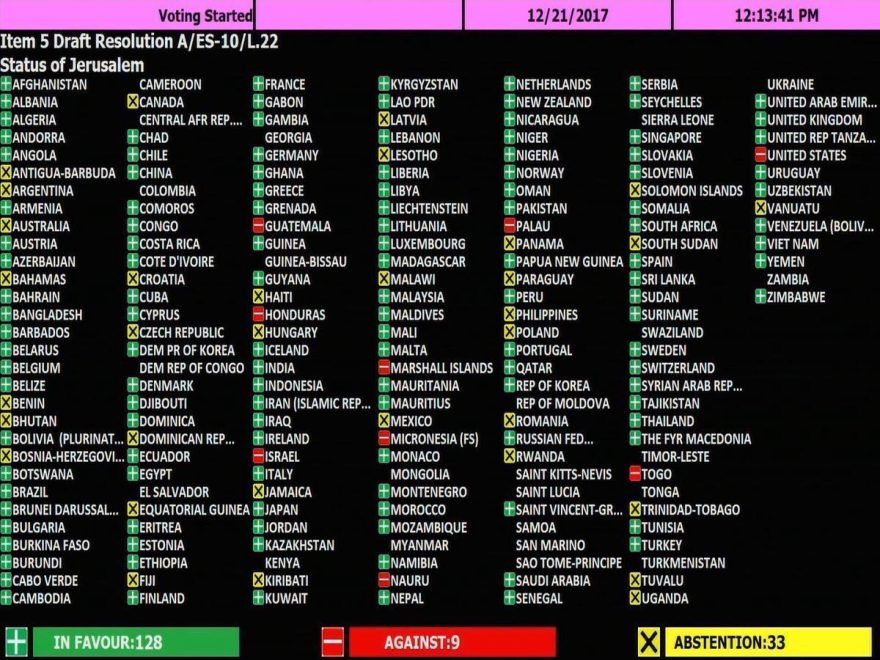
The UN General Assembly has overwhelming adopted a resolution calling on the US to reverse its decision to recognize Jerusalem as the capital of Israel. One hundred and twenty-eight countries voted in favor of the motion.
Nine states voted against the UN resolution and 35 nations abstained.
Turkey, which has led the Muslim opposition to the US Jerusalem declaration, was among the first to speak at the meeting. Turkish Foreign Minister Mevlut Cavusoglu stressed that only a two-state solution and sticking to the 1967 borders can be a foundation for a lasting peace between Israel and Palestine. The minister said that since Jerusalem is the cradle for the “three monotheistic religions,” all of humanity should come together to preserve the status quo.
“The recent decision of a UN member state to recognize Jerusalem as the capital of Israel violates the international law, including all relevant UN resolutions. This decision is an outrageous assault on all universal values,” Cavusoglu said.
US envoy to the UN Nikki Haley said that whatever decision is made by the UNGA, it will not influence Washington’s decision to recognize Jerusalem as the capital of Israel. Haley reminded UN members of the US’ generous contributions to the organization and said that the United States expects its will to be respected in return.
“When we make a generous contributions to the UN, we also have a legitimate expectation that our goodwill is recognized and respected,” Haley said, adding that the vote will be “remembered” by the US and “make a difference on how the Americans look at the UN.”
Israeli envoy to the UN Danny Danon stated that Israel considers Jerusalem its capital, dating back to Biblical times, and the US decision only outlines the obvious. Danon went further and accused the UN of “double standards” and an “unbreakable bond of hypocrisy” with Palestine and prejudice against Israel.
“Those who support today’s resolution are like puppets. You’re puppets pulled by the strings of your Palestinian puppet masters. You’re like marionettes forced to dance, while the Palestinian leadership looks on with glee,” Danon told the gathering.
The US leadership earlier voiced threats towards UN member states which would back the UN resolution against its Jerusalem decision. Haley said Washington would be “taking names.”
Trump also suggested that countries which vote in favor of the resolution at the UN General Assembly will lose money. “Let them vote against us,” he said. “We’ll save a lot. We don’t care. But this isn’t like it used to be where they could vote against you and then you pay them hundreds of millions of dollars… we’re not going to be taken advantage of any longer.”
The US threats were condemned by Turkey, with the country’s President Recep Tayyip Erdogan stating that Trump “cannot buy Turkey’s democratic will.”
“I hope and expect the United States won’t get the result it expects from there (the UN General Assembly) and the world will give a very good lesson to the United States,” Erdogan said during a speech in Ankara on Thursday ahead of the meeting.
On Monday, the US vetoed a UN Security Council (UNSC) resolution on Jerusalem, which had demanded that the American decision to recognize the city as the Israeli capital be withdrawn. All other UNSC members voted in favor of the document.
In a highly significant diplomatic gesture, India showed solidarity with Russia in the UN General Assembly vote on Tuesday, which condemned the human rights situation in Crimea and Sevastopol. The resolution, which was proposed by Ukraine and backed by the western powers was passed by 70 votes, with 76 countries abstaining and 26 opposing.
Interestingly, India was the only country from South Asia to oppose the resolution – Pakistan and Sri Lanka abstained – and one of just three from Asia-Pacific to do so – the others being China and Myanmar. The line-up of voting had the ominous look of an epic ‘East-West’ battle of a bygone era. There is no issue that can be more important for Russian foreign policy today than Ukraine. And US pressure is building up on Russia lately. From the US perspective, there is no better way to whip up the enemy image of Russia and shepherd dispirited European allies behind its transatlantic leadership than by rekindling the embers in eastern Ukraine. (Read my earlier blog US-EU-Russia tensions spill over the Ukraine.)
This has been, therefore, a brilliant assertion of India’s independent foreign policies. Simply put, the Modi government took a deliberate decision to stand up and be counted as Russia’s friend – although President Trump had just the previous day issued a birth certificate to India as ‘global power’. This would have been a decision taken at a political level – probably even at the highest level — because these are extraordinary times when Nikki Haley keeps a note pad to jot down where individual countries stood on issues of vital interest to the American foreign policy and, presumably, she is under instruction to report directly to the boss. (BBC)
India has traditionally taken a dim view of the intrusive western attempts to use the pretext of human rights to politicize regional issues. But then, this is not like any other issue. Nothing brings it home [more] than the curious coincidence that even as the UN General Assembly vote on Crimea got under way, the US state department disclosed in Washington that the Trump administration has decided to cross the ‘red line’ in Ukraine. (Canada, which usually does the foreplay for the US, took a similar decision last week.) Moscow has repeatedly warned Washington against precipitating a flare-up in Ukraine by arming the forces of ultra-nationalists and neo-Nazis who double as the ‘army’ in Kiev.
But Russia apparently anticipated the US move. In fact, there were far too many tell-tale signs that couldn’t be overlooked. Reports have been appearing of Ukrainian troop movements on the Donbas front. The Russian monitors within the OSCE group were being prevented from physically accessing the frontline. At a meeting of the OSCE Permanent Council in Vienna on December 14, the Russian ambassador detailed the violations of the Minsk agreement protocol by the Ukrainian forces. (Transcript) On December 19, Moscow announced that it was withdrawing the Russian officers in the monitoring group, since “further work of the Russian Armed Forces’ mission at the Centre has become impossible.” (MFA)
A concerted attempt seems to have begun to ‘activate’ the front in Eastern Ukraine. Smarting under the humiliating defeat in the project to overthrow the Assad regime in Syria, Washington is blackmailing Moscow.
The US National Security Advisor HR McMaster recently hinted at a new doctrine of ‘competitive engagement’ of Russia. Possibly, the generals in the Trump administration see the situation in Ukraine through the Cold War prism with a zero sum mindset. That will be a catastrophic mistake. Putin recently warned of massacres worse than Srebrenica if violence flares up again in Ukraine. But then, if there is another refugee problem, it will be after all Germany’s headache – not Trump’s.
Now, what could be the Russian counter-move? For sure, President Vladimir Putin would have thought through a long time ago already what should be the next step and the step thereafter and the step even thereafter if Trump refuels the conflict in Ukraine.
The Washington Post reports President Donald Trump has approved providing lethal weapons to Ukraine’s armed forces.
Specifically, according to the report, the decision opens the door for delivery of items like Model M107A1 sniper systems and ammunition, plus associated parts and equipment, with a value of $41.5 million. At the same time, presidential approval is reportedly still being withheld from providing Javelin man-held anti-tank missiles, which Kiev also wants.
The decision to provide lethal “defensive” weapons comports with repeated Congressional authorizations, passed with overwhelming bipartisan support since 2014. While former President Barack Obama declined to act on those authorities, President Trump evidently has now done so.
With regard to the domestic political purposes of the decision, it seems to be another Trump effort to appear wisely Solomonic by “splitting the baby”: look “strong” by making a muscular judgment but don’t go all the way. It’s the same ploy he used in recognizing Jerusalem as Israel’s capital (but not yet moving the US embassy, which he could easily do by switching the plaques of the US Consulate General in West Jerusalem with the current embassy in Tel Aviv) and by “de-certifying” the Iran deal (but not pulling the US out of it, yet).
For arming Ukraine, we can be sure Trump will be heaped with praise from the same domestic sectors that for more than a year have been denouncing him as “Putin’s puppet.” While there will be objections from antiwar dissidents – whose opinions don’t count – the only point of criticism from the establishment will be that he hasn’t yet gone far enough (the Javelins).
This has already begun, with Michael Carpenter, Barack Obama’s former Deputy Assistant Secretary of Defense for Russia, Ukraine, Eurasia, the Balkans, and conventional arms control, tweeting his approval of Secretary of Defense James Mattis for his role in the decision.
It’s reminiscent of the plaudits Trump received in April following his order to hit a Syrian airbase with cruise missiles in retaliation for a chemical attack that almost certainly was not committed by Syrian government forces. For example, at that time, CNN’s Fareed Zakaria, up to then uniformly a harsh critic who had derided Mr. Trump’s “rocking horse presidency” as a “circus,” intoned the next day: “I think Donald Trump became President of the United States last night.” Expect more of such hosannas in the coming days.
Carpenter’s mention of Mattis is significant. According to the Post report, Trump approved sending the arms to Ukraine by signing off on a decision memorandum presented by Mattis and Secretary of State Rex Tillerson. (It is certain that National Security Adviser H.R. McMaster also concurred, or the memo would not have been given to the President.) As Carpenter would know (and as I would know, having had a hand in drafting State Department decision memoranda), the principal almost always signs off on the decision option preferred by the subordinates who drafted the memo. While Trump no doubt understands the gravity of the decision, his grasp of the details would be no more than what his underlings wanted him to know to point him to their favored outcome.
The Ukraine decision comes two days after the release of a US National Security Strategy (NSS) that could be best called confused. Pillar I (defense of American borders and tightening immigration controls to keep dangerous people out) and Pillar II (ending unfair trade practices and restoring America’s industrial base) are solid “America First” principles from Trump’s campaign and a repudiation of the Democratic and Republican establishments.
But Pillar III could have been drafted by any group of George W. Bush retreads – and no doubt was – or for that matter by Obama holdovers. It is little more than a rehash of the usual litany of “threats” from China, Russia, North Korea, Iran, etc. Still, in his speech unveiling the NSS Trump made a point of acknowledging Russian President Vladimir Putin’s thank you call for reportedly providing intelligence information from the CIA to thwart a terrorist attack on St. Petersburg’s Kazan Cathedral. (One can’t help but wonder if the whole story was intended as a cover for some backroom effort to improve Washington-Moscow ties. After all, since the American side would never abide “thanking the Russians” for anything, having the Russians thank the US for something would be a sensible approach.)
In short, as with his Jerusalem and Iran nuclear moves, Trump’s Ukraine decision was mainly calculated for domestic political effect in the United States. Read most optimistically, it could be intended as political “protection” for some kind of positive move concerning Russia. But in the meantime, it could have consequences. How serious they might be remains to be seen.
First, the very notion of “defensive” weapons is a myth. Weapons kill. The units approved for sale to Ukraine are designed for use as anti-materiel rifles, but they can also be used as anti-personnel weapons. Their very nature is offensive, though their tactical use can be either offensive or defensive. Trump’s decision to supply the sniper systems to Kiev will not have any impact on the strategic situation on the ground in eastern Ukraine. Its only likely consequence is that more people will die, as Ukrainian forces use their new equipment to probe for vulnerabilities on the line of control. Forces of the Donetsk and Lugansk republics will respond in kind.
Second, the decision will have no positive influence on the political stalemate over the Donbas. With no effort from Kiev to implement the political aspects of the Minsk 2 agreement and with sporadic killing continuing – and now possibly being stepped up – along the front line, a political solution will be farther away as ever. Instability in Kiev, fed by the antics of the clownish former Georgian President Mikhail Saakashvili in his effort to topple the unpopular President Petro Poroshenko, makes serious political engagement all but impossible. Inside Ukraine, the only direct political consequence of Trump’s action will be to convince the Donbas even more – if that is possible – that no rapprochement with Kiev is possible.
Jim Jatras is a former US diplomat (with service in the Office of Soviet Union Affairs during the Reagan administration) and was for many years a senior foreign policy adviser to the US Senate Republican leadership.
North Korea has rejected media speculation, fueled by the US National Security Strategy, that it’s preparing for chemical warfare. Pyongyang accused Washington of fabricating yet another “false pretext” for a surprise attack.
As tensions on the Korean peninsula continue to escalate, a series of reports suggest that North Korea might be developing a program to fit biological weapons on intercontinental ballistic missiles. One such report appeared in Japan’s Asahi newspaper, which cited an unnamed person allegedly connected to South Korea’s intelligence. The allegations took root in the fertile media ground, already prepped by the assessment from Donald Trump’s National Security Strategy released Monday.
“As missiles grow in numbers, types, and effectiveness, to include those with greater ranges, they are the most likely means for states like North Korea to use a nuclear weapon against the United States,” the document notes. “North Korea is also pursuing chemical and biological weapons which could also be delivered by missile.”
North Korea dismissed the allegations that it’s preparing for biological warfare. “The DPRK, as a state party to the Biological Weapons Convention (BWC), maintains its consistent stand to oppose development, manufacture, stockpiling and possession of biological weapons,” the North’s Institute for American Studies, affiliated with the foreign ministry, was quoted as saying by state news agency KCNA.
Furthermore, the North accused the US of “fabricating” rumors as a potential justification for a surprise attack, pointing out that Washington already used the pretext of biological and chemical weapons to invade Iraq in 2003 and to strike Shayrat airbase in Syria in April 2017.
“It is the US that conducts military aggressions and cruise missile attacks on sovereign states in broad daylight while faking up ‘possession of WMD’ and ‘use of chemical weapons’ of those countries,” the KCNA statement reads.
North Korea urged Washington to abandon such behavior, or otherwise be ready for a “revenge” and “destruction” in case of an attack.
“The more the US clings to the anti-DPRK stifling move, by denouncing us as a state of ‘developing the biological weapons’, the more hardened the determination of our entire military personnel and people to take revenge will be and the earlier the days of destruction of the US, an empire of evils will come,” the statement said further.
Pyongyang’s statement follows the conclusion of last week’s US-South Korean ‘Warrior Strike’ military drills which focused on practicing a potential infiltration into the North to dismantle Pyongyang’s nuclear installations. The North could possess up to 13 types of pathogens that can potentially be used as biological weapons and that need to be secured in case of a war, according to the Korea Institute for Defense Analyses.
While the US keeps insisting that it is ready to pursue a military option to neutralize the North Korean threat, both Russia and China have been calling for calm, urging a diplomatic solution to the crisis based on a ‘double freeze’ initiative. The simple Sino-Russian proposal, rejected by Washington, seeks a simultaneous suspension to any missile launches and nuclear tests by Pyongyang, as well as large-scale military exercises by Washington and Seoul.
The iconic and even trending Supreme Court Justice Ruth Bader Ginsburg (lovingly known to fans as Notorious RBG or Ruth Badass Ginsburg) came this close to receiving the 2018 Genesis Prize, aka the “Jewish Nobel,” awarded yearly to Jews who have attained excellence and recognition in their fields, and who inspire others in their dedication to the Jewish community, Jewish values, and the State of Israel.
The award comes with a $1 million payout, and there, as they say, was the rub.
Ha’aretzreports that the prize was taken away from Ginsburg (and given to Natalie Portman) because the committee’s legal advisor discovered a rule against awarding monetary prizes to US judges. She had already decided to donate half of her prize money to women’s groups in the US, and the other half to equivalent organizations in Israel. Apparently her office had even contacted the groups and told them they had some big bucks coming their way.
Well, the charities got stiffed, but Ginsburg got a consolation prize: a new and prestigious award was created for her – the Genesis Prize for Lifetime Achievement. She will receive the award during a ceremony next summer.
Does Ginsburg meet all of the qualifications for a Genesis award? She has indeed attained excellence and recognition; no doubt she has been an inspiration – to Jews and Gentiles alike – as she has beaten the odds and risen to the very top of her field. Is she “dedicated to Jewish community, Jewish values, and the Jewish State”? Let’s do some sleuthing to find out.
A little background
Ginsburg was born on March 15th, 1933 in Brooklyn, New York. She fought her way past gender discrimination (one of 9 women in a class of 500 at Harvard Law School) and became only the second female and the sixth Jewish justice to be appointed to the Supreme Court.
Religiously, Ginsburg became non-observant when, at her mother’s death, she saw up close the second-class role of women in Orthodox Judaism. She has worked tirelessly for women’s rights throughout her distinguished career.
My heritage as a Jew and my occupation as a judge fit together symmetrically. The demand for justice runs through the entirety of Jewish history and Jewish tradition. I take pride in and draw strength from my heritage, as signs in my chambers attest: a large silver mezuzah on my door post, [and the Hebrew words] from Deuteronomy: “Zedek, zedek, tirdof” — “Justice, justice shall you pursue.”
Check the box marked “Jewish values.”
Moving on to “Jewish community,” just look back to last September. Ms. Ginsburg surprised members of a Washington DC synagogue when she came to speak at their Rosh Hashanah service. She talked about faith, about her fellow Jewish justices over the years and the views they have shared. She reminded worshipers that “the Jewish religion is an ethical religion. That is, we are taught to do right, to love mercy, do justice.” And she remarked that their shared experience as Jews makes them compassionate: “If you are a member of a minority group, particularly a minority group that has been picked on, you have empathy for others who are similarly situated.”
Ginsburg has pursued justice wholeheartedly all her life, and has throughout her career advocated for progressive causes. In 1972, she co-founded the Women’s Rights Project at the ACLU, and fought more than 300 gender discrimination cases between 1973 and 1974.
But these admirable convictions we see in Ginsburg that are common among many Americans – empathy toward the marginalized, advocacy for defenseless – suddenly evaporate in certain situations. Perhaps it’s subconscious, but there lurks another loyalty ready to override the cause of true justice and compassion. Ruth Bader Ginsburg is among the many influential members of the P.E.P. Club: Progressive Except Palestine.
For someone dedicated to liberty and justice for all, she is resoundingly silent on the issue of Palestine. Nowhere in her recently published collection of writings, My Own Words, do the words “Palestine” or “Palestinian” appear. Even “Arab” is nowhere to be found, although she discusses the Holocaust, Zionism, and Israel.
Ginsburg was poised to donate $500,000 to women’s organizations in Israel, a country which – surely she has heard – has been flagrantly violating the human rights of Palestinians for decades, denying them the most basic justice. This is a country in which many rock stars fear to book a concert, lest they be ostracized by the moral majority for pandering to an apartheid state – but Ginsburg was about to drop a cool half a mil.
Well, at least we can check the most important box of all: the one marked “dedication to the State of Israel.”
This leaning is no surprise, given Ginsburg’s admiration for one particular former US Supreme Court justice.
The Honorable Louis Brandeis
Louis Brandeis, associate justice
on the US Supreme Court, 1916 to 1939
Ruth Bader Ginsburg is a big fan of the Supreme Court’s first Jewish justice, Louis Dembitz Brandeis. Brandeis is revered today as a great judge, but at the time of his appointment – 1916 – he was recognized by some as “unscrupulous” in his methods and at times “unethical” in his behavior.
Distinguished historian Bruce Allen Murphy revealed that Brandeis was involved in some covert pursuits for many years, both before and during his time on the Supreme Court. The fact that he and his primary cohort, Felix Frankfurter, kept their work secret indicates that they knew it was – or at least looked – unethical.
Brandeis’ endeavors included (but were not limited to) advancing the Zionist agenda, both in the US and internationally. Murphy describes his work in general as “part of a vast, carefully planned and orchestrated political crusade.”
Israeli professor Dr. Sarah Schmidt described a clandestine society of which Brandeis was a part: “a secret underground guerilla force determined to influence the course of events in a quiet, anonymous way.” The most ambitious young Jewish men were recruited for the work. Their secret initiation ceremony included the charge:
You are about to take a step which will bind you to a single cause for all your life… [Y]ou will be fellow of a brotherhood whose bond you will regard as greater than any other in your life – dearer than that of family, of school, of nation. By entering this brotherhood, you become a self-dedicated soldier in the army of Zion. Your obligation to Zion becomes your paramount obligation… It is the wish of your heart and of your own free will to join our fellowship, to share its duties, its tasks, and its necessary sacrifices.
Brandeis also served as president of the Provisional Executive Committee for Zionist Affairs – essentially the leader of the world’s Zionists. He spent several months during 1914 – 1915 on a speaking tour to build a network of support for the “Jewish homeland,” underscoring the goals of self-determination and freedom.
In 1916, President Woodrow Wilson named Brandeis to the Supreme Court. As required, Brandeis officially resigned from his formal affiliations, including stepping down from his leadership role in Zionism. However, he zealously continued his work on a more informal basis, even from his Supreme Court chambers. Later, he would persuade the next 2 Jewish justices – Cardozo and Frankfurter – to join the ranks of the Zionist Organization of America, assuring a continued, subtle partiality toward the Jewish project.
Brandeis is tapped
In fact, Brandeis remained so deeply involved in Zionism that he was chosen by a leader of the movement for a very important job: that of, possibly, helping to turn the tide of World War I for the British.
Great Britain was in desperate need of an ally in the war, and the Zionists were in need of an ally in their quest for a homeland. Brandeis was tasked with delivering the United States as an ally to Great Britain; Great Britain would reimburse the Zionists with the Balfour Declaration.
Samuel Landman, secretary of the World Zionist Organization, claimed in a 1936 article in World Jewry, that it was “Jewish help that brought USA into the war on the side of the Allies.” The goal was not victory for the Allies, but real estate in Palestine, so Brandeis and associate Felix Frankfurter reportedly worked to ensure the war would last until Palestine was in the bag. They even reportedly sabotaged a potential opportunity to end the war in May 1917 (18 months early), which would have saved much destruction and many lives, including Brandeis’ fellow Americans.
Eventually, of course, Germany was defeated. According to historian Henry Wickham Steed, one of Germany’s top generals considered the Balfour Declaration to be “the cleverest thing done by the Allies in the way of propaganda,” and wished Germany had thought of it first.
Landman further stated that Germany was aware of the Jewish connection, and, chillingly, this “contributed in no small measure to the prominence which anti-Semitism occupie[d] in the Nazi program” only a few decades later. This horrific irony can not be overstated.
“Never again”
Ruth Bader Ginsburg spoke of those days in 2004 at the Holocaust Memorial Museum:
Hitler’s Europe, his Holocaust Kingdom, was not lawless. Indeed, it was a kingdom full of laws, laws deployed by highly educated people—teachers, lawyers, and judges—to facilitate oppression, slavery, and mass murder. We convene to say “Never again,” not only to Western history’s most unjust regime, but also to a world in which good men and women, abroad and even in the USA, witnessed or knew of the Holocaust Kingdom’s crimes against humanity, and let them happen…
In striving to drain dry the waters of prejudice and oppression, we must rely… upon the wisdom of our laws and the decency of our institutions, upon our reasoning minds and our feeling hearts. And as a constant spark to carry on, upon our vivid memories of the evils we wish to banish from our world.
And indeed, Ginsburg has famously spent years of her life checking America’s laws against the rubric of our Constitution to banish what evil she can from America.
But as a highly intelligent woman, in the Information Age, is it even remotely possible that she is not aware of the opinions of progressive Jewish anti-Zionist voices from the time of Brandeis, like Alfred Lilienthal and Rabbi Elmer Berger, or the historians of our time who have brought to light the folly of early Zionism, like Noam Chomsky, Norman Finkelstein, and Ilan Pappé? (The Palestinian historians who first wrote about this, sadly, are less likely to have shown up on her radar.)
Can she not know about the displacement of 750,000 Palestinians in the Nakba? Or the Deir Yassin massacre? Or a hundred other stories of injustice imposed on a people because of where they lived by another people who had been mistreated because of what they believed?
Aharon Barak
To be passionate about justice and yet ignore this gross injustice requires a studied unconcern. “Progressive Except Palestine” has mentors in the highest places, and Ginsburg has a friend who may be among the best.
Meet Aharon Barak
Former Israeli supreme court president Aharon Barak, partly educated at Harvard, talks some good talk, the kind that would resonate with Americans:
Democracy has its own internal morality, based on the dignity and equality of all human beings… Most central of all human rights is the right to dignity. It is the source from which all other human rights are derived.
[E]quality is a fundamental value of every democratic society…. The feeling of the lack of equality is the most difficult of feelings. It undermines the forces that unite society.
And he discusses his home country in language that sounds relatable:
The State of Israel is a State whose values are Jewish and democratic. Here we have established a State that preserves law, that achieves its national goals and the vision of generations, and that does so while recognizing and realizing human rights in general and human dignity in particular. Between these two there are harmony and accord, not conflict and estrangement.
The Israeli legal system is a young system, albeit one with deep historical roots that reflect its Jewish values. It is a legal system that guards its democratic nature despite the existential struggle it has faced since its founding.
No wonder Ginsburg and Barak are close: they share a deep reverence for democracy, and for the Jewish values they like to believe are inherent in their respective countries’ justice systems.
But Barak sees the Israeli court, and Israel itself, as an exceptional world. It is not a simple, safe democracy like America, but a “defensive democracy” that fights daily for its very survival. Barak lives under the delusion that nuclear-capable, Iron-Dome, cruise-missile, armored-personnel-carrier Israel, is under constant “existential threat” from rock-throwing, homemade-missile-launching, underfed Palestinians. Israel was created through ethnic cleansing and is maintained through illegal occupation and blockade, and when Palestinians legally exercise their right to resist, Barak sees this as “terrorism.”
we have recognized the power of the state to protect its security and the security of its citizens on the one hand; on the other hand, we have emphasized that the rights of every individual must be preserved, including the rights of the individual suspected of being a terrorist (sic).
It sounds so ethical, but Gideon Spiro knew better and wrote eloquently about “The Barak Method”:
No doubt about it: Barak has succeeded in creating around him a “human-rights man” aura even outside Israel. This is a huge propaganda feat…considering that Barak is, to a large extent, the judicial designer, enabler and backer of the regime of human-rights abuses in the Occupied Territories. [He] legitimized almost all the injustices of the occupation. He has led Israel’s judicial system into the role of indentured servant to the security forces – the IDF, the Shin Bet (domestic secret service), the Mossad and the settlers.
Barak’s time on the bench is replete with examples of Supreme Court benevolence toward individuals suspected of being terrorists (i.e. pretty much every Palestinian who set foot in his courtroom). One such example happened in 1992.
Mass Deportation
Hamas had killed six Israeli soldiers, and in retaliation, the IDF arrested, blindfolded, and deported 415 Palestinians (believed to be Hamas members) to Lebanon.
Human rights organizations immediately petitioned the Israeli Supreme Court – Barak was on call that night – and testimony was heard. It was pointed out that the men had not been given a hearing before the deportation.
The Court ruled: Israel must grant the deportees a hearing – but it would take place a month later.
The deportees spent the month in freezing winter weather. The Red Cross asked to bring them medical aid, but Israel refused. The UN Security Council condemned the mass deportation (full text here).
On January 17, 1993, the hearing in Israel began. A few days later, the Israeli Supreme Court found – unanimously – that in one sense, the deportation orders were not valid, but in another sense, the orders were valid. (Obviously, this is a simplification; find details here and here.)
Punitive house demolition
Another area in which Aharon Barak labored to find the alleged balance between security and human rights is in the area of house demolition. His court recognized the need for proportionality, and concluded that “only when human life has been lost is it permissible to destroy the buildings where the terrorists lived.”
A relative of Abdelrahman Shaludi, a Palestinian who killed two Israelis last month, displays his portrait inside his family home after it was razed by Israel in E. Jerusalem. Nov. 19, 2014.
The struggle was real for Barak and the rest of the Israeli Supreme Court on the issue of administrative detention – holding people for months or years without even charging them with a crime. Once again, they had to choose between protecting fundamental human rights of the individual or protecting “national security.”
They went with national security. And so the practice of administrative detention continues unchecked: Palestinians are arrested without charge and detained for 6 months; their case undergoes “judicial review,” in which a judge looks at their file (without representation from the detainee) and often approves another 6-month term, and another, and another. Some have been held for years. During Barak’s reign, well over a thousand Palestinians were held under administrative detention.
Since 1967, Israeli forces have arrested over 800,000 Palestinians – almost 20% of the Palestinian population, and about 40% of the male Palestinians in the occupied territories.
The separation (aka apartheid) wall
It was on Aharon Barak’s watch that construction of the Wall was begun. Correction: “security fence to prevent terror.” The damage done by this “fence” – confiscating Palestinian land, cutting off children from their schools, patients from their doctors, workers from their jobs, families from each other, farmers from their land – this is what Barak termed “proportionate damage.” In 2004 and 2005 he and his Court dropped a few crumbs for the Palestinians in the form of rulings to alter the route of the wall a bit, but at no point did they address the legality of the wall itself.
The rest of the world, however, did address the issue. In 2004, the UN Security Council called on Israel to abide by international law; the General Assembly called on the International Court of Justice to rule on the wall. The ICJ complied, in 2004 finding the wall to be in violation of international law. The Israeli Supreme Court chose, as usual, to ignore near global condemnation, Barak himself claiming “factual superiority” over the ICJ.
Extrajudicial executions (aka targeted killing)
The final verdict of Aharon Barak’s career, the cherry on top of his years of whatever-that-was, looked just like the others. It was all about balance. Harm – even death – to civilians is permitted if there was no better way to manage the situation; harm must be proportionate, that is the civilian “damage” must be comparable to the military advantage achieved. In Barak’s own decisive words, “we cannot determine that a preventative strike is always legal, just as we cannot determine that it is always illegal.” So, kill if you must, and fall on the mercy of the Court (wink, wink).
Torture (aka moderate physical pressure)
Aharon Barak had a few words on the issue of torture, which Justice Ginsburg found compelling. She explained in a recent interview:
The police think that a suspect they have apprehended knows where and when a bomb is going to go off…Can the police use torture to extract that information? And in an eloquent decision by Aharon Barak, then the chief justice of Israel, the court said: ‘Torture? Never.’
Barak himself elaborated: “They act against the law, by violating and trampling it, while in its war against terrorism, a democratic state acts within the framework of the law and according to the law.”
An Israeli Peace activist demonstrates a torture technique used by Shin Bet interrogators against Palestinian prisoners.
But once again, the actions of the State speak louder than the words of the Court.
The ruling to which Ginsburg referred left a “narrow opening for torture: a defense of “necessity,” which allows for interrogators, during “extraordinary circumstances” (for example, in a “ticking time bomb scenario,” when innocent lives, according to Israeli officials, are believed to be in the balance), to independently choose to break the no-torture law. Later, if torturers are taken to court for it, they may use the “necessity defense.”)
That “narrow opening” has proved to be wide and welcoming.
According to a 2016 Ha’aretz article, over 1,000 complaints of torture have been registered against Israel’s General Security Service, Shin Bet, since 2001. Not a single criminal investigation has ever been launched by the one investigator that the department employs.
It has been reported that 70-90% of the time, detained men, women and children are not permitted to speak to anyone – including a lawyer – until they have “confessed.” And once that confession has been obtained, whether it is genuine or not, there is no recanting.
Caution: PEP causes selective blindness
While Justice Ruth Bader Ginsburg has done great things for women and minorities, and is no doubt a woman of compassion and conscience, she shows all of the symptoms of P.E.P. Prognosis: if the anti-BDS law (Israel calls BDS an “Israel de-legitimization program”) comes before the Supreme Court, will she uphold it, limiting our free speech and support for human rights? Or if the Taylor Force Act comes up for judicial review – the law which would effectively deprive Palestinian widows of their “survivor benefits” (Israeli hasbara calls it a “terrorism incentivizing program”), would Ginsburg sympathize with women and orphans when they are Palestinian?
It is likely that she has seen reports of the humanitarian crisis in Gaza and the rampant and illegal settlement-building in the West Bank and East Jerusalem, but there is no indication that these issues have penetrated her consciousness. If they had, one expects she would be in a moral quandary –what does one do with a lifetime of unexposed bias when light finally shines on it?
Conclusion
Lady Justice is the traditional symbol of our judicial systems. Her attributes include a blindfold – to represent impartiality and a total absence of bias; a balance – to represent the weighing of the evidence as the only source of a decision of guilt or innocence; and a sword – to represent the authority of the court, and the swiftness of the meting out of justice.
“Progressive Except Palestine” is, sadly, a reality for too many people of all faiths and and people of no faith. The result? Where justice ought to be applied impartially, objectivity becomes impossible when Israel is part of the equation. Where guilt or innocence should be determined based on evidence, the label “terrorist” makes guilt a foregone conclusion. And where justice should be meted out swiftly, only injustice seems to move at that pace.
And when one of America’s Supreme Court justices is complicit in this, there is little hope of improvement.
Kathryn Shihadah is a staff writer for If Americans Knew
How Israeli dual citizens and their associates work to influence U.S. legislation in favor of Israel. For more information see
“Israeli dual citizens driving US laws against Palestinians, BDS, etc” (http://iakn.us/2iKxkhX)
“Adelson-funded Israel lobby group IAC could soon rival AIPAC” (http://iakn.us/2BTyIX9)
If Americans Knew: The Israel lobby (http://iakn.us/2z4UbXP)
The video was made by DeceptionsUSA with assistance from If Americans Knew. Please donate so we can continue our work! (http://iakn.us/2kRFSRf)
There has been a sharp rise in the number of US drone strikes in Yemen and Somalia since US President Donald Trump took office, says a report.
In March, Trump gave the US military authority to carry out airstrikes without notifying the government in regions designated as areas with “active hostilities.”
“In Yemen, 30 strikes hit within a month of the declaration being reported – nearly as many as the whole of 2016. Most of the 125 strikes in 2017 hit in central Yemen, where the US military’s Central Command vigorously pursued fighters from al-Qaeda in the Arabian Peninsula (AQAP),” said the Bureau of Investigative Journalism.
Yemen has come under regular US drone strikes, with Washington claiming to be targeting al-Qaeda militants while local sources say civilians have been the main victims.
The London-based NGO noted that the number of strikes doubled in Somalia and tripled in Yemen since Trump began his term in January 2017.
“In Somalia, the Obama administration had officially designated the al-Shabab group as an al-Qaeda affiliate at the end of November 2016, essentially widening who could be targeted. But there was no increase in strikes until July 2017, with all but two of this year’s 32 strikes carried out since then,” it added.
The Pentagon has been carrying out airstrikes and ground raids in Somalia for a decade, initially using helicopters and AC-130 gunships.
In June 2011, American forces began using drones to carry out the strikes, in a mission which has so far failed to uproot militancy in the country.
A Kiev-sponsored UN resolution condemning the human-rights situation in Crimea and the city of Sevastopol failed to convince much of the UN General Assembly, as 76 countries abstained, 26 opposed, and 70 supported the motion.
Among those who voted against the resolution were Russia, China, India, Iran, Serbia, and Belarus; while the US and its allies approved. In all, countries representing nearly half the world’s population rejected the document.
The resolution called on Russia, described as an “occupying power,” to “take all necessary measures to immediately put an end to all violations and infringements of human rights against the inhabitants of the Crimea.” It also called on the country to rescind the “illegal establishment of laws, jurisdiction and management by the Russian Federation” in Crimea, and to provide “accessibility of education in the Ukrainian and Crimean Tatar languages.” In addition, it requires Russia to annul its recognition of the Mejlis of the Crimean Tatar People as an extremist organization.
Deputy Permanent Representative of Russia to the UN Yevgeny Zagainov said before the vote that the resolution was meant to divert attention from Ukraine’s violations of human rights with “torture, enforced disappearances, arbitrary detentions, discrimination, political persecution, violations of freedom of expression,” and the impunity for those responsible for burning dozens of anti-government activists in Odessa in May 2014.
Zagainov said that the Ukrainian delegation and its patrons do not care about human rights in the Russian region or its inhabitants wishes, but rather aims to challenge the status of Crimea and distort realities on the ground through human rights rhetoric. He noted past actions by the Mejlis in Crimea in relation to organized provocations, blockages and attempts to increase inter-ethnic tensions.
With this resolution, they “encourage these very dangerous fantasies, creating the ground for Kiev’s provocations and enterprises and thus sharing responsibility for them,” warned Zagainov.
He said that Kiev had passed a controversial new law in September that “deprives hundreds of thousands of children of the opportunity to receive education in their native language.” Various European countries, such as Hungary, Romania, Bulgaria, Poland had complained in the OSCE about this language law and the rights of minorities in Ukraine. Zagainov’s concerns about Ukraine’s human rights problems have been confirmed in the reports of the UN mission deployed in Ukraine to monitor the human rights situation.
Following the coup in Ukraine, the rise of radical nationalist groups, and the worsening situation in Donbass, the population and authorities of Crimea feared a crackdown on the Russian people and language. They expressed their desire to rejoin Russia in a referendum that took place on March 18, 2014, when more than 80 percent of eligible voters participated. Some 96.7 percent voted for reunification in Crimea, including 95.6 percent in the city of Sevastopol. The same day, Russian President Vladimir Putin signed a decree allowing the Republic of Crimea and Sevastopol to join the Russian Federation.
A senior representative of the Russian parliamentary majority party has called the UN resolution on human rights in Crimea a provocation aimed at justifying the growing expenses of supporting Ukraine and countering Russia.
MP Sergey Zheleznyak (United Russia) said on Wednesday that the resolution was prepared by anti-Russia politicians from Ukraine, the EU, and the US, adding that he personally was outraged by the fact that the Human Rights Monitoring Mission had prepared the document on the basis of statements made by Ukrainian politicians, without actually visiting the peninsula and looking into these claims.
“Respectable international organizations, such as the United Nations, must thoroughly study the true state of affairs, have a weighted approach to any political provocation and give their own assessment of the events that take place in the world,” Zheleznyak said.
He added that many Western politicians visited Crimea after its reunification with Russia and realized that “the true goal of Ukrainian ‘human rights advocates’ is only the creation of lies about our country.”
“Just as the previous Kiev initiatives, this one has nothing in common with the real situation concerning human rights, freedom of conscience, and school lessons in native languages… The real objective behind this resolution is heating up the anti-Russian tensions in order to justify the funds spent on containment of our country and on support of the Kiev regime,” he said.
On Tuesday, the UN General Assembly approved a resolution on human rights in Crimea. 70 nations, including most European countries and the US, voted in support of the resolution, with 26 voting against and 76 nations abstaining from voting. The document describes Crimea’s accession into the Russian Federation as “occupation” and gives 20 recommendations on how Moscow should stop the alleged rights abuses in the republic.
Soon after the resolution was passed, Sergey Aksyonov, the head of the Crimean Republic, wrote on his Facebook page that the document was just another collection of “propaganda myths from Kiev,” adding that the 2014 reunification with Russia was a free choice of the republic’s citizens.
Former Pfizer chief toxicologist Helmut Sterz presents a critical examination of the development, approval, and global rollout of mRNA COVID-19 vaccines—particularly those produced by Pfizer/BioNTech. The Vaccine Mafia details the failure of pharmaceutical companies, regulatory authorities, politicians, and international organizations to follow established scientific and ethical standards during the pandemic. Drawing on the author’s decades of experience in pharmaceutical toxicology, Sterz reveals the many ways the vaccines’ inadequate or omitted preclinical safety testing put the world’s population at risk.
Sterz demonstrates how “emergency” approvals allowed manufacturers to bypass long-standing international guidelines governing toxicity testing, especially with regard to reproductive and cancer risks. They also allowed governments and health authorities to ignore or conceal evidence of serious adverse effects that occurred, including myocarditis, reproductive harm, and other long-term health risks.
This site is provided as a research and reference tool. Although we make every reasonable effort to ensure that the information and data provided at this site are useful, accurate, and current, we cannot guarantee that the information and data provided here will be error-free. By using this site, you assume all responsibility for and risk arising from your use of and reliance upon the contents of this site.
This site and the information available through it do not, and are not intended to constitute legal advice. Should you require legal advice, you should consult your own attorney.
Nothing within this site or linked to by this site constitutes investment advice or medical advice.
Materials accessible from or added to this site by third parties, such as comments posted, are strictly the responsibility of the third party who added such materials or made them accessible and we neither endorse nor undertake to control, monitor, edit or assume responsibility for any such third-party material.
The posting of stories, commentaries, reports, documents and links (embedded or otherwise) on this site does not in any way, shape or form, implied or otherwise, necessarily express or suggest endorsement or support of any of such posted material or parts therein.
The word “alleged” is deemed to occur before the word “fraud.” Since the rule of law still applies. To peasants, at least.
Fair Use
This site contains copyrighted material the use of which has not always been specifically authorized by the copyright owner. We are making such material available in our efforts to advance understanding of environmental, political, human rights, economic, democracy, scientific, and social justice issues, etc. We believe this constitutes a ‘fair use’ of any such copyrighted material as provided for in section 107 of the US Copyright Law. In accordance with Title 17 U.S.C. Section 107, the material on this site is distributed without profit to those who have expressed a prior interest in receiving the included information for research and educational purposes. For more info go to: http://www.law.cornell.edu/uscode/17/107.shtml. If you wish to use copyrighted material from this site for purposes of your own that go beyond ‘fair use’, you must obtain permission from the copyright owner.
DMCA Contact
This is information for anyone that wishes to challenge our “fair use” of copyrighted material.
If you are a legal copyright holder or a designated agent for such and you believe that content residing on or accessible through our website infringes a copyright and falls outside the boundaries of “Fair Use”, please send a notice of infringement by contacting atheonews@gmail.com.
We will respond and take necessary action immediately.
If notice is given of an alleged copyright violation we will act expeditiously to remove or disable access to the material(s) in question.
All 3rd party material posted on this website is copyright the respective owners / authors. Aletho News makes no claim of copyright on such material.