CNN pundit David Frum on fake news: Trust blunder-prone media as they expose Trump
RT | December 11, 2017
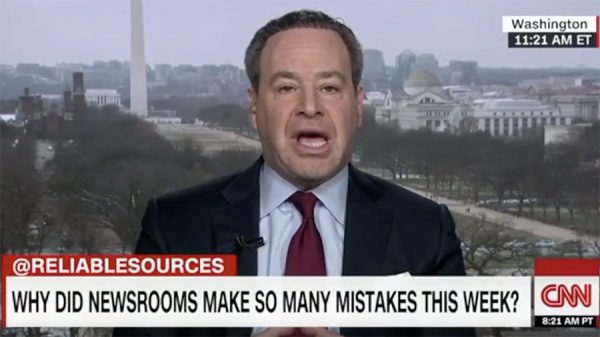
Factually inaccurate reports are a natural by-product of fighting Donald Trump’s “system of lies”, CNN pundit David Frum has reassured the public. The Atlantic senior editor’s comments were made in the wake of false reporting by ABC and CNN.
“The mistakes are precisely the reason people should trust the media,” Frum told Brian Stelter, on CNN’s ‘Reliable Sources’ program.
He insisted that “the worst mistakes that press organizations have made in their coverage of [US President Donald] Trump has precisely occurred in their overzealous effort to be fair to the president.”
Frum’s comments come after two major news networks, CNN and ABC, each had to correct “bombshell” reports that showed Trump and his administration in a poor light.
Frum, who is The Atlantic’s editor and was a speech-writer for President George W. Bush, argued that Trump and his supporters are “not well-placed to complain” about the false media reports, because they themselves are engaged in a “system of lies.”
“Mistakes occur in the process of exposing the lies,” Frum claimed. “The liars then complain about the mistakes that are investigating them.”
Likening CNN reporters to astronomers committed to the “discovery of truth,” Frum urged news consumers to trust the press, but also to consult a variety of sources, in order to avoid close-minded thinking. However, Frum warned CNN’s viewers against watching Fox News, which he said did not have “an interest in finding truth.”
Several American news networks have been on the defensive after back-to-back “bombshell” stories about Trump and his associates were quickly revealed as ‘nothing burgers’.
Brian Ross, chief investigative correspondent for ABC News, erroneously reported on December 1 that Michael Flynn, the former national security adviser, would testify that Trump had directed him to make contact with Russian officials while Trump was still only a candidate for the presidency.
The story was considered so damaging to US political and economic stability that the stock market took a hit after it was published. In fact, Flynn had been asked to contact Russian diplomats only after Trump won the election.
Ross received a four-week suspension from ABC after the widely-publicized story, which had been hailed as conclusive proof of Trump’s so-called collusion with Russia. Such contact is nothing more than routine procedure by an incoming administration.
CNN painted itself into a similar, factually dubious corner when it reported that congressional investigators had been provided an email that suggested Trump had been offered early access to leaked Democratic National Committee emails.
The story, which was heralded by CNN as evidence of a nefarious Trump-Wikileaks-Russia trifecta, fell apart within hours, after it was revealed that the news network had misreported the date of the email, which had been sent by a random Trump supporter forwarding publicly available information.
Although it corrected its story, CNN has since avoided explaining how it got the facts so wrong. Its initial report cited “multiple” anonymous sources. However, during his Sunday program, Stelter did acknowledge that the report was “a black eye for CNN.”
Japan to host joint missile drills with US, South Korea
Press TV – December 10, 2017
Japan’s Defense Minister Itsunori Onodera has announced that a joint drill with the United States and South Korea will be held this week amid an escalated stand-off in the region over North Korea’s missile and nuclear tests.
Onodera said Sunday during a visit to a garrison in northern Japan that the joint missile drills will be held on Monday and Tuesday in waters near Japan.
A defense official said the military exercises will be aimed at “practicing tracking an object and sharing information on it among the three countries”.
“It will translate into a measure against ballistic missiles,” said the Japanese official who declined to be named.
The drills comes despite warnings by North Korea that joint military exercises in the region would escalate a current conflict over the country’s weapons program and prepare the ground for a full nuclear confrontation. Pyongyang has test-fired several ballistic missiles over the past months, including two in July that experts said showed the country’s capability to hit potential targets in the mainland US. North Korea also carried out its sixth and largest nuclear test in August, prompting the US to lead international efforts to further pressure the country through economic means.
North Korea has been specifically worried about repeated drills between US and South Korea, saying they are clear provocations. Washington denies Pyongyang’s allegations that the actions are meant to simulate an invasion of the North, saying they are normal, pre-planned procedures to test the readiness of thousands of US troops stationed in the Korean Peninsula.
The US State Department said the upcoming drills with Japan and South Korea and intensified US engagement in diplomatic efforts in the region were meant to persuade the North to refrain from further developing its weapons program.
“The United States looks forward to continuing its partnership with both these nations so that the DPRK will return to credible talks on denuclearization,” said the department in a Sunday statement, using North Korea’s official name.
Pyongyang rejected the claims about the drills, reiterating its view that they were a provocation. It said in a statement that the upcoming exercise between Japan, the US and South Korea revealed “its intention to mount a surprise nuclear pre-emptive strike against the DPRK”.
Egypt journalists: ‘Sorry Palestine, we are governed by a Zionist’
MEMO | December 10, 2017
Egyptian journalists staged a protest on Thursday evening in front of the Journalists Syndicate in Cairo, objecting to US President Donald Trump’s decision to recognise Jerusalem as the capital of Israel and move the US embassy from Tel Aviv.
A number of public figures took part in the protest, including former presidential candidate Hamdeen Sabahi, human rights activist Tariq Al-Awadhi as well as representatives of the Kefaya Movement, the April 6 Youth Movement and Al-Dustour.
The protesters demanded authorities sever ties with the Zionist entity, expel the Israeli ambassador in Cairo and close the Israeli embassy.
Condemning Arab governments, the protesters chanted: “Arab leaders are cowards… either resistance or treachery” and “down with every collaborator”.
In a bold move, they criticised Egyptian President Abdel Fattah Al-Sisi’s response to Trump’s decision saying: “Sorry Palestine, we are governed by a Zionist.”
Police forces cordoned off the protesters using iron barricades, while riot police were positioned nearby to ensure the demonstration did not spread.
Amr Badr, member of the Journalists Syndicate, described the American decision and said he doesn’t not expect it to be followed through.
In the first official call to boycott US products, the Journalists Syndicate issued a statement which condemned Trump’s decision and called on all Egyptians to boycott American goods.
While the international community has almost unanimously disagreed with Donald Trump’s announcement, reports suggest that the announcement was done with the pre-agreement of Egypt and Saudi Arabia, with the Saudi Arabia going as far as, allegedly, stating to the Palestinian President to accept a village on the outskirts of Jerusalem as the alternative Palestinian capital.
Since the announcement, Saudi Arabia’s royal court has sent notices to the nation’s media outlets to limit the airtime given to protests against Trump’s announcement.
Emboldened by Trump’s annoucement, Israeli housing Minister Yoav Galant decided on Friday to promote a plan to build 14,000 new settlement units in the occupied Jerusalem.
Read also: Makkah and Madinah imams silent on Jerusalem in Friday sermons
Lebanon proposes anti-US sanctions over embassy move
Press TV – December 9, 2017
 Lebanon’s foreign minister has told an emergency Arab League meeting that imposing economic sanctions should be considered against the US over its embassy relocation move.
“Preemptive measures (must be) taken against the decision… beginning with diplomatic measures, then political, then economic and financial sanctions,” said Gebran Bassil during an Arab Lague meeting held in Cario on Saturday.
US President Donald Trump on Wednesday defied global warnings and said Washington formally recognized Jerusalem al-Quds as the “capital” of Israel and would begin the process of moving its embassy to the occupied city, breaking with decades of American policy.
“Could this calamity bring us together and wake us from our slumber? Let it be known that history will never forgive us and our future will not be proud of what we have done,” added Bassil.
Arab League chief Ahmed Aboul-Gheit also called on world nations to recognize the State of Palestine with East Jerusalem al-Quds as its capital.
He added that Trump’s decision raised a question over Washington’s role as a peace mediator, not just in Palestine but the whole world. “The decision amounts to the legalization of occupation,” he added.
“The decision by the US administration is in its essence legitimizing the occupation and admitting and allowing their stance by force. It is a waste of international legitimacy and the principles of justice, and therefore has placed he who took (the decision) in a state of conflict with the collective will of the international community,” he stressed.
Palestinian Foreign Minister Riyad Al-Maliki called on members of the league to instruct their UN envoys to submit a draft resolution to Security Council to condemn Trump’s decision, which “betrays its hostility and bias against the Palestinian people.”
He also called on world nations to recognize the State of Palestine with East Jerusalem al-Quds as its capital.
“I expect from you to commission the Arab block (in the Security council) to immediately act in presenting a draft resolution to the security council that rejects this American decision. We also call upon all Arabs in light of this American decision that challenged, not only Arabs and Muslims, but the world as a whole, to quickly visit Jerusalem, so as not to leave it as a victim to the American decision and Israeli threat,” he added.
Jordanian foreign minister also stressed that there will be no peace and security in the region unless Jerusalem al-Quds is free.
“We want peace as a strategic option, which we demand for all of the region’s peoples completely and indefinitely. However, there will be no peace without a free and independent Palestine, there will be no peace unless Jerusalem is free, and is the capital of Palestine,” said Ayman Al Safadi.
Meanwhile, Palestinian President Mahmud Abbas’s diplomatic adviser said that Abbas will reject to meet US Vice President Mike Pence during his scheduled visit to the region later in the month.
“There will be no meeting with the vice president of America in Palestine… The United States has crossed all the red lines with the Jerusalem decision,” he added.
Clashes between Israeli security forces and Palestinian protesters in al-Quds continued on Saturday over the Trump administration’s divisive decision.
Palestinian protestors threw objects at Israeli soldiers and set trash cans on fire, while others held guns to the head of an effigy of Trump, before burning it.
US Allegations of Russia Violating INF Absolutely Unfounded – Moscow
Sputnik – 09.12.2017
The INF treaty, which prohibits the development, deployment and testing of ground-launched ballistic or cruise missiles with ranges between 300 and 3,400 miles, celebrated its 30th anniversary on December 8.
“The United States has long been claiming that we are allegedly exceeding the limits of the Treaty prohibiting the deployment of cruise missiles with a range of 500 to 5,500 kilometers. But there is an interesting pattern — just as with the well-known statements about ‘Russian meddling in the US elections,’ no real evidence is provided … In other words, the accusations are absolutely unsubstantiated, they are not supported either by the technical characteristics of the launcher allegedly not meeting the Treaty, nor by flight telemetry data. And it is understandable why — because it simply does not exist,” Russian Deputy Foreign Minister Sergei Ryabkov said on Saturday.
The deputy foreign minister has explained that the US growing “anti-Russian campaign” is an indicator of US wish to withdraw from the Intermediate-Range Nuclear Forces Treaty (INF), with Washington appearing to be looking for a pretext and trying to create its own ideas for the introduction of new sanctions against Moscow, adding that the dissolution of the document would deal a hard blow to the global nuclear non-proliferation regime.
“So anti-Russian propaganda campaign in the context of the INF treaty looks increasingly like an attempt to project US issues onto another entity. Its increase may be a sign of Washington readying to withdraw from this treaty just as it withdrew from the Anti-Ballistic Missile Treaty,” Ryabkov said.
The high-ranking official has yet again reiterated Moscow’s commitment to the deal, “On our side, we are fully committed to the treaty, always have rigorously implemented it and are ready to continue to do so. However, if one side stops to comply with it, we will have, as Russian President Vladimir Putin said previously, to issue a mirror-like response.”
INF Treaty and Anti-Russia Sanctions
The statement was made in wake of the reported approval of new sanctions against Russia by US President Donald Trump earlier in the day over the alleged violations of the INF deal. The move followed the US Secretary of State Rex Tillerson’s accusations made in September, regarding the alleged violations of the treaty, a claim which has been repeatedly denied and called groundless by the Russian Foreign Ministry.
Moscow has also warned the United States against trying to talk to Russia with the language of ultimatums, or to exert military and political pressure.
The 1987 INF treaty prohibits the development, deployment and testing of ground-launched ballistic or cruise missiles with ranges between 300 and 3,400 miles.
READ MORE:
Why INF Treaty Between US, Russia Remains Key to Global Security
Trump Approves New Sanctions Against Russia Over Alleged INF Treaty Violations
US and Israel ‘Isolated’ at UN Security Council Meeting on Jerusalem

U.S. Ambassador Nikki Haley at the United Nations Security Council on December 8, 2017. | Photo: AFP
teleSUR | December 8, 2017
In an emergency meeting convened by the United Nations Security Council on the crisis prompted by President Trump’s decision to recognize Jerusalem as Israel’s capital, the U.S. stood isolated as other members unanimously condemned the decision.
The meeting was called by Bolivia, Uruguay, Italy, Senegal, Egypt, France and the United Kingdom on Friday.
Bolivian Ambassador Sacha Llorenti offered the strongest words of condemnation. Llorenti is known for his outspoken support of the Palestinian people, having debated the issue at the U.N. wearing a Keffiyah: a black-and-white scarf that has become a symbol of Palestinian resistance.
“While there are two parties in this conflict, they are not on a level playing field,” Llorenti said. “One is an occupying power, the other is an occupied people.
“One party builds illegal settlements… One party puts a seige on Gaza… One party takes over the water resources and farmlands of the other …. One of the parties engages in forced displacement. Bolivia opposes the unilateral decision of the United States to recognize Jerusalem as the capital of Israel.”
Other representatives, including France, Japan, Russia, and Sweden, expressed their dismay at the decision, saying that it would lead to violence and potentially ruin chances at the peace process that President Trump claims to favor.
Egyptian Ambassador Amr Aboulatta said he expected the decision to have a “grave” impact on peace.
The U.N. special coordinator for the peace process, Nickolay Mladenov said: “The United Nations has repeatedly declared that any unilateral decision that seeks to alter the character and status of Jerusalem… could seriously undermine current peace efforts and may have repercussions across the region.”
Despite resounding criticism from the rest of the international community, U.S. Ambassador Nikki Haley maintained that Trump’s move was “simple common sense,” and that the president remains “committed to achieving a lasting peace agreement.” She also accused the U.N. of being “hostile” towards Israel.
Israel’s ambassador was the only other party who praised the decision, calling it “courageous” and demonstrating a “true understanding of justice.”
Since Trump’s announcement, Palestinians have resolutely condemned the decision and erupted in mass “days of rage” protests. Palestinian resistance movement Hamas has called for a “new intifada,” or uprising, against Israeli occupation, a plea backed by Lebanese resistance movement Hezbollah.
Protests in various parts of occupied Palestine have met with violence by Israeli armed forces. At least two Palestinians have been killed and hundreds more injured. On Friday, the Red Crescent said they have so far attended 767 injuries in the West Bank, Jerusalem and Gaza.
Trump Approves New Sanctions Against Russia Over Alleged INF Treaty Violations
Sputnik – December 8, 2017
The US Commerce Department will impose sanctions on Russian companies that have provided technology to help develop the new weapon outlawed by the Intermediate-Range Nuclear Forces (INF) Treaty, Politico reported on Friday.
US media also reported, citing a senior administration official that US President Donald Trump has approved these new restrictions against Moscow.
Earlier in the day, US Department of State spokesperson Heather Nauert said in a release the United States is prepared to stop its intermediate-range missile systems research if Russia complies with all the terms of the INF treaty. Nauert explained that while the United States will continue to seek a diplomatic solution, it is now pursuing economic and military measures to induce Russia to return to the INF treaty compliance.
The State Department spokesperson added the United States remains committed to its INF treaty obligations and seeks Russia’s return to compliance with the agreement.Earlier on Friday, the Russian Foreign Ministry said Moscow will comply with all the terms of the INF treaty as long as the United States complies with them, and is ready to conduct professional dialogue with Washington.
The Foreign Ministry stressed that the United States was interpreting its commitments under the INF treaty freely while bringing unfounded accusations against Russia of violating the agreement. Moreover, the Foreign Ministry warned the United States against attempting to talk to Russia with the language of ultimatums, or to exert military and political pressure.
In September, US Secretary of State Rex Tillerson accused Russia of violating the INF treaty. The Russian Foreign Ministry said the US accusations were groundless, adding that the United States did not present any evidence to support its claims.
Russian President Vladimir Putin said in October that, before the INF treaty, US missile capabilities had already included air- and sea-launched missiles, while the Soviet Union had not developed such weapons. Since the INF treaty banned land-based missile launchers, the disarmament was done unilaterally by the Soviet Union.
The 1987 INF treaty prohibits the development, deployment and testing of ground-launched ballistic or cruise missiles with ranges between 300 and 3,400 miles.
Do You Hold Dual Citizenship? You Can Serve in Congress–but not the Israeli Knesset!

By Richard Edmondson | Fig Trees and Vineyards | December 8, 2017
A few days ago I posted an article entitled Zionists Form Group to Promote Kurdish Statehood, about the latest efforts underway to carve up the Middle East. In the course of researching that article I made a rather interesting discovery: that Israel has a law prohibiting holders of dual citizenship from serving in the Knesset, the Israeli parliament.
Needless to say, we need such a law here in the US, but of course anyone who suggests this gets accused of anti-Semitism.
A couple of years ago when talk show host Diane Rhem interjected a discussion about dual Israeli citizenship into an interview with Senator Bernie Sanders, Rhem was subjected to withering criticism. The ADL, among others, jumped into the fray, accusing Rhem of playing into “classic anti-Semitic charges of dual loyalty,” and the talk show host was forced to issue an apology.
And this kind of thing doesn’t just happen in America. When an official in South Africa proposed a law that would revoke South African citizenship under certain circumstances, one of them being if dual citizens were to serve in the armed forces of the other country, the reaction from South African Jews was about what you’d expect:
South African Jewish community leaders have expressed outrage at an African National Congress (ANC) official’s recent announcement of possible plans to ban dual citizenship.
While Obed Bapela, head of the ANC’s national executive committee’s subcommittee on international relations, has countered that the idea includes anybody with dual citizenship without discrimination, the South African Jewish Board of Deputies and South African Zionist Federation have issued a joint communication condemning the move as discriminatory towards Jews.
But dual citizens are banned from serving in the Israeli Knesset and no one seems to get too upset over it.
In my article of a few days ago, I mentioned a Knesset member by the name of Ksenia Svetlova, who is passionately advocating the formation of a Kurdish state. According to a Times of Israel article, Svetlova held dual Israeli-Russian citizenship until 2015, when she was elected to the Knesset, at which time she was forced to formally renounce her Russian citizenship.
“While Israelis may hold dual citizenship, a Basic Law passed in 1958 states that Knesset members cannot pledge allegiance as parliamentarians unless their foreign citizenship has been revoked under the laws of that country,” the article states.
Another Israeli politician, who was elected at the same time as Svetlova is Rachel Azaria, who was also forced to renounce her foreign citizenship–in the US! Again from the Times of Israel :
Azaria, a 38-year-old Jerusalem deputy mayor, renounced her American citizenship, which she had held by virtue of her mother having been born in the US.
It is astounding, is it not? Israel gets billions of dollars per year courtesy of US taxpayers–but anyone holding US citizenship is barred from serving in the Knesset! But we are not allowed to have a similar law here in the US banning Israeli citizens from serving in Congress!
And not only do we not have a similar in the US, but apparently Freedom of Information Act requests aimed at finding out which Congress members do in fact hold dual citizenship–are denied. The following is a 2015 article that was published at Counterpunch.
***
Dual Citizens in Congress?
By L. Michael Hager
Is dual citizenship in the U.S. Congress and administration creating potentially serious conflicts of interest?
My Counterpunch piece of November 12, 2014 described a failed effort to identify members of Congress who hold dual citizenship and to ascertain the second nationality of those members. I mentioned the then outstanding Freedom of Information Act request that I filed with the Congressional Research Service (CRS) last October.
This week I received the information I sought, in the form of a telephone call from a legal officer of the Library of Congress. After reminding me that Congress (and the CRS by its connection with Congress) is exempt from FOIA requests, he verbally confirmed my suspicion that CRS does not currently collect dual citizenship data.
That’s bad news for those of us who believe that citizens should know if their representatives in Congress (and senior government officials and judges, for that matter) owe allegiance to any other nation. For example, when a Senator, a House Member or a high USG official speaks out, submits bills or determines policy on an issue of importance to a second country, shouldn’t constituents (and citizens at large) be able to judge whether there is or is not a conflict (or apparent) conflict of interest?
Without transparency on dual citizenship, Americans remain in the dark, free to speculate on which representatives may have divided loyalties. Current entries on the Internet reveal a wide range of such speculation. The lack of transparency is dangerous, for it erodes trust in government, creating credibility doubts where there should be none and allowing some conflicts to continue undetected, without question or debate.
Thus the first requirement is transparency. We need a government agency (presumably the CRS) or a non-governmental organization to disclose the names and non-U.S. national affiliations of Members of Congress and senior government officials and to track and report on this issue.
Secondly, we need more media attention to the subject of dual citizenship. Senator Ted Cruz and Representative Michelle Bachman both received wide press coverage, when they renounced their Canadian and Swiss nationalities, respectively.
Stanley Fischer, who currently serves as vice chairman of the U.S. Federal Reserve, became an Israeli citizen in 2005 while retaining his American citizenship. Prior to his appointment to the Fed in 2014, he served for eight years as governor of the Bank of Israel. Although the New York Times article of March 13, 2014 reporting on his then upcoming confirmation hearings, disclosed his dual nationality, it failed to ask the obvious question of why one appointed to such a senior policy position should not be required to renounce his Israeli citizenship. Why has the mainstream media largely ignored the potential conflict of interest inherent in dual citizen Members of Congress and Executive Branch officers?
What about those members and government officials who fail even to disclose their second or more nationalities? As mentioned in my previous article on this subject, U.S. officials and government officers with Jewish identity may acquire Israeli citizenship without much or any formality under the Israeli Law of Return. Thus it is possible, if not probable, that some of such officials hold Israeli citizenship.
Beyond the threshold issue of transparency are equally important questions of whether a dual citizen elected to Congress or appointed to a senior USG position should be required to renounce his or her citizenship in the second nation. Even if American law continues to allow the government service of dual citizens, should it not require such persons at least to recuse themselves from participating in decisions or policy debates that relate to their second nationality?
To address these question we need accurate information on who are the dual citizens in our government. To obtain such data will require a vigorous campaign by interested citizens and NGOs, first to have elected Members disclose any non-U.S. citizenship they hold and second to have the CRS begin to track and report on the presence of dual citizens in Congress and in the higher levels of Government.
Conflicts of interest and apparent conflicts by public officials erode trust in government. Allowing dual citizenship in Congress (and in the Executive and Judicial Branches) to flourish under cover of non-disclosure puts our democracy at risk.
It’s time to bring this issue into open debate.
L. Michael Hager is co-founder and former director general of the International Development Law Organization, Rome
US Views the Balkans As Battlefield to Fight Russia
By Peter KORZUN | Strategic Culture Foundation | 06.12.2017
Otto von Bismarck, the legendary first Chancellor of Germany, scoffed at the notion of intervening in the Balkans. He believed that the region was “not worth the bones of a single Pomeranian grenadier.” The US appears to hold quite a different view on the matter. With a resurgent Russia on the international stage, it plans to ramp up the attempts aimed at establishing its dominance in the Balkan region.
Moscow is concerned over Washington’s attempts to increase its influence on the politics of the Balkan states and draw them into NATO. Andrey Kelin, Director of the Russian Foreign Ministry’s Department of European Cooperation, said that the US wants to “fully master the Western Balkans, and, after Montenegro, to draw other countries into its orbit too.” According to him, any wave of NATO expansion, especially at a time of poor relations between the bloc and Russia “is an additional factor complicating European security.”
The statement comes after the report entitled ‘Balkans Forward: A New US Strategy for the Region’, was published by the Washington-based Atlantic Council on Nov.28. It warns of increased Russia’s influence, blaming Moscow for “attempts by Russia to capitalize on the region’s lingering pathologies to undermine the European project” and other alleged wrongdoings. The authors claim that Russia is seeking “leverage” by making “as big a mess as possible” in the Balkans region, citing unconfirmed assertions and invented stories as evidence. For instance, the report states that Moscow has been “cultivating a client” in Milorad Dodik, the leader of Bosnia’s Serb-dominated entity of Republika Srpska. Russia’s “playing games” in Kosovo is another example. The list can go on. Not a single fact is adduced to support the stories.
The Russia bogie is used as a pretext to justify the calls for a permanent American military presence in the Balkans, a “historic rapprochement” between the US and Serbia, and for the US to regain its reputation as an “honest broker”. The authors believe that establishing a permanent US military presence in the region would “anchor the United States’ ability to influence developments”. Camp Bondsteel in Kosovo, which is built on Serbian land without consulting with the government of Serbia, is believed to be ideal for this purpose.
The report does not shy away from advocating outright interference into internal affairs. It singles out Serbia, saying “Belgrade can and should be a close partner and ally in the region, but it can only become one if it begins to meaningfully distance itself from Russia.”
The Atlantic Council is a meeting place for heads of state, military leaders, and international leaders from both sides of the Atlantic. It has great influence on the US foreign policy decision-making process. Some proposals unveiled in the report align with prior calls by US policy hawks, such as Senator John McCain, who in April called for a substantially strengthened US commitment to the region.
Looks like his calls are heard and recommendations are followed. Hoyt Brian Yee, US Deputy Assistant Secretary of State, will soon take up the post of US Ambassador to Macedonian capital Skopje. “For a long time, the United States is present in the Western Balkans, and we are planning to stay there,” he said at the conference organized by the Atlantic Council in Washington the next day after the report was published.
James Jay Carafano, a Heritage Foundation Vice President, has come up with a plan of his own, offering guidelines to boost US diplomatic, economic and military efforts to drive Russia from the region and make it dominated by the United States. He believes that “The Balkans remain a soft spot in US transatlantic policy. We need to be more proactive there – and sooner rather than later.”
With Montenegro having joint NATO recently, Macedonia appears to be next. The Atlantic Council’s report offers to launch mediation efforts aimed at putting an end the long-standing row between Athens and Skopje over Macedonia name and, thus, unblock Greece’s ongoing objections to the latter’s membership in NATO. The center-left government, which came to power in late May, sees NATO membership as a top priority. The Macedonian people think otherwise. According to a recent poll by the International Republican Institute (IRI), Macedonian support for NATO membership is at its lowest level since 2008.
It all goes to show that the US views the Balkans not as a region with prospects of economic cooperation and partnership on equal terms but rather as a battlefield against Russia. What the United States does is enforcing an openly destructive choice between the West and Russia on the Balkan countries. Such a policy will lead to increased tensions and destabilization on the European continent as well as in the region. The last thing the region needs is US military presence to oppose Russia – the country with strong historic and cultural ties to the Balkan states.
Featured Video
Daniel Davis: Trump’s New Iran Land Blockade Is a Dangerous Fantasy
or go to
Aletho News Archives – Video-Images
New Book
The Vaccine Mafia: Pfizer’s Former Chief Toxicologist Proves How Toxic Substances Were Unlawfully Sold to Us as a Solution for COVID-19
By Helmut Sterz
Former Pfizer chief toxicologist Helmut Sterz presents a critical examination of the development, approval, and global rollout of mRNA COVID-19 vaccines—particularly those produced by Pfizer/BioNTech. The Vaccine Mafia details the failure of pharmaceutical companies, regulatory authorities, politicians, and international organizations to follow established scientific and ethical standards during the pandemic. Drawing on the author’s decades of experience in pharmaceutical toxicology, Sterz reveals the many ways the vaccines’ inadequate or omitted preclinical safety testing put the world’s population at risk.
Sterz demonstrates how “emergency” approvals allowed manufacturers to bypass long-standing international guidelines governing toxicity testing, especially with regard to reproductive and cancer risks. They also allowed governments and health authorities to ignore or conceal evidence of serious adverse effects that occurred, including myocarditis, reproductive harm, and other long-term health risks.
Blog Roll
 Aletho News
- US still trying to recycle failed hypersonic missile programs
- France’s ‘Cold War’: Paris blames Tehran for supermarket fridge hacks
- Psywar no more? 77th Brigade’s sudden death
- Ukraine Already Carved Up… Before Talks Begin? /Prof. Richard Sakwa
- The vindication of Marjorie Taylor Greene
- Nearly 80% of Britons consider Israel a threat to world peace and security: Survey
- Rhode Island Staffer Could Be Reinstated After Firing Over Ceasefire Post
- Will Republicans Learn Their Lesson from the ‘Disastrous’ Midterms?
- Wrong, Newswise, Irresponsible Climate Messaging, Not Climate Change Itself, Is Fueling Student Anxiety
- Zelensky’s Critics Vanish Into Ukrainian Secret Prisons – Source
- If Americans Knew
- An error has occurred; the feed is probably down. Try again later.
- No Tricks Zone
- German Authorities Start Initiative To Evaluate Public Register For Climate “Disinformation” Spreaders!
- Zonal Asymmetry of Temperature Change in the Antarctic Circumpolar Current
- New Study: The Net Fossil Fuel Contribution To Rising Atmospheric CO2 Has Been Zero For 500 Years
- Germany’s Green Energy Transition Becoming Increasingly Expensive…Another 6 Trillion Euros!
- Sudden Stratospheric Warming, Powerful El Niño Combination May Lead To Extreme Europe Cold, Energy Crisis!
- Two New Studies Find Thwaites Glacier Melt Cannot Be Driven By Human Activity Or A Warming Ocean
- E-Cars Reduce CO2 Emissions By Only 41% Compared To Internal Combustion Engine Vehicles
- Predictions Made By Renowned Climate Professor Over Past Decades Have Been Proven To Be Poor
- New Study Suggests Large Regions Of The Pacific Ocean Have Been Cooling For The Last 80 Years
- Germany’s Green Energy Debacle: High Energy Costs Force Kahla Porzellan to Close After 182 Years!

