“DoD Owes Families, Nation Information on Niger Action” but NOT on USS Liberty Attack
If Americans Knew | November 2, 2017

On June 8, 1967 Israeli air and sea forces attacked a U.S. Navy ship, the USS Liberty, killing 34 crew members, wounding over 170, and fatally damaging the ship. For 50 years surviving crew members and families of the fallen have called for a full investigation of the attack – without success.
by Joe Meadors, USS Liberty Survivor
The USS Liberty was attacked on June 8, 1967. No investigation of the attack was conducted by the US government.
The USS Pueblo was attacked on January 23, 1968 – 229 days after the attack on the USS Liberty. The attack on the USS Pueblo was thoroughly investigated by the US government. No investigation of the attack on the USS Liberty has been conducted. No evidence that any investigation has been contemplated by anyone in the US government.
The Marine Barracks in Beirut were bombed on October 23, 1983 – 5,981 days after the attack on the USS Liberty. The bombing of the Marine Barracks in Beirut was thoroughly investigated by the US government. USS Liberty survivors are still waiting for word that an investigation on their ship is in the works by the US government.
The USS Stark was attacked on May 17, 1987 – 7,286 days after the attack on the USS Liberty. The attack on the USS Stark was thoroughly investigated by the US government. USS Liberty survivors are still waiting for an investigation of the attack on their ship.
The USS Cole was attacked on October 12, 2000 – 12,180 days after the attack on the USS Liberty. The attack on the USS Cole was thoroughly investigated by the US government. USS Liberty survivors are still waiting.
The Niger attack was on October 4, 2017 – 18,381 days after the attack on the USS Liberty. The Niger attack is currently being investigated by the US government. No investigation of the attack on the USS Liberty is on the horizon.
In a DoD Press Release Chairman of the Joint Chiefs of Staff, Marine General Joe Dunford tells us “The Defense Department owes the families of the soldiers lost in Niger and the American people an explanation of what the soldiers were doing in Niger and why it was important.”
Given its refusal to conduct an investigation of the attack on the USS Liberty the DoD obviously doesn’t feel the same about our families, the families of our fallen shipmates and those of us who survived the attack.
Below is an article that expands on this subject and provides a list of questions we’d like to have answered. By no means all of the questions on the table. Arguably not the most important questions.
I respectfully submit that the question on the top of the list is: Why has the US government refused to conduct an investigation of the Israeli attack on the USS Liberty?
DOD Says truth on Niger more important than USS Liberty
“DoD Owes Families, Nation Information on Niger Action” but NOT on USS Liberty Attack
By Joe Meadors | Arab Daily News
Four Green Berets were Killed in Action in Niger. The Chairman of the Joint Chiefs of Staff, Marine Corps Gen. Joe Dunford, held a prolonged, public press conference which was covered by every news outlet in the US.
In a DoD Press Release Gen. Dunford tells us “The Defense Department owes the families of the soldiers lost in Niger and the American people an explanation of what the soldiers were doing in Niger and why it was important.”
Given its refusal to conduct an investigation of the attack on the USS Liberty the DoD obviously doesn’t feel the same about our families, the families of our fallen shipmates and those of us who survived the attack.
Not that we haven’t asked.

USS Liberty crew, ignored by U.S. politicians for 50 years.
For over 50 years USS Liberty survivors have been begging the Department of Defense to conduct an investigation of the attack on our ship.
The Department of Defense obviously doesn’t think the American people deserve to hear from American servicemen who:
- saw the unmarked aircraft as they attacked our ship;
- heard the jamming of our radios on both US Navy tactical and international maritime distress frequencies;
- witnessed the deliberate machine gunning of life rafts we had dropped over the side in anticipation of abandoning ship;
- witnessed the slow circling of our ship by Israeli torpedo boats as they fired from close range at crewmen who were either trapped topside or who ventured topside to help their wounded shipmates;
- saw the Israeli helicopters filled with armed assault troops hover very close to our ship in an apparent attempt to find a place to allow those troops to rappel down to the ship; and,
- witnessed the torpedo boats immediate departure from the scene of the attack after cessation of hostilities instead of offering assistance as is their obligation under international law.
What questions have we been asking? I’ll share with you questions a USS Liberty widow asked then-Senator John Warner. Not surprising that he refused to respond to her questions:
- Why didn’t the Sixth Fleet come to the aid of the Liberty?
- Why were the rescue aircraft called back by the President of the United States?
- What involvement did the 303 Committee have in the Liberty‘s deployment and mission?
- What did Project Cyanide have to do with the Liberty, directly or indirectly?
- What did Frontlet 615 have to do with the Liberty directly or indirectly?
- Why wasn’t the USS Amberjack allowed to come to the aid of the Liberty?
- Where is the film of the attack taken by the Amberjack?
- Why weren’t violations of the UCMJ investigated?
- Why were warning and operational messages to the Liberty intentionally mis-routed?
- Why was the crew told to keep silent regarding the attack?
- What secret is so volatile that cannot be revealed by our government after 50 years?
- Why haven’t clear violations of international law been investigated?
- Why was Admiral Tobin awarded the Bronze Star when he wasn’t even there?
- Why hasn’t our former ambassador to Lebanon, Dwight Porter, ever been questioned by Congress, when it is known he listened to the attack at our embassy in Lebanon?
- Why was Commander McGonagle awarded his Medal of Honor, our country’s highest honor, in the Navy Yard instead of in a ceremony conducted by the President at the White House?
These are just a sampling of the many questions that remain unanswered about the attack on our ship.
Questions that the Department of Defense will continue to ignore.
We are reaching out to everyone who believes that the attack on the USS Liberty should be treated exactly the same as the attacks on the USS Pueblo, USS Stark, USS Cole, as well as the 1982 bombing of the Marine Barracks in Beirut and the death of the four Green Berets in Niger.
Help us persuade the US government to investigate the attack on our ship – including the War Crimes that were committed by and against the United States during that attack.
For further reading:
American Legion calls for full investigation into Israel’s attack on the USS Liberty
Iran’s snub to US has meaning for India
By M K Bhadrakumar | Indian Punchline | November 2, 2017
Only Tehran could have punctured US President Donald Trump’s massive ego with just a delicate deflection by the wrist. It all began in the weekend with an innocuous media disclosure in Iran that Trump had sought a meeting with President Hassan Rouhani during the latter’s visit to New York in September to address the UN General Assembly, but the latter spurned the overture summarily. On Sunday Iranian Foreign Ministry spokesman Bahran Qassemi commented crisply, “A request indeed was made by the US side, but it wasn’t accepted by President Rouhani.”
Of course, Washington went into a tizzy with White House struggling to deny the Iranian report at first, but belatedly realizing, perhaps, that a lie might boomerang, allowed the State Department spokesperson to tamely confirm it on Tuesday. Trump’s request was apparently transmitted to the Iranian side when the US secretary of state Rex Tillerson and his Iranian counterpart Mohammed Javed Zarif were closeted together on the sidelines of a meeting of the foreign ministers of the P5+1 and Iran to review the implementation of the Iran nuclear deal in September.
The episode speaks volumes about Trump, the man and the statesman – and his times in the White House and the US foreign policies in such extraordinary times. Countries such as India or China must draw appropriate conclusions. Indian analysts, in particular, are still crowing about Tillerson’s recent rhetoric at the CSIS conjuring up from thin air a quadripartite alliance between the US, Japan, India and Australia to contain China, while Trump on the other hand is preparing for a momentous state visit to China looking for some foreign-policy trophy as outcome in his barren presidency.
The point is, Trump could so blithely befool the wily Saudi King Salman and the pompous Israeli Prime Minister Benjamin Netanyahu in one go, sending them into wild ecstasy that he is about to go after the jugular veins of the Iranian leaders, while in reality also desiring to cultivate them on the quiet or at least keep open a line of communication to them – and, perhaps, even do some business with Tehran for ‘America First’.
The bad part is that the US is also intruding into India’s Iran policies. Did India have to cut back oil imports from Iran and replace it with US shale oil? For the US (or Israel), it is important that India-Iran relations remain sub-optimal for as long as their own relationships with Iran remain problematic. India’s interests, on the other hand, lie in forging a strategic partnership with Iran that can be highly productive and beneficial for advancing its development strategy as well as for strengthening regional security. To borrow the American expression, Iran is India’s ‘natural partner’.
Nothing brings this home as when Iran’s Supreme Leader Ali Khamenei proposed to the visiting Russian President Vladimir Putin at a meeting in Tehran on Wednesday that a transportation corridor could be built connecting the Iranian port of Chabahar with St-Petersburg. India cannot miss the point that Russia and Iran could be meaningful partners in fostering regional connectivity. Simply put, geography dictates geopolitics and geo-economy.
The bottom line is that the Iranian snub to Trump also highlights its strategic defiance of the US’ attempts to (re)impose hegemony in what the Americans call the ‘Greater Middle East’ – stretching from the Levant to the Central Asian steppes. Delhi should pay serious attention to the remark by Khamenei to Putin yesterday when he said that the “good cooperation” between Iran and Russia in Syria has proved “meaningful” and bore “important results”, and above all, “this cooperation showed that Tehran and Moscow can realize common goals in difficult situations.” (Tehran Times )
Khamenei didn’t specifically refer to Afghanistan, but the thought couldn’t have been far from his mind. The US’ plans to consolidate an open-ended military presence in Afghanistan is actually aimed at encircling Iran and Russia and containing them. It is useful to recall in this context that the then Iranian and Russian foreign ministers – Ali Akbar Velayati and Evgeniy Primakov – had worked closely together to bring the Tajik civil war to an end in 1997. Equally, Iran and Russia were on the same page in supporting the Northern Alliance in Afghanistan during 1997-2001.
No doubt, the preference of Tehran and Moscow once again will be to carry Delhi along with them in the struggle for strengthening regional security and stability through regional initiatives – as Khamenei’s remark on connecting Chabahar with St. Petersburg implies.
US Lawmaker demands RT YouTube ban during Russia hearing
At a hearing before the House Intelligence Committee on Wednesday, Rep. Jackie Speier (D-California) put RT in her crosshairs, asking Kent Walker, the general counsel at Google, why his company has not yet banned RT from YouTube.
Walker said that Google “carefully” reviewed RT’s history on the social media platform and said they have “not found violations of our policies against hate speech and incitement to violence and the like.”
“It’s a propaganda machine, Mr. Walker,” Speier interjected. “The Intelligence Community – all 17 agencies – says it’s an arm of one of our adversaries. I would like for you to take that back to your executives and rethink continuing to have it on your platform.”
Walker responded that Google is looking into ways to increase transparency for “all government-funded sources of information.”
However, when Walker would not agree to the lawmaker’s wishes, Speier asked him if Google would at least consider putting a disclaimer on RT’s YouTube page that would say: “the Intelligence Community in the United States believes it’s an arm of our adversary, Russia.”
Walker said that they would “take a look at all forms of transparency.”
Speier also claimed that during the 2016 election, President Donald Trump’s campaign was “mimicking” stories from RT. Specifically, she referenced a video from CNN that was posted to Trump’s Twitter account on August 31, 2016. The tweet featured Trump speaking before a crowd and questioning former secretary of state Hillary Clinton’s “strength and stamina.”
Speier said RT “hammered” the same message, comparing Trump’s tweet to a video posted to RT’s Twitter account, which featured footage of Clinton stumbling at the 9/11 memorial on September 11, 2016. Clinton’s campaign repeatedly changed its story as to the circumstances of Clinton’s fall at the time.
“What I would like to understand is who is mimicking who,” Speier asked, without acknowledging that Clinton’s stumble was covered by every major media outlet.
Rep. Eric Swalwell (D-California) also appeared to be grasping at straws during the hearing when he called out RT for reporting an event that was covered by other major news agencies.
Swalwell pointed to a July 2016 report about Ted Cruz being booed at the Republican National Convention (RNC) and suggested that the factual story, which was widely reported, could somehow be interpreted as election meddling or “propaganda.”
Referencing a large poster board display of an RT tweet promoting the story, Swalwell concluded that “if this interference campaign has taught us anything, it’s that the Russians don’t care.”
“They’re not pro-Republican, they’re not anti-Democrat, they’re just pro-Russian,” Swalwell said, warning his Republican colleagues that they could be targeted in the next election.
However, Swalwell failed to mention that the story about Cruz was entirely true and carried by numerous media outlets.
Swalwell also asked if RT made any money on the ads they posted.
“The same is true beyond the internet, of course, because RT is featured on cable stations, satellite stations, hotel television networks, they buy advertising in newspapers, magazines, airports, etc,” Walker said.
Walker then went on to explain that the money comes from advertisers and Google gets a small percentage of that money while the majority goes to the publisher.
House Intelligence Committee members accusing RT of being “fake news” were only able to point to accurate and widely reported stories on the network, during the hearing with social media executives on alleged Russian interference in the 2016 election.
‘Red flag’
Rep. Terri Sewell (D-Alabama) directed most of her questions to Facebook, suggesting that it should have been a “red flag” that some of the ads in question were paid for in Russian rubles.
In response, Colin Stretch, the general counsel at Facebook, said that all ads on the social media platform go through “a combination of automated and manual review.”
Sewell, a member of the Congressional Black Caucus, interrupted Stretch at that point, seemingly distracted from the official purpose of the hearing.
Instead of pursuing a line of questioning about Russia, Sewell asked who vets material posted on Facebook and if they are a “diverse group of people.”
Stretch explained that Facebook has vetters speaking a “number of languages” based “around the globe” adding that the company is “committed to building a workforce that is as diverse as the community we serve.”
“With all due respect, I have to stop you there,” Sewell interrupted again. “I don’t know if you know exactly how many racially diverse workforce that you have, what the percentage is, but I can tell you if you don’t know. It’s very low.”
Sewell went on to say that Facebook’s overall racial ethnicity was poor, with black employees making up 8.8 percent of the total workforce and only 2.3 percent of the leadership roles.
Later in the hearing, Sewell asked all three companies if they would agree with legislation that would require them to add a disclosure of who paid for any given ad.
The executives from all three companies responded by saying they were in agreement with the “general direction” of that notion, to which the other two companies agreed.
In October, lawmakers introduced the Honest Ads Act, which would subject social media outlets to the same transparency and disclosure laws as television and radio ads.
Wait, how do Facebook ads work?
When Rep. Michael Turner (R-Ohio) took the floor, he asked how each of the companies helped RT target the audience that would see their ads.
Sean Edgett, the acting general counsel at Twitter, said the company did not have much of an interaction with RT and most of the ads were promoted content.
“So, they take a tweet of a news story and they promote it so that it is seen by users who don’t follow them and potentially want to drive viewership to their own platform or then have them follow back,” Edgett explained.
Edgett went on to explain that RT used “very general targeting,” which included US citizens who follow other media or news organizations. He added that the RT en Español account specifically targets users in California and Florida.
When asked if Facebook was aiding RT, Stretch said that all of the ads that the company has released to the committee were bought through their “self-serve ad platform,” adding that there was “no human interaction with any of the advertisers.”
Read more:
Twitter: Speaking Russian, Having Russian IP Makes You a Kremlin Shill
Sputnik – 02.11.2017
During testimony before the Senate Intelligence Committee, a representative of Twitter admitted that his company discovered alleged Russian election interference on their platform by flagging every account with Russian text, email, phone, IP address and so on as a potential agent of the Kremlin.
It sounds like we’re making this up, but we aren’t. This statement came from the mouth of Twitter’s Acting General Counsel Sean Edgett as he testified before the Senate Intelligence Committee. “We’re looking at things like, whether they registered in Russia, do they have a Russian phone number, are they on a Russian mobile carrier, do they have a Russian email address, are they coming in from a Russian IP, have they ever… logged in at any time from Russia?” Edgett testified.
In other words, Russian shills include anyone who bought a phone in Russia, lives in Russia, used Twitter in Russia, does business in Russia or with Russians. You’re probably a Russian shill just for reading this article, according to Twitter.
Perhaps the most telling comment was in Edgett’s written testimony that was submitted to the Senate. It read that accounts with “Russian language or Cyrillic characters [that appear] in the account information or name” were also flagged as “Russia-linked.” (Emphasis ours.)
Although this should probably go without saying, speaking Russian does not make you Russian — and being Russian does not make you a servant of Vladimir Putin. Virtually every former Soviet Socialist Republic has a large percentage of Russian speakers among their population.
It isn’t just the former Soviet Union. There are 3 million speakers in Germany (a holdover from East Germany) and about 1 million in Israel (a result of the diaspora of Russian Jews after the Soviet Union collapsed.) Some 850,000 Americans have Russian as their primary household language. If any of them thought to type something Russian on Twitter, they are now Kremlin shills. Oops.
But wait, there’s more. Cyrillic is the alphabet used in the Russian language — as well as the national languages of countries such as Ukraine (a US ally) Bulgaria and Montenegro (NATO members alongside the US). It is the alphabet of the languages of dozens of ethnic groups in Central Asia, as well as the Dungan and Uyghur peoples of China.
It’s also the alphabet of the language of the Yupik people — the vast majority of whom live in reservations in Alaska, US of A. Truly, the network of Kremlin interference is frightening, that an entire ethnic group of American Indians have become their election-jacking puppets. There are, of course, already allegations that Russians somehow infiltrated or co-opted the Standing Rock Sioux protests against the Dakota Access Pipeline last year.
Twitter also admitted to censoring (or “taking action… to fight automation and spam on our platform,” in their parlance) hashtags that related to the WikiLeaks release of the private emails of Hillary Clinton campaign chair John Podesta in October as well as emails from the Democratic National Committee in July. Twenty-five percent of all tweets tagged #PodestaEmails were automatically hidden, and 48 percent of tweets tagged #DNCLeak met the same fate.
Again, this is not a Pepe Silvia-esque conspiracy theory. These are statements taken directly from sworn testimony from Twitter’s official representative.
Putin, Trump and Manafort
By Margaret Kimberley | Black Agenda Report | November 1, 2017
The American propaganda campaign being waged against the Russian Federation and its president Vladimir Putin has reached a stage of perverse perfection. It is virtually impossible to put forth a dissenting opinion that will be accepted or considered worthy of consideration. The Democrats are leading the charge to silence and censor and they are getting buy-in from people who otherwise consider themselves to be progressive.
This columnist has been interviewed on Radio Sputnik on two occasions. That fact should not be at all noteworthy but in the current atmosphere of Russophobia being pushed by the corporate media and Democratic politicians, it is a risky statement to make. Sputnik International is a Russian government entity, just as the BBC is “state run media” on behalf of the British government and the CBC for Canada. But anyone and anything connected to Russia gets the double standard treatment and is targeted for attack.
Marcus Ferrell was until recently a campaign staffer for Georgia gubernatorial candidate Stacey Abrams. He resigned after the Atlanta Journal Constitution revealed that he had been a guest on the program By Any Means Necessary which is hosted by Sputnik. Ferrell didn’t discuss Russia at all. Confederate monuments were the topic of conversation. But the level of fear is so great that he felt compelled to resign. His boss made no effort to fight against the tide and she didn’t defend him either.
Every day a new shoe drops in this faux scandal. Twitter announced that it would not accept advertisements from Sputnik or RT, formerly known as Russia Today. Sputnik had never even paid for ads on Twitter but why be bothered by facts when ginned up phony outrage is so readily available.
It is Democrats who demanded that Facebook and Twitter stop telling the truth about Eastern European click bait schemes and instead join in that party’s witch hunt. Now we are told that Russian social media posts meant to influence American politics reached 126 million people on Facebook over a two-year period. Of course the last paragraphs of that story reveal that only one out of 23,000 pieces of content actually reached anyone. That fact is too inconvenient and makes for a bad headline.
While social media giants are submitting to marching orders, the state and corporate sponsored Public Broadcasting System (PBS) produced its second anti-Putin documentary in as many years. First “Putin’s Way” in 2015 and now “Putin’s Revenge” feature so-called experts who outdo one another in stoking anti-Russian flames. PBS can never seem to find any expert who can make counter arguments.
While the corporate media compete to see who can dumb down the country the fastest, the legal wheels are turning to get Trump out of office and Russia is the pretext for the action. Trump’s former campaign manager Paul Manafort has been indicted for tax fraud. His indictment is just the beginning of the bipartisan effort to end the Trump presidency. They hope to resume doing the elites’ business without hindrance from the man who is so bad for the neoliberal brand.
Nothing matters to liberals more than getting Trump out of office. Their juvenile political understanding was turned upside down by Hillary Clinton’s defeat and they haven’t been the same since. They are obsessed with the man they hate. They have been fed a steady diet of red meat which explains away their illusions about the failed Democratic Party and the fact that millions of their fellow citizens don’t see the world the way they do.
Paul Manafort was a long time Republican Party operative going back to the days of Ronald Reagan’s presidential campaign. He used his connections to become a lobbyist, a hired gun for governments ranging from Nigeria to the Philippines to Kenya to Romania to Ukraine. Manafort would not be facing serious legal jeopardy if he hadn’t taken on that particular gig.
We are told that Ukraine’s former president Victor Yanukovich was “pro Russian” and that Manafort’s representation proves Russian interference in the 2016 presidential campaign. Neither statement is true but no one knows outside of the small circle of people who make herculean efforts to educate themselves about world affairs.
As the old saying goes, the fix is in. Manafort is just the first notch on former FBI director Robert Mueller’s gun. He will go after other Trump connected cronies and relatives who have done shady business but that won’t be the reason for the pursuit. There are many sleazy American lobbyists and business people but no one cares until there is a moment when their downfall is politically useful.
Free speech is being undermined, the left are losing their access to media and prosecutors are going after crooks, but not because they want justice to be done. If Putin was trying to destroy America he couldn’t do a better job than the media, crooked politicians and the deluded liberals who all work together.
Margaret Kimberley can be reached via e-Mail at Margaret.Kimberley(at)BlackAgendaReport.com.
$250mn each day for 16yrs: The staggering cost of ‘War on Terror’
RT | November 1, 2017
The ‘War on Terror’ has cost US taxpayers at least $1.46 trillion since September 11, 2001, the Department of Defense’s cost of war report has revealed.
The 74-page DoD dossier was obtained by the Federation of American Scientists’ Secrecy News. It breaks down the cost of the US’s various conflicts and reveals the ongoing war in Afghanistan and the war in Iraq account for the greatest chunk of change.
Operation Enduring Freedom (the name given to the ‘War on Terror’ between 2001 and 2014), Operation Iraqi Freedom (Iraq War) and Operation New Dawn (past operations in Iraq and Afghanistan in 2010 and 2011) made up the biggest expense. They cost a combined $1.315 trillion.
Current military operations cost $147.6 billion. This includes $102.9 billion for Operation Freedom’s Sentinel, the name given to the ‘War on Terror’ by Barack Obama at the end of 2014, and Operation Inherent Resolve, the US’s operations against ISIS in Iraq and Syria which started in 2014, and has cost $17.1 billion.
Operation Noble Eagle, the US’s domestic air defense operation has cost $27.6 billion.
The report only includes direct war-related expenses, such as equipment, operating bases, training, paying troops as well as the costs related to feeding, housing and transporting them.
COSTS OF WAR NOT INCLUDED
The numbers don’t include veterans’ expenses, or the amount racked up by intelligence agencies in their war on terror. The numbers also don’t take into account the cost involved in rebuilding and post-conflict programs.
The Veterans Benefits Administration’s latest annual report found 1,060,408 veterans are receiving benefits, at an average of $15,907 each per year.
Veterans of the War on Terror’s benefits’ are costing $16.8 billion a year, and 1 million are receiving benefits at the moment.
According to a 2011 Harvard Kennedy School study, Afghanistan and Iraq veterans’ benefits were estimated to cost between $600 billion and $1.3 billion over 40 years.
The report found that $31.3 billion had been spent in the 10 years since 2001 on medical care and disability for almost 500,000 vets. It also found that Afghanistan and Iraq veterans were applying for benefits at far greater rates than previous wars.
The report found the “cost of caring for war veterans rises for several decades and peaks in 30-40 years or more after a conflict.”
The CIA’s classified operations, along with the NSA’s efforts to combat terrorism aren’t included in the total.
The report includes the total amount of funding given through war related-requests between 2001 and 2017, which is $1.7 billion and includes war spending, non-war spending on fuel and the cost of running the Noble Eagle base. It also includes an $83 billion in funds marked as “classified.”
US Intelligence agencies receive upwards of $66 billion budget to play with annually, a significant fraction of which goes to foreign operations.
The intelligence budget request for 2018 was $57.7 billion for the National Intelligence Program, which includes all programs, projects and activities of the intelligence community, and $20.7 billion for the Military Intelligence Program, which includes military intelligence operations. The NSA, the Defense Intelligence Agency and the National Geospatial Intelligence Agency fall under both programs.
Despite the staggering amount spent on defense, President Trump has promised to “rebuild” the military which he says is “depleted.” He proposed a $603 billion budget for defense spending in March.
Both the Senate and House of Representatives have voted to pass $696 billion and $696.6 billion defense budgets, respectively.
UK PM Takes Russia’s Alleged Attempts to Intervene in Elections ‘Very Seriously’
Sputnik – 01.11.2017
UK Prime Minister Theresa May has voiced London’s concern over Russia’s alleged attempts to interfere in the electoral or democratic processes of any country.
“We take very seriously issues of Russian intervention or Russian attempts to intervene in the electoral processes or in the democratic processes of any country,” May told the House of Commons.
The British prime minister’s statement comes in the wake of the ongoing investigation in the US into Russia’s alleged interference in the 2016 presidential election dubbed a “witch hunt” by Donald Trump.
Asked if the UK authorities were cooperating with US Special Counsel Robert Mueller in his inquiry into Russia’s alleged meddling in the 2016 US presidential election, May pointed out that London was working closely with Washington.
“As part of that relationship, we do cooperate when required,” May said.
The statement comes amid the launch of a UK Electoral Commission investigation into the funding of the campaign supporting Brexit by a pro-Leave campaigner.
Russia’s Alleged Meddling
Moscow has repeatedly denied Russia’s interference in the US election which is being investigated separately by US Congress and Special Prosecutor Robert Mueller, calling the claims “groundless” and “absurd.”
In the wake of US media reports claiming about the alleged Russia’s meddling in the November 2016 election, media outlets in several European countries, including France and Germany, have began speculating about Moscow’s “attempts” to interfere in their countries’ affairs.
Commenting on the growing number of foreign states’ accusations of alleged attempts by Moscow to undermine democracy, Foreign Minister Sergei Lavrov has called the claims ridiculous, emphasizing that there was no proof that Russia was involved in the election processes of the United States, Germany, France, or the United Kingdom.
READ MORE:
UK Electoral Commission Opens Probe Into Brexit Campaigner Banks
German Election: Futile Hunt for ‘Russian Meddling’ Continues
France Finds No Traces of Russian Hackers in Attack on Macron’s Campaign
First Indictment in Russiagate: Special Counsel Not Up to the Task
Strategic Culture Foundation | 01.11.2017
Special Counsel Robert Mueller, the “Russiagate” investigator aided by a team of seasoned prosecutors, has launched the first wave of charges. The indictment of Paul Manafort, the veteran GOP operative who once chaired Donald Trump’s presidential campaign, and his former longtime business associate Rick Gates, went public on October 30. It made Russia’s alleged meddling into the 2016 US presidential election hit media headlines but they happened to be wrong. It wasn’t Russia the indictment was about.
In May, Robert Mueller was appointed Special Counsel of the Russia probe. He was given a mandate to investigate “any links and/or coordination” between the Russian government and Trump campaign associates. Surprising or not, the indictment does not mention either Trump nor Russia! The story is about Ukraine. Paul Manafort had ties with Ukraine’s Party of Regions, which was considered as a “pro-Moscow” political force. That’s the only “Russia connection.” Everything related to Manafort pertains to the period before he started to work for Donald Trump. And Rick Gates has never had any relation to the incumbent president or his team.
The text of indictment prepared by the one who media have often called the best US investigator is fraught with speculations, inaccuracies and mistakes to make the horse laugh.
For instance, Manafort’s indictment (Item 22, page 15) states very seriously that Yulia Tymoshenko had served as Ukraine’s President prior to Yanukovych! It takes a few seconds to have a look at the list of Ukraine’s presidents to find out that Yulia Timoshenko has never been the holder of the highest office.
Another indictment says Trump campaign foreign policy adviser George Papadopoulos, a cooperating witness, had repeatedly contacted individuals tied to the Russian government in an attempt to broker a meeting with Kremlin officials. Who do you think he met? “Putin’s niece” in flesh and blood! She was supposed to help him organize a meeting between the then-candidate and Russian President Vladimir Putin. The same document says it was later established she was not a relative of the Russian president and it is still not known who the Russian lady was! Ridiculous, isn’t it? Can it be called a high-quality investigation done by a team of seasoned prosecutors?
The document also mentions unmanned contacts preparing a top-level meeting. The indictment does not provide any explanation why Donald Trump should need any dubious mediators at all. He visited Moscow in 2013 and there were no problems.
White House Press Secretary Sarah Sanders said Papadopoulos never was a presidential adviser. According to her, he was “nothing more than a campaign volunteer” not paid by the campaign. Was it so hard for such an experienced lawyer as Robert Mueller to make precise who exactly the man was before publishing the document?
Can the fancy stories based on mere rumors about “Putin’s nieces” and nonexistent presidential advisers preparing summits be considered serious evidence to go upon? The charges appear to be harmless for the White House and the nature of any potential allegations could be nebulous.
Nevertheless, Paul Manafort may be sentenced to 80 years behind bars; Rick Gates may get a 70-year term of imprisonment. The prospects are scary enough to make the indicted give any testimony the prosecution wants as the only way to reduce their sentences. The charges appear to be elements of a larger investigation. The threat of long prison sentences allows investigators to extract plea deals from potential witnesses, which can then be used to bring charges against more significant targets. Pressure is exerted on the indicted to provide information in connection with other possible violations of law involving other persons. The special counsel could file additional charges in the future. President Trump or one of the top officials may say something under oath and then Manafort or Gates will say it wasn’t true. Then the evidence given by those who are charged could constitute grounds for impeachment. Setting up the scene is the name of the game.
Donald Trump claimed on October 25 that former Democratic presidential candidate Hillary Clinton‘s campaign paid nearly $6 million to the firm behind a controversial opposition research dossier alleging ties between the Trump campaign and Russia. But nobody talks about the need to launch an inquiry. That’s what justice is like in the United States.
Evidently, Mueller’s team is not up to the task. It has failed to find new examples of communication between the Trump campaign associates and Russia. If the mission is to smear Russia, then Robert Mueller has done a very poor job.
No evidence of RT manipulating YouTube during US election – Google
RT | October 31, 2017
Google says it found no evidence that RT manipulated video hosting platform YouTube or violated its policies during the 2016 US election campaign. It comes amid a frenzy in the US over alleged Russian meddling in the election and RT’s coverage in particular.
On Monday, Richard Salgado, Google’s director for law enforcement and information security, shared the results of the company’s investigation into how Google products may have been misused to affect the election. The two-page report falls far short of revealing the smoking gun that some commentators were hoping for.
Google identified two accounts linked to the Internet Research Agency, a Russian-based NGO accused by some US media reports of being a Russian government “troll bot factory.” The accounts spent a total of $4,700 on Google platforms during the 2016 election cycle on search and display ads, the report said. The ads were not targeted at specific groups based on geography or political preferences.
On YouTube, Google found 18 channels “likely associated” with the campaign that published videos in English and “with content that appeared to be political,” but not exclusively so. The channels uploaded 1,108 such videos representing 43 hours of content and totaling 309,000 US views from June 2015 to November 2016, the report said, noting that a single user may generate multiple views on a single video. Only 3 percent of the videos generated more than 5,000 views, Google said. Neither channel was targeted at the US or any particular part of the US public. The company has suspended the channels in question.
The report also specifically mentioned the use of YouTube by RT, which remains the most-viewed international news network on the platform. “Some have raised questions about the use of YouTube by RT, a media service funded by the Russian government,” the document said. “Our investigation found no evidence of manipulation of our platform or policy violations; RT—and all other state-sponsored media outlets— remains subject to our standard rules.”
Commenting on Google’s report, RT’s Editor-in-Chief Margarita Simonyan said: “As they said in school, QED [Latin: quod erat demonstrandum, English: ‘what was to be shown].”
Earlier, microblogging website Twitter banned the accounts of RT and another Russian news outlet, Sputnik, from using the service’s advertising mechanism. RT criticized the news, saying it was inconsistent with the US-based company’s multimillion-dollar offer of an exclusive ad campaign on Twitter to raise the news outlet’s presence during the 2016 election.
Russian officials say RT is being targeted as part of a general anti-Russian “witch-hunt” in the US. Moscow denies any interference in the US election and says it was drawn into partisan strife in America that has nothing to do with Russia.
Executives from Google, Facebook and Twitter are expected to testify before the US Senate Judiciary Committee’s panel on Crime and Terrorism on Wednesday, with more hearings scheduled with other Senate and House committees. The tech giants are to report to lawmakers on the results of their internal investigations into alleged use of their online services by the Russian government to influence the US election campaign.
Leaks from Facebook and Twitter testimonies reported this week imply that the scale of such alleged actions, as identified by the companies, was very small.
How America Spreads Global Chaos
By Nicolas J.S. Davies | Consortium News | October 30, 2017
As the recent PBS documentary on the American War in Vietnam acknowledged, few American officials ever believed that the United States could win the war, neither those advising Johnson as he committed hundreds of thousands of U.S. troops, nor those advising Nixon as he escalated a brutal aerial bombardment that had already killed millions of people.

U.S. F-105s bomb North Vietnam in 1966
(Photo credit: U.S. Air Force)
As conversations tape-recorded in the White House reveal, and as other writers have documented, the reasons for wading into the Big Muddy, as Pete Seeger satirized it, and then pushing on regardless, all came down to “credibility”: the domestic political credibility of the politicians involved and America’s international credibility as a military power.
Once the CIA went to work in Vietnam to undermine the 1954 Geneva Accords and the planned reunification of North and South through a free and fair election in 1956, the die was cast. The CIA’s support for the repressive Diem regime and its successors ensured an ever-escalating war, as the South rose in rebellion, supported by the North. No U.S. president could extricate the U.S. from Vietnam without exposing the limits of what U.S. military force could achieve, betraying widely held national myths and the powerful interests that sustained and profited from them.
The critical “lesson of Vietnam” was summed up by Richard Barnet in his 1972 book Roots of War. “At the very moment that the number one nation has perfected the science of killing,” Barnet wrote, “It has become an impractical means of political domination.”
Losing the war in Vietnam was a heavy blow to the CIA and the U.S. Military Industrial Complex, and it added insult to injury for every American who had lost comrades or loved ones in Vietnam, but it ushered in more than a decade of relative peace for America and the world. If the purpose of the U.S. military is to protect the U.S. from the danger of war, as our leaders so often claim, the “Vietnam syndrome,” or the reluctance to be drawn into new wars, kept the peace and undoubtedly saved countless lives.
Even the senior officer corps of the U.S. military saw it that way, since many of them had survived the horrors of Vietnam as junior officers. The CIA could still wreak havoc in Latin America and elsewhere, but the full destructive force of the U.S. military was not unleashed again until the invasion of Panama in 1989 and the First Gulf War in 1991.
Half a century after Vietnam, we have tragically come full circle. With the CIA’s politicized intelligence running wild in Washington and its covert operations spreading violence and chaos across every continent, President Trump faces the same pressures to maintain his own and his country’s credibility as Johnson and Nixon did. His predictable response has been to escalate ongoing wars in Syria, Iraq, Afghanistan, Yemen, Somalia and West Africa, and to threaten new ones against North Korea, Iran and Venezuela.
Trump is facing these questions, not just in one country, Vietnam, but in dozens of countries across the world, and the interests perpetuating and fueling this cycle of crisis and war have only become more entrenched over time, as President Eisenhower warned that they would, despite the end of the Cold War and, until now, the lack of any actual military threat to the United States.
Ironically but predictably, the U.S.’s aggressive and illegal war policy has finally provoked a real military threat to the U.S., albeit one that has emerged only in response to U.S. war plans. As I explained in a recent article, North Korea’s discovery in 2016 of a U.S. plan to assassinate its president, Kim Jong Un, and launch a Second Korean War has triggered a crash program to develop long-range ballistic missiles that could give North Korea a viable nuclear deterrent and prevent a U.S. attack. But the North Koreans will not feel safe from attack until their leaders and ours are sure that their missiles can deliver a nuclear strike against the U.S. mainland.
The CIA’s Pretexts for War
U.S. Air Force Colonel Fletcher Prouty was the chief of special operations for the Joint Chiefs of Staff from 1955 to 1964, managing the global military support system for the CIA in Vietnam and around the world. Fletcher Prouty’s book, The Secret Team: The CIA and its Allies in Control of the United States and the World, was suppressed when it was first published in 1973. Thousands of copies disappeared from bookstores and libraries, and a mysterious Army Colonel bought the entire shipment of 3,500 copies the publisher sent to Australia. But Prouty’s book was republished in 2011, and it is a timely account of the role of the CIA in U.S. policy.
Prouty surprisingly described the role of the CIA as a response by powerful people and interests to the abolition of the U.S. Department of War and the creation of the Department of Defense in 1947. Once the role of the U.S. military was redefined as one of defense, in line with the United Nations Charter’s prohibition against the threat or use of military force in 1945 and similar moves by other military powers, it would require some kind of crisis or threat to justify using military force in the future, both legally and politically. The main purpose of the CIA, as Prouty saw it, is to create such pretexts for war.
The CIA is a hybrid of an intelligence service that gathers and analyzes foreign intelligence and a clandestine service that conducts covert operations. Both functions are essential to creating pretexts for war, and that is what they have done for 70 years.
Prouty described how the CIA infiltrated the U.S. military, the State Department, the National Security Council and other government institutions, covertly placing its officers in critical positions to ensure that its plans are approved and that it has access to whatever forces, weapons, equipment, ammunition and other resources it needs to carry them out.
Many retired intelligence officers, such as Ray McGovern and the members of Veteran Intelligence Professionals for Sanity (VIPS), saw the merging of clandestine operations with intelligence analysis in one agency as corrupting the objective analysis they tried to provide to policymakers. They formed VIPS in 2003 in response to the fabrication of politicized intelligence that provided false pretexts for the U.S. to invade and destroy Iraq.
CIA in Syria and Africa
But Fletcher Prouty was even more disturbed by the way that the CIA uses clandestine operations to trigger coups, wars and chaos. The civil and proxy war in Syria is a perfect example of what Prouty meant. In late 2011, after destroying Libya and aiding in the torture-murder of Muammar Gaddafi, the CIA and its allies began flying fighters and weapons from Libya to Turkey and infiltrating them into Syria. Then, working with Saudi Arabia, Qatar, Turkey, Croatia and other allies, this operation poured thousands of tons of weapons across Syria’s borders to ignite and fuel a full-scale civil war.
Once these covert operations were under way, they ran wild until they had unleashed a savage Al Qaeda affiliate in Syria (Jabhat al-Nusra, now rebranded as Jabhat Fateh al-Sham), spawned the even more savage “Islamic State,” triggered the heaviest and probably the deadliest U.S. bombing campaign since Vietnam and drawn Russia, Iran, Turkey, Israel, Jordan, Hezbollah, Kurdish militias and almost every state or armed group in the Middle East into the chaos of Syria’s civil war.
Meanwhile, as Al Qaeda and Islamic State have expanded their operations across Africa, the U.N. has published a report titled Journey to Extremism in Africa: Drivers, Incentives and the Tipping Point for Recruitment, based on 500 interviews with African militants. This study has found that the kind of special operations and training missions the CIA and AFRICOM are conducting and supporting in Africa are in fact the critical “tipping point” that drives Africans to join militant groups like Al Qaeda, Al-Shabab and Boko Haram.
The report found that government action, such as the killing or detention of friends or family, was the “tipping point” that drove 71 percent of African militants interviewed to join armed groups, and that this was a more important factor than religious ideology.
The conclusions of Journey to Extremism in Africa confirm the findings of other similar studies. The Center for Civilians in Conflict interviewed 250 civilians who joined armed groups in Bosnia, Somalia, Gaza and Libya for its 2015 study, The People’s Perspectives: Civilian Involvement in Armed Conflicts. The study found that the most common motivation for civilians to join armed groups was simply to protect themselves or their families.
The role of U.S. “counterterrorism” operations in fueling armed resistance and terrorism, and the absence of any plan to reduce the asymmetric violence unleashed by the “global war on terror,” would be no surprise to Fletcher Prouty. As he explained, such clandestine operations always take on a life of their own that is unrelated, and often counter-productive, to any rational U.S. policy objective.
“The more intimate one becomes with this activity,” Prouty wrote, “The more one begins to realize that such operations are rarely, if ever, initiated from an intent to become involved in pursuit of some national objective in the first place.”
The U.S. justifies the deployment of 6,000 U.S. special forces and military trainers to 53 of the 54 countries in Africa as a response to terrorism. But the U.N.’s Journey to Extremism in Africa study makes it clear that the U.S. militarization of Africa is in fact the “tipping point” that is driving Africans across the continent to join armed resistance groups in the first place.
This is a textbook CIA operation on the same model as Vietnam in the late 1950s and early 60s. The CIA uses U.S. special forces and training missions to launch covert and proxy military operations that drive local populations into armed resistance groups, and then uses the presence of those armed resistance groups to justify ever-escalating U.S. military involvement. This is Vietnam redux on a continental scale.
Taking on China
What seems to really be driving the CIA’s militarization of U.S. policy in Africa is China’s growing influence on the continent. As Steve Bannon put it in an interview with the Economist in August, “Let’s go screw up One Belt One Road.”
China is already too big and powerful for the U.S. to apply what is known as the Ledeen doctrine named for neoconservative theorist and intelligence operative Michael Ledeen who suggested that every 10 years or so, the United States “pick up some small crappy little country and throw it against the wall, just to show we mean business.”
China is too powerful and armed with nuclear weapons. So, in this case, the CIA’s job would be to spread violence and chaos to disrupt Chinese trade and investment, and to make African governments increasingly dependent on U.S. military aid to fight the militant groups spawned and endlessly regenerated by U.S.-led “counterterrorism” operations.
Neither Ledeen nor Bannon pretend that such policies are designed to build more prosperous or viable societies in the Middle East or Africa, let alone to benefit their people. They both know very well what Richard Barnet already understood 45 years ago, that America’s unprecedented investment in weapons, war and CIA covert operations are only good for one thing: to kill people and destroy infrastructure, reducing cities to rubble, societies to chaos and the desperate survivors to poverty and displacement.
As long as the CIA and the U.S. military keep plunging the scapegoats for our failed policies into economic crisis, violence and chaos, the [elite elements of] United States and the United Kingdom can remain the safe havens of the world’s wealth, islands of privilege and excess amidst the storms they unleash on others.
But if that is the only “significant national objective” driving these policies, it is surely about time for the 99 percent of Americans who reap no benefit from these murderous schemes to stop the CIA and its allies before they completely wreck the already damaged and fragile world in which we all must live, Americans and foreigners alike.
Douglas Valentine has probably studied the CIA in more depth than any other American journalist, beginning with his book on The Phoenix Program in Vietnam. He has written a new book titled The CIA as Organized Crime: How Illegal Operations Corrupt America and the World, in which he brings Fletcher Prouty’s analysis right up to the present day, describing the CIA’s role in our current wars and the many ways it infiltrates, manipulates and controls U.S. policy.
The Three Scapegoats
In Trump’s speech to the U.N. General Assembly, he named North Korea, Iran and Venezuela as his prime targets for destabilization, economic warfare and, ultimately, the overthrow of their governments, whether by coup d’etat or the mass destruction of their civilian population and infrastructure. But Trump’s choice of scapegoats for America’s failures was obviously not based on a rational reassessment of foreign policy priorities by the new administration. It was only a tired rehashing of the CIA’s unfinished business with two-thirds of Bush’s “axis of evil” and Bush White House official Elliott Abrams’ failed 2002 coup in Caracas, now laced with explicit and illegal threats of aggression.
How Trump and the CIA plan to sacrifice their three scapegoats for America’s failures remains to be seen. This is not 2001, when the world stood silent at the U.S. bombardment and invasion of Afghanistan after September 11th. It is more like 2003, when the U.S. destruction of Iraq split the Atlantic alliance and alienated most of the world. It is certainly not 2011, after Obama’s global charm offensive had rebuilt U.S. alliances and provided cover for French President Sarkozy, British Prime Minister Cameron, Secretary of State Hillary Clinton and the Arab royals to destroy Libya, once ranked by the U.N. as the most developed country in Africa, now mired in intractable chaos.
In 2017, a U.S. attack on any one of Trump’s scapegoats would isolate the United States from many of its allies and undermine its standing in the world in far-reaching ways that might be more permanent and harder to repair than the invasion and destruction of Iraq.
In Venezuela, the CIA and the right-wing opposition are following the same strategy that President Nixon ordered the CIA to inflict on Chile, to “make the economy scream” in preparation for the 1973 coup. But the solid victory of Venezuela’s ruling Socialist Party in recent nationwide gubernatorial elections, despite a long and deep economic crisis, reveals little public support for the CIA’s puppets in Venezuela.
The CIA has successfully discredited the Venezuelan government through economic warfare, increasingly violent right-wing street protests and a global propaganda campaign. But the CIA has stupidly hitched its wagon to an extreme right-wing, upper-class opposition that has no credibility with most of the Venezuelan public, who still turn out for the Socialists at the polls. A CIA coup or U.S. military intervention would meet fierce public resistance and damage U.S. relations all over Latin America.
Boxing In North Korea
A U.S. aerial bombardment or “preemptive strike” on North Korea could quickly escalate into a war between the U.S. and China, which has reiterated its commitment to North Korea’s defense if North Korea is attacked. We do not know exactly what was in the U.S. war plan discovered by North Korea, so neither can we know how North Korea and China could respond if the U.S. pressed ahead with it.
Most analysts have long concluded that any U.S. attack on North Korea would be met with a North Korean artillery and missile barrage that would inflict unacceptable civilian casualties on Seoul, a metropolitan area of 26 million people, three times the population of New York City. Seoul is only 35 miles from the frontier with North Korea, placing it within range of a huge array of North Korean weapons. What was already a no-win calculus is now compounded by the possibility that North Korea could respond with nuclear weapons, turning any prospect of a U.S. attack into an even worse nightmare.
U.S. mismanagement of its relations with North Korea should be an object lesson for its relations with Iran, graphically demonstrating the advantages of diplomacy, talks and agreements over threats of war. Under the Agreed Framework signed in 1994, North Korea stopped work on two much larger nuclear reactors than the small experimental one operating at Yongbyong since 1986, which only produces 6 kg of plutonium per year, enough for one nuclear bomb.
The lesson of Bush’s Iraq invasion in 2003 after Saddam Hussein had complied with demands that he destroy Iraq’s stockpiles of chemical weapons and shut down a nascent nuclear program was not lost on North Korea. Not only did the invasion lay waste to large sections of Iraq with hundreds of thousands of dead but Hussein himself was hunted down and condemned to death by hanging.
Still, after North Korea tested its first nuclear weapon in 2006, even its small experimental reactor was shut down as a result of the “Six Party Talks” in 2007, all the fuel rods were removed and placed under supervision of the International Atomic Energy Agency, and the cooling tower of the reactor was demolished in 2008.
But then, as relations deteriorated, North Korea conducted a second nuclear weapon test and again began reprocessing spent fuel rods to recover plutonium for use in nuclear weapons.
North Korea has now conducted six nuclear weapons tests. The explosions in the first five tests increased gradually up to 15-25 kilotons, about the yield of the bombs the U.S. dropped on Hiroshima and Nagasaki, but estimates for the yield of the 2017 test range from 110 to 250 kilotons, comparable to a small hydrogen bomb.
The even greater danger in a new war in Korea is that the U.S. could unleash part of its arsenal of 4,000 more powerful weapons (100 to 1,200 kilotons), which could kill millions of people and devastate and poison the region, or even the world, for years to come.
The U.S. willingness to scrap the Agreed Framework in 2003, the breakdown of the Six Party Talks in 2009 and the U.S. refusal to acknowledge that its own military actions and threats create legitimate defense concerns for North Korea have driven the North Koreans into a corner from which they see a credible nuclear deterrent as their only chance to avoid mass destruction.
China has proposed a reasonable framework for diplomacy to address the concerns of both sides, but the U.S. insists on maintaining its propaganda narratives that all the fault lies with North Korea and that it has some kind of “military solution” to the crisis.
This may be the most dangerous idea we have heard from U.S. policymakers since the end of the Cold War, but it is the logical culmination of a systematic normalization of deviant and illegal U.S. war-making that has already cost millions of lives in Afghanistan, Iraq, Syria, Libya, Somalia, Yemen and Pakistan. As historian Gabriel Kolko wrote in Century of War in 1994, “options and decisions that are intrinsically dangerous and irrational become not merely plausible but the only form of reasoning about war and diplomacy that is possible in official circles.”
Demonizing Iran
The idea that Iran has ever had a nuclear weapons program is seriously contested by the IAEA, which has examined every allegation presented by the CIA and other Western “intelligence” agencies as well as Israel. Former IAEA Director General Mohamed ElBaradei revealed many details of this wild goose chase in his 2011 memoir, Age of Deception: Nuclear Diplomacy in Treacherous Times.
When the CIA and its partners reluctantly acknowledged the IAEA’s conclusions in a 2007 National Intelligence Estimate (NIE), ElBaradei issued a press release confirming that, “the agency has no concrete evidence of an ongoing nuclear weapons program or undeclared nuclear facilities in Iran.”
Since 2007, the IAEA has resolved all its outstanding concerns with Iran. It has verified that dual-use technologies that Iran imported before 2003 were in fact used for other purposes, and it has exposed the mysterious “laptop documents” that appeared to show Iranian plans for a nuclear weapon as forgeries. Gareth Porter thoroughly explored all these questions and allegations and the history of mistrust that fueled them in his 2014 book, Manufactured Crisis: the Untold Story of the Iran Nuclear Scares, which I highly recommend.
But, in the parallel Bizarro world of U.S. politics, hopelessly poisoned by the CIA’s endless disinformation campaigns, Hillary Clinton could repeatedly take false credit for disarming Iran during her presidential campaign, and neither Bernie Sanders, Donald Trump nor any corporate media interviewer dared to challenge her claims.
“When President Obama took office, Iran was racing toward a nuclear bomb,” Clinton fantasized in a prominent foreign policy speech on June 2, 2016, claiming that her brutal sanctions policy “brought Iran to the table.”
In fact, as Trita Parsi documented in his 2012 book, A Single Roll of the Dice: Obama’s Diplomacy With Iran, the Iranians were ready, not just to “come to the table,” but to sign a comprehensive agreement based on a U.S. proposal brokered by Turkey and Brazil in 2010. But, in a classic case of “tail wags dog,” the U.S. then rejected its own proposal because it would have undercut support for tighter sanctions in the U.N. Security Council. In other words, Clinton’s sanctions policy did not “bring Iran to the table”, but prevented the U.S. from coming to the table itself.
As a senior State Department official told Trita Parsi, the real problem with U.S. diplomacy with Iran when Clinton was at the State Department was that the U.S. would not take “Yes” for an answer. Trump’s ham-fisted decertification of Iran’s compliance with the JCPOA is right out of Clinton’s playbook, and it demonstrates that the CIA is still determined to use Iran as a scapegoat for America’s failures in the Middle East.
The spurious claim that Iran is the world’s greatest sponsor of terrorism is another CIA canard reinforced by endless repetition. It is true that Iran supports and supplies weapons to Hezbollah and Hamas, which are both listed as terrorist organizations by the U.S. government. But they are mainly defensive resistance groups that defend Lebanon and Gaza respectively against invasions and attacks by Israel.
Shifting attention away from Al Qaeda, Islamic State, the Libyan Islamic Fighting Group and other groups that actually commit terrorist crimes around the world might just seem like a case of the CIA “taking its eyes off the ball,” if it wasn’t so transparently timed to frame Iran with new accusations now that the manufactured crisis of the nuclear scare has run its course.
What the Future Holds
Barack Obama’s most consequential international achievement may have been the triumph of symbolism over substance behind which he expanded and escalated the so-called “war on terror,” with a vast expansion of covert operations and proxy wars that eventually triggered the heaviest U.S. aerial bombardments since Vietnam in Iraq and Syria.
Obama’s charm offensive invigorated old and new military alliances with the U.K., France and the Arab monarchies, and he quietly ran up the most expensive military budget of any president since World War Two.
But Obama’s expansion of the “war on terror” under cover of his deceptive global public relations campaign created many more problems than it solved, and Trump and his advisers are woefully ill-equipped to solve any of them. Trump’s expressed desire to place America first and to resist foreign entanglements is hopelessly at odds with his aggressive, bullying approach to every foreign policy problem.
If the U.S. could threaten and fight its way to a resolution of any of its international problems, it would have done so already. That is exactly what it has been trying to do since the 1990s, behind both the swagger and bluster of Bush and Trump and the deceptive charm of Clinton and Obama: a “good cop – bad cop” routine that should no longer fool anyone anywhere.
But as Lyndon Johnson found as he waded deeper and deeper into the Big Muddy in Vietnam, lying to the public about unwinnable wars does not make them any more winnable. It just gets more people killed and makes it harder and harder to ever tell the public the truth.
In unwinnable wars based on lies, the “credibility” problem only gets more complicated, as new lies require new scapegoats and convoluted narratives to explain away graveyards filled by old lies. Obama’s cynical global charm offensive bought the “war on terror” another eight years, but that only allowed the CIA to drag the U.S. into more trouble and spread its chaos to more places around the world.
Meanwhile, Russian President Putin is winning hearts and minds in capitals around the world by calling for a recommitment to the rule of international law, which prohibits the threat or use of military force except in self-defense. Every new U.S. threat or act of aggression will only make Putin’s case more persuasive, not least to important U.S. allies like South Korea, Germany and other members of the European Union, whose complicity in U.S. aggression has until now helped to give it a false veneer of political legitimacy.
Throughout history, serial aggression has nearly always provoked increasingly united opposition, as peace-loving countries and people have reluctantly summoned the courage to stand up to an aggressor. France under Napoleon and Hitler’s Germany also regarded themselves as exceptional, and in their own ways they were. But in the end, their belief in their exceptionalism led them on to defeat and destruction.
Americans had better hope that we are not so exceptional, and that the world will find a diplomatic rather than a military “solution” to its American problem. Our chances of survival would improve a great deal if American officials and politicians would finally start to act like something other than putty in the hands of the CIA.
Nicolas J. S. Davies is the author of Blood On Our Hands: the American Invasion and Destruction of Iraq. He also wrote the chapters on “Obama at War” in Grading the 44th President: a Report Card on Barack Obama’s First Term as a Progressive Leader.
Featured Video
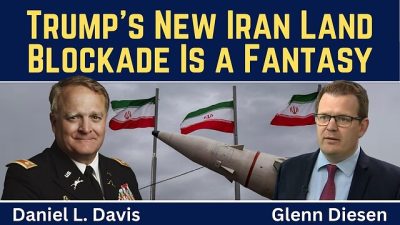
Daniel Davis: Trump’s New Iran Land Blockade Is a Dangerous Fantasy
or go to
Aletho News Archives – Video-Images
New Book
The Vaccine Mafia: Pfizer’s Former Chief Toxicologist Proves How Toxic Substances Were Unlawfully Sold to Us as a Solution for COVID-19
By Helmut Sterz
Former Pfizer chief toxicologist Helmut Sterz presents a critical examination of the development, approval, and global rollout of mRNA COVID-19 vaccines—particularly those produced by Pfizer/BioNTech. The Vaccine Mafia details the failure of pharmaceutical companies, regulatory authorities, politicians, and international organizations to follow established scientific and ethical standards during the pandemic. Drawing on the author’s decades of experience in pharmaceutical toxicology, Sterz reveals the many ways the vaccines’ inadequate or omitted preclinical safety testing put the world’s population at risk.
Sterz demonstrates how “emergency” approvals allowed manufacturers to bypass long-standing international guidelines governing toxicity testing, especially with regard to reproductive and cancer risks. They also allowed governments and health authorities to ignore or conceal evidence of serious adverse effects that occurred, including myocarditis, reproductive harm, and other long-term health risks.
Blog Roll
 Aletho News
- The ‘Gaza Treatment’: How Media Headlines Obscure Who is Bombing Yemen
- Ro Khanna urges Democrats to strip Israel ‘integration’ provision from defense bill
- Why Iran designated British MI6, Royal Navy, and RAF as hostile, terrorist organizations
- Armenian opposition politician dies in custody
- US still trying to recycle failed hypersonic missile programs
- France’s ‘Cold War’: Paris blames Tehran for supermarket fridge hacks
- Psywar no more? 77th Brigade’s sudden death
- Ukraine Already Carved Up… Before Talks Begin? /Prof. Richard Sakwa
- The vindication of Marjorie Taylor Greene
- Nearly 80% of Britons consider Israel a threat to world peace and security: Survey
- If Americans Knew
- An error has occurred; the feed is probably down. Try again later.
- No Tricks Zone
- German Authorities Start Initiative To Evaluate Public Register For Climate “Disinformation” Spreaders!
- Zonal Asymmetry of Temperature Change in the Antarctic Circumpolar Current
- New Study: The Net Fossil Fuel Contribution To Rising Atmospheric CO2 Has Been Zero For 500 Years
- Germany’s Green Energy Transition Becoming Increasingly Expensive…Another 6 Trillion Euros!
- Sudden Stratospheric Warming, Powerful El Niño Combination May Lead To Extreme Europe Cold, Energy Crisis!
- Two New Studies Find Thwaites Glacier Melt Cannot Be Driven By Human Activity Or A Warming Ocean
- E-Cars Reduce CO2 Emissions By Only 41% Compared To Internal Combustion Engine Vehicles
- Predictions Made By Renowned Climate Professor Over Past Decades Have Been Proven To Be Poor
- New Study Suggests Large Regions Of The Pacific Ocean Have Been Cooling For The Last 80 Years
- Germany’s Green Energy Debacle: High Energy Costs Force Kahla Porzellan to Close After 182 Years!

