RT may soon be dropped by US providers, courtesy of McCain & Graham
RT | September 21, 2017
Buried deep inside the just-passed defense budget is a small amendment, which could lead to a ban on broadcasting RT in America. The architects of the provision, Senators Graham and McCain, may recall that in their youth such practices formed what was known as the ‘Iron Curtain’.
The National Defense Authorization Act (NDAA) for the fiscal year 2018, which was passed by the US Senate earlier this week, is stuffed with provisions that have little to do with US national defense. This is a tactic that US lawmakers have traditionally used to ‘piggy-back’ legislation which would have little hope of adoption as a stand-alone bill.
Deep down the list of amendments is No 1096, which aims to “prohibit multichannel video programming distributors from being required to carry certain video content that is owned or controlled by the Government of the Russian Federation”.
Proposed by Senator Lindsey Graham (R-South Carolina) and co-sponsored by Sen. Sheldon Whitehouse (D-Rhode Island), the amendment was submitted by John McCain (R-Arizona), a fellow foreign policy hawk. The provision says a distributor working in a US jurisdiction “may not be directly or indirectly required” to carry video content that is “is owned, controlled, or financed (in whole or in part) by the Government of the Russian Federation.”
In plain English then, any contract RT currently has or will have with American cable and satellite networks to carry its programming will no longer be protected by US federal law after this amendment is signed into law by President Donald Trump. The channel’s current arrangements with carriers made it illegal for them to arbitrarily drop RT’s programming (unless the content shown was obscene) but now they will apparently be able to discriminate against it should they so wish.
The discussion on how the US could insulate its population from RT was sparked by a declassified US intelligence community report on alleged Russian meddling in the 2016 presidential election, which put this channel in the spotlight. The report asserted that RT was a primary tool of such interference, done through critical reporting on US foreign policy and domestic problems. Despite the report containing factual errors and no evidence, it was taken at face value by many US media outlets and politicians.
“There is an obsession on Capitol hill and in the mainstream media with RT, because RT is effective and because RT is watched. But also because RT carries perspectives that are not available on the mainstream media,” commented Daniel McAdams, Executive Director for the Ron Paul Institute.
“The fact of the matter is that John McCain and Lindsey Graham, the people behind this amendment, the Atlantic Council and the others that are trying to silence RT – they are the totalitarians, they are the enemies of free speech, the enemies of the First Amendment.”
The move seems to resemble the strategy of the Soviet government, which strictly controlled domestic media and suppressed radio broadcasts from Europe to insulate the population of the country from ideas and narratives it deemed unfit. The censorship system, dubbed the “Iron Curtain”, backfired and became a major factor in eroding the Communist Party’s control, for the simple reason that people perceived media sources which the government tried to silence as more trustworthy than those it allowed.
Russia warns US it will strike back if militia attacks in Syria don’t end
RT | September 21, 2017
Moscow has warned the US that if militias it supports in northeast Syria again attack positions of pro-government forces backed by Russia, the Russian military will use all its force to retaliate.
The troops of the Syrian Democratic Force (SDF), a predominantly Kurdish militia that receives support from the US military, have twice attacked positions of the Syrian Arab Army in the Deir ez-Zor governorate with mortar and rocket fire, according to the Russian Defense Ministry’s spokesman, Major General Igor Konashenkov.
“Russia unequivocally told the commanders of US forces in Al Udeid Airbase (Qatar) that it will not tolerate any shelling from the areas where the SDF are stationed,” Konashenkov said, adding that the attacks put at risk Russian military advisers embedded with Syrian government troops.
“Fire from positions in regions [controlled by the SDF] will be suppressed by all means necessary,” he stressed.
Konashenkov said Moscow suspected the SDF of colluding with the terrorist group Islamic State (IS, also known as ISIS/ISIL) in Deir ez-Zor rather than fighting it, as it claims to be. He said Russia had detected the transfer of SDF fighters from the IS stronghold of Raqqa, to join forces with the jihadists.
“SDF militants work to the same objectives as IS terrorists. Russian drones and intelligence have not recorded any confrontations between IS and the ‘third force,’ the SDF,” the Russian general said.
The statement said that the siege of Raqqa by the SDF has been halted, apparently in response to the latest advances by Syrian government forces in Deir ez-Zor, which is located to the east from Raqqa along the Euphrates River.
“The central parts of the former ISIL capital, which account for roughly 25 percent of the city, remain under full control of the terrorists,” Konashenkov remarked.
According to the statement, in the last 24 hours Syrian government troops “continued their offensive operation” to destroy the last “IS bridgehead” near the city of Deir ez-Zor, the provincial capital. Troops led by Syrian Army General Suheil al-Hassan liberated around 16 sq km of territory and two settlements on the western bank of the Euphrates River.
“More than 85 percent of Deir ez-Zor’s territory is under the full control of Syrian troops. Over the next week the city will be liberated completely,” Konashenkov said.
The city of Deir ez-Zor in eastern Syria was besieged by Islamic State in 2014. Syrian government forces lifted the blockade of the city in early September.
However, the liberation of Deir ez-Zor also triggered a confrontation between Syrian government forces and the US-backed SDF militants, the point of contention being control of Deir ez-Zor’s oil fields.
Following Damascus’s strategic victory, food, medicine and other essentials started to reach the city by convoy, where previously the inhabitants had to rely on air-drops.
The escalation of tension in eastern Syria is mirrored in the western Idlib governorate, where militant forces this week attacked Syrian positions in a designated de-escalation zone. The offensive threatened a unit of Russian military police, who were stationed in the area to monitor the ceasefire. Russia mounted an emergency rescue operation on Wednesday, in which three Russian special operations troops were injured. The Russian Defense Ministry claimed that the militants’ offensive had been instigated by US special services.
More Holes in Russia-gate Narrative
By William Binney and Ray McGovern | Consortium News | September 20, 2017
It is no secret that our July 24 VIPS Memorandum for the President, entitled “Was the ‘Russian Hack’ an Inside Job?,” gave rise to some questioning and controversy – nor was it a surprise that it was met with almost total silence in the mainstream media.
The ongoing U.S. media campaign against Russia has been so effective that otherwise intelligent people have been unable even to entertain the notion that they may have been totally misled by the intelligence community. The last time this happened in 2003, after a year of such propaganda, the U.S. attacked Iraq on fraudulent – not “mistaken” – intelligence.
Anticipating resistance from those allergic to rethinking “what everybody knows” about Russian “meddling,” we based our VIPS analysis on forensic investigations that, oddly, the FBI had bent over backwards to avoid. In other words, we relied on the principles of physics and the known capability of the Internet in early July 2016.
We stand by our main conclusion that the data from the intrusion of July 5, 2016, into the Democratic National Committee’s computers, an intrusion blamed on “Russian hacking,” was not a hack but rather a download/copy onto an external storage device by someone with physical access to the DNC.
That principal finding relied heavily on the speed with which the copy took place – a speed much faster than a hack over the Internet could have achieved at the time – or, it seems clear, even now. Challenged on that conclusion – often by those conducting experiments within the confines of a laboratory – we have conducted and documented additional tests to determine the speeds that can be achieved now, more than a year later.
To remind: We noted in the VIPS memo that on July 5, 2016, a computer directly connected to the DNC server or DNC Local Area Network, copied 1,976 megabytes of data in 87 seconds onto an external storage device. That yields a transfer rate of 22.7 megabytes per second.
Recent Tests
Over the last few weeks, we ran three tests to determine how quickly data could be exfiltrated from the U.S. across the Atlantic to Europe.
–First, we used a 100 megabits-per-second (mbps) line to pull data from a one-gigabyte file to Amsterdam. The peak transfer speed was .8 MBps.
–Second, we used a commercial DSL (Digital Subscriber Line) to send the same one-gigabyte file to a commercial DSL in Amsterdam. The peak transfer speed was 1.8 MBps.
–Third, we pushed the same one-gigabyte file from a data center in New Jersey to a data center in the UK. The peak transfer speed was 12 MBps.
None of these attempts achieve anything close to the average rate of 22.7 megabytes per second evident in the July 5, 2016 download/copy associated with the DNC. In fact, this happens to be the speed typical of a transfer to a USB-2 external storage device. We do not think this pure coincidence; rather, it is additional evidence of a local download.
We are preparing further trans-Atlantic testing over the next few weeks.
Some researchers have noted that some partitioning of the data might have occurred in the U.S., allowing for a transfer to be made at the measured speed over the Internet, and that this could have made possible a hack from the other side of the Atlantic. One of our associate investigators has found a way to achieve this kind of data partitioning and later transfer.
In theory, this would be one possible way to achieve such a large-data transfer, but we have no evidence that anything like this actually occurred. More important, in such a scenario, the National Security Agency would have chapter and verse on it, because such a hack would have to include software to execute the partitioning and subsequent data transfer. NSA gives the highest priority to collection on “execution software.”
Most Americans, apparently including President Donald Trump, remain in a Russia-did-it-or-could-have-maybe-might-have-done-it subjunctive mood on this important issue – one that has been used to inject Cold War ice into relations with Russia? The answer is absolutely not. Rather, definitive answers are at hand.
How can we be so confident? Because NSA alumni now active in Veteran Intelligence Professionals for Sanity (VIPS) are intimately familiar with NSA’s capabilities and practice with respect to bulk capture and storage of fiber-optic communications. Two of us actually devised the systems still in use, and Edward Snowden’s revelations filled in remaining gaps. Today’s NSA is in position to clear up any and all questions about intrusions into the DNC.
In sum, we are certain that the truth of what actually happened – or didn’t happen – can be found in the databases of NSA. We tried to explain this to President Barack Obama in a VIPS Memorandum of Jan. 17, just three days before he left office, noting that NSA’s known programs are fully capable of capturing – and together with liaison intelligence services do capture – all electronic transfers of data.
Our Jan. 17 Memorandum included this admonition: “We strongly suggest that you ask NSA for any evidence it may have indicating that the results of Russian hacking were given to WikiLeaks.” … “If NSA cannot give you that information – and quickly – this would probably mean it does not have any.”
We also appealed to Obama in his final days in office to order the chiefs of the NSA, FBI and CIA to the White House and have them lay all their cards on the table about “Russian hacking,” and show him what tangible evidence they might have – not simply their “assessments.” We added, “We assume you would not wish to hobble your successor with charges that cannot withstand close scrutiny.” Having said this, we already were reaching the assumption that there was no real evidence to back the “assessments” up.
FBI: Not Leaning Forward
The FBI could still redeem itself by doing what it should have done as soon as the DNC claimed to have been “hacked.” For reasons best known to former FBI Director James Comey, the Bureau failed to get whatever warrant was needed to confiscate the DNC servers and computers to properly examine them.
In testimony to the House Intelligence Committee six months ago, Comey conceded “best practice is always to get access to the machines themselves.” And yet he chose not to. And his decision came amid frenzied charges by senior U.S. officials that Russia had committed “an act of war.”
But is it not already too late for such an investigation? We hope that, at this point, it is crystal clear that the answer is: No, it is not too late. All the data the FBI needs to do a proper job is in NSA databases – including data going across the Internet to the DNC server and then included in their network logs.
If President Trump wants to know the truth, he can order the FBI to do its job and NSA to cooperate. Whether the two and the CIA would obey such orders is an open question, given how heavily invested all three agencies are in their evidence-impoverished narrative about “Russian hacking.”
Let us close with the obvious. All three agencies have been aware all along that NSA has the data. One wonders why it should require a Presidential order for them to delve into that data and come up with conclusions based on fact, as opposed to “assessing.”
William Binney (williambinney0802@comcast.net) worked for NSA for 36 years, retiring in 2001 as the technical director of world military and geopolitical analysis and reporting; he created many of the collection systems still used by NSA. Ray McGovern (rrmcgovern@gmail.com) was a CIA analyst for 27 years; from 1981 to 1985 he briefed the President’s Daily Brief one-on-one to President Reagan’s most senior national security officials.
Hué Back When: Vietnam’s Pivotal Battle Reconsidered

Photo by Raymond Depardon | CC BY 2.0
By Michael Uhl | CounterPunch | September 20, 2017
For Mark Bowden, author of Hué 1968, the pivotal battle of the War in Vietnam did not follow the script most Americans were used to scanning in their newspapers or visualizing on the evening news. The war Americans followed at home was like a humongous hunting expedition. U.S. forces seemed engaged in an endless chase over a lush boondocks inhabited by peasants and dotted with rice paddies or trailing the rugged forested highlands in search of the Viet Cong, a cunning and elusive enemy whose tactics were hit and run, not stand and fight.
When an atypical fixed battle developed, it was typically well-removed from the population centers that hugged the coastline off the South China Sea. Vietnam was, after all, a guerrilla war, or more broadly understood, a people’s war fought to reunite a nation, artificially divided into North and South by fiat of the United States in the service of geopolitical brinksmanship. Accused of fermenting the southern insurgency, North Vietnam was mercilessly bombed, but spared the carnage of a ground war. Not so the south where, by whatever foul means, the idea was “to isolate the population from the Viet Cong,” notwithstanding that, as Mark Bowden readily concedes, “in most instances they were one in the same.” The resistance was popular and widespread, and its idea was to drive the American invader out, and overthrow a despised ruling clique of Vietnamese compradors which survived only because the invader had committed hundreds of thousands of its own troops and billions of its taxpayers’ dollars to sustain it.
Americans were consistently assured that bit by bit the tumultuous countryside was being pacified, and the guerillas attrited, both politically and as a fighting force. In late 1967 Americans were told they were winning the war. When Tet – the Luna New Year – dawned on January 31, 1968, that illusion was irreparably shattered. The vastly superior forces of the United States and its southern catspaw, the Army of the Republic of Vietnam (ARVN), were caught virtually flat footed when thousands of regular troops of the People’s Army of North Vietnam seemingly materialized from thin air, and in coordination with local units of the southern resistance, launched up and down the length and breath of South Vietnam what was quickly branded the Tet Offensive. The most stunning blow for Americans, war managers and citizens alike, was an assault on the South Vietnamese capital of Saigon taken right to the walls of the American Embassy.
For several weeks thereafter, media attention in the U.S. and throughout the world focused primarily on the shock of Saigon’s vulnerability, overplaying its significance. A thousand kilometers north, at first scarcely noticed, even by the Commander of U.S. forces, General William Westmoreland, a battle had commenced that would become the “longest and bloodiest” of the war, not waged over the – till then – familiar rural topography, but house to house, street by street, culminating in one of the most intense chapters of urban warfare in the annals of American military history. Observers today might liken it to a more recent urban free-for-all entangling American troops in Fallujah, Iraq. Or, better yet, recall a U.S. military fiasco in downtown Mogadishu that Mark Bowden had crafted into an earlier best seller. To the extent comparisons hold, the Battle of Hue was like Black Hawk Down on steroids.
Hue 1968 is a comprehensive account of that battle written in the page-turning style of popular narrative non-fiction. The author has assembled a cast of eyewitnesses who participated in the action, Vietnamese and Americans, and the battle unfolds in recollections mined from their 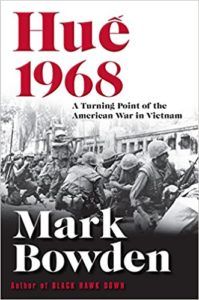 interviews, and, for the departed, from other primary sources at his disposal, such as lengthy wartime correspondences. Bowden has properly set the strategic stage for his action in the context of the war’s two most relevant contemporaneous developments. There was the very fact of Tet, simultaneous attacks with varying degrees of effectiveness on virtually every population center and military base in the South. The Year of the Monkey came in like Armageddon, catching General Westmoreland, for one, completely off guard even though he later claimed he knew those crafty commies were planning something.
To draw attention away from their true intentions, the North Vietnamese had executed a feint, keeping a remote Marine encampment under heavy bombardment at Khe Sanh near the border with Laos, and just below the Demilitarized Zone (DMZ). Taking the bait, and just two weeks before Tet, Westmoreland weakened his coastal enclaves by detaching troops to reinforce the beleaguered camp. The American general believed he was luring the North Vietnamese into a repeat of the battle of Dien Bien Phu, which in 1954 brought French colonial control of Vietnam to an end but inadvertently opened the door to an American invasion. This time, Westmoreland fantasized, “he was determined to prevent history from repeating itself.” That battle never developed, and several months later, Khe Sanh was abandoned by the Americans.
Westmoreland’s obsession with Khe Sanh apparently prevented him from fully grasping that Hue, South Vietnam’s third largest city, and former Imperial capital, had fallen to the Liberation Front in less than twenty-four hours. This pattern of disbelief was moreover pervasive up and down the American chain of command. At Phu Bai, a Marine base less than fifteen miles south of Hue, the commanding general, with improbable symmetry named Forster LaHue, repeatedly ignored reports on the size of the force his counterattack would face, and insisted that, instead of thousands, their number couldn’t possibly exceed more than a few hundred. Could a force as large as the one being reported enter and occupy the entire city that quickly and virtually undetected? Through some of his most original reporting Bowden reconstructs exactly how that occurred.
Shifting the action in his account from one adversary to the other, Bowden begins with the attack, describing how four regiments totaling roughly four thousand uniformed NVA soldiers managed to infiltrate the border between North and South Vietnam, rendezvous with local guerrillas in a force of equal size, and ultimately bivouac on the outskirts of Hue. “It was the kind of troop movement,” comments Bowden, “that could remain secret only if the citizenry supported it, or didn’t care enough to sound the alarm.”
Certainly in Hue there were many Catholics who, in general, were partisans of the Saigon regime, not to mention a contingent of elite ARVN soldiers stationed there, who would have sounded the alarm if they’d been aware of any imminent threat. On another side was a strong current of anti-Americanism among the Buddhists and the student body at Vietnam’s prestigious Hue University, who two years earlier had combined and rioted against the repressive South Vietnamese government, and burned the library of the United States Information Service. But by early 1968, Hue was being little frequented by the war’s violence, and hopes were stoked that the city’s rich stock of architectural treasures, not least the palace of Vietnam’s last royal dynasty, might avoid destruction. Compared with the rest of the country, life in Hue was reasonably good, and reasonably safe. A degree of political complacency had set into what remained a functional commercial entrepot where trade and traffic on Hue’s iconic Perfume River remained brisk.
Even though a majority of Hue’s population of 140,000 could not be considered pillars of the revolution, an underground resistance network was well-entrenched in the city and highly motivated. And Bowden, having tracked down a small cast of survivors, gives us affecting sketches of, among others, the Village Girl who guided the troops through the darkness and pointed them toward their targets; the VC commander who stood up to the hero of Dien Bien Phu, General Vo Nguyen Giap, and revised the battle plan; the college boy who worked with his fisherman landlord to smuggle arms into the city by sampan; the Buddhist poet turned what we would call ‘information officer,’ and Bowden – who holds many conventional opinions– calls “propagandist;” but my favorite was the balsy little guy who was given the task to create a giant new flag for the victors to raise once they’d taken the city.
The flag detail merits a special nod to illustrate the contrast between the high tech m.o. of the Empire’s war machine, and the endless improvisation of those in the Front who used gumption, imagination and stealth to their advantage in the face of overwhelming fire power from air, land and sea. The task to create a flag to be seen, not as “an invasion or occupation, but rather as a liberation,” fell to Sargent Cao Van Sen, an old war horse who’d fought with the Viet Minh against the French, joined the northern Army, and was then ordered back to his native Hue to organize among the Viet Cong. The idea of the flag, Bowden says “was to recognize real political differences between North and South,” with a design that represented, not only the liberation forces, but also “the intelligentsia and the city’s religious factions – Buddhists and Catholics.” Hanoi’s political objective at that stage was transitional, “to establish a neutral, independent South Vietnam,” leaving reunification to future negotiations.” Sgt. Sen’s job was to line up the material, a sewing machine and a seamstress to produce a single flag, which, when completed, required two men to carry it. After being “run up the 123-foot flagpole… that stood just outside the royal palace before the Citadel’s southern wall… it was visible all over Hue” when the city’s denizens awoke January 31st on the first morning of Tet.
Metropolitan Hue spread over both sides of the Perfume River, and the Front’s objective was to occupy the zone on the south bank called the Triangle, and, on the north, the Citadel, an “enormous fortress that enclosed nearly two square miles… its walls twenty-six feet high and impenetrably thick,” and enclosing the neighborhoods of Hue’s most affluent residents. Primary targets, included the air strip inside the Citadel, the province headquarters, the treasury, the post office, the prison, the radio station and “the sole American base, the [Military Assistance Command, Vietnam] MACV compound.”
The Commander of the Front, General Dang Kinh watched from high ground to the west, anxiously awaiting the assault to begin. Finally, “throughout the city arose the sound of gunfire… scattered at first, and then as if touched off by a fuse, it rose rapidly to a din.” By the time the shooting stopped, the attacking force, having “suffered only a few casualties, had dealt Hue’s defenders a crushing surprise blow.” The only major targets not overrun were a fortified redoubt occupied by the 1st ARVN Division inside the Citadel, and the MACV compound on the opposite side of the river, both heavily under siege.
Notwithstanding the loud cheerleading from Hanoi for Tet to unleash a “popular uprising,” it was General Kinh’s opinion, according to Bowden, that no such uprising would occur, not even in subdued and occupied Hue, given the certainty of an overpowering American counter-attack. Kinh knew his forces “could take the city, but… not hold it for long. Achievable goals… were to destroy the ARVN division, and… round up… those who represented the Saigon regime… who were marked for arrest and punishment.”
The subsequent executions of many of these Saigon officials is thematic in Bowden’s text, an overly eager retailing of the ex post facto justification among the war’s apologists for the American decision to rescue their allies by destroying their city. More informed observers might counter that for an American writer of Bowden’s stature to lay charges of mass murder at the Vietnamese resistance– in this instance taking blood retaliation on enemies considered legitimate military targets – demonstrates a highly hometown cast of mind, and a failure to do the math on the infinitely less selective assassination orgy of the U.S. Phoenix Program, not to mention the war’s vastly unbalanced human death toll perpetrated upon the Vietnamese population by the invader.
Kinh’s prediction proved correct. And much of what Bowden encapsulates in Hue 1968 is devoted to a ground level view on just how the city was retaken. Bowden fully examines first January 31st, the day Hue fell, from a variety of vantage points including civilians and combatants on both sides, then moves the battle forward in week long blocks until the Front, faced with annihilation, is forced to withdraw. Had the U.S. command acted more swiftly, the lives of many marines might have been spared, but the city faced devastation in every scenario as long as the occupiers remained. The initial counter-thrust came from the nearby Marine base at Phu Bai when General LaHue, still doubting his adversary’s vast numerical superiority, initially dispatched so few marines that, on one of few occasions during the war, the U.S. was seriously out-gunned. When a marine captain already in Hue called for air and artillery strikes to dislodge the entrenched enemy, General LaHue told him “rather strikingly that he was overreacting.“ LaHue “saw no reason on earth why the more than four hundred men in the [MACV] compound, reinforced with well over three hundred U.S. marines,” assorted tanks and heavy weaponized vehicles, “should not be able to flatten anything between them and the fucking Citadel.” Bowden aptly titles this episode An Idiotic Mission.
Three hundred men represented one understrength marine battalion, but only a single unit, Alpha Company of the 1st Battalion of the 1st Marine Division was dispatched at first to test the enemy strength. This proved a disaster, and the best account of the action on the ground I’ve found was not Bowden’s, but in Vietnam-Perkasie, a memoir by W.D. (Bill) Ehrhart. When Alpha Company left Phu Bai just as the sun was coming up, Bill Ehrhart was given the option of staying behind. He was short, meaning only a few days remained on what had already been a harrowing thirteen month tour. But since the unit was just going to check things out, and were told they’d be back by evening, Bill threw caution to the wind.
Alpha Company, moving to relieve the assault on the MACV compound passed a gas station on the city outskirts, and then, Ehrhart writes, “all hell broke loose… The shock of the ambush caught the whole column completely by surprise… We knew the compound lay straight up the road… seven blocks ahead… We fought our way up the [first] block. And the one after that. All day long we inched up the street. Casualties were appalling. Wounded and dead Marines lay everywhere.” Ehrhart, wounded in action, was in the thick of it the whole time. His memoir is a compelling, heart wrenching read.
From there Bowden covers the fighting chapter and verse. And if battle action is your genre, it’s a read that’s hair raising enough to fix your attention. The killing went on for 26 days, and by the end, 80% of the city lay in rubble. Bowden devotes a last chapter to Hue’s human toll. “Two-hundred and fifty American marines and soldiers were killed, and 1,554 wounded… The Front’s losses are estimated at between 2,400 and 5000…. A conservative guess at those executed would be two thousand… [which] brings us to a combined civilian death toll of about eight thousand… not an exact figure, but to the degree it’s off, it’s off by being too low.”
That the civilian death toll was enormous, cannot be doubted, and is by most accounts I’ve read over the years attributed to the terrible pounding the city took from naval off-shore guns, and from American and ARVN air power and artillery intent on expelling the Front whatever the human cost. As for “those executed,” it appears as if Bowden may have that figure “off” by a factor of ten. Writing in The New York Times in October 1972, Richard Barnet, a former State Department official and co-founder of the Institute for Policy Studies, quotes what the Hué Police Chief told a correspondent of The Times of London in March 1968 just days after the battle. The Chief, “Doan Cong Lap estimated the total number of executions at 200.“ Moreover, “the local Catholic priest reported that none of his clergy or parishioners were harmed by the N.L.F. [National Liberation Front],” who had been given instructions to be on their best behavior. Even if these two eyewitnesses under-counted the reprisal deaths, it’s still unlikely that Bowden’s figure holds water, given his reliance on official U.S. sources.
Richard Barnet took up this topic at a time when voices in the Nixon administration were claiming that mass executions at Hué were proof there would be a bloodbath if the U.S. withdrew and the communists came to power. When questioned on this in Hanoi, Premier Pham Van Dong retorted, “There is nothing in recent Vietnamese history to suggest that a government bent on killing hundreds of thousands of people in South Vietnam can keep peace.” In any case the bloodbath was us. As Barnet dryly quipped, “In the Orwellian age, the daily saturation bombings of Indochina are defended as missions of mercy.”
Mark Bowden seems to bend over backwards throughout this voluminous and valuable book to provide a two-sided perspective on a particularly tragic moment in the Vietnam War. But there’s something distastefully familiar in his throwaway rhetoric of the Cold War bias that got us into Vietnam in the first place. Bowden demonstrates how truth is betrayed by the words he chooses, for example, that “antiwar activists in the States romanticized Ho Chi Minh, and his cause, emphasizing his nationalist character… [but] Hanoi was Communist, authoritarian to the core… ruthless and doctrinaire.” Yet even this phobic reflex to honor the thought police in the mainstream where he prospers doesn’t cause Bowden to ignore that it was the Stalinists who hoped to come to power though the ballot box and the Americans who made war to prevent that.
By consensus in the school of conventional wisdom the Tet Offensive of 1968 was the turning point of the Vietnam War, after which the American war aim was not to win, but how to get out. Mark Bowden makes an excellent case that the fulcrum of that turning point was the Battle of Hue. But what if there was no turning point? In Vietnam the protracted war to expel a powerful foreign invader had its roots in millennia past; the American invasion was just another bump in the road.
Michael Uhl is the author of Vietnam Awakening.
Nuclear powers refrain from signing UN treaty on banning nukes
Press TV – September 20, 2017
World powers that possess nuclear weapons refrain from attending a ceremony at the United Nations to sign a long-anticipated treaty on banning nukes, merely arguing that the pact will not work.
None of the nuclear-armed states including the United States, Britain, Russia, France, China, India and Pakistan sent representatives to the ceremony for signing the Treaty on the Prohibition of Nuclear Weapons, a pact that was adopted by 122 countries at the United Nations in July.
UN Secretary General Antonio Guterres opened the event in New York while hailing the agreement as a milestone and the first multilateral pact on disarmament in more than two decades.
Brazilian President Michel Temer was the first head of state to put his signature on the document, which comes amid heightened tensions over North Korea’s nuclear program.
North Korea tested its sixth and most powerful nuclear bomb earlier this month following the test-fire of two intercontinental ballistic missiles, weapons that experts say could target the mainland United States and could be used to carry a nuclear warhead.
The United States, Britain and France have dismissed the UN treaty as unrealistic, arguing that North Korea’s intensified nuclear activity has shown that they still need nuclear arms to maintain deterrence.
Supporters of the pact, however, say the time has come for the international community to push harder toward eliminating atomic weapons as a 50-year-old Non-Proliferation Treaty has effectively failed to contain the thirst of powers for expanding their nuclear arsenal.
“We call upon them to join this date with history,” said Costa Rican President Luis Guillermo Solis at the ceremony, held on the sidelines of the annual UN General Assembly meeting of world leaders.
Morgan Freeman Declares War on Russia at Rob Reiner’s Behest
Sputnik – September 20, 2017
Social media is awash with outrage after Hollywood megastar Morgan Freeman appeared in a propaganda video issued by a newly-established anti-Russian non-profit group, in which he declares Washington is at war with Moscow.
Morgan Freeman is an almost universally beloved figure in the West, and his famed golden voice almost universally beloved across the West, so it’s understandable why the newly-established Committee to Investigate Russia might choose him to front its propaganda campaign.
However, initial reactions to the clip on social media suggest the move might’ve been a titanic misfire, as even supporters of the #TheRussiansDidIt hypothesis are criticizing the group, and slamming the video’s incendiary tone.
In the two-minute-long video, the Shawshank Redemption star issues a dire warning, “We have been attacked. We are at war.”
“My fellow Americans, during this past election, we came under attack by the Russian government. I’ve called on Congress and our intelligence community to use every resource available to conduct a thorough investigation to determine exactly how this happened. We need our president to speak directly to us and tell us the truth,” Freeman says.
No Experience Required
The Committee to Investigate Russia aims to help US citizens “understand and recognize the scope and scale of Russia’s continuing attacks on our democracy” — a lofty ambition, but given the weight of the group’s advisory board, one it will surely have little trouble achieving.
The five-strong board is led by Rob Reiner, director of “This Is Spinal Tap” and “When Harry Met Sally”; James Clapper, former Director of National Intelligence, who committed perjury in 2013 when he told a Senate Select Committee on Intelligence the NSA did not “wittingly” collect data on US citizens; Max Boot, a neoconservative blogger; Norman Ornstein, an obscure political scientist with no discernible history of research into Russia; Charles Sykes, a right-wing radio talk show host.
To promote the launch, board members appeared on numerous mainstream US news channels — Reiner, a consistent Trump critic who has called for “all out war” against the president, told CNN he was moved to found the group as he felt Americans didn’t understand the “gravity of what the Russians were able to do.”
“They’re trying to undermine our democracy. And for some reason we are not understanding the gravity of this. And I think a big part of that is because the president of the United States is not saying, in the Oval Office, “my fellow Americans, we’ve been attacked.” So I started reaching out to people who are patriots,” the director said.
Clapper likewise has a record of making controversial statements about Trump and Russia alike. He has previously suggested the president is secretly working for the Kremlin, and claimed Russians are “genetically” predisposed to manipulate and infiltrate.
Boot, an avowed Republican, has also been consistently condemnatory of Trump, and caused consternation in some conservative circles by announcing “real” Republicans should vote for Hillary Clinton in the Presidential election.
In the meantime, despite suggestions of Russian interference echoing since before the November 2016 presidential election, no evidence of Kremlin-backed covert interventions have been publicly offered, despite the House and Senate Intelligence committees launching investigations into the matter.
Manafort Demands Probe After Leak Revealed He Was Being Wiretapped
Sputnik – 20.09.2017
A legal representative of Paul Manafort, who at one time managed the successful 2016 presidential bid of Donald Trump, has demanded an investigation into the FBI after anonymous sources seemingly broke federal law by leaking classified information to the media regarding the investigation into Manafort.
On Tuesday, CNN broke the news that the FBI had secured a wiretap on Manafort’s phone under the Foreign Intelligence Surveillance Act (FISA.) The investigation began in 2014 following allegations that Manafort was operating as a foreign agent in his capacity as a campaign adviser to Ukrainian president Viktor Yanukovych. The wiretap paused in 2016, and resumed in 2017 under new allegations of Manafort’s ties to Russian intelligence. Eventually, the FBI ended the wiretapping for a lack of evidence.
If the reports are true, then a felony has been committed — but not by Manafort. According to Jason Maloni, a spokesman for the former lobbyist and Trump presidential campaign manager, “it is a felony to reveal the existence of a FISA warrant, regardless of the fact that no charges ever emerged. The US Department of Justice’s Inspector General should immediately conduct an investigation into these leaks and to examine the motivations behind a previous Administration’s effort to surveil a political opponent.”
“Mr. Manafort requests that the Department of Justice release any intercepts involving him and any non-Americans so interested parties can come to the same conclusion as the DOJ — there is nothing there.”
Manafort has denied the charges that he “knowingly” communicated with Russian intelligence operatives during the election. He denies any participation in efforts to “undermine the interests of the United States.”
FISA warrants aren’t easy to secure. As former FBI agent Asha Rangappa told Public Radio International, “what the FBI has to do is go into a secret FISA court and show the judge that there’s probable cause to believe that the person they are targeting is acting as what’s called ‘an agent of a foreign power,’ that they’re acting at the direction and control of a foreign intelligence service in this case.”
Robert Mueller, the Department of Justice Special Counsel in charge of investigating the alleged ties between Russia and the Trump campaign team, has been undertaking what the New York Times called a “shock and awe” strategy in his investigation, utilizing tactics like dramatic nighttime raids on Manafort’s residence and impaneling a grand jury to indict Manafort.
“Mr. Mueller has obtained a flurry of subpoenas to compel witnesses to testify before a grand jury, lawyers and witnesses say, sometimes before his prosecutors have taken the customary first step of interviewing them. One witness was called before the grand jury less than a month after his name surfaced in news accounts. The special counsel even took the unusual step of obtaining a subpoena for one of Mr. Manafort’s former lawyers, claiming an exception to the rule that shields attorney-client discussions from scrutiny,” The Times reported.
“It’s important early on to strike terror in the hearts of people in Washington,” one attorney told the Times, in reference to Mueller’s probe.
Trump Falls in Line with Interventionism
By Robert Parry | Consortium News | September 19, 2017
In discussing President Trump, there is always the soft prejudice of low expectations – people praise him for reading from a Teleprompter even if his words make little sense – but there is no getting around the reality that his maiden address to the United Nations General Assembly must rank as one of the most embarrassing moments in America’s relations with the global community.
Trump offered a crude patchwork of propaganda and bluster, partly delivered as a campaign speech praising his own leadership – boasting about the relatively strong U.S. economy that he mostly inherited from President Obama – and partly reflecting his continued subservience to Israeli Prime Minister Benjamin Netanyahu.
However, perhaps most importantly, Trump’s speech may have extinguished any flickering hope that his presidency might achieve some valuable course corrections in how the United States deals with the world, i.e., shifting away from the disastrous war/interventionist policies of his two predecessors.
Before the speech, there was at least some thinking that his visceral disdain for the neoconservatives, who mostly opposed his nomination and election, might lead him to a realization that their policies toward Iran, Iraq, Syria and elsewhere were at the core of America’s repeated and costly failures in recent decades.
Instead, apparently after a bracing lecture from Netanyahu on Monday, Trump bared himself in a kind of neocon Full Monte:
–He repeated the Israeli/neocon tripe about Iran destabilizing the Middle East when Shiite-ruled Iran actually has helped stabilize Iraq and Syria against Sunni terrorist groups and other militants supported by Saudi Arabia and – to a degree – Israel;
–He again denounced the Iranian nuclear agreement whose main flaw in the eyes of the Israelis and the neocons is that it disrupted their plans to bomb-bomb-bomb Iran, and he called for “regime change” in Iran, a long beloved dream of the Israelis and the neocons;
–He repeated the Israeli/neocon propaganda about Hezbollah as a terrorist organization when Hezbollah’s real crime was driving the Israeli military out of southern Lebanon in 2000, ending an Israeli occupation that began with Israel’s 1982 invasion;
–He praised his rush-to-judgment decision to bomb Syria last April, in line with Israeli/neocon propaganda against President Bashar al-Assad and partly out of a desire to please the same Washington establishment that is still scheming how to impeach him;
–He spoke with the crass hypocrisy that the neocons and many Israeli leaders have perfected, particularly his demand that “all nations … respect … the rights of every other sovereign nation” — when he made clear that he, like his White House predecessors, is ready to violate the sovereignty of other nations that get in Official Washington’s way.
A Litany of Wars
Just this century, the United States has invaded multiple nations without U.N. authorization, based on various “coalitions of the willing” and other subterfuges for wars of aggression, which the Nuremberg Tribunals deemed the “supreme international crime” and which the U.N. was specifically created to prevent.
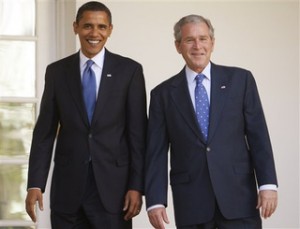
Barack Obama and George W. Bush
Not only did President George W. Bush invade both Afghanistan and Iraq – while also sponsoring “anti-terror” operations in many other countries – but President Barack Obama acknowledged ordering military attacks in seven countries, including against the will of sovereign states, such as Libya and Syria. Obama also supported a violent coup against the elected government of Ukraine.
For his part, Trump already has shown disdain for international law by authorizing military strikes inside Yemen and Syria. In other words, if not for the fear of provoking American anger, many of the world’s diplomats might have responded with a barrage of catcalls toward Trump for his blatant hypocrisy. Without doubt, the United States is the preeminent violator of sovereignty and international law in the world today, yet Trump wagged his finger at others, including Russia (over Ukraine) and China (over the South China Sea).
He declared: “We must reject threats to sovereignty, from the Ukraine to the South China Sea. We must uphold respect for law, respect for borders, and respect for culture, and the peaceful engagement these allow.”
Then, with a seeming blindness to how much of the world sees the United States as a law onto itself, Trump added: “The scourge of our planet today is a small group of rogue regimes that violate every principle on which the United Nations is based.”
Of course, in the U.S. mainstream media’s commentary that followed, Trump’s hypocrisy went undetected. That’s because across the American political/media establishment, the U.S. right to act violently around the world is simply accepted as the way things are supposed to be. International law is for the other guy; not for the “indispensible nation,” not for the “sole remaining superpower.”
On Bibi’s Leash
Despite some of his “America First” rhetoric – tossed in as red meat to his “base” – Trump revealed a global outlook that differed from the Bush-Obama neoconservative/liberal-interventionist approach in words only. In substance, Trump appears to be just the latest American poodle on Bibi Netanyahu’s leash.
For instance, Trump bragged about attacking Syria over a dubious chemical-weapons claim while ignoring the role of the Saudi/Israeli tandem in assisting Al Qaeda and its Syrian affiliate; Trump threatened the international nuclear agreement with Iran while calling for regime change in Tehran, two of Netanyahu’s top priorities; and Trump warned that he would “totally destroy North Korea” over its nuclear and missile programs while making no mention of Israel’s rogue nuclear arsenal and sophisticated delivery capabilities.
Ignoring Saudi Arabia’s ties to terrorism, Trump touted his ludicrous summit in Riyadh in which he danced with swords and let King Salman and other corrupt Persian Gulf monarchs, who have long winked and nodded at ideological and logistical support going to Al Qaeda and other Islamic terror groups, pretend their governments were joining an anti-terror coalition.
Exploding the myth that he is at least a street-smart operator who can’t be easily conned, Trump added, “In Saudi Arabia early last year, I was greatly honored to address the leaders of more than 50 Arab and Muslim nations. We agreed that all responsible nations must work together to confront terrorists and the Islamist extremism that inspires them.”
No wonder Netanyahu seemed so pleased with Trump’s speech. The Israeli prime minister could have written it himself while allowing Trump to add a few crude flourishes, like calling North Korean leader Kim Jong Un “Rocket Man … on a suicide mission”; referring to “the loser terrorists”; and declaring that many parts of the world are “going to hell.”
Trump also tossed in a plug for his “new strategy for victory” in Afghanistan and threw in some interventionist talk regarding the Western Hemisphere with more threats to Cuba and Venezuela about escalating sanctions and other activities to achieve more “regime change” solutions.
So, what Trump made clear in his U.N. address is that his “America First” and “pro-sovereignty” rhetoric is simply cover for a set of policies that are indistinguishable from those pushed by the neocons of the Bush administration or the liberal interventionists of the Obama administration. The rationalizations may change but the endless wars and “regime change” machinations continue.
Investigative reporter Robert Parry broke many of the Iran-Contra stories for The Associated Press and Newsweek in the 1980s.
America’s Jews Are Driving America’s Wars
Shouldn’t they recuse themselves when dealing with the Middle East?

Philip Giraldi • Unz Review • September 19, 2017
I spoke recently at a conference on America’s war party where afterwards an elderly gentleman came up to me and asked, “Why doesn’t anyone ever speak honestly about the six-hundred-pound gorilla in the room? Nobody has mentioned Israel in this conference and we all know it’s American Jews with all their money and power who are supporting every war in the Middle East for Netanyahu? Shouldn’t we start calling them out and not letting them get away with it?”
It was a question combined with a comment that I have heard many times before and my answer is always the same: any organization that aspires to be heard on foreign policy knows that to touch the live wire of Israel and American Jews guarantees a quick trip to obscurity. Jewish groups and deep pocket individual donors not only control the politicians, they own and run the media and entertainment industries, meaning that no one will hear about or from the offending party ever again. They are particularly sensitive on the issue of so-called “dual loyalty,” particularly as the expression itself is a bit of a sham since it is pretty clear that some of them only have real loyalty to Israel.
Most recently, some pundits, including myself, have been warning of an impending war with Iran. To be sure, the urging to strike Iran comes from many quarters, to include generals in the Administration who always think first in terms of settling problems through force, from a Saudi government obsessed with fear over Iranian hegemony, and, of course, from Israel itself. But what makes the war engine run is provided by American Jews who have taken upon themselves the onerous task of starting a war with a country that does not conceivably threaten the United States. They have been very successful at faking the Iranian threat, so much so that nearly all Republican and most Democratic congressmen as well as much of the media seem to be convinced that Iran needs to be dealt with firmly, most definitely by using the U.S. military, and the sooner the better.
And while they are doing it, the issue that nearly all the Iran haters are Jewish has somehow fallen out of sight, as if it does not matter. But it should matter. A recent article in the New Yorker on stopping the impending war with Iran strangely suggests that the current generation “Iran hawks” might be a force of moderation regarding policy options given the lessons learned from Iraq. The article cites as hardliners on Iran David Frum, Max Boot, Bill Kristol and Bret Stephens.
Daniel Larison over at The American Conservative has a good review of the New Yorker piece entitled “Yes, Iran Hawks Want Conflict with Iran,” which identifies the four above cited hawks by name before describing them as “… a Who’s Who of consistently lousy foreign policy thinking. If they have been right about any major foreign policy issue in the last twenty years, it would be news to the entire world. Every single one of them hates the nuclear deal with Iran with a passion, and they have argued in favor of military action against Iran at one point or another. There is zero evidence that any of them would oppose attacking Iran.”
And I would add a few more names, Mark Dubowitz, Michael Ledeen and Reuel Marc Gerecht of the Foundation for Defense of Democracies; Daniel Pipes of the Middle East Forum; John Podhoretz of Commentary magazine; Elliot Abrams of the Council on Foreign Relations; Meyrav Wurmser of the Middle East Media Research Institute; Kimberly Kagan of the Institute for the Study of War; and Frederick Kagan, Danielle Pletka and David Wurmser of the American Enterprise Institute. And you can also throw into the hopper entire organizations like The American Israel Public Affairs Committee (AIPAC), the Washington Institute for Near East Policy (WINEP) and the Hudson Institute. And yep, they’re all Jewish, plus most of them would self-describe as neo-conservatives. And I might add that only one of the named individuals has ever served in any branch of the American military – David Wurmser was once in the Navy reserve. These individuals largely constitute a cabal of sanctimonious chairborne warriors who prefer to do the heavy thinking while they let others do the fighting and dying.
So it is safe to say that much of the agitation to do something about Iran comes from Israel and from American Jews. Indeed, I would opine that most of the fury from Congress re Iran comes from the same source, with AIPAC showering our Solons on the Potomac with “fact sheets” explaining how Iran is worthy of annihilation because it has pledged to “destroy Israel,” which is both a lie and an impossibility as Tehran does not have the resources to carry out such a task. The AIPAC lies are then picked up and replayed by an obliging media, where nearly every “expert” who speaks about the Middle East on television and radio or who is interviewed for newspaper stories is Jewish.
One might also add that neocons as a group were founded by Jews and are largely Jewish, hence their universal attachment to the state of Israel. They first rose into prominence when they obtained a number of national security positions during the Reagan Administration and their ascendancy was completed when they staffed senior positions in the Pentagon and White House under George W. Bush. Recall for a moment Paul Wolfowitz, Doug Feith, and Scooter Libby. Yes, all Jewish and all conduits for the false information that led to a war that has spread and effectively destroyed much of the Middle East. Except for Israel, of course. Philip Zelikow, also Jewish, in a moment of candor, admitted that the Iraq War, in his opinion, was fought for Israel.
Add to the folly a Jewish U.S. Ambassador to Israel who identifies with the most right-wing Israeli settler elements, a White House appointed chief negotiator who is Jewish and a Jewish son-in-law who is also involved in formulating Middle East policy. Is anyone providing an alternative viewpoint to eternal and uncritical support for Benjamin Netanyahu and his kleptocratic regime of racist thugs? I think not.
There are a couple of simple fixes for the dominant involvement of American Jews in foreign policy issues where they have a personal interest due to their ethnicity or family ties. First of all, don’t put them into national security positions involving the Middle East, where they will potentially be conflicted. Let them worry instead about North Korea, which does not have a Jewish minority and which was not involved in the holocaust. This type of solution was, in fact, somewhat of a policy regarding the U.S. Ambassador position in Israel. No Jew was appointed to avoid any conflict of interest prior to 1995, an understanding that was violated by Bill Clinton (wouldn’t you know it!) who named Martin Indyk to the post. Indyk was not even an American citizen at the time and had to be naturalized quickly prior to being approved by congress.
Those American Jews who are strongly attached to Israel and somehow find themselves in senior policy making positions involving the Middle East and who actually possess any integrity on the issue should recuse themselves, just as any judge would do if he were presiding over a case in which he had a personal interest. Any American should be free to exercise first amendment rights to debate possible options regarding policy, up to and including embracing positions that damage the United States and benefit a foreign nation. But if he or she is in a position to actually create those policies, he or she should butt out and leave the policy generation to those who have no personal baggage.
For those American Jews who lack any shred of integrity, the media should be required to label them at the bottom of the television screen whenever they pop up, e.g. Bill Kristol is “Jewish and an outspoken supporter of the state of Israel.” That would be kind-of-like a warning label on a bottle of rat poison – translating roughly as “ingest even the tiniest little dosage of the nonsense spewed by Bill Kristol at your own peril.”
As none of the above is likely to happen, the only alternative is for American citizens who are tired of having their country’s national security interests hijacked by a group that is in thrall to a foreign government to become more assertive about what is happening. Shine a little light into the darkness and recognize who is being diddled and by whom. Call it like it is. And if someone’s feelings are hurt, too bad. We don’t need a war with Iran because Israel wants one and some rich and powerful American Jews are happy to deliver. Seriously, we don’t need it.
Featured Video

Spain train disaster raises questions over Israeli-linked security contractors
or go to
Aletho News Archives – Video-Images
From the Archives
Are There 50,000 ‘Israeli-born’ Individuals Living in the UK?
By Professor David Miller | August 18, 2026
Recent disclosures by the Zionist regime show that some 2,069 British nationals were serving in the IDF as of March 2025, according to Freedom of Information (FoI) requests submitted to the occupation forces (1,686 dual British-Israeli, plus 383 multinational). We cannot tell from the figures how many of these were already settler colonists and intend to stay in the colony, and how many will return or have returned to the UK. Presumably, those returning to the UK will number far fewer than 2,000, since many are known to have become permanently residents of the colony.
Additionally, the IDF figures only provide a snapshot, and do not tell us how many have served in the Jewish supremacist military either before or after March 2025. One way into the question of how many genocidaires are living in Britain is to ask how many current British residents were born in the Zionist colony. There is data on that, as we shall see. … continue
Blog Roll
 Aletho News
- Are There 50,000 ‘Israeli-born’ Individuals Living in the UK?
- German CDU MPs Seek Climate “Misinformation” List
- The ‘Gaza Treatment’: How Media Headlines Obscure Who is Bombing Yemen
- Ro Khanna urges Democrats to strip Israel ‘integration’ provision from defense bill
- Why Iran designated British MI6, Royal Navy, and RAF as hostile, terrorist organizations
- Armenian opposition politician dies in custody
- US still trying to recycle failed hypersonic missile programs
- France’s ‘Cold War’: Paris blames Tehran for supermarket fridge hacks
- Psywar no more? 77th Brigade’s sudden death
- Ukraine Already Carved Up… Before Talks Begin? /Prof. Richard Sakwa
- If Americans Knew
- An error has occurred; the feed is probably down. Try again later.
- No Tricks Zone
- German Authorities Start Initiative To Evaluate Public Register For Climate “Disinformation” Spreaders!
- Zonal Asymmetry of Temperature Change in the Antarctic Circumpolar Current
- New Study: The Net Fossil Fuel Contribution To Rising Atmospheric CO2 Has Been Zero For 500 Years
- Germany’s Green Energy Transition Becoming Increasingly Expensive…Another 6 Trillion Euros!
- Sudden Stratospheric Warming, Powerful El Niño Combination May Lead To Extreme Europe Cold, Energy Crisis!
- Two New Studies Find Thwaites Glacier Melt Cannot Be Driven By Human Activity Or A Warming Ocean
- E-Cars Reduce CO2 Emissions By Only 41% Compared To Internal Combustion Engine Vehicles
- Predictions Made By Renowned Climate Professor Over Past Decades Have Been Proven To Be Poor
- New Study Suggests Large Regions Of The Pacific Ocean Have Been Cooling For The Last 80 Years
- Germany’s Green Energy Debacle: High Energy Costs Force Kahla Porzellan to Close After 182 Years!

