The Myth of the Kurdish YPG’s Moral Excellence
By Stephen Gowans | what’s left | July 11, 2017
A barbed criticism aimed at the International Socialist Organization, shown nearby, under the heading “If the ISO Existed in 1865” encompasses a truth about the orientation of large parts of the Western Left to the Arab nationalist government in Damascus. The truth revealed in the graphic is that the ISO and its cognates will leave no stone unturned in their search for an indigenous Syrian force to support that has taken up arms against Damascus, even to the point of insisting that a group worthy of support must surely exist, even if it can’t be identified.
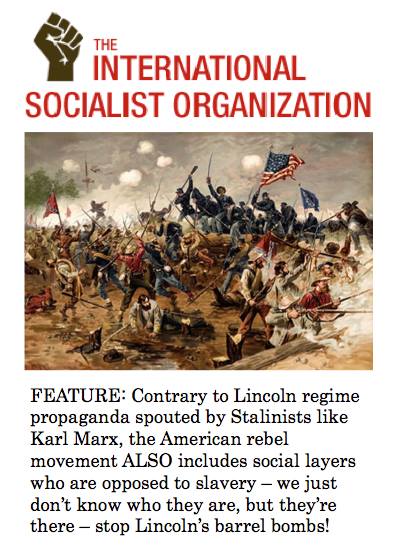
If the ISO existed in 1865.
Of course, Washington lends a hand, helpfully denominating its proxies in the most laudatory terms. Islamist insurgents in Syria, mainly Al Qaeda, were not too many years ago celebrated as a pro-democracy movement, and when that deception proved no longer tenable, as moderates.
Now that the so-called moderates have been exposed as the very opposite, many Leftists cling to the hope that amid the Islamist opponents of Syria’s secular, Arab socialist, government, can be found votaries of the enlightenment values Damascus already embraces. Surely somewhere there exist armed anti-government secular Leftists to rally behind; for it appears that the goal is to find a reason, any reason, no matter how tenuous, to create a nimbus of moral excellence around some group that opposes with arms the government in Damascus; some group that can be made to appear to be non-sectarian, anti-imperialist, socialist, committed to the rights of women and minorities, and pro-Palestinian; in other words, a group just like Syria’s Ba’ath Arab Socialists, except not them.
Stepping forward to fulfill that hope is the PKK, an anarchist guerrilla group demonized as a terrorist organization when operating in Turkey against a US ally, but which goes by the name of the YPG in Syria, where it is the principal component of the lionized “Syrian Democratic Force.” So appealing is the YPG to many Western Leftists that some have gone so far as to volunteer to fight in its units. But is the YPG the great hope it’s believed it to be?
Kurds in Syria
It’s difficult to determine with precision how many Kurds are in Syria, but it’s clear that the ethnic group comprises only a small percentage of the Syrian population (less than 10 percent according to the CIA, and 8.5 percent according to an estimate cited by Nikolaos Van Dam in his book The Struggle for Power in Syria. [1]
Estimates of the proportion of the total Kurd population living in Syria vary from two to seven percent based on population figures presented in the CIA World Factbook. Half of the Kurd community lives in Turkey, 28 percent in Iran and 20 percent in Iraq. A declassified 1972 US State Department report estimated that only between four and five percent of the world’s Kurds lived in Syria [2].
While the estimates are rough, it’s clear that Kurds make up a fairly small proportion of the Syrian population and that the number of the group’s members living in Syria as a proportion of the Kurd community as a whole is very small.

The PKK
Kurdish fighters in Syria operate under the name of the YPG, which is “tied to the Kurdistan Workers’ Party, or PKK, a radical guerrilla movement combining [anarchist ideas] with Kurdish nationalism. PKK guerrillas [have] fought the Turkish state from 1978” and the PKK is “classified as a terrorist organization by the European Union, Turkey and the U.S.” [3]
Cemil Bayik is the top field commander of both the PKK in Turkey and of its Syrian incarnation, the YPG. Bayik “heads the PKK umbrella organization, the KCK, which unites PKK affiliates in different countries. All follow the same leader, Abdullah Ocalan, who has been in prison in Turkey” [4] since 1999, when he was apprehended by Turkish authorities with CIA assistance.
Ocalan “was once a devotee of Marxism-Leninism,” according to Carne Ross, who wrote a profile of the Kurdish nationalist leader in The Financial Times in 2015. But Ocalan “came to believe that, like capitalism, communism perforce relied upon coercion.” Imprisoned on an island in the Sea of Marmara, Ocalan discovered “the masterwork of a New York political thinker named Murray Bookchin.” Bookchin “believed that true democracy could only prosper when decision-making belonged to the local community and was not monopolized by distant and unaccountable elites.” Government was desirable, reasoned Bookchin, but decision-making needed to be decentralized and inclusive. While anarchist, Bookchin preferred to call his approach “communalism”. Ocalan adapted Bookchin’s ideas to Kurd nationalism, branding the new philosophy “democratic confederalism.” [5]
Labor Zionism has similar ideas about a political system based on decentralized communes, but is, at its core, a nationalist movement. Similarly, Ocalan’s views cannot be understood outside the framework of Kurdish nationalism. The PKK may embrace beautiful utopian goals of democratic confederalism but it is, at its heart, an organization dedicated to establishing Kurdish self-rule—and, as it turns out, not only on traditionally Kurdish territory, but on Arab territory, as well, making the parallel with Labour Zionism all the stronger. In both Syria and Iraq, Kurdish fighters have used the campaign against ISIS as an opportunity to extend Kurdistan into traditionally Arab territories in which Kurds have never been in the majority.
The PKK’s goal, writes The Wall Street Journal’s Sam Dagher, “is a confederation of self-rule Kurdish-led enclaves in Iran, Iraq, Syria and Turkey” [6] countries in which Kurdish populations have a presence, though, as we’ve seen, an insignificant one in Syria. In pursuit of this goal “as many as 5,000 Syrian Kurds have died fighting alongside the PKK since the mid-1980s, and nearly all of YPG’s top leaders and battle-hardened fighters are veterans of the decades-long struggle against Turkey.” [7]
In Syria, the PKK’s goal “is to establish a self-ruled region in northern Syria,” [8] an area with a significant Arab population.
When PKK fighters cross the border into Turkey, they become ‘terrorists’, according to the United States and European Union, but when they cross back into Syria they are miraculously transformed into ‘guerrilla” fighters waging a war for democracy as the principal component of the Syrian Democratic Force. The reality is, however, that whether on the Turkish or Syrian side of the border, the PKK uses the same methods, pursues the same goals, and relies largely on the same personnel. The YPG is the PKK.
An Opportunity
Washington has long wanted to oust the Arab nationalists in Syria, regarding them as “a focus of Arab nationalist struggle against an American regional presence and interests,” as Amos Ma’oz once put it. The Arab nationalists, particularly the Ba’ath Arab Socialist party, in power since 1963, represent too many things Washington deplores: socialism, Arab nationalism, anti-imperialism, and anti-Zionism. Washington denounced Hafez al-Assad, president of Syria from 1970 to 2000, as an Arab communist, and regards his son, Bashar, who succeeded him as president, as little different. Bashar, the State Department complains, hasn’t allowed the Syrian economy—based on Soviet models, its researchers say—to be integrated into the US-superintended global economy. Plus, Washington harbors grievances about Damascus’s support for Hezbollah and the Palestinian national liberation movement.
US planners decided to eliminate Asia’s Arab nationalists by invading their countries, first Iraq, in 2003, which, like Syria, was led by the Ba’ath Arab Socialists, and then Syria. However, the Pentagon soon discovered that its resources were strained by resistance to its occupations of Afghanistan and Iraq, and that an invasion of Syria was out of the question. As an alternative, Washington immediately initiated a campaign of economic warfare against Syria. That campaign, still in effect 14 years later, would eventually buckle the economy and prevent Damascus from providing education, health care and other essential services in some parts of the country. At the same time, Washington took steps to reignite the long-running holy war that Syria’s Islamists had waged on the secular state, dating to the 1960s and culminating in the bloody takeover of Hama, Syria’s fourth largest city, in 1982. Beginning in 2006, Washington worked with Syria’s Muslim Brotherhood to rekindle the Brother’s jihad against Assad’s secular government. The Brothers had two meetings at the White House, and met frequently with the State Department and National Security Council.
The outbreak of Islamist violence in March of 2011 was greeted by the PKK as an opportunity. As The Wall Street Journal’s Yaroslav Trofimov recounts, “The PKK, once an ally of… Damascus… had long been present among Kurdish communities in northern Syria. When the revolutionary tide reached Syria, the group’s Syrian affiliate quickly seized control of three Kurdish-majority regions along the Turkish frontier. PKK fighters and weapons streamed there from other parts of Kurdistan.”[9] The “Syrian Kurds,” wrote Trofimov’s colleagues, Joe Parkinson and Ayla Albayrak, viewed “the civil war as an opportunity to carve out a self-governing enclave—similar to the one established by their ethnic kin in neighboring Iraq.” [10] That enclave, long backed by the United States and Israel, was seen as a means of weakening the Iraqi state.
Damascus facilitated the PKK take-over by withdrawing its troops from Kurdish-dominated areas. The Middle East specialist Patrick Seale, who wrote that the Kurds had “seized the opportunity” of the chaos engendered by the Islamist uprising “to boost their own political agenda” [11] speculated that the Syrian government’s aims in pulling back from Kurd-majority areas was to redirect “troops for the defence of Damascus and Aleppo;” punish Turkey for its support of Islamist insurgents; and “to conciliate the Kurds, so as to dissuade them from joining the rebels.” [12] The PKK, as it turns out, didn’t join the Islamist insurgents, as Damascus hoped. But they did join a more significant part of the opposition to Arab nationalist Syria: the puppet master itself, the United States.
By 2014, the PKK had “declared three self-rule administrations, or cantons as they call them, in northern Syria: Afreen, in the northwest, near the city of Aleppo; Kobani; and Jazeera in the northeast, which encompasses Ras al-Ain and the city of Qamishli. Their goal [was] to connect all three.” [13] This would mean controlling the intervening spaces occupied by Arabs.
A Deal with Washington
At this point, the PKK decided that its political goals might best be served by striking a deal with Washington.
The State Department had “allowed for the possibility of a form of decentralization in which different groups” — the Kurds, the secular government, and the Islamist insurgents — each received some autonomy within Syria. [14] Notice the implicit assumption in this view that it is within Washington’s purview to grant autonomy within Syria, while the question of whether the country ought to decentralize, properly within the democratic ambit of Syrians themselves, is denied to the people who live and work in Syria. If we are to take seriously Ocalan’s Bookchin-inspired ideas about investing decision-making authority in the people, this anti-democratic abomination can hardly be tolerated.
All the same, the PKK was excited by the US idea of dividing “Syria into zones roughly corresponding to areas now held by the government, the Islamic State, Kurdish militias and other insurgents.” A “federal system” would be established, “not only for Kurdish-majority areas but for all of Syria.” A Kurd federal region would be created “on all the territory now held by the” PKK. The zone would expand to include territory the Kurds hoped “to capture in battle, not only from ISIS but also from other Arab insurgent groups.” [15]
The PKK “pressed U.S. officials” to act on the scheme, pledging to act as a ground force against ISIS in return. [16] The group said it was “eager to join the U.S.-led coalition against Islamic State in return for recognition and support from Washington and its allies for the Kurdish-dominated self-rule administrations they [had] established in northern Syria.” [17]
The only people pleased with this plan were the PKK, the Israelis and the Americans.
“US support for these Kurdish groups” not only in Syria, but in Iraq, where the Kurds were also exploiting the battle with ISIS to expand their rule into traditionally Arab areas, helped “to both divide Syria and divide Iraq,” wrote The Independent’s veteran Middle East correspondent Robert Fisk. [18] Division redounded to the benefit of the United States and Israel, both of which have an interest in pursuing a divide and rule policy to exercise a joint hegemony over the Arab world. Patrick Seale remarked that the US-Kurd plan for Kurdish rule in northern Syria had been met by “quiet jubilation in Israel, which has long had a semi-clandestine relationship with the Kurds, and welcomes any development which might weaken or dismember Syria.” [19]
For their part, the Turks objected, perceiving that Washington had agreed to give the PKK a state in all of northern Syria. [20] Meanwhile, Damascus opposed the plan, “seeing it as a step toward a permanent division of the nation.” [21]
Modern-day Syria, it should be recalled, is already the product of a division of Greater Syria at the hands of the British and French, who partitioned the country into Lebanon, Palestine, Transjordan, and what is now Syria. In March, 1920, the second Syrian General Congress proclaimed “Syria to be completely independent within her ‘natural’ boundaries, including Lebanon and Palestine.” Concurrently “an Arab delegation in Palestine confronted the British military governor with a resolution opposing Zionism and petitioning to become part of an independent Syria.” [22] France sent its Army of the Levant, mainly troops recruited from its Senegalese colony, to quash by force the Levantine Arabs’ efforts to establish self-rule.
Syria, already truncated by British and French imperial machinations after WWI “is too small for a federal state,” opines Syria’s president Bashar al-Assad. But Assad quickly adds that his personal view is irrelevant; a question as weighty as whether Syria ought to become a federal or confederal or unitary state, he says, is a matter for Syrians to decide in a constitutional referendum, [23] a refreshingly democratic view in contrast to the Western position that Washington should dictate how Syrians arrange their political (and economic) affairs.
Tip of the US Spear
For Washington, the PKK offers a benefit additional to the Kurdish guerrilla group’s utility in advancing the US goal of weakening Syria by fracturing it, namely, the PKK can be pressed into service as a surrogate for the US Army, obviating the necessity of deploying tens of thousands of US troops to Syria, and thereby allowing the White House and Pentagon to side-step a number of legal, budgetary and public relations quandaries. “The situation underscores a critical challenge the Pentagon faces,” wrote The Wall Street Journal’s Paul Sonne; namely, “backing local forces… instead of putting American troops at the tip of the spear.” [24]
Having pledged support for Kurdish rule of northern Syria in return for the PKK becoming the tip of the US spear, the United States is “providing “small arms, ammunition and machine guns, and possibly some nonlethal assistance, such as light trucks, to the Kurdish forces.” [25]
The arms are “parceled out” in a so called “drop, op, and assess” approach. The shipments are “dropped, an operation [is] performed, and the U.S. [assesses] the success of that mission before providing more arms.” Said a US official, “We will be supplying them only with enough arms and ammo to accomplish each interim objective.” [26]
PKK foot soldiers are backed by “more than 750 U.S. Marines,” Army Rangers, and US, French and German Special Forces, “using helicopters, artillery and airstrikes,” the Western marionette-masters in Syria illegally, in contravention of international law. [27]
Ethnic Cleansing
“Large numbers of Arab residents populate the regions Kurds designate as their own.” [28] The PKK has taken “over a large swath of territory across northern Syria—including predominantly Arab cities and towns.” [29] Raqqa, and surrounding parts of the Euphrates Valley on which the PKK has set its sights, are mainly populated by Arabs, observes The Independent’s veteran foreign correspondent Patrick Cockburn—and the Arabs are opposed to Kurdish occupation. [30]
Kurdish forces are not only “retaking” Christian and Muslim Arab towns in Syria, but are doing the same in the Nineveh province of Iraq—areas “which were never Kurdish in the first place. Kurds now regard Qamishleh, and Hassakeh province in Syria as part of ‘Kurdistan’, although they represent a minority in many of these areas.” [31]
The PKK now controls 20,000 square miles of Syrian territory [32], or roughly 17 percent of the country, while Kurds represent less than eight percent of the population.
In their efforts to create a Kurdish region inside Syria, the PKK “has been accused of abuses by Arab civilians across northern Syria, including arbitrary arrests and displacing Arab populations in the name of rolling back Islamic State.” [33] The PKK “has expelled Arabs and ethnic Turkmen from large parts of northern Syria,” reports The Wall Street Journal. [34] The Journal additionally notes that human rights “groups have accused [Syrian and Iraqi Kurdish fighters] of preventing Arabs from returning to liberated areas.” [35]
Neither Syrian nor Democratic
The PKK dominates the Syrian Democratic Forces, a misnomer conferred upon a group of mainly Kurdish fighters by its US patron. The group is not Syrian, since many of its members are non-Syrians who identify as Kurds and who flooded over the border from Turkey to take advantage of the chaos produced by the Islamist insurgency in Syria to carve out an area of Kurdish control. Nor is the group particularly democratic, since it seeks to impose Kurdish rule on Arab populations. Robert Fisk dismisses the “Syrian Democratic Forces” as a “facade-name for large numbers of Kurds and a few Arab fighters.” [36]
The PKK poses as a Syrian Democratic Force, and works with a token force of Syrian Arab fighters, to disguise the reality that the Arab populated areas it controls, and those it has yet to capture, fall under Kurd occupation.
A De Facto (and Illegal) No Fly Zone
In August, 2016, after “Syrian government bombers had been striking Kurdish positions near the city of Hasakah, where the U.S. [had] been backing Kurdish forces” the Pentagon scrambled “jets to protect them. The U.S. jets arrived just as the two Syrian government Su-24 bombers were departing.” This “prompted the U.S.-led coalition to begin patrolling the airspace over Hasakah, and led to another incident… in which two Syrian Su-24 bombers attempted to fly through the area but were met by coalition fighter jets.” [37]
The Pentagon “warned the Syrians to stay away. American F-22 fighter jets drove home the message by patrolling the area.” [38]
The New York Times observed that in using “airpower to safeguard areas of northern Syria where American advisers” direct PKK fighters that the United States had effectively established a no-fly zone over the area, but noted that “the Pentagon has steadfastly refused to” use the term. [39] Still, the reality is that the Pentagon has illegally established a de facto no-fly zone over northern Syria to protect PKK guerillas, the tip of the US spear, who are engaged in a campaign of creating a partition of Syria, including through ethnic cleansing of the Arab population, to the delight of Israel and in accordance with US designs to weaken Arab nationalism in Damascus.
An Astigmatic Analogy
Some find a parallel in the YPG’s alliance with the United States with Lenin accepting German aid to return from exile in Switzerland to Russia following the 1917 March Revolution. The analogy is inapt. Lenin was playing one imperialist power off against another. Syria is hardly an analogue of Imperial Russia, which, one hundred years ago, was locked in a struggle for markets, resources, and spheres of influence with contending empires. In contrast, Syria is and has always been a country partitioned, dominated, exploited and threatened by empires. It has been emancipated from colonialism, and is carrying on a struggle—now against the contrary efforts of the PKK—to resist its recolonization.
The PKK has struck a bargain with the United States to achieve its goal of establishing a Kurdish national state, but at the expense of Syria’s efforts to safeguard its independence from a decades-long US effort to deny it. The partition of Syria along ethno-sectarian lines, desired by the PKK, Washington and Tel Aviv alike, serves both US and Israeli goals of weakening a focus of opposition to the Zionist project and US domination of West Asia.
A more fitting analogy, equates the PKK in Syria to Labor Zionism, the dominant Zionist force in occupied Palestine until the late 1970s. Like Ocalan, early Zionism emphasized decentralized communes. The kibbutzim were utopian communities, whose roots lay in socialism. Like the PKK’s Syrian incarnation, Labor Zionism relied on sponsorship by imperialist powers, securing their patronage by offering to act as the tips of the imperialists’ spears in the Arab world. Zionists employed armed conquest of Arab territory, along with ethnic cleansing and denial of repatriation, to establish an ethnic state, anticipating the PKK’s extension by armed force of the domain of a Kurdish state into Arab majority territory in Syria, as well as Kurd fighters doing the same in Iraq. Anarchists and other leftists may have been inspired by Jewish collective agricultural communities in Palestine, but that hardly made the Zionist project progressive or emancipatory, since its progressive and emancipatory elements were negated by its regressive oppression and dispossession of the indigenous Arab population, and its collusion with Western imperialism against the Arab world.
Conclusion
Representing an ethnic community that comprises less than 10 percent of the Syrian population, the PKK, a Kurdish anarchist guerrilla group which operates in both Turkey and Syria, is using the United States, its Air Force, Marine Corps, Army Rangers and Special Forces troops, as a force multiplier in an effort to impose a partition of Syria in which the numerically insignificant Kurd population controls a significant part of Syria’s territory, including areas inhabited by Arabs in the majority and in which Kurds have never been in the majority. To accomplish its aims, the PKK has not only struck a deal with a despotic regime in Washington which seeks to recolonize the Arab world, but is relying on ethnic cleansing and denial of repatriation of Arabs from regions from which they’ve fled or have been driven to establish Kurdish control of northern Syria, tactics which parallel those used by Zionist forces in 1948 to create a Jewish state in Arab-majority Palestine. Washington and Israel (the latter having long maintained a semi-clandestine relationship with the Kurds) value a confederal system for Syria as a means of weakening Arab nationalist influence in Arab Asia, undermining a pole of opposition to Zionism, colonialism, and the international dictatorship of the United States. Forces which resist dictatorship, including the most odious one of all, that of the United States over much of the world, are the real champions of democracy, a category to which the PKK, as evidenced by its actions in Syria, does not belong.
1. Nikolaos Van Dam, The Struggle for Power in Syria: Politics and Society under Assad and the Ba’ath Party, IB Taurus, 2011, p.1.
2. “The Kurds of Iraq: Renewed Insurgency?”, US Department of State, May 31, 1972, https://2001-2009.state.gove/documents/organization/70896.pdf
3. Sam Dagher, “Kurds fight Islamic State to claim a piece of Syria,” The Wall Street Journal, November 12, 2014.
4. Patrick Cockburn, “War against ISIS: PKK commander tasked with the defence of Syrian Kurds claims ‘we will save Kobani’”, The Independent, November 11, 2014.
5. Carne Ross, “Power to the people: A Syrian experiment in democracy,” Financial Times, October 23, 2015.
6. Dagher, November 12, 2014.
7. Dagher, November 12, 2014.
8. Dagher, November 12, 2014.
9. Yaroslav Trofimov, “The State of the Kurds,” The Wall Street Journal, June 19, 2015.
10. Joe Parkinson and Ayla Albayrak, “Syrian Kurds grow more assertive”, The Wall Street Journal, November 15, 2013.
11. Patrick Seale, “Al Assad uses Kurds to fan regional tensions”, Gulf News, August 2, 2012.
12. Seale, August 2, 2012.
13. Dagher, November 12, 2014.
14. David E. Sanger, “Legacy of a secret pact haunts efforts to end war in Syria,” the New York Times, May 16, 2016.
15. Anne Barnard, “Syrian Kurds hope to establish a federal region in country’s north,” The New York Times, March 16, 2016.
16. Dagher, November 12, 2014.
17. Dagher, November 12, 2014.
18. Robert Fisk, “This is the aim of Donald Trump’s visit to Saudi Arabia – and it isn’t good for Shia communities,” The Independent, May 18, 2017.
19. Seale, August 2, 2012.
20. Yaroslav Trofimov, “U.S. is caught between ally Turkey and Kurdish partner in Syria,” The Wall Street Journal, May 4, 2017.
21. Anne Barnard, “Syrian Kurds hope to establish a federal region in country’s north,” The New York Times, March 16, 2016.
22. David Fromkin, A Peace to End All Peace: The Fall of the Ottoman Empire and the Creation of the Modern Middle East, Henry Holt & Company, 2009, p. 437.
23. “President al-Assad to RIA Novosti and Sputnik: Syria is not prepared for federalism,” SANA, March 30, 2016.
24. Paul Sonne, “U.S. seeks Sunni forces to take militant hub,” The Wall Street Journal, April 29, 2016.
25. Dion Nissenbaum, Gordon Lubold and Julian E. Barnes, “Trump set to arm Kurds in ISIS fight, angering Turkey,” The Wall Street Journal, May 9, 2017.
26. Nissenbaum et al, May 9, 2017.
27. Dion Nissenbaum and Maria Abi-Habib, “Syria’s newest flashpoint is bringing US and Iran face to face,” The Wall Street Journal, June 15, 2017; “Syria condemns presence of French and German special forces in Ain al-Arab and Manbij as overt unjustified aggression on Syria’s sovereignty and independence,” SANA, June 15, 2016; Michael R. Gordon. “U.S. is sending 400 more troops to Syria.” The New York Times. March 9, 2017.
28. Matt Bradley, Ayla Albayrak, and Dana Ballout, “Kurds declare ‘federal region’ in Syria, says official,” The Wall Street Journal, March 17, 2016.
29. Maria Abi-Habib and Raja Abdulrahim, “Kurd-led force homes in on ISIS bastion with assent of U.S. and Syria alike,” The Wall Street Journal, May 11, 2017.
30. Patrick Cockburn, “Battle for Raqqa: Fighters begin offensive to push Isis out of Old City,” The Independent, July 7, 2017.
31. Robert Fisk, “This is the aim of Donald Trump’s visit to Saudi Arabia – and it isn’t good for Shia communities,” The Independent, May 18, 2017.
32. Dion Nissenbaum and Maria Abi-Habib, “U.S. split over plan to take Raqqa from Islamic state,” The Wall Street Journal. March 9, 2017.
33. Raja Abdulrahim, Maria Abi_Habin and Dion J. Nissenbaum, “U.S.-backed forces in Syria launch offensive to seize ISIS stronghold Raqqa,” The Wall Street Journal, November 6, 2016.
34. Margherita Stancati and Alia A. Nabhan, “During Mosul offensive, Kurdish fighters clear Arab village, demolish homes,” The Wall Street Journal, November 14, 2016.
35. Matt Bradley, Ayla Albayrak, and Dana Ballout, “Kurds declare ‘federal region’ in Syria, says official,” The Wall Street Journal, March 17, 2016.
36. Robert Fisk, “The US seems keener to strike at Syria’s Assad than it does to destroy ISIS,” The Independent, June 20, 2017.
37. Paul Sonne and Raja Abdulrahim, “Pentagon warns Assad regime to avoid action near U.S. and allied forces,” The Wall Street Journal, August 19, 2016.
38. Michael R. Gordon and Neil MacFarquhar, “U.S. election cycle offers Kremlin a window of opportunity in Syria,” The New York Times, October 4, 2016.
39. Michael R. Gordon and Neil MacFarquhar, “U.S. election cycle offers Kremlin a window of opportunity in Syria,” The New York Times, October 4, 2016.
Big Military Spending Boost Threatens Our Economy and Security
By Ron Paul | July 17, 2017
On Friday the House overwhelmingly approved a massive increase in military spending, passing a $696 billion National Defense Authorization bill for 2018. President Trump’s request already included a huge fifty or so billion dollar spending increase, but the Republican-led House found even that to be far too small. They added another $30 billion to the bill for good measure. Even President Trump, in his official statement, expressed some concern over spending in the House-passed bill.
According to the already weak limitations on military spending increases in the 2011 “sequestration” law, the base military budget for 2018 would be $72 billion more than allowed.
Don’t worry, they’ll find a way to get around that!
The big explosion in military spending comes as the US is planning to dramatically increase its military actions overseas. The president is expected to send thousands more troops back to Afghanistan, the longest war in US history. After nearly 16 years, the Taliban controls more territory than at anytime since the initial US invasion and ISIS is seeping into the cracks created by constant US military action in the country.
The Pentagon and Defense Secretary James Mattis are already telling us that even when ISIS is finally defeated in Iraq, the US military doesn’t dare end its occupation of the country again. Look for a very expensive array of permanent US military bases throughout the country. So much for our 2003 invasion creating a stable democracy, as the neocons promised.
In Syria, the United States has currently established at least eight military bases even though it has no permission to do so from the Syrian government nor does it have a UN resolution authorizing the US military presence there. Pentagon officials have made it clear they will continue to occupy Syrian territory even after ISIS is defeated, to “stabilize” the region.
And let’s not forget that Washington is planning to send the US military back to Libya, another US intervention we were promised would be stabilizing but that turned out to be a disaster.
Also, the drone wars continue in Somalia and elsewhere, as does the US participation in Saudi Arabia’s horrific two year war on impoverished Yemen.
President Trump often makes encouraging statements suggesting that he shares some of our non-interventionist views. For example while Congress was shoveling billions into an already bloated military budget last week, President Trump said that he did not want to spend trillions more dollars in the Middle East where we get “nothing” for our efforts. He’d rather fix roads here in the US, he said. The only reason we are there, he said, was to “get rid of terrorists,” after which we can focus on our problems at home.
Unfortunately President Trump seems to be incapable of understanding that it is US intervention and occupation of foreign countries that creates instability and feeds terrorism. Continuing to do the same thing for more than 17 years – more US bombs to “stabilize” the Middle East – and expecting different results is hardly a sensible foreign policy. It is insanity. Until he realizes that our military empire is the source of rather than the solution to our problems, we will continue to wildly spend on our military empire until the dollar collapses and we are brought to our knees. Then what?
Ambassador Yakovenko’s comment on the situation in Syria
Ambassador’s view | RT | July 16, 2017
We believe that the current round of Geneva talks is off to a better start due to the participation of all the main opposition platforms – the Riyadh, Moscow, and Cairo groups.
The constitutional reform and the fight against terrorism are priorities, but not forgetting about two other issues (running the country prior to the adoption of a new constitution and holding elections). Eventually, the constitution should reflect the concerns of all ethnic, religious, and political groups of Syria without exception. This is the only way to ensure the stable functioning of the Syrian state and prevent the spread of [the] terrorist threat. Meanwhile, the current constitution provides for a broad range of opportunities to expand the participation of opposition representatives in running the state. We actively support the efforts of UNSG Special Envoy for Syria Staffan de Mistura to encourage the Syrian parties to engage in a productive conversation on constitutional reforms.
The success of agreements on de-escalation zones, particularly one in southwest Syria signed by Russia, the US, and Jordan on July 7, will make the fight against terrorism more efficient. This opportunity is real now, because the very concept of de-escalation zones provides for separation of the armed opposition from ISIS, Al-Qaeda, Jabhat Al-Nusra, and other UN-proscribed terrorist groups. They also help normalize relations between the government forces and the armed opposition. The conditions are thus created for their stopping fighting each other and joining forces against the terrorists. Russia will contribute to this process.
Among other things, the agreements on de-escalation zones provide for stepping up practical cooperation between Moscow and Washington. Our joint efforts to enforce ceasefire in southwest Syria will be coordinated by the Monitoring Center, which Russia, the United States, and Jordan have agreed to establish in Amman. This center will maintain direct contact both with the opposition groups and representatives of the Syrian government. Basically, we keep the doors open to cooperation on further development of the de-escalation concept, while maintaining regular contact with the other key players that can influence developments in Syria. All in all, the July 7 agreement reached between Russia, the US, and Jordan shows that, despite differences in our positions and interests, cooperation is possible for common good. Let’s build on this to make further progress in dealing with jihadist aggression that distorted the entire Syrian situation.
Dr Alexander Yakovenko, Russian Ambassador to the United Kingdom of Great Britain and Northern Ireland, Deputy foreign minister (2005-2011). Follow him on Twitter @Amb_Yakovenko
Why Moscow Resents US for Its ‘Blackmail’ Demands for Return of Russian Property
Sputnik – 16.07.2017
Washington’s conditions for the return of Russia’s diplomatic property in the US are nothing but blackmail, according to Vladimir Dzhabarov, first deputy chairman of the Russian Upper House’s International Affairs Committee.
In an interview with the Russian news network Zvezda, Vladimir Dzhabarov, first deputy chairman of the Russian Upper House’s International Affairs Committee, slammed the White House’s conditions for the return of Russia’s diplomatic property in the US as blackmail.
On Thursday, Deputy Assistant to the US President Sebastian Gorka said that the US may return two diplomatic compounds confiscated by the Obama administration to Moscow, if it sees “acts of good faith” from the Kremlin, similar to the recently brokered ceasefire in Syria.
By considering a release of the Russian diplomatic compounds that have remained sealed since December, Washington wants to leave the door open for rapprochement with Russia, Gorka said in an interview with CNN.
Commenting on the matter, Dzabarov stressed that the situation in Syria has nothing to do with diplomatic property, and that Washington should return it to Russia “without any preconditions.”
“Talking about certain conditions to be made in exchange for having access to diplomatic property looks like trading and even blackmail,” Jabarov said.
He warned that Russia may respond in kind to Sebastian Gorka’s statement.
“We have the right to retaliate unless the situation changes. We can do so because correlating our right to our own property with our political steps is the wrong move,” Jabarov said.
His remarks were preceded by Moscow’s warning that it is preparing a “tough response” to the move.
“We assume that this issue can be solved in a civilized way, within the framework of the law and probably humanely, given the emotions roiling in Washington,” Russian Foreign Ministry spokeswoman Maria Zakharova said on air of the program “60 Minutes” on Rossiya 1 television channel.
She added that Russia had “different ways” to settle the issue, and that it would not give up its interests.
On Friday, the Russian Foreign Ministry warned that Russia is ready to expel US diplomats in response to Washington’s failure to return its diplomatic property in New York and Maryland.
“If the US partners do not understand differently, we will at some point have to act in this direction,” Zakharova said at her weekly briefing, noting that the “long pause” on the issue has “dragged on.”
The issue was also addressed by Russia’s Foreign Minister Sergei Lavrov, who said at a joint news conference with the EU’s foreign policy chief Federica Mogherini on Tuesday that Moscow is “outraged” over the fact that Washington has not yet resolved the situation with Russian diplomatic property in the US, adding that Moscow is working out its response to the US actions.
In December 2016, the administration of former president Barack Obama imposed a set of punitive measures against Russia over Moscow’s alleged meddling in the US presidential election and harassment of US diplomats stationed in Russia.
The sanctions included the closure of Russian diplomatic compounds in Washington and New York, which the White House claimed had been used as a cover for Russian spying activities in the United States.
6 Americans who should be investigated for their Ukrainian ties
By Adam Garrie | The Duran | July 15, 2017
Incoming FBI Director Cristopher Wray has stated that he would be interested in investigating links between officials of the Ukrainian regime and the Hillary Clinton campaign.
With evidence mounting that high level officials in Kiev actively worked with the Clinton campaign to try and influence US voters, it is imperative that any future investigation isn’t whitewashed simply because Kiev’s tactics failed to win the election for Clinton.
Although the investigation into Donald Trump’s non-existent links with Russia have unsurprisingly come up with virtually nothing of interest, the methods of the investigation ought to be examined and replicated where necessary in a future Ukraine-Clinton investigation.
One of the most fascinating aspects of the so-called Russiagate investigation is that seemingly anyone connected to Donald Trump who ever had a conversation with a Russian, irrespective of their lack of involvement in Russian politics, is a person of interest to investigators.
The same tactics could be accurately applied to an investigation into Clinton and the Democratic party’s links with Ukraine.
Here are the people that ought to be questioned.
1. Hunter Biden
Hunter Biden is the youngest son of Barack Obama’s Vice President Joe Biden. In April of 2014, just two months after the February coup in Kiev, Joe Biden visited Ukraine where he gave a tub-thumping speech about the need for the Ukrainian regime to rely less on Russian gas supplies.
Weeks later, Hunter Biden was appointed to the board of directors of Ukraine’s largest private sector gas company, Burisma.
While many spoke of a prima facie conflict of interest in the appointment, the US mainstream media’s favourable stance towards the Obama administration meant that the story never saw the light of day.
The issue remains prescient, especially in light of allegations regarding wide spread Ukrainian collusion with the Democratic party in respect of the 2016 election.
2. Joe Biden
The timing of Joe Biden’s anti-Russian Ukrainian gas speech and his son’s appointment to the board of a major Ukrainian energy company necessarily means that the former American Vice President is a person of interest.
No one could reasonably believe that the proximate timing of the former VP’s speech and his son’s appointment to the board of Burisma was coincidental.
This is a matter which speaks of itself.
3. Alexandra Chalupa
For over 10 years, Chalupa, a US citizen of Ukrainian origin worked for the Democratic party. It has been established that she had multiple meetings at the Ukrainian Embassy in Washington D.C. in order to dig up dirt on former Trump campaign worker Paul Manafort.
Chalupa claims that her visits to the Ukrainian Embassy were for unrelated endeavours. Her word should not be take at face value. Her interactions with foreign officials in relation to the 2016 US election should be fully investigated.
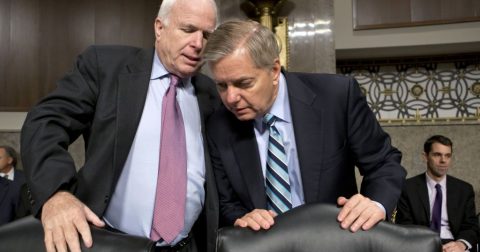
4. John McCain
Unlike Chalupa, McCain is not a Democrat, McCain has more political ties to Ukraine than anyone in the US Senate. His position as a former Presidential candidate and a strong critic of Donald Trump makes him a person of interest.
McCain is something of a fanatic when it comes to the Ukraine issue. Prior to the coup of February 2014, McCain was frequently pictured in Kiev with many extremist and fascist leaders who actively participated in the coup.
McCain recently visited Ukrainian leader Petro Poroshenko along with troops loyal to the regime during the 2016/2017 New Year’s holiday.
This visit, just weeks before Donald Trump’s inauguration ought to be thoroughly investigated as well as McCain’s other connections to a plethora of Ukrainian politicians, leaders, business and military figures.

For these reasons and because of McCain’s increasingly dubious role in allegedly leaking the so-called ‘Urinegate’ dossier to the media, he is clearly a person of interest.
5. Maxine Waters
Maxine Waters is a Democratic Congresswoman from Los Angeles whose anti-Russian rhetoric is vile and at times incoherent, but nevertheless protected by free speech.
It is not clear if Waters has any direct connections with Ukrainian authorities, but an innocent prank call by the Russian comic callers Vovan and Lexus to Waters, reveals that she is highly susceptible to anti-Russian propaganda. The fact she engaged with the prank callers, seemingly believing that they were officials from Kiev, means that Waters ought to be questioned about any real calls she may have taken from actual Ukrainian regime officials.
For those who believe that Waters is far removed from the sandal, one ought to be reminded that political commentator Alex Jones has been accused by Hillary Clinton of being a Russian agent. It was later confirmed by Jones and other media outlets that the FBI is currently investigating whether Jones’s platform InfoWars as well as Breitbart had direct links with Russia.
InfoWars and Breitbart can hardly be considered Russophile outlets, but the fact remains that Waters has said far more in favour of Ukraine than InfoWars or Breitbart have of Russia.
What’s good for the goose is good for a much more prominent gander.
6. Lindsey Graham
Lindsey Graham was a Trump opponent before it became fashionable in certain quarters. During the Republican primary, Donald Trump read out Graham’s private phone number and encouraged his supporters to ring up the Senator.
Graham was furious with Trump and later had to change his phone number.
When it comes to being a US Senator with close ties to the Ukrainian regime, only John McCain has more than Graham. Graham indeed accompanied McCain to Ukraine on his infamous New Year’s excursion and has close personal contacts with many individuals in Kiev.
For the same reasons McCain should be of interest to anyone who wants to unearth the extent of Ukrainian interference in American democracy, Graham ought to be on the list too.
Israeli firms promote military tourism at fantasy terror camps
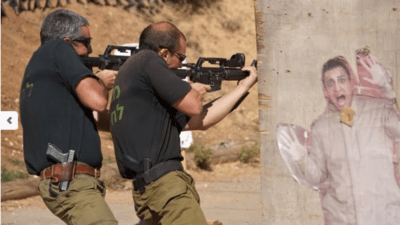
Press TV – July 15, 2017
A growing number of Israeli firms promote the regime’s military tourism in the occupied territories by offering tourists from across the world courses that include simulated situations of killing assailants who suspiciously look like Palestinian Arabs.
Half a dozen Israeli firms run several fantasy terror camps across the occupied territories, which allow foreign tourists to receive training like Israeli forces for $115 per person in a variety of situations such as explosions, stabbing attacks, sniper tournaments and live demonstrations with attack dogs.
The two-hour camps also allow the tourists to use actual guns and have former soldiers and retired officials guide them as to how to shoot the targets, which are usually photos of Palestinian Arabs.
Apart from the training programs, the Israeli companies are also earning revenues from merchandise they sell, including T-shirts and hard-core military equipment.
Caliber 3 in the West Bank settlement of Gush Etzion, the first and reportedly “the most popular” facility of its kind in Israel, attracts approximately 15,000 to 25,000 tourists each year.
The facility also runs a three-month summer camp for teenage boys, which includes training and lessons on Zionism.
In a Tuesday report, Israeli daily Haaretz described the camps as “part-propaganda and part-morbid amusement.”
Observers warn that the facilities, which are constantly profiting from the idea of threat of war in Israel, are mainly aimed at promoting anti-Palestinian sentiments and forging a moral image for the Israel army.
The file photo by Israeli daily Haaretz shows a poster for the Caliber 3 military training camp in July 2017.
While most of the visitors comprise American Jews, the facilities have also attracted a considerable number of tourists from Brazil, Argentina, France, Italy, Russia and China.
The Israelis are also promoting the idea of fantasy terror camps abroad, with Cherev Gidon, a US-based Israeli military training school, providing specialized courses on Israeli tactical shooting techniques at its branches across America.
Israel’s 24-7 ‘War’ on Palestine Rights Movement Torpedoes Events, Advances Anti-boycott Legislation

The 29th floor of Tel Aviv’s Champion Tower is the nerve center of a 24-7 ‘war’ against Palestinian rights supporters around the world. Israeli agents working behind the scenes advance legislation, torpedo events, organize counter protests, close bank accounts. The Director says: ‘In order to win we must use tricks and craftiness.’
By Alison Weir | If Americans Knew | July 14, 2017
An Israeli newspaper reports that a special office in Israel’s Ministry of Strategic Affairs is advancing anti-boycott, pro-Israel legislation around the world.
Israel’s Ynet News reports: “The State of Israel is waging one of its most important and difficult battles: The war on delegitimization and on the boycott movement.” The Ministry has mapped 150 entities and has implemented what it calls a “combat doctrine” against them.
According to Ynet, the ministry has created a $70 million unit that works “24-7” to monitor and counter activism in support of Palestinian rights.
The unit, named “The Battle,” has worked to advance legislation, torpedo events, block bank accounts, thwart funding, and organize counter protests. It has also placed agents in Israeli embassies around the world.
The Ministry’s Director-General Sima Vaknin-Gil says that in order to win, Israel must “must use tricks and craftiness.”
According to Ynet, the office monitors “all protests, conferences, publications calling for an anti-Israel boycott and international bodies’ boycott initiatives. It then transfers the information to the relevant people to provide a proper response to these activities, whether through a counter-protest or through moves to thwart the initiative behind the scenes.”
Israel’s justice department has agreed to exclude the unit from Israel’s Freedom of Information Law.
Gilad Erdan, Minister of Public Security, Strategic Affairs and Information, states:
“Since the ministry began leading the war on the boycott movement, boycott organizations have been under constant pressure.
“Legislation is being advanced in Israel and in the world, the organizations are under financial pressure which includes closing bank accounts and thwarting donations, and the hypocrisy of bodies disguised as ‘human rights organizations’ is being exposed. My policy of moving from the defense to the offense has proved itself, but there’s a lot more to be done.”
Numerous anti-boycott, pro-Israel bills are making their way through U.S. governmental bodies.
The U.S. Congress passed anti-boycott legislation in 2015, at least 22 state legislatures throughout the country have enacted anti-boycott bills, and anti-boycott legislation in other states is in process.
In addition, legislation calling criticism of Israel “anti-Semitic” is being advanced at both the federal and state levels, and similar regulations are being adopted on college campuses. Related laws and resolutions are also being promoted internationally.
Israeli efforts to influence events in the U.S. are not new. In 1994 a former Mossad agent described on C-Span how the Mossad used pro-Israel organizations to plant claims that individuals critical of Israel are “antisemitic.”
In 1963 Senator William Fulbright discovered that Israel had given more than $5 million ($40 million in today’s dollars ) to organizations and individuals in the U.S. to influence public opinion in favor of Israel.
Alison Weir is executive director of If Americans Knew, president of the Council for the National Interest, and author of Against Our Better Judgment: The Hidden History of How the U.S. Was Used to Create Israel
US Dems Start Coordinated Bid to Obtain Trump Records, Force Votes on Russia
Sputnik – 14.07.2017
WASHINGTON – Democrats in the US House of Representatives have launched a coordinated effort to order the release of records related to President Donald Trump’s alleged ties to Russia and to force floor votes on the matter, Minority Leader Nancy Pelosi said in a briefing on Friday.
“Today we are announcing a new coordinated effort to force votes to get answers for the American people. We will force Republicans to take votes on the record… [and] we will expose House Republicans in action for their willful, shameful enabling,” Pelosi told reporters at a joint news conference with eight other lawmakers.
Seven members of Congress announced that they would introduce Resolutions of Inquiry on Friday as part of the coordinated effort.
The goal of the procedural measures is to hold Republicans accountable for their “complicity” with Trump, Pelosi said.
“They [Republicans] have become enablers of the violation of our Constitution, the attack on the integrity of our elections, the security of our country,” Pelosi said.
Congresswoman Maxine Waters said she and other Democrats on the Financial Services Committee introduced a Resolution of Inquiry directing the Treasury secretary to provide any documents related to credit extended by Russian banks or Russian government officials to the president, his immediate family, his associates or his properties and businesses.
In a similar vein, Congressman Bill Pascrell said he would introduce a Resolution of Inquiry to force the release of Trump’s tax returns to the Ways and Means Committee.
Meanwhile, Congressman Joaquin Castro introduced a Resolution of Inquiry directing the Secretary of State to provide Congress with any documents or communications records related to efforts to modify or revoke sanctions against Russia.
“If during the campaign or since the president’s inauguration members of the Trump team have considered altering sanctions on our adversary Russia, Congress and the American people need to know and have a right to know,” Castro told reporters. “House Republicans shouldn’t be providing cover for the administration and its affection for Russia.”
Congresswoman Pramilia Jayapal and Congressman David Cicilline said they would draft a Resolution of Inquiry, as well as letters to the chair of the Judiciary Committee demanding more information about Jared Kusher and Donald Trump Jr,’s affairs and meetings with Russian government officials.
Jayapal said the resolution seeks to expose the full extent of the ties between Donald Trump’s inner circle and the Kremlin.
“I fear that we are witnessing a betrayal of our nation that is unlike anything we have ever seen before in American politics. And we have a responsibility to uncover the truth and to lay the facts bare for all to see and judge for themselves,” Cicilline told reporters.
For her part, Congresswoman Bonnie Watson Coleman drafted a Resolution of Inquiry calling on the Department of Homeland Security to provide the House Homeland Security Committee with all documents of payments made by the agency to Trump organizations or Trump family travel in furtherance of Trump family business.
In addition, Congressman Hank Johnson, Ranking Member of the Transportation and Infrastructure, drafted a resolution to force the General Service Administration to produce documents related to a 60-year lease agreement for the Trump Organization to develop the iconic Old Post Office building in Washington.
“We need to ensure that President Trump is not enriching himself while serving in the ultimate position of public trust,” Johnson said.
Republicans are unlikely to back any of the resolutions, but Democrats could use the recorded votes as political fodder during next year’s midterm elections.
The issue of Russia’s alleged meddling in the 2016 presidential election has become a political weapon in Washington, with Democrats seeking to portray Trump and his Republican party as soft on Russia.
Russia has repeatedly denied interference in the US presidential election and has called such allegations absurd and intended to deflect public attention from revealed instances of election fraud and corruption as well as other domestic concerns.
Featured Video

Spain train disaster raises questions over Israeli-linked security contractors
or go to
Aletho News Archives – Video-Images
From the Archives
Are There 50,000 ‘Israeli-born’ Individuals Living in the UK?
By Professor David Miller | August 18, 2026
Recent disclosures by the Zionist regime show that some 2,069 British nationals were serving in the IDF as of March 2025, according to Freedom of Information (FoI) requests submitted to the occupation forces (1,686 dual British-Israeli, plus 383 multinational). We cannot tell from the figures how many of these were already settler colonists and intend to stay in the colony, and how many will return or have returned to the UK. Presumably, those returning to the UK will number far fewer than 2,000, since many are known to have become permanently residents of the colony.
Additionally, the IDF figures only provide a snapshot, and do not tell us how many have served in the Jewish supremacist military either before or after March 2025. One way into the question of how many genocidaires are living in Britain is to ask how many current British residents were born in the Zionist colony. There is data on that, as we shall see. … continue
Blog Roll
 Aletho News
- Are There 50,000 ‘Israeli-born’ Individuals Living in the UK?
- German CDU MPs Seek Climate “Misinformation” List
- The ‘Gaza Treatment’: How Media Headlines Obscure Who is Bombing Yemen
- Ro Khanna urges Democrats to strip Israel ‘integration’ provision from defense bill
- Why Iran designated British MI6, Royal Navy, and RAF as hostile, terrorist organizations
- Armenian opposition politician dies in custody
- US still trying to recycle failed hypersonic missile programs
- France’s ‘Cold War’: Paris blames Tehran for supermarket fridge hacks
- Psywar no more? 77th Brigade’s sudden death
- Ukraine Already Carved Up… Before Talks Begin? /Prof. Richard Sakwa
- If Americans Knew
- An error has occurred; the feed is probably down. Try again later.
- No Tricks Zone
- German Authorities Start Initiative To Evaluate Public Register For Climate “Disinformation” Spreaders!
- Zonal Asymmetry of Temperature Change in the Antarctic Circumpolar Current
- New Study: The Net Fossil Fuel Contribution To Rising Atmospheric CO2 Has Been Zero For 500 Years
- Germany’s Green Energy Transition Becoming Increasingly Expensive…Another 6 Trillion Euros!
- Sudden Stratospheric Warming, Powerful El Niño Combination May Lead To Extreme Europe Cold, Energy Crisis!
- Two New Studies Find Thwaites Glacier Melt Cannot Be Driven By Human Activity Or A Warming Ocean
- E-Cars Reduce CO2 Emissions By Only 41% Compared To Internal Combustion Engine Vehicles
- Predictions Made By Renowned Climate Professor Over Past Decades Have Been Proven To Be Poor
- New Study Suggests Large Regions Of The Pacific Ocean Have Been Cooling For The Last 80 Years
- Germany’s Green Energy Debacle: High Energy Costs Force Kahla Porzellan to Close After 182 Years!

