Trump ends CIA arms to Salafists in Syria
By Adam Garrie | The Duran | July 19, 2017
Today, two reports emerged within minutes of each other which indicate that under Donald Trump, the United States has fully shifted its policies in Syria away from arming and aiding Salafist/jihadist terrorist fighters and is now allying exclusively with Kurdish.
To a less extent, America is also politically allied with Russia in a limited capacity in south western Syria, something which is more significant due to the shift it represents rather than in terms of size or scope.
Here are the key events:
1. US media reports that Trump ends CIA arming of terrorists
The deeply anti-Trump Washington Post has reported the following,
“President Trump has decided to end the CIA’s covert program to arm and train moderate Syrian rebels battling the government of Bashar al-Assad, a move long sought by Russia, according to U.S. officials.
The program was a central plank of a policy begun by the Obama administration in 2013 to put pressure on Assad to step aside, but even its backers have questioned its efficacy since Russia deployed forces in Syria two years later.
Officials said the phasing out of the secret program reflects Trump’s interest in finding ways to work with Russia, which saw the anti-Assad program as an assault on its interests. The shuttering of the program is also an acknowledgement of Washington’s limited leverage and desire to remove Assad from power”.
The report adds,
“Officials said Trump made the decision to scrap the CIA program nearly a month ago, after an Oval Office meeting with CIA Director Mike Pompeo and national security adviser H.R. McMaster ahead of a July 7 meeting in Germany with Russian President Vladimir Putin”.
While the Washington Post calls this a win for Russia, in reality this will not directly effect Russia one way or another. It is however, a win for Syria.
By most reasonable accounts, the conflict in Syria could have ended far earlier if not for the CIA and other US actors arming, funding and training Salafist jihadist fighters in Syria (often referred to as moderate rebels by the western mainstream media).
As even the Washington Post admits, almost in a gloating fashion, arming such jihadists was a flagship policy of the United States under Barack Obama.
This will take a substantial deal of pressure off the Syrian Arab Army and their fight against remaining terrorists in Syria.
Ever since Trump took office, the general trajectory of US meddling in Syria shifted from arming jihadists to arming, funding and working in close military coordination with Kurdish forces.
Today’s revelation simply affirms what was long the apparent on the ground policy of the United States since February of 2017.
It is key to remember that even after this announcement, the US presence in Syria is still illegal according to international law.
2. FSA jihadists withdraw from front-line in Raqqa
Almost simultaneous to the Washington Post report, Al-Masdar which is generally the most reliable source of on the ground information in Syria, reported the following,
“The Quwwat al-Nukhba sub-group of the Free Syrian Army (FSA), which fights within the US-backed Syrian Democratic Forces (SDF), has been dismissed from any and all front-line duties in the ongoing Raqqa operation.
About one week ago, word came out that the FSA-linked group was to give up its positions within Raqqa city and retreat to the SDF’s rear areas outside the urban center. However, contradictory reports then came in suggesting that a compromise was reached whereby the Arab faction could retain its positions within the city – this was supported by some photo evidence.
However, according to the latest reports, Quwwat al-Nukhba has officially withdrawn from all of its front-line positions within Raqqa city and handed them over to the Kurdish People’s Protection Units (YPG).
Information on why the Arab militia has been booted out of the operation remains officially unclear. Nonetheless, some sources suggest that the group showed repeated incompetence during Raqqa battle, advancing quickly within the city but then withdrawing from all gains, abandoning them to ISIS, almost as soon as they were taken.In any case, the United States – who has overall command of the SDF – represents the party that gave the order for the Arab FSA-linked faction to withdraw (perhaps at the behest of Kurdish recommendations).
This now means that the battle to capture Raqqa from ISIS has become an almost exclusively Kurdish operation”.
Raqqa is now officially a two-horse race between US backed Kurdish forces from the north and the Syrian Arab Army approaching from the west and from the south via Dier Ez-Zor, which is fast becoming a bigger hotspot of remaining ISIS fighters in Syria vis-a-vis Raqqa.
The upside of this for Syria is that the danger of a kind of semi-permanent style US funded Salafist insurgency is reduced to almost nil. This is especially true due to Syria’s strong central government vis-a-vis that of Iraq in the mid-2000s and into recent years.
With the US garrison in southern Syria located in At-Tanf now effectively cut off from the rest of the country via strong lines of control by the Syrian Arab Army and its allies, the US would have hit a logistical brick wall if it expended its resources continuing to arm increasingly encircled and materially ineffective jihadist groups like the FSA and its splinter groups and off-shoots.
This move also removes any scant Turkish influence from the race to Raqqa as the few FSA fighters participating in the surge represented the only people who are loyal to a group that is in great part, a Turkish proxy.
Thus, the American decision to force the withdrawal of the minor contingent of the FSA from front-line fighting in Raqqa is close to a de-facto admission that incorporating such jihadists into the final battle with the jihadists of ISIS would be an exercise in futility, one that Kurds themselves also likely oppose.
3. The Russia connection
At present, there is no overt linkage to these events and Donald Trump’s meeting at the G20 summit with Vladimir Putin. One can however, infer a conclusion that in order to work more effectively with Russia, the United States has dropped the last vestiges of support for jihadists such as the FSA, knowing that it would have reached a similar conclusion based on sheer logistics, even if Russia and the US did not strike a deal to mutually enforce the current ceasefire in south-western Syria along with Jordan.
In this sense, it is wise to remember that hyperbolic linkages of items 1 and 2 with the Trump-Putin meeting are at best circumstantial rather than causal–pragmatic rather than overtly strategic.
This still does not solve the crisis of what Kurdish forces might want as a result of their participation in the race for Raqqa, assuming they partly or wholly win the race.
Furthermore, if Kurds demand further concessions from Damascus including increased autonomy or even independence, many suspect that the United States will strongly back Kurdish demands rather than play the part of a neutral party. This would of course be opposed not only by Syria, Iraq and Iran but most strongly by Turkey which is a traditional US ally, although one which hardly sees eye-to-eye with the US on major Middle Eastern issues ranging from Qatar to Syria.
In this sense, the United States has chosen to infuriate Turkey further, make life slightly less difficult for Syria in terms of battle-field logistics, vaguely placate Russia and most importantly, declare an increased measure of loyalty to Kurds at the expense of the many anti-Kurdish actors in the region, including several technical US allies, namely both Turkey and Iraq.
US Agrees to Clean Up World War II Mustard Gas Stockpile in Panama
Sputnik – 18.07.2017
The US has come to an agreement with Panama to destroy a stockpile of mustard gas left over from secret human tests conducted by the Americans during and shortly after World War II.
Tiny San Jose Island, with an area of 17 square miles and a permanent population of 10, once hosted a contingent of 200 US soldiers who began conducting chemical warfare testing from 1945 to 1947. Seventy years later, eight mustard gas bombs still remain undetonated on the island, and one Panamanian report claimed that there could be as many as 3,000 other bombs that still haven’t been found.
Panama has repeatedly pushed the United States to destroy the bombs since they were discovered in 2002, and the US only agreed to do so in 2017. Previously, Washington offered to pay for the training of Panamanians to dispose of the bombs, so long as the small Central American republic released the US from liability.
Panama refused and demanded that Washington clean the mess up themselves. As the American government took a hardline stance against the use of chemical weapons during the Syrian Civil War, it became increasingly amenable to the disposal of such weapons it created in decades past.
The disposal will begin in September 2017 and will take six to eight weeks, according to Panamanian officials. It will be overseen by the Organization for the Prohibition of Chemical Weapons.
In a new wrinkle, the Canadian Department of National Defense (DND) has revealed that they may also have mustard gas and other chemical weapons on the island. Ottawa is not going to participate in the disposal of the bombs, according to a statement from Global Affairs Canada, but in the past Canada has denied involvement in the San Jose weapons tests.
In fact, the new DND file notes that most of the mustard gas, as well as roughly 1,000 of the bombs used in the San Jose tests, were Canada-made. Canadian scientists helped design some of the tests, and Canadian pilots flew the planes that dropped chemical bombs during the experiments.
Furthermore, Canada used heavy duty metal shipping containers to transport mustard gas to the island — containers durable enough to have survived 70 years of weathering and decay. Mustard gas decomposes very slowly, especially outside of water, meaning much of the soil in San Jose may be contaminated.
Susan Smith, a professor of history at the University of Alberta and an expert on the use of mustard gas during World War II, said that Canada was a significant participant in the chemical weapons tests on San Jose Island. “This was an area where Canada indeed punched above its own weight,” Smith told the Ottawa Citizen. “Canada has a moral commitment to help clean up the mess it created.”
She added that the San Jose experiments tested how soldiers of different races reacted to mustard gas exposure, with white, Puerto Rican, black, and Japanese soldiers all being exposed.
“It felt like you were on fire,” then-93-year-old Rollins Edwards told NPR in 2015. Edwards served in the US Army during the war and was party to the mustard gas tests. “Guys started screaming and hollering and trying to break out. And then some of the guys fainted. And finally they opened the door and let us out, and the guys were just, they were in bad shape.”
Edwards says he still gets rashes and flaky skin from the chemical burns he suffered 70 years ago.
In 1974, a construction worker on San Jose Island suffered mysterious chemical burns. In 2001, Panama discovered the existence of the chemical weapons and asked Canada to assist in a comprehensive search for bombs in the island’s jungles, but Canada said no.
Most countries who fought in World War II did not use chemical weapons against enemy combatants. The Imperial Japanese did, but only against other Asian nations such as China. The Americans did at one point consider the use of mustard gas against the Japanese in the last days of the war, but opted for atomic weapons instead.
Canada, Panama and the United States are all signatories to the 1992 United Nations Chemical Weapons Convention, which stipulates that all chemical weapons worldwide are to be destroyed. The US government has disposed of 90 percent of its 37,000-ton stockpile of chemical weapons since then.
Schumer, ‘guardian of Israel,’ calls anti-Zionism a form of antisemitism
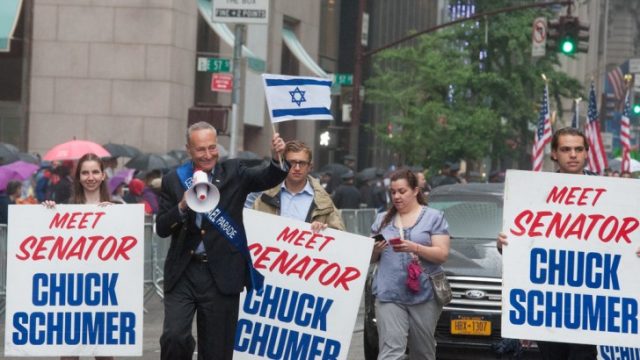
Sen. Chuck Schumer marches in the Celebrate Israel Parade in the rain on June 5, 2016 in New York City
If Americans Knew | July 18, 2017
In a recent speech on the Senate floor, New York Senator Charles Schumer said that anti-Zionism is a form of anti-Semitism. (In a 2010 speech Schumer said that God made him a ‘guardian of Israel’ – see below).
Schumer, the Senate minority leader, made his remarks at the end of a speech on health care. Schumer said he wanted to thank French President Emmanuel Macron for his recent comments claiming that anti-Zionism was antisemitism.
Schumer claimed that the Boycott, Divestment and Sanctions (BDS) movement, an extremely diverse movement that includes many Jewish individuals and groups, is “antisemitic.”
Schumer said: “The global BDS movement is a deeply biased campaign that I would say, in similar words to Mr. Macron, is a ‘reinvented form of anti-Semitism’ because it seeks to impose boycotts on Israel and not on any other nation.”
The Jewish Telegraphic Agency’s report on Schumer’s remarks notes that Schumer is the Senate’s “highest-ranking Jewish lawmaker.”
The claim that criticism of Israel is antisemitic has been promoted by an international campaign working to embed this as a new definition of “antisemitism.”
Schumer says he is a ‘guardian of Israel’
In 2010, Schumer told an AIPAC convention: “As some of you know, my name is a Hebrew word. “Schumer” comes from the Hebrew word “Shomer,” which means “guardian,” “watchman.”
Schumer said his name was given to him “for a reason”:
“For as long as I live, for as long as I have the privilege of serving in the Senate from New York, I will unflinchingly, unstintingly and with all of my strength be Shomer Yisrael, a guardian of Israel. Ladies and gentlemen, Am Yisrael Chai, in Israel and America, the Jewish nation lives now and forever.”
CNN: “Russia is an adversary, Ukraine is not.”
So that settles it!
By Gary Leupp | Dissident Voice | July 17, 2017
Monday morning. David Chalian, CNN Political Director, on CNN’s “New Day” program. News ticker: “How do Trump-Russia and DNC-Ukraine compare?
New Day co-anchor Alysin Camerota (former Fox anchor) puts the question to her Political Director.
Chalian’s mechanical reply: “Russia is an adversary, Ukraine is not.”
Camerota, as always exuding wisdom, follows up: “Thanks so much for sifting through this with us.” (Good, so that’s settled! There had been so much sifting there, in those few precious boilerplate minutes.)
But wait, Mr. Political Director! (And by the way, Dave, what’s your job description? How exactly do you direct CNN’s politics? The responsibility must rest heavily on your robust 43-year-old shoulders.) What law ever made Russia an adversary? My adversary, your adversary? Was some law passed that I didn’t notice?
Russia wasn’t an adversary under Yeltsin in the 90s, when the collapse of the old system produced mind-boggling misery as neocons in this country crowed about the triumph of capitalism and the need for U.S. “full-spectrum dominance” forever and ever. It wasn’t an adversary when Yeltsin bombarded the Russian Parliament building kin 1993 because legislators backed by the Supreme Court refused to disband. That as you know was two years before the U.S. interfered in the Russian elections to insure Yeltsin’s reelection.

TIME Magazine Cover: Boris Yeltsin – July 15, 1996
It wasn’t an adversary when the new leader Vladimir Putin offered assistance to the U.S. in its Afghan war, offering NATO a transport route through Russia.
Moscow only became, in the minds of some, an adversary when it started to seriously challenge Washington’s unremitting efforts to expand its anti-Russian military alliance, NATO. The main talking points of the clueless Camerotas are (1) Russia invaded Georgia in 2008, (2) Russia invaded Ukraine in 2014, and (3) Russia is somehow threatening the Baltic states. But these situations are never analyzed in any depth; they are simply a litany of officially mandated postulates about the past. And NATO never factors into the narrative.
Mr. Chalian: Is not your primary function as CNN’s Political Director to direct attention away from any critical thinking about NATO? And to discourage attention to the fact that NATO has expanded by 13 members since 1999, to surround Russia? Isn’t it among your key functions to discourage people from wondering why this is happening, or why Russians of all stripes find this expansion a matter of concern? And to depict Russian resistance to U.S. geopolitical expansion as aggression?
What sort of logical gymnastics do you have to inflict on yourself to argue as you do? And even to add to the list of Russian wrongs Moscow’s support for the Syrian state versus terrorism, in the face of U.S. efforts to topple the Syrian regime in league, as you know (you do know, right?) with al-Nusra aligned forces backed by Saudi Arabia?
And Ms. Camerota: Is it not your primary function as CNN morning anchor to furrow your brow and roll your eyes when reading the (politically directed) teleprompter content, whenever you are reporting on anything Russian, and to exude equanimity when, as your default mode, you glorify the U.S. military no matter what they do? And send best wishes to John McCain as though he—of course—deserves them?
Why do you inevitably tell anyone you interview who has fought in a U.S. war—any war, for any reason—that “We thank you for your service?”
Is that heart-felt enthusiasm for anyone’s participation in wars of aggression based on lies, or a rule of etiquette set down by the political director? Because it is a distinctly political statement. A loyalty oath you make every day, I suspect as a condition for continued employment.
Try asking the person you interview next time: Are you actually proud of what you did in Vietnam? Or Afghanistan? Or Iraq? Are you concerned about the war crimes? (You might be back on a plane to New Jersey within days.)
Pathetic. Let me “sift” through this with you. You guys in the final analysis promote war. Your promotion of Russophobia as an article of faith constitutes active collusion with the U.S. war machine. You are an active, unregistered, propagandist for NATO by default. And maybe you don’t even know it. Maybe on your own time you confuse NATO with UNESCO and for the life of you can’t grasp why any good person would worry about it.
Russia is not my adversary. Warmongers and their colluders are. You are.
Gary Leupp is a Professor of History at Tufts University, and author of numerous works on Japanese history. He can be reached at: gleupp@granite.tufts.edu.
Gulf Crisis: US Admits Fake News of Russian Hacking
By Finian CUNNINGHAM | Strategic Culture Foundation | 18.07.2017
In a sharp about-turn, US intelligence agencies are now accusing the United Arab Emirates for hacking into Qatar’s official news agency, thereby sparking the Gulf crisis between Washington’s Arab allies. The latest twist amounts to an admission that the US is guilty of previously broadcasting fake news blaming Russia.
This week, the Washington Post cites US intelligence officials when it reported Monday: «The United Arab Emirates orchestrated the hacking of Qatari government news and social media sites in order to post incendiary false quotes attributed to Qatar’s emir, Sheikh Tamim bin Hamad al Thani, in late May that sparked the ongoing upheaval between Qatar and its neighbors».
However, last month, on June 7, the American news outlet CNN had a completely different take on the Gulf crisis, when it blamed Russia for trying to sow division between US allies in the Persian Gulf. It reported in an «exclusive» article with the headline: US suspects Russian hackers planted fake news behind Qatar crisis.
That CNN report went on to claim: «US officials say the Russian goal appears to be to cause rifts among the US and its allies. In recent months, suspected Russian cyber activities, including the use of fake news stories, have turned up amid elections in France, Germany and other countries».
While CNN hinted that the alleged Russian hackers in the Gulf could have been criminal privateers, the thrust of its report last month very much pointed the finger of blame at the Russian government for hacking into the Qatar news agency. Using assertion, speculation and anonymous sources, the alleged Russian cyber-attack on Qatar was linked to alleged meddling by the Kremlin in the US presidential election last year.
«US intelligence has long been concerned with what they say is the Russian government’s ability to plant fake news in otherwise credible streams, according to US officials», reported CNN.
But now this week, US intelligence officials have changed their tune on who they think is whipping up the Gulf crisis. It is not Russia, it is the United Arab Emirates (UAE).
«[US] Officials became aware last week that newly analyzed information gathered by US intelligence agencies confirmed that on May 23, senior members of the UAE government discussed the plan and its implementation,» reports the Washington Post this week.
For over a month now, the UAE has aligned with Saudi Arabia and Bahrain to blockade Qatar, another member of the Gulf Cooperation Council (GCC). The crisis has become deadlocked with neither side willing to back down, much to the strategic concern of Washington. All of the monarchial energy-rich states are longtime allies of the US and together as a unit are a linchpin in maintaining the global petrodollar system. The other GCC members, Kuwait and Oman, have taken a neutral stance in the diplomatic crisis and have acted as brokers to resolve the dispute. Egypt, has joined with the Saudi-led bloc, to impose sanctions against Qatar.
The row blew up dramatically days after US President Donald Trump made an official state visit to Saudi Arabia on May 20-22. In exchange for a record $110-billion arms deals with the Saudi rulers, it seems clear that Trump gave the green light for the Saudis to instigate a blockade on Qatar. Ostensibly, the Saudis and the others are accusing Qatar of sponsoring terrorism and, they say, that is why they acted to isolate the neighboring gas-rich state. The absurd hypocrisy behind the accusation belies the real motive of petty rivalry among the Gulf monarchs. In particular, the Qatari-based Al Jazeera news network has been a bane for the Saudi and Egyptian rulers owing to its relatively independent and critical reporting on repression in those countries. Qatar’s support for the Muslim Brotherhood has also rankled the Saudis and Egyptians.
Two days after Trump flew out of Saudi on May 22, the official Qatari News Agency was hit with a fake news attack. Its news reports attributed statements to the Qatari emir, Sheikh Tamim bin Hamad al Thani, in which he praised Iran – the Shia arch-enemy of the US-backed Sunni monarchies – as well as making critical comments about Trump.
The whole debacle was an obvious set-up. Despite urgent notices from Qatar that its new agency had been hacked with fake news, the Saudi, Bahraini and Emirati media continued to prominently report the statements as if they were genuine, with the evident intention of smearing Qatar and provoking a stand-off.
The stage was then set for Saudi Arabia, UAE, Bahrain and Egypt to announce on June 5 a total embargo of commercial, media and transport links with Qatar «because of its support for terrorism and friendly relations with Iran».
US President Trump initially voiced support for the blockade on Qatar, claiming it as a success from his trip to Saudi Arabia.
«So good to see the Saudi Arabia visit with the King [Saudi King Salman] and 50 countries already paying off», Trump smugly declared through his Twitter feed. «They said they would take a hard line on funding extremism, and all reference was pointing to Qatar. Perhaps this will be the beginning of the end to the horror of terrorism!»
But ever since Trump set off the worst crisis in the Gulf among US allies, his top diplomat Rex Tillerson has been busy trying to calm the row.
Qatar serves as the base for US Central Command in the Middle East with an airbase housing 10,000 troops. American warplanes flying out of Qatar are the main strike force for operations in Iraq, Syria and Yemen. Strategic planners in Washington realize that the US cannot afford to alienate Qatar.
Tillerson has diverged noticeably from Trump’s simplistic broadside supporting Saudi Arabia, and has instead sought to bring Qatar back into the GCC fold. The US Secretary of State has hinted that the Saudi-led blockade is draconian and unrealistic. On June 23, Saudi Arabia and its partners demanded that Qatar shut down the Al Jazeera network along with a dozen other ultimatums. Qatar refused.
Last week, Tillerson had a frenetic week of shuttle diplomacy flying between Qatar and Saudi Arabia to get both sides to compromise. On Friday, July 14, the former Exxon CEO returned to the US deflated, unable to break the deadlock.
While traveling back to the US, Tillerson alluded to the strategic importance at stake for Washington in maintaining Gulf Arab unity. He said it is «really important to us from a national security standpoint. We need this part of the world to be stable, and this particular conflict between these parties is obviously not helpful».
This would explain why the US has now moved to expose the Saudi-led camp as being behind the fake news hack incident against the Qatari news agency.
That disclosure undermines the Saudi-led position. It confirms what the Qataris have been saying from the outset; namely, that they have been set up for a faux crisis by Gulf rivals, whose objective is to subjugate Qatari sovereignty under Saudi tutelage. Shutting down the «offensive» Al Jazeera news station being one of the desired outcomes.
By undermining the Saudis and UAE in this way, the US is wagering that it can lever the Saudis and the others GCC members into softening their demands on Qatar.
So keen are the US military and geopolitical planners to defuse the prolonged Gulf crisis – a crisis that threatens the petrodollar system – that they were obliged to come clean about the real identify of the perpetrators of the cyber attack on Qatar. That means dishing the dirt on the Saudis and UAE as the source of the hack, and abandoning the earlier claim that Russia was to blame.
CNN is once again caught out faking news about Russian hackers. At the time of its «exclusive» last month accusing Russia of destabilizing US allies in the Gulf, the news channel at least had the decency to quote Kremlin spokesman Dmitry Peskov on the claim.
Peskov said in the June 7 report: «It is another lie.. CNN again and again publish references to unnamed sources in unnamed agencies, etc, etc. These streams of information have no connection with the reality. It is so far away from the reality. Fake is a fake».
What the whole episode shows is not just how irresponsible US intelligence officials and major media are in publishing false claims defaming Russia. It also shows them as unscrupulous and expedient.
Just because the lingering Gulf crisis is spiraling to threaten US strategic interests, only then is there a sudden switch to a version of events that more accurately reflects reality. If it weren’t for US strategic concerns in the Gulf, the fake news put out about Russian hackers would no doubt continue. Which begs the question: if Russian hackers in the Gulf is fake news, then what does that say about similar claims of Russian hacking in the US?
US adding new sanctions against Iran over missile program
Press TV – July 18, 2017
The administration of US President Donald Trump says it is imposing new economic sanctions against Iran over the Islamic Republic’s ballistic missile program.
The US Departments of Treasury and State said Tuesday they are targeting 18 Iranian individuals, groups and networks.
The new sanctions freeze any assets the targets may have in the US and prevents Americans from doing business with them.
The restrictions ranged from a company that allegedly aided Iran’s drone program to a Turkey-based provider of naval equipment and a China-based network that provided electronics to Iran, according to the Associated Press.
Treasury Secretary Steven Mnuchin said the sanctions “send a strong signal that the United States cannot and will not tolerate Iran’s provocative and destabilizing behavior.”
The move comes one day after the Trump administration certified to Congress that Iran is in compliance with the 2015 nuclear agreement, which lifted nuclear-related sanctions imposed against Tehran.
The Trump administration notified the Congress of Iran’s compliance for the first time in April.
The White House is bound by US law to notify Congress of Iran’s compliance with the nuclear deal every 90 days. The Trump administration had notified the Congress of Iran’s compliance for the first time in April.
The certification that Iran is technically complying with the nuclear agreement clears the way for sanctions to remain lifted.
Washington claims Iran’s missile program is in breach of United Nations Security Council Resolution 2231, which endorsed Tehran’s nuclear deal with the P5+1 states in 2015.
However, Tehran insists its missile tests do not breach any UN resolutions because they are solely for defense purposes and not designed to carry nuclear warheads.
The Islamic Republic has said it will spare no effort to meet its national security needs, and does not allow any party to intervene in the imperative.
Afghanistan civilian deaths hit record highs as US-led airstrikes reach 2012 levels
RT | July 18, 2017
The US Air Force and its allies have dropped more munitions on Afghanistan in the first half of 2017 than in all of the previous year. This is level with the previous high in the first half of 2012 and coincides with a spike in civilian casualties, according to the UN.
So far this year, 232 civilians were killed in the airstrikes, compared to 162 the first six months of 2016. Around half of those died in operations carried out by the Afghan Air Force.
The American and coalition forces have dropped 1,634 munitions in Afghanistan during the first half of 2017, according to figures released by the US Air Force. The US and allied jets have flown over 2,000 combat sorties, and more than 500 of them ended up releasing at least one munition.
By comparison, there were 28,760 sorties recorded in all of 2012, with 1,975 of them reported to have released at least one weapon.
A drastic increase in aerial missions predictably caused more fatalities among Afghan civilians. A Monday report released by the UN’s mission to Afghanistan said the death toll began to climb due to the coalition bombings during the first half of 2017.
The last time the US Air Force expended munitions at this level was in 2012. At the time, there were nearly 50,000 US soldiers in the country, compared to the 9,800 US troops estimated to be stationed there now.
In June, President Donald Trump authorized the Pentagon, headed by Secretary of Defense Jim Mattis, to set the number of US forces in Afghanistan. Mattis reportedly plans to deploy an additional 4,000 troops to the war-torn country, signaling the largest troop increase since Trump took office.
“Each one of these casualty figures reflects a broken family, unimaginable trauma and suffering, and the brutal violation of people’s human rights,” Zeid Ra’ad Al Hussein, UN High Commissioner for Human Rights, said in a statement.
“Many Afghan civilians are suffering psychological trauma, having lost family and friends, and are living in fear knowing the risks they face as they go about their daily lives. Many more have been forced from their homes and suffered lasting damage to their health, education and livelihoods. The continuing national tragedy of Afghanistan must not be overlooked,” Al Hussein said.
Netanyahu Pushes Trump Toward Wider Wars
By Robert Parry | Consortium News | July 18, 2017
A weakened, even desperate President Donald Trump must decide whether to stand up to Israeli Prime Minister Benjamin Netanyahu or to repudiate the Syrian partial ceasefire, which Trump hammered out with Russian President Vladimir Putin on July 7.
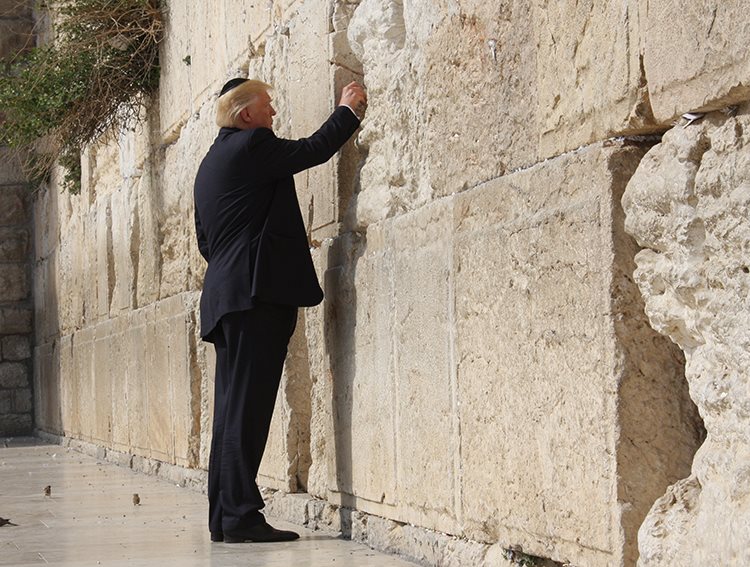
(Official White House Photo by Dan Hansen)
Whether intentionally or not, this crossroads is where the months of Russia-gate hysteria have led the United States, making Trump even more vulnerable to Israeli and neoconservative pressure and making any cooperation with Russia more dangerous for him politically.
After meeting with French President Emmanuel Macron in Paris on Sunday, Netanyahu declared that Israel was totally opposed to the Trump-Putin cease-fire deal in southern Syria because it perpetuates Iranian presence in Syria in support of the Syrian government of President Bashar al-Assad.
Netanyahu’s position increases pressure on Trump to escalate U.S. military involvement in Syria and possibly move toward war against Iran and even Russia. The American neocons, who generally move in sync with Netanyahu’s wishes, already have as their list of current goals “regime changes” in Damascus, Tehran and Moscow – regardless of the dangers to the Middle East and indeed the world.
At the G-20 summit on July 7, Trump met for several hours with Putin coming away with an agreed-upon cease-fire for southwestern Syria, an accord that has proven more successful than previous efforts to reduce the violence that has torn the country apart since 2011.
But that limited peace could mean failure for the proxy war that Israel, Saudi Arabia, Turkey and other regional players helped launch six years ago with the goal of removing Assad from power and shattering the so-called “Shiite crescent” from Tehran through Damascus to Beirut. Instead, that “crescent” appears more firmly in place, with Assad’s military bolstered by Shiite militia forces from Iran and Lebanon’s Hezbollah.
In other words, the “regime change” gambit against Assad’s government would have backfired, with Iranian and Hezbollah forces arrayed along Israel’s border with Syria. And instead of accepting that reversal and seeking some modus vivendi with Iran, Netanyahu and his Sunni-Arab allies (most notably the Saudi monarchy) have decided to go in the other direction (a wider war) and to bring President Trump along with them.
Neophyte Trump
Trump – a relative neophyte in global intrigue – has been slow to comprehend how his outreach to Netanyahu and Saudi King Salman runs counter to his collaboration with Putin on efforts to defeat the Sunni jihadist groups, including Al Qaeda and Islamic State, which have served as the point of the spear in the war to overthrow Assad.
Al Qaeda and Islamic State have received direct and indirect support from Saudi Arabia, the Gulf States, Turkey, Israel and even the Obama administration, albeit sometimes unwittingly. To block Assad’s overthrow – and the likely victory by these terror groups – Russia, Iran and Hezbollah came to Assad’s defense, helping to turn the tide of the war since 2015.
In his nearly half year in office, Trump has maintained an open hostility toward Iran – sharing a position held by Washington’s neocons as well as Netanyahu and Salman – but the U.S. President also has advocated cooperation with Russia to crush Islamic State and Al Qaeda inside Syria.
Collaboration with Russia – and indirectly with Iran and the Syrian military – makes sense for most U.S. interests, i.e., stabilizing Syria, reversing the refugee flow that has destabilized Europe, and denying Al Qaeda and Islamic State a base for launching terror strikes against Western targets.
But the same collaboration would be a bitter defeat for Netanyahu and Salman who have invested heavily in this and other “regime change” projects that require major U.S. investments in terms of diplomacy, money and military manpower.
So, in last weekend’s trip to Paris, Netanyahu chose to raise the stakes on Trump at a time when Democrats and the U.S. mainstream media are pounding him daily with the Russia-gate scandal, even raising the possibility that his son, Donald Trump Jr., might be prosecuted and imprisoned for having a meeting in June 2016 with a Russian lawyer.
If Trump wants the Russia-gate pain to lessen, he will be tempted to give Netanyahu what he wants and count on the savvy Israeli leader to intervene with the influential neocons of Official Washington to pull back on the scandal-mongering.
The problem, however, would be that Netanyahu really wants the U.S. military to complete the “regime change” project in Syria – much as it did in Iraq and Libya – meaning more American dead, more American treasure expended and a likely wider war, extending to Iran and possibly nuclear-armed Russia.
That might fulfill the neocon current menu of “regime change” schemes but it runs the risk of unleashing a nuclear conflagration on the world. In that way, liberals and even some progressives – who have embraced Russia-gate as a way to remove the hated Donald Trump from office – may end up contributing to the end of human civilization as well.
Investigative reporter Robert Parry broke many of the Iran-Contra stories for The Associated Press and Newsweek in the 1980s.
Clinton ally has ‘bright’ idea on CNN: Trump should bomb Russia!
By Danielle Ryan | RT | July 17, 2017
For months, American politicians and pundits have been busily debating whether or not Russia hacked (or somehow influenced) last year’s presidential election in an effort to support Donald Trump over Hillary Clinton.
The pressing issue for many has been how the US should respond to this (unproven) meddling by a foreign power. It’s a real tough one, but luckily, long-time Clinton family adviser Paul Begala has an idea — and it’s so obvious that it’s hard to believe no one thought of it before.
Trump should just bomb Russia.
Begala made the casual suggestion during an interview with CNN’s Anderson Cooper, declaring the US was “under attack by a hostile foreign power” and Trump should be “retaliating massively” to any interference in the country’s political system.
Instead of just debating more sanctions on Russia, there should also be a debate about “whether we should blow up the KGB, GSU, or GRU [Russia’s foreign military intelligence agency].”
There’s a lot to unpack here, but a few things jump out: 1. The KGB hadn’t existed since 1991 when the Soviet Union collapsed. 2. If bombing a country was an acceptable response to alleged election meddling, the US would already have been reduced to dust by now. 3. Trump bombing Russia could spark World War 3 — over unproven claims Russia somehow cost Clinton the presidency.
I just don’t think that decades from now, future generations would see Justice For Hillary as good enough reason to have incinerated the planet with nuclear weapons, but who knows, maybe I’m wrong.
This Begala is obviously not the sharpest tool in the shed. Nonetheless, there he is being given a platform on CNN to advocate for an action that could easily escalate to nuclear war — just because people on the opposite side of the political spectrum aren’t as angry about something as he is.
Imploring Trump to more drastic action against Russia, Begala even tries to play to the president’s noted ego, tempting him to get back at Russia for “tainting his victory.” This unhinged rhetoric coming largely from Democrats is dangerous, particularly in a climate that has Trump eager to prove that he did not collude with Moscow to achieve victory.
What’s interesting is that while Begala clearly feels that bombing Russian intelligence agencies is a reasonable thing to do, he probably wouldn’t endorse the bombing of the FBI or CIA — despite the fact that, by his logic, it would be a perfectly legitimate response, given the US’s interference in a whole host of foreign elections.
Even more interesting than that, though, is how Begala seems to have changed his tune about Russia now that a Republican is in the White House. During the 2012 election, when President Barack Obama called out opponent Mitt Romney for describing Russia the US’s number one geostrategic threat, Begala agreed, even tweeting that Obama had nailed Romney and quoting from the exchange: “The 1980’s called. They want their foreign policy back.”
Fast-forward, a few years and Begala, wants to bomb “the KGB.” Hey, Begala, the 1980s are calling again.
It’s true, American politics has never been short on fear-mongering about Russia, but it has been elevated to a whole new level, thanks in large part to Clinton, who believed that talking ad nauseum about Russia during the presidential campaign would ensure her victory — and when it didn’t, decided that even more talking about Russia would be the remedy. Now we’re stuck on the Russia loop for God knows how long — and still there has been no indisputable evidence proving that Trump colluded with the Kremlin, or that the Kremlin did in fact even meddle in the election.
The hysteria, promoted heavily by Clinton, has led us to a place where it’s normal to suggest on live television that the United States bombing Russia is a good, reasonable and justifiable idea. It was the kind of comment that should have seen Begala either laughed out of the CNN studio or seriously called out on air for utter lunacy — but of course, nothing of the sort happened.
Someone else who should have been called out last week for similar absurdity is Democratic Congressman Mike Quigley. Quigley, also on CNN, suggested that all Russians should be regarded with suspicion. In fact, all Russians, he implied, are inherently linked to Vladimir Putin by virtue of their nationality: “When you meet with any Russians, you’re meeting with Russian intelligence and therefore President Putin.”
That’s right. All Russians are spies for Putin and Americans can’t talk to or meet with any of them because if they do, they have obviously betrayed their nation. Quigley might want to get in touch with some members of his own party since they too have met with Russians on occasion.
Given the opportunity, one would hope that Quigley might roll back his statement and apologize for implying that meeting with any Russian person is equivalent to meeting with Putin. But it would have been great if he had been more careful in the first place, before contributing to the Russophobic mania which has taken over American political discourse and turned people’s brains to mush.
Then again, we can hardly expect journalists to take issue with bland commentary like that, given that no one batted an eyelid when former FBI director James Clapper said Russian people were “genetically driven” to be untrustworthy. This kind of commentary — which would be almost career ending if uttered about any [certain] other ethnicity, race or religion — is just par for the course when talking about Russia and Russians.
Regardless of whether or not Trump or his people colluded with Russian officials, or whether or not the Kremlin actively meddled in the US election, there is simply no way to deny that McCarthyism is back. For many Democrats, meeting with Russians is now forbidden — and bombing Russia is an option seriously worthy of consideration. That’s a pretty sad state of affairs.
Danielle Ryan is an Irish freelance writer, journalist and media analyst. She has lived and traveled extensively in the US, Germany, Russia and Hungary. Her byline has appeared at RT, The Nation, Rethinking Russia, The BRICS Post, New Eastern Outlook, Global Independent Analytics and many others. She also works on copywriting and editing projects. Follow her on Twitter or Facebook or at her website http://www.danielleryan.net.
Read more :
Featured Video

Spain train disaster raises questions over Israeli-linked security contractors
or go to
Aletho News Archives – Video-Images
From the Archives
Are There 50,000 ‘Israeli-born’ Individuals Living in the UK?
By Professor David Miller | August 18, 2026
Recent disclosures by the Zionist regime show that some 2,069 British nationals were serving in the IDF as of March 2025, according to Freedom of Information (FoI) requests submitted to the occupation forces (1,686 dual British-Israeli, plus 383 multinational). We cannot tell from the figures how many of these were already settler colonists and intend to stay in the colony, and how many will return or have returned to the UK. Presumably, those returning to the UK will number far fewer than 2,000, since many are known to have become permanently residents of the colony.
Additionally, the IDF figures only provide a snapshot, and do not tell us how many have served in the Jewish supremacist military either before or after March 2025. One way into the question of how many genocidaires are living in Britain is to ask how many current British residents were born in the Zionist colony. There is data on that, as we shall see. … continue
Blog Roll
 Aletho News
- Are There 50,000 ‘Israeli-born’ Individuals Living in the UK?
- German CDU MPs Seek Climate “Misinformation” List
- The ‘Gaza Treatment’: How Media Headlines Obscure Who is Bombing Yemen
- Ro Khanna urges Democrats to strip Israel ‘integration’ provision from defense bill
- Why Iran designated British MI6, Royal Navy, and RAF as hostile, terrorist organizations
- Armenian opposition politician dies in custody
- US still trying to recycle failed hypersonic missile programs
- France’s ‘Cold War’: Paris blames Tehran for supermarket fridge hacks
- Psywar no more? 77th Brigade’s sudden death
- Ukraine Already Carved Up… Before Talks Begin? /Prof. Richard Sakwa
- If Americans Knew
- An error has occurred; the feed is probably down. Try again later.
- No Tricks Zone
- German Authorities Start Initiative To Evaluate Public Register For Climate “Disinformation” Spreaders!
- Zonal Asymmetry of Temperature Change in the Antarctic Circumpolar Current
- New Study: The Net Fossil Fuel Contribution To Rising Atmospheric CO2 Has Been Zero For 500 Years
- Germany’s Green Energy Transition Becoming Increasingly Expensive…Another 6 Trillion Euros!
- Sudden Stratospheric Warming, Powerful El Niño Combination May Lead To Extreme Europe Cold, Energy Crisis!
- Two New Studies Find Thwaites Glacier Melt Cannot Be Driven By Human Activity Or A Warming Ocean
- E-Cars Reduce CO2 Emissions By Only 41% Compared To Internal Combustion Engine Vehicles
- Predictions Made By Renowned Climate Professor Over Past Decades Have Been Proven To Be Poor
- New Study Suggests Large Regions Of The Pacific Ocean Have Been Cooling For The Last 80 Years
- Germany’s Green Energy Debacle: High Energy Costs Force Kahla Porzellan to Close After 182 Years!

