Class War on the Waterfront: Longshore Workers Under Attack
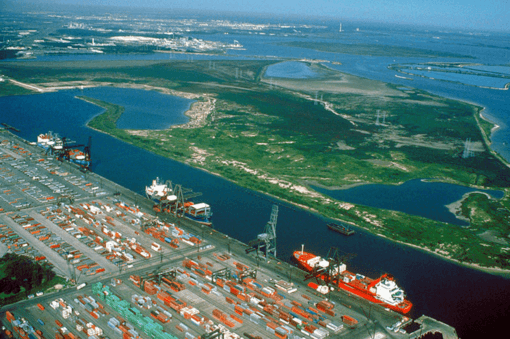
Photo by ROBERT HUFFSTUTTER | CC BY 2.0
By Jack Heyman | CounterPunch | July 21, 2017
The ink wasn’t even dry on the West Coast longshore contract when the head of the employers’ group, the Pacific Maritime Association, proposed an additional 3-year extension to the president of the International Longshore and Warehouse Union (ILWU), making it an eight-year contract. While the number of registered longshore jobs, 14,000, is the about same as in 1952, revenue tonnage has increased 14 times to a record-breaking 350 million revenue tons.
Under the current contract employers have already eliminated hundreds of longshore jobs through automation on marine terminals like the fully-automated Long Beach Container Terminal and semi-automated TraPac in the port of Los Angeles. “By the end of an extended contract in 2022, several thousand longshore jobs will be eliminated on an annual basis due to automation” warned Ed Ferris, president of ILWU Local 10 of San Francisco. With driverless trucks and crane operators in control towers running three cranes simultaneously, the chances of serious and deadly accidents are enormous.
Now maritime employers are pulling out all stops to push through this job-killing contract extension, using both Democratic and Republican politicians, high-powered PR firms and even some union officials.
A Chronicle op-ed appeared this week by Democrat Mickey Kantor, former Secretary of Commerce who was responsible for creating the World Trade Organization and the North American Free Trade Association which lost millions of jobs and Norman Mineta, another Democrat former Secretary of Commerce, from the public relations firm Hill and Knowlton. The first public relations firm was hired by Rockefeller to clean up his public image after nearly 100 people, men, women and children were killed in a 1914 Colorado miners strike known as the Ludlow Massacre and employers continue to use PR firms today.
The authors of this week’s SF Chronicle pro-company PR piece talk of preserving “labor peace” and refer to West Coast port shutdowns over the last 15 years. Yes, there is a class war on the waterfront, but it’s being waged by the employers. Those port closures were caused by employer lockouts in 2002, 2013 and 2014 during longshore contract negotiations. The 2002 lockout was ended after Democrat Diane Feinstein called on President Bush to invoke the anti-labor Taft-Hartley Act directed not against the maritime employers’ lockout but the longshore union. The only time the ILWU shutdown Pacific Coast ports in that period was May Day 2008 to protest the wars in Iraq and Afghanistan in the first-ever labor strike in the United States against a war.
The two Democrats cite distorted figures for wages and pensions that only reflect the highest skill level after a lifetime of work in one of the most dangerous industries. And then they threaten that “if the contract proposal is rejected” it could lead Republicans and Democrats alike to impose anti-strike legislation on the waterfront. The ILWU backed Bernie Sanders in the last election and then Hillary Clinton. Yet no matter who leads it, the Democratic Party represents the employer class, Wall Street on the waterfront. Clearly what’s needed now is a workers party to fight for a workers government that would expropriate the maritime industry, in ports and at sea, while establishing workers control.
The so-called “friends of labor” Democrats have been enlisted by PMA because earlier this year at the Longshore Caucus, a union meeting representing dockworkers on all West Coast ports, the San Francisco longshore delegates voted unanimously to oppose a contract extension. Last week they held a conference at their union hall on automation and the proposed contract extension. One proposal was to make automation benefit dockworkers by reducing the workweek to 30 hours while maintaining 40 hours pay, creating another work shift.
There are tens of millions of unemployed in this country. The labor movement should launch a new campaign for a shorter workweek at no loss in pay as part of a struggle for full employment to benefit all, not Trump and his Wall Street bankster cronies. In resisting the push for this contract extension to automate jobs out of existence, ILWU waterfront workers can stand up for all workers.
Jack Heyman is a retired Oakland longshoreman who edits the Maritime Worker Monitor and chairs the Transport Workers Solidarity Committee.
US corporations lobby against anti-Russia sanctions
RT | July 21, 2017
A wide range of American conglomerates, including oil, energy, banking, aerospace, auto and heavy manufacturing enterprises have jointly started a lobbying campaign against the new round of sanctions against Russia passed by the US Senate, CNN reports.
BP, ExxonMobil, General Electric, Boeing and Citigroup, MasterCard and Visa are reportedly among the companies raising concerns the punitive measures will ultimately harm their businesses, rather than the Kremlin.
Ford, Dow Chemical, Procter & Gamble, International Paper, Caterpillar, and Cummins have reportedly warned the measure could impact their businesses as well.
The new bill, aimed at punishing Russia for alleged meddling in the US presidential election, was approved last month. The measures target already sanctioned Russian banks and energy sector, limiting the financing period for them to 14 and 30 days respectively.
The legislation also introduces individual sanctions for investing more than $5 million a year or $1 million at a time in Russian pipeline projects or providing such enterprises with services, technology or information support.
Over a dozen of US corporations want changes to the bill and lobbyists and trade associations have been visiting Capitol Hill in recent days meeting members of Congress.
“It passed with such force and such a strong vote in the Senate, it seemed to be insurmountable initially. I don’t think they thought through the unintended consequences,” said a senior congressional aide who has worked on the billб as quoted by the media outlet.
The bill, which is still to be approved by both the House of Representatives and the Trump administration has drawn a wave of criticism among European corporations as well.
Earlier this week, the heads of European energy companies warned the sanctions Washington wants to impose on the Nord Stream-2 gas pipeline might have an adverse impact on Europe.
Last month, German Foreign Minister Sigmar Gabriel and Austrian Chancellor Christian Kern said the new measures introduced by the US were only about “selling American liquefied natural gas and ending the supply of Russian natural gas to the European market.”
‘Operational Uncertainty’ Forced Trump to Kill CIA Syria Program – Karen Kwiatkowski
Sputnik – 21.07.2017
WASHINGTON – US President Donald Trump reportedly decided to halt the training of Syrian rebels about a month ago after a meeting with CIA Director Mike Pompeo and national security adviser H.R. McMaster. The program originally ramped up in 2015 and was designed to produce a force of more than 5,000 troops to fight the Syrian government.
“This program increased the level of operational uncertainty beyond which Mr. Trump, McMaster and even CIA Director Pompeo were comfortable,” Kwiatkowski said on Thursday.
Trump, McMaster and Pompeo appear to have decided to shut down the CIA training program well before the US president met Russian President Vladimir Putin on the sidelines of the G20 summit in Hamburg earlier this month, Kwiatkowski recalled.
Contrary to neoconservative analysts who claim Putin during their talks at the G20 persuaded Trump to drop the Syria program, Trump had been prepared to scrap the CIA training program before he was elected president, Kwiatkowski pointed out.
Trump’s decision to end the CIA training program in Syria was likely to be welcomed by many US citizens, Kwiatkowski predicted.
“The CIA aid program initiated under Obama in 2013 had been embarrassing, counterproductive and confusing to many Americans,” she remarked. “It was ineffectual, and typical of most CIA field operations, operationally implemented without thorough coordination with either State [Department], the Department of Defense or local allies,” she said.
The program had aroused increasing concern among US intelligence veterans, Kwiatkowski added, noting that in the past 18 months even CIA officials had expressed concern about the ineffectiveness of the initiative.
“Four years of [Daesh], (banned in Russia) and extremist rebel defections from the US program in Syria, taking with them US weapons, training and intelligence, increases the risk factor of violating the great power goals in Syria,” she said.
The CIA program had also repeated disastrous failed US secret policies in many other conflicts around the world since World War II, Kwiatkowski added.
“The concept of aiding selected rebel groups in a civil war in order to emplace a friendly dictatorship or satrap is certainly a tried and failed US approach around the world for the past 70 years. It’s not particularly imaginative,” she said.
However, the discontinuation of the CIA program, “as with the conclusion of all welfare programs,” will be met with anger, recrimination, and simmering resentment by those who were formerly in receipt of the aid, Kwiatkowski predicted.
McConnell, the Republican Majority Leader in the Senate and McCain who chairs the Senate Armed Services Committee strongly supported the CIA secret training program for rebels seeking to topple Syrian President Bashar Assad over the past five years, Kwiatkowski recalled.
American Armored Vehicles Are Pouring into Raqqa, But Who Are They For?
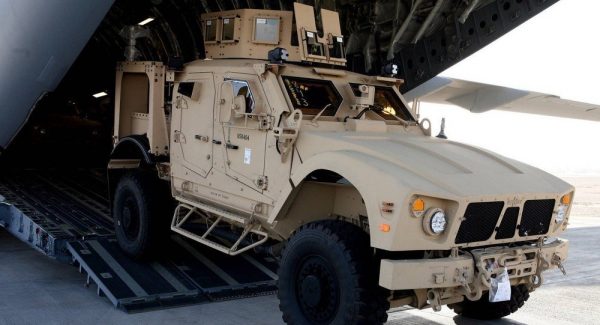
© East News/ Michael Curvin
Sputnik – 21.07.2017
Footage has surfaced online depicting flatbed tracks laden with American armored military vehicles passing through Syria, with conflicting commentary claiming that the materiel was bound for use by either US-backed Syrian militant groups or US troops themselves fighting Daesh in the city of Raqqa.
The photos and videos were uploaded by Syrian Kurdish activists who are known affiliates of the Syrian Democratic Forces (SDF.) The vehicles included Mine-Resistant Ambush Protected (MRAP) vehicles, Mine-Resistant All Terrain Vehicles (M-ATVs) and armored bulldozers. They were mounted on the backs of flatbed trucks and were filmed passing through Qamishli, 170 miles northeast of Raqqa.
All three vehicle types were previously mentioned in Pentagon reports as assets being supplied to SDF fighters. “Up-armored vehicles have been delivered to the SDF and [Syrian Arab Coalition] as part of our existing authorities to enable them,” a spokesperson for US operations in Syria told Task & Purpose.
”Specifically, these vehicles will help them contend with [Daesh’s] IED threat in their current operation, and as they move to isolate [Raqqa].” Mine-resistant vehicles are deployed against areas known to hide improvised explosive devices, which are a major danger to American soldiers riding in armored vehicles. At least half of all US casualties in Iraq and Afghanistan have been attributed to IEDs.
However, the spokesperson went on to tell Task & Purpose that MRAPs and M-ATVs were “not part of the package that is divested to the SDF.” The Military Times noted that the M-ATVs were mounted with Common Remotely Operated Weapon Station (CROWs) systems, which allow for operators to fire the M-ATV’s mounted.50 cal machine gun without exposing themselves to enemy fire. CROWS systems also weren’t provided to SDF fighters.
Instead, the vehicles “are for use by the Coalition to protect our forces from IEDs.” In other words, the Pentagon claims these armored vehicles are for use by Western operators, not SDF militants.
Under the Trump administration, there has been an uptick in American support for the SDF, a coalition of various militias. Since June, the SDF have besieged Raqqa, Daesh’s final stronghold in Syria. Although Daesh has mounted intense resistance, the SDF has encircled the city and is slowly but surely gaining ground. The deeper the SDF go into the city, however, the stiffer the defenses they find awaiting them.
“The SDF has reportedly encountered intensified resistance and ‘better-emplaced defenses’ over the past four weeks following initial rapid gains in districts on the outskirts of [Raqqa],” read a new report from the Institute for the Study of War.
Although the US support for SDF operations is common knowledge, the Pentagon has been very cagey about providing details of American operations. They only directly confirmed the presence of US advisers in Raqqa five weeks into the siege, for instance.
The largest and most prominent militia among them are the Syrian Kurdish People’s Protection Units (YPG). Turkey, a nominal US ally, considers the YPG to be a terrorist group, which the US denies. The Syrian Kurds and the Turkish military have become increasingly belligerent to one another, with some exchanges of gunfire along the Syrian-Turkish border. Ankara has stated in no uncertain terms that they will never support a Kurdish state on their border.
The armored vehicles may then serve a purpose beyond helping to bring an end to the Daesh occupation. They may also be the Pentagon looking ahead to the wars of tomorrow.
US says Syria crisis needs political solution, Assad doesn’t have to go first
Press TV – July 21, 2017
US President Donald Trump’s homeland security and counterterrorism adviser says the US is seeking a political resolution to the conflict in Syria and won’t insist on Syrian President Bashar Assad’s immediate ouster.
Tom Bossert said Thursday there needs to be a political outcome in Syria, not a military-imposed one that has no political strategy to fill a void in leadership.
“I don’t think it’s important for us to say Assad must go first,” Bossert said at the Aspen Security Forum, an annual gathering of intelligence and national security officials and experts.
“The US would still like to see Assad go at some point. That would be our desired outcome,” he added.
The administration of former President Barack Obama had chanted “the Assad must go” mantra on major international forums for several years.
Bossert made the remarks following news reports that Trump had decided to end a covert CIA program that has been arming, training and funding anti-Damascus militants since 2013.
US officials said that ending the CIA operation reflects Trump’s interest in finding ways to work with Russia. Moscow had long pushed Washington to end the covert program, which was begun by the Obama administration to overthrow Assad.
However, the CIA effort had failed to achieve its goals and some US lawmakers had proposed cutting its budget. By some estimates, the CIA trained some 10,000 militants.
For years, Damascus has accused the US of supporting militants seeking to topple the government.
Despite halting the CIA program, the US is still militarily involved in Syria. In May, Trump authorized arming the so-called Syrian Democratic Forces — a Kurdish rebel group — using Department of Defense funds.
Since 2015, Russia has been conducting cruise missile strikes and aerial attacks against terrorist positions in Syria at a request from the Syrian government. The US has been leading dozens of its allies in a military mission purportedly aimed rooting out Daesh since 2014.
Deconstructing Trump’s Iran sanctions
By M K Bhadrakumar | Indian Punchline | July 20, 2017
There is an old impish yarn that Moses was stunned to see the two cats he’d put in the Ark trooping out with a bunch of kittens at the end of the tumultuous existential journey. Seeing the old sage’s puzzled look, the adult male shot back, ‘You thought we were fighting?’ This in some ways captures the noisy, implausible games that Iran and the United States play with each other, growling at each other and making us feel worried at times.
President Donald Trump is having a difficult time to differentiate his Iran policies from Barack Obama’s. The Trump administration has twice certified to the Congress that Iran is complying with the nuclear deal – an agreement he vowed to tear up. But, while doing so on Monday, with an eye on the Israeli lobby, it separately imposed sanctions against a clutch of Iranian personalities and entities – so that the optics look appropriately ‘tough’.
Tehran had conveyed a red line to Washington in the weekend that there shall be no sanctions against the Islamic Revolutionary Guards Corps (which is spearheading Iran’s operations against ISIS in Iraq and Syria). The Trump administration understood perfectly well what it implied – namely, that things can overnight hot up for the US on the ground on the Syrian-Iraqi theatre. (For the uninitiated, IRGC-backed militia and American military advisors tacitly collaborate in the liberation of Mosul.)
Tehran understands that Trump is a bluff master. Read the Iranian Foreign Ministry statement here. Clearly, no one is losing sleep in Tehran. Iran’s missile programme is indigenous; nor will US sanctions frighten IRGC’s elite Qud’s Force under the command of its charismatic general Qassem Soleimani to give up the ‘axis of resistance’ in Syria and Lebanon (and Gaza.)
In fact, Majlis passed a finance bill Tuesday increasing the budget allocation for the missile programme and Quds Force each by $260 million.
The Middle East is witnessing a long sunset of the US hegemony. And Iran senses it. So, Tehran is playing its cards astutely through an admixture of strategic defiance and taunts with unspoken overtures seeking meaningful conversation.
Read the transcript, here, of a fascinating interview by National Interest magazine with Iranian FM Mohammed Javed Zarif who is visiting New York. (Zarif already addressed the CFR and was interviewed by CNN’s Fareed Zakariah and the PBS, amongst others.)
Indeed, Zarif virtually choreographed an Iran policy for Trump. Look at his tantalizing remarks:
- “It took the U.S. longer to clear the purchase of Airbus airplanes than it took for the purchase of Boeing airplanes.”
- “If it comes to a major violation, or what in the terms of the nuclear deal is called significant nonperformance, then Iran has other options available, including withdrawing from the deal.”
- “We need to be more careful about the signaling, because we’ve seen that wrong signaling in the past few weeks in our region, particularly after the Riyadh summit, has caused a rather serious backlash in the region—not between U.S. allies and Iran, but among U.S. allies.”
- “At this stage we are content with simply implementing that (nuclear) agreement… we wanted that agreement to be the foundation and not the ceiling. But in order for that to serve as a solid foundation, we want to make sure that the obligations by all sides have been fully and faithfully implemented. And if we get that, then we have an opening to further progress.”
- “We don’t see the situation in our region as a winning or losing battle… we believe that the situation in today’s world is so interconnected that we cannot have winners and losers; we either win together or lose together. Obviously, if an administration or a government or a country defines its interests in terms of exclusion of others, then it is defining the problem in a way that is not amenable to a solution.”
- “We have had a consistent policy of fighting extremism and terrorism, whether it was in Afghanistan during the reign of the Taliban, or, even during the time that the United States was in occupation of Iraq, against terrorist elements who were instigating terror inside Iraq.”
- “Well, it all depends on the approach that the United States will try, the current administration will try to adopt vis-à-vis Iran. It has to look at Iran as the only country in the region where people stand in line for ten hours to vote. It has to put aside those self-serving assumptions that some members of this administration have repeatedly stated.”
- “We have a very sober understanding of the situation in the region where we are located, and we hope that the United States can also have such a sober understanding.”
Iran is doing just fine. The genius to optimally put diplomacy to use, with maximum cost-effectiveness, has been Iran’s strategic asset in the politics of the Middle East.
Which European Nation Suffers From The Most Drug-Induced Deaths?
By Tyler Durden | Zero Hedge | July 19, 2017
As highlighted by the latest edition of the European Drug Report, Estonia is the country with the most drug-induced deaths per million population in Europe.

You will find more statistics at Statista
At 103 – 82 above the EU average – only Sweden comes close with 100 deaths. However, at the other end of the scale, as Martin Armstrong at Statista points out, Portugal, where drugs were decriminalised back in 2001, had only 6 per million people.
Looking outside of Europe, Estonia’s problems are pulled into sharp relief by the rate in the United States. In 2016, there were a staggering 185 deaths per million.
CONFIRMED: Trump’s cessation of arms to Salafists had nothing to do with Russia
By Adam Garrie | The Duran | July 20, 2017
Today, Russia’s Presidential spokesman Dmitry Peskov confirmed that the issue of America ceasing to arm Salafist jihadist groups in Syria such as the FSA was not discussed in any way during Donald Trump’s meeting with Vladimir Putin.
This conforms to the analysis first published yesterday in The Duran :
“While the Washington post calls this a win for Russia, in reality this will not directly effect Russia one way or another. It is however, a win for Syria.
By most reasonable accounts, the conflict in Syria could have ended far earlier if not for the CIA and other US actors arming, funding and training Salafist jihadist fighters in Syria (often referred to as moderate rebels by the western mainstream media).
As even the Washington Post admits, almost in a gloating fashion, arming such jihadists was a flagship policy of the United States under Barack Obama.
This will take a substantial deal of pressure off the Syrian Arab Army and their fight against remaining terrorists in Syria.
Ever since Trump took office, the general trajectory of US meddling in Syria shifted from arming jihadists to arming, funding and working in close military coordination with Kurdish forces.
Today’s revelation simply affirms what was long the apparent on the ground policy of the United States since February of 2017.
It is key to remember that even after this announcement, the US presence in Syria is still illegal according to international law…..
At present, there is no overt linkage to these events and Donald Trump’s meeting at the G20 summit with Vladimir Putin. …
This contradicts the assumptions made in the Washington Post that somehow the move was a “victory for Putin” or that it represented Trump capitulating to a Russian demand.
The Washington Post’s assertion that Trump’s decision was “sought by Moscow” is patently misleading and that is being charitable.
Furthermore, under Donald Trump, the United States was moving in this direction since February when it became clear that the new US administration sought to shift the focus of it’s Syria policy from arming jihadists to arming secular Kurdish forces, a move which is still illegal according to international law and opposed by a vast majority of Syrians.
While Russia, Syria and Iran have all warned that any state or non-state actors funding, arming or aiding Salafist terrorists under the guise that they are ‘moderate’ will harm Syrian and wider global security, Russia has not ever attempted to dictate US policy nor has Russia issued any threats or even suggestions to the United States on how to frame its foreign alliances.
Once again, western mainstream media totally distort Russia’s foreign policy statements in order to make Donald Trump look weak or compromised.
‘Trump decision to end CIA covert ops in Syria will be severely attacked by Neocons’
RT | July 20, 2017
In 2014 – 2015, $500 million of US taxpayer’s money was spent on training 54 so-called ‘moderate rebels’, most of whom immediately turned their weapons over and joined Al-Nusra or Al-Qaeda, explains investigative journalist Rick Sterling.
A Washington Post article published on Wednesday says that, according to US officials, Donald Trump decided to phase out the covert CIA program to arm and train rebels in Syria in favor of working with Russia.
However, the White House has declined to confirm the details.
RT: If this report is accurate and Trump decided to shut down CIA training of rebels in Syria, how might that affect the situation on the ground?
Rick Sterling: It’ll be a significant step. One thing that should be pointed out is that the US, through the CIA, or the Defense Department, the arming of extremist groups is illegal under international law. It has been a tremendous waste of money; between 2014 – 2015, $500 million of US taxpayer funds were spent to train a grand total of 54 so-called moderate rebels, most of whom immediately turned the weapons over and joined Al-Nusra or Al-Qaeda. That has been the real effect of it. The money and the training the CIA has provided has primarily helped Al-Qaeda. So stopping that will be a very good thing.
RT: Assuming it’s true, why do you think the White House would decline to confirm the report?
RS: I think that is indicative of the battle underway over US foreign policy. Already in the Washington Post report today, the people they quote, such as Charles Lister, are very negative on it. Lister says something like Trump’s falling into a “Russian trap.” They basically want to prolong the conflict in Syria. Lister works at the Middle East Institute, which receives significant funding from military industrial corporations, such as Raytheon. They don’t want the war and the conflict to end – they want to prolong it and even escalate it. This move from people who are little more rational in government is something that needs to be supported strongly. It is a positive step, but it is going to come under severe attack now. Trump is going to come under attack, and the decision may be undermined or sabotaged. So that is something else we need to be looking out for and hopefully guarding against.
RT: This isn’t the first time US officials and the president have issued conflicting messages. Why isn’t there a common line coming out of Washington?
RS: The mainstream media, unfortunately, has had a campaign attacking Trump’s foreign policy. The only time they cheered Trump was when he launched the missile attacks on April 6. As it subsequently turned out that US intelligence knew the Syrian government did not launch chemical weapons in the town of Khan Shaykhun – that is according to Seymour Hersh…. Hersh is one of the foremost, most well-known and regarded investigative journalist from the US, his findings have been basically censored from the mainstream media. So most people don’t know about them.
Trump went to Mike Pompeo, the CIA Director and asked him point blank right after the event happened on April 4 – find out who is responsible. Pompeo came back and said: “It was the Syrian government.” That was Trump’s basis for launching the attacks. Subsequently, it’s come out that US intelligence knew the Syrian government was not responsible. So there is the CIA – they basically supplied the rationale for Trump to launch the attacks that killed 14 people, including nine civilians. That is the only time Trump has been really hailed and given credit in the US mainstream media. This plan now, or the news the CIA Train and Equip Program is being shut down, that is a very good thing. We can expect it to be severely attacked by neoconservatives, who want to prolong and even escalate the conflict much against the interests of the American people, and obviously supremely against the interests of the people of Syria and the region.
Featured Video

Spain train disaster raises questions over Israeli-linked security contractors
or go to
Aletho News Archives – Video-Images
From the Archives
Are There 50,000 ‘Israeli-born’ Individuals Living in the UK?
By Professor David Miller | August 18, 2026
Recent disclosures by the Zionist regime show that some 2,069 British nationals were serving in the IDF as of March 2025, according to Freedom of Information (FoI) requests submitted to the occupation forces (1,686 dual British-Israeli, plus 383 multinational). We cannot tell from the figures how many of these were already settler colonists and intend to stay in the colony, and how many will return or have returned to the UK. Presumably, those returning to the UK will number far fewer than 2,000, since many are known to have become permanently residents of the colony.
Additionally, the IDF figures only provide a snapshot, and do not tell us how many have served in the Jewish supremacist military either before or after March 2025. One way into the question of how many genocidaires are living in Britain is to ask how many current British residents were born in the Zionist colony. There is data on that, as we shall see. … continue
Blog Roll
 Aletho News
- Are There 50,000 ‘Israeli-born’ Individuals Living in the UK?
- German CDU MPs Seek Climate “Misinformation” List
- The ‘Gaza Treatment’: How Media Headlines Obscure Who is Bombing Yemen
- Ro Khanna urges Democrats to strip Israel ‘integration’ provision from defense bill
- Why Iran designated British MI6, Royal Navy, and RAF as hostile, terrorist organizations
- Armenian opposition politician dies in custody
- US still trying to recycle failed hypersonic missile programs
- France’s ‘Cold War’: Paris blames Tehran for supermarket fridge hacks
- Psywar no more? 77th Brigade’s sudden death
- Ukraine Already Carved Up… Before Talks Begin? /Prof. Richard Sakwa
- If Americans Knew
- An error has occurred; the feed is probably down. Try again later.
- No Tricks Zone
- German Authorities Start Initiative To Evaluate Public Register For Climate “Disinformation” Spreaders!
- Zonal Asymmetry of Temperature Change in the Antarctic Circumpolar Current
- New Study: The Net Fossil Fuel Contribution To Rising Atmospheric CO2 Has Been Zero For 500 Years
- Germany’s Green Energy Transition Becoming Increasingly Expensive…Another 6 Trillion Euros!
- Sudden Stratospheric Warming, Powerful El Niño Combination May Lead To Extreme Europe Cold, Energy Crisis!
- Two New Studies Find Thwaites Glacier Melt Cannot Be Driven By Human Activity Or A Warming Ocean
- E-Cars Reduce CO2 Emissions By Only 41% Compared To Internal Combustion Engine Vehicles
- Predictions Made By Renowned Climate Professor Over Past Decades Have Been Proven To Be Poor
- New Study Suggests Large Regions Of The Pacific Ocean Have Been Cooling For The Last 80 Years
- Germany’s Green Energy Debacle: High Energy Costs Force Kahla Porzellan to Close After 182 Years!

