Intel Vets Challenge ‘Russia Hack’ Evidence
Consortium News | July 24, 2017
In a memo to President Trump, a group of former U.S. intelligence officers, including NSA specialists, cite new forensic studies to challenge the claim of the key Jan. 6 “assessment” that Russia “hacked” Democratic emails last year.
MEMORANDUM FOR: The President
FROM: Veteran Intelligence Professionals for Sanity (VIPS)
SUBJECT: Was the “Russian Hack” an Inside Job?
Executive Summary
Forensic studies of “Russian hacking” into Democratic National Committee computers last year reveal that on July 5, 2016, data was leaked (not hacked) by a person with physical access to DNC computers, and then doctored to incriminate Russia.
After examining metadata from the “Guccifer 2.0” July 5, 2016 intrusion into the DNC server, independent cyber investigators have concluded that an insider copied DNC data onto an external storage device, and that “telltale signs” implicating Russia were then inserted.
Key among the findings of the independent forensic investigations is the conclusion that the DNC data was copied onto a storage device at a speed that far exceeds an Internet capability for a remote hack. Of equal importance, the forensics show that the copying and doctoring were performed on the East coast of the U.S. Thus far, mainstream media have ignored the findings of these independent studies [see here and here].
Independent analyst Skip Folden, a retired IBM Program Manager for Information Technology US, who examined the recent forensic findings, is a co-author of this Memorandum. He has drafted a more detailed technical report titled “Cyber-Forensic Investigation of ‘Russian Hack’ and Missing Intelligence Community Disclaimers,” and sent it to the offices of the Special Counsel and the Attorney General. VIPS member William Binney, a former Technical Director at the National Security Agency, and other senior NSA “alumni” in VIPS attest to the professionalism of the independent forensic findings.
The recent forensic studies fill in a critical gap. Why the FBI neglected to perform any independent forensics on the original “Guccifer 2.0” material remains a mystery – as does the lack of any sign that the “hand-picked analysts” from the FBI, CIA, and NSA, who wrote the “Intelligence Community Assessment” dated January 6, 2017, gave any attention to forensics.
NOTE: There has been so much conflation of charges about hacking that we wish to make very clear the primary focus of this Memorandum. We focus specifically on the July 5, 2016 alleged Guccifer 2.0 “hack” of the DNC server. In earlier VIPS memoranda we addressed the lack of any evidence connecting the Guccifer 2.0 alleged hacks and WikiLeaks, and we asked President Obama specifically to disclose any evidence that WikiLeaks received DNC data from the Russians [see here and here].
Addressing this point at his last press conference (January 18), he described “the conclusions of the intelligence community” as “not conclusive,” even though the Intelligence Community Assessment of January 6 expressed “high confidence” that Russian intelligence “relayed material it acquired from the DNC … to WikiLeaks.”
Obama’s admission came as no surprise to us. It has long been clear to us that the reason the U.S. government lacks conclusive evidence of a transfer of a “Russian hack” to WikiLeaks is because there was no such transfer. Based mostly on the cumulatively unique technical experience of our ex-NSA colleagues, we have been saying for almost a year that the DNC data reached WikiLeaks via a copy/leak by a DNC insider (but almost certainly not the same person who copied DNC data on July 5, 2016).
From the information available, we conclude that the same inside-DNC, copy/leak process was used at two different times, by two different entities, for two distinctly different purposes:
-(1) an inside leak to WikiLeaks before Julian Assange announced on June 12, 2016, that he had DNC documents and planned to publish them (which he did on July 22) – the presumed objective being to expose strong DNC bias toward the Clinton candidacy; and
-(2) a separate leak on July 5, 2016, to pre-emptively taint anything WikiLeaks might later publish by “showing” it came from a “Russian hack.”
* * *
Mr. President:
This is our first VIPS Memorandum for you, but we have a history of letting U.S. Presidents know when we think our former intelligence colleagues have gotten something important wrong, and why. For example, our first such memorandum, a same-day commentary for President George W. Bush on Colin Powell’s U.N. speech on February 5, 2003, warned that the “unintended consequences were likely to be catastrophic,” should the U.S. attack Iraq and “justfy” the war on intelligence that we retired intelligence officers could readily see as fraudulent and driven by a war agenda.
The January 6 “Intelligence Community Assessment” by “hand-picked” analysts from the FBI, CIA, and NSA seems to fit into the same agenda-driven category. It is largely based on an “assessment,” not supported by any apparent evidence, that a shadowy entity with the moniker “Guccifer 2.0” hacked the DNC on behalf of Russian intelligence and gave DNC emails to WikiLeaks.
The recent forensic findings mentioned above have put a huge dent in that assessment and cast serious doubt on the underpinnings of the extraordinarily successful campaign to blame the Russian government for hacking. The pundits and politicians who have led the charge against Russian “meddling” in the U.S. election can be expected to try to cast doubt on the forensic findings, if they ever do bubble up into the mainstream media. But the principles of physics don’t lie; and the technical limitations of today’s Internet are widely understood. We are prepared to answer any substantive challenges on their merits.
You may wish to ask CIA Director Mike Pompeo what he knows about this. Our own lengthy intelligence community experience suggests that it is possible that neither former CIA Director John Brennan, nor the cyber-warriors who worked for him, have been completely candid with their new director regarding how this all went down.
Copied, Not Hacked
As indicated above, the independent forensic work just completed focused on data copied (not hacked) by a shadowy persona named “Guccifer 2.0.” The forensics reflect what seems to have been a desperate effort to “blame the Russians” for publishing highly embarrassing DNC emails three days before the Democratic convention last July. Since the content of the DNC emails reeked of pro-Clinton bias, her campaign saw an overriding need to divert attention from content to provenance – as in, who “hacked” those DNC emails? The campaign was enthusiastically supported by a compliant “mainstream” media; they are still on a roll.
“The Russians” were the ideal culprit. And, after WikiLeaks editor Julian Assange announced on June 12, 2016, “We have emails related to Hillary Clinton which are pending publication,” her campaign had more than a month before the convention to insert its own “forensic facts” and prime the media pump to put the blame on “Russian meddling.” Mrs. Clinton’s PR chief Jennifer Palmieri has explained how she used golf carts to make the rounds at the convention. She wrote that her “mission was to get the press to focus on something even we found difficult to process: the prospect that Russia had not only hacked and stolen emails from the DNC, but that it had done so to help Donald Trump and hurt Hillary Clinton.”
Independent cyber-investigators have now completed the kind of forensic work that the intelligence assessment did not do. Oddly, the “hand-picked” intelligence analysts contented themselves with “assessing” this and “assessing” that. In contrast, the investigators dug deep and came up with verifiable evidence from metadata found in the record of the alleged Russian hack.
They found that the purported “hack” of the DNC by Guccifer 2.0 was not a hack, by Russia or anyone else. Rather it originated with a copy (onto an external storage device – a thumb drive, for example) by an insider. The data was leaked after being doctored with a cut-and-paste job to implicate Russia. We do not know who or what the murky Guccifer 2.0 is. You may wish to ask the FBI.
The Time Sequence
June 12, 2016: Assange announces WikiLeaks is about to publish “emails related to Hillary Clinton.”
June 15, 2016: DNC contractor Crowdstrike, (with a dubious professional record and multiple conflicts of interest) announces that malware has been found on the DNC server and claims there is evidence it was injected by Russians.
June 15, 2016: On the same day, “Guccifer 2.0” affirms the DNC statement; claims responsibility for the “hack;” claims to be a WikiLeaks source; and posts a document that the forensics show was synthetically tainted with “Russian fingerprints.”
We do not think that the June 12 & 15 timing was pure coincidence. Rather, it suggests the start of a pre-emptive move to associate Russia with anything WikiLeaks might have been about to publish and to “show” that it came from a Russian hack.
The Key Event
July 5, 2016: In the early evening, Eastern Daylight Time, someone working in the EDT time zone with a computer directly connected to the DNC server or DNC Local Area Network, copied 1,976 MegaBytes of data in 87 seconds onto an external storage device. That speed is many times faster than what is physically possible with a hack.
It thus appears that the purported “hack” of the DNC by Guccifer 2.0 (the self-proclaimed WikiLeaks source) was not a hack by Russia or anyone else, but was rather a copy of DNC data onto an external storage device. Moreover, the forensics performed on the metadata reveal there was a subsequent synthetic insertion – a cut-and-paste job using a Russian template, with the clear aim of attributing the data to a “Russian hack.” This was all performed in the East Coast time zone.
“Obfuscation & De-obfuscation”
Mr. President, the disclosure described below may be related. Even if it is not, it is something we think you should be made aware of in this general connection. On March 7, 2017, WikiLeaks began to publish a trove of original CIA documents that WikiLeaks labeled “Vault 7.” WikiLeaks said it got the trove from a current or former CIA contractor and described it as comparable in scale and significance to the information Edward Snowden gave to reporters in 2013.
No one has challenged the authenticity of the original documents of Vault 7, which disclosed a vast array of cyber warfare tools developed, probably with help from NSA, by CIA’s Engineering Development Group. That Group was part of the sprawling CIA Directorate of Digital Innovation – a growth industry established by John Brennan in 2015.
Scarcely imaginable digital tools – that can take control of your car and make it race over 100 mph, for example, or can enable remote spying through a TV – were described and duly reported in the New York Times and other media throughout March. But the Vault 7, part 3 release on March 31 that exposed the “Marble Framework” program apparently was judged too delicate to qualify as “news fit to print” and was kept out of the Times.
The Washington Post’s Ellen Nakashima, it seems, “did not get the memo” in time. Her March 31 article bore the catching (and accurate) headline: “WikiLeaks’ latest release of CIA cyber-tools could blow the cover on agency hacking operations.”
The WikiLeaks release indicated that Marble was designed for flexible and easy-to-use “obfuscation,” and that Marble source code includes a “deobfuscator” to reverse CIA text obfuscation.
More important, the CIA reportedly used Marble during 2016. In her Washington Post report, Nakashima left that out, but did include another significant point made by WikiLeaks; namely, that the obfuscation tool could be used to conduct a “forensic attribution double game” or false-flag operation because it included test samples in Chinese, Russian, Korean, Arabic and Farsi.
The CIA’s reaction was neuralgic. Director Mike Pompeo lashed out two weeks later, calling Assange and his associates “demons,” and insisting, “It’s time to call out WikiLeaks for what it really is, a non-state hostile intelligence service, often abetted by state actors like Russia.”
Mr. President, we do not know if CIA’s Marble Framework, or tools like it, played some kind of role in the campaign to blame Russia for hacking the DNC. Nor do we know how candid the denizens of CIA’s Digital Innovation Directorate have been with you and with Director Pompeo. These are areas that might profit from early White House review.
Putin and the Technology
We also do not know if you have discussed cyber issues in any detail with President Putin. In his interview with NBC’s Megyn Kelly, he seemed quite willing – perhaps even eager – to address issues related to the kind of cyber tools revealed in the Vault 7 disclosures, if only to indicate he has been briefed on them. Putin pointed out that today’s technology enables hacking to be “masked and camouflaged to an extent that no one can understand the origin” [of the hack] … And, vice versa, it is possible to set up any entity or any individual that everyone will think that they are the exact source of that attack.”
“Hackers may be anywhere,” he said. “There may be hackers, by the way, in the United States who very craftily and professionally passed the buck to Russia. Can’t you imagine such a scenario? … I can.”
Full Disclosure: Over recent decades the ethos of our intelligence profession has eroded in the public mind to the point that agenda-free analysis is deemed well nigh impossible. Thus, we add this disclaimer, which applies to everything we in VIPS say and do: We have no political agenda; our sole purpose is to spread truth around and, when necessary, hold to account our former intelligence colleagues.
We speak and write without fear or favor. Consequently, any resemblance between what we say and what presidents, politicians and pundits say is purely coincidental. The fact we find it is necessary to include that reminder speaks volumes about these highly politicized times. This is our 50th VIPS Memorandum since the afternoon of Powell’s speech at the UN. Live links to the 49 past memos can be found at https://consortiumnews.com/vips-memos/.
FOR THE STEERING GROUP, VETERAN INTELLIGENCE PROFESSIONALS FOR SANITY
William Binney, former NSA Technical Director for World Geopolitical & Military Analysis; Co-founder of NSA’s Signals Intelligence Automation Research Center
Skip Folden, independent analyst, retired IBM Program Manager for Information Technology US (Associate VIPS)
Matthew Hoh, former Capt., USMC, Iraq & Foreign Service Officer, Afghanistan (associate VIPS)
Michael S. Kearns, Air Force Intelligence Officer (Ret.), Master SERE Resistance to Interrogation Instructor
John Kiriakou, Former CIA Counterterrorism Officer and former Senior Investigator, Senate Foreign Relations Committee
Linda Lewis, WMD preparedness policy analyst, USDA (ret.)
Lisa Ling, TSgt USAF (ret.) (associate VIPS)
Edward Loomis, Jr., former NSA Technical Director for the Office of Signals Processing
David MacMichael, National Intelligence Council (ret.)
Ray McGovern, former U.S. Army Infantry/Intelligence officer and CIA analyst
Elizabeth Murray, former Deputy National Intelligence Officer for Middle East, CIA
Coleen Rowley, FBI Special Agent and former Minneapolis Division Legal Counsel (ret.)
Cian Westmoreland, former USAF Radio Frequency Transmission Systems Technician and Unmanned Aircraft Systems whistleblower (Associate VIPS)
Kirk Wiebe, former Senior Analyst, SIGINT Automation Research Center, NSA
Sarah G. Wilton, Intelligence Officer, DIA (ret.); Commander, US Naval Reserve (ret.)
Ann Wright, U.S. Army Reserve Colonel (ret) and former U.S. Diplomat
Okinawa files new lawsuit to block relocation of US Marines base – local media
RT | July 24, 2017
The Japanese prefecture of Okinawa filed a new lawsuit against the government demanding a halt to construction work for the relocation of the US Futenma base, local media report. The relocation has been the target of protests among locals.
The prefectural authorities say that Tokyo is acting illegally without permission from the Okinawa governor, as seen in a copy of the lawsuit sent on Monday and obtained by the Okinawa Times.
The relocation of the base involves damaging seabed rock, which would harm the fishing grounds, the lawsuit states.
Earlier in July, an Okinawa Prefectural Assembly committee asked for legal action against damage to the fishing grounds caused by the relocation.
“The granting of fishing rights is considered a local government matter and it’s the prefecture that determines how to interpret those local government matters,” Kiichiro Jahana, the head of the executive office of the governor, told the assembly.
The US Marine Corps Futenma Air Station is going to be moved from the densely populated city of Ginowan to the less populated city of Nago in the Henoko coastal area. The city is already home to Camp Schwab, another US Marines camp which has caused numerous protests among the local population.
The base relocation has been repeatedly halted due to resistance from the Okinawa authorities and local residents.
Japanese authorities began the relocation of the base back in February this year, despite stiff opposition from the population. Local residents regularly stage protests with thousands of people, often resulting in confrontation with police.
According to the relocation plan, the flight functions of the Futenma airfield will be transferred to Camp Schwab. Tokyo also plans to reclaim around 157 hectares of land in Henoko waters and build a V-shaped runway.
Okinawa Governor Takeshi Onaga is among those who stand firmly opposed to the US military presence on the archipelago, calling for the removal of the Futenma base.
Onaga says that the relocation would destroy the environment of the bay surrounding the new base site.
Around 100,000 US military personnel are currently stationed in Japan, according to the official website of US Forces, Japan. Home to about one percent of Japan’s population, Okinawa hosts almost half of the troops (47,000), according to media reports.
Read more:
Trump Should Veto Congress’ Foolish New Sanctions Bill
By Ron Paul | July 24, 2017
This week’s expected House vote to add more sanctions on Russia, Iran, and North Korea is a prime example of how little thought goes into US foreign policy. Sanctions have become kind of an automatic action the US government takes when it simply doesn’t know what else to do.
No matter what the problem, no matter where on earth it occurs, the answer from Washington is always sanctions. Sanctions are supposed to force governments to change policies and do what Washington tells them or face the wrath of their people. So the goal of sanctions is to make life as miserable as possible for civilians so they will try to overthrow their governments. Foreign leaders and the elites do not suffer under sanctions. This policy would be immoral even if it did work, but it does not.
Why is Congress so eager for more sanctions on Russia? The neocons and the media have designated Russia as the official enemy and the military industrial complex and other special interests want to continue getting rich terrifying Americans into believing the propaganda.
Why, just weeks after the White House affirmed that Iran is abiding by its obligations under the nuclear treaty, does Congress pass additional sanctions anyway? Washington blames Iran for “destabilizing” Syria and Iraq by helping them fight ISIS and al-Qaeda. Does this make any sense at all?
When is the last time Iran committed a terrorist act on our soil? It hasn’t. Yet we learned from the declassified 28 pages of the Congressional 9/11 report that Saudi Arabia was deeply involved in the 2001 attacks against Washington and New York. Who has funded al-Qaeda and ISIS in Syria for years? Saudi Arabia. Yet no one is talking about sanctions against that country. This is because sanctions are not about our security. They are about politics and special interests.
Why is Congress poised to add yet more sanctions on North Korea? Do they want the North Korean people to suffer more than they are already suffering? North Korea’s GDP is half that of Vermont – the US state with the lowest GDP! Does anyone believe they are about to invade us? There is much talk about North Korea’s ballistic missile program, but little talk about 30,000 US troops and weapons on North Korea’s border. For Washington, it’s never a threat if we do it to the other guy.
Here’s an alternative to doing the same thing over and over: Let’s take US troops out of North Korea after 70 years. The new South Korean president has proposed military talks with North Korea to try and reduce tensions. We should get out of the way and let them solve their own problems. If Iran and Russia want to fight ISIS and al-Qaeda at the invitation of their ally, Syria, why stand in the way? We can’t run the world. We are out of money.
President Trump was elected to pursue a new kind of foreign policy. If he means what he said on the campaign trail, he will veto this foolish sanctions bill and begin dismantling neocon control of his Administration.
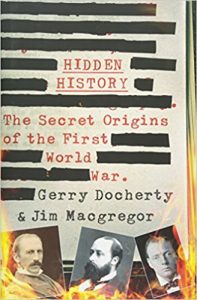
Hidden History: The Secret Origins of the First World War
Overview of Gerry Docherty & Jim Macgregor’s Book
By Antony C. Black | Global Research | July 19, 2017
Of the many myths that befog the modern political mind, none is so corrupting of the understanding or so incongruent with historical fact as the notion that the wealthy and the powerful do not conspire.
 They do.
They conspire continually, habitually, effectively, diabolically and on a scale that beggars the imagination. To deny this conspiracy fact is to deny both overwhelming empirical evidence and elementary reason.
Nevertheless, for the astute observer of the ‘Great Game’ of politics, it is an unending source of wonderment to stumble across ever more astounding examples of the monstrous machinations of which wealthy and powerful elites are capable. Indeed, it is precisely here that authors Docherty and Macgregor enter the fray and threaten to take our breath away entirely.
Thus, the official, canonized history of the origins of the First World War, so they tell us, is one long, unmitigated lie from start to finish. Even more to the conspiratorial point is the authors’ thesis that – and to paraphrase a later Churchill who figures prominently in this earlier story – never were so many murdered, so needlessly, for the ambitions and profit of so few.
In demolishing the many shibboleths surrounding the origins of the ‘Great War’ (including ‘German responsibility’, ‘British peace efforts‘, ‘Belgian neutrality’ and the ‘inevitability’ of the war), Docherty and Macgregor point the finger at what they argue is the real source of the conflict: a more or less secret cabal of British imperialists whose entire political existence for a decade and a half was dedicated to the fashioning of a European war in aid of destroying the British Empire’s newly emerging commercial, industrial and military competitor, Germany.
In short, far from “sleepwalking into a global tragedy, the unsuspecting world”, Docherty and Macgregor contend, “was ambushed by a secret cabal of warmongers” originating not in Berlin, but “in London”.
I must confess at this juncture to a certain bias in granting credence to such a striking thesis, this if only on general principle alone. After all, one straight look at present day political reality is to look square into the maw of Orwell’s nightmare. Moreover, three decades of independent journalism have led me to conclude not only that virtually nothing of what is presented as ‘news’ is remotely true, but that the conventional writing and presentation of history itself is as phoney as a three dollar bill. Still, one does demand a credible argument or two. Let’s look at a few of those contained in ‘Hidden History’.
The Players

Cecil Rhodes (Source: Wikipedia)
Before launching pell-mell into the argumentative labyrinth it is apropos that we first sketch the central cast of characters of this grim story.
In the beginning there was Cecil Rhodes, the prime minister of Cape Colony but who, the authors remind us, was “in reality a land-grabbing opportunist” whose fortune had been underwritten in equal parts “by brutal native suppression and the global mining interests of the House of Rothschild”. Rhodes had, apparently, long talked of setting up a secret ‘Jesuit-like society’ in aid of furthering the global ambitions of the British Empire. In February of 1891 he did just that enlisting the services of his close associates, William Stead, a prominent journalist, and Lord Esher, a close advisor to the British Monarchy.
Two others were soon drawn into the inner circle of the clandestine group: Lord Nathaniel (Natty) Rothschild of the famous British and European banking dynasty, and Alfred Milner, a brilliant academic and colonial administrator who would quickly become the organizing genius and iron-willed master of ceremonies of the group.
These central four would later be joined by: Lord Northcliffe, the owner of ‘The Times’, who would complement Stead in propagandizing and softening up the British public for war with Germany; Arthur Balfour and Herbert Asquith, two future British Prime Ministers who would provide the needed parliamentary influence; Lords Salisbury and Rosebery who brought an additional wealth of political connections to the table; and Lord Edward Grey, he to whom, in the final analysis as British Foreign Secretary in 1914, it would fall to hammer the final nail in the coffin of European peace.
Of particular importance was the addition of Prince Edward (soon to be King Edward VII) who, despite his playboy image, was, in fact, an astute political operative whose frequent international social forays provided the perfect cover for helping to forge the, often secret, military and political alliances between Russia, France, Britain, and Belgium.
This core Praetorian Guard then extended its tentacles to all reaches of the British (and eventually, international) power hierarchy by vigorously recruiting its ‘Association of Helpers’, the myriad of lower down bureaucrats, bankers, military officers, academics, journalists, and senior civil servants, many, as it turns out, hailing from Balliol and All Souls Colleges, Oxford.
And, too, the legendary Churchill, liberally inflated with his own bombast and well lubricated with Rothschild money, would rise to take his anointed place amongst the war-hungry secret elect.
Early Adventures
The first foray of this elite cabal played out in South Africa with the deliberate fomentation of the (2nd) Boer War (1899 – 1902). Gold had been discovered in the Transvaal region in 1886 and British imperialists were determined to grab it. After a number of failed machinations by Rhodes himself to topple the Boers, the secret elite was dealt an ace when Alfred Milner was appointed high commissioner for South Africa. Seizing the moment, Milner, without passing Go, proceeded straight to war and, in his infamous scorched earth policies and adamant demands for unconditional surrender, demonstrated the general martial philosophy that would later be deployed against Germany.
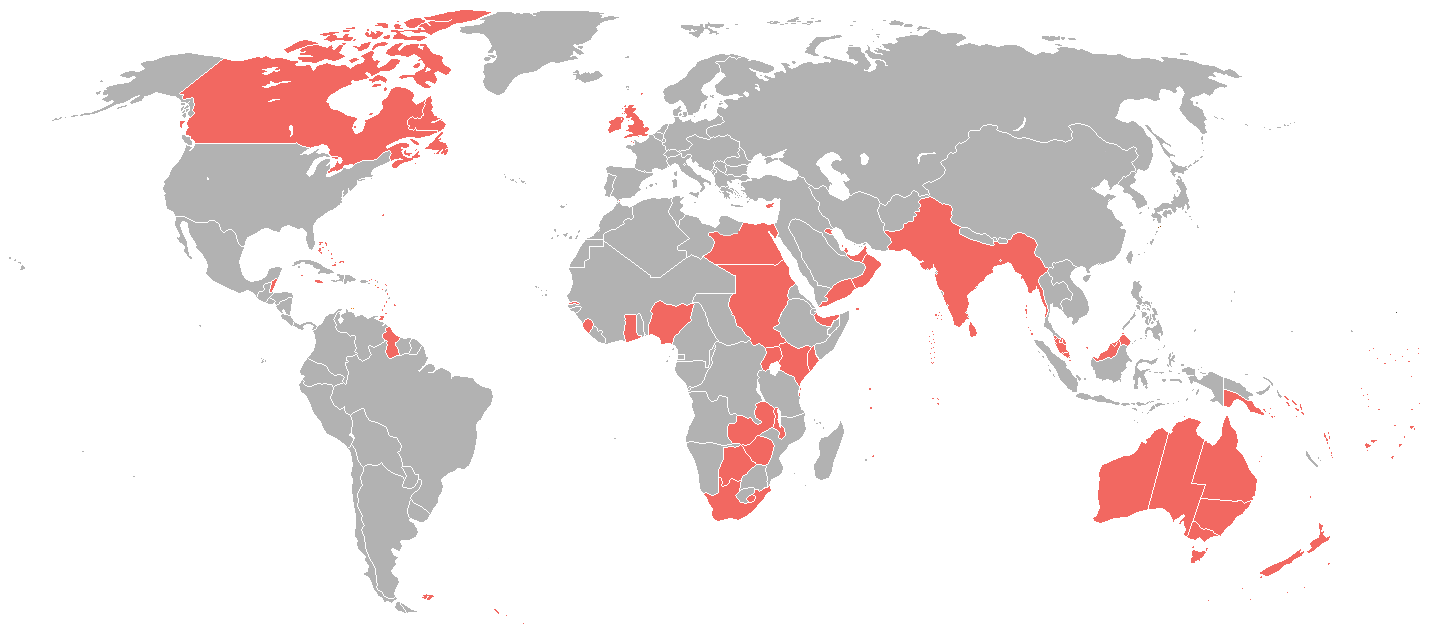
A map of the British Empire as it was in 1898, prior to the Second Boer War (1899-1902). (Source: Wikimedia Commons)
Following the defeat of the Boers, Milner & Co. (Rhodes had died during the ‘peace negotiations’) quickly penetrated the main organs of British imperial governance including the Foreign, Colonial, and War Offices. Arthur Balfour went one better by establishing, in 1902, the Committee for Imperial Defence (CID). The latter proved especially significant in helping to almost completely bypass the British Cabinet in the years, months and days leading up to August, 1914. Indeed, Balfour would prove to be one of only two permanent members of this all-important imperial institution; the other being Lord Fredrick Roberts, commander-in-chief of the armed forces and close friend of Milner. It was Roberts who would later appoint two tragically incompetent hangers-on, Sir John French and Douglas Haig, to their First World War posts overseeing the mass slaughter of hundreds of thousands of Allied soldiers.
The year 1902 also saw the establishment of the Anglo-Japanese Treaty. Britain had long feared for its Far East empire at the hands of Russia and sought to bolster Japan as a counterweight. The alliance bore fruit in the 1904-1905 Russo-Japanese conflict in which Russia was dealt a decisive defeat. Always with the long-term goal in mind, however, i.e. war with Germany, Milner et al adroitly switched bait and immediately began wooing Czar Nicholas II resulting in the Anglo-Russian Convention of 1907. In the same period (1904) Britain – with the crucial assistance of Edward VII – broke its near thousand-year enmity towards France and signed the Entente Cordial with its former rival.
During this same time frame (1905) a more or less secret agreement was made with King Leopold II allowing Belgium to annex the Congo Free State. This was, for all intents and purposes, an alliance between Britain and Belgium; one which was, over the next decade, to be continually deepened with numerous (mostly secret, meaning withheld from the British Parliament) bilateral military agreements and ‘memorandums of understanding’, and which unequivocally put paid to any notion of Belgium being some sort of ‘neutral’ party in the upcoming conflict with Germany.
The core alliance was now complete, i.e. Britain, Russia, France and Belgium, and all that was needed was to secure the fealty and obeisance of the British colonies. In aid of the latter Milner convoked The Imperial Press Conference of 1909 which brought together some 60 newspaper owners, journalists and writers from across the Empire who hobnobbed with another 600 or so British journalists, politicians and military figures in a grand orgy of war-mongering propaganda. The martial message was then duly delivered to the unwitting colonial multitudes. The success of the Conference could be seen most visibly in Canada where, despite the extreme divisiveness of the issue, the nation would eventually send more than 640,000 of its soldiers to the killing fields of Europe, this all on behalf of a tiny handful of British imperialists.
The Moroccan ‘Crisis’
Docherty and Macgregor duly remind us that renowned historian Barbara Tuchman, in her Pulitzer-Prize winning book, ‘The Guns of August’, “made it very clear that Britain was committed to war by 1911 at the latest.” Indeed, preparations for war had proceeded apace since at least 1906.
Still, 1911 marked a turning point when the secret elite first made bold in attempting to ignite war with Germany. The pretext was Morocco. Now, truth to tell, Britain had no direct colonial interests in Morocco, but France and Germany did. By this time the cabal in London – with Edward Grey as Foreign Minister – had inducted a key French minister, Theophile Declasse, into their confidences and were able to engineer what was essentially a false flag operation in Fez. France then followed this up with an army of occupation. Germany posted a minimalist response by sending a small gunboat to Agadir whence the entire British press – reflecting Britain’s ‘deep state’ interests – went into high hysteria condemning German ‘threats to British sea-lanes’ etc. The fuse to war was only snuffed out in the final hour when France’s (recently elected) socialist Premier, Joseph Caillaux, initiated peace talks with the Kaiser. War with Germany would have to wait.
In the meantime, Britain, under the direction of its secret mandarins – i.e. almost entirely beyond Parliamentary review or approval – continued their preparations for war. To this end, for example, Churchill, who by 1911 had been appointed First Lord of the Admiralty, redeployed the British Atlantic fleet from Gibraltar to the North Sea and the Mediterranean fleet to Gibraltar. Simultaneously, the French fleet was moved from the Atlantic to cover Britain’s absence in the Mediterranean. These maneuvers were all strategically aimed at Germany’ North Sea navy. The pieces on the global chessboard were being positioned.

Source: Wikimedia Commons
In France the leftist peacenik Caillaux was, in 1913, replaced as Premier with one of the British elites very own ‘helpers’ in the person of Raymond Poincare, a right-wing, rabid Germanophobe. Poincare quickly acted to remove his anti-war ambassador to Russia, George Louis, and substitute him with the revanchist Declasse. Meanwhile in America the secret cabal, acting largely through the Pilgrims Society and through the Houses of Morgan and Rockefeller, machinated to have an unknown but pliable democrat, Woodrow Wilson, elected over the publicly-controlled central bank advocate, President Taft. It was from this lofty perch that the Anglo-American ‘deep state’ launched the US Federal Reserve System, a private central bank dedicated from the get-go to funding the war against Germany.
The Balkan Sting
The simple tale repeated ad nauseam regarding the circumstances surrounding the assassination of Archduke Franz Ferdinand on June 28, 1914, so Docherty and Macgregor tell us, contains as little veracity as, say, the official version of the assassination of JFK two generations later. Indeed, the structural similarities between the two – from the virtual total stand-down of security through to the clear evidence of state complicity (in this case, starting in Serbia, but leading straight to London) – are remarkable. Suffice to say that there was a domino-like chain of events that then ensued – it’s just that the events weren’t driven by base human instincts and ineluctable forces beyond all human control as is commonly proffered, but rather by calculating minds and conspiratorial design.
Thus, immediately following the assassination, there was widespread international support for Austria-Hungary which was widely perceived as the aggrieved party. Nevertheless, the usual suspects, having helped stage the murder in the first place, were able to deftly turn the propaganda tables against both Austria and Germany by means of an ingenious ruse. Having secretly obtained the contents of the ‘Note’, which contained Austria’s (reasonable under the circumstances) demands for Serbian contrition, the secret cabal were able to gain direct input into the crafting of the ‘Serbian Reply’. The ‘reply’, of course, was designed to be unacceptable to Austria. Simultaneously, France’s President, Poincare, decamped to Moscow to assure the Czar and his generals that, should Germany act to uphold its alliance responsibilities towards Austria, France would back Russia in launching a full scale European war. France, naturally, knew that England – or rather its elite imperial clique – was similarly committed to war. It was during this opportune moment, in fact, when Grey and Churchill connived to purchase the Anglo-Persian Oil Company so securing the necessary oil supplies for the British navy.
All the while Kaiser Wilhelm and Chancellor Bethmann were conspicuous in being the only statesmen genuinely seeking peace. Their subsequent vilification by hordes of appropriately housebroken historians thus rings with the same Orwellian tone as the present-day establishment demonization of nations and individuals resisting the American Imperium.
Grey Hits It Home
Having contrived to fan the flames of a local Balkan fire into a general European inferno, British Foreign Minister Grey and Prime Minister Asquith subsequently deployed every dirty trick in the diplomatic playbook to vitiate any possibility of peace and, instead, to guarantee war.
On July 9th, for instance, the German ambassador to London, Prince Lichnowsky, was repeatedly reassured by Grey that Britain had entered no secret negotiations that would play into war. This, of course, was an outright lie. On July 10, Grey then deceived Parliament into believing that Britain had not the slightest concern that events in Sarajevo might lead to a continental war. Meanwhile, the Austrian Prime Minister, Berchtold, was similarly deceived by all three Entente governments that their reaction to the ‘Note’ would not go beyond a diplomatic protest. However, by the 3rd week of July all of these self-same governments did an about-face and declared a complete rejection of Austria’s response.
On July 20, as already noted, the French Prime Minister, Poincare, went to St. Petersburg to reaffirm their two nations’ respective martial agreements. On July 25, Lichnowsky arrived unannounced at the British Foreign office with a desperate plea from the German government imploring Grey to use his influence to halt Russian mobilization. Incredibly, no one was available to receive him. Russia had, in any case, secretly begun mobilization of its armed forces on July 23, while, on July 26, Churchill quietly mobilized the British fleet at Spithead.
None of the foregoing, of course, was subject to democratic oversight. As Docherty and Macgregor put it,
“As far as the [British] public was concerned, nothing untoward was happening. It was just another summer weekend.”
On July 28th, Austria, despite not being in a position to invade for another fortnight, declared war on Serbia. Meanwhile, the British Foreign Office began to circulate rumours that German preparations for war were more advanced than those of France and Russia even though the exact opposite was, in fact, the case. Matters were quickly racing beyond Wilhelm’s control.
On the 29th, Lichnowsky again begged Grey to prevent a Russian mobilization on Germany’s borders. Grey’s response was to write four dispatches to Berlin which post-war analysis proved were, in truth, never sent. The dispatches turned out to be merely part-and-parcel of the elaborate charade to make it look as if Britain (and, specifically, he, Grey) was doing all it could in the effort to avert war. Also on the evening of the 29th did Grey, Asquith, Churchill, and Richard Haldane meet to discuss what Asquith called the ‘coming war’. Docherty & Macgregor once again here emphasize that these four men were virtually the only people in Britain privy to the impending calamity, i.e. not the other Cabinet members, not the members of Parliament, and certainly not the British citizenry. But then, they were its architects.
On the 30th, the Kaiser wired Czar Nicholas a heartfelt appeal to negotiate the prevention of hostilities. Indeed, Nicholas was so moved by Wilhelm’s plea that he decided to send his personal emissary, General Tatishchev, to Berlin to broker a peace. Unfortunately, Tatishchev never made it to Berlin, having been arrested and detained that very night by the Russian Foreign Minister, Sazonov, who, as ‘Hidden History’ cogently evinces, had long been an asset of the secret cabal in London. Under sustained pressure from senior members of his military Nicholas finally relented and on the afternoon of the 30th ordered general mobilization.
The official announcement of Russian mobilization effectively closed all doors to peace. The Germans, realizing that they had been set up, and also realizing that they were about to be attacked on two fronts – from the west by France, and from the east by Russia – finally, on Aug. 1, ordered their own mobilization; tellingly, the last of the continental powers to do so. Here, however, Germany made a crucial tactical error: it elected to follow up its mobilization with a formal, honour-bound declaration of war on France. By doing so it fell deeper into the trap laid by Grey & Co. who had, all along, machinated to do everything possible to guarantee war without, however, being seen to have officially caused the war.
Still, Grey had one last card to play in order to convince both a war-leery Cabinet and House of Commons to abandon their common sense and plunge headlong into a full-scale pan-European war. For just as the myth of ‘weapons of mass destruction’ would, in a later era, serve to advance American imperial aggression, so here did the myth of poor, benighted little ‘neutral Belgium’ carry the banner for British imperialism.
The Speech That Sealed The Fate of Millions
On the 2nd of August, 1914 Prime Minister Asquith convened a special Cabinet meeting to discuss the (manufactured) crisis. Though the Cabinet was in no mood to countenance British involvement in a continental war, they soon found themselves pressured and hedged about by revelations of a ‘web of [military and political] obligations, which they had been assured were not obligations, [and] had been spun around them as they slept’. Moreover, Grey crucially kept from them the fact that the German ambassador, Lichnowsky, had, only the day before (Aug. 1), specifically offered to guarantee Belgian neutrality. Indeed, Grey’s deception might never have come to light but for the fact that Chancellor Bethmann exposed the offer in the Reichstag on Aug. 4th.
With the Cabinet sufficiently brow-beaten, confounded – and deceived, i.e. Asquith, without Cabinet approval or knowledge, had already issued orders for the mobilization of the Army and Navy – it now only remained to hoodwink Parliament. And so, on Aug. 3rd, Sir Edward Grey took to the pulpit and began what was to be an epic panegyric to the follies of peace and the virtues of war. Here too the audience was not particularly receptive, but the sermon soon gathered force.
Having first set the tone by announcing that peace in Europe ‘cannot be preserved’, Grey then moved on to a stunning series of lies and misrepresentations concerning the intricate and long-formulated military agreements between England, France, Russia and Belgium. According to Grey, they didn’t exist. But what of the dense skein of diplomatic agreements? There were no such agreements, there were no such entanglements. Parliament was ‘free’ to vote its conscience, to exercise its democratic mandate. Just as long, of course, as it didn’t vote for peace.
All of the foregoing was, in any case, mere preamble to the centerpiece ploy of Grey’s speech: Belgian neutrality. That the latter was an out-and-out sham was only surpassed in duplicity by Grey’s concealment, not only from Cabinet but now from Parliament, of Germany’s offer to guarantee exactly the point under contention, i.e. Belgian neutrality. Instead, Grey produced, for dramatic affect, an emotional telegram from the King of Belgium to King George pleading for assistance. The timing couldn’t have been more perfect if it had it been deliberately designed for the occasion. Which, of course, it was. Also pre-planned were the post-sermon affirmations in favour of war by the various opposition party leaders. They had all been vetted and brought onside by Churchill prior to the day’s session. Only Ramsay MacDonald, head of the Labour Party, swam against the well-orchestrated tide of ‘inevitability’ that was the constant and unerring motif of Grey’s martial peroration.
The day’s session ended without debate; Asquith had not allowed any to occur, though he had been pressured by the Speaker of the House to reconvene later that evening. In between Grey sealed the deal, i.e. war, by firing off an ultimatum to Germany demanding that it not invade Belgium even though he, Grey, knew that such an invasion had already begun. As Docherty and MacGregor phrase it, this was a “masterstroke”. War could not now be avoided. And though the night session witnessed a vigorous and substantive debate which largely demolished Grey’s stance, it was all for nought. At the appointed moment Arthur Balfour, “former Conservative Prime Minister and a member of the Secret Elite’s inner circle, rose menacingly. He had had enough.” Using the full weight of his magisterial authority he condemned, ridiculed and dismissed the naysayers’ anti-war arguments as, the ‘very dregs and lees of the debate’. With the Commons thus emotionally bullied into silence, so ended the last chance for peace in Europe.
Plus Ca Change
What strikes one again and again whilst reading ‘Hidden History’ is the ring of truth that resonates from every page, from every revelation. That such a tiny, elite group of individuals, completely beyond democratic control, could determine the fate – and deaths – of millions should shock us. It should, but it doesn’t really. It doesn’t because we see the same phenomenon occurring now, repeatedly, before our very eyes. Indeed, the current state of ‘permanent war’ is, more or less, the unconscious condition of modernity itself.
Docherty & Macgregor have made a fine contribution here. They have gone beyond what David Irving so aptly labelled as the ‘court historians’, i.e. those historians essentially prostituted to elite / establishment consensus, and given us a glimpse of what it really means to write history. And if there is any lesson – or rather counter lesson – we can take from it, it is that we are doomed to repeat history only so long as we listen to those dedicated to obscuring and inverting it. In short, to those who lie to us.
Title: Hidden History: The Secret Origins of the First World War
Authors: Gerry Docherty and Jim MacGregor
Publisher: Mainstream Publishing; Reprint edition (September 1, 2014)
ISBN-10: 1780576307
ISBN-13: 978-1780576305
Featured image from Amazon
John McCain and The Cancer of Conflict

By Patrick Henningsen | 21st Century Wire | July 21, 2017
This week some devastating news befell John Sidney McCain III.
On Wednesday, his staff announced that the US Senator had been diagnosed with a brain tumor called glioblastoma discovered during recent testing at the Mayo Clinic in Phoenix, Arizona.
Since then warm wishes and tributes have been pouring in for the former Republican Presidential candidate. Both the US media and political establishment have closed ranks and are rallying around the Senator to help soften the blow.
Putting previous feuds aside, President Donald Trump was magnanimous and cordial to the Arizona Senator, wishing him and his family the very best.” Melania and I send our thoughts and prayers to Senator McCain, Cindy, and their entire family,” said Trump. “Get well soon.”
Even former electoral rival President Barack Obama pitched in a little love for the 80 year old:
“John McCain is an American hero & one of the bravest fighters I’ve ever known. Cancer doesn’t know what it’s up against. Give it hell, John.”
Regarding McCain’s diagnosis, we all can acknowledge the difficulties and risks involved with various cancer treatments, especially with brain cancer. Likewise, nearly everyone these days can attest to losing a friend, a loved one or family member to the disease.
As with anyone suffering from this terrible condition, we wish the Senator well, along with a successful treatment and recovery.
Still, McCain has a lot in his favor. Unlike most Americans, he will not have to worry about his medical care, and will be receiving the best cancer treatment money can buy, if not the best in the world, and with absolutely no expense spared. In this way, the Senator is extremely fortunate.
And for those reasons, this is not an easy article to write. For fear of appearing too cruel in the face of his dramatic medical disclosure, one would be expected to suspend any political critique for now. Hence, the media has placed an unofficial moratorium on any negative coverage of McCain.
That said, he is a special case. As much as any political leader – he deserves to be panned, even under the present circumstances, because his geopolitical handiwork continues to cause havoc in certain corners of the world.
Cancer Treatment in Syria
Immediately after McCain’s major health announcement, the US mainstream media and Republicans began fretting over the prospect that his extended absence from the legislature might jeopardize his party’s ability to pass legislation to repeal the Affordable Care Act (commonly known as Obamacare).
With that in mind, maybe it’s worth asking: how many innocent Syrians have been denied basic medical treatment, supplies and pharmaceuticals as a result of the harsh US-led regime economic sanctions imposed on Syria? This brutal campaign of collective punishment has been led by US Senator John McCain.
Of course, the idea of sanctions as a form of economic warfare hardly registers in the West as being at all harmful to the population of Syria. “Sanctions? They’re not against the people of Syria, only against Assad.” That’s the general mainstream phantasm when it comes to sanctions, even though the official numbers show a vivid tale of devastation.
One can only imagine how many among Syria’s population of 20 million are no longer able to receive cancer treatment in Syria as a result of McCain’s insistence on punitive sanctions. Before the conflict in Syria began in 2011, citizens were able to get free medical treatment including high-end state-of-the-art cancer treatment (consider that one simple aspect of this war, as men like John McCain still claim to be delivering ‘freedom’ to the Syrian people by backing armed terrorist factions).
Before the terrorist forces occupied the eastern part of the city, Aleppo was home to one of the Middle East’s top cancer treatment centers, Al-Kindi Hospital. This is important because after McCain’s secret trip to the Aleppo area in May 2013, the very same ‘rebels’ he was cavorting with and supplying weapons to – the ‘Free Syrian Army’ (under the command of Jabbat al Nusra aka al Qaeda in Syria) would later order the bombing on this cancer treatment hospital.
Professor Tim Anderson explains the destruction of Al Kindi Hospital in December 2013, including the shameful spin applied after the fact by BBC and western mainstream media:
In an Orwellian revision of events the BBC (21 December 2013) reported the destruction of Al-Kindi with the headline: “Syria rebels take back strategic hospital in Aleppo”. The introduction claimed the “massive suicide lorry bomb” had managed “to seize back a strategic ruined hospital occupied by Assad loyalists.” Al-Kindi was said to have been “a disused building” and “according to an unconfirmed report, 35 rebels died in the attack”. In fact, these ‘rebels’ were a coalition of Free Syrian Army and Jabhat al Nusra, while the ‘Assad loyalists’ were the staff and security guards of a large public hospital.
Watch as McCain’s ‘freedom fighters’ in Syria drive a suicide truck bomb into the ground level of Al Kindi Cancer Treatment Center in Aleppo:
How many Syrian lives were needlessly cut short as a direct result of that bombing carried out by McCain’s own Free Syrian Army? For the cost of McCain’s treatment at the world-famous Mayo Clinic, who knows how many Syrians could have received desperately needed treatment at Al Kindi or other similarly crippled facilities in Syria? One hundred, or possibly one thousand?
Add to this, how many have died or suffer permanent health afflictions as a direct result of US economic sanctions which have crippled Syria’s own National Health Service? One hundred thousand, or maybe five hundred thousand? One million? One day, those figures will be recorded and we will have the answer.
The other piece of US legislation currently on the table which Republicans are desperate to pass is the $1-trillion US infrastructure spending package. Juxtapose that scene next to the systematic destruction of Syria’s infrastructure by US Coalition and Israeli airstrikes and destruction by proxy militant forces on the ground. Estimates for the cost to Syria range from $180 billion to $275 billion. If the conflict continues past 2020, then these numbers could easily double.
In spite of all this, John McCain claims to have no regrets about the damage that he and his fellow war hawks have inflicted on Syria.
The Cancer of Conflict
At the same time that political figures like Barrack Obama dutifully respect the official Washington line on John McCain as the consummate “Vietnam War hero”, very few in the establishment would dare to criticize the powerful Arizona Senator for his central role in engineering instability and violent conflict in foreign countries.

John McCain sneaks into Syria illegally in May 2013 to meet with known terrorists, promising them weapons and regime change by way US bombs would drop in the Fall of 2013.
Americans should be reminded that more than any other single US official, John McCain has been the driving force behind the training and arming of violent jihadist and terrorists fighting groups in Syria, and that those same terrorists have slaughtered tens of thousands of innocent civilians including women and children in Syria and beyond – all sacrificed at the altar of a US-led geopolitical power play in the Middle East, and in the name of Israeli ‘security interests.’
Back in 2012, a delusional McCain, along with another dotty war enthusiast, Connecticut Senator Joe Liberman, insisted that the US needed to arm the ‘rebels’ in Syria in order to “save lives.” Their statement read:
“The bloodshed must be stopped, and we should rule out no option that could help to save lives. We must consider, among other actions, providing opposition groups inside Syria, both political and military, with better means to organize their activities, to care for the wounded and find safe haven, to communicate securely, to defend themselves, and to fight back against Assad’s forces.”
 From the onset of hostilities in 2011, the bold-faced lie that McCain and partner Lindsey Graham have promulgated is that violent jihadists were nothing more than affable “moderate rebels.” That piece of Washington fiction has been widely discredited by now.
Later on in 2015, McCain announced that the US should be supplying stinger missiles to the so-called ‘rebels’ in Syria:
“We certainly did that in Afghanistan. After the Russians invaded Afghanistan, we provided them with surface-to-air capability. It’d be nice to give people that we train and equip and send them to fight the ability to defend themselves. That’s one of the fundamental principles of warfare as I understand it,” said McCain.
Soon after that statement, thousands of US-made TOW Missiles were smuggled into Syria and used by terrorists groups under the command umbrella of Al Nusra.
In her recent exposé for Trud Newspaper, Bulgarian journalist Dilyana Gaytandzhieva revealed the massive scale and scope of the illegal US-NATO weapons trafficking operation to arm thousands of terrorist fighters in Syria.
Despite the overwhelming destruction in Syria and the abject failure of his policies, McCain has never given up on the policy of illegal weapons trafficking in Syria. Just this week, McCain, Chairman of the Senate Armed Services Committee, openly protested against the Trump Administration’s latest announcement to bring an end to the CIA’s failed program of illegally arming and training ‘anti-Assad’ terrorists in Syria. Rather than admitting what everyone else in the world seems to know already – that the US “train and equip” program has been a debacle – instead he feigns defiance, while demonstrating a breathtaking level of ignorance by accusing the White House of being part of a Russian conspiracy:
“If these reports are true, the administration is playing right into the hands of Vladimir Putin.”
“Making any concession to Russia, absent a broader strategy for Syria, is irresponsible and short-sighted.”
When promoting their latest war, McCain is normally part of a tandem act, accompanied by his geomancing interest, South Carolina Senator Lindsey Graham, who arguably views the world through an even more deranged, albeit binary comic book prism:
“Breaking Syria apart from Iran could be as important to containing a nuclear Iran as sanctions.”
“If the Syrian regime is replaced with another form of government that doesn’t tie its future to the Iranians, the world is a better place.”
Like a world view gleaned straight from Ian Flemming’s Goldfinger.
In his seminal 2008 interview with McCain heading to the GOP presidential nomination, The Atlantic magazine’s Jeffrey Goldberg asked, “What do you think motivates Iran?”.… to which McCain replied:
“Hatred. I don’t try to divine people’s motives. I look at their actions and what they say. I don’t pretend to be an expert on the state of their emotions. I do know what their nation’s stated purpose is, I do know they continue in the development of nuclear weapons, and I know that they continue to support terrorists who are bent on the destruction of the state of Israel. You’ll have to ask someone who engages in this psycho stuff to talk about their emotions.”
McCain’s views on Iraq were even more disturbing, essentially surmising that the invasion and occupation was a good thing, and that we shouldn’t have left because ‘leaving Iraq gave rise to al Qaeda.’ OK. Admittedly, it’s a bit counter intuitive, but it works for neoconservatives.
These statements by McCain and Graham are not admissions made by normal well-adjusted individuals, but rather by cold, dark hearted sociopaths who generally view the lives of Arabs (along with Slavs, Russians and others) as necessary cannon fodder in the pursuit of military industrial profits for a select cadré of transnational corporate ‘defense’ contractors – whose interests Senator John McCain represents in his home state of Arizona; Boeing, Raytheon, Lockheed Martin, General Dynamics, and the list goes on, and on.
The geopolitical hubris doesn’t end there, as McCain still maintains – even after 6 years of absolute implosion of his own foreign policy agenda – that removing Syrian President Bashar al Assad from power is still a “key pillar” of the US strategy for Syria.
“The administration has yet to articulate its vision for Syria beyond the defeat of ISIL, let alone a comprehensive approach to the Middle East,” said McCain this week.
The reality, of course, is that ISIL/ISIS could have been defeated already had the US-led ‘Coalition’ and Israel not illegally intervened in Syria territory. Far from doing much to “defeat ISIS” since they have invaded Syrian airspace since 2014, the US has conveniently stretched-out the ‘ISIS problem’ through the extension of its own self-styled international mandate which was originally intended to serve as a precursor to the eventual break-up of Syria into federal states and ethnic cantons. This might explain McCain’s rush to enact regime change in Syria before lording over the eventual break-up of the sovereign nation-state.
All Things Russian
The other country which McCain is determined break is Russia.
“Vladimir Putin is a murder and a KGB thug,” crowed McCain on CNN last year, as he protested against positive statements about Russia made by then candidate Trump.
Suffice to say, he, along with the boards of Boeing, Raytheon, Lockheed Martin, are all extremely happy about NATO pressing right up against the Russian border in eastern Europe.
But 2013 was indeed a busy year for the Senator stirring up trouble internationally. As part of his opening gambit against Moscow, it was McCain who was the driving force behind the US-backed coup d’etat in Ukraine in February 2014 – which ultimately led to a bloody civil war which continues to this day in the Ukraine. Apparently, this was McCain’s way of ‘stopping Putin.’
His has a very dodgy track record; whether it’s NeoNazis, or Jihadi Terrorists, McCain seems always ready to do a deal with the devil, and that’s what makes him particularly dangerous.
Below we can see McCain helping to whip-up Nazi-linked, neofascist street mobs in Kiev helping to bring the ensuing junta into power. Some mainstream US pundits have claimed that this never happened, and that it’s just a conspiracy theory invented by ‘Russian propagandists’ to discredit McCain. Unfortunately for them – it is true, and here is the photo to prove it:

John McCain shares the stage in Kiev with Right Sector strongman, Oleg Tyhanbock, ahead of violent street protests in Ukraine in December of 2013, prior to the US-backed coup.
Looking back at his erratic and flippant behavior, attacking nearly anyone who even suggested détente with Russia or that supplying lethal arms to militants in Syria was a bad idea, it’s no surprise that cognizant onlookers have questioned whether or not McCain is in a normal frame of mind.
Frankly speaking, how could any one in their right mind be so consistently on the wrong side of every issue? How could any politician’s judgement be that poor? Unless there was something else going on below the surface…
The questions didn’t stop there. McCain’s performance during a recent Senate Intelligence Committee Hearing on “Russian Influence in US Elections” was an embarrassment. Onlookers were stunned when McCain lost the plot during the hearing when asking former FBI Director James Comey:
“Well, at least in the minds of this member, there’s a whole lot of questions remaining about what went on, particularly considering the fact that as you mentioned, it’s a “big deal” as to what went on during the campaign, so I’m glad you concluded that part of the investigation, but I think that the American people have a whole lot of questions out there, particularly since you just emphasized the role that Russia played.”
“And obviously she was a candidate for president at the time. So she was clearly involved in this whole situation where fake news, as you just described it, is a big deal took place. You’re going to have to help me out here. In other words, we’re complete, the investigation of anything former Secretary Clinton had to do with the campaign is over and we don’t have to worry about it anymore?”
… to which Comey replied:
“With respect to — I’m a little confused. With respect to Secretary Clinton, we investigated a criminal investigation with her use of a personal email server.”
McCain then finished digging his own hole by responding:
“So at the same time you made the announcement there would be no further charges brought against then-Secretary Clinton for any activities involved in the Russia involvement and our engagement and our election. I don’t quite understand how you can be done with that but not done with the whole investigation of their attempt to affect the out of come our election.”
It was clear McCain had no idea what was going on. At that point any reasonable person would have concluded that John McCain had in fact lost his mind – and was no longer fit to serve in public office. In fact, 21WIRE made this very same case back in 2013 after McCain was caught playing video poker on his iPhone during a Senate Committee where lawmakers were debating the very war of which he is a chief architect. Here is the photo:

As stunning displays of ignorance go, the video poker incident was one of McCain’s greatest ever, and certainly should have been a warning to everyone that this man had no business making military decisions, let alone litigating war and peace between nuclear superpowers like the United States and Russia.
Perhaps an announcement is forthcoming, but it’s surprising after being diagnosed with brain cancer at 80 years old – why McCain has not yet announced his resignation from office?
It’s fair to say that while this Senator is being treated in the world’s leading medical facilities, thousands of innocents will have died needlessly because of US sanctions and support for terrorists – all [supposedly] in the name of defense, energy and ever vast corporate profits. Strange as that might sound to some, for those who consider themselves members of a ruling elite and its mandarin management class, that is perfectly acceptable quid pro quo in 2017.
After World War II, the military industrial complex and the international arms trade has spread conflict like a disease across the planet, metastasizing in ways, in places, and on a scale which no one could have previously imagined before. Undoubtedly, over the last decade, John McCain has played a key role in spreading that anguish. For the people of Syria, Afghanistan and the Ukraine, that will be his legacy, not the chimerical image of a ‘maverick’ Senator or the ‘war hero.’
Once again, we implore the Senator to do the right thing by the American people and for those innocents around the world who have suffered at the hands of an arms industry whose interests John McCain represents.
Please retire.
The Price of Defiance: Why US, Saudi Arabia Turning Kuwait Against Iran
Sputnik – 22.07.2017
Commenting on the latest twist in the diplomatic row in the Persian Gulf, this time between Kuwait and Iran, Iranian political analysts spoke to Sputnik Iran, revealing who’s really behind this new development and which of the two countries will suffer the most from the consequences.
On Thursday, Kuwait sent a diplomatic note to Iran’s embassy stating that the office of military and cultural attaches would be closed down. The note also said that 15 Iranian diplomats, including Ambassador Alireza Enayati, would have to leave the country within 45 days, leaving only four Iranian diplomats in Kuwait.
Kuwait’s acting information minister, Sheikh Mohammad al-Mubarak al-Sabah, said in a statement that the move was taken in “accordance with diplomatic norms and in abidance with the Vienna conventions with regards to its relationship with the Islamic Republic of Iran.”
According to mass media reports, the moves were made following the conviction of the members of Al Abdali terror cell, whose Kuwaiti members were accused of alleged intelligence contacts with Iran and Hezbollah, a Lebanese Shiite militant group.
The Ministry of Foreign Affairs of Iran has responded by summoning the Kuwaiti charge d’affaires. While rejecting the accusations, Iran has said that the measures taken by Kuwaiti officials are regrettable, given that the existing tensions in the region are now in a critical condition.
“We expect Kuwait to act rationally instead of responding to pressures and worsening the tensions,” Iranian Foreign Ministry spokesman Bahram Qassemi was quoted as saying by the Mehr news agency.
In an interview with Sputnik Iran, Sabbah Zanganeh, a political commentator, Iranian envoy to the Organization of Islamic Cooperation and former adviser to the Iranian foreign minister, said that the moves of the Kuwaiti authorities have been evidently fuelled by pressure from Saudi Arabia.
The Iranian authorities have not been informed of any details of the ongoing investigation in Kuwait and any charges which have been put forward. Neither the Iranian legal representative, nor any independent Iranian experts have been allowed to study the case in more detail.
The Iranian political analyst recalled that there have already been groundless and unsubstantiated accusations made against Iran, alleging that it played a major role in liberating the territories of Kuwait from the occupation of Saddam Hussein by supporting and mobilizing hundreds of thousands of Kuwaiti residents, similar to the current accusations against Tehran.
“In due course, Saddam Hussein made a very ambitious offer to Iran to capture not only Kuwait, but the territories of other countries of the Persian Gulf. However Iran had never had a goal of the occupation of the territories of sovereign states and the destruction of the system of government of these countries,” Sabbah Zanganeh told Sputnik.
“Hence this demarche of Kuwait is baseless and is fuelled purely by the pressure of Saudi Arabia, which does not want to put up with the idea that the Arab states of the Persian Gulf, such as Kuwait and Qatar, have good relations with Iran. Saudi Arabia is exerting strong pressure on the Kuwaiti authorities and its mass media,” he added.
The political commentator further explained that until recently, Kuwait has been pursuing a very reasonable and moderate foreign policy; however it has come under strong pressure from the Saudis. Where Qatar was the first target of the Saudis, now it is Kuwait’s turn. The Saudis cannot tolerate Kuwait’s key positions in the settlement of the Qatari crisis, in the negotiations of the Yemeni issue and in the issue of diplomatic correspondence with Iran on behalf of the Cooperation Council for the Arab States of the Persian Gulf. Kuwait, unlike Qatar, is to a far lesser extent an independent state.
In a separate comment on the issue, Iranian political analyst and expert on Middle East and Iranian-Arab relations, former editor-in-chief of the Iranian news agency Mehr News, Hassan Hanizadeh told Sputnik that Kuwait will be the country to suffer from its demarche, while it will have no impact on the economic environment of Iran.
“These actions of Kuwait, aimed at decreasing diplomatic relationship with Iran, have been evidently dictated by Saudi Arabia and the US. As we remember, during his trip to the Middle East, Donald Trump had an important meeting with the leaders of six Arab states of the Persian Gulf in Riyadh. Trump demanded that these states cut their diplomatic relations with Iran or at least lower the level of their ties. Qatar is the first to be punished for disobeying this order,” he told Sputnik.
However, he further elaborated, Qatar held firm and defied pressure from Saudi Arabia and the US. Kuwait, in turn, is a sparsely populated country, compared to its neighbors, and prefers not to oppose the pressure of the US and the Saudis. The danger is that this demarche could spark tensions in the region between the Arab states and Iran even further.
For the last 30 years Iran has been maintaining good and friendly relations with Kuwait, avoiding any hostilities. Moreover, in 1990, during the attack of Saddam Hussein on Kuwait, the Iranian embassy in Kuwait sheltered over a hundred women and young ladies, wives and daughters of Kuwaiti emir and his brothers, on its territory from Hussein’s troops and then safely sent them to Iran for temporary relocation.
Unfortunately, the current Kuwaiti authorities have forgotten this and are putting forward baseless accusations against Iran under pressure from Saudi Arabia, the political analyst said.
“Kuwait will be the only one to suffer from this demarche. Iran is a large and strong country, which will easily overcome this crisis. Kuwait is not a high priority in the Iranian foreign policy and the lowering of the level of diplomatic relations between the two countries won’t have any impact on Iran,” Hassan Hanizadeh told Sputnik.
He explained that there are no deep trade-economic relations between the two states, only political and cultural. Hence the demarche won’t have any impact on the economy of Iran.
Commenting on the conviction of the members of the Al Abdali terror cell, and the accusation of the members in espionage on behalf of Iran, Hassan Hanizadeh noted that Iran would not spend any resources attempting to glean intelligence from Kuwait, hence all the accusations are illogical and unreasonable.
“Kuwait is not the type of country for Iran to spend its intelligence resources on. It has neither a strong army nor any objects of infrastructure, such as a nuclear power plant, for example. It is not of any particular value to Iranian intelligence services. Hence, any accusations of espionage are absurd and unreasonable,” he told Sputnik.
The political analyst said that scenario, which has got the name of “Al Abdali process” had been planned beforehand by the Americans and the Saudis. One of its aims is to clear the way for the breakup of ties between Iran and the member states of the Cooperation Council for the Arab States of the Persian Gulf.
Among other possible reasons of the Kuwaiti demarche, Hassan Hanizadeh suggested that it could be the discontent of the fast growing Shia Muslim population of the country. The Shia Muslim community makes over 40% of the total population of the country. And the Kuwaiti authorities don’t want them to set their eyes on Iran. Thus they are trying to lessen Iran’s influence on their country, he concluded.
QE, the largest transfer of wealth in history
By Dan Glazebrook | RT | July 22, 2017
It appears that the massive, almost decade-long transfer of wealth to the rich known as ‘quantitative easing’ is coming to an end.
Of the world’s four major central banks – the US Federal Reserve, the Bank of England, the European Central Bank and the Bank of Japan – two have already ended their policy of buying up financial assets (the Fed and the BoE), and the ECB plans to stop doing so in December. Indeed, the Fed is expected to start selling off the $3.5 trillion of assets it purchased during three rounds of QE within the next two months.
Given that – judged by its official aims – QE has been a total failure, this makes perfect sense. By ‘injecting’ money into the economy, QE was supposed to get banks lending again, boosting investment and driving up economic growth. But overall bank lending in fact fell following the introduction of QE in the UK, whilst lending to small and medium sized enterprises (SMEs) – responsible for 60 percent of employment – plummeted.
As Laith Khalaf, a senior analyst at Hargreaves Lansdown, has noted: “Central banks have flooded the global economy with cheap money since the financial crisis, yet global growth is still in the doldrums, particularly in Europe and Japan, which have both seen colossal stimulus packages thrown at the problem.”
Even Forbes admits that QE has “largely failed in reviving economic growth”.
This is, or should be, unsurprising. QE was always bound to fail in terms of its stated aims, because the reason banks were not funneling money into productive investment was not because they were short of cash – on the contrary, by 2013, well before the final rounds of QE, UK corporations were sitting on almost £1/2trillion of cash reserves – but rather because the global economy was (and is) in a deep overproduction crisis. Put simply, markets were (and are) glutted and there is no point investing in glutted markets.
This meant that the new money created by QE and ‘injected’ into financial institutions – such as pension funds and insurance companies – was not invested into productive industry, but rather went into stock markets and real estate, driving up prices of shares and houses, but generating nothing in terms of real wealth or employment.
Holders of assets such as stocks and houses, therefore, have done very well out of QE, which has increased the wealth of the richest 5 percent of the UK population by an average of £128,000 per head.
How can this be? Where does this additional wealth come from? After all, while money – contrary to Tory sloganeering – can indeed be created ‘out of thin air’, which is precisely what QE has done, real wealth cannot. And QE has not produced any real wealth. Yet the richest 5 percent now have an extra £128,000 to spend on yachts, mansions, diamonds, caviar and so on. So where has it come from?
The answer is simple. The wealth which QE has passed to asset-holders has come, first of all, directly out of workers’ wages. QE, by effectively devaluing the currency, has reduced the buying power of money, leading to an effective decrease in real wages, which, in the UK, still remain 6 percent below their pre-QE levels. The money taken out of workers’ wages therefore forms part of that £128,000 dividend. But it has also come from new entrants to the markets inflated by QE – primarily, first time buyers and those just reaching pension age.
Those buying a house (which QE has made more expensive), for example, will likely have to work thousands of additional hours over the course of their mortgage in order to pay this increased cost. It is those extra hours that are creating the wealth which subsidizes the spending spree for the richest 5 percent. Of course, these increased house prices are paid by anyone purchasing a house, not only first time buyers – but the additional cost for existing homeowners is compensated for by the rise in price of their existing house (or by their shares for those wealthy enough to hold them).
QE also means that newly retiring pensioners are forced to subsidize the 5 percent. New retirees use their pension pot to purchase an ‘annuity’ – a bundle of stocks and shares generating dividends which serve as an income. However, as QE has inflated share prices, the number of shares they can buy with this pot is reduced. And, as share price increases do not increase dividends, this means reduced pension payments.
In truth, the story that QE was about encouraging investment and boosting employment and growth was always a fantastical yarn designed to disguise what was really going on – a massive transfer of wealth to the rich.
As economist Dhaval Joshi put it in 2011: “The shocking thing is, two years into an ostensible recovery, [UK] workers are actually earning less than at the depth of the recession. Real wages and salaries have fallen by £4bn. Profits are up by £11bn. The spoils of the recovery have been shared in the most unequal of ways.”
In March this year, the Financial Times noted that while Britain’s GDP had recovered to pre-crisis levels by 2014, real wages were still 10 percent lower than they had been in 2008. “The contraction of UK real wages was reversed in 2015,” they added, “but it is not going to last”. They were right. The same month the article was published, real wages began to fall again, and have been doing so ever since.
It is the same story in Japan, where, notes Forbes, “household income actually contracted since the implementation of QE”.
QE has had a similar effect on the global South: enriching the holders of assets at the expense of the ‘asset-poor’. Just as the influx of new money created bubbles in the housing and stock markets, it also created commodity price bubbles as speculators rushed to buy up stocks of, for example, oil and food. For some oil producing countries this has had a positive effect, providing them a windfall of cash to spend on social programs, as was initially the case in, for example, Venezuela, Libya and Iran. In all three cases, the empire has had to resort to various levels of militarism to counter these unintended consequences. But oil price hikes are, of course, detrimental to non-oil-producing countries – and food price hikes are always devastating.
In 2011, the UK’s Daily Telegraph highlighted “the correlation between the prices of food and the Fed’s purchase of US Treasuries (i.e. its quantitative easing programs)… We see how the food price index broadly stabilized through late 2009 and early 2010, then rose again from mid-2010 as quantitative easing was re-started … with prices rising about 40 percent over an eight month period.”
These price hikes pushed 44 million people into poverty in 2010 alone – leading, argued the Telegraph, to the unrest behind the so-called Arab Spring. Former World Bank president Robert Zoellick commented at the time that: “Food price inflation is the biggest threat today to the world’s poor… one weather event and you start to push people over the edge.”
Such are the costs of quantitative easing.
The BRICS economies were also critical of QE for another reason: they saw it as an underhand method of competitive currency devaluation. By reducing the value of their own currencies, the ‘imperial triad’ of the US, Europe and Japan were effectively causing everyone else’s currencies to appreciate, thereby damaging their exports. Forbes wrote in 2015, “The effects are already being felt in the most dynamic exporter in the world, the East Asian economies. Their exports in US dollar terms moved dramatically from 10 percent year-on-year growth to a contraction of 12 percent in the first half of this year; and the results are the same whether China is excluded or not.”
The main benefit of QE to the developing world is supposed to have been the huge inflows of capital it triggered. It has been estimated that around 40 percent of the money generated by the Fed’s first QE credit expansion (‘QE1’) went abroad – mostly to the so-called ‘emerging markets’ of the global South – and around one third from QE2. However, this is not necessarily the great boon it seems. Much of the money went, as we have seen, into buying up commodity stocks (making basic items such as food unaffordable for the poor) rather than investing in new production, and much also went into buying up stocks of currency, again causing an export-damaging appreciation. Worse than this, an influx of so-called ‘hot money’ (footloose speculative capital, as opposed to long term investment capital) makes currencies particularly volatile and vulnerable to, for example, rises in interest rates abroad.
Should interest rates rise again in the US and Europe, for example, this is likely to trigger a mass exodus of capital from the emerging markets, potentially prefiguring a currency collapse. Indeed, it was an influx of ‘hot money’ into Asian currency markets very similar to that seen during QE which preceded the Asian currency crisis of 1997.
It is precisely this vulnerability which is likely to be tested – if not outright exploited – by the coming end of QE and accompanying rise of interest rates.
Dan Glazebrook is a freelance political writer who has written for RT, Counterpunch, Z magazine, the Morning Star, the Guardian, the New Statesman, the Independent and Middle East Eye, amongst others. His first book “Divide and Ruin: The West’s Imperial Strategy in an Age of Crisis” was published by Liberation Media in October 2013. It featured a collection of articles written from 2009 onwards examining the links between economic collapse, the rise of the BRICS, war on Libya and Syria and ‘austerity’. He is currently researching a book on US-British use of sectarian death squads against independent states and movements from Northern Ireland and Central America in the 1970s and 80s to the Middle East and Africa today.
US special operations chief confirms end of CIA support for anti-Assad forces in Syria
RT | July 21, 2017
A US army general has confirmed that Washington has decided to put an end to a CIA scheme to equip and train certain rebel groups fighting the government of Syrian President Bashar Assad. He insisted the policy shift had nothing to do with improving relations with Russia.
US Army General Raymond Thomas, head of the Special Operations Command, said the decision was “based on assessment of the program.”
“At least from what I know about that program and the decision to end it, (it was) absolutely not a sop to the Russians,” Thomas said at the Aspen Security Forum in Colorado on Friday.
Unnamed government sources told various media outlets last week that the decision to end the program had been partly due to the Trump administration wanting a better relationship with Russia.
The decision to terminate the program was reportedly taken by Trump in consultation with CIA Director Mike Pompeo and national security adviser H.R. McMaster ahead of his meeting with Russia’s President Vladimir Putin in Hamburg earlier this month.
But the end of the CIA’s Timber Sycamore strategy was not a precondition for the ceasefire deal reached between Putin and Trump on the sidelines of the G20 summit, the US officials insisted.
The covert CIA program began arming and training the so-called moderate Syrian opposition forces in 2013.
Two US officials who spoke on condition of anonymity with Reuters, pointed out that the covert CIA tactic had produced little success.
Russia has always warned against arming the so-called moderate opposition groups in Syria, underlining that weapons supplied to them often fall into the hands of jihadist groups.
The so-called moderate opposition has effectively ceased to exist in Syria, hijacked by armed extremists, Russia’s former UN ambassador told the General Assembly in December last year.
Having pointed to the scale of destruction in Syria, Vitaly Churkin, now late, said it was “a result of the mindless foreign policy of several international and regional players who once decided to change the leadership in Damascus and to redraw drastically the political, ethnic, confessional, and economic map of the region.”
But despite having “extensive financial, logistical, and propaganda support” from the outside, “the elusive concept of ‘moderate Syrian opposition’ has effectively failed,” the Russian diplomat then said.
Featured Video

Spain train disaster raises questions over Israeli-linked security contractors
or go to
Aletho News Archives – Video-Images
From the Archives
Are There 50,000 ‘Israeli-born’ Individuals Living in the UK?
By Professor David Miller | August 18, 2026
Recent disclosures by the Zionist regime show that some 2,069 British nationals were serving in the IDF as of March 2025, according to Freedom of Information (FoI) requests submitted to the occupation forces (1,686 dual British-Israeli, plus 383 multinational). We cannot tell from the figures how many of these were already settler colonists and intend to stay in the colony, and how many will return or have returned to the UK. Presumably, those returning to the UK will number far fewer than 2,000, since many are known to have become permanently residents of the colony.
Additionally, the IDF figures only provide a snapshot, and do not tell us how many have served in the Jewish supremacist military either before or after March 2025. One way into the question of how many genocidaires are living in Britain is to ask how many current British residents were born in the Zionist colony. There is data on that, as we shall see. … continue
Blog Roll
 Aletho News
- Are There 50,000 ‘Israeli-born’ Individuals Living in the UK?
- German CDU MPs Seek Climate “Misinformation” List
- The ‘Gaza Treatment’: How Media Headlines Obscure Who is Bombing Yemen
- Ro Khanna urges Democrats to strip Israel ‘integration’ provision from defense bill
- Why Iran designated British MI6, Royal Navy, and RAF as hostile, terrorist organizations
- Armenian opposition politician dies in custody
- US still trying to recycle failed hypersonic missile programs
- France’s ‘Cold War’: Paris blames Tehran for supermarket fridge hacks
- Psywar no more? 77th Brigade’s sudden death
- Ukraine Already Carved Up… Before Talks Begin? /Prof. Richard Sakwa
- If Americans Knew
- An error has occurred; the feed is probably down. Try again later.
- No Tricks Zone
- German Authorities Start Initiative To Evaluate Public Register For Climate “Disinformation” Spreaders!
- Zonal Asymmetry of Temperature Change in the Antarctic Circumpolar Current
- New Study: The Net Fossil Fuel Contribution To Rising Atmospheric CO2 Has Been Zero For 500 Years
- Germany’s Green Energy Transition Becoming Increasingly Expensive…Another 6 Trillion Euros!
- Sudden Stratospheric Warming, Powerful El Niño Combination May Lead To Extreme Europe Cold, Energy Crisis!
- Two New Studies Find Thwaites Glacier Melt Cannot Be Driven By Human Activity Or A Warming Ocean
- E-Cars Reduce CO2 Emissions By Only 41% Compared To Internal Combustion Engine Vehicles
- Predictions Made By Renowned Climate Professor Over Past Decades Have Been Proven To Be Poor
- New Study Suggests Large Regions Of The Pacific Ocean Have Been Cooling For The Last 80 Years
- Germany’s Green Energy Debacle: High Energy Costs Force Kahla Porzellan to Close After 182 Years!


