Fake News on Russia in the New York Times, 1917-2017

By Edward S. Herman | Monthly Review | July-August 2017
It has been amusing watching the New York Times (Times) and its fellow mainstream media (MSM) cohort express their dismay over the rise and spread of “fake news.” They take it as an obvious truth that what they provide is straightforward and unbiased fact-based news. They do offer such news, but they also provide a steady flow of their own varied forms of genuinely fake news, often in disseminating false or misleading information supplied them by the CIA, other branches of government, and sites of corporate power. An important form of MSM fake news is that which is presented while suppressing information that calls the preferred news into question. This was the case with “The Lie That Wasn’t Shot Down,” the title of a January 18, 1988 Times editorial referring to a propaganda claim of five years earlier that the editors had swallowed and never looked into any further. The lie–that the Soviets knew that Korean airliner 007, which they shot down on August 31, 1983, was a civilian plane–was eventually uncovered by congressman Lee Hamilton, not by the Times.
MSM fake news is especially likely where a party line is quickly formed on a topic, with deviationism therefore immediately looking naïve, unpatriotic or simply wrong. In a dramatic illustration, in a book chapter entitled “Worthy and Unworthy Victims,” Noam Chomsky and I showed that coverage by Time, Newsweek, CBS News and the New York Times of the 1984 murder of the priest Jerzy Popieluzko in communist Poland, a dramatic and politically useful event for the politicized western MSM, exceeded their coverage of the murders of 100 religious figures killed in Latin America by U.S. client states in the post-World War II years taken together.1 It was cheap and free of any negative feedback to focus heavily on the “worthy” victim, whereas looking closely at the deaths of the 100 would have required an expensive and sometimes dangerous research effort and would have upset the State Department. But it was a form of fake news to discriminate so heavily with news (and indignation) on a politically useful victim while ignoring large numbers whose murder the political establishments wanted downplayed or completely suppressed.
The Fake News Tradition on Russia in the New York Times
Fake news on Russia is a Times tradition that can be traced back at least as far as the 1917 revolution. In a classic study of the paper’s coverage of the Russian revolution from February 1917 to March 1920, Walter Lippmann and Charles Merz found that “From the point of view of professional journalism the reporting of the Russian Revolution is nothing short of a disaster. On the essential questions the net effect was almost always misleading, and misleading news is worse than none at all….They can fairly be charged with boundless credulity, and an untiring readiness to be gulled, and on many occasions with a downright lack of common sense.”2 Lippmann and Merz found that strong editorial bias clearly fed into news reporting. The editors very much wanted the communists to lose, and serving this end caused the paper to report atrocities that didn’t happen and the imminent fall of the Bolshevik regime on a regular basis (at least 91 times). There was a heavy and uncritical acceptance of official handouts and reliance on statements from unidentified “high authority.” This was standard Times practice.
This fake news performance of 1917-1920 was repeated often in the years that followed. The Soviet Union was an enemy target up to World War II, and Times coverage was consistently hostile. With the end of World War II and the Soviet Union at that point a major military power, and soon a rival nuclear power, the Cold War was on. Anti-communism became a major U.S. religion, and the Soviet Union was quickly found to be trying to conquer the world and needing containment. With this ideology in place and U.S. plans for its own real global expansion of power well established,3 the communist threat would now help sustain the steady growth of the military-industrial complex and repeated interventions to deal with purported Soviet aggressions.
An Early Great Crime: Guatemala
One of the most flagrant cases in which the Russian threat was used to justify U.S.-organized violence was the overthrow of the social democratic government of Guatemala in 1954 by a small proxy army invading from U.S. ally Somoza’s Nicaragua. This action was provoked by government reforms that upset U.S. officials, including a 1947 law permitting the formation of labor unions, and government plans to buy back (at tax rate valuations) and distribute to landless peasants some of the unused land owned by United Fruit Company and other large landowners. The U.S., which had been perfectly content with the earlier 14-year- long dictatorship of Jose Ubico, could not tolerate this democratic challenge and the elected government, led by Jacobo Arbenz, was soon charged with assorted villainies, with the main fake news base of an alleged Red capture of the Guatemalan government.4
In the pre-invasion propaganda campaign the unified MSM leveled a stream of false charges of extreme repression, threats to its neighbors, and the communist takeover. The Times featured these alleged abuses and threats repeatedly from 1950 onward (my favorite, Sidney Gruson’s “How Communists Won Control of Guatemala,” March 1, 1953). Arbenz and his predecessor, Juan Jose Arevalo, had carefully avoided establishing any embassies with Soviet bloc countries, fearing U.S. reactions. But it was to no avail. Following the removal of Arbenz and installation of a right-wing dictatorship, court historian Ronald Schneider, after studying 50,000 documents seized from communist sources in Guatemala, found that not only did the communists never control the country, but that the Soviet Union “made no significant or even material investment in the Arbenz regime” and was too preoccupied with internal problems to concern itself with Central America.5
The coup government quickly attacked and decimated the organized groups that had formed in the democratic era, like peasant, worker and teacher organizations. Arbenz had won 65 percent of the votes in a free election, but the “liberator” Castillo Armas quickly won a “plebiscite” with 99.6 percent of the vote. Although this is a result familiar in totalitarian regimes, the MSM had lost interest in Guatemala and barely mentioned this electoral outcome. The Times had claimed back in 1950 that U.S. Guatemala policy “is not trying to block social and economic progress but is interested in seeing that Guatemala becomes a liberal democracy.”6 But in the aftermath the editors failed to note that the result of U.S. policy was precisely to “block social and economic progress,” and via the installation of a regime of terror.
In 2011, more than half a century after 1954, Elizabeh Malkin reported in the Times that Guatemalan president Alvaro Colom had apologized for that ”great crime [the violent overthrow of the Arbenz government in 1954] …an act of aggression to a government starting its democratic spring.” (“An apology for a Guatemalan Coup, 57 Years Later,” October 20, 2011). Malkin mentions that, according to president Colom, the Arbenz family is “seeking an apology from the United States for its role” in the “great Crime.” There has never been any apology or even acknowledgement of its role in the Great Crime by the editors of the New York Times.
Another Great Crime: Vietnam
There were many fake news reports in the Times and other mainstream publications during the Vietnam war. The claim that the Times was anti-Vietnam-war is misleading and essentially false. In Without Fear or Favor, former Times reporter Harrison Salisbury acknowledged that in 1962, when U.S. intervention escalated, the Times was “deeply and consistently” supportive of the war policy.7 He contends that the paper became steadily more oppositional from 1965, culminating in the publication of the Pentagon Papers in 1971. But Salisbury fails to recognize that from 1954 to the present the paper never abandoned the Cold War framework and language of apologetics, according to which the U.S. was resisting somebody else’s aggression and protecting “South Vietnam.” The paper never applied the word aggression to this country, but used it freely in referring to North Vietnamese actions and those of the National Liberation Front in the southern half of Vietnam.
The various halts in the U.S. bombing war in 1965 and later in the alleged interest of “giving peace a chance” were also fake news, as the Johnson administration used the halts to quiet antiwar protests, while making it clear to the Vietnamese that U.S. officials demanded full surrender. The Times and its colleagues swallowed this bait without a murmur of dissent.8
Furthermore, although from 1965 onward the Times was willing to publish more information that put the war in a less favorable light, it never broke from its heavy dependence on official sources or its reluctance to check out official lies or explore the damage being wrought on Vietnam and its civilian population by the U.S. war machine. In contrast with its eager pursuit of Cambodian refugees from the Khmer Rouge after April 1975, the paper rarely sought out testimony from the millions of Vietnamese refugees fleeing U.S. bombing and chemical warfare. In its opinion columns as well, the new openness was limited to commentators who accepted the premises of the war and would confine their criticisms to its tactical problems and costs–;to us. From beginning to end those who criticized the war as aggression and immoral at its root were excluded from the debate by the Times.9
The 1981 Papal Assassination Attempt. The “Missile Gap,” and “Humanitarian Intervention” in Yugoslavia
Papal Assassination Attempt. A major contribution to Cold War propaganda was provided by fake news on the assassination attempt on Pope John Paul II in Rome in May 1981. This was a time when the Reagan administration was trying hard to demonize the Soviet Union as an “evil empire.” The shooting of the Pope by the Turkish fascist Ali Agca was quickly tied to Moscow, helped by Agca’s confession, after 17 months imprisonment, interrogations, threats, inducements, and access to the media, that the Bulgarians and Soviet KGB were behind it. There was never any credible evidence of this connection, the claims were implausible, and the corruption in the process was remarkable. (See Manufacturing Consent, chapter 4 and Appendix 2). And Agca also periodically claimed to be Jesus Christ. The case against the Bulgarians (and implicitly the KGB) was lost even in Italy’s extremely biased and politicized judicial framework. But the Times bought it, and gave it long, intensive and completely uncritical attention, as did most of the U.S. media.
In 1991, in Senate hearings on the qualifications of Robert Gates to head the CIA, former CIA officer Melvin Goodman testified that the CIA knew [from the start that Agca’s confessions were false because they had “very good penetration” of the Bulgarian secret services. The Times omitted this statement by Goodman in reporting on his testimony. In the same year. with Bulgaria now a member of the Free World, conservative analyst Allen Weinstein obtained permission to examine Bulgarian secret service files on the papal assassination attempt. His mission was widely reported when he went, including in the Times, but when he returned without having found anything implicating Bulgaria or the KGB, a number of papers, including the Times, found this not newsworthy.
Missile Gap. There was a great deal of fake news in the “missile gap” and other gap eras, from roughly 1975 to 1986, with Times reporters passing along official and often false news in a regular stream. An important case occurred in the mid-1970s, at a time when the U.S. war-party was trying to escalate the Cold War and arms race. A 1975 report of CIA professionals found that the Soviets were aiming only for nuclear parity. This was unsatisfactory, so CIA head George H.W. Bush appointed a new team of hardliners, who soon found that the Soviets were achieving nuclear superiority and getting ready to fight a nuclear war. This Team B report was taken at face value in a Times front page article of December 26, 1976 by David Binder, who failed to mention its political bias or purpose and made no attempt by tapping experts with different views to get at the truth. The CIA admitted in 1983 that the Team B estimates were fabrications. But throughout this period, 1975-1986, the Times supported the case for militarization by disseminating lots of fake news. Much of this false information was convincingly refuted by Tom Gervasi in his classic The Myth of Soviet Military Supremacy (New York: Harper & Row, 1986), a book never reviewed in the paper despite the paper’s frequent attention to its subject matter.
Yugoslavia and “Humanitarian Intervention.” The 1990s wars of dismantlement of Yugoslavia succeeded in removing an independent government from power and replacing it with a broken Serbian remnant and poor and unstable failed states in Bosnia and Kosovo. It did provide unwarranted support for the new concept of “humanitarian intervention,” which rested on a mass of fake news. The demonized Serbian leader Slobodan Milosevic was not an ultra-nationalist seeking a “Greater Serbia,” but rather a non-aligned leader on the Western hit list who tried to help Serb minorities in Bosnia, Croatia and Kosovo remain in Yugoslavia as the U.S. and EU supported a legally questionable exodus by several constituent Yugoslav Republics. He supported each of the proposed settlements of these conflicts, sabotaged by Bosnian and U.S. officials who wanted better terms or the outright military defeat of Serbia, the latter of which they achieved. Milosevic had nothing to do with the July 1995 Srebrenica massacre, which involved Bosnian Serbs taking revenge on Bosnian Muslim soldiers who had been ravaging nearby Bosnian Serb villages from their base in Srebrenica under NATO protection. The several thousand Serb civilian deaths were essentially unreported in the MSM, while the numbers of Srebrenica executed victims were correspondingly inflated. The Times’s reporting on these events was fake news on a systematic basis.10
The Putin Era: A Golden Age of Fake News
The U.S. establishment was shocked and thrilled with the 1989-1991 fall of the Soviet Union, and its members were happy with the policies carried out under President Boris Yeltsin, a virtual U.S. client, under whose rule ordinary Russians suffered a calamity but a small set of oligarchs was able to loot the broken state. Yeltsin’s election victory in 1996, greatly assisted by U.S. consultants, advice and money, and otherwise seriously corrupt, was, for the editors of the Times, “A Victory for Russian Democracy” (NYT, ed, July 4, 1996). They were not bothered by either the electoral corruption, the creation of a grand-larceny-based economic oligarchy, or, shortly thereafter, the new rules centralizing power in the office of president.11
Yeltsin’s successor, Vladimir Putin, by gradually abandoning the Yeltsin era subservience was thereby perceived as a steadily increasing menace. His re-election in 2012, although surely less corrupt than Yeltsin’s in 1996, was treated harshly in the media. The lead Times article on May 5, 2012 featured “a slap in the face” from OSCE observers, claims of no real competition, and “thousands of anti-government protesters gathered in Moscow square to chant ‘Russia without Putin’” (Ellen Barry and Michael Schwartz, “After Election, Putin Faces Challenges to Legitimacy”). There had been no “challenges to legitimacy” reported in the Times after Yeltsin’s corrupt victory in 1996.
The process of Putin demonization escalated with the Ukraine crisis of 2014 and its sequel of Kiev warfare against Eastern Ukraine, Russian support of the East Ukraine resistance, and the Crimean referendum and absorption of Crimea by Russia. This was all declared “aggression” by the U.S. and its allies and clients, sanctions were imposed on Russia, and a major U.S.-NATO military buildup was initiated on Russia’s borders. Tensions mounted further with the shootdown of Malaysia Airlines Flight 17 over southeastern Ukraine, effectively, but almost surely falsely, blamed on the “pro-Russian” rebels and Russia itself.12
A further cause of demonization and anti-Russian hostility resulted from the escalated Russian intervention in Syria from 2015 in support of Bashar al-Assad and against ISIS and al-Nusra, an offshoot of al-Qaeda. The U.S. and its NATO and Middle East allies had been committing aggression against Syria, in de facto alliance with ISIS and al-Nusra, for several years. Russian intervention turned the tide, the U.S. (Saudi, etc.) goal of removing Assad was upset and the tacit U.S. allies ISIS and al-Nusra were also weakened. Certainly demonic behavior by Putin!
The Times has treated these further developments with unstinting apologetics–for the February 2014 coup in Kiev, which it never calls a coup, with the U.S. role in the overthrow of the elected government of Victor Yanukovych suppressed, and with anger and horror at the Crimea referendum and Russian absorption, which it never allows to be a defensive response to the Kiev coup. Its call for punishment of the casualty-free Russian “aggression” in Crimea is in marked contrast with its apologetics for the million-plus-casualty–rich U.S. aggression “of choice” (not defensive) in Iraq from March 2003 on. The editors and liberal columnist Paul Krugman angrily cite Putin’s lack of respect for international law,13 with their internalized double standard exempting their own country from criticism for its repeated violations of that law.
In the Times’s reporting and opinion columns Russia is regularly assailed as expansionist and threatening its neighbors, but virtually no mention is made of NATO’s expansion up to the Russian borders and first-strike-threat placement of anti-missile weapons in Eastern Europe, the latter earlier claimed to be in response to a missile threat from Iran! Analyses by political scientist John Mearsheimer and Russia authority Stephen F. Cohen that featured this NATO advance could not make it into the opinion pages of the Times.14 On the other hand, a member of the Russian Pussy Riot band, Maria Alyokhina, was given op-ed space to denounce Putin and Russia,15 and the punk-rock group was granted a meeting with the Times editorial board. Between January 1 and March 31, 2014 the paper had 23 articles featuring the Pussy Riot group and its alleged significance as a symbol of Russian limits on free speech. Pussy Riot had disrupted a church service in Moscow and only stopped upon police intervention, which was at the request of the church authorities. A two year prison sentence followed. In contrast, in February 2014, 84 year old Sister Megan Rice was sentenced to four years in prison in the U.S. for having entered a nuclear weapons site in July 2012 and carried out a symbolic protest action. The Times gave this news a tiny mention in its National Briefing section under the title “Tennessee Nun is Sentenced for Peace Protest.” No op-ed columns or meeting with the Times board for Rice. There are worthy and unworthy protesters as well as victims.
As regards Syria, with Russian help the Assad forces were able to dislodge the rebels from Aleppo, to the dismay of Washington and the MSM. It has been enlightening to see how much concern has been expressed over casualties to civilians in Aleppo, with pictures of forsaken children and many stories of civilian distress. The Times focused heavily on those civilians and children, with great indignation at Putin-Assad inhumanity,16 in sharp contrast with their virtual silence on civilian casualties in Falluja in 2004 and beyond, and recently in rebel-held areas of Syria, and in Mosul (Iraq), under U.S. and allied attack.17 The differential treatment of worthy and unworthy victims has been in full sway in dealing with Syria, displayed again with the chemical weapons casualties and Trump bombing response in April 2017 (discussed below).
A further and important phase of intensifying Russophobia may be dated from the October 2016 presidential debates, where Hillary Clinton declared that Mr. Trump would be a Putin “puppet” as president, and her campaign stressed this threat. This emphasis increased after the election, with the help of the media and intelligence services, as the Clinton camp sought to explain the election loss, maintain party control, and possibly get the election result overturned in the courts or electoral college by blaming the Trump victory on Russia.
The Putin connection was given great impetus by the January 6, 2017 release of a report of the Office of Director of National Intelligence (DNI), on Background of Assessing Russian Activities and Intention in Recent US Elections This short document spends more than half of its space describing the Russian-sponsored RT-TV network, which it treats as an illegitimate propaganda source given its sponsorship and sometimes critical reports on U.S. policy and institutions! RT is allegedly part of Russia’s “influence campaign,” and the DNI says that “We assess the influence campaign aspired to help President-elect Trump’s chances of victory when possible by discrediting Secretary Clinton and publicly contrasting her unfavorably to the President-elect.” There is no semblance of proof that there was a planned “campaign” rather than an ongoing expression of opinion and news judgments. All the logic and proofs of a Russian “influence campaign” could be applied with at least equal force to U.S. media and Radio Free Europe’s treatment of any Russian election, and of course the U.S. intervention in the 1996 Russian election was overt, direct and went far beyond any “influence campaign.”
As regards the DNI’s proof of a more direct Russian intervention in the U.S. election, the authors concede the absence of “full supporting evidence,” but they provide no supporting evidence—only assertions, assessments, assumptions and guesses. It states that “We assess that … Putin ordered an influence campaign in 2015” designed to defeat Mrs. Clinton, and “to undermine public faith in the U.S. democratic process,” but it provides no evidence whatsoever for any such order. It also provides no evidence that Russia hacked the Democratic National Committee (DNC), the e-mails of Clinton and former Clinton campaign manager Podesta, or that it gave hacked information to WikiLeaks. Julian Assange and former British diplomat Craig Murray have repeatedly claimed that these sources were leaked by local insiders, not hacked by anybody. And the veteran intelligence agency experts William Binney and Ray McGovern also contend that the WikiLeaks evidence was surely leaked, not hacked.18 It is also notable that among the three intelligence agencies who signed the DNI document, only “moderate confidence” in its findings was expressed by the National Security Agency (NSA), the agency that would most clearly be in possession of proof of Russian hacking and transmission to WikiLeaks as well as any “orders” from Putin.
But the Times has taken the Russian hacking story as established fact, despite the absence of hard evidence (as with the Reds ruling Guatemala, the “missile gaps,” etc.). Times reporter David Sanger refers to the report’s “damning and surprisingly detailed account of Russia’s efforts to undermine the American electoral system,” but he then acknowledges that the published report “contains no information about how the agencies had … come to their conclusions.”19 The report itself includes the amazing statement that “Judgments are not intended to imply that we have proof that shows something to be a fact.” This is a denial of the credibility of its own purported evidence (i.e., “assessments”). Furthermore, if the report was based on “intercepts of conversations” as well as hacked computer data, as Sanger and the DNI claim, why has the DNI failed to quote a single conversation showing Putin’s alleged orders and plans to destabilize the West?
The Times never cites or gives editorial space to William Binney, Ray McGovern or Craig Murray, who are dissident authorities on hacking technology, methodology and the specifics of the DNC hacks. But op-ed space was given to Louise Mensch’s “What to ask about Russian hacking” (NYT, March 17, 2017). Mensch is a notorious conspiracy theorist with no technical background in this area and who is described by Nathan Robinson and Alex Nichols as best-known for “spending most of her time on Twitter issuing frenzied denunciations of imagined armies of online ‘Putinbots’” and is “one of the least credible people on the internet.”20 But she is published in the Times because, in contrast with the well-informed and credible William Binney and Craig Murray, she follows the party line, taking Russian hacking of the DNC as a premise.
The CIA’s brazen intervention in the election process in 2016 and 2017 broke new ground in secret service politicization. Former CIA head Michael Morell had an August 5, 2016 op-ed in the Times entitled “I Ran the C.I.A. Now I’m Endorsing Hillary Clinton”; and former CIA boss Michael Hayden had an op-ed in the Washington Post just days before the election, entitled “Former CIA Chief:- Trump is Russia’s Useful Fool” (November 3, 2016). Morell had another op-ed in the Times on January 6, now openly assailing the new president (“Trump’s Dangerous Anti-CIA Crusade”). These attacks were unrelievedly insulting to Trump and laudatory to Clinton, even making Trump a traitor; they also make it clear that Clinton’s more pugnacious approach to Syria and Russia is much preferred to Trump’s leanings toward negotiation and cooperation with Russia.
This was also true of the further scandal with former Trump Defense Intelligence nominee Michael Flynn’s call from the Russian Ambassador, which possibly included exchanges about future Trump administration policy actions. This was quickly grasped by the outgoing Obama officials, security personnel and MSM, with the FBI interrogating Flynn and with widespread expressions of horror at Flynn’s action, allegedly possibly setting him up for blackmail. But such pre-inauguration meetings with Russian diplomats have been a “common practice” according to Jack Matlock, the U.S. ambassador to Russia under Reagan and Bush, and Matlock had personally arranged such a meeting for Jimmy Carter.21 Obama’s own Russia adviser, Michael McFaul, admitted visiting Moscow for talks with officials in 2008 even before the election. Daniel Lazare makes a good case that not only are the illegality and blackmail threat implausible, but that the FBI’s interrogation of Flynn also reeks of entrapment. And he asks what is wrong with trying to reduce tensions with Russia? “Yet anti-Trump liberals are trying to convince the public that it’s all ‘worse than Watergate’.”22
So the political point of the Assessment seems to have been, at minimum, to tie the Trump administration’s hands in its dealings with Russia. Some non-MSM analysts have argued that we may have been witnessing an incipient spy or palace coup, that fell short but still had the desired effect of weakening the new administration.23 The Times has not offered a word of criticism of this politicization and intervention in the election process by the intelligence agencies, and in fact the editors have been working with them and the Democratic Party as a loosely-knit team in a distinctly un- and anti-democratic program designed to reverse the results of the 2016 election, while using an alleged foreign electoral intervention as their excuse.
The Times and MSM in general have also barely mentioned the awkward fact that the allegedly Russian-hacked disclosures of the DNC and Clinton and Podesta e-mails described uncontested facts about real electoral manipulations on behalf of the Clinton campaign that the public had a right to know and that might well have affected election results. The focus on the evidence-free claims of a Russian hacking intrusion helped divert attention from the real electoral abuses disclosed by the WikiLeaks material. So here again, official and MSM fake news helped bury real news!
Another arrow in the campaign quiver labeling Trump a knowing or “useful fool” instrument of Putin was a private intelligence “dossier” written by Christopher Steele, a former British intelligence agent working for Orbis Business Intelligence, a private firm hired by the DNC to dig up dirt on Trump. Steele’s first report, delivered in June 2016, made numerous serious accusations against Trump, most notably that Trump had been caught in a sexual escapade in Moscow, that his political advance had been supported by the Kremlin for at least five years, under the direction of Putin, and with the further aims of sowing discord within the U.S. and disrupting the Western alliance. This document was based on alleged conversations by Steele with distant (Russian) officials; that is, strictly hearsay evidence, whose assertions, where verifiable, are sometimes erroneous.24 But it said just what the Democrats, MSM and CIA wanted said, so intelligence officials declared the author “credible” and the media lapped this up, with the Times covering over its own cooperation in this ugly denigration effort by calling the report “unverified” but nevertheless reporting its claims.25
The Steele dossier also became a central part of the investigation and hearings on “Russia-gate” held by the House Intelligence Committee starting in March 2017, led by Democratic Representative Adam Schiff. While basing his opening statement on the hearsay-laden dossier, Schiff expressed no interest in establishing who funded the Steele effort (he produced 17 individual reports), the identity and exact status of the Russian officials who were the hearsay sources, and how much they were paid. Apparently talking to Russians with a design of influencing a U.S. presidential election is perfectly acceptable if the candidate supported by this Russian intrusion is anti-Russian!
The Times has played a major role in this Russophobia-enhancement process, reminiscent of its 1917-1920 performance in which, as noted back in 1920 “boundless credulity, and an untiring readiness to be gulled” characterized the news-making process. While quoting the CIA’s admission that they were showing no hard evidence, but were relying on “circumstantial evidence” and “capabilities,” the Times was happy to spell these capabilities out at great length and imply that they proved something.26 Editorials and news articles have worked uniformly on the supposition that Russian hacking was proved, which it was not, and that the Russians had given these data to WikiLeaks, also unproven and strenuously denied by Assange and Murray. So these reiterated claims are arguably first class “fake news” swallowed as palatable facts.
The Times has run neck-and-neck with the Washington Post in stirring up fears of the Russian information war and improper involvement with Trump. The Times now easily conflates fake news with any criticism of established institutions, as in Mark Scott and Melissa Eddy’s “Europe Combats a New Foe of Political Stability: Fake News,” February 20, 2017.27 But what is more extraordinary is the uniformity with which the paper’s regular columnists accept as a given the CIA’s Assessment of the Russian hacking and transmission to WikiLeaks, the possibility or likelihood that Trump is a Putin puppet, and the urgent need of a congressional and “non-partisan” investigation of these claims. This swallowing of a new war-party line has extended widely in the liberal media (e.g., Bill Moyers, Robert Reich, Ryan Lizza, Joan Walsh, Rachel Maddow, Katha Pollitt, Joshua Holland, the AlterNet web site, etc.).
Both the Times and Washington Post have given tacit support to the idea that this “fake news” threat needs to be curbed, possibly by some form of voluntary media-organized censorship or government intervention that would at least expose the fakery.
The Times has treated uncritically the Schiff hearings on dealing with Russian propaganda, and its opinion column by Louise Mensch strongly supports government hearings to expose Russian propaganda. Mensch names 26 individuals who should be interrogated about their contacts with Russians, and she supplies questions they should be asked.
The most remarkable media episode in this anti-influence-campaign campaign was the Washington Post‘s piece by Craig Timberg, “Russian propaganda effort helped spread ‘fake news’ during election, experts say” (November 24, 2016). The article features a report by an anonymous author or authors, PropOrNot, that claims to have found 200 web sites that wittingly or unwittingly, were “routine peddlers of Russian propaganda.” While smearing these web sites, the “experts” refused to identify themselves allegedly out of fear of being “targeted by legions of skilled hackers.” As Matt Taibbi says, “You want to blacklist hundreds of people, but you won’t put your name to your claims? Take a hike.”28 But the Post welcomed and featured this McCarthyite effort, which might well be a product of Pentagon or CIA information warfare. (And these entities are themselves well funded and heavily into the propaganda business.)
On December 23, 2016 President Obama signed the Portman-Murphy “Countering Disinformation and Propaganda Act,” which will supposedly allow this country to more effectively combat foreign (Russian, Chinese) propaganda and disinformation. It will encourage more government counter-propaganda efforts (which will, by patriotic definition, not be U.S. propaganda) and provide funding to non-government entities that will help in this enterprise. It is clearly a follow-on to the claims of Russian hacking and propaganda, and shares the spirit of the listing of 200 knowing or “useful fools” of Moscow featured in the Washington Post. Perhaps PropOrNot will qualify for a subsidy and be able to enlarge its list of 200. Liberals have been quiet on this new threat to freedom of speech, undoubtedly influenced by their fears of Russian-based fake news and propaganda. But they may wake up, even if belatedly, when Trump or one of his successors puts it to work on their own notions of fake news and propaganda.
The success of the war party’s campaign to contain or overthrow any tendencies of Trump to ease tensions with Russia was dramatically clear in the Trump administration’s speedy bombing response to the April 4, 2017 Syrian chemical weapons deaths. The Times and other MSM editors and journalists greeted this aggressive move with almost uniform enthusiasm,29 and once again did not require evidence of Assad’s guilt beyond their government’s say-so. The action was damaging to Assad and Russia, but served the rebels well. But the MSM never ask cui bono? in cases like this. In 2003 a similar charge against Assad, which brought the U.S. to the brink of a full-scale bombing war in Syria, turned out to be a false flag operation, and some potent authorities believe the current case is equally problematic.30 But Trump moved quickly (and unlawfully) and any further rapproachement between this country and Russia was set back. The CIA, Pentagon, liberal-Democrats and rest of the war party had won an important skirmish in the struggle for and against permanent war.
- Manufacturing Consent (New York: Pantheon, 1988, 2002, 2008), chap. 2.
- Walter Lippmann and Charles Merz, A Test of the News (New York: New Republic, 1920).
- On the Grand Area framework, see Noam Chomsky, “Lecture one, The New Framework of Order,” On Power And Ideology: The Managua Lectures (Boston, South End Press, 1987).
- Edward Herman, “Returning Guatemala to the Fold,” in Gary Rawnsley, ed., Cold War Propaganda in the 1950s (London, Macmillan, 1999).
- Ronald Schneider, Communism in Guatemala, 1944-1954 (New York: Praeger, 1959), 41, 196-7, 294.
- “The Guatemala Incident,” New York Times (ed., April 8, 1950).
- Harrison Salisbury, Without Fear or Favor (New York: Times Books, 1980), 486.
- Richard DuBoff and Edward Herman, America’s Vietnam Policy: The Strategy of Deception (Washington, D.C.: Public Affairs Press, 1966).
- See Manufacturing Consent, chap. 6 (Vietnam).
- Edward S. Herman and David Peterson, “The Dismantling of Yugoslavia,” Monthly Review, October 2007; Herman and Peterson, “Marlise Simons on the Yugoslavia Tribunal: A Study in Total Propaganda Service,” ZNet, April 16, 2005.
- Stephen F. Cohen, Failed Crusade: America and the Tragedy of Post-Communist Russia (New York: W.W. Norton, 2000).
- Robert Parry, “Troubling Gaps in the New MH-17 Report,” Consortiumnews.com. September 28, 2016.
- Paul Krugman says “Mr. Putin is someone who doesn’t worry about little things like international law,” in “The Siberian Candidate,” New York Times, July 22, 2016. The fake news implication is that U.S. leaders do worry about it.
- A version of Mearsheimer’s article “Why the Ukraine Crisis Is the West’s Fault,” published in Foreign Affairs, Sept. 10, 2014, was offered to the Times but not accepted. Stephen Cohen’s 2012 article “The Demonization of Putin” was also rejected by the paper.
- “Sochi Under Siege,” New York Times, February 21, 2014.
- Michael Kimmelman, “Aleppo’s F aces Beckon to Us, To Little Avail,” New York Times,, Dec. 15, 2016. Above this front page article are four photos of dead or injured children, the most prominent one in Syria. The accompanying editorial: “Aleppo’s Destroyers: Assad, Putin, Iran,” December. 15, 2016, omits some key actors and killers.
- Rick Sterling, “How US Propaganda Plays in Syrian War,” Consortiumnews.com, September. 23, 2016.
- William Binney and Ray McGovern, “The Dubious Case on Russian ‘Hacking’,” Consortiumnews.com January 6, 2017.
- David Sanger, “Putin Ordered ‘Influence Campaign’ Aimed at U.S. Election, Report Says,” NYT, January 6, 4017.
- Nathan Robinson and Alex Nichols, “What Constitutes Reasonable Mainstream Opinion,” Current Affairs, March 22, 2017.
- “Contacts With Russian Embassy,” JackAMatlock.com, March 4, 2017.
- Daniel Lazare, “Democrats, Liberals, Catch McCarthyistic Fever,” Consortiumnew.com, February 17, 2917.
- Robert Parry, “A Spy Coup in America?,” Consortiumnews,com, Dec. 18, 2016; Andre Damon, “Democratic Party Floats Proposal for a Palace Coup,” Information Clearing House, March 23, 2017.
- Robert Parry, “The Sleazy Origins of Russia-gate,” Consortiumnews.com, March 29, 2017.
- Scott Shane et al, “How a Sensational, Unverified Dossier Became a Crisis for Donald Trump,” New York Times, January 11, 2017.
- Matt Fegenheimer and Scott Shane,” “Bipartisan Voices Back U.S. Agencies On Russia Hacking,” NYT, January 6, 2017; Michael Shear and David Sanger, “Putin Led a Complex Cyberattack Scheme to Aid Trump, Report Finds,“ NYT January 7, 2017; Andrew Kramer, “How the Kremlin Recruited an Army of Specialists to Wage Its Cyberwar,” NYT, Dec. 30, 2016.
- Robert Parry, “NYT’s Fake News about Fake News,”Consortium news.com, February 22, 2017.
- Matt Taibbi, “The ‘Washington Post’ ‘Blacklist’ Story Is Shameful and Disgusting,” Rolling Stone.com, November 28, 2016.
- Adam Johnson, “Out of 47 Media Editorials on Trump’s Syria Strikes, Only One Opposed,” Fair, April 11, 2017.
- Scott Ritter, “Wag the Dog—How Al Qaeda Played Donald Trump And The American Media: Responsibility for the chemical event in Khan Sheikhoun is still very much in question,” Huffingtonpost.com, April 9, 2017; James Carden, ”The Chemical Weapons Attack in Syria; Is there a place for skepticism?,” Nation, April 11, 2017.
Edward S. Herman is an economist and media analyst with a specialty in corporate and regulatory issues as well as political economy and the media.
The Syrian Test of Trump-Putin Accord
By Ray McGovern | Consortium News | July 8, 2017
The immediate prospect for significant improvement in U.S.-Russia relations now depends on something tangible: Will the forces that sabotaged previous ceasefire agreements in Syria succeed in doing so again, all the better to keep alive the “regime change” dreams of the neoconservatives and liberal interventionists?
Or will President Trump succeed where President Obama failed by bringing the U.S. military and intelligence bureaucracies into line behind a cease-fire rather than allowing insubordination to win out?
These are truly life-or-death questions for the Syrian people and could have profound repercussions across Europe, which has been destabilized by the flood of refugees fleeing the horrific violence in the six-year proxy war that has ripped Syria apart.
But you would have little inkling of this important priority from the large page-one headlines Saturday morning in the U.S. mainstream media, which continued its long obsession with the more ephemeral question of whether Russian President Vladimir Putin would confess to the sin of “interference” in the 2016 U.S. election and promise to repent.
Thus, the headlines: “Trump, Putin talk election interference” (Washington Post) and “Trump asks Putin About Meddling During Election” (New York Times). There was also the expected harrumphing from commentators on CNN and MSNBC when Putin dared to deny that Russia had interfered.
In both the big newspapers and on cable news shows, the potential for a ceasefire in southern Syria – set to go into effect on Sunday – got decidedly second billing.
Yet, the key to Putin’s assessment of Donald Trump is whether the U.S. President is strong enough to make the mutually agreed-upon ceasefire stick. As Putin is well aware, to do so Trump will have to take on the same “deep-state” forces that cheerily scuttled similar agreements in the past. In other words, the actuarial tables for this cease-fire are not good; long life for the agreement will take something just short of a miracle.
Secretary of State Rex Tillerson will have to face down hardliners in both the Pentagon and CIA. Tillerson probably expects that Defense Secretary James “Mad-Dog” Mattis and CIA Director Mike Pompeo will cooperate by ordering their troops and operatives inside Syria to restrain the U.S.-backed “moderate rebels.”
But it remains to be seen if Mattis and Pompeo can control the forces their agencies have unleashed in Syria. If recent history is any guide, it would be folly to rule out another “accidental” U.S. bombing of Syrian government troops or a well-publicized “chemical attack” or some other senseless “war crime” that social media and mainstream media will immediately blame on President Bashar al-Assad.
Bitter Experience
Last fall’s limited ceasefire in Syria, painstakingly worked out over 11 months by Secretary of State John Kerry and Russian Foreign Minister Sergey Lavrov and approved personally by Presidents Obama and Putin, lasted only five days (from Sept. 12-17) before it was scuttled by “coalition” air strikes on well-known, fixed Syrian army positions, which killed between 64 and 84 Syrian troops and wounded about 100 others.
In public remarks bordering on the insubordinate, senior Pentagon officials a few days before the air attack on Sept. 17, showed unusually open skepticism regarding key aspects of the Kerry-Lavrov agreement – like sharing intelligence with the Russians (an important provision of the deal approved by both Obama and Putin).
The Pentagon’s resistance and the “accidental” bombing of Syrian troops brought these uncharacteristically blunt words from Foreign Minister Lavrov on Russian TV on Sept. 26:
“My good friend John Kerry … is under fierce criticism from the U.S. military machine. Despite the fact that, as always, [they] made assurances that the U.S. Commander in Chief, President Barack Obama, supported him in his contacts with Russia … apparently the military does not really listen to the Commander in Chief.”
Lavrov specifically criticized Joint Chiefs of Staff Chairman, Gen. Joseph Dunford for telling Congress that he opposed sharing intelligence with Russia despite the fact, as Lavrov put it, “the agreements concluded on direct orders of Russian President Vladimir Putin and U.S. President Barack Obama [who] stipulated that they would share intelligence.” Noting this resistance inside the U.S. military bureaucracy, Lavrov added, “It is difficult to work with such partners.”
Putin picked up on the theme of insubordination in an Oct. 27 speech at the Valdai International Discussion Club, in which he openly lamented:
“My personal agreements with the President of the United States have not produced results. … people in Washington are ready to do everything possible to prevent these agreements from being implemented in practice.”
On Syria, Putin decried the lack of a “common front against terrorism after such lengthy negotiations, enormous effort, and difficult compromises.”
Lavrov’s Foreign Ministry spokeswoman, meanwhile, even expressed sympathy for Kerry’s quixotic effort, giving him an “A” for effort after then-Defense Secretary Ashton Carter dispatched U.S. warplanes to provide an early death to the cease-fire so painstakingly worked out by Kerry and Lavrov for almost a year.
For his part, Kerry expressed regret – in words reflecting the hapless hubris befitting the chief envoy of the world’s “only indispensible” country – conceding that he had been unable to “align” all the forces in play.
With the ceasefire in tatters, Kerry publicly complained on Sept. 29, 2016: “Syria is as complicated as anything I’ve ever seen in public life, in the sense that there are probably about six wars or so going on at the same time – Kurd against Kurd, Kurd against Turkey, Saudi Arabia, Iran, Sunni, Shia, everybody against ISIL, people against Assad, Nusra [Al Qaeda’s Syrian affiliate]. This is as mixed-up sectarian and civil war and strategic and proxies, so it’s very, very difficult to be able to align forces.”
Admitting Deep-State Pre-eminence
Only in December 2016, in an interview with Matt Viser of the Boston Globe, did Kerry admit that his efforts to deal with the Russians had been thwarted by then-Defense Secretary Ashton Carter – as well as all those forces he found so difficult to align.

Former U.S. Defense Secretary Ashton Carter
“Unfortunately we had divisions within our own ranks that made the implementation [of the ceasefire agreement] extremely hard to accomplish,” Kerry said. “But it … could have worked. … The fact is we had an agreement with Russia … a joint cooperative effort.
“Now we had people in our government who were bitterly opposed to doing that,” he said. “I regret that. I think that was a mistake. I think you’d have a different situation there conceivably now if we’d been able to do that.”
The Globe’s Viser described Kerry as frustrated. Indeed, it was a tough way for Kerry to end nearly 34 years in public office.
After Friday’s discussions with President Trump, Kremlin eyes will be focused on Secretary of State Tillerson, watching to see if he has better luck than Kerry did in getting Ashton Carter’s successor, James “Mad Dog” Mattis and CIA’s latest captive-director Pompeo into line behind what President Trump wants to do.
As the new U.S.-Russia agreed-upon ceasefire goes into effect on Sunday, Putin will be eager to see if this time Trump, unlike Obama, can make a ceasefire in Syria stick; or whether, like Obama, Trump will be unable to prevent it from being sabotaged by Washington’s deep-state actors.
The proof will be in the pudding and, clearly, much depends on what happens in the next few weeks. At this point, it will take a leap of faith on Putin’s part to have much confidence that the ceasefire will hold.
Ray McGovern works with Tell the Word, a publishing arm of the ecumenical Church of the Saviour in inner-city Washington. As a CIA analyst for 27 years, he led the Soviet Foreign Policy Branch and, during President Ronald Reagan’s first term, conducted the early morning briefings with the President’s Daily Brief. He now serves on the Steering Group of Veteran Intelligence Professionals for Sanity (VIPS).
North Carolina 22nd state to pass anti-BDS legislation promoted by Israel lobby groups

Still taken from JBSTV news report June 29, 2017
By Alison Weir | If Americans Knew | July 8, 2017
The pro-Israel campaign in state legislatures against boycotting Israel just scored another victory in North Carolina. Last month corresponding bills were passed in Nevada, Ohio, and Kansas.
Similar laws are also being passed in U.S. cities and at the federal level.
Members of the North Carolina House of Representatives voted 96 to 19 and state Senators voted 45 to 3 for legislation that prevents state institutions from doing business with companies that boycott Israeli companies and/or products made in Israel.
The original sponsors of the bill were Senators Tommy Tucker, Rick Gunn and Andrew Brock, and Representatives. John Szoka, Stephen Ross and Jon Hardister.
Israel’s Jerusalem Post newspaper reported: “Representatives from the various Jewish Federations across North Carolina praised the passage of the legislation.”
“This bill makes it clear that the State of North Carolina stands with Israel, which has long been an important trading partner of North Carolina,” said Carin Savel, CEO of the Jewish Federation of Raleigh-Cary. [The Federation’s mission includes helping “to meet the shared obligations of our local community to Israel and international Jewry.”]
“Charlotte Jewish Federation executive director Susan J. Worrel said the bill “will solidify the relationship between North Carolina and Israel, who share important values and a mutually beneficial business relationship.”
“Jill Madsen, CEO of the Jewish Federation of Durham-Chapel Hill, said the bill “is an important step in the right direction.”
She added, “It prevents companies which boycott Israel based on national origin from doing business with the state of North Carolina.”
Marilyn Forman Chandler, executive director of the Greensboro Jewish Federation, said, “This sends a significant message against hatred and discrimination and will outlaw and condemn discrimination against Israel and Israelis. We look forward to Governor Roy Cooper’s signature, making North Carolina the 22nd state to take such action.”
Some of the other groups promoting the legislation are The Israel Project, a national pro-Israel organization; United for Israel, an international organization; and the American Jewish Committee, which created a letter opposing BDS that all 50 US governors signed. The AJC called it “a big win for Jewish advocacy and Israel.” Some groups label the BDS movement “antisemitic.”
The North Carolina bills are Senate Bill 329 and House Bill 161 – short title: “Divestment from Companies That Boycott Israel,” full title: “An Act Requiring State Divestment from, and Prohibiting State 3 Agencies from Contracting with, Companies that Boycott Israel.
JTA reports that this is at least the 22nd state with anti-BDS laws or executive orders. Previous states include Alabama, Arizona, California, Colorado, Florida, Georgia, Illinois, Iowa, Indiana, Kansas, Michigan, Nevada, New Jersey, New York, Ohio, Pennsylvania, South Carolina, Tennessee and Virginia.

Jewish community representatives join Pennsylvania Governor Tom Wolf as he signs anti-boycott legislation. Photo from the Jewish Federation of Greater Pittsburgh
US, Israel use German BND in new allegation against Iran
Sputnik – 08.07.2017
The German Intelligence Agency (BND) claims that Iran is “actively seeking products and scientific know-how” from German companies “for developing weapons of mass destruction and missile technology,” but Iranian political observer Hassan Beheshtipour dismissed the accusation as a “US-Israeli conspiracy against Iran” where BND is merely a pawn.
On Thursday, Fox News reported that German intelligence agency BND has prepared a report on Iran, warning that the Islamic Republic “is actively seeking products and scientific know-how for the field of developing weapons of mass destruction as well as missile technology.” For the purpose, the country is “targeting German companies through various fronts.”
The 181-page manual, the broadcaster said, was published last month and released on Tuesday by officials from the heavily industrialized southern German state of Baden-Württemberg. According to it, “in one case, Iran allegedly worked through a Chinese front company to seek ‘complex metal-producing machines’ from a German engineering firm. German intelligence officials blocked the sale when they told the engineering firm the merchandise was slated to be unlawfully routed to Iran.”
Sputnik Iran discussed the issue with Hassan Beheshtipour, Iranian political observer, an expert on nuclear issues and foreign policy contributor for PRESS TV Network, who called the accusations absurd.
“From the ideological point of view, the 181-page report could be regarded as a new attempt of the Israeli and American intelligence services and the Zionist lobby to discredit Iran with the help of Germany. It looks like a new scenario for the implementation of their schemes which they plotted back in 2001 and which they later modified into the anti-Iranian dossier on the nuclear program. However they failed,” Hassan Beheshtipour told Sputnik.
Not a single evidence has been submitted that Iran is trying to develop a nuclear weapon. Moreover, the expert said, it has been proved that Iran’s nuclear research pursues purely peaceful purposes. Therefore the above services decided to concentrate their efforts on [Iran’s] missile program and allege it the capacities of the weapons of mass destruction.
Hassan Beheshtipour pointed out at a number of contradictions which reveal a frame-up.
First of all, Iran was one of the first countries to sharply condemn and oppose the spread of weapons of mass destruction. It actively cooperates with the Organization for the Prohibition of Chemical Weapons (OPCW). It has also stepped up its cooperation with the International Atomic Energy Agency (IAEA) on the various stages of control and inspection, especially after the signing of the nuclear deal. Iran strictly fulfills all the protocols with regards to Non-Proliferation Treaty (NPT) under the full control of IAEA. No doubts have been left with regards to its nuclear program. And there are no doubts that Iran makes no attempts to develop a weapon of mass destruction.
The expert also reminded that Iran’s missile program is of purely defensive, not offensive nature.
With regard to the defensive program, which also includes the missile program, it is even more transparent. Iran repeatedly reiterated that it has the right of self-defense and will neither discuss this issue with anyone nor negotiate on it.
The country’s missile program, he said, falls within the so-called conventional weapons. Iran has condemned at the highest level any production of chemical weapons. This decree of Supreme Leader of Iran, Ayatollah Khamenei has been protocoled in UN. It has been repeatedly referred to during the negotiations on Iran’s nuclear program. Thus Iran, apart from nuclear and chemical weapons, has no other restrictions for its defense industry.
Iran’s defense industry, which also includes the missile program, had taken center stage during the Iran-Iraq war (1980-1988) when the regime of Saddam Hussein was bombing Iranian cities. Iran then was forced to turn to many countries with the request to supply missile weaponry to be able to defend itself. It had no missile engineering at that time. However practically no one (except for 2 countries) responded to its requests. It gave an impulse to Tehran to set up and further develop its missile engineering.
Since then Iran has reached high success in this area, it now possesses its own developments and technologies. Thus it simply does not need any know-how of German or Chinese companies, especially bypassing the sanctions, which are still partially in place.
Thus, the expert said, all the accusations of Iran, put forward in this report, are absolutely absurd. Iran is developing missiles of various ranges purely for its defensive purposes in case of an external attack. The Iranian missile program is of defensive and not of offensive character. It is a mean of containment, and not of aggression, Hassan Beheshtipour finally stated.
How like sarin is a sarin-like substance?
By Tim Hayward | July 8, 2017
The OPCW has analysed samples from Khan Sheikhoun in April containing what they have identified as ‘sarin or a sarin-like substance’. They know that much, even if they are not sure how it got there or who is responsible.
But how much actually is that? Throughout the OPCW report we find the cumbersome expression sarin or a sarin-like substance. Why not just sarin, pure and simple?
All a non-chemist like me can understand from this is that we are dealing with some nasty stuff, but there is no definite confirmation it is sarin pure and simple. Of course, a non-chemist also has no idea how impure a sample or how different a molecule would need to be to count as merely of a substance like sarin; nor would we know how much more impure or different it could be before becoming unlike sarin. So we non-chemists could easily be bamboozled in these matters.
One thing we do know is that the sarin the Syrian government produced and gave up for destruction in 2013 was referred to by all concerned as sarin, pure and simple. To produce sarin with military grade purity is not easy. To produce improvised versions, however, is within the capacity of insurgents in Syria.
Given that there are already open questions about motive, means and opportunity, as I indicated in my previous blog, then if there is doubt about even the weapon as well, the case for blaming Assad looks decidedly uncertain. In fact, regarding the weapon, as I mentioned in the blog before last, the OPCW could not ascertain the method of delivery or therefore the ‘hardware’ used. So it becomes crucial for those who would prosecute a case against Assad to say that the chemical was one the opposition could not have had access to. So crucial has it become that the UK’s Ambassador Adams has said it: ‘There is no evidence to suggest that any party to the conflict in Syria, other than the Syrian Government, has access to a complex nerve agent such as sarin.’
Still, just saying it does not make it true if the report you are relying on does not say it is true. And – it bears repeating – the OPCW does not say anything that clearly rules out the possibility of opposition responsibility for the incident.
It bears repeating because to accept the unsubstantiated claim as a pretext for sending more bombs, death and destruction against the people of Syria would be a heinous act. Anybody who pronounces on the matter without striving to be scrupulously honest and clear about what they are saying will be complicit in that act.

New Syria Ceasefire Deal May Be US Attempt to Save Rebels From Defeat
Sputnik – July 7, 2017
A newly announced deal on a ceasefire in southwestern Syria may be an attempt by the United States to save the Syrian rebels from defeat, Ron Paul Institute for Peace and Prosperity Executive Director Daniel McAdams told Sputnik.
‘On the Syria “ceasefire” agreement, we need to see the fine print. But I am skeptical that yet another US “ceasefire” proposal for Syria will result in the reduction of violence in that six year war,’ McAdams said on Friday. ‘It seems whenever the US side experiences significant losses on the battlefield, Washington comes forward with a ceasefire proposal in a desperate attempt to save its “rebels” from defeat.’
Earlier on Friday, Russian Foreign Minister Sergey Lavrov said, after talks between Presidents Donald Trump and Vladimir Putin that the United States, Russia and Jordan agreed on ceasefire in southwestern Syria starting at noon on July 9.
McAdams suggested that the best agreement between Putin and Trump on Syria would be “a negotiated withdrawal of US forces from the country, where they illegally occupy Syrian territory.”
The United States and Russia have backed opposing sides in Syria’s six-year-conflict, with Moscow supporting the forces of Syrian President Bashar Assad and Washington backing rebel groups seeking his ouster.
Russia, Iran and Turkey are guarantors of the Syrian ceasefire regime, having signed a memorandum on the establishment of four safe zones in Syria that came into force on May 6.
Multi-polar World Arrives: Russia, China Face Down US Bully
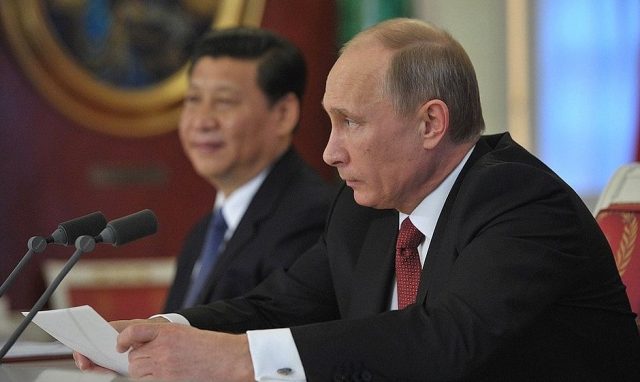
By Finian CUNNINGHAM | Strategic Culture Foundation | 07.07.2017
The United States’ hegemonic dominance in the world is heading to the exits. The decline in US uni-polar power has been underway for several years, in line with the emergence of a multi-polar world. This week, Russia and China showed important resolve to face down American bully tactics over North Korea. The confrontation suggests a turning point in the transition from American world dominance to a multi-polar one.
US President Donald Trump reiterated the possibility of military attack on North Korea while in Poland this week. This was also while Washington was hectoring China and Russia to join in a tougher response to North Korea over its ballistic missile launch days before – the former two nations themselves having recently been sanctioned anew by the US. Talk about American audacity and double think.
However, the crass arrogance shown by the US seems to have hit a new limit of tolerance in Moscow and Beijing. Both are beginning to demonstrate a loss of patience with the bumptious, insufferable Americans.
Reacting to North Korea’s breakthrough ballistic missile launch, Washington deployed its typical conceit, casually threatening to carry out a «retaliatory» military strike. Trump said he was considering «severe» options over Pyongyang’s «very, very dangerous behavior».
But Russia and China’s stance this time to the Americans had significantly stiffened. Both explicitly warned the US against taking military action against North Korea.
Moreover, Russia and China said that they would oppose Washington imposing further sanctions on the government of Kim Jong-un. The latter has already been subjected to six rounds of US-led sanctions.
In short, the American bully is finding that it is no longer able to dictate its unilateral way.
Addressing an emergency session of the United Nations Security Council, the Russian and Chinese ambassadors rejected the shrill American call for «global action to a global threat». Russian envoy Vladimir Safronkov stood firmly with his Chinese counterpart, saying that threatened American military action was simply not an option, and that a different policy was needed from the failed American one of slapping ever-more sanctions on North Korea.
One can imagine the exasperation felt within Washington of being bluntly told «no» to its invariable, self-anointed belligerence.
The alternative route being proposed by Russia and China was the «radical» one – radical from the American point of view – of diplomacy. It has perhaps taken the Russians and Chinese overdue time to reach this point. But what is remarkably apparent now is that they are asserting themselves against the US with increased confidence. And what they are asserting in this case is an eminently reasonable solution to the Korean crisis. They are calling for a freeze on Pyongyang’s nuclear weapons program in conjunction with the US freezing its constant military exercises on the peninsula, as well as withdrawing its anti-missile THAAD system. The next step is to then hold multilateral negotiations for a comprehensive peaceful settlement, without preconditions.
Such an eminently reasonable approach is anathema to the Americans. Because it negates their unilateral arrogance and self-righteousness to dictate terms.
This is a significant development, one that portends a new determination by Russia and China to confront the American bully head-on. For too long, Washington has gotten away with outrageous aggression, lawlessness, hypocrisy and absurd hubris, not just over Korea but on countless other international issues. On the world stage it behaves like a schoolyard bully, or perhaps more accurately that should be a street thug. Going around beating up other people, usually the weak, as it likes. Then when Washington feels particularly affronted about some perceived slight, it invokes international law and righteousness.
This week, what we saw over the North Korea missile launch and the typical American over-reaction was Russia and China saying to Washington: your days of self-licensing aggression and abusing international law are over; your American uni-polar hegemony is redundant.
Welcome to the multi-polar world forged largely by Russia and China where all nations must abide by international norms and law, principally the paramount pursuit of diplomacy.
Oh the shock to American arrogance to receive such a rude awakening.
The lawlessness of American «exceptionalism» is a theme that Russian President Vladimir Putin has been constantly hammering over the past decade. But it seems now that Russia and China are strong enough politically, economically and militarily to begin asserting and acting on the conviction that the days of American arrogance and lawlessness are indeed over. It is no coincidence that the firm Russian-Chinese opposition to American aggression over North Korea came at the same time that Putin was hosting his counterpart President Xi Jinping in Moscow, where both leaders hailed an even deeper Sino-Russian strategic alliance.
Moscow and Beijing censured North Korea over its 11th missile launch so far this year. They said it violated UN sanctions imposed on Pyongyang since it first exploded a nuclear warhead in 2006. Still, they sought to put a proper perspective on the event, rather than reflexively demonizing North Korea as the Americans never cease to do.
The intercontinental ballistic missile (ICBM) launched this week by North Korea was not armed with a warhead but Pyongyang said it now has the capability to do so and to strike anywhere on the globe. The trajectory of the ICBM indicates that North Korea could now hit the US state of Alaska. That heralds a major breakthrough in North Korea’s military capability. Earlier this year, President Trump claimed that North Korea would never be allowed to reach that point. Well, it just did this week.
Nevertheless, Russia and China realize that the Korean crisis is a complex issue, not the simplistic narrative put out by Washington about a «rogue regime» threatening world peace. Moscow and Beijing are well aware that Washington is very much part of the problem, with its relentless military exercises and provocative threats to North Korea’s sovereignty.
Russia and China understand that the only reasonable solution is not reckless escalation, but a negotiated engagement by all sides, including North Korea, South Korea, the US, Japan, China and Russia. Past multilateral negotiations have come unstuck largely because of Washington’s high-handed imperious attitude. Winding down conflict on the Korean Peninsula necessitates the winding down of military forces by all sides, and a primary responsibility for that lies with the US, the external protagonist in the region.
As the Russia-China strategic alliance grows ever stronger heralding a «post-West» world order, as Russian foreign minister Sergey Lavrov put it, one which was dominated by American capitalism, the US petrodollar and its military machine, it seems unmistakable that both Russia and China have reached a practical limit of tolerance to Washington’s lawless arrogance.
In recent weeks, Washington has slapped more sanctions on both Russia and China, conducted provocative military incursions into their territorial domains, and continued to disparage them with media distortions. Washington possesses thousands of ICBMs, test-fires them all the time, and installs missile systems around Russian and Chinese territory. Washington has waged or covertly sponsored criminal wars across the Middle East over the past two decades, resulting in millions of innocent deaths and spawning of terror groups.
North Korea has attacked no-one, has an arsenal of perhaps 10 nuclear weapons and conducts its missile tests far from any of its neighbor’s territory.
Yet the lawless, mass-murdering Americans – the only nation to have actually dropped nuclear weapons on civilian populations – have the audacity to declare North Korea a threat to world peace and insist on the «right» to preemptively attack Pyongyang. And if Russia and China do not acquiesce to this American demand then Washington threatens to increase more sanctions on them.
The American bully is patently beyond itself from its own megalomanic despotism. But the big, crucial difference now is that Russia and China are moving to finally put this bully in its place. The multi-polar world has arrived. And the only «radical» thing that Russia and China are insisting on is that the US behaves like everyone else and abides by international law. That basic requirement is an indication of how lawless the Americans are.
Addressing bused-in supporters in Poland’s Warsaw Square this week, Trump declared with bravado that «the West [that is, the US] will never back down».
Well, we’ll see about that. As noted, the multi-polar world has arrived and America is being compelled to back down by an ascendant Russia and China who also happen to have world opinion on their side.
Putin & Trump agree to create bilateral channel to promote Ukraine settlement – Lavrov

Houses damaged during a shelling by the Ukrainian military, in Donetsk © Irina Gerashchenko / Sputnik FILE PHOTO
RT | July 7, 2017
A special channel between the Russian and American presidents will be established to further push for a settlement of the Ukrainian crisis, Russia’s Foreign Minister Lavrov has announced following the Putin-Trump meeting.
Additional efforts will be made “to support” the Minsk peace agreements and the work of the existing contact group on Ukraine, Russia’s chief diplomat said.
“While discussing Ukraine, the American side informed us that they had appointed a special representative to assist the efforts on settling the Ukrainian crisis.
“Arrangements have been made to create a channel between presidents of Russia and US to use this opportunity that Washington has, to further advance the settlement based on the Minsk agreements and considering the potential established in the contact group and the Normandy format,” Lavrov told reporters during the G20 summit in Hamburg, Germany.
Moscow hopes to soon meet the US representative “for consultations,” he added.
Saying that “everyone is interested” in fulfillment of the Minsk agreements, to which Kiev “is the main part,” Lavrov said Moscow “senses that its Western partners very much understand the necessity of additional influence” on the peace process which so far has been delayed.
Citing his “long” talks with the US Secretary of State Rex Tillerson earlier in the day, as well as a Thursday meeting with the French Minister of Foreign Affairs Jean-Yves Le Drian, Lavrov said everyone agrees the crisis needs to be settled within the framework of the Minsk agreements.
“I have a feeling that it has been confirmed that both the Russian and American presidents are driven by their national interests, which they see primarily in looking for mutually beneficial agreements rather than by trying to play out some confrontational scenarios.”
Lavrov added that the Ukrainian issue had been discussed “in a concrete, businesslike” manner.
Israel Wants US, Not Russia, to Control Deescalation Zones in Syria – Haaretz Report
Sputnik – 07.07.2017
TEL-AVIV – Senior Israeli politicians held talks on safe zone issues with US special envoy for the global coalition to counter Islamic State (terrorist group outlawed in Russia) Brett McGurk, telling him Israel would prefer to have US troops rather than Russian troops controlling Syrian deescalation zones, and US President Donald Trump’s administration is already considering this idea, but has not made any decision yet, Haaretz newspaper reported, citing three sources involved in the talks.
Israel voiced three main demands upon the US envoy: the separation of safe zone talks from the Astana talks; keeping Iran, Hezbollah and other Shiite militias away from the Israeli and Jordanian borders; and not playing any active role in controlling safe zones near its border.
“We’re in close contact with the Americans and they understand our positions and our concerns very well. We made it clear to the Americans and other parties that we want to see the entire package relating to the deescalation zones, not just a few details, and then we can decide what our position is,” one of the officials said, as quoted by the newspaper.
Russian President Vladimir Putin and Trump are expected to meet for the first time later Friday on the sidelines of the G20 summit to discuss key issues of the international agenda, including cooperation in the settlement of the Syrian crisis. On Thursday, Putin discussed the fight against terrorism and the situation in Syria with Israeli Prime Minister Benjamin Netanyahu in a telephone conversation.
Featured Video

Spain train disaster raises questions over Israeli-linked security contractors
or go to
Aletho News Archives – Video-Images
From the Archives
Are There 50,000 ‘Israeli-born’ Individuals Living in the UK?
By Professor David Miller | August 18, 2026
Recent disclosures by the Zionist regime show that some 2,069 British nationals were serving in the IDF as of March 2025, according to Freedom of Information (FoI) requests submitted to the occupation forces (1,686 dual British-Israeli, plus 383 multinational). We cannot tell from the figures how many of these were already settler colonists and intend to stay in the colony, and how many will return or have returned to the UK. Presumably, those returning to the UK will number far fewer than 2,000, since many are known to have become permanently residents of the colony.
Additionally, the IDF figures only provide a snapshot, and do not tell us how many have served in the Jewish supremacist military either before or after March 2025. One way into the question of how many genocidaires are living in Britain is to ask how many current British residents were born in the Zionist colony. There is data on that, as we shall see. … continue
Blog Roll
 Aletho News
- Are There 50,000 ‘Israeli-born’ Individuals Living in the UK?
- German CDU MPs Seek Climate “Misinformation” List
- The ‘Gaza Treatment’: How Media Headlines Obscure Who is Bombing Yemen
- Ro Khanna urges Democrats to strip Israel ‘integration’ provision from defense bill
- Why Iran designated British MI6, Royal Navy, and RAF as hostile, terrorist organizations
- Armenian opposition politician dies in custody
- US still trying to recycle failed hypersonic missile programs
- France’s ‘Cold War’: Paris blames Tehran for supermarket fridge hacks
- Psywar no more? 77th Brigade’s sudden death
- Ukraine Already Carved Up… Before Talks Begin? /Prof. Richard Sakwa
- If Americans Knew
- An error has occurred; the feed is probably down. Try again later.
- No Tricks Zone
- German Authorities Start Initiative To Evaluate Public Register For Climate “Disinformation” Spreaders!
- Zonal Asymmetry of Temperature Change in the Antarctic Circumpolar Current
- New Study: The Net Fossil Fuel Contribution To Rising Atmospheric CO2 Has Been Zero For 500 Years
- Germany’s Green Energy Transition Becoming Increasingly Expensive…Another 6 Trillion Euros!
- Sudden Stratospheric Warming, Powerful El Niño Combination May Lead To Extreme Europe Cold, Energy Crisis!
- Two New Studies Find Thwaites Glacier Melt Cannot Be Driven By Human Activity Or A Warming Ocean
- E-Cars Reduce CO2 Emissions By Only 41% Compared To Internal Combustion Engine Vehicles
- Predictions Made By Renowned Climate Professor Over Past Decades Have Been Proven To Be Poor
- New Study Suggests Large Regions Of The Pacific Ocean Have Been Cooling For The Last 80 Years
- Germany’s Green Energy Debacle: High Energy Costs Force Kahla Porzellan to Close After 182 Years!

