Iran UN ambassador calls for destruction of all nuclear weapons
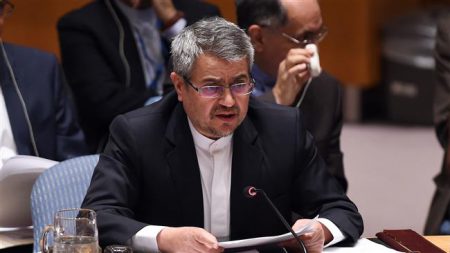
Iran’s ambassador to the UN Gholamali Khoshroo
Press TV – March 29, 2017
Iran’s ambassador to the UN Gholamali Khoshroo has called for the total eradication of nuclear weapons.
Khoshroo reiterated Iran’s call during a UN conference aimed at creating a nuclear weapons ban treaty in New York on Tuesday.
“Iran, as a victim of chemical weapons, strongly feels the danger posed by the existence of weapons of mass destruction and is determined to engage actively in international diplomatic efforts to save humanity from the menace of nuclear weapons,” he said.
Khoshroo stressed that Iran is committed to its Non-Proliferation Treaty (NPT) obligations, which include negotiations based on effective nuclear disarmament measures.
He added that several countries continue to ignore international calls and treaties for nuclear disarmament and even continue to increase their nuclear stockpiles. “They do not have political determination to abandon doctrines of nuclear deterrence and nuclear terror,” he went on to say.
Iran’s UN ambassador noted that boycotting the talks by many countries, including the US, shows that the world’s nuclear powers are by no means committed to the eradication of nuclear arms. Britain and France were also among the some 40 countries that did not join the talks.
“We note that prohibition of nuclear weapons must be accompanied by the elimination of such weapons. There can be no doubt that without complete abolition of nuclear weapons, there will be no absolute guarantee against the danger of nuclear war and the use of such weapons,” Khoshroo added.
Why US Missile Defense May Trigger Development of ‘Satellite Killers’ in Russia
Sputnik – March 29, 2017
The US global missile defense system will threaten virtually all low Earth orbit spacecraft within the next 10-12 years, Russian experts Alexey Fenenko and Konstantin Sivkov told RIA Novosti. The experts suggested that one of the solutions to counter the threat is the development of similar systems by Russia.
The US anti-ballistic missile defense (ABM) system is likely to pose a real threat to the Russian low-altitude spacecraft in the near future, experts told RIA Novosti. They believe it may prompt Russia to begin developing similar systems.
Speaking at the Conference on Disarmament in Geneva, the Russian General Staff’s Deputy Chief Lt. Gen. Viktor Poznikhir warned that virtually all low Earth orbit space will soon fall within the US global missile defense system’s killing zone.
That means that the space activities of any country, including Russia and China, will be under threat, Gen. Poznikhir highlighted.
Speaking to RIA Novosti, Alexey Fenenko, Associate Professor at Moscow State University’s World Politics Department, emphasized that the US missile defense system will really threaten the Russian orbital grouping of satellites in the next 10-12 years.
“This could become a threat in just 10-12 years, but Russia, unfortunately, has yet to take action; meanwhile China is developing its own anti-satellite weapons, and we will have to do the same,” Fenenko said.
According to Fenenko, the US continues to conduct tests of anti-satellite weapons within the framework of the country’s ABM program.
“The first time they tested it was in 1985; the second test was conducted in 2008. In addition, the US national space strategy of 2006 stressed the necessity of creating weapons able to destroy an adversary’s satellites as part of US missile defense [capabilities],” the Russian academic explained.
He also recalled that within the framework of its Prompt Global Strike project, the US carried out several unsuccessful attempts to test the so-called “space weapon” — low Earth orbit vehicles. However, following a series of unsuccessful tests, Washington has shifted its focus to anti-satellite systems (ASAT).
Russian military expert and First Vice President of the Academy of Geopolitical Studies Konstantin Sivkov echoes Fenenko, suggesting that the threat posed by the US missile defense may prompt Moscow to develop a system which would be able to hit US low Earth orbit spacecraft at a distance of thousands of kilometers.
“The Americans have carried out tests of their SM-3 missile, and they have managed to shoot down a satellite. We need to create our own missile systems,” Sivkov told RIA Novosti.
He specified that Russia needs to design systems which would be able to shoot down satellites at a distance of hundreds or thousands of kilometers.
“The S-500 [Prometey anti-ballistic missile system] was designed as a missile defense system for the theater of war; we need a system that would hit satellites in quasi-stationary orbit drifting a few thousand kilometers above the Earth,” Sivkov suggested.
Sivkov emphasized that Russia is currently not involved in developing these systems; however, according to the military analyst, the US efforts to bolster its missile defense may force Russia to kick off such a project.
Previously, in his January interview with RIA Novosti, Sivkov drew attention to US Air Force Gen. John E. Hyten’s calls for “deterrence in space.”
Gen. Hyten claimed that “in the not-so-distant future” Moscow and Beijing will be able to threaten US spacecraft.
“We have to prevent that and the best way to prevent war is to be prepared for war. So the United States is going to do that, and we’re going to make sure that everybody knows we’re prepared for war,” Hyten said in his speech at Stanford University’s Center for Security and Cooperation.
Stressing that Hyten’s claims bear no relation to reality, Sivkov warned that the Pentagon is about to start a new arms race.
“In fact this is the way to justify the beginning of the large-scale militarization of space by the United States, under the pretext of a Russian or Chinese threat,” the Russian expert stressed.
Marco Rubio Threatens El Salvador, Haiti, and DR to Vote for Venezuela OAS Suspension
By Lucas Koerner | Venezuelanalysis | March 28, 2017
Caracas – Florida Republican Senator Marco Rubio publicly warned the governments of El Salvador, Haiti, and the Dominican Republic Monday that the US would cut off aid if they failed to vote to suspend Venezuela from the Organization of American States.
“This is not a threat, but it is the reality,” said Rubio, speaking ahead of an extraordinary OAS session scheduled for Tuesday, in which the body’s 35 member-states may be called to vote on whether to invoke the Inter-American Democratic Charter against Venezuela.
“We have a very difficult situation in Washington, where massive cuts in foreign aid are under consideration and it will be very difficult for us to justify assistance to those countries if they, at the end of the day, are countries that do not cooperate in the defense of democracy in the region,” the senator added.
El Salvador’s left-wing FMLN government, for its part, slammed Rubio’s instrumentalizing of US aid as a means of “political pressure”.
“Marco Rubio’s disregard for international treaties that mediate and lay down the rules for cooperation astonishes us,” expressed Eugenio Chicas, spokesman for President Salvador Sanchez Ceren.
Chicas added that Washington is welcome to cut off future aid, noting however that slashing current assistance would be a violation of previous agreements.
The Dominican Republic likewise responded to Rubio by reaffirming its commitment to non-intervention and support for dialogue in Venezuela.
“The Dominican Republic supports dialogue as the solution to the situation in Venezuela,” declared Dominican Foreign Minister Miguel Vargas Maldonado.
Santo Domingo has been a key player in Vatican-sponsored talks between the Maduro government and right-wing opposition over the past year, with former Dominican President Leonel Fernandez serving on the UNASUR mediation team alongside the former presidents of Spain and Panama, Jose Rodriguez Zapatero and Martin Torrijos.
“We appeal to the international principle of non-interference in the internal affairs of [other] countries, respecting their sovereignty,” Vargas Maldonado continued.
Haiti, for its part, has yet to issue public statement concerning Rubio’s remarks.
Under the Chavez and Maduro governments, Caracas has forged strong political and economic ties with the three neighboring countries, which are all members of Venezuela’s regional energy integration initiative known as PetroCaribe.
Rubio’s comments come as OAS Secretary General Luis Almagro scrambles to amass a two-thirds majority of member-states to support Venezuela’s suspension, which has faced opposition from not only leftist governments, but also close US allies.
Most recently, the right-wing Kuczynski government in Peru, one of Venezuela’s most vocal critics in the region, has cast doubt on the success of the bid, calling it “extreme” and admitting that “there is not a majority”.
Likewise, Costa Rica has announced that it would not endorse the application of the Democratic Charter, insisting that the only solution to the country’s current crisis is “electoral”.
Why This Isn’t the Time for a Public Option or Medicare for Some
By Margaret Flowers – Health Over Profit – March 28, 2017
This has been a tumultuous week for healthcare reform. First there was the pleasantly quick defeat of the American Health Care Act in the House of Representatives Friday afternoon. Then, that evening, Senator Sanders spoke at a town hall in Vermont with Senator Pat Leahy and Representative Peter Welch where he announced that he would introduce a Medicare for All bill. Medicare for All and Bernie supporters lit up social media with their excitement over the announcement. This should have been great news, but it wasn’t exactly.
Over the weekend, more information was revealed in a series of interviews with Sen. Sanders. Sunday, he said on CNN that single payer legislation wouldn’t have the votes, so the first priority will be to improve the Affordable Care Act (ACA) with a public insurance, called a public option, and possibly lowering the age of Medicare eligibility to 55.
There are a number of reasons why this isn’t the time for tinkering with the ACA. We have a healthcare crisis now and the means to solve it. The ACA is fundamentally flawed and cannot be tweaked into a universal program. And Sanders’ proposals are exactly the same ones used in 2008-10 to divide and weaken the movement for National Improved Medicare for All. We can’t be fooled into going down that path again.
The Current Crisis and its Solution
Right now in the United States almost 30 million people have no health insurance. On top of that, tens of millions of people who have health insurance can’t afford health care. When people experience a serious accident or illness, they face a stark choice: seek care and risk financial ruin or go without it and risk disability or death. Hundreds of thousands of families go bankrupt each year due to medical illness and an estimated 29,000 people die each year due to lack of access to care.
Think about how the country galvanized when 3,000 people were killed in the attacks on 9/11 or when the 2,000th soldier was killed in Iraq, but that amount of death happens ten times a year or more in the US and we hardly hear a peep of outrage.
Health outcomes in the United States are not very good. A recent study found:
Notable among poor-performing countries is the USA, whose life expectancy at birth is already lower than most other high-income countries, and is projected to fall further behind such that its 2030 life expectancy at birth might be similar to the Czech Republic for men, and Croatia and Mexico for women. The USA has the highest child and maternal mortality, homicide rate, and body-mass index of any high-income country, and was the first of high-income countries to experience a halt or possibly reversal of increase in height in adulthood, which is associated with higher longevity. The USA is also the only country in the OECD without universal health coverage, and has the largest share of unmet health-care needs due to financial costs.
Yet, of all of the industrialized nations, the United States spends the most per person on health care, in some cases double the amount and those countries cover everyone. We are already paying for universal comprehensive health coverage, but we aren’t getting it because the bottom line of the system in the US is profits for a few rather than health for all.
The US has the most complex and heavily bureaucratic system in the world because it is a market-based system with a few public programs to try to fill in the gaps. A third of our healthcare dollar goes to administration for the hundreds of different insurance plans with their differing coverage, networks and rules. And we pay the highest prices, by far, for health services and pharmaceuticals because there is no rational system to set a fair price.
To begin to solve the healthcare crisis in the US, we need a system that is based on health and the money to pay for it. The proven solution is a universal not-for-profit, publicly-funded system that provides all medically-necessary care. House Resolution 676: “The Expanded and Improved Medicare for All Act,” which has 72 co-sponsors, is the model for that system. This would address the fundamental causes of the healthcare crisis.
The good news is that not only do we have the money to pay for this system, but there is also widespread support for it. For decades many independent polls have shown more than 60% support by the general public, plus more than 80% support by Democratic Party voters, rapidly growing support by Republicans who earn under $75,000 and majority support by health professionals.
Why a Public Option and Medicare for Some Plans will fail
Steve Bannon, President Trump’s chief strategist, had an interesting statement in the New York Magazine recently. He criticized the Republican’s American Health Care Act (AHCA) because it was “written by the insurance industry.” That same criticism can be made of the Democrat’s ACA, which was basically written by Liz Fowler, a former executive for WellPoint. She also oversaw the regulations’ process.
The ACA is fundamentally flawed because it treats health care as a commodity, not a public necessity. It has achieved the best that it can do, and similar to other attempts at the state level that don’t address the roots of the crisis, it is starting to deteriorate with stagnant coverage and rising premiums and out-of-pocket costs.
Attempts to improve the ACA with a public insurance or Medicare for some will bring coverage to a few more, but they will similarly fail over time because they will not change the system or control healthcare costs.
Sen. Sanders and others are pushing a public option. This would be a public insurance that people could choose instead of private insurance. It sounds good in theory but has not worked in practice because it draws the sickest patients and struggles to cover their care while keeping premiums and out-of-pocket costs affordable. Private insurers are experts at attracting the healthiest enrollees. In fact, I have argued that a public insurance is just what the private insurers want (though they are unlikely to admit it) because it serves as a relief valve to take sick people off their hands. That leaves private insurers to focus on the young, employed and wealthy, from which they can collect premiums and who won’t need much in the way of health care.
Sen. Sanders is also raising the possibility of lowering the age of Medicare to 55, just as Alan Grayson suggested in 2010. This is another gift to the insurance industry because it takes a group that is more likely to have health problems off of their books. It will place more of a burden on the Medicare system without bringing the cost savings needed to cover health needs. I call this Medicare for some to contrast it with Medicare for all.
The basic reasons that Medicare for all works are because the administrative simplicity of one universal plan provides over $500 billion a year in administrative savings and its ability to negotiate fair drug prices means over $100 billion per year in savings on pharmaceuticals. The savings offset the cost of paying for care and getting rid of out-of-pocket costs that currently keep people from seeking necessary care.
Rather than wasting time and effort on a public option or Medicare for some, which will still leave people out and maintain the high costs of health care, we need to mobilize to win national improved Medicare for all. Like other industrialized nations, we need to create a universal high quality health system. It doesn’t make sense to leave anybody out when we have the resources to achieve it and public support for it. The only thing lacking is support from members of Congress. But as we witnessed last week with the defeat of the AHCA, changing the minds of members of Congress is within the power of the public.
The public option and Medicare for some are being used to divide and distract supporters of Medicare for all in order to weaken them and make them believe they are asking for too much, just as happened during the health reform efforts in 2008-10. We can’t be taken off track again.
What is the real purpose of a public option or lowering the age of Medicare when neither is an effective nor a lasting solution? It is only because the Democrats are unwilling to take on the powerful health insurance and pharmaceutical industries. The problem is that we can’t solve the healthcare crisis until we do.
Margaret Flowers is co-director of It’s Our Economy, co-host of Clearing the FOG Radio and an organizer of the occupation of Freedom Plaza in Washington, DC. She is also with the Health Care is a Human Right campaign in Maryland.
‘Any Data They Can Intercept’: US Congress Will Let Companies Sell Browsing Data
Sputnik – 29.03.2017
Following in the Senate’s footsteps, the US House of Representatives has approved a piece of legislation that would allow massive telephone and cable companies to sell the data generated by internet users’ browsing habits.
On March 28, the US House narrowly passed a bill that analysts say is a huge win for the bloated telecommunications industry, and a commensurately large invasion on citizens’ privacy – or lack thereof. The resolution cleared its way through the lower chamber of the legislature by a 215-205 vote.
If US President Donald Trump signs the resolution into law, companies will legally be able to create profiles about every internet user, then sell those profiles to the highest bidder, the Electronic Frontier Foundation said in a statement.
“Considering how much access [internet service providers, or ISPs] already have to highly sensitive data, it is absolutely unacceptable for them to monetize personal information,” Representative Mike Pocan of Wisconsin said Tuesday.
The ability for service providers to collect “essentially any data they can intercept and read for themselves” was supposed to be an opt-in only policy, giving consumers a choice whether to disclose their data, but instead telecommunications companies will have the ability to generate revenue off of the public’s browsing habits, said Matt Erickson on Radio Sputnik’s By Any Means Necessary with Eugene Puryear. Erickson is a director with the Digital Privacy Alliance.
”Google and Facebook collect large amounts of information in ways that should be very concerning to people,” Puryear said.
The news comes as a major setback for privacy advocates and a major victory for Comcast, TimeWarner, AT&T and Verizon, which “will have free rein to hijack your searches, sell your data, and hammer you with unwanted advertisements,” the EFF said.
What’s more, at a time when nearly every major financial institution, electrical utilities company, defense and aerospace firm, and governmental agency is seeking to bolster its cyber defense systems, there are a host of reasons to think that these new rules would be detrimental to the US’ collective cybersecurity.
By recording your traffic and building a profile about you, for instance, hackers gain a new target database to breach.
The Surveillance State Behind Russia-gate
By Ray McGovern and Bill Binney | Consortium News | March 28, 2017
Although many details are still hazy because of secrecy – and further befogged by politics – it appears House Intelligence Committee Chairman Devin Nunes was informed last week about invasive electronic surveillance of senior U.S. government officials and, in turn, passed that information onto President Trump.
This news presents Trump with an unwelcome but unavoidable choice: confront those who have kept him in the dark about such rogue activities or live fearfully in their shadow. (The latter was the path chosen by President Obama. Will Trump choose the road less traveled?)
What President Trump decides will largely determine the freedom of action he enjoys as president on many key security and other issues. But even more so, his choice may decide whether there is a future for this constitutional republic. Either he can acquiesce to or fight against a Deep State of intelligence officials who have a myriad of ways to spy on politicians (and other citizens) and thus amass derogatory material that can be easily transformed into blackmail.
This crisis (yes, “crisis” is an overused word, but in this highly unusual set of circumstances we believe it is appropriate) came to light mostly by accident after President Trump tweeted on March 4 that his team in New York City’s Trump Towers had been “wiretapped” by President Obama.
Trump reportedly was relying on media reports regarding how conversations of aides, including his ill-starred National Security Advisor Michael Flynn, had been intercepted. Trump’s tweet led to a fresh offensive by Democrats and the mainstream press to disparage Trump’s “ridiculous” claims.
However, this concern about the dragnets that U.S. intelligence (or its foreign partners) can deploy to pick up communications by Trump’s advisers and then “unmask” the names before leaking them to the news media was also highlighted at the Nunes-led House Intelligence Committee hearing on March 20, where Nunes appealed for anyone who had related knowledge to come forward with it.
That apparently happened on the evening of March 21 when Nunes received a call while riding with a staffer. After the call, Nunes switched to another car and went to a secure room at the Old Executive Office Building, next to the White House, where he was shown highly classified information apparently about how the intelligence community picked up communications by Trump’s aides.
The next day, Nunes went to the White House to brief President Trump, who later said he felt “somewhat vindicated” by what Nunes had told him.
The ‘Wiretap’ Red Herring
But the corporate U.S. news media continued to heckle Trump over his use of the word “wiretap” and cite the insistence of FBI Director James Comey and other intelligence officials that President Obama had not issued a wiretap order aimed at Trump.
As those paying rudimentary attention to modern methods of surveillance know, “wiretapping” is passé. But Trump’s use of the word allowed FBI and Department of Justice officials and their counterparts at the National Security Agency to swear on a stack of bibles that the FBI, DOJ, and NSA have been unable to uncover any evidence within their particular institutions of such “wiretapping.”
At the House Intelligence Committee hearing on March 20, FBI Director Comey and NSA Director Michael Rogers firmly denied that their agencies had wiretapped Trump Towers on the orders of President Obama.
So, were Trump and his associates “wiretapped?” Of course not. Wiretapping went out of vogue decades ago, having been rendered obsolete by leaps in surveillance technology.
The real question is: Were Trump and his associates surveilled? Wake up, America. Was no one paying attention to the disclosures from NSA whistleblower Edward Snowden in 2013 when he exposed Director of National Intelligence James Clapper as a liar for denying that the NSA engaged in bulk collection of communications inside the United States.
The reality is that EVERYONE, including the President, is surveilled. The technology enabling bulk collection would have made the late demented FBI Director J. Edgar Hoover’s mouth water.
Allegations about the intelligence community’s abuse of its powers also did not begin with Snowden. For instance, several years earlier, former NSA worker and whistleblower Russell Tice warned about these “special access programs,” citing first-hand knowledge, but his claims were brushed aside as coming from a disgruntled employee with psychological problems. His disclosures were soon forgotten.
Intelligence Community’s Payback
However, earlier this year, there was a stark reminder of how much fear these surveillance capacities have struck in the hearts of senior U.S. government officials. Senate Minority Leader Chuck Schumer of New York told MSNBC’s Rachel Maddow that President Trump was “being really dumb” to take on the intelligence community, since “They have six ways from Sunday at getting back at you.”
Maddow shied away from asking the logical follow-up: “Senator Schumer, are you actually saying that Trump should be afraid of the CIA?” Perhaps she didn’t want to venture down a path that would raise more troubling questions about the surveillance of the Trump team than on their alleged contacts with the Russians.
Similarly, the U.S. corporate media is now focused on Nunes’s alleged failure to follow protocol by not sharing his information first with Rep. Adam Schiff, the ranking Democrat on the House Intelligence Committee. Democrats promptly demanded that Nunes recuse himself from the Russia investigation.
On Tuesday morning, reporters for CNN and other news outlets peppered Nunes with similar demands as he walked down a corridor on Capitol Hill, prompting him to suggest that they should be more concerned about what he had learned than the procedures followed.
That’s probably true because to quote Jack Nicholson’s character in “A Few Good Men” in a slightly different context, the mainstream media “cannot handle the truth” – even if it’s a no-brainer.
At his evening meeting on March 21 at the Old Executive Office Building, Nunes was likely informed that all telephones, emails, etc. – including his own and Trump’s – are being monitored by what the Soviets used to call “the organs of state security.”
By sharing that information with Trump the next day – rather than consulting with Schiff – Nunes may have sought to avoid the risk that Schiff or someone else would come up with a bureaucratic reason to keep the President in the dark.
A savvy politician, Nunes knew there would be high political cost in doing what he did. Inevitably, he would be called partisan; there would be more appeals to remove him from chairing the committee; and the character assassination of him already well under way – in The Washington Post, for example – might move him to the top of the unpopularity chart, displacing even bête noire Russian President Vladimir Putin.
But this episode was not the first time Nunes has shown some spine in the face of what the Establishment wants ignored. In a move setting this congressman apart from all his colleagues, Nunes had the courage to host an award ceremony for one of his constituents, retired sailor and member of the USS Liberty crew, Terry Halbardier.

Rep. Devin Nunes, R-California.
On June 8, 1967, by repairing an antennae and thus enabling the USS Liberty to issue an SOS, Halbardier prevented Israeli aircraft and torpedo boats from sinking that Navy intelligence ship and ensuring that there would be no survivors to describe how the Israeli “allies” had strafed and bombed the ship. Still, 34 American seamen died and 171 were wounded.
At the time of the award ceremony in 2009, Nunes said, “The government has kept this quiet I think for too long, and I felt as my constituent, he [Halbardier] needed to get recognized for the services he made to his country.” (Ray McGovern took part in the ceremony in Nunes’s Visalia, California office.)
Now, we suspect that much more may be learned about the special compartmented surveillance program targeted against top U.S. national leaders if Rep. Nunes doesn’t back down and if Trump doesn’t choose the road most traveled – acquiescence to America’s Deep State actors.
Ray McGovern served as a CIA analyst for 27 years and conducted one-on-one briefings of the President’s Daily Brief under Ronald Reagan from 1081 to 1985.
Bill Binney was former Technical Director, World Geopolitical & Military Analysis, NSA and co-founder of NSA’s SIGINT Automation Research Center before he retired after 9/11.
US Decision to Sanction Russian Companies Pre-Dates Trump Administration

© Sputnik/ Michael Klimentyev
Sputnik – 28.03.2017
WASHINGTON – The US decision to impose new sanctions against Russian entities was made during the final days of President Barack Obama’s administration, a Department of State official told Sputnik.
On Saturday, the United States announced new sanctions on eight Russian companies for alleged nonproliferation-related violations. The Russian Foreign Ministry said the move contradicts the White House’s alleged desire to improve relations with Moscow.
“These determinations to sanction this group of individuals and entities were made by the State Department on January 17, 2017… and subsequently reviewed by the incoming administration prior to transmission to Congress,” the official stated on Monday.
The official noted that the sanctions decisions were then delivered to Congress on March 21 as part of a report related to violations of the US Iran, North Korea, and Syria Nonproliferation Act (INKSNA).
The companies affected by the INKSNA sanctions include the 150th Aircraft Repair Plant, Aviaexport, Bazalt, Kolomna Design Bureau of Machine-Building, Rosoboronexport, Ulyanovsk Higher Aviation Academy of Civil Aviation, Ural Training Center for Civil Aviation, Zhukovskiy and Gagarin Academy.
Top US general in Europe urges arming Ukraine

RT | March 28, 2017
Washington must do more to deter “Russian aggression,” including sending lethal weapons to the government in Ukraine and engage in information warfare across the board, the top US commander in Europe told lawmakers.
“I personally believe that we need to consider lethal defensive weapons for Ukraine,” General Curtis M. Scaparrotti, head of the US European Command (EUCOM) told the House Armed Services Committee on Tuesday.
“I haven’t discussed that specific issue with most of our partners,” Scaparrotti admitted when he was asked about the NATO allies’ opinion on arming Kiev. The general is also the NATO Supreme Allied Commander in Europe (SACEUR).
“Russia seeks to undermine this international system and discredit those in the West who have created it,” Scaparrotti argued in his opening remarks, calling for “demonstrating strength in every area” when it comes to dealing with Moscow.
He also accused Russia of threatening every country in its vicinity, stoking ethnic tensions in the Balkans, “complicating” US operations against Islamic State (IS, formerly ISIS/ISIL) in Syria and violating the Intermediate-Range Nuclear Forces (INF) Treaty by deploying land-based cruise missiles.
For its part, Moscow has rejected insinuations it was violating the 1988 treaty.
“There have not been violations from our side,” Russian Foreign Minister Sergey Lavrov told Argumenty i Fakty weekly, answering accusations about the breach of the INF. “The United States claim the opposite, but they do not provide any information that could be verified in order to clarify the situation.”
At the hearing on Tuesday, however, Scaparrotti and the lawmakers were of the same mind that Russia was an adversary and a threat in every respect. In addition to arming the government in Ukraine and building up the US military presence in Europe, the general advocated information warfare as well.
“Going forward, we must bring the information aspects of our national power more fully to bear on Russia, both to amplify our narrative and to draw attention to Russia’s manipulative, coercive, and malign activities,” he said.
Scaparrotti’s predecessor, General Philip M. Breedlove, had worked for years with State Department and other Washington insiders to push the Obama administration to be more belligerent towards Russia, according to his private emails released by DCLeaks in July 2016, shortly after Breedlove’s retirement. Last week, Breedlove testified before the Senate Armed Services Committee, calling once again for arming the government in Kiev.
US-Led Coalition Destroyed Four Bridges, Interrupting Transportation in Raqqa
Sputnik – 28.03.2017
The US-led coalition destroyed four bridges in Syria, which interrupted the communication between the north and south of Raqqa, with 200 thousand people, head of the Main Operations Directorate of the General Staff of the Russian Armed Forces, Colonel-General Sergei Rudskoy stated.
“On February 3, the coalition’s aviation destroyed four bridges: two in Raqqa and two in the settlements of El-Calta and El-Abbara. As a result of these actions, the communication between the northern and southern parts of the city, with over 200 thousand inhabitants, has been completely interrupted. On February 18, a bridge in El Megle was completely destroyed in the vicinity of the city of Maadan, 60 kilometers east of Raqqa,” he said.
He also stated that the Russian General Staff was concerned by the strikes carried out by the international coalition on the dam in the Euphrates River in the area of Raqqa.
“Our greatest concern are the airstrikes performed by the coalition’s aviation forces on the dam on the Euphrates River west of Raqqa,” Rudskoy told journalists on Tuesday.
According to Rudskoy, as a result of the March 26 airstrikes, two dampers in the southern part of the dam were damaged, designed for the prevention of the reservoir’s overflow.
“These actions could lead to a large-scale environmental catastrophe, the flooding of vast areas and numerous victims among civilians,” Rudskoy stated.
He summarized by saying that the US-led coalition seems straining after the destruction of Syria’s critical infrastructure.
“It seems the international coalition has set itself the goal of completely destroying critical infrastructure in Syria, making it as difficult as possible to postpone the reconstruction of the country,” the general said.
US ABM shield in Europe may lead to sudden nuclear attack on Russia, Moscow says
RT | March 28, 2017
The US’ ABM sites in Europe and on warships patrolling Russia’s borders are creating the potential for America to launch an overwhelming surprise nuclear strike on Russia, the Russian general staff said.
“The presence of American ABM sites in Europe and ABM-capable ships in the seas and oceans close to Russia’s territory creates a powerful clandestine potential for delivering a surprise nuclear missile strike against Russia,” Viktor Poznikhir, deputy head of operations of the Russian general staff, told a disarmament conference in Geneva.
The Conference on Disarmament being held in Switzerland over five days this week is an international forum focusing on global security and the non-proliferation of weapons of mass destruction with the participation of 65 member states.
The US’ global antiballistic missile system is provoking a new arms race, Russia’s top brass has warned, adding that the US system, which includes sites in Alaska, Romania, and Poland, compromises Russia’s nuclear deterrence capabilities.
Russia estimates that by 2020 the US will have as many as 1,000 interceptor missiles at its disposal, which would be a threat to Russia’s missile capacity.
“The presence of the global ABM system lowers the threshold for the use of nuclear weapons, because it gives the US the illusion of impunity for using strategic offensive weapons from under the protection of the ABM ‘umbrella,’” Poznikhir said.
“The ABM shield is a symbol of the build-up of rocket forces in the world and a trigger for a new arms race.”
Poznikhir also said that the American system poses a risk to the peaceful use of space by other nations.
He said the US is continuing to develop the system under a pretext of countering a perceived threat from North Korea and Iran, while ignoring Russia’s wider concerns.
The US’ attempt to get an advantage over Russia and China is undermining the global security system, Russia’s top brass said.
Poznikhir rejected the US’ contention that the ABM shield is incapable of intercepting all of Russia’s ICBMs if Moscow fires them en masse, and thus does not undermine its security, noting that the system can already intercept some missiles and would only become more capable in the future.
The US’ continuing development of the ABM shield “narrows down the opportunity for nuclear reduction dialogue,” the Russian official argued.
Featured Video

Spain train disaster raises questions over Israeli-linked security contractors
or go to
Aletho News Archives – Video-Images
From the Archives
Are There 50,000 ‘Israeli-born’ Individuals Living in the UK?
By Professor David Miller | August 18, 2026
Recent disclosures by the Zionist regime show that some 2,069 British nationals were serving in the IDF as of March 2025, according to Freedom of Information (FoI) requests submitted to the occupation forces (1,686 dual British-Israeli, plus 383 multinational). We cannot tell from the figures how many of these were already settler colonists and intend to stay in the colony, and how many will return or have returned to the UK. Presumably, those returning to the UK will number far fewer than 2,000, since many are known to have become permanently residents of the colony.
Additionally, the IDF figures only provide a snapshot, and do not tell us how many have served in the Jewish supremacist military either before or after March 2025. One way into the question of how many genocidaires are living in Britain is to ask how many current British residents were born in the Zionist colony. There is data on that, as we shall see. … continue
Blog Roll
 Aletho News
- Zelensky spent over 740 days outside Ukraine while West serves as his real home
- Indian captain of Russian ‘shadow fleet’ tanker faces 10-year jail term in UK
- Europe, US face higher heating bills amid Iran war fallout
- The Leak That Arrived Right on Cue
- No, New York Times, California’s Climate Has Always Been a Land of Flood, Drought, and Fire
- Are There 50,000 ‘Israeli-born’ Individuals Living in the UK?
- German CDU MPs Seek Climate “Misinformation” List
- The ‘Gaza Treatment’: How Media Headlines Obscure Who is Bombing Yemen
- Ro Khanna urges Democrats to strip Israel ‘integration’ provision from defense bill
- Why Iran designated British MI6, Royal Navy, and RAF as hostile, terrorist organizations
- If Americans Knew
- An error has occurred; the feed is probably down. Try again later.
- No Tricks Zone
- German Authorities Start Initiative To Evaluate Public Register For Climate “Disinformation” Spreaders!
- Zonal Asymmetry of Temperature Change in the Antarctic Circumpolar Current
- New Study: The Net Fossil Fuel Contribution To Rising Atmospheric CO2 Has Been Zero For 500 Years
- Germany’s Green Energy Transition Becoming Increasingly Expensive…Another 6 Trillion Euros!
- Sudden Stratospheric Warming, Powerful El Niño Combination May Lead To Extreme Europe Cold, Energy Crisis!
- Two New Studies Find Thwaites Glacier Melt Cannot Be Driven By Human Activity Or A Warming Ocean
- E-Cars Reduce CO2 Emissions By Only 41% Compared To Internal Combustion Engine Vehicles
- Predictions Made By Renowned Climate Professor Over Past Decades Have Been Proven To Be Poor
- New Study Suggests Large Regions Of The Pacific Ocean Have Been Cooling For The Last 80 Years
- Germany’s Green Energy Debacle: High Energy Costs Force Kahla Porzellan to Close After 182 Years!

