Hong Kong: Anglo-America’s Struggling Foothold in China
By Joseph Thomas – New Eastern Outlook – March 22, 2017
Prominent American propagandist Howard French recently published a lengthy editorial in the Guardian titled, “Is it too late to save Hong Kong from Beijing’s authoritarian grasp?,” in which he attempts to buttress an otherwise categorically false narrative surrounding an alleged indigenous struggle for democracy and independence within Hong Kong.

French attempts to hold China accountable for backtracking on an agreement made with Britain over the return of its own territory taken from it by force in 1841. He also attempts to portray Beijing’s crackdown on US-UK subversion in Hong Kong as “authoritarian,” never making mention of the extensive funding and meddling both the United States and the United Kingdom are engaged in within Chinese territory.
The article documents only one side of the so-called “independence” movement in Hong Kong, sidestepping any critical analysis of the colonial background of the ongoing political crisis or the neo-colonial aspects that shape current events even now.
The lengthy piece was paid for by a grant from the Pulitzer Center on Crisis Reporting, a Washington D.C.-based front that collaborates with the New York Times, PBS, NPR, Time Magazine and other mainstays of US propaganda. These are the same media outlets that helped sell the US invasion and occupation of Afghanistan and Iraq, as well as US-led attacks on Libya and US meddling in Syria beginning in 2011. By supporting French’s work, they now help sell to the public a narrative that undermines Chinese sovereignty an ocean away from American shores.
The entire editorial, its contents, author and the special interests that paid for it as well as its placement in the Guardian, represent a continued and concerted effort to maintain an Anglo-American foothold in Hong Kong, part of the last vestiges of Western hegemony within Chinese territory.
The Truth About Hong Kong
Had Howard French penned an honest account of Hong Kong’s recent political crisis, he would have included the extensive, some may say exclusive, control the United States and the United Kingdom exercised over an otherwise fictitious and impossible pro-independence movement. Quite literally every leader of the so-called “Umbrella Revolution” is either directly funded and directed by the US and/or UK government, or possesses membership within an organisation, institution or front funded by Anglo-American money.
The notion that a teen-aged Joshua Wong was single-handedly defying Beijing is preposterous even at face value. He was but one cog of a much larger, well-documented foreign-funded machine aimed at stirring up conflict within Hong Kong, undermine Beijing’s control of the territory and infect Chinese society as a whole with notions of Western-style “democracy.”

Just months before the 2014 “Umbrella Revolution,” one of its leaders, Martin Lee, was literally in Washington D.C., before members of the National Endowment for Democracy (NED), pleading for material and political support for upcoming demonstrations. Toward the end of that same year, and despite NED denying Lee was a protest leader, Lee would find himself in the streets of Hong Kong leading the protests from the front shoulder-to-shoulder with Benny Tai and Joshua Wong.
Ironically, after the protests diminished and were finally pushed off the streets by both local police and impatient residents, Lee, Tai and Wong would be invited to Washington D.C. for a special event organised by NED subsidiary, Freedom House, dubbed, “Three Hong Kong Heroes.” The three protest leaders, having attempted to shake off accusations of being Washington puppets, or even protest leaders altogether, would take to the stage with yellow umbrellas in hand.
Howard French, and others attempting to persuade Western audiences of their version of events in Hong Kong omit these critical facts regarding the foreign-funded and directed nature of the “pro-independence” movement. They do so intentionally, with French himself being a 2011 Open Society fellow, Open Society being one of several fronts the US has channelled money through in support of subversion in Hong Kong.
In reality, there is nothing “pro-independence” about the movement in Hong Kong. It is simply the latest in a centuries-long attempt by Western powers to project geopolitical hegemony into Asia and more specifically, upon China itself.
French’s lengthy lament regarding China’s “authoritarianism” captures what may possibly be frustration that Washington and London’s tricks no longer work, and the more “Umbrella Revolutions” they attempt to organise against Beijing, the more familiar the Chinese public will be with them and subsequently, the more determined they will become to frustrate them.
Additionally, China’s influence over Hong Kong and even across Asia as a whole, is stronger, more sustainable and continuously expanding versus waning Western influence. Spectacular political stunts like the “Umbrella Revolution” attempt to leverage global public opinion over which the US media still maintains considerable influence, but ultimately such strategies have been confounded by Beijing and are, in the long-term, unsustainable.
Hong Kong represents a past, strong bastion of Western colonial power, now struggling to maintain itself even as a minor regional foothold. Despite the efforts of manipulators like Howard French and media platforms that lend themselves to his disingenuous narrative, footholds like Hong Kong will continue to diminish until the last remnants of the West’s colonial past are all but swept from modern geopolitics and permanently assigned to the pages of history.
California Lawmakers Looking To Make Bad Law Worse By Banning ‘False’ Political Speech
By Tim Cushing | TechDirt | March 20, 2017
There’s something to be said for an informed electorate, although it really shouldn’t be elected officials advocating for it. They’d benefit least from people knowing more about sausage and the making thereof. And legislators definitely shouldn’t be robbing the First Amendment to pay for better information, as a few California lawmakers are attempting to do.
A new bill, pointed out by the EFF’s Dave Maass, seems to be a response of sorts to “fake news” and other political detritus of this highly-partisan system. Ostensibly, the bill is aimed at keeping voters from being misled on issues that affect them. The problem is, this bill would allow the government to determine what is or isn’t misleading and apply to a citizen’s social media posts, blog, etc.
California’s existing “political cyberfraud” law (yes, really) already contains wording that forbids cybersquatting, misleading redirects, and otherwise tricking internet users who are seeking information on ballot measures. The existing law is more concerned with acts along the lines of false impersonation and deliberate fraud. The amendment, however, isn’t. It adds a couple of new aspects, both making the bad law worse.
First, the law would no longer be limited to “cyberfraud” related to pending ballot measures. It would expand to protect political candidates from being bested by wily web denizens. Where it really goes downhill is this new clause, which criminalizes even more speech.
SEC. 2.
Section 18320.5 is added to the Elections Code, to read:
It is unlawful for a person to knowingly and willingly make, publish or circulate on an Internet Web site, or cause to be made, published, or circulated in any writing posted on an Internet Web site, a false or deceptive statement designed to influence the vote on either of the following:
(a) Any issue submitted to voters at an election.
(b) Any candidate for election to public office.
With this law, opinions and misinterpretations of ballot measures/candidates’ political stances are now illegal acts. The law goes further than simply punishing the writer of false statements. It also aims to punish publishers (which could be read as punishing hosts who would normally be protected by Section 230) and anyone who shares the newly-illegal content. If anything in the original post hints of political leaning, it can be construed as “designed to influence the vote,” which would make most heated political discussions a breeding ground for criminal communications.
It would seem the “victims” listed in the proposed amendment aren’t really in need of a free speech-abusing law. If California’s government doesn’t like the tone of online posts about ballot measures, it has plenty of opportunities (and numerous platforms) to set the record straight. Worse, it gives the government the power to shut down speech it doesn’t agree with under the pretense preventing voters from being misled.
As for political candidates, they rarely suffer the problem of having too little speech. Bullshit can be countered with more speech, a rhetorical weapon everyone has access to, but political candidates in particular tend to be especially well-equipped in this department.
How the original law managed to survive a constitutional challenge remains a mystery. This addition has zero chance of being found constitutional if it somehow manages to become law.
Israeli occupation most malignant in the world, says UN rapporteur
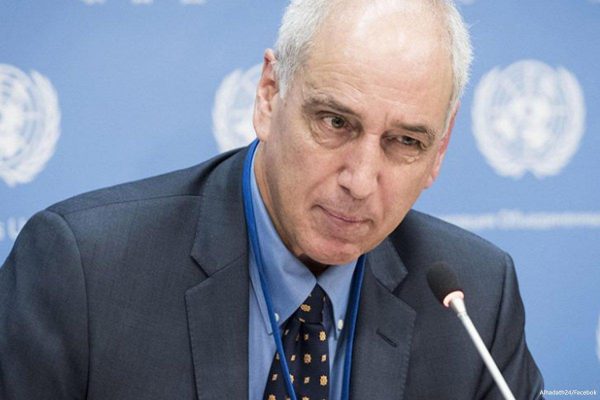
Michael Lynk, Special Rapporteur on the situation of human rights in the Palestinian territories occupied Michael Lynk [Alhadath24/Facebok]
MEMO | March 22, 2017
The UN Special Rapporteur on the situation of human rights in the Palestinian territories occupied since 1967, Michael Lynk, has described the Israeli occupation as “the most malignant” in the world. The Canadian official added that perpetuating an alien rule over almost five million people, against their fervent wishes, inevitably requires the repression of rights, the erosion of the rule of law, the abrogation of international commitments and the imposition of deeply discriminatory practices.
Lynk accused Israel of humiliating the Palestinians and intensifying the crackdown on human rights activists. He presented his report to the UN Commission on Human Rights and Human Rights Council during its latest session on Israel. Israeli and US diplomats boycotted the session dedicated to several UN reports criticising Israeli settlements, the blockade of Gaza and the excessive use of force against Palestinians.
The report also criticised the Palestinian authorities for their violations, including unlawful killings and detentions. It comes after the resignation of the Executive Secretary of the UN Economic and Social Commission for Western Asia, Rima Khalaf, after her report accusing Israel of being an apartheid state was rejected by the international body under pressure from Israel and the US.
The US boycotted the debate on Israel and the occupied Palestinian territories in Geneva on Monday, claiming that the UN Human Rights Council is biased against Israel. The move came after the US administration announced in March that it would review its relationship with the Geneva-based council, in light of its strong focus on Israel, Washington’s ally.
The HRC regularly addresses many areas of tension, including Syria and North Korea. However, Israel is the only state regularly placed on a separate agenda item with numerous human rights reports.
US State Department spokesman Mark Toner claimed in a statement from Washington that the discussion of the Monday session is an additional reminder of the long-standing bias of this body against Israel. “The continued existence of this item on the agenda is among the greatest threats to the council’s credibility,” he added.
Read also:
Facebook expands roll-out of fact-checker in ‘fake news’ crackdown
RT | March 22, 2017
Facebook has expanded the roll-out of its fact-checker tool to combat ‘fake news’ as more users report the appearance of the ‘disputed’ message alert. The pop-up lets users know when a story’s accuracy is questionable before they share it.
Users in regions including the US have reported seeing the warning, advising them that “before you share this content, you might want to know that the fact-checking sites, Snopes.com and Associated Press disputed its accuracy.”
The alert then allows the user to share the story or cancel.
The tool is not yet in operation in all regions, with the UK, Ireland and Australia among countries so far known not to be seeing the alert when tested against a story known in some regions of the US to display the alert.
The alert first appeared earlier this month, when users reported a ‘disputed’ news tag appearing on stories deemed false by the organizations employed by Facebook to fact check.
Associated Press (AP), one of the fact checkers partnered with Facebook, published details last week on why a story on the alleged Irish slave trade was false. The story it’s based on is prompting the ‘disputed’ alert when users attempt to share it on Facebook.
Facebook announced the plan to crack down on ‘fake news’ last December, following unproven claims it contributed to the US presidential election result by providing a vehicle for questionable news sources.
The tech giant partnered with fact checkers including ABC News, FactCheck.org, AP, Snopes and Politifact as part of the plan.
READ MORE:
Facebook begins ‘fake news’ crackdown with ‘disputed’ story tag roll out
A Breach in the Anti-Putin Groupthink
By Gilbert Doctorow | Consortium News | March 21, 2017
Realistically, no major change in U.S. foreign and defense policy is possible without substantial support from the U.S. political class, but a problem occurs when only one side of a debate gets a fair hearing and the other side gets ignored or marginalized. That is the current situation regarding U.S. policy toward Russia.
For the past couple of decades, only the neoconservatives and their close allies, the liberal interventionists, have been allowed into the ring to raise their gloves in celebration of an uncontested victory over policy. On the very rare occasion when a “realist” or a critic of “regime change” wars somehow manages to sneak into the ring, they find both arms tied behind them and receive the predictable pounding.
While this predicament has existed since the turn of this past century, it has grown more pronounced since the U.S.-Russia relationship slid into open confrontation in 2014 after the U.S.-backed coup in Ukraine overthrowing elected President Viktor Yanukovych and sparking a civil war that led Crimea to secede and join Russia and Ukraine’s eastern Donbass region to rise up in rebellion.
But the only narrative that the vast majority of Americans have heard – and that the opinion centers of Washington and New York have allowed – is the one that blames everything on “Russian aggression.” Those who try to express dissenting opinions – noting, for instance, the intervention in Ukrainian affairs by Assistant Secretary of State Victoria Nuland as well as the U.S.-funded undermining on Yanukovych’s government – have been essentially banned from both the U.S. mass media and professional journals.
When a handful of independent news sites (including Consortiumnews.com) tried to report on the other side of the story, they were denounced as “Russian propagandists” and ended up on “blacklists” promoted by The Washington Post and other mainstream news outlets.
An Encouraging Sign
That is why it is encouraging that Foreign Affairs magazine, the preeminent professional journal of American diplomacy, took the extraordinary step (extraordinary at least in the current environment) of publishing Robert English’s article, entitled “Russia, Trump, and a new Détente,” that challenges the prevailing groupthink and does so with careful scholarship.
In effect, English’s article trashes the positions of all Foreign Affairs’ featured contributors for the past several years. But it must be stressed that there are no new discoveries of fact or new insights that make English’s essay particularly valuable. What he has done is to bring together the chief points of the counter-current and set them out with extraordinary writing skills, efficiency and persuasiveness of argumentation. Even more important, he has been uncompromising.
The facts laid out by English could have been set out by one of several experienced and informed professors or practitioners of international relations. But English had the courage to follow the facts where they lead and the skill to convince the Foreign Affairs editors to take the chance on allowing readers to see some unpopular truths even though the editors now will probably come under attack themselves as “Kremlin stooges.”
The overriding thesis is summed up at the start of the essay: “For 25 years, Republicans and Democrats have acted in ways that look much the same to Moscow. Washington has pursued policies that have ignored Russian interests (and sometimes international law as well) in order to encircle Moscow with military alliances and trade blocs conducive to U.S. interests. It is no wonder that Russia pushes back. The wonder is that the U.S. policy elite doesn’t get this, even as foreign-affairs neophyte Trump apparently does.”
English’s article goes back to the fall of the Soviet Union in the early 1990s and explains why and how U.S. policy toward Russia was wrong and wrong again. He debunks the notion that Boris Yeltsin brought in a democratic age, which Vladimir Putin undid after coming to power.
English explains how the U.S. meddled in Russian domestic politics in the mid-1990s to falsify election results and ensure Yeltsin’s continuation in office despite his unpopularity for bringing on an economic Depression that average Russians remember bitterly to this day. That was a time when the vast majority of Russians equated democracy with “shitocracy.”
English describes how the Russian economic and political collapse in the 1990s was exploited by the Clinton administration. He tells why currently fashionable U.S. critics of Putin are dead wrong when they fail to acknowledge Putin’s achievements in restructuring the economy, tax collection, governance, improvements in public health and more which account for his spectacular popularity ratings today.
English details all the errors and stupidities of the Obama administration in its handling of Russia and Putin, faulting President Obama and Secretary of State (and later presidential candidate) Hillary Clinton for all of their provocative and insensitive words and deeds. What we see in U.S. policy, as described by English, is the application of double standards, a prosecutorial stance towards Russia, and outrageous lies about the country and its leadership foisted on the American public.
Then English takes on directly all of the paranoia over Russia’s alleged challenge to Western democratic processes. He calls attention instead to how U.S. foreign policy and the European Union’s own policies in the new Member States and candidate Member States have created all the conditions for a populist revolt by buying off local elites and subjecting the broad populace in these countries to pauperization.
English concludes his essay with a call to give détente with Putin and Russia a chance.
Who Is Robert English?
English’s Wikipedia entry and biographical data provided on his University of Southern California web pages make it clear that he has quality academic credentials: Master of Public Administration and PhD. in politics from the Woodrow Wilson School of Public and International Affairs at Princeton University. He also has a solid collection of scholarly publications to his credit as author or co-editor with major names in the field of Russian-Soviet intellectual history.
He spent six years doing studies for U.S. intelligence and defense: 1982–1986 at the Department of Defense and 1986-88 at the U.S. Committee for National Security. And he has administrative experience as the Director of the USC School of International Relations.
Professor English is not without his political ambitions. During the 2016 presidential election campaign, he tried to secure a position as foreign policy adviser to Democratic hopeful Sen. Bernie Sanders. In pursuit of this effort, English had the backing of progressives at The Nation, which in February 2016 published an article of his entitled “Bernie Sanders, the Foreign Policy Realist of 2016.”
English’s objective was to demonstrate how wrong many people were to see in Sanders a visionary utopian incapable of defending America’s strategic interests. Amid the praise of Sanders in this article, English asserts that Sanders is as firm on Russia as Hillary Clinton.
By the end of the campaign, however, several tenacious neocons had attached themselves to Sanders’s inner circle and English departed. So, one might size up English as just one more opportunistic academic who will do whatever it takes to land a top job in Washington.
While there is nothing new in such “flexibility,” there is also nothing necessarily offensive in it. From the times of Machiavelli if not earlier, intellectuals have tended to be guns for hire. The first open question is how skilled they are in managing their sponsors as well as in managing their readers in the public. But there is also a political realism in such behavior, advancing a politician who might be a far better leader than the alternatives while blunting the attack lines that might be deployed against him or her.
Then, there are times, such as the article for Foreign Affairs, when an academic may be speaking for his own analysis of an important situation whatever the political costs or benefits. Sources who have long been close to English assure me that the points in his latest article match his true beliefs.
The Politics of Geopolitics
Yet, it is one thing to have a courageous author and knowledgeable scholar. It is quite another to find a publisher willing to take the heat for presenting views that venture outside the mainstream Establishment. In that sense, it is stunning that Foreign Affairs chose to publish English and let him destroy the groupthink that has dominated the magazine and the elite foreign policy circles for years.
The only previous exception to the magazine’s lockstep was an article by University of Chicago professor John Mearsheimer entitled “Why the Ukraine Crisis is the West’s Fault” published in September 2014. That essay shot holes in Official Washington’s recounting of the events leading up to the Russian annexation of Crimea and intervention in the Donbass.
It was a shock to many of America’s leading foreign policy insiders who, in the next issue, rallied like a collection of white cells to attack the invasive thinking. But there were some Foreign Affairs readers – about one-third of the commenters – who voiced agreement with Mearsheimer’s arguments. But that was a one-time affair. Mearsheimer appears to have been tolerated because he was one of the few remaining exponents of the Realist School in the United States. But he was not a Russia specialist.
Foreign Affairs may have turned to Robert English because the editors, as insider-insiders, found themselves on the outside of the Trump administration looking in. The magazine’s 250,000 subscribers, which include readers from across the globe, expect Foreign Affairs to have some lines into the corridors of power.
In that regard, the magazine has been carrying water for the State Department since the days of the Cold War. For instance, in the spring issue of 2007, the magazine published a cooked-up article signed by Ukrainian politician Yuliya Tymoshenko on why the West must contain Russia, a direct response to Putin’s famous Munich speech in which he accused the United States of destabilizing the world through the Iraq War and other policies.
Anticipating Hillary Clinton’s expected election, Foreign Affairs’ editors did not hedge their bets in 2016. They sided with the former Secretary of State and hurled rhetorical bricks at Donald Trump. In their September issue, they compared him to a tin-pot populist dictator in South America.
Thus, they found themselves cut off after Trump’s surprising victory. For the first time in many years in the opening issue of the New Year following a U.S. presidential election, the magazine did not feature an interview with the incoming Secretary of State or some other cabinet member.
Though Official Washington’s anti-Russian frenzy seems to be reaching a crescendo on Capitol Hill with strident hearings on alleged Russian meddling in the presidential election, the underlying reality is that the neocons are descending into a fury over their sudden loss of power.
The hysteria was highlighted when neocon Sen. John McCain lashed out at Sen. Rand Paul after the libertarian senator objected to special consideration for McCain’s resolution supporting Montenegro’s entrance into NATO. In a stunning breach of Senate protocol, a livid McCain accused Paul of “working for Vladimir Putin.”
Meanwhile, some Democratic leaders have begun cautioning their anti-Trump followers not to expect too much from congressional investigations into the supposed Trump-Russia collusion on the election.
In publishing Robert English’s essay challenging much of the anti-Russian groupthink that has dominated Western geopolitics over the past few years, Foreign Affairs may be finally bending to the recognition that it is risking its credibility if it continues to put all its eggs in the we-hate-Russia basket.
That hedging of its bets may be a case of self-interest, but it also may be an optimistic sign that the martyred Fifteenth Century Catholic Church reformer Jan Hus was right when he maintained that eventually the truth will prevail.
Gilbert Doctorow is a Brussels-based political analyst. His latest book, Does Russia Have a Future? was published in August 2015.
Trump opens the Russia file, finally
By M K Bhadrakumar | Indian Punchline | March 21, 2017
The first half of April will witness the first major forays by the United States into the foreign policy arena under President Donald Trump. The summit with Chinese President Xi Jinping is slated for April 6-7 at Trump’s Mar-a-Lago resort in Florida. On April 12, Secretary of State Rex Tillerson will be visiting Moscow.
There is much heartburn already in Washington and in some European capitals that Trump administration is showing preference for big powers and is ‘ignoring old allies’. The lamentation is factually baseless. There have been a string of visits by leaders of allied powers to meet with Trump in the White House – Theresa May, Angela Merkel, Shinzo Abe and so on.
Interestingly, however, Tillerson showed disinterest in attending the NATO foreign ministers meeting in Brussels on April 5-6 and is instructing his deputy Tom Shannon to represent the US, pleading he will be preoccupied with Xi’s visit to Florida. The Reuters reported that NATO offered to re-schedule the Brussels meeting to suit Tillerson’s convenience, but that Washington ‘rebuffed’ the offer.
If so, it is a big statement on the Trump administration’s foreign-policy priorities. Possibly, Washington has decided to subject the alliance to a spell of benign neglect if only to show who calls the shots in the western alliance system. There were some testy exchanges between the US and Germany over Trump’s taunt against the backdrop of German Chancellor Angela Merkel’s recent trip to the White House that “Germany owes vast sums of money to NATO & the United States must be paid more for the powerful, and very expensive, defense it provides to Germany!” German Defense Minister Ursula von Der Leyen, a close associate of Merkel, promptly snapped back at Trump the next day saying, “There is no debt account at NATO.” (See my blog Trump hangs tough on Germany, eases on China.)
At any rate, the symbolism is profound when Tillerson signals that he has more important things to do than wasting time with NATO counterparts. The message Trump conveys here is that he doesn’t care to consult the NATO allies or to handle Russia ties on the basis of a unified policy toward Russia with the European allies. Trump would rather pursue US interests. In essence, it means he will not be held hostage by the European allies in the pursuit of his agenda to engage with Russia constructively and improve relations with Russia, western sanctions notwithstanding.
Interestingly, mutinous elements within the US state department – probably Obama-era holdovers – appear to have leaked the info regarding Tillerson’s intention to travel to Russia on April 12, presumably with a view to create a public controversy and somehow force the cancellation of the visit. (Guardian ) This, in turn, prompted the state department to formally announce on Monday within a few hours of the Reuters report that Tillerson proposes to travel to Moscow. It is extremely unusual for a VIP visit to be formally announced full 3 weeks in advance. In sum, Trump administration is creating a fait accompli. Curiously, Moscow learnt about Tillerson’s visit from the state department announcement!
In the Byzantine world of diplomacy, this presents itself indeed as one of those extraordinary spectacles where powerful interest groups or die-hard ideologues in Washington and holdovers from the Obama administration within the USG plus kindred souls in some European capitals — Britain and Germany, in particular — just do not want any easing of US-Russia tensions! They would rather have war drums beating! One is reminded of the famous slice of our own history in 1960 in Delhi when some of Jawaharlal Nehru’s cabinet colleagues demanded that the visiting Chinese Premier Chou-En Lai should not be allowed to have a private session with the then Defence Minister Krishna Menon, which, they feared, might lead to some amicable formula for border settlement! (Indira Gandhi apparently received Chou at Nehru’s reception at Teen Murti House clad in a Tibetan dress.)
Be that as it may, it seems Trump is beginning to force the pace of his foreign-policy agenda. What all this underscores is that Trump is finally asserting. His address to the US Congress, in retrospect, would have been the turning point. All the hoopla over the FBI investigation over alleged Russian interference in the November election in the US hasn’t affected him. Trump seems supremely confident of weathering the storm, and is going ahead on that basis.
One purpose of Tillerson’s visit to Moscow could be to prepare a summit meeting between Trump and Russian President Vladimir Putin.
“There is no American Deep State…it just looks like there is”
By Kit | OffGuardian | March 21, 2017
Last week the New Yorker, and yesterday Salon magazine, published editorials arguing against the very existence of an “American Deep State”. The arguments presented are very… interesting. Both are, perhaps, classic cases of protesting too much.

Well, I don’t know about you guys, but I’m convinced.
This article, appearing in the New Yorker on Sunday, sets out to tell its readers that there is no such thing as an American “deep state”, repeatedly rubbishing the very idea whilst – at the same time – making a compelling case for the exact opposite.
To start off the author, David Remnick, relates a very cheery sounding story about a young man’s transformative journey from junior naval officer to hard-hitting journalist. I shall relate it to you in bullet points, for the sake of brevity:
- In 1970 junior naval officer Bob Woodward, a Yale graduate and member of the Book and Snake secret society, goes to the White House Situation room. At night.
- Whilst there, he meets a high-up at the FBI named Mark Felt, an intelligence veteran and long-time loyalist to J. Edgar Hoover.
- For reasons unknown the two men discuss the career prospects of young Mr Woodward. Mr Felt gives Woodward advice about pursuing “only employment that interests him”.
- Later that year Woodward leaves the navy, and applies for a job at the Washington Post. He doesn’t get it, thanks to a complete lack of any journalistic experience. He spends a year working at a minor local paper instead, before being hired by the WaPo in 1971.
- Throughout this time Woodward and his FBI friend are in constant contact, Woodward thinking of Felt as a “career counsellor”.
- Felt confides in Woodward that he sees the Nixon administration as “corrupt, paranoid, and trying to infringe on the independence of the Bureau”.
- In 1973 Felt, under the alias “Deep Throat”, leaks Woodward information on the Watergate break-in, and – by proxy – brings down the Nixon administration.
How does that story read to you? There are unquestionably overtones of Operation Mockingbird, right?
Well, not according to Remnick. He tells us the meeting was accidental, the friendship natural, the career advice sincere and the leak opportunistic. He asks the rhetorical question:
Was Deep Throat part of the Deep State?”
As if the only logical answer is “no, of course not”, when in truth any answer other than “Yes, almost certainly” shows a level of willful blindness or chronic naivety that probably merits medication. We are expected to believe that a young naval officer, with no previous interest or experience in journalism, takes career advice from a senior FBI agent after one (accidental) meeting, leaves the navy, becomes a reporter, and ultimately acts as a key cog in what amounted to a “soft coup” in the United States. That is patently absurd.
As I said before, what is presented as a case against the existence of an American Deep State, makes a very strong argument for both its existence, and its power.
Next, Remnick provides us with a little history on “Deep States”:
“Deep State” comes from the Turkish derin devlet, a clandestine network, including military and intelligence officers, along with civilian allies, whose mission was to protect the secular order established, in 1923, by the father figure of post-Ottoman Turkey, Mustafa Kemal Atatürk. It was behind at least four coups, and it surveilled and murdered reporters, dissidents, Communists, Kurds, and Islamists. The Deep State takes a similar form in Pakistan, with its powerful intelligence service, the I.S.I., and in Egypt, where the military establishment is tied to some of the largest business interests in the country.
You see, he’s not arguing that Deep State power structures don’t exist – he willingly admits that they do – it’s just that they don’t have them in America. His argument for this is simple… or at least, it probably would be if he were to make one. What he actually DOES is simply describe how deep states work in other countries, and then leave an ellipsis that’s meant to convey “and of course none of that is true in the USA”, when in fact – again – it does the exact opposite.
What he does is supply us a short checklist of qualities which define a “Deep State”:
- Clandestine and secretive
- Involving military and intelligence officers
- civilians allies
- Protecting the status quo
- coups
- surveillance
- assassinations
- ties to big business interests
Does that not sound the least bit familiar to anyone else? The first two are givens that need no explanation.
Civilian allies? Well, I would imagine that a planted and/or manipulated journalist would make a good “civilian ally”. Such a person could be used to “leak” information that brings down enemies of the Deep State. Or, indeed, to write clumsy editorials about how the Deep State doesn’t even exist.
Protecting the status quo. The protection of “secular order” in Turkey could easily be translated as the protection of the neo-liberal order in the United States. It is essentially a program of protecting those in power from any kind of change. In fact, the way Remnick writes about this mission, it’s almost as if he is arguing that the noble ends justify ignoble means. That’s an interesting subtext to include.
Coups, surveillance and assassinations. Turkey’s derin devlet was behind only four coups? That’s a busy morning at the CIA. Surveillance? Well, it has suited the MSM of late to pretend they didn’t tell us all about the level of surveillance we operate under every single day. But we all know. Assassinations? Yes, there are a few famous examples, and a few not so famous. Blowing the President’s head off in the middle of a public square probably counts.
Ties to big business? Well Eisenhower admitted that, and warned against it, sixty years ago. Soros Open Society Foundation frequently collaborates with the State Department, as does the Bill and Melinda Gates Foundation. The Pentagon’s ties to Boeing and Lockheed Martin are well documented, as is Dick Cheney’s involvement with Halliburton. The list is endless.
As an eight-point definition of a “deep state”, America’s power structures certainly seem to stand as a perfect template.
Now we come to the good part. The part where Remnick is forced to include a lot of information he’d rather pretend wasn’t true, because – if he didn’t mention it – he would open himself up awful lot of correction and/or ridicule… even more so than he does already.
One does not have to be ignorant of the C.I.A.’s abuses—or of history, in general—to reject the idea of an American Deep State. Previous Presidents have felt resistance, or worse, from elements in the federal bureaucracies: Eisenhower warned of the “military-industrial complex”; L.B.J. felt pressure from the Pentagon; Obama’s Syria policy was rebuked by the State Department through its “dissent channel”.
You see, there undoubtedly are powerful secretive intelligence organisations with ties to big business and the military. Yes, you can point to the uncontested public record of literally dozens of crimes – both international and domestic – carried out by these agencies (calling coups and wars “abuses”, is craven apologist language). Yes, it’s perfectly true that many Presidents (from both parties) have faced domestic opposition from these agencies, to their eventual ruin in some cases. Yes, some of those President’s – including Truman, Eisenhower and Kennedy – have publicly warned against the influence of these unelected actors and agencies… but – BUT – that doesn’t mean America has a “Deep State. Because:
… to use the term as it is used in Turkey, Pakistan, or Egypt is to assume that all these institutions constitute part of a subterranean web of common and nefarious purpose.
Which begs the response: “And?”
For one thing, David, it’s not to assume that, it’s to reason that… based on evidence (including all the evidence you helpfully supply in your article). It was your self-appointed task to provide a counter-argument to this reading of the evidence…. and you have failed. Miserably.
However, David Remnick is not alone in his ineffectual assertion that “there is no deep state, it just looks like there is”. Further arguments that there are no “secretive military and intelligence collectives” pushing their agendas through “civilian allies”, was published in Salon. It is an editorial on the exact same subject, published on the exact same day, with almost the exact same title.
The author, Ryan Bohl, argues (in apparent seriousness) that deep states are definitely real, that Egypt has one, but that American can’t have one… because America and Egypt are different.
His assertions that America “doesn’t have a deep state”, would probably hold more water if he displayed any kind of understanding of what the term actually means. Instead he has, in truly Orwellian fashion, redefined the phrase in order to present a counter-argument… and even then barely manages to scrape one together.
… a major flaw of the American Deep State theory is that a deep state needs a weak state to survive
I’m not sure where Bohl got this statement from. I suspect he made it up. It means nothing, and is never backed up by any kind of sources, analysis or evidence. It is a baseless factoid, invented to allow the author to use the rhetorical trick of shifting the argument. Having “established” that a Deep State cannot exist within a strong nation, the author no longer has to disprove the deep states existence… but can now focus on proving that America is strong. Unfortunately for him, he is equally bad at this.
What does a weak state look like? For one, it’s horrifically ineffective: not a “I can’t believe they made me wait 45 minutes for my driver’s license when there were only six people in front of me” nuisance, but “I can’t believe I had to spend 2 years, $4000, and know an official at the Ministry of Transport via a relative to get my license”-style corruption. It is a state that fails to provide water, electricity, schools, and roads on a vast scale every single day.
The logic is obviously terrible. His argument that a deep state can only exist within weak and corrupt infrastructure? A completely unjustifiable a priori assumption. One that is never established with any kind of evidence.
… but let’s suppose, for the sake of argument, that he’s right – doesn’t America have a failing infrastructure?
Doesn’t America house 20% of all the incarcerated people on the planet? Aren’t many of these people held in corrupt private prisons? Aren’t post-industrial cities falling apart? Didn’t Detroit have no water for weeks at a time? And didn’t Flint have toxic water? Aren’t there roads and bridges crumbling? Didn’t New Orleans flood because of neglected levees? Aren’t their dams crumbling to dust?
Have not Salon themselves published two articles in the last month about the collapsing American infrastructure?
If a state is labeled “weak” on the quality of its infrastructure and development, then any objective observer would have to accept that America is weak. In many cases it is practically a third world nation. But Bohl has a response:
It can seem like the United States has a weak state when you compile the many anecdotes of bad roads, bridges, schools, water supplies, and other creaky public services. But this is misleading: just because you know a lot of stories about a topic doesn’t mean you know anything about its societal scale.
You see, much like the deep state, it might seem like America is falling apart… but it’s not really. Just look at the statistics he cites. Of course, these statistics are “indexes”, with a secret formula entirely invented by America-based NGOs who are almost certainly part of the (entirely fictional) American deep state.
There is also yet another critical argument against an America deep state: the regular transfer of power.
Another flawed argument. The very theory he is arguing against is that the elected officials possess very little power at all, and, as such, power is never transferred. Rather, the puppet is replaced.
What frustrates Trump and his allies is not a conspiracy of a CIA/State Department/journalists/Democrats/Obama/Pentagon cabal, agenda-driven to impose some secret world order upon the United States. Rather, they are encountering the hard edges of America’s geopolitical interests.
You see, it’s not that there is a deep state with an agenda, it’s just that America has concrete, innate “interests” that cannot be threatened by elected officials without encountering massive resistance from the agencies whose job it is to protect these interests.
… it is not in America’s interests to align with Russia any more than it has to, especially under the Putin government. So long as Russia has an independent foreign policy, it will be a threat to both NATO and the American-led world order; only bringing its foreign policy into the American-led alliance system will end that condition.
It is counter to the unquestioned and never-changing “interests” of the USA to have friendly relations with Russia, so naturally if the elected representatives of the people try to improve those relations, then the CIA/State Dept./FBI/the media and other unelected bodies will work together in opposing those plans.
This does not mean America has a deep state.
America having geo-political interests that extend beyond the power of the people’s elected officials is NOT evidence of a “deep state”… because? Well…
As the deep state accusations grow, it would behoove some to visit Egypt, stay a while, and try to get a driver’s license. That is what a place with a deep state truly feels like.
… have you ever tried getting a driver’s license in Cairo?
*
So two…
… wait, did I say two? I meant three four five six seven.
Seven non-members of the non-deep state are so enraged by the idea that people might think the totally fake American deep state might be real, that they accidentally publish seemingly coordinated attacks on the very idea. Under very similar titles. All within the same few days. Citing the same “counter examples” of Egypt and Turkey. All acting with symmetrical umbrage.
That’s almost as unlikely as bumping into a senior FBI agent in the White House by chance, taking his off-hand advice about a career change and then accidentally breaking the story that results in the FBI’s removal of a President they perceived as a threat to their influence, when you think about it.
Never mind. I’m just paranoid. America doesn’t have a deep state.
It just sometimes really looks like it does.
Text of Resignation Letter by ESCWA Executive Secretary Rima Khalaf

Jadaliyya | March 18, 2017
The following is the resignation letter by ESWA Executive Secretary Rima Khalaf in response to the formal request by UN Secretary General Antonio Guterres that ESCWA withdraw the publication of a scholarly report (below) that found Israel guilty of apartheid.
Dear Mr. Secretary-General,
I have carefully considered your message conveyed through the Chef de Cabinet and assure you that at no point have I questioned your right to order the withdrawal of the report from our website or the fact that all of us working in the Secretariat are subject to the authority of its Secretary-General. Nor do I have any doubts regarding your commitment to human rights in general, or your firm position regarding the rights of the Palestinian people. I also understand the concerns that you have, particularly in these difficult times that leave you little choice.
I am not oblivious to the vicious attacks and threats the UN and you personally were subjected to from powerful Member States as a result of the publication of the ESCWA report “Israeli Practices towards the Palestinian People and the Question of Apartheid”. I do not find it surprising that such Member States, who now have governments with little regard for international norms and values of human rights, will resort to intimidation when they find it hard to defend their unlawful policies and practices. It is only normal for criminals to pressure and attack those who advocate the cause of their victims. I cannot submit to such pressure.
Not by virtue of my being an international official, but simply by virtue of being a decent human being, I believe, like you, in the universal values and principles that have always been the driving force for good in human history, and on which this organization of ours, the United Nations is founded. Like you, I believe that discrimination against anyone due to their religion, skin color, sex or ethnic origin is unacceptable, and that such discrimination cannot be rendered acceptable by the calculations of political expediency or power politics. I also believe people should not only have the freedom to speak truth to power, but they have the duty to do so.
In the space of two months you have instructed me to withdraw two reports produced by ESCWA, not due to any fault found in the reports and probably not because you disagreed with their content, but due to the political pressure by member states who gravely violate the rights of the people of the region.
You have seen first hand that the people of this region are going through a period of suffering unparalleled in their modern history; and that the overwhelming flood of catastrophes today is the result of a stream of injustices that were either ignored, plastered over, or openly endorsed by powerful governments inside and outside the region. Those same governments are the ones pressuring you to silence the voice of truth and the call for justice represented in these reports.
Given the above, I cannot but stand by the findings of ESCWA’s report that Israel has established an apartheid regime that seeks the domination of one racial group over another. The evidence provided by this report drafted by renowned experts is overwhelming. Suffice it to say that none of those who attacked the report had a word to say about its content. I feel it my duty to shed light on the legally inadmissible and morally indefensible fact that an apartheid regime still exists in the 21st century rather than suppressing the evidence. In saying this I claim no moral superiority nor ownership of a more prescient vision. My position might be informed by a lifetime of experiencing the dire consequences of blocking peaceful channels to addressing people’s grievances in our region.
After giving the matter due consideration, I realized that I too have little choice. I cannot withdraw yet another well-researched, well-documented UN work on grave violations of human rights, yet I know that clear instructions by the Secretary-General will have to be implemented promptly. A dilemma that can only be resolved by my stepping down to allow someone else to deliver what I am unable to deliver in good conscience. I know that I have only two more weeks to serve; my resignation is therefore not intended for political pressure. It is simply because I feel it my duty towards the people we serve, towards the UN and towards myself, not to withdraw an honest testimony about an ongoing crime that is at the root of so much human suffering. Therefore, I hereby submit to you my resignation from the United Nations.
Respectfully
Rima Khalaf
Featured Video

Spain train disaster raises questions over Israeli-linked security contractors
or go to
Aletho News Archives – Video-Images
From the Archives
Are There 50,000 ‘Israeli-born’ Individuals Living in the UK?
By Professor David Miller | August 18, 2026
Recent disclosures by the Zionist regime show that some 2,069 British nationals were serving in the IDF as of March 2025, according to Freedom of Information (FoI) requests submitted to the occupation forces (1,686 dual British-Israeli, plus 383 multinational). We cannot tell from the figures how many of these were already settler colonists and intend to stay in the colony, and how many will return or have returned to the UK. Presumably, those returning to the UK will number far fewer than 2,000, since many are known to have become permanently residents of the colony.
Additionally, the IDF figures only provide a snapshot, and do not tell us how many have served in the Jewish supremacist military either before or after March 2025. One way into the question of how many genocidaires are living in Britain is to ask how many current British residents were born in the Zionist colony. There is data on that, as we shall see. … continue
Blog Roll
 Aletho News
- Zelensky spent over 740 days outside Ukraine while West serves as his real home
- Indian captain of Russian ‘shadow fleet’ tanker faces 10-year jail term in UK
- Europe, US face higher heating bills amid Iran war fallout
- The Leak That Arrived Right on Cue
- No, New York Times, California’s Climate Has Always Been a Land of Flood, Drought, and Fire
- Are There 50,000 ‘Israeli-born’ Individuals Living in the UK?
- German CDU MPs Seek Climate “Misinformation” List
- The ‘Gaza Treatment’: How Media Headlines Obscure Who is Bombing Yemen
- Ro Khanna urges Democrats to strip Israel ‘integration’ provision from defense bill
- Why Iran designated British MI6, Royal Navy, and RAF as hostile, terrorist organizations
- If Americans Knew
- An error has occurred; the feed is probably down. Try again later.
- No Tricks Zone
- German Authorities Start Initiative To Evaluate Public Register For Climate “Disinformation” Spreaders!
- Zonal Asymmetry of Temperature Change in the Antarctic Circumpolar Current
- New Study: The Net Fossil Fuel Contribution To Rising Atmospheric CO2 Has Been Zero For 500 Years
- Germany’s Green Energy Transition Becoming Increasingly Expensive…Another 6 Trillion Euros!
- Sudden Stratospheric Warming, Powerful El Niño Combination May Lead To Extreme Europe Cold, Energy Crisis!
- Two New Studies Find Thwaites Glacier Melt Cannot Be Driven By Human Activity Or A Warming Ocean
- E-Cars Reduce CO2 Emissions By Only 41% Compared To Internal Combustion Engine Vehicles
- Predictions Made By Renowned Climate Professor Over Past Decades Have Been Proven To Be Poor
- New Study Suggests Large Regions Of The Pacific Ocean Have Been Cooling For The Last 80 Years
- Germany’s Green Energy Debacle: High Energy Costs Force Kahla Porzellan to Close After 182 Years!

