Contacts with Russian Embassy
By Jack Matlock | March 4, 2017
Our press seems to be in a feeding frenzy regarding contacts that President Trump’s supporters had with Russian Ambassador Sergei Kislyak and with other Russian diplomats. The assumption seems to be that there was something sinister about these contacts, just because they were with Russian diplomats.

Former US Ambassador to the USSR Jack Matlock
As one who spent a 35-year diplomatic career working to open up the Soviet Union and to make communication between our diplomats and ordinary citizens a normal practice, I find the attitude of much of our political establishment and of some of our once respected media outlets quite incomprehensible. What in the world is wrong with consulting a foreign embassy about ways to improve relations? Anyone who aspires to advise an American president should do just that.
Yesterday I received four rather curious questions from Mariana Rambaldi of Univision Digital. I reproduce below the questions and the answers I have given.
Question 1: Seeing the case of Michael Flynn, that has to resign after it emerged that he spoke with the Russian ambassador about sanctions against Russia before Trump took office, and now Jeff Sessions is in a similar situation. Why is so toxic to talk with Sergey Kislyak?
Answer: Ambassador Kislyak is a distinguished and very able diplomat. Anyone interested in improving relations with Russia and avoiding another nuclear arms race — which is a vital interest of the United States — should discuss current issues with him and members of his staff. To consider him “toxic” is ridiculous. I understand that Michael Flynn resigned because he failed to inform the vice president of the full content of his conversation. I have no idea why that happened, but see nothing wrong with his contact with Ambassador Kislyak so long as it was authorized by the president-elect. Certainly, Ambassador Kislyak did nothing wrong.
Question 2: According to your experience, are Russian ambassadors under the sight of the Russian intelligence or they work together?
Answer: This is a strange question. Intelligence operations are normal at most embassies in the world. In the case of the United States, ambassadors must be informed of intelligence operations within the countries to which they are accredited and can veto operations that they consider unwise or too risky, or contrary to policy.
In the Soviet Union, during the Cold War, Soviet ambassadors did not have direct control over intelligence operations. Those operations were controlled directly from Moscow. I do not know what Russian Federation procedures are today. Nevertheless, whether controlled by the ambassador or not, all members of an embassy or consulate work for their host government. During the Cold War, at least, we sometimes used Soviet intelligence officers to get messages direct to the Soviet leadership. For example, during the Cuban missile crisis, President Kennedy used a “channel” through the KGB resident in Washington to work out the understanding under which Soviet nuclear missiles were withdrawn from Cuba.
Question 3. How common (and ethic[al]) is that a person related with a presidential campaign in the US has contact with the Russian embassy?
Answer: Why are you singling out the Russian embassy? If you want to understand the policy of another country, you need to consult that country’s representatives. It is quite common for foreign diplomats to cultivate candidates and their staffs. That is part of their job.
If Americans plan to advise the president on policy issues, they would be wise to maintain contact with the foreign embassy in question to understand that country’s attitude toward the issues involved. Certainly, both Democrats and Republicans would contact Soviet Ambassador Dobrynin during the Cold War and discuss the issues with him.
As the person in charge of our embassy in Moscow during several political campaigns, I would often set up meetings of candidates and their staffs with Soviet officials. Such contacts are certainly ethical so long as they do not involve disclosure of classified information or attempts to negotiate specific issues. In fact, I would say that any person who presumes to advise an incoming president on vital policy issues needs to understand the approach of the country in question and therefore is remiss if he or she does not consult with the embassy in question.
Question 4: In a few words, What’s your point of view about Sessions-Kislyak case? Is possible that Sessions finally resigns?
Answer: I don’t know whether Attorney General Sessions will resign or not. It would seem that his recusal from any investigation on the subject would be adequate. He would not have been my candidate for attorney general and if I had been in the Senate I most likely would not have voted in favor of his confirmation. Nevertheless, I have no problem with the fact that he occasionally exchanged words with Ambassador Kislyak.
In fact, I believe it is wrong to assume that such conversations are somehow suspect. When I was ambassador to the USSR and Gorbachev finally allowed competitive elections, we in the U.S. embassy talked to everyone. I made a special point to keep personal relations with Boris Yeltsin when he in effect led the opposition. That was not to help get him elected (we favored Gorbachev), but to understand his tactics and policies and to make sure he understood ours.
The whole brou-ha-ha over contacts with Russian diplomats has taken on all the earmarks of a witch hunt. President Trump is right to make that charge. If there was any violation of U.S. law by any of his supporters — for example disclosure of classified information to unauthorized persons — then the Department of Justice should seek an indictment and if they obtain one, prosecute the case. Until then, there should be no public accusations.
Also, I have been taught that in a democracy with the rule of law, the accused are entitled to a presumption of innocence until convicted. But we have leaks that imply that any conversation with a Russian embassy official is suspect. That is the attitude of a police state, and leaking such allegations violates every normal rule regarding FBI investigations. President Trump is right to be upset, though it is not helpful for him to lash out at the media in general.
Finding a way to improve relations with Russia is in the vital interest of the United States. Nuclear weapons constitute an existential threat to our nation, and indeed to humanity. We are on the brink of another nuclear arms race, which would be not only dangerous in itself, but would make cooperation with Russia on many other important issues virtually impossible. Those who are trying to find a way to improve relations with Russia should be praised, not scapegoated.
Jack Matlock served as U.S. Ambassador to the Soviet Union from 1987 to 1991.
Cheerleading for Israel
Everyone’s doing it

By Philip Giraldi • Unz Review • March 7, 2017
Those of us who voted for Donald Trump in hopes that he would turn out to be the peace candidate are facing disappointment. He has increased the already bloated military budget by $54 billion and has appointed an outspokenly anti-Russian and anti-Iranian active duty general as his National Security Advisor. A retired general with pretty much the same views heads the Pentagon. President Trump meanwhile vows to “extinguish” ISIS without presenting any plan regarding how exactly that might be accomplished.
The most important objective of all, resetting with Moscow to avoid World War 3, is in reverse gear, with the appointment of Fiona Hill, a critic of Vladimir Putin, as Russian specialist at the National Security Council. Meanwhile, our clueless United Nations Ambassador calls for Russia to withdraw from Crimea, where 58% of the population is Russian and only 24% is Ukrainian. Reports circulating in Washington suggest that the one phone call between Trump and Putin was a disaster, with the U.S. president demanding an end to the New START nuclear weapons reduction treaty, which the Kremlin wants to renew, before going off on a tangential monologue about his unexpected electoral victory.
In fact, even though the individual neocons have largely been outed from the foreign and security policy positions they once dominated it would not be completely inappropriate to suggest that their legacy of military interventionism lives on in terms of what the Trump administration has been so far promoting to keep America “safe.” Where all of this will go is anyone’s guess.
But if there is one constant in all of this it is the bright shining beacon of Israel, with Trump recently enthusing over the “unbreakable” bond between the two countries. One hopes that he misspoke and really meant “unbearable” or even “unspeakable” but it is clear from other indications that The Donald has succumbed to the inevitable Washington groupthink regarding America’s greatest ally and best friend in the whole wide world.
On Sunday New York Governor Andrew Cuomo met with Israeli Prime Minister Benjamin Netanyahu to discuss “trade and security issues” without anyone complaining that he was in violation of the Logan Act, which apparently only applies if you are talking to Russians. And a congressional delegation is in Israel right now studying the feasibility of moving the U.S. Embassy to Jerusalem, which most foreign policy pundits consider to be a very bad idea. Meanwhile at the United Nations, the U.S. has blocked the appointment of former Palestinian prime minister Salam Fayyad as special representative to Libya. U.S. Ambassador Nikki Haley explained the veto, saying irrelevantly “For too long the U.N. has been unfairly biased in favor of the Palestinian Authority to the detriment of our allies in Israel. The United States does not currently recognize a Palestinian state or support the signal this appointment would send within the United Nations.”
Ambassador Haley has also denounced the international body in general terms, stating that she was “underscore[ing] the ironclad support of the United States for Israel,” adding that “I am here to emphasize that United States is determined to stand up to the U.N.’s anti-Israel bias.” And if anyone failed to understand, on March 1st, U.S. envoy to the U.N. Human Rights Council in Geneva Erin Barclay told the group that it must drop its “obsession with Israel” or risk Washington withdrawing from the organization. The suggestion that the U.S. might consider departing came, incidentally, directly from Israeli Prime Minister Benjamin Netanyahu, who proposed such action to Donald Trump to “delegitimize” the U.N. body.
It is ironic that in the midst of a media and congressional feeding frenzy on foreign interference in the U.S., the one country in the world that consistently leads Washington by the nose is immune from criticism. The subservient role dutifully played by every U.S. president since JFK when dealing with Tel Aviv has resulted in defining United States national interests in terms of Israeli perceptions. The real irony is that even though Trump is giving the Israelis everything they want and is bowing to the Israel Lobby and Jewish groups at every opportunity, it is still not enough. It is never enough. That is because the neoconservatives, who are mostly Jewish and themselves complete Israel-firsters, hate him, having overwhelmingly favored Hillary Clinton as president due to their conviction that she would be the more aggressive president. They now believe that if they succeed in forcing Trump’s resignation or impeachment they will return to power in whatever new government formulation is put in place, so they continue to pile on.
Israel’s friends characteristically either run or have the ear of the media and they are supported by a formidable Washington based lobbying machine to get their point across. Whenever anything happens in the Middle East or elsewhere that is related to Israel’s perceived interests the machine goes to work with multiple position papers presented to every congressional office the next morning by runners from AIPAC, AEI, FPI, WINEP, JINSA and FDD. No one else has the clout of the Israel Lobby.
And Trump is also being battered by Jewish interests coming from the political left. France’s greatest living poseur-hypocrite Bernard-Henri Levy, described as a “philosopher, filmmaker and activist,” has hammered Trump twice recently, first in The New York Times on January 19th. Levy, who has described the brutal Israel Defense Forces as “a democratic army, which asks itself so many moral questions” and who was a war-on-Libya cheerleader, warns that Trump is a threat to all American Jews. Why? Because even though he has showered benefits on Israel his love for the Jewish people is “insufficient.” Levy explains, “This love is precisely what is required of an American president in dealings affecting Israel.”
The reader might well be astonished by the chutzpah of Levy in demanding love on top of the $38 billion already in the pipeline and wonder even more why the New York Times would print such garbage. But the French whiz kid does not really explain his remark, instead going on to denounce the “betrayal” of Israel by President Barack Obama at the United Nations before explaining that as Trump is “deeply unpopular” it would not do for American Jews to embrace him closely even if it appears he is doing good things for Israel. And Levy provides “evidence” that Trump might not be what he seems, citing inter alia his speech before the Republican Jewish Coalition in which he said he didn’t need their money. Levy sees this as a precursor to genuine, full blooded anti-Semitism, and speculates that Trump will take revenge against Jews to show “that he is indeed smarter than they are.” Why would he do that? Because he “respects only power, money and the perquisites of the palace.”
Levy’s second foray second foray, on CNN a month later, took Trump to task for his “incredible slip” on January 27th, Holocaust Remembrance Day, when he did not single out Jewish victims of Nazi crimes and instead cited all of those exterminated by the Germans. For Levy, Jewish deaths are intrinsically more memorable and valuable than those of others and the failure to grant them special status is a “tell-tale trope of Holocaust deniers” and a “hallmark of the new anti-Semitism.”
Bernard-Henri goes on to cite more evidence of Trump’s closet anti-Semitism, including the assertion that he has failed to address the reality of “Jewish children who go to school full of fear.” While it is possible to dismiss Levy as a completely self-serving bullshit artist who badly needs a haircut and a bath, he is far from alone. Also on the left there is the renowned Professor Alan Dershowitz of Harvard University.
Dershowitz, threatening to leave the Democratic Party if it elected Keith Ellison chair of the party’s central committee, appeared frequently on television and in the print media claiming that Ellison was an enemy of Israel and of the Jewish people. The threat to leave the Democrats produced numerous jokes directed at the abrasive and unpopular lawyer somewhat akin to those crafted at the expense of the Hollywood celebrities who promised to leave the country if Donald Trump were elected president. Unfortunately, I have to note that neither Dershowitz nor Barbra Streisand has yet departed.
Ellison was the preferred candidate of the Bernie Sanders liberal wing of the party and initial opinion polls suggested that he would likely win the position. While Dershowitz’s bombast could be regarded with some amusement, there was another, darker side to the campaign to sideline Ellison, who is black, a Muslim and not openly hostile to the Palestinians. This last attribute inevitably made it possible to start a whispering campaign labeling him as anti-Semitic and a number of Jewish Democratic fundraisers, to include Israeli Haim Saban of Hillary Clinton fame, privately made it known that they would end their donations to the party if Ellison were elected. Barack Obama and the Clintons also piled on, even working the phones to stop Ellison.
When Ellison lost in a close result, Dershowitz announced that he would not be leaving the party after all because the result was a “victory in the war against bigotry, anti-Semitism, [and] the anti-Israel push of the hard left within the Democratic Party.” As evidence of Ellison’s anti-Israel sentiment Dershowitz cited the congressman’s vote against funding Iron Dome, which is the Israel missile defense system. “Can you imagine any reasonable person voting against a missile system designed to protect innocent civilians against terrorist rocket attacks?”
Indeed Dersh, but maybe the Israelis should be paying for it, not the American taxpayer, which is actually the crux of the matter. I for one am tired of the perpetual whining of Alan Dershowitz and international professional Jews like Bernard-Henri Levi, who is frequently in the U.S. doing richly rewarded speaking tours on the so-called “Synagogue circuit.” And someone should wake U.N Ambassador Nikki Haley up to the fact that her job is to take care of the American people, not Israel. Quite frankly, if these folks are so much in love with Israel they should go live there and leave the rest of us as well as the U.S. Treasury alone.
If we are heading into yet another round of Israel-centric foreign policy we will be inevitably involved in new wars, starting with Iran which has always been Netanyahu’s enemy of choice. And then there is Syria, where the Israelis would prefer a continuation of chaos, presumably carried out by Washington which can pay the bills and take the casualties. As Bernard-Henri Levy has made clear and the Talmud asserts, Jewish lives are more important than those of gentiles, so it is fit and proper that Americans should fight and die to make sure that Israel might prosper.
Exactly what are scientists marching ‘for’?
By Judith Curry | Climate Etc. | March 5, 2017
The smartest people on the planet want to oppose Trump & the best they can come up with is a march in support of themselves? – Roger Pielke Jr
A mega March for Science has been planned for Earth Day (April 22) in Washington DC. The web site states:
The March for Science demonstrates our passion for science and sounds a call to support and safeguard the scientific community. Recent policy changes have caused heightened worry among scientists.
The mischaracterization of science as a partisan issue, which has given policymakers permission to reject overwhelming evidence, is a critical and urgent matter. It is time for people who support scientific research and evidence-based policies to take a public stand and be counted.
Of course, the poster child for partisan ‘mischaracterization of facts’ is statements by members of the Trump administration regarding uncertainty surrounding the causes of climate change. President Obama and his Call Out the Climate Deniers campaign apparently elicited no concerns about partisan mischaracterization of facts from the science establishment.
Scientists fear what ‘might’ happen under the Trump administration — they are working from rumors, leaks and a few public statements by individuals connected with Trump’s transition teams. These are the same scientists pushing for ‘evidence based’ policies — go figure.
The American Geophysical Union (AGU) – which is joining the March – had a blog post describing the positions on climate change and science of important individuals in the Trump administration: Mick Mulvaney, Rick Perry, Wilbur Ross, Scott Pruitt, Ryan Zinke. Read the blog post. To me, Trump’s team looks like it has a healthier attitude to science than did Obama’s team, who sought to scientize policy debates and politicize science debates.
The scientists’ big concern is ‘silencing of facts’. This concern apparently derives from their desire to have their negotiated ‘facts’ — such as the ‘consensus’ on climate change — dictate public policy. The scientists who are marching seem not very interested in science as a process based on continually evaluating evidence and reassessing conclusions through reasoning and impartial habits of mind.
The scientists are not just out to defend ‘facts’ — they fear funding cuts and limits to immigration. They also seem very attached to safeguarding the academic scientific community and the elite institutions that support it.
Some sentiments from scientists supporting the March:
Caroline Weinberg: “[I]t is not possible to ignore policy when it affects not just your jobs but the future of your field.” [link]
Dr Jacquelyn Gill: “A lot of scientists are realizing that the institutions that fund and support and science in this country . . .are under direct attack.” Trump, she said, “not only doesn’t value our institutions, he doesn’t seem to value evidence-based decision making at all. That is alarming to us.” [link]
Other scientists are very concerned about the March:
Professor Jim Gates, former adviser to Barack Obama, told journalists that the march appeared to lack an end goal – a prerequisite for political action – and would simply be perceived as “science against Trump”. “At least as far as I can detect, there is no theory of action behind this,” he said. “This bothers me tremendously. “To have science represented as this political force I think is just extraordinarily dangerous.” [link]
Robert Young wrote that the march would be perceived as a protest of President Trump and “trivialize and politicize the science we care so much about.” “Trying to recreate the pointedly political Women’s March will serve only to reinforce the narrative from skeptical conservatives that scientists are an interest group and politicize their data, research and findings for their own ends.” [link]
Tactics in want of a strategy
So, exactly what do scientists expect to accomplish with this March, and how do they plan to go about it? Well, I am still at a loss to understand what they expect to accomplish, but there have been some interesting suggestions on how they might go about it.
Jonathan Foley in the Scientific American on how to defeat those who are waging war on science: portray an inclusive vision; get political; don’t fall into the culture war trap; balance facts with meaningful stories; be forceful.
Roger Pielke Jr in the Guardian : To counter Trump’s administration, scientists need counter-propaganda, evidence-based alternative policies and political representation. The scientific community needs to eschew old habits that have manifested themselves in the march: calling for more funding and waging political battles through science.
Kristy Henschel in Science : hold webinar viewing parties; host science policy seminars; design a science advocacy workshop; organize a State Hill day; invite your government representatives for a lab tour; host a science cafe; share your voice on twitter.
The most provocative suggestion comes from an editorial in Nature : Researchers should reach beyond the science bubble. Excerpt: Scientists in the United States and elsewhere ought to address the needs and employment prospects of taxpayers who have seen little benefit from scientific advances. As they ponder their next move in response to the election of Trump, science organizations — universities, funders, supporters and the rest — should look harder at social problems and opportunities, and seek ways for science to help.
JC reflections
So far, the March for Science seems to be shaping up as a self-serving navel gazing exercise for scientists — sort of a ‘we don’t like Trump’ tantrum. The impression that this will have on policy makers and the public will be to cement scientists as a politicized special interest group, just like any other lobbying group. In short, I very much fear that this March will do more harm than good.
It’s not too late to turn this around. We need to rethink the contract between scientists and government, and develop a new model for the the 21st century. Here are some recommendations:
- Embrace science as a process, not a collection of ‘facts’; invite the public to engage in the process of science.
- The institutions of science need to reform themselves, and scientists need to get out of the ivory tower and engage with the real world [link]
- Universities need a new business model and incentive structure for faculty members that doesn’t rely on massive federal research grants but rewards faculty for educating students at all levels and serving the needs of society.
- Scientists need a much better understanding of the policy process, the role that science plays, and how complexity, pluralism and uncertainty in science is accommodated in the policy process. Evidence-based policy making is a good political slogan, but not a good description of the policy process. [link]
- Scientists need to stop using science to support desired political outcomes.
- Scientists need to do more than push back against flawed arguments and bad policy. We need to engage the public, and, even more, invite the public, across the political spectrum, to engage with science. [link]
Lieberman Says Washington Warned Tel Aviv against Annexing West Bank
Al-Manar | March 6, 2017
Israeli Defense Minister Avigdor Lieberman said on Monday that the United States has warned that annexing the West Bank would lead to an “immediate crisis” with President Donald Trump’s administration.
Lieberman sought to push back against those in Prime Minister Benjamin Netanyahu’s coalition calling for a declaration of Israeli sovereignty over all or part of the occupied territory.
He said annexation would provoke a crisis with Washington and result in steep costs for the Israeli government since it would be required to provide services to Palestinians in the West Bank.
“We have received a very clear, direct message from the United States stating that the application of Israeli law in Judea and Samaria (the West Bank) would provoke an immediate crisis with the new administration,” Lieberman, who heads the right-wing Yisrael Beitenu party, said before a parliamentary committee.
Some 2.6 million Palestinians live in the West Bank, which the Zionist authorities occupied in 1967.
The latest call for annexation came on Sunday, when lawmaker Miki Zohar from Netanyahu’s Likud party said in a television interview that “the two-state solution is dead”.
Zohar advocated a single state, but said that Palestinians in the West Bank should not be allowed to vote in Israeli parliamentary elections.
Others have made similar calls, including Education Minister Naftali Bennett who heads the religious nationalist Jewish Home party.
Bennett advocates annexing most of the West Bank, and has said he hopes support from Trump’s presidency will spell the end of the idea of a Palestinian state.
In his comments on Monday, Lieberman also laid out an economic argument against annexation, saying Israel immediately “will be required to spend 20 billion shekels ($5.4 billion, 5.1 billion euros)” on various social services.
Following Donald Trump’s wiretap accusations Clapper and Comey make only qualified denials
By Alexander Mercouris | The Duran | March 6, 2017
Following Saturday’s charges come Sunday’s denials.
On Saturday in a series of tweets Donald Trump accused his predecessor Barack Obama of wiretapping his office in Trump Tower. A few hours later Obama responded with a statement published by his spokesman which neither admitted nor denied the wiretap but which said that Obama himself had never ordered surveillance within the US on anyone.
Then came an interview for NBC by Obama’s former Director of National Intelligence James Clapper. In it in carefully chosen words Clapper said that he had “no knowledge” of any FISA court authorising wiretaps of Trump Tower, and that no section of the US intelligence community which he supervised had carried out such a wiretap.
Some sections of the media – especially in Britain the BBC and the Guardian – have reported these denials in a way that gives the impression to a casual viewer or reader that Clapper has denied the existence of the wiretap outright. This is certainly not so. Clapper’s careful words were
[For the part of the national security apparatus that I oversaw] there was no such wiretap activity mounted against the president, the president-elect at the time, or as a candidate, or against his campaign….. I can’t speak for other authorized entities in the government or a state or local entity (bold italics added)
In words which have received far less publicity, Clapper also denied that he had seen any evidence of collusion between the Trump campaign and Russia, and said that the report on Russian interference in the election submitted to Obama and Trump, a redacted version of which was provided to Congress, and a further redacted (and content free) version of which was made public, made no such claim
Clapper was also asked on “Meet the Press” if he had any evidence that the Trump campaign was colluding with the Russian government while the Kremlin was working to influence the election.
“Not to my knowledge,” Clapper said, based on the information he had before his time in the position ended.
“We did not include anything in our report … that had any reflect of collusion between members of the Trump campaign and the Russians. There was no evidence of that included in our report,” he said. “We had no evidence of such collusion.”
A few hours after Clapper’s comments, there appeared an article in The New York Times drawing on the usual anonymous sources. This claimed that shortly after the President published his tweets on Saturday FBI Director Comey contacted the Justice Department to say that the President’s claim that Obama had ordered Trump’s phone in Trump Tower wiretapped was false, and asked the Justice Department to publish a retraction (as of the time of writing the Justice Department has published no such retraction).
In a comment which I see as intended to goad Comey into publishing his own statement denying the President’s claims, The New York Times questions why he has not done so
It is not clear why Mr. Comey did not issue a statement himself. He is the most senior law enforcement official who was kept on the job as the Obama administration gave way to the Trump administration. And while the Justice Department applies for intelligence-gathering warrants, the F.B.I. keeps its own records and is in a position to know whether Mr. Trump’s claims are true. While intelligence officials do not normally discuss the existence or nonexistence of surveillance warrants, no law prevents Mr. Comey from issuing the statement.
As I recall, The New York Times initially also made the very strange claim that because Jeff Sessions has recused himself from the investigation into the Trump campaign’s alleged contacts with Russia, Comey was finding it difficult to find anyone in the Justice Department competent to handle his request.
That cannot be true since Sessions’s statement on Friday made it clear that it would be the acting Deputy Attorney General Dana Boente who would henceforth be supervising the investigation and who Comey would therefore be dealing with. I notice that the current version of the story in The New York Times no longer makes this claim.
It is always difficult (and perhaps unwise) to comment on something someone is reported to have said based on accounts of what that person is reported to have said which are provided anonymously and at second hand. Assuming however that The New York Times story is true (as I believe) and assuming that Comey’s concerns are also being reported accurately (which with some qualifications I also believe) then Comey is not actually denying that a wiretap took place, merely that Obama ordered it. Here is the first paragraph of The New York Times report
The F.B.I. director, James B. Comey, asked the Justice Department this weekend to publicly reject President Trump’s assertion that President Barack Obama ordered the tapping of Mr. Trump’s phones, senior American officials said on Sunday. Mr. Comey has argued that the highly charged claim is false and must be corrected, they said, but the department has not released any such statement.
This is of course what Obama said in his statement on Saturday, and which (as I have already pointed out) is almost certainly true
The statement does not deny that Donald Trump’s office in Trump Tower was wiretapped. Nor does it deny that Donald Trump’s ‘associates’ (a flexible word the precise meaning of which has never been made clear) or members of his campaign team were placed under surveillance.
Instead it indirectly denies that Obama himself or people working directly under him in the White House ordered these actions. It does so by denying they have ever ordered surveillance of any US citizen, something which by the way is almost certainly true.
The statement hints than any order to wiretap Donald Trump’s office or for carrying out surveillance on Donald Trump’s ‘associates’ was the work of officials in the Justice Department, and it seeks to shift responsibility – or blame – onto them.
This too is almost certainly true. (bold italics added)
On the face of it therefore Comey’s comments – if they are being reported accurately – do not add anything to what following Obama’s statement of Saturday we already know.
Certain other comments attributed to Comey in The New York Times article are attracting less attention, though they are actually very interesting.
Firstly, it seems that what drove Comey to contact the Justice Department is concern that Donald Trump’s tweets on Saturday implied that the FBI by wiretapping his office had broken the law.
Mr. Comey, who made the request on Saturday after Mr. Trump levelled his allegation on Twitter, has been working to get the Justice Department to knock down the claim because it falsely insinuates that the F.B.I. broke the law, the officials said.
Comey’s concern here is entirely legitimate. As I have said previously, if there was a wiretap and if it was authorised by a court after an application made in the proper way by the Justice Department, then the wiretap was legal. Comey is absolutely right to want to set the record straight about this. Presumably in the absence of a public statement that will be done over the course of the Congressional inquiries which the President has now requested.
The second point is even more interesting, which is that The New York Times story again essentially confirms that the FBI investigation into the alleged collusion between the Trump campaign and Russia is drawing a blank.
In addition to being concerned about potential attacks on the bureau’s credibility, senior F.B.I. officials are said to be worried that the notion of a court-approved wiretap will raise the public’s expectations that the federal authorities have significant evidence implicating the Trump campaign in colluding with Russia’s efforts to disrupt the presidential election. (bold italics added)
This is very twisted language which shows that The New York Times is not reporting this part of the story straightforwardly. However the meaning is clear enough. The FBI is worried that the more discussion of its investigation there is – extending all the way to discussions by no less a person than the President himself of court approved wiretaps – the more people will fall for the false ‘no smoke without fire’ argument, and will feel let down by the FBI when it eventually announces that its investigation has drawn a blank.
This is an entirely valid concern, and is one of several reasons why such investigations are supposed to be confidential.
This is the second confirmation within a few hours from people who have held posts within the national security bureaucracy that the endlessly repeated claims of collusion between the Trump campaign and Russia are not supported by evidence. The first was made by Clapper (see above) and the second was made anonymously to The New York Times by officials of the FBI.
These admissions follow a continuous pattern of admissions from officials within the national security bureaucracy now stretching back months that inquiries into claims of collusion by the Trump campaign and Russia are drawing a blank.
Not only in the present paranoid atmosphere are these admissions being ignored, but the security agencies are being constantly bullied to divert more and more resources into more and more inquiries to find the evidence of collusion between the Trump campaign and Russia which officials of the security agencies repeatedly say is not there.
Students of political witch-hunts eg. the Popish Plot in Seventeenth Century England, the Stalinist purges of the 1930s, or the McCarthyite witch-hunts of the 1950s, will recognise the phenomenon.
The position therefore as of the time of writing is that Obama has denied – though in a very convoluted way – that he ordered a wiretap (though he has hinted that if there was a wiretap it was the Justice Department which requested it), Comey is reported as having also denied that Obama ordered a wiretap, and Clapper has denied that the part of the bureaucracy that he supervised sought or carried out a wiretap.
These are not denials that a wiretap took place. Neither are they admissions that it did take place. I have repeatedly warned against the logical error of inferring a positive from a negative, and of treating a denial of one thing as an admission of something else. What it is fair to say is that the fingers are being pointed towards Obama’s Justice Department, and that so far its senior officers – Loretta Lynch and Sally Yates – are staying silent.
US ex-intel chief Clapper believes Russia-Trump claims, despite ‘no evidence to his knowledge’
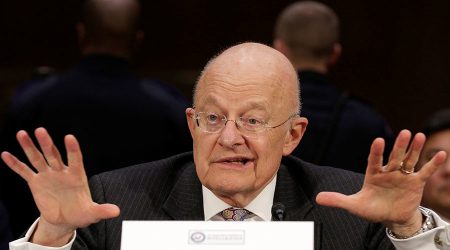
Former Director of National Intelligence (DNI) James Clapper. © Joshua Roberts / Reuters
RT | March 6, 2017
Former US Director of National Intelligence James Clapper has said on NBC’s ‘Meet the Press’ show that he is unaware of any evidence that the Russian government colluded with the Trump campaign during the US election, but still believes contacts existed.
“We didn’t include evidence in our report that had any reflection of collusion between members of the Trump campaign and the Russians. There was no evidence of that included in our report,” Clapper said, referring to a paper compiled by the NSA, FBI and CIA, together with the office of the DNI.
When asked if such proof even existed, he said: “Not to my knowledge.”
The show’s host, Chuck Todd, continued to press the issue, asking: “If [evidence] existed, it would have been in the report?”
Clapper answered that “this could have unfolded or become available in the time since I left the government. But at the time, we had no evidence of such collusion.”
Todd hinted that the public could start wondering if the situation is “all just smoke,” given the absence of a “smoking gun.”
“Well, that’s a good question. I don’t know,” Clapper responded. “I do think, though, it is in everyone’s interest, in the current president’s interests, in the Democrats’ interests, in the Republican interests, the country’s interest to get to the bottom of all of this, because it’s such a distraction. And certainly the Russians have to be chortling about the success of their efforts to sow dissension in this country.”
Clapper, however, still appeared unable to put his finger on where to look for any proof of the alleged “dissension-sowing.”
Asked if he still believed the Trump-Russia collusion claims, Clapper stated: “Yes, I do.”
Clapper is not the first to face questions over the issue of any substantial proof – or the lack thereof – of the Trump-Russia allegations.
At the end of February, the House Intelligence Committee chief, Rep. Devin Nunes, told journalists that they “still haven’t seen any evidence” of “any phone calls [between the Trump campaign and Russian officials]” but mysteriously added: “It doesn’t mean they don’t exist.”
Moscow has repeatedly denied allegations of contact with the Trump campaign, with the Kremlin spokesman lamenting that it’s become difficult to distinguish fact from fiction in the US media.
“Those reports are not based on concrete facts,” Dmitry Peskov said in mid-February, commenting on claims made by the New York Times and CNN, among others. Peskov noted that “there are five different sources in the story and none are named. So you see, really laughable stories are now given a go.”
Requiem for a Martyr: The “Blind Sheik”, Omar Abdel Rahman, Innocent Victim of Seditious Conspiracy Trial

By Karin Brothers | Global Research | March 5, 2017
“[America’s treatment of me] is a crime that history will never forgive.” – Omar Abdel Rahman
Sheik Omar Abdel Rahman, the “blind sheik”, died on the morning of February 18, 2017, near the 24th anniversary of the 1993 WTC bombing. He was an innocent victim of the US agenda to create a new enemy by engineering events that would make terrorism virtually synonymous with “Islamic fundamentalism”.
Sheik Rahman attained national fame in Egypt while he was on trial for inciting the 1981 assassination of former Egyptian President Anwar Sadat. With a passionate moral integrity, he courageously attacked the government during his two days on the stand; the intensive trial media gave him a national platform that made him famous throughout the Muslim world. His sermons were taped and traded throughout Egypt.
While he was vindicated of the charges against him, President Mubarak’s government ominously refused to give the necessary certification of the verdict and eventually drove Sheik Rahman out of Egypt. The Sheik went to Afghanistan, where he helped the CIA recruit Arab fighters to serve with the US-backed mujahadeen (he would lose at least one of his own sons there), and the Sheik was reportedly on the CIA payroll.
Sheik Rahman came to the US in 1990, hoping to remain until he could safely return to Egypt. According to Benjamin Begin in a 1993 Israel Today newsletter, Rahman’s mosques were infiltrated by FBI and Mossad operatives and would be the source of recruitment for their operations.
The World Trade Center explosion occurred on Friday, February 26th, 1993. The Sheik was soon declared deportable when some of those charged were identified as members of his mosques. The sheik was in the FBI’s crosshairs; the FBI offered Egyptian intelligence agent Emad Salem over one million dollars to entrap him.
The cagey Salem, who had become a trusted member of the Sheik’s inner circle, was aware of the obligation that the Sheik had as spiritual leader to respond to congregants’ needs. Salem blindsided the sheik by going to his home after midnight on a Sunday, pretending to be in a spiritual crisis. He claimed that he felt guilty for his years in the Egyptian military and needed to atone for his actions by attacking a target in the US — such as the United Nations. The sheik tried to fob him off and talked him out of that terrorist target; he suggested that a US military target would be more appropriate, but he told Salem to “slow down” — to cool off. Salem went home happy.
The Joint Anti-Terror Task Force and the Justice Department were allegedly dubious about whether they had evidence that would convict Rahman. The Sheik had repeatedly and publicly denounced the bombing of the WTC and claimed that he had nothing to do with it. Those who heard Emad Salem’s recorded attempt to incriminate the Sheik didn’t think it was persuasive enough to stand up in court. The FBI had tapped the Sheik’s telephones from two weeks before the WTC explosion until June, 1993; there was no evidence of any wrongdoing. The INS said he was complying with the requirements of his deportation appeal. Authorities noted that incarcerating the Sheik would be expensive because of his diabetes. A detention until appeals were completed could have lasted for months — if not for years.
Attorney General Janet Reno, who had publicly been reluctant to charge the Sheik, finally succumbed to the political pressure: pressure that also came from the Egyptian government, which still felt threatened by the Sheik’s popularity. Egyptian officials, afraid that Rahman would be deported to Egypt, wanted him safely incarcerated in the US. On July 1st, 1993, the Justice Department, while avoiding making any criminal charge, decided to take the Sheik into custody – “indefinite administrative detention” — on immigration charges.
The Egyptian conundrum
Egyptian President Hosni Mubarak was afraid of Rahman’s popularity and influence; he appeared to be worried about suffering the same fate as the Shah of Iran, deposed by a popular religious leader. Mubarak banned tapes of Sheik Rahman’s sermons; those found with copies were subject to up to five years in jail. Three thousand copies of a newspaper Al-Hayat that featured a March interview with Rahman were confiscated, and Rahman’s mosque in Fayoum was empty, guarded by a police agent.
While the Egyptian government had initially asked the Clinton administration to hold the Sheik to make sure he was not deported to Egypt, they changed their minds when they were informed that under the immigration charges, the sheik could accept his deportation voluntarily and go to any country that would take him, which could make him even more of a threat to the Mubarak government. After intense discussions, the US agreed to accept Egypt’s official extradition request, which it claimed would take precedence over the deportation charge. The only hitch was that appeals might take as long as eight years.
Mubarak was livid. He reminded the U.S. that he had hosted an Arab summit before the 1991 US-led invasion of Iraq which brought most of the Arab world onside, providing important “optics” for the engineered invasion.
Egyptian authorities were also outraged that two employees of the US Embassy had met earlier that year with prominent members of the Islamic Group, which regarded Sheik Rahman as their spiritual leader. The US seemed to be hedging its bets on Egyptian leadership so that it would not be caught out in Egypt as it had been in Iran, when Khomeini was swept into power. To add insult to injury, there was even a Congressional effort to cut back on US aid to Egypt.
President Mubarak then demonstrated to the Clinton administration who was in charge of Egypt. On July 8th, the Egyptian government hanged seven followers of Sheik Rahman for attacks against foreign tourists and for conspiring to overthrow the Mubarak government. It was the largest number of executions for a political crime in more than four decades, and it would be the start of a brutal campaign against dissidents that would last until the 2011 Arab Spring.
After witnessing Mubarak’s treatment of the Muslim Brotherhood, it was evident that Rahman’s supporters were powerless; Rahman was expendable.
US rejects political asylum for Rahman but can’t extradite him to Egypt
Meanwhile there were unforeseen complications with U.S. efforts to extradite Rahman to Egypt. While the Board of Immigration Appeals rejected Rahman’s appeal for political asylum, it appeared that his appeals would eventually reach the Supreme Court. Also, State Department officials realized that the 100-year old extradition treaty between the US and Egypt did not permit extradition based on “any crime or offense of political character.” While one official claimed that US courts were not limited by treaties, another noted that the treaty strengthened Rahman’s case for political asylum.
The Egyptian plan to ensure that Sheik Rahman would be placed under their control hit another challenge at the end of July when Afghanistan’s Prime Minister Gulbuddin Hekmatyar offered his country as a refuge for the Sheik. The Sheik’s lawyers realized that deportation might be the only way for the sheik to regain his freedom, so they contacted the office of U.S. Attorney Mary Jo White to request his deportation.
White’s office sat on the sheik’s deportation request while trying to accommodate Egypt’s demand for permanent control of the sheik. The problem was that those who were deported were free to go to any country that would accept them, but Egypt did not want the sheik in Afghanistan, where he would be free to communicate with his followers.
The “seditious conspiracy” solution
The sheik’s lawyers were still waiting for a response when, a week later, on August 25th, 1993, Attorney General Janet Reno issued an indictment for Sheik Rahman along with 14 others for “seditious conspiracy”, an obscure charge employed against political dissidents.
The 20-count, 27-page indictment claimed that one terrorist organization [which started in 1989, the year before the sheik arrived in the U.S.] was behind all of the plots and that Sheik Rahman, while not directly involved with the acts, was the “mastermind” who explicitly gave the orders. The listed plots included: plans to attack American military installations; plans to murder F.B.I. agents; plans to seize hostages to help release jailed conspirators; the 1990 killing of Rabbi Meir Kahane; the 1991 killing of Alkifah Center President Mustafa Shalabi; the 1993 WTC bombing [ambiguously included, since there was currently a separate trial for that]; the June “landmarks bombing plot”; and the plot to assassinate President Hosni Mubarak. The New York Times featured a map of the presumed terrorist targets; it appeared that New York City was under a Muslim siege.
The “seditious conspiracy” charge, which had been created to target Confederates at the end of the Civil War, was defined as when two or more people “conspire to overthrow, put down, or destroy by force the Government of the United States, or to levy war against them.” Experts noted that the broad nature of the conspiracy indictment, which did not require connecting a defendant to any specific act of violence and allowed prosecutors to bring in evidence not related to terrorist acts, made it possible to convict people with little proof (let alone evidence) of guilt. Criminal defense experts claimed that the Government was framing the case as much on the defendants’ beliefs as on any acts they may have committed.
Defense lawyers were also disturbed by the Government’s piling up of charges on a socially-isolated and demonized group, especially reviving the Kahane case just two years after El Sayid Nosair had been acquitted. Claiming that the indictment was an attempt to “create an atmosphere of fear and intimidation“, defense lawyer Ronald Kuby noted that, “What they have done is take every allegation, every rumor, every loose end and created a vast mythical Islamic conspiracy. They have created a case that is so big and complicated that it is impossible to defend, impossible to understand, and impossible for any of these defendants to get a fair trial.”
Emad Salem’s tapes
Defense lawyers claimed that Emad Salem entrapped their clients by hiring them for his plots, then taped them making incriminating statements. Salem’s tapes, on which most of this trial would be based, would also include two FBI admissions of overseeing the provision of the WTC explosives. Ron Kuby requested that all of Salem’s tapes collected as evidence (which also showed the FBI’s unsavory ways of doing business) be released in their entirety to the public to expose the case as a conspiracy to frame the defendants. Judge Michael B. Mukasey, (who would be named Attorney General in 2007), refused to allow the tapes to be made public.
The seditious conspiracy trial would be delayed until January, 1995, and corresponded in time to the televised O.J. Simpson trial, which contributed to its lack of media coverage, despite being touted as the terror trial of the century. The year and a half between the defendants’ arrests and their trial gave the Government and courts time to strip the sheik and other defendants of Constitutional rights, including the Sixth Amendment right to counsel, the Fourth Amendment right against unwarranted search and seizure, and other basic freedoms. The homes of two of Rahman’s paralegals would be raided for information against him, and dissident reading material found in defendants’ homes that was deemed “anti-American” or showed “hatred of Jews” could be used as evidence against them.
The seditious conspiracy trial
As with the first World Trade bombing trial, there would be no change of venue, the jury would be unsequestered and — supposedly to protect them from Muslim terror threats — would be identified only by number; their names would never be made public. None of the jury was Muslim.
The media during the entirety of this trial would be filled with various terror stories. The seditious conspiracy trial had barely started when the “mastermind” of the WTC bombing, Ramzi Yousef, arrived in New York with huge media fanfare. Mukasey asked the jury on the day after Yousef’s arrival if their opinions were changed by this media coverage. He immediately determined that they weren’t, but ignored the subsequent barrage of prejudicial media exposure that lasted throughout this trial. Some of Yousef’s publicity should have helped the defendants because Yousef, who didn’t know sheik Rahman, made statements that should have exonerated Rahman and others. Unfortunately Yousef refused to testify at this trial and Judge Mukasey would not permit the defense counsel access to Yousef’s documents that the FBI had taken.
The Oklahoma City bombing, which occurred six weeks later in mid-April, was initially claimed to be similar to the WTC bomb, and due to Muslim terrorism. Mukasey “assumed” that the jury would not be affected by the anti-Muslim media, although the defendants received heightened physical protection in their detention center.
That June, the actual driver of the bomb-laden Ryder van came to media attention and in August, there was media fanfare with his extradition to the U.S.
Sheik Rahman’s (nonexistent) Constitutional rights
Prosecution attention turned to the Sheik’s sermons to show his attitude towards the U.S. as well as his leadership in the Muslim community. Many of the Sheik’s sermons, which encouraged the devout to fight enemies of Islam and God, were read out in an effort to criminalize what should have been his freedoms of speech and belief.
Mukasey barred witnesses that would have shown the role of politics behind the arrest of Sheik Rahman, that would have testified that Rahman was not the radical that the media had described, and that would have provided a clearer understanding of Muslim terms (such as jihad and fatwa) that were being used against the defendants. Mukasey’s rulings were devastating to the Sheik’s defense.
The defense lawyers tried to introduce sealed material from the previous WTC trial that would show the lengths to which the FBI had gone to implicate as well as convict the previous defendants in the World Trade Center trial. Although that material was not produced, FBI scientist Fredrick Whitehurst’s subsequent testimony about the FBI’s incompetence, perjury and obstruction of justice that facilitated the convictions of the four charged in the WTC bombing did tell part of that story.
The Government’s desperation to find damaging information on Sheik Rahman was evident in the arrest of his paralegal at the end of April. The authorities’ claim that Nasser Ahmed’s overstay on a student visa “just came to our attention”, was contradicted by an FBI agent’s message to Ahmed that if he did not cooperate with the FBI, he would be deported to Egypt. After being charged with “secret evidence” and spending three years in solitary confinement, Ahmed would not be released until 1999.
The verdicts
Since this trial showed that there was little evidence that any of the defendants were guilty of any untried crime that had taken place, the prosecution tried to criminalize Islam; it described the defendants as a frightening “jihad army”: foreigners of a mysterious, militant culture. Judge Mukasey assured the jurors they could find that there was a single conspiracy despite the differing defendants and plots, “so long as you find that some of the conspirators continued for the entire duration of the conspiracy to act for the purposes charged in the indictment.”
After deliberating for seven days, the jury returned on October 1, 1995 with guilty verdicts for 48 out of the 50 charges. Sheik Rahman’s lawyer Lynne Stewart broke down and cried.
The defense cries “foul” and calls for a mistrial
The defense counsel immediately called for a mistrial because they believed that the problems with the trial were so egregious. It was clear that the FBI made use of Egypt’s intelligence agent as an agent provocateur to carry out its own agenda. Some defendants claimed that exculpatory conversations were missing from the tapes; the FBI admitted that they had “briefly” returned the tapes to Salem after they had been entered as evidence.
Judge Mukasey told the defense lawyers that he would consider their request to hold a post-trial hearing on the issue of whether he should overturn the convictions. But on January 10, 1996, he rejected the defense motion to throw out the convictions of Sheik Omar Abdel Rahman and nine others, claiming that there was no proof that the evidence that Salem had destroyed would have helped exonerate the defendants. Mukasey ignored Salem’s obvious motive for destroying evidence and the FBI’s interest in wanting him to do it.
Mukasey was determined to make an example of these “terror” defendants. While the sentence for seditious conspiracy was 20 years, Mukasey used that as a starting point, and added the other charges on top of that. He used his discretionary powers to make each part of the sentences sequential rather than concurrent; the sentences ranged from 30 years to life.
Sheik Rahman was sentenced to life. Worse, the government silenced Rahman even further by new “Special Administration Measures” which allowed them to essentially isolate him totally. To facilitate that agenda, it taped what were supposed to be his private conversations with his lawyer Lynne Stewart, and would imprison her for trying to circumvent the restrictions.
The obscure conspiracy law came into its own
The prosecution congratulated itself on its use of the seditious conspiracy charge. The verdict showed that the conspiracy law provided them with an easy venue to obtain verdicts with little evidence and for which no crimes had occurred. The conspiracy charge would become the mechanism to convict Muslims in future terror trials because of the low standards required of any individual’s involvement.
The price
This trial demonstrated how the efforts of the government, the courts and the media — particularly the New York Times — ensured that the Muslim defendants could not obtain a fair trial. The New York Times enabled convictions in all of these related trials by maligning the defendants with anonymous government leaks, generally using biased and inflammatory language to describe them, and invariably assuming their guilt.
The injustice of these convictions and the fruitless appeals have been clear to those following the cases. While few Americans seem to be aware of the injustice, it has not been lost on the worldwide Muslim community. There were various actions designed to free Sheik Rahman, including the 2005 kidnapping of the four Christian Peacemaker Team members in Iraq: Tom Fox (who died), James Loney, Norman Kember and Harmeet Singh Sooden.
The world lost a passionate voice for moral integrity with the silencing of Sheik Omar Abdel Rahman, and his death before attaining justice was tragic. His passing should provide Americans the opportunity to understand how FBI-monitored acts were used to eliminate Constitutional rights to freedom of speech, freedom of belief, the right against unreasonable search and seizure, the right to counsel, and protection from cruel and unusual punishment. By ignoring the elimination of Muslim rights, Americans are laying the groundwork for the elimination of their own.
Karin Brothers is a freelance writer.
Copyright © Karin Brothers, Global Research, 2017
Featured Video

Spain train disaster raises questions over Israeli-linked security contractors
or go to
Aletho News Archives – Video-Images
From the Archives
Are There 50,000 ‘Israeli-born’ Individuals Living in the UK?
By Professor David Miller | August 18, 2026
Recent disclosures by the Zionist regime show that some 2,069 British nationals were serving in the IDF as of March 2025, according to Freedom of Information (FoI) requests submitted to the occupation forces (1,686 dual British-Israeli, plus 383 multinational). We cannot tell from the figures how many of these were already settler colonists and intend to stay in the colony, and how many will return or have returned to the UK. Presumably, those returning to the UK will number far fewer than 2,000, since many are known to have become permanently residents of the colony.
Additionally, the IDF figures only provide a snapshot, and do not tell us how many have served in the Jewish supremacist military either before or after March 2025. One way into the question of how many genocidaires are living in Britain is to ask how many current British residents were born in the Zionist colony. There is data on that, as we shall see. … continue
Blog Roll
 Aletho News
- Zelensky spent over 740 days outside Ukraine while West serves as his real home
- Indian captain of Russian ‘shadow fleet’ tanker faces 10-year jail term in UK
- Europe, US face higher heating bills amid Iran war fallout
- The Leak That Arrived Right on Cue
- No, New York Times, California’s Climate Has Always Been a Land of Flood, Drought, and Fire
- Are There 50,000 ‘Israeli-born’ Individuals Living in the UK?
- German CDU MPs Seek Climate “Misinformation” List
- The ‘Gaza Treatment’: How Media Headlines Obscure Who is Bombing Yemen
- Ro Khanna urges Democrats to strip Israel ‘integration’ provision from defense bill
- Why Iran designated British MI6, Royal Navy, and RAF as hostile, terrorist organizations
- If Americans Knew
- An error has occurred; the feed is probably down. Try again later.
- No Tricks Zone
- German Authorities Start Initiative To Evaluate Public Register For Climate “Disinformation” Spreaders!
- Zonal Asymmetry of Temperature Change in the Antarctic Circumpolar Current
- New Study: The Net Fossil Fuel Contribution To Rising Atmospheric CO2 Has Been Zero For 500 Years
- Germany’s Green Energy Transition Becoming Increasingly Expensive…Another 6 Trillion Euros!
- Sudden Stratospheric Warming, Powerful El Niño Combination May Lead To Extreme Europe Cold, Energy Crisis!
- Two New Studies Find Thwaites Glacier Melt Cannot Be Driven By Human Activity Or A Warming Ocean
- E-Cars Reduce CO2 Emissions By Only 41% Compared To Internal Combustion Engine Vehicles
- Predictions Made By Renowned Climate Professor Over Past Decades Have Been Proven To Be Poor
- New Study Suggests Large Regions Of The Pacific Ocean Have Been Cooling For The Last 80 Years
- Germany’s Green Energy Debacle: High Energy Costs Force Kahla Porzellan to Close After 182 Years!

