Milo Djukanovic’s Claims of Russian Assassination Plot Are a Desperate Ploy to Further NATO Bid
By James George JATRAS | Strategic Culture Foundation | 26.02.2017
Reports surfacing in the British media of a Russian plot to kill Montenegro’s former prime minister Milo Djukanovic should be seen for the cynical ploy they are. To give just the smallest bit of defense to these British publications – yes, it is true Djukanovic is making these allegations. Is there any substance or proof to these allegations? No. The UK media has shown it is as politicized as its American mainstream counterparts like CNN by publishing such fake news.
Good reason to doubt these baseless charges starts from the fact that they come from Djukanovic, who has a stupendous reputation for corruption and is trying to move forward desperately with NATO accession for Montenegro which has stalled in the U.S. Senate for about two months. At this point if he were to say the sky is blue, it would be reason to disbelieve him and look for an ulterior motive.
Djukanovic transparently is throwing this red meat on the table in the context of hysteria that is going on in Washington concerning allegations of Moscow’s hacking the American election (“the Russians did it!”) and the open attack by the “deep state,” by elements of the intelligence community with their leaks, and by the mainstream media that just claimed the scalp of general Mike Flynn, President Donald Trump’s former National Security Adviser. Besides criminally seeking to overthrow the constitutionally elected government – as they have imposed “regime change” on other countries – they want to do anything they can to block any rapprochement from the Trump administration with Moscow.
Djukanovic has very artfully inserted himself into this narrative. His message is simple: you can’t let the Russians win. Nothing else matters. He is trying to use “the Russians are coming” meme as a way to jumpstart Montenegro’s stalled NATO bid. Let’s remember the debate in Washington isn’t about letting Montenegro into NATO because having it as an ally makes American more secure. Montenegro obviously does nothing for our defense. The question is whether the NATO door will remain open, particularly for Georgia and Ukraine.
It seems no one cares to ask why America should be allied with a nation that doesn’t particularly want to be allied with us. According to opinion polls, it is far from clear that most Montenegrins want to be in NATO and aligned to us in the first place. Most recent polls indicate a slight plurality in the “against” camp despite relentless government propaganda and the braying of Soros-controlled media. A recent survey indicated that some 84% of Montenegrins want a vote on the matter. Even a solid majority of NATO supporters favor a referendum. Djukanovic won’t hold a referendum because he knows he would lose it.
Djukanovic’s ploy is well timed. It both feeds and feeds off of the anti-Russian frenzy, which is the basis of what former Congressman Denis Kucinich has called an attempted coup to bring down the Trump administration. Calls are openly heard for “patriots” in the intelligence services to overthrow Trump for the “good of the country.”
It is uncertain whether Djukanovic will successfully ride the wave of Russophobia to get Montenegro into NATO. What is certain is that America is on the edge of turning into a banana republic. Trump has very little time to strike back, hard. One way for him to show who’s boss is to turn thumbs down on Djukanovic and his trickery.
Trump’s Embattled ‘Revolution’
By Alastair Crooke | Consortium News | February 25, 2017
Pat Buchanan – perhaps the U.S. politician with the greatest feel (as a thrice-times U.S. presidential candidate himself) for what President Trump is trying to achieve – tells us compellingly, just why Trump is now the US President:
[Simply,] …“He [Trump], read the nation and the world, better than his rivals. He saw the surging power of American nationalism at home, and of ethno-nationalism in Europe. And he embraced Brexit. While our bipartisan establishment worships diversity, Trump saw Middle America recoiling from the demographic change brought about by Third World invasions. And he promised to curb them.
“While our corporatists burn incense at the shrine of the global economy, Trump went to visit the working-class casualties. And those forgotten Americans in Pennsylvania, Ohio, Michigan and Wisconsin, responded. And while Bush II and President Obama plunged us into Afghanistan, Iraq, Libya, Yemen, Syria, Trump saw that his countrymen wanted to be rid of the endless wars, and start putting America first. [And] He offered a new foreign policy … Putin’s Russia is not ‘our number one geopolitical foe.’”
That’s it. That’s Trump’s domestic, and his foreign policy, in one.
What we all presently are obsessed with, is the bellicosity and hysteria to which Trump and his agenda has given rise: Is détente with Russia now effectively dead, as a consequence of the new Russo-phobic McCathyism? Or, is that which we are witnessing nothing more than “a mere tantrum by a clutch of ‘spooks’ whose jobs are under threat … along with the liberal press having a ‘parallel tantrum’: [not believing] that they lost the election to Donald Trump” – as one American commentator told MK Bhadrakumar? Or, are we seeing a brittle American Establishment splitting apart, in a more profound way?
We do not know the answer. The notion of removing Trump from office seems somewhat far-fetched (see here). Certainly, America is deeply divided: Trump plainly evokes strong, emotional reactions. Three-fourths of Americans react to him strongly – either positively or negatively.
The Pew Research Center’s latest survey shows that only eight percent of Democrats and Democratic-leaning independents approve Trump’s job performance, which is the lowest rating for any new president from the opposing party in more than three decades. But interestingly, Pew also finds that 84 percent of Republicans and Republican-leaners, regard Trump’s initial job performance as president “favorably.”
A Divided Administration
But then, Gilbert Doctorow relates, as the new Administration got underway, “came a stunning about-face in the early roll-out of Donald Trump’s new foreign policy, which looked a lot like Barack Obama’s old foreign policy. We heard presidential press secretary Sean Spicer say Trump ‘expected the Russian government to … return Crimea’ to Ukraine.
“Then we heard Defense Secretary James Mattis in Brussels (NATO headquarters), Secretary of State Rex Tillerson in Bonn (G20 Foreign Ministers meeting) and Vice President Pence in Munich (Security Conference) collectively pledge unswerving loyalty to the NATO alliance, insist that any new talks with Russia must be conducted from ‘a position of strength,’ and vow to hold Russia accountable for the full implementation of the Minsk Accords, meaning all sanctions stay in place pending that achievement which the Ukrainian government has consistently blocked, while blaming Moscow.
“Amid these signals of surrender from the Trump Administration – suggesting continuation of the disastrous foreign policy of the last 25 years – the newly revived enemies of détente on Capitol Hill added more anti-Russian sanctions and threats. In response to alleged violations by the Kremlin of the Treaty on Intermediate and Short-range Missiles (INF) dating back to 1987, Sen. Tom Cotton, R-Arkansas, introduced a bill enabling the re-installation of American nuclear-tipped cruise missiles in Europe. If enacted, this would undo the main achievements of disarmament from the Reagan years, and bring us back to a full-blown Cold War.”
This has unnerved Trump supporters; apparently disappointed some in Moscow; and also failed to reassure anxious Europeans at the Munich Security Conference. They are puzzling over which Administration faction to believe more correctly reflects future U.S. policy: the Pence/Mattis/Haley ‘wing’, that Europeans would like to hope is dominant; or, the Trump/Bannon/Miller triumvirate, which Steve Bannon hints views the European Union as a flawed construct, and who foresees conducting future relations with Europe, on a bilateral basis.
Which of these two, reflects America’s likely path, more accurately? Has the Establishment now succeeded in walking-back Trump’s agenda? Who now speaks for the President?
The answer is not hard to fathom: return to Pat Buchanan’s clear explanation of how Trump became President: “He saw the surging power of American nationalism at home, and of ethno-nationalism in Europe. And he embraced Brexit. While our bipartisan establishment worships diversity, Trump saw Middle America recoiling from the demographic change, brought about by Third World invasions. And he promised to curb them.”
Obviously, it is the Trump-Bannon wing. Were Trump to abandon his reading of the nation and of the Europeans that brought him to the Presidency, he might as well throw in the towel now. He will not be re-elected.
Weakening the Dollar
And Mr. Trump is showing no signs of reversing (for all the mixed messaging that has emanated from his diverse team). So, back to basics. What then is his foreign policy? Simply this: If President Trump wishes to keep his 84 percent (Republican) approval rating – and stay elected – there is only one way that he can do that: he must continue to carry “the working-class casualties and those forgotten Americans” (as Buchanan called them) of the Midwest, Michigan, Indiana, Ohio, Wisconsin and Pennsylvania.
And the only way to do that is to bring back manufacturing jobs to this (white), Middle America, (hurting) constituency. And the only way you can bring those jobs back, is with a weak dollar. A strong dollar would be deadly to Trump’s project.
Today, the dollar is too strong to allow any real return of manufacturing to the U.S. Trump needs to staunch any propensity for the dollar to rise. And, in his very first interview upon taking office (with the Wall Street Journal), Trump’s main point, was that he wanted the U.S. dollar “down.”
Here it is, then: Trump’s main foreign policy objective is the return of jobs to Middle America – and that means, in practical terms, avoiding a strong dollar. Secondly, the ultimate point of détente with Russia – apart from Trump’s reading that Middle America is experiencing war fatigue – is that détente can release a “peace dividend” which would be vital for the task of rebuilding America’s frayed infrastructure. (His tax proposals ultimately will have to be revenue neutral if Trump is to avoid an ugly row with his Tea Party supporters, who are aggressively fiscal conservative.)
Again, détente with Russia is a domestic need, required to attend to the re-building of the frayed structures of the communities who voted him into office. It is not anchored in any particular foreign policy ideology, but merely in a sense of peoples’ fatigue.
Of course, wanting a weaker dollar and wanting détente with Russia, does not mean that Trump will get either; he will continue to face stiff internal resistance and filibustering. But these two aims, as it were, may be seen to constitute the overriding prism by which Trump views his foreign policy aims, in the longer term.
In the shorter term – perhaps – what we are seeing now, is a tactical pause, dictated by the malicious leaks from within the system, and by the unrelenting “war” being waged by the mainstream media – a pause to allow Trump to get on with sorting out his Administration – purging the leaks, putting in place his people, and contending with certain of the mainstream media.
It seems the purge is slowly happening (it must be a huge process, and be imposing a heavy demand on time). It is however, simply not very realistic for Trump to pursue an accord with either Russia or China while he is under siege, and when his very survival is being widely questioned. And, as is now widely known, Trump believes in negotiating from a position of strength, and not weakness. Pence and Mattis may well have been dispatched to Europe to apply some anaesthetizing balm, while the difficulties of the first month are being resolved.
So, how might this “foreign policy” be conducted in practice? Well, if Trump were to impose protectionist measures on other states (China, say), this would likely result in their currencies depreciating, as a consequence. A 30 percent tax might result in a 30 percent currency devaluation. We have seen something of the sort happening with the peso, in the case of Mexico. And, ipso facto, if the Mexican or Chinese currency weakens, the dollar appreciates (thus weakening U.S. capacity to compete).
There are two possible routes ahead: one is for Trump to negotiate bilaterally with (say) Germany, Japan, China and others, to warn them that either they revalue their currencies (or, at minimum, hold their foreign exchange value stable), or else to suffer the consequences of a U.S.-imposed protectionism, which would badly damage the health of their economies.
Or, Trump can revert to the Reagan tactic of the mid-1980s, when the then the U.S. President pulled together all the main global central banks and finance ministers in Paris, to instruct that the dollar was not to be allowed to rise in value any further (after its rapid appreciation in the early 1980s). This was known as the “Plaza Accord.”
Going with ‘Bilateralism’
It seems that Trump will pursue the first course (bilateralism), as he has already made it clear that he wants to negotiate on a fuller field than just the stability of foreign exchange values. Specific trade deals, and inward investment into the U.S., will be on the agenda – as well as his declared aim of leveraging U.S. defense provision as a bilaterally negotiated quid pro quo, in return further economic benefit to the U.S. – rather than having the U.S. defense umbrella being provided as a highly subsidized “good.”
The implications of this bilateral approach are significant. It does not imply, per se, that Trump should want to split Russia from China. Trump, by his own logic, would not want, ultimately, to resort to protectionism against China (other than as a negotiating ploy). Imposing punitive tariffs on China would likely lead to a strengthening of the dollar, and risk a devaluation of the yuan – even possibly a maxi-devaluation of the yuan. Rather, he wants a deal. One that would bring additional jobs and Chinese infrastructure investment to America.
The notion that America needs to divide Russia from China (or Iran) for strategic reasons (though one probably embraced by some of his team) is essentially “old think.” It belongs to the neoconservative era, which held that America must remain as a global defense and financial hegemon. And therefore must contain and weaken any contending rising power.
Russia will not, in any case, break with China. But in the Trumpian logic, why should that matter, so long as Trump has achieved satisfactory commercial deals with each? (Kissinger though, may try to persuade Trump otherwise.)
Again, pursuing the war on radical Islam (for which Trump has called for proposals from the Pentagon) would not necessarily call for decisive military U.S. interventions in the Middle East, on this logic. A change in policy, and in ethos, by a reformed CIA – away from using radical Islam as “a tool” by which to pursue its “interests” (as it has from Afghanistan in the 1980s to Syria in recent years), would in and of itself, bring about a profound change. It would quickly percolate through to European intelligence services – and more slowly – marinate Gulf thinking.
Changing the ‘Group Think’
Pat Lang, a former senior U.S. Defense Intelligence officer, notes how a small shift in bureaucratic “group think” from one paradigm to another can bring crucial change, simply by virtue of approaching a problem from a different direction:
“1. General Dunford, USMC, the uniformed head of the US armed forces, is meeting this week at Baku in Azarbaijan with General Gerasimov, the head of the Russian General Staff.
“2. My sources tell me that US and Russian air forces are increasingly coordinating and de-conflicting their air actions in Syria and Iraq. This can clearly be seen in USAF and US Navy air attacks on ‘moderate’ (in fact jihadi forces) in Idlib Province. These obviously have been coordinated with Russian air defenses.
“3. The CIA has stopped providing assistance to aforesaid ‘moderate’ jihadi and FSA forces in Syria. They would not have done that without instructions from outside and above CIA.
All of that tells me that sanity reigns in the Trump Administration no matter what lunatics like Schumer, Waters and McCain may do, think or say.” (emphasis added).
What then are the major risks to the Trump “paradigm”? They are not negligible. Any increase in international tension usually will lead to a flight to the “safety” of the U.S. dollar – thus to a “strengthening” of the dollar. (One good reason why Trump may stick with rhetoric against Iran, rather than action).
Secondly, although Trump has been trying to “talk down” the value of the U.S. dollar, most of his policies (de-offshoring of corporate cash, de-regulation and tax cuts) are seen as inflationary – and therefore are pushing the dollar upwards. So, too, are pronouncements by the Federal Reserve about the prospects for an interest rate hike next month. It is not clear that Trump will be able to keep the dollar weak, against a general sense that interest rates are heading upwards. David Stockman’s inflation index for the U.S., which uses more realistic values for energy, food, shelter and medical insurance than the official CPI index, is now rising at better than a 4 percent annual rate.
And thirdly, China may yet undo Trump’s plans. As one well-versed economic commentator notes:
“I strongly contend that a more than one-half Trillion ($) one-month Chinese Credit expansion in early 2017 will exert divergent inflationary impacts to those from early 2016…
“Inflationary biases evolve significantly over time… Liquidity will tend to further inflate the already inflating asset class(s); ‘hot money’ will chase the hottest speculative Bubble. Inflationary surges in Credit growth can, as well, have profoundly different impacts depending on inflationary expectations, economic structure and the nature of financial flows.
“I would argue that Chinese officials today face a more daunting task of containing mounting financial leverage and imbalances than just a few months ago. The clock continues to tick, with rising odds that Beijing will be forced to take the types of forceful measures that risk an accident.”
These inflationary risks threaten Trump, more than the unlikely prospect of impeachment. He has been consistent in warning that whomsoever won this Presidential election, would, sooner or later, face a financial crisis – and then possibly a concomitant social crisis. Like most revolutions, Trump’s revolution cannot afford to stand still: if it cannot, or does not, go forward, it will go backwards. We will return to the past. Trump, no doubt, grasps this.
Alastair Crooke is a former British diplomat who was a senior figure in British intelligence and in European Union diplomacy. He is the founder and director of the Conflicts Forum.
How ‘New Cold Warriors’ Cornered Trump
By Gareth Porter | Consortium News | February 25, 2017
Opponents of the Trump administration have generally accepted as fact the common theme across mainstream media that aides to Donald Trump were involved in some kind of illicit communications with the Russian government that has compromised the independence of the administration from Russian influence.
But close analysis of the entire series of leaks reveals something else that is equally sinister in its implications: an unprecedented campaign by Obama administration intelligence officials, relying on innuendo rather than evidence, to exert pressure on Trump to abandon any idea of ending the New Cold War and to boost the campaign to impeach Trump.
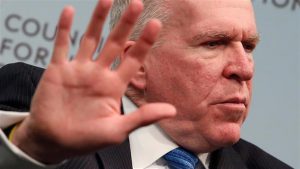 A brazen and unprecedented intervention in domestic U.S. politics by the intelligence community established the basic premise of the cascade of leaks about alleged Trump aides’ shady dealing with Russia. Led by CIA Director John Brennan, the CIA, FBI and NSA issued a 25-page assessment on Jan. 6 asserting for the first time that Russia had sought to help Trump win the election.
Brennan had circulated a CIA memo concluding that Russia had favored Trump and had told CIA staff that he had met separately with Director of National Intelligence James Clapper and FBI Director James Comey and that they had agreed on the “scope, nature and intent of Russian interference in our presidential election.”
In the end, however, Clapper refused to associate himself with the document and the NSA, which agreed to do so, was only willing to express “moderate confidence” in the judgment that the Kremlin had sought to help Trump in the election. In intelligence community parlance, that meant that the NSA considered the idea the Kremlin was working to elect Trump was merely plausible, not actually supported by reliable evidence.
In fact, the intelligence community had not even obtained evidence that Russia was behind the publication by Wikileaks of the e-mails Democratic National Committee, much less that it had done so with the intention of electing Trump. Clapper had testified before Congress in mid-November and again in December that the intelligence community did not know who had provided the e-mails to WikiLeaks and when they were provided.
The claim – by Brennan with the support of Comey – that Russia had “aspired” to help Trump’s election prospects was not a normal intelligence community assessment but an extraordinary exercise of power by Brennan, Comey and NSA Director Mike Rogers.
Brennan and his allies were not merely providing a professional assessment of the election, as was revealed by their embrace of the the dubious dossier compiled by a private intelligence firm hired by one of Trump’s Republican opponents and later by the Clinton campaign for the specific purpose of finding evidence of illicit links between Trump and the Putin regime.
Salacious Gossip
When the three intelligence agencies gave the classified version of their report to senior administration officials in January they appended a two-page summary of the juiciest bits from that dossier – including claims that Russian intelligence had compromising information about Trump’s personal behavior while visiting Russia. The dossier was sent, along with the assessment that Russia was seeking to help Trump get elected, to senior administration officials as well as selected Congressional leaders.
Among the claims in the private intelligence dossier that was summarized for policymakers was the allegation of a deal between the Trump campaign and the Putin government involving full Trump knowledge of the Russian election help and a Trump pledge – months before the election – to sideline the Ukraine issue once in office. The allegation – devoid of any verifiable information – came entirely from an unidentified “Russian emigre” claiming to be a Trump insider, without any evidence provided of the source’s actual relationship to the Trump camp or of his credibility as a source.
After the story of the two-page summary leaked to the press, Clapper publicly expressed “profound dismay” about the leak and said the intelligence community “has not made any judgment that the information in this document is reliable,” nor did it rely on it any way for our conclusions.”
One would expect that acknowledgment to be followed by an admission that he should not have circulated it outside the intelligence community at all. But instead Clapper then justified having passed on the summary as providing policymakers with “the fullest possible picture of any matters that might affect national security.”
By that time, U.S. intelligence agencies had been in possession of the material in the dossier for several months. It was their job to verify the information before bringing it to the attention of policymakers.
A former U.S. intelligence official with decades of experience dealing with the CIA as well other intelligence agencies, who insisted on anonymity because he still has dealings with U.S. government agencies, told this writer that he had never heard of the intelligence agencies making public unverified information on a U.S. citizen.
“The CIA has never played such a open political role,” he said.
The CIA has often tilted its intelligence assessment related to a potential adversary in the direction desired by the White House or the Pentagon and the Joint Chiefs of Staff, but this is the first time that such a slanted report impinges not only on domestic politics but is directed at the President himself.
The egregious triple abuse of the power in publishing a highly partisan opinion on Russia and Trump’s election, appending raw and unverified private allegations impugning Trump’s loyalty and then leaking that fact to the media begs the question of motive. Brennan, who initiated the whole effort, was clearly determined to warn Trump not to reverse the policy toward Russia to which the CIA and other national security organizations were firmly committed.
A few days after the leak of the two-page summary, Brennan publicly warned Trump about his policy toward Russia. In an interview on Fox News, he said, “I think Mr. Trump has to understand that absolving Russia of various actions that it’s taken in the past number of years is a road that he, I think, needs to be very, very careful about moving down.”
Graham Fuller, who was a CIA operations officer for 20 years and was also National Intelligence Officer for the Middle East for four years in the Reagan administration, observed in an e-mail, that Brennan, Clapper and Comey “might legitimately fear Trump as a loose cannon on the national scene,” but they are also “dismayed at any prospect that the official narrative against Russia could start falling apart under Trump, and want to maintain the image of constant and dangerous Russian intervention into affairs of state.”
Flynn in the Bull’s Eye
As Trump’s National Security Adviser, Michael Flynn presented an easy target for a campaign to portray the Trump team as being in Putin’s pocket. He had already drawn heavy criticism not only by attending a Moscow event celebrating the Russian television RT in 2016 but sitting next to Putin and accepting a fee for speaking at the event. More importantly, however, Flynn had argued that the United States and Russia could and should cooperate in their common interest of defeating Islamic State militants.
That idea was anathema to the Pentagon and the CIA. Obama’s Defense Secretary Ashton Carter had attacked Secretary of State John Kerry’s negotiating a Syrian ceasefire that included a provision for coordination of efforts against Islamic State. The official investigation of the U.S. attack on Syrian forces on Sept. 17 turned up evidence that CENTCOM had deliberately targeted the Syrian military sites with the intention of sabotaging the ceasefire agreement.
The campaign to bring down Flynn began with a leak from a “senior U.S. government official” to Washington Post columnist David Ignatius about the now-famous phone conversation between Flynn and Russian Ambassador Sergei Kislyak on Dec. 29. In his column on the leak, Ignatius avoided making any explicit claim about the conversation. Instead, he asked “What did Flynn say, and did it undercut the U.S. sanctions?”
And referring to the Logan Act, the 1799 law forbidding a private citizen from communicating with a foreign government to influence a “dispute” with the United States, Ignatius asked, “Was its spirit violated?”
The implications of the coy revelation of the Flynn conversation with Kislyak were far-reaching. Any interception of a communication by the NSA or the FBI has always been considered one of the most highly classified secrets in the U.S. intelligence universe of secrets. And officers have long been under orders to protect the name of any American involved in any such intercepted communication at all costs.
But the senior official who leaked the story of Flynn-Kislyak conversation to Ignatius – obviously for a domestic political purpose – did not feel bound by any such rule. That leak was the first move in a concerted campaign of using such leaks to suggest that Flynn had discussed the Obama administration’s sanctions with Kislyak in an effort to undermine Obama administration policy.
The revelation brought a series of articles about denials by the Trump transition team, including Vice President-elect Mike Pence, that Flynn had, in fact, discussed sanctions with Kislyak and continued suspicions that Trump’s aides were covering up the truth. But the day after Trump was inaugurated, the Post itself reported that the FBI had begun in late December go back over all communications between Flynn and Russian officials and “had not found evidence of wrongdoing or illicit ties to the Russian government….”
Two weeks later, however, the Post reversed its coverage of the issue, publishing a story citing “nine current and former officials, who were in senior positions at multiple agencies at the time of the calls,” as saying that Flynn had “discussed sanctions” with Kislyak.
The story said Flynn’s conversation with Kislyak was “interpreted by some senior U.S. officials as an inappropriate and potentially illegal signal to the Kremlin that it could expect a reprieve from sanctions that were being imposed by the Obama administration in late December to punish Russia for its alleged interference in the 2016 election.”
The Post did not refer to its own previous reporting of the FBI’s unambiguous view contradicting that claim, which suggested strongly that the FBI was trying to head off a plan by Brennan and Clapper to target Flynn. But it did include a crucial caveat on the phrase “discussed sanctions” that few readers would have noticed. It revealed that the phrase was actually an “interpretation” of the language that Flynn had used. In other words, what Flynn actually said was not necessarily a literal reference to sanctions at all.
Only a few days later, the Post reported a new development: Flynn had been interviewed by the FBI on Jan. 24 – four days after Trump’s inauguration – and had denied that he discussed sanctions in the conversation. But prosecutors were not planning to charge Flynn with lying, according to several officials, in part because they believed he would be able to “parse the definition of the word ‘sanctions’.” That implied that the exchange was actually focused not on sanctions per se but on the expulsion of the Russian diplomats.
Just hours before his resignation on Feb. 13, Flynn claimed in an interview with the Daily Caller that he had indeed referred only to the expulsion of the Russian diplomats.
“It wasn’t about sanctions. It was about the 35 guys who were thrown out,” Flynn said. “It was basically, ‘Look, I know this happened. We’ll review everything.’ I never said anything such as, ‘We’re going to review sanctions,’ or anything like that.”
The Russian Blackmail Ploy
Even as the story of the Flynn’s alleged transgression in the conversation with the Russian Ambassador was becoming a political crisis for Donald Trump, yet another leaked story surfaced that appeared to reveal a shocking new level of the Trump administration’s weakness toward Russia.
The Post reported on Feb. 13 that Acting Attorney General Sally Yates, an Obama holdover, had decided in late January – after discussions with Brennan, Clapper and FBI Director James Comey in the last days of the Obama administration – to inform the White House Counsel Donald McGahn in late January that Flynn had lied to other Trump administration officials – including Vice President Mike Pence – in denying that he discussed sanctions with Kislyak. The Post cited “current and former officials” as the sources.
That story, repeated and amplified by many other news media, led to Flynn’s downfall later that same day. But like all of the other related leaks, the story revealed more about the aims of the leakers than about links between Trump’s team and Russia.
The centerpiece of the new leak was that the former Obama administration officials named in the story had feared that “Flynn put himself in a compromising position” in regard to his account of the conversation with Kislyak to Trump members of the Trump transition.
Yates had told the White House that Flynn might be vulnerable to Russian blackmail because of the discrepancies between his conversation with the Ambassador and his story to Pence, according to the Post story.
But once again the impression created by the leak was very different from the reality behind it. The idea that Flynn had exposed himself to a potential Russian blackmail threat by failing to tell Pence exactly what had transpired in the conversation was fanciful in the extreme.
Even assuming that Flynn had flatly lied to Pence about what he had said in the meeting – which was evidently not the case – it would not have given the Russians something to hold over Flynn, first because it was already revealed publicly and second, because the Russian interest was to cooperate with the new administration.
The ex-Obama administration leakers were obviously citing that clumsy (and preposterous) argument as an excuse to intervene in the internal affairs of the new administration. The Post’s sources also claimed that “Pence had a right to know that he had been misled….” True or not, it was, of course, none of their business.
Pity for Pence
The professed concern of the Intelligence Community and Justice Department officials that Pence deserved the full story from Flynn was obviously based on political considerations, not some legal principle. Pence was a known supporter of the New Cold War with Russia, so the tender concern for Pence not being treated nicely coincided with a strategy of dividing the new administration along the lines of policy toward Russia.
All indications are that Trump and other insiders knew from the beginning exactly what Flynn had actually said in the conversation, but that Flynn had given Pence a flat denial about discussing sanctions without further details.
On Feb. 13, when Trump was still trying to save Flynn, the National Security Adviser apologized to Pence for “inadvertently” having failed to give him a complete account, including his reference to the expulsion of the Russian diplomats. But that was not enough to save Flynn’s job.
The divide-and-conquer strategy, which led to Flynn’s ouster, was made effective because the leakers had already created a political atmosphere of great suspicion about Flynn and the Trump White House as having had illicit dealings with the Russians. The normally pugnacious Trump chose not to respond to the campaign of leaks with a detailed, concerted defense. Instead, he sacrificed Flynn before the end of the very day the Flynn “blackmail” story was published.
But Trump appears to have underestimated the ambitions of the leakers. The campaign against Flynn had been calculated in part to weaken the Trump administration and ensure that the new administration would not dare to reverse the hardline policy of constant pressure on Putin’s Russia.
Many in Washington’s political elite celebrated the fall of Flynn as a turning point in the struggle to maintain the existing policy orientation toward Russia. The day after Flynn was fired the Post’s national political correspondent, James Hohmann, wrote that the Flynn “imbroglio” would now make it “politically untenable for Trump to scale back sanctions to Moscow” because the “political blowback from hawkish Republicans in Congress would be too intense….”
But the ultimate target of the campaign was Trump himself. As neoconservative journalist Eli Lake put it, “Flynn is only the appetizer. Trump is the entree.”
Susan Hennessey, a well-connected former lawyer in the National Security Agency’s Office of General Counsel who writes the Lawfare blog at the Brookings Institution, agreed. “Trump may think Flynn is the sacrificial lamb,” she told The Guardian, “but the reality is that he is the first domino. To the extent the administration believes Flynn’s resignation will make the Russia story go away, they are mistaken.”
The Phony “Constant Contacts” Story
No sooner had Flynn’s firing been announced than the next phase of the campaign of leaks over Trump and Russia began. On Feb. 14, CNN and the New York Times published slight variants of the same apparently scandalous story of numerous contacts between multiple members of the Trump camp with the Russian at the very time the Russians were allegedly acting to influence the election.
There was little subtlety in how mainstream media outlets made their point. CNN’s headline was, “Trump aides were in constant touch with senior Russian officials during campaign.” The Times headline was even more sensational: “Trump Campaign Aides Had Repeated Contacts with Russian Intelligence.”
But the attentive reader would soon discover that the stories did not reflect those headlines. In the very first paragraph of the CNN story, those “senior Russian officials” became “Russians known to U.S. intelligence,” meaning that it included a wide range Russians who are not officials at all but known or suspected intelligence operatives in business and other sectors of society monitored by U.S. intelligence. A Trump associate dealing with such individuals would have no idea, of course, that they are working for Russian intelligence.
The Times story, on the other hand, referred to the Russians with whom Trump aides were said to be in contact last year as “senior Russian intelligence officials,” apparently glossing over a crucial distinction that sources had made to CNN between intelligence officials and Russians being monitored by U.S. intelligence.
But the Times story acknowledged that the Russian contacts also included government officials who were not intelligence officials and that the contacts had been made not only by Trump campaign officials but also associates of Trump who had done business in Russia. It further acknowledged it was “not unusual” for American business to come in contact with foreign intelligence officials, sometimes unwittingly in Russia and Ukraine, where “spy services are deeply embedded in society.”
Even more important, however, the Times story made it clear that the intelligence community was seeking evidence that Trump’s aides or associates were colluding with the Russians on the alleged Russian effort to influence the election, but that it had found no evidence of any such collusion. CNN failed to report that crucial element of the story.
The headlines and lead paragraphs of both stories, therefore, should have conveyed the real story: that the intelligence community had sought evidence of collusion by Trump aides with Russia but had not found it several months after reviewing the intercepted conversations and other intelligence.
Unwitting Allies of the War Complex?
Former CIA Director Brennan and other former Obama administration intelligence officials have used their power to lead a large part of the public to believe that Trump had conducted suspicious contacts with Russian officials without having the slightest evidence to support the contention that such contacts represent a serious threat to the integrity of the U.S. political process.
Many people who oppose Trump for other valid reasons have seized on the shaky Russian accusations because they represent the best possibility for ousting Trump from power. But ignoring the motives and the dishonesty behind the campaign of leaks has far-reaching political implications. Not only does it help to establish a precedent for U.S. intelligence agencies to intervene in domestic politics, as happens in authoritarian regimes all over the world, it also strengthens the hand of the military and intelligence bureaucracies who are determined to maintain the New Cold War with Russia.
Those war bureaucracies view the conflict with Russia as key to the continuation of higher levels of military spending and the more aggressive NATO policy in Europe that has already generated a gusher of arms sales that benefits the Pentagon and its self-dealing officials.
Progressives in the anti-Trump movement are in danger of becoming an unwitting ally of those military and intelligence bureaucracies despite the fundamental conflict between their economic and political interests and the desires of people who care about peace, social justice and the environment.
Castigated by the Southern Poverty Law Center

By Deir Yassin Remembered | Dissident Voice | February 24, 2017
The “public” that allegedly “protested” against this billboard in Ann Arbor, as reported by the Rochester Democrat and Chronicle, were not the only folks watching DYR.
The SPLC has now included DYR on its Hate Map.
Dan McGowan responds:
The Southern Poverty Law Center (SPLC) recently criticized Deir Yassin Remembered (DYR) by including it on the so-called Hate Map, purportedly for the high crime of Holocaust denial.
Apparently if the SPLC disagrees with you, it will label you as a racist or a hatemonger. There is no discussion, no defense, and no chance of winning a defamation suit against it.
The SPLC is the cash cow of the civil rights movement. Last year it took in over $58 million, some of which was added to its bloated endowment of over $328 million held in questionable investments, some in off shore accounts.
Its two chief executives together received over $800,000. Of its nine top executives, none come from minorities.
The SPLC claims to reject hate, embrace diversity, and respect differences. But often the SPLC and the people who believe their fear mongering behave exactly the opposite. The SPLC campaigns to deny free speech and freedom of association to groups of Americans with whom they disagree, often doing so to pander to other groups for more contributions all in the name of promoting “tolerance.” For example, if the British historian David Irving plans a lecture in Syracuse, the SPLC will protest any venue he might select, leaflet cars at his hotel saying, “There is a Nazi staying here,” and photograph and shout at anyone who might try to attend.
SPLC slime is not reserved solely for skinheads and members of the KKK. Dr. Ben Carson got a dose for opposing same sex marriage. SPLC later apologized but the charge never completely goes away, leading Carson to say that fear of being on the SPLC’s list serves to shut people up.
The SPLC makes money out of fear mongering and promoting the idea that Americans are inundated with hateful people, particularly on the radical right. The favorite target is the KKK and white supremacists.
The Baltimore Sun characterizes SPLC operations this way: “Its business is fundraising, and its success at raking in the cash is based on its ability to sell gullible people on the idea that present-day America is awash in white racism and anti-Semitism, which it will fight tooth-and-nail as the public interest law firm it purports to be.”1
It is understandable that the SPLC will run out of rocks under which to look for old KKK members and skinheads, but why criticize Deir Yassin Remembered, a small not-for-profit organization of Jews and non-Jews working to build a memorial for Palestinians murdered in 1948 on the west side of Jerusalem? DYR is certainly not the radical right. DYR practices and preaches tolerance; it has agreed to the advice of none other than the Latin Patriarch of Jerusalem that its memorial show the Christian tenet of forgiveness. Its advisory board boasts diversity; it is composed of half men, half women, half Jews, half non-Jews. It has worked continuously since 1994 for Palestinian human rights, including equal rights of citizenship, with no compensation for any executive and with less than $5,000 of reserves.
The answer lies in the writings of some of the DYR members who have questioned the use of the Holocaust as both the sword and shield of Israel. The Holocaust has been used to justify the need for a Jewish state and its expropriation of Palestinian land; the Holocaust is used to monopolize victimhood and defend Israel from criticism of its brutal and unending occupation.
But it is more than that. The Holocaust has morphed from a historical event to a religion, which must not be contradicted for fear of being branded an apostate or a hater or a denier or an anti-Semite. Religious faith is self-validating, impervious to reason, and regards proposals to scientifically validate its claims as profane in all senses of the word.
So, anyone who is skeptical about the number “six million,” about mass extermination in gas chambers, or about Nazi orders for extermination is to be named and shamed and hated. For this topic, there can be no diversity of opinion and no respect for inquiry or debate.
Don’t tell us that the United States government claimed Hitler murdered over 20 million people until the late 1970s when that number was officially revised downwards and carved in stone at 11 million. Don’t tell us that Jewish historians today claim the 5 million number of non-Jewish victims is overstated. Don’t remind us that the lampshade and the soap-from-human-fat stories were simple gruel propaganda and have no historical significance. Don’t remind us that Elie Wiesel took his violin to Auschwitz and that none of his family was gassed. Don’t remind us that Elie chose to retreat with the Nazis rather than be liberated from Auschwitz as was the father of Anne Frank.
Fear mongering and sliming little organizations like DYR is fake news. It is ridiculous disinformation to keep SPLC campaign money coming in. It foments hate and bigotry and intolerance by the very hypocrites who claim the opposite.
- “The truth about ʻhate crimesʼ and the racial justice racket” by Ron Smith, Baltimore Sun, December 3, 2008.
Deir Yassin Remembered seeks progress on behalf of the over 100 Palestinian men, women, and children who were victims of the Deir Yassin Massacre. Read other articles by Deir Yassin Remembered, or visit Deir Yassin Remembered’s website.
Venezuelan VP Releases Open Letter to US Treasury as Parliament Demands Resignation
By Lucas Koerner | Venezuelanalysis | February 21, 2016
Caracas – Venezuelan Vice-President Tareck El Aissami published an open letter to the US Treasury Department in the New York Times Tuesday in which he lambasted the body’s recent drug trafficking accusations as an attempt to further derail bilateral relations.
On February 13, the US Treasury Department’s Office of Foreign Assets Control (OFAC) froze all of El Aissami’s alleged assets in the US under the Foreign Narcotics Kingpin Act, making the vice-president the top-ranking official of any country to be sanctioned in this way. In particular, the OFAC accused El Aissami of having “facilitated shipments of narcotics from Venezuela” allegedly in collusion with the Las Zetas Cartel in Mexico.
In the letter, El Aissami charged the OFAC of being “deceived” by certain US political factions “whose fundamental interest is to prevent Venezuela and the United States from restoring their political and diplomatic relations on the basis of mutual recognition and respect”.
The vice-president further lambasted the drug trafficking allegations as a “false positive” which he said was intended to “criminalize – by way of my person – the Bolivarian Government of Venezuela”. The US Treasury Department has yet to release concrete evidence buttressing the accusations; meanwhile no US court has indicated that it is opening an investigation into the case.
El Aissami also highlighted the 62 percent increase in Venezuelan drug busts following the expulsion of the US Drug Enforcement Agency in 2005, which he said evidences Washington’s “egregious failure in the fight against drug trafficking”.
“How many heads of drug trafficking organizations has the US captured in its territory? How many banks and tax havens has the US closed for serving as a financial base for this gigantic business and crime against humanity? … The United States should reflect and rectify,” he wrote in the New York Times.
While El Aissami has received resounding support from President Maduro as well as the nation’s armed forces, the number two official has come under fire from the opposition-controlled National Assembly (AN), which has demanded that he resign from his post.
On Wednesday, a special parliamentary commission headed by Popular Will party legislator Freddy Guevara announced that it was opening an inquiry into the US Treasury allegations and called on the vice-president to step down in order to “facilitate the investigation”.
The AN moreover resolved to formally solicit from the US Congress and the US Treasury Department “the precise information that backs up the claims made so the AN can carry out the corresponding inquiry”.
The legislature additionally called on the Public Prosecutor’s office to provide all information relevant to the case.
Neither the executive branch nor the Public Prosecutor’s office have yet responded to the AN’s resolutions.
Venezuela’s parliament has been declared “null and void” by the Supreme Court over the body’s failure to unseat three legislators from Amazonas state under investigation for alleged electoral fraud.
Perfidious Albion…

By Andre Vltchek | OffGuardian | February 24, 2017
Here it goes again! The same old tired and predictable tune, the same recognizable chorus. Once again the world is told what to think and what to believe. The world is also given both rhythm and leitmotif, so the grotesque and crooked dance could begin.
Who could resist, really? The lyrics of the tune are recited in perfect English, and with that air of moral and cultural superiority, which is supposed to disperse all doubts.
On February 19, 2017, RT published the following:
The Telegraph, as a favored mouthpiece for British intelligence service disinformation, is a part of psychological warfare operation against Russia, said independent journalist Martin Summers. Another accusation is being thrown at Russia as a British newspaper published a story about Moscow being allegedly behind a plot to kill Montenegro’s Prime Minister last October… According to the article, Russia wanted to overthrow the country’s government to stop them joining NATO.
So now it is Montenegro. Yesterday it was Crimea, Donbas, and the US elections. Evil Russia again! Evil China, evil socialist Latin American countries, evil Syria, Eritrea, Zimbabwe, South Africa, North Korea, Philippines, evil all those who are laughing at the notion of Anglo-Saxon superiority.
This time I’m actually not intending to write some long, philosophical essay on the subject of “shamelessness of British propaganda”. I’m just taking a short break from my 10 thousand-word ‘paper’ for the China Academy of Social Sciences (CASS); a paper analyzing the impact of the 1917 Soviet Revolution on the world.
I just want to state what I believe should be so obvious, but somehow isn’t, at least to billions of people all over the world: “Those British blokes running the mainstream media outlets and global propaganda network really cannot be trusted. For centuries, no other country brought more grief to the planet, destroyed more lives, ruined more nations and cultures, and stole more natural resources from the ‘natives’, than the United Kingdom.” All this was done with a straight face, all explained and justified by the most advanced propaganda apparatus on earth, all ‘morally defended’. The entire twisted concept of British-style ‘justice’ was first introduced at home, and then exported to many corners of the globe.
It went on for several long centuries, and it goes on until now: the rapists are introducing globally accepted moral codes. Mass murderers are running international courts of justice. Notorious liars and thieves are teaching the world about ‘objectivity’. Gurus of disinformation are even ‘educating’ their own children, as well as the children of elites from all parts of the world, in their ‘prestigious’ factories of indoctrination – schools and universities.
Of course there are some countries that have tried very hard to outdo the UK in terms of brutality, greed and tactics of deception. It is worth mentioning such candidates for genocidal world leadership like France, Germany, Spain and lately the United States. They really have been competing determinately and zealously, but despite all their efforts, they never truly managed to come close to the forerunner.
Please, just think about all this, if you haven’t already done it for years. Then wash your eyes thoroughly, and look anew at those tabloids and ‘serious publications’ that are printed in the UK. Look at the indoctrination television channels. If you are still able to retain at least some detachment and common sense, please compare what they are saying and writing and showing, with the reality outside your own window, wherever on this Planet you may be.
For many years I worked all over the world, on all continents, in some 160 countries. For many years, I was told stories, shown evidence, about the most monstrous and barbaric crimes that the Brits have been committing almost everywhere on this Planet.
To compile even some semi-complete list, one would need to compose at least a sizable brochure, if not an entire book. Let’s just mention a few of the most obvious horrors that ‘Great’ Britain is responsible for: Slave trade and destruction of entire huge parts of Africa with tens of millions people directly or indirectly killed. Monstrous occupation of the ‘Sub-continent’, with tens of millions of lives lost (including those in several artificially triggered famines). Ransacking of large parts of China, murdering and participating in breaking the most populous nation on earth. Brutal attacks against the young Soviet state. Horrid treatment of colonized peoples of the island nations, from Oceania (South Pacific) to the Caribbean. Gassing, bombing, literally exterminating people of the Middle East, from what is now Iraq and Kuwait, to Palestine. There were invasions of Afghanistan and the ‘reign of terror in Kabul’ in 1879. There were many other things, many nightmarish crimes, of course, but today I’m being brief…
In the “New World”, consisting of countries like the US, Canada and Australia, the most terrible massacres of the native people were committed by the first and second generation of Europeans, mainly the Brits.
Britain actually never ceased to commit crimes against humanity. Since WWII it has been tutoring the United States, strategically and ideologically, in the art of how to run the Empire and how to manufacture unanimity inside the West itself, and even among the population of the colonized nations (in the neo-colonialist context).
It has also been involved in some of the vilest acts in modern history, related to countries like Egypt, Iran, Iraq, Afghanistan, Congo as well as entire areas of Asia Pacific and the African Great Lakes.
Again, that’s only a brief and incomplete summary.
Having experience with occupying huge parts of the world for centuries, knowing first-hand how to ‘pacify’ the natives, the Brits gradually developed and then passed on to the rest of the Western world their highly effective and successful indoctrination methods. These were eventually spread further – mainly among the elites of the colonized nations. As a result, fully standardized global perceptions evolved, and were implemented and upheld until this very moment. They included the general worldview, ‘principles’ and ‘moral standards’, law and justice (including such concepts as ‘human rights’), and even the set of overall values.
The English language (especially well articulated; spoken with certain recognizable and ‘acceptable’ accents) became the main linguistic tool embodying both truth and authority.
News presented in a certain ‘objective’ way and with a certain accent (or acceptable set of accents) became subconsciously, for the great majority of people, much more trustworthy than that which would be delivered by individuals whom a great Polish journalist, anthropologist and philosopher Ryszard Kapuscinski used to define as ‘the others’.
This ‘perfect’, seemingly bulletproof system produces intellectual laziness, submissiveness, even servitude. It is successfully upholding the status quo.
Lies are mounting on top of lies, and even the most obvious fabrications lately do not get challenged, except in some marginal and ‘extremist’ (defined by the Western regime) outlets.
The colonialist empire managed to survive. It is now fully in charge. It dominates the psyche of both the colonizers and the colonized. Advances that were made by liberation and independence struggles, by the anti-colonialism fighters during the post-WWII era, have been skillfully annulled. Then, it was officially declared, “colonialism is over”.
At some point, the Anglo-Saxon demagogues invented ‘political correctness’, one more highly effective tool designed to neutralize and ‘pacify’ any serious resistance. Political correctness claims that all nations and races are equal; it is even glorifying those ‘little people’ and almost all ‘cultures of the under-developed nations’, at least verbally, while in reality the Empire keeps plundering and manipulating the planet, as it has been doing for ages. In the colonies, the only individuals who are gaining are the elites; those morally corrupt rulers of the deprived and still enslaved world.
As in the past, the regime pragmatically chooses its enemies, and it then applies the most proven and spiteful tactics, launching defamation campaigns, dehumanizing citizens and leaders of adversary states, creating often phantasmagoric but highly effective conspiracy theories.
The British media, the British propagandists, in fact the entire British establishment, had reached absolute perfection in the field of mind-control and brainwashing.
How else, otherwise, would anyone in his or her sane mind trust the words of those who are responsible for tens of millions, perhaps for hundreds of millions of lost human lives in all corners of the world?
How could the primary architects of our insane global arrangement be taken seriously, unless they managed to fully indoctrinate their ‘subjects’?
Some would suggest that we are living in a world where the ‘normality’ could be found only in an insane asylum; where the only place for a decent man or a woman could be behind some barricade, or behind bars.
However, not many would have such thoughts, as even reflections are now almost fully standardized and controlled. So much glorified freedom has been reduced to just a handful of personal, very limited, often self-serving choices that one is still allowed to make while being generally fully locked within the existing system.
This British, European, in fact Western obsession with controlling, with ruling over everything in this world, has actually fully derailed natural human evolution. Instead of much higher aspirations, instead of optimistic attempts to build an egalitarian, compassionate and joyful society, our humanity is once again stuck in some master-slave morass, in something that appeared to be on its way out even during some periods of the 19th century, and definitely later, in the 20th century.
How to fight this nightmare? I wrote it many times before, and I have to repeat it again: To change things, one has to first understand reality. But it is not only about knowing the facts; it is mainly about how to analyze them, how to perceive the world and essential events.
We are being bombarded, in fact flooded with information, data and ‘facts’. What is missing is a totally new approach towards sorting and analyzing the reality within which we live.
The Empire is not withholding the facts. It is doing something much more sinister: it is depriving people of learning how to analyze them in the most logical ways.
Let us begin with absolute basics: “Mass murderer cannot be a judge”. “Indoctrinator and brainwasher cannot be a teacher”. “Those who are shackling, enslaving billions, should not be allowed to preach about freedom.”
The reality is: we have a handful of deranged, mentally disturbed nations and cultures that have been subjugating, raping and robbing entire nations and continents, still in charge of our beautiful but already terribly scarred Planet.
These morally defunct nations have no compassion left, and no real rationality. This fact they have proven again and again. One million victims, tens of millions of victims – it means nothing to them, as long as they can continue to rule. Ruined nature, disappearing islands, poisoned air, it matters nothing to them. People turning into indoctrinated, intellectually and emotionally uniformed cattle; good, who cares?
It is an extremely unsettling reality, but reality it is. The sooner we recognize it for what it is, the better.
‘Great’ Britain should sit down on its ass and cry in horror, recalling all crimes it has been committing, imagining the concentration camps it built in Africa and elsewhere, recalling the famines it triggered in India and elsewhere, remembering all those innocent people it murdered on each and every continent. It should be howling from shame, because of the nihilism it has been spreading, while ruining enthusiasm, beautiful dreams and hopes of our human kind.
It should stop and weep in horror, picturing instructions it provided to countries like South Africa, the United States or Rwanda – instructions that brought terrible bloodbaths, instead of harmony and progress to our world.
Why all this terror? Just so the UK and its cohorts could continue to rule! It is not about greed only, or natural resources, it is about control.
I don’t want their analyses, anymore. I don’t want their news, their films, their books, and their propaganda materials. Even in the dark solitude of some cave, one could understand the world much better than when reading their disinformation sheets, or when watching their indoctrination channels. All this is just designed to confuse people, to make them passive and submissive. Their announcers as well as their writers are like some sad lobotomized robots: there is no life, nothing new, nothing daring or revolutionary in their words. They function, somehow: they move, they eat, shit, repeat what they are expected to say, but they are not alive.
They only smear, but don’t inspire. If there is any optimism, it is always false, pre-approved, and mass-produced.
If you think about it, it all actually makes sense: A torturer cannot be a visionary, or an idealist.
Compared to China or Iran, the UK is a relatively young culture. But it feels old, tired, spent, and obsolete. Too many crimes and too many lies can exhaust and depress even a young person.
Were England a person, operating in a normal society, it would be either in prison or in a mental institution. The same could be said about the rest of the West.
We have nothing to learn from some murderous maniac, do we? The only concern should be: how to put a straightjacket on such an individual, how to prevent him from killing and harming others, and how to do it as quickly as possible.
I also highly doubt that with such a background and monstrous track record, our dangerous maniac should be allowed to interpret the world publicly, to teach people, and to even participate in the discussions touching the most essential issues facing our planet!
How Trump Could Be a Truth-teller
By Robert Parry | Consortium News | February 23, 2107
One positive thing about a change in party control of the White House is that the new occupants sometimes release information that the old residents kept hidden because the facts were politically embarrassing or did not support some favored policy.
We saw this in the first days of the Obama administration when President Barack Obama declassified some documents relating to President George W. Bush’s internal policy debates about torture and other abuses from the “war on terror.”
However, as yet, we have seen nothing similar from the Trump administration even though some truth-telling might work very well for President Donald Trump, especially given his reputation for getting facts wrong. A commitment to transparency – giving some truth to the American people on important topics – could change Trump’s image for the better.
Plus, by releasing information that was unjustifiably kept hidden during Obama’s second term, Trump could underscore how Obama grew increasingly obsessive about secrecy the longer he remained in the White House, treating the American people as objects to be manipulated rather than citizens to be informed.
For instance, Obama kept the clamps on CIA analyses relating to the Ukrainian crisis, even regarding the shoot-down of Malaysia Airlines Flight 17 over eastern Ukraine on July 17, 2014, killing 298 people and leading to a dangerous escalation in the New Cold War with Russia.
After the crash, the Obama administration quickly steered the Western media toward blaming President Vladimir Putin and got the European Union to join in economic sanctions against Russia.
However, after exploiting the rush to judgment against Putin, the Obama administration went silent, withholding U.S. intelligence evidence even from the official crash investigators. The more the administration learned about the tragic event and who was responsible the less it wanted to say.
At the time, I was told that the reason was that some senior CIA analysts were uncovering evidence that went in an inconvenient direction, suggesting a rogue Ukrainian operation connected to a hardline oligarch with the intent of shooting down a Russian jetliner, possibly even the one carrying Putin back from a state visit in South America, but instead brought down MH-17, which had similar markings.
To spread confusion and create some deniability for the attack, the scheme supposedly called for launching the missile from as deep inside “rebel-controlled” territory as possible.
A Closed File
The source described getting this briefing from U.S. intelligence analysts, but I was unable to get the CIA or the Office of Director of National Intelligence to provide any guidance. Instead, they clammed up, claiming that they didn’t want to “prejudice” the official Dutch-led investigation (although I pointed out that the hasty U.S. finger-pointing at Russia had already done that).
The refusal of the Obama administration to open its MH-17 files allowed the “Dutch-led” Joint Investigation Team (JIT) to be effectively taken over by Ukraine’s unsavory SBU intelligence agency, which oversaw the care and feeding of Dutch and Australian investigators who decamped for long periods in Kiev.
The SBU’s “evidence” became central to the JIT’s investigation although the SBU was deeply involved in the war against the ethnic-Russian Ukrainian rebels and was even denounced by United Nations investigators for blocking access to alleged SBU torture centers. Beyond that, part of the SBU’s mandate was to protect Ukrainian government secrets, so the SBU had obvious conflicts of interest.
Nevertheless, the JIT relied on SBU-provided telephone “intercepts” of cryptic Russian-language conversations to base its conclusion that Russia provided the rebels a Buk missile system on the night of July 16, 2014, which was then taken on a strangely circuitous route far to the west before circling back to the east to a location far from the battlefront where it shot down MH-17 on July 17 and then was driven back to Russia that evening, again taking an unnecessarily long way home.
Though there were numerous holes in the SBU’s evidence and serious questions about why the Buk would have taken its bizarrely long ride – when a much more direct and discreet route was available – the Western media again showed no skepticism, simply accepting Russian guilt as established fact and dismissing any alternative explanation as “fanciful.”
The Value of Truth
However, whatever the truth is – whether the Russians and their rebel allies were responsible for the tragedy or whether a rogue Ukrainian operation brought down MH-17 – there is no reason why President Trump shouldn’t instruct CIA Director Mike Pompeo to release as much of the U.S. intelligence analysis as possible.
First, the families of the dead deserve all the help that the U.S. government can provide to identify the killers and bring them to justice. Second, by releasing the MH-17 file, President Trump can demonstrate that he does care about truth in contrast to President Obama who mysteriously withheld this information for 2½ years and thus gave the culprits, whoever they are, time to escape and cover their tracks.
Further, if the file blames the Russians, releasing it would show that Trump is not in Putin’s pocket, as many people in Official Washington claim. And, if the file implicates an element of the Ukrainian government – even a rogue faction – that might relieve geopolitical tensions with Russia and open possible paths for resolving the Ukrainian crisis.
The Trump administration also could consider other topics for declassification, such as the circumstances surrounding the U.S-backed coup that ousted elected Ukrainian President Viktor Yanukovych on Feb. 22, 2014. U.S. intelligence surely was following those events closely and could clarify the roles of Assistant Secretary of State Victoria Nuland, U.S. Ambassador to Ukraine Geoffrey Pyatt and Sen. John McCain, who all cheered on and encouraged violent protests that preceded the coup.
Obama also hid the intelligence regarding the mysterious sarin gas attack outside Damascus, Syria, on Aug. 21, 2013, which Secretary of State John Kerry and others blamed on the Syrian government although later evidence seemed to implicate jihadist rebels who wanted to trick the U.S. military into intervening directly in the war on their side.
Given the importance of those turning-point moments – and the Obama administration’s attempts to exploit them for geopolitical ends – the American people deserve to know what the U.S. intelligence analysts ultimately concluded and whether President Obama’s team was telling the truth or had gotten lost in the Orwellian idea of “perception management.”
President Trump might find that he can begin to turn around his reputation as a person who doesn’t care about the truth by becoming a truth-teller.
Investigative reporter Robert Parry broke many of the Iran-Contra stories for The Associated Press and Newsweek in the 1980s.
At US behest Turkey reboots Syrian war
By M K Bhadrakumar | Indian Punchline | February 23, 2017
Turkey has decided to pick up a quarrel with Iran. It all began with President Recep Erdogan’s sudden outburst on February 14 in the first leg of a regional tour of Gulf States – Bahrain, Saudi Arabia and Qatar — when he said, “Some people want both Iraq and Syria to be divided. There are some that are working hard to divide Iraq. There is a sectarian struggle, a Persian nationalism at work there. This Persian nationalism is trying to divide the country. We need to block this effort.”
Tehran hit back by accusing Turkey of supporting terrorist organizations “to destabilize neighbouring countries.” And there has been much back and forth in mutual recriminations since then. The spat makes a mockery of the “trilateral alliance” between Russia, Turkey and Iran that Moscow has been promoting at the recent Astana talks on Syria. The Russian Foreign Ministry had announced as recently as February 16 that Russia, Turkey and Iran have formed a tripartite operational group to stabilize the ceasefire in Syria. The most puzzling aspect is that this is happening just when the Syrian peace talks began in Geneva today under UN auspices.
But then, there is always a method in Erdogan’s madness. Succinctly put, Erdogan’s outburst reflects an overall frustration that Iran has greatly outstripped its traditional rival Turkey in expanding its influence in both Iraq and Syria. The Iranian militia played a big role in taking Aleppo city and vanquishing the rebel groups supported by Turkey.
Turkey had fancied that it would play a similar lead role in wresting control of Mosul from the hands of the ISIS. But to its great consternation and anger, Iran has wrested that role too. The latest reports show that Iraqi forces have stormed Mosul airport. Iraq (and Iran) opposed any role for Turkey in the liberation of Mosul.
Conceivably, with an eye on the new US administration’s reported plan to create an anti-Iran alliance in the region, Turkey is repositioning itself. There are several developments pointing in this direction. The US and Turkey have been holding a series of top-level meetings through the past fortnight since President Donald Trump made his first phone call with Turkish President Recep Erdogan on February 7. The American visitors to Ankara since then included CIA Director Mike Pompeo, Chairman of the Joint Chiefs of Staff General Joseph Dunford and US the senator who heads the Armed Services Committee John McCain.
Meanwhile, Erdogan has undertaken a tour of the GCC states, which aimed at harmonising the Turkish stance on Syria with that of Saudi Arabia and Qatar. (During Erdogan’s tour, Turkey and Saudi Arabia signed a defence agreement.) Ankara has noted that in the past fortnight there have been important visitors from the US to the Gulf region –CIA chief Pompeo, Senator John McCain and Defence Secretary James Mattis. Pompeo conferred on Saudi Crown Prince Mohammed bin Nayef bin Abdulaziz the CIA’s George Tenet Medal for his exceptional contributions in the fight against terrorism. It doesn’t take much ingenuity to figure out that the US is promoting a Saudi-Israeli alliance against Iran.
Equally, Ankara and Washington are edging toward a mutually satisfactory resolution of a discord that had set them apart in the recent past – the fate of Islamist preacher Fetullah Gulen who lives in exile in Pennsylvania. The Trump administration may act to curb Gulen’s activities, while Erdogan may no longer press for his outright extradition to Turkey.
However, one other contentious issue still remains unresolved – US military support for Syrian Kurds. This is a non-negotiable issue for Turkey, which considers the Syrian Kurdish militia to be an affiliate of the separatist Kurdish group PKK. Turkey and the US are actively discussing at the moment the modalities of a Turkish military operation aimed at liberating Raqqa, the ‘capital’ of the Islamic State. The Turkish Prime Minister Binaldi Yildirim discussed the Raqqa operation with the US Vice-President Mike Pence in the weekend at the Munich Security Conference. It will be a major military operation with tanks, armoured vehicles and artillery. Turkey seeks US Special Forces’ participation, which will also serve the purpose of deterring Russian intervention, apart from weakening the Syrian Kurds’ drive to create an entity in northern Syria.
Without doubt, the capture of Raqqa will be much more than a symbolic event. Raqqa determines how much of Syria will be under the control of the Syrian regime. Clearly, Erdogan hopes to project Turkish power right into Damascus and have a big say in Syria’s future. Yildirim sounded upbeat after meeting Pence. See a report in the pro-government Turkish daily Yeni Safak – PM Yildirim: Turkey, US turning over a new leaf.
Suffice to say, Erdogan seems confident that the Trump administration is viewing Ankara once again as a “strategic partner and a NATO ally” (as Trump indeed told him). Just another 5 days remain in the timeline given by the Trump administration to the Pentagon to prepare a comprehensive plan to defeat the Islamic State in Syria and Iraq. But Turkey is already acting as if it had a preview of the Pentagon plan.
A lengthy dispatch from Damascus by Xinhua underscores that Turkey’s journey back to its American ally also coincides with the “re-emergence of the Gulf states as the backers of the rebels” and with a growing probability of US putting boots on the ground in Syria — all in all a “remilitarization” of the Syrian conflict. Read the insightful report titled Spotlight: Gloomy outlook shadows Syrian talks in Geneva.
Who is Responsible for the Economic Collapse in the US
By Grete Mautner – New Eastern Outlook – 23.02.2017
Some people today still remember the times when America was the wealthiest nation on the entire planet and that could afford even the boldest infrastructure. But things are different now, as the US now has the biggest mountain of debt in the history of the world and it can’t even afford to repair the marvels that it used to build. The near catastrophic failure of the Oroville Dam is a perfect example of the situation most Americans have found themselves in.
Just recently, the Most Important News presented its version of 11 deeply alarming facts about America’s crumbling infrastructure and its long-term economic collapse. According to this site, the US economy expanded at its slowest rate for five years in 2016. Gross domestic product (GDP) rose by only 1.6 percent in 2016, down from 2.6 percent in 2015.
In turn, the World Socialist Web Site notes that the feature to emerge from the US GDP figures is the ever-widening disconnect between the underlying real economy and the financial system. This disconnect has a significant impact on economic growth, as vast amounts of wealth are diverted from the real economy into various forms of financial speculation. This leads to a decline in investment and falling productivity, two central features of the US economy in the eight years since the eruption of the financial crisis.
The situation is critical, so it’s hardly surprising that The Daily Caller has attempted to establish those responsible for the crisis most Americans have found themselves in, noting that President Obama’s time in the White House has added nearly 8 trillion dollars to the national debt. It means that Obama’s agenda came at a cost of the national debt increasing from more than 10.6 trillion dollars in January 2009 to 19.6 trillion dollars at the end of fiscal year 2016.
At the same time, as it’s pointed out by the Economic Collapse, none of long-term economic problems have been fixed. When the cost of living rises faster than paychecks do year after year, eventually that becomes a very big problem. Every month, tens of millions of American families struggle to pay the bills, and most of them don’t even understand the economic forces that are putting so much pressure on them.
Even if one still manages to remain employed, his quality of life is degrading rapidly as the rent, healthcare rates and even food are getting more expensive by the day. The Huffington Post notes that Water bills are on the rise across the United States, and the poor communities are being hit the hardest.
The total household debt climbed to 12.58 trillion dollars at the end of 2016, which constitutes an increase of 266 billion dollars from the third quarter, according to a report from the Federal Reserve Bank of New York. For the year, household debt ballooned by 460 billion dollars – the largest increase in almost a decade. That means the debt loads of Americans are flirting with 2008 levels, when total consumer debt reached a record high of 12.68 trillion dollars.
How much more are you going to squeeze out of U.S. consumers? Two-thirds of the country is living paycheck to paycheck. But the US government is reluctant to provide relief to those hard working people who have suddenly found themselves struggling financially even after taking on a tremendous work load. Instead it prefers to finance all sorts of military contractors that are pouring money down the drain on such projects as the F22 program, which has already consumed hundred of billions of dollars.
The American Thinker is predicting an abrupt rise in political violence in the United States, while arguing that wars begin when, in a major crisis, no peaceful solution can be found. Americans are at or near that point. Unfortunately, most people are not going to acknowledge the truth until it is too late.
Artificial Intelligence: ‘Frankenstein’ or Capitalist Money Machine
By James Petras :: 02.21.2017
Introduction
The Financial Times’ Special Report (2/16/2017) published a four-page spread on the ‘use and possible dangers of artificial intelligence (AI)’. Unlike the usual trash journalists who serve as Washington’s megaphones on the editorial pages and political columns, the Special Report is a thoughtful essay that raises many important issues, even as it is fundamentally flawed.
The writer, Richard Walters, cites several major problems accompanying AI from ‘public anxieties, to inequalities and job insecurity’. Walters pleads with those he calls the ‘controllers of autonomous systems’ to heed social and ‘political frictions’ or face societal ‘disruption’. Experts and journalists, discussing the long-term, large-scale destruction of the working class and service jobs, claim that AI can be ameliorated through management and social engineering.
This essay will proceed to raise fundamental issues, questions leading to an alternative approach to AI relying on class analysis. We will reject the specter of AI as a ‘Frankenstein’ by identifying the social forces, which finance, design and direct AI and which benefit from its negative social impact.
Basic Questions: Demystifying AI
The best and the worst of the experts reporting on AI assert that it is an autonomous system, devoid of any link to the class structure within which it operates. Their version of technological determinism, above and beyond the needs and demands of capitalists, fits neatly with the corporate ideology of the trash journalists and pundits.
The fundamental questions that must be raised include: 1) ‘AI’, for whom?; 2) How are the productivity gains of AI to be distributed between capital and labor? 3) How are work time, income and pensions distributed between the owners of technology and the labor force?; and 4) What kinds of socio-economic activity does AI serve?
‘Artificial Intelligence’ and related technological innovations are financed, designed, controlled and ultimately applied by the major corporations and financial institutions in order to reduce the cost of labor and to enhance profits and competitiveness between capitalist rivals.
AI and similar capitalist technological changes, along with the overseas relocation of information technology and manufacturing production are the principal destroyers of workers’ employment and living standards in the US.
AI technology, alongside vast spending for imperial wars and military procurement, multi-billion dollar bank-bailouts and the promotion of finance-over-productive capital represent the forces driving down wages, salaries, living standards, pensions and, lately, life expectancy for the marginalized working class and rural population.
The innovators and promoters of AI, whether individuals or small groups, seek capitalist support to finance, market and ‘acquire’ their ‘discoveries’. In fact, the entire industry has been built upon large-scale, tax-funded public research centers and university laboratories, which have paid for the buildings as well as the scientists’ and professors’ salaries.
Most of IT and AI related profits are distributed among the military-industrial complex, the chemical agro-industrial monopolies and the transport and consumer goods manufacturing elites. While garbage journalists and experts cite ‘AI’s contribution to health, education and social services, they forget to clarify that these ‘innovations’ are controlled by private health corporations, private ‘charter’ schools and public sector education elites intent on increasing profits, lowering teachers’ salaries, slashing programs and undermining student learning. The dismal, fragmented and mal-distributed state of healthcare and education in the United States is never seriously discussed because it puts the lie to the absurd claims made about the benefits of AI and IT for the broader population.
Far from being ‘autonomous’ and subject to abstract ‘controllers’, AI, IT and high technology serve to concentrate wealth, power and profits for multiple sectors of the ruling class who determine how such technologies will be used.
The financiers of AI and their partners direct the scientists, engineers and marketers. The garbage journalists are paid to proclaim the arrival of ‘history-making’ innovations. The media describe AI as ‘machine learning, a form of advanced pattern recognition technology to make judgments by analyzing large amounts of data (which) could supplement human thought’ (FT Special Report 2/17/2017).
Contrary to the above-mentioned assumptions, the ‘judgments’ are made by the ruling class, using parameters and metrics determined by the elite, deciding on what kinds of ‘patterns are to be recognized’ in order that they can derive the kind of information they need to enhance profits, make war, maximize killing and engineer massive layoffs of workers. In a word, class assumptions dictate AI, IT and the use of these innovations.
Conclusion: Alternatives
If class determines AI, and in present-day America that means the ruling class, then only changes in the class structure can pose different questions and answers to our originally stated problems. Only by sharpening the class struggle, which changes who rules the banks, factories and social institutions, will new assumptions direct AI and IT and other innovations.
Only workers, professionals and scientists, who replace the prioritizing of profits with meeting social needs, can produce an AI that lowers the retirement age, increases national health care, facilitates workers’ decision making, distributes high quality education and information to the citizenry, reduces inequalities and shifts earnings from capital to labor.
NYT’s Fake News about Fake News
By Robert Parry | Consortium News | February 22, 2017
A grave danger from the Western mainstream media’s current hysteria about “fake news” is that the definition gets broadened from the few made-up stories that are demonstrably false – often fabricated by kids to get more clicks – to include reasonable disputes about the facts of a complex controversy.
This danger has grown worse because The New York Times, The Washington Post and other major Western news organizations have merged their outrage over “fake news” with the West’s propaganda campaign against Russia by claiming without evidence that the Russian government is somehow putting out false stories to undermine Western democracy.
However, when news organizations actually track down “fake news” outlets, they are usually run by some young entrepreneurs from outside Russia who saw made-up stories as a way to increase revenue by luring in more readers eager for “information” that supports their prejudices.
Yet, a front-page Times article on Tuesday, citing “fake news” as a threat to Europe, contains what arguably is “fake news” itself by claiming that many of the purported 2,500 stories “discredited” by the European Union’s East Stratcom operation have “links to Russia” although the Times doesn’t identify those links.
The article by Mark Scott and Melissa Eddy then goes on to blur these two separate concepts: “In a year when the French, Germans and Dutch will elect leaders, the European authorities are scrambling to counter a rising tide of fake news and anti-European Union propaganda aimed at destabilizing people’s trust in institutions.”
But it is this mushing together of “fake news” and what the Times describes as “anti-European Union propaganda” that is so insidious. The first relates to consciously fabricated stories; the second involves criticism of a political institution, the E.U., which is viewed by many Europeans as elitist, remote and disdainful of the needs, interests and attitudes of average citizens.
Whether you call such criticism “propaganda” or “dissent,” it is absurd to blame it all on Russia. When it comes to “destabilizing people’s trust in institutions,” the E.U. — especially with its inept handling of the Great Recession and its clumsy response to the Syrian refugee crisis — is doing a bang-up job on its own without Russian help.
Yet, rather than face up to legitimate concerns of citizens, the E.U. and U.S. governments have found a convenient scapegoat, Russia. To hammer home this point — to make it the new “groupthink” — E.U. and U.S. leaders have financed propaganda specialists to disparage political criticism by linking it to Russia.
Even worse, in the United States, the Times and other mainstream publications – reflecting the views of the political establishment – have editorialized to get giant technology companies, like Facebook and Google, to marginalize independent news sites that don’t accept the prevailing conventional wisdom.
There is an Orwellian quality to these schemes — a plan for a kind of Ministry of Truth enforced by algorithms to weed out deviant ideas — but almost no one whose voice is allowed in the mass media gets to make that observation. Even now, there is a chilling uniformity in the endless denunciations of Russia as the root of all evil.
Though the Times’ article treats the E.U.’s East Stratcom operatives as 11 beleaguered public servants sticking their fingers in the dike to protect the citizenry from a flood of Russian disinformation, “stratcom” actually is a euphemism for psychological operations, i.e., the strategic use of communications to influence the thinking of a target population.
In this case, the target populations are the European public and – to an ancillary degree – the American people who get to absorb the same propaganda from The New York Times. The real goal of stratcom is not to combat a few sleazy entrepreneurs generating consciously false stories for profit but to silence or “discredit” sources of information that question the E.U. and U.S. propaganda.
More Stratcom
NATO has its own Stratcom command based in Latvia that also is assigned to swat down information that doesn’t conform to Western propaganda narratives. The U.S. Agency for International Development and the U.S.-funded National Endowment for Democracy also pour tens of millions of dollars into media operations with similar goals as do major Western foundations, such as currency speculator George Soros’s Open Society. Last December, the U.S. Congress approved and President Obama signed legislation to create an additional $160 million bureaucracy to combat “Russian propaganda.”
In other words, the West’s stratcom and “psychological operations” are swimming in dough despite the Times’ representation that these “anti-disinformation” projects are unfairly outgunned by sinister forces daring to challenge what everyone-in-the-know knows to be true.
If these “stratcom” operations were around in 2002-2003, they would have been accusing the few people questioning the Iraq-has-WMD certainty of putting out “fake news” to benefit Saddam Hussein. Now, journalists and citizens who don’t buy the full-Monte demonization of Russia and its President Vladimir Putin are put into a similar category.
Instead of trusting in the free exchange of ideas, the new attitude at the Times, the Post and other Western news outlets is to short-circuit the process by smearing anyone who questions the official narratives as a “Putin apologist” or a “Moscow stooge.”
Beyond being anti-democratic, this anti-intellectual approach has prevented serious examination of the facts behind the West’s war or words against Russia. To shut down that debate, all you need to do is to say that any fact cited at a Russian news outlet must be false or “fake news.” Any Westerner who notes the same fact must be a “Putin puppet.”
Western “stratcom” doesn’t even want to allow Russian media to criticize politicians who are criticizing Russia. The Times article lamented that “Many false claims target politicians who present the biggest obstacles to Moscow’s goal of undermining the European Union.” The Times, however, doesn’t offer any examples of such “false claims.”
Instead, the Times writes that Russian news channels had “targeted the [French] presidential candidate Emmanuel Macron, who belongs to the party and is running on a pro-European Union platform.”
But what does that mean? Is it now an act of aggression when newscasts in one country criticize a leader of another country? If so, are the European news channels that have “targeted” U.S. President Donald Trump somehow deserving of U.S. government retaliation? Doesn’t the E.U. – and by extension The New York Times – accept the idea of political disagreement and debate?
This closed-mindedness is especially dangerous – indeed existentially risky – when applied to a confrontation between nuclear-armed powers. In such a case, the maximum amount of debate should be encouraged, instead of what amounts to blacklisting dissidents in the West who won’t toe the official propaganda lines.
Media Censors
Disturbingly, the leading forces in this suppression of skepticism are the most prestigious newspapers in the United States and Europe. Even after the disastrous experience with the Iraq War and the bogus WMD groupthink, Western news outlets that were party to that fiasco have virtually excluded well-reported articles and documentaries that question the U.S. and E.U. narratives of the New Cold War.
For instance, there has been almost no presentation in the mainstream Western media of an alternative – and I would argue more complete and accurate – narrative of the Ukraine conflict, taking into account the country’s complex history and deep ethnic divisions.
It is essentially forbidden to refer to the violent overthrow of elected President Viktor Yanukovych three years ago as a “coup” or a “putsch” or to cite evidence of a U.S.-backed “regime change,” such as an intercepted phone call between U.S. Assistant Secretary of State Victoria Nuland and U.S. Ambassador to Ukraine Geoffrey Pyatt in which they discussed how to “glue” and how to “midwife” the installation of a new leadership in Kiev.
In the supposedly “free” West, you can only refer to the post-coup events in Crimea, in which the people of the largely ethnic Russia area voted overwhelmingly to secede from Ukraine and rejoin Russia, as a “Russian invasion.” No skepticism is allowed even though there were no images of Russian troops wading ashore on Crimea’s beaches or Russian tanks crashing across borders. The “invasion” supposedly happened even though no invasion was necessary because Russian troops were already in Crimea under the naval basing agreement at Sevastopol.
Amid the West’s current hysteria about “Russian propaganda,” U.S. and E.U. citizens are not even given the opportunity to watch well-reported documentaries about key moments in the New Cold War, including an eye-opening investigative report debunking the Western propaganda myth constructed around the death of Russian accountant Sergei Magnitsky or a well-produced historical account of the Ukraine crisis.
Western news outlets and governments even take pride in blocking such dissenting views and contrary information from reaching the American and European publics. Like East Stratcom — the E.U.’s Brussels-based 11-member team of diplomats, bureaucrats and former journalists — establishment institutions see themselves bravely battling “Russian disinformation.” They see it as their duty not to let their people hear this other side of the story.
If that is what the West’s institutions have come to — dismissing reasonable criticism and thoughtful dissent as “Russian disinformation” — is it any wonder that they are losing the confidence of their people?
Investigative reporter Robert Parry broke many of the Iran-Contra stories for The Associated Press and Newsweek in the 1980s.
Featured Video

Spain train disaster raises questions over Israeli-linked security contractors
or go to
Aletho News Archives – Video-Images
From the Archives
Are There 50,000 ‘Israeli-born’ Individuals Living in the UK?
By Professor David Miller | August 18, 2026
Recent disclosures by the Zionist regime show that some 2,069 British nationals were serving in the IDF as of March 2025, according to Freedom of Information (FoI) requests submitted to the occupation forces (1,686 dual British-Israeli, plus 383 multinational). We cannot tell from the figures how many of these were already settler colonists and intend to stay in the colony, and how many will return or have returned to the UK. Presumably, those returning to the UK will number far fewer than 2,000, since many are known to have become permanently residents of the colony.
Additionally, the IDF figures only provide a snapshot, and do not tell us how many have served in the Jewish supremacist military either before or after March 2025. One way into the question of how many genocidaires are living in Britain is to ask how many current British residents were born in the Zionist colony. There is data on that, as we shall see. … continue
Blog Roll
 Aletho News
- Zelensky spent over 740 days outside Ukraine while West serves as his real home
- Indian captain of Russian ‘shadow fleet’ tanker faces 10-year jail term in UK
- Europe, US face higher heating bills amid Iran war fallout
- The Leak That Arrived Right on Cue
- No, New York Times, California’s Climate Has Always Been a Land of Flood, Drought, and Fire
- Are There 50,000 ‘Israeli-born’ Individuals Living in the UK?
- German CDU MPs Seek Climate “Misinformation” List
- The ‘Gaza Treatment’: How Media Headlines Obscure Who is Bombing Yemen
- Ro Khanna urges Democrats to strip Israel ‘integration’ provision from defense bill
- Why Iran designated British MI6, Royal Navy, and RAF as hostile, terrorist organizations
- If Americans Knew
- These Democrats Are Bringing a Christian Case Against Israel’s War to Congress
- Netanyahu calling Trump ‘every day’ to push for renewed war on Iran
- What will big wins by Democrats actually mean for Palestine?
- What is Section 219 of the US defense bill, and what would it mean for Israel?
- Hegseth dodges impeachment after using troops and vets for cover
- Israel Bombs Lebanon’s Churches
- Israel Targets U.S. Conservatives in New Influence Operation
- Declassified FBI Files Reveal Early U.S. Counterintelligence Probe into Israeli Espionage and Smuggling Networks
- Israelis perpetrated 1,182 arson attacks in the West Bank in past 3 years
- DAILY UPDATE: Latest essential news on Palestine, Israel, & region
- No Tricks Zone
- German Authorities Start Initiative To Evaluate Public Register For Climate “Disinformation” Spreaders!
- Zonal Asymmetry of Temperature Change in the Antarctic Circumpolar Current
- New Study: The Net Fossil Fuel Contribution To Rising Atmospheric CO2 Has Been Zero For 500 Years
- Germany’s Green Energy Transition Becoming Increasingly Expensive…Another 6 Trillion Euros!
- Sudden Stratospheric Warming, Powerful El Niño Combination May Lead To Extreme Europe Cold, Energy Crisis!
- Two New Studies Find Thwaites Glacier Melt Cannot Be Driven By Human Activity Or A Warming Ocean
- E-Cars Reduce CO2 Emissions By Only 41% Compared To Internal Combustion Engine Vehicles
- Predictions Made By Renowned Climate Professor Over Past Decades Have Been Proven To Be Poor
- New Study Suggests Large Regions Of The Pacific Ocean Have Been Cooling For The Last 80 Years
- Germany’s Green Energy Debacle: High Energy Costs Force Kahla Porzellan to Close After 182 Years!

