Events in Turkey just become stranger with each passing day.
We now have Middle Eastern and Persian sources, cited by Russian and German papers, that Russia’s security agencies overheard helicopter radio transmissions by the coup participants, and President Putin warned Erdogan about what was happening, likely saving his skin.
If true, this would help explain the apparent ineptness of the coup forces. My first hypothesis explaining this ineptness plus other peculiarities of the coup was that the plotters were unwittingly working in a dark operation run by Turkish security forces, intended to make them fail while flushing them out and giving Erdogan a free hand.
This possibility of Russian advance warning put together with Erdogan’s own belief that the coup originated in America should yield some serious geopolitical shifts in the region.
We could have an even stronger rapprochement between Turkey and Russia than was already underway, a rapprochement, by the way, which could well have helped tip the United States into giving a wink and a nod (and of course, as always, some cash) to Turkish rebel forces.
But that would not be the only reason for America’s supporting a coup. The truth is, from the American point of view, Erdogan’s erratic behavior – shooting down a Russian war plane, firing artillery into Syria at American Kurdish allies, blackmailing Europe over large numbers of refugees resident in Turkish camps, and still other matters – over the last few years has added uncertainty and potential instability to a strategically important region.
Even if the United States were not involved in the coup, although right now Turkey’s government appears to believe firmly that it was, Putin’s warning would add a powerful positive element to Russian-Turkish relations.
Just as America’s failure to warn Erdogan adds a new negative element to Turkish-American relations. After all, no one is better equipped for international communication interception than the NSA. If the United States were not involved, why didn’t it warn Erdogan? Either way, the outcome is negative for Turkish-American relations.
One of the strongest suggestions for American involvement is the fact that Turkish jets, for bombing and fuel supplies, took off from the İncirlik Airbase during the coup. This airbase is Turkish, but has many Americans resident, including some high-level ones since there is not only a sizable air force stationed there but an estimated fifty thermonuclear bombs. The Turkish commander, Gen. Bekir Ercan Van, was in daily contact with the Americans and sought asylum in the United States before he was arrested by Turkey.
If it is true that Putin warned Erdogan, this would also be the second time Putin has blunted the success of a major American-inspired coup, as he very much did in Ukraine.
Seems as though poor old America, for all its grossly swollen and over-paid security services, just cannot run a good coup anymore.
Putin is disliked by Washington’s establishment precisely because he successfully blunted a huge and costly operation in Ukraine, so disliked that NATO has been pushed dangerously into something resembling the terrifying preparations for Hitler’s Operation Barbarossa in Eastern Europe, 1941.
And, of course, Putin also has thwarted the American effort to overthrow President Assad with paid and supplied proxy forces of mercenaries and religious maniacs. Interestingly, Erdogan has been a key player there. French intelligence has just estimated that even now about a hundred thugs cross the border from Turkey into Syria each week.
If Putin has now also stopped a Turkish adventure, the hissing in Washington will likely become much louder.
A new relationship between Turkey and Russia offers a lot of possibilities, none of them favorable from America’s point of view, the restart of the Turkish Stream natural gas project being just one.
And if Europe speaks up or acts too strongly against Erdogan’s counter-coup measures, there’s always the possibility of a new release of refugees from Turkish camps, something which could genuinely destabilize the EU after so many other recent woes. And smooth control of the EU has been one of America’s chief policy objectives for years.
Of course, we should remember that Churchill’s famous quote originally applied to Russia in the days of Stalin. It does not apply to contemporary Russia, and Putin’s deft moves have made some of America’s clumsy efforts at re-ordering the world rather make it resemble Stalin in international affairs.
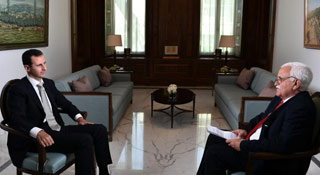
Prensa Latina transmits below the full text of the exclusive interview with Syrian President Bashar Al Assad:
PRENSA LATINA: Mr. President, thanks for giving Prensa Latina this historic opportunity of conveying your point of views to the rest of the world about the reality in Syria, because as you know, there is a lot of misinformation out there about your country, about the foreign aggression that is taking place against this beautiful country.
Mr. President, how would you evaluate the current military situation of the external aggression against Syria, and what are the main challenges of Syrian forces on the ground to fight anti-government groups? If it is possible, we would like to know your opinion about the battles or combats in Aleppo, in Homs.
President Assad: Of course, there was a lot of support to the terrorists from around the world. We have more than one hundred nationalities participating in the aggression against Syria with the support of certain countries like Saudi Arabia and Qatar with their money and Turkey with the logistical support, and of course with the endorsement and supervision of the Western countries, mainly the United States, France, and the UK, and some other allies.
But since the Russians decided to intervene in supporting legally the Syrian Army in fighting the terrorists in Syria, mainly al-Nusra and ISIS and some other affiliated groups, the scales have been tipped against those terrorists, and the Syrian Army has made many advancements in different areas in Syria.
And we are still moving forward, and the Syrian Army is determined to destroy and to defeat those terrorists. You mentioned Homs and Aleppo.
Of course, the situation in Homs, since the terrorists left Homs more than a year ago, the situation has been much, much better, more stable.
You have some suburbs of the city which were infiltrated by terrorists. Now there is a process of reconciliation in those areas in which either the terrorists give up their armaments and go back to their normal life with amnesty from the government, or they can leave Homs to any other place within Syria, like what happened more than a year ago in the center of the city.
For Aleppo it is a different situation, because the Turks and their allies like the Saudis and Qataris lost most of their cards on the battlefields in Syria, so the last card for them, especially for Erdogan, is Aleppo.
That is why he worked hard with the Saudis to send as much as they can of the terrorists – the estimation is more than five thousand terrorists – to Aleppo.
PRENSA LATINA: Through the Turkish borders?
President Assad: Yes, from Turkey to Aleppo, during the last two months, in order to recapture the city of Aleppo, and that didn’t work.
Actually, our army has been making advancement in Aleppo and the suburbs of Aleppo in order to encircle the terrorists, then, let’s say, either to negotiate their going back to their normal life as part of reconciliation, or for the terrorists to leave the city of Aleppo, or to be defeated. There’s no other solution.
PRENSA LATINA: Mr. President, which are the priorities of the Syrian Army in the confrontation with the terrorist groups? What is the role that the popular defence groups are playing in the theatre of operations?
President Assad: The priority of the Syrian Army, first of all, is to fight ISIS, al-Nusra and Ahrar al-Cham and Jaish al-Islam. These four organizations are directly linked to Al Qaeda through the ideology; they have the same ideology, they are Islamic extremist groups who want to kill anyone who doesn’t look or doesn’t feel or behave like them.
But regarding what you called the popular militia groups, actually, at the beginning of the war, the terrorists started an unconventional war against our army, and our army is a traditional army, like any other in the world, so the support of those popular defence groups was very important in order to defeat the terrorists in an unconventional way.
That was very helpful to the Syrian Army, because those fighters, those national fighters, they fight in their regions, in their cities, in their villages, so they know the area very well, they know the region very well, I mean the pathways, the terrain, let’s say, very well.
So, they can be very huge assets for the Syrian Army. That is their role.
PRENSA LATINA: Mr. President, how does the resistance of the Syrian people take place in the economic front to foreign aggression, I mean the economy, and please, what is your opinion on which sectors of the Syrian economy have remained functioning despite the war, economic blockade, looting, and so forth?
President Assad: Actually, the war on Syria is a full-blown war; it is not only supporting terrorists. They support the terrorists, and at the same time they launched a political war against Syria on the international level, and the third front was the economic front, in which they dictate to their terrorists, to their surrogate mercenaries, to start destroying the infrastructure in Syria that helped the economy and the daily needs of the Syrian citizens.
At the same time, they started an embargo directly on the borders of Syria through the terrorists and abroad through the banking systems around the world. In spite of that, the Syrian people were determined to live as much normal life as they can.
That prompted many Syrian businessmen or the owners of, let’s say, the industry, which is mainly medium and small industry, to move from the conflict areas and unstable areas toward more stable areas, on a smaller scale of business, in order to survive and to keep the economy running and to keep the needs of the Syrian people available.
So, in that regard, most of the sectors are still working. For example, the pharmaceutical sector is still working in more than 60 percent of its capacity, which is very important, helpful, and very supportive to our economy in such circumstances.
And I think now we are doing our best in order to re-expand the base of the economy in spite of the situation, especially after the Syrian Army made many advancements in different areas.
PRENSA LATINA: Mr. President, let’s talk a little bit about the international environment, please, give me your opinion about the role of the United Nations in the Syrian conflict, the attempts of Washington and its allies to impose their will on the Security Council and in the Geneva peace talks.
President Assad: Talking about the role of the United Nations or Security Council could be illusive, because actually the United Nations is now an American arm, where they can use it the way they want, they can impose their double standards on it instead of the Charter.
They can use it like any other institution within the American administration. Without some Russian and Chinese stances in certain issues, it would be a full American institution.
So, the Russian and Chinese role has made some balance within these institutions, mainly regarding the Syrian issue during the last five years. But if you want to talk about their role through their mediators or their envoys, like recently de Mistura, and before that Kofi Annan, and in between Brahimi, and so on. Let’s say that those mediators are not independent; they reflect either the pressure from the Western countries, or sometimes the dialogue between the main powers, mainly Russia and the United States.
So, they’re not independent, so you cannot talk about the role of the United Nations; it is a reflection of that balance. That is why so far, there is no United Nations role in the Syrian conflict; there is only Russian and American dialogue, and we know that the Russians are working hard and seriously and genuinely in order to defeat the terrorists, while the Americans always play games in order to use the terrorists, not to defeat them.
PRENSA LATINA: Mr. President, how do you see at the present time the coexistence among Syrian ethnic and religious groups against this foreign intervention? How do they contribute or not in this regard?
President Assad: The most important thing about this harmony between the different spectrums of the Syrian fabric, is that it is genuine, because that has been built up through the history, through centuries, so for such a conflict, it cannot destroy that social fabric.
That is why if you go around and visit different areas under the control of the government, you will see all the colors of the Syrian society living with each other.
And I would say, I would add to this, that during the conflict, this harmony has become much better and stronger, and this is not rhetoric; actually, this is reality, for different reasons, because this conflict is a lesson.
This diversity that you have, it is either to be a richness to your country, or a problem. There’s no something in the middle. So, the people learned that we need to work more on this harmony, because the first rhetoric used by the terrorists and by their allies in the region and in the West regarding the Syrian conflict at the very beginning was sectarian rhetoric.
They wanted people to divide in order to have conflict with each other, to stoke the fire within Syria, and it didn’t work. And the Syrians learned that lesson, that we had harmony; we had had harmony before the conflict, in the normal times, but we have to work more in order to make it much stronger.
So, I can say without any exaggeration that the situation regarding this part is good. In spite of that, I would say the areas under the control of the terrorists – and as you know those terrorists are mainly extremist groups affiliated to Al Qaeda – in which they worked very hard in order to indoctrinate the young generation with their dark ideology, and they succeeded in some areas, this dark ideology with the killing and beheading and all these horrible practices.
With the time, it is going to be more difficult to deal with this new generation of young people who have been indoctrinated with Al Qaeda and Wahabi doctrine and ideology. So this is the only danger that we are going to face regarding our society, harmony, and coexistence that you just mentioned.
PRENSA LATINA: Mr. President, I would like to go again to the international arena. What is in your opinion the role of the U.S.-led international coalition in relation to the groups that operate in northern Syria, in particular regarding the Kurds group. I mean the bombing of the American airplanes and the coalition in the northern part of the country. What to do you think about that?
President Assad: You know, traditionally, the American administrations, when they had relations with any group or community in any country, it is not for the sake of the country, it is not for the interest of the people; it is for the agenda of the United States.
So, that is what we have to ask ourselves: why would the Americans support any group in Syria? Not for Syria. They must their agenda, and the American agenda has always been divisive in any country. They don’t work to unite the people; they work to make division between the different kinds of people.
Sometimes they choose a sectarian group, sometimes they choose an ethnical group in order to support them against other ethnicities or to push them in a way that takes them far from the rest of the society.
This is their agenda. So, it is very clear that this American support is not related to ISIS, it is not related to al-Nusra, it is not related to fighting terrorism, because since the beginning of the American intervention, ISIS was expanding, not shrinking. It has only started to shrink when the Russian support to the Syrian Army took place last September.
PRENSA LATINA: Mr. President, what is your opinion about the recent coup d’état in Turkey, and its impact on the current situation in that country, and on the international level, and on the Syrian conflict also?
President Assad: Such a coup d’état, we have to look at it as a reflection of instability and disturbances within Turkey, mainly on the social level. It could be political, it could be whatever, but at the end, the society is the main issue when you have instability.
Regardless of who is going to govern Turkey, who is going to be the president, who is going to be the leader of Turkey; this is an internal issue. We don’t interfere, we don’t make the mistake to say that Erdogan should go or should stay. This is a Turkish issue, and the Turkish people have to decide.
But what is more important than the coup d’état itself, we have to look at the procedures and the steps that are being taken by Erdogan and his coterie recently during the last few days, when they started attacking the judges; they removed more than 2,700 judges from their positions, more than 1,500 professors in the universities, more than 15,000 employees in the education sector. What do the universities and the judges and that civil society have to do with the coup d’état?
So, that reflects the bad intentions of Erdogan and his misconduct and his real intentions toward what happened, because the investigation hasn’t been finalized yet. How did they take the decision to remove all those?
So, he used the coup d’état in order to implement his own extremist agenda, Muslim Brotherhood agenda, within Turkey, and that is dangerous for Turkey and for the neighboring countries, including Syria.
PRENSA LATINA: Mr. President, how do you evaluate the Syrian government’s relations with the opposition inside Syria? What is the difference between these opposition organizations and those based outside Syria?
President Assad: We have good relations with the opposition within Syria based on the national principles. Of course, they have their own political agenda and they have their own beliefs, and we have our own agenda and our beliefs, and the way we can make the dialogue either directly or through the ballot boxes; it could be a different way of dialogue, which is the situation in every country.
But we cannot compare them with the other oppositions outside Syria, because the word “opposition” means to resort to peaceful means, not to support terrorists, and not to be formed outside your country, and to have grassroots, to have real grassroots made of Syrian people.
You cannot have your grassroots be the foreign ministry in the UK, Franceor the intelligence in Qatar and Saudi Arabia and the United States. This is not opposition, this is called, in that case, you are called a traitor.
So, they call them oppositions, we call them traitors. The real opposition is the one that works for the Syrian people and is based in Syria and its agenda derived its vision from the Syrian people and the Syrian interests.
PRENSA LATINA: Mr. President, how do you evaluate the insistence of the U.S. and its allies that you leave power in addition to the campaign to distort the image of your government?
President Assad: Regarding their wish for me to leave power, they have been talking about this for the last five years, and we never responded even with a statement.
We never cared about them. Actually, this is a Syrian issue; only the Syrian people can say who should come and go, who should stay in his position, who should leave, and the West knows our position very well regarding this.
So, we don’t care and don’t have to waste our time with their rhetoric. I am here because of the support of the Syrian people. Without that, I wouldn’t be here. That is very simple.
About how they defame, or try to demonize certain presidents, this is the American way, at least since the second World War, since they substituted British colonization in this region, and maybe in the world, the American administrations and the American politicians haven’t said a single honest word regarding anything.
They always lie. And as time goes by, they are becoming more inveterate liars, so this is part of their politics. So, to demonize me is like how they tried to demonize President Vladimir Putin during the last two years and they did the same with the Cuban leader Fidel Castro during the last five decades.
This is their way. So, we have to know that this is the American way. We don’t have to worry about it. The most important thing is to have good reputation among your own people. That is what we have to worry about.
PRENSA LATINA: Mr. President, what is your opinion on Syria’s relation with Latin America, particularly the historical links with Cuba?
President Assad: In spite of the long distance between Syria and Latin America, we are always surprised how much the people in Latin America, not only the politicians, know about this region. I think this has many reasons, but one of them is the historical similarities and commonalities between our region, between Syria and Latin America.
Latin America was under direct occupation for long time ago but after that it was under the occupation of the American companies, and the American coup d’états and the American intervention.
So, they know what is the meaning of being independent or not to be independent. They understand that the war in Syria is about independence.
But the most important thing is the role of Cuba. Cuba was the spearhead of the independence movement within Latin America and Fidel Castro was the iconic figure in that regard.
So, on the political level and the knowledge level, there is a strong harmony between Syria and Latin America, especially Cuba. But I do not think we work enough to improve the other part of the relation; to be on the same level mainly on the educational and the economic level.
That was my ambition before the crisis and that is why I visited Latin America, Cuba, Venezuela, Argentine and Brazil, in order toinvigorate this relation. Then, we had this conflict started and it was a big obstacle to do anything in that regard, but I think that we have not to restrain the relation on the historical and the political levels. That is not enough. You have so many other sectors, people should know more about each other. The long distance could be an obstacle, but it shouldn’t because we have strong relations with the rest of the world, east and west.
So, it is not an obstacle in these days. So, I think if we overcome this crisis and this war, we should work harder in order to invigorate the different sectors of this relation with Latin America and especially with Cuba.
PRENSA LATINA: Mr. President, would you tell me your opinion about the electoral process in the United States mainly for the president? Now, there are two candidates; the Republican one is Mr. Donald Trump and the Democrat one is Mrs. Hillary Clinton, what is your opinion about this process, about the result of this process and how it could impact the conflict here, in the war in Syria?
President Assad: We resumed our relation with the United States in 1974. Now, it has been 42 years since then and we witnessed many American presidents in different situations and the lesson that we have learned is that no one should bet on any American president, that is the most important thing. So, it is not about the name.
They have institutions, they have their own agenda and every president should come to implement that agenda in his own way, but at the end he has to implement that agenda.
All of them have militaristic agendas, and the only difference is the way. One of them sends his army like Bush and the other one sends mercenaries and proxies like Obama, but all of them have to implement this agenda.
So, I do not believe that the president is allowed completely to fulfill his own political convictions in the United States, he has to obey the institutions and the lobbies, and the lobbies have not changed and the institutions’ agenda has not change.
So, no president in the near future will come to make a serious and dramatic change regarding the politics of the United States.
PRENSA LATINA: Mr. President, one final question: what message would you send using this interview with Prensa Latina to the governments and people of Latin America, the Caribbean, and also why not the American people, about the importance of supporting Syria against terrorism?
President Assad: Latin America is a very good and important example to the world about how the people and their governments regain their independence.
They are the backyard of the United States as the United States sees, but this backyard was used by the United States to play its own games, to implement its own agenda and the people in Latin America sacrificed a lot in order to regain their independence and everybody knows that.
After regaining their independence, those countries moved from being developing countries, or sometimes under-developed countries, to be developed countries. So, independence is a very important thing and it is very dear for every Latin American citizen.
We think they have to keep this independence because the United States will not stop trying to topple every independent government, every government that reflects the vast majority of the people in every country in Latin America.
And again, Cuba knows this, knows what I am talking about more than any other one in the world; you suffered more than anyone from the American attempts and you succeeded in withstanding all these attempts during the last sixty years or more just because the government reflected the Cuban people.
So, holding strongly to this independence, I think, is the crucial thing, the most important thing for the future of Latin America. Regarding Syria, we can say that Syria is paying the price of its independence because we never worked against the United States; we never worked against France or the UK. We always try to have good relations with the West.
But their problem is that they do not accept any independent country and I think this is same for Cuba. You never tried to do any harm to the American people but they do not accept you as an independent country.
The same is true for other countries in Latin America and that’s why you always have coup d’états mainly between the sixties and the seventies.
So, I think preserving the independence of a certain country is not only an isolated case; if I want to be independent, I have to support the independence in the rest of the world. So, the independence anywhere in the world, including Latin America, will support my independence. If I am alone, I will be weak.
Supporting Syria will be mainly in the international arena. There are many international organizations, mainly the United Nation, in spite of its impotence, but at the end, their support could play a vital role in supporting Syria and, of course, the Security Council; it depends on who is going to be the temporary member in the Security Council, and any other organization supporting Syria will be very important.
PRENSA LATINA: Mr. President, we know you are a very busy person, that is why I appreciate very much your time that you have dedicated to Prensa Latina interview in this moment. I hope this would not be the last interview that we have with you.
A 5-hour meeting between a visiting foreign minister and Russian President Vladimir Putin is not only rare but difficult to recall. Putin makes rare exceptions to receive foreign ministers. And he always receives them after their talks with Foreign Minister Sergey Lavrov. By all these yardsticks, US Secretary of State John Kerry’s meeting with Putin last Thursday in the Kremlin was extraordinary.
He drove into the Kremlin straight after touching down in Moscow Thursday evening and had talks with Putin lasting till 1 am in the wee hours of Friday morning. Putin’s rare appearance for a joint press briefing with a foreign minister (Kerry), Puitn’s ‘body language’ and, of course, the subsequent joint press conference by Kerry and Lavrov — they distinctly sought to convey the impression that the US and Russia were on to a big joint venture apropos the Syrian conflict. (here and here)
None of the three statesmen – neither Putin and Lavrov nor Kerry – was even remotely affected by the negative energy radiated by the high-profile summit meeting of the NATO, which had taken place in Warsaw hardly four days ago whose leitmotif was the strong determination of the western alliance to defend and deter Russia’s perceived aggressive tendencies in Eurasia.
Kerry is going to meet a select group of European allies later today in London to brief them on “the concrete steps that the U.S. and Russia are planning to take”. He disclosed that he had a phone conversation with Lavrov on Tuesday, and,
We both [with Lavrov] believe that we have understanding of the direction we are going in and what needs to be achieved. Our teams will meet shortly in order to continue to do that, in order to bolster the cessation of hostilities, in order to increase our capacity to fight against Al Qaeda, an Nusra, as well as fight back against ISIL.
It all sounds too good to be true. But then, Kerry is a seasoned diplomat with 30 years as a senator behind him during which he also headed the senate foreign relations committee and now as America’s top diplomat for over 3 years. Why is the US all of a sudden giving such hype to a peace project with Russia, an aggressive regional power, to kickstart a political process Syria?
The US has always sought a “selective engagement” of Russia on issues of concern to Washington while pursuing the containment strategy on another track. Lavrov may have gently rubbed this in when Kerry phoned him on Thursday to discuss the “concrete steps” on Syria as follow-up to his talks in the Kremlin last week. Curiously, the Russian Foreign Ministry readout makes a wry reference to Lavrov also, inter alia, availing of the opportunity to gently remind Kerry how the Obama administration is also simultaneously moving heaven and earth to humiliate Russia on another front by keeping it out of the Rio Olympics. These seasoned diplomats must be having the hide of rhinoceros — the readout says, “Mr. Kerry agreed that sports should not be politicized”. (here)
Won’t Moscow be aware that Kerry might even be dissimulating a concord with Russia over Syria? Won’t Moscow know that the Obama administration is on its last leg and time has run out? The point is, there is a powerful lobby in Washington, including the Pentagon and apparently within the State Department itself, which opposes any form of US-Russia cooperation in Syria that does not lead to the ouster of President Bashar al-Assad in a near term. (Read a briefing by the Brookings Institution, on the hawkish opinion in Washington.)
Indeed, the US is engaging Russia assiduously against the backdrop of the dramatic events in Turkey. The ground has shifted in the geopolitics of the region. Interestingly, Kerry made the hurried unscheduled trip to Moscow last week within 4 days of the NATO summit even as the failed coup attempt was getting under way in Turkey. Actually, Kerry was about to meet with Putin in the Kremlin — or had been conversing with him already –even as the coup began in Turkey. Something doesn’t quite gel here, isn’t it? Suffice it to say, much depends on how far back Kerry (Obama administration) actually had known about the coup that was in the making in Turkey. (Read a breath-taking, blow-by-blow account of the ‘Turkish coup’ by senior editor Murat Yetkin in today’sHurriyet.)
Of course, the failed coup in Turkey becomes a defining moment for the Syrian conflict. The Turkish military and state intelligence – and the political leadership – are all passing through such turbulence that Ankara simply lacks the presence of mind or the sheer capacity to continue to pursue an interventionist policy in Syria in a foreseeable future. Meanwhile, great uncertainties have crept into Turkey’s relations with the US and Europe. Moscow cannot but be aware that Turkey desperately needs to hold the Russian hand — and that indeed adds to Russia’s politico-military options in Syria. The thinking is reflected in a commentary by a top Kremlin pundit Fyodor Lukyanov inMoscow Times.
Clearly, the US policies on Syria are floundering. The Syrian forces have laid siege to Aleppo and the US-backed rebels are trapped inside the city, while Turkey may have begun disengaging from reaching aid to them. Washington has no option but to engage Moscow to work out some sort of face-saving compromise formula.
But what does Russia get in return? Participation in Rio Olympics? It shouldn’t be surprising if the International Olympics Committee has a last-minute change of heart and says ‘Da‘ to the Russian team, finally. If that happens, it will be in the best traditions of Russian-American trade-offs, and Kerry worked hard on it.
The recent violent events in Turkey, Armenia and Kazakhstan could have been provoked by special services “from across the ocean,” a Russian MP working on the committee in charge of Eurasian integration has commented.
“In my opinion these are all links in one chain. The events in Turkey, Armenia and in Aktobe, Kazakhstan, are all connected and were all provoked from abroad. I think that special services from across the ocean are dealing with these issues, destabilizing the situation in these countries,” the deputy chair of the State Duma Committee for Eurasian Integration and Commonwealth of Independent States, Kazbek Taisayev, told Life news portal.
The MP said that Western nations were not interested in a calm situation near Russian borders and took steps to prevent such developments.
“As soon as we start a normal dialogue with our neighbors, something immediately happens in these countries,” he said.
“We need to unite our efforts, I think that we have enough political will to render mutual help to poor nations,” Taisayev stated.
The comment came shortly after a group of radical nationalists stormed and captured a police station in Armenia’s capital, Yerevan, killing one policeman and taking several more hostage. The attackers demanded the release of Armenian opposition figure Jirayr Sefilyan, who was detained last month after authorities reportedly uncovered a plot to seize several buildings and telecommunication facilities in Yerevan.
The standoff continues and on Wednesday night Armenian police used tear gas to dissolve a rally of Sefiyan’s supporters in central Yerevan.
In early June, a group of radicals raided two gun shops, hijacked a bus and attacked a military base in the city of Aktobe, Kazakhstan, killing at least five people and wounding 10 more. Police fought off the terrorists, killing four of them and arresting seven more.
This week two people allegedly connected with radical Islamist groups opened fire at a police station in Kazakhstan’s largest city, Almaty, killing seven people and injuring nine more. President Nursultan Nazarbaev has called the attack an act of terrorism.
On July 15, an attempted military coup took place in Turkey. A large group of military officers attempted to seize power, displacing President Recep Tayyip Erdogan. However, their plans were thwarted by police and thousands of ordinary people who took to the streets of Ankara and Istanbul. According to Turkish authorities 246 government supporters and at least 24 coup plotters were killed during the conflict. Thousands of Turkish military and law enforcement personnel were arrested and fired in the large-scale purge that followed these events.
On Wednesday, Erdogan announced the introduction of a state of emergency in Turkey for three months.
Erdogan and the government have said that the attempted coup was masterminded by Muslim cleric Fethullah Gulen who is currently living in the United States. Ankara also demanded Gulen’s extradition.
Iraq war criminals deserve to be prosecuted. Britain’s Chilcot report is only the most recent example of a worthy cause needing to be addressed. But in 1979, long before false intelligence was used to justify the Iraq war, a heinous war crime was committed against Afghanistan by President’s Carter’s National Security Advisor Zbigniew Brzezinski.
It’s not just Brzezinski who is culpable. It was the Washington bureaucracy that enabled Brzezinski to activate his Machiavellian plot of intentionally drawing the Soviets into his “Afghan Trap.”
How the Washington bureaucracy enabled Brzezinski’s scheme and why it’s still important today
Once the Soviets took Brzezinski’s bait and crossed the border into Afghanistan on December 27, 1979 the fates of both countries were doomed. As if in a trance, a complacent bureaucracy turned a blind eye to the lack of proof of the American claims that the Soviet invasion was a step towards world domination. Within days the beltway became a cheering squad, enabling Brzezinski to fulfill his imperial dream of giving the Soviets their own “Vietnam.” The bureaucracy’s motivation was simple. Brzezinski was winning the only game in town, the Cold War against the “Evil Empire.” The fact that Brzezinski’s deceitful plot could lead to the death of Afghanistan as a sovereign state did not concern Washington’s elites, either from the right or the left. Predictably, Afghans’ lives have been turned into an endless nightmare that festers to this day. Not only is Brzezinski’s scheme continuing to undermine Afghanistan’s sovereignty, his Russophobia also drives NATO’s unjustified aggression towards Russia today!
How Brzezinski activated his Russophobic Imperial Dream that now dominates Washington
In 1977 when Brzezinski stepped into the Oval office as National Security Advisor to President Jimmy Carter, his Russophobia was a well-known fact from Washington to Moscow. It was no surprise that he was not content with the American moderates’ pragmatic Cold War acceptance of coexistence with the Soviet state. The Polish born Brzezinski represented the ascendency of a radical new breed of compulsive xenophobic Eastern European intellectual bent on holding Soviet/American policy hostage to their pre-World War II world view. According to Brzezinski biographer Patrick Vaughan, Brzezinski rejected the very legitimacy of the Soviet Union itself, calling it “a cauldron of conquered nationalities brutally consolidated over centuries of Russian expansion.”
Racism is not a basis for a rational foreign policy
A phobia is defined as an extreme or irrational fear. Therefore it is reasonable to define a Russophobe as one who has an irrational fear of Russians. Simply put, a Russophobe hates Russians for being Russian! That’s called racism, pure and simple, not the basis of creating rational foreign policy. The Beltway should have demanded that a well-known Russophobe like Brzezinski back his claims with proof that the Soviet invasion of Afghanistan was the first step to taking over the world. Instead, the Washington Bureaucracy dined out on his fantasy and we have been living with the consequences ever since.
The Bureaucracy knows Brzezinski has always been a Russophobe
Paul Warnke, President Carter’s SALT II negotiator put Brzezinski’s racial bias this way in an interview we conducted with him in 1993. “It was almost an ethnic thing with Zbig, basically that inbred Polish attitude toward the Russians. And that of course that was what frustrated the Carter Administration. [Secretary of State] Vance felt very much the way that I did. Brzezinski felt the opposite. And Carter couldn’t decide which one of them he was going to follow. So it adds up to a recipe for indecision.” Warnke went on to say that he believed the Soviets would never have invaded Afghanistan in the first place if Carter had not fallen victim to Brzezinski’s irrational attitude toward détente and his undermining of SALT II. In our own research into the causes of the Soviet invasion we did prove Warnke’s assumption that there would have been no invasion without Brzezinski’s willful use of entrapment.
At a conference conducted by the Nobel Institute in 1995, a high-level group of former US and Soviet officials faced off over the question: Why did the Soviets invade Afghanistan? Former National Security Council staff member Dr. Gary Sick established that the US had assigned Afghanistan to the Soviet sphere of influence years before the invasion. So why did the US choose an ideologically-biased position when there were any number of verifiable fact-based explanations for why the Soviets invaded? To former CIA Director Stansfield Turner, responsibility could only be located in the personality of one specific individual. “Brzezinski’s name comes up here every five minutes; but nobody has as yet mentioned that he is a Pole.” Turner said. “[T]he fact that Brzezinski is a Pole, it seems to me was terribly important.” What Turner was suggesting in 1995 was that Brzezinski’s well-known Russophobia led him to take unjustifiable advantage of a Soviet miscalculation.
The conference revealed that “self-fulfilling prophecies,” “a dubious deductive apparatus,” and “decisions that provoked as often as they deterred” provided the operating system for more than a decade of Cold War policy under Presidents Carter and Reagan. Numerous scholars pondered Brzezinski’s decision-making process before, during and after the Soviet invasion. Dr. Carol Saivetz of Harvard University testified, “Whether or not Zbig was from Poland or from someplace else, he had a world view, and he tended to interpret events as they unfolded in light of it. To some extent, his fears became self-fulfilling prophecies… Nobody looked at Afghanistan and what was happening there all by itself.”
But it wasn’t until the 1998 Nouvel Observateur interview that Brzezinski boasted that he had provoked the invasion, by getting Carter to authorize a presidential finding to intentionally suck the Soviets in, six months before Moscow considered invading. Yet, despite Brzezinski’s admission, Washington’s entire political spectrum continued to embrace his original false narrative, that the Soviets were embarked on world conquest.
Brzezinski’s Russophobia is still the basis of U.S. foreign policy towards Russia
For Brzezinski, getting the Soviets to invade Afghanistan was an opportunity to shift Washington toward an unrelenting hard line against the Soviet Union. By using deceit combined with covert action, he created the conditions needed to provoke a Soviet defensive response, which he then used as evidence of Soviet expansion. However, after Brzezinski’s exaggerations and outright lies about Soviet intentions became accepted, they found a home in America’s imagination and never left. US foreign policy, since that time, has operated in a delusion of triumphalism, provoking international incidents and then capitalizing on the chaos.
Brzezinski’s current status as the almost mystical “wise elder” of American foreign policy should be viewed with extreme caution given the means by which he achieved it. Today, the legacy of Brzezinski’s Russophobic ideological agenda continues through many acolytes including his two sons, as they carry on the Brzezinski lineage by aggressively pushing beltway polices towards dangerous confrontations with Russia. Tragically, Brzezinski’s legacy also lives on in the failed state of Afghanistan as the hated Taliban are poised to take over again. While all this horror is happening to the Afghan people, NATO forces are using Brzezinski’s homeland of Poland to push provocatively against Russia’s border.
The role that Brzezinski played, as well as those officials who enabled him to cause the death of Afghanistan while intentionally triggering the rise of Islamic extremism, must be examined. Building to a trial, even in absentia, will begin the desperately needed process of breaking the trance-like hold Brzezinski’s Russophobia still has on Washington’s foreign policy that is denying its core role in creating Islamic extremism and driving America to the brink of nuclear war with Russia.
No matter whom the next president is, if we are to save America, this forty year old crime against Afghanistan must first be made right.
Last night, Pence addressed the Republican Convention: “And if the world knows nothing else, it will know this: America stands with Israel.”
I’ve heard him say that before.
Being a journalist based in the Washington, D.C. area, I try to ask tough questions of political figures when I can. Perhaps my favorite question is some variation of “do you acknowledge that Israel has nuclear weapons?” I’ve asked this of many political figures and virtually none have given me a straightforward response.
But the most surreal — almost comical — response came from Donald Trump’s VP pic, Mike Pence, in 2011. At the time, he was a congressman and vice-chair of the House Foreign Affairs Subcommittee on the Middle East and South Asia:
Question: You’ve also served on the Foreign Affairs Committee. Do you know that Israel has nuclear weapons?
Pence: [long pause, looks down] I’m — I am aware that Israel is our most cherished ally. And I strongly support Israel’s right of self defense and to take such actions as are necessary to secure their homeland as much as we take actions to secure ours.”
Question: “Do you think it increases or decreases U.S. credibility around the world when U.S. government officials can’t even acknowledge that Israel has a massive nuclear arsenal?”
Pence: “The American people support Israel. I call Israel our most cherished ally and I will continue to stand — without apology — for a strong U.S.-Israel relationship and strong cooperation with our most cherished ally in a very volatile part of the world.”
He was utterly incapable of engaging on the issue. The passionate attachment has become a mantra and no inconvenient facts need enter the equation.
Since my questioning these figures, information has come out about gag orders on the subject. As Grant Smith of the Institute for Research: Middle Eastern Policy wrote in 2015: “Under two known gag orders — punishable by imprisonment — U.S. security-cleared government agency employees and contractors may not disclose that Israel has a nuclear weapons program. GEN-16 is a ‘no-comment’ regulation on ‘classified information in the public domain.’ ‘DOE Classification Bulletin WPN-136 on Foreign Nuclear Capabilities’ forbids stating what 63.9 percent of Americans already know — that Israel has a nuclear arsenal.'”
Thanks to Matt Bradley and Chris Belcher for help with the Washington Stakeout project, which questioning Pence was a part of: @dcstakeout and on YouTube.
Russian President Vladimir Putin did on Sunday what no major western leader from the NATO member countries cared to do when he telephoned his Turkish counterpart Recep Erdogan to convey his sympathy, goodwill and best wishes for the latter’s success in restoring constitutional order and stability as soon as possible after the attempted coup Friday night.
The US Secretary of State John Kerry instead made an overnight air dash to Brussels to have a breakfast meeting on Monday with the EU foreign ministers to discuss a unified stance on the crisis in Turkey. The French Foreign Minister Jean-Marc Ayrault was in an angry mood ahead of the breakfast, saying “questions” have arisen as to whether Turkey is any longer a “viable” ally. He voiced “suspicions” over Turkey’s intentions and insisted that European backing for Erdogan against the coup was not a “blank cheque” for him to suppress his opponents.
The US has expressed displeasure regarding the Turkish allegations of an American hand in the failed coup. Indeed, the Turkish allegation has no precedent in NATO’s 67-year old history – of one member plotting regime change in another member country through violent means. Clearly, US and Turkey are on a collision course over the extradition of the Islamist preacher Fethullah Gulen living in exile in Pennsylvania whom the Turkish government has named as the key plotter behind the coup. Turkish Prime Minister Binali Yildirim has warned that Ankara will regard the US as an “enemy” if it harbored Gulen. The dramatic developments expose the cracks appearing in the western alliance system. (See the commentary in the Russian news agency Sputnik entitled NATO R.I.P (1949-2016): Will Turkey-US Rift Over Gulen Destroy Alliance?)
Interestingly, the senior Turkish army officials detained so far include the following:
Commander of the Incirlik air base (and 10 of his subordinates) where NATO forces are located and 90 percent of the US’ tactical nuclear weapons in Europe are stored;
Army Commander in charge of the border with Syria and Iraq;
Corps Commander who commands the NATO contingency force based in Istanbul; and,
Former military attaches in Israel and Kuwait.
Most certainly, the needle of suspicion points toward the Americans having had some knowledge of the coup beforehand. Two F-16 aircraft and two ‘tankers’ to provide mid-air refuelling for them and used in the coup attempt actually took off from Incirlik.
Of course, Ankara has been wary of the US and France establishing military bases in northern Syria with the support of local Kurdish tribes, which it suspected would be a stepping stone leading to the creation of a ‘Kurdistan’. (The advisor on foreign affairs to Iran’s supreme leader, Ali Akbar Velayati, who is an influential figure in Tehran alleged on Sunday that the US is attempting to create a Kurdistan state carved out of neighboring countries with Kurdish population, which will be a “second Israel” in the Middle East to serve Washington’s regional interests.)
Today, the famous Saudi whistleblower known as ‘Mujtahid’ has come out with a sensational disclosure that the UAE played a role in the coup and had kept Saudi Arabia in the loop. Also, the deposed ruler of Qatar Hamad bin Khalifa Al-Thani (who is a close friend of Erdogan) has alleged that the US, another Western country (presumably France) had staged the coup and that Saudi Arabia was involved in it. (here and here) Meanwhile, word has leaked to the media that in a closed-door briefing to the Iranian parliament on Sunday, Foreign Minister Mohammad Zarif hinted at Saudi and Qatari involvement in the coup.
Putin’s phone call to Erdogan suggests the possibility that Russian and Turkish intelligence are keeping in touch. The two leaders have agreed to meet shortly.
The timing of the coup attempt – following the failure of the US push to establish a NATO presence in the Black Sea and in the wake of the Russian-Turkish rapprochement – becomes significant. Equally, the signs of shift in Turkey’s interventionist policies in Syria would have unnerved the US and its regional allies.
Israel, Saudi Arabia and Qatar have a great deal to lose if Turkey establishes ties with Syria, which is on the cards. Thus, stopping Erdogan on his tracks has become an urgent imperative for these countries. The spectre of the Syrian government regaining control over the country’s territory haunts Israel, which has been hoping that a weakened and fragmented Syria would work to its advantage to permanently annex the occupied territories in the Golan Heights. Again, Turkey’s abandonment of the ‘regime change’ agenda in Syria means a geopolitical victory for Iran. On the contrary, a triumphant and battle-hardened Hezbollah next door means that its vast superiority in conventional military strength will be rendered even more irrelevant in countering the resistance movement. Significantly, Israel is keeping stony silence.
Will the US and its regional allies simply throw in the towel or will they bide their time to make a renewed bid to depose Erdogan? That is the big question. Erdogan’s popularity is soaring sky-high today within Turkey. He can be trusted to complete the ‘vetting’ process to purge the Gulenists ensconced in the state apparatus and the armed forces. The meeting of the High Military Council due in August to decide on the retirement, promotions and transfers of the military top brass gives Erdogan the free hand to remove the Gulenists.
M. K. Bhadrakumar is the former career diplomat in the Indian Foreign Service.
Are these the tell-tale signs of kids at risk of committing violence: An 8-year-old who wore a t-shirt saying he wanted to be like a seventh-century Muslim leader? A 17-year-old who sought to draw attention to the water shortage in Gaza by handing out leaflets? A 4-year-old who drew a picture of his dad slicing a vegetable?
Teachers and school officials in the United Kingdom thought so, and they referred these children for investigation as potential terrorists. They were interrogated by U.K. law enforcement. They’re likely subject to ongoing monitoring, with details of their childhoods maintained in secret government files potentially indefinitely.
A report released last week by Rights Watch (UK) highlights these and other children’s experiences under a U.K. countering violent extremism (CVE) program known as Prevent. Prevent imposes a legal obligation on schools to implement policies assessing whether children have “extremist” views or are at risk of engaging in terrorism, and to “intervene as appropriate.” Intervention may include referring the child to a related program in which panels of police officers, teachers, and other government employees identify children they think are vulnerable to terrorist recruitment.
Why should any of this concern Americans? Because the FBI wants to do something a little bit too close for comfort in U.S. schools, and American schoolchildren may come under similar suspicion and scrutiny.
While there’s no similar government-imposed duty on American schools, U.S. CVE initiatives are based on the Prevent model. Due to this, a core component of the U.S. CVE plan tasks teachers, social workers, and school administrators with monitoring and reporting to law enforcement on children in their care. An FBI document released earlier this year tells teachers to spy on their students’ thoughts and suggests that administrators essentially turn schools into mini-FBI offices. Rights Watch’s report shows what might happen if American schools actually follow the FBI’s proposals.
Prevent, unsurprisingly, turns out to be controversial and divisive—a “toxic brand.” Earlier this year, the United Kingdom’s largest teachers union voted to reject the program, calling it ineffective and counterproductive and stating that it causes “suspicion in the classroom and confusion in the staff room.”
We’ve written before about one fundamental concern with CVE programs: They are premised on disproven theories and junk science. Despite years of study, there is no reliable indicator to predict who will engage in violence. In the absence of reliable indicators, the Rights Watch report shows that U.K. programs rely on over-broad and ambiguous criteria describing common and entirely innocent conduct. These so-called indicators include changing one’s style of dress or appearance to match a certain group, expressing a need for identity or belonging, or “becoming quieter” — factors so general it would be difficult to find a child or teenager who hasn’t exhibited such behavior at some point.
Unsurprisingly, when teachers are required to report on “extremist” thoughts or conduct using unreliable and vague criteria, some of those teachers’ suspicions reflect society’s prejudice. Rights Watch found that although Prevent purports to apply to all children at risk of extremism, it disproportionately targeted Muslim children. According to Rights Watch:
“[T]argeting Muslim children, making them feel that they are not welcome to discuss political or religious matters at school, and creating a dynamic in which Muslim youth come to be fearful of the educational setting and distrustful of their teachers and their classmates, is counter-productive, discriminatory, and a violation of the fundamental rights that are at the heart of the very civil society the government seeks to protect.”
CVE programs in the United States using similarly over-broad and ambiguous criteria will inevitably result in discriminatory and unfair targeting of American Muslim children, too.
Another concern about CVE programs is that the government uses them to task people to spy on each other. The Rights Watch report bears out this concern — and its consequences. In the U.K., students fear that reading “controversial” books or engaging in classroom discussion may cause teachers to report them as potential terrorists. Teachers in turn report that Muslim students are ceasing to engage in classroom debate and that teachers themselves are self-censoring the topics they discuss in classrooms. Rights Watch found resulting violations of students’ freedoms of speech and association and their rights to privacy and equal treatment in education.
Here in the United States, the first principle of the National Education Association’s Code of Ethics is a commitment to the student. Teachers may not deny a student’s access to different viewpoints, deliberately suppress or distort subject matter relevant to a student’s progress, or restrict benefits to any student on the basis of race, national origin, or political or religious beliefs. The Rights Watch report is a warning to American principals and teachers of how CVE programs can violate that first principle. It’s also a warning to the U.S. agencies charged with formulating or implementing CVE, including the Departments of Justice, Homeland Security, Health and Human Services, and Education.
There are some things we just shouldn’t import — and on the top of that list should be a discriminatory government program that turns teachers into spies and stifles children’s ability to learn, ask questions, and debate ideas.
The commission monitoring the implementation of a nuclear deal between Iran and six world powers is to convene for a fourth meeting in Vienna.
The Iranian delegation, headed by Deputy Foreign Minister Abbas Araqchi, arrived in the Austrian capital on Tuesday to attend the Joint Commission meeting, which is to convene later in the day.
The first meeting of the commission was held last October, agreeing to reconvene every three months.
The deal between Iran and the world powers, namely Britain, China, France, Germany, Russia and the United States, envisages Tehran scaling back its nuclear program in return for the lifting of all nuclear-related sanctions on the Islamic Republic.
However, months after the accord went into effect in January, the US and the European Union (EU) continue to maintain some sanctions on Iran, scaring off companies from resuming trade with the country.
European banks have balked at the idea of resuming transaction with Iran, fearing punitive US measures. US Republicans, meanwhile, are pushing through three anti-Iran bills in the Congress.
Commenting on the upcoming commission meeting on Sunday, Araqchi said it would be trying to prevent any potential problems from turning into “critical obstacles” in the way of the implementation of the deal, which is officially known as the Joint Comprehensive Plan of Action (JCPOA).
“There are numerous instances of insufficient progress in the removal of the sanctions. It was up to the opposite side to bring about some circumstances, but it did not,” he complained.
He acknowledged that major banks have not resumed transactions with the Islamic Republic, attributing this to the atmosphere surrounding the agreement.
The Americans “did not create the requisite circumstances needed for the removal of the sanctions… In some places, they even created a destructive atmosphere,” he said.
On Monday, Iran’s Parliament Speaker Ali Larijani also said that, “If the sanctions are not supposed to be lifted and banking transactions to take place, there would remain no reason [to continue with] this agreement.”
“Iran has lived up to all its commitments in the nuclear agreement, from the reduction of centrifuges to decreasing of heavy water and enriched materials. But there has been reneging on promises by the other side, especially the US,” he said.
Meanwhile, Secretary of Iran’s Supreme National Security Council (SNSC) Ali Shamkhani said the Islamic Republic is keeping a close eye on the US “bullying, illogicality, and disloyalty” under the JCPOA.
Shamkhani said Leader of the Islamic Revolution Ayatollah Seyyed Ali Khamenei had raised the alarm as to the opposite side’s potential backtracking on its promises at the start of the negotiations.
Elizabeth Richard, 65, seems interested to operate in Lebanon, where she commenced her missions last week. And she, according to the video introducing her at the US embassy, is “interested to get introduced to Lebanon’s natural and cultural heritage (in the video’s background, there are scenes showing the cedars, the Bay Rock and women stuffing vine leaves, edited in a bad and unrefined manner.) The new American ambassador, who visited the “land of cedars” in 2007 under an American initiative to train Internal Security Forces and arm them, seems assertive in her first message to the Lebanese people: “As Lebanon works to save its security and build the strong government’s institutions (…) the American people will stay by your side.” It was a nice diplomatic speech that covers unplanned intentions of the new ambassador, especially regarding her concept of “saving security” and “the state’s strong institutions.” Richard was clearer in her attestation at the congress after she was nominated for the post months ago. Thereat, the specialized in law announced her actual agenda, classifying the “main” problems in Lebanon; all what the Lebanese are suffering from currently in economics, security and politics is because of one single thing: the resistance.
In economics, Richard uncovered a magic equation to deal with the crisis in Lebanon, saying: “our target is to dismantle Hezbollah’s international financial network and help the Lebanese institutions and the Lebanese people, which will contribute directly to activating the economic prosperity in Lebanon.” How would targeting the international funding for resistance lead to refreshing the country’s economy?! Richard didn’t explain this in her testimony; she was not asked to do so in her country, neither the Lebanese government, nor diplomats moved to hold accountable a diplomat who publicly announced that she is going to work from inside Lebanon to fight one of the Lebanese parties that is represented in the parliament and participating in the government! Nobody even dared to demand explanation of the ambassador’s words. Richard, as if she is holding everything in her hands, with the old American unashamed boldness, said she will work hard “not to let Hezbollah break through the Lebanese banking sector” because this is “the interest of Lebanon and the United States.” The new ambassador raised her wand in front of the Lebanese state before she arrived at the host country, yet none of the officials’ sovereignty was touched.
On the security level, Richard had her own philosophy as well. Of course, “Israel” was absent from her speech regarding the security threats Lebanon is subject to, yet ISIL and al-Nusra threats were present. However, the ambassador seems assured in threatening the two organizations that were brought by al-Qaeda. She is convinced that “partnership between the United States and the Lebanese Security Forces, through the generous Congress support, played a decisive role in saving Lebanon’s security facing such threats.” Therefore, there is no fear on the Lebanese people from ISIL and al-Nusra, so what is the first threat Lebanon is subject to according to Richard? The answer is: Hezbollah. “Hezbollah’s activities in Syria create serious security threats in Lebanon,” the ambassador said as she vowed to support the Lebanese army since it is “the only legitimate protector of Lebanon.”
The third “main problem” the Lebanese are suffering from, as Richard identified, is the political void and decrying Lebanon’s independence and sovereignty, which she will also work on solving, this time in cooperation with “the voices calling for moderation and progress.” Against whom? Against “Hezbollah that is still interfering in Syria without the Lebanese consent,” Richard explains. The new ambassador’s swaggering made her talk on behalf of the Lebanese people, without the need to use numeric evidences, even if fabricated, to verify her announcement on the Lebanese people’s accepting or rejecting Hezbollah’s interference in Syria. The conclusion, as Richard informed the congressmen: Hezbollah went to Syria despite the will of most of the Lebanese, which decries Lebanon’s sovereignty and independence.
Usually, western diplomats complain that they couldn’t understand the happenings in Lebanon, and complain about its complicated social structure, economic system and political scene. However, it seems that Elizabeth Richard doesn’t suffer from any of this. Her vision is clear, and so is her single goal: to target the Lebanese resistance through its party, people and money using every possible means.
In her latest post before being appointed to custodianship on the Lebanese people, Richard was the Deputy Assistant Secretary in the Bureau of Near Eastern Affairs at the State Department. In her testimony at the congress in July 2015, she boasted the State Department’s achievements; counting the projects she supervised, such as: the initiative to qualify and develop industrial cities, creating job opportunities, activating exportation in Egypt, Jordan and “Israel”, the General Motors agreement to provide Egypt with huge amounts of electric energy, qualifying the railways in Algeria, buying tons of Iraqi rice, encouraging investments in the Gulf countries, supporting the youth initiatives and medical cooperation with “Israel” and the Arab Emirates… Most of the Middle Eastern and North African countries were present, yet Lebanon was absent from the achievements of Richard and her department last year, and now she comes to the weakest country in the region, having in her pocket a single (non-developmental) political project, promises of armament… and a raised wand!
A friend recently observed to me that it is ironic that the neoconservatives, whose bottom line foreign policy issue is the uncritical support of Israel, should be obsessed with constantly confronting and goading Russia even though Tel Aviv and Moscow get along just fine. Israeli Prime Minister Benjamin Netanyahu has traveled to Russia three times in the past year and he and President Vladimir Putin reportedly understand each other very well.
To be sure, part of the reasoning behind the Israeli offering the hand of friendship is certainly demographic and electoral as many Israelis are Russian in origin and also characteristically strongly support recent right wing governments. They are regarded as essential members of Netanyahu’s coalition, but there is clearly more to it than counting votes.
From the Israeli point of view, Russia, though allied with Syria and friendly with Iran, does not threaten Israel and it also is an available resource to help Tel Aviv develop, refine and market its claimed offshore energy resources. Israel, increasingly isolated because of its repression of the Palestinians, is always eager to make new friends who will help protect it in international fora, witness Netanyahu’s recent charm offensive in Africa.
From the Russian point of view, Israel is a useful friend given its unparalleled access to the U.S. Congress, the White House and the American media. The Netanyahu government also understands Moscow’s concerns about radical Islam in the Arab world and Central Asia and is willing to share information that it obtains to contain the problem. For both Israel and Russia terrorism is not an abstraction – it sits right on and even inside their borders.
Even though Israel is undercutting the neocon plan to isolate and punish Russia at every opportunity people like Bill Kristol, the Kagans and John Bolton make no effort to criticize Netanyahu for his temerity. It is a policy of deliberately looking the other way and it underlines the essential phoniness of what the neoconservatives stand for. To put it bluntly, the neocons claim to support American military dominance globally for altruistic reasons but the reality is that they are largely in it for the money as well as the political and media access to power that money brings with it in contemporary America. What would Sunday morning talk shows be like without a beaming Bill Kristol?
And the cash for the neocons comes mostly from defense contractors who are eager to have a clearly defined serious enemy to boost military spending coupled with an articulate group of pundits who insist on seeing threats worldwide and are willing to promote that viewpoint. Keeping the cash flowing to fund that nice corner office with a view of the Capitol even trumps the Israel relationship but the neocons are careful to make sure the two issues never bump up against each other when they are fulminating against Obama’s national security policies.
We are currently witnessing neocon perfidy at its most refined. They are jumping over themselves to support Hillary Clinton for president in spite of her manifest corruption and unreliability because Donald Trump has threatened to do two things: first he has expressed his unwillingness to enter into new wars in the Middle East or anywhere else and second he has stated that Washington should be even handed when attempting to negotiate peace between Israel and the Palestinians. Both are anathema to the neocons and Trump has further complicated matters by indicating that he would be willing to talk with Vladimir Putin. If Trump were to win, many neocons would likely find themselves having to look for a real job, a terrifying prospect for people with few skills to fall back on.
Hillary Clinton on the other hand will do what is right from the neocon point of view – confronting the world one nation at a time starting with Iran, which she has threatened to “obliterate.” She will also need to boost defense spending to support her wars, will stiff Vlad, and will allow Bibi to move in down the hall at the White House as Bill will often be out on the town and his room in the East Wing is not needed.
Hillary’s bellicosity guarantees that the military industrial complex cash machine will continue to operate full speed, driving scores of leading neocons to announce that they will vote for her. Reuel Marc Gerecht, one of the neocons’ favorite Iran bashers, concluded in an article appearing in a recent issue of the Weekly Standard that Hillary’s “not a neoconservative, but Hillary Clinton isn’t uncomfortable with American power. Unlike Obama, she isn’t the apologetic type. Whatever her opinions were in the Vietnam era, she doesn’t now view the Cold War ambivalently. She’s certain that might married right in that struggle, even in the Third World, where Obama and many on the left have serious doubts.” I’m not completely sure what that pompous bit of prose is supposed to mean but Gerecht in a backhanded fashion also provided what is for me a ringing endorsement of Donald Trump, though he of course meant to do the opposite having stated his intention to vote for Hillary, writing “Trump is probably the most anti-interventionist presidential candidate since Eugene V. Debs, the indefatigable socialist, in 1912.”
The issue of Israel has, of course, been somewhat hidden during the lead-up to the major party nominating conventions, with everyone inevitably expressing his or her deep affection for Netanyahu, but it has surfaced somewhat in the Democratic Party platform deliberations where Cornel West and James Zogby attempted to introduce some language critical of the occupation of the former Palestinian West Bank. They failed in that attempt though it is possible that something similar will be introduced from the floor during the actual convention. It will undoubtedly also fail even if it succeeds as it did in 2012 when the presiding chairman seemed to hear more “yea” votes than anyone else present in the hall.
The Republicans, still firmly under control of the neocon foreign policy clique, have outdone the Democrats. On July 12th the platform committee, with input from Jason Greenblatt and David Friedman, advisers to presumptive Republican nominee Donald Trump, approved a plank on Israel that does not accept creation of a Palestinian state at all unless Israel decides to take action to permit that to develop. On that and all other issues there will be “no daylight” between the U.S. and Israel. The subcommittee that drafted the position reportedly approved it by an overwhelming majority followed by a standing ovation.
The document calls Israel a “beacon of democracy and humanity.” It states that “support for Israel is an expression of Americanism” and declares that the U.S. Embassy will be moved to Jerusalem. It denies that Israel is an “occupier,” and calls for legislation to combat the “anti-Semitic” Boycott, Divestment and Sanctions movement. The plank could have been written by Netanyahu’s Foreign Ministry or perhaps by the American Israel Public Affairs Committee (AIPAC) and basically cedes to Israel control over the direction of U.S. foreign policy in a critical and unstable region.
And there has been additional activity in Congress lately regarding Iran, with a large sale of Boeing jets being blocked and three additional bills submitted for consideration that will punish that country by, among other steps, denying it access to international finance. Indeed, the unrelenting neocon hostility towards Iran is a subset of the pro-Israel bias as Tehran is perceived as a problem for Tel Aviv while the arguments made to suggest that Iran threatens Europe and the United States lack any plausibility.
The creation of enemies unnecessarily, as applied to both Iran and Russia, is a symptom of the neoconservative disease. It is a pointless search for full spectrum military dominance that panders to an inchoate fear that the U.S. is surrounded by foes that can only be dealt with by decisive kinetic action which will require large defense budgets. Today’s neo-conservatism is a movement born from a curious amalgam of interests that have come together at a time when the United States is in reality militarily unchallenged worldwide and is threatened neither by any other country nor by the pinpricks inflicted by terrorists. Neocons and their associated liberal interventionists have to an extent dominated the foreign and defense policy thinking of the two major parties and most of the media but their message is ultimately based on emphasizing national insecurity, which in the current context is somewhat inexplicable. The United States has never been more secure internationally, if not domestically, and the only problems it is confronting are themselves part and parcel of the imbroglios that have been engineered by the interventionists and their friends. Speculation is that a Trump victory will actually end their dominance. If that is so, it might just be sufficient reason to vote for Donald Trump.
The lie about Erdoğan being refused asylum in Germany appears to have originated (see from 13:50 in the video here) with a tweet from an MSNBC producer called Kyle Griffin, based on information from a ‘senior US military source’. I believe that conclusively refutes any American claims to non-involvement.
MONTREAL – The documentary “Inside Gaza,” which chronicles the experiences of Palestinian journalists working with Agence France-Presse (AFP) while covering the Israeli war on the Gaza Strip, won the Best Documentary Award at the 32nd Cinemania International Francophone Film Festival held in Montreal, Canada.
Directed by Helene Lam Trong, the 72-minute film follows the daily lives of four AFP journalists who bear witness to the difficulties of reporting in a war-torn territory largely closed off to international media.
The film is compiled from material produced by the team on the ground, as well as from interviews conducted after they left.
The film also won the People’s Choice Award at the festival on Saturday. … continue
This site is provided as a research and reference tool. Although we make every reasonable effort to ensure that the information and data provided at this site are useful, accurate, and current, we cannot guarantee that the information and data provided here will be error-free. By using this site, you assume all responsibility for and risk arising from your use of and reliance upon the contents of this site.
This site and the information available through it do not, and are not intended to constitute legal advice. Should you require legal advice, you should consult your own attorney.
Nothing within this site or linked to by this site constitutes investment advice or medical advice.
Materials accessible from or added to this site by third parties, such as comments posted, are strictly the responsibility of the third party who added such materials or made them accessible and we neither endorse nor undertake to control, monitor, edit or assume responsibility for any such third-party material.
The posting of stories, commentaries, reports, documents and links (embedded or otherwise) on this site does not in any way, shape or form, implied or otherwise, necessarily express or suggest endorsement or support of any of such posted material or parts therein.
The word “alleged” is deemed to occur before the word “fraud.” Since the rule of law still applies. To peasants, at least.
Fair Use
This site contains copyrighted material the use of which has not always been specifically authorized by the copyright owner. We are making such material available in our efforts to advance understanding of environmental, political, human rights, economic, democracy, scientific, and social justice issues, etc. We believe this constitutes a ‘fair use’ of any such copyrighted material as provided for in section 107 of the US Copyright Law. In accordance with Title 17 U.S.C. Section 107, the material on this site is distributed without profit to those who have expressed a prior interest in receiving the included information for research and educational purposes. For more info go to: http://www.law.cornell.edu/uscode/17/107.shtml. If you wish to use copyrighted material from this site for purposes of your own that go beyond ‘fair use’, you must obtain permission from the copyright owner.
DMCA Contact
This is information for anyone that wishes to challenge our “fair use” of copyrighted material.
If you are a legal copyright holder or a designated agent for such and you believe that content residing on or accessible through our website infringes a copyright and falls outside the boundaries of “Fair Use”, please send a notice of infringement by contacting atheonews@gmail.com.
We will respond and take necessary action immediately.
If notice is given of an alleged copyright violation we will act expeditiously to remove or disable access to the material(s) in question.
All 3rd party material posted on this website is copyright the respective owners / authors. Aletho News makes no claim of copyright on such material.