How the Australian, British, and US Governments Shamelessly Helped Kill Countless People in Indonesia in 1965
Asia-Pacific Research – July 23, 2016
The Hague-based International People’s Tribunal has ruled that the Indonesian regime that replaced Indonesian President Sukarno committed crimes against humanity in 1965. The governments of Australia, Britain, and the United States have also been pronounced guilty as complicit partners in the massacre of 500,000 to 1000,000 people or more in Indonesia. People were murdered in Indonesia due to their principles, political ideology, ethnic backgrounds, and opposition to foreign influence. Albeit the ruling is an important historical acknowledgment, the assistance that the Australian, British, and US governments provided to the coup and played in the massacres is not a secret.
Asia-Pacific Research presents these excerpts from the Australian journalist John Pilger’s book The New Rulers of the World, which was published by Verso in 2002, in the interest of providing the historical background about the massacres that took place in Indonesia. Reading them will educate one on the despicable and criminal roles that Australia, Britain, and the US played. ”There were bodies being washed up on the lawns of the British consulate in Surabaya, and British warships escorted a ship full of Indonesian troops down the Malacca Straits so that they could take part in this terrible holocaust,” for example Pilger writes. In his work John Pilger also notes that the US was directly involved in the operations of the death squads and helped compile the lists of people to be murdered while the Australian, British, and US media were used as propaganda tools to whitewash the coup and bloodbaths in Indonesia. A key point, however, that is emphasizes is that the underlying economic motivations and plunder hidden behind the ideological discourse of the Cold War that really motivated the massacres in Indonesia. – Mahdi Darius Nazemroaya, Asia-Pacific Research Editor, 22 July 2016.

Indonesians preparing to die in a mass grave
Excerpts from The New Rulers of the World (Verso)
John Pilger, 2002
… according to a CIA memorandum, Prime Minister Harold Macmillan and President John Kennedy had agreed to ‘liquidate President Sukarno, depending on the situation and available opportunities’. The CIA author added, ‘It is not clear to me whether murder or overthrow is intended by the word liquidate.’
Sukarno was a populist, the founder of modern Indonesia and of the non-aligned movement of developing countries, which he hoped would forge a genuine ‘third way’ between the spheres of the two superpowers. In 1955, he convened the ‘Asia-Africa Conference’ in the Javanese hill city of Bandung. It was the first time the leaders of the developing world, the majority of humanity, had met to forge common interests: a prospect that alarmed the western powers, especially as the vision and idealism of nonalignment represented a potentially popular force that might seriously challenge neo-colonialism. The hopes invested in such an unprecedented meeting are glimpsed in the faded tableaux and black-and-white photographs in the museum at Bandung and in the forecourt of the splendid art deco Savoy Hotel, where the following Bandung Principles are displayed:
I – Respect for fundamental human rights and the principles of the United Nations Charter.
2 – Respect for the sovereignty and territorial integrity of all nations.
3 – The recognition of the equality of all peoples.
4 – The settlement of disputes by peaceful means.
Sukarno could be a democrat and a demagogue. For a time, Indonesia was a parliamentary democracy, then became what he called a ‘guided democracy’. He encouraged mass trade unions and peasant, women’s and cultural movements. Between 1959 and 1965, more than 15 million people joined political parties or affiliated mass organisations that were encouraged to challenge British and American influence in the region. With 3 million members, the PKI was the largest communist party in the world outside the Soviet Union and China. According to the Australian historian Harold Crouch, ‘the PKI had won widespread support not as a revolutionary party but as an organisation defending the interests of ‘the poor within the existing system’. It was this popularity, rather than any armed insurgency, that alarmed the Americans. Like Vietnam to the north, Indonesia might ‘go communist’ .
In 1990, the American investigative journalist Kathy Kadane revealed the extent of secret American collaboration in the massacres of 1965-66 which allowed Suharto to seize the presidency. Following a series of interviews with former US officials, she wrote, ‘They systematically compiled comprehensive lists of communist operatives. As many as 5,000 names were furnished to the Indonesian army, and the Americans later checked off the names of those who had been killed or captured.’ One of those interviewed was Robert J Martens, a political officer in the US embassy in Jakarta. ‘It was a big help to the army,’ he said. ‘They probably killed a lot of people and I probably have a lot of blood on my hands, but that’s not all bad. There’s a time when you have to strike hard at a decisive moment.’ Joseph Lazarsky, the deputy CIA station chief in Jakarta, said that confirmation of the killings came straight from Suharto’s headquarters. ‘We were getting a good account in Jakarta of who was being picked up,’ he said. ‘The army had a “shooting list” of about 4,000 or 5,000 people. They didn’t have enough goon squads to zap them all, and some individuals were valuable for interrogation. The infrastructure [of the PKI] was zapped almost immediately. We knew what they were doing . . . Suharto and his advisers said, if you keep them alive you have to feed them.’
Having already armed and equipped much of the army, Washington secretly supplied Suharto’s troops with a field communications network as the killings got under way. Flown in at night by US air force planes based in the Philippines, this was state-of-the-art equipment, whose high frequencies were known to the CIA and the National Security Agency advising President Johnson. Not only did this allow Suharto’s generals to co-ordinate the killings, it meant that the highest echelons of the US administration were listening in and that Suharto could seal off large areas of the country. Although there is archive film of people being herded into trucks and driven away, a single fuzzy photograph of a massacre is, to my knowledge, the only pictorial record of what was Asia’s holocaust.
The American Ambassador in Jakarta was Marshall Green, known in the State Department as ‘the coupmaster’. Green had arrived in Jakarta only months earlier, bringing with him a reputation for having masterminded the overthrow of the Korean leader Syngman Rhee, who had fallen out with the Americans. When the killings got under way in Indonesia, manuals on student organising, written in Korean and English, were distributed by the US embassy to the Indonesian Student Action Command (KAMI), whose leaders were sponsored by the CIA.
On October 5, 1965, Green cabled Washington on how the United States could ‘shape developments to our advantage’. The plan was to blacken the name of the PKI and its ‘protector’, Sukarno. The propaganda should be based on ‘[spreading] the story of the PKI’s guilt, treachery and brutality’. At the height of the bloodbath, Green assured General Suharto: ‘The US is generally sympathetic with and admiring of what the army is doing.” As for the numbers killed, Howard Federspiel, the Indonesia expert at the State Department’s Bureau of Intelligence and Research in 1965, said, ‘No one cared, as long as they were communists, that they were being butchered. No one was getting very worked up about it.’
The Americans worked closely with the British, the reputed masters and inventors of the ‘black’ propaganda admired and adapted by Joseph Goebbels in the 1930s. Sir Andrew Gilchrist, the Ambassador in Jakarta, made his position clear in a cable to the Foreign Office: ‘I have never concealed from you my belief that a little shooting in Indonesia would be an essential preliminary to effective change.’ With more than ‘a little shooting’ under way, and with no evidence of the PKI’s guilt, the embassy advised British intelligence headquarters in Singapore on the line to be taken, with the aim of ‘weakening the PKI permanently’ .
Suitable propaganda themes might be: PKI brutality in murdering Generals and [Foreign Minister] Nasution’s daughter . . . PKI subverting Indonesia as agents of foreign Communists . . . But treatment will need to be subtle, e.g. (a) all activities should be strictly unattributable, (b) British participation or co-operation should be carefully concealed.
Within two weeks, an office of the Foreign Office’s Information Research Department (IRD) had opened in Singapore. The IRD was a top-secret, cold war propaganda unit headed by Norman Reddaway, one of Her Majesty’s most experienced liars. It would be salutary for journalists these days to study the critical role western propaganda played then, as it does now, in shaping the news. Indeed, Reddaway and his colleagues manipulated the press so expertly that he boasted to Gilchrist in a letter marked ‘secret and personal’ that the story he had promoted – that Sukarno’s continued rule would lead to a communist takeover – ‘went all over the world and back again’ . He described how an experienced Fleet Street journalist agreed ‘to give exactly your angle on events in his article … . i.e. that this was a kid glove coup without butchery.’
Roland Challis, the BBC’s South-East Asia correspondent, was a particular target of Reddaway, who claimed that the official version of events could be ‘put almost instantly back to Indonesia via the BBC’. Prevented from entering Indonesia along with other foreign journalists, Challis was unaware of the extent of the slaughter. ‘It was a triumph for western propaganda,’ he told me. ‘My British sources purported not to know what was going on, but they knew what the American plan was. There were bodies being washed up on the lawns of the British consulate in Surabaya, and British warships escorted a ship full of Indonesian troops down the Malacca Straits so that they could take part in this terrible holocaust. It was only much later that we learned the American embassy was supplying names and ticking them off as they were killed. There was a deal, you see. In establishing the Suharto regime, the involvement of the IMF and the World Bank was part of it. Sukarno had kicked them out; now Suharto would bring them back. That was the deal.’
With Sukarno now virtually powerless and ill, and Suharto about to appoint himself acting president, the American press reported the Washington-backed coup not as a great human catastrophe, but in terms of the new economic advantages. The massacres were described by Time as ‘The West’s Best News in Asia’. A headline in US News and World Report read: ‘Indonesia: Hope . . . where there was once none’. The renowned New York Times columnist James Reston celebrated ‘A gleam of light in Asia’ and wrote a kid-glove version that he had clearly been given. The Australian Prime Minister Harold Holt, who was visiting the US, offered a striking example of his sense of humour: ‘With 500,000 to a million communist sympathisers knocked off,’ he said approvingly, ‘I think it’s safe to assume a reorientation has taken place.’
Holt’s remark was an accurate reflection of the complicity of the Australian foreign affairs and political establishment in the agony of its closest neighbour. The Australian embassy in Jakarta described the massacres as a ‘cleansing operation’. The Australian Ambassador, KCO Shann, enthused to Canberra that the Indonesian army was ‘refreshingly determined to do over the PKI’, adding that the generals had spoken approvingly of the reporting on Radio Australia, which he described as ‘a bit dishonest’.’ In the Prime Minister’s Department, officials considered supporting ‘any measures to assist the Indonesian army … cope with the internal situation’.
In February 1966, [British] Ambassador Gilchrist wrote a report on the scale of the massacres based on the findings of the Swedish Ambassador, who had toured central and eastern Java with his Indonesian wife and had been able to speak to people out of earshot of government officials. Gilchrist wrote to the Foreign Office: ‘The Ambassador and I had discussed the killings before he left [on the tour] and he had found my suggested figure of 400,000 quite incredible. His enquiries have led him to reconsider it a very serious under-estimate. A bank manager in Surabaya with twenty employees said that four had been removed one night and beheaded . . . A third of a spinning factory’s technicians, being members of a Communist union, had been killed … The killings in Bali had been particularly monstrous. In certain areas, it was felt that not enough people [emphasis in the original] had been killed.’
On the island of Bali, the ‘reorientation’ described by Prime Minister Holt meant the violent deaths of at least 80,000 people, although this is generally regarded as a conservative figure. The many western, mostly Australian, tourists who have since taken advantage of cheap package holidays to the island might reflect that beneath the car parks of several of the major tourist hotels are buried countless bodies.
The distinguished campaigner and author Carmel Budiardjo, an Englishwoman married to a tapol and herself a former political prisoner, returned to Indonesia in 2000 and found ‘the trauma left by the killings thirty-five years ago still gripping many communities on the island’. She described meeting, in Denpasar, fifty people who had never spoken about their experiences before in public. ‘One witness,’ she wrote, ‘who was 20 years old at the time calmly told us how he had been arrested and held in a large cell by the military, 52 people in all, mostly members of mass organisations from nearby villages. Every few days, a batch of men was taken out, their hands tied behind their backs and driven off to be shot. Only two of the prisoners survived . . . Another witness, an ethnic Chinese Indonesian, gave testimony about the killing of 103 people, some as young as 15. In this case, the people were not arrested but simply taken from their homes and killed, as their names were ticked off a list.’
[…]
‘In the early sixties,’ he said, ‘the pressure on Indonesia to do what the Americans wanted was intense. Sukarno wanted good relations with them, but he didn’t want their economic system. With America, that is never possible. So he became an enemy. All of us who wanted an independent country, free to make our own mistakes, were made the enemy. They didn’t call it globalisation then; but it was the same thing. If you accepted it, you were America’s friend. If you chose another way, you were given warnings, and if you didn’t comply, hell was visited on you. But I am back; I am well; I have my family. They didn’t win.’
Ralph McGehee, a senior CIA operations officer in the 1960s, described the terror in Indonesia from 1965 – 66 as a ‘model operation’ for the American-run coup that got rid of Salvador Allende in Chile seven years later. ‘The CIA forged a document purporting to reveal a leftist plot to murder Chilean military leaders,’ he wrote, ‘[just like] what happened in Indonesia in 1965.’ He says Indonesia was also the model for Operation Phoenix in Vietnam, where American-directed death squads assassinated up to 50,000 people. ‘You can trace back all the major, bloody events run from Washington to the way Suharto came to power,’ he told me. ‘The success of that meant that it would be repeated, again and again.’
[…]
Indonesia, once owing nothing but having been plundered of its gold, precious stones, wood, spices and other natural riches by its colonial masters, the Dutch, today has a total indebtedness estimated at $262 billion, which is 170 per cent of its gross domestic product. There is no debt like it on earth. It can never be repaid. It is a bottomless hole.
Copyright © Asia-Pacific Research, Asia-Pacific Research, 2016
Will NYT Retract Latest Anti-Russian ‘Fraud’?
By Robert Parry | Consortium News | July 22, 2016
In a fresh embarrassment for The New York Times, a photographic forensic expert has debunked a new amateurish, anti-Russian analysis of satellite photos related to the shoot-down of Malaysia Airlines Flight 17 over eastern Ukraine in 2014, labeling the work “a fraud.”
Last Saturday, on the eve of the second anniversary of the tragedy that claimed 298 lives, the Times touted the amateur analysis asserting that the Russian government had manipulated two satellite photos that revealed Ukrainian anti-aircraft missiles in eastern Ukraine at the time of the shoot-down.
The clear implication of the article by Andrew E. Kramer was that the Russians were covering up their complicity in shooting down the civilian airliner by allegedly doctoring photos to shift the blame to the Ukrainian military. Beyond citing this analysis by armscontrolwonk.com, Kramer noted that the “citizen journalists” at Bellingcat had reached the same conclusion earlier.
But Kramer and the Times left out that the earlier Bellingcat analysis was thoroughly torn apart by photo-forensic experts including Dr. Neal Krawetz, founder of the FotoForensics digital image analytical tool that Bellingcat had used. Over the past week, Bellingcat has been aggressively pushing the new analysis by armscontrolwonk.com, with which Bellingcat has close relationships.
This past week, Krawetz and other forensic specialists began weighing in on the new analysis and concluding that it suffered the same fundamental errors as the previous analysis, albeit using a different analytical tool. Given Bellingcat’s promotion of this second analysis by a group with links to Bellingcat and its founder Eliot Higgins, Krawetz viewed the two analyses as essentially coming from the same place, Bellingcat.
“Jumping to the wrong conclusion one time can be due to ignorance,” Krawetz explained in a blog post. “However, using a different tool on the same data that yields similar results, and still jumping to the same wrong conclusion is intentional misrepresentation and deception. It is fraud.”
A Pattern of Error
Krawetz and other experts found that innocuous changes to the photos, such as adding a word box and saving the images into different formats, would explain the anomalies that Bellingcat and its pals at armscontrolwonk.com detected. That was the key mistake that Krawetz spotted last year in dissecting Bellingcat’s faulty analysis.
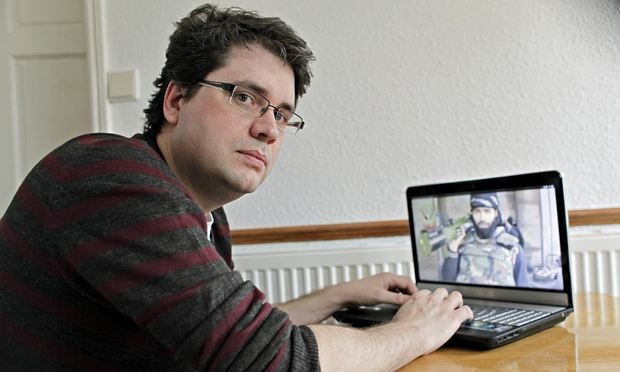
Bellingcat founder Eliot Higgins
Krawetz wrote: “Last year, a group called ‘Bellingcat’ came out with a report about flight MH17, which was shot down near the Ukraine/Russia border. In their report, they used FotoForensics to justify their claims. However, as I pointed out in my blog entry, they used it wrong. The big problems in their report:
“–Ignoring quality. They evaluated pictures from questionable sources. These were low quality pictures that had undergone scaling, cropping, and annotations.
“–Seeing things. Even with the output from the analysis tools, they jumped to conclusions that were not supported by the data.
“–Bait and switch. Their report claimed one thing, then tried to justify it with analysis that showed something different.
“Bellingcat recently came out with a second report. The image analysis portion of their report heavily relied on a program called ‘Tungstène’. … With the scientific approach, it does not matter who’s tool you use. A conclusion should be repeatable though multiple tools and multiple algorithms.
“One of the pictures that they ran though Tungstène was the same cloud picture that they used with ELA [error level analysis]. And unsurprisingly, it generated similar results — results that should be interpreted as low quality and multiple resaves. … These results denote a low quality picture and multiple resaves, and not an intentional alteration as Bellingcat concluded.
“Just like last year, Bellingcat claimed that Tungstène highlighted indications of alterations in the same places that they claimed to see alterations in the ELA result. Bellingcat used the same low quality data on different tools and jumped to the same incorrect conclusion.”
Although Krawetz posted his dissection of the new analysis on Thursday, he began expressing his concerns shortly after the Times article appeared. That prompted Higgins and the Bellingcat crew to begin a Twitter campaign to discredit Krawetz and me (for also citing problems with the Times article and the analysis).
When one of Higgins’s allies mentioned my initial story on the problematic photo analysis, Krawetz noted that my observations supported his position that Bellingcat had mishandled the analysis (although at the time I was unaware of Krawetz’s criticism).
Higgins responded to Krawetz, “he [Parry] doesn’t recognize you’re a hack. Probably because he’s a hack too.”
Further insulting Krawetz, Higgins mocked his review of the photo analyses by writing: “all he has is ‘because I say so’, all mouth no trousers.”
Spoiled by Praise
Apparently, Higgins, who operates out of Leicester, England, has grown spoiled by all the praise lavished on him by The New York Times, The Washington Post, The Guardian and other mainstream publications despite the fact that Bellingcat’s record for accuracy is a poor one.
For instance, in his first big splash, Higgins echoed U.S. propaganda in Syria about the Aug. 21, 2013 sarin gas attack — blaming it on President Bashar al-Assad — but was forced to back down from his assessment when aeronautical experts revealed that the sarin-carrying missile had a range of only about two kilometers, much shorter than Higgins had surmised in blaming the attack on Syrian government forces. (Despite that key error, Higgins continued claiming the Syrian government was guilty.)
Higgins also gave the Australian “60 Minutes” program a location in eastern Ukraine where a “getaway” Buk missile battery was supposedly videoed en route back to Russia, except that when the news crew got there the landmarks didn’t match up, causing the program to have to rely on sleight-of-hand editing to deceive its viewers.
When I noted the discrepancies and posted screenshots from the “60 Minutes” program to demonstrate the falsehoods, “60 Minutes” launched a campaign of insults against me and resorted to more video tricks and outright journalistic fraud in defense of Higgins’s faulty information.
This pattern of false claims and even fraud to promote these stories has not stopped the mainstream Western press from showering Higgins and Bellingcat with acclaim. It probably doesn’t hurt that Bellingcat’s “disclosures” always dovetail with the propaganda themes emanating from Western governments.
It also turns out that both Higgins and “armscontrolwonk.com” have crossover in personnel, such as Melissa Hanham, a co-author of the MH-17 report who also writes for Bellingcat, as does Aaron Stein, who joined in promoting Higgins’s work at “armscontrolwonk.com.”
The two groups also have links to the pro-NATO think tank, Atlantic Council, which has been at the forefront of pushing NATO’s new Cold War with Russia. Higgins is now listed as a “nonresident senior fellow at the Atlantic Council’s Future Europe Initiative” and armscontrolwonk.com describes Stein as a nonresident fellow at the Atlantic Council’s Rafik Hariri Center for the Middle East.
Armscontrolwonk.com is run by nuclear proliferation specialists from the Middlebury Institute for International Studies at Monterey, but they appear to have no special expertise in photographic forensics.
A Deeper Problem
But the problem goes much deeper than a couple of Web sites and bloggers who find it professionally uplifting to reinforce propaganda themes from NATO and other Western interests. The bigger danger is the role played by the mainstream media in creating an echo chamber to amplify the disinformation coming from these amateurs.
Just as The New York Times, The Washington Post and other major outlets swallowed the bogus stories about Iraq’s WMD in 2002-2003, they have happily dined on similarly dubious fare about Syria, Ukraine and Russia.
And just as with the Iraq disaster, when those of us who challenged the WMD “group think” were dismissed as “Saddam apologists,” now we’re called “Assad apologists” or “Putin apologists” or simply “hacks” who are “all mouth, no trousers” – whatever that means.
For instance, in 2013 regarding Syria, the Times ran a front-page story using a “vector analysis” to trace the sarin attack back to a Syrian military base about nine kilometers away, but the discovery of the sarin missile’s much shorter range forced the Times to recant its story, which had paralleled what Higgins was writing.
Then, in its eagerness to convey anti-Russian propaganda regarding Ukraine in 2014, the Times even returned to a reporter from its Iraq-falsehood days. Michael R. Gordon, who co-authored the infamous “aluminum tubes” article in 2002 that pushed the bogus claim that Iraq was reconstituting a nuclear weapons program, accepted some new disinformation from the State Department that cited photos supposedly showing Russian soldiers in Russia and then reappearing in Ukraine.
Any serious journalist would have recognized the holes in the story since it wasn’t clear where the photos were taken or whether the blurry images were even the same people, but that didn’t give the Times pause. The article led the front page.
However, only two days later, the scoop blew up when it turned out that a key photo supposedly showing a group of soldiers in Russia, who then reappeared in eastern Ukraine, was actually taken in Ukraine, destroying the premise of the entire story.
But these embarrassments have not dampened the Times’ enthusiasm for dishing out anti-Russian propaganda whenever possible. Yet, one new twist is that the Times doesn’t just take false claims directly from the U.S. government; it also draws from hip “citizen journalism” Web sites like Bellingcat.
In a world where no one believes what governments say the smart new way to disseminate propaganda is through such “outsiders.”
So, the Times’ Kramer was surely thrilled to get fed a new story off the Web that claimed the Russians had doctored satellite photographs of Ukrainian Buk anti-aircraft missile batteries in eastern Ukraine just before the MH-17 shoot-down.
Instead of questioning the photo-forensic expertise of these nuclear proliferation specialists at armscontrolwonk.com, Kramer simply laid out their findings as further corroboration of Bellingcat’s earlier claims. Kramer also mocked the Russians for trying to cover their tracks with “conspiracy theories.”
Ignoring Official Evidence
But there was another key piece of evidence that the Times was hiding from its readers: documentary evidence from Western intelligence that the Ukrainian military did have powerful anti-aircraft missile batteries in eastern Ukraine on July 17, 2014, and that the ethnic Russian rebels didn’t.
In a report released last October, the Netherlands’ Military Intelligence and Security Service (MIVD) said that based on “state secret” information, it was known that Ukraine possessed some older but “powerful anti-aircraft systems” and “a number of these systems were located in the eastern part of the country.” MIVD added that the rebels lacked that capacity:
“Prior to the crash, the MIVD knew that, in addition to light aircraft artillery, the Separatists also possessed short-range portable air defence systems (man-portable air-defence systems; MANPADS) and that they possibly possessed short-range vehicle-borne air-defence systems. Both types of systems are considered surface-to-air missiles (SAMs). Due to their limited range they do not constitute a danger to civil aviation at cruising altitude.”
Since Dutch intelligence is part of the NATO intelligence apparatus, this report means that NATO and presumably U.S. intelligence share the same viewpoint. Thus, the Russians would have little reason to fake their satellite photos showing Ukrainian anti-aircraft missile batteries in eastern Ukraine if the West’s satellite photos were showing the same thing.
But there is a reason why the Times and other major mainstream publications have ignored this official Dutch government document – because if it’s correct, then it means that the only people who could have shot down MH-17 belong to the Ukrainian military. That would turn upside-down the desired propaganda narrative blaming the Russians.
Yet, that blackout of the Dutch report means that the Times and other Western outlets have abandoned their journalistic responsibilities to present all relevant evidence on an issue of grave importance – bringing to justice the killers of 298 innocent people. Rather than “all the news that’s fit to print,” the Times is stacking the case by leaving out evidence that goes in the “wrong direction.”
Of course, there may be some explanation for how both NATO and Russian intelligence could come to the same “mistaken” conclusion that only the Ukrainian military could have shot down MH-17, but the Times and the rest of the Western mainstream media can’t ethically just pretend the evidence doesn’t exist.
Unless, of course, your real purpose is to disseminate propaganda, not produce journalism. Then, I suppose the behavior of the Times, other MSM publications and, yes, Bellingcat makes a lot of sense.
[For more on this topic, see Consortiumnews.com’s “MH-17: Two Years of Anti-Russian Propaganda” and “NYT Is Lost in Its Ukraine Propaganda.”]
Investigative reporter Robert Parry broke many of the Iran-Contra stories for The Associated Press and Newsweek in the 1980s. You can buy his latest book, America’s Stolen Narrative, either in print here or as an e-book (from Amazon and barnesandnoble.com).
Okinawa Residents Stage Sit-In Protest Over US Helipad Construction
Sputnik — 22.07.2016
TOKYO — The residents of Japan’s island prefecture of Okinawa have staged a sit-in protest against the construction of helipads for the US military forces in the region, local media reported Friday.
The construction, which was suspended two years ago, resumed on Friday morning, according to media reports.
The local residents are concerned that helipads could be used by the Osprey tilt-rotor aircraft, considered to be defective by its opponents.
In exchange for construction of six helipads, the United States agreed in 1996 to return to Japan almost half of the 17,500 acres of land in the Yanbaru jungles, used by the US forces as a training camp. The Japanese government had built two helipads but construction of the remaining four was halted in 2014 due to the protests.
Since becoming operational in 2007, the V-22 Osprey has had three crashes resulting in six deaths and several minor incidents.
Saudi mouthpiece assails Turkey’s Erdogan
By M K Bhadrakumar | Indian Punchline | July 22, 2016
The influential Saudi daily Asharq Al-Awsat, which belongs to Prince Faisal bin Salman (son of King Salman), Governor of Madinah, tore into Turkish President Recep Erdogan with a series of vicious attacks that brings to the fore the cracks in the politics of the Muslim Middle East following the failed coup in Turkey last Friday. On successive days, three Op-Eds have appeared, authored by two of the most authoritative establishment talkers in the Saudi media – Abdulrahman Al-Rashed (currently general manager of Al-Arabiya television and formerly editor-in-chief of the daily) and Eyad Abu Shakra (incumbent managing editor of the daily).
The first Op-Ed entitled Will Turkey Boycott the West? by Al-Rashed appeared on Tuesday in the immediate aftermath of the coup attempt in Turkey. Its message to Erdogan was two-fold: a) Do not annoy the West (read US); and, b) There will be dire consequences if Erdogan pressed for the extradition of the Islamist cleric Fetullah Gulen from the US.
Evidently, Erdogan ignored Al-Rashed’s advice and doomsday predictions and went ahead to allege a likely US role in the coup attempt and warn that Washington will be making a “big mistake” if Gulen is not extradited. On Thursday, Shakra and Al-Rashed in separate articles followed up with a scathing attack on Erdogan personally and his politics.
Shakra in his article titled About Erdogan and Turkey’s Coup Attempt condemned Erdogan for the crackdown on ‘Gulenists’ and all but cited Gulen as a torch bearer of political Islam as much as Erdogan claims himself to be. The article hinted that Gulen casts an appeal within the ruling party AKP. Shakra pointedly brought in former president and AKP’s co-founder Abdullah Gul and former prime minister Ahmet Davutoglu). He virtually advised a patch-up between Erdogan and Gulen.
Al-Rashed in a second article alleged that Erdogan is grandstanding on the ‘Arab Street’ and his fate cannot be any different from that of Abdel Gamal Nasser and Sadam Hussein. Worse still, he drew comparison with Imam Khomeini. His article They All Walked This Path also seems to suggest Saudi displeasure that Erdogan draws support from parts of the Arab world. Qatar — whose Emir is close to Erdogan?
What is it that is frightening the Saudi royal family? Prima facie, the disclosures by the famous Saudi whistleblower Mutjahid (who many suspect to be a dissenter within the House of Saud) to the effect that Gulen has strong links with Saudi Arabia and that the powerful deputy crown prince and defence minister Mohammed bin Salman was in the know of the Turkish coup seems to have some basis. There is indeed a tone of panic in the Saudi media attack on Erdogan.
According to Mutjahid, Mohammed bin Salman apparently suspects that the Turkish intelligence knows about the Saudi-UAE role in the attempted coup against Erdogan. (Curiously, according to reports, Turkish military attaché in Kuwait tried to flee to an unnamed western country from the Saudi airport of Dammam before being detained for involvement in the coup attempt.) The Saudi talkers have probably gone on the offensive as the best form of defence, fearing a retaliation by Erdogan.
More importantly, Saudis must be feeling frightened about the manner in which the coup attempt in Turkey was countered by Erdogan, who invoked ‘people’s power’. Shades of ‘Arab Spring’! This is the spectre that always haunted the Saudis – masses pouring out into the streets in their tens of thousands as the final arbiters of political power in a Muslim country. Worse still, this political tactic also leaps out of the manifesto of the Muslim Brotherhood, which poses an existential threat to the Saudi regime.
The point is, from the Saudi viewpoint, the most dangerous thing about Erdogan is not his ‘neo-Ottomanism’ but his close links with the Brothers for whose sake he even sacrificed Turkey’s state-to-state relations with the Egyptian regime of President Abdel Fattah- el-Sisi (who came to power through a Saudi-backed military coup).
Finally, the Saudis are big losers – next only to Israel – in the rapprochement between Turkey and Iran that is getting under way in regional politics. Erdogan told Iranian President Hassan Rouhani during a phone conversation on Tuesday that he is ready to work with Iran and Russia to restore regional peace. The Iranian official news agency quoted Erdogan as saying,
- Today, we are determined more than ever before to contribute to the solution of regional problems hand in hand with Iran and Russia and in cooperation with them.
Of course, such a realignment in the Muslim Middle East would profoundly impact the balance of forces in regional politics, virtually isolating Saudi Arabia.
The dangers of Western military action in Libya
By Jessica Purkiss | MEMO | July 22, 2016
In April, the French and British foreign ministers visited Tripoli to show support for Libya’s UN-backed unity government. France’s Foreign Minister Jean-Marc Ayrault urged Libya’s neighbours to get behind the government, adding, “There is no other possible path.” Reports have however recently surfaced showing that Western forces, including France, have been assisting General Khalifa Haftar – a figure who has been threatened with EU sanctions for refusing to support the unity government and who has been fighting some groups involved in the Western-backed campaign against Daesh.
Earlier this month, air traffic control recordings obtained by the Middle East Eye showed that British, French, Italian and US troops, have been coordinating air strikes in support of Haftar. On Wednesday, the death of three French soldiers led to the first official confirmation that French special forces are operating in Libya, something the unity government say they were not informed of. France’s presence in the country was first reported by Le Monde in February, with reports claiming that a detachment was aiding Haftar in his battle against Daesh from a base at Benghazi airport. Earlier this year, the Pentagon said its units were deployed to “partner” local militias against Daesh and Britain has admitted sending RAF reconnaissance flights over the country.
Since the fall of the Libyan leader Muammar Gadaffi in 2011, the country has struggled to stay on course. Today Libya is in the middle of a civil war and is split between two warring parliaments. The political vacuum has allowed for the powerful militant group Daesh to gain a foothold and criminal networks to flourish.
General Khalifa Haftar, who leads the Libyan National Army (LNA), has been the key force fighting against Libya Dawn, an umbrella of several armed groups who have supported Omar Al-Hassi’s General National Congress (GNC). The GNC was replaced by the House of Representatives (HoR) following an election but political opponents of the new parliament challenged its legitimacy and revived the GNC in Tripoli. Fighters from Libya Dawn forced the government of Prime Minister Abdullah Al-Thani and the HoR to Tobruk. Haftar’s crackdown is known as Operation Dignity.
The UN-backed unity government, effectively Libya’s third parliament, was formed in Tunisia in December 2015, with the aim of bringing an end to the conflict. It has the difficult task of replacing the two governments, bringing unity to the fractured country and dealing with security concerns arising from the presence of Daesh.
But it has faced endless opposition. The government only managed to sail into Tripoli in March 2016 as opposition groups prevented them from flying in. Daesh has also made things difficult – in the run-up to the January 16 2016 deadline for its formation, the militant group led a sustained attack against Libya’s vital infrastructure. While the unity government does have the mandate to call for the UN to militarily intervene, unsanctioned military actions by Western countries only works to undermine the already very thin veneer of legitimacy it has.
In Libya, the response to the news of the French soldiers has been strong, with condemnations from the UN-backed government and angry protests in Tripoli. As Fayez Serraj, the Prime Minister of Libya, said in a recent op-ed, “Islamic State of Iraq and the Levant (Daesh) is not our greatest enemy. National division is.” The divisions within Libya have allowed it to veer into civil war, with groups such as Daesh managing to exploit the cleavages in the country. The growth of Daesh is a symptom of conflict in Libya not the cause.
Serraj continues, “The stark lesson from the past five years of turmoil is that when Libyans fail to work together they empower those who would destroy our country… terrorists will be defeated by our Armed Forces uniting under civilian command, not rival militias rushing to claim a political prize.” This applies to achieving peace in Libya- by backing one side politically while supporting another militarily, divides that are preventing peace only widen. In supporting Haftar whose power base is in the east, it undermines the unity government’s struggle to gain control of this heavily divided area.
Aside from the implications of peace for the country, there is also a question of the legality of the action. As Libya’s Supreme State Council put it, it is a “clear deception by a permanent member of the UN Security Council and a sponsor of the [December 2015] political agreement”. Stop the War Coalition’s Chris Nineham told RT: “They are not backed by the UN, these interventions. They are not checked anywhere. They are just unilateral acts of military aggression.” Some have gone even further. “This is a sort of coup against the political process and against the democratic path chosen by the Libyan people,” Mansour Al Hasadi, a member of the GNA, told Al Jazeera.
Britain and France took the lead in pushing for military intervention in 2011. While the intervention led to rapid results and was initially considered successful, the country now contends with three parliaments, the growing presence of Daesh and continued violence. Peace seems a distant prospect. Yet the same international powers have not learned from their mistakes.
Homeland Security detains US journalist returning from Beirut, tries to confiscate phones
RT | July 22, 2016
A Wall Street Journal reporter returning from Beirut was taken into holding, grilled and asked to hand over her phones by the Department of Homeland Security at Los Angeles International Airport.
When the journalist, Maria Abi-Habib, returned from Beirut, it was another ordinary work trip. But after touching down at LAX in Los Angeles, she was treated as a dangerous suspect by the service, which now enjoys broad authority at airports.
She outlined the ordeal in a Facebook post, largely focusing on the dangers of the loss of privacy and the risk to journalistic work emerging out of the DHS practice.
As soon as she joined the line for immigration, a friendly officer walked up, giddily saying “Oh, there you are. I was trying to recognize you from your picture. I’m here to help you get through the line.” The friendly greeting by the female agent was only offset by the fact of how much she already knew. As Abi-Habib explains:
“The DHS agent went on to say she was there to help me navigate immigration because I am a journalist with The Wall Street Journal and have travelled to many dangerous places that are on the US’ radar for terrorism. She independently knew who I worked for and my Twitter account, countries I’d reported from (like Iraq) and even recent articles I’d written — I told her nothing about myself.”
But to a journalist already on the US Immigration list, this was unsurprising. Abi-Habib was put on the list precisely because of her line of work, and it had previously served to help her navigate customs more quickly.
But this time was different. After being escorted to baggage claim, she was led into a closed-off section of LAX into a room, where another DHS agent was already waiting.
“They grilled me for an hour – asking me about the years I lived in the US, when I moved to Beirut and why, who lives at my in-laws’ house in LA and numbers for the groom and bride whose wedding I was attending.”
Although she took this all in high spirits – given her previous work experience with security checks – Abi-Habib’s story quickly took a darker turn when the DHS officers asked her for her two mobile phones, saying they needed to “collect information,” though didn’t say about what.
Abi-Habib tried to explain that this not only violated her First Amendment rights, but exposed the professional sources she was protecting as a journalist. Although the words are nothing out of the ordinary for the profession, the DHS officer questioning her shot back: “Did you just admit you collect information for foreign governments?”
Shocked, Abi-Habib replied: “No, that’s exactly not what I just said,” as she proceeded to protest the confiscation of the phones.
That is when the real shock came. Abi-Habib was promptly handed a DHS document, which outlined that the service could deprive her of her rights as a US citizen at any border, and that the authority extended up to 100 miles (160km) from the border inside the actual country.
“So, all of NY city for instance,” she writes. “If they forgot to ask you at JFK airport for your phones, but you’re having a drink in Manhattan the next day, you technically fall under this authority. And because they are acting under the pretence to protect the US from terrorism, you have to give it up.”
Abi-Habib tried a different tactic – revealing that the phones were the property of the Wall Street Journal, and that the service would need to contact the paper’s attorneys to obtain permission. At that point things became potentially even more dangerous. The DHS now accused her of impeding the investigation.
That is “a dangerous accusation,” she wrote, “as at that point, they can use force.”
“She said she had to speak to her supervisor about my lack of cooperation and would return,” she wrote, as another officer remained.
The female officer returned 30 minutes later and said Abi-Habib was free to go.
“I have no idea why they wanted my phones – it could have been a way for them to download my contacts. Or maybe they expect [sic] me of terrorism or sympathizing with terrorists – although my profile wouldn’t fit, considering I am named Maria Teresa, and for a variety of other reasons including my small child.”
The DHS’ expanded powers are coming under increasing scrutiny in an age when all of one’s most private information is carried in their back pocket – not to mention sensitive work-related information. But as Abi-Habib later found out, the DHS was indeed perfectly within its right to deprive a citizen of their rights for up to 100 miles within US borders – a law that was “quietly passed” in 2013.
“This legislation also circumvents the Fourth Amendment that protects Americans’ privacy and prevents searches and seizures without a proper warrant,” she explains, adding that using encryption is now practically a must – although even then is not a guarantee, seeing as some apps will reveal the identity of the recipient, if not the chat history.
“Never download anything or even open a link from a friend or source that looks suspicious. This may be malware, meaning that they have downloaded software on your phone that will be able to circumvent the powers of encryption,” Abi-Habib warns after speaking to an encryption expert.
She also advises to “travel naked” – an expression which a tech-savvy acquaintance used. That means not taking a sensitive phone with you – only the SIM card – and using it in a ‘clean’ phone. All sensitive numbers should also be written on paper.
Abi-Habib’s story follows a wave of controversy over special powers now afforded to US agencies at the border. A new proposal to ask visitors for their “social media identifier” could help border agents search your background without having to go to the National Security Agency (NSA), it turned out late June.
Customs and Border Protection (CBP), which is part of the DHS, believes having this “identifier” could help it find “possible nefarious activity and connections.”
The public consultation process for that proposal will expire August 22. If successful, the social media information would be gathered in addition to the numerous database checks, fingerprinting, and face-to-interviews that already take place. How it would be processed is not revealed in the proposal and providing the information would be voluntary.
Read more:
Social profiling: US border agents want to know what you’re saying on Facebook & Twitter
Turkey’s failed coup throws up surprises
By M K Bhadrakumar – India Punchline – July 21, 2016
What emerges on the sixth day of the failed coup attempt in Turkey is that three inflection points could be in play in the Turkish-American relations in the coming days and weeks. They are:
- The functioning of the Incirlik Air Base on the Syrian border;
- Extradition of Islamist cleric Fetullah Gulen from the US; and,
- The massive purge of ‘Gulenists’ that is under way in Turkey.
Each of them is going to be trickier to negotiate than the other two and, yet, all three are also inter-related.
The power supply for Incirlik has been suspended since Friday and a back-up generator is barely enabling the US facilities there to support flight operations and around 2700 stationed in that NATO base. It’s an untenable situation. The US Defence Secretary Ashton Carter telephoned his Turkish counterpart Fikri Isik on Tuesday evening to stress the importance of operations at the Incirlik to the counter-ISIS campaign.
But on his part, Isik regretted his inability to attend the counter-ISIS defence ministerial that Carter was hosting in Washington on Wednesday. Turkey was represented only at ambassadorial level at Wednesday’s conference which was attended by the defence ministers of some 30 countries, NATO, and top Pentagon officials to discuss “the next plays in the campaign that will culminate in the collapse of ISIL’s control over Mosul and Raqqa”. (Pentagon)
The detention of the commander at Incirlik Gen. Bekir Ercan Van and his subordinates underscores the sensitivities involved here. Gen. Van resisted arrest and had apparently sought political asylum in the US before being led away by the Turkish security.
Interestingly, in an interview with Al Jazeera on Wednesday, President Recep Erdogan said some of those who have been detained have started confessing and that there might have been foreign involvement. Erdogan warned that it would be a “big mistake” if the US decided not to extradite Gulen.
The official Turkish position will be that there is no linkage between continued access of US forces to Incirlik and Gulen’s extradition, but, clearly, that is not the state of play here. The Turks know that Incirlik provides the most efficient base for conducting the US operations in Syria.
However, Washington is not likely to extradite Gulen to Turkey, while Erdogan has staked his prestige on that issue. It seems as of now no wriggle room really exists here – unless some face-saving formula can be found such as the US revoking Gulen’s ‘green card’ and/or persuading him to leave for a third country.
The point is, Gulen has been a ‘strategic asset’ of the US intelligence for two or three decades and if Turkish security agencies interrogate him, that may cause even more damage to the Turkish-American relationship and even, perhaps, complicate the US’ relations with third countries where Gulen’s extensive network might have functioned or are still functioning as the CIA’s front organizations. (Sputnik )
Meanwhile, what role, if any, that Israel might have played in the coup attempt also remains a mystery. Israel is keeping pin-drop silence, but would certainly know that Gen. Akin Ozturk, former chief of air force, who has confessed his leadership role in the attempted coup, used to be the Turkish military attaché in Tel Aviv at one time. (Algemeiner )
By the way, these are the exact words Erdogan used in the interview on Wednesday with Al Jazeera:
- Other states could be behind this coup attempt. Gulenists have a ‘supreme intelligence,’ which could have plotted all this. The time will come for all these links to be revealed.
Erdogan explicitly hinted at the involvement of more than one country in the coup attempt.
Israel is mighty upset with Erdogan over his close ties with Hamas. Equally, Israel favors the creation of a Kurdistan state that could provide a base for its intelligence in a highly strategic region neighboring Iran. There is congruence on this issue between Israel and the US. The Turks have long suspected the US intentions in Iraq and Syria. (Read a fascinating interview with a retired Turkish admiral titled Goal Reached? Military Coup Attempt Disempowers Turkish Armed Forces.)
The plot really thickens if the opinion piece in the Saudi establishment daily Asharq Al-Awsat yesterday is read keeping in view the recent establishment of a Saudi consulate in Erbil in the Kurdish region of northern Iraq. (The daily, incidentally, is owned by Prince Faisal, son of King Salman.) The article all but warns Erdogan that he may be overthrown if he pushes for Gulen’s extradition from the US, and that he risks the West’s wrath if he proceeds with the crackdown on ‘Gulenists’. (Asharq al-Sharq )
Now, on whose side are the Saudis playing in this great game? For a quick answer, read a stunning statement by a top Israeli national security expert, here, recently.
Make no mistake, the US and its European allies are certain to pile pressure on Erdogan to fall in line. The standoff can become a showdown as time passes — and even take an ugly turn. The stakes are very very high for the western alliance system and the US’ regional strategies. This is where Erdogan’s crackdown on ‘Gulenists’ will be grabbed by the West as an alibi to isolate him.
Simply put, the US cannot let go of Turkey. Sans Turkey, NATO gets badly weakened in the entire southern tier – Balkans, Black Sea, Caucasus, Caspian, Southern Russia and Central Asia, Middle East and Eastern Mediterranean – and the US’ containment strategy against Russia will be doomed.
Beyond that, from the limited perspective of the Syrian conflict also, whatever chance the US and its allies (Israel, Saudi Arabia, etc) still would have to put in motion a viable ‘Plan B’ to counter the Russian-Iranian axis would critically depend on Turkey remaining a partner and willing to pursue an interventionist role.
US imposes new sanctions on Assad government

Adam J. Szubin, US Treasury Department’s acting undersecretary for terrorism and financial intelligence
Press TV – July 21, 2016
The United States has imposed new sanctions on Syria, targeting the arms and financial networks of the government of President Bashar al-Assad.
The Department of the Treasury on Thursday included eight individuals and seven entities to its sanctions blacklist, which aims to cut them out of the global financial system.
The Treasury said the Syrian firm Hesco Engineering and Construction is operating energy production facilities in Syria, and added its Russia-based representatives to the sanctions list.
The Treasury also claimed that Yona Star International and T-Rubber are supplying the Syrian defense ministry, air force and other military bodies from their international offices and slapped sanctions on them.
Sanctions were also imposed on many individuals and businesses involved in international money transfers.
Adam Szubin, Treasury Acting Under Secretary for Terrorism and Financial Intelligence, said the Assad government is engaged in “destabilizing behavior.”
“Treasury will continue to act against those responsible for fueling the Assad regime’s repressive actions and dangerous weapons proliferation,” Szubin added.
Since March 2011, the United States and its regional allies, in particular Saudi Arabia, Qatar and Turkey, have been conducting a proxy war against Syria.
The conflict has left more than 470,000 Syrians dead and half of the country’s population of about 23 million displaced within or beyond the Arab country’s borders.
In September 2014, the US and some of its allies started conducting airstrikes inside Syria against Daesh terrorists, many of whom were initially trained by the CIA to fight against the Syrian government.
In September of last year, Russia launched its own air offensive against the terrorists who were still wreaking havoc in Syria. The Russian campaign, analysts say, has broken the backbone of ISIL and other militants.
Featured Video
Piers Corbyn on religion of climate change
or go to
Aletho News Archives – Video-Images
New Documentary
“Inside Gaza” wins best documentary at Montreal’s Cinemania film festival
Palestine Information Center – November 16, 2026
MONTREAL – The documentary “Inside Gaza,” which chronicles the experiences of Palestinian journalists working with Agence France-Presse (AFP) while covering the Israeli war on the Gaza Strip, won the Best Documentary Award at the 32nd Cinemania International Francophone Film Festival held in Montreal, Canada.
Directed by Helene Lam Trong, the 72-minute film follows the daily lives of four AFP journalists who bear witness to the difficulties of reporting in a war-torn territory largely closed off to international media.
The film is compiled from material produced by the team on the ground, as well as from interviews conducted after they left.
The film also won the People’s Choice Award at the festival on Saturday. … continue
Blog Roll
 Aletho News
- “Inside Gaza” wins best documentary at Montreal’s Cinemania film festival
- Activists block German munitions plant over arms exports to ‘Israel’
- The Nasser Hospital attack and Israel’s relentless lies
- Could it be satan? No, Huckabee, just the Americans you work for
- AIPAC and more: Network of pro-Israel influence in US Congress
- Putin aide reveals Moscow’s stance on Europe at peace talks
- Imran Khan warns Pakistani judges he may die in prison
- IOF used Amazon facial recognition to track millions of Palestinians
- More EU Citizens Face Sanctions For Criticizing The Ukraine Proxy War
- In Mexico, the CIA Is Playing a Dangerous Game
- If Americans Knew
- An error has occurred; the feed is probably down. Try again later.
- No Tricks Zone
- New Study: Barents Sea Temperatures Were Warmer And Sea Ice Less Extensive In The 1700s Than Today
- German Authorities Start Initiative To Evaluate Public Register For Climate “Disinformation” Spreaders!
- Zonal Asymmetry of Temperature Change in the Antarctic Circumpolar Current
- New Study: The Net Fossil Fuel Contribution To Rising Atmospheric CO2 Has Been Zero For 500 Years
- Germany’s Green Energy Transition Becoming Increasingly Expensive…Another 6 Trillion Euros!
- Sudden Stratospheric Warming, Powerful El Niño Combination May Lead To Extreme Europe Cold, Energy Crisis!
- Two New Studies Find Thwaites Glacier Melt Cannot Be Driven By Human Activity Or A Warming Ocean
- E-Cars Reduce CO2 Emissions By Only 41% Compared To Internal Combustion Engine Vehicles
- Predictions Made By Renowned Climate Professor Over Past Decades Have Been Proven To Be Poor
- New Study Suggests Large Regions Of The Pacific Ocean Have Been Cooling For The Last 80 Years

