Russia Not to Discuss Conditions for Lifting Sanctions – Lavrov
Sputnik – 25.05.2016
Russia has not and will not get into discussions on criteria to lift sanctions, Russian Foreign Minister Sergei Lavrov said.
The West has introduced several rounds of sanctions against Russia since 2014, accusing Moscow of meddling in Ukraine’s internal affairs and fueling the conflict in the southeast of Ukraine, however Russia denies the allegations and has responded to the restrictive measures with a food embargo.
“As for the future of these restrictions, this question should be directed to those who initiated the sanctions spiral. We have not and will not discuss any conditions or criteria for lifting these restrictive measures,” Lavrov told Hungary’s Magyar Nemzet newspaper.
“The European Union has linked this to Russia fulfilling the Minsk agreements,” the minister said. “Such a connection is absurd, because our country, as is well known, is not party to the conflict in Ukraine. Such a stance only encourages Kiev to sabotage the Minsk measures without any consequences.”
Unilateral Sanctions Unable to Force Russia to Sacrifice National Interests
Russia will not give up on pursuing its national interests due to attempts to pressure it through unilateral sanctions, Russian Foreign Minister Sergei Lavrov said.
“It is clear that attempts to pressure Russia through unilateral sanctions will not force us to abandon our principled line or to sacrifice our national interests,” Lavrov told Hungary’s Magyar Nemzet newspaper.
“Significant security risks”: State Department says Clinton violated email security rules
RT | May 25, 2016
Hillary Clinton violated federal records rules by never obtaining permission to conduct official business on private email server during her tenure as secretary state, a State Department audit concluded.
The report from the State Department’s inspector general say mentions “longstanding, systemic weaknesses” in the agency’s communications even before Clinton took office there, but it singles her out as having been a particularly bad offender for her exclusive use of private, unsecured email.
“Secretary Clinton had an obligation to discuss using her personal email account to conduct official business with their offices, who in turn would have attempted to provide her with approved and secured means that met her business needs” says the audit, which was first obtained by Politico.
“At a minimum, Secretary Clinton should have surrendered all emails dealing with Department issues before leaving government service and, because she did not do so, she did not comply with the Department’s policies that were implemented in accordance with the Federal Records Act,” the report continued.
The 78-page report is the culmination of a review prompted by last year’s revelations that Hillary Clinton conducted official business on a private email server, rather than the secured government servers that officials are expected to use, during her four years in the Obama administration.
The inspector general states that its findings are based on interviews with Secretary of State John Kerry, and predecessors Colin Powell, Condoleeza Rice and Madeleine Albright.
Clinton and her deputies, including Cheryl Mills and Huma Abedin, declined the inspector general’s request for interviews, Politico reported.
The report said that State Department workers are required to use “agency-authorized information systems to conduct normal day-to-day operations” because the use of other systems “creates significant security risks.”
The inspector general went on to recommend that the State Department remind employees that the use of personal email accounts to conduct official business is “discouraged in most circumstances,” and improved policies to promote compliance by all employees – including the secretary of state. The State Department’s management concurred with these recommendations.
“While people were aware of her use of personal email, no one had a full and complete understanding of the extent,” said the State Department’s representative Mark Toner. “We acknowledge that we need to do a better job with our record keeping.”
Clinton campaign spokesman Brian Fallon responded to the report on Wednesday, saying that the report actually showed that Clinton’s practices were consistent with previous secretaries of state.
“[A]s this report makes clear, Hillary Clinton’s use of personal email was not was not unique, and she took steps that went much further than others to appropriately preserve and release her records,” Fallon said.
Clinton herself made the same argument in a March debate. However, Politifact found that statement to be “mostly false.”
However, the State Department has apparently made progress in its record keeping systems.
“Any email that [Secretary Kerry] sends is automatically copied and saved automatically,” the agency’s Deputy Spokesman said at a press briefing. “This automatic archiving approach does comply with the Federal Records Act.”
The audit is only one part of a much larger controversy. Clinton, who is the likely Democratic presidential nominee, is currently under investigation by the FBI for potentially putting highly sensitive information at risk, a fact that has become an important talking point in the election.
Clinton has contended that since most of her emails were sent to other people in the state department, she was complying with the federal law requiring the preservation of government records.
Though the FBI’s investigation is still ongoing, the inspector general’s audit casts doubt on this defense, saying that sending emails to other State Department accounts “is not an appropriate method of preserving any such emails that would constitute a federal record.”
Clinton’s use of a private email account came to light in 2013, when a hacker going by the name of Guccifer accessed the email account of her aide Sydney Blumenthal. The hacker, whose real name is Marcel Lazar, pleaded guilty to various hacking-related offenses on Wednesday.
Nuclear threats in US worse than previously known — study
RT | May 25, 2016
Conflicting with a prior industry study, a new analysis claims 96 nuclear facilities in the US are less safe than reported, citing risks such as terrorism and sabotage. The study says there remain lessons to be learned from the Fukushima disaster.
Neglect of the risks posed by used reactor fuel, or spent nuclear fuel, contained in 96 aboveground, aquamarine pools could cost the US economy $700 billion, cause cancer in tens of thousands of people as well as compel the relocation of some 3.5 million people from an area larger than New Jersey, a study released May 20 finds.
The National Academies of Sciences, Engineering, and Medicine’s study, ‘Lessons Learned from the Fukushima Nuclear Accident for Improving Safety and Security of US Nuclear Plants,’ is the second installment of a two-part study ordered by Congress on the 2011 Fukushima Daiichi nuclear disaster in Japan. It not only cites, but also outright challenges a 2014 study by the Nuclear Regulatory Commission, the US industry’s regulator and enforcer of safety standards.
The spent fuel, The Academies’ study recommends, is safer in dry casks rather than pools, because of the risk of leaks, drawing water away from the irradiated nuclear rods. An accident, terrorist attack or malicious employee all pose greater dangers to the pools, the study says.
Aside from calling on the Nuclear Regulatory Commission to offer a better evaluation of the health risks posed, The Academies study conducted by 17 engineers, nuclear physicists and other scientists demands the commission fulfill a 10-year-old promise to put together an impartial review of the surveillance and security policies on spent nuclear fuel.
“Even with the recommendations that the Academies’ board has put together,” Nuclear Regulatory Commission spokesman Scott Burnell responded, “we continue to conclude that spent fuel is being stored safely and securely in the US.”
“Nothing in the report causes immediate concern,” Burnell added, although the commission is planning a more formal follow-up later this year, according to The Center for Public Integrity.
Congress felt compelled to fund the study on Japan’s natural-turned-nuclear disaster to help prevent a similar accident from occurring in the US. On March 11, 2011, the Daiichi nuclear plant in Fukushima was thrashed by an earthquake and tsunami, leaving three reactors without power or coolants, which resulted in their radioactive cores melting down.
Pure luck kept the disaster from becoming even worse, The Acadamies found. Instead of Daiichi’s highly radioactive rods being exposed to oxygen, which would have sent over 13 million people packing from as far as 177 miles south in Tokyo, a leak happened to be situated between a fuel rod pool and a reactor core, which sent just enough coolant to keep the vulnerable rods from rising above the water. In the end, 470,000 people were evacuated and the still ongoing cleanup is estimated to cost about $93 billion.
The Nuclear Regulatory Commission’s 2014 study put the highest odds of an earthquake happening near spent fuel storage at one in 10 million years, boasting that “spent fuel pools are likely to withstand severe earthquakes without leaking,” while the odds of a terrorist attack or internal subversion were deemed incalculable and left out of any risk assessment.
Calling that cost-benefit analysis “deeply flawed,” The Academies panel member Frank von Hippel, also an emeritus professor and senior research physicist at Princeton University, complained that the commission’s study also left out the impact on property contamination in a 50-mile radius of an accident, tourism rates and the economy, The Center for Public Integrity reported.
The new analysis also calls for new officially designated risk assessments of safety and financial impacts at the federal level as well as what improvements aboveground dry casks may bring compared to pools. The latter is estimated to cost upwards of $4 billion by the industry.
Layers of Islamophobia: Rep. Ellison Says He’s Unaware of Clinton Having Returned “Muslim Money”
By Sam Husseini | May 24, 2016
At a news conference Tuesday, I asked Reps. Keith Ellison (D-Minn.) and André Carson (D-Ind.) about Hillary Clinton’s having returned money from Muslims and refusing to meet with Arab and Muslim groups in her 2000 Senate run.
Rep. Ellison indicated he didn’t know about the controversy and — while stressing his backing for Sen. Bernie Sanders, argued that Clinton was someone who has done outreach to the Muslim community. Carson lauded her as the “most traveled” secretary of state.
Ellison and Carson, Congress’ only Muslim members, spoke at the at National Press Club to discuss “Islamophobia and Hateful Rhetoric Directed At Muslims.” [See video of their response, full video (33:00) and transcript below.]
Their opening remarks focused on Donald Trump, Ted Cruz, Ben Carson, Newt Gingrich, Peter King — all Republicans.
I had gone into the event wanting to question the manner in which they spoke — or declined to speak — about U.S. foreign policy. More on that later.
But, their emphasis on Republican transgressions, some going back to previous election cycles, I thought it important to raise the issue of Clinton’s actions and asked if there wasn’t anti-Muslim sentiment in the Democratic Party as well.
I cited a recent piece by Rania Khalek, in which she writes:
Back in 2000, during a heated U.S. Senate race in New York, Clinton came under attack for accepting political contributions from Muslim groups whose members were targets of a smear campaign generated by one of the Islamophobia industry’s most discredited operatives.
Without hesitation, Clinton condemned her Muslim supporters, returned their donations and refused to meet with Arab and Muslim Americans for the remainder of her campaign…
Ellison said: “I’m not aware of the incident. … When she came to Minnesota she specifically reached out to the Muslim community and had a sit down and talked about anti-Muslim hate. … I also know that years ago when she was Secretary of State, the Black Caucus had a meeting with her and she had recently appointed a special envoy to Muslim communities, you know — Farah Pandith — and she sat Andre and I right next to Farah because she wanted to make sure we were talking and comparing notes.”
Presuming he was being forthright, it says something about Ellison’s information flow that he would not have been aware of the controversy.
He mentioned Farah Pandith. According to her bio at the Kennedy School of Government, “Special Representative Pandith served as the Director for Middle East Regional Initiatives for the National Security Council from December 2004 to February 2007, where she was responsible for coordinating U.S. policy on ‘Muslim World’ Outreach and the Broader Middle East North Africa initiative.”
Pandith reported to Elliot Abrams at the Bush National Security Council, who is well known for his longtime backing of U.S. wars in the Mideast and Latin America.
Ellison stated that Clinton has “not in any way contributed to anti-Muslim hate. In fact Huma Abedin is one of her closest aides and Huma has been the target of anti-Muslim hate herself.”
Ellison’s defense of Clinton — and by extension the Democratic Party, since I specifically asked about that, was noteworthy. At another point in the event, he talked about how every community was guilty of bigotry to some extent.
Carson, who supports Clinton over Sanders, stated that while Clinton was recently in Indianapolis, “We helped to ensure that Muslims were not only there, they were part of the process. And there were a group of Syrian-Americans who had a moment with Secretary Clinton. … She is the most traveled Secretary of state in U.S. history. … Whenever I go to embassies that have Muslim ambassadors they talk about the bridge building that was done under her leadership as Secretary of State. … [Clinton] has a special sensitivity as it relates to issues impacting the Muslim community. As it relates to unwanted surveillance … Once she becomes president you will see Muslims in very important positions in her cabinet.”
It seems at best incredibly paltry: “Part of the process.” Syrian-Americans “had a moment.” “A moment” to discuss the fate of their country of origin. Which Syrian-Americans? Doubtlessly, there are some who want more U.S. intervention of the sort that brought disaster to Libya — which Clinton oversaw and Ellison himself backed at the time. Glen Ford has noted that Ellison has also backed a “no fly” zone in Syria.
Though she’s at times criticized Republicans for scapegoating Muslims, CNN reported: “Clinton calls for more surveillance, police after Brussels attacks.”
I actually asked the first question after their opening remarks. I had hoped that I’d get another question later about U.S. foreign policy after they had staked out their positions on foreign policy in response to other questions. However, I did not get another question in.
The deeper issue is the manner in which the question of “Islamophobia” is being dealt with: It largely excludes discussion of U.S. foreign policy, the dehumanization of Muslim lives lost, especially in U.S. attacks.
At the event, Ellison stressed that most of the victims of Daesh [ISIL] were Muslims, which is of course true, but it leaves out that most of the victims of U.S. foreign policy are Muslims — and that U.S. foreign policy has helped foster Al-Qaeda and ISIS and other sectarian groups.
You have Carson talking about how Muslim officials in embassies — almost invariably of tyrannical regimes — speak fondly of Clinton. This seems at best a dubious badge of honor.
Rep. Carson spoke in his other remarks of being on the House Intelligence Committee. He also spoke of his time growing up and being critical of law enforcement. I’ve criticized anti-Muslim bias for over twenty years, but a tacit bargain seems to have been struck whereby Muslims are “tolerated” — so long as they do not seriously critique U.S. foreign policy, and those who go along with it most will clearly be rewarded most by those who control U.S. foreign policy. Indeed, the subtext of some of Carson’s remarks is that such Muslims will be rewarded with plum positions for their apologetics.
The tension here is critical. While some who have written about Islamophobia see a meaningful resolution in incorporation of Muslims into the West, this tends to ignore the incredible violence of U.S. foreign policy. For example, John Feffer, who I know and like personally, recently wrote “Sadiq Khan and the End of Islamophobia” about the recent mayoral race in London.
There is real danger of a line of thinking that in effect charts a course of Muslims being accepted in the West in a manner that neuters any meaningful crit of foreign policy. It’s a course that explicitly or implicitly folds in the Muslim community rather than using it as a messenger to meaningful open up the Western societies in terms of challenging and ending their aggressive foreign policies and bring about a more peaceful world.
In fact, this course is incredibly dangerous because it leads to the impression of having a global dialogue when none is actually taking place about the most critical issues of U.S. government violence.
As Arun Kundnani has argued: “The promise of the ‘war on terror’ was that we would kill them ‘over there’ so they would not kill us ‘over here.’ Hence mass violence in Iraq, Afghanistan, Pakistan, Palestine, Yemen, and Somalia — in the name of peace in the West. The ‘Authorization to Use Military Force’ that the U.S. Congress passed in the days after 9/11 already defined the whole world as a battlefield in the ‘war on terror’. President Obama continues to rely on the authorization to give his drone-killing program a veneer of legality. This is the old colonial formula of liberal values at home sustained by a hidden illiberalism in the periphery — where routine extra-judicial killing is normalized.”
The remarks of Malcolm X — whose birthday just passed — and his view of the course of African Americans in the U.S. is relevant: “They have a new gimmick every year. They’re going to take one of their boys, black boys, and put him in the cabinet so he can walk around Washington with a cigar. Fire on one end and fool on the other end. And because his immediate personal problem will have been solved he will be the one to tell our people: ‘Look how much progress we’re making. I’m in Washington, D.C., I can have tea in the White House. I’m your spokesman, I’m your leader.’ While our people are still living in Harlem in the slums. Still receiving the worst form of education.”
Transcript:
Sam Husseini: You’ve mentioned Trump and Cruz and Carson. I think all the names that you mentioned are Republicans that you feel are guilty of some form of Islamophobia. Rania Khalek, an Arab-American writer recently had a piece recounting that in her 2000 run, Hillary Clinton — after there were allegations that she was taking quote-unquote Muslim money — returned the money and refused to meet with members of the Muslim-American and Arab community. How do you respond to something like that? Is the Democratic party itself clear of Islamophobic sentiment as well?
Keith Ellison: I can only speak on what I know about — and I’m a Bernie supporter. And I support Bernie running all the way through the election. And — but have to be honest and tell you I’m not aware of that, right?Husseini: You don’t know about this?
Ellison: Well I’m not aware of the incident. I’ll tell you what I’m aware of I know that when she came to Minneapolis, Minnesota — and this is just being fair and honest. When she came to Minnesota she specifically reached out to the Muslim community and had a sit down and talked about anti-Muslim hate. I know about that.
I also know that years ago when she was Secretary of State, the black caucus had a meeting with her and she had recently appointed a special envoy to Muslim communities, you know — Farah Pandith — and she sat Andre and I right next to Farah because she wanted to make sure we were talking and comparing notes.
Now, I don’t want to say something didn’t happen when I don’t know — when I don’t have information. But I can say that if that did happen there’s weight with her reaching out as well.
Again, I’m not trying to discredit anyone’s experience, I don’t have any information on it. But I can tell you she did some things and has not in any way contributed to anti-Muslim hate. In fact Huma Abedin is one of her closest aides and Huma has been the target of anti-Muslim hate herself and I have never sensed that Secretary Clinton is backing herself away from her association with Huma Abedin. So.
Again, I’m a Bernie guy. I’m standing up there — if you wanna talk who should be president I believe it’s Bernie Sanders, but fair’s fair and true’s true and she has no record that I’m aware of of anti-Muslim hate.
Andre Carson: As a Clinton guy (laughter)
Ellison: Did I mention that —?
Carson: As Keith stated, one of her chief advisers and closest confidants is Huma Abedin who is phenomenal. She’s a friend of mine. Secretary Clinton was in Indianapolis a few weeks ago. We helped to ensure that Muslims were not only there, they were part of the process. And there were a group of Syrian-Americans who had a moment with Secretary Clinton. If you look at her history as not only as first lady of Arkansas but first lady of the United States of America, and even Secretary of State. She is the most traveled Secretary of state in U.S. history. Let’s make that clear.
Whenever I go to embassies that have Muslim ambassadors they talk about the bridge building that was done under her leadership as Secretary of State. When I go to Muslim communities across the country and communities are divided — some are Feeling the Bern and some like me are climbing up that Hill. But they respect Secretary Clinton because she has a special sensitivity as it relates to issues impacting the Muslim community. As it relates to unwanted surveillance as it relates to outright discrimination. And I believe and we can talk about this later, that once she becomes president you will see Muslims in very important positions in her cabinet.
More Game-Playing on MH-17?
By Robert Parry | Consortium News | May 24, 2016
A newly posted video showing a glimpse of a Buk missile battery rolling down a highway in eastern Ukraine has sparked a flurry of renewed accusations blaming Russia for the July 17, 2014 shoot-down of Malaysia Airlines Flight 17 killing 298 people. But the “dash-cam video” actually adds little to the MH-17 whodunit mystery because it could also support a narrative blaming the Ukrainian military for the disaster.
The fleeting image of the missile battery and its accompanying vehicles, presumably containing an armed escort, seems to have been taken by a car heading west on H-21 highway in the town of Makiivka, as the convoy passed by heading east, according to the private intelligence firm Stratfor and the “citizen journalism” Web site, Bellingcat.
However, even assuming that this Buk battery was the one that fired the missile that destroyed MH-17, its location in the video is to the west of both the site where Almaz-Antey, the Russian Buk manufacturer, calculated the missile was fired, around the village of Zaroshchenskoye (then under Ukrainian government control), and the 320-square-kilometer zone where the Dutch Safety Board speculated the fateful rocket originated (covering an area of mixed government and rebel control).
In other words, the question would be where the battery stopped before firing one of its missiles, assuming that this Buk system was the one that fired the missile. (The map below shows the location of Makiivka in red, Almaz-Antey’s suspected launch site in yellow, and the general vicinity of the Dutch Safety Board’s 320-square-kilometer launch zone in green.)
Another curious aspect of this and the other eight or so Internet images of Buk missiles collected by Bellingcat and supposedly showing a Buk battery rumbling around Ukraine on or about July 17, 2014, is that they are all headed east toward Russia, yet there have been no images of Buks heading west from Russia into Ukraine, a logical necessity if the Russians gave a Buk system to ethnic Russian rebels or dispatched one of their own Buk military units directly into Ukraine, suspicions that Russia and the rebels have denied.
The absence of a westward-traveling Buk battery fits with the assessment from Western intelligence agencies that the several operational Buk systems in eastern Ukraine on July 17, 2014, were under the control of the Ukrainian military, a disclosure contained in a Dutch intelligence report released last October and implicitly confirmed by an earlier U.S. “Government Assessment” that listed weapons systems that Russia had given the rebels but didn’t mention a Buk battery.
The Netherlands’ Military Intelligence and Security Service (MIVD) reported that the only anti-aircraft weapons in eastern Ukraine capable of bringing down MH-17 at 33,000 feet on July 17 belonged to the Ukrainian government. MIVD made that assessment in the context of explaining why commercial aircraft continued to fly over the eastern Ukrainian battle zone in summer 2014.
MIVD said that based on “state secret” information, it was known that Ukraine possessed some older but “powerful anti-aircraft systems” capable of downing a plane at that altitude and “a number of these systems were located in the eastern part of the country,” whereas the MIVD said the ethnic Russian rebels had only MANPADS that could not reach the higher altitudes.
Ukrainian Offensive
On July 17, the Ukrainian military also was mounting a strong offensive against rebel positions to the north and thus the front lines were shifting rapidly, making it hard to know exactly where the borders of government and rebel control were. To the south, where the Buk missile was believed fired, the battle lines were lightly manned and hazy – because of the concentration of forces to the north – meaning that an armed Buk convoy could probably move somewhat freely.
Also, because of the offensive, the Ukrainian government feared a full-scale Russian invasion to prevent the annihilation of the rebels, explaining why Kiev was dispatching its Buk systems toward the Russian border, to defend against potential Russian air strikes.
Just a day earlier, a Ukrainian fighter flying along the border was shot down by an air-to-air missile (presumably fired by a Russian warplane), according to last October’s Dutch Safety Board report. So, tensions were high on July 17, 2014, when MH-17, flying from Amsterdam to Kuala Lumpur, broke apart over eastern Ukraine, believed downed by a surface-to-air missile although there have been other suggestions that the plane might have been hit by an air-to-air missile.
At the time, Ukraine also was the epicenter of an “information war” that had followed a U.S.-backed coup on Feb. 22, 2014, which ousted democratically elected President Viktor Yanukovych and replaced the Russian-friendly leader with a fiercely nationalistic and anti-Russian regime in Kiev. The violent coup, in turn, prompted Crimea to vote 96 percent in a hasty referendum to secede from Ukraine and rejoin Russia. Eastern Ukraine and its large ethnic Russian population also revolted against the new authorities.
The U.S. government and much of the Western media, however, denied there had been a coup in Kiev, hailed the new regime as “legitimate,” and deemed Crimea’s secession a “Russian invasion.” The West also denounced the eastern Ukrainian resistance as “Russian aggression.” So, the propaganda war was almost as hot as the military fighting, a factor that has further distorted the pursuit of truth about the MH-17 tragedy.
Immediately after the MH-17 crash, the U.S. government sought to pin the blame on Russia as part of a propaganda drive to convince the European Union to join in imposing economic sanctions on Russia for its “annexation” of Crimea and its support of eastern Ukrainians resisting the Kiev regime.
However, a source briefed by U.S. intelligence analysts told me that the analysts could find no evidence that the Russians had supplied the rebels with a sophisticated Buk system or that the Russians had introduced a Buk battery under their own command. The source said the initial intelligence suggested that an undisciplined Ukrainian military team was responsible.
Yet, on July 20, 2014, just three days after the tragedy, Secretary of State John Kerry appeared on all Sunday morning talk shows and blamed the Russian-backed rebels and implicitly Moscow. He cited some “social media” comments and – on NBC’s “Meet the Press” – added: “We picked up the imagery of this launch. We know the trajectory. We know where it came from. We know the timing. And it was exactly at the time that this aircraft disappeared from the radar.”
Two days later, on July 22, the Obama administration released a “Government Assessment” that tried to bolster Kerry’s accusations, in part, by listing the various weapons systems that U.S. intelligence believed Russia had provided the rebels, but a Buk battery was not among them. At background briefings for selected mainstream media reporters, U.S. intelligence analysts struggled to back up the administration’s case against Russia.
For instance, the analysts suggested to a Los Angeles Times reporter that Ukrainian government soldiers manning the suspected Buk battery may have switched to the rebel side before firing the missile. The Times wrote: “U.S. intelligence agencies have so far been unable to determine the nationalities or identities of the crew that launched the missile. U.S. officials said it was possible the SA-11 [Buk anti-aircraft missile] was launched by a defector from the Ukrainian military who was trained to use similar missile systems.”
However, after that July 22 briefing — as U.S. intelligence analysts continued to pore over satellite imagery, telephonic intercepts and other data to refine their understanding of the tragedy — the U.S. government went curiously silent, refusing to make any updates or adjustments to its initial rush to judgment, a silence that has continued ever since.
Staying Silent
Meanwhile, the source who continued receiving briefings from the U.S. intelligence analysts told me that the reason for going quiet was that the more detailed evidence pointed toward a rogue element of the Ukrainian military connected to a hardline Ukrainian oligarch, with the possible motive the shooting down of President Vladimir Putin’s plane returning from a state visit to South America.
In that scenario, a Ukrainian fighter jet in the vicinity (as reported by several eyewitnesses on the ground) was there primarily as a spotter, seeking to identify the target. But Putin’s plane, with similar markings to MH-17, took a more northerly route and landed safely in Moscow.

A side-by-side comparison of the Russian presidential jetliner and the Malaysia Airlines plane.
Though I was unable to determine whether the source’s analysts represented a dissenting or consensus opinion inside the U.S. intelligence community, some of the now public evidence could fit with that narrative, including why the suspected Buk system was pushing eastward as close to or even into “rebel” territory on July 17.
If Putin was the target, the attackers would need to spread immediate confusion about who was responsible to avoid massive retaliation by Moscow. A perfect cover story would be that Putin’s plane was shot down accidentally by his ethnic Russian allies or even his own troops, the ultimate case of being hoisted on his own petard.
Such a risky operation also would prepare disinformation for release after the attack to create more of a smokescreen and to gain control of the narrative, including planting material on the Internet to be disseminated by friendly or credulous media outlets.
The Ukrainian government has denied having a fighter jet in the air at the time of the MH-17 shoot-down and has denied that any of its Buk or other anti-aircraft systems were involved.
Yet, whatever the truth, U.S. intelligence clearly knows a great deal more than it has been willing to share with the public or even with the Dutch-led investigations. Last October, more than a year after the shoot-down, the Dutch Safety Board was unable to say who was responsible and could only approximate the location of the missile firing inside a 320-square-kilometer area, whereas Kerry had claimed three days after the crash that the U.S. government knew the launch point.
Earlier this year, Fred Westerbeke, the chief prosecutor of the Dutch-led Joint Investigative Team [JIT], provided a partial update to the Dutch family members of MH-17 victims, explaining that he hoped to have a more precise fix on the firing site by the second half of 2016, i.e., possibly more than two years after the tragedy.
Westerbeke’s letter acknowledged that the investigators lacked “primary raw radar images” which could have revealed a missile or a military aircraft in the vicinity of MH-17. That apparently was because Ukrainian authorities had shut down their primary radar facilities supposedly for maintenance, leaving only secondary radar which would show commercial aircraft but not military planes or rockets.
Russian officials have said their radar data suggest that a Ukrainian warplane might have fired on MH-17 with an air-to-air missile, a possibility that is difficult to rule out without examining primary radar which has so far not been available. Primary radar data also might have picked up a ground-fired missile, Westerbeke wrote.
“Raw primary radar data could provide information on the rocket trajectory,” Westerbeke wrote. “The JIT does not have that information yet. JIT has questioned a member of the Ukrainian air traffic control and a Ukrainian radar specialist. They explained why no primary radar images were saved in Ukraine.” Westerbeke said investigators are also asking Russia about its data.
Westerbeke added that the JIT had “no video or film of the launch or the trajectory of the rocket.” Nor, he said, do the investigators have satellite photos of the rocket launch.
“The clouds on the part of the day of the downing of MH17 prevented usable pictures of the launch site from being available,” he wrote. “There are pictures from just before and just after July 17th and they are an asset in the investigation.”
Though Westerbeke provided no details, the Russian military released a number of satellite images purporting to show Ukrainian government Buk missile systems north of the eastern Ukrainian city of Donetsk before the attack, including two batteries that purportedly were shifted 50 kilometers south of Donetsk on July 17, the day of the crash, and then removed by July 18.
Russian Lt. Gen. Andrey Kartopolov called on the Ukrainian government to explain the movements of its Buk systems and why Kiev’s Kupol-M19S18 radars, which coordinate the flight of Buk missiles, showed increased activity leading up to the July 17 shoot-down.
Necessary Secrets?
Part of the reason that the MH-17 mystery has remained unsolved is that the U.S. government insists that its satellite surveillance, which includes infrared detection of heat sources as well as highly precise photographic imagery, remains a “state secret” that cannot be made public.
However, in similar past incidents, the U.S. government has declassified sensitive information. For instance, after a Soviet pilot accidentally shot down Korean Airlines Flight 007 over Russian territory in 1983, the Reagan administration revealed the U.S. capability to intercept Soviet ground-to-air military communications in order to make the Soviets look even worse by selectively editing the intercepts to present the destruction of the civilian aircraft as willful.
In that case, too, the U.S. government let its propaganda needs overwhelm any commitment to the truth, as Alvin A. Snyder, who in 1983 was director of the U.S. Information Agency’s television and film division, wrote in his 1995 book, Warriors of Disinformation.
After KAL-007 was shot down, “the Reagan administration’s spin machine began cranking up,” Snyder wrote. “The objective, quite simply, was to heap as much abuse on the Soviet Union as possible. … The American media swallowed the U.S. government line without reservation.”
On Sept. 6, 1983, the Reagan administration went so far as to present a doctored transcript of the intercepts to the United Nations Security Council. “The perception we wanted to convey was that the Soviet Union had cold-bloodedly carried out a barbaric act,” Snyder wrote.
Only a decade later, when Snyder saw the complete transcripts — including the portions that the Reagan administration had excised — would he fully realize how many of the central elements of the U.S. presentation were lies.
Snyder concluded, “The moral of the story is that all governments, including our own, lie when it suits their purposes. The key is to lie first.” [For more details on the KAL-007 deception and the history of U.S. trickery, see Consortiumnews.com’s “A Dodgy Dossier on Syrian War.”]
In the MH-17 case, the Obama administration let Kerry present the rush to judgment fingering the Russians and the rebels but then kept all the evidence secret even though the U.S. government’s satellite capabilities are well-known. By refusing to declassify any information for the MH-17 investigation, Washington has succeeded in maintaining the widespread impression that Moscow was responsible for the tragedy without having to prove it.
The source who was briefed by U.S. intelligence analysts told me that the Obama administration considered “coming clean” about the MH-17 case in March, when Thomas Schansman, the Dutch father of the only American victim, was pleading for the U.S. government’s cooperation, but administration officials ultimately decided to keep quiet because to do otherwise would have “reversed the narrative.”
In the meantime, outfits such as Bellingcat have been free to reinforce the impression of Russian guilt, even as some of those claims have proved false. For instance, Bellingcat directed a news crew from Australia’s “60 Minutes” to a location outside Luhansk (near the Russian border) that the group had identified as the site for the “getaway video” showing a Buk battery with one missile missing.
The “60 Minutes” crew went to the spot and pretended to be at the place shown in the video, but none of the landmarks matched up, which became obvious when screen grabs of the video were placed next to the scene of the Australian crew’s stand-upper. [See Consortiumnews.com’s “Fake Evidence Blaming Russia for MH-17.”]
Yet, reflecting the deep-seated mainstream media bias on the MH-17 case, the Australian program reacted angrily to my pointing out the obvious discrepancies. In a follow-up, the show denounced me but could only cite a utility pole in its footage that looked similar to a utility pole in the video.
While it’s true that utility poles tend to look alike, in this case none of the surroundings did, including the placement of the foliage and a house shown in the video that isn’t present in the Australian program’s shot. [For details, see Consortiumnews.com’s “A Reckless Stand-upper on MH-17.”]
But the impact of the nearly two years of one-sided coverage of the MH-17 case in the mainstream Western media has been considerable. In the last few days, a lawyer for the families of Australian victims announced the filing of a lawsuit against Russia and Putin in the European court for human rights seeking compensation of $10 million per passenger. Many of the West’s news articles on the lawsuit assume Russia’s guilt.
In other words, whatever the truth about the MH-17 shoot-down, the tragedy has proven to be worth its weight in propaganda gold against Russia and Putin, even as the U.S. government hides the actual proof that might show exactly who was responsible.
(Research by Assistant Editor Chelsea Gilmour.)
Investigative reporter Robert Parry broke many of the Iran-Contra stories for The Associated Press and Newsweek in the 1980s. You can buy his latest book, America’s Stolen Narrative, either in print here or as an e-book (from Amazon and barnesandnoble.com).
Brother of ‘Guantanamo Diary’ author denied entry to US
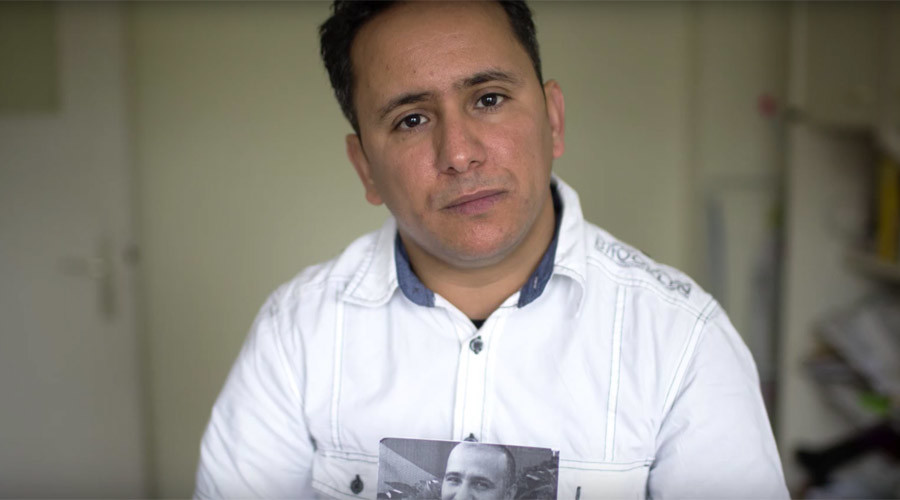
Yahdih Ould Slahi holds up a photo of his brother Mohamedou in a May 2016 video by American Civil Liberties Union © acluvideos / YouTube
RT | May 24, 2016
US authorities detained, interrogated and sent back a German citizen flying in to campaign for the release of his brother – author of the best-selling “Guantanamo Diary,” who has been imprisoned and tortured at the US camp since 2002.
Mohamedou Ould Slahi’s memoir, heavily redacted by government censors, was published in 2015 and quickly became a best-seller. The Mauritanian native was arrested in 2001 and rendered to Jordan for interrogation by the CIA. He was transferred to Guantanamo Bay the following year.
His younger brother Yahdih, a German citizen, has campaigned for Mohamedou’s release for years. Yahdih was supposed to attend a number of events in the US this week, seeking to persuade Guantanamo’s Periodic Review Board to set Mohamedou free at the June 2 hearing.
When Yahdih Slahi arrived at the John F. Kennedy airport in New York on Saturday, however, he was detained by US Customs and Border Patrol (CBP) agents, questioned for hours, and sent back to Germany the following day, The Intercept reported.
“He was asked questions about his family, his brother, and what he knew about why his brother was in Guantánamo,” said Hina Shamsi of the American Civil Liberties Union. “It was a harrowing, stressful, and exhausting experience.”
Yahdih Slahi is a German citizen who lives in Düsseldorf, and would have been able to enter the US under the visa waiver program that Germany participates in. The CBP gave no explanation for denying Slahi entry.
In his memoir, Mohamedou Slahi described being held in isolation and subjected to beatings, extreme cold, sleep deprivation, sexual abuse, a simulated kidnapping, and a simulated execution. At one point, his captors tried to trick him by showing him a forged letter from his mother, Yahdih recounted in 2015. The ploy failed because the forgery misspelled Slahi’s name – and because, unbeknownst to his jailers, Slahi’s mother was illiterate.
Mohamedou Slahi admits that he fought in Afghanistan in the early 1990s with what became Al-Qaeda– when the organization was backed by the US in its struggle against the socialist government in Kabul. While he had nothing to do with Al-Qaeda since 1992, Slahi did stay in touch with his cousin and former brother-in-law, Mahfouz Ould al-Walid, who served as a lieutenant to Osama Bin Laden.
Slahi was never charged with any crime, but the 2010 decision to release him has been held up by government appeals.
“The judge said there was no evidence in 2010 to hold him. There’s certainly not evidence now. The Chief Prosecutor said when he resigned in 2007, that there was no evidence then,” Slahi’s attorney Nancy Hollander told RT in January 2015.
Slahi’s family and friends hope the Periodic Review Board will recommend his release at the June 2 hearing. The inter-agency panel ruled on Monday to set free an Afghan man, known only as Obaidullah, who was held at Guantanamo for 14 years.
It took a decade of fighting with the government for the Guantanamo Diary, written in 2005, to see the light of day. Slahi is the first Guantanamo prisoner to publish a memoir while still at the camp. He has not been allowed to receive a copy of his book.
U.S. Government Secretly Destroyed Evidence in Trial of Accused “9/11 Masterminds”
By Derrick Broze | Activist Post | May 21, 2016
In another setback for the death penalty trial of the five men accused of aiding the terrorist attacks of September 11, 2001, two defense lawyers for Khalid Shaikh Mohammed say the U.S. government secretly destroyed relevant evidence.
On May 11, defense lawyers for the accused mastermind of the 9/11 terror attacks asked for judge Col. James Pohl and the prosecution team to be recused from the trial, and for the case to be shut down. Defense lawyers David Nevin and Maj. Derek Poteet say that the U.S. government destroyed evidence related to the case, according to the New York Times. The two men are unable to provide further details because the issue is classified, but Mr. Nevin said the evidence was “favorable” to the defendants.
Major Poteet also told the Times that the defense was first informed in February that Colonel Pohl would provide them with a “summary of a substitute” for the original, classified evidence. The defense requested Colonel Pohl to preserve the evidence for the record and Pohl complied. Or so they thought.
“But they learned in February, they said, that about 20 months earlier, and without their knowledge, prosecutors had obtained from Colonel Pohl a secret order that reversed his previous decision,” the Times writes. “By the time they found out, the government had already destroyed the evidence, giving them no opportunity to challenge the move.”
Major Poteet said the situation created the appearance that Colonel Pohl was “colluding with the government.” The Times reports that the original, now destroyed evidence, may have been related to one of several foreign black site prisons operated by the Central Intelligence Agency in Thailand, Poland, Romania, Lithuania and Afghanistan, and at a secret site at the Guantánamo base. KSM was tortured for several years at one of these sites before being transferred to the military prison at Guantánamo Bay, Cuba in 2006.
The accusations are likely to delay upcoming scheduled hearings from May 30 to June 3. If there is a delay it will be latest in a long line of interruptions to this alleged pursuit of justice. Most recently, Col. Pohl canceled two weeks of hearings that were scheduled to begin on Friday, April 1st.
“The whole thing is really odd to me. I thought it was an April Fools’ joke,” said Chicago defense attorney Cheryl Bormann, who was already in Washington to travel to Guantánamo this weekend to represent alleged 9/11 plot deputy Walid bin Attash.
The destruction of evidence is, unfortunately, not the first controversy this trial has faced. Another conflict of interest became an issue in 2014 when the defense attorneys for Mohammed and the four alleged co-conspirators said they believed they were being spied on by the Federal Bureau of Investigation.
Foreign Policy reported,
the FBI had secretly conducted an investigation into possible wrongdoing on the part of one or more members of the five separate defense teams (one for each defendant). Such an investigation could put defense team members in the untenable position of having to provide information to defend themselves or others against possible criminal action — information that could be used against the interests of their own clients.
There was also the issue of interference from outside sources during the hearings. FP continues:
In January 2013, the court’s audio-visual feed, visible to a small set of commission observers, was abruptly cut off by someone other than Judge Pohl; previously, Pohl was believed to be the only person with the authority to use the unique-to-Guantanamo “kill-switch.”
Later, a clearly annoyed Pohl learned that something called the Original Classification Authority (OCA) — which is likely the CIA given that most of the information subject to censorship in the case is related to the agency’s rendition, detention, and interrogation program — had hit the kill switch. Judge Pohl promptly cut off their privileges.
In February 2013 it was revealed that listening devices were hidden within smoke detectors, possibly infringing upon attorney-client privileges. The defense also claimed their emails and work files were disappearing. Former defendant Ramzi Bin al-Shibh was also removed from the trial by the judge in an attempt to speed the process along after so many delays. However, critics argue that al-Shibh was removed because he refused to be quiet, complaining loudly of sleep deprivation.
Is this trial really about truth, justice, and upholding law and order? If the military court hopes to find something close to the truth they should open the hearings to the public, end the spying on the defense team, and be transparent about the treatment of the alleged hijackers. Only by allowing the truth to be released will the wounds of 9/11 begin to heal.
Derrick Broze is an investigative journalist and liberty activist. He is the Lead Investigative Reporter for ActivistPost.com and the founder of the TheConsciousResistance.com. Follow him on Twitter.
Why Obama Accused Russia of Showing No Interest in Nuke Reduction
Sputnik – May 23, 2016
US President Barack Obama tried to show Russia in a bad light when he said that Moscow is not doing enough to reduce its stockpile of nuclear weapons, but Russia has many reasons for not accepting Washington’s initiative, Svobodnaya Pressa asserted.
“The US president mentioned Russia, but preferred not to name other members of the official nuclear club, including China, the United Kingdom and France,” the media outlet noted, pointing out that several other nations are believed to have nuclear weapons, including India, Pakistan, Israel and North Korea.
Another major reason for Russia to keep its nukes intact involves Washington. The US has not ratified the 1996 Comprehensive Nuclear-Test-Ban Treaty (CTBT), which bans all nuclear weapons in all environments. Moscow ratified the deal in 2000, but CTBT will only enter force when all signatories ratify it.
In addition, Moscow, according to the Svobodnaya Pressa, has to consider the funds that the US allocates for defense purposes – nearly $600 billion a year. Washington’s “gargantuan” military budget, as analyst Finian Cunningham described it, exceeds those of other big spenders, including China, Russia, Saudi Arabia, France, the UK, Germany, Japan and India.
But this is not the whole picture – alliances and affiliations also matter.”Three of these countries [France, the UK and Germany] are NATO members, while Japan has been a longtime US ally. This means that the gap [in military spending] between the US and Russia is even wider,” the media outlet explained.
Last week, Obama told Japan’s public broadcaster NHK that “we can go further” in reducing the stockpiles of Russian and US nuclear weapons “but so far Russia has not shown its self interest in doing more.”
Russian lawmaker Vyacheslav Tetekin pointed out that the US foreign policy is “disingenuous.”
“Any disarmament initiatives launched by US hawks, who are pretending to be ‘doves of peace,’ serve merely as an instrument designed to weaken their opponents. The Pentagon is making every effort to deploy its missile defense system, upgrading its nuclear weapons. Meanwhile they are offering Moscow to stop,” he said.
Earlier this month, the US-made Aegis Ashore base became operational in Romania. The site is part of a larger initiative aimed at creating a missile shield to cover the US and Europe from Iranian ballistic missiles. Russian officials have called the system a threat to the country, as well as global security.In this context, Moscow has no other option than to keep its nukes. Defense analyst Mikhail Alexandrov noted that Russia’s “nuclear weapons guarantee the country’s national security.”
Read more: Kim Jong Un Vows to Avoid Using Nukes Unless Sovereignty Violated
Pentagon-Linked Analysts Push Preemptive Strike on Russia, Missile Defense

Sputnik – 24.05.2016
The Beltway military punditry floats one of its most inflammatory ideas yet, in calls for a preemptive strike against Moscow along with calls to bolster America’s missile defense system.
On Friday, a DC-based think tank issued a report calling for additional funding to advance US missile defense technology to combat what they view as a rising nuclear missile threat from Russia.
Earlier this year, Russian President Vladimir Putin scoffed at Western assertions that Russia poses the preeminent threat to the US and NATO, labeling the idea of an attack against the military alliance “the type of thing that only crazy people think, and only when they are dreaming.”
Faced with the need to keep the budget spigot open, a Cold War-inspired Beltway commentariat continues to ratchet up “protective measures” against Moscow’s “aggression,” by installing a missile defense system in Romania and constructing another similar missile defense system in Poland. NATO is now considering deploying permanent troops on the border between Poland and Russia, while undertaking a series of costly and polluting military exercises, steps from Russian lands.
The latest war-drum-beating report is provided by the Center for Strategic & Budgetary Assessments, whose scholars Bryan Clark and Mark Gunzinger not only call for spending more money on lasers, railguns, and hypervelocity projectiles, but also posit fail-safe artificial intelligence systems capable of shooting down incoming missiles, again from Russia.
The two note that while existing missile defense systems like the Navy’s Aegis have an automatic mode, the system lacks the kind of sophistication required to counter large incoming salvos. The paper proposed a plan modeled after a pet project of deputy Defense secretary and, coincidentally, a former vice-president of the Center for Strategic & Budgetary Assessments, Bob Work, who has led efforts to combine artificial intelligence with unmanned missile defense.
In addition to calling for widely expanding appropriations to upgrade the US missile defense system against a hypothetical Russian attack threat, the think tank analysts suggest preemptive strikes against Russia, China, or any other nation, in the event diplomatic relations deteriorate.
The two spell out their enhanced rules of engagement in text that clearly violates international law, detailing a “blinding campaign” of coordinated strikes against hostile headquarters, satellites and radar, using cyberattacks, jamming, and long-range bombing, in anticipation of an attack.
Close calls: We were closer to nuclear destruction than we knew
By Gunnar Westberg | International Physicians for the Prevention of Nuclear War | May 23, 2016
“The proposition that nuclear weapons can be retained in perpetuity and never used — accidentally or by decision — defies credibility”
This unanimous statement was published by the Canberra Commission in 1996. Among the commission members were internationally known former ministers of defense and of foreign affairs and generals.
The nuclear-weapon states do not intend to abolish their nuclear weapons. They promised to do so when they signed the Nuclear Non-Proliferation Treaty (NPT) of 1970. Furthermore, the International Court in The Hague concluded in its advisory opinion more than 20 years ago that these states were obliged to negotiate and bring to a conclusion such negotiations on complete nuclear disarmament. The nuclear-weapon states disregard this obligation. On the contrary, they invest enormous sums in the modernization of these weapons of global destruction.
It is difficult today to raise a strong opinion in the nuclear-weapon states for nuclear disarmament. One reason is that the public sees the risk of a nuclear war between these states as so unlikely that it can be disregarded.
It is then important to remind ourselves that we were for decades, during the Cold War, threatened by extinction by nuclear war. We were not aware at that time how close we were. In this article I will summarize some of the best-known critical situations. Recently published evidence shows that the danger was considerably greater than we knew at the time.
The risk today of a nuclear omnicide—killing all or almost all humans—is probably smaller than during the Cold War, but the risk is even today real and it may be rising. That is the reason I wish us to remind ourselves again: as long as nuclear weapons exist we are in danger of extermination. Nuclear weapons must be abolished before they abolish us.
Stanislav Petrov: The man who saved the world
1983 was probably the most dangerous year for mankind ever in history. We were twice close to a nuclear war between the Soviet Union and the USA. But we did not know that.
The situation between the USA and the Soviet Union was very dangerous. In his notorious speech in March 1983, President Reagan spoke of the “Axis of Evil” states in a way that seriously upset the Soviet leaders. The speech ended the period of mutual cooperation, which had prevailed since the Cuba crisis.
In the Soviet Union many political and military leaders were convinced that the USA would launch a nuclear attack. Peter Handberg, a Swedish journalist, has reported of meetings with men who at that time watched over sites where the intercontinental missiles were stored. These men strongly believed that an American attack was imminent and they expected a launch order.
In Moscow, the leaders of the Communist party prepared for a counter attack. The head of the KGB, the foreign intelligence agency, General Ileg Kalunin, had ordered his agents in the world to watch for any sign of a large attack on the Mother Country.
A previous head of the KGB, Jurij Andropov, was now leader of the country. He was severely ill and was treated with chronic dialysis. He was the man ultimately responsible for giving the order to fire the nuclear missiles.
The nuclear arms race was intense. The USA and the Soviet Union were both arming the “European Theater” with medium-distance nuclear missiles. President Reagan’s “Star Wars” program was a source of much anxiety on the Russian side. The belief was that the USA was trying to obtain a first strike capacity. In Russia, a Doomsday machine was planned—a system that would automatically launch all strategic nuclear weapons if contact with the military and political leaders of the country was completely disabled.

Stanislov Petrov
The increased risk of war was felt particularly strongly by those in Russia who were ordered to prepare for an immediate response in case of a nuclear attack. The command centre situated in the military city Serpukov-15 was the hub for the vigilance, evaluating reports from satellites in space and radar stations at the borders. Colonel Stanislav Petrov was ordered to take the watch on the evening of September 25, instead of a colleague who had called in sick.
Late in the evening, the alarm sounded. A missile had apparently been fired from the American west coast. Soon two were detected; finally four. The computer warned that the probability of an attack was at the highest level.
Petrov should now, according to the instructions, immediately report that an American attack had been discovered. Against orders, he decided to wait. He knew that if he reported a nuclear attack a global war would be likely. The USA, the Soviet Union, and most of mankind would be exterminated. Petrov waited for more information.
He found it very unlikely that the USA had launched only a few missiles. Petrov was well informed about the computer system and he knew that it was not perfect.
After a long wait the “missiles” disappeared from the screens. The explanation came at last: There was a glitch in the computer system.
Petrov had himself been involved in developing the system. Maybe this special knowledge saved us? Or unusual self-confidence and courage in an unusual individual?
This fateful event became known when a superior officer, who had criticized omissions in Petrov’s records of the evening, told the story on his deathbed. Petrov has received rather little recognition in Russia.
What happened that critical night—and Petrov’s part in the story—is played out in a recent movie by the Danish producer Peter Anthony: “The man who saved the world.”
“Able Archer”: A NATO exercise which could have become the last
Just like the “Petrov incident,” the “Able Archer” crisis was known only to a few military and political leaders in Russia and the USA until decades later. Only in 2013 could the Nuclear Information Service get access to the classified US file. Important documents from Russia and Great Britain are still not available. Why do our leaders feel they need to “protect” us against the truth of the greatest dangers mankind has faced?

Soviet SS-20 missile
“Able Archer” was a NATO exercise carried out in the beginning of November 1983. The purpose was so simulate a Soviet invasion stopped by a nuclear attack. About 40,000 soldiers participated and large troop movements took place.
Similar exercises had been carried out in previous years. The development could be monitored by Soviet intelligence through radio eavesdropping. What was new was that the tension between Soviet and the USA was stronger than before. In the background was the Soviet operation RYAN, an acronym for an attack with nuclear missiles. RYAN had become the strategic plan of the Soviet KGB two years earlier, on how to respond to an expected American nuclear attack. The combination of Soviet paranoia and the rhetoric of President Ronald Reagan did place the world in great danger.
Soviet leaders thought that this exercise could be a parallel to Hitler’s Operation Barbarossa, the military maneuver that suddenly was turned into a full-scale attack on the Soviet Union.
The Soviet leaders placed bomb planes on highest alert, with pilots in place in the cockpits. Submarines carrying nuclear missiles were placed in protected positions under the Arctic ice. Missiles of the SS-20 type were readied.
NATO concluded the exercises after a few days, with an order to launch nuclear weapons against the Soviet Union and Eastern Europe. No missiles were fired, however, and the participants went back home.
After the exercise the British Prime Minister Margaret Thatcher learnt from the intelligence service how the NATO command had been ignorant of the serious misunderstanding in Russia of the intention of this exercise. She conferred with President Ronald Reagan. It is likely that this information, together with his viewing of the film “The Day After,” caused the conversion of the President which was expressed in his State of the Union message in 1984: “A nuclear war cannot be won and must never be fought.” Reagan continued this process up to the famous meeting in Reykjavik in 1986, when he and President Gorbachev for a brief moment agreed to abolish all nuclear weapons before the end of the century.
An interesting and most worrying rendition of how the exercises were perceived in Russia is given in the documentary movie “1983: Brink of the Apocalypse.” The story is based on documents that became available in 2013 and on interviews with some of those who were active on both sides in the situation. Two spies were important in convincing the leaders of KGB that no attack was underway. One was a Russian spy in NATO headquarters who insisted to the KGB that this was an exercise and not a preparation for an attack. The other, a Russian spy in London, gave the same picture.
We can conclude that a lack of insight in the USA and in NATO into the perceptions in the Soviet Union put the world in mortal danger. Did two spies save the world?
A reflection of the danger associated with this NATO exercise plays out in the recent German TV production “Deutschland.”
The Cuba crisis: More dangerous than we knew
 Soviet nuclear weapons were placed in Cuba. Fidel Castro and Russia’s generals intended to use them if the USA attacked. A Russian submarine that came under attack carried a nuclear weapon. A nuclear attack on the US was closer than we knew.
The development of this crisis has been described in several American books. “Thirteen Days” by Robert Kennedy is the best known and has also been made into a movie. As the story is so well known I will not repeat it here.
In the reports, we can experience how badly prepared the political and military leadership were for such a situation, and how little these two groups understood each other. The generals saw no alternatives other than doing nothing or destroying Cuba with a full-scale nuclear attack. Robert Kennedy wrote that he even feared a military coup!
The US side had little information about plans and evaluations in Moscow. There was no direct communication between Kennedy and Khrushchev. The final Russian answer to President Kennedy’s proposal was sent from the Russian Embassy to Kennedy by a bicycle messenger! (The “Hot line” was installed after—and because of—the Cuban Missile Crisis).
We know less about what went on in Moscow, but Khrushchev’s memoirs give some information. It seems that the Russian generals were greatly worried about the image and prestige of Russia. “If we give in to the US in this situation how could our allies trust us in the future. How could the Chinese have any respect for us?”
The world knew at the time that the crisis was very dangerous and that a nuclear war was a real possibility. Decades later we know more. Thus, Cuban President Fidel Castro, at a meeting many years later with US Secretary of Defense McNamara, said that if the USA had attacked Cuba, Castro would have demanded that Russian nuclear missiles be launched against the USA.
An American U-2 spy plane was shot down over Cuba during the crisis. Only much later were we informed that another U-2 plane in the Arctic had entered over Soviet territory, misled by the influence of the Northern Light! US fighter planes were sent to protect the U-2 plane. These planes were equipped with nuclear weapons for this mission. Why? Was it possible for the lone pilot to launch these weapons?
We have also belatedly learned that four Russian submarines carrying nuclear torpedoes were navigating close to Cuba. The commanders were instructed to use their nuclear weapons if bombs seriously damaged their vessel. At least one of the submarines was hit by charges that were intended as warnings, but the commander did not know this. The captain believed his submarine was damaged and he wanted to launch his nuclear torpedo. His deputy, Captain Vasilij Alexandrovich Arkhipov, persuaded him to wait for an order from Moscow. No connection was established but the submarine escaped. Arkhipov’s role has been highlighted in a movie which, like the film about Petrov, is called “The man who saved the world.”
What would have been the consequence had the nuclear torpedo hit the US aircraft carrier that led the US operation?
Quite recently, reports have surfaced from the US base on Okinawa, Japan. During the Cuba crisis the order came to prepare for a nuclear attack against the Soviet Union. There was considerable confusion at the nuclear command at the base. An increase in the alarm level from DefCon-2 to DefCon-1 was expected but never came.
A bizarre event, which could have been come from a novel by John le Carré, was called “Penkovsky’s sighs.” Oleg Penkovsky was a double agent who had given important information to the CIA—the US Central Intelligence Agency—about the Soviet nuclear weapons in Cuba. He had been instructed to send a coded message—three deep exhalations repeated twice—to his contact were he informed that the Soviets intended to attack. This sighing message was sent during the Cuba crisis to the CIA. The CIA contact, however, realized that Penkovsky had been captured and tortured and the code had been extricated.
Other serious close calls
In November 1979, a recorded scenario describing a Russian nuclear attack had been entered into the US warning system NORAD. The scenario was perceived as a real full-scale Soviet attack. Nuclear missiles and bombers were readied. After six minutes the mistake became obvious. After this incident new security routines were introduced.
Despite these changed routines, less that one year later the mistake was repeated—this time more persistent and dangerous. Zbigniew Brzezinski, the US national security adviser, was called at three o´clock in the morning by a general on duty. He was informed that 220 Soviet missiles were on their way towards the USA. A moment later a new call came, saying that 2,200 missiles had been launched. Brzezinski was about to call President Jimmy Carter when the general called for a third time reporting that the alarm had been cancelled.
The mistake was caused by a malfunctioning computer chip. Several similar false alarms have been reported, although they did not reach the national command.
We have no reports from the Soviet Union similar to these computer malfunctions. Maybe the Russians have less trust in their computers, just as Colonel Petrov showed? However, there are many reports on serious accidents in the manufacture and handling of nuclear weapons. I have received reliable information from senior military officers in the Soviet Union regarding heavy use of alcohol and drugs among the personnel that monitor the warning and control systems, just as in the USA.
The story of the “Norwegian weather rocket” in 1995 is often presented as a particularly dangerous incident. Russians satellites warned of a missile on its way from Norway towards Russia. President Yeltsin was called in the middle of the night; the “nuclear war laptop” was opened; and the president discussed the situation with his staff. The “missile” turned out not to be directed towards Russia.
I see this incident as an indication that when the relations between the nuclear powers are good, then the risk of a misunderstanding is very small. The Russians were not likely to expect an attack at that time.

Indian soldiers fire artillery in Kargil
Close calls have occurred not only between the two superpowers. India and Pakistan are in a chronic but active conflict regarding Kashmir. At least twice this engagement has threatened to expand into a nuclear war, namely at the Kargil conflict in 1999 and after an attack on the Indian Parliament by Pakistani terrorists in 2001. Both times, Pakistan readied nuclear weapons for delivery. Pakistan has a doctrine of first use: If Indian military forces transgress over the border to Pakistan, that country intends to use nuclear weapons. Pakistan does not have a system with a “permissive link”, where a code must be transmitted from the highest authority in order to make a launch of nuclear weapons possible. Military commanders in Pakistan have the technical ability to use nuclear weapons without the approval of the political leaders in the country. India, with much stronger conventional forces, uses the permissive link and has declared a “no first use” principle.
The available extensive reports from both these incidents show that the communication between the political and the military leaders was highly inadequate. Misunderstandings on very important matters occurred to an alarming degree. During both conflicts between India and Pakistan, intervention by US leaders was important in preventing escalation and a nuclear war.
We know little about close calls in the other nuclear-weapon states. The UK prepared its nuclear weapons for use during the Cuba conflict. There were important misunderstandings between military and political leaders during that incident. Today all British nuclear weapons are based on submarines. The missiles can, as a rule, be launched only after a delay of many hours. Mistakes will thus be much less likely.
France, on the contrary, claims that it has parts of its nuclear arsenal ready for immediate action, on order from the President. There are no reports of close calls. There is no reason to label the collision between a British and French nuclear-armed submarine in 2009 as a close call.
China has a “no first use” doctrine and probably does not have weapons on hair-trigger alert, which decreases the risk of dangerous mistakes.
Why was there no nuclear war?
Eric Schlosser, author of the book “Command and Control,” told this story: “An elderly physicist, who had taken part in the development of the nuclear weapons, told me: ‘If anyone had said in 1945, after the bombing of Nagasaki, that no other city in the world would be attacked with atomic weapons, no one would have believed him. We expected more nuclear wars.’”
Yes, how come there was no more nuclear war?
In the nuclear-weapon states they say that deterrence was the reason. MAD—“Mutual Assured Destruction”—saved us. Even if I attack first, the other side will have sufficient weapons left to cause “unacceptable” damage to my country. So I won’t do it.
Deterrence was important. In addition, the “nuclear winter” concept was documented in the mid-1980s. The global climate consequences of a major nuclear war would be so severe that the “winner” would starve to death. An attack would be suicidal. Maybe this insight contributed to the decrease in nuclear arsenals that started after 1985?
MAD cannot explain why nuclear weapons were not used in wars against countries that did not have them. In the Korean war, General MacArthur wanted to use nuclear weapons against the Chinese forces that came in on the North Korean side but he was stopped by President Truman. During the Vietnam war many voices in the USA demanded that nukes should be used. In the two wars against Iraq the US administration threatened to use nuclear weapons if Iraq used chemical weapons. Many Soviet military leaders wanted to use atomic bombs in Afghanistan.
What held them back? Most important were moral and humanitarian reasons. This was called the “Nuclear Threshold.” If the USA had used nuclear weapons against North Vietnam the results would have been so terrible that the US would have been a pariah country for decades. The domestic opinion in the US would not have accepted the bombing. Furthermore, the radioactive fallout in neighbouring countries, some of them allies to the US, would have been unacceptable.
Are moral and humanitarian reasons a sufficient explanation why nukes were never used? I do not know, but find no other.
Civil society organisations have been important in establishing a high nuclear threshold. International Physicians for the Prevention of Nuclear War has been particularly important in this regard. IPPNW has persistently pointed at the humanitarian consequences of nuclear weapons and warned that a global nuclear war could end human civilisation and, maybe, exterminate mankind. The opinion by the International Court in The Hague, that the use or threat of use of nuclear weapons was generally prohibited, is also important.
The nuclear-weapon states do not intend to use nuclear weapons except as deterrence against attack. Deterrence, however, works only if the enemy believes that, in the end, I am prepared to use nuclear weapons. Both NATO and Russia have doctrines that nukes can be used even if the other side has not done so. In a conflict of great importance, a side that is much weaker and maybe is in danger of being overrun is likely to threaten to use its atomic weapons. If you threaten to use them you may in the end be forced to follow through on your threat.
The close calls I have described in this article mean that mankind could have been exterminated by mistake. Only decades after the events have we been allowed to learn about these threats. It is likely that equally dangerous close calls have occurred.
So why did these mistakes not lead to a nuclear war, when during the Cold War the tension was so high and the superpowers seemed to have expected a nuclear war to break out?
Let me tell of a close call I have experienced in my personal life. I was driving on a highway, in the middle of the day, when I felt that the urge to fall asleep, which sometimes befalls me, was about to overpower my vigilance. There was no place to stop for a rest. After a minute I fell asleep. The car veered against the partition in the middle of the road and its side was torn up. My wife and I were unharmed.
But if there had been no banister? The traffic on the opposing side of the road was heavy and there were lorries.
The nuclear close calls did not lead to a war. Those who study accidents say that often there must be two and often three mistakes or failures occurring simultaneously.
There have been a sufficient number of dangerous situations between the USA and Russia that could have happened at almost the same time. Shortly before the Able Archer exercise, a Korean passenger plane was shot down by Soviet airplanes. But what if Soviet fighters had, by mistake, been attacked and shot down over Europe? What if any of the American airplanes carrying nuclear weapons had mistaken the order in the exercise for a real order to bomb Soviet targets? In the Soviet Union bombers were on high alert, with pilots in the cockpit, waiting for a US attack.
What if the fighters sent to protect the U-2 plane that had strayed into Soviet territory in Siberia during the Cuba crisis had used the nuclear missile they were carrying?
Eric Schlosser tells in his book about a great number of mistakes and accidents in the handling of nuclear weapons in the USA. Bombs have fallen from airplanes or crashed with the carrier. These accidents would not cause a nuclear war, but a nuclear explosion during a tense international crisis when something else also went wrong, such as the “Petrov Incident” mentioned earlier, could have led to very dangerous mistakes. Terrorist attacks with nuclear weapons simultaneous with a large cyber attack might start the final war, if the political situation is strained.
Dr. Alan Philips guessed in a study from the year 2003 that the risk of a nuclear war occurring during the Cold War was 40%. Maybe so. Or maybe 20%. Or 75%. But most definitely not zero—not close to zero.
Today the danger of a nuclear war between Russia and the USA is much lower that during the Cold War. However, mistakes can happen. Dr. Bruce Blair, who has been in the chain of command for nuclear weapons, insists that unauthorized firing of nuclear missiles is possible. The protection is not perfect. In general, the system for control and for launching is built to function with great redundancy, whatever happens to the lines of command or to the command centers. The controls against launches by mistake, equipment failure, interception by hackers, technical malfunction, or human madness, seem to have a lower priority. At least in the US, but there is no reason to believe the situation in Russia to be more secure.
The tension between Russia and the USA is increasing. Threats of use of nuclear weapons have, unbelievably, been heard.
But we have been lucky so far.
As I said in the beginning of this paper, quoting the Canberra Commission: “The proposition that nuclear weapons can be retained in perpetuity and never used — accidentally or by decision — defies credibility. The only complete defence is the elimination of nuclear weapons and assurance that they will never be produced again.”
The most important source for this review is the Chatham House Report from 2014 “Too close for comfort.”
Featured Video
Piers Corbyn on religion of climate change
or go to
Aletho News Archives – Video-Images
New Documentary
“Inside Gaza” wins best documentary at Montreal’s Cinemania film festival
Palestine Information Center – November 16, 2026
MONTREAL – The documentary “Inside Gaza,” which chronicles the experiences of Palestinian journalists working with Agence France-Presse (AFP) while covering the Israeli war on the Gaza Strip, won the Best Documentary Award at the 32nd Cinemania International Francophone Film Festival held in Montreal, Canada.
Directed by Helene Lam Trong, the 72-minute film follows the daily lives of four AFP journalists who bear witness to the difficulties of reporting in a war-torn territory largely closed off to international media.
The film is compiled from material produced by the team on the ground, as well as from interviews conducted after they left.
The film also won the People’s Choice Award at the festival on Saturday. … continue
Blog Roll
 Aletho News
- Austria seeks to strip former foreign minister of citizenship over Russia ties
- “Inside Gaza” wins best documentary at Montreal’s Cinemania film festival
- Activists block German munitions plant over arms exports to ‘Israel’
- The Nasser Hospital attack and Israel’s relentless lies
- Could it be satan? No, Huckabee, just the Americans you work for
- AIPAC and more: Network of pro-Israel influence in US Congress
- Putin aide reveals Moscow’s stance on Europe at peace talks
- Imran Khan warns Pakistani judges he may die in prison
- IOF used Amazon facial recognition to track millions of Palestinians
- More EU Citizens Face Sanctions For Criticizing The Ukraine Proxy War
- If Americans Knew
- An error has occurred; the feed is probably down. Try again later.
- No Tricks Zone
- Argentina’s Perito Moreno Glacier Joins Antarctica and Arctic In Defying Doomsday Melt Claims
- New Study: Barents Sea Temperatures Were Warmer And Sea Ice Less Extensive In The 1700s Than Today
- German Authorities Start Initiative To Evaluate Public Register For Climate “Disinformation” Spreaders!
- Zonal Asymmetry of Temperature Change in the Antarctic Circumpolar Current
- New Study: The Net Fossil Fuel Contribution To Rising Atmospheric CO2 Has Been Zero For 500 Years
- Germany’s Green Energy Transition Becoming Increasingly Expensive…Another 6 Trillion Euros!
- Sudden Stratospheric Warming, Powerful El Niño Combination May Lead To Extreme Europe Cold, Energy Crisis!
- Two New Studies Find Thwaites Glacier Melt Cannot Be Driven By Human Activity Or A Warming Ocean
- E-Cars Reduce CO2 Emissions By Only 41% Compared To Internal Combustion Engine Vehicles
- Predictions Made By Renowned Climate Professor Over Past Decades Have Been Proven To Be Poor

