Baghdad State of Emergency, Green Zone Stormed
By Felicity Arbuthnot | Global Research | April 30, 2016
Supporters of Shia cleric Moqtada al-Sadr have stormed Baghdad’s highly fortified, US established Green Zone, also home to the US Embassy, uninvited, the biggest in the world.
All staff of the Japanese, French, British, Australian, Jordanian, Emirates and Saudi Arabia Embassies have moved in to into the American Embassy, it is being reported.
Entrances have been reported sealed and tight security imposed to protect the Iraq Central Bank and other government banks, says an unconfirmed report. However, the Guardian contradicts stating that: “A guard at a checkpoint said the protesters had not been searched before entering. About ten members of the armed group loyal to Sadr were checking protesters cursorily while government security forces who usually conduct careful searches with bomb-sniffing dogs stood by the side.”
Moreover: “Rudaw TV showed protesters chanting and taking selfies inside the parliament chamber where moments earlier MPs had been meeting.”
As Al Jazeera explains: “It is the climax of weeks of political turmoil in Iraq that has seen MPs hold a sit-in, brawl in the parliament chamber and seek to sack the speaker, stalling Prime Minister Haider al-Abadi’s efforts to replace party-affiliated ministers with technocrats.”
The further chaos comes just two days after US Vice President Joe Biden arrived in Baghdad in a situation so chaotic for the US’ puppet government that as the New York Times described it (28th April 2016) “… the political situation in Iraq has become so fluid that Mr. Biden’s team has sometimes been unsure whether officials he planned to meet with would still be in office when he arrived.”
America’s fortress Green Zone has been breached with thousands of protestors breaking in, with one shouting: “You are not staying here! This is your last day in the Green Zone”, according to Al Jazeera who reported that in Parliament: “… some rioters rampaged through the building and broke into offices, while other protesters shouted: “peacefully, peacefully” and tried to contain the destruction …”
Barbed wire was pulled across the road leading to the Green Zone exits: “preventing some scared lawmakers from fleeing the chaos.”
The hated US imposed and fortified Zone – which was simply central Baghdad for all to wander under Saddam Hussein has finally been breached after thirteen years. Where another period of chaos will end, who knows, but meanwhile diplomats cower in the US Embassy, as factions Iraqis patience finally runs out over the tragedy and disaster that is the US and UK’s illegally imposed “New Iraq.”
“Iraqis are very quick to revolt”, former Deputy Prime Minister and Foreign Minister, Tareq Aziz, told me in an interview before the invasion, listing the years and the fate of those the uprisings had been against. The decimation since has delayed a further one, but it seems it’s time has arrived.
As for the outcome, updates follow. As we have wondered before in these columns, Embassy roof time for the residents and guests of the US Ambassador – again? Vietnam’s spectre hovers?
Pentagon Whitewashes Mass Murder
By Stephen Lendman | April 30, 2016
America considers civilians legitimate targets in all its wars of aggression. Fundamental laws of war prohibit attacking them – ignored in all US combat operations.
CENTCOM lied, calling its October 3, 2015 bombing of the Kunduz, Afghanistan Doctors Without Borders (MSF) hospital a “tragic incident.”
It turned truth on its head, claiming “personnel involved did not know that they were striking a medical facility. The intended target was an insurgent-controlled site which was approximately 400 meters away…”
CENTCOM commander General Joseph Votel willfully lied, claiming US forces “had no idea” they were attacking a medical facility.
False! CENTCOM knew it was an MSF hospital, yet ordered the attack anyway, falsely claiming it was used as a Taliban command and control center – before acknowledging otherwise.
Dozens of doctors, other medical staff and patients were massacred in cold blood, many others injured, victims of US imperial viciousness.
MSF provided CENTCOM and Afghan authorities with precise hospital coordinates several times. While under attack, it informed their authorities about what was happening, the facility struck multiple times for over an hour with precision weapons – a war crime by any standard.
MSF called the attack an “abhorrent and a grave violation of international humanitarian law. (A) war crime (was) committed.”
The Pentagon denied MSF’s demand for an independent investigation into what happened – conducted its own to whitewash mass murder.
CENTCOM’s report acknowledged violations of rules of engagement and laws of war breaches, while at the same time denying culpability for an indisputable high crime.
Votel said more than a dozen US servicemen were disciplined for what happened, meaningless wrist slaps at most. None face criminal charges for deliberate mass murder. Coverup and denial reflect longstanding Pentagon practice.
CENTCOM’s commander willfully lied, saying “(t)he investigation found that the incident resulted from a combination of unintentional human errors, process errors and equipment failures, and that none of the personnel knew they were striking a hospital.”
“The trauma center was a protected facility but it was misidentified during this engagement.” It was on a “no strike” list, its precise location known, yet willfully attacked anyway without just cause.
In response to CENTCOM’s whitewash, MSF’s Meinie Nicolai called Votel’s briefing “an admission of an uncontrolled military operation in a densely populated urban area.”
“It is incomprehensible that, under the circumstances described by the US, the attack was not called off.”
“The threshold that must be crossed for this deadly incident to amount to a grave breach of international humanitarian law is not whether it was intentional or not.”
“(A)rmed groups cannot escape their responsibilities on the battlefield simply by ruling out the intent to attack a protected structure such as a hospital.”
“(V)ictims and their families have neither the option to pursue legal action (for justice) nor claim compensation for loss of life and livelihood.”
America commits war crimes with impunity in all its theaters of conflict. US warplanes destroyed or damaged several Syrian and Iraqi hospitals along with numerous nonmilitary related sites, these actions continuing on a regular basis.
Pentagon coverup and denial doesn’t wash. Repeated high crimes go unpunished – naked aggression without mercy most of all, attacking nonbelligerent nations threatening no one, raping and destroying them, the highest of high crimes.
NYT editors disgracefully called mass murdering and injuring dozens of MSF doctors, medical staff and patients a mistake, a catastrophe, “gross negligence,” and war zone blunder – failing to condemn a willful war crime and demand full accountability.
They ludicrously cited Pentagon officials claiming “they acted promptly to retrain all troops in Afghanistan about the rules for using deadly force and… have taken precautions” to avoid repeat incidents.
They continue on a regular basis in all US war theaters. Mass civilian casualties don’t matter, considered a small price to pay to advance America’s imperium – an agenda the NYT wholeheartedly endorses.
Stephen Lendman lives in Chicago. He can be reached at lendmanstephen@sbcglobal.net.
His new book as editor and contributor is titled Flashpoint in Ukraine: US Drive for Hegemony Risks WW III.
Hanford, Not Fukushima, is the Big Radiological Threat to the West Coast
By Robert Jacobs | CounterPunch | April 29, 2016
There is a dangerous radiological threat to the West Coast of the United States that puts the health of millions of Americans at risk. It includes dangers to public health, dangers to the food supply, and dangers to future generations from long-lived radionuclides, including some of the most toxic material in the world. It is not Fukushima, it is Hanford. While radiation from the Fukushima nuclear meltdowns is reaching the West Coast, carried across the ocean from Japan, the radiation from Hanford is already there, has been there for 70 years, and is in serious risk of catastrophe that could dwarf the effects of Fukushima even on Japan.
Hanford, on the Columbia River in Eastern Washington State, is the site where the United States produced the majority of its plutonium for nuclear weapons during the Cold War. These tens of thousands of American nuclear weapons were built as an end product of the high levels of plutonium production at Hanford. The first three nuclear reactors on Earth were built at Hanford, with a total of nine nuclear power plants being built there eventually. Nuclear power plants operated for ten years in this world before they were ever used to generate electricity. Electricity is a secondary purpose for nuclear power plants, they were designed and built as plutonium manufacturing plants.
Hanford was the first of these plutonium production sites. The two worst radiological disasters (besides nuclear weapon detonations) in the first four decades of the Atomic Age were accidents at the plutonium production sites of the United Kingdom and the Soviet Union, both in 1957. Military plutonium production sites remain among the most contaminated sites on Earth. During the period of operation more than 67 metric tons of plutonium were manufactured at Hanford. Hanford is home to 60% (by volume) of all of the high level radioactive waste stored in the United States. Nearly 80% of the Department of Energy’s inventory of spent nuclear fuel rods are stored just 400 yards away from the Columbia River. (Statistics taken from Physicians for Social Responsibility webpage)
Here is a very brief review of some of the worst impacts and dangers at the Hanford Site.
The Green Run
In December 1949 the United States deliberately released an immense amount of radiation into populated areas at the Hanford Site during the notorious Green Run. It was the largest intentional release of radiation conducted by the U.S. government. While nuclear testing in Nevada exposed many people to significant amounts of radiation, this was a byproduct of the desire to test weapons. In the Green Run the intention was specifically to release the radiation into the Hanford area. The Green Run was conducted in reaction to the test of the first Soviet nuclear weapon in Kazakhstan several months earlier. The first indications that the Soviets had successfully tested a nuclear weapon came when sensors at Hanford picked up the radiation several days later. It was decided to release radiation “similar” to that of the Soviet test to develop and hone detection equipment and better analysis of the Soviet program.
After the end of World War Two the U.S. method of processing the plutonium from the spent nuclear fuel rods involved “maturing” the rods, or letting them cool for approximately 100 days to allow short-lived nuclear isotopes (like iodine-131) to decay. Kate Brown has a detailed discussion of the decisions that eventually led to extending this maturing period at Hanford during this time in her pivotal book, Plutopia. The U.S. assumed that in their rush to produce nuclear weapons as quickly as possible the Soviets were “short-cooling” their plutonium being manufactured at the Mayak Complex, and thus processing the plutonium before these short-lived radionuclides had decayed. The Green Run was a plan to mimic this and process plutonium that had not cooled for 100 days, but instead had cooled only a few weeks and was, hence, “green.” To increase the ability of the radiation detection equipment in the area, and on the airplanes that participated, the filters at the plutonium processing plants that specifically filtered out iodine-131 were turned off for the 12-hour duration of the Green Run.
As bad as this deliberate release of radiation into the downwind communities was, things did not go as planned. The intended amount of iodine-131 to be released was dwarfed by the actual release, which was double what was anticipated. While scientists imagined they would then be tracking a coherent cloud as it moved away from the site, the resulting radiation dispersed throughout a vast area stretching across much of Washington State and into Southern Oregon. Concentrations were found in valleys and lowlands as the radiation distributed irregularly. Internalizing iodine-131 is a direct cause of thyroid cancer.

EPA map of iodine-131 distribution following the Green Run showing both heavy dose area and total distribution
The Tank Farms
Few things pose as great a threat to public health at Hanford than the Tank Farms. The Tank Farms are 177 single and double shelled waste storage tanks sited at two different locations on the Hanford complex. In the early days at Hanford, when plutonium for nuclear weapons was separated from the spent nuclear fuel, the leftover uranium from the process was stored in these tanks. Over the years a wide range of the highest level radioactive and chemical wastes were dumped into these tanks. According to the State of Washington the 177 tanks hold 53 million gallons of the highest level radioactive waste existing in the United States. 67 of the single shelled tanks have leaked over 1 million gallons of this highly radioactive waste which is migrating through the soil and groundwater into the Columbia River. In 2011 the Department of Energy emptied the contents of many of the leaking single shelled tanks into double shelled tanks, however the design of the double shelled tanks was found to be flawed, resulting in further leaks.

A section of the Tank Farms at Hanford. Photo: D0E.
Dealing with the 53 million gallons of highly radioactive waste is a multi-billion-dollar effort designed to manage the waste by 2050, or roughly 100 years after it was first manufactured. Currently almost nothing has yet been accomplished towards this goal besides the paying out of the contracts to design plans and begin the construction of the “Vitrification Plant” that is intended to encase the waste in glass. In recent years’ numerous whistleblowers have come forward from among Hanford employees to describe the flawed design and safety protocols of the Vit Plant. Most of these whistleblowers have been fired by the contractors running the Hanford cleanup. One, Walter Tamosaitis, the research and technology manager of the Vit Plant, was vindicated and awarded $4.3M to settle his wrongful termination suit, however other whistleblowers have been dismissed from their positions since that award. While the liquid waste has been extracted from the tanks the remaining high level waste in the tanks remains largely untreated.
Hanford employees who work maintaining the Tank Farms have suffered serious and unexplained health problems in recent years. Each year numerous workers have been exposed to “vapors” and have become sick or lost consciousness and required hospitalization. Many have suffered ongoing health problems as a result of these exposures. In 2014 over 40 workers suffered from such exposures including a two-week period in late March that saw 26 workers hospitalized. According to KGW news in Portland, a 1997 study conducted by the Pacific Northwest National Laboratory warned that workers exposed to vapors from specific tanks would have significantly increase risk of cancers and other serious diseases, but the conclusions of this report “were never made public, shared with Hanford workers or members of the federally chartered Hanford Advisory Board.”
On 29 September 1957 a tank containing waste similar to the waste in the Hanford Tank Farms exploded at the Mayak plutonium production site in the former Soviet Union, known as the Kyshtym Disaster. The cooling system for one of the tanks at the Mayak site failed and the temperature inside the tank rose eventually causing a chemical explosion that sent a radioactive cloud for over 350 km downwind and heavily contaminated an area near the plant with catastrophic levels of cesium-137 and strontium-90. This was one of the worst radiological disasters in human history at the time, and remained so, along with the fire three weeks later inside a nuclear reactor core at the Windscale facility (now called Sellafield) in Cumbria in the United Kingdom, until the Chernobyl meltdown and explosion in 1987. The Kyshtym Disaster, which a Soviet study concluded resulted directly in 8,000 deaths (not to mention illnesses) was the consequence of an explosion in one tank. At Hanford there are currently 177 such tanks, each containing similar disastrous potential, and located beside one another.
Contaminations and Dangers
The EPA has identified between 1,500-1,200 specific sites on the Hanford grounds where toxic or radioactive chemicals have been dumped. The ambiguity of that number speaks volumes about the lack of record keeping and functional data for addressing these problems. If plans for remediation of the waste in the Tank Farms at the Hanford Site are carried out as intended, there remains massive contamination of the soil and groundwater under the site, leeching into the Columbia River and surrounding countryside. That is if things go well. Things could go badly. The Kyshtym Disaster shows the dangers of an explosion in one of the tanks storing waste such as that stored in the 177 tanks at the Hanford Tank Farms. An incident in which multiple tanks experience problems could be catastrophic beyond our imagination. What’s more, there is not effective containment or security at the Tank Farms to face the threats of current times. While the countries around the world worry about the dangers of flying airplanes or drones into nuclear power plants, or of cyber attacks on the power supplies to such plants, those sites have at least some effective containment around the toxic materials they hold. The Tank Farms are open air and unshielded. The amount of deadly radiological materials contained in these tanks is far beyond that contained at any single nuclear site in the United States.
Hanford is Here, Fukushima is There
The triple meltdown at Fukushima Daiichi was a horrible disaster that has released massive amounts of radiation into the environment. The daily passage of tons of water through the watershed below the plants where the melted nuclear cores (corium) sit smoldering will continue to release radiation into the ocean for decades to come. The health toll that this will take, especially on the children of Northern Japan is horrifying. Already a much higher than expected incidence of thyroid cancers have been reported in area youth. This is the first of the cancers to present and is the tip of the iceberg of health impacts on those in the area. The release of long lived radionuclides such as cesium-137 and uranium into the ecosystem presents dangers to people all around the world as these particles cycle through the biosphere. But the largest and most tragic impacts of Fukushima will be on people in Japan. The plumes from the explosions of March 2011 deposited the bulk of their fallout within a few hundred kilometers of the plants. Radiation from the regular releases of contaminated water into the ocean, and the passage of groundwater across the corium will continue to bring radioactive particles into the Pacific Ocean where they will work their way up the food chain much as the fallout deposited by atmospheric nuclear testing did in the Pacific during the 1940s and 1950s. Some of that radiation is reaching the West Coast of the U.S., and this will continue as long as the site hemorrhages contaminated water into the ocean, which will likely be for some decades. This disaster should not be discounted. But it should also be remembered that it is the people of Japan, and specifically the children of Japan who live in the areas where the fallout plumes deposited that face the direst of these consequences.
There is currently a great deal of awareness about the arrival of Fukushima radiation on the West Coast. There are many people who say they will not eat fish from the Pacific Ocean, or eat food from Japan. At the same time, there is no discussion about eating Salmon from the Columbia River, drinking wines from the Columbia Valley, or fruit from the orchards that fill the downwind area around Hanford. The amount of radiation in the Hanford area dwarfs the amount arriving on the West Coast of the United States on a scale that is mind-boggling. What is arriving from Fukushima is the result of the meltdowns of three nuclear cores, and it is crossing an ocean. What is stored at Hanford and leeching into the Columbia is resultant from 2/3rds of the high level nuclear waste of the United States, and is from production that began decades before Fukushima was built. This is not just contamination that is arriving today, or this year, it has been saturating the groundwater and ecosystem of the Northwest for more than 70 years.
Furthermore, the impacts from Hanford are not only what may happen, but what has already happened. Hanford downwinders have suffered generations of cancers and other diseases across a wide area of Eastern Washington and beyond. There is a legacy of death and illness that spans generations downwind from Hanford, and the source of those diseases percolates away in the tanks and waste sites that sit along the Columbia River, spreading deeper into the surrounding ecosystem. The radiation from Fukushima may slowly seep across the vast Pacific, while at Hanford we have the threat of a radiological explosion or terrorist act that could release volumes more radiation than was released by Fukushima and deposited in Japan any day of any week, and spread radiation across the West Coast and mountain west.
By all means we should be vigilant and monitor the levels of Fukushima radiation that arrives on the West Coast of the United States, while remembering that the most profound victims of Fukushima are children living near the site. But we should turn our attention and concerns to the radioactive wound that seeps radiation into the ecosystem of the American and Canadian West every day and threatens it with a radiological disaster that would dwarf the worst that Fukushima has done even in Japan. Stand up for Hanford whistleblowers. Demand transparency on waste management practices and plans at Hanford. Stand up for the health of Hanford workers who are being exposed to dangerous vapors in their workplace. And demand support and compensation for the downwind families and workers whose health and wellbeing has been devastated by the most radioactive site in the United States.
Robert Jacobs is a historian of nuclear technologies and radiation technopolitics at the Hiroshima Peace Institute of Hiroshima City University. @bojacobs.
House committee holds hearing on modernizing US nuclear infrastructure
RT | April 30, 2016
The House Energy and Commerce Subcommittee held a hearing on a bill intended to streamline nuclear power regulatory rules, in order to allow safer and more efficient next-generation reactors to replace those being decommissioned.
The Advanced Nuclear Technology Development Act of 2016 (HR 4979), introduced by Representative Bob Latta (R-Ohio), was discussed during a Friday hearing of the House Energy and Commerce Subcommittee to reduce regulatory hurdles for building advanced reactors. “Advanced” being defined as having significant improvements over contemporary nuclear reactor, such as better “inherent safety features, lower waste yields, greater fuel utilization, superior reliability, resistance to proliferation, and increased thermal efficiency.”
Currently, the Nuclear Regulatory Commission (NRC) demands a complete and final design from potential nuclear developers. This, combined with expensive reviews that developers pay out of pocket, can deter potential startups with a multimillion dollar price tag with no assurance of ever being allowed to operate. The bipartisan panel’s tenor was that this needs to change.
“The future of the nuclear industry needs to start now, and the Nuclear Regulatory Commission needs to be able to provide the certainty the provide sector needs to invest in innovative technologies.” Goodlatte said at the hearing. “As the United States looks to the future, more energy will be needed, and Nuclear power provides reliable, clean baseload power option.
“Investment in new technology is already happening, with approximately 50 companies in this country working to develop the next generation of nuclear power. It’s time to insure that the NRC provides a framework so that innovators and investors can prepare to apply to licensing technologies.”
In order to create a conducive environment for investment in next-generation plants, HR 4979 would require the NRC to implement a new framework to streamline nuclear plant licensing, making it more efficient and cost-effective to investors by 2019. The commission would have to submit to an implementation plan for such a framework within 180 days of the enactment of the law.
The US’s 99 operational nuclear energy plants provide nearly 20 percent of the country’s power, but approximately 126,000 megawatts of nuclear power generation is set to be retired over the next 15 years. At the same time, the US Energy Information Administration forecasts a need for 287,000 megawatts of new electric capacity by 2040 – on top of replacing the electric capacity that is needed to replace the retired power plants.
This reality, combined with the fact that nuclear power produces no greenhouse gasses, has led to environmentally-conscious lawmakers on the committee making common cause with their innovation-minded colleagues worried about falling behind international competitors.
“Our nation will, by necessity, diminish its dependence on fossil fuels in order to fight climate change. And as we do so, we will need to turn more and more to nuclear power,” said Representative Jerry McNerney (D-Illinois), who co-signed the bill.
The hearing comes at a time of renewed anxiety about aging nuclear power infrastructure. Earlier this month, a Manhattan Project-era nuclear storage facility in Washington state had up to 3,500 gallons of waste leaking out. However, the Washington Department of Ecology said that there was no risk to the environment or nearby residents.
Strengthening Biological Weapons Convention requires constructive approach
Dr Alexander Yakovenko | RT | April 30, 2016
Recently, the US Department of State has submitted to Congress its annual Report on Adherence to and Compliance with Arms Control, Nonproliferation and Disarmament Agreements and Commitments.
Among other things, Washington has chosen Moscow as the target for unsubstantiated insinuations and lies on the issue of Russia’s compliance with the Convention on the Prohibition of the Development, Production and Stockpiling of Bacteriological (Biological) and Toxin Weapons and on their Destruction (BWC). It is becoming ever more obvious that regular verbal attacks against Russia are used to distract attention from the unseemly role that the US plays within the BWC context.
The reality is that it is the US who seriously damaged the BWC regime by single-handedly ruining the long-lasting multilateral talks on the supplementary BWC protocol that were about to come to an end. The microbiological activity of the member states under the developed protocol would have been subject to on-site inspections by an independent authority. Having derailed the protocol, the US now complains of having no possibility to verify compliance with the BWC.
However, it has nobody to blame but itself for this, including the fact that it has blocked any constructive attempts to step up specific work within the framework of the BWC since 2001.
Against this background, the international community witnesses the Pentagon’s dangerous microbiological activities.
The US Department of Defense has been mailing live anthrax spores all over the world for years. Far from being accidental, this occurred on 195 occasions and reached 12 different countries. As a result, not only US citizens but also populations in other countries were exposed to lethal danger. Until now, the scale of these violations has not been revealed or explained, including the real purpose of the Defense Department’s spore-producing “industrial facilities” and the reason for distributing them to US military bases overseas.
For a further example, the Defense Department has been continuously expanding worldwide its military biological infrastructure. These facilities have sprung up in many countries, and in recent years they are being created increasingly closer to Russian borders. For instance, a high-level bio-safety laboratory was built in Georgia, with Washington and Tbilisi making efforts to conceal the true content and focus of this military unit’s activities. The Pentagon is also trying to introduce similar undercover military medical-biological facilities to other CIS countries.
While accusing developing countries of a lack of progress in implementing the BWC at the national level, the US has consistently kept intact its own laws, which run counter to its international commitments. These include, in particular, reserving the right, in the 1925 Geneva Protocol, to retaliate with chemical or toxin weapons and presidential Executive Order 11850 enabling US armed forces to use “nonlethal” chemical or toxin weapons as warfare agents. Particularly flagrant is applying the 2001 Patriot Act to actually endorse the development of biological weapons with governmental assent.
In the meantime, Russia, along with a few other states, is busy trying to launch multilateral negotiations aimed at strengthening the Biological Weapons Convention as a tool of mutual security. Our US partners should constructively engage in these efforts, instead of judging others and making unsubstantiated allegations.
Dr Alexander Yakovenko is Russia’s Ambassador to the United Kingdom of Great Britain and Northern Ireland, Deputy foreign minister (2005-2011). Follow him on Twitter @Amb_Yakovenko
Russian MoD States US Spy Plane Intercepted in Accordance With Int’l Law
Sputnik – 30.04.2016
The Russian Defense Ministry responded to the Pentagon claims that a Russian aircraft allegedly performed an “unsafe” interception of a US jet over the Baltic region, saying that all Russian aircraft frights are carried out under international rules.
“All flights of Russian aircraft are held in accordance with international regulations on the use of airspace,” ministry’s spokesman Maj. Gen. Igor Konashenkov told reporters.
Earlier this month, the Pentagon accused a Russian Su-27 of flying too close to another US spy plane operating in the Baltic, again a stone’s throw away from Russia’s borders. The Russian Defense Ministry acknowledged the incident, but denied that unsafe maneuvers were performed.
“At the same time we want to note that the RC-135U reconnaissance plane tries to sneak up to the Russian border with the transponder turned off all the time. Therefore, air defense forces on duty have to lift our fighter to visually identify the type of aircraft and its tail number,” Konashenkov added.
On Friday, United States European Command (EUCOM) spokesperson Lt. Col. David Westover told Sputnik that Russia carried out an “unsafe and unprofessional air intercept” of a US Air Force RC-135 aircraft over the Baltic region.
While the Pentagon continues to complain of Russian “aggression,” Kremlin defense forces respond in precisely the same manner that the US does when foreign military units approach its borders.
Hillary Clinton’s Damning Emails
By Ray McGovern | Consortium News | April 30, 2016
A few weeks after leaving office, former Secretary of State Hillary Clinton may have breathed a sigh of relief and reassurance when Director of National Intelligence James Clapper denied reports of the National Security Agency eavesdropping on Americans. After all, Clinton had been handling official business at the State Department like many Americans do with their personal business, on an unsecured server.
In sworn testimony before the Senate Intelligence Committee on March 12, 2013, Clapper said the NSA was not collecting, wittingly, “any type of data at all on millions or hundreds of millions of Americans,” which presumably would have covered Clinton’s unsecured emails.
But NSA contractor Edward Snowden’s revelations — starting on June 5, 2013 — gave the lie to Clapper’s testimony, which Clapper then retracted on June 21 – coincidentally, Snowden’s 30th birthday – when Clapper sent a letter to the Senators to whom he had, well, lied. Clapper admitted his “response was clearly erroneous – for which I apologize.” (On the chance you are wondering what became of Clapper, he is still DNI.)
I would guess that Clapper’s confession may have come as a shock to then ex-Secretary Clinton, as she became aware that her own emails might be among the trillions of communications that NSA was vacuuming up. Nevertheless, she found Snowden’s truth-telling a safer target for her fury than Clapper’s dishonesty and NSA’s dragnet.
In April 2014, Clinton suggested that Snowden had helped terrorists by giving “all kinds of information, not only to big countries, but to networks and terrorist groups and the like.” Clinton was particularly hard on Snowden for going to China (Hong Kong) and Russia to escape a vengeful prosecution by the U.S. government.
Clinton even explained what extraordinary lengths she and her people went to in safeguarding government secrets: “When I would go to China or would go to Russia, we would leave all my electronic equipment on the plane with the batteries out, because … they’re trying to find out not just about what we do in our government, they’re … going after the personal emails of people who worked in the State Department.” Yes, she said that. (emphasis added)
Hoisted on Her Own Petard
Alas, nearly a year later, in March 2015, it became known that during her tenure as Secretary of State she had not been as diligent as she led the American people to believe. She had used a private server for official communications, rather than the usual official State Department email accounts maintained on federal servers. Thousands of those emails would retroactively be marked classified – some at the TOP SECRET/Codeword level – by the department.
During an interview last September, Snowden was asked to respond to the revelations about highly classified material showing up on Clinton’s personal server: “When the unclassified systems of the United States government, which has a full-time information security staff, regularly gets hacked, the idea that someone keeping a private server in the renovated bathroom of a server farm in Colorado is more secure is completely ridiculous.”
Asked if Clinton “intentionally endangered US international security by being so careless with her email,” Snowden said it was not his place to say. Nor, it would seem, is it President Barack Obama’s place to say, especially considering that the FBI is actively investigating Clinton’s security breach. But Obama has said it anyway.
“She would never intentionally put America in any kind of jeopardy,” the President said on April 10. In the same interview, Obama told Chris Wallace, “I guarantee that there is no political influence in any investigation conducted by the Justice Department, or the FBI – not just in this case, but in any case. Full stop. Period.”
But, although a former professor of Constitutional law, the President sports a checkered history when it comes to prejudicing investigations and even trials, conducted by those ultimately reporting to him. For example, more than two years before Bradley (Chelsea) Manning was brought to trial, the President stated publicly: “We are a nation of laws. We don’t let individuals make decisions about how the law operates. He [Bradley Manning] broke the law!”
Not surprisingly, the ensuing court martial found Manning guilty, just as the Commander in Chief had predicted. Though Manning’s purpose in disclosing mostly low-level classified information was to alert the American public about war crimes and other abuses by the U.S. government, Manning was sentenced to 35 years in prison.
On March 9, when presidential candidate Clinton was asked, impertinently during a debate, whether she would withdraw from the race if she were indicted for her cavalier handling of government secrets, she offered her own certain prediction: “Oh, for goodness sake! It’s not going to happen. I’m not even answering that question.”
Prosecutorial Double Standards
Merited or not, there is, sadly, some precedent for Clinton’s supreme confidence. Retired General and ex-CIA Director David Petraeus, after all, lied to the FBI (a felony for “lesser” folks) about giving his mistress/biographer highly classified information and got off with a slap on the wrist, a misdemeanor fine and probation, no jail time – a deal that Obama’s first Attorney General Eric Holder did on his way out the door.
We are likely to learn shortly whether Attorney General Loretta Lynch is as malleable as Holder or whether she will allow FBI Director James Comey, who held his nose in letting Petraeus cop a plea, to conduct an unfettered investigation this time – or simply whether Comey will be compelled to enforce Clinton’s assurance that “it’s not going to happen.”
Last week, Fox News TV legal commentator Andrew Napolitano said the FBI is in the final stages of its investigation into Clinton and her private email server. His sources tell him that “the evidence of her guilt is overwhelming,” and that the FBI has enough evidence to indict and convict.
Whether Napolitano has it right or not, it seems likely that Clinton is reading President Obama correctly – no profile in courage is he. Nor is Obama likely to kill the political fortunes of the now presumptive Democratic presidential nominee. Yet, if he orders Lynch and Comey not to hold Hillary Clinton accountable for what – in my opinion and that of most other veteran intelligence officials whom I’ve consulted – amounts to at least criminal negligence, another noxious precedent will be set.
Knowing Too Much
This time, however, the equities and interests of the powerful, secretive NSA, as well as the FBI and Justice, are deeply involved. And by now all of them know “where the bodies are buried,” as the smart folks inside the Beltway like to say. So the question becomes would a future President Hillary Clinton have total freedom of maneuver if she were beholden to those all well aware of her past infractions and the harm they have done to this country.
One very important, though as yet unmentioned, question is whether security lapses involving Clinton and her emails contributed to what Clinton has deemed her worst moment as Secretary of State, the killing of Ambassador Christopher Stevens and three other U.S. personnel at the lightly guarded U.S. “mission” (a very small, idiosyncratic, consulate-type complex not performing any consular affairs) in Benghazi, Libya, on Sept. 11, 2012.
Somehow the terrorists who mounted the assault were aware of the absence of meaningful security at the facility, though obviously there were other means for them to have made that determination, including the State Department’s reliance on unreliable local militias who might well have shared that inside information with the attackers.
However, if there is any indication that Clinton’s belatedly classified emails contained information about internal State Department discussions regarding the consulate’s security shortcomings, questions may be raised about whether that information was somehow compromised by a foreign intelligence agency and shared with the attackers.
We know that State Department bureaucrats under Secretary Clinton overruled repeated requests for additional security in Benghazi. We also know that Clinton disregarded NSA’s repeated warnings against the use of unencrypted communications. One of NSA’s core missions, after all, is to create and maintain secure communications for military, diplomatic, and other government users.
Clinton’s flouting of the rules, in NSA’s face, would have created additional incentive for NSA to keep an especially close watch on her emails and telephone calls. The NSA also might know whether some intelligence service successfully hacked into Clinton’s server, but there’s no reason to think that the NSA would share that sort of information with the FBI, given the NSA’s history of not sharing its data with other federal agencies even when doing so makes sense.
The NSA arrogates to itself the prerogative of deciding what information to keep within NSA walls and what to share with the other intelligence and law enforcement agencies like the FBI. (One bitter consequence of this jealously guarded parochialism was the NSA’s failure to share very precise information that could have thwarted the attacks of 9/11, as former NSA insiders have revealed.)
It is altogether likely that Gen. Keith Alexander, head of NSA from 2005 to 2014, neglected to tell the Secretary of State of NSA’s “collect it all” dragnet collection that included the emails and telephone calls of Americans – including Clinton’s. This need not have been simply the result of Alexander’s pique at her disdain for communications security requirements, but rather mostly a consequence of NSA’s modus operandi.
With the mindset at NSA, one could readily argue that the Secretary of State – and perhaps the President himself – had no “need-to-know.” And, needless to say, the fewer briefed on the NSA’s flagrant disregard for Fourth Amendment protections against unreasonable searches and seizures the better.
So, if there is something incriminating – or at least politically damaging – in Clinton’s emails, it’s a safe bet that at least the NSA and maybe the FBI, as well, knows. And that could make life difficult for a Clinton-45 presidency. Inside the Beltway, we don’t say the word “blackmail,” but the potential will be there. The whole thing needs to be cleaned up now before the choices for the next President are locked in.
Ray McGovern works with Tell the Word, a publishing arm of the ecumenical Church of the Saviour in inner-city Washington. He served as a CIA analyst for 27 years, during which he prepared and briefed the morning President’s Daily Brief for Presidents Nixon, Ford, and Reagan.
US presidential elections: A view from the Middle East
By Sharmine Narwani | RT | April 30, 2016
Although the era of US global hegemony is coming to a close, the Middle East – more than most regions – is still reeling from the nasty last jabs of that Empire in decline.
It is little wonder, then, that the US presidential election season is scrutinized carefully in all corners of the Mideast.
Over here, the debate over the likely victor is less about economic, political and social projects than it is about which candidate is least likely to launch wars against us.
Anecdotally, there seems to be a consensus that Hillary Clinton would be the worst for the region, though of course – like in the United States – that perception changes dramatically when the conversation is with regional elites and ‘liberals.’
And just like their American counterparts, Middle Easterners get bogged down in arguments about Donald Trump’s ‘racism,’ Bernie Sanders’ ‘viability’ and Clinton’s ‘hawkishness.’ Media, after all, has never been more uniform in its pronouncements – we all, universally, receive the same talking points.
But US Presidential Election 2016 means a lot more than US polls in decades past. From the Levant to the Persian Gulf to North Africa, borders have never been so frayed, terrorism so pervasive, security and resources so threatened.
The Middle East is a wretched mess. And at the heart of each and every one of these quagmires stands the United States, imposing itself, its military ‘expertise’ and its humanitarian ‘do-gooding’ into our suffering. Ironically, perhaps, there are few problems in the Mideast that have not been caused or exacerbated by the destructive hand of US foreign policy.
The last playground
The Middle East is the last global playground where the US can act with impunity. Part of the reason for this is that most of the two dozen states that make up the region are still headed by US-backed dictators and monarchs – American proxies that prioritize Washington’s interests over those of its citizenry. The US plays hard in this region because it wishes to maintain this remarkably favorable status quo, which it has lost virtually everywhere else.
Even as the Cold War was drawing to a close – vanquishing the old Soviet bloc proxy leaders in the Mideast and replacing them with US-friendly ones – the 1979 Iranian Revolution flipped the region once more, ushering in a new framework for independence from the ‘Anglo imperialist.’
In the aftermath of Iraq’s war with Iran, which had placed Iranian aspirations on hold for eight long, destructive years, Tehran began to forge regional relationships that formed the underpinnings of a new Axis of Resistance to US and Western hegemonic ambitions.
The US expanded its military role in the Middle East mainly to eradicate this ‘Shia’ thorn in its side – but it has not only failed to do so with each consecutive US administration, it has willfully unleashed the well-contained demons of sectarianism to achieve this goal.
Hello, Sunni Wahhabi fundamentalism. Hello, Al Qaeda. Hello, ISIS.
Why even get into this recent history? It’s important for one main reason. Even as the US now turns its guns on the Frankenstein monster it created from its invasions of Afghanistan, Iraq, Libya and now its intervention in Syria… Washington also has its guns aimed at Iran, Syria, Hezbollah and other entities that are fighting this very terrorism.
When Trump debuted his foreign policy vision earlier this week, he pointed out that current US policy was “reckless, rudderless and aimless” – “one that has blazed the path of destruction in its wake.”
It’s all we’ve heard in recent years – certainly since the start of the Arab ‘uprisings’ – with pundits and commentators alike scratching their heads in confusion over US goals in the region.
American policy is not confused – it is very deliberate. Get your head around this: Washington seeks to thwart the Iranian-led axis by unleashing sectarian, Wahhabi-influenced extremists into parts of the region viewed as Iran’s strategic depth, AND it seeks to counter the proliferation of these extremists by reaching out to Iran, tactically – hence the sudden P5+1 nuclear deal in the midst of all this conflict.
This is what I call America’s “strategic dissonance” – playing both sides to engineer protracted conflict in an effort to gradually drive the two sides into extinction.
Only problem is the unpredictability of it all – and the ensuing chaos, destruction and terrorism that has now poured over these borders into Europe and beyond.
Mr. America versus Ms. Beltway
It is clear that this strategic dissonance has once more led to an American “unintended consequence.” It is equally clear that it will take nothing less than a sledgehammer to alter the destructive bent of US foreign policy.
What’s interesting about this election year is that voters have put their backs behind unlikely candidates Bernie Sanders and Donald Trump, mostly, it seems, to buck the establishment.
The two long-shot candidates have delivered scathing reviews of Beltway politicos and the ‘interest groups’ that prop them up – foreign and domestic, both.
By contrast, Hillary Clinton – the ‘deserving’ establishment candidate who was a shoo-in until a few short months ago – has had to fight for every vote in her contests with Democratic Party newcomer Sanders.
And the easiest blows against Clinton have been in the foreign policy arena, where the Beltway hawk has a long record of backing the wrong plan – in Iraq, in Libya, in Syria.
In the Mideast, Clinton’s militaristic leanings scuttle any goodwill one would otherwise have for a Democratic Party candidate. Egyptians lobbed tomatoes, shoes and water bottles at her motorcade when the then-secretary of state made an appearance after the ousting of longtime US ally President Hosni Mubarak.
It was under her stewardship at the Department of State when “foreign hands” began to make their marks on the Arab uprisings – none to the benefit of the Arab masses.
Her support for the ill-conceived US invasion of Iraq, which led to the establishment of Al Qaeda in that country, is a constant refrain here in the Mideast – much as it is in the United States. And her refusal to acknowledge the disastrous consequences of US military intervention in Libya remain proof that she never learned from Iraq.
Like him or not, Clinton’s maniacal laughter over Libyan leader Muammar Gaddafi’s violent death as she sanguinely declared “We came, we saw, he died,” has been forever imprinted on our collective memories.
We have since learned that US President Barack Obama’s decision to militarily intervene in Libya came down to her vote. Libyan blood cannot be washed off those hands.
And now Clinton wants to escalate in Syria by carving out a “safe zone” – which is how her Libyan adventure started.
If Clinton suffers from a likeability problem in the US, she is downright reviled in the Mideast – except among the usual suspects which include dictators, monarchs and other super-wealthy elites who have either contributed to the Clinton Foundation or are desperate to maintain their cushy positions within a US-dominated region.
Then there’s Trump
The highly controversial billionaire businessman Donald Trump has been roundly bashed in this region for his prejudicial comments against Muslims, but there’s a quiet parade of thinkers in the Mideast – from Arab nationalists to progressives to intellectuals – who have been casting coy second glances his way.
“Trump can turn the system upside down,” says a leading Lebanon-based Arab nationalist. “He’s his own man, he will not be dragged into the trappings of the deep state,” says an influential writer.
“Who else is willing to put the brakes on NATO, disengage from lousy alliances, hook up with Putin and others to fight terrorism the right way, prioritize diplomacy over military options? Not Clinton, no way,” a college student rants.
There is that.
Unlike Clinton, there’s not much we know about Trump. He has no foreign policy record, except of course his non-stop reminder that he opposed the US invasion of Iraq and warned that it would be a “disaster.”
But if you’re going to take a chance on a candidate – if you’re going to try to read between the lines of campaign promises – I suggest taking the unconventional, risky declarations more seriously than predictable, voter-friendly platitudes like “I support the state of Israel unconditionally.”
And Trump has some doozies.
On key US ally Saudi Arabia, arguably ground zero for the militant extremism rampant in the region – and a country that former Defense Secretary Robert Gates says was prepared to “fight the Iranians to the last American” – Trump warns that he might halt purchases of Saudi oil unless Riyadh commits ground troops to the ISIS fight. His comments mirror those of Gates – as disclosed in a 2010 Wikileaks cable – who said of the Saudis that it “is time for them to get in the game.”
“If Saudi Arabia was without the cloak of American protection, I don’t think it would be around,” suggests Trump, quite correctly.
On Russia, Syria and US support of rebels: “Putin does not want ISIS. The rebel groups… we have no idea who these people are. We’re training people, we don’t know who they are… we’re giving them billions of dollars to fight Assad… If you look at Libya, look what we did there, it’s a mess. If you look at Saddam Hussein, with Iraq, look at what we did there, it’s a mess…”
In what seemed like a swipe at US support of questionable militants in Syria and elsewhere, Trump says: “We need to be clear sighted about the groups that will never be anything other than enemies. And believe me, we have groups that no matter what you do, they will be the enemy. We have to be smart enough to recognize who those groups are, who those people are, and not help them.”
Asked if the Mideast would be more secure if Saddam and Gaddafi were still around and Assad were stronger, Trump boldly declares: “It’s not even a contest… Of course it would be.”
And this: “I like that Putin is bombing the hell out of ISIS. Putin has to get rid of ISIS because Putin doesn’t want ISIS coming into Russia.”
In short…
Trump is an unknown quantity, but he is delivering some home truths to restive voters in an unconventional election year.
Clinton is the quintessential establishment candidate, the sure-thing that voters wish they could like, who is running for president at the wrong time for a beltway insider.
Trump has defied all the odds thus far, and there is no reason he can’t continue to do that all the way to the White House. Whether or not he can keep surprising once he is there is anyone’s guess. Will he become co-opted by the system? Will he strike down entrenched Washington dogmas with his trademark arrogance? Nobody knows.
If Trump runs against Clinton, his campaign mantra has to be “Clinton: tons of experience, no judgment.” It’s pretty much the only way he can compete with a seasoned politician who is sure to throw his inexperience back in his face at every opportunity.
For the Mideast, this is not the time to pick the ‘devil we know.’ We know how that story ends every single time: destabilization, chaos, terrorism.
Trump is definitely the lesser evil, whichever way one looks at it. He simply cannot be worse than her.
But there is one solitary upside to a Clinton presidency. If Hillary Clinton is the next president of the United States… we will see the world shift decisively into a new multi-polar order. The battle over Syria became a red line for the Russians, Chinese and Iranians, and they placed protective arms around key states, in turn forging closer relations with each other – some of these, military dimensions – and with a number of other ‘middle powers’ that threatened to up-end US hegemonic ambitions once and for all.
Imagine then, the reactions of Russia, China, Iran, Brazil, South Africa and other states irked by US-backed destabilizing campaigns, if a hawk like Clinton is ensconced in the White House.
We’ll slip into a new world order faster than you can say ‘Goldman Sachs.’
Follow Sharmine Narwani on Twitter at @snarwani
Read more:
‘Neocon Clinton courts regime change, isolationist Trump wants less US meddling abroad’
Hiding the Indonesia Massacre Files
By Jonathan Marshall | Consortium News | April 29, 2016
Now that the Indonesian government has officially opened a probe into what the CIA called “one of the worst mass murders of the 20th century,” it’s time for the U.S. government to come clean about its own involvement in the orchestrated killing of hundreds of thousands of Communists, ethnic Chinese, intellectuals, union activists and other victims during the mid-1960s.
President Joko Widodo this week instructed one of his senior ministers to begin investigating mass graves that could shed light on the slaughter of more than half a million innocents by soldiers, paramilitary forces and anti-Communist gangs.
That orgy of violence followed the killing of six generals on Sept. 30, 1965, which the Indonesian military blamed on an attempted coup by the Indonesian Communist Party (PKI). It marked the beginning of several decades of military dictatorship and further mass murders in East Timor and West Papua.
The PKI, which had some three million members, and millions more sympathizers, was by the early 1960s the strongest political force in the country aside from the military and the revered father of Indonesia’s independence, President Sukarno.
As one CIA adviser warned in 1963, “If the PKI is able to maintain its legal existence . . . Indonesia may be the first Southeast Asia country to be taken over by a popularly based, legally elected communist government.” Two years later, the military-led bloodbath put an end to that threat.
Indonesia’s government, whose leaders include military veterans of that era, still refuses to open criminal investigations into the mass murder, as called for in 2012 by Indonesia’s National Commission on Human Rights.
But some survivors nonetheless welcome the chance to expose truths that have been vigorously suppressed over the years by mass political arrests, press censorship, and pervasive indoctrination programs in the country’s schools.
Hiding Secrets
To help tell the whole story, Indonesia’s human rights commission and major international human rights organizations have called on the Obama administration to declassify U.S. government documents related to the massacres, as it did recently with respect to Argentina’s “dirty war” from 1976-83.
But President Obama, like his predecessors, has so far been reluctant to shed light on tragic events in Indonesia more than half a century ago.
“The extent of America’s role remains hidden behind a wall of secrecy,” complained Joshua Oppenheimer, maker of two acclaimed documentaries about the massacres: “The Act of Killing” and “The Look of Silence.”
“C.I.A. documents and U.S. defense attaché papers remain classified. Numerous Freedom of Information Act requests for these documents have been denied,” he observed. “If the U.S. government recognizes the genocide publicly, acknowledges its role in the crimes, and releases all documents pertaining to the issue, it will encourage the Indonesian government to do the same.”
It’s easy to guess why Washington is so reluctant to bare the truth. The limited number of documents that have been released suggest that U.S. officials goaded Indonesia’s military into seizing power in 1965 and then liquidating PKI supporters throughout the archipelago. The full record could look even uglier.
Indonesia became a focus of U.S. strategic concerns as far back as 1940, when Imperial Japan threatened its immensely valuable rubber plantations, tin mines, and oil wells. President Franklin Roosevelt’s showdown with Tokyo, which culminated in the Pearl Harbor attack, stemmed from his determination to resist the loss of the islands’ strategic resources. Years later, Richard Nixon would call Indonesia “by far the greatest prize in the South-East Asian area.”
Prompted by its appreciation of Indonesia’s value, the Eisenhower administration financed a full-scale but unsuccessful military rebellion in 1958 against the neutralist Sukarno government. The Kennedy administration tried to patch up relations, but President Lyndon Johnson — angered at the regime’s threat to U.S. rubber and oil companies as well as Sukarno’s friendly relations with the PKI — cut off economic aid while continuing training and assistance to the anti-Communist military.
As one senior State Department official testified in executive session before Congress just a few months before the 1965 coup, explaining the administration’s proposal to increase military aid, “When Sukarno leaves the scene, the military will probably take over. We want to keep the door open.”
Prompting the Slaughter
To prompt the army to act against Sukarno, U.S., British, and Australian intelligence operatives planted phony stories about PKI plots to assassinate army leaders and import weapons from Communist China to launch a revolt — elements of a “strategy of tension” that would later be used in Chile.
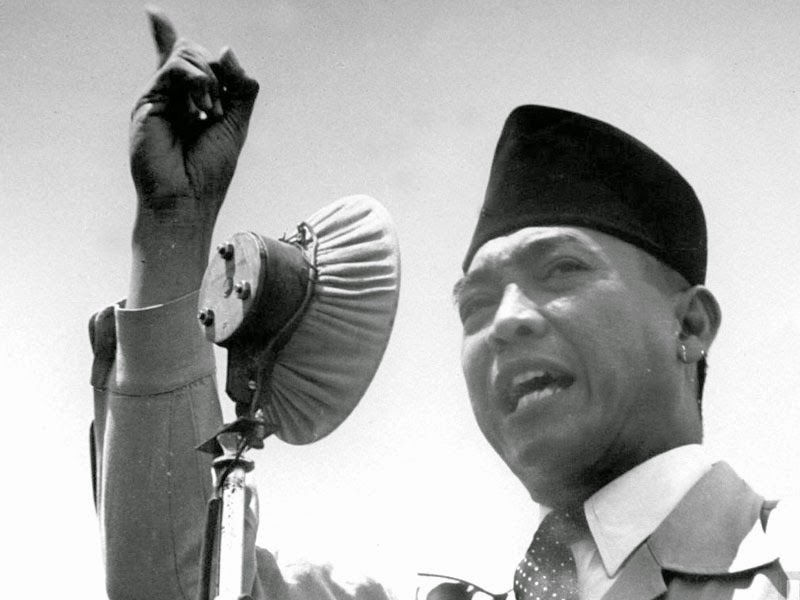
Indonesian President Sukarno.
According to former CIA officer Ralph McGehee, the CIA “was extremely proud” of its campaign and “recommended it as a model for future operations.”
Months after the bloodbath began, the well-connected associate editor of the New York Times, James Reston, would write, “Washington is being careful not to claim any credit” for the coup “but this does not mean that Washington had nothing to do with it.”
The events that triggered the military takeover remain murky even today, thanks to the regime’s systematic suppression of evidence. What seems clear, however, is that the PKI was largely caught unprepared when a group of junior officers — acting either on their own or as part of a “false flag” operation mounted by the anti-Communist General Suharto — killed six generals in the name of stopping a right-wing coup against Sukarno.
Suharto and his colleagues quickly arrested the killers, blamed the PKI for the atrocity, and aroused popular outrage by spreading false stories that the murdered generals had been sexually mutilated.
They also charged that Indonesia’s Communists were targeting Islamic leaders. In response, the country’s largest Muslim organization issued an order to “eliminate all Communists.”
On Oct. 5, 1965, U.S. Ambassador to Indonesia Marshall Green informed Washington that Muslin groups were “lined up behind” the army, which “now has opportunity to move against PKI if it acts quickly. . . Momentum is now at peak with discovery of bodies of murdered army leaders. In short, it’s now or never.”
Green was hopeful: “Much remains in doubt, but it seems almost certain that agony of ridding Indonesia of effects of Sukarno . . . has begun.” To help make sure that came to pass, Green advised telling coup leaders of “our desire to be of assistance where we can,” while remaining in the shadows.
Fanning Flames
Green proposed fanning the flames of popular anger through covert propaganda: “Spread the story of PKI’s guilt, treachery and brutality (this priority effort is perhaps most-needed immediate assistance we can give army if we can find way to do it without identifying it as solely or largely US effort).”
To that end, he later instructed to U.S. Information Agency to use all its resources to “link this horror and tragedy with Peking and its brand of communism; associate diabolical murder and mutilation of the generals with similar methods used against village headmen in Vietnam.”
By mid-October, Green reported that the embassy had discussed strategy with Army and Muslim contacts for a “step-by-step campaign not only against PKI but against whole communist/Sukarno clique.”
Soon he was reporting the good news: the army had executed hundreds of Communists and arrested thousands of PKI cadre, with help from Muslim death squads.
“I, for one, have increasing respect for [the army’s] determination and organization in carrying out this crucial assignment,” he wrote.
To help the army succeed, Green endorsed Washington’s decision to bankroll the military’s clean-up operations against the PKI, adding that “the chances of detection or subsequent revelation of our support . . . are as minimal as any black bag operation can be.”
In addition, by December 1965 the U.S. embassy began sending the Indonesian military lists of PKI leaders — facilitating their liquidation.
“It really was a big help to the army,” said Robert J. Martens, a former member of the U.S. Embassy’s political section. “They probably killed a lot of people, and I probably have a lot of blood on my hands, but that’s not all bad. There’s a time when you have to strike hard at a decisive moment.”
In a December 1965 story, Time magazine offered the first significant account in the American media of the scope of the killing:
“Communists, red sympathizers and their families are being massacred by the thousands. Backlands army units are reported to have executed thousands of Communists after interrogation in remote jails. Armed with wide-bladed knives called ‘parangs,’ Moslem bands crept at night into the homes of Communists, killing entire families and burying the bodies in shallow graves.
“The murder campaign became so brazen in parts of rural East Java, that Moslem bands placed the heads of victims on poles and paraded them through villages. The killings have been on such a scale that the disposal of the corpses has created a serious sanitation problem in East Java and Northern Sumatra where the humid air bears the reek of decaying flesh.
“Travelers from these areas tell of small rivers and streams that have been literally clogged with bodies. River transportation has at places been seriously impeded.”
By February 1996, the U.S. embassy was estimating that at least 400,000 people had already been killed across the country — more than died from the atomic bomb attacks on Hiroshima and Nagasaki.
Media Approval
C.L. Sulzberger of The New York Times remarked in April that “the killing attained a volume impressive even in violent Asia, where life is cheap.”
Speaking for official Washington, in a column titled “A Gleam of Light in Asia,” the New York Times’ James Reston called this bloodbath one of “the more hopeful political developments” in Asia, one that could not have “been sustained without the clandestine aid it has received indirectly from here.”
The full extent of that clandestine aid remains a contested question, but historian Bradley Simpson, in a 2008 study of U.S. relations with Indonesia in the 1960s, observed that “declassification of just a fraction of the CIA’s records demonstrates that the agency’s covert operations in Indonesia were more widespread and insidious than previous acknowledged. These records also reveal that the Johnson administration was a direct and willing accomplice to one of the great bloodbaths of twentieth-century history.”
New Mexico’s Tom Udall declared last year as he introduced a Senate resolution to promote reconciliation on the 50th anniversary of the Indonesian massacres, “the United States and Indonesia must work to close this terrible chapter by declassifying information and officially recognizing the atrocities that occurred. . .
“The United States should stand in favor of continued democratic progress for our vital ally Indonesia and allow these historical documents to be disclosed. Only by recognizing the past can we continue to work to improve human rights across the globe.”
The world is still waiting on President Obama to heed that call.
Jonathan Marshall is author or co-author of five books on international affairs, including The Lebanese Connection: Corruption, Civil War and the International Drug Traffic (Stanford University Press, 2012).
Sikh community furious at Texas authorities after detention on false terrorism accusations
RT | April 29, 2016
A Sikh man and a Pakistani-American man were arrested at gunpoint after fellow bus passengers claimed they were discussing a bomb threat in Arabic – even though they were speaking Punjabi. The Sikh Coalition has filed a complaint against the accusers.
Daljeet Singh, an asylum-seeker from India, began chatting with Mohammed Chotri, a Pakistani-American man, while the two were traveling on a Greyhound bus in February. The two conversed in Punjabi.
When a woman on the bus claimed she heard the word “bomb” mentioned in their conversation, she urged the bus driver to pull onto the side of the road. The bus was passing through Amarillo, Texas, at the time.
The driver dialed 911 and two other passengers restrained the men in their seats until police arrived and arrested them at gunpoint, the Hindustan Times reported.
The men were detained for 30 hours and eventually released after being cleared of criminal wrongdoing by the FBI and the Potter County Attorney’s Office.
The Sikh Coalition has filed a complaint against the woman, identified as Tianna Lynn Decamp, which urges her prosecution due to the fact that she “knowingly reported a false and baseless bomb threat.”
The complaint also urges for criminal charges to be filed against passengers Anthony Lamar Lillie and Kelly Michael Morris, for “unlawfully restraining Mr. Singh on the bus.”
“By filing this complaint, we hope to bring attention to the crisis facing minority communities today. The list of things brown people can’t do on public transportation is growing — we can’t get a can of Diet Coke, we can’t switch seats on a bus or a plane, we can’t speak in a language other than English, really we can’t be human beings,” Gurjot Kaur, senior staff attorney for the Sikh Coalition, told NBC News.
Singh said in a statement that the only crime he committed was “wearing a turban, having a beard, and speaking in a different language to another brown man on a bus.”
“I still cannot believe that this happened to me in America,” he said.
Potter County Attorney Scott Brumley told the Globe-News that he will review the complaint before deciding if any charges should be filed.
The February incident occurred the same month that a Sikh actor, model and designer was barred from taking a flight to New York after refusing to take off his turban. Just two months prior, a passenger on a Delta flight falsely believed a breastfeeding Sikh mother posed a terror threat.
Read more:
‘Hate crime evidence’: Sikh advocacy group criticizes LA authorities over bus driver attack
President Obama: The Race for the Imperial Legacy
By James Petras :: 04.29.2016
President Obama is racing forward to establish his imperial legacy throughout Russia, Asia and Latin America. In the last two years he has accelerated the buildup of his military nuclear arsenal on the frontiers of Russia. The Pentagon has designed a high tech anti-missile system to undermine Russian defenses.
In Latin America, Obama has shed his shallow pretense of tolerating the center–left electoral regimes. Instead he is has joined with rabid authoritarian neo-liberals in Argentina; met with the judges and politicians engineering the overthrow of the current Brazilian government; and encouraged the emerging far-rightwing regimes in Peru under Keiko Fujimori and Colombia under President Santos.
In Asia, Obama has clearly escalated a military build-up threatening China’s principle waterways in the South China Sea. Obama encouraged aggressive and violent separatist groupings in Hong Kong, Tibet, Xinjian and Taiwan. Obama invites Beijing billionaires to relocate a trillion dollars in assets to the ‘laundry machines’ of North America, Europe and Asia. Meanwhile he has actively blocked China’s long-planned commercial ’silk route’ across Myanmar and west Asia.
In the Middle East, President Obama joined with Saudi Arabia as Riyadh escalated its brutal war and blockade in Yemen. He directed Kenya and other African predator states to attack Somalia. He has continued to back mercenary armies invading Syria while collaborating with the Turkish dictator, Erdogan, as Turkish troops bomb Kurdish, Syrian and Iraqi fighters who are engaged on the front lines against Islamist terrorism.
President Obama and his minions have consistently groveled before the Jewish State and its US Fifth Column, massively increasing US ‘tribute’ to Tel Aviv. Meanwhile, Israel continues to seize thousands of acres of Palestinian land murdering and arresting thousands of Palestinians, from young children to aged grandparents.
The Obama regime is desperate to overcome the consequences of his political, military and economic failures of the past six years and establish the US as the uncontested global economic and military power.
At this stage, Obama’s supreme goal is to leave an enduring legacy, where he will have: (1) surrounded and weakened Russia and China; (2) re-converted Latin America into an authoritarian free-trade backyard for US plunder; (3) turned the Middle East and North Africa into a bloody playpen for Arab and Jewish dictators bent on brutalizing whole nations and turning millions into refugees to flood Europe and elsewhere.
Once this ‘legacy’ is established, our ‘Historic Black President’ can boast that he has dragged our ‘great nation’ into more wars for longer periods of time, costing more diverse human lives and creating more desperate refugees than any previous US President, all the while polarizing and impoverishing the great mass of working Americans. He will, indeed, set a ‘high bar’ for his incumbent replacement, Madame Hilary Clinton to leap over and even expand.
To examine the promise of an Obama legacy and avoid premature judgements, it is best to briefly recall the failures of his first 6 years and reflect on his current inspired quest for a ‘place in history’.
Fear, Loathing and Retreat
Obama’s shameless bailout of Wall Street contrasted sharply with the desires and sentiments of the vast majority of Americans who had elected him. This was a historic moment of great fear and loathing where scores of millions of Americans demanded the federal government reign in the financial criminals, stop the downward spiral of household bankruptcies and home foreclosures and recover America’s working economy. After a brief honeymoon following his ‘historic election’, the ‘historic’ President Obama turned his back on the wishes of the people and transferred trillions of public money to ‘bailout’ the banks and financial centers on Wall Street.
Not satisfied with betraying the American workers and the beleaguered middle class, Obama reneged on his campaign promises to end the war(s) in the Middle East by increasing the US troop presence and expanding his drone-assassination warfare against Afghanistan, Iraq, Yemen, Libya, Somalia and Syria.
US troops re-invaded Afghanistan, fought and retreated in defeat. The Taliban advanced. The US expanded its training of the puppet Iraqi army, which collapsed on its first encounters with the Islamic State. Washington retreated again. Regime change in Libya, Egypt and Somalia created predator-mercenary states without any semblance of US control and dominance.
Obama had become both a master of military defeats and financial swindles.
In the Western Hemisphere, a continent of independent Latin American governments had emerged to challenge US supremacy. The ‘Historic President’ Obama was dismissed as a clueless hack of the US Empire who lacked any rapport with governments south of the Panama Canal. While trade and investment flourished between Latin America and Asia; Washington fell behind. Regional political and economic agreements expanded, but Obama was left without allies.
Obama’s clumsy attempts at US-backed ‘regime change’ were defeated in Venezuela and elsewhere. Only the small, corrupt narco-state of Honduras fell into Obama’s orbit with the Hillary Clinton-engineered overthrow of its elected populist-nationalist president.
China and Russia expanded and flourished as commodities boomed, wealth expanded and demand for Chinese manufactures exploded.
By 2013 Obama had no legacy.
The Recovery: Obama’s Lost Legacy
Obama began the road to establishing his ‘legacy’ with the US-financed coup in Ukraine, spearheaded by the first bona fide Nazi militia since WWII. After celebrating the violent ‘regime change’ against Ukraine’s elected government, Obama’s new oligarch-puppet regime and its ethno-nationalist army have been a disaster, losing control of the industrialized Donbas region to ethnic Russian rebels and completely losing the strategic Crimea when the population overwhelmingly voted to re-join Russia after 50 years. Meanwhile, the oligarch-’president’ Poroshenko and his fellow puppets have pilfered several billion dollars in ‘aid’ from the EU… all in pursuit of the Obama legacy’.
Obama then slapped devastating economic sanctions against Russia for its role in the Crimean referendum and its support for the millions of Russian speakers in Donbas, and in the process forced the European Union to make major trade sacrifices. For their role in creating a real “American legacy” for Mr. Obama, the Germans, French and the other twenty-eight countries have sacrificed billions of Euros in trade and investments – alienating large sectors of their own agricultural and manufacturing economy.
The Obama regime placed nuclear weapons on the Polish border with Russia, pointed at the Russian heartland. Estonians, Lithuanians and Latvians joined Obama’s military exercises stationing US ships and attack aircraft in the Baltic Sea threatening Russia’s security.
Obama’s Legacy in Latin America
The Obama regime intensified its efforts to re-establish supremacy with the demise of the center-left regimes following elections in late 2013 to the present.
Obama’s ‘legacy’ in Latin America is based on the return to power of neo-liberal elites in the region. Their successful elections were the result of several factors, including: (1) the rise of rightwing economic power in Latin America; (2) the decay and corruption of political power within the Left; 3) incapacity of the Left to develop its own independent mass media to challenge the media monopoly of the right; and (4) the failure of center-left regimes to diversify their economy and develop growth outside the boundaries defined by the dominant capitalist sectors.
The Obama regime worked closely with the political-business elite, organizing the political campaigns and controlling key economic policies even during the center-Left governments. The Left regimes had financed, subsidized and rewarded right-wing business interests in agro-mineral industries, banking, and the media as well as in manufacturing and imports.
As long as worldwide demand for primary materials was strong, the Center-Left governments had plenty of room to adjust their social spending for workers while accommodating business interests. When demand and prices fell, budget deficits forced the Center-Left to cut back on social spending for the masses as well as subsidies for the business elite. In response, the business sector organized a full-scale attack on the government – in defense of elite power. The Center-Left failed to counter the growing power and position of their business elite adversaries.
The business elite launched a full-scale propaganda war via its captive mass media – focusing on real or imagined corruption scandals discrediting Center-Left politicians. The Left lacked its own effective mass media to answer the Right’s accusations, having failed to democratize the corporate media monopolies.
The Center-Left parties adopted the elite’s technique of financing political campaigns – namely, through bribes, contract concessions, patronage other deal making with billionaire private and state contractors. The center-Left imagined it could compete with the free-market rightwing in financing campaigns and candidates via swindlers – and not through class struggle. This was a game they could never master.
The Right, however, mobilized their allies within police, judicial and public institutions to prosecute and disqualify the Center-Left for committing the same crimes the Right had evaded.
The Center-Left did not mobilize the workers and employees to establish even minimal controls over the elite and assume some managerial power. They thought they could compete with the Right on its own terms, through shady business and chicanery.
The Center-Left relied on financing its administration and policies through the commodity boom in demand for its natural resources – overlooking the fundamental instability and volatility of the global commodity market. While the Right openly condemned the ‘weakness of the Center-Left’ – in private, it pursued policies even more dependent on overseas speculators and narrow elites.
In Argentina, as the economy declined, the leadership of the rightwing, led by Mauricio Marci, launched a successful presidential campaign involving the mass media, banks, middle class voters and agro-mining elites. Immediately upon taking power, the Macri regime cut social services for workers and the lower middle class, slashing their living standards and lay off thousands of government employees. Obama saw Macri as his kind of legacy savior and viewed Argentina as the new center of US power in Latin America – with plans for more regime change in Brazil, Venezuela and throughout the region.
In Brazil, the Center-Left Workers’ Party (PT) faced a massive attack on its power base by the extreme rightwing parties. Corruption scandals rocked the entire spectrum of the political class, but the PT was most heavily implicated by massive fraud in Brazil’s huge national oil company, Petrobras. The PT regime’s troubles intensified as the country entered a recession with the drop in demand for its agro-mining exports. Growing fiscal deficits compounded the regime’s problems. The Brazilian hard Right mobilized its entire apparatus of elite power – the courts, judges, police and intelligence agencies – in a bid to overthrow the PT government and impose an authoritarian neo-liberal regime seizing all financial, business and productive assets.
The Center-Left had never been very left, if at all. Under Presidents Lula and Rousseff (2003-2016), the powerful mining and agricultural elites flourished; banking, investment and multi-national enterprises prospered. The Center-Left made some paternalistic concessions to the lowest income classes, and increased wages for labor and farm workers. But the PT relegated labor to the background while it signed business agreements and granted tax concessions to capital. It failed to engage Brazilian workers in class struggle.
The Right was never engaged in any struggle with a genuine leftist government pressing business for structural changes. Nevertheless, the Right sought to eliminate even the most superficial reforms. It would accept nothing short of total control, including: the privatization of the major national oil company, the reduction of wages, pensions and transport subsidies and a slashing of social programs. The Brazilian Rightwing coup – a fake impeachment organized by indicted crooks – is designed to vastly re-concentrate wealth, and re-establish the power of business, while plunging millions into poverty and repressing the principal organized mass movements. In Brazil, the elite-controlled media, courts and politicians act as judge, jury and jailers – against a center-left regime which had never taken control over the major institutions of elite power.
Obama and the Axis of his Legacy
Political rightists join police to control the multitudes and seize power, re-establishing deep ties among Brazil, Washington and Argentina. They will then move toward the neo-liberal re-conquest of all Latin America. Against this new wave, it must be understood that Obama’s Latin American legacy is too recent, too hasty and too disjointed – the new Right exhibits the same or even worse features of the recently deceased Left.
Argentina’s Marci borrows $15 billion at 8% interest, when the economy is fracturing, employment is collapsing, exports and worldwide demand is declining. At the same time, President Mauricio Marci’s cabinet is plagued by major financial scandals ‘a la Panama Papers’. The entire political party-trade union-employed working class is profoundly disenchanted with Marci’s minority rule.
Argentina may not turn out to be Obama’s enduring Latin Legacy: While Macri may open the door for a brief Washington take-over, the results will be catastrophic and the future, given Argentina’s recent history of popular street uprisings, is uncertain.
Likewise in Brazil, the impeachment/coup will result in new and more numerous investigations with trials of post-impeachment politicians and a deepening economic crisis. Brazil’s Vice-President, who turned against Rouseff, now faces corruption charges, as do his supporters. The prolonged confrontation precludes any basic continuity. The rightwing regime’s policy of slashing wages, pensions and poverty ‘baskets’ will detonate large-scale confrontations with the polarized population. Obama’s ‘legacy’ will be a brief episode – celebrating the ouster of the Workers’ Party President followed by a long period of instability and disorder.
Rightist regimes in Venezuela, Colombia and Peru will be part of Obama’s ‘legacy’ but to what lasting end?
The Venezuelan rightwing congress – dubbed the MUD – seeks to overthrow the elected president. It demands the release of several right-wing assassins from prison, the privatization of the oil industry, and a deep cut in social programs (health and education). They would reduce employees’ wages and eliminate food subsidies. The MUD has no competent plan or capacity to grow the oil economy and overcome chronic food shortages. The MUD would merely replace the Left’s subsidized economy with massive price increases for basic commodities — reducing domestic consumption to a fraction of its current level. In other words, the right-wing offensive may defeat the Chavista left but it will not stabilize Venezuela or develop a viable neo-liberal alternative. Any new rightwing regime will deteriorate rapidly and the chronic problem of criminal violence will exceed the current levels. The alliance between Washington and Venezuela’s far right will hardly support Obama’s claim to a historic legacy. More likely, it will serve as another example of a failed right wing state unable to replace a weakening left regime.
Similar circumstances can be found among other ‘emerging’ rightist regimes.
In Colombia, the current rightwing President Santos talks to the FARC guerrillas, but also accommodates the paramilitary death squads. His talks of peace settlements and social reform are linked to the genocidal right, led by the former President Uribe. Meanwhile, the economy stagnates with oil and metal prices collapsing on the world market. Colombian living standards have declined and the promise of a rightwing revival grows dim. The US-Colombian alliance may undercut the FARC but the rightwing does not offer any prospect for modernizing the economy or stabilizing the society.
Similarly in Peru, the rightwing wins votes and embraces free markets, but growth declines, investments and profits dry up and mass disenchantment grows among the poor promising street conflicts.
The Obama ‘legacy’ in Latin America has followed a series of brutal victories, which have no capacity to re-impose a stable ‘new order’ of free markets and free elections. The initial wave of favorable investments and lucrative concessions will fail to revive and recalibrate a new growth dynamics.
More ominously, Obama relied on mass murder to replace an elected leftist-nationalist president in Honduras and imposed a regime of terror against the poor and indigenous population. Meanwhile, illicit offshore handouts reward speculators in Argentina.
Obama’s legacy in Latin America reflects an entire spectrum from illicit-rightwing coups to oust the elected governments in Brazil and Venezuela, to elected authoritarian presidents in Peru and Colombia with historic links to death squads and multi-million dollar overseas accounts.
Obama’s contemporary ‘Latin American legacy’ reeks of gross electoral manipulation preparing the ground for bloody class wars.
Obama’s Legacy in the Ukraine, Yemen and Syria
The Obama regime thought it could manage widespread conflicts, uprisings and wars to advance its global supremacy.
To that end, Obama spent billions of dollars in weapons and propaganda arming Neo-Nazi para-military troops to seize power in Ukraine. A grotesque, brutal gang of oligarchs (and disgraced, foreign fugitives – like the ousted Georgian leader, Mikhail Saakashvili) served Washington in the puppet Kiev regime. Critics, journalists, jurists and citizens are being assassinated. The economy has collapsed; prices skyrocket; incomes declined by half; unemployment tripled and millions have sought refuge abroad. Wars raged between Russian ethnic citizen armies in the Donbas and the puppet Kiev regime. The people of Crimea voted to rejoin Russia. Meanwhile, economic sanctions against trade with Russia have exacerbated shortages for the people of Ukraine.
Under Obama’s stewardship the Ukraine became a world-class… basket case: so much for his European legacy. He can rightly claim credit for imposing a thoroughly retrograde regime of Klepto-capitalism with no redeeming feature.
Obama embraced Saudi Arabia’s war against Yemen – destroying the life and cities of the poorest nation in the Middle East. Obama’s ‘legacy’ in Yemen stands for the systematic obliteration of a sovereign people: Obama performs his tricks for billionaire Saudi despots while savaging the innocent. To the Israelis in Palestine and the Saudis in Yemen, Obama pays homage to the criminals responsible for millions of shattered lives.
What of the Obama ‘legacy’ in Syria and Libya? How many million Africans and Arabs have been murdered or fled on rotten boats in destitution. Only the rankest gang of corrupt media pundits in the US media can pretend this gangster President should evade a war crimes tribunal.
Conclusion
The Obama regime has pursued wars of unremitting destruction. It has forged partnerships with terrorists and death squads as it seeks short-term imperial victories, which end in dismal failures.
The imperial legacy of this ‘historic’ president is a mirage of pillage, squalor and destruction. The effect of his political lies has even begun register here among the American public: Who trusts the US Congress and the President? And in Europe, who trusts Obama’s European partners as they eagerly pushed for wars in the Middle East and North Africa and now fear and loathe the millions of their victims–refugees fleeing to the cities of Europe, with the drowned corpses of uprooted communities spoiling their beaches?
Obama pushed for wars and the Europeans receive the victims – with fear and disgust.
Obama’s victories are temporary, blighted and reversed.
Obama bombed Afghanistan yesterday and now flees renewed resistance.
Obama’s allies are again plundering Latin America but face imminent ouster via popular uprisings.
Obama terrorized and fragmented Syria yesterday but lost elections the day after.
Obama threatens China’s economy while eagerly buying China’s products.
The Obama legacy began as a failed military and economic offensive accompanying a profound social crisis. During his final year in office, Obama tries to forge alliances with the dregs of the hard right to save his legacy. His brief advance into this sordid world of neo-liberals, neo-Nazis and Saudi despots is a prelude to more retreat and chaos.
Obama’s public celebration of the right turn in Asia, Latin America, Europe and the Middle East applauds the most retrograde alignment of forces in modern times: Saudis and Israelis; Egyptian generals and Libyan jihadis; neo-Ottoman Turks with Ukrainian gangster-oligarchs. Regime changes in Argentina and Brazil encourage Obama to claim vindication of his imperial legacy.
His ‘moment’ of imperial truth is brief, all too brief. Everywhere, we witness the rapid rise of imperial success followed by a series of debacles.
Throughout Latin America capitalist profiteers plunge into wild financial adventures, theft and chaos. In the Middle East, the US stands on the crumbling palaces of a moribund Saudi regime. The much-proclaimed imperial advances are based on grand theft everywhere, from Egypt and Turkey to the Ukraine.
Simply stated: the US formula for a successful legacy is failing at the precise moment that it claims success! Obama and the Right have created a world of chaos and disintegration. Obama and his legions, the US and Europe have no future in peace or war, election or defeats.
There is no imperial legacy for the ‘historic’ President Obama!
Featured Video

or go to
Aletho News Archives – Video-Images
New Documentary
“Inside Gaza” wins best documentary at Montreal’s Cinemania film festival
Palestine Information Center – November 16, 2026
MONTREAL – The documentary “Inside Gaza,” which chronicles the experiences of Palestinian journalists working with Agence France-Presse (AFP) while covering the Israeli war on the Gaza Strip, won the Best Documentary Award at the 32nd Cinemania International Francophone Film Festival held in Montreal, Canada.
Directed by Helene Lam Trong, the 72-minute film follows the daily lives of four AFP journalists who bear witness to the difficulties of reporting in a war-torn territory largely closed off to international media.
The film is compiled from material produced by the team on the ground, as well as from interviews conducted after they left.
The film also won the People’s Choice Award at the festival on Saturday. … continue
Blog Roll
 Aletho News
- How The Jensen Huang Chinese Spy Hoax Is Russiagate 2.0
- Austria seeks to strip former foreign minister of citizenship over Russia ties
- “Inside Gaza” wins best documentary at Montreal’s Cinemania film festival
- Activists block German munitions plant over arms exports to ‘Israel’
- The Nasser Hospital attack and Israel’s relentless lies
- Could it be satan? No, Huckabee, just the Americans you work for
- AIPAC and more: Network of pro-Israel influence in US Congress
- Putin aide reveals Moscow’s stance on Europe at peace talks
- Imran Khan warns Pakistani judges he may die in prison
- IOF used Amazon facial recognition to track millions of Palestinians
- If Americans Knew
- An error has occurred; the feed is probably down. Try again later.
- No Tricks Zone
- Argentina’s Perito Moreno Glacier Joins Antarctica and Arctic In Defying Doomsday Melt Claims
- New Study: Barents Sea Temperatures Were Warmer And Sea Ice Less Extensive In The 1700s Than Today
- German Authorities Start Initiative To Evaluate Public Register For Climate “Disinformation” Spreaders!
- Zonal Asymmetry of Temperature Change in the Antarctic Circumpolar Current
- New Study: The Net Fossil Fuel Contribution To Rising Atmospheric CO2 Has Been Zero For 500 Years
- Germany’s Green Energy Transition Becoming Increasingly Expensive…Another 6 Trillion Euros!
- Sudden Stratospheric Warming, Powerful El Niño Combination May Lead To Extreme Europe Cold, Energy Crisis!
- Two New Studies Find Thwaites Glacier Melt Cannot Be Driven By Human Activity Or A Warming Ocean
- E-Cars Reduce CO2 Emissions By Only 41% Compared To Internal Combustion Engine Vehicles
- Predictions Made By Renowned Climate Professor Over Past Decades Have Been Proven To Be Poor

