China investments in US to double
Press TV – April 14, 2016
A report by researchers from Rhodium Group as well as the National Committee on US-China Relations showed that investments by China in the US for 2015 stood at $15 billion. However, this could see a major rise as more Chinese companies are expected to bring in their capital to the US.
By the end of 2015 more than 1,900 Chinese-affiliated companies were operating in the US across more than 80 percent of its congressional districts and employing some 90,000 people, said the report.
The study showed that only an eighth of China’s $120 billion in outward investment last year went to the US.
Nevertheless, the amount invested in American businesses is growing rapidly as Beijing wants to shift the economy toward technology, services and greater consumer spending.
More than $5 billion in US deals have been completed in the first three months of this year alone, reported Russia Today on its website.
The study found that last year New York saw the most Chinese investment at $4.1 billion topping California’s $1.8 billion. New York has benefited from deals related to tourism and financial services.
Over the past 15 years, Chinese firms invested $70 million in Californian food and agriculture companies while total investment in the sector across the US reached $7.4 billion, RT added.
The report further added that California will be a top destination in coming years for a variety of Chinese investment in the US, which could reach $200 billion by 2020.
University used $175,000 to bury ‘pepper spray’ cop internet searches

© Brian Nguyen / Reuters
RT | April 14, 2016
Officials at University of California at Davis have reportedly spent $175,000 trying to digitally suppress the memory of the time campus police indiscriminately pepper sprayed Occupy protesters – to no success.
The university, with a student population of just over 35,000, wants people to forget that in November 2011 campus police lost the run of themselves when responding to a sit-down protest.
Footage from the scene, showing campus police Lt. John Pike discharging military-grade pepper spray into the eyes of student protesters sitting on the ground, caused outrage around the world.
It quickly became a social media meme, with the incident resulting in a number of legal cases, including an agreement by UC Davis to collectively compensate victims to the tune of $1 million.
According to freedom of information documents requested by The Sacramento Bee newspaper, UC Davis paid two separate consultant firms to try to clean the internet of bad publicity.
Some $92,970 out of the university’s communications beefed-up budget was paid to Maryland state PR firm Nevins & Associates in 2013, report the Sacramento Bee.
Meanwhile, a year later an $82,500 contract was signed with ID Media Partners to design a “search engine results management strategy.”
A document by Nevins & Associates details the plan to filter out “venomous rhetoric” concerning UC Davis and its chancellor, Linda Katehi.
“Nevins & Associates is prepared to create and execute an online branding campaign designed to clean up the negative attention the University of California, Davis, and Chancellor Katehi have received related to events that transpired in November 2011,” it reads.
A list of objectives by the public relations firm reveals a plan to launch an “aggressive” campaign to dilute negative search results and eradicate references to the pepper spray incident on Google.
The company advised optimizing the use of Meta tags and feeding local media “content with positive sentiment.”
Chancellor Linda Katehi was roundly criticized for her reaction to the Occupy Wall Street protest at the time, with students demanding her resignation.
“We have worked to ensure that the reputation of the university, which the chancellor leads, is fairly portrayed,” a UC Davis spokesperson said.
“We wanted to promote and advance the important teaching, research and public service done by our students, faculty and staff, which is the core mission of our university.”
US Representative Kevin McCarty (D-California), who serves and chair of the Assembly Budget Subcommittee on Education Finance, said that the PR expenditure was “troubling” given the increase in university tuition.
“It is troubling that the administration chose to spend scarce public dollars and to nearly double its PR budget when tuition soared, course offerings were slashed and California resident students were being shut out. These findings just raise more questions about university priorities,” he posted on Facebook.
Why was the Nakba Tour Canceled at Stanford?
Palestinian Refugee: Stanford students censored me over condemnation of Israel
Free Palestine Movement | April 11, 2016
In an interview, Amena El-Ashkar, a Palestinian refugee from Lebanon, states that she refused to speak at Stanford University after students told her she could not express her views about Israel.
I’m coming here to say that Israel has no right to exist. [The students] said we could discuss this kind of thing with each other, but not in front of American people…
Ms. Ashkar’s talk is one of several on a national “North America Nakba Tour,” a tour designed to educate Americans about the enduring effects Israel’s mass expulsion of Palestinians from their homeland in 1948. Ms. Ashkar and Mariam “Umm Akram” Fathallah, an 86-year-old survivor of the expulsion, had planned to speak at Stanford University on 6 April 2016. Ms. Ashkar was born and raised in a Palestinian refugee camp in Lebanon, where her ancestors were banished during the expulsion, or Nakba, of 1948.
Stanford Students for Justice in Palestine (SJP), which was hosting the talk at Stanford, told Ms. Ashkar that their existence as a campus organization depends on not challenging Israel’s “right to exist,” and told her not to address the topic. Ms. Ashkar refused to censor herself and was shocked that an organization named “Students for Justice in Palestine” would insist on such a requirement. Although some of the students admitted to sharing Ms. Ashkar’s views, the students cited the hostile administrative climate at Stanford to justify censoring their guest.
I told them, it is a fight, and any fight is going to have sacrifices. In Lebanon, we have Palestinian clubs… which do not take funds from the University. We pay it ourselves.
Stanford SJP released a false statement attributing the cancellation to concerns about Alison Weir, a pro-Palestinian commentator who was in the audience. Ms. Weir was subject to widely disputed — and widely rejected — accusations of anti-Semitism by other Palestinian rights organizers last summer, revealing deep-seated divisions within the Palestinian rights movement. Although Tour organizers had informally asked Ms. Weir to give Ms. Ashkar public speaking advice, and Ms. Weir had offered the Tour some generic informational materials — none of which are authored by Weir — Ms. Weir is not one of the national organizers of the North America Nakba Tour and was not a planned speaker. Weir offered to sell copies of her own writings at the event to raise money for the Tour, but complied when Stanford students asked her not to sell them. The statement alleges that Ms. Weir refused to leave when asked, which Weir and Tour organizers deny. No security personnel were called to remove Weir or anyone else from the audience; instead, the speaker herself felt alienated and called off the event.
Ms. Ashkar explains that disagreements about who was in the audience were not why the talk was canceled. Instead, Ms. Ashkar says that she herself called off the talk when the organizers demanded that she censor herself.
The existence of Israel, as I told the SJP, means that I have no right to exist. Because I am a refugee in a Palestinian camp inside Lebanon. The Lebanese government doesn’t want me, and we cannot return. So what are we? Are we going to stay stateless refugees generation after generation?
One of the informational flyers provided by Weir, but authored by former PLO legal advisor John V. Whitbeck apparently sparked the feud with similar arguments. The flyer states, in part,
To demand that Palestinians recognize “Israel’s right to exist” is to demand that a people who have been treated as subhumans unworthy of basic human rights publicly proclaim that they are subhumans. It would imply Palestinians’ acceptance that they deserve what has been done and continues to be done to them. Even 19th-century US governments did not require the surviving native Americans to publicly proclaim the “rightness” of their ethnic cleansing by European colonists…
North America Nakba Tour organizers call on Stanford SJP to retract its false explanation and issue a public apology for their behavior to Ms. Ashkar. They have also asked concerned citizens to consider donating to the Tour and attending Tour events in lieu of the cancellation. Paul Larudee, a Tour organizer, and Ms. Weir have separately authored their own accounts of the incident.
Paul Larudee | April 7, 2016
Last night, Mariam Fathalla and Amena Elashkar were scheduled to speak at Stanford University, sponsored by Students for Justice in Palestine. The previous day, I had asked Alison Weir, who has been giving talks on Palestine for 15 years all over the country, to meet with Amena and give her advice on reaching American audiences since this is Amena’s first trip to the U.S. It was an excellent, fruitful meeting.
I then said it would be valuable if Alison could hear Amena’s presentation to see if she would have any suggestions. Alison is extremely busy but agreed to come down to Stanford with us for that purpose.
When Alison learned we did not yet have any written materials along to provide the audience, she brought some along with her for us to use and also gave us some of her books that we could sell to help raise money for the tour. We had already discussed that IAK would supply their excellent written materials for the tour.
We had no idea that Alison would turn out to be an issue, or that the Stanford SJP would object to what Amena might wish to say.
Alison is an extremely committed and popular antiracist writer, speaker, and activist, and people even follow her work in refugee camps in Lebanon. While some groups oppose her and If Americans Knew, most people working for justice in Palestine feel she is one of the top writers and speakers on this issue.
In any case this should not be an issue for the Nakba Tour; Alison is not one of the national organizers of the tour, and she was not intended to be one of the speakers or to have any role in the presentation at Stanford. She was simply there as a favor to us, as described above.
However, some members of the SJP immediately objected to Alison’s presence, perhaps assuming she was going to speak, and also to the presence of her book and the If Americans Knew materials. We immediately explained that Alison was not to be a speaker and was just there to sit in the audience, and that we had invited her to come with us. We also agreed to remove the books, but said we were disturbed that they also wished to censor the materials we could make available on our own tour. In all my years of activism, I’ve never heard of such a thing.
Amena then began discussing the situation with the students, and was extremely upset when they told her that she could not speak truthfully about her feelings and the feelings of the thousands of dispossessed Palestinian refugees living in camps about their situation, about the Nakba, and about whether or not Israel has “the right to exist” that Israel partisans claim. This was not an issue at the two previous talks.
When it became clear that they wished Amena to censor her excellent talk, she refused to do so and the event was canceled.
We think it is extremely important that people hear from Amena and Mariam. They represent millions of Palestinian refugees whose rights and views have been trampled upon and who are often ignored. Thank you for helping us bring their voice to the discussion. It is long past time that they are heard.
If you have any questions, please feel free to contact me.
– Paul Larudee, Tour Coordinator
Washington Post Lies to Justify Intervention in Venezuela
teleSUR | April 13, 2016
The noted Brazilian political scientist and theologian Frei Betto recently said that “the Yankees will do everything so that our continent will go back to being their backyard.”
Despite the rhetoric about democratic values that emanates from Washington, the U.S. government has always been willing to use any means necessary to impose their will on Latin America. This has often translated into foreign intervention.
But the U.S. public has grown weary of their government’s imperialist adventures, which as of late have ended in utter disaster. Washington elites know they must first fool the public into believing that intervention is a necessity.
To accomplish this they turn to private media outlets and their editorial boards, who help drum up support for U.S. intervention in foreign countries.
Enter the latest example: a recent editorial by the Washington Post entitled: “Venezuela is in desperate need of a political intervention.”
This from the same paper that was once vilified by U.S. conservatives for its supposed leftist tilt.
The use of the word intervention is deliberate, the Post knows that the Bolivarian Revolution – started by Hugo Chavez and continued by his successor Nicolas Maduro – still commands enormous support. The Venezuelan people will not simply hand the state back over to the very same politicians that abused the working class for decades.
An intervention done in the name of the Organization of American States, as the editorial calls for, is still imperialist. And it’s not just Venezuelans who know it but the whole region, which has seen the OAS used time and again to legitimize the imperialist fancies of the U.S. in the region.
The Post also knows that deceiving their audience sometimes requires outright lies.
Like the New York Times editorial on Venezuela that proceeded the Post’s, the editorial team claims that lack of cooperation between the Maduro government and the opposition-controlled National Assembly is entirely the fault of Maduro.
The Post claimed that he “pursued scorched-earth warfare with the National Assembly,” while the Times claimed that it opposition only reluctantly settled on ousting the democratically-elected Maduro from power.
Lies. All of it.
From the moment they were declared the winners of the parliamentary election, the opposition said their goal was ousting Maduro from power.
There was never an opportunity for cooperation between the Venezuelan government and the opposition and the blame for that lies with the opposition. On the day the new parliament was sworn in, Henry Ramos Allup, a leading figure in the opposition, literally ran his finger across his throat to indicate his feelings about the government and its supporters.
Does that sound like a politician interested in dialogue? Hardly unsurprising that the Post would chose to leave that detail out.
But lying through omission isn’t enough for the Post editorial board. They fancy themselves legal experts, able to pass judgment on Venezuela’s division of powers and the decisions of its Supreme Court.
The Post took issue with the court’s decision to rule a highly controversial “amnesty” bill as unconstitutional. This bill doesn’t promote amnesty for so-called political prisoners, it affords impunity for people directly responsible for the deaths of dozens.
The objective of the opposition’s impunity bill was the release of politicians involved in efforts to oust Maduro by force, politicians like Leopoldo Lopez who was found guilty of inciting the violent protests that led to the deaths of 43 people.
Of course the truth doesn’t fit their narrative, so the Post brazenly claims that state security forces were largely responsible for the deaths during the 2014 protests. The truth is the vast majority of those killed were either innocent bystanders, government supporters, or state security officials.
It wasn’t the state that set up violent blockades, it wasn’t the state that strung up barbed wire so that passing motorists would be decapitated, it was Lopez’s supporters.
Venezuela is confronting a major economic crisis, that much is true, but the Post doesn’t bother with an investigation as to why. No, instead it blames everything on Maduro, including the drought that is affecting Venezuela’s ability to produce electricity. The same drought that is causing similar problems in neighboring Colombia. Is that too the fault of Maduro?
Seems as if the Post’s editorial board is also gifted with the power of premonition, predicting that the opposition’s efforts to prematurely end Maduro’s mandate would be declared void.
Media outlets made the same sort of predictions ahead of the 2015 parliamentary elections, claiming that the government would not recognize the results. Of course Maduro immediately recognized the results.
The opposition is free to pursue a recall referendum against Maduro, as they did with Chavez, which they lost. All that Venezuela’s electoral authority asks is that they follow the rules, something they seem unable to do.
As for an effort to pass a law to shorten Maduro’s term, well even the Post’s friends at the Times understands that “it would be hard to justify carrying out that change retroactively when Mr. Maduro was elected for a six-year term.”
Any foreign intervention, even one under the auspices of the OAS, would indeed result the kind of intense scenes the Post describes, but it would come as a result of millions of Venezuelans hitting the streets to reject it.
Venezuelans, and more broadly speaking Latin Americans, have lived through an era where the shackles of imperialism have been shed. They will not allow the region to become the backyard of the United States ever again.
The New Propaganda War
By Jonathan Marshall | Consortium News | April 13, 2016
“[Russia] is conducting an intensive propaganda campaign directed primarily against the US and is employing coordinated psychological, political and economic measures . . . The ultimate object of this campaign is not merely to undermine the prestige of the US and the effectiveness of its national policy but to weaken and divide world opinion to a point where effective opposition to [Russian] designs is no longer attainable by political, economic or military means.”
With that justification, the Truman administration secretly authorized the start of covert operations by the CIA against America’s wartime ally, the USSR, in December 1947. It was one of the seminal decisions that launched the Cold War.
Fast forward now to March 2016, when the “Countering Information Warfare Act of 2016” was introduced in the U.S. Senate — as if nothing has changed in nearly seven decades.
The bipartisan bill, co-authored by Senators Chris Murphy, D-Connecticut, and Rob Portman, R-Ohio, declares that the Russian government uses “disinformation and other propaganda tools to undermine the national security objectives of the United States and key allies and partners” and achieve “a destabilizing effect on United States allies and interests.”
It further asserts that “the challenge of countering disinformation” requires “a whole-of-government approach leveraging all elements of national power,” coordinated by the Secretary of Defense and Director of National Intelligence.
Last year, in the same spirit, the House Armed Services Committee sought to add $30 million to funding of the U.S. Special Operations Command to combat Russian and Islamist information operations. It accused Russia of challenging “the NATO system” by engaging in “propaganda, diplomatic and economic measures to . . . preserve and extend its perceived sphere of influence” in Ukraine and beyond.
Philip Karber, president of the hawkish Potomac Foundation in Washington, D.C., agreed that Russia’s success in “hybrid warfare,” above all in Ukraine, requires a much bigger response from the American military. “Against the Russian media machine, you cannot just depend on a free press alone to defend against their multi-front ‘Big Lie’ campaign,” he declared.
Karber is one of many neo-Cold Warriors who warn that the United States and its NATO allies are falling behind Russia in the information war. In 2014, NATO’s Supreme Commander, General Philip Breedlove called on the alliance to prepare responses to what he called “the most amazing information warfare blitzkrieg we have ever seen,” related to Russia’s support for separatists in the eastern Ukraine.
Spreading Hysteria
Similar hysteria spilled into the pages of The Atlantic magazine, which complained that Breedlove had actually understated the threat.
“The new Russia doesn’t just deal in the petty disinformation, forgeries, lies, leaks, and cyber-sabotage usually associated with information warfare,” cried author Peter Pomerantsev. “It reinvents reality, creating mass hallucinations that then translate into political action. . . . We’re rendered stunned, spun, and flummoxed by the Kremlin’s weaponization of absurdity and unreality.”
Pomerantsev is affiliated with the Legatum Institute, a London-based think-tank that brought together “senior British and American officials” and “top Germans” with “frontline information-warriors from Ukraine” in 2014 to help expose “Kremlin propagandists.”
Alarmists say Russia’s information war is aimed at persuading gullible Westerners to render their governments “largely passive” in the face of Russia’s hostile actions, for example, in Ukraine. (The claim of passivity may surprise some Russians, who attribute their serious economic recession in part to Western economic sanctions.)
Russia’s deadly weapons in this information war are its TV and web channels, RT (formerly Russia Today) and Sputnik. Edward Lucas, senior vice-president of the U.S.-based Center for European Policy Analysis, calls RT “a fearsome adversary” and “a corrosive, anti-systemic force.” [Also, see Consortiumnews.com’s “Who’s the Propagandist: US or RT?“]
Russia’s dastardly tactic is to allocate “disproportionate coverage to speakers who echo the Kremlin’s preferred narratives” on controversial issues, according to a recent paper for the House of Commons on “Russia’s Information Warfare — Airbrushing Reality,” by former NATO press officer Ben Nimmo and Dr. Jonathan Eyal, international director of the Royal United Services Institute, a defense and security think tank.
Among other things, their paper complains, these media channels air Russia’s claim that NATO violated Western promises by expanding after the breakup of the USSR. Apparently, “many Western academics” have been hoodwinked by this claim. (So, apparently, was Der Spiegel, whose extensive report on the issue cited Secretary of State James Baker’s explicit promise to Mikhail Gorbachev on Feb. 9, 1990, that there would be “no extension of NATO’s jurisdiction for forces of NATO one inch to the east.”)
As a result, the “Airbrushing Reality” paper claims, “Moscow has succeeded in getting across a set of messages which may well hobble European security, and which need to be urgently confronted.”
RT’s Tiny Audience
These alarmists generally offer no statistics to support their warnings about the mass brainwashing of Western viewers. No wonder: RT garnered “less than 0.1 percent of Europe’s television audience.”
It proved only slightly more popular in Great Britain, where it ranked 175th out of 278 channels. The British government nonetheless deemed RT a big enough menace to threaten to revoke the network’s license. Among other sins, it was apparently guilty of airing “anti-Western comments in a late-night discussion on Ukraine.”
Anti-Russian investigative journalists have also gleefully reported that RT is “woefully failing in its mission” and misleading its Kremlin funders by “pretending that it has had a far bigger impact in the Western media sphere than it has, particularly online.” RT’s most popular videos evidently pertain to natural disasters, crime stories and social reporting, rather than politics.
Ironically it took a reporter for the U.S.-government-funded Radio Free Europe/Radio Liberty to admit that the propaganda war isn’t entirely one-sided. As Russia “embrac[es] information warfare for the 21st-century media environment,” he wrote, the “Kremlin has taken a page from Washington’s operations manual.”
The reporter added, as if the USSR had never dissolved, “Soviet intelligence services honed the tactical use of information to gain a strategic military advantage, deploying campaigns of deception, misinformation, and propaganda during the Soviet Union’s decades-long standoff with the United States, which itself used the CIA and other intelligence and information agencies to shape public opinion throughout the Cold War.” (emphasis added)
Created at the end of the 1940s as a propaganda arm of the CIA, Radio Free Europe proudly called itself a “political warfare operation engaged in a struggle against Soviet Russian colonialism behind the Iron Curtain.” But it also sought to counter “communist influence [on] this side of the Curtain” — meaning that it aimed its propaganda toward Western Europe and the United States as well.
Today, the CIA’s former international broadcasting operations enjoy lavish overt support from U.S. taxpayers through the federal Broadcasting Board of Governors (BBG). For fiscal year 2017, BBG has requested $778 million in funding.
BBG works closely with the hawkish Victoria Nuland, assistant secretary of state for European and Eurasian Affairs, to counter what she calls the “Kremlin’s pervasive propaganda campaign poisoning minds . . . on Russia’s periphery and across Europe.” (Nuland’s husband Robert Kagan is a veteran of Reagan-era “public diplomacy” and “perception management” programs led by a senior CIA covert operations specialist with the National Security Council.)
BBG has increased spending “to engage young audiences who are impacted by Russian . . . disinformation” and “launch digital teams for Central Asia and other areas where Russia supports frozen conflicts.” It created a Russian-language TV program carried by 25 outlets in eight countries along Russia’s periphery, including Ukraine,” to “correct the disinformation that is driving conflict in the region.”
Radio Free Europe/Radio Liberty also funds an online magazine, The Interpreter, which in the words of one enthusiastic supporter, “relentlessly exposes the liars, scaremongers and cranks who feature on RT’s programmes.”
So all this heated concern among Western politicians, military brass and policy analysts over Russia’s “information warfare” comes despite the tiny market share of Russia-funded media outlets in the West and enormous spending by the U.S. government on its own propaganda.
It also comes despite the almost suffocating homogeneity of major U.S. media and politicians in their condemnation of Russia governance and policies. As the noted Russia scholar Stephen Cohen, professor emeritus at New York University and Princeton University, has rued, virtually no conflict in recent memory has attracted less debate than America’s dangerous revival of the Cold War with the world’s only other nuclear superpower.
Perhaps the “information warfare” alarmists worry that some Russian claims might contain enough truth to sow seeds of doubt in Western minds and spark that long-overdue debate. But spending tens of millions of additional taxpayer dollars to swamp Russia’s voice with our own government’s version of truth is no way to realize the democratic values we profess.
America needs to hear a wider range of opinion — not because Russia deserves particular support, but because wise policy cannot emerge from today’s group think.
Jonathan Marshall is author or co-author of five books on international affairs, including The Lebanese Connection: Corruption, Civil War and the International Drug Traffic (Stanford University Press, 2012).
Syrian General Elections Update
By Stephen Lendman | April 14, 2016
On Thursday, 7,000 polling stations in 13 of Syria’s 15 provinces opened at 7AM, ISIS and Jabhat al-Nusra controlled Raqqa and Idlib excluded for obvious reasons.
Scheduled to remain open until 7PM, the deadline was extended to midnight to accommodate heavy turnout, results to follow when tabulations are completed.
US elections are farcical by comparison, meaningless money controlled exercises serving wealth, power and privilege exclusively.
Syrians have the real thing. Washington mocked their democratic process, saying it doesn’t reflect “the will of the people,” polar opposite reality.
Internally displaced Syrians and others in terrorist controlled areas could vote if able to get to polling stations anywhere in the country.
Washington and its rogue allies only recognize election results in countries under pro-Western regimes – including in ruthless ones like Saudi Arabia, other Gulf states, Egypt, Turkey, Israel and elsewhere.
The democratic “will of the people” is called illegitimate in sovereign independent states like Syria, Iran, Venezuela, Cuba and elsewhere.
Media scoundrels mocked Syria’s electoral process as expected, suppressing hard truths, featuring misinformation and Big Lies like always.
The New York Times mocked reality, calling Syria’s parliament “a largely powerless body… in a country where nearly every decision rests with President Bashar al-Assad.”
Thursday’s elections showed nationwide solidarity, genuine overwhelming support for Assad and his government. The Times turned truth on its head claiming they “highlight divisions and uncertainty.”
A litany of additional lies followed, including claiming low turnout in Damascus where huge crowds queued to vote, and suggesting some Assad supporters cast multiple ballot despite no evidence indicating voting irregularities.
The neocon Washington Post denounced what it called “a farce,” an utter perversion of truth. It claimed Thursday’s elections “snub(bed) Russia,” ignoring its Foreign Ministry spokeswoman Maria Zakharova, calling them a “major factor of stabilization in the country.”
Final results may be known later today. A follow-up article will discuss them.
Stephen Lendman can be reached at lendmanstephen@sbcglobal.net.
His new book as editor and contributor is titled “Flashpoint in Ukraine: US Drive for Hegemony Risks WW III.”
Former US State Department Official to Buy Ukraine’s Largest Telecom Company
By Robert Wenzel | Economic Policy Journal | April 13, 2016
This is just about as insane and open of an inside look, as to how US empire operators grab the spoils of their interventions that result in turmoil, that you are ever likely to get.
As is clear, the US played an important role in the Ukrainian revolution as revealed by the release of a recording of a phone call between Assistant US Secretary of State Victoria Nuland and U.S. Ambassador to the Ukraine Geoffrey Pyatt (SEE: An Important Second Listen to the “F–k the EU” Ukraine Recording).
But, Nuland isn’t the only US State Department official playing a major role in Ukraine.
A US citizen, the Elmhurst, Illinois-born Natalie Jaresko, obtained a second citizenship (Ukrainian) on December 2, 2014, the day of, get this, her appointment as Minister of Finance of Ukraine.
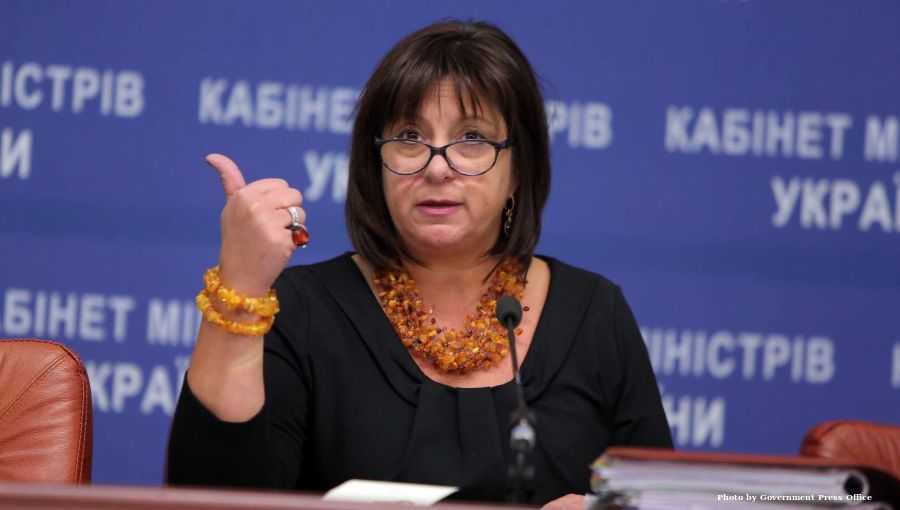 |
| Natalie Jaresko |
Prior to Jaresko becoming Ukraine’s finance minister, she, according to Wikipedia:
…. held several economics-related positions at the US Department of State in Washington, D.C., and eventually coordinated activities of the State Department, the Departments of Commerce, Treasury, the United States Trade Representative, and Overseas Private Investment Corporation (OPIC) in their economic relations with the Soviet Union and its successors. As part of her work she interacted with the International Monetary Fund, World Bank, and the European Bank for Reconstruction and Development. Later from 1992 to 1995, she was the first Chief of the Economic Section of the U.S. Embassy in Ukraine, responsible for strengthening economic cooperation between the two countries.[8] In 2003 she was awarded the Ukrainian Order of Princess Olga for her contributions to the Ukrainian economy.
Between 2005 and 2010 Jaresko was a member of President Viktor Yushchenko’s Foreign Investors Advisory Council and the Advisory Board of the Ukrainian Center for Promotion of Foreign Investment under the auspices of the Cabinet of Ministers of Ukraine.
So what is Jaresko up to as finance minister of Ukraine?
She is about to take control, for herself, of Datagroup, the Ukraine telecom company that controls 85% of the Ukranian telecom market.
Datagroup is owned by Oleksandr Kardakov but his personal empire has collapsed due to foreign currency loan debt.
Foreign loan debt is an old muscle trick of economic hit men (SEE John Perkins, Confessions of an Economic Hit Man). Banksters and international global financial organizations (think the World Bank) load up third-world governments with debt that can’t possibly be repaid and they go in to pick off the juicy meat when the third-world governments can’t make the debt payments.
The loans to Kardakov were a spin-off on the basic maneuver. With Nuland fomenting revolution and turmoil in Ukraine, the Ukranian currency, the hryvnia, has collapsed on foreign exchange markets.

This has made it impossible for Kardakov to pay off his US dollar-denominated loans.
Enter Jaresko.
Ukraine Today reports:
In late February, the company began its liquidation procedure. The company’s other major asset – ‘Datagroup’ telecom operator – may soon be sold out to pay off debts. It may be purchased by its current minority shareholder – investment company ‘Horizon Capital’, co-founded by Ukraine’s current Finance Minister Natalie Jaresko.
Robert Wenzel is Editor & Publisher at EconomicPolicyJournal.com and at Target Liberty. He is also author of The Fed Flunks: My Speech at the New York Federal Reserve Bank. Follow him on twitter:@wenzeleconomics
US readies ‘Plan B’ to supply heavy weapons to militants: Report
Press TV – April 13, 2016
The United States and its regional allies have prepared plans to supply more-powerful weapons to militants fighting the Syrian government, amid concerns that a landmark ceasefire is threatening to fall apart.
US officials said the so-called Plan B is aimed at providing vetted “moderate” militant units with weapons system that would enable them to launch attacks against Syrian government aircraft and artillery positions, the Wall Street Journal reported on Tuesday.
US-backed militants carried out a series of attacks in central and southern Syria on Monday even as the Damascus government was observing a ceasefire and holding talks with opposition groups to end the years-long conflict.
A ceasefire brokered by the US and Russia went into effect on February 27 across Syria. The truce agreement does not apply to Daesh and al-Qaeda-affiliated al-Nusra Front. A new round of discussions is to resume between the two sides in Geneva this week.
Concern has been growing that the recent uptick in violence is putting intense strain on the fragile truce.
US Secretary of State John Kerry floated the idea of a “Plan B” for the first time late in February, stressing that partitioning of Syria was on the table if the ceasefire collapsed.
The preparations for the “Plan B” were discussed at a secret gathering of intelligence chiefs in the Middle East before the ceasefire went into effect and in exchanges between intelligence services, the Journal said.
During those sessions, the CIA gave assurances to allies that they would be given approval to expand arms shipments to Syria’s “moderate” militants.
Coalition members reportedly agreed to the outlines of the plan, but the White House must approve the list of proposed weapons systems before they can be sent to Syria.
“The agreement is to up the ante, if needed,” a senior US official said.
The plan for introducing more sophisticated weapons into the Syrian battlefield is perceived as being part of a broader behind-the-scenes effort by the US to counter its adversaries in the conflict.
US officials have privately warned their Russian counterparts that the armed opposition will persist in Syria and that a return to full-scale fighting could put further strain on Russian pilots there, according to the Journal.
In addition, Pentagon officials said in recent weeks that the White House was looking to “greatly increase” the number of special forces deployed in Syria. The US military also said that it had resumed training new units of militants operating in the country.
The discussions for a possible escalation of the proxy war in Syria have been fueled to a large extent by a relatively successful Russian campaign in the country.
Featured Video

or go to
Aletho News Archives – Video-Images
New Documentary
“Inside Gaza” wins best documentary at Montreal’s Cinemania film festival
Palestine Information Center – November 16, 2026
MONTREAL – The documentary “Inside Gaza,” which chronicles the experiences of Palestinian journalists working with Agence France-Presse (AFP) while covering the Israeli war on the Gaza Strip, won the Best Documentary Award at the 32nd Cinemania International Francophone Film Festival held in Montreal, Canada.
Directed by Helene Lam Trong, the 72-minute film follows the daily lives of four AFP journalists who bear witness to the difficulties of reporting in a war-torn territory largely closed off to international media.
The film is compiled from material produced by the team on the ground, as well as from interviews conducted after they left.
The film also won the People’s Choice Award at the festival on Saturday. … continue
Blog Roll
 Aletho News
- Brand ‘rape’ case just doesn’t add up. Was he framed?
- How The Jensen Huang Chinese Spy Hoax Is Russiagate 2.0
- Austria seeks to strip former foreign minister of citizenship over Russia ties
- “Inside Gaza” wins best documentary at Montreal’s Cinemania film festival
- Activists block German munitions plant over arms exports to ‘Israel’
- The Nasser Hospital attack and Israel’s relentless lies
- Could it be satan? No, Huckabee, just the Americans you work for
- AIPAC and more: Network of pro-Israel influence in US Congress
- Putin aide reveals Moscow’s stance on Europe at peace talks
- Imran Khan warns Pakistani judges he may die in prison
- If Americans Knew
- Mossad abducted Iranian general in Turkey, tortured him for weeks before killing him: Report
- I Am a Palestinian-American. Israeli Soldiers Occupied My Home for Weeks and Trashed It
- Jeffries Accused of “Straight Up Lie” for Claiming AIPAC Is Ending Donations
- DAILY UPDATE: Latest essential news on Palestine, Israel, & region
- Mothers fear for their children as polio returns to Gaza amid Israel’s ongoing genocide
- Inside the Israel-backed ‘NAZA’ disinformation campaign
- US Restrictions Prevent Palestinian Clergy From Speaking in Washington
- Gazan medics detained on shift, tortured – and return to work
- AIPAC and more: Network of pro-Israel influence in US Congress
- Israel Pays “Conservative” Media to Propagandize Americans
- No Tricks Zone
- Argentina’s Perito Moreno Glacier Joins Antarctica and Arctic In Defying Doomsday Melt Claims
- New Study: Barents Sea Temperatures Were Warmer And Sea Ice Less Extensive In The 1700s Than Today
- German Authorities Start Initiative To Evaluate Public Register For Climate “Disinformation” Spreaders!
- Zonal Asymmetry of Temperature Change in the Antarctic Circumpolar Current
- New Study: The Net Fossil Fuel Contribution To Rising Atmospheric CO2 Has Been Zero For 500 Years
- Germany’s Green Energy Transition Becoming Increasingly Expensive…Another 6 Trillion Euros!
- Sudden Stratospheric Warming, Powerful El Niño Combination May Lead To Extreme Europe Cold, Energy Crisis!
- Two New Studies Find Thwaites Glacier Melt Cannot Be Driven By Human Activity Or A Warming Ocean
- E-Cars Reduce CO2 Emissions By Only 41% Compared To Internal Combustion Engine Vehicles
- Predictions Made By Renowned Climate Professor Over Past Decades Have Been Proven To Be Poor

