Surprise: Flying Nuclear Bombers Overhead Tends to Increase Tensions
Sputnik – 22.03.2016
The recent and historical record on US nuclear “signaling,” or flying nuclear armed aircraft over opposition nations, shows that it increases the risk of conflict and war.
 In an editorial this week, military defense experts Adam Lowther and Chris Winklepleck argue that the strategic aircraft arm of the US nuclear triad provides unique “nuclear signaling” and serves a critical deterrence role in US military strategy.
Recent and historical evidence, however, shows that their claim lacks merit, as brandishing nuclear weapons only serves to exacerbate tensions and heighten the risk of conflict, former nuclear weapons expert at Los Alamos National Lab Jim Doyle writes for Defense News.
South Korea saw nuclear flyovers by the US in 2013 and 2016 using B-2 and B-52 aircraft, but the maneuvers have done nothing to diminish tensions on the Korean peninsula nor have they been a corrective to Pyongyang’s militaristic brinksmanship.
Recent North Korean missile launches and nuclear tests show that nuclear signaling does not achieve its desired effect. Reports out of Pyongyang suggest that US nuclear flyovers have been used instead by the Kim regime to increase domestic support for the dictatorship by confirming that a threat exists.
Specifically, the 2013 “long-range show of presence missions” by the US on the Korean peninsula was followed by North Korea’s restart of its Yongbyon nuclear reactor one month later. Following the second show of presence mission in 2016, DPRK conducted a fourth nuclear test explosion and expedited ballistic missile production and testing.
While military experts may write off aggressive North Korean military response as an anomaly, citing the country’s sometimes incoherent foreign policy, history points to the ineffectiveness of similar missions elsewhere.
On October 27, 1969, Doyle writes, the Nixon administration attempted to “signal” to the Soviet Union and the Viet Cong, in what became known as the “madman nuclear alert,” that Nixon was aggressive enough to launch a nuclear attack against North Vietnam if Moscow did not pressure the Hanoi government to seek peace. In that effort, 18 B-52s approached the USSR from the arctic. The posturing failed, heightening tensions with the Soviet Union, and doing nothing to resolve the Vietnam quagmire.
History shows that nuclear deterrence by means of mutually assured destruction is not an effective way to keep the peace, especially when global economic and political interests seek to end the threat of nuclear weapons. Research illustrates heightened tensions and conflict in the use of nuclear signaling. Nations seeking peace have no need to wield a larger club.
Photo – © Flickr/ Christopher Ebdon
‘Non-negotiable’: Clinton attacks Trump at AIPAC for ‘neutrality’ remarks about Israel
RT | March 21, 2016
In a speech to the annual policy conference of the American Israel Public Affairs Committee, Democratic front-runner Hillary Clinton took Republican front-runner Donald Trump to task for voicing a “neutral” position on Israeli-Palestinian talks.
“We need steady hands,” Hillary Clinton, a former secretary of state, told thousands of attendees at the AIPAC conference in Washington, DC on Monday. “Not a president who says he’s neutral on Monday, pro-Israel on Tuesday, and who-knows-what on Wednesday, because everything’s negotiable.
Israel’s security, she proclaimed to loud applause, “is non-negotiable.”
Clinton’s criticism of Trump, while not naming him directly, stemmed from remarks he made during a CNN-hosted Republican debate on February 26, when all of the candidates were asked about their stances on Israel and a peace agreement between the Jewish State and Palestine.
Trump said he supported Israel but added, “As president there is nothing I wouldn’t do to bring peace to Israel and its neighbors. It is probably the toughest negotiation in the world. I am pro-Israel. It doesn’t do any good to take sides against the neighbors,” said Trump. “If I could bring peace it would be one of my greatest achievements.”
Clinton told AIPAC about her long ties to Israel, having first visited the country 35 years ago. Then she moved on to highlight her work as a New York senator and as secretary of state, all of which led to a “deepening and strengthening the US ties to Israel” and supporting a “secure and democratic homeland for the Jewish people,” according to Clinton.
The Democratic presidential hopeful said the US couldn’t be neutral when “rockets rain down on residential neighborhoods, when civilians are stabbed in the street, when suicide bombers target the innocent. Some things aren’t negotiable, and anyone who doesn’t understand that has no business being our president.”
A new president from day one, Clinton told conference goers, will immediately face a world of “both perils and opportunities.”
“The next president… [will] start making decisions that will affect the lives and livelihoods of Americans and the security of our friends around the world, so we have to get this right,” Clinton said.
“Candidates for president who think the United States can outsource Middle East security to dictators, or that America no longer has vital, national interests at stake in this region are dangerously wrong,” said Clinton. “It would be a serious mistake for the United States to abandon our responsibilities or cede the mantel of leadership for global peace and security to anyone else.”
Clinton pointed to three evolving threats in the Middle East: “Iran’s continued aggression, a rising tide of extremism across a wide arc of instability, and the growing effort to de-legitimize Israel on the world stage,” which she noted make the “US-Israel alliance more indispensable than ever.”
“We have to combat these trends with even more security and diplomacy,” said Clinton.
While Trump was due to address AIPAC later on Monday, Clinton also referred to his proposal to temporarily ban all foreign Muslims from entering the US and “playing coy with white supremacists.”
“We’ve had dark chapters in our history before,” Clinton said, pointing to America’s refusal to allow a ship packed with Jewish refugees to dock in the US in 1939.
“But America should be better than this, and I believe it’s our responsibility as citizens to say so. If you see bigotry, oppose it. If you see violence, condemn it. If you see a bully, stand up to him,” Clinton said, receiving a standing ovation from the group.
AIPAC bills itself as nonpartisan and has never endorsed a candidate, but the organization does play a big role in partisan political debates over issues of interest to Israel.
A group of rabbis and other pro-Israel leaders were planning to protest Trump’s speech. Clinton’s comments were well-received, as the audience of Israel supporters loudly cheered throughout her address, not just when she was taking swipes at Trump.
‘Dismantle the disastrous deal’: Trump tells AIPAC Iran deal is ‘number one priority’
RT | March 22, 2016
Republican presidential front-runner Donald Trump told attendees at the American Israel Public Affairs Committee conference that he didn’t come to pander, saying “that’s what politicians do,” but he did make a promise related to the Iran nuclear deal.
“My number one priority is to dismantle the disastrous deal with Iran,” Trump said, speaking before AIPAC in Washington, DC on Monday evening. “I have been in business a long time… this deal is catastrophic for Israel – for America, for the whole of the Middle East… We have rewarded the world’s leading state sponsor of terror with $ 150 billion and we received absolutely nothing in return.”
Trump criticized the deal for not requiring Iran to dismantle its military nuclear capability and only limiting its nuclear program for a certain number of years. He chastised Iran for contributing to problems in Gaza, Syria, Lebanon, Yemen, and Saudi Arabia by providing weapons and money.
“Iran is financing military forces throughout the Middle East and it is absolutely indefensible that we handed them over $150 billion to facilitate even more acts of terror,” added Trump. “During the last five years, Iran has perpetrated terror attacks in 25 different countries on five continents. They’ve got terror cells everywhere, including in the western hemisphere very close to home. Iran is the biggest sponsor of terrorism around the world and we will work to dismantle that reach.”
He then slammed the United Nations, decrying it for its utter weakness and incompetence and arguing that it was “not a friend” of democracy, freedom, the United States, or Israel, while also vowing to veto any attempt by the UN to impose its will on the Jewish state.
“With President Obama in his final year, discussions have been swirling about an attempt to bring a Security Council resolution on the terms of an eventual agreement between Israel and Palestine,” Trump said. “Let me be clear: An agreement imposed by the UN would be a total and complete disaster. The United States must oppose this resolution and use the power of our veto. Why? Because that’s now how you make a deal. Deals are made when parties come to the table and negotiate.”
Other Republican presidential candidates spoke before and after Trump at AIPAC.
Ohio Governor John Kasich stressed his experience in foreign policy.
“I don’t need on the job training,” Kasich told the audience on Monday, explaining he already knows about the dangers facing the US and its allies. He stressed his “firm and unwavering” support for Israel and vowed to work to stamp out intolerance, racism, and anti-Semitism.
Kasich called for the suspension of the Iran nuclear deal in response to recent ballistic missile tests, which he said were a violation.
“We are Americans before we are Republicans and Democrats,” he said, adding, “I will not take the low road to the highest office in the land.”
Texas Senator Ted Cruz also spoke at AIPAC after Trump. He attacked the billionaire businessman for promising to be “neutral” in brokering a peace deal between Israel and the Palestinians.
“As president, I will not be neutral,” said Cruz. He added, “America will stand unapologetically with the nation of Israel.”
Anti-Trump protesters gathered outside the venue to voice their anger over Trump’s brash political rhetoric and his attendance at the conference.
The leader of one of Washington’s most prominent synagogues said that he felt compelled to denounce Trump as he spoke at a conference of Israeli activists.
Rabbi Shmuel Herzfeld of the Ohev Sholom congregation wept as he described to reporters the importance of standing up to what he viewed as Trump’s hatred, describing him as “wicked.”
“This man is inspiring violence,” Herzfeld said, according to the Associated Press. “He is an existential threat to our country.”
“This man is wicked,” Herzfeld added, referring to Trump. “He inspires racists and bigots. He encourages violence. Do not listen to him.”
Trump Makes Same Promise on Jerusalem We’ve Been Hearing Since 1972
By Nima Shirazi | Wide Asleep In America | March 21, 2016

Breaking news!
The news media is abuzz today with reports that, speaking before the American Israeli Public Affairs Committee (AIPAC) conference, an annual gathering of rabid right-wing Israel supporters, a presidential candidate vowed to move the U.S. Embassy in Israel from Tel Aviv to Jerusalem.
So who was it this time? Donald Trump.
So why is this news? It’s not.
Promising to recognize Jerusalem as Israel’s undivided capital and to move the American embassy there is part of Pandering 101 for Oval Office hopefuls. Every candidate in the past few decades knows this. It’s an easy vow to make, and no one ever pays any political price for inevitably breaking it (since half of Jerusalem remains occupied territory and actually moving the embassy there would be a clear violation of international law, which doesn’t recognize Israel’s claim over the historic city). Making such an absurd promise plays well to the writhing masses at AIPAC confabs, establishes one’s Zionist bona fides, and is a quick and easy way to offend indigenous Palestinians living under occupation, apartheid and blockade without actually flipping them the bird.
Nevertheless, the press continues to report on this blustery promise, no matter who utters it, as if it actually merits attention.
While he repeated the promise today for AIPAC, Trump had already said it back in January. And Ted Cruz has too:

And Jeb Bush before him:

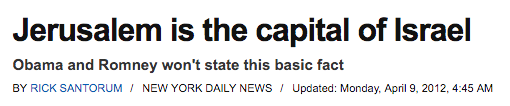
So did Mitt Romney in 2012:

And Ron Paul and Rick Santorum the same year before they dropped out of the race:

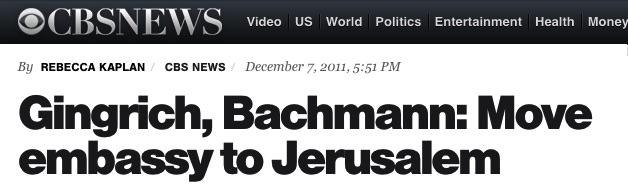
And Newt Gingrich and Michelle Bachmann (and Herman Cain) before them:
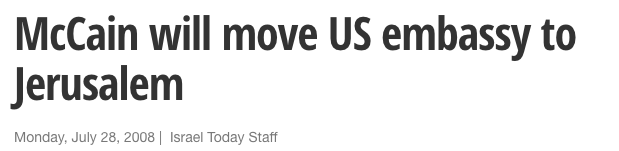
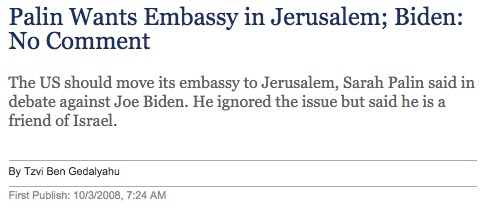
Both John McCain and running mate Sarah Palin made the promise back in 2008:
Four years earlier, John Kerry did the same, while also touting his record of making similar demands during his tenure in the Senate:

Before that was Al Gore and George W. Bush in 2000. As reported by The New York Times in May 2000:

(Supporters of moving the embassy were subsequently disappointed in Bush’s failure to act on his promise.)
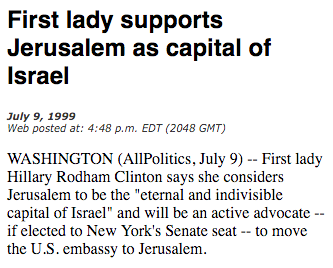
The year before, while beginning her campaign for New York’s Senatorial seat, the then-First Lady Hillary Clinton weighed in on the matter herself:
In the mid-1990s, Senate Majority Leader Bob Dole and House Speaker Newt Gingrich similarly pandered like pros:

Before that, in 1992, the Clinton/Gore campaign hit the incumbent Bush administration for balking at the official recognition of “Israel’s sovereignty over a united Jerusalem.” Their campaign promised voters that “Bill Clinton and Al Gore will… support Jerusalem as the capital of the state of Israel.”
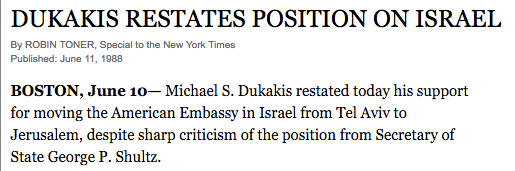
Even Mike Dukakis tacked to the right of both the outgoing Reagan administration and George H.W. Bush campaign in 1988:
Al Gore, who tried to win the Democratic nomination for president that year, reportedly said in September 1987 that “he would consider moving the U.S. embassy from Tel Aviv to Jerusalem.”
In April 1984, during a heated Democratic primary season, Walter Mondale and Gary Hart bent over backwards to assure voters in New York City that they too supported moving the U.S. Embassy from Tel Aviv to Jerusalem.
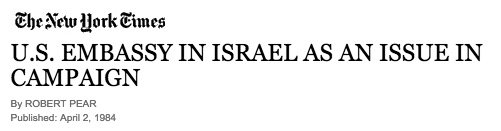
The New York Times reported at the time:
Walter F. Mondale said he had supported such a move for 20 years, and he asserted that Senator Gary Hart had changed his position on the issue five days ago. In the past two weeks, Mr. Hart has denied that he suddenly changed his position, but has said his position has ”evolved.” He has said firmly that if he became President, he would move the embassy to Jerusalem.
The Rev. Jesse Jackson is the only one of the three candidates who opposes moving the embassy. The Reagan Administration also opposes such a move because the status of Jerusalem has long been disputed and the United States does not support Israeli sovereignty over the city.
Despite efforts by New York Senator Daniel Moynihan and California Congressman Tom Lantos to introduce a bill mandating the move, Reagan was adamant about not moving the embassy, as such a divisive policy would, according to his Secretary of State George P. Shultz, “be very bad for the United States” and “damage our ability to be effective in the peace process.”
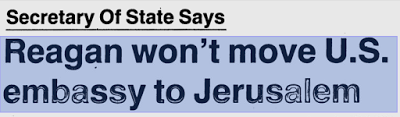
The pandering was so thick, however, that a month later the Reagan administration had to pretend to consider supporting the move in order to stave off losing votes in the upcoming election.

Though the bill eventually stalled, Los Angeles Times syndicated columnist Nick Thimmesch, who called the proposal “one of the dumbest ideas to be advanced in Congress this session,” lamented that “some of the election-year pandering in the Republic verges on the obscene” and credited the ill-conceived gambit to the lawmakers’ “blind obedience to the Israel lobby (American Israeli Public Affairs Committee).” That was October 3, 1984.
By 1986, another bill was introduced to move the embassy, this time brought to the Senate floor by Republican Jesse Helms.
But even in the mid-1980s, though, this was an old political ploy. The New York Times pointed out that the 1976 Democratic Party platform – on which Jimmy Carter and Walter Mondale ran for office – declared:
We recognize and support the established status of Jerusalem as the capital of Israel, with free access to all its holy places provided to all faiths. As a symbol of this stand, the U.S. Embassy should be moved from Tel Aviv to Jerusalem.
Before that, on March 17, 1972, Michigan Congressman Gerald Ford, then the Republican Minority Leader, told a Zionist Organization of America regional meeting in Cleveland that the Nixon Administration should transfer the U.S. Embassy to Jerusalem.
Two years later, after first replacing Spiro Agnew as Vice President and then becoming President himself following Nixon’s resignation, Ford backtracked on his previous position. “Under the current circumstances and the importance of getting a just and lasting peace in the Middle East, that particular proposal ought to stand aside,” Ford said at his very first presidential press conference on August 9, 1974.
It’s been nearly 42 years since then and, sadly, while Palestine remains under brutal occupation, Israeli colonies continue to expand with impunity, and Palestinians are subject to ongoing oppression and violence, election-year pandering in the United States has become more obscene than ever.
Germany wants its gold back
RT | March 21, 2016
The Bundesbank has announced plans to repatriate some of Germany’s gold reserves from abroad. At least half of the country’s gold would be transferred to Frankfurt by 2020, according to Bundesbank President Jens Weidmann.
Weidmann says 366 tons of gold worth €11.5 billion have been delivered to Frankfurt so far. “There are now about 1,400 tons or 41.5 percent of our gold reserves here,” the banker said.
In October last year Germany’s gold reserves stood to around 3,384 tonnes, worth about €120 billion, which is the second largest in the world after the US.
Weidmann added the rest of the gold will remain in New York and London, which he says are as safe as Germany. In case of emergency, these reserves would quickly be converted on the markets in these cities, the banker said.
The Bundesbank has been criticized at home for keeping a major part of Germany’s gold reserves abroad. Critics are demanding the complete return of the gold to the country. They regard the gold as insurance if a crisis comes, and the immediate physical availability would be the decisive criterion.
When trying to move gold from New York in 2014, the Bundesbank met obstacles from US authorities when officials tried to inspect the German gold kept in US vaults.
“I’m no conspiracy theorist, but the Bundesbank should be able to audit the gold once a year like it does with reserves in Frankfurt,” Hans Olaf Henkel, a German member of the European Parliament, told RT.
Some even doubted the German gold is still physically there.
“We are still missing … published lists of gold bar number, even though the US Federal reserve publishes this list for their own gold,” said Peter Boehringer, founder of the Repatriate our Gold Campaign.
Read more:
Germany’s failed attempts to get its gold back from the US ‘opens question of its sovereignty’
Hillary Clinton: Iran poses threat to Israel
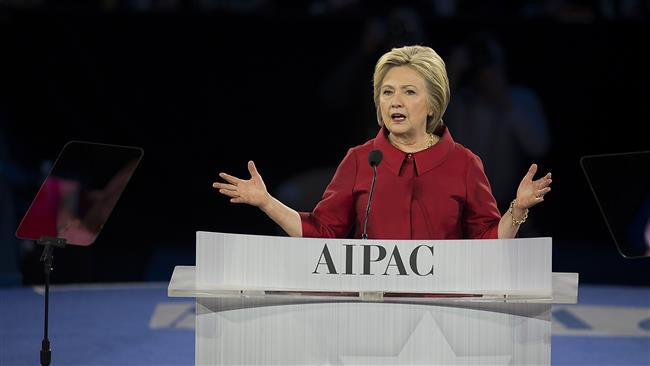
Democratic presidential candidate Hillary Clinton speaks during the 2016 AIPAC Policy Conference in Washington, DC, March 21, 2016. (AFP photo)
Press TV – March 21, 2016
US Democratic presidential candidate Hillary Clinton said in a speech to an influential Zionist lobby group in Washington that Iran still posed a threat to Israel and needed to be closely watched.
Speaking on Monday to the annual policy conference of the American Israel Public Affairs Committee (AIPAC), Clinton also criticized her Republican rival Donald Trump for having a “neutral” stance on Israel.
She said American leaders needed to show loyalty to Israel and “anyone who doesn’t understand that has no business being our president.”
“This is a serious danger and demands a serious response,” Clinton said, declaring that sanctions must be placed against the country. “We must work closely with Israel and other partners to cut off the flow of money and other arms from Iran to Hezbollah” she added.
Many of the US presidential candidates, in particular Clinton, receive large campaign funding from wealthy Jewish donors who have strong ties to the far-right wing in Israel, experts say.
“Clinton is heavily favored by the Israel lobby because she is quite clear about her intention to pursue the war policies of several presidential predecessors,” said Mark Dankof, who is also a broadcaster and pastor in San Antonio, Texas.
“She is getting very, very strong backing from the Israeli lobby and is getting more money from the defense industry than any other candidate in this race,” Dankof told Press TV earlier this month.
On Sunday, activists gathered outside the building where the annual AIPAC conference was being held to protest America’s financial support for Israel.
The US government is pressured to serve Israel’s interests due to the influence of the powerful Zionist lobby in the United States. The pro-Israel pressure groups actively work to steer US foreign policy in favor of Israel.
Iraqi Shiite militias say US troops ‘forces of occupation,’ demand withdrawal
RT | March 21, 2016
Iran-backed Shiite militia forces in Iraq have strongly opposed new US troops deployed in the country. The militias warned that if Washington does not withdraw its forces “immediately,” they will deal with them “as forces of occupation.”
The US military are “making a new suspicious attempt to restore their presence in the country under the pretext of fighting their own creation, Daesh [acronym for Islamic State, IS, formerly ISIS/ISIL],” the Asaib Ahl al-Haq militia said on its TV channel, al-Ahd on Monday, as quoted by Reuters.
The Shiite group added that “if the US administration doesn’t withdraw its forces immediately, we will deal with them as forces of occupation.”
Additional troops deployed by Washington on Sunday were also strongly objected to by Iraqi Hezbollah on Monday.
The Hezbollah movement in Iraq said the new deployment of US marines is a plot to help IS terrorists.
Stressing its resistance against Washington’s “occupation of the regional states,” Hezbollah said the US has sent its forces to Iraq to further assist IS, the Iranian Fars news agency reported, citing the al-Mayadeen news channel.
Despite Baghdad saying it doesn’t need foreign assistance in fighting jihadists, the Pentagon announced the new deployment on Sunday, saying it has sent a detachment of US Marines to Iraq to bolster the fight against IS.
A group of Marines from the 26th Marine Expeditionary Unit (MEU), was on the ground in Iraq, the US military said, without specifying exactly how many personnel have been sent to Iraq. The move followed the killing of a US marine in an IS rocket attack last week.
New US Training Program for Syrian Rebels ‘Just Another Waste of Money’
Sputnik – 20.03.2016
The US Defense Department reportedly plans to launch a new train-and-equip effort in Syria. The new effort will focus on preparing a small contingent of rebels outside Syria.
The rebels will reportedly be trained in infantry tactics and then sent back to their homeland. The spokesman for the US-led military operation against Daesh, Colonel Steve Warren, said the new effort was part of the Pentagon’s adjustments to the train-and-equip program built on prior experience.
However, many details about the new program remain unclear, including its cost, the number of fighters it aims to train as well as the exact date of its launch, according to Foreign Policy magazine.
Michael Maloof, former Pentagon official and senior security policy analyst in the office of the Secretary of Defense, was not too optimistic about the Pentagon’s ability to learn from the mistakes, saying that his hopes for the new programs were pretty low.
“The program is very vague, no details are being given as to where the training will be conducted and smaller contingents doesn’t necessarily mean a success. The problem has been as to who would be available to fight ISIS as opposed to wanting to take down the government of Syrian President Bashar Assad. That has been the problem. Also what countries would actually conduct the training, before it was Saudi Arabia, Jordan and Turkey? Those countries generally are against the government of Syria as it now stands.”
“It is going to be questionable as to how effective this so-called revised program is going to be. I don’t hold much hope for it and it’s just another waste of money frankly at this point,” Maloof said.
Talking about what the Pentagon’s exact goal was for launching this new train-and-equip program, the official said, “The concept is to fight ISIS, but in reality the people that they are recruiting are Sunnis, they are sympathetic to the Sunni ISIS fighters and even though they may not agree with them wholeheartedly, they are Sunnis and Sunnis will not be fighting Sunnis. That’s just the way it goes.”
He further spoke about the reluctance of Turkey in going after ISIS and instead are venting against the Kurds. “The consequences of these actions are questionable and the success is highly dubious and I don’t hold much faith in them.”
Maloof also discussed Saudi Arabia’s position in this situation. He said, “Saudi’s don’t like ISIS either but they are bank rolling, funding them outside the Kingdom but if they start pointing inward that’s another problem for them because ISIS is fundamentally against monarchy.”
Mission Accomplished: Fallout Between Iran and Russia in Syria?
By Mahdi Darius NAZEMROAYA – Strategic Culture Foundation – 20.03.2016
Since the start of 2016 the mainstream media in the US and the countries that are in Washington’s sphere of influence have been talking about fallout between Russia and Iran over the conflict in Syria. These media reports continuously talk about Russia becoming afraid of Iran or vice-versa, Iran becoming afraid of Russia. These reports constantly talk about competition and rifts between the Iranian and Russian governments over Syria.
Here are two examples. The Financial Times reported that Iran should be afraid of Russia on February 24, 2016. A few weeks later, Bloomberg reported that the Russian military downsizing in Syria risks a rift with Iran in an article by Ilya Arkhipov, Dana Khraiche, and Henry Meyer, published on March 16, 2016.
For months, however, the steady streams of reports about a Russo-Iranian split have been utterly wrong. They are part of a campaign of misinformation (wrong information and analysis) and disinformation (propaganda). The relations between Moscow and Tehran are stable, and their cooperation is strategically oriented. In fact, Russia is supporting Iran against the US initiative at the United Nations Security Council to say that Iranian ballistic missile tests are a violation of Joint Comprehensive Action Plan (JCAP) signed between Iran and the US, Britain, France, Germany, China, and Russia (the P5+1 or EU3+3).
By the same token, other misleading and deceiving reports have been released about Iranian and Russian tensions. Some have been over the levels of Iranian oil production exports. Others have been about fallout between Moscow and Tehran over an Iranian transfer of Russian arms to Hezbollah in Lebanon. Many have also been about the deal and delivery of the Russian-manufactured S-300 anti-missile system to the Iranian military.
In regards to a Russo-Iranian rift over Iranian oil production, these reports focus on demands by Saudi Arabia and Russia that Iran cut back its oil production. Moscow, however, has said that Iran is a special cases and it understands that Iran is working to regain lost energy markets. It has exempted Iran from its call to cut back global oil exports under a global output freeze as part of an initiative to raise the price of oil. While visiting his counterpart in Tehran in mid-March 2016, Russian Energy Minister Alexander Novak even announced that the Russian government understands and accepts the Iranian position, which demands that Iran be allowed to regain its pre-sanction output levels.
In regards to Israeli media reports that there has been fallout between Iran and Russia over Russian arms being transferred to Hezbollah, no signs of this have manifested themselves empirically anywhere. The Russian government has made no statements against Iran. Nor have the Israeli reports been verified in any substantive way.
It was reported in Kuwait that the S-300 deal had been annulled on March 9, 2016. On the same day Sputnik interviewed an Iranian military spokesperson, who rejected the claim. While, from what the public knows, the delivery of the S-300 system to Iran by Russia has been delayed, this does not automatically insinuate tensions between Moscow and Tehran. Both Iranian and Russian officials have repeatedly denied reports saying that the deal has been cancelled. Delays have taken place due to legal provisions and technical matters, according to officials in Moscow and Tehran. Rostec, the government-owned national arms manufacturer of Russia, has even announced that the first orders of the S-300 will be delivered to Iran sometime running from August to September 2016.
Russo-Iranian Cooperation in Syria
About three weeks after a cease-fire agreement for Syria officially started (on February 27, 2016), Russian President Vladimir Putin announced that Russia would begin to partially withdraw from Syria on March 14, 2016. The next day the Russian military began downsizing its presence in Syria. This began being presented as a stumbling block between Tehran and the Kremlin.
Reports were published that claimed that Tehran was upset at the Russian move. The Russian withdrawal is portrayed in these reports as a surprise to the Iranian side. The Iranian government, however, has announced that the reduction of the Russian military force in Syria is a positive sign of success, which means that Iran and Russia have achieved their key objectives inside Syria. Moreover, if the Russian move hurt Iranian interests inside Syria, it would not have resulted in Israeli President Reuven Rivlin making a request on March 16, 2016 to Moscow to ensure that Iran and Lebanon’s Hezbollah do not benefit from the Russian decision to reduce its military presence.
Nor was Iran caught off guard by the Kremlin’s decision to reduce its military presence in Syria. Iranian and Russian generals and officials have been shuttling back and forth from one another’s capitals for months speaking on and strategizing over the conflict Syria. It is highly unlikely that Moscow’s decision to reconstitute its military position in Syria was not coordinated with either the Iranian or Syrian governments. Tehran, Moscow, and Damascus have been constantly consulting one another about the military operations in Syria.
If it was not for Iranian and Russian cooperation and resoluteness in Syria, the cease-fire agreement in Syria would not have materialized. The most recent wave of false reports about Russian and Iranian tensions in Syria are aimed at creating suspicion and managing the perception of US clients. This discourse is not only aimed at misleading people or targeting Iran and Russia, it is aimed at deceiving US clients and Syrian opposition figures in the Middle East about the reality of the situation on the ground in Syria, which is that the camps supported by the Iranians and the Russians in the Middle East are the ones on top.
Any ideas about some type of Russo-Iranian fallout are wishful thinking. Both powers are moving towards even deeper cooperation across the Eurasian landmass from the Mediterranean littoral and Iraq to the Caucasus and Central Asia. They are not only cooperating militarily together, but both Tehran and Moscow are also deepening their industrial, agricultural, financial, political, and economic ties too. This is no temporary alliance, but part of a long-term engagement and strategic partnership.
Featured Video

or go to
Aletho News Archives – Video-Images
New Documentary
“Inside Gaza” wins best documentary at Montreal’s Cinemania film festival
Palestine Information Center – November 16, 2026
MONTREAL – The documentary “Inside Gaza,” which chronicles the experiences of Palestinian journalists working with Agence France-Presse (AFP) while covering the Israeli war on the Gaza Strip, won the Best Documentary Award at the 32nd Cinemania International Francophone Film Festival held in Montreal, Canada.
Directed by Helene Lam Trong, the 72-minute film follows the daily lives of four AFP journalists who bear witness to the difficulties of reporting in a war-torn territory largely closed off to international media.
The film is compiled from material produced by the team on the ground, as well as from interviews conducted after they left.
The film also won the People’s Choice Award at the festival on Saturday. … continue
Blog Roll
 Aletho News
- Brand ‘rape’ case just doesn’t add up. Was he framed?
- How The Jensen Huang Chinese Spy Hoax Is Russiagate 2.0
- Austria seeks to strip former foreign minister of citizenship over Russia ties
- “Inside Gaza” wins best documentary at Montreal’s Cinemania film festival
- Activists block German munitions plant over arms exports to ‘Israel’
- The Nasser Hospital attack and Israel’s relentless lies
- Could it be satan? No, Huckabee, just the Americans you work for
- AIPAC and more: Network of pro-Israel influence in US Congress
- Putin aide reveals Moscow’s stance on Europe at peace talks
- Imran Khan warns Pakistani judges he may die in prison
- If Americans Knew
- An error has occurred; the feed is probably down. Try again later.
- No Tricks Zone
- Argentina’s Perito Moreno Glacier Joins Antarctica and Arctic In Defying Doomsday Melt Claims
- New Study: Barents Sea Temperatures Were Warmer And Sea Ice Less Extensive In The 1700s Than Today
- German Authorities Start Initiative To Evaluate Public Register For Climate “Disinformation” Spreaders!
- Zonal Asymmetry of Temperature Change in the Antarctic Circumpolar Current
- New Study: The Net Fossil Fuel Contribution To Rising Atmospheric CO2 Has Been Zero For 500 Years
- Germany’s Green Energy Transition Becoming Increasingly Expensive…Another 6 Trillion Euros!
- Sudden Stratospheric Warming, Powerful El Niño Combination May Lead To Extreme Europe Cold, Energy Crisis!
- Two New Studies Find Thwaites Glacier Melt Cannot Be Driven By Human Activity Or A Warming Ocean
- E-Cars Reduce CO2 Emissions By Only 41% Compared To Internal Combustion Engine Vehicles
- Predictions Made By Renowned Climate Professor Over Past Decades Have Been Proven To Be Poor

