Iran-Israel War: China Refuses to React, and That’s the Strategy
GVS Deep Dive | June 17, 2025
As Israel and Iran edge closer to full-scale war, one major power is choosing silence over escalation: China. Despite being Iran’s largest oil customer and a self-declared counterbalance to U.S. dominance, Beijing has refused to take sides.
In this GVS Deep Dive, we examine:
🔹 China’s muted response to Israel’s airstrikes on Iranian nuclear sites
🔹 President Xi Jinping’s cautious diplomacy at the Central Asia Summit
🔹 Trump’s Truth Social posts warning 10 million Iranians to evacuate Tehran
🔹 The G7’s pro-Israel stance and growing Western military buildup in the Gulf
🔹 Why China sees wars like this as disruptions—not opportunities
🔹 And how China’s “smart diplomacy” and non-intervention policy are reshaping the rules of global power
While the West fuels chaos, China plays the long game. But the real question is: Can it afford to stay out if this war explodes into something bigger?
Najma tweets @MinhasNajma
Najma Minhas is Managing Editor, Global Village Space. She has worked with National Economic Research Associates (NERA) in New York, Lehman Brothers in London and Standard Chartered Bank in Pakistan. Before launching GVS, she worked as a consultant with World Bank, and USAID. Najma studied Economics at London School of Economics and International Relations at Columbia University, NewYork. She tweets at @MinhasNajma.
‘Net Zero’ Is Collapsing in U.S. States
By Steve Goreham – Master Resource – June 16, 2025
From New York to California, state renewable electrical power dreams are collapsing. Power demands soar, while the federal government cuts funding and support for wind, solar, and grid batteries. Renewables cannot provide enough power to support the artificial intelligence revolution. The Net Zero electricity transition is failing in the United States.
For the last two decades, state governments have embraced policies aimed at replacing coal and natural gas power plants with renewable sources. Twenty-three states enacted laws or executive orders to move to 100% Net Zero electricity by 2050. Onshore and offshore wind, utility-scale and rooftop solar, and grid-scale batteries were heavily promoted by states and most federal administrations.
The New York State Climate Action Scoping Plan of 2022 called for 70% renewable electricity by 2030 and 100% by 2040. But 49.7% of the state’s electricity came from gas in 2024, up from 47.7% in 2023. A January executive order issued by President Trump halted federal leases for construction of offshore wind systems. New York, nine other east coast states, and California were counting on offshore wind in efforts to get to 100% renewable electricity, but new offshore wind projects are now halted.
Wind and solar have benefited from federal tax credits, loans, and outright grants since 1992. But the Trump administration is now working to slash federal government support for these technologies. The One Big Beautiful Bill Act (OBBB) passed the House of Representatives on May 22. The bill eliminates Production Tax Credits and Investment Tax Credits for renewable systems that begin construction later than 60 days after passage of the bill or for projects that do not complete construction by year end 2028. The bill also halts the sale of tax credits from renewable projects. If the Senate passes the bill, these measures will choke off green energy projects that have relied on federal funding for decades.
Wind and solar advocates attack the OBBB, warning that the bill would create a “nightmare scenario” for US clean energy. These same advocates claim that wind and solar are the lowest-cost generators of electricity but also demand that huge federal subsidies must continue.
Along with federal cutbacks, the artificial intelligence (AI) revolution now drives the nation’s power system, interrupting the renewable electricity transition. Microsoft, Meta, Google, Amazon, and other giant firms are building new data centers and upgrading existing data centers to power AI. AI processors run 24-hours a day for months to enable computers to think like humans. When servers are upgraded to support AI, they consume 6 to 10 times more power than when used for cloud storage and the internet. Data centers consumed 4% of US electricity at the start of 2024 but are projected to consume 20% within the next decade.
Artificial intelligence drives a massive increase in electricity demand. For years, state legislators forced grid operators to close coal and natural gas power plants as part of a transition to renewables. More than 200 coal-fired power plants were closed. But now, many states face a shortage of generating capacity. Virginia has the highest concentration of data centers in the world, with power consumption forecasted to triple by 2040. The Electric Reliability Council of Texas estimates that Texas electricity demand will soar from a record 85.5 gigawatts in 2023 to 218 GW by 2031.
In December, the North American Electric Reliability Corporation concluded that that over half of North America risks power shortfalls in the next decade from surging demand and coal and gas plant retirements. Grid operators are now stepping back from the transition to wind and solar. Coal-fired power plant closures have been postponed in Georgia, Indiana, Illinois, Tennessee, Utah, West Virginia, and other states. Nuclear plants are being restarted in Michigan and Pennsylvania. But the big winner will be natural gas.
More than 200 gas plants are planned or under construction. Gas facilities can be brought online in about three years, compared to ten years for nuclear plants. Gas plants can be built near cities, often on former power plant sites, and require fewer new transmission lines than needed by wind and solar systems.
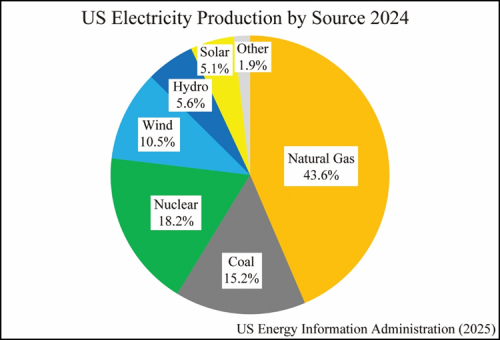
The latest trend is BYOP (bring your own power). AI firms are building their own gas plants to power data centers. Gas turbine manufacturer capacity is now sold out for years. The gas share of electricity production will rise from 43.6% of US consumption in 2024 to much higher levels. The AI power demand and the push for gas are destroying state plans for a transition to green electricity.
California, Massachusetts, Michigan, New York, Texas, and other states are installing grid-scale batteries to try to compensate for wind and solar intermittency. Huge lithium batteries are intended to store excess wind and solar output when the wind blows and the sun shines and then release electricity when wind and solar output is low. But lithium batteries are unproven technology that is prone to spontaneous ignition, creating huge fires that are difficult to extinguish and which endanger residents.
In the last two years, California suffered four grid battery fires, each at facilities less than five years old. The Otay Mesa storage facility near San Diego burned for more than a week and reignited three times. The Moss Landing battery facility, located south of Santa Cruz, caught fire in January. Forty percent of Moss Landing, one of the largest grid-scale battery facilities in the world, was destroyed in the fire. Residents have sued to prevent the restart of Moss Landing. New York also had three grid battery fires in the last 18 months. Battery fires release toxic gases, force evacuations and school closures, and disrupt communities.
In addition, grid batteries are very expensive. To back up a wind or solar facility for 24 hours requires batteries that cost about ten times as much as the wind or solar system itself. But without grid batteries, wind and solar cannot replace coal, gas, or nuclear generation and still provide reliable power.
The cost of wind, solar, and batteries is hurting the renewable electricity transition. Electricity rates in California, the epicenter of green energy, have risen 116% in the last 16 years, more than three times the national average increase of 33%. California’s residential electricity prices are now over 30 cents per kilowatt-hour, the second highest in the nation. Connecticut, Hawaii, Massachusetts, and Rhode Island complete the top five for the highest US power costs—all states with aggressive green electricity goals.
The Net Zero electricity transition, endorsed by many states for more than a decade, is failing in the United States. Wind, solar, and batteries suffer from the offshore wind cancellation, federal subsidy cuts, inability to meet the demand of the artificial intelligence revolution, grid battery fires, and high cost. A green energy breakdown is underway. States will be forced to return to sensible energy policy.
———————
Steve Goreham is a speaker on energy, the environment, and public policy and author of the bestselling book Green Breakdown: The Coming Renewable Energy Failure.
Israel received 14 weapon shipments from US, Germany since start of Iran war
The Cradle | June 20, 2025
Fourteen military cargo planes have arrived in Israel since the start of Tel Aviv’s brutal war against Iran, the Israeli Defense Ministry confirmed.
According to the ministry, the shipments are part of a broader flow of 800 military cargo planes that have arrived in Israel since the start of the genocidal war against Gaza in October 2023.
The ministry stated the shipment is “part of efforts to strengthen operational continuity and support all the IDF’s needs, both for achieving the goals of the war and for improving readiness and stockpiles.”
Most of these planes originated from the US, while the rest came from Germany.
The ministry confirmed that the latest shipments, which arrived on 19 June, are carrying equipment for Israel’s defense systems, which are being used to intercept Iran’s retaliatory ballistic missile strikes against Israeli targets.
Military cargo planes are expected to continue arriving in the coming weeks, the Israeli Defense Ministry added. It said that these shipments are part of a joint effort involving the Defense Procurement Administration, procurement delegations in the US and Germany, the Israeli army’s Planning and Force Build-Up Directorate, and the Israeli Air Force.
The US has continued to funnel massive amounts of weapons and military equipment into Israel, and has deployed warships and fighter jets to the region to help the Israeli army in its attempts to shoot down Iranian missiles.
Middle East Eye reported on 14 June that before the Israeli attack on Iran last Friday, the US covertly delivered about 300 Hellfire missiles to Israel.
Since the genocide of Palestinians in Gaza began, Washington has delivered over 90,000 tons of armaments and military equipment.
“The US is a partner in the Israeli aggression against Iran, even if it does not participate publicly,” Iranian Foreign Minister Abbas Araghchi said on 20 June.
Over the past few days, there has been widespread anticipation over a potential decision by US President Donald Trump to directly enter the war against Iran – particularly for joint strikes on the Fordow nuclear facility.
“Based on the fact that there’s a substantial chance of negotiations that may or may not take place with Iran in the near future, I will make my decision whether or not to go within the next two weeks,” Trump said on Thursday.
Reports in Hebrew media have said Trump may be trying to deceive the Iranians, and could be planning to enter the war much sooner.
Iran’s ambassador to the UN said in Geneva on 18 June that Tehran will “respond seriously and strongly” if Washington directly enters the Israeli war.
The Islamic Republic had previously warned that all US bases in the region were within its reach and would be targeted if Washington launched an attack against the country.
Mohammad Marandi: Iran Prepares for War with America
Prof. Seyed Mohammad Marandi and Prof. Glenn Diesen
Glenn Diesen | June 19, 2025
Seyed Mohammad Marandi is a professor at Tehran University and a former advisor to Iran’s Nuclear Negotiation Team. Prof. Marandi discusses the US preparations to enter the war directly, and Iran’s preparations to fight the US. Trump will only accept Iran’s surrender, yet he does not appear to have the means to achieve this objective. What will happen if US strikes are ineffective and US military assets in the region are attacked? The only path forward now is reckless escalation.
TV Networks Face Advertising Apocalypse After Trump Admin Mulls Pharma Restrictions
By Tyler Durden | Zero Hedge | June 17, 2025
Last week independent Senators Bernie Sanders (VT) and Angus King (ME) introduced legislation that would ban pharmaceutical companies from promoting prescription drugs directly to consumers – including through television, radio, print, digital platforms, and social media.
Today, Bloomberg reports that the Trump administration is now ‘discussing policies that would make it harder and more expensive for pharmaceutical companies to advertise directly to patients.’
Although the US is the only place, besides New Zealand, where pharma companies can directly advertise, banning pharma ads outright could make the administration vulnerable to lawsuits, so it’s instead focusing on cutting down on the practice by adding legal and financial hurdles, according to people familiar with the plans who weren’t authorized to speak publicly on the matter.
The two policies the administration has focused in on would be to require greater disclosures of side effects of a drug within each ad — likely making broadcast ads much longer and prohibitively expensive — or removing the industry’s ability to deduct direct-to-consumer advertising as a business expense for tax purposes, these people said.
If this happens, it would mark a major victory for Health and Human Services Secretary RFK Jr., who says he believes Americans consume more drugs than people in other countries due to the ability of US drug companies to directly advertise to consumers.
While running for president, Mr. Kennedy said he would issue an executive order removing pharmaceutical ads from television, citing overmedication and industry influence on news coverage.
Advertising Apocalypse
As we noted last week, the move would mark a sweeping shift in the U.S. advertising landscape, where pharmaceutical companies are among the largest spenders. Prescription drug brands accounted for roughly 13 percent of all ad spending on linear television in 2025, totaling approximately $2.18 billion so far this year, according to iSpot data. In 2024, the industry spent $3.4 billion on traditional TV ads between January and August alone, according to ad-tracking data.
Since 1997, when the Food and Drug Administration relaxed disclosure requirements for DTC ads, pharmaceutical companies have increasingly leaned on consumer advertising to drive demand. Under current rules, companies need only disclose a drug’s “most important” risks during commercials.
The result has been a media environment saturated with pharmaceutical messaging. Drug ads made up 24.4 percent of all advertising minutes on evening news broadcasts across major networks — including ABC, CBS, CNN, Fox News, MSNBC, and NBC — through May of this year, according iSpot. On CBS Evening News, pharmaceutical companies appeared in more than 70 percent of commercial breaks, per Kantar Media.
Israel’s war on Iran is not about nuclear weapons
It is, and has always been, about regime change and breaking the Axis of Resistance
By Robert Inlakesh | RT | June 19, 2025
The claim that has been adopted by the United States, Israel and its European partners, that the attack on Iran was a “pre-emptive” attempt to stop Tehran from acquiring nuclear weapons, is demonstrably false. It holds about as much weight as the allegations against Iraq’s Saddam Hussein in 2003 and this war of aggression is just as illegal.
For the best part of four decades, Israeli Prime Minister Benjamin Netanyahu has been claiming that Iran is on the verge of acquiring a nuclear weapon. Yet, every single attempt to strike a deal which would bring more monitoring and restrictions to Iran’s nuclear program has been systematically dismantled by Israel and its powerful lobbying groups in Western capitals.
In order to properly assess Israel’s attack on Iran, we have to establish the facts in this case. The Israeli leadership claim to have launched a pre-emptive strike, but have presented no evidence to support their allegations that Iran was on the verge of acquiring a nuclear weapon. Simply stating this does not serve as proof, it is a claim, similar to how the US told the world Saddam Hussein possessed weapons of mass destruction.
Back in March, the US Director of National Intelligence, Tulsi Gabbard testified before a Senate Intelligence Committee that the intelligence community “continues to assess that Iran is not building a nuclear weapon and Supreme Leader Ayatollah Ali Khamenei has not authorized the nuclear weapons program he suspended in 2003.”
On top of this, Iran was actively participating in indirect negotiations with the US to reach a new version of the 2015 Nuclear Deal. Donald Trump announced Washington would unilaterally withdraw from the agreement in 2018, instead pursuing a “maximum pressure” sanctions campaign at the behest of Israel.
Despite the claims of Netanyahu and Trump that Iran was violating the Nuclear Deal, the International Atomic Energy Agency (IAEA) released a report which stated Iran was in full compliance with the deal at the time.
If you trace back every conversation with neo-conservatives, Israeli war hawks and Washington-based think tanks, their opposition to the Obama-era Nuclear Deal always ends up spiraling into the issues of Iran’s ballistic missile program and its support for regional non-State actors.
Israeli officials frequently make claims about Iran producing a nuclear weapon in “years”, “months” or even “weeks,” this has become almost second nature. Yet their main issue has always been with Iran’s support for groups like Hamas and Hezbollah, who strive for the creation of a Palestinian State.
Proof of all this is simple. Israel, by itself, cannot destroy Iran’s vast nuclear program. It is not clear the US can destroy it either, even if it enters the war. An example of the US’ ineffectiveness at penetrating Iranian-style bunkers, built into mountainous ranges, as many of Iran’s nuclear facilities are, was demonstrated through the American failure to destroy missile storage bases in Yemen with its bunker-buster munitions, which were dropped from B-2 bombers.
Almost immediately after launching his war on Iran, Netanyahu sent out a message in English to the Iranian people, urging them to overthrow their government in an attempt to trigger civil unrest. The Israeli prime minister has since all but announced that regime change is his true intention, claiming that the operation “may lead” to regime change.
Israel’s own intelligence community and military elites have also expressed their view that their air force alone is not capable of destroying the Iranian nuclear program. So why then launch this war, if it is not possible to achieve the supposed reason it was “pre-emptively” launched?
There are two possible explanations:
The first is that the Israeli prime minister has launched this assault on Iran as a final showdown in his “seven front war,” with which he hopes to conclude the regional conflict through a deadly exchange that will ultimately inflict damage on both sides.
In this scenario, the desired outcome would be to conclude the war with the claim that Netanyahu has succeeded at destroying or has significantly degraded Iran’s nuclear program. He would also throw in claims, like we already see him making, that huge numbers of Iranian missiles and drones were eliminated. This would also make the opening Israeli strike, which killed senior Islamic Revolutionary Guard Corps (IRGC) commanders and nuclear scientists, make sense. It would all be the perfect blend of propaganda to sell a victory narrative.
On the other hand, the assumption would be that Tehran would also claim victory. Then both sides are able to show the results to their people and tensions cool down for a while. If you are to read what the Washington-based think-tanks are saying about this, most notably The Heritage Foundation, they speak about the ability to contain the war.
The second explanation, which could be an added bonus that the Israelis and US are hoping could come as a result of their efforts, is that this is a full-scale regime change war that is designed to rope in the US.
Israel’s military prestige was greatly damaged in the Hamas-led attack on October 7, 2023, and since that time there has been no victory achieved over any enemy. Hamas is still operating in Gaza and is said to have just as many fighters as when the war began, Hezbollah was dealt significant blows but is still very much alive, while Yemen’s Ansarallah has only increased its strength. This is an all round stunning defeat of the Israeli military and an embarrassment to the US.
As is well known, Iran is the regional power that backs all of what is called the Axis of Resistance. Without it, groups like Hezbollah and Hamas would be significantly degraded. Evidently, armed resistance to Israeli occupation will never end as long as occupied people exist and live under oppressive rule, but destroying Iran would be devastating for the regional alliance against Israel.
The big question however, is whether regime change is even possible. There is a serious question mark here and it seems much more likely that this will end up on a slippery slope to nuclear war instead.
What makes the Israeli-US claim that this war is somehow pre-emptive, for which there is no proof at all, all the more ridiculous of a notion, is that if anything, Iran may now actually rush to acquire a nuclear weapon for defensive purposes. If they can’t even trust the Israelis not to bomb them with US backing, while negotiations were supposed to be happening, then how can a deal ever be negotiated?
Even in the event that the US joins and deals a major blow to the Iranian nuclear program, it doesn’t mean that Iran will simply abandon the program altogether. Instead, Tehran could simply end up rebuilding and acquiring the bomb years later. Another outcome of this war could end up being Israeli regime change, which also appears as if it could now be on the table.
Robert Inlakesh is a political analyst, journalist and documentary filmmaker currently based in London, UK. He has reported from and lived in the Palestinian territories and currently works with Quds News. Director of ‘Steal of the Century: Trump’s Palestine-Israel Catastrophe’.
UK joining US-led Israeli war on Iran would be illegal, says Attorney General
MEMO | June 19, 2025
The UK’s participation in a potential US-led attack on Iran on behalf of Israel could be unlawful, according to legal advice issued to Prime Minister Keir Starmer by Attorney General Lord Hermer. The warning, reported in The Telegraph, sharply limits Britain’s ability to support military action and presents a political headache for Starmer, who is under pressure to back Washington while avoiding another illegal war reminiscent of Iraq.
Hermer, who was recently appointed as Attorney General and is a close ally of Starmer, has issued legal advice stating that any UK military involvement must be strictly limited to defensive actions, namely protecting allies, rather than participating in direct offensive operations against Iran. One official who reviewed the legal opinion remarked: “The AG has concerns about the UK playing any role in this except for defending our allies.”
This caution comes as speculation grows that US President Donald Trump may order strikes on Iranian nuclear infrastructure, using American stealth bombers and joint US-UK bases such as Diego Garcia in the Indian Ocean. While the UK retains sovereign control over the base, any US offensive would require British authorisation.
The legal advice presents a major political dilemma for Starmer. A committed Atlanticist, the UK prime minister has signalled strong support for US-Israeli interests, but any attempt to bypass legal scrutiny in backing a unilateral military campaign may undermine his government’s legitimacy at home and abroad. Comparisons are already being drawn to Tony Blair’s controversial decision to join the US invasion of Iraq in 2003, a war widely deemed illegal by international legal experts and condemned for bypassing the UN Security Council.
Israel’s unprovoked bombing campaign inside Iran, has killed over 300 civilians. Israel’s own justification—that its strikes are defensive—is not accepted under international law unless there is an imminent threat. Any UK participation in such operations could therefore violate its obligations under the Geneva Conventions and customary international law.
Meanwhile, the British government appears to be stepping back from immediate escalation. “We want to de-escalate rather than escalate,” a No. 10 spokesperson said. Foreign Secretary David Lammy has flown to Washington for urgent talks, while Defence Secretary John Healey is said to be reviewing contingency plans for RAF involvement.
Starmer’s government has authorised the deployment of six additional Typhoon fighter jets to Cyprus, with preparations underway to expand UK capacity in the Gulf. However, sources say no final decision has been made regarding the potential use of Diego Garcia.
The warnings come as Trump threatens what he described as a “very big” response to Iran’s missile attacks on Israel. Iran, in turn, has vowed to resist any foreign aggression, rejecting calls for surrender.
Legal experts say the Starmer government must avoid repeating the mistakes of the Iraq war. Any military action outside the bounds of self-defence or without UN Security Council approval is illegal.
Recycled Blatant Lies: US & Israel Push for Regime Change in Iran – Expert
By Svetlana Ekimenko – Sputnik – 19.06.2025
The United States and Israel are in “open rebellion against international law and the UN Charter,” according to Professor Alfred de Zayas, author of 10 books including “The Human Rights Industry” and “Building a Just World Order.
The US and Israel are pushing a “primitive, vulgar pretext” to justify aggression against Iran, Professor Alfred de Zayas told Sputnik.
The former UN Independent Expert on International Order underscored that for them, facts are irrelevant.
“Blatant lies, propaganda and demonization of Iran suffices to create an atmosphere that would dupe the American people and the world into ‘tolerating’ an invasion,” he stressed.
Both the IAEA and US intelligence admit there’s “zero evidence” Iran is building a bomb, he reminded.
Furthermore, military force is expressly prohibited under Article 2(4) of the UN Charter.
“If there is a violation of the Non Proliferation Treaty, Iran can be excluded from the benefits of the NPT, but under no conditions can there be aggression,” according to the expert.
Same Playbook, Different Target
Disregarding international law and the UN Charter, the US and Israel are recycling the 2003 tactics – false WMD claims – that were used to justify regime change in Iraq, said Alfred de Zayas.
In 2003, at least Jacques Chirac of France and Gerhard Schroeder of Germany refused to participate in the illegal war. Now, even more countries, like France and Germany, are on board with this, the pundit remarked.
Mainstream Media Complicit
“The media bears considerable responsibility for this tragedy that may yet develop into World War III,” the pundit warns.
Israeli nuclear sites to face ‘crushing blows’ – Iranian source to RT
RT | June 19, 2025
Iran intends to continue its military response against Israel and could target its nuclear infrastructure, a senior Iranian security official has told RT.
In an exclusive statement to the head of RT’s Tehran bureau, the official, who chose to remain anonymous, said that Iranian armed forces will maintain missile and drone operations throughout the day, specifically targeting “the occupied territories and Israeli garrisons.”
The official said Iran’s response follows “the Quranic advice on retaliation,” and warned that Iranian forces would respond “to any extent and wherever the regime attacks Iranian soil.” He noted, however, that based on “Iran’s moral principles,” there would be no attacks on hospitals.
“The Zionist regime’s claim that Iran attacked one of the hospitals in the occupied territories is completely false,” the official stressed, referring to reports of the Soroka hospital being struck in the city of Be’er Sheva in southern Israel.
He also stated that Tehran’s response will be escalated in light of the Israeli strikes on Iranian nuclear sites. “Since the [Israeli] regime has attacked our nuclear facilities, our armed forces will subject their nuclear facilities to crushing blows,” the official said.
Since launching its assault last week, Israel has hit several Iranian nuclear facilities, including sites in Natanz, Isfahan, Fordow and near Tehran. Between nine and 14 nuclear researchers have been reported killed in the attacks.
Without naming the US directly, the Iranian official also warned that “if another country directly enters into war with us, it will provide much more accessible targets for the Iranian armed forces to destroy.”
US President Donald Trump has hailed Israel’s attacks on Iran as “excellent” and has urged Tehran to surrender unconditionally. He has also warned that the US could become directly involved in the conflict if any American targets are hit by Iran.
Last Friday, Israeli forces began carrying out strikes on Iran, claiming Tehran is nearing the completion of a nuclear bomb. Iran dismissed the accusations and retaliated with waves of drone and missile strikes on the Jewish state.
The head of the International Atomic Energy Agency, Rafael Grossi, has since also refuted Israel’s claims, stating that the watchdog has found no evidence that Iran has been making a “systematic effort” to produce a nuclear weapon.
A catalytic event
By Přemysl Janýr | June 19, 2025
Bombing from the air will not bring about the overthrow of the regime, but rather its consolidation. We have seen this in Germany, Japan, Vietnam, Yugoslavia, Afghanistan, Lebanon, Gaza, Yemen. The only way to overthrow a regime is by a color revolution or a ground military campaign, if one is lucky.
And Israel isn’t up to it in Iran.
I don’t think he didn’t know. Just like he didn’t know in advance what the Iranian missiles would cause.
If Israel went ahead with the operation anyway, it means it has a plan in reserve. That is to use the US military for a ground campaign.
The fact is, however, that neither the American public nor the president are particularly keen on that. Just as they have not been keen before World War I and World War II or the Vietnam War, just as they have not been keen to destroy seven countries in five years. It always needed, as the neocons say, a catalytic event: the sinking of the Lusitania, the attack on Pearl Harbor, the Tonkin incident, the 9/11 attacks.
If Israel went ahead with the operation anyway, it means it has a catalytic event in reserve.
We can only speculate about it for now. Or infer from the few indistinct hints and signals.
These could be, for example, the meanwhile buried news of Iran’s foiled assassination attempt on Donald Trump, later of Iranian terrorists dropped into the US and equipped with a surface-to-air missile to shoot down Trump’s plane. Netanyahu recently reiterated Iran’s intention to take out Trump.
The shooting down of Trump’s plane would indeed be such an ideal catalytic event. If Israel kills Ayatollah Khamenei before, it would be Iranian retaliation beyond any doubt. It would convince Americans – Trump supporters and opponents alike – of the necessity of the Iranian campaign, while removing the erratic eccentric repeatedly meddling with Israel.
And workable. Experts with access to the necessary information and equipment will surely find a way for such a missile to bypass defense systems. And singling out Iranians who will happily fire it and die in the ensuing firefight is also tried and tested.
It’s speculation, of course. Quite possibly, there will be another catalytic event, perhaps the sinking of an American ship, more successful than that of the Liberty, an attack by pro-Iranian militias on an American base, or something else.
But that Israel would go headlong into it I think is out of the question.
The Czech original: https://www.janyr.eu/123-katalyticka-udalost
Decoding Iran’s strategy in current war
By Amro Allan | Al Mayadeen | June 18, 2025
Iran’s Foreign Minister has made it clear in multiple statements that the Islamic Republic remains open to re-engaging the diplomatic track, provided that the US-Israeli aggression against the country comes to an end. At the same time, however, IRGC Commander Brigadier General Mohammad Pakpour has declared, “Even if the Israeli attacks stop, we will continue our mission to the end.” These seemingly contradictory positions raise a key question: What exactly is Iran’s objective in this confrontation, and how should its strategy be understood? More pressingly, what role is the United States playing on the battlefield?
Tehran understands that the ultimate goal of the current assault, launched in the early hours of June 13, is not simply aggressive, but existential. The US-Israeli axis seeks nothing less than the collapse of the Islamic Republic itself. According to most military analysts, neutralizing Iran’s nuclear programme through conventional means is well beyond the capabilities of the Israeli military. This is particularly true when it comes to heavily fortified enrichment facilities like Natanz and Fordow, which are among the most secure sites in the world against aerial and missile strikes.
To strike such hardened targets, advanced bunker-busting munitions would be required, arms that are exclusively in the hands of the US military. What’s more, the only aircraft capable of delivering these weapons—the B-2 stealth bomber—operates solely under the command of the United States Air Force. Some experts even question whether these bombs would be effective against Iran’s most deeply buried and reinforced sites.
Both Washington and Tel Aviv are fully aware of these limitations, which cast serious doubt on their publicly stated rationale for launching the war. This scepticism is only reinforced by Netanyahu’s early appeal, issued just hours after the attack, urging Iranians to rise up against their own government, a move that tacitly reveals the true aim of the aggression.
This level of strategic ambition has been absent from previous assaults on Iran. The assassination of Lieutenant General Qassem Soleimani, Commander of the IRGC Quds Force, in January 2020, “Israel’s” missile strike on the Iranian consulate in Damascus in April 2024, and the attack on an air defense site near Isfahan inside Iran later that month, none of these triggered the same level of overt intent to destabilise the Iranian state.
It is this shift in objective that explains Iran’s evolving response. Unlike past retaliatory actions, such as the missile strike on the Ain al-Assad US base in January 2020, or Operation True Promise 1 and 2 of April and October 2024, Iran’s current posture signals a long-term strategic engagement rather than a calibrated response.
Tehran does not appear eager to escalate the conflict into a regional war, fully aware that such a scenario could have catastrophic consequences not just for itself, but for the wider Middle East. Still, it is determined to impose a high cost on its adversaries, one that restores the balance of deterrence and redraws the lines of power in the region.
This approach was articulated clearly by Iranian Leader Sayyed Ali Khamenei, who warned, “We will not allow the Zionists to escape unscathed for this great crime. The Zionist entity has committed a grave miscalculation—one that will bring ruin upon them, by God’s grace.”
It is in this context that General Pakpour’s remarks must be understood. Iran’s continuation of Operation True Promise 3 is not dependent on whether “Israel” halts its attacks. Rather, it is driven by a broader aim: to establish new rules of engagement and a new balance of power, irrespective of short-term developments.
At the same time, the Foreign Minister’s comments point to Iran’s reluctance to turn this war into a fight for national survival, unless forced to do so by further escalation from the other side.
But “Israel’s” failure to cripple the Islamic Republic in its initial, high-stakes strike, an operation designed to fundamentally alter the regional power balance, makes direct American involvement more likely in the days ahead. Washington may now feel compelled to interfere in order to accomplish what Tel Aviv could not.
All this suggests that the risk of escalation remains high. The war could soon expand to include oil infrastructure across the Gulf and target US military bases scattered throughout the region.
This leaves a crucial question hanging in the balance: Will key regional powers, Egypt, Turkey, Algeria, and Pakistan, recognize the gravity of what is unfolding? And will they act accordingly, acknowledging that the war being waged by the US-Israeli alliance poses a serious threat to their own security, sovereignty, and future stability?
Pentagon removes joint staff officer over anti-‘Israel’ posts
Al Mayadeen | June 18, 2025
The Pentagon has removed Colonel Nathan McCormack, a senior planner responsible for the Levant and Egypt region at the Joint Chiefs of Staff’s J5 planning directorate, from his position, pending an internal investigation into social media posts deemed anti-“Israel”.
The move follows a report by the Jewish News Syndicate (JNS), which pointed out that McCormack had operated a semi-anonymous public social media account containing posts critical of the Israeli occupation, including remarks about Israeli Prime Minister Benjamin Netanyahu and pro-“Israel” activism in the United States.
A Pentagon official told JNS that the Joint Staff is “aware of the situation” and has initiated a formal review.
“He will no longer be on the joint staff while the matter is being investigated,” the official stated. McCormack is being returned to his service branch, a step often taken when a service member is reassigned during a personnel inquiry.
The official added, “The information on the X account does not reflect the position of the Joint Staff or the Department of Defense.”
The case is indicative of the interplay between pro-“Israel” media outlets and decision-making circles in the US, where criticism of “Israel” or even Israeli officials is quickly silenced and censored.
Controversial posts draw scrutiny from defense officials
The social media account, which has since been disabled, reportedly contained archived posts referring to Netanyahu and his “Judeo-supremacist cronies,” as well as statements suggesting that US foreign policy has been compromised by unconditional support for the Israeli occupation.
Other posts questioned the loyalty of American pro-“Israel” advocates, claiming they prioritize support for “Israel” over US strategic interests.
A Defense Department contractor who interacted with McCormack told JNS that the posts were “dangerous” given the officer’s rank and influence.
“This is the kind of bitter oversharing I’d expect from someone who doesn’t know better,” the contractor said. “But at his level and under his own name and likeness? It’s mind-boggling.”
The Pentagon emphasized that McCormack’s personal commentary does not represent official policy. “Our global alliances and partnerships are vital to our national security, enhancing our collective defense, deterrence, and operational reach,” the official added.
An investigating officer has been assigned to review the material and determine whether McCormack violated military conduct or security policies.
Featured Video

AIDS Inc. by Gary Null (2007)
or go to
Aletho News Archives – Video-Images
From the Archives
Clash of Civilization, Iran Part II
By Jamal Kanj – Intifada-Palestine.com – January 14, 2011
Israel’s survival kit is: perpetuate conflict, insecurity to rationalize collective hate and finally playing victim.
Devoid of conflict, Israel implodes internally; without hate, Zionism loses its justification; and playing eternal victim to continue blackmailing the West. Absence of this holy trinity, Israel ceases to exist.
From its inception, the house of Zion has mastered exploiting adversarial powers to advance Israel’s cause. For instance, their influence over the Democratic Party in the US began with President Truman’s bid for 2nd term election in 1948.
Responding to strong opposition from Secretary of State General George Marshall and Department experts urging against recognition of Israel, President Truman replied: “I’m sorry gentlemen but I have to answer to hundreds of thousands [Jewish voters] who are anxious for the success of Zionism. I do not have hundreds of thousands of [voting] Arabs among my constituents”
Zionists influence over liberal American politics was matched with the doctrinal school of Conservative theoreticians aligning the Republican Party’s platform with Israel’s objectives. The Neoconservative Zionists, coined Zioncons, invented the “Clash of Civilization” concept to fight Israel’s wars. … continue
Blog Roll
 Aletho News
- 12 Things Your Psychiatrist Was Trained Not to Tell You
- From Unipolar Universalism to Multipolar Civilizational Distinctiveness
- RSF military group defects, joins Sudanese army: State media
- Ireland goalkeeper refuses to play ‘Israel’ as squad weighs boycott
- China pushes back against US on Cuba, Iran
- Ukrainian Soldiers, Potential Mercenaries: Have Gun, Will Travel!
- Burnham’s UN debut… A masterclass in British disinformation
- Iran flights continue despite US aviation sanctions
- Global Tipping Points Lead the World Into a State of Entropy
- The day-after at the White House: USA and Xi Jinping
- If Americans Knew
- Israel forces Gazans to live in constant peril – Daily Update
- Deconstructing Netanyahu’s pants-on-fire UN rant – Daily Update
- Trump betrayed voters with his campaign lies and prioritized a foreign country once he took office
- Netanyahu calls Israel’s war in Gaza ‘opposite of genocide’ in UN speech to near-empty hall
- Settler Kidnappings: Torture, Sexual Abuse and Terrorisation of Palestinian Abductees as Israel Deepens Annexation of West Bank
- Gaza winter nears as 162,000 tents become unusable, raising fears of humanitarian crisis
- Netanyahu says, “It’s the opposite of genocide”; UN says Gaza economy is world’s ‘most severe crisis on record’ – Daily Update
- Israel’s US-Backed Assault on Gaza Has Created the ‘World’s Most Severe Economic Crisis on Record’: UN
- ‘Protecting U.S. Citizens’… From Israel
- ‘This is where I live now, the back of a truck’: a day in the life of a grandmother in Gaza
- No Tricks Zone
- New Study: Earth And Venus Surface Warmth Largely Explained By Convection And Lapse Rate, Not CO2 Or Radiation
- 2025 Nature Paper Claiming Worsening Global Drought Gets RETRACTED …Heavily Flawed
- New Study: ‘Global Drought Shows No Detectable Recent Acceleration Under Climate Warming’
- Economic Masterminds: German Socialists Suggest Taxing Productivity Gains Stemming From Using AI
- The South China Sea Has Not Been Cooperating With The Climate Change Narrative
- Energy Crisis: Germany Enters Heating Season With Historically Low Gas Reserve Fill Levels
- New Study: The Antarctic Ice Sheet Gained Mass From 2020-2024 Due To Staggering Snow And Ice Accumulation
- Study: Ocean Heating Rates From Thousands Of Years Ago ‘Dwarf’ Modern Ocean Heating Rates
- Climate Extremists Target, Attack Large-Scale Power Grid Infrastructure In Germany!
- New Study: Antarctic Ice Melt Has Contributed Less Than 1 Centimeter To Sea Level Rise In The Last 30 Years

