Israeli general pegs cost of defending against attack – media
RT | April 14, 2024
Israel has claimed success in defending itself against Saturday’s drone and missile barrages by Iran, but that effort reportedly came at a high price.
The interceptors, jet fuel and other materials expended in shooting down Iran’s unmanned aerial vehicles (UAVs) and missiles cost about 4 billion to 5 billion shekels ($1.06 billion to $1.33 billion), Israeli Brigadier General Reem Aminoach told local media outlet Ynet News on Sunday. The estimate included only Israel’s direct costs, not counting the considerable weaponry used by the US and other allies in helping to defend against the attack.
Aminoach, formerly the financial adviser to the Israel Defense Forces (IDF) chief of staff, said West Jerusalem used such munitions as Arrow and David’s Sling interceptor missiles, which have per-unit costs of about $3.5 million and $1 million, respectively. He also included sortie expenses for the fighter jets that did the bulk of the work in shooting down Iranian drones.
The general lamented that it was far cheaper for Iran to launch the attack than for Israel to defend itself. “The attack cost Iran less than 10% of what it cost us to defend against it,” he told Ynet. “In the future – in a year, two years, or five years – they can carry out 50 such attacks. And let’s say that if the IDF’s net budget in 2023 was 60 billion shekels, with less than double that you have no chance of reaching a situation where we can maintain the required amounts.”
The IDF claimed that 99% of the more than 300 kamikaze drones and missiles launched from Iranian territory were successfully intercepted. All of the UAVs and cruise missiles were shot down, military spokesman Daniel Hagari said, while a few ballistic missiles got through Israel’s defenses.
Those projectiles fell at the Nevatim Airbase and caused “only minor damage to infrastructure,” the spokesman said. He added that the drones launched by Iranian-backed militants in Iraq and Yemen all failed to reach Israeli territory. The only casualty was a shrapnel wound to a 10-year-old Bedouin Israeli girl who was hit while sleeping at her home in southern Israel.
Saturday’s attack came in response to an April 1 airstrike that killed seven Iranian military officers, including two senior commanders, at Tehran’s consulate in Damascus. Israel has vowed to “exact a price” from Iran for striking back.
Strike on Israel Shows US Bases Near Iran Are ‘Achilles Heel’ – Analyst
By Svetlana Ekimenko – Sputnik – 14.04.2024
Fears of a greater Middle East escalation were triggered after Iran launched a massive drone and missile attack against Israel, aided by Hezbollah and the Yemeni Houthis. Iran said the attack was in response to Israel’s bombing of the Iranian consulate in Damascus, Syria, which killed seven members of the elite Revolutionary Guard Corps.
Iran’s massive retaliatory attack on Israel from its own territory is a sign that the conflict could “escalate out of control.”
Michael Maloof, a former senior security analyst in the office of the US secretary of defense, told Sputnik that the first ever direct Iranian attack on Israel set a dangerous precedent.
“My concern is that this could easily escalate into something not only between Iran and Israel, but beyond the Middle East region,” he said.
Iran’s assault, which it stated was an act of “self-defense” after the Israeli strike on its consulate in Damascus, was originally intended to be a “limited” one, said Maloof.
Iran first sent in “swarms of drones with lights on as a sign of psychological warfare,” but sending in cruise and ballistic missiles by Tehran was a “distinct escalation,” said Maloof.
The scale of Iran’s attack on Israel suggests that Tehran was sending a message, demonstrating that it possesses “extraordinary capabilities,” said Maloof.
“They have built up their missile capabilities extraordinarily, they have drones, cruise missiles, and some of the most accurate ballistic missiles in the region right now,” he added.
“I think that this clearly showed that Iran has a capability. I think it’s limited. They cannot do this on a sustained basis. And they did send their slower ordinance, such as drones, UAVs. But they also claim to have hypersonics,” Maloof noted.
“I think that if Israel were to retaliate, then I think they would engage the more sophisticated missiles and hypersonics, potentially, if they have them,” He added. “Then you’re talking some very serious escalation in the entire region. It’s already unprecedented, but this escalation could be even ratcheted up that could conceivably bring in other and extend beyond just this region.”
All signs point to the potential of a larger regional war erupting, Maloof warned, adding that everything now depends on Israel’s reaction. “Is this a tit-for-tat, a one-on-one, or a further escalation?” he asked.
“I think we are already getting that message from Netanyahu, his ministers, that they are going to respond… How they respond is going to determine the extent of that escalation through the [Middle East] region,” stressed Maloof. “I am quite concerned that neither side is going to stand down at this point.”
Israeli Prime Minister Benjamin Netanyahu is prepared to “continue an endless war in the region,” suggested Maloof, adding that he “knows he had the US backing,” and could opt to strike now, taking advantage of this “window of opportunity.”
“He may not get such an opportunity under a potential Trump administration coming in [after the US elections in November],” said the expert.
Looking at possible scenarios for Israel’s response, he noted that Tel Aviv had already stated publicly an intention to “go after the nuclear sites in Iran.”
“That is going to be exceedingly difficult, plus I don’t know that they have the power projection to do that on any consistent basis, and secondly, I don’t believe they have the so-called ‘bunker busters’ that would be needed to be able to drill down through the mountains to reach those facilities. The US has been reluctant to give Israel these bunker buster [munitions],” said Maloof.
As for the US, it has already “gotten sucked into this,” Maloof noted.
US President Joe Biden issued a statement on Iran’s attack against Israel after speaking with Netanyahu by phone. Biden condemned the attack “in the strongest possible terms”.
He reaffirmed Washington’s “ironclad commitment” to help support Israel’s security. Secretary of State Antony Blinken said the US does “not seek escalation” but will “continue to support” Israel’s defense. “I will be consulting with allies and partners in the region and around the world in the hours and days ahead,” he added.
“There is already a call in Congress to put on fast-track the legislation to approve new ordinance, and the $14 billion for Israel,” said the pundit. He remarked that the Pentagon might “empty its stockpiles to provide support to Israel,” and recalled that besides giving Israel bombs and artillery, the US supports its Iron Dome air defense system, whose missiles will need to be replenished.
“If you have a swarm, wave after wave of swarms, Israel is going to be very hard pressed to be able to defend against that. And that’s why the US now is coming in, and that gets the US directly involved,” Maloof pointed out. “And that could then open up US assets in the region.” We have got some 35 bases that surround Iran, and they thereby become vulnerable. They were meant to be a deterrence. Clearly, deterrence is no longer on the table here. Now they become the American Achilles heel because of their vulnerabilities to attack. They’ve got air defense systems, but they’ve got to be replenished. And given that you got active war going on right now in the region, it’s going to be difficult to replenish those supplies.”
According to the ex-Pentagon analyst, much now also depends upon what stockpiles Iran has and “with what consistency they can keep sending these wave after wave of drones and ballistic missiles… Ultimately, if they have them, the hypersonics… and there’s no defense against hypersonics. Not even Israel’s ‘Arrow’ system, which is designed to deal with ballistic missiles… And apparently, that’s been engaged tonight, as well as the Iron Dome.”
The United Nations (UN) Security Council is to meet on Sunday in response to a request from Gilad Erdan, Israel’s permanent representative to the United Nations. The meeting is scheduled for 4 pm New York time (2000 GMT), as announced by the UN Department of Global Communications.
“I’m hoping that the UN Security Council can take this up and maybe some adult supervision could begin to intervene in this and maybe try to bring it to a halt for now,” Maloof said. “But right now, this minute, it doesn’t look like it. And again, it’s going to depend upon the response from the Israelis if they go directly into Iran in response.”
The current media frenzy surrounding the Iran strike is “disproportionately amplified compared to the actual events transpiring on the ground,” Dr Ahmed Al Ibrahim, a Riyadh-based political analyst, told Sputnik.
He added that any true aftermath of Iran’s strike will be discernible after a “thorough assessment.”
“Indeed, I dismiss the current situation as largely sensationalized, a “bubble” inflated by media coverage and public attention,” the political analyst said.
He expressed skepticism that any Middle Eastern countries would “willingly entangle themselves in the unfolding chaos.” Arguing that “Iran’s capacity to directly threaten Israel is limited by geographical constraints,” Ibrahim agreed that there is “potential for escalation.”
Scott Ritter: Iran’s Retaliatory Attack ‘Reestablished Deterrence’ to Hold Israel, US in Check
By Svetlana Ekimenko | Sputnik | April 14, 2024
Iran’s mission to the United Nations stated earlier that Tehran’s retaliatory drone and missile attack against Israel had “concluded.” The “military action” was a response to Israel’s “aggression against our diplomatic premises in Damascus,” it said, adding that the strike “hit designated targets.”
By launching its retaliatory drone and missile attack on Israel, Iran “reestablished deterrence,” former UN weapons inspector Scott Ritter told Sputnik.
“Israel believed that it could launch a strike against Iran and suffer no consequence. That is no longer the case,” Ritter noted.
As Israeli military officials survey the damage done to their bases, “they understand the following: that Iran deliberately chose not to inflict extremely lethal action against Israel,” the analyst remarked.
Iran launched a massive drone and missile attack against Israel overnight, assisted by Hezbollah and the Yemeni Houthis. Over 300 projectiles were fired at Israeli territory from Iran, with Iran’s mission to the United Nations stating that its retaliatory attack on Israel had “concluded,” and that the strike “hit designated targets.” Israel’s military has claimed that 99% of the projectiles were intercepted.
Iran’s strike was designed to send a signal to Israel and the United States, “that it could do what it did in Nevatim, at Ramona, anywhere in Israel, anywhere in the Middle East, and there was nothing the United States or Israel could do in response.”
“This is deterrence. This means that in the future, if either Israel or the United States plan on carrying out an action against Iran, they have to weigh in the consequences of their actions knowing that Iran has the capacity to reach out and touch any place, any spot, any target in the region in Israel or out of Israel, and there’s nothing anybody could do to stop that,” the retired US Marine Corps intelligence officer said.
US President Joe Biden issued a statement on Iran’s attack against Israel after he spoke on the phone with Israeli Prime Minister Benjamin Netanyahu. The POTUS condemned the strike “in the strongest possible terms.” He also reaffirmed Washington’s “ironclad commitment” to help support Israel, and added that there were no attacks on US forces or facilities on Saturday, but that the US “will remain vigilant to all threats.”
Secretary of State Antony Blinken said the US does “not seek escalation,” but will “continue to support” Israel’s defense. “I will be consulting with allies and partners in the region and around the world in the hours and days ahead,” he added.
Weighing in on the flurry of talks between US and Israeli leaders, Scott Ritter said:
“This is why President Biden has been on the phone with Benjamin Netanyahu, the prime minister of Israel, telling him, ‘Do not retaliate.’ The United States will not be a partner in any offensive action against Iran. Not because the United States is friendly to Iran, but the United States understands the consequences that will accrue, should such an attack take place. The United States has been deterred against further action against Iran.”
The question uppermost at the moment is, “what will Israel do?” Ritter noted.
“Israel has been trying to lead the United States into a larger conflict with Iran for some time now. Indeed, some people have speculated that the Israeli attack against the Iranian Consulate in Damascus was designed for just that purpose… But the Iranians were very clever in designing their response – just like they did, when they retaliated against the United States for the assassination of Qasem Soleimani back in 2020,” Ritter said.
He recalled that at the time, Iran launched over a dozen missiles against the Al-Asad air base in Iraq, but Tehran gave Washington advance notice that that base was going to be struck. Thus, Iran ended up destroying empty buildings, Ritter recalled.
“But it demonstrated to the United States that it had the capacity to strike any American base in the region with extreme precision and kill as many Americans as they wanted – if they wanted to do that. And America was deterred against future action of that sort. Will Israel be deterred?” the analyst wondered.
No decision has been made yet regarding an Israeli response to the Iranian missile and drone attack, an Israeli official told The Times of Israel. It was added that a potential response would be discussed at a war cabinet meeting set for later on Sunday. Israel’s response to the Iranian attack will be coordinated with its allies, The New York Times reported earlier, citing an Israeli official.
After Iran’s unprecedented strike, Tel Aviv “understands that any escalation could mean the destruction of Israel,” Scott Ritter noted.
“Israel probably isn’t going to launch a response against Iran. Israel has been deterred from launching that response by the Iranian actions. In this case, we can say that operation ‘True Promise’ was an extraordinarily successful operation, not only for Iran, but indeed for the world, because Iranian deterrence now is a reality that can hold Israel and the United States in check,” Ritter said.
Iran describes response to Israeli attack as ‘legitimate defense’
Press TV – April 13, 2024
Iran’s permanent mission to the United Nations defends the country’s retaliation against the Israeli regime’s recent terrorist attack on the Islamic Republic’s diplomatic premises in the Syrian capital.
“Iran’s military action was based on Article 51 of the United Nations Charter concerning legitimate defense in response to the Zionist regime’s aggression against our diplomatic premises in Damascus,” the mission said in a statement on Saturday.
“The matter can be considered as concluded,” it added.
The mission, however, warned that if the Israeli regime perpetrated another mistake, Iran’s subsequent response could be “remarkably more intense.”
The statement concluded that the conflict was one between Iran and the rogue regime, “of which the United States should stay away.”
Iran’s Islamic Revolution Guards Corps (IRGC), on Saturday night, launched “extensive” retaliatory missile and drone strikes against the occupied territories, defining the mission as “Operation True Promise.”
The Israeli attack had resulted in the martyrdom of Brigadier General Mohammad Reza Zahedi, a commander of the IRGC’s Quds Force, his deputy, General Mohammad Hadi Haji Rahimi, and five of their accompanying officers.
The terrorist attack drew sharp condemnation from senior Iranian political and military leaders, who vowed “definitive revenge.”
On Thursday, the Iranian mission to the United Nations said the UN Security Council’s condemnation of the Israeli atrocity could have prevented the need for retaliation.
“Had the UN Security Council condemned the Zionist regime’s reprehensible act of aggression on our diplomatic premises in Damascus and subsequently brought to justice its perpetrators, the imperative for Iran to punish this rogue regime might have been obviated,” it said on the social media platform X Thursday.
End of Escalatory Ladder in Ukraine & MidEast – John Mearsheimer, Alexander Mercouris & Glenn Diesen
The Duran | April 12, 2024
$12 Billion Over 10 Years: Pharma, Medical Devices Industries Shell Out Direct Payments to US Physicians
By Brenda Baletti, Ph.D. | The Defender | April 11, 2024
The pharmaceutical and medical devices industries paid physicians more than $12 billion over 10 years, according to a study published last month in JAMA.
The analysis found the industries made 85,087,744 payments totaling $12.13 billion to 826,313 physicians — 57.1% of practicing physicians across 39 specialties.
Orthopedic surgeons, neurologists and psychiatrists, and cardiologists received the most money. Trauma surgeons and pediatric surgeons received the least.
The drugs with the highest payouts were blood thinners Xarelto and Eliquis, along with Humira, an immunosuppressant.
The three medical devices with the highest payouts were robotic surgery systems, da Vinci Surgical System and Mako SmartRobotics, and CoreValve Evolut, a heart valve.
“Money given to doctors has a purpose: it is for marketing,” cardiologist Dr. John Mandrola and co-author of the study wrote on his Substack. “If these direct payments to doctors did not work, industry would not spend billions.”
Dr. Andrew Foy, lead author of the paper, told The Defender in an email he thought some people might find the numbers “shocking” and he hoped it would renew interest in having conversations about physician-industry payments and facilitate more research.
The researchers tracked and compared payments made to physicians across and within specialties. They also identified the top 25 drugs and medical devices associated with the largest total payments.
The analysis included only money received for consulting, travel, food, entertainment, education, gifts, grants and honoraria. The researchers excluded other major external funding sources for physicians such as research funding and royalties.
They analyzed data from 2013-2022 in the Open Payments database, established in 2013 by the Physician Payments Sunshine Act as part of the Affordable Care Act.
Legislators designed the Sunshine Act to address growing public concerns about Big Pharma’s influence over doctors. At the time, several studies had shown that increased interaction with pharmaceutical representatives influenced physician prescribing behavior.
The act requires medical product manufacturers to disclose to the Centers for Medicare and Medicaid Services any payments or other transfers of value made to physicians or teaching hospitals. Open Payments publishes the payments on its website.
The analysis found that payments varied significantly across specialties. The highest-paid specialties like orthopedic surgery received $1.36 billion, and neurology and psychology specialties received $1.32 billion. The lowest-paid specialties received substantially less.
Pediatric surgeons and trauma surgeons received only $2.89 million and $6.96 million respectively.
Payments also varied significantly among physicians within the same specialty, with a small number of physicians in each specialty receiving the largest amounts of money — often exceeding $1 million — while the median physician received significantly less, typically less than $100, ranging from zero to $2,339.
“Our paper is a modest analysis. It does not explain the problem of financial conflicts of interest. But it is a lot of money. And it’s highly targeted to lucrative procedures,” Mandrola wrote.
“Industry influence is way too strong,” he added, and commonly results in medical devices being approved “despite dodgy evidence.”
He said many doctors believe collaboration between industry and physicians is a good thing that drives innovation. However, he said, these payments weren’t simply supporting collaboration.
“Most of it, I would argue, is for marketing and goodwill. Goodwill goes a long way to help establish practice patterns.”
Top drugs and devices on list net billions for pharma
The blood thinner Xarelto, used to prevent blood clots from forming due to an irregular heartbeat or after hip or knee replacement surgery, topped the payment list, accounting for $176.3 million.
The drug, made by Bayer and marketed by Janssen Pharmaceuticals, was Bayer’s top drug in 2023, generating about 4.1 billion euros in revenue.
Payments for Eliquis, another blood thinner used to treat the same conditions, amounted to $102.62 million. Pfizer and Bristol-Myers Squibb manufacture Eliquis.
Pfizer in 2023 brought in over $6.7 billion from the drug, its second-most profitable product behind the Comirnaty COVID-19 vaccine. Bristol-Myers Squibb’s sales topped $12 billion.
Eliquis costs U.S. customers 3 to 7 times more than customers in other high-income countries.
Humira, an immunosuppressant used to treat rheumatoid arthritis, psoriasis and other autoimmune conditions paid out $100.17 million to physicians. Over the last two decades, the drug netted over $200 billion for drugmaker AbbieVie, which listed the medication at $50,000 per year.
Bayer, Pfizer, Bristol-Myers Squibb and AbbieVie did not immediately respond to requests for comment.
Other top drugs included diabetes treatments Invokana, Jardiance, and Farxiga, Dupixent, a drug for allergic diseases, and Botox.
The two medical devices topping the list — da Vinci Surgical System, which paid $307.5 million, and Mako SmartRobotics, which paid $50 million — are machines for robotic-assisted surgeries.
Mako focuses on hip and knee replacements. Da Vinci netted approximately $7.12 billion in 2023 and investors were “blown away” by the “robot-fueled growth” of Mako SmartRobotics device installation for hip and knee replacements. Mako’s parent company Stryker made over $20 billion last year.
Several cardiology devices also made the list, including the third-highest payer CoreValve Evolut, another heart valve, Sapien 3 and LifeVest, a wearable defibrillator. They are all part of their parent companies’ multi-billion dollar product portfolios.
Conflicts of interest
The problem of physicians’ financial ties to pharmaceutical companies has plagued the industry for decades and garnered significant media attention.
Perhaps most famously, Purdue Pharma used misleading marketing to make massive profits from sales of opioids, sparking an epidemic. Nearly 645,000 Americans died from opioid overdose between 1999 and 2021.
However, Purdue Pharma’s policy of paying physicians has long been common practice. Research studies during the last two decades have found the vast majority of physicians accept payments and gifts from pharmaceutical companies. Influential studies include those by the Institute of Medicine and the Medicare Payments Advisory Commission that led to the passage of the Sunshine Act.
This latest study and other recent studies show that despite new mechanisms for transparency in payments, the payments continue.
And those payments are particularly high among physicians with prominent roles directing public policy.
For example, last year The New York Times revealed that while advisers at the National Academies of Sciences, Engineering, and Medicine were shaping public policy on opioids, they were also accepting payments from the Sackler family who owned Purdue Pharma.
Last month, The Defender reported that most of the nine new members appointed to the vaccine advisory committee for the Centers for Disease Control and Prevention have received substantial direct payments or research funding from Big Pharma — largely from the companies whose products they will be reviewing.
Foy said he thought a major part of the problem is that physicians and researchers believe that if they make their conflicts of interest transparent, the problem is resolved.
“As if someone cannot be transparent about their conflicts and highly biased at the same time,” he said.
He said that payments don’t necessarily lead directly to prescribing one specific drug for which a payment is received.
Instead, he said, he worries that the payments lead to, “overly enthusiastic recommendations or guidelines from medical organizations to use new products when they have not been sufficiently tested, or where the evidence is not strong enough, to recommend them over old standards or nothing at all (in some cases).”
Industry payments to physicians, Foy said, have a way of “tilting physicians’ sympathy toward industry and the ‘medical advancements’ that come from industry so that they (the physicians) more willingly adopt new products just for the sake of ‘industry advancement’ even if they don’t have a direct COI [conflict of interest] with that particular product.”
Physicians, he said, “become cheerleaders for industry and more open to adopting new products simply due to this attachment.”
For example, he said it is not uncommon at medical conferences for attendees to stand up and cheer results from “late-breaking” research studies whose “benefits are very rarely ever more than marginal, tiny, or ‘teensy-weensy’ at best.”
“I never understood it,” Foy wrote.
Direct payments aren’t the only way industry collaborates with physicians, Foy said.
Industry ads are featured on the homepage of medical journals and ads bombard physicians at major medical conferences.
He said this gives the impression that “the event is built around industry and its involvement.”
He said he doesn’t think that anyone tries to hide the relationships. “The main reason being, at least in my opinion, is that many physicians, perhaps even the majority, believe that physician-industry collaboration is a net benefit to patients and society,” he said.
“I don’t necessarily share that view; however, I don’t believe there is strong, objective evidence to support one side or the other.”
Brenda Baletti Ph.D. is a reporter for The Defender. She wrote and taught about capitalism and politics for 10 years in the writing program at Duke University. She holds a Ph.D. in human geography from the University of North Carolina at Chapel Hill and a master’s from the University of Texas at Austin.
This article was originally published by The Defender — Children’s Health Defense’s News & Views Website under Creative Commons license CC BY-NC-ND 4.0. Please consider subscribing to The Defender or donating to Children’s Health Defense.
Game Over? Persian Gulf Powers Reportedly Refuse to Give US Access to Bases for Anti-Iran Strikes
By Ilya Tsukanov – Sputnik – 13.04.2024
Going back to the Gulf War in 1991, the US has depended on regional allies for large-scale military operations across the Middle East. Now, as tensions between Israel and Iran rise and the US-led unipolar world order comes under strain, America’s traditional partners are apparently refusing to walk in lock step with Washington.
Persian Gulf countries have reportedly told the United States not to launch any attacks against Iran from their territory or airspace amid seething regional tensions.
Sources, including a senior US official told the Middle East Eye that Gulf monarchies have been “working overtime” on the diplomatic track “to shut down avenues that could link them to a US reprisal against Tehran or its proxies from bases inside their kingdoms.”
The countries include regional heavyweights Saudi Arabia, the United Arab Emirates, Oman, and Kuwait, with their leaderships reportedly “raising questions” on the details of US basing agreements, and taking steps to prevent the use of their Iran-adjacent bases against the Islamic Republic.
NATO member Turkiye has also reportedly barred the US from using its airspace for strikes against Iran, but Sputnik has not been able to independently verify this information.
“It’s a mess,” a senior US official said, referring to the headache the Biden administration faces as it prepares for a potential Iranian retaliatory strike against its top regional ally Israel following Tel Aviv’s April 1 attack on the Iranian Embassy compound in Damascus, Syria.
The Middle East Eye report follows a report by Axios on Friday citing US officials who said that Iran has privately warned the US that it will target American forces in the Middle East if Washington gets involved in a military confrontation between Iran and Israel.
The US has an estimated 40,000+ military personnel at bases dotting the Middle East, including the Al Udeid Air Base in Qatar, which hosts at least 10,000 troops, and serves as the forward headquarters of United States Central Command – the combatant command responsible for military operations across the Middle East. Nearby Bahrain hosts up to 7,000 troops and the US Fifth Fleet – which operates in the Persian Gulf, the Red and Arabian Seas, and part of the Indian Ocean. The US also has a 15,000-troop garrison in Kuwait, at least 5,000 troops in the UAE, and about 2,700 troops and fighter jets at the Prince Sultan Air Base in Saudi Arabia. Oman hosts a few hundred US troops, and allows the US Air Force to conduct overflights and landings, and warships to make 80 port calls annually.
The Gulf powers’ increasingly independent foreign policy is potentially a major setback for Washington, which for many decades after World War II (and especially after the Cold War) was able to rely on the Persian Gulf monarchies for its military operations in the oil-rich region.
Regional countries led by Saudi Arabia and the UAE have taken a series of steps recently to wean themselves off of dependence on the US economically, politically and militarily, with Riyadh moving to break the petrodollar monopoly in the oil trade with China, pausing its military campaign against Yemen’s Houthi militia, restoring diplomatic ties with Iran and, together with Abu Dhabi, joining the BRICS Plus bloc.
The Palestinian-Israeli crisis has driven Gulf state leaders and their populations further from the idea of the establishing relations with Israel, and chilled ties with the US thanks to the Biden administration’s full-fledged support for Tel Aviv in the course of the Gaza War.
‘Russia turned off the gas’ – German leader
RT | April 12, 2024
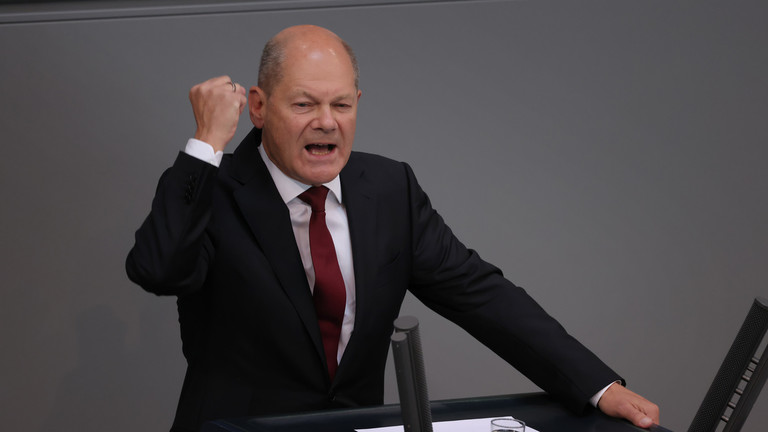
Germans should blame Moscow and not Berlin for high energy prices, Chancellor Olaf Scholz said in an interview published on Friday. He claimed the embargo against Russia was necessary for defending Europe from “imperialism.”
Speaking with Die Tageszeitung, Scholz defended his government’s policy of unequivocal support for Ukraine.
“It’s about defending Europe’s peace order. Russia is waging an imperialist war and must not win,” he told the outlet. “Second: Russia stopped its gas deliveries, not us.”
Russia’s Gazprom delivered natural gas to Germany both via Ukraine – upholding the existing transit contracts – and via the Nord Stream pipeline, built under the Baltic Sea. Under pressure from the US, Germany blocked the certification of Nord Stream 2 in November 2021 – months before the Ukraine conflict escalated.
Berlin refused to certify Nord Stream 2 even after Nord Stream 1 was destroyed by explosive charges in September 2022. Western investigators have yet to name the culprit for the bombing.
According to Scholz, however, his government “developed new sources of supply for gas and oil and built terminals to import liquefied gas.” The LNG has come mainly from the US, at a much higher price.
“All of this has led to energy prices falling again,” the German chancellor said, arguing that his government prevented a ten-year economic crisis through “decisive action.”
Scholz seconded the message of his economy minister, Green leader Robert Habeck, who has argued that the German model of prosperity built around cheap Russian energy was over for good.
“The peacemaking effect of economic contacts was certainly overrated,” he told the Tageszeitung, claiming that Russia sacrificed its economic well-being by choosing violence. To defend its “democracy and freedom,” Germany needs a strong military, an efficient arms industry, and to support Ukraine, he insisted.
Scholz also brushed off the Germans’ concerns about the economy and inflation by saying that green energy and the pharmaceutical industry will soon turn things around.
On the same day his interview was published, Germany’s largest steelmaker Thyssenkrupp announced “a substantial reduction in production” at its Duisburg facility, laying off 13,000 employees. The company blamed “high energy costs and tight emission reduction regulations” as well as increased pressure from Asian imports.
All for One and One for All
By William Schryver – imetatronink – April 13, 2024
Russia, China, and Iran have now formed a de facto military and economic alliance — what they prefer to call a “partnership”.
In the case of Russia and China, a comprehensive full-spectrum partnership has emerged: military, economic, and monetary.
Trade between Russia and China has exploded both quantitatively and qualitatively.
Importantly, trade settlement is overwhelmingly denominated in rubles and renminbi. Use of the dollar and its international mechanisms is being aggressively deprecated.
Russia and China now conduct regular joint naval and air patrols of the western Pacific, from Alaska to the South China Sea.
Russia, China, and Iran conduct regular joint exercises in the Arabian Sea. Those exercises have increased in both scope and frequency in recent years.
Both Russia and China are investing vast sums of capital in Iran, much of it in the energy sector and in ambitious transportation projects aiming to construct fast and efficient trade corridors linking China, Iran, and Russia as primary nodes of Eurasian commerce.
Arms and technology transfers between the three countries have reached unprecedented levels.
Russian foreign minister Sergey Lavrov just concluded several days of talks with Chinese leaders, including both Wang Yi and Xi Jinping. In its report of the talks, the Chinese government’s flagship media organ, Global Times, summarized (in the words of prominent CPC commentator Li Haidong) the current state of the Russia/China relationship:
“China and Russia will not target any third party, but if hegemonic forces threaten China and Russia, or threaten world peace, China and Russia will stand together and fight to protect their own interests and safeguard world peace together.”
It is increasingly evident that Russia, China, and Iran recognize that an attack against any one of them would constitute an existential threat to them all. The strategic interests of all three countries are now inextricably intertwined.
Most importantly, they are united in a single overriding strategic objective: to dismantle the dominion of the long-reigning Anglo-American empire.
Naturally, the rapidly waning global hegemon is not inclined to relinquish its throne without a fight. What form that fight takes remains to be seen. But if the empire attempts to preserve its so-called “rules-based international order” via force of arms, it is essential to understand this incontrovertible reality:
In order for the United States to make war against any ONE of Russia, China, or Iran, it would be necessary to effectively vacate every major US base on the planet in order to concentrate enough military power to undertake the mission.
In a putative war between the United States and Iran, both Russia and China would actively support Iran. I’m not suggesting Russian or Chinese forces would fight alongside Iranians — although that could happen. But it would likely not be necessary. Iran would simply be supplemented with arms and other logistical necessities from both its partners — and quite possibly taken under their nuclear umbrella in an explicit act of deterrence.
Additionally, in consequence of the US weakening its force posture in Europe and the western Pacific in a bid to militarily subdue Iran, Russia and China would be enabled to apply immense pressure to western logistics, trade, and political influence in those regions. This is not to suggest that China would invade Taiwan or Russia would invade the Baltics or Poland. They would need only to exert their dominant influence in what were previously considered to be unassailable American imperial domains in east Asia and Europe.
The empire is stretched so thin and its potential for power projection is so diluted that undertaking even one Big War would be enough to bring the entire house of cards tumbling down.
This is the harsh reality the Masters of Empire are now facing, and no amount of mythologizing about the “limitless” power at their disposal can change it.
There is a vast difference between imagined power and the actual ability to project and sustain power against the adversaries the United States military must now face and defeat in order to prevent or even meaningfully delay the end of American global hegemony.
And, to the extent Russia, China, and Iran are determined to act all for one and one for all, they represent a combination of global military and economic power that cannot be defeated.
US has ‘no viable plan’ for Ukraine – senator
RT | April 12, 2024
Kiev cannot win against Moscow because it has run out of men and needs more weapons and ammunition than Washington could possibly provide, US Senator J.D. Vance said on Friday.
Earlier this week, Senate Majority Leader Chuck Schumer argued that “the biggest reason Ukraine is losing the war is because the hard-right in the Congress has paralyzed the US from acting.” The New York Democrat claimed that a small group of Republicans have been holding up a vital $60 billion aid package for Kiev.
In an op-ed published by the New York Times, Vance addressed Schumer’s claim and accused President Joe Biden of having “failed to articulate even basic facts” about what Ukraine needs and the reality on the ground.
“The Biden administration has no viable plan for the Ukrainians to win this war,” Vance argued.
“Ukraine’s challenge is not the GOP; it’s math,” the Ohio Republican wrote. “Ukraine needs more soldiers than it can field, even with draconian conscription policies. And it needs more matériel than the United States can provide.”
Not only is $60 billion a fraction of what Ukraine would need to turn the tide, Americans “lack the capacity to manufacture the amount of weapons Ukraine needs us to supply to win the war,” Vance argued.
He pointed to the fact that the US can make 360,000 shells for 155mm artillery per year, “less than a tenth of what Ukraine says it needs,” and that’s after doubling prewar production capacity.
Vance also took aim at the White House’s messaging that funding Kiev is good for US military industry.
“The notion that we should prolong a bloody and gruesome war because it’s been good for American business is grotesque. We can and should rebuild our industrial base without shipping its products to a foreign conflict,” he wrote.
The US insistence on not negotiating with Russia is “absurd” and Ukrainian President Vladimir Zelensky’s goal of restoring Ukraine’s 1991 borders is “fantastical,” Vance added. He urged Kiev to dig in and hold until some kind of peace can be brokered by Washington.
Earlier this week, however, Zelensky said Ukraine was planning yet another counteroffensive – after the costly failure of last summer’s operation – but needed even more weapons and ammunition from the West.
Featured Video

or go to
Aletho News Archives – Video-Images
Book Review
The Maidan Killings and the False-Flag Case
By Freddie Ponton | 21st Century Wire | September 5, 2026
Before the killings that helped bring down Ukraine’s president in February 2014, American diplomats were discussing who should enter its government. In a leaked telephone call, senior State Department official Victoria Nuland told US ambassador Geoffrey Pyatt, “I think Yats is the guy,” referring to opposition leader Arseniy Yatseniuk. Washington had clear preferences and was working to advance them. Later that month, Yatseniuk became prime minister.
Ivan Katchanovski’s The Maidan Massacre in Ukraine examines the violence that preceded that transfer of power. Drawing on television footage, witness testimony, forensic examinations and Ukrainian court proceedings, he argues that elements of the opposition shot protesters and police in a false-flag operation. His case centres on evidence of protesters being shot from opposition-controlled locations, including Hotel Ukraina, overlooking the killing ground. … continue
Blog Roll
 Aletho News
- The Maidan Killings and the False-Flag Case
- Georgia’s Largest Healthcare System Will Fire Employees Who Refuse Flu Vaccine
- The Five-Year Fuel Crisis: Why the World Economy Is Paying for a War It Thinks Is Ending
- Trump’s Big Bluff on Iran
- Swiss scammed out of millions by Ukraine-linked call centers – media
- Germany facing potential ‘violent conflict’ with Russia – spy chief
- Ukraine’s EU neighbors reject new plea from Kiev – Politico
- British Transport Police Facial Recognition Trial Scanned 926,912 People With Zero Arrests
- House Bill Would Ban Federal Use of Flock ALPR Data
- Can a Spice Rival a Drug? 10 Head-to-Head Trials Put It to the Test.
- If Americans Knew
- “We See Our Homes Now From A Satellite, Like Strangers”
- Watch “Gaza: Doctors Under Attack”, originally censored by BBC
- NAZA: Israeli embassies in UK and US promote rival documentary to challenge Gaza genocide allegations
- David Ellison appoints Israeli to lead merged Paramount-Warner studios
- Turkish Red Crescent helps elderly Gaza man walk again after Israel confiscates his prosthetic limb
- Four Palestinians Killed in Israeli Attacks in Gaza
- Two Palestinian youths killed and village razed as Israeli attacks on West Bank continue
- Two more Christian women victims of Israeli raids on Gaza
- Cruelty, Deprivation, Indignity: A Journalist’s 22 Months in Israeli Prison
- New IDF Website Frames Slain Gaza Journalists as Terrorists
- No Tricks Zone
- Latest European Green Energy Debacle; Portugal’s Largest Flagship Solar Park Insolvent!
- Green Energy Debacle: German Expert Professor Fritz Vahrenholt Warns Of Severe Economic And Social Consequences
- Two More Paleo Reconstructions Affirm Meters-Higher Sea Levels Across Ireland, Brazil 7000-6000 Years Ago
- New Study: Earth And Venus Surface Warmth Largely Explained By Convection And Lapse Rate, Not CO2 Or Radiation
- 2025 Nature Paper Claiming Worsening Global Drought Gets RETRACTED …Heavily Flawed
- New Study: ‘Global Drought Shows No Detectable Recent Acceleration Under Climate Warming’
- Economic Masterminds: German Socialists Suggest Taxing Productivity Gains Stemming From Using AI
- The South China Sea Has Not Been Cooperating With The Climate Change Narrative
- Energy Crisis: Germany Enters Heating Season With Historically Low Gas Reserve Fill Levels
- New Study: The Antarctic Ice Sheet Gained Mass From 2020-2024 Due To Staggering Snow And Ice Accumulation

