Red Sea rising: Exposing the West’s diminishing naval power
By Ali Halawi | Al Mayadeen | April 12, 2024
The Red Sea has witnessed several developments that brought to light the West’s fading power, as its enemies simultaneously and continuously develop precision weapons and naval capabilities.
Although ongoing escort, air defense, and aerial attack operations in the Red Sea are viewed as uncostly, in terms of human capital, and training routines that will raise the preparedness of NATO forces in the region, they have also unveiled a quite unpleasant reality for Western navies. On the flip side, the aerial attacks of Yemeni Armed Forces (YAF) on Israeli-affiliated ships, which were later expanded to include US-UK-affiliated ships in the Red Sea, add to an extended bill that NATO countries pay for securing the Israeli genocide of the Palestinian people.
The weapons used in these operations are similar to Iranian-designed drones, ballistic missiles, and cruise missiles and have been described as “cheap” yet effective weapons by US CENTCOM commanders. These precise guided munitions have been disseminated across factions in the Axis of Resistance, via direct armament or technology sharing. When put to the correct use the weapons have proven challenging for some of the world’s most well-trained and equipped forces.
West Asia casts a shadow over NATO military industrial complexes
Some weapons could have been transferred with the blueprints for the production of their main compartments and assembly at their final destination, bringing costs down and production levels up, further deepening the hole for Western counterparts. In the case of Ansar Allah in Yemen, the YAF owns and announces to locally produce a wide array of anti-ship weapons, as well as missiles, and drones that have been appropriated for attacking seaborne targets; currently being put to use to tighten a naval blockade on “Israel” through the Red Sea.
On the other hand, flailing Western military hegemony over the seas pushed the US and its allies to embark on a poorly planned campaign to protect Israeli shipping routes, forcing them to deal with these relatively low-cost weapons in the Red Sea and the Arabian Sea, where the YAF has dealt direct hits to multiple non-military vessels and threatened near hits some of the most advanced American military ships. This has been the case in Iraq, Syria, and Jordan, where US military bases have suffered from the horrors of cheap low-flying, and ballistic weapons in more than 100 operations on US assets, which dealt precise hits to their targets on multiple occasions.
When countering these attacks, Western forces have utilized some of the most sophisticated anti-air surface-to-air missiles, which are estimated to cost millions of dollars of taxpayer money. In the Red Sea, the US-led Western alliance has relied on NATO-standard interceptors, each of which was developed to counter specific inbound aerial objects.
According to The Responsible Statecraft and news circulating on Western media outlets regarding the mishaps of air defense units, the Western coalition has depended on the use of a layered anti-air model, consisting of RIM-116 (RAM), RIM-66 (SM-2), RIM-174 (SM-6), RIM-162 (ESSM), and RIM-161 (SM-3) interceptors. Each interceptor has been developed to counter specific weaponry, however, they all share in common extremely pricey tags.
Price list for NATO’s Israeli maritime protection campaign
Below is a list of the cost of a single interceptor, excluding operational and battery costs, as of 2022:
- RIM-116 (RAM): $905,000
- RIM-66 (SM-2): $2,100,000
- RIM-174 (SM-6): $3,901,818
- RIM-162 (ESSM): $2,031,875
- RIM 161 (SM-3) Block IB: $9,698,617
- RIM-161 (SM-3) Block IIA: $27,915,625
The price list is retrieved from the US Department of Defense and military-industrial complexes’ official documents.
Germany’s Navy ridicules itself
Keeping the aforementioned price ranges in mind, an outrageous fluke that came as a result of a failed surface-to-air missile interception attempt by the German Navy’s Hessen frigate exposed the deep-lying issues for the US-led Naval alliance in the Red Sea.
What should have been a strike on a low-cost Yemeni drone turned into a shabby affair in which the German Navy misidentified the drone, launched a dual attack on an allied asset, failed to hit the aircraft, and suffered malfunctions that led to the destruction of two interceptors midflight.
At first glance, the attack underlines several glaring issues including, the under-preparedness of the German air defense crew, inadequate storage or production of interceptors, and poor communication between NATO allied forces at Sea. Some military-concerned outlets have attempted to shift the blame on outdated German comms, however, further investigation of the incident reveals an issue of economic cost that could tip the scale towards NATO’s enemies.
Germany’s embarrassing mishap would cost the country around $4.2 million, as the Hessen launched two SM-2s at a US MQ-9 reaper drone that it failed to identify.
No SM-2 batches produced since 2018
The cost of the failed operation should not be the only consideration here, as the last time Ratheon sold a batch of its SM-2 Block IIIA interceptors was in a deal it signed with Denmark back in 2018. The deal was worth $152 million for 46 SM-2 Block IIIA interceptors and corresponding equipment for a couple of vertical launch systems. Now, the company has stopped producing the system, and the interceptors for lack of international orders and plans to resume production in 2035.
However, conflict in Ukraine, the war on Gaza, and tensions in East Asia may prompt reconsideration, especially as the genocide of Palestinian people drags on while their allies in Yemen, Lebanon, and Iraq tie their operations to the status of the aggression on Gaza itself.
Large-scale confrontation might see selective engagement
The fact that Raethon has not received any major orders since 2018 brings up the possibility of Western shortages in air defense systems and interceptors, in case of larger-scale engagement erupting in the region. The phenomenon cannot be limited to SM-2 interceptors but could affect a range of staple NATO-developed and produced SAMs, including the infamous Patriot systems, THAAD, Israeil Iron Dome, and other anti-ballistic and cruise missile systems.
Large-scale engagement will most likely see the Colletive West prioritize assets and selectively down often low-cost but deadly targets.
One Yemeni strike was capable of sinking a bulk carrier in the Red Sea, while an attack on a secret US outpost on the Jordanian-Syrian border injured and killed more than a hundred US servicepeople.
In a war of attrition, the Axis of Resistance’s factions will have the economic advantages of pumping out low-cost munitions that target multi-million dollar systems and vehicles, and the morale advantage of deep-rooted ideological motives related to religion and nativity to the lands they defend.
Another blunder: Denmark’s unreported defensive failure gets chief sacked
More recently, Denmark sacked its defense chief Flemming Lentfer after major faults were discovered in air defense systems on a frigate that it sent to the Red Sea earlier. Lentfer was axed on Wednesday night after failing to report to the Danish Defense Minister, Troels Lund Poulsen, that the Iver Huitfeldt vessel had experienced a 30 minutes-long malfunction in one of its missile and radar systems, during a drone attack in the Red Sea. The malfunction led Danish authorities to recall the frigate from its mission, marking the gravity of the faults.
“I have lost trust in the chief of defense,” said Poulsen. Shockingly, he found out about the incident from a specialist military outlet, rather than any of his subordinates.
“We are facing a historic and necessary strengthening of Denmark’s defense forces. This places great demands on our organization and on the military advice at a political level,” he asserted.
Danish news website Olfi was the one to break the news to the Minister of Defense, explaining that the frigate was commanded by Commander Sune Lund, who complained about a problem with the ship’s active radar and C-Flex combat management system.
Unexplained outages to the systems were severe enough to prevent the frigate from launching its ESSM interceptors. The Danish frigate’s 76 mm guns were also reported to be defective on several occasions during deployment to the Red Sea. Other reports revealed other aspects of the commander’s message, in which he stated that the equipment problems reportedly had been known about for “years”, but that little had been done to address them.
Germany’s “Embarrassment” vs Yemen’s Victory
Back to Germany’s flop in the Red Sea, which was described by German media outlet BILD as an “Embarrassment to our (the German) Navy in the Red Sea”, the YAF had just marked another milestone by downing a US-operated MQ-9 Reaper Drone over Hodeidah a few days prior to the blunder.
Although both forces attempted to target different MQ-9-type drones using their own SAMs, the Yemeni Armed Forces were able to destroy the highly prized American drone with a “locally produced” air defense system while the Germans harrowingly failed. The Germans said that they mistakenly targeted a drone on February 28, 2024. However, their failure to down the then-unidentified object was due to unnamed technical malfunctions that led to the detonation of the two SM-2 missiles midflight, rather than active efforts to avert the disaster.
Interestingly, Sanaa had only unveiled two air defense systems capable of achieving such a hit. One of which is seemingly a copy of the Iranian-developed compact air-defense missile, dubbed Saqer-2. The missile can be easily transported and launched to take down close-range targets, flying at relatively slow speeds. The Saqer-2, a copycat of the Iranian so-called 358 surface-to-air missile reportedly functions like a one-way attack drone, reaching the required via a liquid fuel-propelled engine, to later hover near an aerial target, approaching it and detonating its warhead after being manually locked on to it by a ground operator, or by working in an autonomous mode.
However, footage published by the YAF’s Military Media indicated that the air defense system utilized in the incident was similar to traditional supersonic SAMs due to the speed at which it reached its target and the sound produced during its flight in the video.
Notably, the missile impacted the drone in a near direct trajectory and did not pause to hover nearby or for directions by operators. Examining the publicly revealed arsenal of the YAF, this likely indicates that the missile in use was the Bareq-1 or Bareq-2 SAM.
The missiles resemble the Iranian Taer line of missiles, which are used on a multitude of staple air defense systems. Digging deeper into the origin of the technology, it is clear that the Taer or Bareq lines of missiles are actually reverse-engineered models of the Soviet-era 3M9, incorporating certain elements from NATO Standard Missiles.
Presuming that the Bareq-2 was used by the YAF for the operation reveals an even deeper hole dug by Western military complexes for their own armies. Moreover, NATO’s SMs are much more developed than the YAF’s interceptors, as they incorporate a wide range of technological and hardware additions, putting them in a class of their own.
These additions allow for 360° scope for air defense teams allowing Hessen and other vessels to fire at any surrounding target within its range at any time without having to adjust their position while boosters on the SM-6 allow for longer-range targeting.
Still, the single-stage and aimed single launch conducted by the YAF achieved a direct hit to the 20 m-long US drone obliterating it to pieces that were scavenged by fighters on al-Hodeidah’s shore.
Yemen’s support to Palestine uncovers deep crises in NATO’s Naval power
Putting this series of unfolding events into the context of the Yemeni Armed Forces’ support to Palestine, as the Western-backed Israeli regime continues its genocidal war on Gaza, is key to not only regional security but global security as a whole.
The equations drawn by the YAF have been unprecedented in the history of the nation’s struggle against Western imperialism, as for the first time, an Arab nation has taken the responsibility of launching an expansive naval campaign to support a moral and national cause, whose result will alter the course of human history. By setting this historical precedent, Yemen has not only altered regional security to the favor of natives, but it has also exposed essential faults in NATO’s military and naval structure which can and will be taken advantage of by adversaries.
These events have not been limited to uncovering the flaws of Danish and German forces, but they have laid bare essential challenges for the far superior American and British navies.
For the US, issues have concentrated around logistics and the high cost of operating multiple strike groups, in order to maintain feeble objectives. The UK on the other hand has witnessed multiple accidents and complications during the period of its operations.
The Yemeni Armed Forces’ strategic engagements in the Red Sea highlight a significant shift in naval dynamics, exposing vulnerabilities in Western military prowess and logistical strategies. Despite maintaining relatively low-scale engagements, the YAF’s precision attacks on military vessels have yielded valuable experience and expanded their target list, aided by direct repercussions from the US’s involvement in the genocidal war on Gaza. This evolving scenario underscores the importance of the Axis of Resistance’s strategic foresight and adaptive responses in navigating the complexities of Western provocations, in the context of modern naval warfare, signaling a paradigmatic challenge for maintaining Western military hegemony in the region.
The Attack on Pearl Harbor Was No Surprise (Part IV)
Tales of the American Empire | April 11, 2024
The previous three parts of this series provide overwhelming evidence that American President Franklin Roosevelt knew a Japanese carrier force was sailing east to attack Hawaii in late 1941. Few Americans know about this shocking fact because their government controls informational sources. In 1989, the BBC produced a great documentary about the Pearl Harbor attack titled: “Sacrifice at Pearl Harbor.” Not only does this documentary expose the truth, the title says that President Franklin Roosevelt sacrificed 2,403 Americans at Pearl Harbor to trick Americans to support his goal of entering World War II. As a result of tighter government controls, this documentary can no longer be found on the BBC’s Timeline documentary website and it is blocked from posting at YouTube.
_______________________________________
“Operation Gladio”; BBC; 1992;  • Operation Gladio – Full 1992 document…
“USS Liberty: Dead in the Water”; BBC; 2002; • USS Liberty: Dead in the Water – BBC …
“Sacrifice at Pearl Harbor”; BBC; 1989; • Sacrifice at Pearl Harbor (BBC)
Related Tales: “The Attack on Pearl Harbor”; • The Attack on Pearl Harbor
The CIA Wants More Power to Spy on Americans!
By Judge Andrew Napolitano | April 11, 2024
Americans need to be aware of the unbridled propensity of federal intelligence agencies to spy on all of us without search warrants as required by the Fourth Amendment to the U.S. Constitution.
These agencies believe that the Fourth Amendment — which protects the individual right to privacy — only regulates law enforcement and does not apply to domestic spying.
There is no basis in the constitutional text, history or judicial interpretations for such a limiting and toothless view of this constitutional guarantee. The courts have held that the Fourth Amendment restrains government — all government. Last week, the CIA asked Congress to expand its current spying in the United States.
Here is the backstory.
When the CIA was created in 1947, members of Congress who feared the establishment here of the type of domestic surveillance apparatus that the Allies had just defeated in Germany insisted that the new CIA have no role in American law enforcement and no legal ability to spy within the U.S. The legislation creating the CIA contains those unambiguous limitations.
Nevertheless, we know that CIA agents are present in all 50 statehouses in the United States. They didn’t arrive there until after Dec. 4, 1981. That’s the date that President Ronald Reagan signed Executive Order 12333, which purports to give the CIA authority to spy in America — supposedly looking for narcotics from foreign countries — but keeps from law enforcement whatever it finds.
Stated differently, while Reagan purported to authorize the CIA to defy the limitations imposed upon it by the Constitution and by federal law, he insisted on a “wall” of separation between domestic spying and law enforcement.
So, if the CIA using unconstitutional spying discovered that a janitor in the Russian Embassy in Washington was really a KGB colonel who abused his wife in their suburban Maryland home, under E.O. 12333, it could continue to spy upon him in defiance of the Fourth Amendment and the CIA charter, but it could not reveal to Maryland prosecutors — who can only use evidence lawfully obtained — any evidence of his domestic violence.
All this changed 20 years later when President George W. Bush demolished Reagan’s “wall” between law enforcement and domestic spying and directed the CIA and other domestic spying agencies to share the fruits of their spying with the FBI.
Thus, thanks to Reagan and Bush, and their successors looking the other way, CIA agents have been engaging in fishing expeditions on a grand scale inside the U.S. for the past 20 years. Congress knows about this because all intelligence agencies are required by statute to report the extent of their spying secretly to the House and Senate Intelligence Committees.
This, of course, does not absolve the CIA of its presidentially authorized computer hacking crimes; rather, it gives Congress a false sense of security that it has a handle on what’s going on.
What’s going on is not government lawyers appearing before judges asking for surveillance warrants based upon probable cause of crime, as the Constitution requires. What’s going on is CIA agents going to Big Tech and paying for access to communications used by ordinary Americans. Some Big Tech firms told the CIA to take a hike. Others took the CIA’s cash and opened the spigots of their fiber-optic data to the voracious federal appetite.
If government lawyers went to a judge and demonstrated probable cause of crime — for example, that a janitor in the Russian Embassy was passing defense secrets to Moscow — surely the judge would have signed a surveillance warrant. But to the government, following the Constitution is too limiting.
Thus, by acquiring bulk data — fiber-optic data on hundreds of millions of Americans acquired without search warrants — the government avoids the time and trouble of demonstrating probable cause to a judge. But that time and trouble were intentionally baked into the Fourth Amendment so as to keep the government off our backs.
Not to be outdone by its principal rival, the FBI soon began doing the same thing — gathering bulk data without search warrants.
When Congress learned of this, it enacted legislation that banned the warrantless acquisition of bulk data. Apparently, Congress is naive enough to believe that the CIA, the FBI and the National Security Agency, their cousin with 60,000 domestic spies, will actually comply with federal law.
Last week, that naivete was manifested front and center when the CIA sent a letter to both congressional intelligence committees addressing its spying on foreign persons and the Americans with whom they communicate, and asking to expand that reach inside the U.S.
The timing of the CIA’s letter coincides with a decision Congress must make in the next 10 days — whether to reenact Section 702 of the Foreign Intelligence Surveillance Act, allow it to expire on April 19 or expand it as the CIA has requested. Section 702 permits warrantless spying on foreigners and the Americans whom intelligence agencies suspect communicate with them. Section 702 is an unconstitutional free pass for domestic spying.
So, notwithstanding the persistent efforts of members of Congress from both parties to limit and in some cases to prohibit the warrantless acquisition of bulk data by the CIA from Americans, the practice continues, the CIA defends it and presidents look the other way.
In 1947, Congress created the CIA monster, which today is so big and so powerful and so indifferent to the Constitution and the federal laws its agents have sworn to uphold that it can boast about its lawlessness, have no fear of defying Congress and always escape the consequences of all this largely unscathed. Even President Harry Truman, who signed the 1947 legislation into law, later acknowledged as much and condemned what the CIA had become.
I suspect the CIA and its cousins will get away with this because they spy on Congress and possess damning personal data on members who regularly vote to increase their secret budgets.
When will we have a government whose officials are courageous enough to uphold the Constitution?
To learn more about Judge Andrew Napolitano, visit https://JudgeNap.com.
DISTRIBUTED BY CREATORS.COM
COPYRIGHT 2024 ANDREW P. NAPOLITANO
US funds Ukraine outlets that censor and smear pro-peace Americans – report

Brigadier-General Oleksii Hromov, Deputy Chief of the Main Operational Directorate of the General Staff of the Armed Forces of Ukraine (Photo by Vladimir Shtanko/Anadolu Agency)
RT | April 11, 2024
A “sprawling constellation” of supposedly independent organizations and fact-checkers bankrolled by Washington has been behind labeling Americans who disagree with Kiev Russian propagandists, according to an investigation published on Thursday.
Journalist Lee Fang and RealClearInvestigations have looked into outfits such as New Voice of Ukraine, VoxUkraine, Detector Media and others, finding that in many cases they “promoted aggressive messages that stray from traditional journalistic practices” to support the Ukrainian government and “delegitimize its critics,” both at home and abroad.
Americans they have gone after range from economist Jeffrey Sachs and University of Chicago Professor John Mearsheimer to journalists Tucker Carlson and Glenn Greenwald. Some of these outfits have also denounced a factually correct New York Times article about the battle of Avdeevka as a “Russian psyop” and “disinformation.”
The US Agency for International Development (USAID) and the National Endowment for Democracy (NED) have funded scores of Ukrainian organizations. Some of them act as fact-checking partners for Meta’s Facebook, Instagram, and WhatsApp platforms, helping Ukraine censor critics under the guise of fighting “Russian disinformation.”
The London-based Zinc Network has been paid by USAID to “undermine Kremlin information operations” and help Ukraine with its own “strategic communications.”
According to another investigative journalist, Jack Poulson, Zinc’s Open Information Partnership in Ukraine has defined disinformation as “verifiable information which is unbalanced or skewed, amplifies, or exaggerates certain elements for effect, or uses emotive or inflammatory language to achieve effects which fit within existing Kremlin narratives, aims, or activities.”
Asked about the “anti-disinformation” groups in Ukraine targeting Americans, the State Department told Fang and RealClear that it “provides funding to credible independent media organizations to strengthen democracies in the countries we work in around the world.”
“We do not control the editorial content of these organizations,” the State Department insisted. According to documents Fang has reviewed, however, the US government and its contractors have “directly set the agenda” for Ukrainian outlets.
The US is “an active participant” in the information war between Russia and Ukraine, George Beebe, a director with the Quincy Institute for Responsible Statecraft, told Fang. “The US government has been trying to shape perceptions, and it’s very difficult to separate what’s intended for foreign audiences from what seeps into the Anglosphere media,” he added.
Ukrainian President Vladimir Zelensky has accused Russia of influencing US lawmakers and society at large. While he has offered little evidence for his claims, Fang’s investigation has revealed that much of the content generated by US-funded Ukrainian outlets “explicitly targets American foreign policy discourse.”
Had UN condemned Israel, there’d be no need for retaliation – Iran
RT | April 11, 2024
Iran feels obligated to punish Israel for its attack on the diplomatic mission in Syria because the UN Security Council has failed in its duty, Tehran’s mission to the world body said on Thursday.
The April 1 airstrike killed seven Iranian officers, including two generals of the Islamic Revolutionary Guard Corps (IRGC) Quds Force. Israel did not officially claim responsibility for the attack.
“Had the UN Security Council condemned the Zionist regime’s reprehensible act of aggression on our diplomatic premises in Damascus and subsequently brought to justice its perpetrators, the imperative for Iran to punish this rogue regime might have been obviated,” the mission posted on X.
Iran’s Supreme Leader Ayatollah Ali Khamenei has said that Israel “must and shall be punished” for what it did. Israeli and US intelligence has fueled speculation that possible reprisal could entail anything from drone attacks to ballistic missile strikes.
Israel has been bracing for some kind of response for over a week, with the Israel Defense Forces (IDF) canceling all leave and starting to spoof GPS signals.
Reports on Wednesday, sourced to anonymous US intelligence officials, spoke of an imminent Iranian strike within 24-48 hours, following the end of the Muslim holy month of Ramadan and the feast of Eid-al-Fitr. Brent oil futures rose above $90 a barrel in anticipation.
British-based media have reported that Israel has been preparing to attack Iranian nuclear program facilities in case of a missile strike. The US government has declared it would back West Jerusalem against Tehran, but anonymous claims that American jets would join Israeli strikes have not been officially confirmed.
How Big a Factor is Iran in the War on Gaza?
By Ted Snider | The Libertarian Institute | April 10, 2024
In both Ukraine and Gaza, the Joe Biden administration has adopted the dangerous doctrine of war management in which, while not stopping a war diplomatically, it attempts to contain it and prevent it from becoming a wider war into which the United States might get drawn.
This difficult to calibrate policy is being threatened in both theaters.
In the Middle East, two Israeli actions have escalated the calibrated strikes between Israel and Iran, up to the threshold that Iran could absorb without feeling the necessity to respond.
One was an airstrike in southern Lebanon that killed Ali Ahmad Hassin, an important Hezbollah commander. The more significant and volatile one was the April 1 attack on an Iranian embassy compound in Damascus that killed seven Iranian officers, including General Mohammad Reza Zahedi, the top Iranian Quds Force commander in Lebanon and Syria.
Zahedi is the most senior Iranian commander to be killed since war broke out on October 7. But what made this strike escalatory and dangerous is that it targeted an embassy compound under Iranian sovereignty. “When they attack our consulate,” Ayatollah Ali Khamenei said in a speech on April 10, “it is as if they have attacked our soil.” Khamenei called the decision to escalate to such an attack a “mistake” that “must be punished.”
A direct response by Iran against Israel could risk the nightmare scenario the United States has sought to avoid through its policy of managing wars. In that scenario, Iran retaliates in kind against Israel and Israel responds, drawing Iran and Hezbollah into the war in a manner that pulls in the Houthis as well as militias in Iraq and Syria. A Houthi source told Responsible Statecraft that “In case a full-scale war was to erupt between Hezbollah and Israel, Yemen and its leadership will stand with the party [Hezbollah] militarily, politically and economically” in a way that could even include “sending foot soldiers.” Such a force aligned against Israel could risk drawing the United States into the war.
In a speech on April 5, Hezbollah Secretary General Sayyed Hassan Nasrallah called the attack on Iran’s Damascus embassy “a turning point” and said that it is “certain that the Iranian response to the [bombing] of the Iranian consulate is coming without a doubt.”
He said, perhaps clearly for the first time, that Hezbollah could intervene in the event of a full-scale Israel-Iran war. “Everyone must prepare themselves, arrange their matters and be careful,” he said, “when the Iranian side responds to the targeting of the Iranian consulate and to the Zionist enemy’s possible response to the Iranian response.”
Nasrallah said that an Iranian response is inevitable and seemed to caution against the size of the Israeli counter-response, saying, not only that “everyone must prepare themselves,” but reminding that Hezbollah has “not used the main weapons nor the main forces and we have not called in the reserves.”
Nasrallah may have been leveraging a fuller Hezbollah entrance into the war to caution Israel and the United States against an even more escalatory Israeli counter-response to the response Iran feels it must deliver. Iran may have gone one step further, leveraging its entrance into the war in an attempt to stop the war altogether.
As Trita Parsi, Executive Vice President of the Quincy Institute first reported, an Arab diplomatic source told Jadeh Iran that Iran will respond to the Israeli attack on its embassy with a direct attack on Israel unless the United States orchestrates a ceasefire in Gaza. According to reporting in Jadeh Iran, “Iran has vowed to respond to the assassination of Zahedi.” However, in an “exchange of messages between Tehran and Washington” whose aim is “to contain escalation,” an Iranian proposal “stipulated a ceasefire in Gaza as a price” for not striking Israel in retaliation.
Though a causal line cannot be drawn, it is interesting that, in an interview recorded on April 3, President Joe Biden said, “I think what [Netanyahu’s] doing is a mistake. I don’t agree with his approach,” and then said, “So what I’m calling for is the Israelis to just call for a ceasefire, allow for the next six, eight weeks, a total access to all food and medicine going into the country.”
It is also interesting that the United States is participating in the latest round of ceasefire negotiations in Cairo. In an April 8 press conference, National Security Communications Advisor John Kirby said that CIA Director Bill Burns was in Cairo for the talks. He said that the Biden administration “is doing everything possible to broker a deal that secures the release of all the hostages and leads to an immediate ceasefire. And there’s simply no higher priority.”
CNN went further, reporting that Burns wasn’t just present or participating, but that he “presented a new proposal to try to bridge the gaps in ongoing negotiations to broker a deal to bring about a ceasefire.”
Hezbollah may be responding to the killing of one of their commanders by leveraging the threat of its entering the war to prevent the war from entering an uncontrolled series of escalations. Iran may be responding to the airstrike on its embassy that killed a general by leveraging its entering the war to stop the war altogether. How big a factor Iran is, and how powerful its leverage, may help determine what comes next, how big the Israeli counter-response to Iran’s promised response is and even, perhaps, the prospects of a future ceasefire.
China tells US it won’t be bullied on Russia
RT | April 10, 2024
Relations between Beijing and Moscow are their business alone, Chinese Foreign Ministry spokeswoman Mao Ning has said, responding to veiled threats by a senior American diplomat.
US Deputy Secretary of State Kurt Campbell said on Tuesday that any further Russian advances in Ukraine will “have an impact” on the US-China relationship.
“China and Russia have the right to carry out normal cooperation. Such cooperation should not come under external interference or constraint,” Mao said, when asked about Campbell’s comments at Wednesday’s press briefing. “China will not accept the accusations and pressuring.”
Speaking to the nonprofit National Committee on US-China Relations, Campbell – who recently took over from Victoria Nuland – said that recent Russian gains could “alter the balance of power in Europe in ways that are, frankly, unacceptable” to Washington, and that the State Department has told Beijing as much.
“On Ukraine, China has always taken an objective and just position and played a constructive role in actively promoting peace talks,” Mao told reporters. “If certain countries truly care about peace and want an early end to the crisis, they should reflect on the root cause of the crisis and do something that will actually help bring about peace, rather than deflect the blame to China.”
Beijing has repeatedly resisted US pressure to side with Kiev and join the Washington-led embargo against Moscow.
Campbell’s remarks echoed the statements made by US Treasury Secretary Janet Yellen during her visit to China earlier this week. Mao responded by saying that China would “take resolute measures to safeguard our legitimate rights and interests.”
On Wednesday, the Chinese Foreign Ministry spokeswoman also condemned US travel warnings as “totally unwarranted,” “wrongful” and “groundless,” noting that they have “deterred many Americans” who wanted to visit the country.
China and other members of BRICS have helped Russia mitigate the “illegal policy of unilateral sanctions” by the West, Russian Foreign Minister Sergey Lavrov said on Tuesday, after meeting his counterpart Wang Yi in Beijing.
Moscow’s trade with the rest of the world has surged over the past two years, more than offsetting the embargo by the US and its allies, imposed over the Ukraine conflict.
CDC Demonstrates Failure of Public Health Management of the COVID-19 Pandemic
BY DR. HARVEY RISCH | APRIL 1, 2024
In so many words—and data—CDC has quietly admitted that all of the indignities of the Covid-19 pandemic management have failed: the masks, the distancing, the lockdowns, the closures, especially the vaccines, all of it failed to control the pandemic. It’s not like we didn’t know that all this was going to fail, because we said so as events unfolded early on in 2020, that the public health management of this respiratory virus was almost completely opposite to principles that had been well established through the influenza period, in 2006. The spread of a new virus with replication factor R0 of about 3, with more than one million cases across the country by April 2020, with no potentially virus-sterilizing vaccine in sight for at least several months, almost certainly made this infection eventually endemic and universal.
Covid-19 starts as an annoying, intense, uncomfortable flu-like illness, and for most people, ends uneventfully two-three weeks later. Thus, management of the Covid-19 pandemic should not have relied upon counts of cases or infections, but on numbers of deaths, numbers of people hospitalized or with serious long-term outcomes of the infection, and of serious health, economic and psychological damages caused by the actions and policies made in response to the pandemic, in that order of decreasing priorities. Even though numbers of Covid cases correlate with these severe manifestations, that is not a justification for case numbers to be used as the actionable measure, because Covid-19 infection mortality is estimated to range below 0.1% in the mean across all ages, and post-infection immunity provides a public good in protecting people from severe reinfection outcomes for the great majority who do not get serious “long-Covid” on first infection.
Nevertheless, once the Covid-19 vaccines were rolled out, with a new large wave of the delta strain spreading across the US in July-August 2021 even after eight months of the vaccines taken by half of Americans, instead of admitting policy error that the Covid vaccines do not much control virus spread, our public health administration doubled down, attempting then to compel vaccination on as many more people as could be threatened by mandates. That didn’t work out too well as seen when the large Omicron wave hit the country during December 2021-January 2022 in spite of some 10% more of the population getting vaccinated from September through December of 2021.
A typical mandate example: in September 2021, Washington Governor Jay Inslee issued Emergency Proclamation 21-14.2, requiring Covid-19 vaccination for various groups of state workers. In the proclamation, the stated goal was, “WHEREAS, COVID-19 vaccines are effective in reducing infection and serious disease, and widespread vaccination is the primary means we have as a state to protect everyone … from COVID-19 infections.” That is, the stated goal was to reduce the number of infections.
What the CDC recently reported (see chart below), however, is that by the end of 2023, cumulatively, at least 87% of Americans had anti-nucleocapsid antibodies to and thus had been infected with SARS-CoV-2, this in spite of the mammoth, protracted and booster-repeated vaccination campaign that led to about 90% of Americans taking the shots. My argument is that by making policies based on number of infections a higher priority than ones based on the more serious but less common consequences of both infections and policy damages, the proclaimed goal of the vaccine mandate to reduce spread failed in that 87% of Americans eventually became infected anyway.
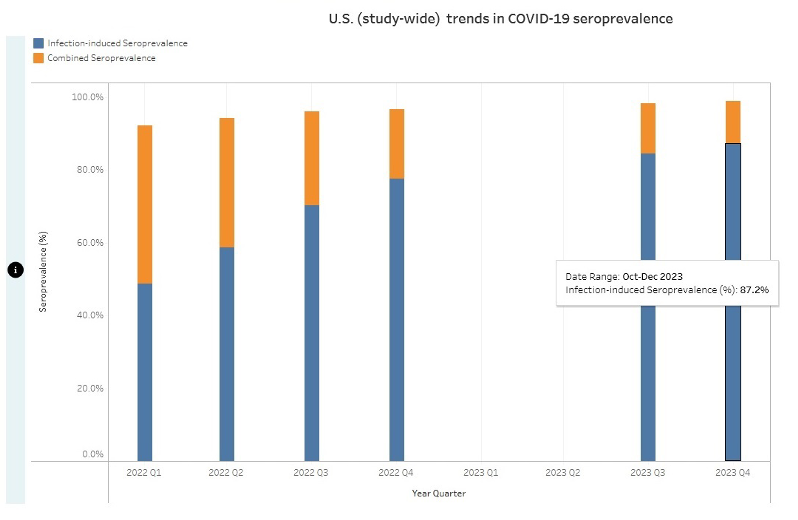
In reality, neither vaccine immunity nor post-infection immunity were ever able fully to control the spread of the infection. On August 11, 2022, CDC stated, “Receipt of a primary series alone, in the absence of being up to date with vaccination through receipt of all recommended booster doses, provides minimal protection against infection and transmission (3,6). Being up to date with vaccination provides a transient period of increased protection against infection and transmission after the most recent dose, although protection can wane over time.” Public health pandemic measures that “wane over time” are very unlikely to be useful for control of infection spread, at least without very frequent and impractical revaccinations every few months.
Nevertheless, infection spread per se is not of consequence, because count of infections is not and should not have been the main priority of public health pandemic management. Rather, the consequences of the spread and the negative consequences of the policies invoked should have been the priorities. Our public health agencies chose to prioritize a failed policy of reducing the spread rather than reducing the mortality or the lockdown and school and business closure harms, which led to unnecessary and avoidable damage to millions of lives. We deserved better from our public health institutions.
Harvey A. Risch, MD, PhD
References Cited
1. Inglesby TV, Nuzzo JB, O’Toole T, Henderson DA. Disease mitigation measures in the control of pandemic influenza. Biosecur Bioterror. 2006;4(4):366-75. https://www.liebertpub.com/doi/10.1089/bsp.2006.4.366
2. Ramirez VB. What Is “R-naught”? Gauging Contagious Infections. Healthline, June 14, 2023. https://www.healthline.com/health/r-naught-reproduction-number
3. Worldometer. United States Coronavirus Cases. March 28, 2024. https://www.worldometers.info/coronavirus/country/us/
4. Gupta S. Was I wrong about the Covid infection fatality rate?. UnHerd, April 5, 2023. https://unherd.com/newsroom/how-wrong-was-i-on-covid-ifr/
5. Inslee J. PROCLAMATION BY THE GOVERNOR AMENDING PROCLAMATIONS 20-05 and 20-14: 21-14.2. COVID-19 VACCINATION REQUIREMENT. Issued September 27, 2021. https://governor.wa.gov/sites/default/files/proclamations/21-14.2%20-%20COVID-19%20Vax%20Washington%20Amendment%20(tmp).pdf
6. CDC. 2022-2023 Nationwide COVID-19 Infection- and Vaccination-Induced Antibody Seroprevalence (Blood donations). March 22, 2024. https://covid.cdc.gov/covid-data-tracker/#nationwide-blood-donor-seroprevalence-2022
7. Our World in Data. Total number of people who received at least one dose of COVID-19 vaccine. Downloaded March 27, 2024. https://ourworldindata.org/grapher/people-vaccinated-covid
8. Massetti GM, Jackson BR, Brooks JT, Perrine CG, Reott E, Hall AJ, Lubar D, Williams IT, Ritchey MD, Patel P, Liburd LC, Mahon BE. Summary of Guidance for Minimizing the Impact of COVID-19 on Individual Persons, Communities, and Health Care Systems – United States, August 2022. MMWR Morb Mortal Wkly Rep. 2022;71(33):1057-1064. https://www.cdc.gov/mmwr/volumes/71/wr/mm7133e1.htm
Dr. Harvey A. Risch MD, PhD is a Professor Emeritus of Epidemiology at the Yale School of Public Health and a guest contributor for Peter Navarro’s Taking Back Trump’s America
Bill to Extend Mass Surveillance Program Fails House Vote
By Kyle Anzalone | The Libertarian Institute | April 10, 2024
A group of 19 House Republicans bucked GOP leadership and voted with Democrats against a bill that would extend Section 702, the law that allows for mass surveillance and the collection of Americans’ data.
On Wednesday, Speaker of the House Mike Johnson (R-LA) brought the legislation up for a procedural vote, and it failed 193-228. The Republican opposition was made up of a group of freedom-oriented Representatives led by Matt Gaetz (R-FL).
“The reauthorization lacks essential reforms to protect Americans’ Fourth Amendment rights, such as requiring the FBI to obtain a warrant before searching Americans’ data and a prohibition on the government purchasing Americans’ data from third-party data brokers,” the Flordia congressman said in a statement. “FISA authorities have been used to violate the law more than 278,000 times by the national security state, and there has yet to be any consequences for this illegal activity by our government.”
Gaetz criticized Johnson for letting a bill to renew Section 702 come to the floor without sufficient reforms. “If Speaker Johnson is unwilling to fix FISA Section 702, we are left wondering what he is indeed willing to fix. Now, the very authorities that we saw weaponized against President Trump and the American people are poised to get enhancements under this reauthorization, rather than any of the reforms that are so desperately needed,” he explained.
In the leadup to the 2016 election, the FBI launched an investigation into Donald Trump’s campaign and alleged ties to the Russian government. That probe was based on opposition research paid for by the Hillary Clinton campaign and ultimately failed to prove any ties between Trump and the Kremlin.
Trump announced his opposition to the bill prior to the vote on Truth Social, saying, “KILL FISA, IT WAS ILLEGALLY USED AGAINST ME, AND MANY OTHERS. THEY SPIED ON MY CAMPAIGN!!!” While Trump now says he opposes Section 702, he signed extensions to the program when he was in the White House.
Section 702 of the Foreign Intelligence Surveillance Act of 1978 has allowed the US government to warrantlessly sweep up the information of millions of Americans for decades. It is set to expire on April 19.
However, even if Congress fails to act before April 19, the Wall Street Journal reports that surveillance will continue for at least a year. 702 spying “could potentially continue for another year due to how and when the secretive court that oversees the program grants annual approval for the categories of intelligence collection it allows.” WSJ adds, “Such a continuation of the program would almost certainly be met with legal challenges, a complexity that Biden administration officials have said they want to avoid.”
Jim Jordan Demands Big Tech CEOs and Feds Hand Over Censorship Collusion Documents
By Dan Frieth | Reclaim The Net | April 10, 2024
Advocating for transparency in the interactions between Big Tech and the government, House Judiciary Committee Chairman Jim Jordan has taken further action. On Tuesday, he issued letters to the FBI, Department of Justice, and CEOs of key Big Tech firms, including Amazon, Alphabet, Apple, Meta, and Microsoft. These letters were not just mere inquiries; they were demands for documents that could shed light on the Biden administration’s communication with social media companies.
We obtained a copy of the letter for you here.
Jordan’s initiative isn’t isolated but comes in the context of an ongoing legal battle concerning the government’s alleged collaboration with social media platforms. He pointed out in a recent press release that the FBI’s Foreign Influence Task Force (FITF) had, as of March, re-engaged with major social media companies. This development, especially considering the FITF’s prior interactions with these companies during the 2020 presidential election, raises significant concerns for Jordan. With the 2024 presidential election on the horizon, he finds the renewal of this relationship between the FITF and Big Tech worrisome.
The documents are related to the renewed efforts of the DOJ to work with tech companies after the Supreme Court appeared skeptical of censorship claims.
He expressed these apprehensions, stating, “Given the FITF’s improper role in communicating with social media and technology companies during the 2020 presidential election, the resumption of meetings between the FITF and Big Tech before the 2024 presidential election is deeply troubling.”
But Jordan’s requests went beyond mere expressions of concern. He specifically asked Alphabet, and similarly, the other companies and government agencies, to produce detailed documentation of their communications with the FITF or the San Francisco Field Office of the FBI. He underscored the urgency and legitimacy of his request by referencing a continuing subpoena issued last year.
Occupied Nation: How the CIA Created Modern Germany
 The sprawling U.S. embassy in Berlin. [Source: spiegel.de]
By Kit Klarenberg | CovertAction Magazine | April 9, 2024
On February 4th, The Economist published a devastating analysis—or perhaps, “pre-mortem”—on the collapse of the German Social Democratic Party (SPD) under Olaf Scholz’s stewardship. Elected in what the Western media contemporaneously branded a “shock” result in September 2021, hopes for his coalition government in many quarters were high. Today, he enjoys the worst approval ratings of any Chancellor in modern history, and national opinion polls place SPD approval at 15% or lower.
The Economist frames Scholz’s collapsed fortunes, and the prospects of his party’s imminent extinction as a serious force within German politics, as a microcosm of Berlin’s declining economic and political clout more widely. It notes that the nation’s finances have gone “limp” during his tenure, with business-sector confidence collapsing, and record inflation destroying citizens’ incomes and savings. Other sources have detailed the country’s “deindustrialization,” Politico coining the nickname, “Rust Belt on the Rhine.”
In keeping with those meditations on Germany’s ever-worsening woes, The Economist’s bleak diagnosis made no mention of how Western sanctions imposed on Russia in February 2022 created Berlin’s crisis. Scholz was a prominent cheerleader for the Biden administration’s push to “make the Ruble rubble.” Now that effort has so spectacularly backfired that it can no longer be ignored or spun otherwise; Newsweek admits “any realistic war game could have easily predicted” the sanctions would not only fail, but boomerang on the sanctioners.
Those few analysts who predicted the invasion of Ukraine well in advance universally failed to anticipate Berlin would support and facilitate any U.S. counterattack, particularly in the financial sphere. They believed Germany possessed the requisite autonomy and sense not to commit willful economic suicide in service of Empire. After all, the country’s stability, prosperity and power were heavily dependent on cheap, readily accessible Russian energy. Voluntarily ending that supply would be inescapably disastrous.
For this failure, they can be forgiven. Berlin, particularly in the wake of reunification, has successfully presented itself to the world as sovereign, led by sensible people acting in the best interests of their nation, and Europe. In truth, ever since 1945, Germany has been a heavily occupied nation, drowning under the weight of U.S. military installations, and its politics, society and culture aggressively shaped and influenced by the CIA.
This unacknowledged reality is amply spelled out in Agency whistleblower Philip Agee’s 1978 tell-all book, Dirty Work: The CIA in Western Europe. Comprehending who is truly in charge in Berlin, and what interests Germany’s elected representatives are actually serving, is fundamental to understanding why Scholz, et al., so eagerly embraced the self-destructive sanctions. And why the facts of Nord Stream 2’s criminal destruction can never emerge.
“Enormous Presence”
Following World War II, the United States emerged as the world’s undisputed military and economic superpower. As Agee wrote, the overriding aim of U.S. foreign policy thereafter was to “guarantee the coherence of the Western world” under its exclusive leadership. CIA activities were accordingly “directed toward achieving this goal.” In service of the Empire’s global domination project, “left opposition movements had to be discredited and destroyed” everywhere.
After West Germany was forged from the respective occupation zones of Britain, France and the U.S., the fledgling country became a particularly “crucial area” in this regard, serving as “one of the most important operational areas for far-reaching CIA programs” in Europe and elsewhere. Domestic Agency operations in West Germany were explicitly concerned with ensuring the country was “pro-American,” and structured according to U.S. “commercial interests.”
In the process, the CIA covertly supported the Christian Democratic Union (CDU) and SPD, and trade unions. The Agency “wanted the influence of the two major political parties to be strong enough to shut out and hold down any left opposition,” Agee explained. The SPD had a radical, Marxist tradition. It was the only party in the Reichstag to vote against the 1933 Enabling Act, which laid the foundations for Germany’s total Nazification, and led to its proscription.
Newly reinstituted following the war, the SPD maintained its revolutionary roots until 1959. Then, under the Godesberg Program, it abandoned any commitment to challenging capitalism in a serious way. It stretches credibility to suggest the CIA was not expressly responsible for neutering the party’s radical tendencies.
In any event, effective control of West German democracy ensured that Washington’s “enormous presence” there–which included hundreds of thousands of troops and almost 300 separate military and intelligence installations—was not challenged by those in power, irrespective of the party to which they belonged, despite a majority of the population consistently opposing U.S. military occupation.
This presence in turn granted the CIA “a number of different covers to work behind,” according to Agee. The majority of its operatives were embedded within the U.S. military, posing as mere soldiers. The Agency’s biggest station was an army base in Frankfurt, although it also boasted units in West Berlin and Munich. U.S. operatives were “highly qualified technicians who tap telephones, open mail, keep people under surveillance, and encode and decode intelligence transmissions,” working “all over the country.”
Dedicated divisions were charged with “making contact with organizations and people within the political establishment,” such as the SPD and its elected representatives. All the intelligence collected was “used to infiltrate and manipulate” the same organizations. The CIA, moreover, collaborated “very closely” with West German security services in many domestic spying efforts, the country’s assorted intelligence agencies conducting operations at the Agency’s direct behest, “often [to] protect CIA activities from any legal consequences.”
“Discredit and Destroy”
Intimate bedfellows as they were, there were nonetheless “difficulties” in the CIA’s relationship with its West German counterparts, per Agee. The Agency never fully trusted their protégés, and felt a pronounced need to “keep an eye” on them. Still, this lack of faith was no barrier to the CIA partnering with the BND, West Germany’s foreign intelligence service, to secretly purchase Swiss encryption firm Crypto AG in 1970. Perhaps this was done to “protect CIA activities from any legal consequences.”
Crypto AG produced high-tech machines through which foreign governments could transmit sensitive high-level communications around the world, safe from prying eyes. Or so they thought. In reality, the clandestine owners of Crypto AG, and by extension the NSA and GCHQ, could easily decipher any messages sent via the firm’s devices, as they themselves crafted the encryption codes. The connivance operated in total secrecy for decades thereafter, only being exposed in February 2020.
The full extent of the information collected via Crypto AG—along with key national competitor Omnisec AG, which the CIA also owned—and the nefarious purposes to which it was put is unknown. It would be entirely unsurprising though if the harvested data helped inform CIA operations to “discredit and destroy” left-wing opposition in West Germany and beyond, efforts that no doubt continue to this day.
The Cold War may be over, but Germany remains heavily occupied. It hosts the largest number of U.S. troops of any European country, despite an overwhelming majority of the population supporting their partial or total withdrawal in the years following the Berlin Wall’s collapse. In July 2020, then-President Donald Trump announced the withdrawal of 12,000 soldiers of the 38,600-strong contingent still there.
While intended to punish Germany for greenlighting the now-destroyed Nord Stream 2, polls indicated most Germans were only too happy to say “auf wiedersehen.” In all, 47% were in favor of them leaving, while a quarter called for the permanent closure of all U.S. bases on their soil. Yet, just two weeks after entering the White House, Joe Biden reversed his predecessor’s policy, returning 500 soldiers who had departed.
The President also scrapped plans to relocate the Stuttgart-based U.S. Africa Command, which effectively embeds Washington in the armed forces of 53 countries across the continent, elsewhere in Europe. Research shows the Command’s training programs have precipitated a significant rise in the number of military coups in Africa. As Agee attested, U.S. military bases are a hotbed of CIA spies. Berlin therefore must remain “one of the most important operational areas for far-reaching CIA programs” within and without the country, whether Germans like it or not.
Featured Video

Anthrax War – CBC The Passionate Eye
or go to
Aletho News Archives – Video-Images
Book Review
Shattered Dreams: The HPV Vaccine Exposed (2019)
By Christina England – 30 Q&As – Book Review & Summary
Lies are Unbekoming | September 4, 2026
… Gardasil received FDA fast-track approval in 2006, Cervarix followed in 2009, and Gardasil 9 was approved in December 2014 with more than double the aluminium adjuvant content of the original. The commercial context is specific. Merck was about to lose patent protection on Zocor and faced $18 billion in Vioxx injury claims from a cardiovascular drug the company had marketed while suppressing its own data showing a five-times increase in heart attacks. Analysts projected the global HPV vaccine market at $4 billion by 2011, contingent on government-funded national programs for teenage girls. The 1986 National Childhood Vaccine Injury Act had already granted manufacturers complete liability immunity. By 2013, Japan had withdrawn its HPV vaccine recommendation after cataloguing severe adverse reactions in hundreds of girls. No Western government followed. The establishment position across the UK, US, Australia, and most of Europe held, and still holds, that the vaccines are safe and effective, that reported injuries are coincidental, and that cervical cancer prevention justifies the program. The book was published into this position, not against a vacuum.
Shattered Dreams sits alongside Mary Holland’s The HPV Vaccine On Trial and Viera Scheibner’s foundational vaccination work as part of the documented record on what has been done to a generation of teenage girls under the banner of cancer prevention. The full summary unpacks three specific findings: that Merck used the aluminium adjuvant itself as the “placebo” control in 92.5% of trial subjects, making it structurally impossible to detect excess reactions from the adjuvant; that Dr. Sin Hang Lee found HPV DNA fragments bound to aluminium in every one of sixteen Gardasil samples tested, and in the blood and spleen of a New Zealand girl six months after her third dose; and that in every country with high vaccination coverage, including Australia, the UK, Norway, and Sweden, cervical cancer rates have stopped declining and started rising specifically in the vaccinated cohort. Martínez-Lavín’s 2017 calculation puts the number needed to seriously harm with Gardasil 9 at 140, and the number needed to vaccinate to prevent one case at 1,757. Thirteen young women are seriously harmed for every one who benefits. The vaccine was approved on the basis of trials that could not detect what the trials were supposed to detect, and it is still being given to twelve-year-olds today. … Read full review
Blog Roll
 Aletho News
- Ukraine’s EU neighbors reject new plea from Kiev – Politico
- British Transport Police Facial Recognition Trial Scanned 926,912 People With Zero Arrests
- House Bill Would Ban Federal Use of Flock ALPR Data
- Can a Spice Rival a Drug? 10 Head-to-Head Trials Put It to the Test.
- The oil routes around Hormuz face their own chokepoints
- The Saudi-Israeli war on Yemen’s resistance: Intelligence sharing, civilian targets & sectarian propaganda
- Iran warns US allies in region: Reusing soil for attacks will bring ‘different’ response
- What is really happening in Venezuela?
- Diplomacy is Now a Crime in Britain / Ian Proud
- UK Government Body Kept Files on People Criticizing Prevent Program
- If Americans Knew
- Targeting the rescuers: Inside Israel’s war on paramedics in Lebanon
- No big deal: Israel to halt humanitarian aid to Gaza for 2 days – Daily Update
- Israel is squeezing the life out of Palestinians – Daily Update
- The Israeli Right Portrays Islam as Murderous. It Serves a Political Purpose
- Jordan Has Had Enough: King Abdullah’s Scathing Warning to Israel
- Israeli Colonizers (i.e. Settlers) Kill Palestinian Man Near Salfit
- New Google Maps images reveal massive scale of devastation in Gaza
- Jewish supremacy, anti-Palestinian bigotry on display in Israel – Daily Update
- Israeli Soldiers Abduct At Least 22 Across Occupied West Bank
- Eight Palestinians Killed in Israeli Attacks on Gaza
- No Tricks Zone
- Latest European Green Energy Debacle; Portugal’s Largest Flagship Solar Park Insolvent!
- Green Energy Debacle: German Expert Professor Fritz Vahrenholt Warns Of Severe Economic And Social Consequences
- Two More Paleo Reconstructions Affirm Meters-Higher Sea Levels Across Ireland, Brazil 7000-6000 Years Ago
- New Study: Earth And Venus Surface Warmth Largely Explained By Convection And Lapse Rate, Not CO2 Or Radiation
- 2025 Nature Paper Claiming Worsening Global Drought Gets RETRACTED …Heavily Flawed
- New Study: ‘Global Drought Shows No Detectable Recent Acceleration Under Climate Warming’
- Economic Masterminds: German Socialists Suggest Taxing Productivity Gains Stemming From Using AI
- The South China Sea Has Not Been Cooperating With The Climate Change Narrative
- Energy Crisis: Germany Enters Heating Season With Historically Low Gas Reserve Fill Levels
- New Study: The Antarctic Ice Sheet Gained Mass From 2020-2024 Due To Staggering Snow And Ice Accumulation

