Nuclear Subsidies Galore …
By Kennedy Maize – Master Resource – March 19, 2024
The U.S. nuclear industry in recent days has hit three cherries on the federal money-and-policy slot machine. The open question is whether the largess (some might call it pork) will have the intended results: revitalizing a moribund industry by hitching its wagon to the feverish fear of climate change and long-run animosity toward nuclear rivals China and Russia.
First, the money–the most tangible of the goodies Congress and the White House have doled out. On March 5, the ranking members of the House and Senate appropriations committees rolled out a consensus on six money balls, including the Energy and Water Development and Related Agencies bill funding all government nuclear programs for fiscal year 2024. Passage is almost certainly a done deal.
For nuclear, the bill includes the following radioactive goodies:
- $1.685 billion for Department of Energy nuclear R&D, including a priority for microreactors and accident tolerant fuel. This is a $212 million increase over 2023 funding.
- $2.72 billion in repurposed supplemental emergency funding for a high-assay low-enriched uranium (HALEU) program for advanced reactor fuel development. This is aimed specifically at Russia (the only significant current supplier of HALEU).
- $280 million for an assortment of nuclear programs, such as $16 million for hydrogen produced from nukes and $137 million for the U.S. Nuclear Regulatory Commission.
House Legislation Passed (H.R. 6544)
The above Treasury payments followed policy victories for the nukes, including legislation and a new regulatory program.
On February 28, the House by an overwhelming 365-36 bipartisan margin passed H.R. 6544, designed to streamline safety reviews by the Nuclear Regulatory Commission and give the Department of Energy some authority to buy electricity through purchase power agreements from commercial nuclear power purveyors.
In some respects, the legislation is a return to the approach of the now-defunct Atomic Energy Commission in the early days of atomic energy. In 1974, Congress abolished the AEC, and the all-power congressional Joint Committee on Atomic Energy, in large part because the AEC viewed reactor safety as a poor cousin to promotion the atom.
The language in the House bill, as described by the Hogan Lovells law firm, would require the NRC to revise it mission statement
to ensure that, while upholding the policies of the Atomic Energy Act of 1954 (AEA), the licensing and regulation of nuclear activities are carried out efficiently without unduly restricting the potential of nuclear energy and to improve the general welfare and the benefits of nuclear technology to society.”
Some observers have suggested this hortatory language is unlikely to survive in the Senate. Senators are trying to combine House provisions with a separate bipartisan bill that passed last year as part of the National Defense Authorization Act but was later axed.
The legislation would also create a cadre of up to 210 Supergrade nuclear ninjas, possibly paid more than NRC commissioners in some cases. According to the bill language, under some circumstances, the NRC chairman Chairman “may, during any period when such a certification is in effect, fix the compensation for such employees or other personnel serving in a covered position without regard to any provision of title 5, United States Code, governing General Schedule classification and pay rates.” These alleged experts appear to have the power to second-guess the Senate-confirmed commissioners.
The House bill would also extend the Price-Anderson federal accident insurance subsidy, first enacted in 1957 and renewed seven times since then. The program expires at the end of 2025. It isn’t clear why this federal subsidy for nuclear is still needed when the industry insists its new, advanced reactor designs are “inherently” walk-away safe. Congress apparently believes it can assess the risks of nuclear energy more accurately than private sector actuaries.
Regulatory Favor
Then there is the third cherry on the governmental slot machine: regulation.
On March 4, the NRC rejected a staff-written draft rule developed over three years for how to regulate the potential new license applications for a variety of advanced reactors. The commission told the staff to rewrite its proposal for a new “Part 53” section of the agency’s authority embodied in 10 Code of Federal Regulations, joining the current sections 50 and 52, which pertain to large light-water reactors.
According to Utility Dive, a key change ordered by the commission “rejected ‘a strict checklist of requirements’ for probabilistic risk assessments while favoring a more flexible framework suited to simplified reactor designs with passive safety features that utilize natural forces, such as gravity or pressure differentials, rather than operator action.”
In a news release, NRC Chairman Christopher Hanson said, “This proposed rule leverages significantly more risk insights than our existing regulatory framework in making safety determinations. Applicants can use our existing regulations today, but this proposed rule will provide future nuclear developers a clear, additional pathway for licensing.” The NRC said it expects to publish the new rule in the Federal Register in about six months.
Legacy of Failure
This latest effort to revive the largely stagnant U.S. nuclear program is the third time in the last nearly 20 years that the government has tried to pump new life into atomic power. The U.S. program started grinding to a halt in the mid-1970s and was barely treading water by the 1990s. The pipeline of new reactor licenses emptied in 1974, and as the final builders of plants under construction either completed or abandoned their projects, the workforce and supply chain infrastructure hollowed out.
In 2005, Congress passed a new “Energy Policies Act,” which offered a smorgasbord of financial goodies for new plants including loans (they called them “loan guarantees” to make them look more palatable to opponents of direct federal subsidies, but the Treasury wrote the checks and received the loan payments), cost overrun protections, and extension of Price-Anderson to 2025.
The 2005 act was largely a failure. The two preeminent U.S. nuclear power developers, Westinghouse and General Electric, ended up sorely financially injured and in Japanese hands. Former NRC Commissioner Peter Bradford commented, “They placed a big bet on this hallucination of a nuclear renaissance.”
Then came the first push for “small modular reactors,” designed to downsize the financial risks and construction costs of nuclear power plants. The strategy was the reverse of the “economies of scale” that drove the first generation of nuclear power plants, where bigger was always assumed to be better, but wasn’t.
In 2009, reactor vendor Babcock & Wilcox, which had substantial experience building nuclear power plants for U.S. submarines, announced it would offer a 125-MW pressurized water reactor (later scaled up to 180 MW) and a year later unveiled an alliance with builder Bechtel Corp. They called the project mPower.
In 2012, the Obama administration announced a $500 million program for development of small modular reactors. In 2013, mPower won financial assistance from DOE, with an award up to around $126 million. The same year, B&W tried and failed to sell a majority share of mPower, then cut back funding by 75%. Bechtel soon soured on the project, and it officially ran out of steam in 2017 after failure to find a customer.
During the same time frame, Westinghouse launched a 225-MW small modular reactor program. It quickly cratered, as the Pittsburgh-based company was unable to find a customer for its machines.
Will the latest government attempt to revive nuclear, driven by global warming concerns, succeed? It’s not a given. There’s lots to like about smaller nukes. They produce no CO2, have a relatively small footprint, can be sited fairly close to load.
But the economics aren’t clear, as the NuScale saga demonstrates. Some of the non-LWR advanced reactor designs will present licensing challenges, as there is little history behind them. Sodium cooled fast reactors may be particularly problematic, given the well-known problems of sodium as a coolant and the experience with Superphenix in France and Monju in Japan, plus issues of nuclear weapons proliferation.
———————-
This revised post originally appeared at The Quad Report.
Fired Harvard Professor: ‘All the Basic Principles of Public Health Were Thrown Out the Window’
By Michael Nevradakis, Ph.D. | The Defender | March 21, 2024
Martin Kulldorff, Ph.D., co-author of the Great Barrington Declaration said Harvard University’s decision to fire him for non-compliance with the university’s COVID-19 vaccine mandate is just one example of the consequences faced by anyone who questioned the official COVID-19 narratives.
In an appearance on “The Defender In-Depth” podcast, Kulldorff, an epidemiologist, said his firing is part of a broader trend of censorship and intolerance toward people who express diverging views in the broader fields of science, medicine and academia.
Kulldorff is one of the five individual plaintiffs in a lawsuit against the Biden administration alleging key administration officials and government agencies coerced social media platforms to remove content, in violation of the First Amendment.
Kulldorff discussed the latest developments in the suit — Murthy et al. v. Missouri et al. — whose plaintiffs also include the attorneys general of Missouri and Louisiana.
On Monday, the U.S. Supreme Court heard arguments on an injunction, previously granted by lower courts, barring the administration and certain federal agencies from communicating with social media platforms for the removal of content.
He also discussed the COVID-19 pandemic response of his native Sweden, which bucked the global trend by eschewing lockdowns, vaccine and mask mandates, making the country the target of global pressure and widespread media criticism. Yet, Sweden now demonstrates better public health outcomes than most other countries.
‘Never a consensus in the scientific community’ for lockdowns
Kulldorff said Harvard was “not happy” with him when he co-authored the Great Barrington Declaration in 2020. However, it was Kulldorff’s decision not to get a COVID-19 vaccine that ultimately led Harvard to fire him.
“We had a disagreement about infection-acquired immunity,” Kulldorff said. “I was fired because I didn’t want to take the vaccine because I didn’t need it. I had better immunity from having had [COVID-19] already, and so, there was no medical reason for me to do it. And there was certain risk, because with every vaccine and drug, there’s some risk.”
Yet, many of his colleagues at Harvard and other institutions “sort of kept quiet” and “went along with it,” Kulldorff said. He attributed their cooperation to the federal funding many scientists and researchers receive from agencies such as the National Institutes of Health (NIH) and the National Institute of Allergy and Infectious Diseases.
“They sit on the biggest pile of medical research money in the world,” Kulldorff said. “So, it’s pretty scary for a scientist to speak up against their wishes, because you risk losing the resource funds that you depend on to support your family, and also to support the other people that work in your laboratory.”
Still, in personal contacts with fellow epidemiologists, Kulldorff said “The majority were arguing for focused protections over better protecting the older people, by letting kids go to school and so on. So, there was never a consensus in the scientific community, at least not in the epidemiological community, for these lockdown measures.”
Kulldorff said that during the pandemic, “all the basic principles of public health were thrown out the window.” His former institution, Harvard, was no exception, “going to online teaching before there was any government incentive or push to do so.”
This, Kulldorff said, “set the stage, and a lot of other colleges and even high schools and elementary schools sort of followed Harvard’s lead” in locking down.
Similarly, Harvard later imposed a COVID-19 vaccine mandate — which it finally ended on March 5. “There was no public health reason to mandate vaccines for students” in particular, Kulldorff said, because most of them “had COVID, so they have superior immunity. But even those few that haven’t [caught COVID-19] face minuscule risk from COVID.”
Children ‘will never fully recover’ from school closures
Kulldorff cited his native Sweden as an example of a country that bucked the trend and kept schools — and society more broadly — open during the pandemic.
“If you look at the elementary and high school students, we know that the test results went down” in countries that closed their schools, Kulldorff said. “The kids were hurt by this, and they will never fully recover from the damage that we did to them.”
Sweden was the only major Western country that kept schools open for ages 1-15, according to Kulldorff who said test results in Sweden have shown “no comparable drop — it’s just as normal, slightly going up.”
Among 1.8 million children who went to school in Sweden throughout the virus wave during the spring of 2020, “there were exactly zero COVID deaths and only a few hospitalizations,” he said.
Public health outcomes in Sweden also were positive for other population groups. “Sweden has low COVID mortality, less than the average in Europe [and] the lowest excess mortality in the Western world.”
Kulldorff said Swedish authorities were able to resist global pressure to impose lockdowns and mandates because they “had very strong support from other epidemiologists in Sweden” and “very strong support by the public” for their approach.
He noted that Sweden’s then-prime minister, Stefan Löfven, had a working-class background, having begun his career as a welder. Noting that lockdowns favored “the upper class,” Kulldorff said Löfven’s background might have made a difference as he could “understand what the effect these lockdowns had on regular people.”
Science will ‘dwindle down’ without freedom of speech
Yet, in other countries, including the U.S., dissenting views were silenced, Kulldorff said.
“Those of us who tried to speak up were either silenced or, after they couldn’t silence us anymore, we were slandered,” he said, noting that after the Great Barrington Declaration was published, Francis Collins, M.D., Ph.D., then the director of the NIH, called for “a devastating published takedown” in response.
“With scientific or other logical arguments, they have two options: They can sort of silence it by ignoring it or censoring it, which was done, or they can attack it through slander and smears,” Kulldorff said. He said postings he made on Twitter and YouTube critical of mask mandates and school closures, were removed by those platforms.
“They didn’t want the science to be known, the true science, and the true principles of public health,” Kulldorff said.
That’s why Kulldorff joined the Missouri et al. v. Biden et al. (now known as Murthy et al. v. Missouri et al.) lawsuit. He said the central argument the plaintiffs are making in this case “is that the federal government should not be allowed to coerce social media to censor people like myself.”
“They actually censored accurate, correct scientific information from scientists at Harvard and other places. And to me that’s pretty astonishing,” Kulldorff said.
Kulldorff said that during Monday’s Supreme Court hearing, “There were clearly some justices who seemed to be very sympathetic” to the plaintiffs’ position, and “seemed very concerned about the First Amendment.”
But other justices argued that “the government should be allowed to coerce social media to censor” in some instances.
By June, the Supreme Court will issue a ruling on whether or not to uphold the injunctions lower courts previously granted in this case. Kulldorff said the case will then return to the lower courts and is expected to “take years” to resolve, proceeding “in tandem” with Kennedy et al. v. Biden et al. — a similar lawsuit in which Children’s Health Defense is a plaintiff. The two lawsuits were consolidated in July 2023.
“I thought we were in agreement, as a country, as a society, that freedom of speech is important, that it is the foundation for us,” Kulldorff said. “It saddens me greatly that that’s not the case.”
“If we don’t have this freedom of speech, then gradually, science is going to dwindle down … Academia would go there also and society as a whole.”
Watch ‘The Defender In-Depth’ here.
Michael Nevradakis, Ph.D., based in Athens, Greece, is a senior reporter for The Defender and part of the rotation of hosts for CHD.TV’s “Good Morning CHD.”
This article was originally published by The Defender — Children’s Health Defense’s News & Views Website under Creative Commons license CC BY-NC-ND 4.0. Please consider subscribing to The Defender or donating to Children’s Health Defense.
Jewish Fingernail Fact Check
Did a rabbi say that “a thousand Blacks aren’t worth the fingernail of a Jewish man”?
Nation Of Islam Research Group
Why, yes. More than one rabbi has expressed openly this white Jewish supremacist rhetoric in both Israel and America. And though Jewish leaders have tried mightily to portray themselves as equal rights crusaders, the mind and mentality of white supremacy runs deeply through Jewish culture and history. Now, let’s look at the Jewish fingernail facts.
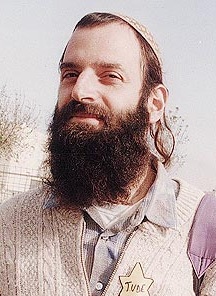
On February 25, 1994, the Brooklyn-born Israeli settler and physician Baruch Goldstein (in photo) machine-gunned 800 Muslims at prayer in Hebron’s Ibrahimi mosque, killing 29 and wounding 125, and setting off riots in which reportedly more than 100 Palestinians were killed by Israeli soldiers. The February 28, 1994, New York Times covered Goldstein’s funeral:
“One million Arabs are not worth a Jewish fingernail,” Rabbi Yaacov Perrin said in a eulogy. At the service in Jerusalem, attended by 300 people, one man shouted, “We are all Goldstein,” an opinion echoed across Qiryat Arba by neighbors who said variously that they approved of his attack on the Arabs or at the least could not judge him.
At least 100 newspapers covered the racist rabbi’s genocidal decree and the support it received in Israel from admirers of Goldstein’s massacre of Palestinians. The Times further reported that Jewish worshippers came to his grave “by the hundreds…many bowing deeply to kiss the tombstone of the Hebron mass killer and to proclaim him a holy man.” A Jerusalem college professor declared Goldstein the “greatest Jew alive,” and Rabbi Dov Lior proclaimed that Goldstein was “holier than all the martyrs of the Holocaust.”
Goldstein’s deification provides a window into the mind and manner of a strangely violent people who have in recent months perpetrated the open extermination of the Palestinian people. What has become clear is that Zionist Jews are following an ancient script—a largely unknown and unholy book of their own creation. This book prescribes one system of justice for themselves, and a system of slavery and apartheid for everyone else. It explicitly declares that all dark-skinned people (and that’s 91% of the planet) are cursed by God to be their slaves forever. It specifically decrees that Jesus, the messiah to 2.4 billion Christians, is worthy only to be boiled in feces—forever. It asserts that his mother Mary, for whom the central Nation of Islam mosque is named, was a whore. Murder, lying, cheating and stealing are endorsed options for its believers, and the preemptive killing of perceived threats is commanded.
The ~2,000-year old Babylonian Talmud is the document we refer to here. Mass murderer Goldstein was trained in the Talmud at a Brooklyn Jewish school (yeshiva), and it has become the focus of attention as its destructive tenets are applied in a live-streamed, televised genocide. Its lead exterminator is the Caucasian prime minister of Israel Benjamin Netanyahu, who announced to the world in 2014 that he would establish the Talmud as the “official basis for Israeli state law.” In other words, once passage of Talmud Law goes into effect, Caucasian Jews will be enthroned at the top of a violent race hierarchy of their own design.
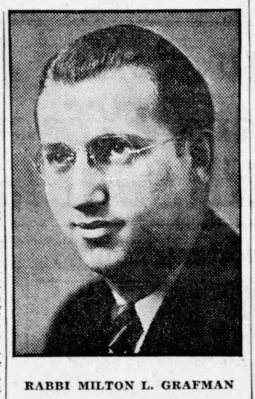
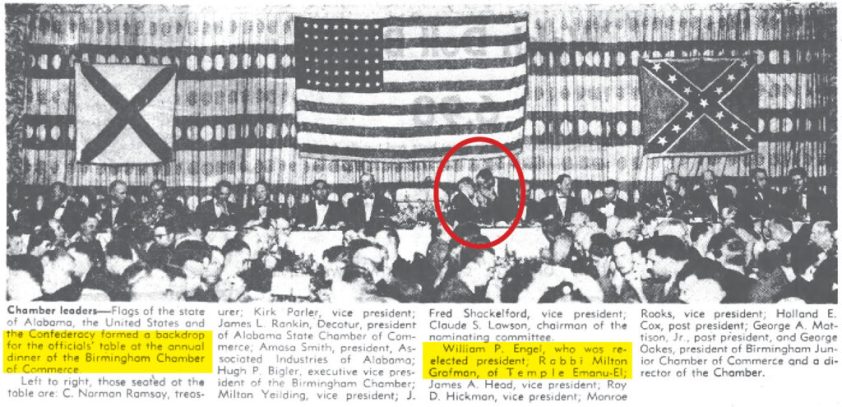
And this vile “Jewish fingernail” fraternity is not unique to Israel. In America, the very same Talmudic mentality was openly expressed by a rabbi at a meeting of the Anti-Defamation League (ADL)—with DIRECT reference to Blacks. Birmingham, Alabama, was “ground zero” of the civil rights movement led by Dr. Martin Luther King, Jr., and it is where four little Black girls were murdered in the bombing of the Sixteenth Street Baptist Church in 1963 by white terrorists. At the time, most of Birmingham’s 4,000 Jews were represented by the notorious racist and white supremacist Rabbi Milton L. Grafman, of Temple Emanu-El synagogue. It was also home to several wealthy Jews in the business community, including Chamber of Commerce president William Engel, who held the group’s meetings under the Confederate flag, with Grafman giving his holy invocation (see photo).
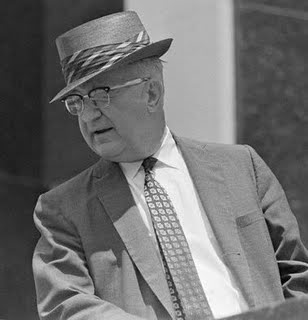
Birmingham’s notoriously vicious Commissioner of Public Safety Eugene “Bull” Connor (in photo) turned fire hoses and attack dogs on Black women and children for the world to see, yet behind the scenes Connor was supported and financed by these Jews, who, according to author Suzanne F. Nossel, “felt safe under his care.” When some progressive Jews criticized Connor, three Birmingham synagogues joined in demanding that they formally apologize to Connor, calling their charges “unfounded, unjust, and irresponsible.” That is the true picture of Black–Jewish relations in America. In fact, Rabbi Grafman was so angered by Dr. King and his freedom movement that he lashed out in that ADL meeting: “The lives of one thousand negroes are not worth a hair on the head of a single Jew!”
At the time, Grafman’s racist bloviations embarrassed the Jewish leadership who were pushing the well-oiled propaganda that Jews were committed “civil rights” crusaders. Grafman’s profile on Wikipedia, the popular on-line encyclopedia, falsely claimed that the Nation of Islam Research Group is the only source for his damning “not worth a hair” statement. The Wiki scribes dismissively wrote: “In 2019, a meme circulated by The Nation of Islam falsely attributed a racist quote to Grafman….This so-called quote was lifted from a 2013 commentary in ‘The Final Call’ by Tingba Muhammad. There is no contemporaneous or current record of the purported remarks, other than in the Final Call article. (see below)”
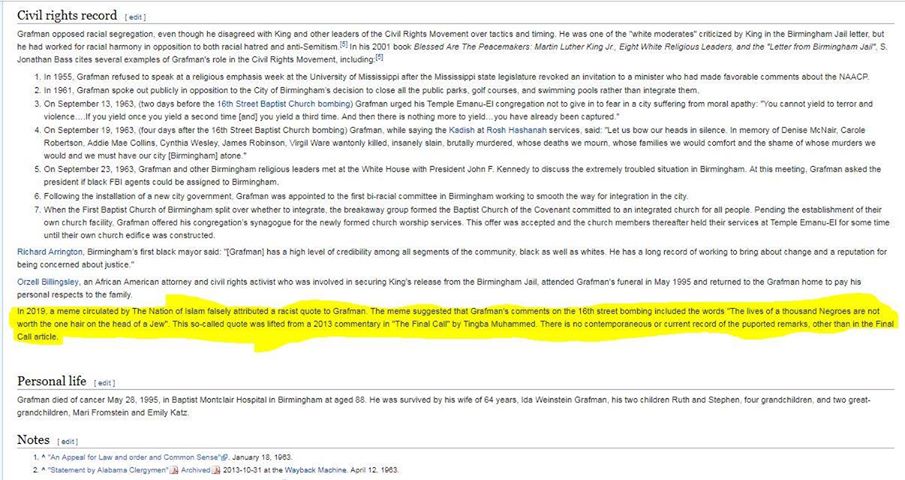
But that was merely the disingenuous protestation of a culprit caught red-handed. Nonetheless, the Wiki entry provides a great opportunity to see how the history of Blacks and Jews is corrupted and relentlessly filtered to “disappear” Jews like Grafman, Engel and Goldstein from their most egregious crimes. Has the Nation of Islam slandered Grafman, or has Wikipedia slandered the Nation of Islam? This is no small consideration, given that the Talmud’s prescribed sentence for slander is to be cursed with white skin (Arakhin 15b)! Let us now back-engineer the quote to determine whether “The Nation of Islam falsely attributed a racist quote” to Rabbi Grafman.
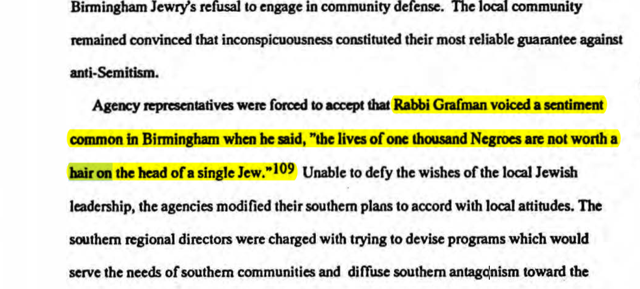
In fact, Rabbi Grafman’s “one thousand negroes” statement has been revealed in several places, but often in ways designed to obscure Grafman and the congregation that supports him. In her unpublished 1991 Harvard study titled “Weathering the Storm: The Jewish Community in Birmingham, Alabama, During the Civil Rights Revolution,” Suzanne F. Nossel writes that Jewish leaders (see screenshot) “were forced to accept that Rabbi Grafman voiced a sentiment common in Birmingham when he said, ‘the lives of one thousand Negroes are not worth a hair on the head of a single Jew.’”
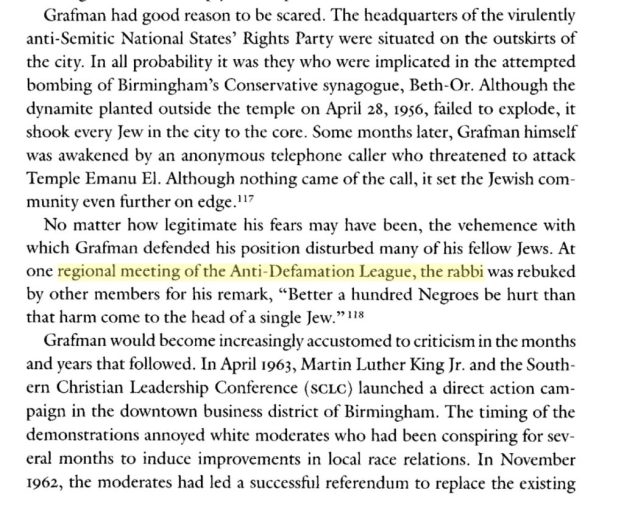
Dr. Clive Webb’s 1997 dissertation, which earned him a Ph.D. from University of Cambridge, is titled “A History of Black–Jewish Relations in the American South, 1790-1970.” It is also unpublished and thus far more difficult for the average reader to access. Webb wrote that Grafman made the following remark at that above-mentioned Anti-Defamation League meeting: “Better a hundred Negroes be hurt than that harm come to the head of a single Jew.” Webb quoted another Jew who was present who recounted that “one rabbi stood up and exclaimed that he would not risk ‘one hair on the head of my members for the life of every shvartzeh in the state’.” Shvartzeh, of course, is the Yiddish word for nigger, and that “one rabbi” is obviously Grafman. At the time, “every shvartzeh in the state” amounted to a Black population of about 1.1 million, bringing Grafman’s holocaust to Palestinian proportions.
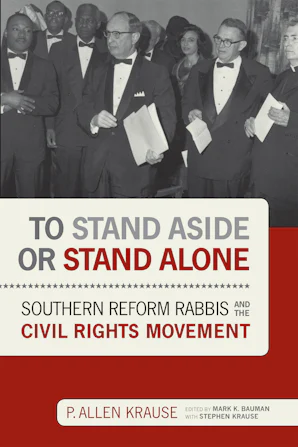
In his posthumously published 2016 book To Stand Aside or Stand Alone: Southern Reform Rabbis and the Civil Rights Movement, Rabbi P. Allen Krause reiterates (on page 74 n45) the “hundred negroes” quote that Dr. Webb revealed. On page 309 of his 2019 book American Judaism: A History, second edition, Brandeis professor Dr. Jonathan D. Sarna tried to obscure Grafman’s klanism by identifying him only as “A prominent Birmingham rabbi, who later modified his views.” Yet Sarna admits that the good rabbi “told a meeting…that he ‘wouldn’t risk one hair on the head of one of my members for the life of every shvartzeh (black) in this state.’”
Certainly, the actual beliefs held by Rabbi Grafman and his Birmingham synagogue— filled with Confederate flag-waving, segregationist backers of Bull Connor—are exactly the opposite of the carefully crafted but absolutely false image of an alleged Black–Jewish civil rights alliance. Grafman is one of many, many Jewish leaders who spoke and acted forcefully to keep Blacks from receiving true justice in America. And that is why it is no mystery why Blacks can see themselves in the plight of the world’s 15 million Palestinians, rather than in the single Jewish hair of Rabbi Grafman or the fingernail of a Baruch Goldstein.
What do Justin Trudeau and Kristi Noem have in common? Both want to put you in jail for having unpopular opinions
Chuck Baldwin Live | March 21, 2024
The left and right sides of an ellipse are descriptive of Left and Right politics. At the top of the ellipse is Liberty. At the bottom of the ellipse is Tyranny. Republicans and Democrats spend most of their time arguing over things that fall in the middle of the ellipse.
I define Tyranny as anything that promotes the power of the state to control people’s lives and liberties beyond the Natural Laws of our Creator. I define Liberty as anything that constrains the power of the state to control people’s lives and liberties beyond the Natural Laws of our Creator.
The problem with so many people from both the political Left and the political Right is that, regardless of their differences over middle elliptical issues, they meet in unison at the bottom of the ellipse. Both Trump and Biden, Republicans and Democrats, want to use the power of government to coerce, intimidate or force the American citizenry to do what THEY want us to do. Whether we agree or not with either side is irrelevant. The fact that we would allow them to exercise governmental power to enforce THEIR personal opinions upon us should be anathema to any true freedomist.
And there are no God-ordained liberties more precious to free men and women than the freedom of speech and the freedom of religion (conscience).
And there is currently a perfect depiction of what I said above being played out before our very eyes with the Leftist Canadian Prime Minister Justin Trudeau and South Dakota’s conservative governor, Kristi Noem.
The Liberal Justin Trudeau
The Canadian government is rapidly advancing plans to usher in full-blown tyranny and will soon begin sentencing citizens to life in prison if they are found guilty of committing the “crime” of so-called “hate.”
Many are likening the new laws to George Orwell’s dystopian novel “1984” as Canada will soon start handing out severe penalties for wrongthink.
The push for life sentences is part of “liberal” Prime Minister Justin Trudeau’s “anti-hate” legislation.
The shocking new law, buried in bill C-6, states:
Everyone who commits an offense under this act or any other act of Parliament, if the commission of the offense is motivated by hatred based on race, national or ethnic origin, language, color, religion, sex, age, mental or physical disability, sexual orientation or gender identity or expression, is guilty of an indictable offense and liable to imprisonment for life.
The new law from Canada comes as Trudeau’s World Economic Forum-controlled administration seeks to rapidly advance the nation’s descent into globalist tyranny.
The government has been pushing several new laws that seek to strip the public of their freedoms.
As Slay News reported, among the draconian new laws are powers that allow authorities to begin jailing citizens who “might” commit a crime.
Trudeau’s government is pushing for the new “pre-crime” authority which officials claim will help to tackle so-called “hate crimes.” (Source)
Naturally, conservatives on the right side of the ellipse are aghast and angry at such a tyrannical proposal—and justifiably so. There is no question that Fidel Castro’s Canadian son wants to turn our northern neighbor into a cold-climate communist state like the balmy prison island of Cuba.
But now let’s visit the other side of the ellipse, the right side, the conservative side.
The Conservative Kristi Noem
In signing a draconian, tyrannical “hate” law of her own in South Dakota, USA, Governor Kristi Noem (on the short list to be Trump’s running mate) said the following (reported by Chris Menahan at InfoWars):
When I was growing up, my dad would always gather our family together and we would pray for Israel. It was instilled in me from a very young age that the Jews were Gods [sic] chosen people, that Israel was the Holy Land, and that we should always pray for them.
I brought those fundamental ideals with me when I was in the State Legislature, when I served in Congress, and now as Governor of South Dakota. Supporting the State of Israel and our Jewish community has always been extremely important to me. It’s important to support Israel for spiritual, historical, and national security reasons. I am continuing to stand with the Jewish people by signing historic legislation to protect them from antisemitism.
I was very proud to sign HB 1076, a very important bill to combat antisemitism. This bill defines antisemitism and makes it easier to prove when discriminatory conduct is motivated by antisemitism. It is an impactful piece of legislation that will ensure the safety of Jewish people and strengthen South Dakota’s anti-discrimination laws.
We held a beautiful, moving signing ceremony for this bill in the Rotunda of our State Capitol in Pierre. Many prominent Jewish leaders attended, including Elan Carr, the CEO of the Israeli-American Council for Action, nationally renowned Jewish leader and founder of the Jacobson Society Dan Rosen, Rabbi and Director of the National Jewish Advocacy Center Dr. Mark Goldfeder, Rabbi Mendel Alperowitz of the Chabad Jewish Center of South Dakota, Renie Schreiber on behalf of Yinam Cohen, Consul General of Israel to the Midwest, and Jordan Cope from Stand With Us. A few of our special guests said some words about the impact this legislation will have for the Jewish people.
This bill puts the gold standard International Holocaust Remembrance Alliance [IHRA] definition of antisemitism into state law.
I hope that more states across our great nation will follow this example that we are setting here in South Dakota. It is more important now than ever for our nation’s leaders to stand up and fight against antisemitism. We must always work to ensure the security of God’s chosen people.
Menahan writes:
The IHRA’s definition of anti-Semitism is completely antithetical to the First Amendment.
The IHRA defines anti-Semitism as:
– Making mendacious, dehumanizing, demonizing, or stereotypical allegations about Jews as such or the power of Jews as collective — such as, especially but not exclusively, the myth about a world Jewish conspiracy or of Jews controlling the media, economy, government or other societal institutions.
– Accusing Jews as a people of being responsible for real or imagined wrongdoing committed by a single Jewish person or group, or even for acts committed by non-Jews.
– Denying the fact, scope, mechanisms (e.g. gas chambers) or intentionality of the genocide of the Jewish people at the hands of National Socialist Germany and its supporters and accomplices during World War II (the Holocaust).
– Accusing the Jews as a people, or Israel as a state, of inventing or exaggerating the Holocaust.
– Accusing Jewish citizens of being more loyal to Israel, or to the alleged priorities of Jews worldwide, than to the interests of their own nations.
– Denying the Jewish people their right to self-determination, e.g., by claiming that the existence of a State of Israel is a racist endeavor.
– Applying double standards by requiring of it a behavior not expected or demanded of any other democratic nation.
– Using the symbols and images associated with classic antisemitism (e.g., claims of Jews killing Jesus or blood libel) to characterize Israel or Israelis.
No other ethnic or religious group in America is afforded any such privileges.
Notice that virtually everything in this list defining “antisemitism” focuses on speech, attitudes or thoughts. “Allegations.” “Accusing.” “Denying.” “Accusing.” “Accusing.” “Denying.” “Applying.” “Using.” All of this refers to speech, attitudes or thoughts.
Kristi Noem is abusing the power of government in an attempt to deny people their First Amendment freedom of speech and freedom of religion.
If Noem wants to believe that the Ashkenazi Jews in the Middle East are “God’s Chosen People,” it is her religious right to believe that. And if she wants to publicly say she believes that, the freedom of speech gives her the right to do so.
BUT . . .
1. That doesn’t mean she is right; in fact, she is NOT right. The Ashkenazi Jews in Palestine today are no more God’s Chosen People and the blood descendants of Abraham than you or me or the man in the moon.
2. That doesn’t give her the right or authority to force people to believe as she does, to share her religious persuasion or to use the power of government to punish them for taking a contrary position.
For your information, Kristi,
I DO believe that the popular scope ascribed to the German Holocaust IS “exaggerated.”
I DO believe that Jewish Zionism IS a radical racist ideology—and so do many Israelis, by the way.
I DO believe that Zionist Jews DO have an extraordinary influence over our media, Federal Reserve, government and societal institutions—and it appears that by signing this bill, Kristi, you are proving my assertion.
And, yes, I also believe that the Jews who coerced and manipulated Pontius Pilate to crucify Jesus ARE blood libel for His death. As a matter of fact, Kristi, the Pharisees and Jews that murdered Jesus admitted their liability for Christ’s death when they shouted, “His blood be on us, and on our children.” (Matthew 27:25)
If I lived in South Dakota, I suppose I would be guilty of a “hate” crime and open to government reprisal.
So, how are Noem and Trudeau any different? Both of them want to use the power and force of government to punish people for exercising their God-ordained freedom of religion and freedom of speech in a manner that doesn’t comport with theirs.
Noem’s tyrannical “hate” bill is not motivated by greed and ambition, using this bill as a means of holding her hand out to the Israeli lobbyists for more campaign cash, is it?
Ditto Trudeau’s tyrannical “hate” bill?
Naw!
Left. Right. Liberal. Conservative. Secularist. Religious. It all spells tyranny if they are meeting at the bottom of the ellipse, as Justin Trudeau and Kristi Noem are doing right now.
© Chuck Baldwin
Full-Spectrum Psyop: US Whips Up Fear of Russian Bugaboo to ‘Subjugate Europe’
By Ilya Tsukanov – Sputnik – 23.03.2024
From the French president’s threats to send troops to Ukraine to a series of media reports on alleged Russian plans to invade NATO, anti-Russian hysteria has reached a fever pitch in European capitals. Meanwhile, one world power has been able to sit back and quietly collect the dividends, says veteran foreign affairs observer Gilbert Doctorow.
European politicians are doing their best to continue ratcheting up tensions with Moscow, with French President Emmanuel Macron reiterating that he may send thousands of troops to Ukraine, Baltic politicians allying with Paris on the issue, and Polish Foreign Minister Radoslaw Sikorski saying it’s an “open secret” that NATO soldiers are already in the country.
British and German media have done their part to add fuel the hysteria, citing a recent briefing to Bundestag lawmakers on purported plans by Russia to kick off a “full-scale ‘land, sea and air’ war” with NATO.
“We hear threats from the Kremlin almost every day… so we have to take into account that Vladimir Putin might even attack a NATO country one day,” German Defense Minister Boris Pistorius warned in an interview earlier this year.
This week, Polish President Andrzej Duda claimed it was a matter “of common sense” that “Putin, by putting his economy on a war footing, will have such military might that he will be able to attack NATO.” Meanwhile, his top general, Polish Armed Forces Chief of Staff Wieslaw Kukula, has alleged that Russia is actively “preparing for a conflict,” and urging Europe to do the same.
Europe’s defenses are in an unenviable state. Facing a major economic downturn and a $61 billion spending shortfall after giving roughly the same amount away to Kiev for NATO’s proxy war against Russia, European military leaders have warned that they could be left “throwing stones” within hours of a major conflict breaking out as arms and ammo stocks round dry.
But the question no Western officials or media have been able to answer is why Russia – which has over the past three decades expressed a preference for economic cooperation with Europe, rather than fighting its western neighbors, would be interested in invading NATO and almost certainly triggering World War III.
“The whole of NATO cannot fail to understand that Russia has no reason, no interest – neither geopolitical, nor economic, nor political, nor military – to fight with NATO countries,” President Putin said in an interview in December, emphasizing that Moscow and the bloc “have no territorial claims against each other” and could live peacefully.
Puppet Hands at Play
The problem may just be that Russia is taking the hysterical outbursts by NATO officials and Western media at face value, instead of searching for the ‘man behind the curtain’ seeking desperately to keep tensions in place.
“For the United States, the war in Ukraine has failed as a means of weakening Russia so that they can proceed with preparations to fight China. But it has succeeded spectacularly as a means of subjugating Europe. Washington now firmly has its knees on the neck of Europe,” veteran international relations and Russian affairs expert Dr. Gilbert Doctorow told Sputnik.
Economically and politically, the US has been able to extract major concessions from the Europeans over the past two years, plucking hundreds of manufacturers from the continent thanks to an energy crisis sparked by the bloc’s “suicidal” decision to cut off Russian energy supplies, forcing the EU to purchase American LNG at four times the cost, and even trying to saddle Brussels with economic and military aid to Ukraine as Congress remains deadlocked over a $61 billion aid package.
“Here in Europe, the war is now being used to whip up popular enthusiasm for war mobilization of the domestic economies and subjugation of the populace to authoritarian and unlimited powers of the ruling elite,” Doctorow said.
“What remains of free speech and other freedoms can be snuffed out in war hysteria. Moreover, the war fever is being used by [European Commission President Ursula] von der Leyen and the EU Commission in a bid to draw more power into Brussels at the expense of the national governments,” Doctorow warned.
“Some countries are resisting, for example Prime Minister [Mark] Rutte of the Netherlands and even the mealy-mouthed German Chancellor [Olaf Scholz, ed.] are publicly opposed to the proposal of a European debt issuance to finance subsidies to the military production companies, all in spite of van der Leyen. Meanwhile, Macron is on the other side, pushing for greater European centralization for which is the proposed common investment in defense is a nice instrument,” the observer added.
Poking the Bear
Russia’s military buildup “has been reactive to new challenges from the West,” Doctorow stressed, pointing out, for example, that “until the decision of Finland and Sweden to join NATO, Russia had almost no troops on its northwest border. Now, in response to new threats from the northern neighbors, that is being rectified by a big military build-up on the Russian side.”
Something similar can be said of defense budgets, with the Stockholm International Peace Research Institute recently estimating that Russia’s defense budget amounted to $65.9 billion in 2021 – a fraction of NATO spending of $1.16 trillion ($753.5 billion of that by the US alone) the same year. Even in 2024, with the proxy war with NATO in Ukraine raging and intensifying, Russia plans to spend the equivalent of $140 billion, still just a fraction of the Western bloc, which has again accounted for more than half of all military spending worldwide this year.
Ultimately, Dr. Doctorow emphasized, Western governments are following an old playbook.
“An aggressive foreign policy stand is almost always a convenient way of distracting attention away from domestic failures. And thanks to the boomerang of Western sanctions, European economies are doing very poorly as we go into the June elections” to the European Parliament, the observer summed up.
Russia explains stance on US-proposed Palestine “cease fire” resolution
Explanation of vote by Permanent Representative Vassily Nebenzia at the UNSC vote on US-proposed draft resolution on the situation in the Middle East, including the Palestinian question
Permanent Mission of the Russian Federation to the United Nations | March 22, 2024
Before the vote:
Mr. President,
For six months now, the UN Security Council has been unable to adopt a resolution demanding a ceasefire in Gaza. Time and again, the United States thwarted any attempt to do so by using a veto in cold blood as many as four times.
During that time, we have heard many different excuses from our American colleagues. For example, that it is premature to seek a ceasefire because it is necessary to give space “for Israel’s counter-terrorism efforts”; that the Council should not interfere with Washington’s “effective diplomacy on the ground”; that we should wait until Ramadan, when, they say, an agreement on a cessation of violence will definitely be made.
Now, six months later, when Gaza has been practically leveled with the ground, the US representative says without batting an eye that Washington finally starts to realize the need for a ceasefire.
This leisurely thinking process by Washington has cost the lives of 32,000 Palestinian civilians, two-thirds of them women and children.
And even now we see a typical hypocritical show, when in the wrapper of a “ceasefire” the United States is trying to sell to the members of the Security Council and the entire international community something else – a vague phrase about “defining the imperative of a ceasefire”. Such philosophy about moral imperatives looks naturally in the works of Immanuel Kant. But it is not enough to save the lives of Palestinian people. And that is not at all what the mandate of the UN Security Council suggests, which has a unique toolkit to demand a ceasefire and, if necessary, enforce it.
In an official interview to Al Hadath in Jeddah on 20 March, Secretary of State Blinken said, “Well, in fact, we actually have a resolution that we put forward right now that’s before the UNSC that does call for an immediate ceasefire tied to the release of hostages and we hope very much that countries will support that”. However, the US-proposed draft resolution does not make such call. It appears that either the US Permanent Representative to the United Nations or the US Secretary of State deliberately mislead the international community.
Colleagues,
From the very beginning, it was obvious that the “negotiations” on the draft resolution held by our American colleagues were only meant to delay time. All our comments and “red lines” were ignored, as well as the proposals of a number of other delegations. This was not a normal work on a document. It felt more like speaking into the void.
The US draft is a thoroughly politicized document, which only aims at pulling on voters’ heartstrings before the US elections by throwing them a “bone” in the form of at least some mention of a “ceasefire” in Gaza. The draft also seeks to consolidate US policy in the region through “terrorist labels” and to ensure impunity for Israel, whose criminal actions the draft gives no assessment to.
Let me also stress that the American draft contains a de facto green light for Israel to conduct a military operation in Rafah. At least, the sponsors have tried to make sure that nothing in their draft would prevent West Jerusalem from completing the deadly cleanup of southern Gaza.
That is actually what Washington wants. We already said that we will no longer pass meaningless resolutions that do not demand a ceasefire and lead us nowhere.
This draft must not pass with the majority of UNSC votes in order to send a message that Washington’s not even palliative but devious concepts are unacceptable. It will be extremely strange if those members of the Council (and they are the majority), who realize this and have been saying to us that the US draft is a flawed one, will now raise their hand in favor. If you do so, you will smear yourselves in disgrace.
Think what this will make you look in the eyes of the people of the Middle East and your own countries, if you support this hypocritical endeavor designed to disorient the international community and, in fact, undermine the authority of the Council by rendering it unable to influence the situation on the ground and making it “stay out of White House’s way”. Are you ready to play a part in this shameful show?
Russia will not do this. As a permanent member of the Security Council and one of the founders of the United Nations, we recognize the global historical responsibility for the maintenance of international peace and security and cannot allow the Council to become a tool of Washington’s destructive policy in the Middle East. If this resolution were adopted, it would definitively close the debate on the need for a ceasefire in Gaza, give Israel a free hand and condemn Gaza and its entire population to extermination or expulsion.
In our work, we are not guided by what pleases Washington or its satellites who are ready to cast a vote at the US behest, but by what is necessary for the Palestinians and what promotes peace.
We urge the members of the UN Security Council to prevent this and vote against the American draft resolution.
Mr. President,
In order for the UN Security Council to still be able to implement its mandate to maintain international peace and security, a number of non-permanent UNSC members have prepared an alternative draft resolution that spells out in black and white the requirements for both a ceasefire and the unconditional release of hostages. It is a balanced and depoliticized document.
We see no reason why members of the Security Council could refuse to support it, unless a ceasefire and the release of hostages are not part of their plans. This is an attempt to allow the Council to carry out the noble functions entrusted to it. We urge to not miss it.
Thank you.
After the vote:
Mr. President,
We have now listened to the hypocritical speeches of some Council members shedding crocodile tears over the Russian and Chinese vetoes. We have explained the reasons why we did not pass this resolution. It was not because it was put forward by the United States delegation, as the American Permanent Representative tried to assure us today. I told you – those of you who voted here today – that you would cover yourselves in disgrace by voting in favor of an American text that was unacceptable to you (including those of you who are now praising it).
Do you want me to say what really happened? Not hard to guess, the scenario is not complicated at all. Your American masters, in addition to “twisting the arms” of your leaders in the capitals, said, “Don’t you worry, Russia will veto anyways, so you won’t have to go against the American draft.” That’s it, that’s the whole scenario. So stop this hypocrisy about how upset you are that Russia and China vetoed the resolution. Once again, you have covered yourselves in disgrace today by voting in favor of a draft resolution that you did not and do not really support.
Thank you.
What caused the US to fall?
By Vladimir Mashin – New Eastern Outlook – 22.03.2024
Europeans and Americans alike are tired of the war in Ukraine. Clear-headed people in the West realise that Russia cannot be defeated: the bravura statements of some officials can hardly hide the obvious truth that the Kiev regime is doomed. More and more observers are coming to the conclusion that the American elite is waging war to “fend off the challenge to its own hegemony”.
In these circumstances, the new book “Defeat of the West” by Emmanuel Todd, a well-known French political scientist and anthropologist, is attracting a lot of attention in the West. According to the historian, the West made a fatal miscalculation when it decided to expand NATO under Presidents B. Clinton and G. Bush: the American elite was drugged by the ideology of “democracy promotion and official demonisation of Russia”. The American ruling elites not only endangered the whole world, but also created great dangers for America’s existence as a single state.
By imposing unprecedented sanctions on Moscow, the United States overestimated its capabilities and failed to rally the major states of the global South to its side. Moreover, the manufacturing base of the United States and its European allies has proved insufficient to supply Ukraine with the equipment (especially artillery) needed to stabilise, let alone win, the war. The United States no longer has the means to fulfil its foreign policy promises.
The United States makes fewer cars than it did in the 1980s and grows less wheat.
But the most important factor explaining today’s problems is the moral and cultural decline of the West – according to Todd, “Too many people want to run things and boss them around. They want to be politicians, artists, managers. And that doesn’t always require learning intellectually challenging things: ultimately, educational progress has led to educational decline because it has led to the disappearance of the values that favour education”.
The US produces fewer engineers than Russia, not only per capita, but also in absolute numbers: the country is experiencing an “internal brain drain” as its young people move from demanding, high-skill, high-value-added professions to law, finance and various occupations that betray the value of the economy and, in some cases, may even destroy it.
According to Todd, the West’s decision to outsource its industrial base is more than bad policy; it is evidence of a project to exploit the rest of the world.
Nor have the Americans succeeded in spreading the federal values they proclaim to be universal. As the United States has modernised, it has come to espouse a model of sex and gender that does not fit well with the models of traditional cultures such as Indian, Islamic and Russian.
Todd believes that many of these values are “deeply negative”. The West does not value the lives of its young. (In 1976, Todd used infant mortality statistics to predict the collapse of the Soviet Union).
Today, Biden’s America has a higher infant mortality rate (5.4 per 1,000) than today’s Russia, and three times that of Japan.
Todd is struck by the inability of the Western elite to distinguish facts from wishes. Newspapers constantly report that President Putin is a threat to the Western order, but the greater threat to the Western order is the arrogance of those who run it.
According to the historian, it sometimes seems that in the United States there are no national principles, only partisan ones, and “each side is convinced that the other is trying not just to run the government but to take over the state”.
Similar assessments can often be heard in the American press. For example, in a commentary on Biden’s speech to the US Congress on 7 March, the well-known columnist Robin Givhan said: “The real audience is not in the parliament, but in the cheap seats outside: in cities where homeless encampments and busloads of desperate migrants are at once enraging and heartbreaking; in towns where fear and confusion drive people to try to rewrite history or hide it from future generations; and in picturesque communities where people want to hold back change because the unknown future seems far more frightening than the sclerotic present. The American people are confused. After all, they elected this dysfunctional Congress.
‘Kind of Terrifying’: Critics Slam Claim That First Amendment Shouldn’t Constrain Government’s Ability to Censor
By John-Michael Dumais | The Defender | March 21, 2024
Journalist Matt Taibbi denounced statements made by liberal Justice Ketanji Brown Jackson during a U.S. Supreme Court hearing suggesting the First Amendment should not constrain the government’s ability to combat misinformation during a crisis.
“That was kind of terrifying because the entire purpose of the First Amendment is to restrain the government — it’s not to restrain the public from getting in the way of government action,” Taibbi said Tuesday during an interview on The Hill’s “Rising.”
Taibbi, who has reported extensively on the government’s censorship efforts, also said the plaintiffs in the case — including Drs. Jay Bhattacharya, Martin Kulldorff and Aaron Kheriaty — had their speech suppressed because they contradicted a false government opinion.
“The entire purpose of the First Amendment is to prevent the government from creating a hegemonic opinion that cannot be challenged,” Taibbi said.
The Supreme Court heard arguments on Monday pertaining to an injunction, granted in September 2023 by a federal appeals court, in Murthy v. Missouri. The case centers on whether the federal government violated the First Amendment by pressuring social media companies to censor content that ran counter to official government narratives on such topics as COVID-19 origins, vaccines, elections and other controversial topics.
Responding to Solicitor General of Louisiana J. Benjamin Aguiñaga during oral arguments, Justice Jackson said:
“So my biggest concern is that your view has the First Amendment hamstringing the government in significant ways in the most important time periods. I mean, what would you have the government do? I’ve heard you say a couple of times that the government can post its own speech, but in my hypothetical, you know, ‘Kids, this is not safe, don’t do it,’ is not going to get it done.
“And so I guess some might say that the government has a duty to take steps to protect the citizens of this country. And you seem to be suggesting that that duty cannot manifest itself in the government encouraging or even pressuring platforms to take down harmful information.”
Government set up ‘private highway’ to social media execs
“Rising” host Briahna Joy Gray asked Taibbi which was the primary issue: the government’s actions or the companies’ choices to succumb to pressure?
Taibbi compared the situation to the government hypothetically threatening to pull a mainstream media outlet’s Federal Communications Commission license unless it held a story, which he argued would be highly inappropriate.
“They didn’t just do that in this case,” Taibbi explained. “They went straight to the heads of the company” using an “industrial-scale operation … a sort of private highway to all of these companies where they were funneling mass requests.”
Taibbi noted that Renée DiResta, research director of the Election Integrity Partnership that was sponsored by both the U.S. Department of State and the U.S. Department of Homeland Security, “talked about using Section 230 to bring these companies to heel.”
“This was an overt threat,” Taibbi said.
Taibbi suggested it would be appropriate for the government to use its bully pulpit to say, “I don’t like what’s on Facebook. They made a mistake here, here and here. Here’s what I think the truth is, and we see these posts that say something else.”
“The president has an enormous megaphone to counter” what it considers misinformation, Tabbi said. “What’s not appropriate is doing it in private and coupling it with a threat.”
Justices missed the point on First Amendment
On his Racket News Substack Tuesday, Taibbi provided further context on the government’s pressure on social media companies.
During oral arguments, Principal Deputy Solicitor General Brian Fletcher — referring to instances where government officials publicly criticized social media platforms and called for changes to Section 230 protections — said, “I think it’s really troubling, the idea that those sorts of classic bully pulpit exhortations, public statements urging actors to behave in different ways, might be deemed to violate the First Amendment.”
Taibbi lamented the lack of a strong response from the other eight justices.
“That a line about ‘the First Amendment hamstringing the government’ was uttered by one Supreme Court Justice is astonishing enough,” he wrote. “[But] listening as none of the other eight pointed out that the entire purpose of the First Amendment is to ‘hamstring’ government from interfering in speech was like watching someone drive a tank back and forth over Old Yeller.”
As evidence of the justices’ confusion over First Amendment rights, Taibbi pointed to Justice Elena Kagan’s statement that the government intervening in news organizations’ activities “happened all the time” decades ago, especially when issues of national security were at stake.
As to her question, “Was that coercion?” Taibbi wrote:
“The situations aren’t remotely analogous. What’s happening now is a wide-scale partnership agreement between intelligence/enforcement agencies and media distributors, not media outlets themselves.”
Rep. Jordan: ‘That is scary where we’re headed’
Some Congress members were quick to criticize Justice Jackson’s statements from the Murthy v. Missouri hearing.
Rep. Jim Jordan (R-Ohio), in an interview with Fox News Monday, said, “The big takeaway today was Katanji Brown Jackson, when she said to the Solicitor General from Louisiana, ‘You’ve got the First Amendment hamstringing the government’ — well, that’s what it’s supposed to do, for goodness sake!”
“That is frightening because she really believes that,” Jordan added. “That is scary where we’re headed.”
Rep. Dan Bishop (R-N.C.) suggested that if the Supreme Court does not intervene, it could allow the FBI to “embed itself with social media companies” and “take down” issues like “the Hunter Biden laptop in election after election after election.”
Bishop argued that the government should not be able to suppress legal, protected speech on public platforms. “I just don’t think the government ever has a valid interest in doing that,” he said.
“[The government] can … come out publicly and say, ‘We don’t agree that there could have been a lab leak, that we think that’s a ridiculous theory,’” said Bishop. But he argued it was a “bad idea” to allow the government to pressure social media because “We see from what has happened afterward … they were wrong.”
Jordan also alleged that the Biden administration abused its power by censoring political opponents, citing its pressure to remove a tweet by Robert F. Kennedy Jr., Children’s Health Defense chairman on leave, despite the tweet containing true statements about Hank Aaron’s vaccination and passing.
“Oh, by the way, who was that individual [requesting the censorship]?” Jordan asked, before answering, “The guy running against him in the [Democratic] primary [at the time]. That is as scary as it gets, but that’s what this White House was doing.”
Will ‘traceability’ derail free speech case?
One of the central questions before the Supreme Court in Murthy v. Missouri is whether the government’s actions, including vague threats and pressure on social media companies, constitute illegal coercion.
Taibbi pointed out in the “Rising” interview that the “Twitter Files” showed “both overt and less obvious evidence” of correspondence among Twitter’s executives describing how they understood proposed regulatory changes as a threat they must answer to get the government off their back.
“That’s not missing from the case — that’s a feature of the case,” Taibbi said, adding that he thought the government publicly airing those threats “was sending a very strong message so that not only the companies would hear it, but the public would hear it.”
Taibbi acknowledged the difficulty of establishing “traceability” — a direct causal relationship between government pressure and the censorship of individual plaintiffs’ posts — saying their evidence “didn’t show a soup-to-nuts progression.”
However, he noted that shortly after the government told social media companies, ‘We don’t want anybody who is creating content that would promote vaccine hesitancy,’” people like Dr. Bhattacharya and Dr. Kulldorff were “deamplified or removed from platforms.”
Taibbi highlighted the lower court rulings that established or upheld injunctions against the government’s use of coercive tactics with social media companies.
“Two judges compared it to a mob movie,” he said. Characterizing the government in this metaphor, the judges said, ‘Hey, it’s a nice tech company you’ve got there. Be a shame if something happened to it,” Taibbi said.
“Rising” host Robby Soave asked Taibbi whether a legislative remedy could prevent government censorship. Taibbi said that while he felt there was ample evidence that what the government engaged in was already against the law, he thought it would be “difficult” to get a new law passed “absent a judicial ruling that this kind of behavior is illegal.”
But even if such a law were passed, “The problem is the enforcement mechanism is absent here,” he said.
In his Racket News article, Taibbi said the Supreme Court hearing “felt like a gut punch.” He expressed concern that if the court rules against the plaintiffs based on “traceability” issues, it could be interpreted as an endorsement of the government’s “plainly abusive” surveillance and censorship programs.
He wrote:
“Murthy [v. Missouri] already represents a major public relations victory for the Executive Branch.
“After roughly two years in which momentum for shutting down government censorship programs seemed to be gaining, and episodes like Bhattacharya’s punctured the myth that such bureaucracies only targeted ‘misinformation,’ yesterday’s hearing will help restore the basic narrative that the activities revealed earlier in this suit and in the Twitter Files was little more than good-faith efforts by a concerned government trying to stop ‘harm’ in a unique historical emergency.
“As Brown Jackson put it, ‘What would you have the government do?’”
John-Michael Dumais is a news editor for The Defender. He has been a writer and community organizer on a variety of issues, including the death penalty, war, health freedom and all things related to the COVID-19 pandemic.
This article was originally published by The Defender — Children’s Health Defense’s News & Views Website under Creative Commons license CC BY-NC-ND 4.0. Please consider subscribing to The Defender or donating to Children’s Health Defense.
Leave TikTok Alone
By Sheldon Richman | The Libertarian Institute | March 22, 2024
This is America, last I checked. Surely, the government would not force the sale of a social-media company or ban its app from the Google and Apple stores. Would it?
Well, yes, it would, could (perhaps), and might. A bill in Congress, backed by the government’s nominal chief executive, could become law. The House of Representatives passed it last week by an overwhelming bipartisan majority — despite valiant efforts by Rep. Thomas Massie, R-KY, plus a few others — and it is now before the Senate.
That bill would establish fuzzy criteria defining a “foreign adversary’s” alleged influence through a social media platform. It is aimed, for now, at requiring TikTok, used by 170 million mostly younger Americans, to be sold to a government-approved American buyer within a specified period. If not sold, Americans would be forbidden to get the app. I guess the app would have to be disabled for those who have it already.
In other words, TikTok would be banned from America — you know, just as China’s communist government bans or interferes with social media over there. Knowing how the government works, we must presume that the bill’s criteria will be applied to other cases later. It certainly would exist as a standing threat to the uncooperative.
The complaint against TikTok is that it’s a subsidiary of ByteDance, a widely owned company subject to Chinese government influence or control, although this is disputed by TikTok’s CEO, Shou Zi Chew, a Singaporean businessman with substantial roots in — the United States. But let’s assume the worst and see where that leads. After all, the Chinese government is no respecter of individual rights. If the U.S. government is eager to interfere with social media, why not the Chinese government?
TikTok worriers say that China could harvest data on Americans while feeding them self-serving democracy-subverting messages. It has reportedly been caught suppressing unflattering information. Not good, but of course, the U.S. government has done the same thing; a lawsuit about this, Murthy v. Missouri, is now before the Supreme Court. As many critics of the bill have pointed out, the Chinese don’t need TikTok to acquire information that users readily give up to other platforms. It’s already on the market. Moreover, nobody should expect the news from any one online source to be complete; as one grows, one should learn to consult a variety of sources for a fuller picture.
Matthew Petti of Reason is right: “Competition is the strongest force keeping the internet free. Whenever users find a topic banned on TikTok, they can escape to Twitter or Instagram to discuss the censored content. And when Twitter or Instagram enforce politically motivated censorship on a different topic, users can continue that discussion on TikTok.”
Changing ownership or banishing TikTok would create a false sense of security. The problem of myopia would remain.
Moreover, as Matt Taibbi alerts us, the bill would give the executive branch “sweeping powers.” He writes: “As written, any ‘website, desktop application, mobile application, or augmented or immersive technology application’ that is ‘determined by the President to present a significant threat to the National Security of the United States’ is covered.’”
Taibbi continues: “A ‘foreign adversary controlled application,’ in other words, can be any company founded or run by someone living at the wrong foreign address, or containing a small minority ownership stake. Or it can be any company run by someone ‘subject to the direction’ of either of those entities. Or, it’s anything the president says it is. Vague enough?”
By this time, shouldn’t we expect the worst from letting legislators write the rules?
But those are not the only reasons for concern. According to Glenn Greenwald, the bill had been floating around for a few years but had not garnered enough support to get through Congress. That changed recently, according to Greenwald, citing articles in the Wall Street Journal, Economist, and Bari Weiss’s Free Press. Why? As Greenwald documents, anxiety about TikTok took a quantum leap beginning on Oct. 7, 2023, the day Hamas killed and kidnapped hundreds of Israeli civilians and Israel began retaliating against the people of the Gaza Strip.
What has this got to do with TikTok? you ask. Good question. Israel’s defenders in the United States, such as Jonathan Greenblatt of the Anti-Defamation League, are upset that TikTok’s young users are being exposed to what he calls anti-Zionist and anti-Semitic disinformation. “It’s Al Jazeera on steroids,” Greenblatt said on MSNBC. During a leaked phone call, he complained, “We have a TikTok problem,” by which he means a generational problem. Younger people — including younger Jewish people — are appalled at what Israel’s military is doing in Gaza. (To complicate things, it looks like TikTok and Instagram have suppressed pro-Palestinian information.)
Would an American-owned TikTok be easier to control? Experience says yes. Have a look at the Twitter Files, which document how American officials, Chinese-style, pressured social media to censor or suppress dissenting views on important matters such as the COVID-19 response and the 2020 election. A federal judge likened the government’s efforts to the Ministry of Truth in Orwell’s Nineteen Eighty-Four.
Do we want to become more like China?
A final word. Defenders of free speech should not argue that ill-intentioned disinformation and well-intentioned misinformation from any source can cause no harm, broadly defined. Of course, it can. The proper answer to this legitimate concern is that government-produced “safetyism,” placing safety above every other value including freedom, will do more harm than good.
The World Sees Gaza as ‘US Genocide’ Not Just Israel’s
By Ian DeMartino – Sputnik – 22.03.2024
On Tuesday, four critical care doctors who recently returned from Gaza spoke to the UN. “I saw the most appalling atrocities, and I saw things I never would have expected to have seen in any healthcare setting,” Dr. Nick Maynard said, adding that he saw “mass indiscriminate bombing” and targeting of healthcare workers.
Americans do not understand how badly the United States’ reputation has been damaged across the world, which sees Gaza as “a US genocide” and “not just an Israeli genocide,” Mohammad Marandi, a professor of English literature and Orientalism at the University of Tehran told Sputnik’s The Critical Hour on Thursday.
“It’s revealing the reality of [the US] empire in a way that not even [author of ‘A People’s History of the United States, Howard Zinn] could do because it’s being done in front of our eyes, it’s being done in front of a global audience. We’ve never seen such a thing before,” Marandi said, adding that he suspects that is why the US is attempting to ban TikTok.
“The United States has lost credibility across the world. I don’t think many Americans understand how bad this has become for the United States. People across the world see this as a US genocide, it’s not just an Israeli genocide.”
Co-host Wilmer Leon asked about a recent freeze on Canadian arms shipments to Israel, which Marandi said showed that “public opinion is shifting” but that ultimately “stopping Canadian exports of weapons is nothing.” Marandi said Canada needs to take a much tougher approach.
“They sanctioned Syria… they’ve imposed sanctions on Cuba, on Venezuela, on Iran, on Yemen. Why don’t they impose sanctions on Israel? They’re carrying out a holocaust. Why don’t they hit the economy?” Marandi asked, noting that Israel will, unlike Russia, be allowed to participate in the Olympics. “No one takes this seriously. And, of course, the bulk of the weapons come from the United States anyway.”
“In any case, there is no reason to believe that the Canadian government cares about Palestinians, that they oppose the genocide, because they’ve done absolutely nothing to stop it,” Marandi added.
Ultimately, Marandi believes that Israel has laid the path for its destruction through its actions in Gaza. “I believe that the Israelis have made a fatal mistake and that what they’ve done in Gaza will be the beginning of the end of the Zionist project,” he asserted. “The real catastrophe for the Israeli regime is the fact that it’s been carrying out the genocide for almost six months in front of the world and it has demolished the facade that the regime had created for itself… about it being a democracy… All that is gone now and across the board the regime is despised and the image of the United States has been destroyed.”
Marandi noted that he has been to China twice and public opinion there has shifted as well. He noted that he does not think China will ever invest in Israel again.
“They see on their own social media networks what you and I are seeing,” he noted.
Why Slovak Wildcard Robert Fico Could Bring EU House of Cards Crashing Down
By Ilya Tsukanov – Sputnik – 21.03.2024
Slovak Prime Minister Robert Fico has found himself in the crosshairs of Eurocrats worried that he may become the next Viktor Orban -a thorn in Brussels’ backside rejecting EU directives on everything from Ukraine to criminal justice reform. Sputnik asked Slovak politician Peter Marcek what it is about Fico that’s so unnerving to the establishment.
Slovaks will go to the polls Saturday for the first round of a highly anticipated presidential election, six months after a snap parliamentary vote in September saw veteran Direction – Social Democracy leader Robert Fico’s return to the prime minister’s chair.
While Slovakia’s presidency carries a largely symbolic function, the president does have the power to appoint key figures, including the prosecutor general, and can help the government in times of crisis, making the post an important one.
The latest polling shows Peter Pellegrini, a Fico ally from the offshoot Voice – Social Democracy party, and independent former ambassador to the United States Ivan Korcok running neck and neck with between 34 and 38 percent support each, guaranteeing a runoff between them in the second round of voting April 6.
Thelooming vote has spawned a spate of articles in European legacy media bashing Fico and his party, attacking him as a left wing populist analogue of Hungarian right wing populist Viktor Orban and the Fidesz party, and fearmongering about Slovak “democracy’s future,” Pellegrini’s supposed “Russia tilt,” and Bratislava’s alleged “democratic backsliding.”
All these reports have one thing in common: dread at the prospect that Fico and his allies will pursue an independent foreign and domestic policy which threatens the interests of Brussels and the United States.
Headache for Brussels
From Ukraine arms aid (which Fico halted last October) to Kiev’s NATO membership bid (which he has promised to block), to Bratislava’s defense pact with Washington (whose terms Fico has expressed dissatisfaction with) to the launch of an independent inquiry into the EU’s authoritarian pandemic policy, to criminal code reforms slammed by Brussels, Fico has already proven a major “headache” for the West. And that’s just for openers.
“Robert Fico has been in office for only four months, but he has begun to implement the right policies. He has begun to pursue policies for his people, for his country,” Peter Marcek, a former Slovak lawmaker, businessman and the chairman of the Slavic Unity party, told Sputnik.
“He refused to support Ukraine, stopped the supply of weapons to Ukraine, agreeing only to humanitarian assistance and saying that Slovakia would only provide such aid. Fico also doesn’t agree with many of the economic laws adopted by the European Union – which are adopted to benefit the EU itself, rather than its members,” the politician said.
Fico has already managed to get into trouble with the bloc in the course of his short time in office, Marcek said, pointing to Brussels’ threats to cancel the transfer of €1 billion in funds to Bratislava over the prime minister’s legal reform agenda. “They must give this money to Slovakia because it belongs to us. If they don’t… they will make people even more against the European Union. Fico has said that if they behave like this, the result can be only one thing – that Slovakia will exit the European Union, because economically our standard of living is getting worse and worse.”
“When sanctions were introduced against Russia, it did not kill the Russian economy, maybe only creating problems at the very start, but Russia was able to find other markets. We bought oil and gas from Russia at reasonable prices, now we pay the Americans four times more. Our standard of living has dropped significantly,” Marcek explained.
“If the European Union continues its current policy, we will soon leave it. Things simply cannot continue like this, and I think everyone sees it. For example, we have to pay €22,000 for each migrant that we did not accept into our country. What if they tell us that our quota for migrants is 300,000 people? Do the math: that’s 300,000 x €22,000. Instead of allocating this money to pensioners, children, families, will we give it to migrants? Why should we accept immigrants from Africa when we were never colonizers?” the politician asked.
Brussels’ self-serving policies have people from across the EU up in arms, Marcek said, pointing to the rising popularity of both right and left populist, Eurosceptic forces across Europe, and the “major farmer protests” in Austria, France, Germany and even Spain.
Amid the chaos, the EU will have to change its policy, “or the EU will collapse.” It’s as simple as that, the observer believes.
Marcek expects elections to the European Parliament in June to bring a new crop of leaders who seek greater national autonomy against EU institutions which don’t benefit their countries.
As for Slovakia’s upcoming presidential vote, Marceck says Pellegrini will be likely to defeat “pro-American Korcok,” and replace the current president, Zuzana Caputova, who “has created many problems for the government” and prevented its normal functioning. “She is a president that was installed by the US embassy,” the politician summed up.
Featured Video
Anthrax War – CBC The Passionate Eye
or go to
Aletho News Archives – Video-Images
Book Review
Shattered Dreams: The HPV Vaccine Exposed (2019)
By Christina England – 30 Q&As – Book Review & Summary
Lies are Unbekoming | September 4, 2026
… Gardasil received FDA fast-track approval in 2006, Cervarix followed in 2009, and Gardasil 9 was approved in December 2014 with more than double the aluminium adjuvant content of the original. The commercial context is specific. Merck was about to lose patent protection on Zocor and faced $18 billion in Vioxx injury claims from a cardiovascular drug the company had marketed while suppressing its own data showing a five-times increase in heart attacks. Analysts projected the global HPV vaccine market at $4 billion by 2011, contingent on government-funded national programs for teenage girls. The 1986 National Childhood Vaccine Injury Act had already granted manufacturers complete liability immunity. By 2013, Japan had withdrawn its HPV vaccine recommendation after cataloguing severe adverse reactions in hundreds of girls. No Western government followed. The establishment position across the UK, US, Australia, and most of Europe held, and still holds, that the vaccines are safe and effective, that reported injuries are coincidental, and that cervical cancer prevention justifies the program. The book was published into this position, not against a vacuum.
Shattered Dreams sits alongside Mary Holland’s The HPV Vaccine On Trial and Viera Scheibner’s foundational vaccination work as part of the documented record on what has been done to a generation of teenage girls under the banner of cancer prevention. The full summary unpacks three specific findings: that Merck used the aluminium adjuvant itself as the “placebo” control in 92.5% of trial subjects, making it structurally impossible to detect excess reactions from the adjuvant; that Dr. Sin Hang Lee found HPV DNA fragments bound to aluminium in every one of sixteen Gardasil samples tested, and in the blood and spleen of a New Zealand girl six months after her third dose; and that in every country with high vaccination coverage, including Australia, the UK, Norway, and Sweden, cervical cancer rates have stopped declining and started rising specifically in the vaccinated cohort. Martínez-Lavín’s 2017 calculation puts the number needed to seriously harm with Gardasil 9 at 140, and the number needed to vaccinate to prevent one case at 1,757. Thirteen young women are seriously harmed for every one who benefits. The vaccine was approved on the basis of trials that could not detect what the trials were supposed to detect, and it is still being given to twelve-year-olds today. … Read full review
Blog Roll
 Aletho News
- The Five-Year Fuel Crisis: Why the World Economy Is Paying for a War It Thinks Is Ending
- Trump’s Big Bluff on Iran
- Swiss scammed out of millions by Ukraine-linked call centers – media
- Germany facing potential ‘violent conflict’ with Russia – spy chief
- Ukraine’s EU neighbors reject new plea from Kiev – Politico
- British Transport Police Facial Recognition Trial Scanned 926,912 People With Zero Arrests
- House Bill Would Ban Federal Use of Flock ALPR Data
- Can a Spice Rival a Drug? 10 Head-to-Head Trials Put It to the Test.
- The oil routes around Hormuz face their own chokepoints
- The Saudi-Israeli war on Yemen’s resistance: Intelligence sharing, civilian targets & sectarian propaganda
- If Americans Knew
- David Ellison appoints Israeli to lead merged Paramount-Warner studios
- Turkish Red Crescent helps elderly Gaza man walk again after Israel confiscates his prosthetic limb
- Four Palestinians Killed in Israeli Attacks in Gaza
- Two Palestinian youths killed and village razed as Israeli attacks on West Bank continue
- Two more Christian women innocent victims of Gaza raids
- Cruelty, Deprivation, Indignity: A Journalist’s 22 Months in Israeli Prison
- New IDF Website Frames Slain Gaza Journalists as Terrorists
- Israeli media: After settlers beat him mercilessly, they stuffed dirt into his mouth
- Americans Are Paying the Price to Preserve Israel’s Nuclear Hegemony
- A U.S. Jewish Fund’s Ambitious Bid to Put a Settler Elite in Control of Israel’s Security
- No Tricks Zone
- Latest European Green Energy Debacle; Portugal’s Largest Flagship Solar Park Insolvent!
- Green Energy Debacle: German Expert Professor Fritz Vahrenholt Warns Of Severe Economic And Social Consequences
- Two More Paleo Reconstructions Affirm Meters-Higher Sea Levels Across Ireland, Brazil 7000-6000 Years Ago
- New Study: Earth And Venus Surface Warmth Largely Explained By Convection And Lapse Rate, Not CO2 Or Radiation
- 2025 Nature Paper Claiming Worsening Global Drought Gets RETRACTED …Heavily Flawed
- New Study: ‘Global Drought Shows No Detectable Recent Acceleration Under Climate Warming’
- Economic Masterminds: German Socialists Suggest Taxing Productivity Gains Stemming From Using AI
- The South China Sea Has Not Been Cooperating With The Climate Change Narrative
- Energy Crisis: Germany Enters Heating Season With Historically Low Gas Reserve Fill Levels
- New Study: The Antarctic Ice Sheet Gained Mass From 2020-2024 Due To Staggering Snow And Ice Accumulation

