Col Douglas Macgregor: War to the Last Missile in Iran
Daniel Davis / Deep Dive
A military mobilization exercise offers clues about who might be drafted for what sort of conflict
By Edward Hasbrouck | Responsible Statecraft | July 8, 2026
Documents obtained through a Freedom of Information (FOIA) request show that the Selective Service recently gamed out what a military draft would look like in a future war. It would not resemble the one the nation lived through 55 years ago for the Vietnam War or the contingency plans in current standby Selective Service regulations. Instead, those with “special skills” would be conscripted first.
This is the opposite of what the Selective Service says in its promotional materials, that “if a draft is authorized, individuals are selected through a random lottery” from among all young men regardless of their occupation or current skills.
According to the January 2026 military mobilization exercise, the first wave of draftees could include “computer network technicians, electronics technicians, aerospace engineers, divers, welders, gas turbine engine mechanics, electricians, heavy equipment operators, longshoremen, steel workers / pipefitters, radar / communications technicians, fiber optic technicians, mariners, aviation structural mechanics, cyber security specialists, robotics operators and technicians, air traffic controllers, logistics specialists, [and] linguists.”
A retired Army officer who spoke with RS suggested these kinds of skills indicate “the skill set required to expand (the) Navy, both manning ships and shore support, plus airfield operations.”
Officially, the Selective Service claims that a draft would be activated only in the event of a “national emergency.” This euphemistic language suggests a natural disaster or defense against invasion of the United States — what the chair of the National Commission on Military, National and Public Service (NCMNPS) posed as the “Red Dawn scenario”.
But the January exercise followed a much different course — an escalation to war, presumably with China over Taiwan, leading to full mobilization and then the draft.
In this scenario Washington intervenes militarily after Country A (China) blockades Country B (Taiwan) and the U.S. tries to break the blockade. The war escalates to “U.S. air attacks” on “Country A homeland.” A national emergency is declared and a draft is activated after full mobilization and retaliatory “kinetic strikes” by Country A on U.S. bases in Alaska and Hawaii. The first wave draft is declared shortly after. This scenario is very similar to the one envisioned recently in RS by Doug Bandow for how a U.S. attempt to break a Chinese blockade of Taiwan might escalate.
A provision in the NDAA for FY2022 required the Department of Defense conduct an exercise that would “include the processes of the Selective Service System in preparation for induction of personnel into the armed forces” by the end of FY2023. That exercise still hasn’t been conducted, but the SSS engaged in the above exercise in preparation for it. Multiple scenarios were considered in the SSS exercise, but only one was released in response to my FOIA request.
The lottery has long been considered central to the fairness of a draft. Many Americans would likely draw a line between a draft to mobilize against an unprovoked invasion of the United States and one to backfill military ranks in war started with China on behalf of another country 8,000 miles away.
All of this comes as the SSS is preparing to replace the failed system of self-registration with an automated system (also likely to fail) under which the SSS will try to identify and locate potential draftees by using existing databases from other Federal agencies.
Proposed regulations for “automatic” draft registration have been held up in review by the White House for more than three months, running down the clock for the SSS to complete the notice-and-comment administrative proceedings required before the change in the registration law takes effect on December 18, 2026.
I suspect the White House has realized that visible moves toward an unpopular draft in the middle of an unpopular war with Iran will fan the flames of opposition to its war policies. Meanwhile, the SSS has maintained radio silence since the “automatic” registration law was enacted, not issuing any statements or responding to any inquiries from journalists for more than six months.
Meanwhile, the idea for a “special skills” draft has been a controversial one ever since it was conceived of by the SSS in the early 1990s.
Aside from the SSS mandate to maintain readiness for the general draft, U.S. law mandates a parallel plan for a draft of “persons qualified for practice or employment in a health care occupation.” Proposed regulations for the Health Care Personnel Delivery System (HCPDS), to include men and women up to their 45th birthday in 57 occupational categories from dietitians and physical therapists to dental assistants and medical equipment repair specialists, were published in 1989. The SSS has maintained contingency plans ever since for activation of the HCPDS.
Congress has never seriously debated a special-skills draft other than for health care workers. But despite the lack of any Congressional authorization for planning and preparation for a broader special-skills draft, it has been under discussion by the Pentagon and the SSS for many years.
In 2004, a spokesperson for the SSS said that, “Talking to the manpower folks at the Department of Defense and others, what came up was that nobody foresees a need for a large conventional draft such as we had in Vietnam. But they thought that if we have any kind of a draft, it will probably be a special skills draft.”
Negative public reaction quickly prompted the Acting Director of the SSS to walk back the significance of this planning: “Today’s discussions about a broader special-skills draft are a practical outgrowth of normal contingency planning and are conceptual only.”
When the National Commission on Military, National, and Public Service (NCMNPS) was established in 2016, part of its mandate from Congress was to consider “the feasibility and advisability of modifying the military selective service process in order to obtain… individuals with skills (such as medical, dental, and nursing skills, language skills, cyber skills, and science, technology, engineering, and mathematics (STEM) skills) for which the Nation has a critical need, without regard to age or sex.”
The option of a special-skills draft modeled on the HCPDS was discussed but voted down by the NCMNPS. In closed-door meetings, one NCMNPS member noted that “it would be less politically feasible to set up a separate skills draft” than a draft that impacted all young men equally, and another opined that a special-skills draft would not be “fair and equitable.”
The continued prominence of a special-skills draft in SSS war games, despite the absence of a legal basis for it and its rejection by the NCMNPS, is indicative of the disconnect between what the SSS says and what it is doing, as well as between SSS fantasies and the real obstacles to a draft.
We all should be concerned about what sort of draft and what sort of war the SSS is preparing for. The time to consider whether we want a draft, and whether current contingency plans could feasibly be activated, is before the nation is committed to a war that would require a draft.
Yet there were no hearings or debate before Congress rubber-stamped the SSS proposal for “automatic” registration. Congress has never considered whether a special-skills draft would be feasible or fair. There’s been no audit of the accuracy or completeness of the SSS registration database since 1982.
Even supporters of a draft should be concerned about reliance on unworkable plans. It’s time for Congressional oversight hearings on whether the SSS is making realistic plans for national defense, or just trying to justify its continued existence in the face of proposals to abolish the agency.
Edward Hasbrouck is the editor and publisher of Resisters.info, the most comprehensive independent source of information about the draft and draft registration in the U.S. since 1980.
Press TV – July 8, 2026
Iran has issued a firm warning that it will not back down from its management of the Strait of Hormuz and is prepared to fight to maintain control over the strategic waterway, an informed security source told Press TV on Wednesday.
The source revealed that developments over the past 48 hours have solidified Tehran’s resolve, with a new military and strategic doctrine now in place.
According to the source, Iran’s updated strategy dictates that in the event of any fresh attack on Iranian soil or interests, the Islamic Republic will respond with overwhelming force.
The source elaborated on Iran’s new retaliatory framework, stating that following any strike against Iran, two immediate actions will be taken: first, the Strait of Hormuz will be completely closed to all maritime traffic; and second, Iran will strike enemy targets at a ratio of at least two to one, meaning that for every Iranian target hit, at least two enemy targets will be struck in return.
“The memorandum of understanding signed on this matter clearly states that Iran will reopen the Strait in accordance with its own arrangements. Therefore, Iran will not permit the establishment of any new route outside the framework of its own arrangements,” the source said.
The source also addressed recent threats made by US President Donald Trump, delivering a blunt message to Washington.
“Any threat will receive a powerful response. Iran does not distinguish between the United States and its partners in the region,” the source told Press TV.
“Trump will gain nothing from these recent threats, but he will certainly lose both the Strait of Hormuz and the negotiations over a final agreement. The choice is now his.”
The warning comes amid rising tensions in the Persian Gulf region, after the US military carried out a fresh round of illegal and unprovoked strikes against Iran’s coastal areas early on Wednesday.
US launched military strikes on a number of coastal bases and non-military stations in Iran’s southern Hormozgan province and Mahshahr, which openly violates the ceasefire.
In response, the Islamic Revolution Guards Corps (IRGC) struck 85 US military targets in Bahrain and Kuwait with missiles and drones in an initial response to the American aggression.
The IRGC said the strikes hit facilities at Port Salman, the US Fifth Fleet’s area in Bahrain, and Ali Al Salem Air Base in Kuwait. It also announced the downing of an MQ-9 drone, saying the aircraft attempted to interfere with the operation before it was shot down.
In a statement earlier on Wednesday, Iran’s Khatam al-Anbiya Central Headquarters said any source of support for the “aggressor US army” will be considered a legitimate target for Iranian armed forces.
“The source of any support for the aggressor US army to violate the sovereignty and territory of Islamic Iran will be a legitimate target for the armed forces,” the top military command center warned.
It said that the only safe route for commercial ships and oil tankers in the Strait of Hormuz is the path designated by Iran, and that Tehran will not allow any interference in the management of the Strait.
Iranian parliament speaker and lead negotiator Mohammad Baqer Qalibaf also slammed the US for committing major violations of the Iran-US memorandum of understanding (MoU), stressing that Washington’s “era of bullying and extortion” is over.
“Major MoU violations by the US: [1.] Violating Iranian adjustments in the Strait, [2.] Reinstating oil sanctions, [3.] Attacks on southern Iran, [4.] Continued Zionist aggression on Lebanon,” he said.
“The era of bullying and extortion is over. It leads nowhere. We don’t fold.”
By Justin K.P. | The Dissident | July 7, 2026
Laura Loomer, the unhinged Zionist commentator with the Trump White House’s ear, continues her attempt to use lawfare to silence reporters and commentators opposed to the American/Zionist war on Iran.
Anti-War journalist Max Blumenthal, the editor of The Grayzone, is currently on the ground reporting on the funeral for slain Iranian supreme leader Ali Khamenei.
For daring to report on this important historical moment, the unhinged Zionist commentator, Laura Loomer called for Blumenthal- an American citizen- to lose his citizenship and be raided by the FBI for the crime of doing journalism.
On X, Loomer disturbingly wrote :
Max Blumenthal You’re a shill for Islam and communism and I hope you’re raided in a heavily armed raid by the FBI at 5 am and that SecRubio strips you of your passport for aiding the Iranian regime as they chant Death to America.
I hope SecScottBessent investigates how you paid for your trip to Iran, or if it was given to you by Iran and IRGC supporters so you are charged and prosecuted for possible sanctions violations.
Loomer tagged the FBI, Marco Rubio, and Scott Bessent in the post, in an obvious attempt to get a bogus lawfare investigation launched against Max Blumenthal because he gave a voice to the millions of Iranians who came out in defiance of the U.S/Israeli war of aggression.
This is far from the first time Loomer has attempted to get the Trump White House to crack down on critics of the war in Iran.
Previously, Loomer spearheaded a campaign to get the co-founder of the anti-war, realist think tank Quincy Institute for Responsible Statecraft, Trita Parsi, deported from the country for his opposition to the war in Iran.
Loomer, on X, made similar threats against Parsi, saying he “should be deported next” and directly telling him that “your days in our country are numbered”.
On X, Loomer wrote :
Secretary Rubio
Just so you know, Trita Parsi is also a Green Card holder.
He holds citizenship in Iran and Sweden.
Trita Parsi is a mouthpiece for the Iranian Regime and has used NIAC and the Quincy Institute to push out pro-Iranian regime talking points.
He should be deported next.
He is truly a threat to US National Security.
After the Israel lobby successfully primaried the anti-war Kentucky representative Thomas Massie, Loomer posted a picture with him next to Trita Parsi and wrote:
Hey Trita Parsi ,
Your boy Thomas Massie is about to be removed from Congress, and then…you’re probably going to be deported back to Iran.
Tick tock.
Your days in our country are numbered.
Loomer’s disturbing threats were following by an article from the Zionist propaganda blog, The Free Press, which falsely claimed that “In the eyes of some inside the Trump administration, Parsi isn’t just another Washington pundit eager to share his point of view. The State Department has launched an investigation of Parsi and could try to deport him, according to U.S. officials and documents reviewed by The Free Press.”
The State Department later clarified that “The State Department has no plans to revoke the green card of Mr. Parsi at this time”, but Trita Parsi said he believed that “some elements within the State Department wanted to start one and thought external pressure could help move things forward” following the threats from Loomer.
Before her attempt to deport Trita Parsi, Laura Loomer successfully got two Iranian women opposed to the U.S/Israeli war on Iran detained by ICE over false claims that they were related to the late Iranian general Qasem Soleimani.
Loomer boasted on social media , “Following my report and follow up with the US State Department in which I exposed the fact that Qasem Soleimani’s Niece Hamideh Soleimani Afshar has been living in the United States (Los Angeles, California) where she posts pro-Iranian regime and pro-IRGC content on her social media while she lives a life of luxury, the US State Department and SecRubio have just revoked her green card and she has been picked up by ICE. She has been arrested and will be deported back to Iran.”
ICE also detained her daughter, Sarina Hosseiny.
But as journalists Ryan Grim and Murtaza Hussain revealed , the two women had no connection to Qasem Soleimani.
They documented:
A review of personal documentation undercuts the allegation of a personal connection to Soleimani. Birth certificates from Iran, collected by the family, lay out a documented family tree spanning multiple generations with no connection to Qassem Soleimani, or even to relatives of the late general. Drop Site also reviewed other personal identification documents, including passports, family photographs, and work documentation from both Iran and the U.S. that strongly contradict the allegations that the two women were connected to the late Iranian military commander, or living lavishly from any connection to the Iranian government.
In order for Qasem Soleimani to be Hamideh’s uncle, based on her last name, he would need to be the brother of Hamideh’s father, Ali Soleimani-Afshar, who was born in Tehran in 1947. Yet according to the documents, Soleimani-Afshar had no brothers at all and his father died in the early 50s. Gen. Soleimani was born years later—in 1957—in a small village in the southern province of Kerman. Ali Soleimani-Afshar’s parents died in his childhood. Historical passport documents also show that Soleimani-Afshar’s family origins go back generations to the city of Yazd in central Iran, a province away from the roots of Gen. Soleimani.
The late general is also known to have two brothers, Sohrab and Hossein, who have previously given interviews about their upbringing in rural Kerman that identify themselves as his only brothers and make no mention of a connection to Ali Soleimani-Afshar.
Qassem Soleimani’s own family in Iran issued numerous strident denials that they had any relation to the late general. Soleimani’s youngest daughter, Zeinab Soleimani, a well-known political figure inside Iran, said in Iranian media that the State Department’s allegations were ‘false’ and that ‘the individuals arrested in the United States have no connection whatsoever to our family.’ Another daughter, Narjes Soleimani, went further in a separate statement, adding that, ‘To this day, no member of the Soleimani family, nor any relative of General Soleimani, has resided in the United States
Emboldened after having the state department use her false claims to detain and deport critics of the Iran war, Loomer is now trying to use her connections to the U.S. state department to have critics of the Iran war- even U.S. citizens like Max Blumenthal- stripped of their citizenship.
By Jose Nino | Occidental Review | July 7, 2026
The hawks who pushed the United States into its most expensive military operation in decades are already planning the next one. Ben Shapiro and Mark Levin, two of the most listened-to Jewish voices in conservative media, have made clear in the immediate aftermath of the U.S.-Iran Memorandum of Understanding that they view the current peace not as a resolution but as an intermission, one they intend to use to rebuild the political and military conditions for a return to war.
Ben Shapiro published a Daily Wire piece titled “Why Trump Signed The Agreement With Iran,” explaining the MOU while making clear his deep reservations. In the same Fox News appearance hours after the text was released, he simultaneously called the war “the signal act of political bravery, perhaps, of my lifetime” and labeled the Memorandum of Understanding “a disaster that does not achieve any of the actual signal goals that were set by the administration at the beginning.” Shapiro laid out five specific objectives he said the administration had named —ending all nuclear enrichment, dismantling ballistic missiles, ending support for so-called terrorist proxies, permanently reopening the Strait of Hormuz toll-free, and conditioning sanctions relief on Iranian compliance—and argued the MOU met none of them. Despite his public condemnation of the deal, he nonetheless stopped short of urging Trump to reject it, thus revealing something more significant than mere disagreement. It exposed a proposed recalibration among hawkish commentators who now appear to be laying the groundwork for a resumption of hostilities after the November midterm elections.
While commentators debated the terms of the deal, the war itself had already delivered its verdict in blood. The war they championed exacted a staggering price. Operation Epic Fury, which began on February 28, 2026, killed between 7,144 and 9,676 people across multiple countries while wounding approximately 46,965 more. Iran’s Foundation of Martyrs confirmed 3,468 Iranian deaths while independent monitors documented higher figures. Among the dead were 240 women and 212 children. One American strike on the Shajareh Tayyebeh Primary School in Minab, Hormozgan province on February 28 killed approximately 175 to 180 people—the majority of them schoolchildren—a strike investigated by the New York Times, BBC Verify, Reuters, NPR, and CBC all of which concluded the United States was likely responsible. Over 4,000 people were killed in Lebanon according to its Health Ministry.
The economic devastation proved equally severe. The Pentagon reported spending $29 billion by May 12, though this figure excluded damage to American military bases from Iranian retaliation and the costs of munitions expended. By June, the Pentagon sought an additional $87.6 billion supplemental from Congress to cover the full costs of the campaign. Harvard economist Linda Bilmes projected that total costs could reach $1 trillion when accounting for long-term ripple effects including veteran care, replenishment of depleted weapons stockpiles, and regional economic disruption. Iran estimated its losses at $270 billion and demanded compensation as a condition of broader peace negotiations. CSIS independently assessed the total U.S. military campaign cost at approximately $34 to $42 billion—a figure that excluded base damage, munitions replacement costs, and long-term obligations.
This catastrophic toll apparently failed to satisfy those who pushed hardest for the conflict. Mark Levin emerged as the most explicit voice calling for a strategic pause followed by renewed military action. On June 18, the same day CNN reported that Israeli Prime Minister Netanyahu was actively using pro-Israel media figures to influence the deal, Levin posted on X/Twitter his prescription for the path forward. “Time for a change in strategy. We should consider slow walking the enemy, building up our munitions, our oil reserves, get the price of gasoline down, get through the midterms, then knock them out. Instead of rushing to a deal, building up their oil industry, transferring billions to them, etc.”
Levin had advocated for military action against Iran long before the war began. He reportedly lobbied Trump directly at a private White House lunch in early June, falsely warning that Iran was “days away from a nuclear weapon”—a claim the U.S. intelligence community did not support. On his show in May he had argued that “The mass-murdering death cult that is the Iranian regime is not going to commit suicide” and that “they cannot” abide by any deal “because as a matter of religious and political ideology and doctrine, they will not in the end bend to the demands of the great Satan.”
Shapiro adopted a position less explicit but functionally identical. After the MOU was signed at Versailles on June 18, he declared the agreement a disaster and hoped that Trump would return to bombing Iran after November’s midterms. He had previously called the war “the single bravest foreign policy move of my lifetime,” telling Lara Trump on Fox News that what Trump was doing in Iran “has the potential to be a true game changer for America’s role in the world,
The broader hawk faction echoed the same framework for restarting the conflict. Hugh Hewitt called the MOU “halftime” and predicted a return to war after the election. Fox and Friends co-host Brian Kilmeade added that “After the midterms, the gloves come off.” Media Matters described this as the hawks’ new “cope” strategy—a way to avoid criticizing Trump directly while keeping the door open for future military escalation.
These commentators built their case for war over several years. Shapiro praised Trump’s 2020 killing of IRGC commander Qassem Soleimani as “utterly righteous,” calling Soleimani “one of the worst human beings on the planet,” and he consistently argued that Iran required direct confrontation rather than the appeasement he accused the Obama administration of pursuing. When Israel launched preemptive strikes on Iran’s nuclear program in June 2025, Shapiro published a syndicated column declaring that “two lies die: the lie that only negotiations can end the threat of a rogue state seeking nuclear weapons, and the lie that every conflict must necessarily become Iraq.” Levin appeared on Hannity right before the 2026 conflict to argue that “If this Islamic Nazi terrorist mass killing regime gets a nuclear weapon, will they use it? The answer is yes” and that “We don’t need to put up with their crap. It’s time to put it to an end.”
Despite the memorandum of understanding being signed on June 17, the conflict remains far from resolved. The deal lifted the U.S. naval blockade, reopened the Strait of Hormuz, created a 60-day window to negotiate permanent terms, and proposed a $300 billion reconstruction fund. Critics noted that despite the war’s enormous costs, Iran’s government remained intact, its ballistic missile program is still functional, and its support for regional resistance organizations like Hezbollah is still unwavering. The statements from Shapiro and Levin give the game away. They have already begun conditioning their audiences for a second round of bellicosity against the Islamic Republic.
For the likes of Shapiro and Levin, conservatism is merely a skinsuit they don, carefully tailored to win trust and influence within the American Right. But the substance beneath it has nothing to do with American national interests. Every war they cheer, every deal they oppose, every argument they make is calibrated toward using American blood and treasure as a battering ram for the interests of World Jewry. The consequences for the United States, the American people, and the families who bear the cost of their wars are simply not part of their calculation. It is time to stop mistaking their fluency in conservative language for loyalty to this country.
Glenn Diesen | July 7, 2026
Prof. Seyed Mohammad Marandi is a former advisor to Iran’s nuclear negotiation team. Prof. Marandi discusses the continued attacks on Lebanon and Gaza, the US efforts to renegotiate the MoU, the possibility of improved ties between Iran, the Arab States, and Turkey.
Follow Prof. Glenn Diesen:
Support the research by Prof. Glenn Diesen:
MEMO | July 7, 2026
A report published by the French newspaper Le Monde says satellite image analysis indicates the gradual construction of a military base in the city of Berbera in the self-declared region of Somaliland.
According to the report, the project is being supported by the United Arab Emirates and is intended to serve the interests of the United States and Israel.
Le Monde said satellite images reviewed by the newspaper showed continued expansion of Berbera Airport since October 2025, including infrastructure development. The newspaper said the work suggests a new military facility is being built at a strategically important location near the southern entrance to the Red Sea.
The report said Berbera has attracted growing interest from regional and international powers because of its location on the Gulf of Aden, close to the Bab el-Mandeb Strait, one of the world’s most important maritime routes.
It linked the reported developments to increasing competition for influence in the Horn of Africa and the Red Sea, amid regional security tensions and efforts to protect international shipping lanes.
According to the newspaper, the report included no official comment from the UAE, the United States or Israel. There has also been no official response from the authorities in Somaliland or the Somali federal government to the claims.
Berbera occupies a strategic position on the Gulf of Aden near the Bab el-Mandeb Strait, through which a significant share of global trade and energy supplies passes between Asia and Europe. Its location has made the area a focus of military and economic competition among regional and international powers.
The UAE has invested in Berbera Port for several years through DP World, which is responsible for developing and operating the port. The UAE previously used facilities in Berbera for logistical and military purposes during its operations in Yemen before announcing a reduction in its military presence there.
The Cradle | July 7, 2026
A Saudi-flagged crude oil vessel and a Qatari tanker were damaged on 7 July after being struck by projectiles in the Strait of Hormuz, multiple reports have confirmed.
Qatari liquefied natural gas (LNG) tanker Al-Rekayyat was “struck overnight and its engine room set on fire,” maritime sources told Reuters, adding that “a Saudi crude oil tanker has also been damaged.”
“Mayday … This is vessel Al-Rekayyat, LNG vessel Al-Rekayyat. We are being hit by drone on port side, top of engine room. Status: engine room fire and full of smoke. Unable to assess further damage,” the ship’s captain said in a recorded radio call heard by Reuters.
The ship was disabled and called for help, but the crew was unharmed, according to the report.
Iranian state television reported that an LNG ship was hit off the coast of Oman after “ignoring warnings.” Responsibility has yet to be officially claimed by Tehran.
According to Reuters, the Saudi oil tanker Wedyan was damaged in the same area – near Oman’s coast, close to the Strait of Hormuz.
The Wedyan vessel’s last position was inside the Persian Gulf on 3 July. Riyadh has not commented.
“Iran’s military fired at least two missiles at commercial ships transiting the Strait of Hormuz,” US officials told Axios.
Nevertheless, the US government has not officially commented on the incident.
The latest escalation near the strategic waterway comes after Iranian officials responded to new threats from US President Donald Trump.
“Negotiations on final deal will not commence if threats continue. Honor your signature,” Iranian Foreign Minister Abbas Araghchi warned on Tuesday, coinciding with a massive funeral for the country’s late supreme leader Ali Khamenei.
A day earlier, Trump threatened to “finish the job” and “knock down” bridges and energy sites across Iran.
In recent days, Iran has doubled down on its right to jointly manage the strait with Oman. The waterway is effectively under Iranian control.
Last month, a shipping corridor connecting the US and Oman via the Strait of Hormuz was launched, prompting Tehran to call it a breach of Clause 5 of the MoU.
Tehran has since announced that it has reached a deal with Oman on the management of the strait.
Since the MoU was signed, the illegal US blockade has largely ceased, and the Strait of Hormuz has been partially reopened by Iran.
However, Washington has continued to violate the MoU through multiple attacks on Iran, and a failure to rein in Israel’s brutal campaign of ethnic cleansing and occupation in Lebanon.
Daniel Davis / Deep Dive – July 6, 2026
By Peter Haenseler | SONAR21 | July 5, 2026
Introduction
In 1959, Ingeborg Bachmann concluded that the truth is something people can be expected to handle, since they are quite capable of enduring it, no matter how uncomfortable it may be. Literature, she argued, should neither conceal nor gloss over the truth.
This is all the more true of the media, which for years have failed to fulfill their duty as the fourth estate. The world is heading toward a new world war, and the majority of humanity is unable to assess the risks and opportunities when the media distort the facts through their propaganda in such a way that the truth vanishes into an ever-thickening fog. The dumbing down has reached such a level that even politicians in the West believe the propaganda of their own media and act accordingly. The falsehoods that politicians spread are no longer perceived by them as lies; for the most part, their intellect is simply not sufficient for that. It must be stated that politicians have first and foremost become “ambassadors” of an ever-declining level of education—and continue to do so—and, as a result, have become victims of their own propaganda.
This article attempts to show that it is still possible to separate the wheat from the chaff, because the truth is hidden amid all the garbage in the news coverage.
Don’t Forget About Evil
In the article “Will Evil Prevail?,” I pondered who actually determines geopolitical events around the world. I discussed the “City of London” and the “Rothschilds” as examples of forces that steer the world from behind the scenes. They are thus also responsible for wars, coups, and other upheavals in our world. Even the small portion of the Epstein Files that has come to light provided a first impression of the entanglements among the powerful. See “Epstein – ‘Concierge of Evil’ – Dangerous Questions.” For example, the Rothschild family was dragged back into the public eye; the very family that has gone to great lengths to convince the world that it has exerted no influence since World War II and merely operates a few private banks, museums, and vineyards. It should come as no surprise that discussion of the contents of the Epstein Files—or their further releases—has completely vanished from the media; one might well wonder who controls the media.
Incidentally, the ‘deep state’ is not a concept peddled by a few crackpots. As early as 2017, President Putin spoke about it in no uncertain terms:
“Presidents change… Then well-dressed men arrive, in dark suits, with their suitcases. They start explaining how things really work… and everything changes instantly.”
Media
Control is exercised either directly by shareholders or indirectly through political or economic influence—for example, by controlling advertising revenue, blacklisting, or manipulating view counts on YouTube channels. Control over the media in the Collective West is, de facto, complete—not a bad achievement.
Consider this: freedom of speech is championed very vocally by politicians and the media at every opportunity, whether appropriate or not. Practically “in tandem,” it is restricted in the very same breath by first denouncing the spread of “fake news” and “hate speech”—that is, the expression of genuine freedom of speech—just as loudly, and then defining and enforcing it as a criminal offense for one’s own political gain.
Ultimately, then, it is the state that defines what “fake news” and “hate speech” mean. As a result, a right that is no longer absolute but has been relativized collapses under this restriction. In Germany, the desired political direction of judicial decisions is ensured through the political appointment of judges to the Federal Constitutional Court. The process for selecting judges to the European Court of Justice follows a similar procedure.
The consequences of this restriction are deliberate and obvious. Analysts who express even the most well-founded opinions that do not suit the tastes of those in power are stripped of their rights, dispossessed, and portrayed as criminals without due process. The method of choice is, for example, EU sanctions, which were originally enacted to target terrorists but are now—with the support of the general public—imposed on the most objective experts, such as the Swiss citizen (and thus non-EU citizen) Jacques Baud; see our coverage on this. The result of this targeted political influence is reporting in the traditional media that no longer has anything to do with the truth, but often turns it on its head.
All Geopolitical Crises Stem from a Single Source
All military conflicts around the world must be understood as a single package, a comprehensive strategy. The same people who are fueling the war against Iran and the violent creation of “Greater Israel” are also responsible for the conflict in Ukraine and the war between Europe and Russia that will likely unfold soon—and many other conflicts, such as those in Africa, which we have neglected in our blog, are likewise part of this strategy. Everything is interconnected, and it shows a lack of geopolitical understanding when journalists defend the war—waged with genocidal methods—against Iran, Lebanon, and Gaza, while simultaneously supporting Russia’s actions in Ukraine. The forces triggering and fueling these conflicts are identical. Understanding this is very helpful in grasping the overall geopolitical situation.
The overall picture is not hard to understand: After hundreds of years of colonial rule over the rest of the world, the Collective West has already lost the economic race against the Global South; more on this below. While wars over the past 500 years have been about who in the West would wield the scepter of hegemony over the colonial empire, today’s conflicts are about whether the Collective West can maintain its colonial empire. The odds are against it, as we have already outlined in our series “The War Between Two Worlds Has Begun.” At that time, we anticipated many individual conflicts spanning decades, but without a world war. This relatively optimistic thesis now seems to be faltering, as aggression between the world powers is escalating daily, the Collective West refuses to abandon the arrogance of the colonial master, and completely overestimates itself with spurious arguments.
The Defence Budget as a Measure of Military Strength Is a Fallacious Argument
For decades, the Americans have led the world to believe that they have the strongest armed forces in the world. This claim is backed up by an astronomical figure: the U.S. military budget of no less than 1.5 trillion U.S. dollars. That is 10 times more than the Russian military budget, or even 190 times more than Iran’s military budget, which amounted to 7.89 billion U.S. dollars in 2024. NATO, excluding the US, spent 608 million U.S. dollars.
Nevertheless, the US—along with Israel—suffered defeats in both the 12-Day War and the ongoing war, which has spiraled out of control. NATO, alongside the US, is suffering defeat in Ukraine. The massive budgets in the West are a clear indication that the military there is not designed to defend freedom, but rather to rake in as much money as possible. As a result, a weapons system in the West is considered successful if it can be sold—for as much money as possible—to its own armed forces or those of third countries. In 2024, we compared two combat helicopters that experts deemed equivalent: the Russian Kamov KA-52 and the American AH-64 Apache. The Apache costs 155 million U.S. dollars; the Kamov costs 16 million. On top of that, Western weapons systems are produced in virtually homeopathic doses, and it is impossible to increase production to a level capable of sustainably supporting a protracted conflict—it is too expensive, too complex, and combined with an industrial capacity that simply no longer exists.
In the medium term, the US will not be able to produce high-quality military equipment in sufficient quantities at reasonable costs, as it currently faces a multi-faceted problem: First, there is a lack of will, since profit is the primary goal of the military-industrial complex. Second, due to 30 years of deindustrialization, the US no longer has the industrial base necessary to produce weapons in quantities sufficient for wartime.
Rather, the focus is on making a profit. Objective observers should realize that such a strategy is bound to lead to disaster in a crisis—as has been demonstrated in the Middle East and Ukraine. According to various experts, the West has fallen at least a decade behind its competitors in both missile technology and drones in those regions.
Iran, for example, whose defense spending is about 200 times less than that of the US, possesses hypersonic missiles that are extremely difficult to intercept. In contrast, the Collective West still has no operational hypersonic weapons. Critics attribute this to a combination of profit-seeking, arrogance, and corruption within the military-industrial complex.
If the West wants to operate on an equal footing militarily in the future, it would have to fundamentally reform the military-industrial complex—a task that seems nearly impossible given the existing economic and political balance of power; this industry is controlled by the groups discussed above.
A Lack of Will to Fight in the West
How does the Collective West react to the wars it has lost? — It increases its military budgets without addressing the necessary structural issues. In the West, there is a mistaken belief that everything can be solved with money. In Russia, the defense industry is essentially state-owned, and therefore there is a strong interest in producing high-quality but affordable weapons.
Thus, there will only be a change in the US if the American pursuit of profit in weapons production were seriously called into question—and if society were able to attract the best minds to the defense industry in the interest of American society as a whole, which is not the case today. American missile physicists earn more as analysts at investment banks, and they have no motivation to serve their country, given the poor state of the will to defend the West. In Germany, for example, one figure dashes any hope for greater willingness to serve: out of 300,000 young Germans, 530 are willing to perform military service—that’s 0.17%! (Source: Süddeutsche Zeitung ). This figure stands in stark contrast to statements made by Boris Pistorius, the German Minister of Defense, who announced as early as 2024:
“We must be combat-ready by 2029,” the minister said. “We must provide a deterrent to prevent things from escalating to the extreme.”
The outlook for the Collective West to prepare its armed forces for war is thus bleak. Nevertheless, the Europeans and Americans seem to be charging headlong into a world war with outdated yet overpriced weapons systems and without the necessary will to defend themselves among the population. This not only seems insane—it is insane. The facts speak for themselves. Who would do such a thing? Corrupt politicians, like the ones we described at the beginning.
The Economy as an Indicator of Losing
If we look at the economic data, it is easy to see that the Collective West has already lost the economic race. History teaches us that, in such a situation, war is the only option left.
For years, I have been drawing attention to the devastating national debt and the grotesque valuations in the financial markets. On top of that, the Collective West also cheats when calculating economic power. All of this is done to maintain a narrative that allows the US to continue to be portrayed as number one. If you calculate GDP on a purchasing power parity basis—that is, taking into account the local purchasing power of individual countries—the US has already lost.
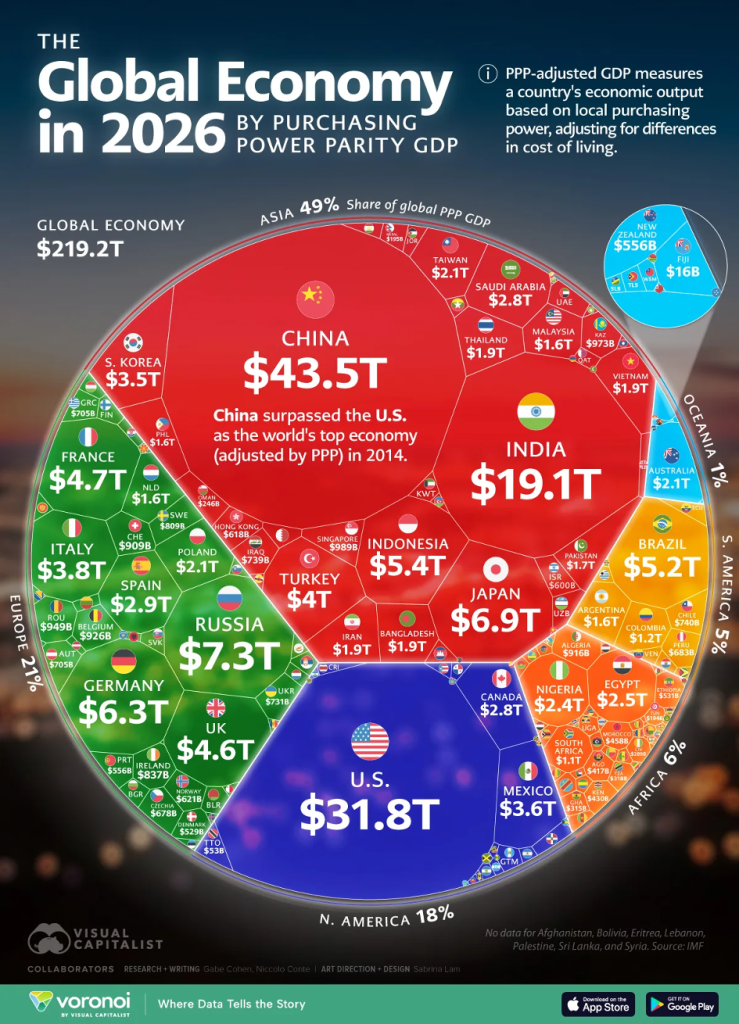
According to this calculation, China ranks ahead of the US, Russia ahead of Japan, and Germany.
Furthermore, the Collective West, as the aggressor, finds itself in a domestic political and economic situation that does not allow for a military showdown with Russia, Iran, and China: US debt stands at over 121%—the last time this was the case was at the end of World War II, following an industrial war that brought the US global dominance. After 35 years, and under economic and political conditions that remained favorable to the US, this debt was reduced to below 40%.
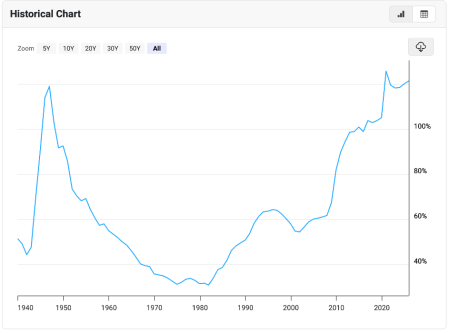
 Source: Macrotrends
In 1945, the Americans reached the height of their power. Together with the Soviet Union, they dominated the course of the war, held 22,000 metric tons of gold, and American industry produced 70% of the world’s manufactured goods. This is what true “full spectrum dominance” looks like: military dominance, industrial dominance, gold—because whoever has the gold sets the rules. Now the US is once again facing a world war, and the situation looks much like it did after the last war, with one major difference: China is at least the US’s economic equal, with far more favorable economic conditions.
These are not the conditions necessary for a military conflict on a global scale—neither financially, nor economically, nor, consequently, politically.
Middle East
It is clear from the text of the MOU that Iran has defeated both Israel and the US militarily; otherwise, the Americans would never have signed such a document. Israel cannot, without risking the collapse of its own delusions of great-power status, comply with the spirit of the document and end the war in Lebanon and Gaza. Therefore, there will be no peace.
Our comments on this topic: “Iran Defeats the US – Thoughts.” In Iran, voices are growing louder claiming that the president and foreign minister are not negotiating hard enough—public pressure in Iran is calling for a tougher stance toward the US and Israel. Iran’s Supreme Leader, Mojtaba Khamenei, has approved the memorandum of understanding (MoU) with the US to end the regional war under certain conditions. However, in a public statement, he said that he fundamentally held a “different view,” but had agreed to the agreement after receiving guarantees from President Masoud Pezeshkian that Iran’s national rights and the “Resistance Front” would be safeguarded. This is a clear indication that the Iranians are ultimately unwilling to make compromises at the expense of Lebanon and Gaza.
It is to be expected that the conflict in the Middle East will continue: Neither the US nor Israel is willing to accept defeat in the war and deal with its consequences. This stance maintains a state of limbo that could tip in one direction or the other at any moment. However, this strategy is countered by the fact that time is running out for the West because of Hormuz. The dwindling oil reserves were the main reason the US signed this MOU in its current form in the first place. The Americans are thus seeking a state of limbo that allows them to prepare their next military steps in peace; however, this state can only be maintained if the Strait of Hormuz remains open in the meantime. While approximately 130 ships passed through the Strait of Hormuz daily until February 28, 2026, these numbers dropped to practically zero, then stabilized at 5%–10% of pre-war levels, before surging to 70 ships on June 25, 2026. These figures should be treated with caution: It is said that the majority of these 70 ships were exporting oil from Iran after the US lifted the oil sanctions upon signing the agreement. If the Israelis do not withdraw from Lebanon and the Iranians remain steadfast—which is to be expected—then the Strait of Hormuz will remain a congested bottleneck: the time bomb for the West’s supply of raw materials continues to tick.
The Iranians can wait—the Americans cannot. When assessing the situation, one should simply disregard Donald Trump’s statements, because Trump speaks of peace one moment and war the next, changing his mind sometimes several times a day. He seems to believe that he can achieve something with the Iranians through this “New York-style deal-making” terror, but that is not the case, since he achieves only one thing: Americans are increasingly proving themselves to be agreement incapable, thereby threatening world peace.
War in Europe
The armed conflict in Ukraine, instigated by the West, began in 2014. Only those who do not classify Ukraine’s years-long artillery shelling of the Donbass as an act of war claim that the Russians started the war in February 2022. This is just one fact that is so obvious that one can only wonder at the West’s arguments that Russia is the aggressor.
Another fact is that this war has completely transformed the technology and tactics of warfare—the parties had to adapt to a new kind of war dominated by drones and missiles. Tank columns and troop concentrations are attacked by inexpensive drones as soon as they are detected—and they are detected very quickly. The warring parties had to undergo migration and learn this new art of warfare. The Russians, in particular, have done this successfully and now dominate the battlefield in a new way: through slow, efficient advances, because massed attacks produce only one thing—heavy casualties. Similar waves of technological advancement have occurred time and again. The machine gun, which was already in use before World War I but whose significance was underestimated at the time, brought an end to maneuver warfare as early as the first year of the war, when large columns of soldiers advanced toward the enemy and were wiped out. Toward the end of World War I, the tank brought some movement back to the front lines. However, comparing the frontline situation in Ukraine to that of World War I is a flawed analogy: Slow movements in small groups seem, so far, to be the only way to survive the drone barrage and maintain mobility.
Recently, Western media have been reporting that the Ukrainians have the upper hand in the war. However, this is fake news that has nothing to do with the reality on the ground. One must distinguish between the fighting on the front lines and NATO’s drone attacks in Russia. On the Donbass front, only a few fortified cities still stand in the Russians’ way; once those are taken, the Donbass will be liberated. Beyond that, there are no longer any fortifications worth taking seriously. Rather than going into details, I refer you to one of the best channels, Military Summary, which has been providing a twice-daily update on the situation at the front since the war began.
The West has not yet recognized the signs of the times. Its experts believe they will be successful in a war against Russia. However, they have not even defined their war aims in any way. Thus, they have no strategic plan against Russia other than to weaken it.
First and foremost, the Germans set the start of the war against Russia for 2030. However, it is now 2026, and the Germans apparently assume that, with Ukraine acting as their proxy, they can send drones and cruise missiles into Russia with impunity until 2030. Europe’s approach is, of course, coordinated with the US. The use of these weapons systems is not possible without American input. President Putin made this very clear a few days ago.
Many observers and experts both inside and outside Russia believe that President Putin will soon decide to launch a strike against targets in Europe—including those outside Ukraine.
There is a wide range of opinions on this topic. We have already published several articles on this subject: In “Will 1914 Repeat Itself? Will War Between Europe and Russia Finally Break Out?,” we also examined the Karaganov Doctrine, which advocates the use of nuclear weapons, and concluded that an attack is necessary, but not with nuclear weapons. Scott Ritter subsequently addressed the “Karaganov fallacy” and also spoke out clearly against the use of nuclear weapons.
Conclusion
In the Middle East, I see no realistic chance of ending the war, because that would mean, on the one hand, the withdrawal of American forces, and Israel would then be left alone as a small, genocidal aggressor. The Israelis are under pressure and are continuing their genocide in Gaza and Lebanon, paying no heed whatsoever to agreements between the US and Iran, because for Netanyahu personally, maintaining the war is the only way to survive politically.
In Russia, pressure is mounting on President Putin to adopt a more aggressive stance toward Europe, which is no longer even attempting to conceal its direct involvement in the war against Russia. Russia is intensifying its attacks on Ukraine, in part by destroying every gas station in eastern Ukraine to paralyze transportation logistics. Ground forces are making visible progress, and once the last fortified cities in the Donbas are liberated—which is likely to happen within the next few weeks—the path to the Dnieper will be clear.
President Putin is thus banking on a military solution in Ukraine and waiting for an energy crisis to unfold in Europe, where many flights are already being canceled under flimsy pretexts.
The concerted media coverage in the West claiming that the tide has turned in Ukraine finds not the slightest confirmation in the reality on the ground in Ukraine. The fuel shortage in Russia is also being exaggerated. In some regions, fuel is being rationed at gas stations. However, this is in no way sufficient to change Russia’s course of action.
Very occasionally, I have the opportunity to speak with someone who lives in Kyiv. According to this person, the situation is catastrophic, and over 90% of the population is against Zelensky. When I asked why the people weren’t rising up, the source replied that people were so intimidated by the terror of the security and intelligence services that the communication necessary for an uprising was impossible. Ukraine, which is portrayed by the West as a shining example of democracy, seems to be a time bomb whose ticking goes unheard out of fear.
My concerns that a war between Europe and Russia might break out—even though Europe has virtually no military power—have never been greater. President Putin will not be the one to take the first step toward a Third World War. Only he knows how much longer he will tolerate the West’s systematic provocations and how he will respond to them.
Mario Nawfal | July 3, 2026
Dialogue Works | July 2, 2026
Substack: https://substack.com/@dialogueworks?u…
X (Twitter): https://x.com/Dialogue_NRA
Patreon: https://patreon.com/Dialogueworks?utm…
Buy Me a Coffee: https://buymeacoffee.com/dialogueworks
Leadership has spun, misled, and kept the populace in the dark through many wars during the country’s 250-year history. This may be the worst.
By Gregory Daddis | Responsible Statecraft | July 3, 2026
When it comes to war, the Trump administration faces a credibility problem. According to CNN, between late March and early June, the president claimed he was on the verge of reaching a peace deal with Iran at least 38 times. Such fabrications came nearly a full year after Trump declared that Iran’s nuclear facilities had been “obliterated” and suffered “monumental damage.”
Secretary of Defense Pete Hegseth has been equally sanguine these past months, bragging at one April Pentagon press conference that Operation Epic Fury, the campaign against Iran launched on February 28, had been “a historic and overwhelming victory on the battlefield, a capital-V military victory.” And yet the war continued on.
Now, a tenuous “memorandum of understanding” to reopen the Strait of Hormuz and lift Iranian sanctions, while raising alarm among some members of Congress, has been painted by Trump as a major win thanks to a “record high” stock market and “tumbling” oil prices.
Such optimistic yet fallacious progress reports elicit memories of another American war in which credibility became contested ground, both at home and abroad. The lies of Vietnam created a “credibility gap” between the White House and American public — one that has now turned into a credibility chasm undermining the trust necessary for political leaders to deliver on their national security promises.
It is with good reason that the American war in Vietnam has come to be seen as one of the most contentious conflicts in our nation’s 250-year history. The political-military struggle set a historical benchmark for how we talk about — and lie about — war. Distortion and deception seemed indivisible from the very conduct of American military interventionism.
The duplicity started early. Gen. Paul D. Harkins, the first chief of the U.S. military assistance command in Vietnam, openly boasted that “I am an optimist, and I am not going to allow my staff to be pessimistic.” Not surprisingly, rosy reports flowed into Washington. The communist insurgents were diminishing in strength and influence. The Saigon government was attracting loyalty among the rural population. The war was being won.
In August 1964, months after Harkins’ tour ended, Washington Post reporter Arnold Beichman shared a popular refrain Americans were still singing outside of Saigon. “We are winning, this we know / General Harkins tells us so.” When Beichman asked a group of U.S. advisors if they thought the South Vietnamese indeed were winning, they unanimously declared “no.”
Less than a year later, there seemed little doubt about the U.S. advisory mission’s inability to stanch the communist tide. In the spring of 1965, President Lyndon Johnson dispatched ground combat troops to South Vietnam at the behest of senior military commanders. At Johns Hopkins University that April, the president suggested he had little choice but to escalate. “We do this in order to slow down aggression,” he shared.
But the falsehoods only multiplied. Johnson spoke of the “deepening shadow of Communist China,” masking the reality that this conflict was, at its core, a Vietnamese civil conflict. He spoke of strengthening the world order by defeating North Vietnam, avoiding questions of how such a small Southeast Asian country could pack such a huge international wallop. And he spoke of increasing “the confidence of the brave people of South Vietnam,” overlooking the damage being done by American firepower on an already dispossessed rural population.
As American troops poured into South Vietnam, journalists took note of the disconnects between official White House narratives and their own observations. David Wise of the New York Herald Tribune first used the term “credibility gap” in May 1965, followed by Murrey Marder of the Washington Post that December. Marder found “creeping signs of doubt and cynicism about Administration pronouncements” and a “perceptibly growing distrust… about the candor or validity of official declarations.”
White House untrustworthiness was undermining U.S. foreign policy. Worse was yet to come.
By the summer of 1967, two years after U.S. Marines first landed at Da Nang, the war had devolved into a blood-stained impasse. The military command in Vietnam dutifully reported progress at daily press briefings, disparagingly called the “Five O’clock Follies” by skeptical journalists. Back home, the media increasingly spoke of a “stalemate” that only “moved to a higher level of combat, casualties, and destruction.”
Concerned about growing domestic discord, the president summoned home his war managers to help “sell” the war. In November, General William Westmoreland, Harkins’ successor, and U.S. Ambassador Ellsworth Bunker presented an optimistic report on Meet the Press. The general highlighted “significant evidence” of “real progress being made,” while Bunker intimated that media reports were misrepresenting the allied war effort. Days later, the president castigated the disparities between “constructive dissent and storm-trooper bullying.”
Then the walls crumbled. In early 1968, Vietnamese communists launched a general offensive across South Vietnam during the Tet holiday, hoping to spur a general uprising among the southern population. The American public relations campaign came crashing down as television viewers back home watched military police fighting across shattered U.S. embassy grounds.
When word of the attacks reached respected news broadcaster Walter Cronkite, his reaction mirrored many of his fellow Americans. “What the hell is going on,” he reportedly asked. “I thought we were winning the war.” And still, the war dragged on.
By the time of Richard Nixon’s presidency, in historian Christian Appy’s words, “the credibility gap took on Grand Canyon-like proportions.” The New York Times’ June 1972 decision to publish the “Pentagon Papers,” a classified record of duplicitous decisions leading the nation to war, surely aided in this massive breakdown of trust. When asked to justify leaking the secret report, whistleblower Daniel Ellsberg turned the tables, asking what made officials “feel like they had a right to keep silent about the lies that had been told… the crimes that had been committed, the illegalities, the deception of the American public?”
The lies of which Ellsberg spoke matter because they endure, having been replicated, if not intensified, by a Trump administration indifferent to being truthful about the causes, conduct, and consequences of war. Indeed, the administration seemingly has gone out of its way to hide any inconvenient truth from the American public. Earlier this month, Secretary Hegseth declared the Pentagon press office a “classified space,” curtailing journalists’ ability to report on national security issues. The Five O’clock Follies look comparatively transparent.
Of course, Vietnam was not the only case of political leaders using deception to justify military adventurism. The Bush administration’s decision to invade Iraq in 2003, for instance, was far less an “intelligence failure” than a comprehensive case of intelligence manipulation.
Yet the war in Vietnam, perhaps better than any conflict over the nation’s 250-year history, lays bare how dishonesty perpetuates conflict and how the responsibility, if not burden, of citizens in a democracy is to demand a more truthful accounting of wartime decision-making and to question overzealous “progress” reports.
Historian Barbara Tuchman thought the solution for opposing senior officials who peddle falsehoods lay outside the halls of government. Writing less than a decade after Saigon’s fall, she believed that avoiding similar “betrayals” like the one in Vietnam depended upon “educating the electorate to recognize and reward integrity of character and to reject the ersatz.”
If Americans haven’t necessarily rewarded integrity at the ballot box lately, we shouldn’t lose hope that credibility and character still matter when it comes to wartime leadership. There is no better time than our 250th anniversary to demand that our leaders shrink the credibility chasm that we are peering across today.
This article is part of an RS series reflecting on the 250th anniversary of American Independence and its impact and meaning for modern U.S. foreign policy, war, and peace.
Gregory A. Daddis is the Melbern G. Glasscock Endowed Chair in American History at Texas A&M University and author of Faith and Fear: America’s Relationship with War since 1945 (2025). He served 26 years in the U.S. Army before entering academia and is a board member of the Quincy Institute.

or go to
Aletho News Archives – Video-Images
By Kit Klarenberg | Al Mayadeen | July 11, 2024
Almost immediately after the proxy war erupted, ISIS-tier footage of the torture and murder of Russians in Ukrainian custody emerged.
On July 6th, the New York Times published an astonishing investigation: In Ukraine, Killings of Surrendering Russians Divide an American-Led Unit. The article documents in grim detail how Chosen Company, an international volunteer battalion for Kiev, routinely executes Russian prisoners of war. It is the very first mainstream admission that this practice – a brazen breach of the Geneva Conventions, and a grave war crime – is widespread among Ukraine’s fighters, both foreign and homegrown. … continue
 Aletho News If Americans Knew No Tricks Zone
