How Twitter Aided the Pentagon’s Covert Online Propaganda Campaign
Documents and emails from Twitter detail the extensive secret assistance the social media platform gave to CENTCOM’s influence operations
BY LEE FANG | DECEMBER 20, 2023
One year ago, I published my first investigation based on documents I obtained through the “Twitter Files.” I visited the San Francisco office of the social media company several times and took many notes. Below, I am republishing my initial investigation, which explores the secret assistance that Twitter gave to the Pentagon to assist with a fake account network used to manipulate Arabic-language communities in the Middle East. Twitter claimed that it shut down all state-backed influence operations, yet gave special tools to the U.S. military for its propaganda network.
TWITTER EXECUTIVES HAVE claimed for years that the company makes concerted efforts to detect and thwart government-backed covert propaganda campaigns on its platform.
Behind the scenes, however, the social networking giant provided direct approval and internal protection to the U.S. military’s network of social media accounts and online personas, whitelisting a batch of accounts at the request of the government. The Pentagon has used this network, which includes U.S. government-generated news portals and memes, in an effort to shape opinion in Yemen, Syria, Iraq, Kuwait, and beyond.
The accounts in question started out openly affiliated with the U.S. government. But then the Pentagon appeared to shift tactics and began concealing its affiliation with some of these accounts — a move toward the type of intentional platform manipulation that Twitter has publicly opposed. Though Twitter executives maintained awareness of the accounts, they did not shut them down, but let them remain active for years. Some remain active.
The revelations are buried in the archives of Twitter’s emails and internal tools, to which The Intercept was granted access for a brief period last week alongside a handful of other writers and reporters. Following Elon Musk’s purchase of Twitter, the billionaire started giving access to company documents, saying in a Twitter Space that “the general idea is to surface anything bad Twitter has done in the past.” The files, which included records generated under Musk’s ownership, provide unprecedented, if incomplete, insight into decision-making within a major social media company.
Twitter did not provide unfettered access to company information; rather, for three days last week, they allowed me to make requests without restriction that were then fulfilled on my behalf by an attorney, meaning that the search results may not have been exhaustive. I did not agree to any conditions governing the use of the documents, and I made efforts to authenticate and contextualize the documents through further reporting. The redactions in the embedded documents in this story were done to protect privacy, not Twitter.
THE DIRECT ASSISTANCE Twitter provided to the Pentagon goes back at least five years.
On July 26, 2017, Nathaniel Kahler, at the time an official working with U.S. Central Command — also known as CENTCOM, a division of the Defense Department — emailed a Twitter representative with the company’s public policy team, with a request to approve the verification of one account and “whitelist” a list of Arab-language accounts “we use to amplify certain messages.”
“We’ve got some accounts that are not indexing on hashtags — perhaps they were flagged as bots,” wrote Kahler. “A few of these had built a real following and we hope to salvage.” Kahler added that he was happy to provide more paperwork from his office or SOCOM, the acronym for the U.S. Special Operations Command.
Twitter at the time had built out an expanded abuse detection system aimed in part toward flagging malicious activity related to the Islamic State and other terror organizations operating in the Middle East. As an indirect consequence of these efforts, one former Twitter employee explained, accounts controlled by the military that were frequently engaging with extremist groups were being automatically flagged as spam. The former employee, who was involved with the whitelisting of CENTCOM accounts, spoke under condition of anonymity because they were not authorized to speak publicly.
In his email, Kahler sent a spreadsheet with 52 accounts. He asked for priority service for six of the accounts, including @yemencurrent, an account used to broadcast announcements about U.S. drone strikes in Yemen. Around the same time, @yemencurrent, which has since been deleted, had emphasized that U.S. drone strikes were “accurate” and killed terrorists, not civilians, and promoted the U.S. and Saudi-backed assault on Houthi rebels in that country.
Other accounts on the list were focused on promoting U.S.-supported militias in Syria and anti-Iran messages in Iraq. One account discussed legal issues in Kuwait. Though many accounts remained focused on one topic area, others moved from topic to topic. For instance, @dala2el, one of the CENTCOM accounts, shifted from messaging around drone strikes in Yemen in 2017 to Syrian government-focused communications last year.
On the same day that CENTCOM sent its request, members of Twitter’s site integrity team went into an internal company system used for managing the reach of various users and applied a special exemption tag to the accounts, internal logs show.
One engineer, who asked not to be named because he was not authorized to speak to the media, said that he had never seen this type of tag before, but upon close inspection, said that the effect of the “whitelist” tag essentially gave the accounts the privileges of Twitter verification without a visible blue check. Twitter verification would have bestowed a number of advantages, such as invulnerability to algorithmic bots that flag accounts for spam or abuse, as well as other strikes that lead to decreased visibility or suspension.
KAHLER TOLD TWITTER that the accounts would all be “USG-attributed, Arabic-language accounts tweeting on relevant security issues.” That promise fell short, as many of the accounts subsequently deleted disclosures of affiliation with the U.S. government.
The Internet Archive does not preserve the full history of every account, but we identified several accounts that initially listed themselves as U.S. government accounts in their bios, but, after being whitelisted, shed any disclosure that they were affiliated with the military and posed as ordinary users.
This appears to align with a major report published in August by online security researchers affiliated with the Stanford Internet Observatory, which reported on thousands of accounts that they suspected to be part of a state-backed information operation, many of which used photorealistic human faces generated by artificial intelligence, a practice also known as “deep fakes.”
The researchers connected these accounts with a vast online ecosystem that included “fake news” websites, meme accounts on Telegram and Facebook, and online personalities that echoed Pentagon messages often without disclosure of affiliation with the U.S. military. Some of the accounts accuse Iran of “threatening Iraq’s water security and flooding the country with crystal meth,” while others promoted allegations that Iran was harvesting the organs of Afghan refugees.
The Stanford report did not definitively tie the sham accounts to CENTCOM or provide a complete list of Twitter accounts. But the emails I obtained show that the creation of at least one of these accounts was directly affiliated with the Pentagon.
One of the accounts that Kahler asked to have whitelisted, @mktashif, was identified by the researchers as appearing to use a deep-fake photo to obscure its real identity. Initially, according to the Wayback Machine, @mktashif did disclose that it was a U.S. government account affiliated with CENTCOM, but at some point, this disclosure was deleted and the account’s photo was changed to the one Stanford identified as a deep fake. The new Twitter bio claimed that the account was an unbiased source of opinion and information, and, roughly translated from Arabic, “dedicated to serving Iraqis and Arabs.” The account, before it was suspended last year, routinely tweeted messages denouncing Iran and other U.S. adversaries, including Houthi rebels in Yemen.
Another CENTCOM account, @althughur, which posts anti-Iran and anti-ISIS content focused on an Iraqi audience, changed its Twitter bio from a CENTCOM affiliation to an Arabic phrase that simply reads “Euphrates pulse.”
The former Twitter employee told me that they were surprised to learn of the Defense Department’s shifting tactics. “It sounds like DOD was doing something shady and definitely not in line with what they had presented to us at the time,” they said.
Twitter did not respond to a request for comment.
“It’s deeply concerning if the Pentagon is working to shape public opinion about our military’s role abroad and even worse if private companies are helping to conceal it,” said Erik Sperling, the executive director of Just Foreign Policy, a nonprofit that works toward diplomatic solutions to foreign conflicts.
“Congress and social media companies should investigate and take action to ensure that, at the very least, our citizens are fully informed when their tax money is being spent on putting a positive spin on our endless wars,” Sperling added.
FOR MANY YEARS, Twitter has pledged to shut down all state-backed disinformation and propaganda efforts, never making an explicit exception for the U.S. In 2020, Twitter spokesperson Nick Pickles, in a testimony before the House Intelligence Committee, said that the company was taking aggressive efforts to shut down “coordinated platform manipulation efforts” attributed to government agencies.
“Combatting attempts to interfere in conversations on Twitter remains a top priority for the company, and we continue to invest heavily in our detection, disruption, and transparency efforts related to state-backed information operations. Our goal is to remove bad-faith actors and to advance public understanding of these critical topics,” said Pickles.
In 2018, for instance, Twitter announced the mass suspension of accounts tied to Russian government-linked propaganda efforts. Two years later, the company boasted of shutting down almost 1,000 accounts for association with the Thai military. But rules on platform manipulation, it appears, have not been applied to American military efforts.
The emails obtained by The Intercept show that not only did Twitter whitelist these accounts in 2017 explicitly at the behest of the military, but also that high-level officials at the company discussed the accounts as potentially problematic in the following years.
In the summer of 2020, officials from Facebook reportedly identified fake accounts attributed to CENTCOM’s influence operation on its platform and warned the Pentagon that if Silicon Valley could easily out these accounts as inauthentic, so could foreign adversaries, according to a September report in the Washington Post.
Twitter emails show that during that time in 2020, Facebook and Twitter executives were invited by the Pentagon’s top attorneys to attend classified briefings in a sensitive compartmented information facility, also known as a SCIF, used for highly sensitive meetings.
“Facebook have had a series of 1:1 conversations between their senior legal leadership and DOD’s [general counsel] re: inauthentic activity,” wrote Yoel Roth, then the head of trust and safety at Twitter. “Per FB,” continued Roth, “DOD have indicated a strong desire to work with us to remove the activity — but are now refusing to discuss additional details or steps outside of a classified conversation.”
Stacia Cardille, then an attorney with Twitter, noted in an email to her colleagues that the Pentagon may want to retroactively classify its social media activities “to obfuscate their activity in this space, and that this may represent an overclassification to avoid embarrassment.”
Jim Baker, then the deputy general counsel of Twitter, in the same thread, wrote that the Pentagon appeared to have used “poor tradecraft” in setting up various Twitter accounts, sought to potentially cover its tracks, and was likely seeking a strategy for avoiding public knowledge that the accounts are “linked to each other or to DoD or the USG.” Baker speculated that in the meeting the “DoD might want to give us a timetable for shutting them down in a more prolonged way that will not compromise any ongoing operations or reveal their connections to DoD.”
What was discussed at the classified meetings — which ultimately did take place, according to the Post — was not included in the Twitter emails provided to The Intercept, but many of the fake accounts remained active for at least another year. Some of the accounts on the CENTCOM list remain active even now — like this one, which includes affiliation with CENTCOM, and this one, which does not — while many were swept off the platform in a mass suspension on May 16.
In a separate email sent in May 2020, Lisa Roman, then a vice president of the company in charge of global public policy, emailed William S. Castle, a Pentagon attorney, along with Roth, with an additional list of Defense Department Twitter accounts. “The first tab lists those accounts previously provided to us and the second, associated accounts that Twitter has discovered,” wrote Roman. It’s not clear from this single email what Roman is requesting – she references a phone call preceding the email — but she notes that the second tab of accounts — the ones that had not been explicitly provided to Twitter by the Pentagon — “may violate our Rules.” The attachment included a batch of accounts tweeting in Russian and Arabic about human rights violations committed by ISIS. Many accounts in both tabs were not openly identified as affiliated with the U.S. government.
Twitter executives remained aware of the Defense Department’s special status. This past January, a Twitter executive recirculated the CENTCOM list of Twitter accounts originally whitelisted in 2017. The email simply read “FYI” and was directed to several Twitter officials, including Patrick Conlon, a former Defense Department intelligence analyst then working on the site integrity unit as Twitter’s global threat intelligence lead. Internal records also showed that the accounts that remained from Kahler’s original list are still whitelisted.
Following the mass suspension of many of the accounts this past May, Twitter’s team worked to limit blowback from its involvement in the campaign.
Shortly before publication of the Washington Post story in September, Katie Rosborough, then a communications specialist at Twitter, wrote to alert Twitter lawyers and lobbyists about the upcoming piece. “It’s a story that’s mostly focused on DoD and Facebook; however, there will be a couple lines that reference us alongside Facebook in that we reached out to them [DoD] for a meeting. We don’t think they’ll tie it to anything Mudge-related or name any Twitter employees. We declined to comment,” she wrote. (Mudge is a reference to Peiter Zatko, a Twitter whistleblower who filed a complaint with federal authorities in July, alleging lax security measures and penetration of the company by foreign agents.)
After the Washington Post’s story published, the Twitter team congratulated one another because the story minimized Twitter’s role in the CENTCOM psyop campaign. Instead, the story largely revolved around the Pentagon’s decision to begin a review of its clandestine psychological operations on social media.
“Thanks for doing all that you could to manage this one,” wrote Rebecca Hahn, another former Twitter communications official. “It didn’t seem to get too much traction beyond verge, cnn and wapo editors promoting.”
CENTCOM did not initially provide comment to The Intercept. Following publication of this story, CENTCOM’s media desk referred The Intercept to Brigadier Gen. Pat Ryder’s comments in a September briefing, in which he said that the Pentagon had requested “a review of Department of Defense military information support activities, which is simply meant to be an opportunity for us to assess the current work that’s being done in this arena, and really shouldn’t be interpreted as anything beyond that.”
THE U.S. MILITARY and intelligence community have long pursued a strategy of fabricated online personas and third parties to amplify certain narratives in foreign countries, the idea being that an authentic-looking Persian-language news portal or a local Afghan woman would have greater organic influence than an official Pentagon press release.
Military online propaganda efforts have largely been governed by a 2006 memorandum. The memo notes that the Defense Department’s internet activities should “openly acknowledge U.S. involvement” except in cases when a “Combatant Commander believes that it will not be possible due to operational considerations.” This method of nondisclosure, the memo states, is only authorized for operations in the “Global War on Terrorism, or when specified in other Secretary of Defense execute orders.”
In 2019, lawmakers passed a measure known as Section 1631, a reference to a provision of the National Defense Authorization Act, further legally affirming clandestine psychological operations by the military in a bid to counter online disinformation campaigns by Russia, China, and other foreign adversaries.
In 2008, the U.S. Special Operations Command opened a request for a service to provide “web-based influence products and tools in support of strategic and long-term U.S. Government goals and objectives.” The contract referred to the Trans-Regional Web Initiative, an effort to create online news sites designed to win hearts and minds in the battle to counter Russian influence in Central Asia and global Islamic terrorism. The contract was initially carried out by General Dynamics Information Technology, a subsidiary of the defense contractor General Dynamics, in connection with CENTCOM communication offices in the Washington, D.C., area and in Tampa, Florida.
A program known as “WebOps,” run by a defense contractor known as Colsa Corp., was used to create fictitious online identities designed to counter online recruitment efforts by ISIS and other terrorist networks.
I spoke to a former employee of a contractor — on the condition of anonymity for legal protection — engaged in these online propaganda networks for the Trans-Regional Web Initiative. He described a loose newsroom-style operation, employing former journalists, operating out of a generic suburban office building.
“Generally what happens, at the time when I was there, CENTCOM will develop a list of messaging points that they want us to focus on,” said the contractor. “Basically, they would, we want you to focus on say, counterterrorism and a general framework that we want to talk about.”
From there, he said, supervisors would help craft content that was distributed through a network of CENTCOM-controlled websites and social media accounts. As the contractors created content to support narratives from military command, they were instructed to tag each content item with a specific military objective. Generally, the contractor said, the news items he created were technically factual but always crafted in a way that closely reflected the Pentagon’s goals.
“We had some pressure from CENTCOM to push stories,” he added, while noting that he worked at the sites years ago, before the transition to more covert operations. At the time, “we weren’t doing any of that black-hat stuff.”
Google Experiments With “Faster and More Adaptable” Censorship of “Harmful” Content Ahead of 2024 US Elections
By Tom Parker | Reclaim The Net | December 20, 2023
In the run-up to the 2020 US presidential election, Big Tech engaged in unprecedented levels of election censorship, most notably by censoring the New York Post’s bombshell Hunter Biden laptop story just a few weeks before voters went to the polls.
And with the 2024 US presidential election less than a year away, both Google and its video sharing platform, YouTube, have confirmed that they plan to censor content they deem to be “harmful” in the run-up to the election.
In its announcement, Google noted that it already censors content that it deems to be “manipulated media” or “hate and harassment” — two broad, subjective terms that have been used by tech giants to justify mass censorship.
However, ahead of 2024, the tech giant has started using large language models (LLMs) to experiment with “building faster and more adaptable” censorship systems that will allow it to “take action even more quickly when new threats emerge.”
Google will also be censoring election-related responses in Bard (its generative AI chatbot) and Search Generative Experience (its generative AI search results).
In addition to these censorship measures, Google will be continuing its long-standing practice of artificially boosting content that it deems to be “authoritative” in Google Search and Google News. While this tactic doesn’t result in the removal of content, it can result in disfavored narratives being suppressed and drowned out by these so-called authoritative sources, which are mostly pre-selected legacy media outlets.
Like Google, YouTube confirmed that it will enforce its existing censorship policies ahead of the 2024 elections, including those that apply to election “misinformation” and “harmful conspiracy theories.” These policies resulted in the censorship of tens of thousands of videos and many popular channels in the buildup to and aftermath of the 2020 presidential election.
The video sharing platform will also boost videos from authoritative sources — a policy that resulted in independent creators being 14x less likely to be recommended on election-related content after the 2020 elections.
Additionally, YouTube will demonetize videos that it deems to contain “demonstrably false claims that could undermine trust or participation in elections.”
Outside of these direct censorship tactics, YouTube will label “altered or synthetic election content” that doesn’t violate any of its rules. Although these labels won’t result in content suppression, similar labels on other platforms have confused users and resulted in them believing that real but selectively edited videos are fake. Plus, legacy media outlets often use these labels to bolster their censorship demands.
Collectively, these announcements from Google and YouTube signal an intention to supercharge the mass censorship playbook that was deployed during the 2020 election and resulted in a two-tiered system where independent creators that dared to have dissenting or alternative opinions about the election were censored while legacy media outlets had their election narrative boosted across Google’s platforms.
Related:
Every Legal Option Must Be Explored to Remove Trump From California Ballot – Lt. Governor
Sputnik – 20.12.2023
WASHINGTON – California Lieutenant Governor Eleni Kounalakis on Wednesday wrote to Secretary of State Shirley Weber demanding that she explore “every legal option” to remove former President Donald Trump from the state’s 2024 ballot.
“Based on the Colorado Supreme Court’s ruling in Anderson v. Griswold (2023 CO 63), I urge you [Weber] to explore every legal option to remove former President Donald Trump from California’s 2024 presidential ballot,” Kounalakis wrote in her letter.
Kounalakis said she was prompted by the ruling to conclude that Trump is ineligible to appear on the state ballot as a presidential candidate due to his alleged involvement in the so-called insurrection on January 6, 2021. Kounalakis also said Colorado’s decision could serve as the basis for a similar decision in California.
“California must stand on the right side of history,” the letter said. “The constitution is clear: you must be 40 years old and not be an insurrectionist.”
The White house has said on its website that the US Constitution lists three qualifications for the presidency – the president must be at least 35 years old, be a natural born citizen and must have lived in the United States for at least 14 years.
On Tuesday night, the Colorado Supreme Court ruled that Trump is disqualified from the 2024 Republican primary ballot due to his role in the events on January 6 at the US Capitol, citing the 14th Amendment of the US Constitution. The amendment restricts people who are engaged in insurrection from holding public office.
The Trump campaign described the Colorado Supreme Court’s ruling as being a “flowed decision” and said they will appeal.
If US can clear way for ‘cease-fire in Gaza’, Red Sea problem would be solved
By Yang Sheng | Global Times | December 19, 2023
The US-led joint patrol in the Red Sea following Houthi militia attacks against ships heading toward Israel shows that the Palestinian-Israeli conflict in Gaza is not only affecting the whole region, but also the international community. Chinese analysts pointed out that the root cause of the trade route problem is the ongoing conflict in Gaza, and only a sustainable cease-fire and allowing humanitarian aid to enter Gaza via land and sea routes can solve the problem in the Red Sea.
China will pay close attention to the situation, and Chinese naval vessels that conduct UN authorized anti-piracy missions in the region will keep performing their duty, analysts said, adding that China will stick to the priority of realizing a cease-fire and clear the way for humanitarian aid for the people in Gaza, rather than joining the US to conduct any military operations without UN authorization to escalate the crisis in Gaza.
The US and a host of other nations are creating a new force to protect ships transiting the Red Sea that have come under attack by drones and ballistic missiles fired from Houthi-controlled areas of Yemen, Defense Secretary Lloyd Austin announced Tuesday in Bahrain, the AP reported.
The UK, Bahrain, Canada, France, Italy, Netherlands, Norway, Seychelles and Spain have joined, Austin said. Some of those countries will conduct joint patrols while others will provide intelligence support in the southern Red Sea and the Gulf of Aden.
The Houthi militia attacked two commercial ships in the Red Sea with naval drones on Monday. The recent attacks have caused concerns about the impact on the passage of oil, grain and other goods on what is an important global trade route, and have pushed up the cost of insuring and shipping goods through the Red Sea, Reuters reported.
The Shanghai-based news website The Paper reported on Tuesday that following other international shipping companies including Denmark’s Maersk and France’s CMA, Chinese shipping giants like COSCO and Orient Overseas Container Line (OOCL) also suspended transport through the Red Sea.
Ma Xiaolin, dean of the Institute for Studies on the Mediterranean Rim at Zhejiang International Studies University, told the Global Times on Tuesday that the trade route via the Red Sea is truly important for China as it connects Europe, Asia and Africa, so China will pay close attention to the situation.
“However, although China has naval vessels in the region, their mission is about anti-piracy, rather than intervening in regional issues and other countries’ internal affairs. Only a solution to the ongoing crisis in Gaza can effectively solve the problem in the Red Sea,” Ma said.
On December 9, Al Jazeera reported that the armed group in Yemen claimed that “it will target all ships heading to Israel, regardless of their nationality, and warned all international shipping companies against dealing with Israeli ports.”
“If Gaza does not receive the food and medicines it needs, all ships in the Red Sea bound for Israeli ports, regardless of their nationality, will become a target for our armed forces,” the group’s spokesperson said in a statement on Saturday, according to Al Jazeera.
Song Zhongping, a Chinese military expert and TV commentator, told the Global Times on Tuesday that the “Houthis are specifically targeting Israel, so it’s unlikely it will attack Chinese vessels. China doesn’t need to be too worried about the situation and the Chinese warships in the region will stick to their plan.”
“China will keep making efforts to realize a sustainable cease-fire and clear the way for humanitarian aid to get into the Gaza Strip. This is the real priority that needs to be done,” Wang Jin, an associate professor at the Institute of Middle Eastern Studies at Northwest University, told the Global Times on Tuesday.
If Washington and its allies want to solve the Red Sea problem, they should play a responsible role in the UN Security Council to pass a cease-fire resolution and to put concrete efforts into improving the humanitarian situation in Gaza, which would be more effective than sending warships to conduct joint patrols, experts said.
The humanitarian situation in Gaza remains severe. According to Reuters on Tuesday, Israeli missiles and air strikes on the Rafah area in southern Gaza struck three houses killing at least 20 Palestinians, Gaza health officials said on Tuesday. Tens of thousands of displaced Palestinians have crammed into Rafah on Gaza’s border with Egypt to escape Israeli bombardments.
The lack of unity in the UN that is mainly caused by the US is another key reason why the situation is far from easing. The UN Security Council delayed until Tuesday morning a vote on an Arab-sponsored resolution calling for a halt to hostilities in Gaza to allow for urgently needed aid deliveries to a massive number of civilians as members intensified negotiations to try to avoid another veto by the US, the AP reported.
Wang Wenbin, a spokesperson for the Chinese Foreign Ministry, said at a routine press conference on Tuesday that “the UN General Assembly has adopted two resolutions with an overwhelming majority. We hope the US will listen to the voice of the international community, stop single-handedly blocking Security Council resolutions, and play its due role to promote an immediate cease-fire and prevent an even larger humanitarian catastrophe.”
US must protect Ukraine from ‘communist’ Russia – congressman
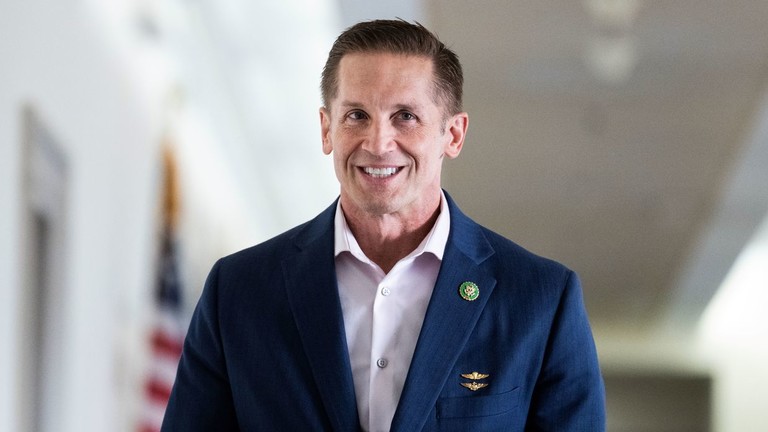
Republican Congressman from Georgia, Rich McCormick © Getty Images / Tom Williams; CQ-Roll Call, Inc
RT | December 20, 2023
The US must ensure Russia does not defeat Ukraine in order to preserve America’s global hegemony, Republican Congressman Rich McCormick has said in an interview with C-SPAN’s Washington Journal.
The comments come as US lawmakers remain deadlocked over continued financial assistance to Kiev. Republicans have refused to support President Joe Biden’s latest military aid package, including an additional $60 billion for Ukraine, unless a deal is reached on domestic border security and significant immigration reforms.
Georgia Congressman McCormick was asked to comment on concerns that the US could end up “betraying Ukraine” if it delays further assistance, spelling defeat for Kiev’s forces. The lawmaker stressed that he supports Ukraine, while claiming that “every single former [US] secretary of defense” that he has talked to also believes that Washington must prevent a Russian victory.
“First of all, we made a promise. To support a country that was invaded by a communist country,” McCormick said. The Soviet Union ceased to exist in 1991, and Russia has not been a communist nation ever since.
The congressman further insisted that the Russia-Ukraine conflict was a “fight between democracy and autocracy.”
Kiev’s defeat, McCormick continued, would not only affect all of Europe, but also the Far East, where he suggested China would invade Taiwan and threaten US microchip supplies. It would also mean that Ukraine’s vast amounts of grain, steel, titanium, and other resources “would make Russia stronger” and “support China,” which would “break up the US global leadership,” he claimed.
“This is a very important battle we need to have,” McCormick insisted, adding that “we can’t continue to slow roll this” and that the US and Europe must do their part to “end this quickly.”
Moscow has repeatedly described the Ukraine conflict as a proxy war being waged against Russia by the US. According to Russian President Vladimir Putin, Washington is willing to fight Moscow “until the last Ukrainian.”
Putin also claimed last week that Kiev’s desperation over its failed counteroffensive had caused it to send troops on suicide missions in an attempt to breach Russian positions. “I don’t even know why they do that,” the Russian leader said, adding that Ukrainian soldiers themselves describe some operations as a “one-way trip.”
Israel is exploiting the war in Gaza to deny Palestinians access to their West Bank land
By Fareed Taamallah | MEMO | December 18, 2023
Abla Lafi is 59 and from the village of Turmus Ayya, north of Ramallah in the occupied West Bank. She is passionate when speaking about her olive groves, which the Israeli army and illegal Jewish settlers prevent the villagers from harvesting.
“This is our own land,” she said defiantly. “How dare they prevent us from entering it and picking olives from the trees as if we were thieves? We planted them with our own hands. The settlers are the thieves and we are the owners of the land.”
October and November make up the main olive harvest season for Palestinian farmers. Thousands of families depend on a good crop for their livelihood. Around 45 per cent of agricultural land in the occupied West Bank is planted with an estimated 10 million olive trees, producing between 32-35,000 metric tons of olive oil every year.
This year, due to the war on Gaza, settlers and the Israeli army are preventing thousands of farmers from reaching their olive groves. Last month, the occupation state’s extreme far-right Finance Minister Bezalel Smotrich called on the Israeli government to prohibit Palestinians in the West Bank from harvesting their olive trees. According to Smotrich, Israel needs to establish “sterile security zones” with no Palestinian presence around settlements and settler-only roads. It looks as if the Israeli occupation forces are implementing this policy in order to block Palestinians from getting to their own land.

“Extensive damage to land and trees and stringent movement and access restrictions by Israeli forces hamper access to olive trees, especially those close to settlements,” the UN has reported. “At the end of November, an initial estimate indicates [that] 800,000 dunums of land have not been harvested due to Israeli settler violence and access restrictions.”
“Olives not only have economic importance to Palestinians, but are also symbolic of their roots, resilience and attachment to the land. For the Palestinians, the olive tree represents their spirit and identity.”
“We used to go to work on the land with joy and love for all family members, men, women, children and animals, because cultivation means belonging to the land, a feeling which we pass on to our children and grandchildren,” explained Lafi. “The olive season is like Eid for us; we celebrate its blessings with joy and happiness, even the taste of its food is different.” However, she added, since the establishment of the illegal Jewish settlements on Palestinian land, the locals have lived through the olive season in an atmosphere of fear, anxiety and terror from the settlers and the army. “The anxiety and sadness have increased this year due to the war on Gaza.”
The head of the agricultural committee in the village, Nidal Rabie, confirmed that since the war against the Palestinians in Gaza started, the settlers and settlement guards have stopped local residents from reaching their olive groves in the plain adjacent to the illegal settlements built on lands confiscated from the village. “They expelled us as recently as today,” said Rabie. “We tried to access our land, but they came and expelled us at gunpoint.”
The 61-year-old Palestinian farmer who holds US citizenship, added: “We are now in the middle of December trying to pick our olives to no avail. Every farmer who tries to pick olives is shot at. If we wait any longer, the olives will be ruined and the quality of the oil will become low and inedible.”
Although the settlers and soldiers obstruct the olive harvest every year, explained Rabie, sometimes the Palestinians succeed in harvesting at least part within hours and days determined by the Israeli army. “This year the soldiers prevented us from harvesting any olives in the plain. I personally own 30 dunums that I am not able to harvest at all.”
A few days ago, the army even stormed Turmus Ayya at night and confiscated 50 vehicles belonging to the villagers, because they were used in agricultural work. Altogether, around 2,500 dunums belonging to the villagers but adjacent to the illegal settlements have not been allowed to be harvested. “They would have produced around 70,000 litres of olive oil,” he added.

Palestinian farmers in the village are also prevented from cultivating their own land next to which illegal settlements have been built. Mishal Al-Quq, 43, said that he used to live in the US and went back to Palestine two years ago to take care of the land and cultivate it. “This year we are facing a big problem in growing wheat in the plain east of the village as we are prohibited from working there by the occupation army, but now is the season for planting seeds. We must plant quickly, otherwise it will be too late.” Wheat is very important and is a basic crop for the villagers, he said. “We must grow it.” This was confirmed by Rabie, who pointed out that he had bought wheat and barley seeds, but did not know whether he would be able to plant them or not.

The Israeli destruction of the olive groves unmasks a fact that not many in the West know about; it’s often heard that Israelis hold dual US citizenship, but we don’t hear so much about Palestinian Americans. It is estimated that between 45-60,000 Palestinian Americans live in the occupied West Bank, according to Reuters. However, this does not stop Israel from targeting them. They are treated by the apartheid state as Palestinians and have no “American” privileges. For instance, Israel prevents Palestinian Americans from entering the US from the West Bank, an apparent violation of a recent agreement in which citizens from the US and Israel can travel to the other country without a visa. According to Rabie, most of the residents of Turmus Ayya hold dual Palestinian and US citizenship, but the US government doesn’t provide any protection to the farmers. “Some villagers who hold American citizenship contacted the US Embassy and asked for protection to work on our own land. But the embassy said that it could only assist in securing travel to the United States. This would mean displacing us from our land in Turmus Ayya.”
Although the Biden administration has declared the intention to deny visas to violent settlers, Rabie doubts that it will happen. “This was only propaganda. Biden’s true position was clear when he said that if there was no Israel, the US would have to create one. This shows Washington’s collusion with Israel.”
Abla Lafi believes that the goal of Israeli “harassment” is to seize the Palestinian land close to the illegal settlements that were established on stolen land which contains olive trees that have been cultivated for hundreds of years. “They have no right or ownership over it,” she insisted. “We inherited the land from our ancestors and we should not be prevented from entering it. Although it is more difficult this year, we have been facing this same problem every year since the establishment of the first settlement, which I remember was Shilo, in 1978, when I was 14 years old. At the beginning, there were mobile homes and the road leading to them ran through our village. The roads were built on lands confiscated from Qaryut and Turmus Ayya, after which they began to spread like a cancer and descended from the hilltop on to our land in the plain and spread to the nearby villages.”
More settlements were built, such as Rachel, Adei Ad, Amichai and other random outposts inhabited by terrorists known as the hilltop youth, she added. “They began terrorising the people, shooting, destroying property and blocking the roads. Before those settlements were built, when I was a child, we used to live peacefully, plough and plant. I have beautiful memories of the different seasons of figs, olives and wheat that we used to grow.”
Rabie confirmed that settler crimes, the confiscation of land and the cutting down and burning of olive trees in his and other villages, have been carried out constantly by settlers and the Israeli army even before Israel’s latest war against the Palestinians in Gaza. The most ferocious attack by settlers happened on 21 June this year, when hundreds of settlers stormed the village killing Omar Qutain, burning dozens of houses and cars, and hundreds of olive trees and wheat fields, destroying the village. The Israeli army stood and watched, but did not intervene.
No indictment has been filed against anyone, and this is not an exceptional case. According to Yesh Din, out of a thousand cases regarding acts of violence committed by settlers between 2005 and 2021, 93 per cent were closed without an indictment.

“These attacks did not and will not stop farmers from continuing to work on their land,” said Rabie. “If we stop cultivating the land, the Israeli authorities will exploit that to claim that the land is no man’s land, confiscate it and give it to the settlers. They did this before.”
This was a reference to Israel’s use in 1979 of an Ottoman land law of 1858 which stipulates that if private land is not cultivated for three years in a row it becomes state property. “At which point Israel hands it over to the settlers.”
Abla Lafi is determined that these Israeli attacks and policies will not discourage Palestinian farmers from cultivating their land. “I love my land and I love the fertile plain. This is the land that was watered by the sweat of the farmers and the blood of the martyrs who fell defending it: Joda Awad shot dead by the Israeli army in 1988, and Khamis Abu Awad, who was killed by a settler in 1993 while ploughing the land. Minister Ziad Abu Ain was also martyred in the plain defending the land and so was, most recently, Omar Al-Qotain this summer. We cannot give up on the land that many died to defend. We will pass it on to our children.”
Ukraine joins NATO’s Arctic projects against Russia
BY M. K. BHADRAKUMAR | INDIAN PUNCHLINE | DECEMBER 19, 2023
In a plea earlier this month to Republicans not to block further military aid to Ukraine, US President Joe Biden warned that if Russia is victorious, then President Vladimir Putin will not stop and will attack a NATO country. Biden’s remark has drawn a sharp rebuke from Putin when he said, “This is absolutely absurd. I believe that President Biden is aware of this, this is merely a figure of speech to support his incorrect strategy against Russia.”
Putin added that Russia has no interest in fighting with NATO countries, as they “have no territorial claims against each other” and Russia does not want to “sour relations with them.” Moscow senses that a new US narrative is struggling to be born out of the debris of the old narrative on Ukraine war.
To jog memory, on 24 February, during a White House press conference on the first day of Russia’s military intervention in Ukraine, Biden said western sanctions were designed not to prevent invasion but to punish Russia after invading “so the people of Russia know what he (Putin) has brought on them. That is what this is all about.”
A month later, on 26 March Biden, speaking in Warsaw, blurted out, “For God’s sake, this man (Putin) cannot remain in power.” These and similar remarks that followed, especially from Britain, reflected a US strategy for regime change in Moscow, with Ukraine as the pivot.
This strategy dates back to the 1990s and was actually at the core of the expansion of NATO along Russia’s borders, from the Baltics to Bulgaria. The Syrian conflict and covert activities of US NGOs to foment unrest in Russia were offshoots of the strategy. At least since 2015 after the coup in Kiev, CIA was overseeing a secret intensive training programme for elite Ukrainian special operations forces and other intelligence personnel. Succinctly put, the US set a trap for Russia to get it bogged down in a long insurgency, the presumption being the longer the Ukrainians can sustain the insurgency and keep Russian military bogged down, the more likely is the end of the Putin regime.
The crux of the matter today is that Russia defeated the US strategy and not only seized the initiative in the war but also rubbished the sanctions regime. The dilemma in the Beltway narrows down to how to keep Russia as an external enemy so that the West’s often fractious member states will continue to rally under US leadership.
What comes to mind is a sardonic remark by Soviet Academician Georgy Arbatov who was advisor to Mikhail Gorbachev, to an elite group of senior US officials even as the curtain was coming down on the Cold War in 1987: “We are going to do a terrible thing to you -– we are going to deprive you of an enemy.”
Unless black humour in this cardinal truth is properly understood, the entire US strategy since the 1990s to rebuff the efforts of Gorbachev, Boris Yeltsin, and early Putin to establish non-adversarial relations with the West cannot be grasped.
Put differently, if the US’ post-cold war Russia strategy has not worked, it is because of a fundamental contradiction: on the one hand, Washington needs Russia as an enemy to provide internal unity within the western alliance, while on the other hand, it also needs Russia as a cooperative, subservient junior partner in the struggle against China.
The US hopes to draw down in Ukraine and stave off defeat by leaving behind a “frozen conflict” which it’s free to revisit later at a time of its choice, but in the meanwhile, is increasingly eyeing the Arctic lately as the new theatre to entrap Russia in a quagmire. The induction of Finland into NATO (and Sweden to follow) means that the unfinished business of Ukraine’s membership, which Russia thwarted, can be fulfilled by other means.
After meeting Biden at the White House last Tuesday, Ukrainian President Vladimir Zelensky headed for Oslo on October 13 on a fateful visit to forge his country’s partnership in NATO projects to counter Russia in the Arctic. In Oslo, Zelensky participated in a summit of the 5 Nordic countries to discuss “issues of cooperation in the field of defence and security.” The summit took place against the backdrop of the US reaching agreements with Finland and Sweden on the use of their military infrastructure by the Pentagon.
The big picture is that the US is encouraging Nordic countries to get Ukraine to participate in strengthening NATO’s Arctic borders. One may wonder what is the “additionality” that a decrepit military like Ukraine’s can bring into NATO. Herein hangs a tale. Simply put, although Ukraine has no direct access to the Arctic, it can potentially bring in an impressive capability to undertake subversive activities inside Russian territory in a hybrid war against Russia.
In a strange coincidence, the Pentagon recently prepared the Starlink satellite system for use in the Arctic, which was used by Ukrainian military for staging attacks on the Crimean Bridge, Russia’s Black Sea Fleet and strategic assets on Russian territory. The US’ agreement with Finland and Sweden would give the Pentagon access to a string of naval and air bases and airfields as well as training and testing grounds along the Russian border.
Several hundred thousand Ukrainian citizens are presently domiciled in the Nordic countries who are open to recruitment for “an entire army of saboteurs like the one that Germany collected during the war between Finland and the USSR in 1939-1940 on the islands of Lake Ladoga,” as a Russian military expert told Nezavisimaya Gazeta recently.
Russia’s naval chief Admiral Nikolai Evmenov also pointed out recently that “the strengthening of the military presence of the united NATO armed forces in the Arctic is already an established fact, which indicates the bloc’s transition to practical actions to form military force instruments to deter Russia in the region.” In fact, Russia’s Northern Fleet is forming a marine brigade tasked with the fight against saboteurs to ensure the safety of the new Northern Sea Route, coastal military and industrial infrastructure in the Arctic.
Suffice to say, no matter Ukraine’s defeat in the US’ proxy war with Russia, Zelensky’s use for the US’ geo-strategy remains. From Oslo, Zelensky made an unannounced visit on December 14 to a US Army base in Germany. Analysts who see Zelensky as a spent force had better revise their opinion — that is, unless the power struggle in Kiev exacerbates and Zelensky gets overthrown in a coup or a colour revolution, which seems improbable so long as Biden is in the White House and Hunter Biden is on trial.
The bottom line is that Biden’s new narrative demonising Russia for planning an attack on NATO can be seen from multiple angles. At the most obvious level, it aims to hustle the Congress on the pending bill for $61 billion military aid to Ukraine. Of course, it also distracts attention from the defeat in the war. But, most important, the new narrative is intended to rally the US’ transatlantic allies who are increasingly disillusioned with the outcome of the war and nervous that US involvement in Europe may dwindle as it turns to Indo-Pacific.
When Putin reacts harshly that Biden’s new narrative is “absurd”, he is absolutely right insofar as Russia’s focus is on things far more important than waging a senseless continental war in Europe. After all, it was one of the founding fathers of the USA, James Monroe who said that a king without power is an absurdity.
Ex-US Airman on Depleted Uranium: ‘I Saw Disfigured Newborns & My Dad Dying From Cancer’
By Ekaterina Blinova – Sputnik – 19.12.2023
It is only a matter of time before Ukraine uses depleted uranium ammunition on the battlefield, if it hasn’t already. The United States and United Kingdom sent the radioactive shells to the Zelensky regime earlier this year, and the rounds have been spotted in warehouses near the frontlines.
Following the costly failure of their “summer counteroffensive,” the Ukrainian military has begun desperately searching for “wonder weapons” to restore their battlefield fortunes.
Announcing the provision of DU rounds to Ukraine, Washington insisted in September that there’s nothing to worry about: the wonder-weapon is somewhat toxic, but overall harmless and fine. Rafael Grossi, International Atomic Energy Agency (IAEA) director general, joined the chorus, asserting to the public that there are “no significant radiological consequences” from the use of depleted uranium shells.
These are barefaced lies, according to Damacio A. Lopez, a US Air Force veteran who founded the International Depleted Uranium Study Team and co-founded the International Coalition to Ban Uranium Weapons (ICBUW).
“He [Grossi] is part of the team, part of the team that promotes this project, use of these weapons, he is part and parcel of the superpowers that use it and making excuses for it and trying to convince the public that this is not a problem, as they do repeatedly here in this country. You asked what the people thought about this. Well, they haven’t been getting accurate information. And I tried my best to get that information out in Uranium Battlefields and go in and talk to all these countries and try to explain what was going on.”
Damacio was one of the first Americans who raised the red flag about the disastrous consequences of the weapons. Since 1985, he has been seeking a global ban on depleted uranium arms, which are still not covered by international chemical or nuclear conventions, despite DU’s toxicity and radioactivity.
Sinister Black Cloud Over Socorro
Damacio was born in Socorro, a town in southern central New Mexico along the Rio Grande. Back in 1945, the Trinity nuclear test rocked the Jornada del Muerto Desert, only 36 miles southeast of his hometown. Damacio was only two years at that time, but later he became curious about radiation hazards.
The Trinity blast wasn’t the only US nuclear experiment in the region. In 1985, when Lopez visited his parents in Socorro during the Christmas holidays, the first thing he heard on his arrival was the sound of very loud explosions less than two miles from his house. Explosions occurred regularly, making dishes rattle and causing cracks in the walls. But even more alarming was a dark black cloud hovering over the town after the blasts.
“This was disturbing. And it wasn’t just my family. It was all the families in Socorro. From the middle of Socorro, the city park, to where the explosions had taken place, is two miles. That’s up. And the prevailing winds come over the community every time one of these bombs goes off. And of course, people were very concerned about what was going on. And my Mom asked me to look into this. And so I did. I contacted the Board of Regents of the New Mexico Institute of Mining and Technology, who are responsible for these explosions. Because they had been testing different kinds of weapons there since 1946.”
Lopez went to a Board of Regents meeting and asked about the explosions and dark clouds of smoke. But in response, he only got evasive answers.
Still, his efforts bore some fruit: one morning, he found five mysterious boxes in the front yard of his Socorro house. When he opened them, he found documents shedding light on the ongoing disaster.
“Well, those boxes were full of information about depleted uranium and testing in Socorro, and their ideas and what they were doing. And it went way, way back, before 1972, explaining the development of these weapons and what they were trying to do and the different kinds of weapons they were experimenting with, like cluster bombs instead of using metal or tungsten or titanium. They would try depleted uranium and see how that worked. So they were doing these kinds of preliminary testing, along with two other laboratories in New Mexico, plus laboratories outside of New Mexico. They were all working together. And I saw all this information. It wasn’t just about Socorro. It was about worldwide testing with what was going on in Europe and who was testing these weapons and what kind of weapons they were testing.”
He learned that the black cloud that he saw was radioactive and chemically toxic dust ejected into the atmosphere by depleted uranium blasts.
Damacio decided to dig deeper. He knew that the exposure to nuclear materials could lead to health problems, so he went to the Health Department in Santa Fe and sought information about Socorro’s residents. The records gave him the shivers: over past years, the community’s health problems had piled up, with the number of cases of hydrocephalus, cancer, and birth defects higher than in the other counties around the state.
This gruesome discovery prompted him to start researching the effects of depleted uranium contamination.
Horrific Effects of Exposure to Depleted Uranium
“I have a brother who’s bent over, and when he speaks, and he’s 10 years younger than me, something’s wrong with his spine,” Damacio said. “And his body is kind of flopped over. And when he looks at you, he looks like a turtle. He’s way down like this, and looks up. I mean, he’s normally about 5 ft 6 in. And now he looks like he’s about 4 ft. It’s a horrible sight. His teeth are all rotten. He’s the one who lives right next to the facility. You know, here’s the facility right here.
Here’s my house. And here is a town. There’s a fence between us and it says ‘Keep out, government property.’ And so our family is very close, one of the closest homes to this facility.”
“My dad ended up dying from cancer,” the activist continued. “And it was a sad situation for us. And like I said earlier, the people there, when they realized the truth about what was going on, instead of saying, ‘Oh, we want to stop this,’ no, they’re saying, ‘What? What can we do to survive? How can we survive this thing?’ And well, they couldn’t leave. So they just stay. And over the years, refusing sometimes to even acknowledge the dangers around them, because I believe they have no other choice. And it’s dehumanizing for people to be in that situation.”
In the late 1990s, Damacio was invited to Iraq by the nation’s authorities to speak at a conference on the depleted uranium weapons used in the country by the US during the Persian Gulf War (1990-1991). In 1993, Lopez and his fellows published the book Uranium Battlefields Home and Abroad: Depleted Uranium Use by the US Department of Defense, looking into DU testing sites in the US and the Pentagon’s use of the weapons abroad. The US and its allies unleashed over 300 tons of DU in Iraq.
“Well, when I went to Iraq and I told the people, I want to see if what’s happening here is happening there as well. So I’m not only the victim, but I’m also a researcher and I want to have accurate information. I just don’t want to take other people’s word for things. And I don’t, and I never have. Maybe at the very beginning of my discovery I did that. But since then, I want to see the people involved in these situations.”
“I found a lot of [health] related issues. At that conference that I went to, I learned a lot of things and I was one of the speakers at this conference. And so I was able to get studies from these medical people who had done a lot of studies on the people in Iraq and birth defects, cancers. These were the top things that were going on in their country, and some of the cancers were the same cancers, the same cancer that my father died from. And a lot of other people in the town were having problems in Socorro with birth defects. So I was able to go into hospitals in Iraq to see for myself the people who were victims.”
But the greatest shock for Damacio was Iraqi children who were born after the US bombing campaign. When he recalls them, he cannot hold back his tears.
“In one particular hospital I was able to see many, many children with birth defects that were so severe that it was so hard for me to think of them as even human.”
“I’m talking about very, very serious birth defects. Can you imagine walking into a place and seeing a child with one eye and his forehead? It’s like not even human. And I met this little boy. He was three years old. He was with his mother and he had a big head, hydrocephalus. And one eye was turned up and his other eye was turned down. He was skin and bones. He was three years old, couldn’t weigh more than 20 pounds. And his head was huge. Little tiny, tiny legs. It’s almost skin and bone. And the mother was holding him and wiping the blood from his mouth. And as I was leaving the hospital, tears started streaming down my face. I couldn’t control it. It was so, so bad.”
The little boy looked listless. Damacio thought for a moment that the toddler couldn’t see or hear. “And as I was leaving the room, I heard the little boy scream out: ‘Mama, mama!’ And it sent chills through my entire body.”
If Damacio were told at the time that the US government would throw another thousand tons of depleted uranium on Iraq in just three weeks during the Second Gulf War, it would have stopped the researcher’s heart.
Geiger Counter Never Lies: DU Weapons are Radioactive
Lopez suspected that these hideous birth defects and the spike in cancer cases were caused by depleted uranium’s radioactivity and toxicity. Preparing for his Iraq trip, he took his Geiger counter. The radiation detector “could identify alpha, beta, and gamma, and could identify whether it was depleted uranium or something more hot than depleted uranium,” according to the researcher.
While in Baghdad, Damacio visited the Amiriyah shelter, which was subjected to a US aerial attack that killed over 400 civilians, including children, on February 13, 1991.
“It was quite a sight when I was looking at the blood and hairs of the people on the walls and the children. And then there was an area where they had all their pictures. I was there with the Japanese delegation in this particular visit. And for them, it was common – it was not common, but they knew this well about the shadows on the wall and the hair and the blood from what happened in their country when they were bombed. So they understood all this.”
“Eyewitnesses told me, more than one said to me: ‘Damacio, what happened here is… I saw this projectile. I saw this large Tomahawk cruise missile making curves around streets.’ And then, when they got to the Amiriyah shelter, they went up high, came straight down in the middle of the shelter that had three stories, three feet of concrete between the stories to protect the people in there. In this case, children. There were more than 600 kids and school kids in that shelter at this time. The missile came down from the middle of the shelter, went through, went all the way down to the bottom of the shelter, and then went into a deep hole there. I saw all this, and they’re watching it.”
Lopez decided to find remnants of projectiles used during the US bombing of Baghdad and other areas and make measurements. He knew that typically, natural background radiation levels could range between five and 60 counts per minute, or a little more. Anything higher than that meant potential radioactive contamination.
“I found in one of the facilities in Baghdad after going to the Amiriyah shelter, there was an exhibition, there was a big building and they had picked up all the war remnants that they had found. One of them was partially, about three quarters, a Tomahawk cruise missile. And I had my detector and I checked it out. It was about a hundred counts per minute, which was an indication that there was radiation within this Tomahawk cruise missile.”
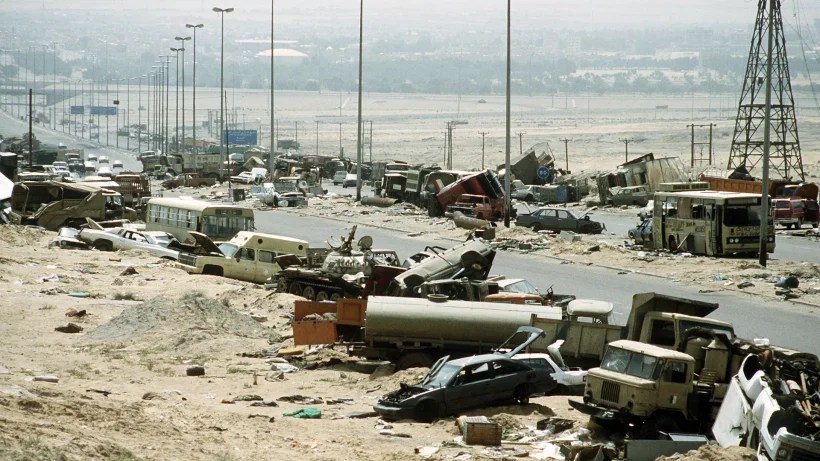
Then he travelled to a site on the border between Kuwait and Iraq, dubbed the “Highway of Death,” where thousands of Iraqi tanks and armored vehicles were pierced and burned by DU munitions fired by US A-10 Warthogs. There, he got readings of about 100-120 counts per minute on the holes of the damaged tanks. Lopez also collected small pieces of metal as samples that showed a reading of 600 counts per minute.
“And I happened to find several projectiles, 30 millimeters, that had missed the target and hit the ground and bounced. And they were intact. So I checked them out with my detector, thinking I’m going to get 600 counts per minute. I was getting 2,500 per minute on these projectiles, so high that my radiation detector wouldn’t go any higher than in its capabilities. And it would go ‘u-u-u-u,’ could have been higher than 2,400 counts per minute. And the only conclusion I could draw from that is that nuclear waste from nuclear facilities was being mixed with what was so-called depleted uranium. And this became even more alarming.”
DU Weapons are Made of Radioactive Waste
Lopez tried to find out why the US had decided to use depleted uranium for its ammo in the first place.
Damacio’s book Uranium Battlefields Home and Abroad: Depleted Uranium Use by the US Department of Defense explains that DU is a byproduct of the uranium enrichment process by which the fissionable isotope uranium-235 (U235) is extracted from natural uranium for subsequent use as fuel for nuclear reactors.
Natural uranium, a silvery-grey metal, contains 0.7% U235, 99.3% U238, and a small amount of U234 by mass. After producing 85 kilograms of enriched uranium, one would get 915 kg of U238, or depleted uranium.
The Pentagon argues that U238 retains “only” 60% of natural uranium’s radioactivity and emits alpha particles, which have low penetration depth and can be stopped by skin. Inside the body, however, alpha-emitters can be extremely harmful, damaging sensitive living tissue. After the explosion of DU projectiles, microscopic and light uranium dust can travel with the wind, be inhaled, swallowed, or enter the body through a wound, later causing cancer and chromosome damage.
One should bear in mind that depleted uranium is radioactive waste that should be disposed of, Lopez pointed out in his book. However, almost all DU tails have been saved by the US government since the early 1940s. Moreover, they can be purchased for commercial use, according to the researcher. To date, the US has accumulated a massive storage of DU amounting to over 700,000 metric tons.
Why Do Pentagon and Defense Contractors Like DU So Much?
Lopez explained that from a military standpoint, the most important property of DU is its great density, relatively low cost of fabrication, and availability. The material is used for tank armor and projectiles of different sizes.
Highly-dense DU munitions easily pierce tanks and other armored vehicles. While tungsten carbide projectiles are capable of doing the same, DU is cheaper, more accessible, and offers greater margins for US military firms.
On the other hand, turning spent uranium into bullets and shells has become an “ingenious” solution for the US nuclear industry on how to “dispose” of radioactive waste, Lopez said in his book. So, as money talks, the US’ testing and use of DU weapons continue unabated, according to the activist.
But has the Pentagon ever been aware of the long-lasting hazard related to DU projectiles?
The US Department of Defense’s internal memos, leaked to the press in the late 1990s and the beginning of the 2000s, indicate that the Pentagon knew. But why would it use the toxic and radioactive substance nevertheless?
A March 1, 1991 document shows the US DoD’s attitude to DU weapons use in a nutshell. Authored by US Lieutenant Colonel M.V. Ziehmn at the Los Alamos Laboratories in New Mexico, the memo reads:
“There has been and continues to be a concern regarding the impact of DU [sic] on the environment.
Therefore, if no one makes a case for the effectiveness of DU on the battlefield, DU rounds may become politically unacceptable and thus, be deleted from the arsenal.”
The memo went on by saying: “If DU penetrators proved their worth during our recent combat activities, then we should assure their future existence (until something better is developed),” adding “we should keep this sensitive issue at mind when after action reports [sic] are written”; otherwise the US may lose “a valuable combat capability.”
Why Are the Pentagon and White House Keeping DU’s Deadly Effects Secret?
The documentary Uranium 238: The Pentagon´s Dirty Pool (2009), used by Lopez’s International Coalition to Ban Uranium Weapons (ICBUW) as part of its international campaign to prohibit DU, said that the Pentagon is in denial about DU munitions potentially leading to carcinogenic diseases, birth defects, and environmental contamination.
The US Defense Department has even invented a sort of “DU diplomacy” to reassure the world community and American citizens that there is nothing to worry about, according to the ICBUW. Meanwhile, the US has not only failed to inform affected nations – Iraq, Bosnia, Serbia, Syria – about the DU hazard, but also repeatedly exposed American soldiers to the toxic and radioactive waste. Per the documentary, DU weapons in all but name are a “dirty bomb” – a mix of explosives and radioactive material – used by terrorists. Yet somehow DU rounds are still called “conventional weapons.”
One could easily imagine that if the US government admits DU’s hazardous effects, the weapon would be banned, influential defense contractors would be stripped of their profits, and Washington would be slapped with a heap of legal cases with compensation demands.
And the US is not the only country that uses depleted uranium as a weapon, as some of its NATO allies also do, according to Lopez.
“[The US keeps DU’s deadly effect secret], for the same reason all the other countries that have the weapon kept secret, as much as they can keep it secret, it is because they know they’re violating international laws, international conventions on weapons, and they know that they’re going to have to pay the price someday, and they may end up with charges of violations of international laws. And so they’re trying to protect themselves. And at the same time, they want to continue to keep the weapon because they’re afraid other countries have weapons too,” Lopez concluded.
NATO troops directly involved in Ukraine conflict – Russia
RT | December 19, 2023
Several NATO member states have boots on the ground in the Ukraine conflict, Russian Defense Minister Sergey Shoigu has claimed. He alleged that Western military personnel are operating certain weapons systems, and that hundreds of satellites belonging to the US-led military bloc are providing Kiev with surveillance.
Speaking at a meeting of Defense Ministry officials on Tuesday, where President Vladimir Putin was also present, Shoigu stated that “NATO service members are directly operating air defense systems, tactical ballistic missiles, and multiple launch rocket systems” in Ukraine. He cited radio intercepts featuring English and Polish speakers. According to the minister, Western officers are also playing an active role in preparing Ukrainian military operations as well as training troops, both in their home countries and in Ukraine.
Russian officials have repeatedly warned that ever-deepening Western involvement in the conflict unnecessarily increases the chances of a direct military confrontation between NATO and Moscow.
The Russian defense chief went on to claim that more than 5,000 foreign fighters have been killed since hostilities broke out in February 2022, with 1,427 Polish, 466 US, and 344 UK nationals among them.
“Working in the Ukrainian Armed Forces’ interest are 410 NATO military and dual-purpose space devices,” Shoigu estimated.
He also lauded Russia’s defense industry for ramping up production in the past 18 months and helping prevent ammunition shortages on the front lines. “Despite the sanctions, we are manufacturing more high-tech weaponry than NATO countries,” Shoigu continued.
The minister concluded by stating that “as of today, the Russian army is the best-prepared and most combat-ready in the world, armed with cutting-edge weapons tested in combat.”
Putin insisted at the same meeting that the West’s efforts to inflict a strategic defeat on Russia have failed.
Speaking to the Ukrainian branch of US state-run broadcaster Radio Free Europe/Radio Liberty (RFE/RL) on Friday, Kiev’s former ambassador to the UK, Vadim Prystaiko, claimed that Britain is developing plans to potentially deploy troops to Ukraine.
The diplomat, who was fired after criticizing Ukrainian President Vladimir Zelensky, went on to suggest that while Western officials will deny any such plans, foreign deployments are still possible under certain circumstances.
Will political West transfer $300 billion of stolen Russian assets to Kiev regime?
By Drago Bosnic | December 19, 2023
When the political West insists on the so-called “rules-based world order“, it’s perhaps the most laughable claim of our time, as this supposed “international community” doesn’t abide by its own rules and laws which formally state that private property is protected. The nominally capitalist power pole has no problem using what it usually calls a “communist practice” of illegal confiscation of the said property. In the aftermath of the special military operation (SMO), the United States and its numerous vassals and satellite states illegally froze hundreds of billions in Russian foreign exchange (forex) reserves. Estimates vary, but the most commonly cited number amounts to approximately $300 billion in assets.
The original idea was to cause an artificial default in Russia. In turn, this was supposed to result in massive financial destabilization. Namely, when a country defaults, it disposes of (or ignores, depending on the viewpoint) its financial obligations towards its creditors. The immediate consequence for the country is a reduction in its total debt and a reduction or even cessation of payments on the interest of that debt. A credit rating agency then takes this into account in its gradings of capital, interest, extraneous and procedural defaults, and failures to abide by the terms of bonds or other debt instruments. In short, the country in question becomes a geoeconomic pariah, which then affects its diplomatic standing.
Precisely this was what the political West wanted to ensure for Russia. With no access to its forex reserves, Moscow was expected to bleed dry financially, forcing it into a default that would then isolate the country and make trading with it not just hard, but nearly impossible. This geopolitical tool has been the mainstay of non-kinetic segments of Western hybrid warfare against the world for well over half a century now. And it might work against small to medium-sized countries. However, the Eurasian giant is neither of those. Russia is an energy superpower and a net exporter of natural gas, oil, rare earth metals and nonmetals, fertilizer, food and many other commodities that are absolutely essential to the world.
It’s also an industrial power that produces heavy machinery, chemical products, manufacturing tools, etc. Trying to isolate such a country is simply impossible. What’s more, even much smaller and less powerful countries targeted by US sanctions are finding ways to circumvent them, simply because others need their commodities. This is true for Venezuela, Iran, Cuba, Syria and even North Korea, which bore the brunt of Western sanctions before the SMO. Rather schizophrenically, even the political West itself is trying to find ways to circumvent its own sanctions. Still, it’s trying to make Russia’s life as difficult as possible by attempting to turn it into a failed state or at the very least making it look like one.
All this accomplishes little more than propaganda “wins”, effectively serving only for optics purposes. Thus, the US-led power pole is now trying to find other uses for frozen Russian forex reserves. Namely, according to the Financial Times, G7 is moving closer to approving a plan that would funnel approximately $300 billion in stolen Russian assets to the increasingly cash-strapped Kiev regime. According to the FT’s own admission, the proposal constitutes “a radical step that would open a new chapter in the West’s financial warfare against Moscow”. The troubled Biden administration is yet to announce that this is their official stance, but FT posits that American officials are “actively engaging G7 countries to see it through”.
“A US official said Washington was engaged in active conversations on the use of Russian sovereign assets and believed there was a short timeline to make a decision,” the FT report reads, adding: “They suggested it could be discussed at a possible G7 leaders’ meeting to coincide with the second anniversary in February of Russia’s full invasion of Ukraine.”
In other words, the “exclusive club” of closest Anglo-American vassals and satellite states is being given instructions on how to handle their own financial and foreign policy, including the theft of other countries’ forex assets. As previously mentioned, the sanctions warfare has not only been a miserable failure, but has also backfired. Thus, the political West is trying to hurt Russia by not only stealing its reserves, but also illegally transferring them to the Neo-Nazi junta. The obvious goal is to “adequately” substitute US funding that is now virtually guaranteed to run out thanks to the peculiarities of America’s political system, as the growing Republican-Democrat divide turns into an even bigger headache for the Kiev regime.
Apart from the halt in Washington DC’s financing, the EU is also having major issues in finding consensus about continued support for the Neo-Nazi junta. Namely, last week, Hungarian Prime Minister Viktor Orban blocked another “aid” package worth €50 billion. This happened on the same day Budapest abstained from a vote on starting formal EU membership talks with the Kiev regime. It can be argued that Brussels is its last chance to stay afloat financially, although this is virtually guaranteed to break Europe’s already flailing economy. In other words, the political West is risking the dismantling of its entire financial system and stability for the sake of the Neo-Nazi junta that is bound to lose anyway.
Drago Bosnic is an independent geopolitical and military analyst.
Featured Video
Daniel Davis: Trump’s New Iran Land Blockade Is a Dangerous Fantasy
or go to
Aletho News Archives – Video-Images
New Book
The Vaccine Mafia: Pfizer’s Former Chief Toxicologist Proves How Toxic Substances Were Unlawfully Sold to Us as a Solution for COVID-19
By Helmut Sterz
Former Pfizer chief toxicologist Helmut Sterz presents a critical examination of the development, approval, and global rollout of mRNA COVID-19 vaccines—particularly those produced by Pfizer/BioNTech. The Vaccine Mafia details the failure of pharmaceutical companies, regulatory authorities, politicians, and international organizations to follow established scientific and ethical standards during the pandemic. Drawing on the author’s decades of experience in pharmaceutical toxicology, Sterz reveals the many ways the vaccines’ inadequate or omitted preclinical safety testing put the world’s population at risk.
Sterz demonstrates how “emergency” approvals allowed manufacturers to bypass long-standing international guidelines governing toxicity testing, especially with regard to reproductive and cancer risks. They also allowed governments and health authorities to ignore or conceal evidence of serious adverse effects that occurred, including myocarditis, reproductive harm, and other long-term health risks.
Blog Roll
 Aletho News
- Armenian opposition politician dies in custody
- US still trying to recycle failed hypersonic missile programs
- France’s ‘Cold War’: Paris blames Tehran for supermarket fridge hacks
- Psywar no more? 77th Brigade’s sudden death
- Ukraine Already Carved Up… Before Talks Begin? /Prof. Richard Sakwa
- The vindication of Marjorie Taylor Greene
- Nearly 80% of Britons consider Israel a threat to world peace and security: Survey
- Rhode Island Staffer Could Be Reinstated After Firing Over Ceasefire Post
- Will Republicans Learn Their Lesson from the ‘Disastrous’ Midterms?
- Wrong, Newswise, Irresponsible Climate Messaging, Not Climate Change Itself, Is Fueling Student Anxiety
- If Americans Knew
- Lyor Cohen: The Shady Israeli Executive Running YouTube Music & the Global Hip Hop Industry
- DAILY UPDATE: Latest essential news on Palestine, Israel, & region
- Israeli soldiers are also settlers in West Bank: Al Jazeera investigation
- Report: US, Israel in Talks To Extend Military Aid Through 2033 Despite Trump Saying It Would End
- US lawmaker Ro Khanna urges Democrats to strip Israel ‘integration’ provision from defense bill
- The vindication of Marjorie Taylor Greene
- Stephen Miller: What Trump’s new chief of staff means for MENA
- Winter Rains Drown Displacement Tents in Devastated Gaza
- In Jericho, Israeli Settlers Violently Seize and Occupy Palestinian Homes
- Covering Palestine: Historic news clippings reveal US media complicity in Israel’s crimes
- No Tricks Zone
- German Authorities Start Initiative To Evaluate Public Register For Climate “Disinformation” Spreaders!
- Zonal Asymmetry of Temperature Change in the Antarctic Circumpolar Current
- New Study: The Net Fossil Fuel Contribution To Rising Atmospheric CO2 Has Been Zero For 500 Years
- Germany’s Green Energy Transition Becoming Increasingly Expensive…Another 6 Trillion Euros!
- Sudden Stratospheric Warming, Powerful El Niño Combination May Lead To Extreme Europe Cold, Energy Crisis!
- Two New Studies Find Thwaites Glacier Melt Cannot Be Driven By Human Activity Or A Warming Ocean
- E-Cars Reduce CO2 Emissions By Only 41% Compared To Internal Combustion Engine Vehicles
- Predictions Made By Renowned Climate Professor Over Past Decades Have Been Proven To Be Poor
- New Study Suggests Large Regions Of The Pacific Ocean Have Been Cooling For The Last 80 Years
- Germany’s Green Energy Debacle: High Energy Costs Force Kahla Porzellan to Close After 182 Years!

