The final exchange, caught on camera between visiting Chinese President Xi Jinping and his Russian host and counterpart, Vladimir Putin, sums up the current geopolitical conflict, still in its nascent stages, between the United States and its Western allies on the one hand, and Russia, China and their allies, on the other.
Xi was leaving the Kremlin following a three-day visit that can only be described as historic. “Change is coming that hasn’t happened in 100 years and we are driving this change together,” Xi said while clasping Putin’s hand.
“I agree,” Putin replied while holding Xi’s arm. ‘Please take care, dear friend,” he added.
In no time, social media exploded by sharing that scene repeatedly. Corporate western media analysts went into overdrive, trying to understand what these few words meant.
“Is that part of the change that is coming, that they will drive together?” Ian Williamson raised the question in the Spectator. Though he did not offer a straight answer, he alluded to one: “It is a chilling prospect, for which the west needs to be prepared.”
Xi’s statement was, of course, uttered by design. It means that the Chinese-Russian strong ties, and possible future unity, are not an outcome of immediate geopolitical interests resulting from the Ukraine war, or a response to US provocations in Taiwan. Even before the Ukraine war commenced in February 2022, much evidence pointed to the fact that Russia and China’s goal was hardly temporary or impulsive. Indeed, it runs deep.
The very language of multipolarity has defined both countries’ discourse for years, a discourse that was mostly inspired by the two countries’ displeasure with US militarism from the Middle East to Southeast Asia; their frustration with Washington’s bullying tactics whenever a disagreement arises, be it in trade or border demarcations; the punitive language; the constant threats; the military expansion of NATO and much more.
One month before the war, I argued with my co-writer, Romana Rubeo, that both Russia and China might be at the cusp of some kind of unity. That conclusion was drawn based on a simple discourse analysis of the official language emanating from both capitals and the actual deepening of relations.
At the time, we wrote,
“Some kind of an alliance is already forming between China and Russia. The fact that the Chinese people are taking note of this and are supporting their government’s drive towards greater integration – political, economic and geostrategic – between Beijing and Moscow, indicates that the informal and potentially formal alliance is a long-term strategy for both nations”.
Even then, like other analysts, we did not expect that such a possibility could be realized so quickly. The Ukraine war, in itself, was not indicative that Moscow and Beijing will grow closer. Instead, it was Washington’s response, threatening and humiliating China, that did most of the work. The visit by then-US House Speaker, Nancy Pelosi, to Taiwan in August 2022 was a diplomatic disaster. It left Beijing with no alternative but to escalate and strengthen its ties with Russia, with the hope that the latter would fortify its naval presence in the Sea of Japan. In fact, this was the case.
But the “100 years” reference by Xi tells of a much bigger geopolitical story than any of us had expected. As Washington continues to pursue aggressive policies – with US President Joe Biden prioritising Russia and his Republican foes prioritising China as the main enemy of the US – the two Asian giants are now forced to merge into one unified political unit, with a common political discourse.
“We signed a statement on deepening the strategic partnership and bilateral ties which are entering a new era,” Xi said in his final statement.
This ‘no-limits friendship‘ is more possible now than ever before, as neither country is constrained by ideological confines or competition. Moreover, they are both keen on ending the US global hegemony, not only in the Asia and Pacific region, but in Africa, the Middle East and, eventually, worldwide as well.
On the first day of Xi’s visit to Moscow, Russia’s President Putin issued a decree in which he has written off debts of African countries worth more than $20 billion. Moreover, he promised that Russia is “ready to supply the whole volume sent during the past time to African countries particularly requiring it, from Russia free of charge ..,” should Moscow decide “not to extend the (grain) deal in sixty days.”
For both countries, Africa is a major ally in the upcoming global conflict. The Middle East, too, is vital. The latest agreement, which normalised ties between Iran and Saudi Arabia is earth-shattering, not only because it ends seven years of animosity and conflict, but because the arbitrator was no other than China itself. Beijing is now a peace broker in the very Middle East which was dominated by failed US diplomacy for decades.
What this means for the Palestinians remains to be seen, as too many variables are still at work. But for these global shifts to serve Palestinian interests in any way, the current leadership, or a new leadership, would have to slowly break away from its reliance on western handouts and validation, and, with the support of Arab and African allies, adopt a different political strategy.
The US government, however, continues to read the situation entirely within the Russia-Ukraine war context. US Secretary of State Antony Blinken responded to Xi’s trip to Moscow by saying that “the world should not be fooled by any tactical move by Russia, supported by China or any other country, to freeze the war (in Ukraine) on its own terms.” It is rather strange, but also telling that the outright rejection of the potential call for a ceasefire was made by Washington, not Kyiv.
Xi’s visit, however, is truly historic from a geopolitical sense. It is comparable in scope and possible consequences to former US President Richard Nixon’s visit to Beijing, which contributed to the deterioration of ties between the Soviet Union and China under Chairman Mao Zedong.
The improved relationship between China and the US back then helped Washington further extend its global dominance, while putting the USSR on the defensive. The rest is history, one that was rife with geostrategic rivalry and divisions in Asia, thus, ultimately, the rise of the US as the uncontested power in that region.
Nixon’s visit to Beijing was described by then-Ambassador Nicholas Platt as “the week that changed the world.” Judging that statement from an American-centric view of the world, Platt was, in fact, correct in his assessment. The world, however, seems to be changing back. Though it took 51 years for that reversal to take place, the consequences are likely to be earth-shattering, to say the least.
Regions that have long been dominated by the US and its western allies, like the Middle East and Africa, are processing all of these changes and potential opportunities. If this geopolitical shift continues, the world will, once again, find itself divided into camps. While it is too early to determine, with any degree of certainty, the winners and losers of this new configuration, it is most certain that a US-western-dominated world is no longer possible.
March 26, 2023
Posted by aletho |
Aletho News | Africa, China, Middle East, Russia, United States |
Leave a comment
The circumstances surrounding the flare-up in Syria between the US occupation forces and pro-Iranian militia groups remain murky. President Biden claims that the US is reacting, but there are signs that it is likely being proactive to create new facts on the ground.
The US Central Command claims that following a drone attack on March 23 afternoon on an American base near Hasakah, at the direction of President Biden, retaliatory air strikes were undertaken later that night against “facilities used by groups affiliated with Iran’s Islamic Revolutionary Guards Corps.”
However, this version has been disputed by the spokesman of Iran’s Supreme National Security Council who accused Washington of “creating artificial crises and lying.” The Iranian official has alleged that “Over the past two days, American helicopters have carried out several sorties with the aim of increasing instability in Syria and transferred Daesh (Islamic State) terrorists in the territory of this country.”
He said Washington must be held accountable for such activities. The official warned that Tehran will give a prompt response to any US attack on whatever false pretext against Iranian bases that exist on Syrian soil at the request of Damascus for fighting terrorism.
Is the US deliberately ratcheting up tensions in Syria even as the China-brokered Saudi-Iranian rapprochement is radically changing the security scenario in the West Asian region in a positive direction?
There is optimism that Syria stands to gain out of Saudi-Iranian rapprochement. Already, the Saudi Foreign Ministry revealed on Thursday that talks are going on with Syria for resuming consular services between the two countries, which will pave the way for the resumption of diplomatic relations and in turn make it possible to reinstate Syria’s membership of the Arab League.
Saudi Arabia has established an air bridge with Syria to send relief supplies for those affected by the devastating earthquake in February.
The backdrop is that the normalisation of relations between Syria and its estranged Arab neighbours has accelerated. It must be particularly galling for Washington that these regional states used to be active participants in the US-led regime change project to overthrow the government of President Bashar al-Assad. The Saudi-Iranian rapprochement badly isolates the US and Israel.
From such a perspective, it stands to reason that the US is once again stirring up the Syrian cauldron. Lately, Russian aircraft have been reported as frequently flying over the US’s military base At Tanf on the Syrian-Iraqi border where training camps for militant groups are known to exist.
Israel too is a stakeholder in keeping Syria unstable and weak. In the Israeli narrative, Iran-backed militia groups are increasing their capability in Syria in the last two years and continued US occupation of Syria is vital for balancing these groups. Israel is paranoid that a strong government in Damascus will inevitably start challenging its illegal occupation of Golan Heights.
A key factor in this matrix is the nascent process of Russian mediation between Turkiye and Syria. With an eye on the forthcoming presidential and parliamentary election in Turkiye in May, President Recep Erdogan is keen to achieve some visible progress in improving the ties with Syria.
Erdogan senses that the Turkish public opinion strongly favours normalisation with Syria. Polls in December showed that 59 percent of Turks would like an early repatriation of Syrian refugees who are a burden on Turkish economy, which has an inflation rate of 90 percent.
Evidently, Turkiye is ending up as a straggler when the West Asian countries on the whole are coasting ahead to normalise their relations with Damascus. But the catch is, Assad is demanding the vacation of Turkish occupation of Syrian territory first for resuming ties with Ankara.
Now, there are growing signs that Erdogan may be willing to bite the bullet. The consummate pragmatist in him estimates that he must act in sync with the public mood. Besides, the main opposition party CHP always maintained that an end to the Syrian conflict needs to be anchored firmly on the principles of Syria’s unity and territorial integrity.
The influential Beirut newspaper Al-Akhbar has reported citing sources close to Damascus that Erdogan is weighing options that would meet Assad’s demand with a view to restore relations. The daily reported that one possibility is that Turkiye may propose a timetable for the withdrawal of its troops in Syria.
Significantly, Erdogan telephoned Russian President Vladimir Putin on Saturday and the Kremlin readout mentioned that amongst “topics concerning Russian-Turkish partnership in various fields,” during the conversation, “the Syrian issue was touched upon, and the importance of continuing the normalisation of Turkish-Syrian relations was underlined. In this regard the President of Türkiye highlighted the constructive mediatory role Russia has played in this process.”
Earlier, on Wednesday, Turkish Defense Minister Hulusi Akar held telephone talks with his Russian counterpart Sergei Shoigu to discuss developments in Syria where he underscored that the “sole purpose” of its deployment in northern Syria is to secure its borders and fight terrorism.
It is entirely conceivable that Erdogan has sought Putin’s help and intervention to reach a modus vivendi with Assad quickly. Of course, this is a spectacular success story for Russian diplomacy — and for Putin personally — that the Kremlin is called upon to broker the Turkish-Syrian normalisation.
The China-brokered Saudi-Iranian normalisation hit Washington where it hurts. But if Putin now brokers peace between two other rival West Asian states, Biden will be exposed as hopelessly incompetent.
And, if Turkiye ends its military presence in Syria, the limelight will fall on the US’ illegal occupation of one-third of Syrian territory and the massive smuggling of oil and other resources from Syria in American military convoys.
Furthermore, the Syrian government forces are sure to return to the territories vacated by Turkish forces in the northern border regions, which would have consequences for the Kurdish groups operating in the border region who are aligned with the Pentagon.
In sum, continued US occupation of Syria may become untenable. To be sure, Russia, Turkiye, Iran and Syria are on the same page in seeking the vacation of US occupation of Syria.
Thus, an alibi is needed for the US to justify that although dialogue and reconciliation is in ascendance in West Asian politics, Syria is an exception as a battleground against “terrorism.” The US is vastly experienced in using extremist groups as geopolitical tools.
The US’ real intention could be to confront Iran on Syrian soil — something that Israel has been espousing — taking advantage of Russia’s preoccupations in Ukraine. The Russian-Iranian axis annoys Washington profoundly.
The spectre that is haunting Washington is that the stabilisation of Syria following Assad’s normalisation with the Arab countries and with Turkiye will inexorably coalesce into a Syrian settlement that completely marginalises the “collective West.”
In retrospect, the unannounced visit by General Mark Milley, chairman of the US Joint Chiefs of Staff to northern Syria in early March falls into perspective. Milley told reporters traveling with him that the nearly eight-year-old US deployment to Syria is still worth the risk!
The time may have come for the militants, including ex-Islamic State fighters, who were trained in the US’s remote At Tanf military base to return to the killing fields for “active duty.”
Tass reported that on Friday, the terrorist group known as Hayat Tahrir al-Sham tried to break into the Aleppo region which has been under Syrian government control and relatively stable in the recent years.
March 26, 2023
Posted by aletho |
Illegal Occupation, Wars for Israel | Israel, Russia, Saudi Arabia, Syria, Turkiye, United States, Zionism |
Leave a comment
Republicans and Democrats may quibble over how federal tax dollars might be spent on various social welfare programs like Medicaid and food stamps. But alongside Social Security, there is one area of federal spending that everyone can apparently agree on: military spending. Last year, the Biden administration requested one of the largest peacetime budgets ever, at $813 billion. Congress wanted even more spending and ended up approving a budget of $858 billion. In inflation-adjusted terms, that was well in excess of the military spending we saw during the Cold War under Ronald Reagan. This year, Joe Biden is asking for even more money, with a new budget request that starts at $886 billion. Included in that gargantuan amount—which doesn’t even include veterans spending—is billions for new missile systems for deploying nuclear arms, plus other programs for “modernizing” the United States’ nuclear arsenal.
Indeed, over the past year, the memo has gone out among the usual advocates of endless military spending that the US needs to spend much more on nuclear arms. This is a perennial position at the Heritage Foundation, of course, which has never met a military pork program it didn’t like. Moreover, in recent months, the Wall Street Journal has run several articles demanding more nuclear arms. The New York Post was pushing the same line late last year. Much of the rhetoric centers on the idea that Beijing is increasing its own spending on nuclear arms and thus the United States must “keep up.” For instance, last month, Patty-Jane Geller insisted that the US is in an “arms race” with China. Meanwhile, writers at the foreign-policy site 1945 claimed Congress must “save” the American nuclear arsenal.
Congress will surely be happy to cooperate. Such spending is an enormous cash cow for weapons manufacturers, although it has little to do with actual military defense. The US nuclear arsenal is huge, and China’s efforts to expand its own arsenal will have no effect on the already substantial deterrent effects of the US’s existing nuclear arsenal. Although the 1945 article insists that China soon “will field a peer or superior arsenal to the United States,” it’s difficult to see by what metric this is actually true.
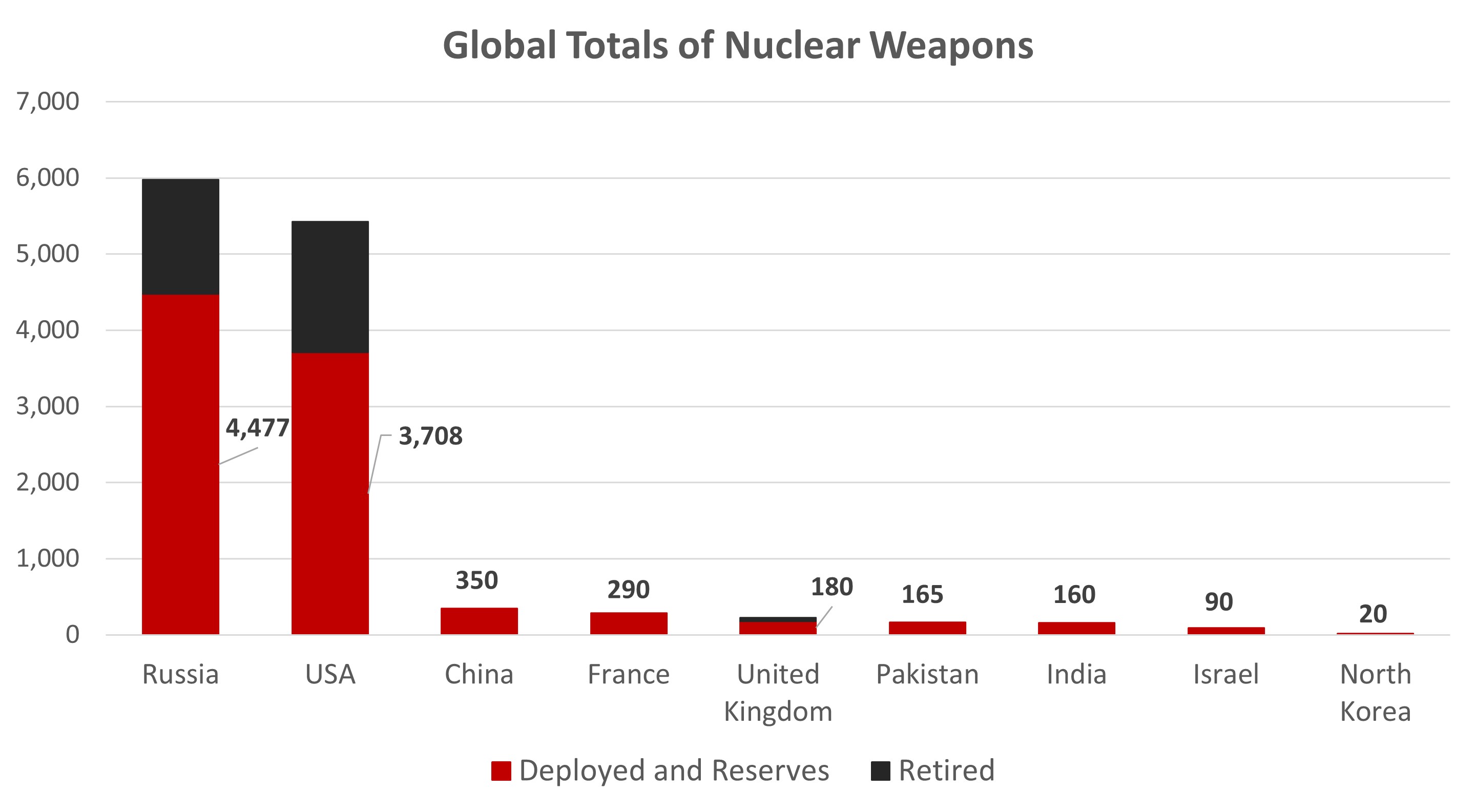
Contrary to claims that the US nuclear arsenal needs to be “saved” or it will soon be eclipsed by the Chinese arsenal, the US remains well in the lead of every single nuclear power except Russia. Even if Beijing increases its arsenal to one thousand warheads, as the New York Post breathlessly predicts, the Chinese arsenal will remain well behind that of the US.
This is true even if we remove all the retired US warheads from the equation. In that case, Moscow retains the global lead with more than forty-four hundred weapons, and the US comes in second with more than thirty-seven hundred. Presently, Beijing has approximately 350 of these weapons, France has 290, and the rest of the world is well behind that.
Like Moscow, Washington has a full-blown and well-developed nuclear triad, complete with a fleet of nuclear subs that can launch up to twenty missiles—each containing multiple independently targeted warheads—land-based missile silos, and bombers. Each option provides ways to deliver hundreds of warheads. The submarine fleet, of course, is constantly mobile, ensuring first-strike survivability.
The Nonexistent Missile Gap
This won’t stop advocates of more spending from calling for more. They’ll always have reasons why there is some sort of missile gap. Lately, the obsession is with hypersonic missiles and having various forms of delivery, as well as the claim that the current gap between the US arsenal and rival arsenal is not sufficiently large.
There’s a reason US advocates of an aggressive nuclear posture invented the “missile gap” myth during the Cold War. It sows doubt about US security and ensures a certain level of paranoia about US nuclear capability. Nowadays, it’s acknowledged that the missile gap was always a myth, but this was much less known in the days when debates over US rocket technology were a frequent cause for alarm and debate. Nonetheless, the nonfactual basis of the “gap” was known at least as early as the 1960s, and then defense secretary Robert McNamara noted to John F. Kennedy:
There was created a myth in the country that did great harm to the nation. It was created by, I would say, emotionally guided but nonetheless patriotic individuals in the Pentagon. There are still people of that kind in the Pentagon. I wouldn’t give them any foundation for creating another myth.
How Much Do Numbers Matter?
The myth persists, however, and Geller claims: “Given the hundreds of new Chinese missile launchers and other new weapons, the U.S. will need more nuclear weapons to hold these targets at risk. In nuclear deterrence, numbers matter.”
How much do numbers really matter? Yes, in matters of deterrence, ten is certainly better than zero. But is three thousand better than one thousand, or even one hundred? That logic often works with conventional arms, but it makes little sense with nuclear arms, a single unit of which can destroy an entire city. As John Isaacs noted last year in the National Interest:
In the nuclear age, a country that deployed 1,000 nuclear weapons rather than an adversary’s 500 is not twice as powerful since a handful of weapons could devastate both countries. But the Pentagon and political leaders did not learn this critical lesson. This is a numbers game that may have been relevant for tanks and battleships before [the invention of nuclear weapons] but is not today.
What is key in nuclear deterrence is not simply numbers. Nuclear strategist Albert Wohlstetter identified this problem in the early 1960s and concluded that “the criterion for matching the Russians plane for plane, or exceeding them is, in the strict sense, irrelevant to the problem of deterrence.” Rather the key, Wohlstetter went on, is creating a force that is “survivable” to ensure the possibility of a retaliatory “second strike.” This is what establishes deterrence.
Wohlstetter certainly wasn’t the only one to come to this conclusion. In a 1990 essay titled “Nuclear Myths and Political Realities,” Kenneth Waltz—perhaps the most influential scholar of international relations of the past fifty years—concludes that the total number of missiles in these enormous arsenals is of little importance for nations that are already well above the threshold for achieving nuclear deterrence.
What really matters is the perception that the other side has second-strike capability, and this certainly exists in both US-Russia and US-China relations. Once each regime knows that the other regime has second-strike capability, the competition is over. Deterrence is established. Waltz notes:
So long as two or more countries have second-strike forces, to compare them is pointless. If no state can launch a disarming attack with high confidence, force comparisons become irrelevant. . . . Within very wide ranges, a nuclear balance is insensitive to variation in numbers and size of warheads.
The focus on second-strike capability is key because pro-arms-race policy makers are quick to note that if a regime’s first strike is able to destroy an enemy’s ability to retaliate in kind, then a nuclear war can be “won.”
Second-Strike Capability Evens the Score
But, as shown by Michael Gerson in “No First Use: The Next Step for U.S. Nuclear Policy” (2010) establishing second-strike capability—or, more importantly, the perception of it—is not as difficult as many suppose. Gerson writes:
A successful first strike would require near-perfect intelligence, surveillance, and reconnaissance (ISR) to detect, identify, and track all of the adversary’s nuclear forces; recent events surrounding U.S. assessments of Iraq’s suspected WMD [weapons of mass destruction] capabilities forcefully demonstrate the challenges of reliable, accurate, and unbiased information. Intelligence regarding where an adversary’s nuclear weapons are located and if the state is actually planning to attack could be wrong or incomplete, and an attempted first strike based on inaccurate or incomplete information could have far-reaching negative consequences.
The threat of a successful first strike can be countered through a variety of methods, including secrecy and the ability to shift weapons delivery channels. This is why the US, Russian, and Chinese regimes have long been so enthusiastic about the so-called nuclear triad. It is assumed that if nuclear weapons can be delivered by submarine, aircraft, and land, then it is impossible for an opposing regime to destroy all three at once and achieve first-strike victory.
But even in the absence of a triad, an opposing regime that seeks a total first-strike victory has few grounds for much confidence. As Waltz shows, “nuclear weapons are small and light; they are easy to move, easy to hide, and easy to deliver in a variety of ways.” That is, if a regime manages to hide even a small number of planes, subs, or trucks, this could spell disaster for the regime attempting a successful first strike. Gerson explains:
A nuclear first strike is fraught with risk and uncertainty. Could a U.S. president, the only person with the power to authorize nuclear use and a political official concerned with re-election, his or her political party, and their historical legacy, ever be entirely confident that the mission would be a complete success? What if the strike failed to destroy all of the weapons, or what if weapons were hidden in unknown areas, and the remaining weapons were used in retaliation?
Nor must it be assumed that a large number of warheads is necessary to achieve deterrence. Waltz recalls that Desmond Ball—who advised the US on escalation strategies—convincingly asserted that nuclear deterrence could be achieved with as few as fifty warheads.
Proceeding on the assumption that an enemy has no warheads left following a first strike requires an extremely high level of confidence because the cost of miscalculation is so high. If a regime strikes and misses only a few of the enemy’s missiles, this could lead to devastating retaliation both in terms of human life and in terms of the first-strike regime’s political prospects.
This is why a rudimentary nuclear force can achieve deterrence even with a small but plausible chance of second-strike capability. A small nuclear strike is nonetheless disastrous for the target, and thus “second-strike forces have to be seen in absolute terms.” Waltz correctly insists that calculating an arsenal’s relative dominance is a waste of time: “the question of dominance is pointless because one second-strike force cannot dominate another.”
The US Is Already Far beyond the Deterrence Threshold
One could certainly debate how much the US nuclear stockpile could be cut without sacrificing deterrence. Given the enormous size of the stockpile, however, the answer is that “most of it” could be cut. Indeed, the US arsenal could be cut by 90 percent and still have hundreds of warheads available for silos, submarines, and bombers.
Moreover, reductions in the arsenal are prudent for reasons of avoiding unintended nuclear war. As Wohlstetter noted, a prudent policy also requires “strategic nuclear forces to be not only capable of riding out and operating coherently after an actual preemptive attack against them; but also completely controllable in times of peace, crisis, and war—and especially in the face of ambiguous warning—so as to avoid unauthorized operations, accidents, and war by mistake.” Having large numbers of nuclear warheads actually is imprudent because it creates more potential for accidents, mistakes, and unauthorized use. Maintenance remains expensive and risky.
In spite of all this, it remains popular among some to keep arguing for more nuclear expansion year after year. Surely, some of these advocates are true believers, but there is also a lot of money at stake for government contractors. Thus, in one form or another, the myth of the missile gap—and its modern variants—endures.
March 26, 2023
Posted by aletho |
Corruption, Mainstream Media, Warmongering, Militarism | China, United States |
Leave a comment
The U.S. Centers for Disease Control and Prevention (CDC) published inaccurate data about the COVID-19 pandemic and made incorrect claims that exaggerated the threat on at least 20 occasions since January 2021, a new paper has found.
The pre-print (not yet peer-reviwed) by Vinay Prasad, Tracy Beth Hoeg, Kelley Krohnert and Alyson Haslam documents 25 instances when the CDC reported statistical or numerical errors. Twenty (80%) of these instances exaggerated the severity of the COVID-19 situation, three instances (12%) simultaneously exaggerated and downplayed the severity of the situation and one error was neutral. One error exaggerated COVID-19 vaccine risks. The CDC was notified about the errors in 16 instances (64%), and later corrected the errors, at least partially, in 13 instances (52%).
The authors searched for the errors by reviewing CDC publications, press releases, interviews, meetings and Twitter accounts. They also catalogued mortality data from both the National Center for Health Statistics and the CDC Covid Data Tracker and compared reported results.
They concluded that “a basic prerequisite for making informed policy decisions is accurate and reliable statistics, even during times of uncertainty”. They note a need for greater diligence in data collection and reporting. They also recommend that the federal entity responsible for reporting health statistics “should be firewalled from the entity setting policy due to concerns of real or perceived systematic bias in errors” – in this instance, towards exaggerating risk.
Here are the 25 errors they found:
February 26th 2021:
- MMWR stated that during the study period, the seven-day moving average of cases identified by PCR or antigen testing ranged from 152 to 577 cases.
- Multiple errors. Reported case rates during the study period were described as a seven-day moving average of cases per 100,000 persons including PCR and antigen cases, but the paper actually reported the raw seven day moving average (without adjusting for population) and for PCR only (not including antigen tests).
- From: MMWR
- Risk: Exaggerated
- Concerns: Children
July 26th 2021:
- Delta Variant is as contagious as chicken pox.
- Delta is not as contagious as varicella. The CDC overstated Delta R0 and understated chicken pox R0 (Delta estimate was overlaid directly on a New York Times graphic).
- From: CDC slide deck
- Risk: Exaggerated
- Concerns: All
July 27th 2021:
- 4% of COVID-19 deaths are in children 0-17.
- Actual number was 0.04% based on original CDC estimated data. When the estimated data were updated later, the percentages were not updated. The actual percentage based on the updated data was 0.07%.
- From: COVID-19 website
- Risk: Exaggerated
- Concerns: Children
October 15th 2021:
- “COVID-NET data for the week ending Sept. 25th show that rates of COVID-19-associated hospitalisations in children ages 5-11 years are the highest they’ve been.”
- COVID-NET hospitalisations were already falling from Sept peak. Rate was 1.1 in week ending Sept. 11th and Sept. 25th. (Now week of Sept. 11th shows 1.2),
- From: Twitter @CDCgov
- Risk: Exaggerated
- Concerns: Children
October 27th 2021:
- “CDC Director Walensky said “there have been 745 deaths in children less than 18.”
- As of 27/10/21, NCHS data showed 558 deaths with COVID-19. Final NCHS data shows 679 pediatric deaths with COVID-19 through Oct. 30th, 2021
- From: White House Press Briefing
- Risk: Exaggerated
- Concerns: Children
November 8th 2021:
- Among ages 0-17, CDC’s reported rate of symptomatic illness was [more] than the total infection rate (asymptomatic + symptomatic –
an impossible claim), and this error occurred among children (infection rate also fell only for children from May 21st to Sept 21st estimates).
- Estimated infection rate was 35,490 per 100K, not 29,885 per 100K (symptomatic illness remained at 30,253 per 100K).
- From: COVID-19 website
- Risk: Neutral
- Concerns: All
December 20th 2021:
- Omicron makes up 73% of new infections in the U.S.
- Error with Nowcast estimate, a week later they revised to 23% (outside the previous 95% CI).
- From: Data Tracker
- Risk: Exaggerated
- Concerns: All
February 24th 2022:
- COVID-19 hospitalisations had a sudden over-1.6-fold increase in Georgia per HHS/CDC data.
- Very likely a dramatic multi-week increase was due to imputation error on behalf of the reporting state or municipality, yet this was not audited or detected.
- From: Data Tracker
- Risk: Exaggerated
- Concerns: All
March 15th:
- Paediatric deaths on the Data Tracker demographics page were overstated while adult deaths were understated.
- On 15/3/22, CDC removed 416 paediatric deaths from Data Tracker from 1,755 to 1,339 (still overstated) and almost 72,000 adult deaths, blaming an algorithm for classifying deaths as COVID-19 related.
- From: Data Tracker
- Risk: Mixed
- Concerns: Both
June 17th 2022:
- COVID-19 is a top five cause of death in children of all age groups.
- Pre-print had inaccurate data, and CDC chose the most extreme version of the flawed data. Specifically, for COVID-19 it used cumulative counts (which spanned more than two years), and death was attributed if it was one of any multiple cause of death, whereas for other causes of death, they used only a single year, and attributed it only if it was the single underlying cause of death).
- From: ACIP Meeting
- Risk: Exaggerated
- Concerns: Children
June 23rd 2022:
- At a White House COVID-19 briefing, CDC Director Walensky cited the claim that COVID-19 is a “top five cause of death” in children
- Flawed pre-print, authors already acknowledged that fact, and COVID-19 was not a top five cause of death.
- From: White House Press Briefing
- Risk: Exaggerated
- Concerns: Children
June 27th 2022:
- ACIP website includes the “top five cause of death” claim
- Flawed pre-print, authors already acknowledged that fact, and COVID-19 was not a top five cause of death.
- From: ACIP website
- Risk: Exaggerated
- Concerns: Children
August 9th 2022:
- COVID-19 has killed 1,500 children ages 17 and younger.
- As of 10/8/22, NCHS data showed 1,201 deaths with COVID-19. As of 5/2/23, NCHS data shows 1,323 paediatric deaths with COVID-19 through August 6th 2022.
- From: Twitter @CDCgov
- Risk: Exaggerated
- Concerns: Children
August 12th 2022:
- “COVID-19 hospitalisations for children and teens are increasing again in the U.S.”
- CDC hospitalisation data showed hospitalisations had peaked two weeks prior, on 29/7/22.
- From: Twitter @CDCgov
- Risk: Exaggerated
- Concerns: Children
August 20th 2022:
- CDC Excess Mortality Dashboard overstated recent deaths in North Carolina and Connecticut.
- Model for weighting due to death reporting lag was poorly adjusted.
- From: CDC Excess Mortality Dashboard
- Risk: Exaggerated risk of all-cause mortality
- Concerns: All
August 22nd 2022:
- Alabama paediatric hospitalisations had a dramatic single week increase from under 10 per day to over 50 per day.
- Very likely a dramatic single week increase was due to imputation error on behalf of the reporting state or municipality, yet this was not audited or detected.
- From: Data Tracker
- Risk: Exaggerated
- Concerns: Children
August 26th 2022:
- CDC Data Tracker made a single week jump of 186 paediatric deaths and 1,679 adult deaths, which is unusually high for children and unusually low for adults.
- Incorrect death data. CDC corrected this days later, removing 173 paediatric deaths and adding 2,484 adult deaths
- From: Data Tracker
- Risk: Mixed
- Concerns: All
September 1st 2022:
- ACIP Chair Grace Lee repeated the “top five cause of death” claim in ACIP meeting to approve bivalent booster.
- Flawed pre-print was corrected two months prior. Unknown if ACIP committee informed.
- From: ACIP meeting
- Risk: Exaggerated
- Concerns: Children
November 9th 2022:
- Florida paediatric hospitalisations had a dramatic single week increase from seven to 112 (seven-day new admissions).
- Very likely a dramatic single week increase was due to imputation error on behalf of the reporting state or municipality, yet this was not audited or detected.
- From: Data Tracker
- Risk: Exaggerated
- Concerns: Children
December 30th 2022:
- XBB.1.5 variant reported at 41% of new infections in the US.
- A week later they revised to 18% (outside the original 95% CI).
- From: COVID-19 website
- Risk: Exaggerated
- Concerns: All
December 31st 2022:
- North Carolina paediatric hospitalisations had a dramatic single week increase from two to 19 (seven-day new admissions).
- Very likely a dramatic single week increase was due to imputation error on behalf of the reporting state or municipality, yet this was not audited or detected
- From: Data Tracker
- Risk: Exaggerated
- Concerns: Children
January 13th 2023:
- Table 2 listed 62 events for children needing medical care as 13.9%.
- It should be 1.9%. It is correct in the text, but not the table.
- From: MMWR
- Risk: Exaggerated risk of vaccine
- Concerns: Children
February 9th 2023:
- Dr. Walensky testified before Congress that there had been “2,000 paediatric deaths from COVID-19”.
- This number comes from the flawed Data Tracker. Actual number is 1,400-1,500
- From: Data Tracker/ testimony
- Risk: Exaggerated
- Concerns: Children
February 23rd 2023:
- ACIP slide claimed 1,489 paediatric deaths in ages six months-17 years.
- They did not remove 305 deaths in infants under-six months. Actual number should have been 1,184 using the NCHS data source cited on the slide
- From: ACIP meeting
- Risk: Exaggerated
- Concerns: Children
Through March 3rd 2023:
- Data Tracker continues to report too many paediatric deaths and too few adult deaths.
- Inaccurate mortality data by age group are updated weekly on the CDC Data Tracker Demographics page.
- From: Data Tracker
- Risk: Mixed
- Concerns: All
Read the full paper here.
March 25, 2023
Posted by aletho |
Deception, Science and Pseudo-Science | CDC, COVID-19 Vaccine, United States |
Leave a comment
The United States and its European allies have sent tens of billions of dollars-worth of military equipment to Kiev to fuel a proxy war against Russia in Ukraine. Moscow has warned repeatedly about the consequences of these actions for regional and global security.
Western countries won’t be able to deliver enough weapons in Ukraine to outgun Russia, President Vladimir Putin has assured.
“Threats exist, of course. When weapons are supplied to a country we are in conflict with, this is always a threat. As for how they can be assessed, of course we know about the plans to supply them,” Putin said in an interview with Russian TV on Saturday, responding to a question about whether Moscow considers Western arms deliveries to Kiev a “threat” to national security.
“We see, hear about and know about these delivery plans. You mentioned one million shells, about the delivery of tanks. One million – is it a lot or a little? This is a significant amount. First of all, the leading NATO countries, let’s say the United States of America, according to our information, produce about 14,000-15,000 shells per month… Ukraine’s Armed Forces, according to our military’s estimates, use up to 5,000 shells per day of hostilities,” Putin said.
Russia is aware of NATO’s plans to ramp up shell production to 42,000 per month by this year, and to 750,000 per year by 2025, Putin said. “We don’t know yet what will happen in 2025, but right now, this year, 14,000-15,000 shells are being produced, despite the fact that Ukraine’s military is spending up to 5,000 per day,” he noted.
“We are concerned about [weapons deliveries] from the perspective that this is an attempt to prolong the conflict,” Putin said, noting that “from the point of view of the logic of those who provoked this conflict and are trying to preserve it at any cost, [the supply of weapons] is probably the right decision. But in my opinion, this will only lead to a greater tragedy,” he said.
Emphasizing that Russia will not allow for the “excessive militarization” of its economy, Putin said that to date, Moscow hasn’t reduced civilian construction, health care, education and infrastructure development, but the West will be forced to do so.
“The [NATO] ‘arsonists’ plan to send between 420 and 440 tanks to Ukraine. Here it is the same thing as with ammunition. During this period, we will produce and modernize over 1,600 tanks, Putin said. “The total number of tanks of the Russian Army will be three times greater than the number of tanks of the Ukrainian Armed Forces. Even more than three times,” he added.
Depleted Uranium Weapons
Putin disagreed with claims being made by Western officials and media that the depleted uranium weapons being sent to Kiev won’t result in any health or other consequences.
“This, of course, is not the case. The fact is that they do not belong to the category of weapons of mass destruction. That’s true. But the core of the projectile with depleted uranium (different materials can be used, it is used for armor-piercing purposes) still generates so-called radiation dust, and in this sense it of course amounts to a weapon of the most dangerous kind,” he said.
Russia has the means to respond, Putin warned. “Without exaggeration, we have hundreds of thousands, namely hundreds of thousands of such rounds. We haven’t used them yet,” he said.
The Russian president didn’t rule out that the UK’s announcement of DU munitions deliveries to Kiev were “deliberate” and designed specifically to try to disrupt this week’s talks between himself and Chinese President Xi Jinping to discuss Beijing’s 12 point Ukraine peace plan.
“On the same day that President Xi Jinping told me about the positive aspects of the Chinese plan to resolve the Ukrainian [crisis] by peaceful means, we learned about the supply of millions of shells to Ukraine from the Western countries which served as the instigators of the conflict. The next day, right before our meeting with the press, we learned about this story that the UK is planning to send depleted uranium shells,” Putin said. “It’s as if the West did this on purpose to somehow disrupt our negotiations or influence them somehow.”
The UK’s announcement of plans to send DU munitions to Kiev this week have sparked fears that wide swathes of Ukraine could become another depleted uranium-contaminated wasteland similar to parts of the former Yugoslavia and Iraq, where cancers and other illnesses have shot up dramatically in the aftermath of US and British DU use in the 1990s and 2000s. The Russian military’s chief of Radiation, Chemical and Biological Defense Troops warned Friday that the use of such arms would “cause irreparable harm to the health of the Armed Forces of Ukraine and the civilian population.”
Tactical Nukes in Belarus
Putin also commented on matters of strategic security, saying Moscow and Minsk had agreed in principle that, without violating its obligations under the New START Treaty, Russia will be able to deploy tactical nuclear weapons on Belarusian territory.
“We agreed that – in this sense, [Belarusian President] Alexander Grigorievich [Lukashenko] is right when he says ‘listen, we are your closest allies. Why do the Americans place nukes on their allies’ territory?’ They also engage, by the way, in the training of their pilots to use these weapons if necessary. We have agreed that if necessary, we will do the same thing, without violating our obligations – I would like to emphasize – without violating our international obligations on the nonproliferation of nuclear weapons,” Putin said.
“The United States has been doing this for decades. They have long placed their tactical nuclear weapons on the territory of allied countries, NATO countries, in Europe. In six states, if memory serves: Germany, Turkey, the Netherlands, Belgium, Italy and Greece. There are no nukes in Greece right now, but there is a storage facility,” Putin said.
Nord Stream Terrorism
Asked to comment on the investigations surrounding last year’s sabotage attacks against Russia’s Nord Stream natural gas pipelines, Putin expressed his “full agreement” with the sentiment that the blasts were the handiwork of US intelligence.
“An American journalist who has become quite famous in the world now, conducted… an investigation and came to the conclusion, as you know, that this explosion of the gas pipelines was organized by the special services of the United States. I absolutely agree with such conclusions,” Putin said, referring to the investigative work conducted by Seymour Hersh.
March 25, 2023
Posted by aletho |
Aletho News | NATO, Russia, UK, Ukraine, United States |
Leave a comment

© AFP 2023 / OLIVIER DOULIERY
President Joe Biden warned Friday that Washington would “act forcefully to protect our people” against attacks by “Iranian-backed” groups in Syria, which were blamed for a kamikaze drone attack that killed a US contractor Thursday. A US service member was reportedly injured Friday after attacks on US bases at Syria’s largest oil and gas fields.
A group of anti-interventionist Republicans in the House and Senate have repeated calls for a US pullout from Syria after a fresh round of violence in the war-torn country left a contractor dead, another injured, and up to half a dozen US service members wounded in two days of violence.
“Warmongers in both parties say keeping troops in Syria is necessary to preserve the balance of power. That is simply not true. If they believe that, they should say it directly to the parents of Americans in Syria who have to sleep there tonight and guard oil fields against Iranian drones. We need to bring our troops home,” Matt Gaetz wrote in a tweet late Friday.
“It is deeply sad to continue to see Americans killed and troops injured in Syria. This is the price of guarding oil fields in other countries, presumably forever,” Gaetz wrote in a separate tweet.
In a video accompanying Friday’s post of a statement he made on the House floor, Gaetz reiterated that it was “not appropriate to put Americans at risk” in Syria, and said that he was “shocked” that the deployment of US forces had not already caused an “escalatory accident” or more casualties.
“The Kurds have an opportunity to pave their path, let’s pave ours. And if we’re so worried about threats to the homeland, how about we actually focus on our true point of vulnerability, which is not the emergence of some caliphate – it’s the fact that terrorists are crossing our southern border on a daily, weekly, monthly basis. We’ve seen far less concern about that than we undeniably should be,” the lawmaker said.
Congressman Ben Cline of Virginia signaled his agreement with Gaetz, tweeting that this week’s violence was “EXACTLY why” he “voted to remove the US Armed Forces From Syria and bring our troops home” in Gaetz’s recent House resolution on the issue.
Kentucky Senator Rand Paul also brought up the week’s violence as evidence of the need to get troops out of the war-torn country. “Bring our troops home from Syria and end every unauthorized war going on today. Return the power to engage in war to Congress. Our service members deserve it. The Constitution demands it,” Paul tweeted.
The Senate voted down Paul’s amendment to rescind the 2001 Authorization for Use of Military Force (AUMF) this week, with just four Republicans, four Democrats, and Bernie Sanders, an independent who caucuses with Democrats, voting to repeal the resolution – which has served as the legal tool allowing the president to dispatch troops abroad without asking Congress for over two decades.
In mid-March, the House voted down Gaetz’s resolution to withdraw US troops from Syria 321-103, with the Florida congressman and other members of the pro-Trump Freedom Caucus showing a rare display of bipartisan unity alongside members of the Democratic Congressional Progressive Caucus in the vote to bring troops home. Other Republican supporters of the resolution included Representative Paul Gosar of Arizona, Chip Roy of Texas, Thomas Massie of Kentucky and Marjorie Taylor Greene of Georgia. On the Democrat side were Representative Ilhan Omar of Minnesota, Alexandria Ocasio-Cortez of New York, Rashida Tlaib of Michigan, and others. 56 House Democrats and 47 Republicans voted in favor of the resolution in total.
Former President Donald Trump first ordered the withdrawal of US troops in Syria in late 2019, but quickly backpeddled by saying US forces would remain in the country to “take the oil” and “keep the oil” – in violation of international laws on plunder.
In late 2020, former Trump Pentagon aide Douglas Macgregor was reportedly instructed by the president to try to pull US troops from Syria, Iraq, Afghanistan, Germany, and Africa before President Biden’s inauguration in early 2021. During the transition period, Pentagon officials openly boasted that they played “shell games” with the White House to cover up troop numbers and prevent a pullout.
Syrian officials have spent years attacking their US counterparts and Washington’s Kurdish allies for plundering the war-torn country’s energy resources, and want all foreign forces not explicitly invited into the country by Damascus to withdraw immediately. The US-led pillage of Syria has cost the government hundreds of billions of dollars in revenues needed for reconstruction, and has continued even in the wake of last month’s devastating earthquakes. On Saturday, Syrian media reported that a massive 148-vehicle convoy including 80 tankers loaded with stolen oil and 60 refrigerator and cargo trucks had been spotted heading toward the illegal al-Walid crossing with Iraq.
The Pentagon responded to Thursday’s attack on a US base in Hasakah, Syria with airstrikes, reportedly killing over a dozen “pro-Iran targets.” Biden blamed Iran for the attacks, saying that while the US “does not seek conflict with Iran,” Tehran should “be prepared for us to act forcefully to protect our people.”
The US leader did not elaborate on what his “people” were doing occupying oil fields in Syria, well over 9,000 km from America’s shores. Iran has dispatched military advisors and other forms of support to Syria over the past decade to assist Damascus in the Western-funded dirty war against the country, but denies open involvement in the conflict.
March 25, 2023
Posted by aletho |
Illegal Occupation, Militarism | United States |
Leave a comment
Theater with Moderna Billionaire CEO Stephane Bancel Fails to Ask Key Questions
In 2006, Stephane Bancel was a sales director then head of Belgium operations for Eli Lilly, a mid to high level big pharma sales executive. In 2007 he catapulted to become CEO of French diagnostics company BioMérieux and began work with the Chinese to build the biosecurity annex level 4 at the Wuhan Institute of Virology. His company trained the Chinese lab technicians. Bancel then joined startup Moderna in 2011. Moderna has three patents that claim priority to applications filed between 2011 and 2016 covering its foundational intellectual property on mRNA, code to SARS-CoV-2 Spike protein, and related functions. In April 2020, Moderna’s sales and stock price skyrocketed on the promise of a COVID-19 vaccine that was planned for years. Bancel’s stake of the company is about 9% and net worth estimated to be ~$6 billion.
While the countenance Senator Rand Paul was stern and his questions on the surface appeared intimidating, he and the committee failed to drill Bancel on issues that would reveal corruption, racketeering, fraud, conspiracy to commit domestic terrorism, public harm, or mass negligent homicide.
Here are five question sets the Senators either didn’t have the foundational understanding, perceptiveness, or courage to ask:
- What was Bancel’s involvement with the Chinese in the construction of the lab annex? Was it intended for bioterrorism? How many times did Bancel visit the lab between 2007 and 2020?
- Did Moderna collaborate with or rely upon Dr. Ralph Baric’s NIH work on chimeric SARS-CoV-2 as published in 2015 in Nature Medicine and the Proceedings of the National Academy of Science? Is the patented genetic code for Moderna mRNA derived from Baric’s chimeric virus or another one originating from the WIV BSL-4?
- Did Bancel know ahead of time his product would cause myocarditis, neurologic injury, blood clotting, and immunologic syndromes (VITT, MIS)?
- How many deaths and serious adverse events did Moderna record in its 90 day obligatory post-release safety data? Why has this dossier not been released to the public? When will it be? Assuming Moderna’s dossier has similar numbers of fatalities to Pfizer, why did Moderna fail to pull their product off the market early in 2021 due to excess risk of death?
- Has Moderna or FDA or any third party at any time inspected its mRNA–1273 vaccine for quality, purity, and concentration as it is being produced by biodefense contractor National Resilience or other supplier? How does Moderna assure the quantity of mRNA in the final fill and finish of the vials before they are shipped to pharmacies and vaccine centers?
In conclusion, the Senate Committee on Health, Education, Labor and Pensions needs to step up its game if America wants to get to the bottom of what is going on with the COVID-19 vaccine debacle. I suggest they call in some doctors with courage, expertise, and clear vision to advise them on questioning. Wednesday March 22, 2023 fell short by a Kentucky mile and Bancel must be skipping away in relief.
Leake JS, McCullough PA. Courage to Face COVID-19: Preventing Hospital Deaths While Battling the Biopharmaceutical Complex
Menachery VD, Yount BL Jr, Debbink K, Agnihothram S, Gralinski LE, Plante JA, Graham RL, Scobey T, Ge XY, Donaldson EF, Randell SH, Lanzavecchia A, Marasco WA, Shi ZL, Baric RS. A SARS-like cluster of circulating bat coronaviruses shows potential for human emergence. Nat Med. 2015 Dec;21(12):1508-13. doi: 10.1038/nm.3985. Epub 2015 Nov 9. Erratum in: Nat Med. 2016 Apr;22(4):446. Erratum in: Nat Med. 2020 Jul;26(7):1146. PMID: 26552008; PMCID: PMC4797993.
Menachery VD, Yount BL Jr, Sims AC, Debbink K, Agnihothram SS, Gralinski LE, Graham RL, Scobey T, Plante JA, Royal SR, Swanstrom J, Sheahan TP, Pickles RJ, Corti D, Randell SH, Lanzavecchia A, Marasco WA, Baric RS. SARS-like WIV1-CoV poised for human emergence. Proc Natl Acad Sci U S A. 2016 Mar 15;113(11):3048-53. doi: 10.1073/pnas.1517719113. Epub 2016 Mar 14. PMID: 26976607; PMCID: PMC4801244.
Aquino-Jarquin G. The patent dispute over the breakthrough mRNA technology. Front Bioeng Biotechnol. 2022 Nov 3;10:1049873. doi: 10.3389/fbioe.2022.1049873. PMID: 36406223; PMCID: PMC9669595.
March 24, 2023
Posted by aletho |
Corruption, Deception | COVID-19 Vaccine, United States |
Leave a comment

Serbs protesting the EU plan for independence of the breakaway province of Kosovo carry a sign that says ‘Never NATO,’ March 2023. © Sputnik / Aleksandar Jorovich
In a carefully worded statement to the public on Friday, US ambassador in Belgrade Christopher Hill commented on the 78-day bombing campaign against Yugoslavia by calling on the Serbs to build a “better future” together with Washington.
“I offer my personal condolences to the families of those who lost their lives during the wars of the 1990s, including as a result of the NATO air campaign,” Hill said in a series of tweets.
“I know that the Serbian people will never forget that terrible time, nor should they,” he added. “The Serbian people will never set aside their grief, but I believe they are strong enough to set aside their grievances.”
The US has an “unwavering” commitment to diplomacy and “partnership” with Serbia, Hill claimed. “Together, we can build the better future the Serbian people deserve and want for future generations.”
His comments came on the anniversary of ‘Operation Allied Force’, the air war launched by the US-led bloc on behalf of ethnic Albanian insurgents in Kosovo. Against the UN Security Council Resolution 1244 that ended the war, the US-backed Kosovo provisional government declared independence in 2008.
As the immediate pretext for the bombing, NATO had cited Belgrade’s rejection of the ultimatum presented by then-US Secretary of State Madeleine Albright at Rambouillet, including a deployment of NATO troops in Kosovo and independence of the breakaway province within three years. Annex B of the proposal also demanded unrestricted access of NATO forces to all of Yugoslavia – present-day Serbia and Montenegro – which the government in Belgrade could not accept.
Hill was present in Rambouillet, and in what seemed to be a nod to that episode, he claimed in his statement that he had learned during his long career that “sometimes diplomacy fails. When it does, the results can be tragic.”
According to official casualty figures by the Serbian government, the 1999 war resulted in the deaths of 1,031 soldiers and police officers, as well as 2,500 civilians – including 89 children. On Friday, Russian Ambassador Aleksandr Botsan-Kharchenko laid a wreath at the children’s memorial in Belgrade.
March 24, 2023
Posted by aletho |
Aletho News | NATO, United States |
Leave a comment

Children who were born with birth defects in Fallujah. (Photo Credit: Getty Images)
The Commander of the Russian army’s Radiological, Chemical, and Biological Protection Forces, Igor Kirillov, on 24 March accused the US of using “no less than 300 tons of depleted uranium” during the early years of the Iraq war.
“In 2003-2004, the USA extensively used such munitions in strikes on targets in Iraqi cities: Amarah, Baghdad, Basra, Karbala, Fallujah. According to the UN, the US used no less than 300 tons of depleted uranium in Iraq,” Kirillov told reporters on 24 March.
He added that the resulting radioactive fallout in Fallujah alone was “worse than what happened in Hiroshima and Nagasaki.”
“This city is still called the second Chernobyl,” the Russian official stressed.
A 2018 investigation by Al Araby shows Iraq recorded the highest rate of congenital malformations in the world over the previous decade. These rates were worse in Fallujah, which was showered in depleted uranium and white phosphorus by US coalition forces.
“According to the Iraqi government, in 2005, the incidence of cancer in the country due to the use of depleted uranium munitions increased from 40 to 1,600 cases per 100,000 citizens. In this regard, Baghdad filed an official lawsuit with the International Court of Arbitration in Stockholm on December 26, 2020, against Washington, claiming compensation for the damages sustained,” Kirillov added.
In 2014, the Dutch peace group Pax revealed that US jets and tanks fired nearly 10,000 depleted uranium rounds in Iraq, many of which were fired in or near populated areas.
The Kremlin official made his statement on Friday in response to the UK government saying earlier this week they will provide Ukraine with armor-piercing rounds containing depleted uranium.
Depleted uranium is a byproduct of creating enriched uranium used in nuclear fuel and weapons. Although it can not generate a nuclear reaction, depleted uranium is higher in density than lead, making it highly attractive as a projectile.
“It’s so dense, and it’s got so much momentum that it just keeps going through the armor – and it heats it up so much that it catches on fire,” Edward Geist, a nuclear expert at research organization RAND, told Al Jazeera on Thursday.
US officials backed London’s decision, claiming the ammunition is “not anywhere close to going into” the sphere of nuclear weaponry.
“This is a commonplace type of munition … If Russia is particularly concerned about the welfare of their tanks and their tank soldiers … they could just take them across the border back into Russia,” White House National Security Council spokesman John Kirby said.
The UN Environment Program described depleted uranium ammunition as “chemically and radiologically toxic heavy metal.” A 2001 World Health Organization (WHO) report concluded that depleted uranium could accumulate at the ground surface and enter the food chain, while uranium dust can be inhaled and retained in the lungs.
London’s plan to send the radioactive arms to Ukraine came to light as the twentieth anniversary of the Iraq invasion passed. Last December, the US navy named a next-generation warship the ‘USS Fallujah.’
March 24, 2023
Posted by aletho |
Timeless or most popular, War Crimes | Iraq, United States |
Leave a comment
The US occupation base in northeastern Syria’s Al-Omar oilfield was attacked with rockets on 24 March, just hours after the US army bombed several locations in the eastern city of Deir Ezzor on Thursday night.
The US bombing was in response to a drone strike on its base in northeastern Hasakah’s Kharab al-Jir military airport, which killed a US contractor and injured several others, CENTCOM said in a statement on Friday.
“This evening, we responded to an attack on our forces that killed an American contractor and wounded our troops and another American contractor by striking facilities used by groups affiliated with Iran’s Islamic Revolutionary Guards Corps,” CENTCOM said.
“We will always take all necessary measures to defend our people and always respond … We are postured for scalable options in the face of any additional Iranian attacks,” it added.
According to the London-based Syrian Observatory for Human Rights (SOHR), eleven ‘Iranian-backed militiamen’ were killed in the US strikes. SOHR claims that six were killed in strikes on a weapons depot in Deir Ezzor’s Harabish neighborhood, three were killed in strikes on the Al-Bukamal desert, while two were killed by strikes on the southern outskirts of Al-Mayadin town.
SOHR adds that among the wounded are serious injuries, and the death toll is expected to rise.
“Among the dead are two of Syrian nationality,” SOHR says. However, Iranian news outlet Press TV alleged that no Iranians were killed in the strike. Press TV cited local sources as saying that the strike on the Harabish neighborhood was against a rural development and grain center, not a weapons depot, adding that those who were killed were Syrian military forces.
US strikes have targeted and killed Syrian Arab Army (SAA) soldiers several times in the past, including in April 2018 after an alleged chemical attack in Douma that was attributed to the Syrian government.
The last US strike on alleged Iranian targets in Syria took place in 2022 and left a number of Syrian soldiers dead.
The US military occupation in Syria is illegal under international law and constitutes a clear violation of the country’s sovereignty.
As a result of this occupation, as well as the US army’s continuous looting of Syrian natural resources, attacks against Washington’s military bases in Syria have become regular occurrences.
Despite this, the US has shown no intent to end its presence in the country. At the start of the month, a US general illegally visiting Syria referred to the occupation as ‘worth the risk.’
March 24, 2023
Posted by aletho |
Illegal Occupation | Syria, United States |
Leave a comment
MOSCOW – The use of uranium ammunition will cause irreversible harm to the health of the military and civilian population of Ukraine, but NATO is ready to supply them to Kiev, Lt. Gen. Igor Kirillov, the head of the radiation, chemical and biological defense troops of the Russian armed forces, said on Friday.
“Despite the fact that the use of such ammunition [with depleted uranium] will cause irreparable harm to the health of the Armed Forces of Ukraine and the civilian population, NATO countries, in particular the UK, express their readiness to supply this type of weapon to the Kiev regime,” Kirillov told a briefing.
Depleted uranium compounds, remaining in the soil after its use as part of projectiles, may be dangerous for people, animals and the environment for a long time, the official added.
After the use of shells with depleted uranium on the territory of Ukraine, significant cultivation areas will be contaminated — through vehicles, radioactive substances will be carried to the territory outside the combat zone, he said.
Lt. Gen. added that use of depleted uranium shells can provoke serious diseases, and the ingestion of dust into the body is a radiation hazard.
“As a result of the impact of a depleted uranium munition, a mobile hot cloud of a finely dispersed aerosol of uranium-238 and its oxides is formed, which, when exposed to the body in the future, can provoke the development of serious diseases,” Kirillov said.
The main radiation hazard from depleted uranium occurs if it enters the body in the form of dust, the official added.
“The flux of alpha-radiation from small uranium particles deposited in the upper and lower respiratory tract, lungs and esophagus cause the development of malignant tumors. Uranium dust accumulating in the kidneys, bone tissue and liver leads to changes in internal organs,” Lt. Gen. explained.
NATO fired about 40,000 shells with more than 15 tons of depleted uranium during the 1999 bombing of Yugoslavia, Kirillov recalled.
“It is necessary to recall that depleted uranium aircraft munitions were used by NATO forces during the bombing of Yugoslavia in 1999. In total, about 40,000 armor-piercing air shells with a total amount of depleted uranium of more than 15 tons were used on the territory of this country,” Kirillov told reporters.
The level of uranium contamination of soil and groundwater in Serbia still requires constant monitoring to assess potential risks, the official added.
NATO soldiers have become victims of the use of depleted uranium ammunition in Iraq and Yugoslavia, he stressed.
“The victims of the irresponsible policy of their own leadership were NATO servicemen who took part in military campaigns in Iraq and Yugoslavia,” Kirillov told a briefing.
According to a 2016 report by the Chief Military Medical Inspector of Italy, it is reported that more than 4,000 servicemen of the national armed forces had malignant tumors of various types. These soldiers were deployed in the Balkans in 1994-1999 and in Iraq in 2003 in areas where the alliance forces used depleted uranium ammunition. At the same time, 330 people — 8% of cases — died as a result of the disease, official concluded.
Meanwhile, Kirillov stressed the fact that depleted uranium shells do not have significant advantage over tungsten shells in conditions of modern military operations.
“The use of ammunition containing depleted uranium has no significant advantage over tungsten in the conditions of modern military operations,” he told.
The term depleted uranium is a trivial name for a metal based on over 90% of the isotopes of uranium-238 and less than 1% of uranium-235, the official said.
“The use of depleted uranium in such ammunition is associated with its high density, which ensures a high armor-piercing effect. This effect is achieved by using the kinetic energy of the core itself, as well as its shell. Upon impact with the armor, the shell made of soft steel is destroyed and transfers its energy to the core, which penetrates into the armor,” Kirillov explained.
According to the military, tungsten alloys have similar characteristics, but ammunition based on them is much more expensive to manufacture. Therefore, depleted uranium ammunition is much more often used in those countries where there are uranium reserves, its processing technology, and their use is planned on foreign territory when there is no need to think about environmental consequences.
March 24, 2023
Posted by aletho |
Timeless or most popular, War Crimes | Iraq, NATO, UK, Ukraine, United States |
Leave a comment
By Lucas Leiroz | March 24, 2023
US weapons abroad are being relocated in line with Washington’s new strategic priorities. According to recent reports, the US will send old and outdated attack aircraft to the Middle East, replacing the modern and advanced aircraft that are currently stationed in the region. The goal is to transfer the most efficient military equipment to Europe and the Pacific, where it can eventually be used against Russian and Chinese forces – which are currently the main concerns for the US government.
The data was shared in an article published by the Wall Street Journal (WSJ) on March 21. According to information obtained by the authors, there is a plan to redistribute the planes in April. It is planned that aircraft of the type A-10, an older and less efficient model, will be sent to American bases in the Middle East. WSJ sources inform that the Pentagon considers such planes to be strong enough to protect US interests in the Middle East, therefore there is no need for more modern and equipped jets.
“The imperative is to get the most suitable aircraft to the Pacific for the higher threat challenges (…) The A-10 is still relevant to the mission CENTCOM (United States Central Command) flies over the Middle East”, Larry Stutzriem, a retired Air Force major general, told WSJ.
There is still a lack of official and more concrete information on the subject, but, in fact, this move was already expected. The Middle East is no longer part of the focus of attention in American foreign policy today. In the midst of a proxy war with Russia and the imminent emergence of a conflict with China in Taiwan, it is expected that more and more modern war equipment will be transported to regions close to Russian and Chinese territories.
According to the most recent issue of the National Defense Review, published by the Pentagon last year, China would be a kind of “pacing threat.” This means that the US sees China as a danger, but at the same time considers the threat “under control” – suggesting that Beijing is being closely “monitored”. Also, in recent speeches, US Secretary of Defense Lloyd Austin repeatedly corroborated this thesis, emphasizing the “Chinese threat”.
Regarding Russia, a country that is already the victim of American aggression – through the Ukrainian neo-Nazi proxies -, the same document states that Moscow would be an “acute threat”. This means that the rivalry between the countries would be something far beyond the mere collision of strategic interests, being also related to an antagonism of values. This would “justify” exceptional measures in search of increasing American military capacity against Russia.
For these reasons, it is likely that the next few months will see a wide redeployment of forces by the Pentagon. All sorts of modern, sophisticated, and efficient weapons may be located as close as possible to Russian and Chinese borders. Some sources claim that F-35 fighters are about to be sent on a large scale to Europe and the Pacific. This happens, of course, in addition to the official and regular arms supply that already takes place with the enemy states of Russia and China. So, a new wave of militarization is starting, and certainly will not end anytime soon.
Obviously, this wave will not end US military campaigns in the Middle East – nor in other regions where Washington maintains troops. There is a concern on the part of the US to avoid the loss of territories that are already under its military domain. After victory of the Taliban in Kabul, the image of the American Army among global public opinion was strongly shaken. And given the imminent defeat of pro-NATO forces in Ukraine, there is concern on the part of the Pentagon that anti-US rebellions will arise around the world, demanding an end to territorial occupation or the handover of military bases to local governments. For this reason, certainly these moves are calculated in a very careful way. It means that, in the face of the emergence of possible new conflict situations, more redistributions of weapons may be made, always in accordance with the updates of American strategic interests.
On the other hand, with these mobilizations becoming clear, the tendency is for Russia and China to prepare themselves for an eventual situation of open conflict. More than that, the greater the American pressure, the more the two countries tend to deepen their bilateral cooperation, which may adopt clearer military contours soon. And given the many reports of problems with the US defense industry and cases of corruption and financial speculation in the military-industrial complex, there are many doubts about the US capacity to face the integrated Russian-Chinese alliance.
Lucas Leiroz is a journalist, researcher at the Center for Geostrategic Studies, geopolitical consultant.
You can follow Lucas on Twitter and Telegram.
March 24, 2023
Posted by aletho |
Militarism, Russophobia | United States |
Leave a comment