US and Taiwan plan to equip Kiev regime forces with ‘swarms-of-swarms’ drones
By Drago Bosnic | March 28, 2023
There’s very little doubt that warfare has changed dramatically in recent decades, with the tactical gap between leading militaries and those of local powers (or even the usually overlooked small countries) narrowing as the proliferation of unmanned systems continues unabated. With the advent of the information era, the abundance of war footage has essentially eliminated the once-assured readiness of tens of millions to go to war, leaving militaries around the globe struggling to meet their recruitment quotas. Losing even a hundred drones is certainly preferable to having ten soldiers (or even one) killed and/or wounded in action, particularly for politicians and their respective parties seeking reelection. As a result, drones, robots and other unmanned vehicles have become increasingly important.
The combination of these factors created the “perfect storm” for the dramatic rise and adoption of unmanned systems by most militaries around the world. Perhaps the best proof of this has been the mass usage of drones by both sides of the Ukrainian conflict. Ranging from commercial quadcopters to HALE (high-altitude, long-endurance) military drones, these weapons are changing the face of warfare in a manner no less revolutionary than airplanes and tanks did during the First World War. Interestingly, as both the Russian military and the Kiev regime forces deploy advanced long-range air defenses (particularly the former), the role of larger drones has subsided, leaving smaller platforms as the more cost-effective alternative, while also providing significant tactical advantages.
Aside from circumventing advanced SAM (surface-to-air missile) systems, miniature drones offer an important upper hand in terms of first-strike capabilities and forward reconnaissance. Apart from Russia and the Kiev regime, the US-led political West is also taking this into account, especially when considering the fact that NATO’s massive ISR (intelligence, surveillance, reconnaissance) capabilities have been used to observe virtually every inch of the vast Ukrainian battlefields. Precisely this is pushing the belligerent alliance to equip the Neo-Nazi junta forces with the latest unmanned technologies, both as a way of providing its favorite puppet regime with weapons to counter the Russian military, as well as battle-testing the said drones against an advanced state adversary.
And while the Kiev regime’s pompous announcements of an upcoming offensive may be dismissed as routine propaganda stunts, Russian intelligence found solid evidence that such weapons are being supplied to the Neo-Nazi junta. Needless to say, the political West sending advanced weapons to Kiev is hardly breaking news, but what’s unusual is the participation of Taiwan. Apparently, China’s breakaway island province is working directly with the US on developing and manufacturing the new unmanned systems. Another novelty in this particular case is the ostensible ability of these drones to autonomously coordinate their attacks and act as a swarm, or more precisely, “swarms-of-swarms”, as the program’s name clearly indicates.
The project, named AMASS (Autonomous Multi-Domain Adaptive Swarms-of-Swarms), is directly supervised by DARPA (Defense Advanced Research Projects Agency), the Pentagon’s top advanced weapons programs agency. In order to accomplish the task of controlling hundreds of drones simultaneously, the use of advanced artificial intelligence (AAI) is a given in this case. Considering that AAI is one of DARPA’s main fields of study, its involvement in the project is effectively guaranteed. Military experts estimate that several hundred kamikaze drones can function within one network, further connected to a much larger system that includes thousands of drones. DARPA’s share in the project is by far the largest, although Taiwan seems to be providing key manufacturing facilities.
Back in early February, several media reports emerged that the AMASS project was fast-tracked by DARPA due to Pentagon’s plans to create a “swarms-of-swarms” system that would “simultaneously counter multiple adversarial assets and enable warfighters to operate within the A2/AD [anti-access/area denial] environment”. With Russia and China being the only countries with such capabilities, it’s essentially guaranteed they are the primary targets. This is further reinforced by the involvement of the government in Taipei, which clearly aims to counter China’s A2/AD “bubbles”. These still represent an insurmountable obstacle against which the Taiwanese military is effectively powerless, both in terms of offensive and defensive capabilities.
However, before the possible deployment of AMASS in Taiwan, the system needs to be battle-tested in Ukraine. If it were to be proven effective, Washington DC and Taipei would certainly mass-produce it. Thus, it’s extremely likely that the project was discussed by Russian and Chinese military delegates during President Xi Jinping’s latest visit to Moscow, as it’s in the interest of both to see the program fail. Otherwise, if it proves successful in Ukraine, the Chinese military itself would most certainly face it in Taiwan, endangering the success of a possible amphibious operation in case of a US-orchestrated escalation. And while China has advanced systems capable of countering such weapons (including its own drone swarms), the best possible defense is preventing their deployment altogether.
Nevertheless, with the Russian military poised to be the first to encounter weapons such as the AMASS, Moscow has already started crucial upgrades to its air defense systems. Still, Russia’s A2/AD, better known as “echeloned defense” in Russian military nomenclature, is only one segment of its (recently revised) strategy, with the so-called “active defense” being the key to neutralizing immediate threats. This includes adopting new offensive capabilities and precisely this could have been one of the main topics of behind-closed-doors talks about Sino-Russian technological cooperation, which almost certainly includes the exchange of information on drone swarms.
Drago Bosnic is an independent geopolitical and military analyst.
Moscow calls out US’ rules-based order in Europe
BY M. K. BHADRAKUMAR | INDIAN PUNCHLINE | MARCH 27, 2023
Baroness Goldie is an experienced Scottish politician and life peer who served as Leader of the Scottish Conservative Party from 2005 to 2011 and as the UK’s Minister of State for Defence since 2019. She is anything but a party girl like Liz Truss who often had to swallow her indiscreet words betraying ignorance.
Certainly, Baroness Goldie understood perfectly well the implications of what she put down in a written statement at the House of Lords on March 20 in her answer to Lord Hylton’s seemingly innocuous question: “To ask His Majesty’s Government whether any of the ammunition currently being supplied to Ukraine contains depleted uranium.” (By the way, Lord Hylton is one of 92 hereditary peers elected to remain in the House of Lords; he is currently the longest-serving Crossbench member of the House of Lords, since 1968, and is a dynamic campaigner for peace and the interests of the vulnerable and the marginalised.)
It is a fair guess that the UK Defence Secretary Ben Wallace kept 10 Downing Street informed — and even more important, had prior consultations and concurrence with his US counterpart, Secretary of Defence Lloyd Austin — before Baroness Goldie made the statement.
Both Wallace and Austin are military people and understand why ammunition tipped with “depleted uranium” is needed in the current stage of the proxy war in Ukraine if at all Kiev is to launch a “credible counter-offensive” in spring when the tide of the war has distinctly turned in Russia’s favour.
Equally, both must be well aware that the legality of the NATO intervention in Yugoslavia is still an open issue. In response to NATO’s bombing campaign, former Yugoslavia instituted proceedings before the International Court of Justice on April 29, 1999, against the ten NATO members directly involved in the attack — Belgium, Canada, France, Germany, Italy, the Netherlands, Portugal, Spain, the UK, and the US — citing a series of violations of the law of nations (which included the obligation not to use prohibited weapons.)
Although the ICJ rejected Belgrade’s request for provisional measures, it, nonetheless, declared itself profoundly concerned with the use of force in Yugoslavia, which “under the present circumstances … raises very serious issues of international law.” Suffice to say, the cases brought by Yugoslavia against the NATO respondents still remain on the ICJ’s docket although the petitioner got dismembered.
Make no mistake, Washington and London are consciously repeating the war crime in the former Yugoslavia. The Anglo-Saxon clique’s core objective is a calculated escalation of the proxy war that is certain to draw forth a robust reaction by Moscow, as predictable as night follows day.
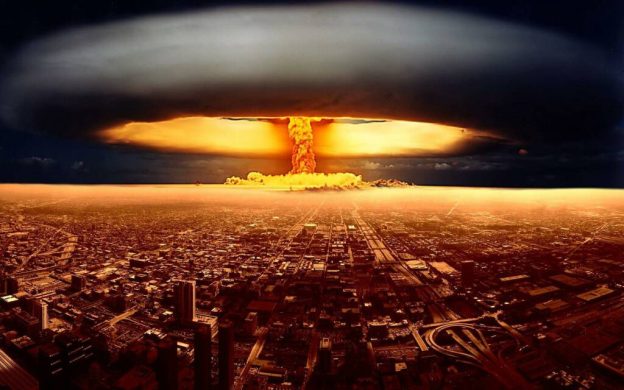
Indeed, that is precisely what happened when Russian President Vladimir Putin announced on Saturday that Russia will deploy its tactical nuclear weapons in Belarus. Putin linked this to a request from Belarus in reaction to Baroness Goldie’s statement in London a week ago.
More importantly, Putin also drew the analogy of the US placing its tactical nuclear weapons on the territories of the allied NATO countries for decades.
The EU and NATO went ballistic after Putin’s disclosure. EU’s chief diplomat Josep Borrell said on Sunday called out Moscow’s decision as “an irresponsible escalation and threat to European security.” He threatened to impose “further sanctions” against Belarus!
A NATO spokeswoman called Moscow’s decision “dangerous and irresponsible.” Interestingly, though, the Biden administration neatly side-stepped the issue, focusing instead that the US has not seen any signs that Russia has moved nuclear weapons to Belarus or anywhere else!
In good measure, National Security Council spokesperson John Kirby added, “We’ve in fact seen no indication he (Putin) has any intention to use nuclear weapons, period, inside Ukraine.”
But then, Putin also made it clear that Russia would first complete construction on a storage facility in Belarus for the tactical nuclear weapons by July 1.
Kirby is fudging. What is the game plan? First, the Anglo-Saxon clique would hope that the issue will create further antagonism in Europe against Russia and Putin personally and would rally European countries behind the Biden administration at a time when fault lines were appearing within the transatlantic alliance over a protracted war in Ukraine that might be catastrophic for European economies.
Washington is hard-pressed to respond to Putin’s remark that Russia is only doing something that the US has been doing for decades. The point is, a mutual commitment not to deploy nuclear weapons in third countries was one of the proposals Moscow made to Washington in December 2021, alongside a commitment that Ukraine would not join NATO. The US ignored it and precipitated the Russian special military operation in Ukraine.
The crux of the matter is, as with the Cuban missile crisis of 1962, the Russian decision on tactical nuclear weapons in Belarus is retaliatory, drawing attention to the US missiles stationed close to its borders. (An estimated 100 nuclear weapons are stored in vaults in five European countries — Belgium, Germany, Italy, Netherlands and Turkey.)
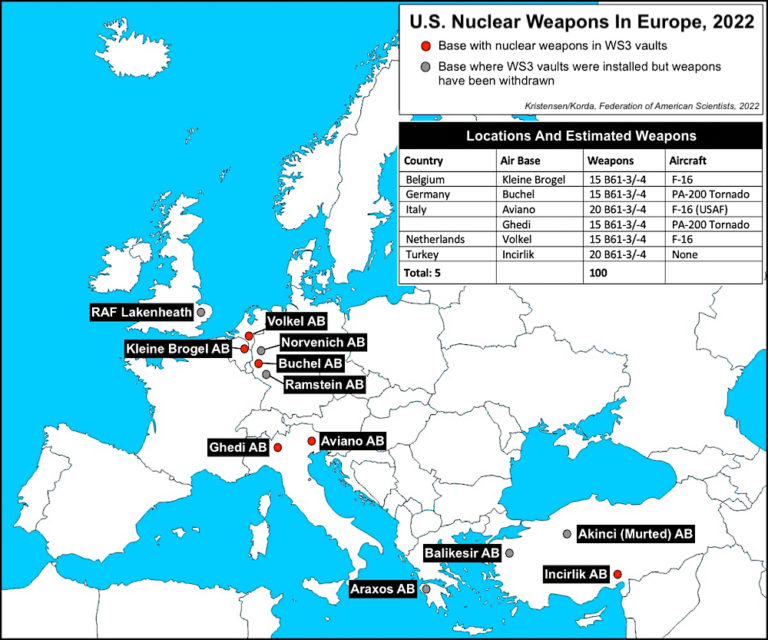
Worse still, the US practices a controversial arrangement known as “nuclear sharing”, under which it installs nuclear equipment on fighter jets of select non-nuclear NATO countries and train their pilots to carry out nuclear strike with US nuclear bombs. This is when the US, being a party to the nuclear Non-Proliferation Treaty (NPT), has promised not to hand over nuclear weapons to other countries, and the non-nuclear countries in the NATO’s sharing arrangement have themselves promised not to receive nuclear weapons from the nuclear weapon states!
NATO declared last year that seven NATO countries have contributed dual-capable aircraft to the nuclear sharing mission. These countries are believed to be the US, Belgium, Germany, Italy, Netherlands, Turkey and Greece. And all are signatories to the NPT!
Welcome to the rules based order! What is perfectly permissible to the “collective West” is forbidden for Russia!
Finally, the diplomatic pirouette has yet another dimension: Britain’s decision to send depleted uranium weaponry to Ukraine is confirming its reputation as the most reckless and unscrupulous state in the whole NATO alliance.
For, there is no question that depleted uranium munitions are radioactive and toxic and their heavy use in the Yugoslavia and Iraq wars has been linked to birth defects and cancers. It has been tied to “the highest rate of genetic damage in any population ever studied” in Fallujah, the city subjected to two brutal US sieges during the invasion of Iraq.
Ironically, the toxicity of depleted uranium munitions has been accepted by many NATO countries and the European Parliament has called for its use to be banned. So, what is Britain up to, behaving like an outlier?
The heart of the matter is that Britain is creating conditions in Europe to base nuclear-armed US bombers in Britain at Lakenheath in Suffolk (which were removed in 1991 in line with the Intermediate Nuclear Forces treaty.)
At a time when the peace movement in Britain is moribund, count on the Russian retaliation to deploy tactical nuclear weapons in Belarus to trigger calls for yet another tit for tat escalation from warmongers and Russophobes. Expect the US bombers to return to Lakenheath in a near future.
US democracy ‘a facade’ – Russian security chief
RT | March 27, 2023
The US is not really a democracy, nor does it seek to promote democracy in its relations with other nations, contrary to Washington’s claims, senior Russian security official Nikolay Patrushev has said. He made the remarks while commenting on the upcoming ‘Summit for Democracy’ hosted by the US government.
Patrushev, who is the secretary of the Russian Security Council, described the US economy as “dependent on corruption and lobbying connections going to the White House and Capitol Hill.”
Corporate interests have hijacked the levers of political power in the US and use the country’s international clout to pursue their own agenda, he said in an interview with Rossiyskaya Gazeta newspaper, to be published in full later today.
Their democracy is a pretty facade for the political system, which serves to hide the neglect of the rights of ordinary Americans.
Washington pursues the same approach in the international arena, where it claims to be the champion of democracy but disregards other nations’ sovereignty, Patrushev said. He believes that this “hypocrisy” will be on display at the Summit for Democracy, which will kick off this week in Washington.
The event will be “a gathering to support a world order in which Washington wants to play the central role forever. Dissenters will be labeled ‘undemocratic states,’” he predicted. The US, which “appointed itself the dictator of the world, will harass the nations whose sovereignties and democracies were undermined,” by Washington.
The reality is that “Washington has long been a leader in violating the sovereignty of other nations, in the number of wars and conflicts it has unleashed,” the security chief said. He called the nations that support this arrangement “vassals” that are constantly “humiliated” in their abusive relationships with the US.
The international event, which is being held for the second time, is meant to promote democracy against what Washington increasingly sees as assertive “authoritarian” states. The US reportedly invited all participants of the first summit, which was held in 2021, including the administration of the self-governed Chinese island of Taiwan. NATO members Hungary and Türkiye were snubbed once again, according to Foreign Policy magazine.
The EU is losing relevance in the emerging new world
By Timur Fomenko | RT | March 27, 2023
Vladimir Putin and Xi Jinping met in Moscow last week, and Western circles predictably responded by accusing Russia of becoming “subservient” or even a “vassal state” to China.
MEP Guy Verhofstadt, a Euro-fantasist and former prime minister of Belgium, jeered on Twitter, “Putin’s appalling legacy now includes turning Russia more and more into a Chinese vassal state,” oblivious to the irony of his own words. As the United States took the lead in denouncing China’s peace plan for the Ukraine conflict, publicly setting out the conditions on which it should end, the European Union was nowhere to be seen, or at least had nothing original to say.
This makes Verhofstadt’s comments a damning display of lacking self-awareness. Russia and China are setting out their vision for a new multipolar world, while the US struggles against them in seeking to maintain its hegemonic position. Meanwhile, the European Union has been reduced to the status of a mere bench player in it all, and has become effectively irrelevant. The failure of EU countries to stake out their own will and position amidst the larger powers, as well as their total subservience to the US, has made a mockery of the “strategic autonomy” concept once championed by Emmanuel Macron.
“Strategic autonomy” is a principle of European integration where the EU should be an actor in a multipolar world, which advocates for its own interests and pursues its own agenda. Supporters of this principle insist that the EU should not blindly follow the will of the US when it comes to every foreign policy issue, but should be proactive and enhance its role on the world stage. Therefore, they should not, as is commonly demanded by Washington, take sides on matters such as a new Cold War with China. The term gained growing traction during the years of the Trump administration, when Europe’s relations with the US hit a low due to his particular interpretation of the “America first” doctrine.
However, the practical reality of “strategic autonomy” is that the EU is not a unitary state, but a loose intergovernmental organization of states which, while seeking to establish common positions on a principle of unity, do not truly have a unified foreign-policy-making mechanism. The intra-institutional politics of the EU are often a messy compromise and battle of wills between different levels of actors, including the states themselves, the European Commission, and the European Parliament. This combines with the reality that “European integration” has been a broken process since 2008. Challenges such as the Eurozone financial crisis, Brexit, Covid-19, and internal conflicts with various states such as Poland have all weakened and fractured the EU.
As a result, the EU has been ill-suited to deal with what is, despite media misdirection, the single most explicit source of foreign influence and interference against it, the US. Washington has multiple channels whereby it exerts control over the EU’s many foreign policy actors. Firstly, it uses a web of government-funded think tanks and associated journalists to control public opinion and steer EU countries towards supporting its objectives. Secondly, the US has an extraordinarily political hold over the former Soviet bloc states to the east of the EU (with the exception of Hungary), which it uses to foment increased antagonism against Russia and China, and therefore undermines the attempts of the bloc’s most “autonomous” and powerful states – Germany and France – to pursue more reconciliatory foreign policies.
Thirdly, the US uses the United Kingdom as its primary cheerleader in Europe (be it from within or without the EU) to project its political will onto the continent and override the will of any defiant member states. An example of this is the BBC World Service acting as a massive propaganda machine to push narratives in line with Washington’s foreign policies. Additionally, the US has shown an ability to work with and weaponize the intelligence services of member states against their own countries, such as using Danish intelligence to spy on other European leaders.
Through all these factors, both past and present, the US has been able to keep Europe divided, conflicted, and seemingly unable to pursue any foreign policy which actually meets European interests, as opposed to those of the US. This has culminated even to the extent of literally destroying the Nord Stream pipelines and then propagating a false narrative that Ukraine was responsible. The Ukraine war has ultimately only accelerated the isolation and irrelevance of Europe, which has strengthened the hold of the military-industrial complex over the continent, undermined its energy industries, and thus converted the term “strategic autonomy” into a laughing stock.
One might ask, who is truly the vassal? If a new multipolar world is emerging, it’s fair to say, Europe simply isn’t part of it. Russia, China, and America are the drivers of current events, the EU is but a passenger.
Moscow waiting for Western leaders ‘to sober up’ – Lavrov
RT | March 27, 2023
Moscow will determine how its future relations with Western nations will develop only after they come to their senses, Russian Foreign Minister Sergey Lavrov said on Monday.
Speaking at the Gorchakov Public Diplomacy Fund, which provides support to Russian and foreign NGOs and think tanks, Lavrov accused the US and its allies of being “mired in cave Russophobia, while sacrificing the glaring problems in their own societies.”
“When and if they sober up, we will decide on our position regarding further relations with them. But we will make this decision, of course, on our own and based on our terms,” the foreign minister added.
Lavrov went on to point out that, despite the ongoing “dirty campaign to cancel everything linked to Russia,” it still had a lot of friends worldwide – including in the West – who like Russian culture and share the traditional family values it promotes.
At the same time, the minister warned that Russia would give a harsh response to all hostile actions. He claimed that Western countries wanted to stir unrest in Russia and undermine its stability. “They have found very capable agents of their will in the current Nazi regime in Ukraine, whose roots were laid a long time ago,” Lavrov said.
Against this backdrop, the top diplomat reiterated that Russia was fighting to protect not only the Russian-speaking population in the new territories that chose to join the country in public referendums last autumn, but also its own statehood.
Russia has repeatedly warned the West against supporting Ukraine, arguing that such policies make it a direct participant in the conflict. While Moscow maintains it is open to talks with Kiev, on Saturday, Kremlin spokesman Dmitry Peskov claimed that the US “had maniacally set itself up for not allowing Ukrainians to even think about” a potential peaceful settlement of the conflict.
Russian tactical nuclear weapons in Belarus – escalation or legitimate response?
By Drago Bosnic | March 27, 2023
On March 25, Russian President Vladimir Putin announced that Russia will start deploying its tactical nuclear weapons in Belarus. Construction of designated storage facilities for the weapons is planned to be completed by July 1. The decision to transfer nuclear weapons to Belarus was made after Minsk issued a formal request, essentially mirroring Washington DC’s nuclear sharing agreements with several NATO member states. And while the decision was officially made after the United Kingdom announced it would supply depleted uranium munitions to the Kiev regime, the actual reasoning might have to do with much more sinister plans by the United States.
Namely, Warsaw and Washington DC have been floating the idea of transferring some of the US nuclear weapons stockpiled in Europe to Poland. The move has been mentioned several times in recent years, including in early October last year, when Polish President Andrzej Duda mentioned it in an interview with Gazeta Polska. The US has nuclear sharing agreements with the Netherlands, Belgium, Germany, Italy and Turkey, with approximately 100 (mainly air-launched) tactical nuclear weapons deployed in all five countries. Greece also took part in the program, but discontinued its participation in 2001, although it’s widely believed Athens still keeps the necessary storage facilities functional.
President of Belarus Alexander Lukashenko advised against UK plans to deliver depleted uranium munitions to the Kiev regime and warned that Russia would soon supply Belarus with “munitions with real uranium”. However, Putin himself stated that “even outside the context of these events”, Belarus still has legitimate security concerns and that “Alexander Grigoryevich [Lukashenko] has long raised the question of deploying Russian tactical nuclear weapons on the territory of Belarus”. This clearly implies that threats to Minsk transcend the immediate danger of depleted uranium munitions deliveries to the Neo-Nazi junta in Kiev.
“There is nothing unusual in such a decision, as the United States has been doing this for decades. They have long placed their tactical nuclear weapons on the territories of their allies, NATO countries, and in Europe. In six states – the Federal Republic of Germany, Turkey, the Netherlands, Belgium, Italy and Greece – well, not in Greece now, but there is still a storage facility,” Putin stressed, further adding: “[Russia and Belarus] will do the same, without violating our international obligations on the non-proliferation of nuclear weapons”.
He added that Russia is indeed mirroring the United States in this regard and that it’s not transferring the ownership of its tactical nuclear weapons to Belarus, but that it’s simply deploying them to the country and training the Belarussian military to operate and use them in the case of a wider escalation by the US and NATO. The Russian military has already provided Belarus with the necessary upgrades to be able to deliver tactical nuclear warheads. At least 10 (presumably Belarussian Air Force) jets have been assigned and equipped to carry such weapons, although neither side specified what type of aircraft received the said upgrades.
Belarus operates several types of nuclear-capable fighter jets, including the recently acquired Su-30SM and the Soviet-era MiG-29. In addition to air-launched nuclear weapons, Russia already deploys ground-based assets in Belarus, including the “Iskander” systems capable of launching nuclear-tipped hypersonic and regular cruise missiles. Minsk also operates its own “Iskander” units, meaning that those too could be equipped with tactical nuclear warheads, further bolstering the country’s deterrence capabilities. This is particularly important as Belarus has also been targeted by US/NATO covert/black operations in recent years, including an attempted Maidan-style color revolution in 2020.
“We have handed over to Belarus our well-known and very effective ‘Iskander’ system that can carry [nuclear weapons],” Putin stated, adding: “On April 3, we will start training the crews and on July 1 we will complete the construction of a special storage [facility] for tactical nuclear weapons on the Belarussian territory.”
In addition to the “Iskander”, Belarus still maintains a number of Soviet-era nuclear-capable assets, including a substantial arsenal of “Tochka-U” tactical ballistic missiles. These could serve as a secondary delivery option given their shorter range and inferior accuracy when compared to the “Iskander” which boasts a 500 km range, high precision, extreme maneuverability at every stage of flight, as well as a hypersonic speed estimated to be at least Mach 5.9, although military sources indicate that it can go up to Mach 8.7. This makes the “Iskander” virtually impossible to intercept, as evidenced by its performance during the SMO (special military operation). The system also provides a significant advantage over NATO forces in Eastern Europe.
President Lukashenko strongly indicated that Minsk could host Russian nuclear weapons as soon as NATO implied it could deploy US B61 nuclear bombs to Poland, highlighting that his country’s Soviet-era infrastructure for such weapons remains intact despite US pressure to destroy it during the 1990s. Belarus is home to a growing arsenal of state-of-the-art Russian military units and equipment, including strategic assets such as the S-400 SAM (surface-to-air missile) systems, as well as the advanced Su-35S air superiority fighter jets and MiG-31 interceptors, including the K/I variants capable of deploying the already legendary “Kinzhal” hypersonic missiles, which are also nuclear-capable.
Drago Bosnic is an independent geopolitical and military analyst.
Jabbed pilots’ roll call of death and injuries
By Sally Beck | TCW Defending Freedom | March 27, 2023
‘Mayday! Mayday!’ is something no airline pilot wants to say, and no passenger wants to hear, but this month Virgin Australia, Emirates, United and Southwest airlines have all turned back aircraft or made emergency landings because air crew have suffered serious health incidents. A British Airways pilot died of a heart attack just before he was due to fly a plane from Egypt.
Here’s the timeline:
· March 3: Virgin Australia crew received a memo describing why flight VARA A320 from Adelaide to Perth returned 30 minutes into the journey: ‘The First Officer [co-pilot] became unwell. A return to Adelaide was considered the best course of action by the captain.’
· March 11: United flight 2007 from Guatemala to Chicago was diverted because the captain had chest pains, landing at George Bush airport in Houston.
· March 12: It is reported that a British Airways pilot collapsed and died in a hotel in Cairo, Egypt, shortly before he was due to fly.
· March 13: Emirates flight EK205 from Milan turned back because the co-pilot felt unwell 90 minutes after take-off.
· March 22: Josh Yoder, President of US Freedom Flyers, an organisation fighting vaccine mandates for airline staff, tweeted: ‘On a Southwest flight departing Las Vegas, the captain became incapacitated soon after take-off. He was replaced by a non-Southwest pilot who was commuting on that flight.’
According to pilot and medical aviation doctor Jackie Stone, airline pilots have Class One medical clearance. This means they are extremely fit and extremely healthy, with less than a 1 per cent chance per year of having a medical incident that could immobilise them. They receive extensive annual medicals and are grounded if an incapacitating condition is picked up.
This makes the above highly unusual, and the favourite explanation for this increase is vaccine injury. Especially as we now know vaccines can cause myocarditis, heart inflammation which can cause heart attacks, and blood clots, which can lead to heart attacks and strokes, although authorities claim these are ‘rare’.
Glen Waters, a member of Aussie Freedom Flyers, a group fighting aviation vaccine mandates, is a former captain with Virgin Australia whose career was terminated on its twentieth anniversary for refusing the Covid jab. He said: ‘Injuries in aviation following Covid-19 vaccination are occurring and data is not being vigilantly collected or reported. We have a growing list of anecdotal post-vaccination injury reports from pilots, and other staff, across the airline industry.’
Captain Lee Maisey, who worked for Jetstar, New Zealand (owned by Qantas), was fired after 13 years for not being fully vaccinated. She not only suffered vaccine injury but felt her employer was unsympathetic. She said: ‘In November 2021, I reluctantly took a first dose of Pfizer vaccine because I was threatened with being fired. Ten days later I was walking on the beach when my feet went a funny colour, then my legs started going numb and tingly. By the end of the day both arms and both legs were just fizzing.
‘My heart would miss beats and I’d have palpitations.
‘Then came the insomnia. I lay down in bed and my eyes just didn’t shut. It was like that all night. I found out later that this is a side-effect of the vaccine.
‘I told my bosses at Jetstar what was happening. They were not sympathetic. They arranged for me to speak with an aviation medical doctor over the phone. His response to my side-effects was “Yes, that’s normal.”
‘The second was the head of medical. I spent over two hours on the phone, and I was particularly worried about the insomnia. On any other occasion that would be enough to pull my medical [clearance to fly]. I asked her if this would happen, and she said: “It’s up to you.” Which I found remarkable.’
International airline pilot Brit Malone (not his real name) was injured by the AstraZeneca vaccine, not recommended by the FAA but available to pilots outside the US. He was advised not to have another AZ vaccine, but his airline then insisted he get a dose of Pfizer so that he had received the recommended two doses.
Mr Malone said: ‘I succumbed to pressure and had the first dose of AstraZeneca. While I was flying, I was aware of this pain forming in my leg. I didn’t pay too much attention, I go to the gym a lot and thought I’d pulled a muscle.
‘I woke up one morning and found a blue line up the inside of my leg. It was a blood clot. I was off work for three months on blood thinners. It’s been confirmed by a number of specialists that it was vaccine-related.’ Mr Malone has since been diagnosed with cancer and has a 17cm tumour in his liver.
Josh Yoder of US Freedom Flyers said: ‘To ensure passenger safety the pilot medical should be updated to include d-dimer tests, which pick up blood clots, and troponin tests, which measure troponin proteins released when the heart muscle has been damaged.’
Many airlines mandated Covid-19 vaccines even though pilots are not allowed to take part in drug trials and are allowed to receive only approved medication which has been in general use for a minimum of 12 months. The Covid vaccines were, and are still, experimental and we are currently in phase four trials, so pilots should have been exempt.
The US Federal Aviation Administration (FAA)’s recommendations are followed globally by all aviation governing bodies. The FAA website says: ‘The FAA generally requires at least one year of post-marketing experience with a new drug before consideration for aeromedical certification purposes. This observation period allows time for uncommon, but aeromedically significant, adverse effects to manifest themselves.’
Some airlines, especially in Australia and New Zealand, simply sacked pilots refusing to have a Covid vaccination with the result that those still in service and suffering health conditions potentially caused by the jab are trying to hide it. Glen Waters said: ‘The most worrying is flight deck crew failing to disclose medically significant conditions for fear of losing their pilot’s licence.’
Airlines are aware that Covid vaccinations are being questioned for causing serious adverse events but have chosen to ignore all safety signals.
Dr Kate Manderson, the principal medical officer of Australia’s Civil Aviation Safety Authority (CASA), says she has no concerns about Covid vaccinations although she is aware of the case of American Airlines pilot Bob Snow, who suffered a heart attack last year, six minutes after landing his plane in Dallas, Texas. Citizen journalist and entrepreneur Steve Kirsch talked directly to Susan Northrup, who is the Federal Air Surgeon for the FAA, the top medical officer. She has never talked to Snow either although Kirsch provided her with Snow’s phone number. Bob Snow says that he has never been contacted by any authority for information about his vaccine-induced heart attack.
In June 2021, I reported that four British Airways pilots had died unexpectedly but BA refused to confirm or deny whether vaccines were implicated.
Fed up with negotiating with their airlines, pilots are fighting back. Qantas pilot Alan Dana, who set up Aussie Freedom Flyers, and former Virgin Australia captain Shane Murdock have launched a legal action on behalf of pilots, engineers, ground staff, and cabin crew, against Qantas and Virgin for breach of contract and unfair dismissal. They say aviation staff cannot be legally injected if they are being coerced, while both airlines argue this is not the case.
To support Aussie Freedom Flyers’ class action please donate here or here.
US Freedom Flyers have also launched a legal action.
The FAA issued this statement: ‘The FAA’s Federal Air Surgeon determined that pilots and air traffic controllers can safely receive the Pfizer, Moderna, Johnson & Johnson or Novavax vaccine. The FAA has seen no credible evidence of aircraft accidents or incapacitations caused by pilots suffering medical complications associated with COVID-19 vaccines.’
A Jetstar spokesperson said: ‘All New Zealand-based pilots, irrespective of the airline they work for, were required under New Zealand government health orders to be fully vaccinated in order to fly. All Jetstar employees are required to comply with government requirements at all times.’
We contacted all five airlines mentioned at the top of this article and Australia’s Civil Aviation Safety Authority but received no response.
Biden Administration demanded crackdown on “vaccine-skeptical” WhatsApp chats
Despite it being end-to-end encrypted

By Ken Macon | Reclaim The Net | March 26, 2023
The Biden administration was pushing for the censorship of COVID-related content on WhatsApp, according to communications between the White House and Meta, the company that owns the messaging platform.
This move has raised concerns about freedom of expression and the ability to communicate privately on digital platforms.
Unlike Facebook and Instagram, which are also owned by Meta, WhatsApp is an encrypted direct messaging platform that is used for private conversations between individuals or small groups. The White House has been pressing Meta executives to find ways to measure “reduction of harm” on WhatsApp, insisting that they must have a “good mousetrap” to observe what conversations are shared on the platform.
According to the report by David Zweig, who echoed Reclaim The Net’s reporting from January, the White House has also offered to work closely with Meta to curb the spread of so-called “vaccine-skeptical” content.
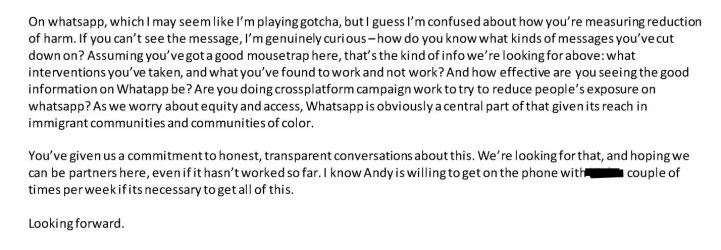
However, because of WhatsApp’s structure, targeted suppression or censorship of certain information is not possible. Instead, the focus of content moderation on WhatsApp has been to push information to users.
This has included partnering with the World Health Organization, UNICEF, and over 100 governments and health ministries to send COVID-19 updates and vaccine-related messages to users.
This move by the Biden administration raises concerns about the impact on freedom of expression and the ability to communicate privately on digital platforms.
With the White House pressing for content moderation on the platform, it could undermine this privacy and freedom of expression that is expected on end-to-end encrypted apps (although WhatsApp is perhaps less trusted anyway over its ties to Meta.)
Fake News No More: Dozens of Babylon Bee Satire Pieces Turn Into Real Stories
Sputnik – 26.03.2023
The Florida-headquartered satirical news website became a household name ahead of the 2020 presidential election, and has been characterized as The Onion for conservatives and Christians, although it is also enjoyed by independents and those who can handle a political joke or two.
The Babylon Bee has repeatedly been caught in government and media dragnets to crack down on so-called disinformation and fake news, with major outlets occasionally falling for and reprinting some of its gut-busting satirical claims, and Snopes even fact-checking a Bee piece about CNN buying an industrial-sized washing machine to literally spin the news.
Now, the company, whose tagline is ‘Fake News You Can Trust’, has a problem of another sort: its fake news pieces becoming reality.
According to Babylon Bee founder Seth Dillon, over 90 of the site’s joke headlines have become actual news stories over time.
“It ranges from really silly stuff like – we did a joke during the pandemic about how pants sales were plummeting because everyone was working from home. And it was this picture of a guy sitting there in his boxers, but he’s got a nice dress shirt on at his desk. And the very next day in Yahoo Finance there was this story about how Walmart was seeing increased sales of tops, but not bottoms,” Dillon recalled in an interview with US media.
“We make a joke about how Kamala Harris was taking likability lessons from Hillary Clinton, which is just insane and silly – who would take likeability lessons from Hillary Clinton? But then a month later there’s a real story that her staff reached out to Hillary’s staff to make her more likable,” he added.
In another example, last fall, the Bee penned a joke-style article offering “9 Reasons Not to Worry About the Tanking Economy.” Days later, a column appeared in Jeff Bezos’ Washington Post on “7 ways a recession could be good for you financially.”
“We even did one about Trump, about how Trump had claimed to have done more for Christianity than Jesus himself. That one went crazy viral, it got fact-checked and rated ‘false’, and two years later he actually said it. He said he’d ‘done more for Christianity than anyone else in history, in fact he’s done more for religion than anyone else in history,’” Dillon recalled.
The problem, Dillon said, is that today’s news stories often already come across as satire due to their whimsical, “incredibly outrageous” nature. “We’re living in really crazy, insane times. So yes, there are plenty of times where we pull up a headline, and we’re just baffled by it.”
The issue of fake, satirical news blending with reality has been a feature of reality for at least the past two decades, and been fueled by the rise of the internet and social media, and the often surreal political clown show in Washington. Academics have speculated that satire has become an important feature of the postmodern age in which we live because the latter denies the difference between reality and what appears to be, and embraces incoherence and meaninglessness.
Despite its obvious satirical nature, the Bee’s close-to-the-real-news approach and sharp political angle has gotten it into repeated trouble with censors. In 2022, the site saw its Twitter account suspended after jokingly labeling a transgender Biden administration official “man of the year.” The account was restored by Elon Musk after he bought out the microblogging giant last October.
Featured Video

Seyed M. Marandi: US-Iran War Inevitable: Kuwait and Bahrain May Fall
or go to
Aletho News Archives – Video-Images
From the Archives
Oil and the Israel Lobby
Reknowned economist M. Shahid Alam offers this excellent critique of Noam Chomsky’s defective analysis of the relative influence of Oil versus the Israel lobby over US foreign policy: … continue
Blog Roll
 Aletho News
- ICC ignored ‘very well-documented’ NATO crimes – ex-Libyan minister
- SNSC secretary dismisses US response to Iran’s conditions as ‘inadequate’
- Sanaa says Taiz roads open, secure for residents, warns Saudi forces
- Iraqi resistance group urges Saudi leadership to admit defeat, lift Yemen siege
- Trump’s Retreat: How Al-Aqsa Flood Took Down the US Empire
- Israel’s Military Actions in Lebanon Grossly Violate International Law — Lavrov
- Seyed M. Marandi: US-Iran War Inevitable: Kuwait and Bahrain May Fall
- Leaders Condemn Ansarallah Attack on Saudi Arabia While Ignoring Illegal War Against Yemen
- Leaked: Britain’s Covert Iraqi Psyops Network
- Yemeni Armed Forces Warn Airlines Against Using Saudi Airports, Exempt Mecca and Medina
- If Americans Knew
- After Oct 7, IDF policy allowed civilian casualties for even the lowest-ranking targets
- Israel’s Destruction of Southern Lebanon Intensified After the Cease-Fire
- The Last-Minute Decision That Gave Israel Its Name
- The American Conservative: How Trump Made the World Go Nuclear
- Meet the US generals and admirals advancing Israeli policy
- Opinion: Why news organizations should boycott Israel
- The Israeli witch hunt of Sami Abu Shehadeh exposes the lie of the ‘Jewish and democratic’ state
- No state has a ‘right’ to exist – least of all Israel
- Testimonies about Gaza’s civilian death toll expose Israel’s atrocities – Daily Update
- How Israel Conquered the Latin American Right
- No Tricks Zone
- New Study Suggests Large Regions Of The Pacific Ocean Have Been Cooling For The Last 80 Years
- Germany’s Green Energy Debacle: High Energy Costs Force Kahla Porzellan to Close After 182 Years!
- New Study: 50 Years Of The Most Aggressive ‘Net Zero’ Policies Can Only Affect The Global Climate By 0.03°C
- US September “Heat” Was No Record…Many Records Set Decades Ago
- Latest European Green Energy Debacle; Portugal’s Largest Flagship Solar Park Insolvent!
- Green Energy Debacle: German Expert Professor Fritz Vahrenholt Warns Of Severe Economic And Social Consequences
- Two More Paleo Reconstructions Affirm Meters-Higher Sea Levels Across Ireland, Brazil 7000-6000 Years Ago
- New Study: Earth And Venus Surface Warmth Largely Explained By Convection And Lapse Rate, Not CO2 Or Radiation
- 2025 Nature Paper Claiming Worsening Global Drought Gets RETRACTED …Heavily Flawed
- New Study: ‘Global Drought Shows No Detectable Recent Acceleration Under Climate Warming’

