Ezra Klein Warns Israel’s Role in Iran War Will Fuel Antisemitism
By Jose Nino | Occidental Observer | May 30, 2026
For decades, prominent Jewish voices have wrestled privately with an uncomfortable question. Does aggressive Israeli government conduct expose diaspora Jewish communities to backlash they did not invite? In early March, Ezra Klein brought that question back into public view. Speaking with former Obama senior adviser Ben Rhodes on a podcast episode titled “The Great Lie of War”, the New York Times columnist warned that Israel’s central role in the joint U.S. assault on Iran could fuel a new wave of antisemitism.
The two men spent most of the interview discussing the strategic recklessness of the Iran operation where the United States and Israel launched an assault that killed Supreme Leader Ali Khamenei and much of his senior command. They examined the lack of congressional authorization, the absence of an endgame, the risk of a massive refugee crisis, and what they described as Israeli Prime Minister Netanyahu’s long-sought goal of drawing the United States into direct military confrontation with Iran.
The antisemitism remark came near the end of that segment, specifically as a follow-on to a discussion about Saudi ambivalence toward the war and the question of what Israel actually wants from the conflict. Klein’s exact words in the transcript were, “I’m not saying this is the biggest issue at this moment, but the centrality of Israel in the operation has raised some concerns for me about what this is going to mean for anti-Semitism. You see the amount of talk on the MAGA right, but elsewhere as well that, you know, Israel’s leverage over Donald Trump or that, you know, this is all just some kind of Israeli plot.”
Klein then noted that Netanyahu appeared to be gambling with Israel’s long term political standing in America and in the world at a time of “very, very sharply rising anti-Semitism,” expressing uncertainty about how it would all pan out. The New York Times columnist’s concern, stated plainly, was that Israel’s highly visible, central role in what many perceived as an unjustified war of aggression would fuel conspiracy theories rather than defuse them. His worry was that Netanyahu’s short-term tactical success, finally getting a U.S. president to strike Iran, risked long-term consequences for Jews, especially in the United States.
This dilemma is not new. Jewish billionaire George Soros articulated a similar concern over two decades ago. Soros has largely steered clear of public association with Jewish communal life and seldom appears at exclusively Jewish functions. That changed in 2003, when he took the stage at a New York City meeting hosted by the Jewish Funders Network. Questioned about the spread of antisemitism across Europe, Soros offered an unexpected diagnosis, laying blame at the feet of U.S. and Israeli policy. “There is a resurgence of anti-Semitism in Europe. The policies of the Bush administration and the Sharon administration contribute to that,” he stated. “If we change that direction, then anti-Semitism also will diminish. I can’t see how one could confront it directly.”
At the time, the reaction from Jewish leadership was furious. Elan Steinberg, who served as senior adviser to the World Jewish Congress after a stint as its executive director, fired back. “Let’s understand things clearly: Anti-Semitism is not caused by Jews; it’s caused by anti-Semites.” Abraham Foxman dismissed Soros’s words as “absolutely obscene.” The head of the ADL elaborated. “He buys into the stereotype. It’s a simplistic, counterproductive, biased and bigoted perception of what’s out there. It’s blaming the victim for all of Israel’s and the Jewish people’s ills.”
The Foxman and Steinberg responses reflected an orthodox position within Jewish communal leadership. Antisemitism, in this view, is a pathology of antisemites, and any attempt to link it to Israeli behavior constitutes victim blaming. Yet this position has always co-existed uneasily with a practical awareness that Israeli actions, particularly those perceived as disproportionate or aggressive, create public relations challenges for diaspora Jewish communities.
Klein’s 2026 remarks fall squarely within this tension. He was warning that Netanyahu’s gamble, making Israel so visibly central to an unpopular war, would hand ammunition to those who already believed such theories. Polling data suggests that Klein’s concerns about Israel’s political standing are well-founded. Gallup’s 2025 Annual World Affairs Survey documented a broader collapse in American sentiment toward Israel. Only 46% of Americans sympathized with Israelis, the lowest figure in 25 years of Gallup tracking. Among Democrats, 59% sympathized more with Palestinians—with only 21% sympathizing with Israelis—creating a nearly 3-to-1 ratio, the first time Palestinians had held such a commanding lead among members of a major U.S. party. A majority of Americans, and a record-high 76% of Democrats, supported an independent Palestinian state.
These trends predate the Iran strike and reflect cumulative damage from Israel’s conduct in Gaza. The joint United States and Israel operation against Iran, with Israel’s role so prominently featured, is unlikely to reverse this trajectory and will more than likely heighten Western populations’ hostility toward Israel. The polling numbers bear this out.
The Jewish People Policy Institute found that only 28% of strong liberal Jews support the war while 62% oppose it. Support climbs to 100% among strong conservative Jews. The partisan split is even more dramatic. Trump voters among American Jews back the war at 99%, while Harris voters divide 47% to 42%.
The picture among Americans generally looks very different. Pew Research found that 59% of Americans said the United States made the wrong decision in using military force and 61% disapprove of Trump’s handling of the conflict. An AP-NORC poll found that 59% of Americans believe U.S. military action has gone “too far,” while a Quinnipiac survey reported 74% oppose sending U.S. ground troops into Iran. The immediate unpopularity of the Iran war combined with Israel’s sullied image as a result of the Gaza genocide may explain why elements of American Jewry are embracing certain forms of controlled opposition to the Netanyahu regime, while stopping short of criticizing the entire Zionist project and its thoroughly Jewish nature.
It should be said that rational anti-Semitism is never about all Jews. Klein’s worry that “Jewish communities globally could be stained with guilt by association in the eyes of those who conflate the Israeli government with all Jews” should be seen as relying on the idea that anti-Semitism refers to complaints about “all Jews.” Most commonly complaints about Jews rely on understanding where the power of the Jewish community is directed, and in this case it’s obvious that the mainstream Jewish community in the U.S. and its powerful lobbying organizations (here and here) are entirely on board with the war. This is especially true in the Trump administration where the more conservative elements of the Jewish community, including Chabad Lubavitch, have increased their influence greatly.
It is simply that their vision [of conservative Jewish groups] for Jewish flourishing in America is radically at odds with the basic assumptions that have grounded American Jewish politics for much of the last century: chiefly, that Jewish interests are best served by the separation of religion and state; that American Jews are best protected through multiethnic, pluralistic coalitions rather than an alliance with the Christian majority; and that the invisibility of Jewish group interests is preferable to visible Jewish particularity.
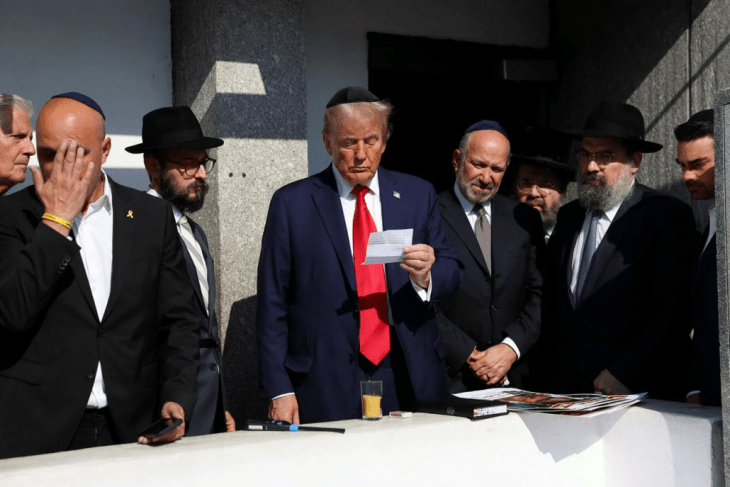
Ezra Klein’s warnings about the centrality of Israel in the Iran war are a tacit admission that the Jewish establishment has lost its ability to operate from behind a veil. By leveraging control over U.S. administrations to initiate wars of choice, this power structure has forced a public reckoning that no amount of image-polishing can reverse. History has repeatedly shown that Jewish overreach eventually triggers an immune response from the host population.
We are currently in the midst of that reaction, and the path forward lies in the unapologetic identification and systematic dismantling of the Jewish influence networks that have compromised the highest levels of our government and financial institutions.
Five Americans injured in Iranian missile strike on Kuwait base: Report
Press TV – May 30, 2026
An Iranian ballistic missile attack on a Kuwaiti air base has wounded several American military personnel and caused serious damage to two US MQ-9 Reaper drones, according to a new report.
The American news outlet Bloomberg, citing an informed source, said in a report published on Saturday that the attack on the Ali Al Salem Air Base resulted in minor injuries to approximately five individuals, including US service members and contractors.
It also caused significant damage to two MQ-9 Reaper drones, with one reportedly destroyed and another heavily damaged. Each drone is valued at around $30 million.
According to Bloomberg, Kuwaiti air defences intercepted an Iranian Fateh-110 missile before it reached its intended target. However, debris from the intercepted projectile fell onto the US-operated Ali Al Salem Air Base, causing the injuries and damage.
The latest development comes amid heightened tensions between Washington and Tehran.
On Thursday, US Central Command (CENTCOM) claimed that Iran had launched a missile toward Kuwait, describing the action as a “gross violation of the ceasefire.”
In a statement issued later in the day, Iran’s Islamic Revolution Guards Corps (IRGC) said it had deliberately targeted the US base, noting that it had been used to launch an earlier American attack.
The IRGC went on to say that US forces had conducted a strike using aerial projectiles against a location near Bandar Abbas airport earlier that morning, describing its missile attack as a warning to the US.
It also vowed that any future acts of aggression would be met with a stronger response, stressing that responsibility for any escalation would rest with the party initiating hostile actions.
The US and Israel started an aggression against Iran on February 28, some eight months after they carried out unprovoked attacks on the country.
Iran began to swiftly retaliate against the strikes by launching a barrage of missiles and drone attacks on the Israeli-occupied territories as well as on US bases in regional countries.
On April 8, forty days into the war, a Pakistan-brokered temporary ceasefire between Iran and the US took effect.
Negotiations ensued in the Pakistani capital, Islamabad, but stopped short of an agreement amid Washington’s maximalist demands and insistence on unreasonable positions.
The Strange Case of Ori Solomon
The dismissal of charges against Ori Solomon raises uncomfortable questions about how the US justice system handles Israeli nationals
José Niño Unfiltered | May 29, 2026
On January 31, 2026, FBI agents and Las Vegas Metropolitan Police officers executed a search warrant at a residence on Sugar Springs Drive in east Las Vegas, near Washington Avenue and Hollywood Boulevard. What they found inside triggered one of the strangest criminal cases in recent Nevada history. Authorities discovered what they described as an illegal biological laboratory concealed within the property, complete with a biosafety hood, a biosafety sticker, a centrifuge, multiple refrigerators containing vials of unidentified liquids, red and brown unknown liquids in gallon-sized containers, and over 1,000 containers with unknown substances.
FBI Special Agent in Charge Christopher Delzotto described the scene as containing “a bio-safety hood, a bio-safety sticker, a centrifuge, multiple refrigerators, red-brown unknown liquids in gallon-sized containers, and refrigerated vials with unknown liquids.” Clark County Sheriff Kevin McMahill confirmed investigators recovered “evidence of possible biological material, including refrigerators with vials containing unknown liquids” and said the items were “consistent in appearance” with those found in the 2023 Reedley, California case, per a report by ABC30.
A whistleblower reportedly told investigators that people who entered the garage became “deathly ill,” with at least one resident hospitalized for a respiratory illness. Testing of the materials was conducted at both the Southern Nevada Health District laboratory and the National Bioforensic Analysis Center in Maryland. Materials were later determined to be consistent with components for medical diagnostic test kits.
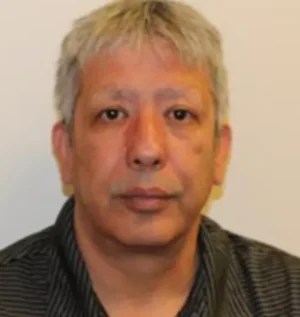
The man at the center of this investigation is Ori Solomon, a 55-year-old property manager who had been living in Las Vegas for over 20 years at the time of his arrest. Officers found an Israeli passport in the name “Ori Solomon” and a French passport in the name “Ori Salomon” at his residence. He was present in the United States on a non-immigrant visa. His primary occupation was managing short-term rental properties, and court records indicate he oversaw approximately 37 such properties in the Las Vegas area. He is not a trained biologist, and court documents note no publicly confirmed expertise in biological sciences. In a significant development, federal charges against Solomon were dropped in May 2026, with prosecutors stating “the Government has concluded that the interests of justice require dismissal of the complaint.”
Solomon managed properties for Chinese national Jia Bei Zhu, also known as David He and Jesse Zhu. Investigators described Solomon as an “agent and conspirator” with Zhu, noting that Zhu made 467 calls to Solomon in the weeks leading up to the raid. Zhu was already in federal custody in California linked to a 2023 illegal biolab in Reedley, California—a case that had attracted the attention of the House Select Committee on the Chinese Communist Party. That committee found the illegal California lab was run by a PRC citizen who was a wanted fugitive from Canada and had evaded a multi-million million Canadian court judgment for stealing American intellectual property.
U.S. Magistrate Judge Elayna Youchah, who is of Sephardic Jewish extraction, presided over the initial federal detention hearing on February 6, 2026. She ordered Solomon’s release on his own recognizance, finding that the allegations were concerning but not severe enough to require detention, noting Solomon had no prior criminal history. She imposed conditions including surrender of all passports, travel restricted to the continental United States, required notification before leaving Clark County, and prohibition on possessing any firearms or weapons.
The federal prosecution was led by the U.S. Attorney’s Office for the District of Nevada, then headed in practice by Sigal Chattah—an Israeli-born attorney who bore the title of First Assistant U.S. Attorney after a federal judge ruled her interim appointment had been made illegally. A criminal complaint charged Solomon with one count of being a prohibited person in possession of a firearm. Multiple firearms were recovered at his residence, including handguns and rifles.
Then came the twist that has fueled speculation. Chattah’s office filed a motion to dismiss without prejudice the federal firearms complaint against Solomon. The motion stated only: “After a careful review of the evidence and additional information provided by defendant, the Government has concluded that the interests of justice require dismissal of the complaint at this time.” A spokesperson declined to explain the rationale. The dismissal was without prejudice, meaning federal prosecutors retain the legal option to re-file.
Solomon still faces the Clark County felony charge for improper disposal of hazardous waste. With the federal case dismissed, there is public concern that Solomon could potentially regain his passports and leave the country before the state case is resolved.
This concern is not hypothetical. The Solomon case mirrors a separate, high-profile case involving an Israeli cybersecurity official charged with child sex crimes in the Las Vegas area in 2025. Tom Artiom Alexandrovich, 38, the Executive Director of the Cyber Defense Division at Israel’s National Cyber Security Authority, was arrested on August 6, 2025, in Henderson, Nevada, as part of a multi-week joint undercover sting operation targeting child sex predators. Alexandrovich was among eight men arrested. He allegedly used WhatsApp and the dating app Pure to communicate with an FBI decoy posing as a 15-year old girl, agreeing to meet for “sexual contact” and bringing a condom to the meeting location.
Alexandrovich was attending the annual Black Hat USA 2025 cybersecurity conference at Mandalay Bay in Las Vegas,which ran August 2-7, 2025, at the time of his arrest on August 6. He was booked at the Henderson Detention Center and charged with luring a child with a computer for sex acts, a Class B felony carrying 1 to 10 years in prison.
What happened next sparked immediate international controversy. Alexandrovich posted $10,000 standard bail, set without review by a judge at the time of booking, and flew back to Israel the following day, August 7, 2025. U.S. Attorney Sigal Chattah, publicly stated Alexandrovich “should have had his passport confiscated by state authorities” and must be brought back to face justice. The U.S. State Department denied any federal intervention, declaring Alexandrovich “did not claim diplomatic immunity and was released by a state judge pending a court date.”
Alexandrovich’s case proceeded through the Nevada courts. Judge Barbara Schifalacqua, ordered remote appearances after he skipped his initial arraignment. He appeared via Zoom before Judge Schifalacqua in September 2025 and was barred from contact with minors and dating apps. A grand jury indicted him on one count of luring children with technology for sexual conduct. He pleaded not guilty via video before District Judge Tina Talim and a trial was set for March 2026. Judge Talim denied a motion to dismiss in November 2025, ruling the prosecution had established probable cause.
Meanwhile, the man at the center of the original biolab investigation has faced his own reckoning. On May 5 and 6, 2026, Jia Bei Zhu was found guilty on all 12 counts for fraudulently selling COVID-19 tests and lying to the FDA. His sentencing was scheduled for August 24, 2026, with a potential sentence of up to 31 years in prison.
To say that strange things are taking place in Sin City would be an understatement. When the layers of the Las Vegas biolab investigation are peeled back, it becomes evident that the “interests of justice” cited by prosecutors are effectively code for the protection of Jewish interests under the current American regime. Solomon’s immediate release and subsequent dismissal are not aberrations but consistent features of a system that has long been captured by Jewish interests hostile to the Historic American Nation.
The ease with which Solomon, a foreign national holding multiple passports, has navigated federal jeopardy exposes the double standard inherent in our society. While common citizens and those who vehemently oppose the Judeo-American order are relentlessly pursued by the state, those embedded within the trans-national Jewish network enjoy a tacit, systemic immunity. This is the hallmark of Empire Judaica—a framework that treats the security of the American people as secondary to the preservation of a Jewish tribe that acts with the same impunity in Nevada as the state of Israel does on the global stage.
Iran Won’t Back Down, They’ll Endure All Suffering /Nima Alkhorshid
Daniel Davis / Deep Dive – May 29, 2026
Fars sources dispute Trump claims on proposed Iran agreement
Al Mayadeen | May 29, 2026
Fars News Agency cited informed sources rejecting recent claims by US President Donald Trump regarding a potential agreement with Iran, saying his remarks are “a mixture of truths and lies” aimed at portraying a “fabricated victory.”
According to the report, the proposed agreement, drafted under the framework of “commitment in exchange for commitment,” is currently in the final stages of approval in Iran, though no final decision has yet been made.
The sources said Trump, whom they said is unable to withdraw from the agreement process, made statements that contradict the actual provisions of the text while simultaneously claiming that the US would immediately end the blockade against Iran.
Distortions in Trump’s remarks
The report said Trump falsely claimed that Iran would be required to open the Strait of Hormuz without imposing transit fees. According to the sources, no such clause exists in the agreement.
Iran, they said, has stressed that once the blockade is lifted, the strait would reopen according to arrangements determined by Tehran, including possible ship monitoring, inspections, maritime services, and security measures. The report added that Iran is currently preparing the infrastructure for implementing those procedures.
Fars also dismissed Trump’s claim that Iran would dismantle or destroy its nuclear materials, saying informed sources confirmed that the memorandum of understanding contains no such provision and that the allegation is “entirely baseless.”
Key provisions omitted
According to the report, one of the most important terms ignored in Trump’s statements is the immediate payment of $12 billion from frozen Iranian assets.
The sources said the agreement requires the payment to be carried out immediately and stipulates that Iran will not proceed to further stages of negotiations until the transfer is completed. Failure to fulfill this obligation would constitute a violation of US commitments under the deal, the report added.
The report also stated that another key component of the proposed agreement involves establishing a full ceasefire in Lebanon in line with Hezbollah’s position.
According to the sources, only after these issues are resolved would Iran move to the next phase of talks concerning the lifting of all sanctions and the nuclear issue, in accordance with Tehran’s “red lines.”
Iranian officials also stressed that any final agreement would be based on the principles and red lines of the Islamic Republic and formulated with “complete distrust” toward the US, ensuring that any breach of commitments would trigger an immediate reciprocal response.
Congress quietly moves to integrate US and Israeli militaries
By Ben Freeman | Responsible Statecraft | May 29, 2026
At a time when the American public is expressing unprecedented levels of distrust in the Israeli government, Congress just proposed tying the U.S. to the Israeli military more than ever before.
Buried in the House’s version of the 2027 National Defense Authorization Act (NDAA) released on Tuesday, is section 224, entitled “United States-Israel Defense Technology Cooperation Initiative.” The provision would arguably do more to intertwine the U.S. military with the Israeli military than the more than $200 billion (inflation adjusted) in military assistance Israel has received from the U.S. since its founding in 1948.
Section 224 lays the groundwork for bilateral research and development, co-production of weapons, joint ventures, licensing agreements, and seemingly every manner of U.S.-Israeli military-industrial complex cooperation. The U.S. and Israel already work together heavily on missile defense, but this provision would greatly expand coordination to seemingly every area of defense tech, including AI, quantum, autonomous systems, directed energy, cyber, biotech, and many more. It also proposes “network integration” and “data fusion.” In other words, the U.S. military’s data could soon be the Israeli military’s data.
If fully enacted, this proposal would provide a higher level of military-industrial integration than the U.S. has with any other country in the world. To be sure, the U.S. has worked closely with its NATO partners on co-production and shared supply chains, most notably via the Defence Production Action Plan. And, as the number one arms dealer in the world, the U.S. provides weapons to militaries across the globe. But that is mostly a one-way street, with the U.S. providing weapons to foreign buyers who only occasionally make parts for those weapons themselves, as in the case of the F-35’s global supply chain.
Section 224 would be a different beast entirely. It would fuse the U.S. and Israeli defense sectors in multiple areas vital to the battlefields of the future, like autonomous systems and cyber. It would also bring extraordinary Israeli influence to the U.S. beyond what it already has through the Israel lobby and its robust network of social media influencers. It would give the Israeli government the opportunity to greatly expand one of the most powerful levers of influence in U.S. politics: jobs in the U.S. By expanding or starting new co-production facilities like it already has in Mississippi and Arkansas, the Israeli government could boast of providing jobs on U.S. soil, thereby securing allies among members of Congress who represent the districts where those jobs lie.
The result could well be a U.S. political system even more susceptible to the whims of an Israeli government that seemingly has no qualms about drawing the U.S. into military conflicts in the Middle East.
This unprecedented level of U.S.-Israeli military integration stands in stark contrast to the traditional aid model of defense cooperation, in which Israel already stood out as the top recipient of U.S. military assistance. As laid out in a recent Quincy Institute brief, authored by Steven Simon, this shift from an aid model to a military integration model has troubling implications, namely:
The shift will strip away the political and diplomatic oversight mechanisms that make the relationship publicly accountable, moving it from a visible annual aid vote into the opaque machinery of defense acquisition, where oversight is limited and political accountability is minimal. The result would be a defense relationship that is simultaneously deeper and less transparent.
This all comes at a time when the Israeli military has repeatedly used U.S. weapons in strikes that have violated international humanitarian laws in Gaza, and as Israel has repeatedly violated ceasefires (as has the U.S. itself) in the Trump administration’s unnecessary war with Iran.
The enormous gulf between what most Americans want and what the president is doing when it comes to Israel and what Congress is proposing here should not be ignored. Just 30% of respondents to a New York Times/Sienna poll from mid-May believe Trump made “the right decision” to go to war with Iran, with 64% saying it was wrong. An Institute for Global Affairs poll released earlier this week dove even deeper into the American psyche when it comes to arming Israel, finding that “Just 16 percent say the United States should keep supplying Israel with weapons without new restrictions. Thirty-eight percent want to stop supplying weapons entirely, and another 24 percent want weapons conditioned on how they’re used.”
Yet, mainstream leadership in both parties remains largely pro-Israel and continues to shape the base legislative text before amendments and broader congressional debate open it to the full body, as is the case with this NDAA provision.
Though slowly, tides within both parties are shifting as more and more members speak out against the growing divide between Israel’s actions and America’s interests. For example, Sen. Chris Van Hollen (D-Md.) wrote in The New York Times on Tuesday that, “The Democratic Party has provided reflexive and unconditional support to Israeli governments, even as their actions have increasingly undermined American interests and values.” On the Republican side of the aisle, Rep. Thomas Massie (R-Ky.) and former Rep. Marjorie Taylor Green (R-Ga.) have openly decried the Israel lobby’s corrosive influence — a stance that may have, at least partially, cost both of them their seats in Congress.
What can other members of Congress who are concerned about Israel’s destabilizing actions do right now? Stop the Israeli-U.S. military-industrial merger in its tracks. Lawmakers should reject Section 224 from the NDAA to avoid deep integration with Israel’s military at a time when a growing number of Americans oppose Israel’s actions in the region.
Ben Freeman is Director of the Democratizing Foreign Policy program at the Quincy Institute and the author of “The Trillion Dollar War Machine: How Runaway Military Spending Drives America into Foreign Wars and Bankrupts Us at Home” (2025).
Israel Relaunches, Rebrands Online Propaganda Campaign
By Harrison Berger | The American Conservative | May 21, 2026
Israel has relaunched and rebranded Act.IL, an online campaign originally designed by Israeli intelligence officials at the Ministry of Strategic Affairs to harass and intimidate American critics of Israel. Such operations are generally referred to as “troll farming,” though the forces behind Act.IL use softer, more highfalutin language.
Rebranded as RiseApp, the program is operated by Israel’s Reichman University (IDC Herzliya) and, according to the project’s website, aims to mobilize Act.IL’s existing database of more than 40,000 pro-Israel online operatives to counter what it describes as “antisemitism” and “misinformation.”
The Reichman University website describes RiseApp as delivering “fact-checked, expert-led responses” for users to deploy in “social media debates and public forums,” in order to engage in “proactive advocacy” on behalf of Israel. A “dual purpose,” of the app, Reichman says, is that it allows users to flag and “identify emerging adversarial narratives” while “alerting partner organizations” to “develop tailored responses.”
A presentation for the forthcoming app’s interface, posted to the Reichman website, pitches the platform as “empowering and uniting the Jewish community” and includes tabs for “The Useful Idiots” and “Genocide Claims.” The latter would seem to provide users with arguments to combat the consensus of human rights organizations that Israel committed genocide against Palestinians in Gaza.
RiseApp’s predecessor Act.IL was launched in 2017 as a joint project of Reichman Institute and the Israeli-American Council (IAC)—the U.S.-based Israel lobby group founded by casino billionaire Sheldon Adelson and run by Adam Milstein (Tuvia Milsztein), who was convicted in 2008 for his involvement in the Spinka tax fraud ring involving Orthodox Jewish charity fronts—and was operated by Yarden Ben-Yosef alongside other current and former Israeli intelligence officials.
“We work with the Ministry of Foreign Affairs and the Ministry of Strategic Affairs, consult with them and manage joint projects.” Act.IL director Ben-Yosef said in a 2018 interview with Forbes Israel. In an interview with The Forward a year earlier, he said of Act.IL’s relationship with Israeli spy agencies: “We talk with each other. We work together.”
As The Forward described the app in 2017, Act.IL would gather “high school students and adult mentors” who complete “social media ‘missions’ assigned out of a headquarters in Herzliya, Israel,” including pressuring social media platforms to censor content supportive of the Boycott Divestment and Sanctions (BDS) movement and critical of Israel, with users getting “points” for each mission they complete.
That propaganda and troll campaign was part of a broader Israeli government operation orchestrated by Gilad Erdan’s Ministry of Strategic Affairs called Concert, whose purpose was to create third party-operated surveillance, censorship, and propaganda firms that could hide all Israeli government links to their operations, which at the time were directed against the BDS movement in North America.
“Ambiguity is part of our guidelines,” the Israeli intelligence officer and director-general of the Ministry of Strategic Affairs Sima Vaknin-Gil explained in a leaked 2016 video recording featured in the suppressed Al Jazeera documentary The Lobby, telling a private audience of Adelson’s IAC activists that Israel has established “a civil intelligence unit that collects, analyzes, and acts upon” Israel’s enemies, using data from “campuses… and labor unions, and churches,” calling the program “Israel Cyber Shield.”
Israel Cyber Shield was eventually expanded into a much larger Israeli propaganda program which cycled through the names Kela Shlomo (Solomon’s Sling), Concert, and finally Voices of Israel. It is now housed under Amichai Chikli’s Ministry of Diaspora Affairs.
The rebranding of controversial hasbara operations is a documented pattern of the Israeli government and its intelligence services. Before Act.IL launched, Israeli company Psy-Group , also staffed by former Israeli spies and affiliates of Reichman University, ran “Project Butterfly” to infiltrate and destabilize BDS chapters on college campuses using fake identities, later pitching their social media manipulation services to Trump’s 2016 presidential campaign. Psy-Group founder Joel Zamel met Donald Trump Jr. at Trump Tower in August 2016, along with the businessman Erik Prince and a man named George Nader who presented himself as an emissary of the UAE and Saudi Arabia, while a senior campaign aide, Rick Gates, had separately solicited proposals from the Israeli spy-staffed firm for a covert influence campaign targeting Republican convention delegates and Hillary Clinton. When special counsel Robert Mueller’s Russiagate investigators closed in on those meetings, Psy-Group simply shut down and relaunched as Percepto International, while the Israel Lobby insinuated that Mueller was antisemitic for looking into Psy-Group’s Israeli interference efforts.
The relaunch of Act.IL as RiseApp follows the Israeli Knesset’s approval of the country’s largest ever budget for foreign propaganda operations, or hasbara, quintupling funding from 2025 to a total of $730 million. That scaled-up expenditure comes amid surveys showing declining support for Israel across party lines in the United States, a trend Israel correctly perceives as an existential threat to the unconditional funding and diplomatic protection their country depends on.
Harrison Berger is a correspondent at The American Conservative. He has contributed to Drop Site News, The Nation, and Responsible Statecraft. Previously, he was a researcher and producer for System Update with Glenn Greenwald. His work focuses on civil liberties and U.S. foreign policy. He studied Political Science and Russian Studies at Union College (NY).
Avoiding Catastrophic Failure in Cuba
SONAR21 | May 28, 2026
ALERT MEMORANDUM FOR: The President
FROM: Veteran Intelligence Professionals for Sanity (VIPS)
SUBJECT: Avoiding Catastrophic Failure in Cuba
Dear President Trump:
We are deeply concerned that the current U.S. approach to Cuba makes an ugly humanitarian disaster – for which the U.S. will be responsible – increasingly likely. We also believe that any military option will draw us into a losing war.
Cuba is not Venezuela. U.S. relations with Cuba have never been good, even before Fidel Castro’s rise in 1959. Washington has never grasped Cubans’ deep national pride and yearning for sovereignty, nor their culture of respect for institutions. Whether we like it or not, the government has residual legitimacy, and even Cubans wanting significant change will rally behind the flag if there is an attack from outside.
The Cuban people are indeed suffering, but reports alleging broad popular support for U.S. sanctions and even military intervention are heavily colored by people who are in the pay of the USG. Given the false choice between living under the current government with U.S. “maximum pressure” sanctions and living under a new system, some Cubans would indeed opt for change. But their protests aren’t about blaming the government, and even those who want major change in Cuba do not trust the U.S. The 65-year embargo and the ongoing oil blockade are sources of deep, if latent, suspicions toward us.
The language in Executive Orders dated 29 January and 1 May, alleging that “the policies, practices, and actions of the Government of Cuba constitute an unusual and extraordinary threat” to U.S. national security, suggests confusion between reality and politically motivated allegations. These narratives are mostly fake.
- Cuba does seek ways to evade U.S. sanctions – as any country would to survive – and several countries help it, albeit at steadily declining levels. Such efforts can hardly be called a “threat” to the United States. While ideally the Cuban military business conglomerate, GAESA, would operate more transparently, it’s cynical of us not to see their need for its secrecy in the face of aggressive U.S. intelligence operations and sanctions.
- Since at least 1992, the USG has had no evidence of Cuba providing any operational, logistical, or training support to any terrorist organization. Stretching the definition of “terrorist” to include a couple of fugitives from U.S. law appears disingenuous.
- A careful review of the intelligence surrounding the tragic, unnecessary shootdown of the two Cuban-American aircraft as they departed Cuban airspace on 24 February 1996 shows clearly that the indictment of former President Raúl Castro last week is not fact-based.
- Neither does the USG have evidence that China and Russia are operating signals intelligence “spy bases” in Cuba directed against the U.S. As the Intelligence Community knows well, Russia abandoned its main facilities after the collapse of the USSR, and there has never been any indication of a Chinese facility pointed at the U.S.
- While debate over the alleged “sonic attacks” or “microwave attacks” against U.S. personnel continues to rage in some quarters, no evidence has been uncovered in the past nine-plus years to support the accusation of a Cuban role in such attacks on the island and in China, Europe, and the U.S.
- The covert operations under U.S. “democracy promotion” or regime-change programs generate information that supports the views of the U.S. constituency that controls them, so the resulting picture is deceptive. We recommend that you review these covert activities closely. If you decide to approve them, sign onto them in a Presidential Finding and official Congressional Notification. The record shows that covert action planners misled President Kennedy about the prospects for the Bay of Pigs operation, and CIA analysts were kept in the dark.
Administration statements, aggressive airborne intelligence collection, and ship movements around Cuba suggest preparations for military action. The Cuban military is weak and lacks even basic supplies, and Cuba’s doctrine of “War of All the People” may seem naïve to us. Cuba will react with what conventional hardware it has and can attain, perhaps even drones, in defense of its leadership and sensitive facilities.
But U.S.-driven “regime collapse” and occupation or imposition of a government of our choosing will fail badly. The same people who keep ’57 Chevrolets on the road with a coat hanger will wreak havoc against a foreign-imposed regime. Administration declarations show a wise tendency to keep U.S. boots off the ground, but it’s also important to know that swarms of Cuban nationalists will silently undermine any system that we impose. The implications of any of these scenarios for migration pressures would be catastrophic.
Press reports indicate that the U.S. is in some kind of “negotiation” with a grandson of former president Raul Castro, who holds no official position in Cuba. In any case, our experience with conflicts worldwide leads us to point out that talks with a gun at one’s temple are not a true negotiation. U.S. coercion against Cuba hasn’t worked for more than six decades. A negotiation without blockades, guns pointed at leaders’ heads, and political indictments can work much better.
FOR THE STEERING GROUP, VETERAN INTELLIGENCE PROFESSIONALS FOR SANITY (VIPS)
- Fulton Armstrong, former National Intelligence Officer for Latin America (ret.)
- Marshall Carter-Tripp, Foreign Service Officer (ret.); Division Director, State Department Bureau of Intelligence and Research
- Philip Giraldi, former C.I.A., Operations Officer (ret.)
- Matthew Hoh, former Capt., USMC, Iraq & Foreign Service Officer, Afghanistan (associate VIPS)
- Larry Johnson, former C.I.A. Intelligence Officer & State Department Counter-Terrorism Official (ret.)
- John Kiriakou, former C.I.A. Counterterrorism Officer and former senior investigator, Senate Foreign Relations Committee
- Karen Kwiatkowski, former Lt. Col., U.S. AF (ret.); at Office of Sec. of Defense watching the manufacture of lies on Iraq, 2001-03
- Ray McGovern, former U.S. Army infantry/intelligence officer & C.I.A. analyst; C.I.A. Presidential briefer (ret.)
- Elizabeth Murray, former Deputy National Intelligence Officer for Near East, National Intelligence Council; C.I.A. political analyst (ret.)
- Scott Ritter, former MAJ., USMC, former chief UN Weapon Inspector, Iraq
- Coleen Rowley, F.B.I. Special Agent and former Minneapolis Division Legal Counsel (ret.)
- Lawrence Wilkerson, Colonel (USA, ret.), Distinguished Visiting Professor, College of William and Mary (associate VIPS)
- Sarah G. Wilton, CDR, USNR, (ret.)/D.I.A., (ret.)
- Robert Wing, former Foreign Service Officer (associate VIPS)
- Ann Wright, Col., U.S. Army (ret.); Foreign Service Officer (resigned in opposition to the war on Iraq)
Trump Administration’s DOJ Filing in Supreme Court ‘Sharp Betrayal’ of Religious Freedom
By Jefferey Jaxen | May 27, 2026
In a stunning reversal the Department of Justice under President Trump has filed a brief urging the U.S. Supreme Court to deny review in John Doe et al. v. Kathy Hochul, No. 24-1015. The case involves former New York healthcare workers fired for refusing COVID-19 vaccination on religious grounds under the state’s now-repealed Section 2.61 mandate, which allowed medical exemptions but barred religious ones.
The move is in stark contrast to the COVID-era legal momentum across the board seeing courts rule in favor of employees fired for religious vaccine refusals.
The Second Circuit upheld the employers’ refusal to accommodate, citing “undue hardship.”
The DOJ’s Call for the Views of the Solicitor General (CVSG) brief argues the petition is a poor vehicle for review—no circuit split, a repealed law, and petitioners who sought only a full exemption rather than alternatives like reassignment—while defending the policy’s consistency with Title VII of the Civil Rights Act.
This position, however, draws sharp criticism for weakening core protections against religious discrimination. Aaron Siri, a leading litigator who has represented numerous affected healthcare workers, called out the filing in an X post stating:
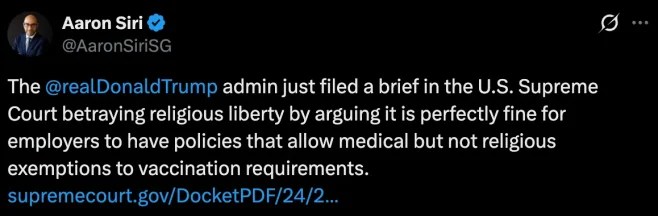
The brief’s analysis hinges on semantics and procedural technicalities. It acknowledges that petitioners claimed New York’s mandate conflicted with Title VII by foreclosing reasonable religious accommodations. Yet it frames their requests as demands for an “exemption” prohibited by state law, rather than the “accommodation” federal law requires.
Siri dismantled this in a follow-up post:
“Instead of defending these wrongfully terminated workers, the DOJ nonsensically and shamefully plays word games to characterize their requests as seeking an ‘exemption’ (which New York law prohibited) instead of an ‘accommodation’ (an option federal law requires). It then relies on this semantic nonsense to argue that the Supreme Court should not review the Second Circuit’s holding that a policy providing for medical but not religious exemptions is legal.”
Siri, who is perhaps the most experienced lawyer defending Americans who experienced COVID-era oversteps of basic liberties and freedoms, described the practical outcome bluntly: the mandate “permitted only a medical exemption and did not include a religious exemption.”
Healthcare workers with sincere religious objections were fired en masse. He continued,
“Having dealt with scores of religious employees in New York that lost their jobs under this policy, the Trump administration’s position is a sharp betrayal. The DOJ should have simply argued the obvious – that Section 2.61 foreclosed any religious exemption and hence should not stand under federal law. Period. That would have taken one or two pages. Instead, it spends over 20 pages creating a word salad of nonsense to justify New York’s and the DOJ’s unjustifiable position.”
This approach is dangerous because it normalizes differential treatment: medical exemptions are permissible, but religious ones trigger “undue hardship” claims tied to state penalties. Under Title VII, as clarified in Groff v. DeJoy (2023), employers must accommodate religious practice unless it imposes substantial increased costs. Yet the DOJ’s brief effectively blesses a regime where religious belief is disfavored, allowing employers to hide behind preempted state rules.
If a law bars religious accommodations outright, Title VII should preempt it—yet here the filing accepts a policy that functionally did exactly that while claiming otherwise.
The stakes extend far beyond healthcare. A Supreme Court denial, influenced by this brief, could embolden employers nationwide to impose vaccine or other medical mandates while dismissing religious objections as unreasonable.
It undermines the free exercise principles reinforced in cases like Fulton v. City of Philadelphia and signals that post-COVID religious liberty battles remain unwinnable in court. Workers facing future mandates—for flu shots, boosters, or novel therapies—would find their faith subordinated to bureaucratic convenience.
Siri’s critique highlights a missed opportunity for the administration that campaigned on restoring freedoms eroded during the pandemic. By playing procedural games instead of forcefully defending Title VII’s mandate to accommodate sincere religious practice, the DOJ risks setting precedent that treats faith as second-class. As Siri warned, this is no minor technical brief; it is a “sharp betrayal” that could erode religious freedom for millions. The Supreme Court must recognize the broader threat and take the case to reaffirm that no employer or state can lawfully force a choice between livelihood and conscience.
Russia warns US against sending more troops to its borders
RT | May 28, 2026
Russia has warned that deploying additional US troops near its borders would be “unacceptable,” after Washington pledged to send more soldiers to Poland.
Russian Foreign Ministry spokeswoman Maria Zakharova said at a press briefing on Thursday that reducing the number of US personnel stationed in Europe would be a “rational, justified, and long-overdue” step toward stabilizing what she described as an “imbalanced” security situation created by NATO policies.
Deploying more American troops in the region, on the other hand, would place them within striking distance, Zakharova added.
She said such a move would only increase tensions in Europe and compel Russia to respond with “military-technical measures.” Zakharova accused NATO of pushing the continent toward a “suicidal” conflict.
Around 10,000 American service members are currently stationed in Poland, most of them on a rotational basis, while roughly 80,000 are deployed across Europe overall. Poland shares a border with Russia’s Kaliningrad Region, an exclave on the Baltic Sea.
Last week, US President Donald Trump unveiled plans to send 5,000 additional troops to Poland, one of the most vocal supporters of Ukraine in its conflict with Russia. The announcement came after the Pentagon said it would delay the rotation of 4,000 troops, which Vice President J.D. Vance later downplayed as a “standard delay.”
Trump has frequently accused NATO members of failing to spend enough on defense and recently announced the withdrawal of 5,000 troops from Germany amid a dispute with Berlin over the war with Iran.
Russian President Vladimir Putin has said Moscow has no intention of attacking NATO members unless Russia itself is attacked first. Russian officials have accused the West of “reckless militarization” and cited NATO’s eastward expansion as one of the causes of the Ukraine conflict.
On Thursday, Sergey Naryshkin, head of Russia’s Foreign Intelligence Service, said NATO was “de facto preparing for a large-scale military conflict in the east.”
The US Military Keeps Blowing Up Small Boats in the Caribbean and Pacific
By Adam Dick | Peace and Prosperity Blog | May 28, 2026
Suppose a Latin American nation’s military kept blowing up private American small boats in the Caribbean Sea and Pacific Ocean, killing nearly all the United States citizens on them in the process. The Donald Trump administration and a horde of US Congress members would be shouting about terrorism and supporting major responsive military actions. However, the actual perpetrator of the blowing up of small boats in the Caribbean and Pacific since early September has been the US government and the victims have been mainly residents of Latin American nations, so the destruction and killing just keeps going on with little pushback from politicians in Washington, DC.
At The Intercept, Nick Turse is keeping a tally of the ongoing slaughter at sea. He counts, relying on information derived from US government sources, 60 strikes killing 197 people. The number of survivors of the strikes is just six.
This is a killing spree, not an ordinary drug interdiction effort.
The blowing up of small boats started in conjunction with the movement toward a regime change war against Venezuela. The small boats were claimed by the Trump administration, though never with convincing argument, to be part of a supposed grand threat of “narco-terrorism” from the South American country. Even if that argument had some credibility, discerning observers asked: Why were the small boats being summarily destroyed and everyone on board killed instead of more typical actions being taken, such as stopping and searching boats and detaining and arresting people on board?
Come January 3, the US military invaded Venezuela and carried off its president to America. The Trump administration has since been imposing demands on the nation’s government. The war justifying rationale for the US government blowing up small boats had thus come to an end. But, the slaughter at sea has continued nonetheless. The latest strike included in Turse’s tally was on Wednesday. It was the fifth such strike this month in the Pacific and Caribbean. The continuation of attacks on boats and the people on them seems to be either a macabre demonstration of the tendency of a government program to continue even after the reason for its creation is gone or part of the preparation for further intervention abroad.
Featured Video
BRITAIN’S WARNING: PREPARE FOR WAR
or go to
Aletho News Archives – Video-Images
From the Archive
How Ukraine Tortured and Slaughtered Donbass
By Kit Klarenberg | Al Mayadeen | July 11, 2024
Almost immediately after the proxy war erupted, ISIS-tier footage of the torture and murder of Russians in Ukrainian custody emerged.
On July 6th, the New York Times published an astonishing investigation: In Ukraine, Killings of Surrendering Russians Divide an American-Led Unit. The article documents in grim detail how Chosen Company, an international volunteer battalion for Kiev, routinely executes Russian prisoners of war. It is the very first mainstream admission that this practice – a brazen breach of the Geneva Conventions, and a grave war crime – is widespread among Ukraine’s fighters, both foreign and homegrown. … continue
Blog Roll
 Aletho News
- Pentagon designates Chinese cultural centers national security threat
- Israel Demolishes Home Of Lebanese Journalist Whose Viral Film Exposed Pager Attack
- Record Oil, Empty Tanks: The UAE’s Miracle Recovery
- Burnham tackles Britain’s poverty with aggression in Yemen
- Peace in Ukraine: the easy way – or the hard way
- Trump & the Rrrrussians
- US taxpayer money laundered back through Ukraine – Musk
- Before COVID, an NIH lab chief proposed making a SARS-like bat virus more infectious
- Gates, Bourla on Trial in Netherlands Accused of ‘Great Reset’ Scheme at Vaccine Injury Hearing
- BRITAIN’S WARNING: PREPARE FOR WAR
- If Americans Knew
- An error has occurred; the feed is probably down. Try again later.
- No Tricks Zone
- Two New Studies Find Thwaites Glacier Melt Cannot Be Driven By Human Activity Or A Warming Ocean
- E-Cars Reduce CO2 Emissions By Only 41% Compared To Internal Combustion Engine Vehicles
- Predictions Made By Renowned Climate Professor Over Past Decades Have Been Proven To Be Poor
- New Study Suggests Large Regions Of The Pacific Ocean Have Been Cooling For The Last 80 Years
- Germany’s Green Energy Debacle: High Energy Costs Force Kahla Porzellan to Close After 182 Years!
- New Study: 50 Years Of The Most Aggressive ‘Net Zero’ Policies Can Only Affect The Global Climate By 0.03°C
- US September “Heat” Was No Record…Many Records Set Decades Ago
- Latest European Green Energy Debacle; Portugal’s Largest Flagship Solar Park Insolvent!
- Green Energy Debacle: German Expert Professor Fritz Vahrenholt Warns Of Severe Economic And Social Consequences
- Two More Paleo Reconstructions Affirm Meters-Higher Sea Levels Across Ireland, Brazil 7000-6000 Years Ago

