Kosovo Conflict is Part of US, EU and NATO’s Broader Plan Aimed Against Serbia & Russia, Experts Say
By Ekaterina Blinova – Samizdat – 12.12.2022
Kosovo and Metohija Serb leader Goran Rakic announced on December 12 that a crisis headquarters would be created to provide civilians and the media with first-hand information about the simmering crisis in the north of the region. Meanwhile, the self-proclaimed Albanian leadership of the so-called Republic of Kosovo is urging NATO to step in.
“A standoff in the predominantly Serbian northern Kosovo was sparked by an arrest of a former police officer [Dejan Pantic] accused of attacking a Kosovo law enforcement patrol,” Scott Bennett, a former US psychological warfare officer and State Department counterterrorism analyst, and former Booz Allen Hamilton contractor, told Sputnik.
“Serbian protesters erected barricades over the weekend to stop Kosovo police from entering a town and launching any kind of a terror operation against the Serbian people. Tensions were already running high after Pristina announced snap elections in the area, which were expected to be boycotted by all Serbian parties. On Saturday, Kosovo’s [de facto] President Vjosa Osmani postponed the vote until April,” Bennett continued.
The Albanian population of Serbia’s province of Kosovo unilaterally declared independence from Serbia in February 2008. Serbia has de facto not controlled the territory of its southern province since 1999, after the US-led NATO invasion of Yugoslavia, which was the first all-out war in Europe after the Second World War.
Even though the so-called Republic of Kosovo has been recognized by the US and less than half of the international community, Serbia’s territorial integrity is confirmed by United Nations Security Council Resolution 1244 of June 10, 1999. Hence, there is no state border between them, but just an internal border line.
This summer, tensions erupted around the self-proclaimed Republic of Kosovo after Pristina decided to impose a ban on the entry of vehicles with Serbian license plates from August 1, 2022. This prompted Serbs, who maintain large communities in northern Kosovo, to hold protests against the move.
Pristina’s initiative was clearly in breach of the 2013 Brussels Agreement. The agreement guaranteed that “there will be an association/community of Serb majority municipalities in Kosovo” with substantial local powers and ties to Serbia. The treaty was negotiated and concluded in Brussels under the auspices of the European Union.
“The Brussels negotiations between Belgrade and Pristina did not bring any positive result for Serbia, but led to the violation of international law, i.e. Resolution 1244, and the Constitution of Serbia,” Dragana Trifkovic, director of the Center for Geostrategic Studies, told Sputnik. “At the same time, the Pristina side did not even fulfill what it committed to in the Brussels agreement. Therefore, the only solution would be for Serbia to announce that it is canceling the Brussels agreement and request that the negotiation process continue in the UN, where it is the place for negotiations if we take into account the fact that the status of Kosovo cannot be resolved outside the framework of the UN Security Council. Attempts by the West to resolve the Kosovo issue outside the framework of international law must be condemned.”
On July 31, 2022 the Russian Foreign Ministry lambasted Pristina and its backers in Brussels and Washington for an attempted expulsion of the Serbian population and Serbian social institutions from Kosovo, calling upon the international community to observe the rights of Serbs in the region.
At the time, the de-facto Albanian authorities of the region backed down, but the conflict erupted again in December.
On Thursday, December 8, the “customs” of the self-proclaimed republic confiscated a batch of 42,000 liters of wine from one of the oldest Serb producers in the village of Velika Hoča in the southwest of the region. The formal reason was that the activities of the manufacturer’s legal entity were frozen during the COVID pandemic. De facto customs officers drove the tank to the wine cellar and poured all sorts of wine into it, thereby actually destroying the high-quality product, which would be impossible to consume if returned.
On December 10, the self-declared republic’s security forces detained 56-year-old former Serb police officer Dejan Pantic on “suspicion of terrorism.” Pantic resigned in November along with other Serbian law enforcement personnel from the self-proclaimed republic’s Interior Ministry. At the time, some Serbs living in Kosovo deliberately withdrew from local government institutions in protest against Pristina’s decision to fine anyone who did not change their Serbian car registration plates to Kosovo ones. Pantic was arrested while trying to enter central Serbia.
Pantic’s arrest prompted Kosovo Serbs to blockade roads and checkpoints on the administrative line between Kosovo and central Serbia. After that, employees of the European Union Rule of Law Mission (EULEX) in Kosovo and KFOR – the NATO-led international force in Kosovo – were dispatched to the barricades. NATO reportedly has roughly 3,700 personnel stationed in Serbia’s province.
The media reported interruptions in Internet and mobile communications. Gunshots were also heard in the north of Kosovo. Eventually, Kosovo’s de facto President Vjosa Osmani announced that local elections scheduled for December 18, 2022 would be postponed until next year.
Meanwhile, Serbia’s President Vucic announced on Saturday that he would make a request to the commander of NATO’s KFOR mission to deploy a 1,000-strong Serbian contingent in the north of Kosovo to protect Serbs under UN Security Council Resolution 1244.
The resolution authorizes Serbia to deploy up to 1,000 military, police, and customs officials to Kosovo’s Orthodox Christian religious sites, areas with Serb majorities, and border crossings, if such a deployment is approved by KFOR’s commander. However, Vucic added that he had “no illusions” that his request would be approved by NATO.
US and Brussels are Behind Kosovo Conflict
According to Bennett, the escalation of tensions over Kosovo was provoked by the US and its Western allies in order to tighten the screws on Belgrade, with whom Russia has a longstanding special relationship, amid Moscow’s special military operation to demilitarize and de-Nazify Ukraine.
“It seems the West, and specifically the United States and its proxies in NATO, are planning a military pivot to open up a new civil war between Serbia and Kosovo, as a means of menacing Russia and opening up a potential new front,” said Bennett. “So expect some kind of a false flag attack where the British-American intelligence services and military mercenaries artificially create a situation – most likely a bombing or massacre – and blame it on Serbia and Russia, to engineer yet another wave of hysterical EU sanctions and NATO military support for Kosovo against Serbia, and by proxy Russia.”
Hysteria has already engulfed Brussels and Pristina, with EU foreign policy chief Josep Borrell trying to threaten Belgrade over possible attacks on the EULEX and Kosovo’s de facto Prime Minister Albin Kurti urging the West to “punish” Serbia.
“The EU has behaved as a biased side from the beginning,” Professor Stevan Gajic, a research associate at the Institute of European Studies in Belgrade, told Sputnik. “And this was obvious, since the negotiations were basically lowered to the level of the EU from the level of the United Nations. The EULEX was biased. The whole process of Brussels agreements was only a sham in order for Serbia to give up all its state powers that it had. It is only logical that now the EU behaves like this. This might be a provocation. Serbia is very calm, actually trying not to use force to defend its citizens. But it only depends on the Western structures, whether they want to escalate or de-escalate this conflict.”
Gajic noted that nothing has changed in the West’s perception of Serbia over the last two centuries: “[T]he Serbs resisted Hitler’s pact [in July 1941] and we were bombed and consequently occupied,” he noted, referring to Nazi Germany’s occupation and subsequent division of the Kingdom of Yugoslavia in 1941 and Serbia’s resistance movement.
“NATO already bombed us twice in the 1990s,” the professor continued. “They bombed the positions of Serbs in Bosnia-Herzegovina, in Croatia in 1995, and then they bombed Yugoslavia, meaning Serbia and Montenegro, in 1999, directly supporting Albanian separatists and terrorists. Now they are again against the Serbs because they see us as proxies of Russia. And this didn’t start yesterday, but it’s been like that for the last 200 years, at least.”
The West is currently trying hard to sever ties between Moscow and Belgrade by both demanding that Serbia impose sanctions on Russia, and pressuring Belgrade into signing a comprehensive peace agreement with Pristina, which would pave the way to Serbia losing its Kosovo province, according to Trifkovic.
“The request for the introduction of sanctions against Russia is related to this in the sense that the West believes that by severing the ties between Russia and Serbia, it would solve the Kosovo issue much faster in terms of the implementation of the Kosovo independence project,” she explained. “Even if Serbia were to impose sanctions on Russia, which over 80% of the population of Serbia opposes, there would still be demands to sign a comprehensive peace agreement with Pristina.”
In addition to that, the West seems eager to twist Belgrade’s hand into dropping its partnership with Moscow because the US and EU’s anti-Russia sanctions have turned out to be a complete failure, according to Bennett. “Former Austrian Vice-Chancellor Heinz-Christian Strache has said Europeans are bearing the brunt of the crisis, while Moscow’s economy is doing fine,” the former US State Department counterterrorism analyst remarked. The West’s inability to “rein in” Moscow is casting a shadow over its image as leader of the world order.
One shouldn’t be deluded into believing Washington or Brussels’ statements about their intent to maintain peace and stability in Kosovo, according to Bennett. “As we have seen in the past, the promises and agreements made by the West, by the EU, and by NATO are worthless and not to be trusted,” he stressed.
Another telling moment, according to Bennett, is former German Chancellor Angela Merkel’s recent remarks about the 2015 Minsk Agreements, which deeply frustrated President Vucic:
“President Vucic describe[ed] how amazed, shocked, and disappointed he was to discover that Germany’s former Chancellor Angela Merkel has admitted what many people suspected all along: that the promises made by Germany and France in the Minsk agreements were never intended to be honored, and were instead simply a ruse or lie intended to generate space and time for the Ukrainian military to build up its ability to wage a proxy war against Russian civilians. President [Vladimir] Putin has also commented on the deceitfulness of this grotesque betrayal, but then again, betrayal and monstrous ugliness seems to be fast becoming the main characteristic of the European Union’s character,” Bennett observed.
Meanwhile, there are numerous similarities between the involvement of American politics in Kosovo and Ukraine, said Trifkovic.
She noted that in both cases, the US, as well as other Western countries, supported extremism, fuelled militant nationalism directed against the Serbs and the Russians in Kosovo and Ukraine, respectively. NATO also provided logistical and material support, so the extremists underwent training and received weapons, according to her. Meanwhile, the Western mainstream media actively spread anti-Serbian and anti-Russian propaganda, with numerous Western-funded NGOs joining the media chorus, the Serbian geopolitical analyst pointed out.
“By and large, they created a complex war atmosphere, and they brought to power extremist structures in Kosovo, as well as in Ukraine, which they control and through which they actually rule,” Trifkovic said. “At the expense of that, American and other Western companies [served] their economic interests. In Kosovo and Metohija, the Americans opened the largest military base in Europe, Bondsteel, and I am sure that there were plans to open American military bases in Ukraine as well. In fact, American military bases have surrounded the whole of Russia, and the attack on Serbia in 1999 was only one segment of that process.”
Elon Musk says some political candidates running for office were secretly shadow banned on Twitter
By Cindy Harper | Reclaim The Net | December 10, 2022
On Friday, Elon Musk confirmed that under previous leadership, political candidates were blacklisted on Twitter. In 2018, Twitter executives testified that the platform did not “shadow ban” people.
On Wednesday, journalist Bari Weiss published the second batch of “Twitter Files,” which showed that “teams of Twitter employees” built blacklists that were used to limit the spread of content.
People have always suspected that some users are shadow banned but Twitter has never been transparent about it and never tells users when they’re being suppressed. The documents obtained by Weiss showed that Twitter used “visibility filtering” to “suppress what people see to different levels.”
Weiss mentioned some of those who were added to the blacklists, including conservative commentators Dan Bongino and Charlie Kirk, Dr. Jay Bhattacharya, and Libs of TikTok. She did not say whether or not politicians were among those that were blacklisted.
Reporter Ian Miles Cheong asked both Musk and Weiss, “were any political candidates – either in the US or elsewhere – subject to shadowbanning while they were running for office or seeking re-election?” Musk responded, “Yes.”
Testifying before Congress in 2018, Twitter executives denied that users were suppressed based on political views.
“To be clear, our behavioral ranking doesn’t make judgments based on political views or the substance of tweets,” said Kayvon Beykpour, the former head of product.
“We don’t shadow ban, and we certainly don’t shadow ban based on political viewpoints. We do rank tweets by default to make Twitter more immediately relevant (which can be flipped off),” said former CEO Jack Dorsey.
What Is CISA and Why Does It Matter?
By Jeffrey A. Tucker | Brownstone Institute | December 10, 2022
On October 27, 2022, Elon Musk fired Vijaya Gadde from her job at Twitter where she was general counsel and the head of legal, policy, and trust. It became quickly obvious to him and others on his team that it was she who drove the censorship policy within the company, including that which blocked all information about Hunter Biden’s laptop before the 2020 election and otherwise shut down critics of government Covid policy.
Her termination from Twitter did not leave her unemployed and homeless. A year earlier, she had already been tapped as an advisor to CISA, which is the government’s Cybersecurity and Infrastructure Security Agency headed by Jen Easterly, who was chosen to head the new agency (created in 2018) out of her tenure at the National Security Agency. As Freddy Gray puts it in the UK Spectator, “That seems fishy, to put it mildly.”
Easterly was called to give a deposition in the case brought by the Attorneys General of Missouri and Louisiana but the government rejected the idea. Fauci and others could be called but not the head of CISA. According to Epoch Times, the judge “ruled that three of the individuals—Murthy, Easterly, and Flaherty—will no longer be required to appear for a deposition after a federal appeals court blocked the move last month, stating that the judge had failed to consider whether alternative and less ‘intrusive’ means could be used to obtain the information being sought.”
Don’t want to be intrusive, right? That would be inhumane. Can’t make such a demand of the head of CISA.
And yet, it was CISA itself that gave the whole of the initial advisory in 2020 for all the stay-at-home orders that were imposed around the country. The agency is also the one primarily responsible for the division of the whole of the American workforce into sharp lines between essential and nonessential. It was a clear sign that something had gone very wrong, even to the point of feeling like martial law.
I’ve puzzled about where this all came from for almost three years. Thanks to research done by many Brownstone writers, we now know. It was CISA from the very beginning. Indeed the webpage laying it all out still survives, including a video. You can look at it all here.
The initial edict was issued March 19, 2020, three days following the catastrophic press conference that announced the need for universal social distancing and issued what is surely one of the most totalitarian edicts in the history of public policy: “indoor and outdoor venues where groups of people congregate should be closed.”
CISA explained the exception. It includes this helpful graphic of those who were entitled or even required to work while everyone else stays home.
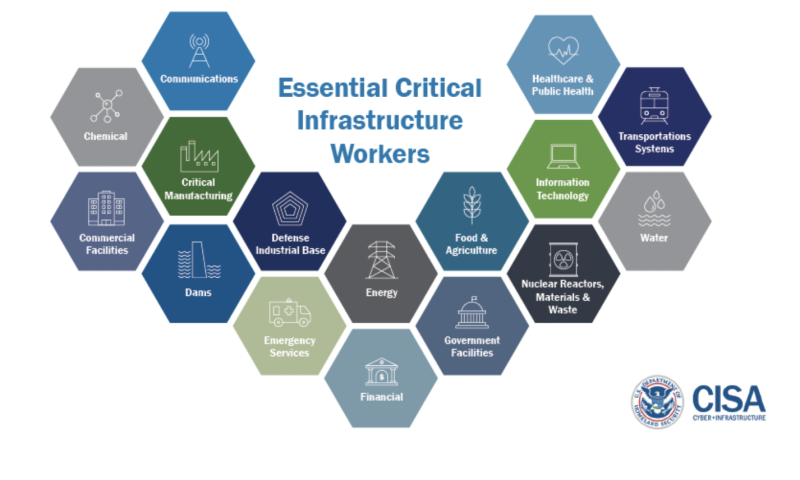
Note the inclusion of communications, which of course, means all media, and of course information technology, which means all Big Tech. As for “commercial facilities” that ended up meaning big-box chain stores while small businesses were brutally shut. Reinforcing the Trump administration’s fatwa against “bars, restaurants, and gyms,” they were closed immediately following the release of CISA’s order.
But of course, and consistent with all this machinery, CISA was careful to note that “This guidance was provided to clarify the potential scope of critical infrastructure to help inform decisions by state and local jurisdictions, but does not compel any prescriptive action.”
Further: “This guidance is not binding and is primarily a decision support construct to assist state and local officials. It should not be confused as official executive action by the United States Government.”
This way, like Fauci, CISA can claim that it didn’t force the shutdown of anything. It only made recommendations and state-level agencies took it from there. And yet here is a FAQ to give you a sense of the military footing that the whole country entered up on in the course of only a few days.
How is this different than traditional disasters or emergencies impacting critical infrastructure?
COVID-19 is different than any emergency the Nation has faced, especially considering the modern, tightly interconnected economy and American way of life. In traditional emergencies, government coordinates with the private sector to get businesses back to business. In this case, as the government works with partners to slow the spread of COVID-19, the economic goal is maintaining resilience of the Nation’s foundation—its critical infrastructure.
In retrospect, the whole thing seems truly hard to believe, all for a respiratory virus with an infection fatality rate that compares with the flu except with a huge risk gradient by age. A military-style cooperation was unleashed on the entire country even as basic therapeutics were completely neglected and concern for collateral damage to health, culture, education, and enterprise were tossed out the window.
The initial lockdowns were followed by quarantine rules, travel restrictions, violations of religious freedom, forced masking and eventually forced medicalization of quickly approved shots that most of the population never needed and vast numbers now regret.
As CISA said, this crisis was “different than any emergency the Nation has faced.” Instead of keeping business going, the response this time was massive destruction of everything except “critical infrastructure.”
Indeed, the whole country fell into complete shambles and trauma for the better part of 2020, leading up to the November elections that gutted Republican control of Congress and flipped the White House. We are now finding out with piles of evidence that this was the ambition of many employees at Twitter, including the general counsel who ended up as a consultant to the very agency that issued the stay-home advisory.
CISA is part of the Department of Homeland Security, created only in 2018 with an act signed by President Trump. As is clear from the text of the law, the whole point was to protect the nation against cyber attacks and develop a response. Nowhere in the text could one discern a broad edict to divide the whole workforce, crush civil liberties, smash businesses, and trample on the Bill of Rights, much less shepherd into being a vast machinery of censorship that would effectively nationalize all major tech platforms on behalf of regime priorities.
On the weekend of March 14-15, 2020, Trump surrounded himself with a handful of advisors including Fauci, Birx, Pence, Kushner, along with a few outside consultants from pharma and tech, and agreed to “15 days to flatten the curve.” It seems highly unlikely he knew that he was approving a complete takeover of the country by the national security arm of the government, much less empowering this one agency with the task of crushing the whole economy except that which government called essential.
We are finding out ever more about what went on behind the scenes, especially thanks to the exceptional research of Debbie Lerman, who has fleshed out the underlying shift that occurred in these days. We went from being a normal nation with all the usual struggles to a country under quasi-martial law, ruled by administrative bureaucrats drawn from the national security arm of government. CISA was an agency that led the charge. Did Trump have any idea what he had approved? I would say it is highly doubtful.
I’ve been unable to find out anything about the agency’s budget or payroll but we do know that it is hiring: “CISA is always searching for diverse, talented, and highly motivated professionals to continue its mission of securing the nation’s critical infrastructure. CISA is more than a great place to work; our workforce tackles the risks and threats that matter most to the nation, our families, and communities. With more than 50 career fields available CISA offers multiple opportunities as well as multiple tracks for employment.”
Jeffrey A. Tucker, Founder and President of the Brownstone Institute, is an economist and author. He has written 10 books, including Liberty or Lockdown, and thousands of articles in the scholarly and popular press.
Iran against the West’s hybrid warfare
By Viktor Mikhin – New Eastern Outlook – 10.12.2022
Western countries, above all the United States, are seeking to replicate Afghanistan and Iraq scenario in Iran, creating chaos to destroy the country and loot its resources, Scott Bennett, a former US Army Special Operations Officer, said honestly and truthfully. “The West is fully committed to an absolute chaotic breakdown of Iranian government, religious, and military sectors in Iran, as they did in Afghanistan and then Iraq, in order for chaos to be created and Iran be divided up into regions for national resources theft,” Scott Bennett told the Tehran Times. He also stressed that Israel is the main instigator of Western hostility and maneuvers against Iran, using these tensions to carry out its attacks in Lebanon, Syria and Iraq.
It is becoming increasingly clear that a campaign of domestic terrorism is being unleashed against Iran under the guise of fake protests allegedly in defense of “human rights,” as has been done in Syria by the United States, Israel and NATO. The same powers are using similar methods and the same mercenaries to participate in the attempted color revolution, the operation to change the Iranian regime. Most likely, these terrorists are a combination of Wahhabi fanatics, Israeli Mossad, Likud party supporters, supported by the US CIA, British MI6 intelligence and some elements in Iraq, terrorists from al-Qaeda, al-Nusra, not destroyed ISIS (that is, the three banned in the Russian Federation), other mercenaries and thugs hired and paid for by the West.
The plan is for foreign terrorists to infiltrate Iran and cause internal strife, tribal and sectarian enmity, conflict between Shia, Sunnis, Alawites, Christians, Jews and Kurds living in Iran. The main areas targeted for fomenting unrest, conflict and violence are precisely in those parts of Iran where there is a mixed population. Mobile phones, social media and Western media are heavily used in the process. The beginning was the emergence of a women’s protest movement over a false allegation that a woman had allegedly died under police torture, when in fact she had died of medical complications caused by a previous serious illness.
The specifics of hybrid warfare, as Scott Bennett argues, are a combination of small-scale operations that take the form of diplomatic, information, military and economic action against Iran to create leverage that can then be used to destabilize the government and create chaos in Iran. On the diplomatic front, hostile statements in the United Nations, various NATO and European Union structures will increasingly be used to spread propaganda and disinformation to other countries about Iran, about alleged abuses of “human rights,” about nuclear programs aimed at undermining Western hegemony and security.
Numerous analysts acknowledge that NATO and the EU are strengthening their defense capabilities not only in Europe, but also abroad, including in the Gulf region. President of the European Commission Ursula von der Leyen recently outlined elements of a new European security doctrine, the EU and NATO approach to security in the Persian Gulf. Her remarks at the Manama Dialogue in Bahrain on November 18 reflect what is widely seen as a new and aggressive approach aimed at further escalating tensions in the region, taking advantage of the extremely hostile attitude of many countries there towards Iran.
One can also see how Israel under the Netanyahu regime is stepping up aggressive air attacks against Syria and continuing to invade Iraqi and Persian Gulf airspace as probing maneuvers against Iran. The Israeli and US air forces will conduct their biggest joint air exercise in years, simulating strikes against Iran. Fighter aircraft from both countries will simulate long-range flights and strikes against distant targets, enhancing readiness for combat scenarios with Iran. In recent years, the Israel Defense Forces and US Central Command have already conducted several joint exercises, practicing strikes against Iran.
In July this year, President Joe Biden and Prime Minister Yair Lapid signed a joint declaration on the US-Israeli strategic partnership, also known as the Jerusalem Declaration. It emphasizes the US commitment “never to allow Iran to acquire a nuclear weapon, and that it is prepared to use all elements of its national power to ensure that.” Subsequent joint exercises were the subject of meetings in Washington between IDF Chief of Staff Lieutenant General Aviv Kochavi and US officials, including Chairman of the Joint Chiefs of Staff General Mark Milley and CENTCOM Commander General Michael Kurilla.
Some NIS 3.5 billion ($1 billion) has been allocated from the IDF’s NIS 58 billion ($17 billion) defense budget for military activities next year related to alleged strikes on Iran. Outgoing Minister of Defense Benny Gantz had earlier warned newly appointed Prime Minister Benjamin Netanyahu to “consider issue very carefully” before launching a strike on Iran. “Israel has the ability to act in Iran. We have the readiness, development capabilities, and long-term plans we are managing. We need to prepare for this possibility, and we will also need to consider this issue very carefully before carrying it out,” he said.
All of the above quite clearly supports the argument that it is Israel that is the main source of Western hostility and maneuvering against Iran and is using these tensions to carry out attacks in Lebanon, Syria, Iraq.
Color revolutions are usually the target of aggressive campaigns by the West, and hybrid wars are smoke and fire to create cover and distractions to create conditions, chaos and tensions to launch these color revolutions. Hybrid wars include the conflict the US has created in Iraq between various tribes and religious sects, and in Libya and Syria, where foreign mercenaries from Saudi Arabia, Qatar, Israel and Turkey were hired, funded and trained by the CIA and Pentagon under General Lloyd Austin, now Secretary of Defense. The aim of these operations was to create tension, chaos, conflict and enmity between peoples in the regions so that natural wealth could be stolen. Suffice it to look at the history of these operations over the past 20 years: Afghanistan, Iraq, Somalia, Libya, Syria, Lebanon, Yemen. And now Ukraine and Iran of course represent the next target of this Western program of color revolutions, and therefore an international coalition is needed to counter such hostile actions.
Moscow: US to Spend $11 Billion on Cyberattacks Against ‘Unwanted’ Governments

© AP Photo / Department of Defense, Cherie Cullen
Samizdat – 10.12.2022
MOSCOW – Washington plans to spend around $11 billion next year on carrying out cyberattacks with the aim of controlling unfriendly governments, Russian Deputy Foreign Minister Oleg Syromolotov said in an interview with Sputnik.
“Western countries want to use information and its carriers – big data and software tools for their transmission – to subjugate unwanted governments through cyberattacks,” Syromolotov said, adding that the “Pentagon’s budget alone for these purposes in 2023 will be more than $11 billion.”
The deputy foreign minister pointed out that, according to the new doctrinal documents released in October, the administration of US President Joe Biden has “declared the whole world and the global information space to be its sphere of interest.”
On October 12, the Biden administration released the 2022 National Security Strategy that characterized China as being the most consequential geopolitical challenge for the United States. According to the document, Beijing is Washington’s sole rival allegedly seeking to increase its economic, diplomatic and military capacity to change the international order.
Syromolotov’s comments come in the wake of the earlier statement by the Russian Embassy in the United States that blasted Washington’s sanctions against Moscow as an attempt to exert pressure on governments that are “inconvenient” for the US.
The Russian diplomatic mission said that Washington is attempting to force “other countries to adjust their foreign policy,” disguising these attempts as efforts to defend human rights.
The Pentagon released its National Defense Strategy (NDS) in October, stating that China remains the top competitor of the United States and warning that Beijing-Moscow collaboration might threaten US interests. The document also characterizes Russia as an acute and more immediate threat to US interests and values than China, which is characterized as a “pacing challenge.”
On Friday, the US Treasury Department announced that the United States was sanctioning over 40 individuals and entities from nine different countries, including Russia, Iran, North Korea, and China, for alleged links to corruption and human rights abuses.
Dr. Jay Bhattacharya says he “strongly” suspects federal government directed Twitter to blacklist his account
By Tom Parker | Reclaim The Net | December 9, 2022
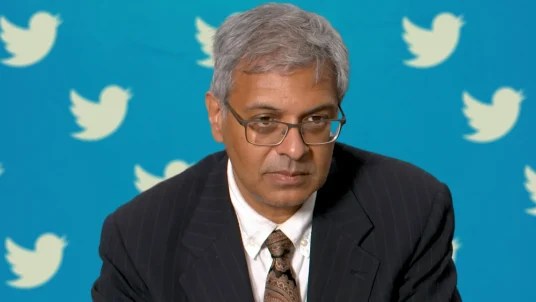
Stanford University Medical School professor and epidemiologist Dr. Jay Bhattacharya has responded to the bombshell revelation that Twitter secretly blacklisted his account by suggesting that the federal government could have been pulling the strings of this censorship.
“I suspect very strongly that there was some government direction of this,” Bhattacharya said during an interview with Fox News’s Laura Ingraham. ”
Bhattacharya continued by discussing the findings from a Biden administration-social media censorship collusion lawsuit that he’s involved in.
The documents that have been released and the sworn statements that have been made as part of this lawsuit have revealed that federal government officials have pressured Big Tech companies to censor many pieces of content that they deemed to be “misinformation.”
One of the documents that’s pertinent to Bhattacharya is an email from then-National Institutes of Health (NIH) Director Francis Collins and Director of the National Institute of Allergy and Infectious Diseases (NIAID) Anthony Fauci where he called for a “quick and devastating published takedown” of the premises of The Great Barrington Declaration — an anti-lockdown statement published by Bhattacharya and other leading epidemiologists.
“We’ve uncovered tremendous evidence that… there were federal agencies that were… directing social media companies about what to censor, even who to censor,” Bhattacharya told Ingraham. “If that is actually the case… that this blacklisting was directed by the government against American citizens, that’s a direct violation of my civil rights, it’s a direct violation of the First Amendment, and every American should be outraged.”
Bhattacharya continued: “A lot of the leadership of Silicon Valley, a lot of… the people who give advice to Silicon Valley and to the government about about these content moderation policies, they’ve gone… way too far.”
The Stanford professor also commented on the far-reaching implications of this censorship of discussions about basic scientific policy.
“Imagine how different [things would have been],” Bhattacharya said. “All the small businesses could have stayed open, all the people that wouldn’t have missed their cancer screenings, all the kids that wouldn’t be depressed and suicidal, all the learning loss that could have been avoided if we just had an open scientific discussion.”
Additionally, Bhattacharya suggested that the censors deployed these tactics because “their arguments were not strong enough to survive the light of day” and called for a “national conversation that brings us back to the American commitment to free speech rights, the American commitment to… open discussion, and… honest dealings.”
The New Civil Liberties Alliance (NCLA), the legal group that’s representing Bhattacharya in the Biden admin-Big Tech censorship collusion lawsuit, said:
“We already know the federal government had a hand in Twitter censorship, especially of those who articulated perspectives that conflicted with government messaging on covid. As Elon Musk exposes further information about Twitter’s inner workings, we anticipate learning more about the extent of government involvement in blacklisting those who express disfavored views.”
Not only does the recent disclosure about Bhattacharya’s account being blacklisted shine a light on the pervasiveness of Big Tech’s censorship but it also demonstrates that Twitter was still engaged in this censorship more than a year after the pandemic began with Bhattacharya only joining Twitter in August 2021.
Twitter’s blacklisting of Bhattacharya’s account is the latest of several examples of the tech giants censoring him after he challenged the government’s Covid narrative. Reddit mods deleted The Great Barrington Declaration, Facebook deleted The Great Barrington Declaration page, and YouTube deleted a public health roundtable featuring The Great Barrington Declaration authors, Florida Governor Ron DeSantis, and former White House coronavirus advisor Dr. Scott Atlas.
What a Bunch of Hooey about Viktor Bout
By Jacob G. Hornberger | FFF | December 9, 2022
It would be difficult to find a bigger pile of hooey in the mainstream press than what they are saying about Viktor Bout. It’s almost as bad as their monumental hooey about Russian citizen Maria Butina. The hooey surrounding Bout and Butina only goes to show what happens to people’s minds when the government inculcates them with an extreme, obsessive anti-Russia hostility.
I’ve written repeatedly about the federal government’s ludicrous prosecution of Butina, and so I won’t repeat my analysis of her case. Let’s instead focus on Bout.
Bout is the Russia arms dealer who was just traded for Brittney Griner, the American basketball star who pled guilty to violating Russia’s drug laws and got sentenced to serve nine years in jail. Bout is the international arms dealer who got convicted of conspiring to sell arms to FARC, the rebel group in Columbia that U.S. officials labeled a terrorist group. He was also convicted of conspiring to kill DEA officials operating in Columbia. He was given a 25-year jail sentence and had served 10 years of it when he was traded for Griner.
The mainstream press is decrying the trade. They’re saying it’s just not fair. An arms dealer for a drug-war violator? Oh my gosh, how could President Biden permit himself to be taken in by the evil Russkies?
Unsaid in all this is that the U.S. government, like the Russian government, makes it a criminal offense to possess and distribute marijuana. Defenders of the U.S. drug war can say that the federal penalty for marijuana possession is lower in the U.S. than in Russia, but isn’t that a distinction without a difference? Moreover, let’s not forget that in the long, sordid history of America’s drug war, countless Americans have been forced to serve much longer jail sentences for marijuana possession than Griner.
The important question — one that the mainstream press dares not ask — is why the U.S. government (and the state governments) have drug laws at all. Given that Russia has drug laws, isn’t that a fairly good sign that drug laws are not consistent with he principles of a genuinely free society? Perhaps it’s also worth mentioning that former President Trump is promising to execute drug-war violators if he is put back into the White House. Don’t they do that in China and North Korea too?
The mainstream press continues to emphasize that Bout is an “international arms dealer,” which apparently makes him an extremely evil person. Well, if that’s true, then how about we focus on the world’s biggest international arms dealer. That would be the U.S. government! Yes, the pious, innocent U.S. government, the same government that prosecuted Bout and sentenced him to 25 years in jail.
Take a look at this web page entitled “U.S. Arms Exports in 2021, by Country.” It lists 65 countries to whom the U.S. government sells arms.
Is it possible — just possible — that U.S. officials went after Bout because he was in competition against them in the sale of arms? What better way to get rid of a competitor than by locking him up in jail for 25 years?
The mainstream press says that Bout was selling arms to terrorist groups. Well, notice on that list that the U.S. government knowingly sells arms to Saudi Arabia, a regime that most everyone in the world, including the family and former fiancé of Jamal Ahmad Khashoggi and even the CIA, knows is one of the most murderous regimes in the world. Is there really any difference in principle between selling arms to a terrorist group and selling arms to a murderous regime?
Let’s now go to to the offenses for which Bout was convicted — conspiring to sell arms to FARC in Colombia and conspiring to kill American drug-war officials operating in Colombia.
There is one big problem with those offenses, however. That problem is that FARC had nothing to do with any of this. Instead, what happened was that DEA agents who were playing like they were FARC representatives approached Bout and said that they wanted to buy arms from him. Bout agreed to sell arms to those DEA agents who he thought were FARC agents. That’s what they busted him for — for conspiring to sell arms to DEA agents who he thought were FARC agents.
In other words, if the DEA had not created the crime, it would not have been committed.
What about the conspiracy to kill American officials who were operating in Colombia. During the fake negotiations for the sale of arms to FARC, one of the DEA agents said that the weapons would be used to kill U.S. officials who were enforcing the drug war in Colombia. Bout allegedly responded indifferently, supposedly saying that they were his enemy too. That’s what got him convicted of conspiring to kill U.S. officials as part of fake negotiations for the sale of arms to DEA agents who were falsely posing as representatives of FARC.
The mainstream press continually claims that Bout was accused of selling arms to al Qaeda. But U.S. officials never charged him with that. Lacking the evidence to convict him of that offense, U.S. officials simply decided to make up a crime and convict him of the made-up crime instead. That’s what goes for “justice” in the federal criminal-justice system.
I’ve had personal experience with this type of federal drug-war “justice.” After I got my law license in Texas back in 1975, I returned to my hometown of Laredo, Texas, to practice law. Almost immediately, our local federal judge appointed me to represent an indigent defendant charged with a cocaine conspiracy.
My client told me that he was innocent. Hoping that I would encourage my client to plead guilty, the assistant U.S. attorney in the case turned over all of the very detailed investigative reports that the DEA had turned over to him. Every day I would pore over those reports and carefully chart them out. I finally realized that my client was, in fact, innocent. The DEA had put together a very sophisticated sting operation to get him convicted, just as they did with Bout.
Why would the DEA do that? Simple. They were convinced he was involved in the drug trade but they couldn’t catch him. So, they did the next-best thing. They made up a crime so that they could get him convicted and punished for the made-up crime.
Fortunately, I was able to make the jury see what the DEA had done and to recognize the manifest injustice of convicting a person of a made-up crime. The jury returned with a not-guilty verdict, which meant, after having been jailed for several months since his arrest, my client walked out of that federal courtroom a free man.
Unfortunately for Bout, the jury in his case was not so inclined. They obviously felt that a made-up crime was just as good as a real crime. However, the federal judge who sentenced Bout apparently didn’t feel totally comfortable with what the DEA had done. The judge sentenced Bout to the minimum amount of time possible, which was nonetheless 25 years.
There is something else worth noting about the Bout conviction. Bout never committed any offense within the United States. The fake negotiations took place entirely outside the United States. In fact, Bout was arrested while engaging in the fake negotiations in Thailand and then was extradited to the United States to stand trial on a fake made-up crime that never took place anywhere in the United States.
It is also worth asking: What business does the DEA have in setting up an international arms dealer on a fake weapons charge? I thought DEA stood for Drug Enforcement Administration, not Weapons Enforcement Administration.
Of course, don’t look to the mainstream press to address any of these discomforting matters. That would entail challenging the U.S. government on such things as its evil drug war, its arms sales to evil regimes, and its evil made-up crimes. As far as the U.S. mainstream press is concerned, it’s only permissible to criticize and condemn those evil Russkies, such as Maria Butina and Viktor Bout.
US betrays EU allies’ interests skillfully using Ukrainian conflict to its advantage
By Uriel Araujo | December 9, 2022
This week London announced it has ordered thousands of new anti-tank weapons to restock, after sending thousands of its units to Ukraine. Meanwhile, it has been reported that Washington is weighing Kiev’s requests to provide the country with cluster munition warheads. Both the UK and NATO have been almost running out of weapons for Ukraine. Recently, US President Joe Biden has been struggling to maintain his international coalition to support Kiev, but hardly succeeded due to domestic problems (both in the EU and in the United States). The conflict in Ukraine aggravates Europe’s energy crisis and this is one of the very reasons Washington has fueled this conflict.
University of Chicago political science professor John Mearsheimer has written extensively on how NATO’s enlargement policies over the years plus its strategy to move Ukraine out of Russia’s orbit by integrating it into the political West are the very root of the conflict which started in 2014 – and 8 years on, this is still the case.
For almost 8 years, the Donbass conflict was Europe’s forgotten war, even though in April 2021 Kiev escalated the violence there once more, with Washington’s full support. Since 2014, NATO has been aggressively provoking and encircling Russia (even in the Arctic), and its member states have been sending massive arms shipments to Ukraine.
Meanwhile, the Washington-led West, including media conglomerates, has white-washed Ukraine’s far-right problem and the blatantly neo-Nazi nature of its Azov Regiment, as well Kiev’s mass killings, its human rights infringements, genocidal policies, and chauvinistic nationalism aimed against ethnic Russians.
For example, on February 18, before the beginning of the current Russo-Ukrainian military conflict (February 24), Kiev started a nasty bombing campaign on Donbass, targetting civilian infrastructure and even a kindergarden in Lugansk. Ironically, the week before that, Moscow had withdrawn its troops from the area near the border, which should have de-escalated tensions – much to no avail.
Up to February 18, in a series of provocations, Ukraine’s military personnel often broke the cease-fire in Donbass and shelled the region so as to instigate the local militias into responding, thus providing a pretext for further Ukrainian aggression while NATO kept sending weapons and mercenaries to Kiev and further fueling tensions. All of that, one can argue, had been escalating to the point of potentially becoming casus belli for Russia. And here we are today. Whether one is critical of Moscow’s decision to launch its military campaign or not, all the above is part of the larger context that one should always keep in mind.
Why then has the US played such a destabilizing role and has supported all that? I’ve written on how the geopolitics of Washington’s strategies is intertwined with geoeconomics and energy interests. The United State’s persistent campaign against Nord Stream and against any Russian-European gas cooperation is part of that. Geoenergetic interests are one of the main issues and driving forces of the 21st century and Washington has been waging a largely unilateral economic war through sanctions and legislative measures.
Its goal has always been to have Europeans buying American LNG, which is more expensive, in fact, even though Russia is quite literally at the “doorstep” of the continent. The truth is that Europe’s energy crisis from the very beginning has served American interests well. In addition, the US-led “Green Agenda” which hampers African energy security quite ironically also hurts European’s own.
One could very well argue then that Washington’s economic war is being waged not only against Moscow, but in fact also against its own European allies. If this sounds far-fetched, one should consider the fact that Biden’s recent aggressive $369 billion subsidies package (which hurts Europe) has been described by French President Emmanuel Macron as an issue that could “divide the West”. EU diplomats have been quoted as saying that the American initiative “changes everything” to the point of making some of them ask “is Washington DC still our ally or not?”. EU industry chief Thierry Breton even stated Biden’s package poses an “existential challenge” to the European economy and industry.
The UK economy is also collapsing over the energy issue, while recession and even depression haunt Europe. Philip Pilkington, an Irish economist famous for his contributions on the empirical estimate of general equilibrium and other fields, has been writing on how post-Nord Stream Europe faces possible deindustrialization. If the high energy costs, related to the ongoing conflict in Ukraine, make European industry uncompetitive, Washington’s subsidy package is a nail in the coffin. In this scenario, Europe’s industry might be “wiped out by American rivals”, as Politico journalists Jakob Hanke and Barbara Moens put it. As the US stands ready to absorb European industrial potential, EU countries will face increasing unemployment, inflation and a decrease in living standards. That scenario of course promises social unrest.
In April, defeated French presidential candidate Marine Le Pen promised to pull France out of NATO. As temperatures decrease with the coming winter amid rising energy prices, one should expect European populism and the far-right to gain more and more political influence, as they have been successfully capitalizing on growing popular discontent with NATO and with the EU bloc itself. It is quite unfortunate that, in Europe, opposition to NATO and to suicidal policies has been largely marginalized to the point of almost becoming a monopoly of so-called extremist discourse.
It remains to be seen how European political elites will respond to the new developments, as the reality of an American economic war against their continent becomes increasingly impossible to deny.
How the ‘Twitter Files’ have exposed a senior FBI official’s role in manipulating the outcome of the 2020 US election
By Felix Livshitz | RT | December 9, 2022
Internal Twitter documents and communications published by the journalist Matt Taibbi have provided devastating detail on a sweeping censorship operation conducted by the social network. They expose the central role played by a senior FBI agent in potentially influencing the outcome of the 2020 US election.
Immediate reaction to the Twitter Files was mixed, but overwhelmingly the mainstream American media has rushed to pour cold water on Taibbi’s bombshell disclosures, with, for example, The Washington Post branding them a “dud” and CNN claiming they “largely corroborated what was already known.”
Such responses are quite extraordinary given that the Twitter Files offers incontrovertible evidence of one of the largest, most influential global social networks taking extraordinary measures – usually reserved to prevent the dissemination of child pornography – to block information on its platform.
In particular, Twitter banned, both publicly and privately, the sharing of a New York Post article, based on the contents of a laptop owned by Hunter Biden, pointing to possible corruption on the part of his father, then-presidential candidate Joe Biden. The report reinforced existing concerns about Hunter’s role with Burisma, for which he received up to $50,000 per month from the Ukrainian energy giant over a five-year period for attending a handful of corporate events.
The material exposed by Taibbi shows that a decision was made by individuals at the highest levels of Twitter – with direct connections to Biden’s Presidential campaign – due to apparent fears the laptop contents had been hacked and/or had been released as part of a Russian information operation. This was despite there being zero evidence or even a vague suggestion that either was the case, and significant internal concerns.
The Twitter Files show how, among the top brass involved in the suppression of this hugely significant story was the social network’s legal vice president Jim Baker, a former FBI general counsel. He was coincidentally also fundamental to the Bureau’s multiple attempts to fraudulently concoct a link between Trump’s campaign and Russia, one way or another.
It’s clear that many staffers didn’t believe there were grounds to ban the New York Post story on the basis of Twitter’s policies on sharing hacked materials. One communications department official wrote that they were “struggling to understand the policy basis for marking this as unsafe,” while their superior fretted, “can we truthfully claim that this is part of the policy?”
However, their legitimate worries were overruled. Twitter later reversed this ban but by that point the false specter of Russian meddling had been so successfully cemented – including via a joint letter signed by over 50 senior US spies – that the story was largely discredited in the eyes of many Americans and, thus, ignored. It is only now, with Biden safely in the White House, that other outlets have begun to verify the laptop’s contents as not only real, but damaging.
Baker was central to overruling subordinates about the basis for banning the story. In an email published by Taibbi, he announced it was “reasonable for us to assume that they may have been” hacked.
It is not explained why it was “reasonable” to make this assumption, especially as Baker himself acknowledged there were instead indications that “the computer was either abandoned and/or the owner consented to allow the repair shop to access it for at least some purposes.” Which is, of course, a total contradiction in terms. So the ban went ahead, despite internal concern about the decision.
“Hacking was the excuse but, within a few hours, pretty much everyone realized that wasn’t going to hold,” an anonymous Twitter source told Taibbi. “But no one had the guts to reverse it.”
One of the reasons Baker’s intervention may have cut through initial misgivings, and no staffers then had the “guts to reverse it,” could’ve been his status as resident Russian “disinformation” expert at Twitter. He left the FBI in June 2018 on undisclosed grounds, although it was later confirmed he was the subject of a criminal Justice Department investigation due to alleged leaking to the media of scurrilous innuendo about Trump’s non-existent relationship with the Kremlin at the time.
Questions were also asked about whether, as General Counsel, Baker played any role in greenlighting or overseeing various failed FBI counterintelligence investigations into Trump’s election team. Known as Crossfire Hurricane, these related probes were built on extremely shaky foundations, and led to no evidence supporting suspicions of Trump-Russia ties being unearthed, but still remained open under internal pressure, in contravention of established investigative protocols.
A subsequent internal review found 17 separate “significant inaccuracies and omissions” in the FBI’s court submissions for warrants that it applied for to spy on campaign staffer Carter Page.
More recently, Baker testified at the trial of Michael Sussmann, a well-connected Washington DC lawyer tied to the Democratic party. He was charged by Attorney General John Durham with lying to the FBI when he presented to the Bureau falsified evidence of contact between Trump Tower and Moscow via Russia’s Alfa Bank, in the summer of 2016.
Sussmann claimed he was not representing a client in doing so, when in reality he was acting on behalf of the Democrats, and billed them for the service. Baker would’ve known anyway that this cover story was a lie, as he and Sussmann were longtime friends, but he recorded the delivery as the uninterested, selfless act of a concerned citizen. Quite why he wasn’t charged for procedural misconduct is not known.
It’s also not known why such dealings didn’t torpedo his professional credibility upon leaving the Bureau. Departing an organization like the FBI under such a dark cloud would normally mean the end of someone’s career. Instead, Baker was snapped up by Twitter to be the right hand man of Vijaya Gadde, the company’s head of legal.
Throughout her time at the social network, she was derided as its censor-in-chief, and leaked documents reveal she regularly consulted with the Department of Homeland Security on how best to restrict inconvenient facts online. It’s understandable why Baker would be such an attractive hire for Gadde.
He was by that point clearly an expert in perpetuating false claims of “disinformation” and “Russian meddling” for political purposes, to tremendous effect. The Russiagate hoax almost took down President Trump, and meant his term in office was spent ramping up tensions with Moscow rather than improving relations as he’d repeatedly promised on the campaign trail.
It could have been calculated within Twitter HQ that Baker would be willing to play a similarly destructive role the next time round, and prevent Trump from getting re-elected in the first place. Helping suppress the damaging material facts contained in the New York Post may have done just that.
Featured Video

Why Hamas Really Attacked Israel on Oct. 7
or go to
Aletho News Archives – Video-Images
From the Archives
Confronting the Threat of Ethnic Bioweapons
By Tony Cartalucci – New Eastern Outlook – 29.11.2017
The United States Air Force’s 59th Medical Wing’s molecular biology branch recently was revealed to have been collecting specifically Russian RNA and synovial (connective) tissue samples, prompting fears in Russia of a possible US directed ethnic-specific bioweapons program. … continue
Blog Roll
 Aletho News
- Meet the US generals and admirals advancing Israeli policy
- Israel’s Straw Widow Protocol: The Kill Zones Where Civilians Were Labelled ‘Terrorists’
- Leading Israeli Think Tank Publishes Psychotic Israeli ‘National Security’ Doctrine
- Are the United States and Israel in Decline-and-Fall Mode?
- Why Hamas Really Attacked Israel on Oct. 7
- Declassified UK exposes British man who fought for ‘Israel’ in Gaza
- West’s death cult in a theater near you
- How the Yandex ‘Russian bots’ lie fell apart
- Burnham’s ‘Russia did Brexit’ ruse crumbles
- Estonia making movies and games to encourage war against Russia
- If Americans Knew
- Gaza’s “ceasefire” death toll passes 1,500 – Daily Update
- Activists Abused By Israel Return to New Freedom Flotilla Mission
- 60 Minutes won’t tell the full truth about Israeli settler violence
- Nearly 50,000 women, girls killed or severely injured in Gaza since October 2023: UN Women
- ADL is working with AI companies to suppress alleged ‘antisemitism’
- Israeli occupation forces using social media surveillance unit to target hundreds of Palestinians in the West Bank
- Israel’s New – and Terrifying – Security Doctrine
- Israeli Attacks Kill Five in Gaza, Including a four-year-old and a woman
- Air Force Major Who Called for Trump’s Impeachment Held in Solitary Confinement
- It’s a Genocide, I’m Into It’: Seinfeld Mocks Protest over Palestinian Children Killed
- No Tricks Zone
- New Study Suggests Large Regions Of The Pacific Ocean Have Been Cooling For The Last 80 Years
- Germany’s Green Energy Debacle: High Energy Costs Force Kahla Porzellan to Close After 182 Years!
- New Study: 50 Years Of The Most Aggressive ‘Net Zero’ Policies Can Only Affect The Global Climate By 0.03°C
- US September “Heat” Was No Record…Many Records Set Decades Ago
- Latest European Green Energy Debacle; Portugal’s Largest Flagship Solar Park Insolvent!
- Green Energy Debacle: German Expert Professor Fritz Vahrenholt Warns Of Severe Economic And Social Consequences
- Two More Paleo Reconstructions Affirm Meters-Higher Sea Levels Across Ireland, Brazil 7000-6000 Years Ago
- New Study: Earth And Venus Surface Warmth Largely Explained By Convection And Lapse Rate, Not CO2 Or Radiation
- 2025 Nature Paper Claiming Worsening Global Drought Gets RETRACTED …Heavily Flawed
- New Study: ‘Global Drought Shows No Detectable Recent Acceleration Under Climate Warming’

