Why Putin says Russia could adopt US-style preemptive strike doctrine
By Drago Bosnic | December 14, 2022
On December 9, the Associated Press reported that President Vladimir Putin stated Russia could adopt a US-style concept of “preemptive strikes”, stressing that Moscow is in possession of advanced weapons to conduct such operations.
“We are just thinking about it. They weren’t shy to openly talk about it during the past years,” Putin said at an EAEU (Eurasian Economic Union) summit in Bishkek, Kyrgyzstan. The statement clearly applies to the United States and its foreign policy framework, including the so-called “preemptive strikes” concept. The program, called PGS (Prompt Global Strike), is a US attempt to develop a capability that enables it to attack enemy strategic targets with precision-guided weapons anywhere in the world within just one hour.
“Speaking about a disarming strike, maybe it’s worth thinking about adopting the ideas developed by our US counterparts, their ideas of ensuring their security,” Putin added, noting that such strikes are intended to knock out command facilities. Putin also stated that Russia is already in possession of hypersonic weapons suitable for carrying out such operations, while the US still hasn’t deployed its own equivalents. The Russian president also added that Moscow has long-range cruise missiles that surpass US analogs, most likely referring to the state-of-the-art scramjet-powered “Zircon” hypersonic cruise missile. Putin noted that Russia’s long-range weapons would certainly be conventional PGMs (precision-guided munitions), while the US never ruled out the possibility of the first use of thermonuclear weapons.
“If the potential adversary believes that it can use the theory of a preemptive strike and we don’t, it makes us think about the threats posed by such ideas in other countries’ defensive posture,” the Russian president said. The political West’s massive mainstream propaganda machine cherry-picked Vladimir Putin’s statements in order to misrepresent them as supposed “saber-rattling” while ignoring the pure logic behind his words. As per usual, Putin pointed out the glaringly obvious hypocrisy of the US political establishment, which quite clearly thinks it’s “indispensable” and “unique” in the sense that Americans are the only ones who have the right to attack others with impunity while they watch helplessly or simply turn a blind eye to the blatant US aggression against the world.
With Russia having actual conventional military capabilities to implement such a “preemptive strike” foreign policy framework almost instantly (unlike the US), Putin warned that if everyone behaved the way America does, the world would certainly become an extremely dangerous place. To make his point even stronger, it could be argued that Moscow would certainly have more reasons to implement such policies than the US itself. Unlike America, which has dozens of vassals and satellite states, Russia doesn’t exert such “soft power” influence over other countries, including its neighbors. On the contrary, the political West even tried to stage coups against Moscow’s close partners such as Belarus and Kazakhstan, forcing Russia to come to both countries’ rescue in recent months and years.
Needless to say, never again would the Eurasian giant tolerate the instalment of hostile puppet regimes so close to its borders. Russia’s leadership is well aware of the mistakes it made by ever trusting any promises given by the political West. After the 2014 NATO-backed coup which brought Neo-Nazis to power in Kiev, Moscow decided to never again allow such occurrences from happening in its geopolitical backyard. In this regard, Putin’s remarks are twofold. First, as previously mentioned, they expose the sheer hypocrisy of the political West, and second, they show that it would certainly come in handy for Russia to use its overwhelming “hard power” to prevent the establishment of anti-Russian regimes so close to its borders. Had Moscow deployed its version of PGS against the Neo-Nazi junta back in 2014, it wouldn’t even have the current problem in Ukraine.
However, the political West keeps insisting that Putin’s remarks are a “clear sign that Russia is planning to use nuclear weapons”, although he specifically stated that Moscow’s potential PGS-style program would include only conventional weapons. For months, the troubled Biden administration has been parroting the accusations that Russia is supposedly planning to use tactical nuclear weapons in Ukraine. The US has been spinning the narrative on virtually every statement by Putin, claiming alleged “nuclear saber-rattling”. The premise is usually based on Russia’s official strategic military doctrine that gives Moscow the right to use thermonuclear weapons in response to a WMD (weapons of mass destruction) or a large-scale conventional attack.
In reality, Putin never mentioned anything about the Eurasian giant’s thermonuclear deterrence. The statements were clearly his critique of the US PGS concept, which Russia has been warning about for years, especially as the weapons used within the framework of such a program would be effectively indiscernible from regular ICBMs (intercontinental ballistic missiles). Precisely this could lead to uncontrollable escalation, as other superpowers would not be able to confirm if the weapon in question is conventional or nuclear-armed. For instance, US PGS missiles spotted by Russian and/or Chinese early warning systems might prompt both (Eur)Asian giants to respond with nuclear-tipped weapons, leading to a world-ending conflict.
Russia’s response to the PGS program could be instantaneous if the Kremlin ever decides to proceed with it. With the Mach 12-capable “Kinzhal” air-launched hypersonic missile carried by modified MiG-31K/I interceptors and Tu-22M3 long-range bombers, the Mach 28-capable “Avangard” HGV (hypersonic glide vehicle) deployed on various ICBMs and the Mach 9-capable scramjet-powered “Zircon” hypersonic cruise missile deployed on naval (both submarines and surface ships) and (soon) on land platforms, Russia is the only country on the planet with the capability to immediately implement its own PGS-style program. And yet, the Eurasian giant still refrains from going ahead with such plans, although its justification for this would hold much better than that of the US.
Drago Bosnic is an independent geopolitical and military analyst.
U.S. Government Has Been Planning to ‘Lockdown and Wait for a Vaccine’ Since 2007
BY WILL JONES | THE DAILY SCEPTIC | DECEMBER 13, 2022
More and more evidence is coming to light that the ‘lockdown and wait for a vaccine’ strategy unleashed in 2020 was being cooked up inside the U.S. Government for decades before COVID-19 appeared and gave too many people an excuse to put the dreadful plan into action.
Recently the role of CISA (Cybersecurity and Infrastructure Security Agency) in producing key lockdown guidance for America in March 2020 came to light.
Now, a pandemic plan from 2007 produced by the National Infrastructure Advisory Council (NIAC) and currently hosted on the CISA website has emerged.
The plan contains the original list of pandemic ‘essential businesses’ that was used by CISA in 2020 to lock down America. The 2007 plan (which was itself based on a Department of Homeland Security plan from the previous year) clearly states the intention to ban large gatherings “indefinitely”, close schools and non-essential businesses, institute work-from-home, and quarantine exposed and not just sick individuals. The aim is simple and clear: to slow the spread to wait for a vaccine.
During a pandemic, the goal will be to slow the virus’ transmission; delaying the spread of the virus will provide more time for vaccine development while reducing the stress on an already burdened healthcare system.
Here’s the relevant section of the 2007 NIAC plan in full.
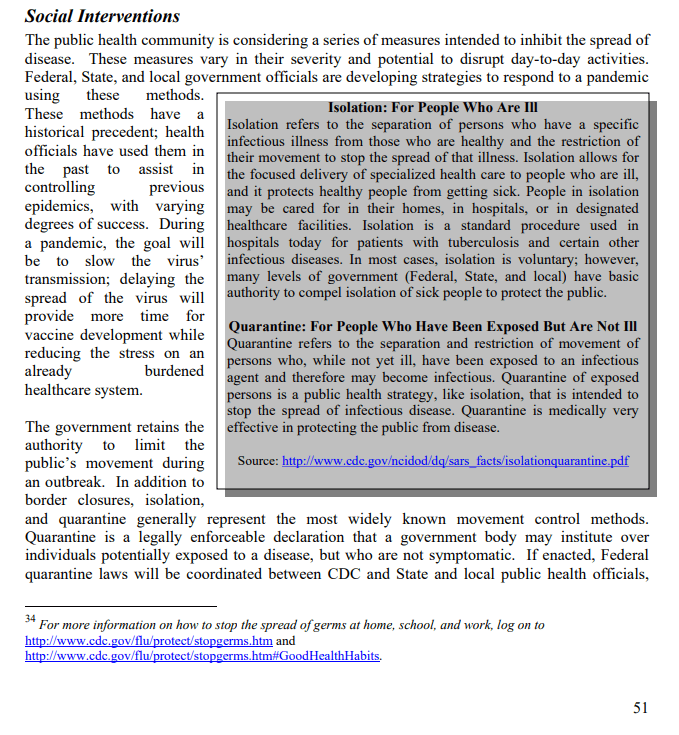
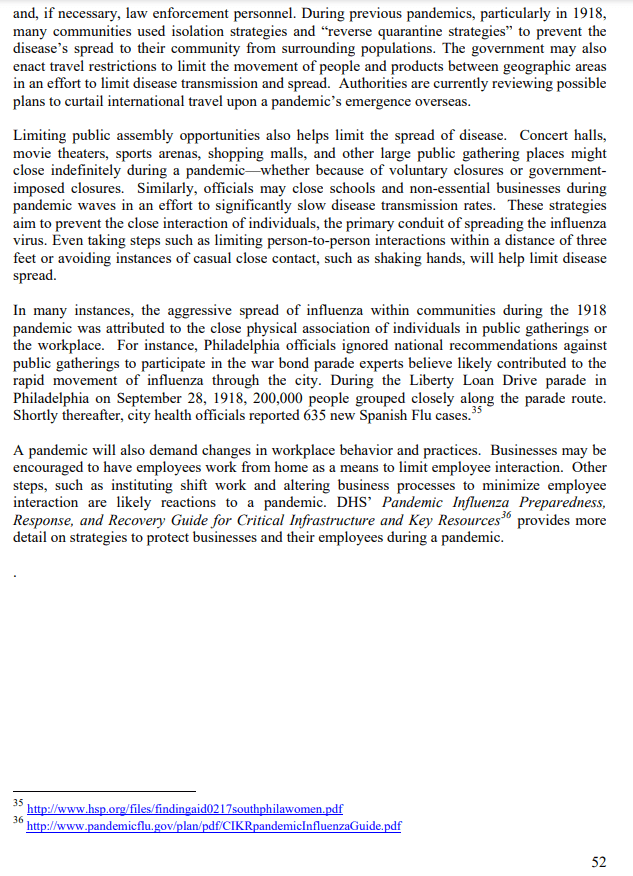
2006 and 2007 were a turning point in U.S. biodefence planning. Prior to 2006, such planning had been focused on biological attacks, but after that point major mission creep set in and the new draconian ideas were applied wholesale to general pandemic planning. This controversial switch in focus so riled leading U.S. disease expert D.A. Henderson, who had been involved with the project up to that point, that he issued his famous riposte objecting in the strongest terms to the new ideas. He and his fellow dissenters wrote, presciently:
Experience has shown that communities faced with epidemics or other adverse events respond best and with the least anxiety when the normal social functioning of the community is least disrupted. Strong political and public health leadership to provide reassurance and to ensure that needed medical care services are provided are critical elements. If either is seen to be less than optimal, a manageable epidemic could move toward catastrophe.
I’m told by someone who was involved with the programme in the early days that the original biodefence planning in 2002-2003 assumed a targeted biological weapons attack with smallpox as the viral case and anthrax as the bacterial case – both considered worst case scenarios. It was recognised that the old smallpox vaccine was too risky to try to use on a wider population to protect them if such an attack occurred, thus the effort for a new vaccine. But very quickly, within a year or two (not least due to the SARS outbreak in 2003), there was a massive expansion of the original mission and suddenly every infectious agent, whether dangerous or not, was cast into the web of biodefence.
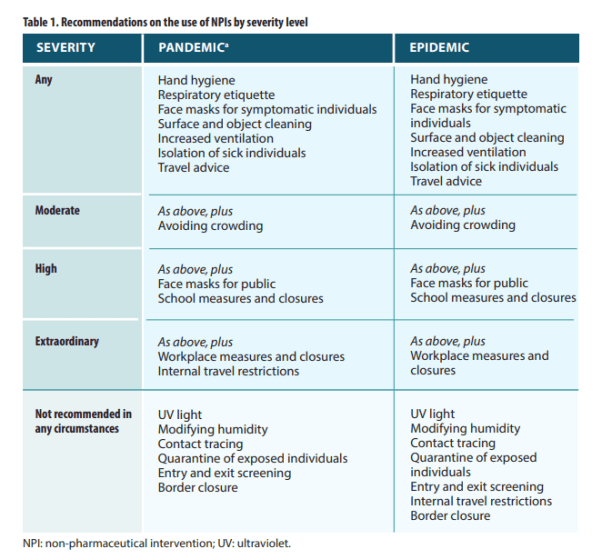
Outside the U.S. there was more resistance to this kind of totalitarian nonsense. However, even the 2019 World Health Organisation pandemic guidance bears many of its marks. While this guidance commendably did not recommend “in any circumstances” contact tracing, border closures, entry and exit screening and quarantine of exposed individuals, it did make conditional recommendations for use of face masks by the public, school and workplace closures and “avoiding crowding” i.e., social distancing.
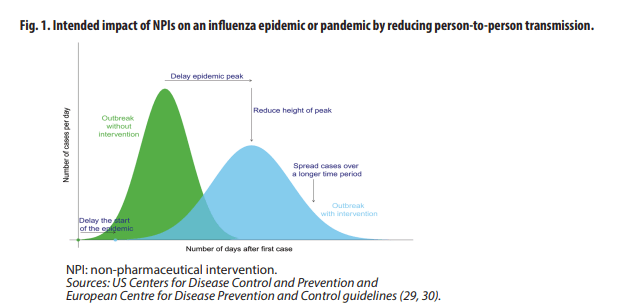
The purpose was also the same: to ‘flatten the curve’ to wait for a vaccine, as illustrated in the diagram below. The WHO guidance states: “NPIs are often the most accessible interventions, because of the time it takes to make specific vaccines available”; “specific vaccines may not be available for the first six months”; NPIs are “used to delay the peak of the epidemic… allowing time for vaccines to be distributed”.
These untested ideas, which the WHO’s own guidance rightly admitted had no good quality evidence to support them, have now become a terrible orthodoxy for global pandemic response. This is despite them utterly failing to achieve any of their goals – a point that no one who backs them seems to have noticed.
Somehow, the world must learn the right lessons from this debacle. Yet it keeps threatening to learn all the wrong ones.
Algeria’s growing influence is putting it in the US crosshairs
By Robert Inlakesh | RT | December 13, 2022
As Algiers continues to play a more prominent role in Middle Eastern and African affairs, will it face US pressure and even regime change attempts for its foreign policy stances that do not align with those of the West?
In September, US Congress members evoked the 2017 Countering America’s Adversaries Through Sanctions Act (CAATSA), to call for sanctions to be placed upon Algeria over weapons deals with Moscow. This plea came shortly after the same argument was made by Republican Senator Marco Rubio in a letter to Secretary of State Antony Blinken.
Since the days of the Cold War, the Algerian state has been outside the orbit of the West, lending its favor instead to national liberation movements and pursuing a more tailor-made foreign policy platform. This pitted it against its western neighbor, Morocco, which opted to align itself with the West. Today, tensions are boiling again between the neighboring North African leaderships over a similar alignment of sorts, especially since Morocco decided to normalize ties with Israel owing to pressure from the administration of then-US President Donald Trump. An arms race has been developing between the two nations since 2015, as both governments find themselves further tied to their East-West allegiances.
Against the backdrop of tensions with its Western-aligned North African neighbor, Algiers has emerged in 2022 as a revived regional player. As the global energy crisis continues amid the West’s standoff with Russia in Ukraine, Algeria has come off well and with more wealth. In the first five months of this year alone, Algeria’s oil and gas earnings skyrocketed by more than 70%, amounting to a total of $21.5 billion. This has given Algiers greater freedom to work on its defense goals and infrastructure projects.
Algeria is making significant strides at building sustainable living and working on projects to provide more jobs to its citizens. One such project is the construction of a futuristic city called Boughezoul. The city will not only house 400 new residents as part of its strategy to eliminate slums and derelict housing, but also seeks to host the Algerian space agency, a new railway station, and a new international airport. Efforts such as these, combined with the revival of military displays on the nation’s independence day, seem to represent a real effort to reassure the population of the government’s intentions after years of mistrust and mass demonstrations.
Along with the ongoing attempts to make the best of the new economic advantages domestically, Algiers also seems fixated on having its own impact on regional affairs. As the nation has cut off ties with neighboring Morocco, due in part to Israel’s intelligence and military influence, as well as the alleged Moroccan backing of Kabylie separatist groups, it now seeks to align itself with Tunisia to a greater degree.
Algeria, the third largest gas supplier to Europe, has attracted significant interest this year, becoming the top supplier now for Italy, as military ties also seem to deepen. In the case of Tunisia, Algeria has granted recognition to the nation’s president, Kais Saied, who relies on Algerian gas and is receiving supplies at a discounted rate. Tunis is facing an acute economic crisis and has been accused of trading its historically cordial relations with Morocco for closer ties with Algeria. The Tunisian president invited Brahim Ghali, the leader of the Polisario Front – a movement that fights for the disputed territory of Western Sahara, against Morocco – to the eighth Tokyo International Conference on African Development that was hosted in Tunisia in August. Inviting the sworn enemy of Morocco to the country triggered the subsequen withdrawal of ambassadors between Tunisia and Morocco. Algeria supports the Polisario Front in its fight over Western Sahara.
For Algerian President Abdelmajid Tebboune, keeping Tunisia on its side is an important issue, as it fears the UAE-Saudi-Egyptian bloc will assert its own dominance over Tunis’ policies. Kais Saied, who seized power in October of 2019, is clearly within the UAE’s sphere of influence, as opposed to his opponents in the Ennahda party that align with Qatar and the Muslim Brotherhood. Due to such a strong influence from Abu Dhabi in North Africa, Algeria is made to play a careful balancing game.
Another major issue that Algiers is now involving itself in is Palestinian reconciliation. It has hosted a number of meetings between rival parties Hamas and Fatah in order to bridge the gap and develop a stronger platform from which to argue for Palestinian statehood. The issue of achieving Palestinian statehood also played out as a central theme in the Arab League summit in November, as Algeria attempted to bolster its position regionally by hosting the meeting.
Despite having to play a careful balancing act, both regionally and internationally, Algeria has emerged this year as a key player in Africa, the Middle East, and beyond. It has even held strong against its former colonizing power, France, forcing President Emmanuel Macron to change his rhetoric about Algiers and has paved the way to dropping French in the education system and opting to adopt the English language instead, eroding France’s influence further.
All the moves being made by Algeria are signaling that it intends to continue along the lines of adopting policies that do not necessarily align with Western interests, sometimes coming into direct conflict with them. This is why threats from US congressmen and senators to impose sanctions on Algeria have begun to raise eyebrows. America’s ambassador to Algeria, Elizabeth Moore Aubin, has refused to answer questions on hypothetically imposing sanctions, opting to focus on what her job entails, which may indicate that such decisions may not be on the immediate minds of high-ranking US officials. However, Republican party officials have certainly stirred the pot. The question now becomes how far Washington will go to punish Algeria for refusing to ditch Moscow and whether the strategy going forward may be to use Morocco against Algeria.
Robert Inlakesh is a political analyst, journalist and documentary filmmaker currently based in London, UK. He has reported from and lived in the Palestinian territories and currently works with Quds News. Director of ‘Steal of the Century: Trump’s Palestine-Israel Catastrophe’.
Social media’s history of suppressing Palestine content

By Kathryn Shihadah | Israel-Palestine News | December 12, 2022
For years, social media have been making it difficult for Palestinian and their allies’ voices to be heard – even as Israel’s stranglehold on Palestinians has grown stronger, and as increasing amounts of US tax money have been sent to Israel and to various countries for Israel’s direct benefit.
Social media users, especially Palestinian human rights advocates, have reported puzzling occurrences on the major platforms Twitter, Facebook, and Instagram – especially during times of Israeli crackdowns.
Users who shared information on the situation in the Palestinian territories described posts being deleted as “hate speech or symbols,” or “violence,” inexplicably losing followers and views of their content, or having entire accounts abruptly frozen or deleted.
One rights group documented over 700 instances of social media networks restricting or removing Palestinian content in May 2021 alone, during a time of especially heavy Israeli state violence.
Another group reported that nearly half of the Palestinian-themed content that disappeared off of Instagram during this time period
occurred without the company providing the user a prior warning or notice. In an additional 20 percent of the cases, Instagram notified the user but did not provide a specific justification for restricting the content.
When users appealed the censorship, often their content or account would be restored, with a message that it never should have been deleted to begin with. But by the time this resolution came, the opportunity to inform and influence readers was past.
For example, in May 2021, during a time of escalating Israeli violence, Twitter restricted the account of Palestinian-American journalist Mariam Barghouti, who had been posting photos and videos of the violence in Jerusalem. It later restored Barghouti’s account and apologized for the suspension, saying it was done “by mistake.”
A long report on social media actions regarding Israel-Palestine in the Columbia Journalism Review pointed out: “Some of those who have been covering such issues for years don’t think these kinds of things are a mistake; rather, they believe social networks are deliberately censoring Palestinian content.”
Barghouti explained the significance of Twitter to the Palestinian rights movement:
It’s our only avenue for speaking with the world from under a military occupation that controls all our entry and exit points. We’re left to share through soundbites of 280 characters. If even that is taken away, we’re looking at the slaughter of Palestinians in silence.
Social media suppression is particularly critical since mainstream media tend not to cover Israel and Palestine with the kind of accuracy and context that would enable Americans to understand the issue.
In essence, social media have been preventing the victims of Israeli violence from sharing their experiences or building support for their plight.
Excuses
Although owned by two different companies, the three platforms, Twitter and Facebook/Instagram, have offered duplicate “explanations” for what has happened, including glitches that just happened to affect posts and hashtags about Israel, and “widespread global technical issue not related to any particular topic.”
While these [glitches] have been fixed, they should never have happened in the first place. We’re so sorry to everyone who felt they couldn’t bring attention to important events, or who felt this was a deliberate suppression of their voice. This was never our intention – nor do we ever want to silence a particular community or point of view.
TRT World reported another case in which Twitter restricted information on Palestine:
Pro-Palestinian activist Hebh Jamal’s Twitter was targeted with complaints over a post detailing an emotional conversation between her husband and his little cousin in Gaza. The young cousin admitted to wanting to brush his hair before sleeping for fear that the Israeli fire may kill him in his sleep. He said he wanted to look good in case he died. Hebh’s post was flagged for deletion, and restricted by Twitter.
Since the German government has implemented legal measures to make social media companies accountable to users, Twitter later confessed to Hebh that the complaints against her post were baseless. Under German law, Twitter has to inform the user if their post or account is being investigated. This only applies because Hebh and her family reside in Germany. For most Palestinians hailing from Gaza City, there’s a different set of rules, and a radically different set of rights.
TRT reports: “Hebh now faces a video review for every post she makes. She’s also been reported on TikTok as well, with her account deleted before.”
Journalist Bayan Ishtaiwi explained: “For Palestinians sealed-off in open-air prisons like Gaza, social media is all they have. Whoever uses words like occupation or martyr, is penalized for three days at least, which happened to me, or face a ban on live videos for a month.”
Whistleblowing
A group of Instagram employees confirmed the human rights activists’ suspicions when they protested the platform’s blocking of pro-Palestinian content during Israel’s violence in May 2021 – even after the issue had already been reported.
Can we investigate the reasons why posts and stories pertaining to Palestine lately have had limited reach and engagement, especially when more people than ever from around the world are watching the situation unfold?
Other employees added comments, including,
I’d really like to understand what exactly is breaking down here and why. What is being done to fix it given that this is an issue that was brought up a week ago?
Soon after, nearly 200 Facebook employees signed on to an open letter demanding that Facebook address the allegations of censorship.
Israel calls the shots
Foreign Policy reports:
“Since 2015, the Israeli Justice Ministry has operated a Cyber Unit that has issued tens of thousands of content removal requests to Facebook, Twitter, and YouTube, mostly alleging violent incitement or support for terrorism.
Technically, these requests are voluntary. They are not legally binding and are therefore not tracked in the transparency reports that technology companies use to disclose formal government censorship orders.
Nonetheless, social media companies have complied with the Cyber Unit’s requests roughly 90 percent of the time.”
Israel’s infamous Cyber Unit patrols social media, searching for “incriminating” content, passing along thousands of requests to social media administrators to remove what the unit finds unacceptable.
In 2016, the Israeli government and Facebook agreed to collaborate on ways to combat what Israel considers “incitement to violence” on the platform.
Then-justice minister Ayelet Shaked noted that at the time, Facebook’s compliance with Israel’s requests to take down content was up to 95%, but expressed hopes that the plan would result in even more censorship.
Neither Israel nor the platforms have been transparent about this practice.
In 2020, Israel’s Ministry of Strategic Affairs issued a report on allegedly “phony” online profiles that put out content critical of Israel.
Within a day, Twitter “suspended dozens of Palestinian and pro-Palestine accounts,” claiming the information they circulated violated its terms of service.
It may be noteworthy that both Meta CEO Mark Zuckerberg and Twitter’s new owner, Elon Musk have had private audiences with top Israeli leaders.
Israelis abound in Silicon Valley, with about 60,000-100,000 in the Bay Area, and Israel partisans are also ever-present. A recent photo of Musk shared on Twitter was of him with his friend Ari Emanuel, son of a former Irgun terrorist and brother of Rahm Emanuel, who once volunteered with the IDF.
One Palestinian activist summed up the situation:
Rather than being some kind of enabler of democracy, social media has come to be the epitome of political silencing and repression as tech giants have collaborated with various oppressive governments, including the Israeli government, to censor and delete content that exposes their true oppressive character.
Facebook, Instagram report card
Facebook’s Oversight Board recommended that Meta (parent company of Facebook, Instagram, and WhatsApp) undergo an evaluation of its treatment of Palestinian content in May 2021. Meta hired the consulting company Business for Social Responsibility (BSR) for the work.
Jewish Currents summarized BSR’s final report in an article entitled “Human Rights Due Diligence of Meta’s Impacts in Israel and Palestine”:
The report underscored heavy-handed content moderation by Facebook and Instagram, which Palestinian social media users claim censors critics of Israeli repression.
These restrictions have undermined Palestinian users’ effort to use social media to document Israeli human rights abuses.
BSR contrasted Meta’s over-enforcement of Palestinian social media posts with its under-enforcement of Hebrew-language posts, which the report attributes to Meta installing an algorithmic “hostile speech classifier” for Arabic, but not for Hebrew.
The report concludes that Arabic language content is over-regulated because Hamas, the ruling, elected party in Gaza, is on Facebook’s blacklist, so it was standard to remove posts that appeared to “praise, support, or represent” that group or others on the list.
Other reasons for the interference lie in the fact that the Palestinian content was not reviewed by Palestinian dialect speakers of Arabic, nor was the algorithm developed with the proper “linguistic and cultural competence.”
Internet policy experts summed up the situation at Facebook and the other platforms:
Social media companies have] shown a willingness to silence Palestinian voices if it means avoiding potential political controversy and pressure from the Israeli government.
“Unintentional”? Really?
BSR’s report speculated that the impact of Facebook’s actions – Palestinian users’ loss of rights to expression – was unintentional. Rights groups disagreed.
Dozens of groups signed a public statement in response to BSR’s report, insisting that they had been
calling Meta’s attention to the disproportionately negative impact of its content moderation on Palestinians for years, [so] even if the bias started out as unintentional, after knowing about the issues for years and not taking appropriate action, the unintentional became intentional.
Looking ahead
The BSR report ends with 21 recommendations to Meta, some of which Meta has committed to, either fully or in part.
Marwa Fatafta, a policy manager for a digital rights group, had mixed feelings:
The report validates the lived experiences of Palestinians… They cannot tell us anymore that this is a system glitch. Now they know the root causes…
But regarding Israel’s interference in content restriction, he added,
We’ve wanted more clarity on this because Meta refuses to provide answers. Users deserve transparency on whether their piece of content has been removed as a result of the Israeli government’s request.
Bottom line
Social media have for years – and for various reasons – repressed content about Israel’s oppression of Palestinians.
In some particularly egregious situations, like Israel’s aggression in May 2021, the companies have offered excuses and apologies. But impartial analysis has proven these excuses false and the apologies hollow.
Not only are social media platforms inherently skewed to over-regulate Palestinian voices, but they are influenced by a powerful foreign government (and no doubt, its US lobby) to an extent we can only imagine.
And Palestinians continue dying.
A report in Foreign Policy by Emerson T. Brooking and Eliza Campbell described the situation with rare eloquence:
The 4.8 million residents of the occupied Palestinian territories live in two simultaneous and vastly different realities. In the physical world, Palestinians are captives, crammed into Gaza or West Bank enclaves and blockaded by Israeli military checkpoints…
But on the internet, the checkpoints disappear. Palestinians can converse with family from whom they are separated by barbed wire and machine gun emplacements. They can share their stories with observers and sympathizers around the world.
In doing so, Palestinians can call themselves citizens of a sovereign State of Palestine: one recognized by 138 countries and admitted in 2012 as a non-member observer state to the United Nations. This second, digital Palestine represents a fulfilment of the internet’s optimistic and largely forgotten promise to give voice to the voiceless and illuminate the darkest corners of the world.
It is also under threat of being extinguished. This is due to a confluence of three forces. The first is the expansive police and surveillance apparatus of the State of Israel, which is used to track, intimidate, and imprison Palestinians in the occupied territories for their online speech.
The second is a network of formal and informal institutions used by the Israeli government to target pro-Palestinian expression across the globe.
The third—and most surprising—force is that of American social media companies, which have shown a willingness to silence Palestinian voices if it means avoiding potential political controversy and pressure from the Israeli government.
Together, these forces demonstrate how it is possible for an ostensibly democratic government to suppress a popular online movement with the acquiescence of ostensibly liberal Silicon Valley executives. The playbook being pioneered against Palestinians will not stay in the Middle East forever. In time, it may be deployed against activist communities around the world.
From Neck-Breaking Ejection Seats to Frightening Lightning: F-35’s Top Ten Problems
By Ilya Tsukanov – Samizdat – 13.12.2022
The Lockheed Martin F-35 Lightning II is the most expensive weapon in history, with a per unit price between $78 and $95 million, and a lifetime operations and sustainment cost of a whopping $1.3 trillion. Yet years after its introduction, the plane has continued to plague operators with a host of problems.
With its overall $1.7 trillion price tag roughly equivalent to the annual GDP of Australia, or more than twenty times Russia’s annual defense budget, one might expect US weapons giant Lockheed Martin to show a little humility when it comes to requesting more cash to fix issues affecting the F-35.
But it seems that’s too much to ask. Last week, US media reported that cost overruns for upgrades to the jet’s sophisticated cockpit computers had reached $680 million, nearly matching the $712 million the Pentagon originally planned to spend on upgrading them (for a total cost of $1.3 billion). Adding insult to injury, the F-35 Joint Program Office announced that the upgrades wouldn’t be completed by the agreed-upon completion deadline of July 2023, with the timeframe pushed back to the end of 2023.
Separately this month, the US Congressional Research Service revealed that the Pentagon wants an unspecified amount of cash for upgrades to the plane’s engines, promising that the new ones will reduce annual sustainment costs, which jumped from $79 million in 2016 to $315 million in 2020, and are projected to reach over $ 1billion by 2028.
Fortunately for Lockheed, cost overruns aren’t a problem. Actually, they’re baked into the agreements on the planes’ acquisition signed by the United States and its allies, with the company enjoying “cost-plus,” “undefinitized” contracts which make any unexpected costs the buyer’s problem (i.e. governments and their taxpayers). Some of Washington’s allies have caught on to the scheme. Last week, one angry Australian defense expert demanded that Canberra get a refund for its existing F-35s and stop buying new ones after calculating that the plane’s “killer” price tag, range limitations, and reliance on a hackable data communications link based thousands of kilometers away in the US makes it a bad buy for the Land Down Under.
The US Government Accountability Office (GAO) issues yearly updates on the F-35’s projected costs, as well as outstanding problems associated with the plane. In its 2022 report, the GAO calculated that seven years after its introduction, the plane still has four major “Category 1” deficiencies, and 822 lesser “Category 2” problems.
Here are some of the issues the jet has faced over the years:
10. Cabin Overpressurization
The 2022 GAO report outlined “cabin overpressurization” as one of these outstanding Category 1 deficiencies. The watchdog did not elaborate on the scale, nature and causes of the problem. However, an overpressurized cabin can be a big deal, causing ear popping, temporary hearing loss, headaches, sinus pain, and, if it’s severe enough, ruptured eardrums, permanent hearing loss, and loss of consciousness. It goes without saying that for the pilot of an $80 million aircraft flying through the skies at speeds up to 2,000 km an hour, an overpressurized cabin can be problematic.
9. Night Vision Problems
“Issues” with the F-35’s night vision camera are another “critical deficiency” highlighted in the GAO’s 2022 report. The document did not offer details, but earlier reports on the matter pointed to a range of potential problems – from failing to operate when there is no Moon, to annoying horizontal lines, or striations, in the night vision display. Other issues, including a disorienting “green glow,” have also been reported, with the latter feeding video from a built-in camera onto the headgear display, obscuring the pilot’s vision during night flight. Last year, the Pentagon announced that fixes to these issues would involve upgrading the planes’ $400,000-a-piece integrated night vision helmets. However, not all branches of the US military have approved the acquisition of the new equipment.
8. Lightning Strikes
Given its name, the F-35 Lightning II has an ironic propensity to suffer from problems related to stormy weather, with the Marine Corps expressing concerns as far back as 2018 that “as a composite type aircraft,” the plane “does not provide inherent passive lightning protection.” A 2012 Pentagon report concluded that the planes’ operation is unsafe within 40 km of a thunderstorm amid fears that lightning could damage or destroy the aircraft if it struck their fuel tank inerting system. The Air Force announced earlier this year that it will fix lightning danger-related issues by 2025.
7. Software Bugs
Software bugs with the aircraft’s onboard computer and its 8 million+ lines of code are a persistently-reported problem for the F-35, with the issue apparently getting so bad that the Pentagon called in software experts from top American universities last year for advice on how to resolve the persisting issues. A $14 billion software upgrade promises to fix a range of issues, from weapons functionality and communications to navigation, cybersecurity and targeting, but the Pentagon has already called the patch “immature, deficient and insufficiently tested.”
6. Radar Headaches
In 2016, the Pentagon confirmed that the F-35 had a problem involving the shutdown of its radar system once every four hours. After shutdown, it would reportedly take “a few minutes” for the radar to “regain picture” – a not-insignificant issue for a warplane, where “a few minutes” can be the difference between flying over your target or finding yourself a hundred or more kilometers away.
5. Corrosion
F-35 jets feature an advanced radar-absorbent skin, designed to improve stealth capabilities against cutting-edge enemy radar. However, photos of Navy F-35s published earlier this year showed that the planes’ skin appears to be suffering from severe corrosion thanks to its use of an iron ball paint designed to scramble radio waves. It’s not clear if and how Lockheed plans to address the problem, but as with almost every other problem involving the aircraft, a fix probably won’t be easy, or cheap.
4. Breakneck Action
One of the most serious problems with the F-35 has been its faulty ejection seats. In 2015, low-speed ejection tests revealed that the aircraft’s ejection seat systems were snapping crash test dummies’ necks. In 2016, the Pentagon responded by beginning testing of a reinforced helmet designed to keep pilots’ precious necks safe. A year later, the Air Force reported that tinkering with the planes’ ejection seat systems had alleviated the danger, allowing the military to lift pilot weight requirements.
3. Trackability
One of the F-35’s biggest selling points is its stealthiness – the ability to fly into and out of enemy territory undetected, fire its munitions, and leave before ever being engaged by enemy missiles. However, even before substantial quantities of the aircraft were built, a flurry of reports indicated that Russian, Chinese, and Iranian designers had developed radars capable of detecting the jets at long ranges. Of course, only time, and radar and air defenses’ interactions with F-35 in real-life environments, will determine the true significance of the aircraft’s trackability.
2. Lockheed’s Nary a Care Culture
Over seven years after its introduction, the F-35 has not yet received approval from the Pentagon for full-rate production. That’s because the US military has not completed the jet’s certification. To date, Lockheed has yet to make good on its requirement to provide the Pentagon with detailed data for the Joint Simulation Environment – a virtual training domain designed to test the F-35’s hypothetical performance against top Chinese and Russian aircraft. The company promises to provide the military with data from 64 JSE tests by the summer of 2023.
Despite the lack of certification, the Pentagon has already taken delivery of hundreds of F-35s, and expects to receive about one-third of its 2,470-plane F-35 fleet before full-rate production is granted, with all the problems that come with it –including issues upgrading and fixing problems with jets already built and bought.
1. Single-Engine Design
Arguably the F-35’s biggest problem, and a flaw that no amount of tinkering will be able to fix, is its single-engine, ‘one size fits all’ design. Lockheed’s decision to use a single, Pratt & Whitney F135 afterburning turbofan means that, if the plane suffers a major malfunction at sea, or damage to its engine while engaged in combat against an enemy plane or ground-based air defenses, it would become nearly impossible for it to limp safely back to base. Japan’s Air Force had cause to ponder this issue in 2019, when one of its F-35A jets was lost at sea after its pilot suffered spacial disorientation.
Moscow’s response to oil price cap revealed
RT | December 13, 2022
The Russian authorities have “generally agreed” on a response to a Western coalition’s price cap on the country’s seaborne oil that took effect last week, the newspaper Vedomosti reported on Tuesday.
Moscow will ban oil sales under contracts that specify a price cap, according to the report, which cites government sources. Also, exports will be banned to countries that demand the price cap as a condition in their supply contracts, or if their reference prices are fixed at the cap price level of $60 per barrel.
A decree describing the mechanism is currently being finalized by the president’s administration, sources said. It will take effect immediately upon being issued and will be valid until July 1, 2023, with the possibility of extension. On Monday, Kremlin spokesman Dmitry Peskov said the decree would be announced “in the next few days.”
The document will also reportedly contain a clause that allows buyers to bypass the restrictions if granted government approval. The measures will not apply to contracts that were concluded prior to December 5, the date when the price cap took effect. One of the sources said the final draft of the decree might include a provision on the marginal discount for Russian oil relative to international grades.
The price cap was introduced by the EU, G7 countries and Australia on December 5. The mechanism prohibits Western companies from providing shipping, insurance, and other services to tankers carrying Russian oil, unless the cargo is bought at or below the price limit.
US anti-Russian war plans limit aid to Kiev
By Lucas Leiroz | December 13, 2022
There is no doubt among military experts that NATO is currently at war with Russia – just using Kiev as a proxy. However, the possibility of something even worse – a direct full-scale war – limits American participation in the current conflict. Internally, Washington’s political scenario is divided between parliamentarian warmongers, interested in taking assistance to Kiev to the ultimate consequences, and experienced, cautious military, interested in keeping the country’s internal stocks ready for any need.
According to a recent Foreign Policy article, US lawmakers are pressuring Pentagon’s officials to send more weapons to Ukraine. The objective would be to allocate the largest possible amount of combat equipment in Kiev, allowing the local forces to continue to face the Russians and possibly “win the war” – since, according to the narrative of the American media, Russia would be frightened and weakened, which obviously does not correspond to the reality of the battlefield.
Pentagon agents, however, act more rationally, avoiding strategic mistakes that could bring problems for national security. Unlike congressmen, whose reasons for supporting Kiev are based on ideological alignment or economic interest, the American military thinking is based on calculations and solid data, so it seems irrational to send Kiev military aid at a level that threatens the US’s defense capability.
The dialogue between the Pentagon and the US Congress for the production, purchase or allocation of weapons and ammunition works through the Department of Defense’s periodic reports on its war plans. These reports are called operational plans (or OPLANs). In theory, the Pentagon has an OPLAN for every situation considered a risk to American security, which includes relations with enemy countries such as Russia, China, and North Korea. After considering the evaluation of its experts, the Pentagon prepares a list of equipment considered necessary to face such countries, submitting the reports to the Congress for approval. If approved, the Pentagon purchases such weapons from private companies affiliated with the “military industrial complex” and eventually allocates them to overseas bases.
In principle, military assistance to Kiev was supposed to be restricted to an exclusive OPLAN for the Ukrainian conflict, but congressmen want to change that. For politicians, who do not think strategically, this is a “mistake” and more weapons to Kiev are needed. Congressmen consider it appropriate to invest all available resources in Ukraine, as Kiev is the state that is currently actually fighting Russia. For them, betting on sending weapons on a large scale is the right attitude, even if the stock reserved for other OPLANs is running out – which is already happening.
As a response to the stock supply crisis, parliamentarians suggest thinking about measures to speed up production and replenishing. According to them, the problem is not the transfer of weapons to Ukraine, but the fact that there is difficulty in filling stocks quickly, as they are dwindling with assistance to Kiev.
However, this narrative does not seem consistent with reality. As previously reported, the American military industry is entering a vicious cycle, where there is no modernization of its arsenal, only a race by military companies to replace weapons which are wasted by the systematic transfer to Ukraine. In this sense, expanding aid and violating the stocks of other OPLANs would only worsen this critical scenario.
In its decisions, the government oscillates between supporting realism and warmongering. For example, a new aid package was recently announced, valued at 275 million dollars – one of the smallest since February. Warmongers criticize this attitude and say that it is time to increase assistance as much as possible, taking advantage of the opportunities of the supposed “Ukrainian counteroffensive” and “imminent victory”. Apparently, many politicians in the US believe the lies created by the American media itself and actually plan strategies based on these fallacies.
Experts, however, know that this rhetoric is unsubstantiated. Ukraine is suffering significant losses day after day. The great victory of Russian forces in Bakhmut makes this absolutely clear. There is no chance of victory for Kiev and, given the defeat in this proxy conflict, the most rational thing to do would be to reduce support and encourage peace negotiations, while replenishing internal stocks for an eventual situation of direct war.
In fact, the case illustrates the US internal scenario well: the dispute between those who want to prepare for a future war with Russia and those who want to do it now, through Ukraine. To solve this problem, the most appropriate thing would be to avoid any possibility of war, taking the simple attitude of interrupting support for Kiev and talking to Russia about a policy of non-expansion of NATO in Eurasia.
Lucas Leiroz is a researcher in Social Sciences at the Rural Federal University of Rio de Janeiro; geopolitical consultant.
Junior ROTC Fits Perfectly within Public Schools
By Jacob G. Hornberger | FFF | December 12, 2022
The U.S. military is having a tough time meeting recruiting targets, possibly because young people are figuring out that they don’t want to come back from some stupid foreign war without legs or arms or with some brain injury or, even worse, dead. To encourage young people to join up and be all that they can be, public-school officials across the country are forcing high-school freshmen to take Junior Reserve Officer Training Corps (JROTC) class, where students are “encouraged” to later join the military.
An article about the controversy in yesterday’s New York Times points out that the JROTC program is funded by the U.S. military and is designed to produce “leadership skills, discipline and civic values — and open students’ eyes to the idea of a military career.”
The JROTC students are required to wear uniforms and are taught the importance of obeying orders. At Pershing High School in Detroit, several students asked to drop the class. They were told that the class was mandatory. The article states: “A review of J.R.O.T.C. enrollment data collected from more than 200 public records requests showed that dozens of schools have made the program mandatory or steered more than 75 percent of students in a single grade into the classes, including schools in Detroit, Los Angeles, Philadelphia, Oklahoma City and Mobile, Ala.”
Why would public-school officials act as tools for the military? According to the article, “The military subsidizes instructors’ salaries while requiring schools to maintain a certain level of enrollment in order to keep the program. In states that have allowed J.R.O.T.C. to be used as an alternative graduation credit, some schools appear to have saved money by using the course as an alternative to hiring more teachers in subjects such as physical education or wellness.”
Oh, and guess which students they are mainly targeting as potential future cannon fodder. According to the Times’s article, “A vast majority of the schools with those high enrollment numbers were attended by a large proportion of nonwhite students and those from low-income households.”
Julio Mejia, a Fort Mayers, Florida, parent whose daughter tried to get out of the JROTC class, pointedly observed, “The only word I can think of is ‘indoctrination.’” The Times points out, “But critics have long contended that the program’s militaristic discipline emphasizes obedience over independence and critical thinking.” Jesús Palafox, a former student, calls the process “brainwashing.”
Not so, claims Cmdr. Nicole Schwegman, a Pentagon spokesman and herself a former JROTC student. “It’s really about teaching kids about service, teaching them teamwork.” It sounds more like she might be a perfect example of the program’s success at indoctrination and brainwashing.
While parents can see how JROTC creates mindsets of conformity, blind obedience, and regimentation, unfortunately they are not able to see that that’s precisely what public (i.e., government) schooling itself does. In fact, public schooling could easily be described as “army-lite,” which is why the JROTC program fits perfectly within the public (i.e., government) schooling system.
Just as students are being forced into JROTC, young people are forced into the state’s educational maw, where they are indoctrinated and brainwashed into becoming “good little citizens,” ones who are inculcated with mindsets of regimentation, obedience to orders, and deference to authority, all of which, they are taught, constitutes “patriotism.” As with the JROTC classes, public-school students have any ability to engage in critical thinking smashed out of them, and they are taught instead to memorize and regurgitate.
In fact, one cannot help but wonder if the reason that so many parents can easily see the downside of JROTC but not the downside of public (i.e., government) schooling is because they themselves are products of the public-school system and its very successful system of indoctrination and brainwashing. After all, what better success story than indoctrinated and brainwashed people who have no idea they’ve been indoctrinated and brainwashed and recoil at any suggestion that they are victims of indoctrination and brainwashing?
Washington wants Europe’s total Dependence on the US
By Salman Rafi Sheikh – New Eastern Outlook – 12.12.2022
In March 2022, the Stockholm International Peace Research Institute (SIPRI) reported that “Europe is the new hotspot” of global arms import. While this development is attributed to the ongoing military conflict between Russia and Ukraine (US/EU/NATO), what’s equally, or even more, important to understand is how most of this European purchase is coming from the US and how the latter has turned the conflict into a money-making machine. The US is responsible for the so-called ‘energy crisis’ in Europe and, by selling expensive US gas to Europe, is making a lot of money. Of course, the US told the Europeans that doing so was necessary to reduce their critical dependence on Moscow. The Europeans, in their bid to ‘punish’ Russia, decided to increase their dependence on the US. This is now turning into an ugly issue, as European powers, as reports in the western mainstream media show, are now directly accusing the US of profiteering from war.
This criticism is based not just on the fact that Europe is buying expensive US gas and the latter is profiting from it. In fact, it is based upon the fact that Europe is now too dependent on the US to prevent its economic collapse. If Europe’s dependency on the US continues to increase, it will only come at the cost of its strategic autonomy.
Secondly, this is not just about gas. If gas is linked to economy, Europe’s increasing military purchase from the US is directly linked to its defence and security, or at least this is how it is being projected. This dependence in the defence field is most easily evident from the German purchase of F-35 fighter jets from the US. While the US is going to make a whole lot of money out of this multi-billion dollar deal, strings attached to this deal show how this deal is a direct reinforcement of European dependency on the US.
Martin Kroell, the President of the Federal Association of the German Aerospace Industry (BDLI), was quoted to have said that Germany, even after purchasing these jets, would not have the rights to maintain and repair these jets in Germany. They will be maintained “in other European countries in the network of the US Armed Forces, or by the US companies Lockheed … this creates a dangerous dependency.”
Let’s not forget that this sale happened, first and foremost, when the US started putting pressure in early 2021, when the Russia-Ukraine conflict began, on European nations to increase their defence capacity. But, using the pressure of this conflict, the US authorities managed to make a deal that did not give much leeway to the German authorities to really protect their interests. As another report confirms, the Germans made an ‘error’ in not demanding the involvement of their own “arms industry in the maintenance, repair, and support of these expensive aircraft.”
This is not Germany alone. Finland, for instance, is another country entering the phase of dangerous dependency on the US. It has already decided to buy 64 Block 4 F-35s for US$9.4 billion. Since the start of the Russia-Ukraine conflict, Finland has upped its weapon purchase, with, unsurprisingly, most of this purchase coming from the US.
While the conflict in Ukraine has led to many deals worth billions of USD, there is a growing fear in the continent that the US is now trying to start a new crisis with China. Such a conflict would create additional problems for Europe.
But the rhetoric being produced – and effectively used – by the US for Europe is to reduce dependence on China. Europe of course is concerned about this form of geopolitics. As Charles Michael, President of the European Council who recently met Xi, said in a tweet: “The EU promotes its interests and values in the world. With China, engaging openly on all aspects of our relationship is the only way forward.”
China, too, understands that Europe is far from being in agreement with the US over a joint China policy. Therefore, Xi was candid enough to tell the EU last week that the bloc should keep up its investment in China, adding that China and the EU must jointly “oppose de-coupling.”
But while the EU is fighting the US over forcing a policy on the EU vis-à-vis the China question and the economic consequences it could have for Europe in the long term, the US continues to make policies that directly impact the EU economy. The latest irritant is certainly the US Inflation Reduction Act (IRA), which gives tax breaks for components used in electric cars provided they are made in (North) America.
While the EU-based companies could set up factories in the US, this would effectively mean that these companies will add to the US economy more than the EU’s economy. In other words, the EU’s capital will be used to add to the US capital at the expense of the EU’s own economic health.
This pattern is similar to the way the EU capital is being used via expensive gas sales and weapon systems to help the US economy. This is precisely how the conflict in Ukraine has turned out to be a major source of profit for the US state.
What can the EU do? The Europeans are unlikely to be able to break out of this dependency relationship without first developing an independent global outlook. Imagine the economic scenario in the EU if, instead of supporting the US bid to expand NATO, it had taken an independent line. The EU did not take that line. Now, the EU accuses the US of its energy crisis. The question is: can it translate this anger into a concrete policy?
Featured Video

Why Hamas Really Attacked Israel on Oct. 7
or go to
Aletho News Archives – Video-Images
From the Archives
Confronting the Threat of Ethnic Bioweapons
By Tony Cartalucci – New Eastern Outlook – 29.11.2017
The United States Air Force’s 59th Medical Wing’s molecular biology branch recently was revealed to have been collecting specifically Russian RNA and synovial (connective) tissue samples, prompting fears in Russia of a possible US directed ethnic-specific bioweapons program. … continue
Blog Roll
 Aletho News
- Meet the US generals and admirals advancing Israeli policy
- Israel’s Straw Widow Protocol: The Kill Zones Where Civilians Were Labelled ‘Terrorists’
- Leading Israeli Think Tank Publishes Psychotic Israeli ‘National Security’ Doctrine
- Are the United States and Israel in Decline-and-Fall Mode?
- Why Hamas Really Attacked Israel on Oct. 7
- Declassified UK exposes British man who fought for ‘Israel’ in Gaza
- West’s death cult in a theater near you
- How the Yandex ‘Russian bots’ lie fell apart
- Burnham’s ‘Russia did Brexit’ ruse crumbles
- Estonia making movies and games to encourage war against Russia
- If Americans Knew
- Gaza’s “ceasefire” death toll passes 1,500 – Daily Update
- Activists Abused By Israel Return to New Freedom Flotilla Mission
- 60 Minutes won’t tell the full truth about Israeli settler violence
- Nearly 50,000 women, girls killed or severely injured in Gaza since October 2023: UN Women
- ADL is working with AI companies to suppress alleged ‘antisemitism’
- Israeli occupation forces using social media surveillance unit to target hundreds of Palestinians in the West Bank
- Israel’s New – and Terrifying – Security Doctrine
- Israeli Attacks Kill Five in Gaza, Including a four-year-old and a woman
- Air Force Major Who Called for Trump’s Impeachment Held in Solitary Confinement
- It’s a Genocide, I’m Into It’: Seinfeld Mocks Protest over Palestinian Children Killed
- No Tricks Zone
- New Study Suggests Large Regions Of The Pacific Ocean Have Been Cooling For The Last 80 Years
- Germany’s Green Energy Debacle: High Energy Costs Force Kahla Porzellan to Close After 182 Years!
- New Study: 50 Years Of The Most Aggressive ‘Net Zero’ Policies Can Only Affect The Global Climate By 0.03°C
- US September “Heat” Was No Record…Many Records Set Decades Ago
- Latest European Green Energy Debacle; Portugal’s Largest Flagship Solar Park Insolvent!
- Green Energy Debacle: German Expert Professor Fritz Vahrenholt Warns Of Severe Economic And Social Consequences
- Two More Paleo Reconstructions Affirm Meters-Higher Sea Levels Across Ireland, Brazil 7000-6000 Years Ago
- New Study: Earth And Venus Surface Warmth Largely Explained By Convection And Lapse Rate, Not CO2 Or Radiation
- 2025 Nature Paper Claiming Worsening Global Drought Gets RETRACTED …Heavily Flawed
- New Study: ‘Global Drought Shows No Detectable Recent Acceleration Under Climate Warming’

