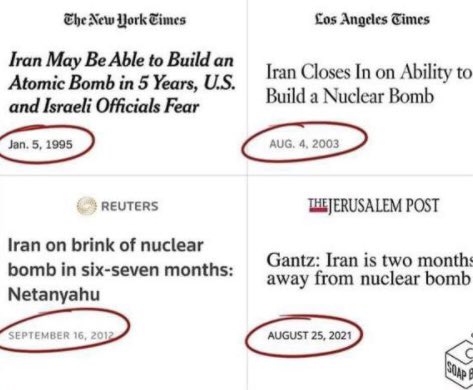
Israel Defense Forces (IDF) Chief of Staff Aviv Kochavi has called on the United States to develop new “operational plans” to take on the Iranian military, urging top US defense and intelligence officials to “accelerate” joint efforts to counter the Islamic Republic.
Kochavi held a series of meetings with Chairman of the Joint Chiefs of Staff Mark Milley, National Security Advisor Jake Sullivan and CIA Director William Burns, the IDF said in a press release on Tuesday, noting that he discussed the “Iranian threat” with each of the officials he spoke with since landing in the US on Sunday morning.
“We are at a critical point in time which requires the acceleration of the operational plans and the cooperation against Iran and its proxies in the region,” Kochavi said after the meetings. “On the one hand, Iran is under many economic, military and internal pressures, and on the other hand continues to advance the nuclear project.”
During his sit-down with General Milley, the two officials discussed “strengthening cooperation between the [US and Israeli] armies against threats in the region, chief among them the Iranian nuclear threat,” according to the IDF. Sullivan, too, said the White House would carry out its pledge to “prevent Iran from acquiring nuclear weapons.”
While Israel has offered little evidence supporting the existence of an Iranian nuclear weapons program, officials have claimed for decades that Tehran is on the cusp of developing its own bomb. The Islamic Republic has denied any plans to build nuclear weapons – with Supreme Leader Ayatollah Ali Khamenei issuing a fatwa (religious decree) against all weapons of mass destruction in 2003 – and passed numerous inspections by the UN’s nuclear watchdog under a major deal signed with world powers in 2015.
However, after Washington unilaterally withdrew from the nuclear deal under President Donald Trump, Tehran has steadily scaled back its compliance, boosting its enrichment of uranium and building new advanced centrifuges while demanding an end to US sanctions. Iran has nonetheless insisted that such steps do not indicate it is seeking a nuclear weapon, despite continued allegations from the United States and Israel.
November 22, 2022
Posted by aletho |
Wars for Israel | Israel, United States, Zionism |
Leave a comment
How do we move ahead in a post-pandemic era? And what are the lessons to be learned from our challenging recent history? Catholic psychiatrist and bioethicist Aaron Kheriaty has thought a great deal about these questions and his answers are found in his just-released book The New Abnormal: The Rise of the Biomedical Security State (Regnery Publishing, 2022). The result is a brilliant mix of scientific observations, personal experiences, philosophical reflections, prudent policy prescriptions, and even a few speculative hints about dystopian possibilities of the near future.
Kheriaty, who lost his previous job as clinical psychiatrist and teacher at UC-Irvine in a dispute over mandated vaccines and natural immunity, begins the book in an unexpected time and place: 1947 Nuremberg. He does this to provide historical context for threats to freedom in our time. He briefly surveys the eugenics movement and its appropriation by the Nazi regime. Germany’s medical professionals were well-trained and as good as any in the world, but they lost their way. “Instead of seeing the sick as individuals in need of compassionate medical care, German doctors became willing agents of a sociopolitical program driven by a cold utilitarian ethos,” writes Kheriaty (xvii). After the war the revulsion at the perversion of medicine led to the Nuremberg Code, which emphasized informed consent as a cornerstone of ethical medical treatment.
That code and other ethical agreements remained as part of the medical-bioethical landscape… until 2020. Kheriaty asserts that “[d]uring the covid pandemic, the public health and medical establishment once again abandoned the principle of free and informed consent to advance a supposed greater good” (xxi). Having laid the groundwork for his argument and narrative, he sums up by issuing this frightening declaration: “The unholy alliance of (1) public health, (2) digital technologies of surveillance and control, and (3) the police powers of the state—what I call the Biomedical Security State—has arrived” (xxii). While this probably seems like a heavy meal to digest, the reader can be assured that Kheriaty writes clearly and is grounded in scientific medicine and a solid ethical worldview. His story, while alarming, is neither conspiracy theory nor exercise in despair.
After the Nuremberg prologue, Dr. Kheriaty continues with four long chapters and an epilogue: “Locked Up: The Biomedical Security State”; “Locked Down & Locked Out: A New Societal Paradigm”; “Locked In: The Coming Technocratic Dystopia”; “Reclaiming Freedom: Human Flourishing in a More Rooted Future”; and, “Seattle, 2030.” Sprinkled throughout what could be a gloomy read, we encounter stories of solidarity and resilience. The author makes sure to show us that human interaction cannot — must not — be stymied by government interference in our lives and the functioning of society. “Consider the human goods we sacrificed to preserve bare biological life at all costs: friendships, holidays with family, work, visiting the sick and dying, worshipping God, and burying the dead” (14). But to resist or even question, we must know as much of a situation’s history as possible. Kheriaty lays out the pieces of the puzzle: states of emergency, agency capture of regulators by the regulated, loosening bonds of social cohesion, and the religion of scientism.
Scientism is distinct from science and scientific inquiry, Kheriaty points out. “The characteristic feature of science is warranted uncertainty, which leads to intellectual humility. The characteristic feature of scientism is unwarranted certainty, which leads to intellectual hubris” (54). In other words, scientism upholds so-called science as the only proper form of knowledge and rejects any questioning or skepticism. It is prone to misuse as a political tool and typically accompanies a materialistic worldview. That heavy-handed framework clashes with how science and medicine have long operated through trial and error, experimentation, imaginative solutions, and, most of all, respect for individual humans as made in the image and likeness of God.
Kheriaty’s own story makes for a fascinating sub-plot. As a doctor, ethicist, and teacher he was closely involved with figuring out how to respond to covid and help patients. As the lockdowns unfolded he encountered staggering amounts of fear, worry, and depression. His grasp of bioethics and knowledge of history led him to speak out against new methods of trying to control spread of the covid virus, especially when they superseded societal freedom and individual liberty. “Freedom of movement, of association, of domicile in one’s country of origin, and access to public spaces and public events—these quickly went from basic rights to special privileges conferred by governments as rewards for good behavior” (68). His medical training also led him to critique the development and imposition of a new and mostly untested vaccine. In his own case, he fought against a mandatory vaccination because of a prior covid infection. His argument at the time did not prevent him from being fired. He also touches on the devastating impact of restrictions on work and supply chains.
Indeed, that is one of the constant themes of this book: technology and safety should never eclipse the humanity of our lives. For instance, “[t]here is clearly no such thing as a medication—or a vaccine—that’s always good for everyone in every circumstance all the time” (137). Technology and cultural immersion endanger our sense of ourselves and nudge us to trade autonomy and dignity for convenience. “Today, routine biometric verification for things from mobile phones to lunch lines gets young people used to the idea that their bodies are tools used in transactions” (155). Connected to abuse of genetic and biometric data is the ominous specter of transhumanism, which Kheriaty characterizes as “clearly a religion—a particular type of neo-Gnostic religion” (167). To all these dehumanizing trends the author counsels resistance, but emphatically “nonviolent resistance and civil disobedience” (184).
The book’s final chapter lays out policy proposals for steering clear of dystopia. I found this chapter to be only somewhat persuasive. Kheriaty’s suggestions are certainly prudent and logical; however, they mostly deal with changing the political and medical climate. But bureaucracy and institutional entropy are like the invasive Japanese Knotweed in my back yard, which is to say impossible to eradicate. On other points Kheriaty is spot-on. “The first and most necessary step is to overcome our fear,” he writes (191). And [t]he enemy is not pain or illness. The enemy is fear. The enemy is hatred or indifference toward our fellow human beings” (192). Fear of death was manifest during the pandemic. As Catholics, we are taught to not fear death, but rather to spend our lives preparing for it and to live in a state of grace. During a pandemic or even “normal” times we can bear witness to Christ by living with courage and fighting fear. We can also resist mask mandates that dehumanize us and separate us from others, covering up our God-created uniqueness. Of importance to religious believers, we can engage with our faith authorities to make sure no one is abandoned again because “too many religious leaders and clergy unfortunately showed themselves during the pandemic to be willing chaplains to the new technocracy” (204).
Readers should not skip the epilogue, in which Kheriaty (a native of the Pacific Northwest) posits a dystopian Seattle in 2030. In this uncomfortable scenario, we are asked to consider what life might be like if current trends in pharmaceuticals and their marketing are joined with further developments in social control to create a two-tiered society reminiscent of many well-known alternative futures in literature and movies. Thankfully, Dr. Kheriaty lightens a somber story with some wry humor.
While The New Abnormal is not an explicitly Catholic book, Aaron Kheriaty founds it in Catholic principles of justice, humanity, clear philosophical first principles, subsidiarity, solidarity, and important spiritual goods. He brings in examples from classical and contemporary philosophy, C.S. Lewis, and George Orwell. The prose is clear but some of the concepts can be a little heady at times. This is a valuable piece of work from a man with unique qualifications. His is a prophetic voice calling us to understand and take action while never forgetting the God Who made us.
Greg Cook is a writer living in New York’s North Country with his wife. He graduated from Plattsburgh State College and The Evergreen State College. He is the author of two self-published books of poetry, Against the Alchemists and A Verse Companion to Romano Guardini’s ‘Sacred Signs’.
November 22, 2022
Posted by aletho |
Book Review, Civil Liberties, Timeless or most popular, War Crimes | Covid-19, COVID-19 Vaccine, Human rights, United States |
Leave a comment
Tehran has for the first time started enriching uranium to 60% fissile purity at the Fordow facility, Iranian media reported on Tuesday. Such a move would be seen as a response to a critical resolution adopted by the UN’s nuclear watchdog last week.
Iran is already enriching uranium at Natanz, its other major production site, to below weapons-grade 90% enrichment, but well above the 3.67% limit specified in the 2015 Iran Nuclear Deal, or JCPOA. The US abandoned the deal with Tehran during the administration of Donald Trump, leading to its erosion and effective collapse.
Other reported moves by Iran include upgrading cascade lines with more advanced gas centrifuges to boost production capacity at Fordow, as well as firing up additional chains at Natanz.
Tehran’s action was described as retaliation for a resolution passed last Thursday by the Board of Directors of the International Atomic Energy Agency (IAEA). The document, which was drafted by the US, Britain, France and Germany, decried “insufficient substantive cooperation by Iran” on the issue of uranium traces found in 2019 by inspectors at three undeclared sites. It demanded “credible explanations” and full cooperation from Tehran.
The four sponsoring nations are also signatories of the JCPOA. China and Russia, two other participants of the landmark deal, reportedly voted against the draft document during the closed-door session last week.
The Iranian Foreign Ministry rejected the resolution, calling it a form of political pressure by the US and its allies. Spokesman Nasser Kanaani said on Monday that the country had taken “initial measures” in response to it on Sunday night.
“The implementation of these measures was realized today in the presence of IAEA inspectors in the Natanz and Fordo enrichment complexes,” the diplomat added, without specifying what had happened.
The JCPOA was meant to exchange an Iranian commitment to limit its nuclear program for relief of economic sanctions imposed on the country. The goal was to prolong the time Tehran would need to create a nuclear weapon, an ambition that Iran officially denies fostering in the first place.
The Trump administration unilaterally pulled out of the Iran Nuclear Deal as part of its “maximum pressure” campaign against Tehran. President Joe Biden has been negotiating a possible revival of the JCPOA, but no breakthrough has been achieved so far.
November 22, 2022
Posted by aletho |
Aletho News | France, Germany, IAEA, Iran, Sanctions against Iran, UK, United States |
Leave a comment
works before a news conference attended by IAEA Director Rafael Grossi during an IAEA Board of Governors meeting in Vienna, Austria, September 13, 2021. (Photo by Reuters)
A political analyst has described the International Atomic Energy Agency (IAEA) as a primary “instrument of pre-aggression” which paves the way for Israel and the US to take unilateral actions against Iran.
“The IAEA has become a primary instrument of pre-aggression. In other words, they create a scenario, they make the false charges, they do not prove the charges, and then they use the false unproven charges, to stoke the fires of aggression against you,” John Bosnitch told Press TV on Monday while commenting on recent tensions between Iran and the IAEA following a resolution passed by the UN nuclear body’s Board of Governors.
The politically motivated draft resolution, ratified on Thursday, has criticized Iran for what it called a lack of cooperation with the agency. It was put forward by the United States, Britain, France, and Germany, in continuation of their political pressures on Iran.
Bosnitch added that the “trend” that has been going on for years against Iran is rooted in the Israeli lobby and its influence on the US government and American personnel inside the IAEA.
“It looks like yet another provocation to create false grounds for aggressive action against Iran,” he said.
The political analyst further pointed to the “invented” excuses and provocations against Iran, saying that the US uses the IAEA as a tool “to make it a little bit more believable to those naive people around the world who still hold trust in such institutions.”
Once the fires of aggression are lit, Bosnitch said, Israel and the US can act unilaterally and illegally based on the so-called reports by the IAEA.
“And that is the formula for aggression. And I have to say that Iran, as I’ve said, through all discussions on this topic, must be ready for the worst,” he cautioned.
‘IAEA a spying organization’
Bosnitch also called the IAEA a “spying organization” that only spies on enemies of the United States and Israel.
In order to ease concerns about its nuclear program, Iran has agreed to install surveillance cameras in its nuclear facilities and has provided the IAEA with physical monitoring and satellite images. According to Bosnitch, however, “nothing works because the lies perpetrated by the lying mainstream media are bigger to the common person’s eye than the truth.”
Head of the Atomic Energy Organization of Iran Mohammad Eslami said on Sunday that the Islamic Republic will give a “firm response” to the IAEA Board of Governors’ anti-Iran resolution.
“The nuclear programs of the Islamic Republic of Iran are moving forward according to the strategic action plan of the parliament, and the issuance of multiple resolutions against Iran will not cause any disruption in the progress of these programs,” the AEOI chief added.
According to a report published on Tuesday, Iran has started enriching uranium to the purity level of 60% at its Fordow nuclear facility. The country has also installed two new IR2M and IR4 cascades at the Natanz and Fordow facilities.
The report added that Iran has fitted and launched new centrifuges at two empty halls in Fordow and Natanz nuclear sites and replaced IR1 centrifuges at Fordow with IR6 which will increase enrichment at the site by 10 times.
Tehran informed the IAEA of that decision via a letter. It described the move as a strong message to the recent anti-Iran resolution passed by the IAEA’s Board of Governors.
‘US provoking protests in Iran’
Elsewhere in his remarks, Bosnitch mentioned the recent violent riots across Iran, warning that US agents are working inside Iran “right now” to provoke protests.
“Whatever grievance there might have been, it has been amplified by the US State Department and by the CIA inside your country already.”
He added that the US is not only attacking Iran on the IAEA side but also organizing protest expansion inside the country.
“They definitely try new tactics, and the only protection against American militarism and unilateralism is to tie up with other countries that are threatened by the same thing,” he concluded.
Riots have broken out in Iran since 22-year-old woman Mahsa Amini died in hospital on September 16, three days after she collapsed in a police station. An investigation has attributed Amini’s death to her medical condition, dismissing allegations that she was beaten by police forces.
In the last two months, using the protests as a cover, rioters, and thugs — many of whom were later found to have links with foreign parties — went on a rampage, engaging in savage attacks on security officers, vandalism, desecration of sanctities, and false-flag killings of civilians to incriminate the Iranian police.
November 22, 2022
Posted by aletho |
Wars for Israel | IAEA, Israel, Sanctions against Iran, United States, Zionism |
Leave a comment
How the world appears all depends on whether your gaze is firmly focussed on the hub of the wheel, or alternatively, were you to watch the wheel’s rotation around the hub – and the bearing it follows – you would see the world differently.
Looked at from a DC-centric perspective, all is still: Nothing (as it were), is moving geo-politically. Was there an election in the U.S.? Well, certainly there is no longer an ‘Election Day’ event as the new mechanics of ballots vs in-person voting, commencing up to 50 days earlier, and ploughing on, weeks after, has become far removed from the old notion of having ‘an election’, and an aggregate macro outcome.
From this ‘centric’ viewpoint, the Midterms change nothing – stasis.
So many of Biden’s policies were already in stone anyway – and beyond the ability of any Congress to change in the short run.
New legislation, if there were any, could be vetoed. And should the election ‘month’ end with the House controlled by Republicans and the Senate controlled by Democrats, there might not be any legislation at all, because of partisanship and an inability to compromise.
More to the point, Biden anyway can rule for the next 2 years through Executive Order and bureaucratic inertia – and not need the Congress at all. In other words, the composition of Congress may not matter that much.
But now, turn your gaze to the rotation around the ‘hub’, and what do you see? The rim spinning wildly. It seizes more and more traction on the ground and has clear directionality.
The biggest pivot around the hub? Well probably, President Xi of China travelling to Riyadh to meet Mohammad bin Salman (MbS). The wheel rim here digs deep for a firm grip on bedrock, as Saudi Arabia makes its pivot toward the BRICS. Xi likely is going to Riyadh to seal the details of Saudi’s accession to the BRICS and the terms of China’s future ‘Oil Accord’ with Saudi Arabia. And that may be the beginning to the end to the petrodollar system – as whatever is agreed in terms of the Chinese mode of payment for oil will mesh with Russo-Chinese plans eventually to move Eurasia onto a new trading currency (far away from the dollar).
Saudi Arabia gravitating BRICS-wards means other Gulf and Mid East – states such as Egypt – leaning BRICS-wards also.
Another pivot: The Turkish Interior Minister Süleyman Soylu said after this week’s explosion in Istanbul: “We do not accept the condolence message of the U.S. Embassy. We understand the message that was given to us, we received the message that was given to us”. Soylu then dismissed the U.S. condolence as akin to “a killer being first to show up at a crime scene”.
Let’s be clear: The minister just told the U.S. to go sc**w itself. This unleashing of raw anger comes just as Turkey has agreed to join with Russia to establish a new gas hub in Turkey and is participating with Russia in a massive oil and gas investment and co-operation deal with Iran. Turkey too, is veering BRICS-wards.
And, as Turkey veers away from one ‘hub’, much of the Turkic sphere will take Turkey’s lead.
These two events – from Xi’s meeting with MbS’ thumbing his nose at the U.S., to Turkey’s fury at the terrorism in Istanbul – clearly dovetail together to mark a strategic Middle East pivot – both in terms of energy and monetary frameworks, towards the unfolding Eurasian free trade sphere.
Then comes the news from last Thursday: Iran says that it has developed a high-precision hypersonic missile. General Hajizadeh said the Iranian hypersonic ballistic missile can reach more than five times the speed of sound and, as such, it will be able to breach all present systems of anti-missile defence.
Simply put: Iran essentially already is a nuclear threshold state (but not a nuclear weapons state). The remarkable technical achievement of producing a hypersonic high-precision missile (which still eludes the U.S.), is a paradigm-changer.
Strategic nukes make no sense in a highly mix-populated, small Middle East – and now, there is no need for Iran to move towards becoming a weapons state. So, what would be the point to a complicated containment strategy (i.e. the JCPOA), oriented towards hindering an outcome that has become overtaken by new technology? A hypersonic ballistic missile capacity makes tactical nukes redundant. And hypersonic missiles are more effective; more easily deployed.
The problem for the U.S. and Israel is that Iran has done it – it has leaped beyond the JCPOA containment cage.
On top of that, a few days earlier, Iran also announced that it had launched a ballistic missile, carrying a satellite into space. If so, Iran now has ballistic missiles capable of reaching, not only Israel, but Europe too. Furthermore, Iran is reported to soon receive 60 SU-35 aircraft, as just one part to its rapidly evolving relationship with Russia, sealed last week with Nikolai Patrushev (Russia’s Security Council Secretary) in Tehran.
Again, to be clear, Russia has just acquired a highly potent kinetic force multiplier; access to Iran’s sanctions-busting rolodex of contacts and strategies, and a full partner to Moscow’s big play of Eurasia becoming a commodities super-oligopoly.
Simply put, as Iran enlists as a force multiplier to the Russia-China axis, so too will Iraq, Syria, Hizbullah and the Houthis slip along a somewhat similar trajectory.
Whilst the European ‘security architecture’ remains still frozen in a tight NATO, anti-Russian grip, West Asia’s security architecture is dissolving away from the old U.S. and Israeli-led hard polarisation of a Sunni sphere vs Shi’i Iran (i.e. the so-called Abraham Accords), and is re-forming around a new security architecture being shaped by Russia and China.
This makes sense. Turkey prizes its Turkic civilisational heritage. Iran clearly is a civilisational state, and MbS plainly wants his kingdom to be widely accepted as one, too (and not as just a U.S. dependency). The point of the SCO format is that it is ‘pro-autonomy’ and is opposed to any singularity of ideology. In fact, by being civilisational in concept, it becomes anti-ideological and opposed to tight binary (with us, or against us) alliances. Membership does not require endorsement of each other partner’s particular policies, provided they do not impinge on others’ sovereignty.
In effect, the whole of West Asia – to one degree or another – is being lifted up into this evolving Eurasian economic and security paradigm.
And, simply said, since Africa is already enlisted into the China camp, the African component to MENA is trending strongly Eurasia-wards, as well. The Global South’s affiliation too, largely can be taken for granted.
Where does this leave the old ‘hub’? It has Europe fully in its control. For now, yes…
However research published by France’s École de Guerre Economique suggests that whilst Europe has, since WW2, “lived in a state of the unspoken” in respect to its full-spectrum dependency on Washington, as Russia sanctions take their catastrophic effect on Europe, “a very different state of affairs takes hold”. Consequently, politicians, and the public alike, struggle to identify “who truly is their enemy”.
Well, the collective view, based on interviews with French intelligence experts (i.e. the French Deep State) is very clear: 97% percent consider the U.S. to be the foreign power that “most threatens” the “economic interests” of France. And they see it as a problem that must be resolved.
Of course, the U.S. will not easily let Europe go. Nonetheless, if parts of the Establishment can speak thus, then something is moving and afoot, beneath the surface. The report underlines naturally that the EU might have a trade surplus of 150 billion euros with the U.S., but the latter would never willingly allow this to translate into ‘strategic autonomy’. And any gain in autonomy is achieved against the constant backdrop of – and more than offset by – “strong geopolitical and military pressure” from the U.S. at all times.
Could the Nord Stream sabotage have been the straw that broke the camel’s back? In part, it was a trigger, but Europe hides its diverse old hatreds and long-nursed vindictiveness under ‘a Brussels lid of easy money’. But this pertains only so long as the EU remains a glorified ATM – states insert their debit-cards and withdraw cash. The concealed animosities are repressed, and monetarily lubricated into quiescence.
The ATM however, is in trouble (economic contraction, de-industrialisation and austerity cometh!); and as the ATM withdrawals’ window winnows down, so too the lid holding down the old animosities and tribal feelings will not hold for long. Indeed, the demons are rising – and are readily visible even now.
And finally, will the Washington ‘hub’ hold? Does it retain the resources to manage so many stress-test events – financial, systemic and political – all arriving synchronistically? We must wait to see.
In retrospect, the ‘Hub’ is not ‘on the move’. It has moved already. It is just that so many are stuck seeing an ‘empty space’ that once was occupied by something past, but which somehow still somehow lingers on, in visual memory, as a ‘shade’ of its earlier solidity.
November 22, 2022
Posted by aletho |
Economics | China, European Union, Iran, Middle East, Russia, Saudi Arabia, Turkiye, United States |
Leave a comment
One week ago, the Ukrainian government may have deliberately attacked neighbor Poland in an attempt to draw the NATO alliance into its war with Russia. The incident involved a missile that hit a grain processing site inside Poland and killed two farmers. Ukrainian President Volodymyr Zelensky immediately blamed Russia for the incident even though he surely must have known that the missile had been fired from Ukraine, meaning that he may have been using a so-called “false flag” to create a false narrative of what had occurred. He also immediately called upon NATO to intervene, citing Article 5 of the NATO treaty which requires all members of the alliance to come to the aid of any individual member that is attacked. An attack on one is an attack on all. Poland is a NATO member and it currently hosts a permanent US military base.
The US mainstream media, most particularly the Associated Press and NBC News, immediately repeated the tale being told by Zelensky, but the “blame the Russians” narrative began to unravel. The remains of the missile revealed that it was of a type used for air defense that is in the Ukrainian arsenal, but not currently used by the Russians, and both Moscow and Washington surely had access to satellite imagery that would demonstrate the actual flight path of the missile that struck Poland.
Those in government and the media who wanted to be supportive of Zelensky began to suggest that the Ukrainian missile must have somehow malfunctioned to land in Poland, making it an unfortunate accident. But others more familiar with the performance characteristics of the weapon were skeptical, seeing something possibly more sinister in the tale.
By last Thursday the story had effectively disappeared in much of the mainstream media as it no longer conformed to the acceptable narrative that it was a Russian-launched missile, which Zelensky has since continued to insist to be the case. President Joe Biden, who was at the G-20 Summit conference in Indonesia at the time, to his credit, responded to the news by stating that there was no intelligence to confirm that the missile had come from Russia and that its apparent trajectory did not support that view. Ironically, Biden had authorized an additional $37 billion in aid for Ukraine the day before the incident in Poland took place.
Biden’s message seeking to deescalate the potential crisis was repeated by Pentagon and intelligence personnel during the day, though Secretary of Defense Lloyd Austin emphasized that the US would continue to support Ukraine “for as long as it takes.” He also added that even though the missile was Ukrainian, the incident was Russia’s fault. He did not explain why that was so. NATO’s secretary general Jens Stoltenberg also promoted the same line as Austin, commenting that the incident was “likely caused by a Ukrainian air defense missile fired to defend Ukrainian territory… This is not Ukraine’s fault. Russia bears responsibility for what happened in Poland yesterday because this is a direct result of the ongoing war.”
Given the fact that Zelensky has been saying and doing everything possible to draw the US and NATO into fighting Russia on his behalf, I believe that the missile strike was quite plausibly a deliberate “false flag” attempt to start a much broader war. That such a war could easily turn nuclear reveals just how reckless Zelensky can be. One NATO country foreign diplomat based in Kiev told the Financial Times that “This is getting ridiculous. The Ukrainians are destroying [our] confidence in them. Nobody is blaming Ukraine and they are openly lying. This is more destructive than the missile.”
To be sure, Zelensky is capable of anything and no lie is too mendacious for the former comedy actor who is now basking in the glow of his celebrity. Hollywood personalities like Sean Penn and Ben Stiller are increasingly making the pilgrimage to Kiev to shake hands, embrace and do photo ops. And Zelensky’s calendar is also featuring some trips to the United States. On November 30th, he will reportedly be in New York City at a “live event” hosted by the New York Times with Sam Bankman-Fried, Larry Fink (CEO of Blackrock), and US Treasury Secretary Janet Yellen as the main speakers.
Yes, Zelensky will be side-by-side with THAT Sam Bankman-Fried, if he shows up, who has also been much in the news lately for his having pulled off the largest currency fraud in history, creating losses for investors totaling multi-billions of dollars as a consequence of the collapse of his exchange-trading company FTX! And it just might be that Zelensky and Bankman-Fried already know each other. Bankman-Fried has been a major financial supporter of Democratic Party politicians, having donated $40 million for “get out the vote” projects in the recently completed election cycle. He is second only to George Soros as a Democratic Party funder, and also has separated donated to causes like unconditionally supporting Ukraine that the Democrats overwhelmingly favor. In April he hosted a conference at his $40 million home in the Bahamas which featured appearances by Tony Blair and Bill Clinton and he has also been a generous supporter of the American Israel Public Affairs Committee (AIPAC).
There has been considerable speculation that the unregulated and unmonitored flow of billions of dollars of US taxpayer provided money through Ukraine’s notoriously corrupt government provided a perfect mechanism for large scale money laundering. Former CIA analyst Larry Johnson has been following the FTX-Ukraine story closely and observes that “The financial collapse of FTX… is exposing evidence that the Democrats, some Republicans, the Ukrainians and FTX organized an elaborate financial kickback scheme. The scheme involved promising members of Congress who sent money to Ukraine a hefty contribution from a Democrat benefactor. In this case, the owner of FTX [Sam Bankman-Fried]. Once the US dollars were credited to Ukraine’s account, President Zelensky and his partners diverted some of the proceeds to purchase crypto currency from FTX. FTX, in turn, sent some of those funds back to the cooperating members of Congress and the Democrat National Committee.”
Other reporting reveals that Bankman-Fried had established a crypto donation “partnership” with the Ukrainian government which provided an estimated $60 million in “assistance” to Zelensky. The Ukrainian government website that reported some details of the arrangement mysteriously was “disappeared” two days before the FTX disaster was made public. The FTX tale, if it turns out to be largely verifiable, underlines just how corrupt a “money pit” called Ukraine is. Hunter Biden gets a well-paid sinecure place on a company board to get to his father and now Ukraine may be directly involved in a massive financial fraud. And Joe Biden obligingly is sending billions of dollars more to that crook Zelensky.
But the real issue is the war. Even assuming that the Ukrainian missile strike on Poland was due to some malfunction, Zelensky comes out of the process smelling really bad as he has worked assiduously at blaming Russia, which clearly is not true. He is using his contrived narrative to dramatically expand the war by creating a situation which would bring NATO directly into the conflict and which could easily go nuclear. Indeed, he is attempting to compel NATO participation. But potentially far worse, if it was a deliberate “false flag” provocation to bring about that end, his tactics should be harshly condemned by all the parties that are currently supporting Ukraine. Beyond that, the US and NATO, burdened with such an “ally,” should take immediate steps to disengage from supporting the fighting and call for a negotiated settlement of the conflict. Joe Biden, if he has any integrity left, and whoever is pulling his strings should not hesitate to take that step.
Philip M. Giraldi, Ph.D., is Executive Director of the Council for the National Interest, a 501(c)3 tax deductible educational foundation (Federal ID Number #52-1739023) that seeks a more interests-based U.S. foreign policy in the Middle East. Website is councilforthenationalinterest.org, address is P.O. Box 2157, Purcellville VA 20134 and its email is inform@cnionline.org.
November 22, 2022
Posted by aletho |
Corruption, Deception, False Flag Terrorism | Ukraine, United States |
Leave a comment
Samizdat – 22.11.2022
MOSCOW – The Russian Embassy in Washington on Tuesday condemned the US reaction to the video believed to be showing a massacre of Russian prisoners of war by the Ukrainian military, saying that the US authorities enable a growing sense of impunity of neo-Nazis in Ukraine.
Earlier in the day, US Ambassador-at-Large for Global Criminal Justice Beth Van Schaack said that the US was monitoring reports of the shooting of Russian prisoners of war in Donbass. She urged all parties to respect international law.
“We noted the statements of Ambassador-at-Large on International Criminal Justice Beth van Shack on the murder of captured Russian military personnel by Ukrainian neo-Nazis. The official refused to directly condemn the massacre of our unarmed soldiers, despite the confirmation of the authenticity of the relevant video materials by American journalists, who did not hush up the tragedy,” the Russian embassy said in a statement.
The US is nurturing an increased sense of permissiveness and impunity of neo-Nazi sympathizers in Ukraine by turning a blind eye to the violence of that kind.
“We have repeatedly stated that by supplying weapons to Kiev, by teaching criminals and mercenaries the art of war, by transferring intelligence the United States are becoming a side of the conflict. Russian-U.S. relations are thusly driven into a dead end,” the statement read.
Last week, Russia’s Defense Ministry said that the Ukrainian military deliberately killed 10 captured Russian soldiers.
On November 17, a video was circulated on the internet showing Ukrainian soldiers shooting surrendered Russians lying heads down. The Russian Human Rights Council said it would send the video to the OHCHR, the OSCE, the Council of Europe, and other international human rights organizations.
On November 18, the Russian Investigative Committee opened a criminal investigation into the execution of Russian POWs by the Ukrainian military.
On November 19, UN Spokesperson Farhan Haq said that the United Nations was calling for a full investigation of all reported human rights violations related to the execution of Russian POWs by Ukrainians.
November 22, 2022
Posted by aletho |
War Crimes | Russia, Ukraine, United States |
Leave a comment
Senator Rand Paul (R-KY) confronted FBI Director Christopher Wray about the collusion with social media companies and whether the FBI scoops up private information to identify users.
“Is Facebook or any other social media company supplying private messages or data on American users that is not compelled by the government or the FBI?” Paul asked Wray. “No warrant, no subpoena, they’re just supplying you information on their users?”
“I don’t believe so, but I can’t sit here and be sure of that as I sit here,” Wray replied.
“Can you give us a yes or no by going back to your team and asking? Because it’s a very specific question. Because if they are, it’s against the law,” Paul said, invoking the Electronic Communications Privacy Act of 1986. “This was done to protect the privacy of people so we could feel like we can send an email or direct message to people without having that information given over. It’s a very specific question: Will you get with your team of lawyers and give us a specific answer? Because this is the law. If you’re doing it, then we need to go to court to prevent you from receiving this information.”
“Well, I can tell you that I’m quite confident that we’re following the law —, ” Wray started.
“Well, that’s not the answer, ” Paul responded.
“ — but what I will also follow up with you to make sure we get you more information; more detailed information,” Wray added.
“Is the FBI obtaining anonymous social media data and then using technical methods to pierce the anonymous nature of the data?” Paul questioned.
Wray paused before asking, “Anonymous social media data?”
“So you purchase data,” Paul said. “People purchase data all the time and we sort of tolerate it for advertising and things because it’s anonymous data. Are you purchasing what is said to be anonymous data through the marketplace and then piercing the anonymous nature to attach individual names to that data? Are you purchasing data and then piercing the anonymous nature of that data?”
“So the manner in which we use — we usually use the term commercial data — is probably longer than I can explain here. But again, let me —, ” Wray said appearing to dodge the question.
“So you will not answer the question of whether or not you’re attaching names to anonymous data,” Paul stated.
“I think it’s a more complicated answer than I can give here,” Wray responded.
“So, so far we’re 0 for 2 at getting you to answer this, but you’re pledging you will actually answer the question because you have to realize the frustration; we’ll write you a letter and your team of lawyers will write back with a 15-page letter that says nothing and you won’t answer the question. These are very specific. This is whether you’re obeying the law, whether we can have confidence. I want to have confidence,” Paul said.
“We are obeying the law,” Wray responded.
“Well, you’re saying that, but you won’t tell us the answer,” Paul stated. “You aren’t telling me the answer. And the answer is: Are you collecting data not compelled by a warrant? That would not be in compliance with the law. But you won’t answer that you’re not collecting that data.”
Eventually, Paul asked, “Are you getting tips and leads from social media companies?”
“We get tips and leads from companies, absolutely,” Wray acknowledged.
“You may think this is jolly well to get all this stuff without a warrant that people volunteer to you, but many of us are alarmed that you’re getting this information that are private communications between people because it is against the law – it’s against the law for Facebook or social media companies to give it to you, but it’s also against the law for you to receive it,” Paul ended.
Related: Commercial surveillance is state surveillance
November 22, 2022
Posted by aletho |
Civil Liberties, Deception, Video | Facebook, FBI, United States |
Leave a comment
Iran has banned the imports of French cars until France’s automobile manufacturers, namely Renault, Peugeot and Citroen, compensate the damage caused by leaving the Islamic Republic.
The withdrawal imposed a lot of costs on Iran’s automobile and parts manufacturing industry and left many investments in ruins after the US imposed new sanctions in August 2018, targeting the Islamic Republic’s car industry, trade in gold and other precious metals, and purchases of US dollars.
Although the withdrawal forced Iranian manufacturers to pool their resources and produce locally-made cars, compensation for the damage caused by the pullout is a central demand.
The ban announced by Ministry of Industry, Mining and Trade spokesman Omid Qalibaf comes as Iran is reintroducing foreign car imports in order to both improve the pool of quality automobiles and meet consumer demand.
Iran prohibited the import of Western cars in 2017 to counter the impending reimposition of US sanctions. The idea was part of Tehran’s efforts to develop a “resistance economy” that could both serve Iranians’ demands for cars, lessen dependence on foreign technology, and potentially boost export revenue.
“Those in the process of importing cars are dealing with the related issues and are concluding their contracts one by one, with the first cars expected to enter the country with the conditions that have been announced to the importers.
“However, what is certain is that French cars will not find a way to our market for now, because French companies such as Renault and Peugeot do not have a good history during the time of sanctions, when they easily left our country despite having committed to joint ventures and investments,” Qalibaf said.
Before the sanctions, French carmaker PSA Group had signed a framework deal with Iranian counterpart SAIPA to produce and sell vehicles for its Citroen brand in the country.
Under the agreement, Citroen and its Iranian partner would invest 300 million euros ($330 million) over five years in manufacturing, research and development, with the first of three planned new Citroen models due to be launched in Iran in 2018.
PSA Group, the maker of Peugeot and Citroen cars, had finalized a similar production deal with major Iranian automaker Iran Khodro under a 50-50 joint venture to invest up to 400 million euros ($451 million).
Renault had signed a new joint venture deal that included an engineering and purchasing center to support the development of local suppliers as well as a plant with an initial production capacity of 150,000 vehicles a year.
“In the middle of the road, however, they left the Iranian automakers alone and caused a lot of damage to our country’s automobile industry,” Qalibaf said.
“As long as the French car manufacturers do not compensate for these damages, they will not have any share in the large car market of our country, and the import of any car from France will be prohibited,” he added.
The ban, however, will not include South Korea, Japan and other countries, because they were not involved in any joint projects with Iranian industrialists when the new sanctions were imposed, Qalibaf stated.
The auto industry forms the second biggest sub-sector of the economy behind oil, accounting for some 10 percent of the gross domestic product and 4 percent of employment.
When the former Trump administration reimposed sanctions on Iran in August 2018, it reserved Washington’s first hammer blow for the car industry to hurt as many Iranians as possible.
However, the US pressures forced domestic manufacturers to mobilize their resources to fulfill some of the tasks which were an exclusive competence of foreign companies.
Last week, Venezuelan Minister of Transport Ramón announced the shipment of 1,000 cars built in Iran to Venezuela, stating that they were among 80,000 requests registered for the products of an Iranian car manufacturer in his country.
“We have a very high demand for Iranian car products, where we were able to register about 80,000 requests in the first stage,” he said in Tehran where he was at the head of a large delegation.
With the exports, Iran is staking out a niche in South America’s automotive marketplace which has a lot of space for growth and expansion, given the uneasy relationship of some of the countries of the region with the United States.
It followed the Iran-Venezuela 2022 Expo Fair held on Sept. 14-18 in Caracas where President Maduro announced the assembly of four Iranian models at Venirauto car manufacturing plant, a joint venture between the Venezuelan government and Iran Khodro.
November 21, 2022
Posted by aletho |
Economics | France, Iran, Sanctions against Iran, United States, Venezuela |
Leave a comment
It is said not in vain that one man’s problem is another man’s opportunity. And the military action in Ukraine against Russia, unleashed by the US and NATO, has clearly demonstrated this. Every day there is more and more evidence to show what huge dividends the US tycoons are reaping from the policies that the current President Joe Biden is pursuing for their benefit alone. Suffice it to say that Washington has already made tens of billions of dollars from the military actions it has unleashed in Ukraine. Not to mention the distraction from US domestic issues in financial, economic and politico-racial fields, that the White House is using against this backdrop.
The US instigated this armed conflict, a conclusion that most political analysts are now coming to. Its aim is to force Europe to submit to US sanctions against Russia and stop buying cheap Russian natural gas. Washington can now sell huge quantities of liquefied gas to Europe at its own prices, and there is no price cap on US hydrocarbons, unlike Russian hydrocarbons, and it is unlikely there will be one. Europe’s economy has suffered a blow, and vast wealth has migrated from Europe to the US, allowing US leaders to maintain their dominant position in the EU.
Ensuring control over Europe is a major strategic imperative for the US. Since the EU has a population of 450 million, while the US population is only 330 million, and their economies are comparable in size, the EU is theoretically in a position to break free from the US and assert itself as an equal or greater superpower on the world stage. A truly independent Europe would prefer to make mutually beneficial trade deals with Russia, China and the rest of Eurasia, pushing back the US and ending US imperial domination of the planet.
It is only natural that the US does not want this to happen. By implementing its divide-and-conquer strategy, Washington is preventing Europe from achieving the cohesion and economic strength that would enable it to free itself from the US occupation that has persisted since after the World War II. Inflation in Germany reached double digits in October for the first time since 1990. Italy is also experiencing the highest inflation in 40 years. The rest of the Eurozone is also suffering. The source of the European crisis is the rise in energy prices caused by US sanctions against Russia. Businesses that produce goods and services have to pay more for energy, and they pass the costs on to consumers. Now most of the extra money paid for what has become ultra-expensive energy goes straight into US coffers. This is the main reason why the euro is falling against the dollar. Furthermore, the dollar has historically been strong in times of panic or uncertainty, and the US has a habit of deliberately provoking panic and uncertainty by organizing wars and crises, of which there have been many examples.
The EU is not an ally of the US, but a coalition of vassal states that have been under US military and economic occupation since the end of World War II. The US committed a holocaust against Germany during and immediately after that war, bombing entire cities where only civilians lived, starving millions of German prisoners of war and civilians during the first few years of the occupation. The mainstream media and academia, owned by the Americans and their satellites, fabricated a story of a mythical World War II victor that essentially turned reality upside down and portrayed the US as a generous rebuilder of Germany through the Marshall Plan. But the reality is that the Marshall Plan was only implemented after the Morgenthau Plan to kill millions of Germans had done its bloody work.
The US is far from being a generous ally. Instead, it has always been and remains a selfish occupier of Europe. The current US-induced destruction of Europe, based on depriving EU countries of cheap energy in order to damage them economically and subjugate them politically, could be called the new Morgenthau Plan. Nevertheless, the United States may have to provide aid packages or loans to help the EU escape hunger and frost this winter. If this happens, the motives will not be altruistic. Instead, Washington will seek to prevent Europeans from overthrowing the US occupation and exercising control over their own destiny.
Before the hostilities unleashed by the US in Ukraine, Russia provided the lion’s share of Europe’s cheap energy imports. However, by artificially supporting the armed conflict, which is now in its ninth month, Washington has broken this partnership, and gas is no longer flowing through Nord Stream. Businesses across Europe are not just limiting their energy consumption. They are shrinking or moving to other continents. Europe, according to economists, may well be on the way to de-industrialization. Eurozone industrial activity fell to its lowest since May 2020. The October PMI from S&P Global signaled a looming recession, falling in November and becoming the fourth monthly reading below 50, indicating an economic slowdown. In its latest analysis of the energy crisis in Europe, published on November 3, the IEA said the EU could face a shortfall of up to 30 billion cubic meters of natural gas during the summer of next year to replenish its gas storage capacity.
In a report entitled “Never Too Early to Prepare for Next Winter: Europe’s Gas Balance for 2023-2024” the IEA warns that the safety cushion provided by current storage levels, as well as recent lower gas prices and unusually mild temperatures, should not lead to unduly optimistic conclusions about the future. A look at the IEA report shows that the European Union will face a major challenge in meeting its energy needs in the coming years. Given the high costs of transporting gas over long distances, Russia could still make a significant contribution to solving this problem. With the world’s largest oil and gas reserves, Russia could provide Europe with the energy it desperately needs if it were not for persistent US sanctions. Unlike oil, natural gas is difficult to transport in large volumes and is therefore exported either by pipeline or by conversion into liquefied natural gas (LNG), but this is expensive and requires large investments. Russia does not currently have the infrastructure to export large volumes of LNG to Europe. Given current experience and looking to the future, European governments should clearly see the huge negative impact that sanctions against Russia have had and will have on global energy security. More should therefore be done to help curb US self-serving agendas and negotiate a multipolar world.
By constantly unleashing wars, the United States always reaps huge profits and the military-industrial complex comes first, as one would expect. It is not surprising that the US military budget is equal to that of the rest of the world combined. And this is further clear evidence that Washington does not want to live in a world where all contentious issues are resolved at the negotiating table, but aims only at military actions.
But lately, all of a sudden, the energy complex, whose owners are making exorbitant profits from oil and gas supplies, mostly to Europe, has become the most profitable sector in the United States. It is only natural that many people became interested and it was primarily the military who were concerned and who simply “pressed” Joe Biden. And now the US President has suddenly become “interested” in these huge sums and has decided to “clip the wings” of the oil and gas industry by imposing an additional tax on the profits of the owners of the energy complex. The simple conclusion from this is that unleashing Ukraine on Russia will continue at an accelerated pace, and Europe will be completely deprived of Russian gas. Even the gas coming through NATO member, Turkey.
By starting any military conflict, the US is not aiming to win. Above all, it is to destabilize the region so that it cannot be a US competitor for decades to come.
Today, a large proportion of the world’s elite keep their reserves in the EU. Naturally, the US will not completely destroy it. But if US companies gain a foothold and dominate the European market, it will force Europe to become even more involved in the Ukrainian conflict, to abandon Russian oil and gas completely, and it will be a huge prize for Washington to implement a policy of solving all issues only through war.
November 21, 2022
Posted by aletho |
Economics, Militarism | European Union, Germany, Ukraine, United States |
Leave a comment
Former White House Press Secretary Jen Paski’s motion to quash the subpoena to depose her in the lawsuit filed by Missouri and Louisiana was denied. The lawsuit alleges that the Biden administration colluded with social media companies to suppress certain viewpoints on Covid and elections.
When she was the White House Press Secretary, Psaki made statements encouraging social media companies to censor more content. At one time, she said, “We engage with (social media companies) regularly and they certainly understand what our asks are.”
The plaintiffs in the lawsuit want her deposed so that she can say who within the government was engaging with social media companies and what they said.
Psaki filed a motion to quash the subpoena in a federal court in Alexandria, Virginia. She was allowed to file the motion in a different state because that is where she lives. Her lawyers argued that she had little information to give and that most of the information is available through the emails and other documents that were obtained by the plaintiffs. They also argued that the deposition would be a burden to her.
US Magistrate Ivan Davis was not impressed by the arguments, but did not reject her request. Instead he referred the motion back to Louisiana, where the lawsuit was filed, because the judge there is more familiar with the case. Davis also refused to stay his ruling so that the motion could be appealed in a district court in Alexandria.
Davis said that Psaki had failed to demonstrate how being deposed in her home state qualifies as an undue burden. If indeed she has little information to offer, it should not be a burden, the judge argued.
“How much time does it take to prepare a witness for deposition when she doesn’t really have anything to say?” Davis asked.
November 21, 2022
Posted by aletho |
Civil Liberties, Deception | Covid-19, COVID-19 Vaccine, Human rights, United States |
Leave a comment
‘Censorship kills’ is the rally cry for a global medical community under unfathomable pressure from big tech and government to stifle the Covid debate. Fortunately, legislators and the greater public are seeing through the authoritarian behavior and taking action.
The Highwire with Del Bigtree | November 17, 2022
Real Housewives Star and business mogul, Bethenny Frankel, made waves on social media when she went off on how taboo it’s become to even question the possibility of suffering an adverse reaction from Covid-19 vaccines.
November 21, 2022
Posted by aletho |
Civil Liberties, Science and Pseudo-Science, Timeless or most popular, Video | Covid-19, Human rights, United States |
Leave a comment



