Sanctions against Biden Resonate With Americans

By Vladimir Platov – New Eastern Outlook – 20.03.2022
By launching information warfare and sanctions against undesirable countries and politicians, the United States clearly did not consider that these same weapons could very well punish the US, its American “stability”, as well as knock many politicians of this “empire of lies” off pedestal.
So, once Moscow, in response to the White House’s insinuations, blacklisted 13 US politicians on March 15, including President Joe Biden, his son Hunter Biden, Secretary of State Anthony Blinken, White House Press Secretary Jennifer Psaki, and Hillary Clinton, approval of the move and strident criticism of the current US political establishment swept the US public.
From Breitbart and its readers, Hillary Clinton, the former Secretary of State who is now trying to reserve her place as the future mistress of the White House, got what they call “what she deserved.” After all, it was she who indirectly benefited when her husband, former President Bill Clinton, received a corrupt fee of $500,000 from a Russian investment bank for a lecture he gave in Moscow in 2010, which even the New York Times wrote about at the time. Moreover, Hillary was also recalled for paying her campaign staff to prepare a fake “dossier” of compromising material concerning the then-candidate, Donald Trump. It is therefore not surprising to see very harsh comments on this article from American readers, in particular IdriveAPontiac: “The same list of wanted persons is posted in the offices of sheriffs all over the country. Lol,” or cylde: “Putin is doing the job for our DOJ.”
The satirical website The Babylon Bee also took a swipe at Hillary, describing Putin’s alleged frustration at “her refusal to cooperate” and the Clinton family’s intention to acquire all disinformation and fake news from domestic sources like The Washington Post.
As for the “first person of the US”, it has completely lost its face and its mind after being blacklisted by Moscow. In particular, he has publicly demonstrated this by speaking at a White House event recently where he called Vice-President Kamala Harris’s husband “the first person of state.”
And a week earlier Joe Biden confused Russia and Ukraine altogether, commenting on the Russian military special operation, and said: “How do we get to the place where, you know, Putin decided he is gonna just invade Russia? Nothing like this has happened since World War II.”
So the stormy reaction to this by users of the Internet and the general shame of Americans for such a “leader” is understandable to all…
Already after the inauguration, having become a laughing stock in the US and beyond, Joe Biden became a “talking head” who too often started to talk a lot of gibberish and voice (probably without proper awareness!) the words of “political prompters”. This is clearly illustrated by the events of March 16, when, during a brief meeting with journalists from the White House pool, Biden, when asked by Fox News to describe Putin, first left the room, and then, apparently having been “prompted” on the sidelines, returned and called the Russian president a “war criminal”.
It is notable that exactly one year ago – on March 16, 2021 – Biden made a high-profile statement in an interview with ABC News when he called Putin a “murderer”. Even then, the Chairman of the State Duma, Vyacheslav Volodin, called Joe Biden’s behavior “impotent hysteria” and Russian Ambassador to Washington Anatoly Antonov was invited to Moscow “for consultations” to review Russian-American relations.
And following the referendum on Crimean independence eight years ago (again in March), Hillary Clinton called Russian President Putin “the new Hitler”.
There is no doubt that such labels, which US leading politicians are trying to place in official statements, are unacceptable. Not only for reasons of diplomatic etiquette, but also morality, as it is American politicians themselves who are up to their elbows in blood. The same applies to Hillary Clinton, who reacted with undisguised enthusiasm to the White House-organized assassination of Muammar Gaddafi in 2011. And to Joseph Biden, who personally came up with the idea of bombing peaceful Belgrade in 1999 and sent American pilots to destroy all the bridges on the Danube. “Biden, US senators and congressmen were the initiators and perpetrators of the current events in Ukraine. They are the ones who committed crimes against humanity and should be brought to justice,” the Chairman of the State Duma, Vyacheslav Volodin said. “US President Joe Biden is beginning to understand that he will have to answer for what is happening in Ukraine, which is causing hysteria in Washington.”
US President Joe Biden’s rating has fallen to 37%, the lowest mark from voters in his career – but even that figure is almost certainly inflated as the country is “going to hell” because of his decisions, Biden’s predecessor Donald Trump told Fox News in a phone interview.
The Daily Wire polled Joe Biden’s supporters on the UCLA campus. In particular, when students were asked what achievements the US president had made over the past year, no one could recall a single specific White House head’s success.
Four dozen people from the US House of Representatives, including the former White House chief doctor, called in February for Joe Biden to undergo a medical test of his mental capacity. They suspect that the head of state is being consumed by “senile dementia”. Their appeal, citing the Alzheimer’s Association, stresses that Biden’s behavior is on a list of ten signs of diminished mental capacity.
Inflation at a 40-year high is dragging both Biden’s and the Democratic Party’s approval ratings down, threatening to have them lose the mid-term election to the Congress next autumn and result in the formation of a parliament opposed to the White House. And there are also sanctions imposed by Moscow on him and his closest “prompters”! Yes, the “talking head” of the White House can’t take this kind of “overheating”, so he “went berserk”.
However, public accusations (not for the first time, either!) against the leader of a world power may result in more than just impeachment!
US continues to push harsh narrative to pressure China over Ukraine crisis; a self-deceiving move of no help
By Xu Hailin and Liu Xin | Global Times | March 19, 2022
After the widely observed virtual summit between Chinese President Xi Jinping and US President Joe Biden on March 18, some US officials and mainstream US media outlets still tried to continue to push the harsh narrative against China with the headlines such as “Biden warns China of ‘consequences,'” a move that attempts to hype isolation of Russia and to show US “toughness” against China, analysts said, noting that such self-deceiving narrative will not help solve the Ukraine crisis and if the US takes no practical action, the consequences of the crisis will be unbearable, not only for Europe, the US itself will not be spared.
Soon after the nearly-two-hour video summit, China released an official readout of what the two leaders talked about. While the White House readout came hours later and was very short and mentioned that during the meeting with Chinese President Xi, Biden “described the implications and consequences if China provides material support to Russia as it conducts brutal attacks against Ukrainian cities and civilians.”
However, during the background press call after the Xi-Biden meeting, when answering questions from media on what are the consequences and how Biden made it, a US senior administration official was reluctant to offer details and said they would not “publicly lay out the options.”
The official then continued that “the President really wasn’t making specific requests of China. He was laying out his assessment of the situation.” The official also repeated that “China will make its own decisions.”
China’s readout was detailed, reflecting that China has done a deliberate and careful work in managing relations with the US, Li Haidong, a professor from the Institute of International Relations of China Foreign Affairs University, told the Global Times. It shows that China is highly responsible in handling the ties with the US and willing to see both sides advance their relations on the basis of difference management.
“The White House’s readout reveals the utilitarianism of the US in its relations with China, focusing only on its own concerns without considering how to maintain the overall landscape of China-US relations. It also reflects the inaccurate understanding of the summit by the US side,” Li noted.
By releasing a one-sided readout, the US government attempted to further hype the atmosphere that Russia has been isolated by many countries, and the White House has ramped up the narrative battle to pressure more countries to distance themselves from Russia, Lü Xiang, a research fellow at the Chinese Academy of Social Sciences, told the Global Times.
After the Xi-Biden meeting on Friday, some mainstream US media outlets, including The New York Times and The Washington Post, reported the event with the headline that highlights “Biden warns China.”
Emphasizing Biden’s “warning” to China is the US government’s way to set its own diplomatic narrative with the purpose to show American public its toughness and capability in pressuring China, further isolating Russia and driving a wedge between China and Russia, Lü said, noting that however, this is a self-deceiving narrative.
Chinese President Xi Jinping encouraged the US and NATO to have conversations with Russia to solve the problems behind the Ukraine crisis, and expressed opposition to indiscriminate sanctions.
Washington is eager to influence China’s attitude over Ukraine crisis, but as the situation evolves, China’s largely neutral stance on the issue has been strengthened. The conflict between Russia and Ukraine has significant impacts, but it has also opened up new geopolitical space, said observers.
The US tried to coerce China to meet its own needs. Such a way is an unhealthy and problematic way to handle relations with China and other major powers. But this is in line with the US’ bullying nature and logics, which apparently is not accepted by China and many other countries. Besides, it is such bullying norm that has made many international issues harder to solve, Li said.
Just hours before the Xi-Biden meeting, China, in a rare move, sent tough signals, stating it will never accept US threats and coercion over the Ukraine issue and vowing to make a strong response if the US takes measures harming China’s legitimate interests. In an exclusive interview with the Global Times, an anonymous Chinese official said China accepted the US’ proposal for the video meeting between the heads of the two countries on China-US relations and the Ukraine situation out of considerations of bilateral relations, promoting peace talks and urging the US to take right stance.
The US continues to see itself as exceptional. The superiority mentality makes the US believe it can set up rules around the world and then act beyond those rules. Washington thinks pressure campaign can solve all the problems while sanctions can bring all it wants, Li noted.
However, the US has overlooked the shattered ties between itself and Russia due to its pressure and sanction campaign of the past three decades, which contributed to the Ukraine crisis. Moreover, the US wants to apply such logics to its relations with China. “Hasn’t the US learned any lesson from this tragedy?” Li asked.
China sees parallel between Ukraine, Taiwan
BY M. K. BHADRAKUMAR | INDIAN PUNCHLINE | MARCH 20, 2022
The Chinese stance on developments around Ukraine was initially one-dimensional, namely, there is no conceivable comparison between Ukraine and Taiwan issues, as they are fundamentally different, because Taiwan is a part of China, whereas Ukraine is an independent country. Factually, that was a correct stance.
However, there has been a shift lately toward acknowledging that the Eurasian tensions hold an analogy for the Indo-Pacific region. Chinese commentaries underline that the relentless expansion of NATO in the post-Cold War era is the root cause of events unfolding over Ukraine. In the video call with President Biden in the weekend, President Xi Jinping implicitly touched on this aspect:
“The US and NATO should also have dialogue with Russia to address the crux of the Ukraine crisis and ease the security concerns of both Russia and Ukraine… As two Chinese sayings go, ‘It takes two hands to clap.’ ‘He who tied the bell to the tiger must take it off.’ It is imperative that the parties involved demonstrate political will and find a proper settlement in view of both immediate and long-term needs… An enduring solution would be for major countries to respect each other, reject the Cold War mentality, refrain from bloc confrontation, and build step by step a balanced, effective and sustainable security architecture for the region and for the world…”
In the spate of Chinese commentaries on the Ukraine conflict, one report that catches attention for its incisiveness and insights is an interview in the Global Times entitled Russia-Ukraine conflict can be regarded as a ‘preview’ of US’ possible acts in Asia: Zheng Yongnian – NATO’s phantom.
Zheng Yongnian is best known as an international authority on Chinese politics, political economy and the CCP. He opined categorically that NATO’s expansion will not stop and it will likely expand to Asia.
In his view, the US is already putting in place “the prototype of an “Asian NATO” — referring to AUKUS, Quad, Five Eyes, Indo-Pacific Strategy, US moves vis-a-vis Vietnam and Singapore. Second, he said China should anticipate a Ukraine-style crisis taking place in “many countries and regions” in Asia and “the expansion of NATO will only stop when another bloc can compete with it and form a check and balance.”
Third, while China’s economic openness and interdependence are its strong points, that may not prevent a war but can probably slow it down. He said bluntly: “Once fierce conflicts happen between China and the US, will the US kick China out of the SWIFT system as it did with Russia? My opinion is: 100 percent YES.” That said, China’s economy, deeply embedded in the West, can make the West feel real pain.
However, Zheng Yongnian also pointed out that it is not all black and white, either. On the one hand, while China and Europe have common interests and no geopolitical disputes, on the other hand, Europe’s current solidarity with the US is very fragile, as European interests are at risk in a longer term perspective and the EU itself is “at a particularly vulnerable moment.”
Besides, a remilitarised Germany will cause uneasiness in the continent, especially for France, with geopolitical implications. Also, the spectre of nuclear proliferation haunts Europe now. It is no longer possible to rule out conflicts happening again within the Western civilisation.
Interestingly, Zheng Yongnian also flagged that the geopolitical landscape of Asia may radically change if Japan, on the footfalls of Germany, also opts for remilitarisation. “This will impact on the entire East Asia, he warned.”
The analysis is very profound and there is very little to add to it. China is wary that Washington is moving in the direction of creating a “Ukraine-like” strategic dilemma for Beijing apropos Taiwan. To be sure, China has been provoked by the abrasive remarks recently by Gen. Kenneth Wilsbach, commander of Pacific Air Forces, on the “key lessons” Beijing should draw out of the Ukraine conflict.
The general listed them as the “solidarity of the global community” in opposing “an unprovoked attack on a neighbour” and “the onerous sanctions that have economically crippled Moscow”. Wilsbach threatened that if China behaves in the Russian way, “something more robust will happen.”
In addition, he warned, China should also consider the opposition of regional countries, apart from the ravages of the war in human lives and treasure. It could not have been lost on Beijing that Wilsbach shot straight from the hip just before Biden’s phone call to Xi Jinping.
Against this backdrop, the speech by Chinese Vice Foreign Minister Le Yucheng on Saturday at the Tsinghua University on the implication of the Ukraine developments for the Asia-Pacific region merits careful attention.
These are the first authoritative remarks by a top Chinese official acknowledging that “the Ukraine crisis provides a mirror for us to observe the situation in the Asia-Pacific. We cannot but ask, how can we prevent a crisis like this from happening in the Asia-Pacific?” They have followed immediately after the 2-hour long phone conversation between President Xi Jinping and President Biden.
Le Yucheng took note that the Asia-Pacific is in “promising situation” today — an anchor of peace and stability, an engine for growth and a “pace-setter” for development. The region faces two choices between building “an open and inclusive family for win-win cooperation or go for small blocs based on the Cold War mentality and group confrontation.”
Le Yucheng explained this binary choice as between: “peace and not undermining regional tranquility; so-called absolute security and common security; mutual respect and wanton interference in others’ internal affairs; and, unity and cooperation versus division and confrontation. Without doubt, he was sounding alert about the US’ so-called Indo-Pacific strategy.
Le Yucheng underscored that the India-Pacific strategy characterised by acts of provocation, formation of “closed and exclusive small circles or groups”, and fragmentation and bloc-based division can only lead to a situation “as dangerous as the NATO strategy of eastward expansion in Europe… (which) would bring unimaginable consequences, and ultimately push the Asia-Pacific over the edge of an abyss.” He underscored the criticality of the regional states pursuing “independent, balanced and prudent foreign policies” that dovetail with the process of regional integration.
The parallels between the situations around Ukraine and Taiwan respectively, are being discussed explicitly in the Chinese commentaries and articulation — while the US “squeezed Russia’s strategic space” through NATO expansion and simultaneously incited Kiev to confront Russia, when it comes to Taiwan too, Washington is instigating the secessionist forces in the island by upgrading arms sales to provoke Beijing.
Of course, the US has refrained from direct intervention in Ukraine, as Russia is not only a military power but also a nuclear power. The big question is whether China will arrive at a conclusion that its best opportunity “to solve its internal Taiwan question” lies in confronting the US at the present juncture when “the US is short of confidence and needs to bluster to embolden itself” and when the NATO’s hands are full in Eurasia and it is unlikely that the US’ allies in the Asia-Pacific will want to intervene in Taiwan.
Russian FM: We never betray friends, Iran very close to us
Press TV – March 20, 2022
Russian Foreign Minister Sergei Lavrov says his country, unlike the US, is not seeking “selfish interests” by the restoration of the 2015 Iran nuclear deal.
Lavrov made the remarks on Saturday when he was asked whether the revival of the Joint Comprehensive Plan of Action (JCPOA) was advantageous to Moscow, given that it could lead to the resumption of Iran’s oil supply to the global market.
“We never betray our friends in politics. Venezuela is our friend, and Iran is a state that is very close to us. Secondly, we do not pursue selfish interests, unlike the Americans,” he told reporters.
“You can see what they [the Americans] are actually doing, trying to spite Russia and teach it a lesson. Ah, well, let the regime in Caracas be. Let Iran be, let us reinstate the program as soon as we can just to punish Russians.”
Earlier this month, US President Joe Biden announced a ban on all Russian oil, gas and energy imports over the military operation in Ukraine.
The measure sent the already skyrocketing oil and gasoline prices ever higher, with reports saying that Washington is potentially looking at Iran and Venezuela for oil talks
Biden also tried to contact Persian Gulf Arab countries to seek help amid rising energy prices.
“So, the Americans have been contacting Saudi Arabia, the Emirates and Qatar regarding oil and gas. All of those countries, just like Venezuela and Iran, clearly said: when we discuss issues pertaining to the appearance of new actors in the oil market, all of us are committed to the OPEC+ format, where quotas for every actor are discussed and agreed upon by consensus,” Lavrov said.
“For now, I see no reason to believe that this mechanism may somehow be dismantled. No one is interested in that.”
Ireland says JCPOA revival can ease oil prices
In another development on Saturday, Irish foreign minister Simon Coveney said a revival of the JCPOA could help ease global oil prices by bringing a major producer back into the market.
“Certainly having a big new player in the market, if you like, Iranian crude oil coming back into the market with the removal of sanctions, would be a very attractive prospect in terms of reducing pressure on oil prices, because of sanctions on Russia, which are likely, I think, to remain for quite some time,” he said.
“I think that is an added incentive to try to get a deal done now.”
Earlier this month, the talks in Vienna, aimed at resurrecting the JCPOA, were paused for an undetermined period of time despite reports suggesting that they were in final stages.
Iranian officials have repeatedly said the United States should remove all illegal sanctions against the Islamic Republic in a verifiable manner and guarantee that a new US administration would not breach the JCPOA once again.
Former US president Donald Trump unilaterally left the JCPOA in May 2018 and re-imposed the anti-Iran sanctions that the deal had lifted. He also placed additional sanctions on Iran under other pretexts not related to the nuclear case as part of his “maximum pressure” campaign.
In May 2019, following a year of strategic patience, Iran decided to let go of some of the restrictions on its nuclear energy program, resorting to its legal rights under the JCPOA, which grants a party the right to suspend its contractual commitments in case of non-compliance by the other side.
The Biden administration says it is willing to compensate for Trump’s mistake and rejoin the deal, but it has retained the sanctions as leverage.
China-Russia relations the most important strategic asset that cannot be damaged by US provocation
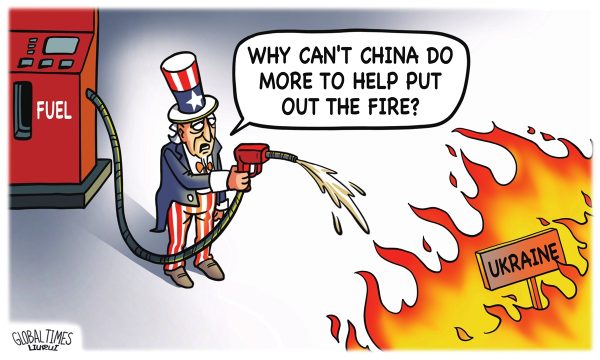
Illustration: Liu Rui/GT
Global Times | March 18, 2022
The close relationship between China and Russia has been a thorn in the US’ side, especially against the backdrop of the ongoing Ukraine crisis. With the simmering of the situation, it couldn’t be any clearer that Washington is eager to exploit the Russia-Ukraine conflict to drive a wedge between Beijing and Moscow.
For one thing, senior White House officials have on multiple occasions accused China of not exerting enough pressure on Russia to stop the country’s military action in Ukraine. US Secretary of State Antony Blinken said on Thursday before US President Joe Biden’s virtual meeting with Chinese President Xi Jinping that Washington will “impose costs” for any support Beijing provides to Russia’s actions against Ukraine. He urged Beijing to assume “responsibility to use its influence and defend the international rules and principles that it professes to support.” For another, an increasing number of Western media reports and analyses have emerged to hype how China’s ties with Russia have made China “uncomfortable” and “awkward” and warn that Beijing risks isolation if it doesn’t distance itself from Moscow.
NATO’s eastward expansion is the root cause of Russia’s anger and military operation in Ukraine. It’s the US that should put out the fire it lit in Ukraine. Ridiculously, it is demanding Beijing to do this job at the cost of damaging China-Russia relations. This is unreasonable and insidious. By pushing China to denounce Russia and asking China to bear the responsibility for the fatal strategic mistake the US and NATO made in the construction of so-called European security, Washington has no intention of hiding its desire to sow discord between China and Russia.
US State Department spokesperson Ned Price said on Monday that China could use its unique relationship to bring an end to Russia’s actions against Ukraine. What nonsense. Russia is an independent major power and China has no ability to exert influence on Russia’s decision on the Ukraine issue which it deems as a “life-and-death” matter.
If China really pressures Russia in a way that is inconsistent with the China-Russia comprehensive strategic partnership of coordination, it will only undermine the China-Russia relationship and sabotage mutual trust, which will be a huge strategic loss to both sides. This is what the US is eager and happy to see.
Washington knows that China cannot influence Russia or force it to do anything. But it has regarded the Ukraine crisis as a good chance to tear the two countries apart. The more discord Washington could sow between China and Russia, the more it will be in line with US interests. But how can Beijing and Moscow allow such an evil trick to succeed?
Not like the petty followers that Washington can manipulate at will, China and Russia are both independent great powers. Besides, China has maintained a consistent position over the Ukraine issue, emphasizing all sides’ security concerns and interests should be respected and upheld. Its position is out of its own interests and the interests of the region. It will never dance to the tune of the US or sacrifice relations with Russia to satisfy US demands.
It also should be noted that no matter how the Ukraine crisis evolves and how heavily Russia is targeted by the US now, Washington still views China as its biggest strategic competitor. China should bear this in mind all the time. It must not give the US any chance to drive a wedge in the China-Russia relationship.
For a long time, the West has misinterpreted the China-Russia relationship, believing it’s based on expediency and could be easily torn apart. The truth is, the China-Russia comprehensive strategic partnership of coordination has withstood the test of the time and is rock solid. It’s China’s most important and stable diplomatic strategic asset that cannot be damaged.
Mail Voting and Election Legitimacy
By Andrew E. Busch | Real Clear Politics | March 15, 2022
Although it had been a feature of elections in some parts of the United States for years, the phenomenon of mail-ballot voting exploded in the 2020 election. In the midst of the COVID pandemic, jurisdictions around the country expanded use of mail voting, sometimes sending ballots to every registered voter. Steps were taken to facilitate ease of mail voting, such as establishing drop boxes for returned ballots, relaxing rules regarding signature verification, and easing restrictions on “ballot harvesting,” the practice whereby paid political activists collect a large number of completed ballots and return them for counting. As a result, by some estimates, the proportion of ballots cast by mail nearly doubled from 2016 to 2020.
There is, of course, an ongoing debate over whether the turn to mail-ballot voting was necessary, given the pandemic circumstances, or a partisan maneuver to advance the prospects of Democrats, who seemed to reap most of the benefits electorally. Whether or not it was necessary, the development clearly contributed in two important ways to undermining confidence in the results – and is likely to continue doing so unless legislators and election officials take corrective measures.
First, mail-ballot voting is intrinsically less secure than in-person voting. Things might go awry at multiple points. The ballot might never be delivered, or it might be delivered to the wrong address, or to the right address but wrong person. Even if delivered into the right hands, it might ultimately be filled out by someone else or by the intended recipient under pressure; under these conditions, there is no guarantee that the secret ballot is preserved, a problem exacerbated by the activity of ballot harvesters. Once the ballot is completed, it can get lost in the mail, removed from a drop box, or otherwise compromised.
And this is without accounting for the potential for large-scale fraud. In 2020, an unnamed political operative in New Jersey described to the New York Post how he had developed and been using for years a system for replicating ballots and submitting them on behalf of his candidates. Despite the assurances of some that voter fraud is not an issue in the United States, a number of high-profile cases in the last quarter-century prove otherwise. Since 1997, mayoral elections in Miami and Paterson, New Jersey, as well as a congressional election in the Ninth District of North Carolina, have been vacated due to proven fraud. As John Fund and Hans von Spakovsky document in their 2021 book “Our Broken Elections,” these three cases are the tip of the iceberg. Indeed, Fund and von Spakovsky note, most cases of large-scale fraud in recent years have involved mail ballots.
There is a reason France no longer uses mail-in ballots in its elections, and why the 2005 commission led by Republican James Baker and Democrat Jimmy Carter identified mail ballots as the least secure mode of voting (though in 2020 Carter rather weakly tried to walk back that conclusion).
Nearly a year and a half after the 2020 elections, a special counsel has charged that substantial voter fraud took place in more than 90 of Wisconsin’s nursing homes, where it appears that nursing home staff or administrators requested ballots for invalid patients, then filled out and returned those ballots, possibly forging the patients’ signatures. A private study (separate from the controversial Arizona “audit”) alleges that 200,000 mail ballots in Maricopa County were counted despite mismatched signatures.
Overall, one does not need to accept former President Trump’s expansive claims of national voter fraud – indeed, one should not, without a great deal more evidence than he has yet offered – in order to recognize that mail-ballot voting is vulnerable to a number of problems that make it chronically less reliable than in-person voting. Moreover, perhaps as importantly, many voters recognize this fact, and as a result will consistently question the validity of close results in elections using large-scale mail balloting, at least if their candidate loses.
Second, because of significant disparities in the political makeup of the mail-ballot electorate and the Election Day in-person electorate (in states that are not 100% mail ballot), the reporting of election results can become distorted. In the 2020 general election, we witnessed both a much-expected “red mirage” and a lesser-noted “blue mirage.” In a few states such as Texas and Ohio, mail-ballot votes were counted and reported first, leading to initial Democratic leads that were gradually wiped out through the night as Election Day votes were added to the tallies. In most major states, the reverse happened. Election Day votes were counted first, followed by mail-ballot votes. The predicted “red mirage” came to pass as President Trump took early leads in Georgia, Michigan, Pennsylvania, and Wisconsin before surrendering them over the next few days as the mail ballots rolled in.
No one paid much attention to Texas and Ohio, which had their totals in relatively early, and in any case went the way they were expected to go. On the other hand, the “red mirage” states drew enormous scrutiny. They were already understood to be swing states that could go either way and would determine the election. Moreover, all had voted for Trump in 2016. Many Trump supporters went to bed on November 3 with their man seemingly headed to another surprise win, and found out on November 4 that it was slipping away in a process that was not completed for several days. That sensation, of having an election victory subsequently overridden, undoubtedly contributed to the willingness of many to embrace Trump’s “stolen election” narrative. That is an outcome we should hope to avoid in the future.
It is possible that the partisan makeup of mail-ballot versus Election Day voters depends on circumstances. In 2020, Democratic voters may have been more afraid of COVID and hence more likely to avoid voting lines, while Republican voters were urged by their president not to trust mail voting. Perhaps other circumstances will produce different tendencies. Unless both modes of voting are utilized equally by supporters of both candidates, the potential will exist that those who lose based on late-reporting mail results will wonder whether something nefarious happened.
The optimal solution would be to increase in-person early voting opportunities and the number of Election Day polling places, while strictly limiting mail voting to traditional absentee voting for reasons of illness, disability, or absence. However, many jurisdictions continue to be committed to widespread mail voting. It is a practice that is not going away anytime soon, so a key question is what can be done to reduce the damage that mail-ballot voting can do to confidence in electoral legitimacy.
The two problems outlined above – inadequate ballot security and delayed vote totals – require distinct measures.
The chief way to mitigate concerns around delayed vote totals is to enforce a strict Election Day deadline for the return of mail ballots and to require election officials to begin counting received mail ballots prior to Election Day. The other confidence-building measure would be to adopt Georgia’s new requirement that election officials must announce on Election Night the total number of votes received. This will prevent the perception that large batches of incoming votes are materializing out of thin air.
As for ballot security, some states have already taken steps that should be adopted more broadly. These include banning ballot harvesting and improving verification techniques (possibly using the last four digits of Social Security numbers instead of signatures). Not least, state and county election offices should take more seriously their obligation to keep their voter-registration rolls updated. If election officials want voters to be confident in the legitimacy of mail-ballot elections, they need to make sure that no household is getting five extra ballots for residents who haven’t lived there in years. Unfortunately, Democrats have widely condemned such measures as “voter suppression.”
None of these steps would prevent a nominally responsible eligible voter from casting a vote by mail, but they can help bolster confidence in our elections. If we have to learn to live with mail-ballot voting, we should be able – no, eager – to answer legitimate concerns rather than pretend that they don’t exist.
Russia’s U.S. Biowarfare Claims in Ukraine Need Serious Answers
Strategic Culture Foundation | March 18, 2022
The United States and Russia continued this week with furious sparring over the issue of biological laboratories in Ukraine. The U.S. accuses Russia of “disinformation” about the labs, saying that they were standard sanitary facilities studying common diseases and epidemiology. For its part, Russia claims that the laboratories were conducting far more sinister and illicit research into developing biowarfare weapons.
Surely, the quickest way to discern the relative validity of concerns is the following basic fact. The research facilities numbering up to 30 locations in Kiev, Kharkov, Kherson, Lvov, Odessa and Poltava, among other cities, were being funded by the Pentagon to the tune of hundreds of millions of dollars. The figure is estimated at $200 million and, it seems, the research has been going on for several years up until recently. If the laboratories were involved in benign disease investigations then why was the Pentagon the sponsor and liaison organization? Why not the U.S. Department of Health, or Center for Disease Control, instead of the Department of Defense? And why were the laboratories ordered to destroy their samples when Russia launched its military intervention in Ukraine – an intervention that Moscow claims is justified on the grounds of self-defense?
This week the Russian Ministry of Defense named the Pentagon’s liaison officer formerly at the U.S. embassy in Kiev who was responsible for the laboratory programs as Joanna Wintrol. It was suggested that American lawmakers should ask this person to give testimony on the purpose of the facilities.
The involvement of the Pentagon in the activities of dozens of laboratories across Ukraine is the most strident fact pointing to concerns that the research was being conducted for the nefarious purpose of developing biological weapons.
It is telling, too, that anyone who raises questions about the activity is immediately denounced as a Russian propagandist. They are vilified as trying to amplify Moscow’s justification for its military intervention into Ukraine that began on February 24. A diverse range of American public figures has called for a transparent investigation into concerns over U.S. bioweapons being developed in Ukraine. They include journalists like Tucker Carlson and Glenn Greenwald, former U.S. Marine intelligence officer Scott Ritter, former congresswoman Tulsi Gabbard, and professor of international law Frances Boyle.
Russia is endeavoring to have the matter raised at the UN Security Council despite American objections. China has also endorsed Russia’s concerns and calls for a full investigation. Given that China has previously raised questions about U.S. covert laboratory work on coronaviruses at Fort Detrick, Maryland, as possibly being responsible for releasing the Covid-19 coronavirus and the ensuing global pandemic it is understandable why Beijing is now taking a keener interest in the discovery of shadowy Pentagon laboratories in Ukraine. China has angrily rejected American attempts to smear it as the originator of the Covid-19 pandemic.
In any case, the matter of Pentagon-funded laboratories in Ukraine can’t simply be dismissed by arrogant assertions of innocence by Washington. After all the lies the U.S. has told about weapons of mass destruction in Iraq that were used for justifying a war that killed over one million Iraqis, the Americans have no credibility whatsoever. The irony here is that Russia went into Ukraine and seems to have actually found evidence of WMD unlike the Americans when they invaded Iraq in 2003.
The background to the present inquiry is that Russia has long expressed fears that the United States was engaged in biological warfare research at facilities set up in former Soviet republics. This concern over clandestine facilities has been shared by independent investigative journalists such as Dilyana Gaytandzhieva who has reported on U.S. bioweapon laboratories in Georgia among other places.
Officially, the United States has sought to deny all allegations of such illicit activities which would put it in gross violation of the Biological Warfare Convention (1983). The Pentagon has claimed that laboratories in Ukraine and elsewhere have been charged with securing Soviet-era bioweapons. But decades later, surely that explanation is wearing thin, if not altogether obsolete.
The issue flared up again – unintentionally – when Victoria Nuland, the U.S. Under Secretary of State with responsibility for Ukraine (responsibility in more ways than her formal title indicates) admitted to the Senate Foreign Relations Committee on March 8 that there were dangerous biological research laboratories in Ukraine funded by Washington. So dangerous, indeed, that Nuland openly expressed concern that Russian forces might come into their possession. To do what? Use them as weapons? Or, more realistically, be able to prove that the Pentagon was funding the development of bioweapons in Ukraine?
Some American media have gladly quoted a few Russian biologists who are dismissive of Moscow’s claims of U.S. bioweapons in Ukraine. They assert the strains of pathogens are not particularly dangerous. How they can be so insouciant is curious. The Russian military experts on biological weapons say the samples being experimented on in Ukrainian laboratories included pathogens causing a host of deadly diseases, ranging from brucellosis, diphtheria, dysentery, and leptospirosis. Pathogens being studied included anthrax and coronaviruses. Furthermore, the research also involved investigating animal to human transmission of these diseases, such as through bird migration paths specific to Russia. There is also evidence of local outbreaks of these diseases in recent years that are atypical for seasonal conditions.
The documents demonstrating Pentagon sponsorship of the Ukrainian laboratories are original and verifiable, according to Moscow. It has published some of the documents which appear to be genuine. Of course, with Western draconian censorship against Russian news outlets, it is harder for the international public interest to avail of relevant information.
Still, however, the case for an international investigation under the auspices of neutral biowarfare experts is one that is valid and urgent.
We have already seen the worldwide impact of the Covid-19 disease that erupted in late 2019. The last thing Europe and the world needs are a chain of potentially deadly bioweapons facilities in Ukraine that the Pentagon is desperate to cover up.
Many questions need answering seriously. It is contemptible to simply brush these questions aside as “Russian propaganda”. The U.S. has a long and vile history of using bioweapons dating back to killing native American populations with smallpox and later civilian populations in Central America and Cuba. Thus, the U.S. has forfeited any benefit of the doubt owing to its well-documented practices of bioterrorism; especially considering the conspicuous involvement of the Pentagon in Ukraine’s laboratories.
The issue also opens up the bigger picture of Russia’s demands for a security treaty in Europe and the end to NATO expansionism and decades of aggressive threatening. Right now the Western media is saturated with anti-Russian smears and Russophobia. Yet, this is precisely why the questions about the U.S., NATO, Pentagon, and their connections to Ukraine need to be focused on.
Russia has insisted on Ukraine and other former Soviet republics being excluded from the U.S.-led military bloc – for good reasons. The turning of Ukraine into a platform of hostility towards Russia since the CIA-backed coup in Kiev in 2014 is the essential background to why the current war has manifested in Ukraine. The apparent involvement of Pentagon biowarfare laboratories in Ukraine is one reason among several why Russia was compelled to take defensive action with its intervention in Ukraine.
If we are ever to restore peace, then we need to understand where the hostility comes from, how, and why.
US to remove IRGC from terror blacklist
BY M. K. BHADRAKUMAR | INDIAN PUNCHLINE | MARCH 19, 2022
Axios reported earlier this week citing Israeli officials and US sources that the Biden administration is considering the removal of Iran’s Islamic Revolutionary Guard Corps [IRGC] from its terror blacklist, in return for a ‘public commitment from Tehran to de-escalation in the region.’
It is improbable that Tehran will give any such ‘public commitment’. But, a ‘private commitment’? Well, that may be possible. Indeed, the Axios report acknowledged that ‘The IRGC designation is not directly related to the nuclear deal, and any decision would take the form of a separate bilateral understanding between the US and Iran.’
No doubt, the lifting of the US sanctions is incompatible with the ban on the IRGC. The IRGC is deeply incorporated into the country’s economy and business. According to some estimates, up to 60% of Iran’s economy — including both state and private companies — is controlled by individuals and entities linked to the IRGC.
And the IRGC is well represented in the organs of the state. Executing a nuclear deal at Vienna while excluding the IRGC elites from plucking its low-hanging fruits is simply unrealistic. Arguably, even Americans wouldn’t want that to happen.
It is entirely conceivable that they too are eagerly looking forward to doing business with the IRGC top brass. After all, it’s best to do business with those who matter most in Tehran.
On balance, therefore, the Biden administration will concede Iran’s demand to drop the designation of the IRGC as a terrorist organisation. The crux of the matter is that the US is desperate to normalise with Iran since they also see potential to erode Iran’s friendly ties with Russia. The immediate goal of the Biden administration is to release Iran’s oil reserves. The amount of Iranian oil that may enter the market once sanctions are lifted is estimated at over two million barrels a day!
That said, even a US-Iran ‘bilateral understanding’ over the activities of the IRGC is not easy to achieve. The IRGC functions directly under the Supreme Leader’s supervision. Clearly, while from the American side, it is rather a formality requiring an executive order by the state department to legitimise IRGC, from the Iranian part, there is an ‘operational angle’ to it — namely, a commitment to end Iran’s expansion in the so-called Shiite Crescent of Syria, Lebanon and Iraq.
That involves the jettisoning of Quds Force’s ‘resistance’ and settling for peaceful co-existence with Israel. Does that look simple?
But then, when it comes to Iran, nothing is simple, because nothing is iron-cast. Didn’t Iran help in the US invasion of Afghanistan and the creation of a puppet government in Kabul? Resistance politics too was the child of difficult times when the country was besieged. With the lifting of sanctions, Iran is unbound for the first time after the 1979 revolution.
To be sure, there is a growing uneasiness among regional states — and, possibly, even in Moscow — about Iran’s future trajectory. The Raisi government now proclaims a ‘balanced foreign policy’ — ‘neither with the West nor the East.’ The framing of the paradigm in this suggests that Tehran anticipates the world community to queue up on the road to Tehran.
Iran’s few steadfast friends in the region may begin to wonder what lies in the womb of time. Syrian President Assad’s visit to the UAE on Friday hints at realignments. Assad hopes to create more space for himself by rejoining the Arab family. Now, he has never been an acolyte of ‘resistance’ and is well aware that the UAE is Israel’s closest regional ally in West Asia.
The bottom line is that Iran will certainly seek integration with the industrial world, which will help it get the best that money can buy in technology or goods and services. But Iran also harbours ambitions that it will not be a junior partner of the West.
This is going to be a trapeze act. Integration into the world economy will require the freeing of market forces, which, in turn, carries attendant risks, as the pent-up social and economic discontent within the country seeks political expression and the genie gets out of the bottle. Colour revolution can take many forms, as current history shows. When George Soros and company move in, nothing is impossible!
Iran, of course, will be in doubts about the US’ intentions, too. Presently, Washington needs an accommodation with Iran devolving upon its capacity to pump more oil. But the US’ male-fide intentions are yet to be exorcised. And the crimes it has committed to the Iranian nation are no secret, either.
Above all, there is never any consistency in the US policies. Its self-interests come first and last. Iran doesn’t have to look far to see in the next-door Gulf region the debris of the US’ discarded Arab alliances once their purpose was served.
Issues and Insights criticize Google censorship
Demonetized
By Christina Maas | Reclaim The Net | March 17, 2022
Market analysis website Issues & Insights has criticized Google for flagging one of its articles. The site suggested that the article was censored for violating the policy on election integrity.
In a blog post reporting the censorship, I&I said that the article that was censored was a poll, where respondents were asked about the 2024 presidential election.
“This new article wasn’t about climate change. It wasn’t about COVID. It also wasn’t about election fraud. It wasn’t about the Jan. 6 riots. It wasn’t about anything controversial,” I&I reported. “It was an article about the results of our own monthly I&I/TIPP poll, which asked registered voters ‘who do you want to see run for president in 2024.’”
I&I claims it received an email from Google’s AdSense that one of its articles was in violation of terms of service. The email warned that there would be no ads on the article until I&I fixed the violation. The email claimed that the article was flagged for “unreliable and harmful information.”
In the blog post, I&I insisted that it had not violated any of Google’s policies and, considering its appeal was rejected, the censorship was not a mistake.

The website theorized that the article was flagged for violating the policy against content that “could significantly undermine participation or trust in an electoral or democratic process.”
I&I concluded that “Google is now attacking content for no other reason than that it doesn’t like the facts being reported.”
“You’ve just taken another step towards acting like a totalitarian dictator. Remind us again of what that motto was you used to parade around. Be evil? Be like Stalin? Help us out here,” I&I wrote.
483 More Deaths After COVID Vaccines Reported to VAERS, as Pfizer and Moderna Push for More Boosters
By Megan Redshaw | The Defender | March 18, 2022
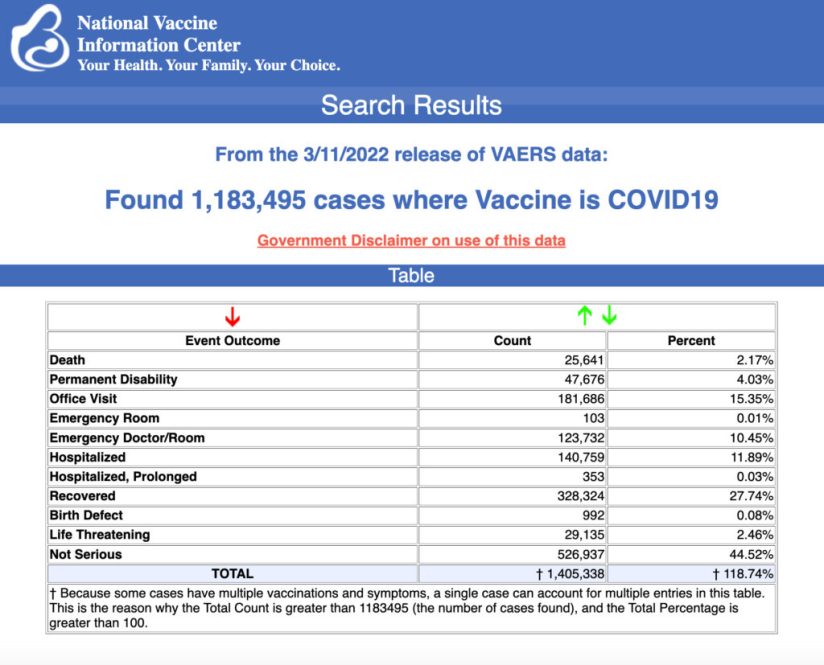
The Centers for Disease Control and Prevention (CDC) today released new data showing a total of 1,183,495 reports of adverse events following COVID-19 vaccines were submitted between Dec. 14, 2020, and March 11, 2022, to the Vaccine Adverse Event Reporting System (VAERS). VAERS is the primary government-funded system for reporting adverse vaccine reactions in the U.S.
The data included a total of 25,641 reports of deaths — an increase of 483 over the previous week — and 208,209 reports of serious injuries, including deaths, during the same time period — up 4,321 compared with the previous week.
Excluding “foreign reports” to VAERS, 788,624 adverse events, including 11,728 deaths and 76,231 serious injuries, were reported in the U.S. between Dec. 14, 2020, and March 11, 2022.
Foreign reports are reports foreign subsidiaries send to U.S. vaccine manufacturers. Under U.S. Food and Drug Administration (FDA) regulations, if a manufacturer is notified of a foreign case report that describes an event that is both serious and does not appear on the product’s labeling, the manufacturer is required to submit the report to VAERS.
Of the 11,728 U.S. deaths reported as of March 11, 17% occurred within 24 hours of vaccination, 22% occurred within 48 hours of vaccination and 60% occurred in people who experienced an onset of symptoms within 48 hours of being vaccinated.
In the U.S., 556 million COVID vaccine doses had been administered as of March 11, including 328 million doses of Pfizer, 209 million doses of Moderna and 19 million doses of Johnson & Johnson (J&J).
Every Friday, VAERS publishes vaccine injury reports received as of a specified date. Reports submitted to VAERS require further investigation before a causal relationship can be confirmed.
Historically, VAERS has been shown to report only 1% of actual vaccine adverse events.
U.S. VAERS data from Dec. 14, 2020, to March 11, 2022, for 5- to 11-year-olds show:
- 9,161 adverse events, including 217 rated as serious and 5 reported deaths.
The most recent death involves a 7-year-old boy (VAERS I.D. 2152560) from Washington who died 13 days after receiving his first dose of Pfizer’s COVID vaccine when he went into shock and suffered cardiac arrest. He was unable to be resuscitated and died in the emergency department.
- 17 reports of myocarditis and pericarditis (heart inflammation).
The CDC uses a narrowed case definition of “myocarditis,” which excludes cases of cardiac arrest, ischemic strokes and deaths due to heart problems that occur before one has the chance to go to the emergency department.
- 34 reports of blood clotting disorders.
U.S. VAERS data from Dec. 14, 2020, to March 11, 2022, for 12- to 17-year-olds show:
- 30,295 adverse events, including 1,744 rated as serious and 42 reported deaths.
The most recent deaths involve a 17-year-old boy (VAERS I.D. 2171083) from Illinois with Duchenne muscular dystrophy who died from cardiac arrest after receiving his second dose of Pfizer’s COVID vaccine, and 14-year-old boy from Guam (VAERS I.D. 2157944) who died one week after his first dose of Pfizer when he suddenly committed suicide.
The boy’s VAERS report states:
“Sudden suicide one week after the vaccine. Patient was a perfectly happy child. After the vaccine, he became much more tired and achy and lost interest in doing his sports. One week later, without any warning, he hung himself.”
- 68 reports of anaphylaxis among 12- to 17-year-olds where the reaction was life-threatening, required treatment or resulted in death — with 96% of cases attributed to Pfizer’s vaccine.
- 646 reports of myocarditis and pericarditis, with 634 cases attributed to Pfizer’s vaccine.
- 162 reports of blood clotting disorders, with all cases attributed to Pfizer.
U.S. VAERS data from Dec. 14, 2020, to March 11, 2022, for all age groups combined, show:
- 20% of deaths were related to cardiac disorders.
- 54% of those who died were male, 41% were female and the remaining death reports did not include the gender of the deceased.
- The average age of death was 72.7.
- As of March 11, 5,250 pregnant women reported adverse events related to COVID vaccines, including 1,668 reports of miscarriage or premature birth.
- Of the 3,613 cases of Bell’s Palsy reported, 51% were attributed to Pfizer vaccinations, 40% to Moderna and 8% to J&J.
- 863 reports of Guillain-Barré syndrome, with 41% of cases attributed to Pfizer, 30% to Moderna and 28% to J&J.
- 2,363 reports of anaphylaxis where the reaction was life-threatening, required treatment or resulted in death.
- 1,683 reports of myocardial infarction.
- 13,512 reports of blood-clotting disorders in the U.S. Of those, 6,034 reports were attributed to Pfizer, 4,818 reports to Moderna and 2,617 reports to J&J.
- 4,045 cases of myocarditis and pericarditis with 2,483 cases attributed to Pfizer, 1,377 cases to Moderna and 175 cases to J&J’s COVID vaccine.
Moderna asks FDA to authorize 4th dose for adults 18 and up
Moderna on Thursday asked the FDA to amend Emergency Use Authorization (EUA) of its COVID vaccine to include a fourth dose for adults 18 and older.
According to The Associated Press, the request is broader than Pfizer’s. Pfizer earlier this week asked the agency to authorize a fourth dose of its COVID vaccine for adults 65 and older.
In a press release, Moderna said the request to include adults over 18 was made “to provide flexibility for the U.S. Centers for Disease Control and Prevention and healthcare providers to determine the appropriate use of an additional booster dose of mRNA-1273, including for those at higher risk of COVID-19 due to age or comorbidities.”
Moderna said its decision to seek FDA approval was based on studies from the U.S. and Israel about the Omicron variant, but didn’t provide further information. Booster doses of Moderna are half the dose of the first and second doses.
Pfizer and BioNTech ask FDA to authorize fourth vaccine dose for older adults
Pfizer and BioNTech on Tuesday said they submitted a request to the FDA for EUA of an additional booster dose of their COVID vaccine for adults 65 and older.
The companies’ request was not based on robust, peer-reviewed U.S. data, but on two recent studies from Israel — both published on preprint servers without peer review.
The first study was done in conjunction with Israel’s Ministry of Health and involved a review of 1.1 million health records. The study concluded rates of COVID in those who received a fourth dose of Pfizer’s COVID vaccine were lower compared to those who received only three doses.
According to the preprint published on medRxiv, since Jan. 2 Israel has been administering a fourth dose of the Pfizer vaccine only to people over 60 and at-risk populations.
In the second study of Israeli healthcare workers, results showed a fourth dose of either Pfizer’s or Moderna’s vaccine boosted antibody levels, but neither was effective at preventing infections.
CDC deletes thousands of reported COVID-19 deaths in children
The CDC removed tens of thousands of deaths linked to COVID, including nearly a quarter of deaths it had attributed to those younger than 18, The Epoch Times reported. The change was made on March 15 on its COVID data tracker website.
“Data on deaths were adjusted after resolving a coding logic error. This resulted in decreased death counts across all demographic categories,” the CDC said on the website. The agency also acknowledged COVID death data is not complete.
Before the change, the CDC listed 1,755 deaths in children from COVID, along with 851,000 others, according to Kelley Krohnert, a Georgia resident who tracks the CDC’s updates.
The CDC removed 416 deaths among children and more than 71,000 other reported deaths — arriving at a total of about 780,000.
The CDC’s statistics are frequently cited by physicians and experts when pushing for children to receive COVID vaccines. Dr. Rochelle Walensky, the CDC’s director, referred to the tracker’s death total on November 2021 while pushing for an expert panel to advise her agency to recommend vaccination for all children 5 to 11 years old.
Vaccine researcher develops tinnitus 90 minutes after COVID shot, calls for more research
A vaccinologist at the Mayo Clinic in Minnesota said he developed tinnitus after receiving his second dose of an mRNA COVID vaccine.
Dr. Gregory Poland’s symptoms began 90 minutes after receiving the vaccine. He described the condition as “fairly severe” and “extraordinarily bothersome, interfering with sleep and the ability to concentrate.”
According to the National Institutes of Health, tinnitus is a sign that something is wrong with the auditory system. It is commonly described as a ringing in the ears, but it also can sound like roaring, clicking, hissing, or buzzing that accompanies soft, loud or high pitches.
According to the most recent VAERS data released on March 11, 19,851 people have reported developing tinnitus after a COVID vaccine, with 12,027 cases attributed to Pfizer’s COVID vaccine.
CEO of German health insurer fired after releasing data on underreported COVID vaccine injuries
The CEO of one of Germany’s largest health insurance companies was abruptly fired last month after he released data suggesting German health authorities are significantly underreporting COVID-19 vaccine injuries.
The data, released by Andreas Schofbeck of BKK/ProVita, have since been scrubbed from the company’s website.
Schofbeck, who noticed an unexpected jump in vaccine-related health insurance claims, in February notified the Paul Ehrlich Institute (PEI) — the German equivalent of the CDC — that BKK billing data indicated the PEI was underreporting adverse events to COVID vaccines.
In his letter to the PEI, Schofbeck wrote:
I’m “If these figures are extrapolated to the whole year and to the population in Germany, probably 2.5-3 million people in Germany have received medical treatment for vaccination side effects after Corona vaccination.”
Dr. Dirk Heinrich, chairman of NAV-Virchow Bund, an association of private medical practitioners in Germany, said PEI and BKK would be working closely to examine the billing code data. Heinrich also stated that the conclusions from Schofbeck’s letter are “complete nonsense.”
Children’s Health Defense asks anyone who has experienced an adverse reaction, to any vaccine, to file a report following these three steps.
Megan Redshaw is a freelance reporter for The Defender. She has a background in political science, a law degree and extensive training in natural health.
© 2022 Children’s Health Defense, Inc. This work is reproduced and distributed with the permission of Children’s Health Defense, Inc. Want to learn more from Children’s Health Defense? Sign up for free news and updates from Robert F. Kennedy, Jr. and the Children’s Health Defense. Your donation will help to support us in our efforts.
CDC reports of historical covid deaths drop by 70k to correct “coding error”
this data is still badly wrong, but i have some real concerns about who we are allowing to “fix” it and how unsupervised they will be as they do so
el gato malo – bad cattitude – march 18, 2022
of all the insanity around covid that took what would literally have been a baddish flu year would have passed with little comment or historical import and turned it into a mass hallucination of apocalypse, defining “covid death” as a death not “from covid as a proximate cause” but rather as “death from any cause if you had had a positive PCR test for covid in the previous 28-30 days” carries a special pride of place.
many of us stood up and screamed about this right from the beginning.
it made zero sense. nothing else is counted this way (for a reason) and the confluence of doing so with the staggeringly unprecedented mass testing of healthy people with overclocked PCR tests run at a 40 or higher Ct that was so over-amplified that it lacked any clinical relevance whatsoever and was probably kicking out 70-90% rates of non-clinical positivity was madness.
once this disastrous definition was put in place, apocalypse was assured.
but “the experts” ran with it, defended it, and treated as unarguable truth that “800k+ americans died from covid.” but they didn’t. it was not even close.
and now that the panic they drove has ended and further deaths are “inconvenient” they are starting to walk it back over what they claim was a “coding error.”
these charts are telling.
the one on the left is from BEFORE the one on the right.
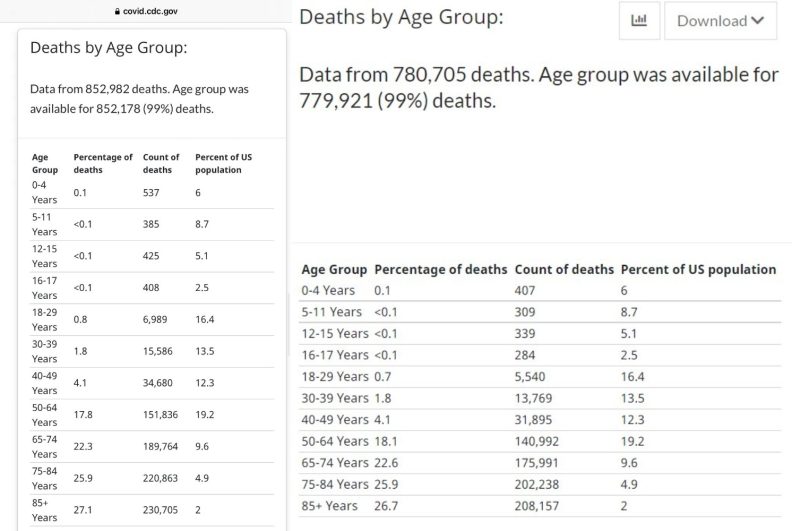
historical deaths dropped 72k.
huh.

it’s a start, but this is still a glaring, whopping overstatement.
now do “died from, not merely in proximity to a positive PCR sample for” covid and let’s see what happens.
my bet is that you drop the count by another ~70%.
here’s some fun math:
the average person probably has (to be conservative) 2 episodes a year in which they would, at a 40 Ct, test positive for the common cold. this does not mean you were sick, felt sick, were contagious, or any of that. it just means “you had enough viral genetic material in your mucus that someone using 1 trillion X amplification on it before looking for it could find it.”
let’s say these periods last 3 days and if you die in the 28 days following, this gets called a “common cold death” just as we did for covid.
this gives you something on the order of 62 days a year when getting hit by a car would still get counted as “cold death” just as in covid.
that’s ~17% of the year. (and these times will tend to overlap with peak winter seasons when more people die anyhow, but let’s ignore that.)
- about 2.9 million people die in the US annually.
- 17% of 2.9 million is 493,000.
starting to see the problem?
adjust this for higher rates of positive viral tests for the old and infirm who are also more likely to die and this really blows out.
- 53% of US covid deaths were in the 6.9% of population over 75 years old and 75% were in over 65s’.
- only about 8% of deaths were in the 39% of the population under 30.
the number of people who “tested positive for covid” was likely overstated by 70-90% when considering who had actual clinical covid and was sick/contagious.
even the NYT figured this out.

and yet the folks at CDC have not, until recently, even tried to address this. this will have had a proportional effect on reported “covid deaths.”
and now they are seeking to erase them and claiming “coding.”
and i do not trust this one whit.
the CDC have not been straight with us from the beginning and have been pushing definitions they knew to be wrong and studies on interventions, especially masking, that were clear, undeniable fraud.
and i fear we are in for more of the same because the CDC are completely, hopelessly politicized and compromised and their federal paymasters need to ensure that 2 things happen:
- that non-pharmaceutical interventions look like they worked
- that the vaccines they pushed so hard and got so wrong worked
and neither is true.
but i doubt that they will let that stop them. i have spoken many times about how the epidemiology grift is just the climate grift played at 50X fast forward.
many of the tactics and praxis of running and manipulating the scare to grab for cash, prominence and power have been the same and i expect this to remain so. it’s the same playbook.
so let me show you a trick play that has been all too common in climate and that i suspect we’re about to see run here:
when the data goes against you, change the data.
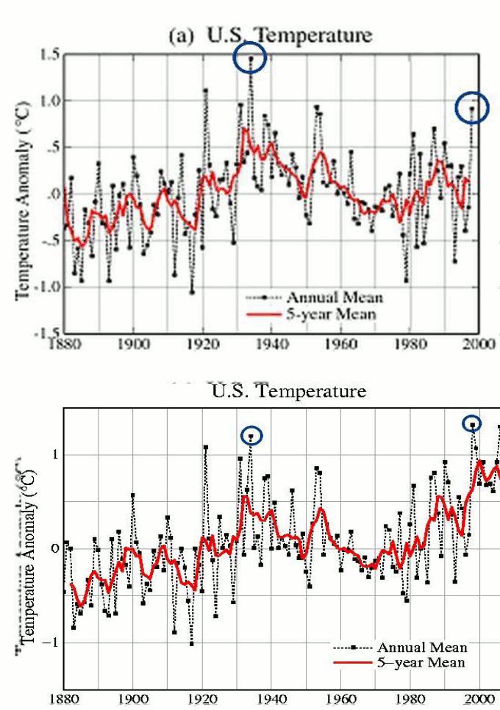
in climate, this has gone on for decades. they literally go back and change the past, cooling the warm periods of the 1930’s and adjusting current temperatures up. bingo, bango, instant warming trend and “unprecedented highs.”
this wonderful gif from steven goddard makes the process clear. and this was LONG before the east anglia “climategate” scandal and the 100 other times they have been caught adulterating data. it’s rife to the point that you pretty much cannot trust anything in the space. i found this so hard to believe i actually once went and checked the paper records myself to comp them to those in the databases. it’s true. they literally inverted the slope of the curve from the 1930’s to 2000 by fiddling the data.
and if you think they will not play this game on covid, i must sincerely ask you: “what movie have you been watching for the last 2 years?”
the fix is about to be in. “adjustments” are going to be applied selectively to make masks look like they worked and vaccines look like they reduced overall societal hospitalization and deaths from covid.
the US data is about to be turned into propaganda.
will this spread globally? who knows? it certainly did in climate. i don’t think this crowd is any nobler and the incentives are the same.
the same people who overstated this situation so aggressively are going to be the ones “fixing” the data to make sure it’s correct.
the same people who pushed and mandated draconian responses that have failed so spectacularly are going to be the ones “adjusting” the data that allows us to assess those outcomes.
we’re already caught them lying who knows how many times.
it is not a conspiracy theory to expect them to lie again.
it is a conspiracy theory to claim they’ll be honest this time.
i recommend grabbing all the data you can now and storing it. the presumption it will be available in unaltered form in the future may not be a good one.
honestly, tracking the changes to the dataset may be the only way to see if the CDC is playing it straight and they look to be disappearing past references already.
this is probably a worthwhile project for some of the datahawks.
AUKUS to bolster combat capabilities of nuclear submarine fleet to challenge China

By Paul Antonopoulos | March 18, 2022
Australia will become the second home for US and British nuclear submarines, meaning that the island country will effectively become a nuclear staging ground aimed at challenging China in the Asia-Pacific region. In this way, AUKUS – a trilateral security pact between Australia, the United Kingdom, and the United States, provokes increased confrontation with China.
Australian Prime Minister Scott Morrison announced on March 15 that the Anglo Alliance’s nuclear ships would initially be stationed in the sparsely populated state of Western Australia. However, he added that infrastructure on the east coast is “incredibly important for how we defend our nation.” Morrison explained that a site for a new base would be decided after the upcoming federal elections to be held on or before May 21. It is noted that although the eastern states account for 37% of the country’s total land area, they are home to over 80% of the population as well as Australia’s most important cities – Sydney, Melbourne, Canberra and Brisbane.
Earlier this week, in a virtual speech at the Lowy Institute, the Prime Minister announced his decision to build a new base in the east to support the deployment of Australia’s future nuclear submarine fleet under an agreement signed within the framework of the AUKUS military alliance. Three locations for the new eastern base are under consideration – Brisbane in the northeast state of Queensland, and Newcastle and Port Kembla to the north and south of Sydney respectively.
“The ability of US and UK nuclear-powered submarines to be here on the west coast, and ultimately we’d like to see them on the east coast as well, is all part of what our plan is as we continue to push forward our AUKUS partnership,” the Australian Prime Minister said.
In this way, the US and UK are using Australia as a junior partner to bolster the combat capabilities of the bloc’s nuclear submarine fleet in the Indian and South Pacific as confrontation with Russia and China escalates. With nuclear warships based in Australia, it greatly enhances the abilities of the US and British naval fleets to perform operations far off from home. However, it is likely not just about submarines, and we can maybe expect American and British aircraft carriers to also appear in Australia.
In general, for a long time, Australia banned nuclear vessels from entering its base.
For the goal of containing China in Asia-Pacific, Australia has now become critical for the US and UK. For example, a US aircraft carrier after 5-7 days of conflict with a potential enemy needs to replenish ammunition for aircraft on the carrier, while repairs and additional fuel for the aircraft are usually carried out in port. Australia can now fill this gap since quite obviously British and American ships operating in and around Southeast Asia are far from home.
This elevated importance given to Australia by Britain and the US has already resulted in greater military confrontation with China, with the East Asian country complaining that an Australian surveillance aircraft was flying in a “malicious” and “unprofessional” fashion close to its warships when the plane was targeted by a laser weapon.
Although China was accused of putting lives at risk by the Australian government in February when a laser was directed towards a RAAF P-8 Poseidon plane monitoring two People’s Liberation Army-Navy (PLA-N) warships sailing through the Arafura Sea, the Chinese Ministry of National Defence released a short video clip recorded on a warship, showing the Australian aircraft flying close by in a “nuisance” manner.
“It is evident in the video taken by the Chinese naval ship that the Australian military aircraft was conducting close-in reconnaissance on Chinese naval vessels,” Senior Colonel Tan Kefei said. “The Australian military aircraft’s conduct was malicious in intention and unprofessional in operation and posed threats to the safety of ships, aircraft and personnel of both sides.”
With Chinese and Australian militaries already skirmishing in such a manner, the entry of US and British nuclear submarines into Australian ports will only further destabilize the situation. It is recalled that Australia’s decision to equip its fleet with nuclear submarines under AUKUS was met with mistrust across the region, especially from Southeast Asian partners like Malaysia and Indonesia.
Now, it has been reported that Australia is actually becoming a “second home” for US and UK nuclear submarines. In the context of growing confrontations between the US and China, including the Taiwan issue, AUKUS in fact raises tensions in the region by encouraging the increasing nuclearization of the region.
Paul Antonopoulos is an independent geopolitical analyst.
Featured Video

Trump asks Iran not to retaliate after he strikes Pickaxe Mountain
or go to
Aletho News Archives – Video-Images
Book Review
‘Why Fauci Must Rot in Prison’: A Tale of Two Diaries
By Jill Erzen | The Defender | October 13, 2026
Dr. Anthony Fauci’s private diary reveals a “mind-numbing” contradiction between what the former top U.S. infectious disease official knew about COVID-19 and what he told the public, senior White House adviser Peter Navarro, Ph.D., said last week on “American Thought Leaders.”
In his new book, “Why Fauci Must Rot in Prison,” due out Oct. 20, Navarro compares Fauci’s private entries to his own pandemic-era diary, and uses what he calls “a tale of two diaries” to argue that Fauci should face criminal prosecution.
“I show, actually, how a prosecution can and should happen … at the state level, most likely,” Navarro said. “He should wind up in prison, and we’ve got the receipts in this book to put him there.”
Navarro said Fauci repeatedly acknowledged important facts in private, then publicly pursued policies that contradicted those facts — with devastating consequences.
“What he says many times privately in his diary is so at odds with both his public behavior and public statements that it’s mind-numbing,” Navarro said.
Navarro examines the lasting damage caused by lockdowns and other pandemic policies, and the ongoing toll of long COVID.
His book also addresses questions about vaccine safety, including why healthy young people faced COVID-19 vaccination mandates despite concerns about myocarditis, and why women were not warned about miscarriage risks linked to the shots. … continue
Blog Roll
 Aletho News
- Trump asks Iran not to retaliate after he strikes Pickaxe Mountain – w/ Prof. Marandi
- Vice President J.D. Vance’s Deceptive ‘Antiwar’ Campaign Speech
- Iran: Palestinians’ rights must not be compromised in Gaza’s future; US, Israel to blame for Hormuz situation
- Ongoing tales of Syrian chemical weapons
- Moscow blasts UN for ignoring torture of Russian POWs
- Millions of Books Could Have Been Destroyed in Lebanon During Israeli Bombings
- Moscow warns of ‘hunt for Russians’
- Calling of an Angel: The True Story of Rene Caisse and an Indian Herbal Medicine Called Essiac (1988)
- South Korean Assistance to the U.S. in the War with Iran: Between Allied Duty and National Interests
- Pharma- and Gates-Funded GAVI Seeks to Assure Parents
- If Americans Knew
- Israeli soldiers debunk Israel’s talking points
- In West Bank, Israeli settlers are totally out of control – Daily Update
- NPR investigation finds evidence of widespread fraud at mall kiosks tied to Israeli skincare brand
- Tucker Carlson exposes Israeli Lies about the Oct 7th attack, Charlie Kirk, and the U.S.
- Israel has detained thousands of Palestinian children since Oct 7th – over half spent time in solitary, many uncharged
- Israeli Analysis: Is Netanyahu Planning an ‘October Surprise’ Attack Before Israel’s Election?
- Israeli settlers brutally attack Palestinians and Washington Post female photographer, 65
- Words Have Changed, Occupation Continues: The Reality of the Gaza Ceasefire
- Gaza’s child amputees are growing faster than their prosthetics allow
- Israel keeps Palestinians struggling just to survive–Daily Update
- No Tricks Zone
- New Study Suggests Large Regions Of The Pacific Ocean Have Been Cooling For The Last 80 Years
- Germany’s Green Energy Debacle: High Energy Costs Force Kahla Porzellan to Close After 182 Years!
- New Study: 50 Years Of The Most Aggressive ‘Net Zero’ Policies Can Only Affect The Global Climate By 0.03°C
- US September “Heat” Was No Record…Many Records Set Decades Ago
- Latest European Green Energy Debacle; Portugal’s Largest Flagship Solar Park Insolvent!
- Green Energy Debacle: German Expert Professor Fritz Vahrenholt Warns Of Severe Economic And Social Consequences
- Two More Paleo Reconstructions Affirm Meters-Higher Sea Levels Across Ireland, Brazil 7000-6000 Years Ago
- New Study: Earth And Venus Surface Warmth Largely Explained By Convection And Lapse Rate, Not CO2 Or Radiation
- 2025 Nature Paper Claiming Worsening Global Drought Gets RETRACTED …Heavily Flawed
- New Study: ‘Global Drought Shows No Detectable Recent Acceleration Under Climate Warming’

