Creating New Enemies
BY PHILIP GIRALDI • UNZ REVIEW • MARCH 1, 2022
It should come as no surprise that many observers, from various political perspectives, are beginning to note that there is something seriously disconnected in the fumbling foreign policy of the United States. The evacuation failure in Afghanistan shattered the already waning self-confidence of the American political elite and the continuing on-again off-again negotiations that were by design intended to go nowhere with Iran and Russia provide no evidence that anyone in the White House is really focused on protecting American interests. Now we have an actual shooting war in Ukraine as a result, a conflict that might easily escalate if Washington continues to send the wrong signals to Moscow.
To cite only one example of how outside influences distort policy, in a phone call on February 9th, Israeli Prime Minister Naftali Bennett advised President Joe Biden not to enter into any non-proliferation agreement with Iran. Biden was non-committal even though it is an actual American interest to come to an agreement, but instead he indicated that as far as the US is concerned, Israel could exercise “freedom of action” when dealing with the Iranians. With that concession has ended in all probability the only possible diplomatic success that the Administration might have been able to point to.
The Biden Administration’s by default global security policy is currently reduced to what some critics have described as “encirclement and containment.” That is why an overstretched US military is being tasked with creating ever more bases worldwide in an effort to counter perceived “enemies” who often are only exercising their own national sovereignty and right to security within their own zones of influence. Ironically, when nations balk at submitting to Washington’s control, they are frequently described as “aggressors” and “anti-democratic,” the language that has most particularly been used relating to Russia. The Biden policy, such as it actually exists, appears to be a throwback to the playing field in 1991-2 when the Soviet empire collapsed. It is all about maintaining the old American dream of complete global dominance coupled with liberal interventionism, but this time around the US lacks both the resources and the national will to continue in the effort. Hopefully the White House will understand that to do nothing is better than to make empty threats.
Meanwhile, as the situation continues to erode, it is becoming more and more obvious that the twin crises that have been developing over Ukraine and Taiwan are “Made in Washington” and are somewhat inexplicable as the US does not have a compelling national interest that would justify threats to “leave on the table” military options as a possible response. The Administration has yet again responded to Russian moves by initiating devastating sanctions. But Russia also has unconventional weapons in its arsenal. It can, for starters, shift focus away from Ukraine by intervening much more actively in support of Syria and Iran in the Middle East, disrupting feeble American attempts to manage that region to benefit Israel.
According to economists, Russia has also been effectively sanction-proofing its economy and is capable of selective reverse-sanctioning of countries that support an American initiative with any enthusiasm. Such a response would likely hurt the Europeans much more than it would damage the leadership in the Kremlin. Barring Russian gas from Europe by shutting down Nord Stream 2 would, for example, permit increased sales to China and elsewhere in Asia and would inflict more pain on the Europeans than on Moscow. Shipping US supplied liquid gas to Europe would, for example, cost more than twice the going rate being offered by the Kremlin and would also be less reliable. The European NATO members are clearly nervous and not fully behind the US agenda on Ukraine, largely because there is the legitimate concern that any and possibly all options being considered by Washington could easily produce missteps that would escalate into a nuclear exchange that would be catastrophic for all parties involved.
Apart from the real immediate danger to be derived from the fighting currently taking place in Ukraine, the real long-term damage is strategic. The Joe Biden Administration has adroitly maneuvered itself into a corner while America’s two principal adversaries Russia and China have drawn closer together to form something like a defensive as well as economic relationship that will be dedicated to reducing and eventually eliminating Washington’s assumed role as the global hegemon and rules enforcer.
In a recent article in the New Yorker foreign affairs commentator Robin Wright, who might reasonably described as a “hawk,” declares the new development to be “Russia and China Unveil[ing] a Pact Against America and the West.” And she is not alone in ringing the alarm bell, with former Donald Trump National Security Council (NSC) Russia watcher Fiona Hill warning that the Kremlin’s intention is to force the United States out of Europe while former NSC Ukrainian expert Alexander Vindman is advising that military force be used to deter Russia now before it is too late.
Wright provides the most serious analysis of the new developments. She argues that “Vladimir Putin and Xi Jinping, the two most powerful autocrats, challenge the current political and military order.” She describes how, in a meeting between the two leaders before the Beijing Olympics, they cited an “agreement that also challenges the United States as a global power, NATO as a cornerstone of international security, and liberal democracy as a model for the world.” They pledged that there would be “No ‘forbidden’ areas of cooperation” and a written statement that was subsequently produced declared that “Russia and China stand against attempts by external forces to undermine security and stability in their common adjacent regions, intend to counter interference by outside forces in the internal affairs of sovereign countries under any pretext, oppose color revolutions, and will increase cooperation.” Wright notes that there is considerable strength behind the agreement, “As two nuclear-armed countries that span Europe and Asia, the more muscular alignment between Russia and China could be a game changer militarily and diplomatically.” One might add that China now has the world’s largest economy and Russia has a highly developed military deploying new hypersonic missiles that would give it the advantage in any conflict with NATO and the US. Both Russia and China, if attacked, would also benefit because they would be fighting close to their bases on interior lines.
And, of course, not everyone agrees that nudging the United States out of its self-proclaimed hegemonic role would be a bad thing. Former British diplomat Alastair Crooke argues that there will be a perpetual state of crisis in the international order until a new system emerges from the status quo that ended the Cold War, and it would be minus the United States as the semi-official transnational rules maker and arbiter. He observes that “The crux of Russia’s complaints about its eroding security have little to do with Ukraine per se but are rooted in the Washington hawks’ obsession with Russia, and their desire to cut Putin (and Russia) down to size – an aim which has been the hallmark of US policy since the Yeltsin years. The Victoria Nuland clique could never accept Russia rising to become a significant power in Europe – possibly eclipsing the US control over Europe.”
What is happening in Europe and Asia should all come down to a very simple realization about the limits of power: America has no business in risking a nuclear war with Russia over Ukraine or with China over Taiwan. The United States has been fighting much of the world for over two decades, impoverishing itself and killing millions in avoidable wars starting with Iraq and Afghanistan. The US government is cynically exploiting memories of old Cold War enemy Russia to create a false narrative that goes something like this: “If we don’t stop them over there, they will be in New Jersey next week.” It is all nonsense. And besides, who made the US the sole arbiter of international relations? It is past time Americans started asking what kind of international order is it that lets the United States determine what other nations can and cannot do.
Worst of all, the bloodshed in Ukraine has all been unnecessary. A little real diplomacy with honest negotiators weighing up real interests could easily have come to acceptable solutions for all parties involved. It is indeed ironic that the burning desire to go to war with Russia demonstrated in the New York Times and Washington Post as well as on Capitol Hill has in fact created a real formidable enemy, tying Russia and China together in an alliance due to their frustration at dealing with a Biden Administration that never seems to know what it is doing or where it wants to go.
Philip M. Giraldi, Ph.D., is Executive Director of the Council for the National Interest, a 501(c)3 tax deductible educational foundation (Federal ID Number #52-1739023) that seeks a more interests-based U.S. foreign policy in the Middle East. Website is councilforthenationalinterest.org, address is P.O. Box 2157, Purcellville VA 20134 and its email is inform@cnionline.org.
Lavrov: US Nuclear Weapons in Europe are Unacceptable for Russia, Time to Return Them Home
Sputnik – 01.03.2022
Russian Foreign Minister Sergei Lavrov has declared that the presence of US nuclear weapons in Europe is simply unacceptable for Moscow.
In the current situation, Lavrov argued, it is important to prevent a new round of the arms race, and said that Russia calls upon the United States and its allies to join a moratorium on the deployment of short- and intermediate-range missiles in Europe.
“It is unacceptable for us that, contrary to the fundamental principles of the Non-Proliferation Treaty, US nuclear weapons are still present on the territory of some European countries,” he said while addressing the Conference on Disarmament in Geneva via a video call.
Lavrov also criticised the practice of the so called “joint nuclear missions” that involve non-nuclear NATO members, and which he said include scenarios where nuclear weapons are used against Russia.
“It is high time the US nuclear weapons are returned home, and the infrastructure in Europe related to them completely dismantled,” he said.
Lavrov also warned that Russia is doing everything it can to prevent Ukraine from acquiring nuclear weapons.
He argued that Kiev’s statements about procuring nuclear weapons are not just empty bravado as Ukraine has Soviet nuclear technology and delivery systems.
Also, Lavrov suggested that Western powers should refrain from creating military installations in former Soviet states that are not members of NATO.
He also expressed hope that Ukraine will realise the seriousness of the current situation, and that it needs to show independence during the negotiations with Russia.
Backed by Big Pharma, NewsGuard Brings ‘Fact Checking’ to Tens of Millions of Kids in Schools
By Michael Nevradakis, Ph.D. | The Defender | February 28, 2022
The American Federation of Teachers (AFT) is partnering with NewsGuard — a for-profit “fact-checking” company with deep ties to Big Pharma — to help students in U.S. classrooms “navigate a sea of online disinformation.”
AFT is the second-largest teachers’ union in the U.S. It’s also a staunch advocate of mandatory COVID vaccination and masks for schoolchildren.
Under a deal announced last month, AFT agreed to purchase NewsGuard licenses for its entire membership of teachers — 1.7 million in total — making the NewsGuard tool available to tens of millions of public school students and their families.
Teachers will receive licensed copies of NewsGuard’s internet browser extension, providing access to its “traffic light” ratings and “nutrition label” reviews evaluating the purported reliability of news and information websites when those sites are visited.
Announced during “News Literacy Week,” AFT touted the agreement as an opportunity for its member teachers to play a bigger role in helping their students “navigate a sea of online disinformation.”
AFT stated:
“For years, educators have fought battles against suspect sourcing, with their students often misled by dubious outlets and spam sites posing as ‘news’. NewsGuard offers a practical solution, alerting students and educators to those sites while also providing a valuable lesson in media literacy.
“Students and their teachers will be able to see how NewsGuard applies nine criteria of journalistic practice to thousands of websites and will get an immediate read on the truthfulness and rigor of the information they encounter when searching online.”
Randi Weingarten, president of AFT, added:
“We are constantly trying to help our students, particularly our middle, high school and post-secondary students, separate fact from fiction, as we help them develop their critical-thinking and analytical skills.
“NewsGuard is a great tool in this regard. It is a beacon of clarity to expose the dark depths of the internet and uplift those outlets committed to truth and honesty rather than falsehoods and fabrications. This historic deal will not only help us steer clear of increasingly fetid waters—it will provide a valuable lesson in media literacy and a discussion point for teachers in class on what can, and can’t, be trusted.
“The hallmark of good journalism is fair, richly sourced reporting that gives citizens an insight into how the world works. Sadly, the foundational role of the fourth estate is in danger of being poisoned by torrents of trash. NewsGuard reminds us of the importance of an independent press that students can rely on to form their own views and opinions so they can participate as active citizens in our democracy.”
Axios described the deal as one in which American schoolchildren are getting “an internet librarian,” adding that “[t]he hope is that students with the skills to spot disinformation will grow into more thoughtful and better-informed citizens and voters.”
Drawing on the library analogy, NewsGuard stated:
“Imagine you walked into a library, and there were a trillion pieces of paper flying around in the air, and you grabbed one, and you didn’t know anything about it, or where it came from or who’s financing it.
“That’s the internet, that’s your Facebook feed, that’s your Google search.”
Helping children become more media literate and better able to spot misinformation online appears, at face value, to be a noble goal.
However, a closer look at NewsGuard’s advisers, partners and investors reveals a web of interests closely linked to the military, intelligence, media and political establishments, as well as to the world of corporate marketing — including an advertising agency sued for illegally marketing opioids.
How does NewsGuard work?
Launched in March 2018 as an effort to “fight fake news,” NewsGuard maintains a database of news and information outlets, which are ranked for their supposed “trustworthiness.”
These rankings then become available to the public via extensions that are available for mainstream browsers such as Google Chrome, Firefox and Microsoft Edge.
Once installed, the browser extension displays green or red warning labels next to a ranked website’s address, indicating whether the site is considered to be “trustworthy” or not.
As of January 2022, NewsGuard had evaluated and ranked 7,466 domains which it claims covers 95% of online news engagement.
Algorithms alone are insufficient for identifying “fake news,” according to NewsGuard:
“Our goal isn’t necessarily to stop [fake news] but to arm people with some basic information when they’re about to read or share stuff,” Brill said. “We’re not trying to block anything.
“Our goal is to help solve this problem now by using human beings—trained, experienced journalists—who will operate under a transparent, accountable process to apply basic common sense to a growing scourge that clearly cannot be solved by algorithms.”
How does this evaluation process take place?
NewsGuard uses nine weighted criteria to rate and analyze news websites along two broad categories: credibility and transparency.
The following five criteria are incorporated into the “credibility” category, listed alongside their respective “weights”:
- Does not repeatedly publish false content (22 points).
- Gathers and presents information responsibly (18 points).
- Regularly corrects or clarifies errors (12.5 points).
- Handles the difference between news and opinion responsibly (12.5 points).
- Avoids deceptive headlines (10 points).
Under the “transparency” category are these four criteria:
- Discloses ownership and financing (7.5 points).
- Clearly labels advertising (7.5 points).
- Reveals who’s in charge, including possible conflicts of interest (5 points).
- Provides the names of content creators, along with either contact or biographical information (5 points).
It is unclear how the respective “weights” were determined and set, or how they are measured.
Connected to these nine criteria, NewsGuard implemented a “Nutrition Label” system, which it uses to rate news sites according to one of four categories: “Green,” “Red,” “Satire” or “Platform.” The corresponding icon then appears in browsers when a rated website is visited.
These categories are connected to the previously mentioned point system, such that sites with a “score” of 60 points or higher earn a “Green” label, while those below 60 points are given a “Red” label.
Specifically:
- A “Green” label indicates the website “generally adheres to basic standards of credibility and transparency.”
- A “Red” label indicates the website “generally fails to meet basic standards of credibility and transparency.”
- Α “Satire” (yellow) label indicates the website is “not a real news website.”
- A “Platform” (gray) label indicates the website “primarily hosts user-generated content that it does not vet” and the information on this site “may or may not be reliable.”
The “Nutrition Labels,” aside from the color-coded system indicated above, also include a more detailed analysis about each news site. As explained by NewsGuard:
“The labels will explain the history of the site, what it attempts to cover, who owns it, who edits it, and make transparent other relevant factors, such as financing, notable awards or missteps, whether the publisher participates in programs such as the Trust Project, which holds publishers to transparency standards, or has repeatedly been found at fault by one of the established programs that check individual articles.”
In other words, there is a direct connection between NewsGuard’s website-level rating system and the various “fact-checking” entities that evaluate the content of individual news stories.
Each website is initially “independently reviewed” by a NewsGuard analyst against the nine criteria. The analyst prepares the “Nutrition Label,” the website is contacted for comment, and then “at least one senior editor and NewsGuard’s co-CEOs review every Nutrition Label prior to publication to ensure that the rating is as fair and accurate as possible.”
In addition to its formal ratings process, a separate NewsGuard “SWAT Team” is “on call on a 24/7 basis to receive and act on alerts about sites that are suddenly trending, but that have not yet been rated — including because the site was just launched to promote a fictitious, sensational story.”
The “SWAT Team” then rates these websites in real time.
NewsGuard also works on social media platforms — specifically, on links to news articles on other websites that are posted on social media.
Additionally, NewsGuard maintains what it calls “advertiser inclusion lists.” As of January, these lists contained 4,247 so-called “quality news sites.” The lists are used to help online advertisers direct their advertising expenditures toward websites NewsGuard deems reliable.
NewsGuard, which received $6 million in seed funding from various investors and venture capitalists, is subscription-based.
A NewsGuard subscription costs $2.95 per month, which includes the browser extension and a mobile app for Android and iOS devices. (The browser extension is available for free on the Microsoft Edge browser, thanks to a licensing agreement with Microsoft).
AFT deal not first time NewsGuard has ventured into education arena
For some, fighting “fake news” on websites and social media isn’t enough — they believe the “battle” needs to reach educational institutions.
As stated in 2019 by Jonathan Anzalone, assistant director and lecturer at Stony Brook University’s Center for News Literacy:
“Our problems are much larger than identifying a bogus website or a piece of propaganda. It’s like we just invented fire, and we’re trying to learn how to deal with it. It will take more than a few tools, as valuable as they may be.”
As a solution, Anzalone recommended “large-scale educational intervention” and “constant reinforcement in class and at home that we have to be critical of the news.”
These calls for “educational intervention” in 2019 perhaps foreshadowed NewsGuard’s later turn toward educational institutions.
NewsGuard’s past educational collaborations may also provide more than a few hints as to the types of learning materials it will provide as part of its new agreement with AFT.
Prior to NewsGuard’s new agreement with AFT, it had maintained a collaboration with Turnitin, a tool commonly used in secondary and higher education to evaluate students’ written assignments and identify possible cases of plagiarism.
NewsGuard’s partnership with TurnItIn, announced May 4, 2020, was touted as an initiative “that will help many million students and teachers spot and avoid misinformation, improve their research abilities and develop critical media literacy skills.”
On its end, Turnitin promoted its collaboration with NewsGuard as a marriage between “academic integrity” and “digital literacy” that would enable students to “navigate 21st-century news with 21st-century skills” and to “imbue [their] work with integrity right from the source.”
Offering NewsGuard through the Turnitin service would allow “students and instructors, writers and researchers [to] confidently discern the legitimacy of digital news and information, using only the sources best suited for their needs.”
Commenting on this partnership in 2020, Crovitz described it as a “perfect match,” and stated:
“From the start, our mission has been to help people tell the difference between trustworthy sources and the many online sources that have hidden agendas, publish misinformation, or exist to promote hoaxes.
“We have heard from many teachers how valuable NewsGuard has been to help students in their research and writing find sources that publish with accuracy and integrity and to stay away from the others. To be able to provide that information to Turnitin’s millions of students and teachers is a tremendously important milestone in advancing that mission.”
Free access to NewsGuard via Turnitin appears to have ended with the conclusion of the 2020-2021 academic year. However, a series of NewsGuard learning materials developed as part of the partnership with Turnitin remain online, and provide a likely indication as to the nature and content of the resources NewsGuard will now make available to schools and teachers as part of its new collaboration with AFT.
These resources, which offer an eye-opening look at how students are instructed to identify so-called “misinformation,” include:
- A NewsGuard lesson plan on the COVID-19 “Infodemic.”
- A guide to Turnitin source credibility and how it can be aligned with NewsGuard lesson plans.
- An implementation guide for school administrators.
- A set of “best practices” for educators about using NewsGuard.
- A student guide for using NewsGuard.
- A complete collection of NewsGuard resources.
The lesson materials for the so-called COVID-19 “Infodemic,” which are targeted primarily to high school students, but also, middle school and university students, include the following statement:
“As misinformation about COVID-19 proliferates online, and as remote learning and social distancing cause students to spend even more of their time on social media and other platforms, media literacy skills have taken on greater importance.
“To address this need, NewsGuard has created a suite of plug-and-play resources for educators to teach a media literacy lesson through the lens of COVID-19 misinformation.”
A set of PowerPoint slides on “Coronavirus Conspiracies & Other Health Hoaxes,” includes a quiz wherein one of the questions asks students to identify which sources they would trust, out of the following list: Medicine-Today.net, MedicineNet.com, Vaccination.co.uk, Patient.info, HealthyChildren.org, and ChildrensHealthDefense.org (the ‘correct’ answers, we are told, are MedicineNet.com, Patient.Info, and HealthyChildren.org).
An accompanying “tip sheet” unironically advises students, educators, and parents to “be suspicious of requests for secrecy or pressure to take action quickly,” and to “teach yourself and your kids to ask the tough questions.”
In turn, the “best practices” recommended by NewsGuard and Turnitin include a suggestion that “students should reference NewsGuard throughout the semester/year,” whenever “they need to do research for a project or paper or any time they need to consult current events.”
As part of this, educators are advised to “have students annotate their bibliographies with explanations for why they selected each source, drawing from NewsGuard’s Nutrition Label reviews to provide evidence for why they deemed certain sources reliable.”
NewsGuard partnerships extend to businesses, ad agencies and the WHO
NewsGuard’s line of products extends beyond its browser extension, “Nutrition Labels,” and educational materials.
For example, it offers a product called “Misinformation Fingerprints,” a “catalog of all the top current hoaxes on the internet.”
According to NewsGuard, the product is “purpose-built for use by both human analysts and AI tools” which “provide a continuously updated view of the digital information environment — and a powerful way to track narratives that are emerging and spreading online,” specifically, the “top misinformation narratives spreading online.”
The users of “Misinformation FIngerprints” include the Pentagon’s Cyber Command and the U.S. State Department’s Global Engagement Center.
For businesses, an “Insights Dashboard” helps clients access NewsGuard’s news reliability ratings and misinformation fingerprints “through a powerful, searchable web interface purpose-built for use by businesses seeking to identify and mitigate risks from misinformation and disinformation.”
“BrandGuard” targets advertisers and advertising agencies. It is touted as “the only humanly generated, constantly updated solution” to help such companies “avoid advertising on misinformation sites while finding valuable new inventory on trustworthy news sites.”
Similarly, NewsGuard’s “HealthGuard” product targets the healthcare industry and global public health authorities.
Described as “a vaccine against medical information,” HealthGuard, we are told, “helps patients, healthcare workers and anyone involved in the medical field identify trustworthy sources of health information — and avoid dangerous misinformation.”
How does HealthGuard purport to accomplish this?
It maintains a set of ratings for more than 3,000 online health information sources, as well as a catalog of “false health narratives — from bogus cancer cures to COVID vaccine myths,” through which it “provides a solution to the “infodemic” of rampant online health misinformation.”
The WHO said it relies on NewsGuard “to fight health hoaxes. Andy Pattison, head of the WHO’s Digital Channels Team, said:
“Though health misinformation circulates online, it causes real life consequences. We must put tools in the hands of people everywhere so they can better assess the credibility of health information online in order to make informed health choices in their life.
“NewsGuard has been instrumental in helping WHO and partners keep people safe by identifying and combating online COVID-19 and vaccine misinformation.”
NewsGuard on Aug. 24, 2020, announced a partnership agreement, “to provide the WHO and the technology platforms that WHO advises on healthcare-related online safety with a variety of reports and data aimed at fighting online COVID-19 misinformation online.”
Dr. Sylvie Brand, director of the WHO’s infectious hazards management department, described the partnership with NewsGuard:
“WHO has been fighting an infodemic of misinformation on multiple fronts, working hand in hand with governments, the private sector and civil society.
“It is vital that people everywhere get the right information at the right time to protect themselves and their loved ones. That’s why we are looking forward to working with NewsGuard and other platforms to fight misinformation and disinformation.”
In turn, NewsGuard claims that, through the provisions of this agreement where it will provide information about health “hoaxes” to social media and search platforms, “digital platforms will finally be able to act before these new myths — whether it’s about a vaccine or another supposed source of the virus—spread on their platforms.”
As it turns out, NewsGuard since 2020 has filed at least 29 such reports with the WHO As described by NewsGuard, these reports have highlighted:
“… trending health hoaxes and conspiracies across Facebook, Instagram, and YouTube, which the WHO has been able to share with digital platforms to alert them to misinformation and hoaxes on their platforms.
“These reports identify large social media pages, accounts, and public and private groups that encourage the spread of false and often dangerous narratives about the virus and vaccines.”
One such report, dated Oct. 28, 2021, is titled “Despite NewsGuard’s prior warnings in reports to the WHO, Facebook and Instagram have allowed known anti-vaccine misinformation superspreaders to flourish on their platforms.
A June 22, 2021 report, “COVID-19 and Vaccine Misinformation Groups and Pages on Facebook” prominently features Children’s Health Defense (CHD), among other pages and groups.
NewsGuard included CHD on its list of websites that spread “vaccine myths,” lamenting that “[s]ome of the websites NewsGuard identified have become more popular online than trustworthy sources of information about COVID-19,” while specifically stating that CHD’s website “has received more engagement … than the CDC and the National Institutes of Health.”
A February 2021 NewsGuard interview with Robert F. Kennedy, Jr. was “annotated in italics in footnote form with fact checks debunking the dozens of arguments Kennedy employed to bolster his false claim that Pfizer and Moderna’s COVID-19 vaccines are dangerous.”
NewsGuard’s involvement in health-related matters also extends to the creation of a “COVID-19 Misinformation Tracking Center,” which “reports on fake news, rumors and bad actors related to the Coronavirus Pandemic.”
What constitutes a “bad actor” does not appear to be defined.
Via this “tracking center,” NewsGuard compiled a list of 53 supposed COVID myths. The list appears in a September 2021 NewsGuard “special report” on “Top COVID-19 vaccine myths.”
In addition to partnering with the WHO, NewsGuard’s HealthGuard partners with the Center for Countering Digital Hate (CCDH).
Described by Mercola as “a progressive cancel-culture leader,” CCDH has “extensive ties to government and global think tanks that has labeled questioning the COVID-19 injection as ‘threats to national security.’”
Who are the people behind NewsGuard?
NewsGuard was founded by two veterans of mainstream journalism: Steven Brill (who previously founded Court TV, the Yale Journalism Initiative and The American Lawyer), and Gordon Crovitz, former publisher of the Wall Street Journal.
When it launched, NewsGuard had a team of 25 professional journalists, purportedly to evaluate the reliability of news sources.
Two other key founding members of NewsGuard, who are still with the company, include James Warren and Eric Effron.
Brill and Crovitz are members of the U.S. Council on Foreign Relations, a highly influential U.S. foreign policy establishment think tank.
This stance is further reflected in the makeup of NewsGuard’s advisory board, which includes a who’s who of individuals from the political, intelligence, Big Tech and media establishments, including:
- Don Baer, who served as White House communications director during the administration of Bill Clinton
- Arne Duncan, who served as Secretary of Education during the administration of Barack Obama.
- (Ret.) General Michael Hayden, former director of the CIA, former director of the NSA, and former Principal Deputy Director of National Intelligence.
- Leo Hindery, Jr., the former chairman of the National Cable Television Association.
- Elise Jordan, a political analyst for NBC News and a former speechwriter for Secretary of State Condoleezza Rice, under the administration of George W. Bus.
- Kate O’Sullivan, general manager for digital diplomacy of Microsoft.
- Anders Fogh Rasmussen, former general secretary of NATO, former prime minister of Denmark, and founder of the Alliance of Democracies Foundation.
- Tom Ridge, the first Secretary of Homeland Security, under the administration of George W. Bush.
- Richard Stengel, former editor of Time Magazine and former Undersecretary of State for Public Diplomacy under the administration of Barack Obama. He is the author of “Information Wars: How We Lost the Global Battle Against Disinformation and What We Can Do About It.”
- Jimmy Wales, co-founder of Wikipedia.
NewsGuard says members of the advisory board play “no role in the determination of ratings or the Nutrition Label[s] … unless otherwise noted” and “have no role in the governance or management of the organization.”
However, members’ association with the military and intelligence community and their connections to major technology companies and media outlets that support COVID measures and mandatory vaccination cannot be overlooked.
Looking at NewsGuard’s team members, similar connections can be made to the media, political and intelligence establishments.
Two team members, Alex Cadier and Amy Westfeldt, have previous “fact-checking” experience. Cadier worked with Agence France-Presse’s AFP Fact Check Service since 2020, with a focus on “COVID-19 vaccine misinformation, 5G conspiracy theories and other myths.”
Westfeldt produced The Associated Press’ first fact checks, soon after the 2016 U.S. presidential election, in conjunction with Facebook. She also founded the “Not Real News” fixture.
Two other team members, Nerissa Beekharry and Cynthia Brill, were previously associated with Verified Identity Pass, operator of the Clear Pass for airport security checkpoints.
And at least two team members, Sam Howard and Sruthi Palaniappan, were involved in presidential campaigns: Howard with the Obama 2012 campaign and Palaniappan with Hillary Clinton’s campaign in 2016, the same year he was a delegate at the Democratic National Convention .
NewsGuard’s partnerships also reflect an affinity for entities associated with Big Tech, the military and intelligence establishments and government more broadly — even as a private initiative.
For example, NewsGuard partners include:
- Microsoft (including Microsoft Bing, Microsoft Edge, Microsoft Education and MSN).
- The WHO.
- The U.S. Department of Defense and the U.S. State Department.
- The U.S. National Security Innovation Network.
- The UK’s Department for Digital, Culture, Media and Sport.
- The News Media Alliance (a U.S.-Canada newspaper trade association).
- The German Marshall Fund of the United States.
- GumGum (a “contextual intelligence” company).
- Dartmouth University, Northeastern University and the University of Michigan.
- Advertising and marketing firms such as IPG, Peer39, TripleLift and the Publicis Groupe.
Backed by Big Pharma?
As mentioned above, NewsGuard received approximately $6 million in venture funds for its launch.
One of its major early investors was the Publicis Groupe, a multinational advertising agency and communications conglomerate.
Publicis, the third largest communications group in the world, divides its businesses into four “solutions hubs”: Publicis Communications, Publicis Media, Publicis Sapient and Publicis Health.
It is Publicis’ health division that has generated significant controversy. The company names “40 clients in the life sciences industry,” including “being a preferred partner with 13 of the top 20 global pharmaceutical companies.”
These clients include Pfizer, AstraZeneca, Merck, Bayer, Abbot, Allergan, Biogen, Eli Lilly, Genentech, Gilead, Sanofi and Purdue Pharma.
In October 2018, GlaxoSmithKline sent its $1.5 billion media account to the Publicis Group, then added an additional $400 million account — for its new portfolio of Pfizer Consumer Healthcare brands such as Advil, Caltrate, and Centrum, as part of a joint venture with Pfizer.
In August 2019, Publicis secured the account of another pharmaceutical giant, Novartis, worth $600 million.
However, it was its partnership with Purdue Pharma that directly generated controversy and legal trouble for the Publicis Groupe.
In May 2021, the Massachusetts attorney general’s office filed a lawsuit against Publicis Health, accusing it of helping Purdue Pharma develop deceptive marketing materials and advertising campaigns, used to mislead doctors into prescribing OxyContin, a widely-abused opioid.
According to the lawsuit:
“From 2010 until 2019, Publicis worked with opioid companies, particularly Purdue Pharma, to increase sales of dangerous opioids like OxyContin, including in Massachusetts, in ways that increased the risk to patients and the public of opioid use disorder, overdose, and death.
“Publicis devised and deployed unfair and deceptive marketing campaigns designed to push doctors to prescribe opioids to more patients, in higher doses, and for longer periods of time.”
So while NewsGuard purports to be fighting against online misinformation and deception pertaining to public health — it has no problem taking money from a major advertising and communications conglomerate that has itself been accused of deceptive practices relating to health care.
Maurice Lévy, chairman of the Publicis Group, made the following remarks on the occasion of NewsGuard’s launch:
“Advertisers are increasingly concerned about their brand safety and do not want to help finance and appear alongside fake news.
“NewsGuard will be able to publish and license ‘white lists’ of news sites our clients can use to support legitimate publishers while still protecting their brand reputations.”
As noted by Dr. Joseph Mercola:
“Seeing how Publicis represents most of the major pharmaceutical companies in the world and funded the creation of NewsGuard, it’s not far-fetched to assume Publicis might influence NewsGuard’s ratings of drug industry competitors, such as alternative health sites.
“Being a Google partner, Publicis also has the ability to bury undesirable views that might hurt its clientele.”
Publicis is a partner of the World Economic Forum (WEF) and, indeed, appears as a partner of the WEF’s “Great Reset” (as are pharmaceutical companies and COVID-19 vaccine manufacturers such as AstraZeneca, Johnson & Johnson, Moderna, and Pfizer).
What appears to be a common thread connecting NewsGuard employees, investors and partners is connections to organizations that have a vested interest in promoting COVID vaccination and pandemic countermeasures;
And now NewsGuard is coming to children’s schools.
Michael Nevradakis, Ph.D., is an independent journalist and researcher based in Athens, Greece.
© 2022 Children’s Health Defense, Inc. This work is reproduced and distributed with the permission of Children’s Health Defense, Inc. Want to learn more from Children’s Health Defense? Sign up for free news and updates from Robert F. Kennedy, Jr. and the Children’s Health Defense. Your donation will help to support us in our efforts.
Is the Internet being censored?
The Naked Emperor’s Newsletter | March 1, 2022
We know social media platforms have been censoring information for a while. Today, YouTube announced that it is blocking channels linked to Russia’s RT and Sputnik across Europe. Facebook has said it would restrict access to RT in the EU and Twitter will reduce the visibility of Russian media. Furthermore, the EU have announced a ban on Russian state-backed channels.
However, is the actual Internet now being censored? I have been trying to read the translated versions of Vladimir Putin’s recent speeches which have been available on the Kremlin website. Now, all I get is this.
We need to be able to read both sides of the story to understand the nuances of the situation. Yes, invasion of another country is never acceptable, yes war is never justifiable but I want to be able to understand why the person ordering it, thinks that it is. Without nuanced discussion the situation is likely to go from bad to worse.
Can anyone else access the website in your country or through a VPN?
UPDATE – You can access the website via a VPN set to Russia.
Putin’s Nuclear Threat
By Scott Ritter | Consortium News | February 27, 2022
Vladimir Putin is a madman. He’s lost it. At least that is what the leaders of the West would like you to believe. According to their narrative, Putin — isolated, alone, confused, and angry at the unfolding military disaster Russia was undergoing in Ukraine — lashed out, ostensibly threatening the entire world with nuclear annihilation.
In a meeting with his top generals on Sunday, the beleaguered Russian president announced, “I order the defense minister and the chief of the general staff of the Russian armed forces to put the deterrence forces of the Russian army into a special mode of combat service.”
The reason for this action, Putin noted, centered on the fact that, “Western countries aren’t only taking unfriendly actions against our country in the economic sphere, but top officials from leading NATO members made aggressive statements regarding our country” in relation to the ongoing situation in Ukraine.
The “deterrence forces” Putin spoke of refers to Russia’s nuclear arsenal.
What made the Russian president’s words resonate even more was that last Thursday, when announcing the commencement of Russia’s “special military operation” against Ukraine, Putin declared that “no one should have any doubts that a direct attack on our country will lead to the destruction and horrible consequences for any potential aggressor.” He emphasized that Russia is “one of the most potent nuclear powers and also has a certain edge in a range of state-of-the-art weapons.”
When Putin issued that threat, The Washington Post described it as “empty, a mere baring of fangs.” The Pentagon, involved as it was in its own review of U.S. nuclear posture designed to address threats such as this, seemed non-plussed, with an anonymous official noting that U.S. policy makers “don’t see an increased threat in that regard.”
NATO’s Response
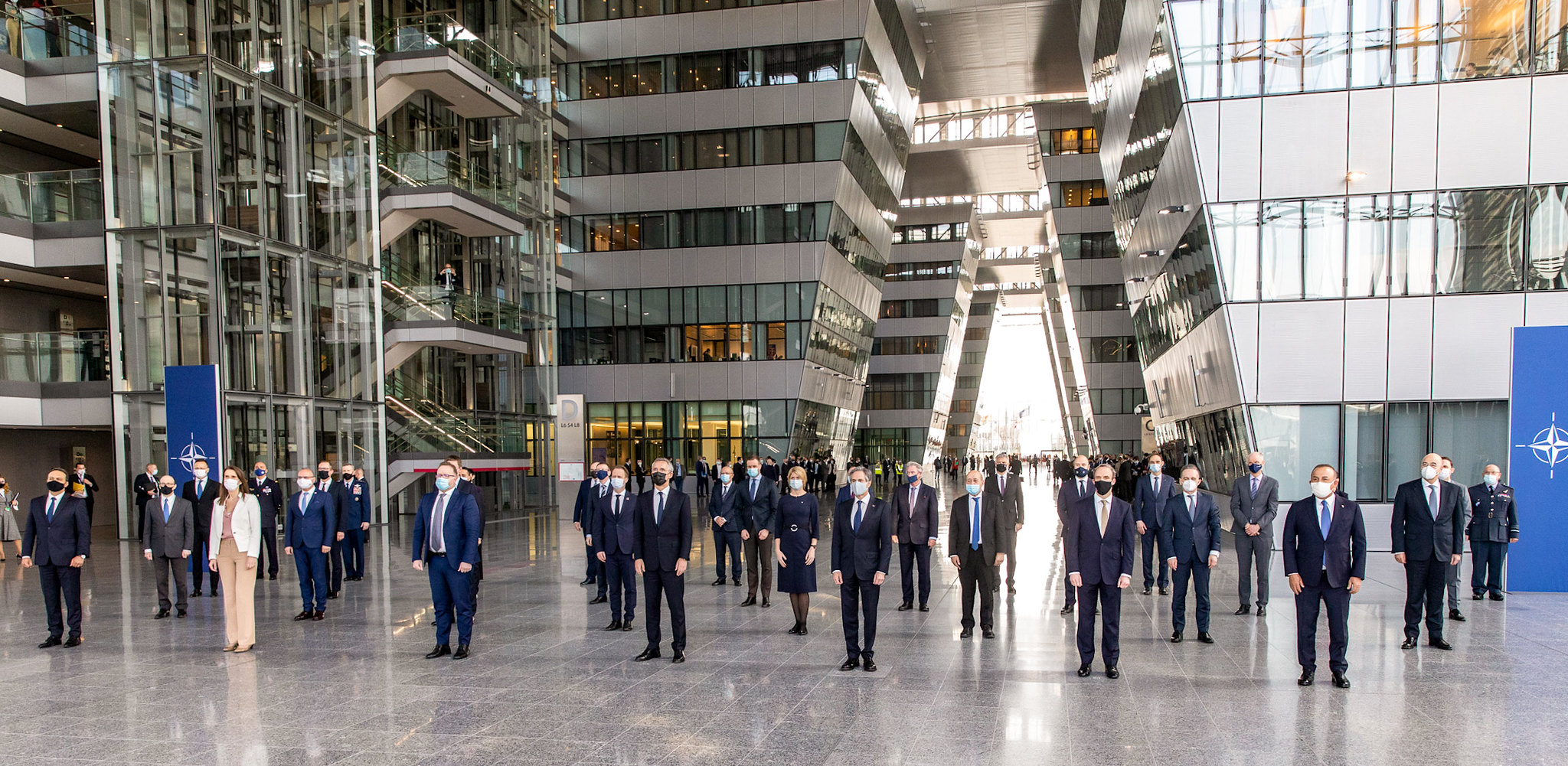
Secretary of State Blinken and other representatives of NATO countries in a group photo at NATO Headquarters in Brussels, March 2021. (State Department/Ron Przysucha)
For NATO’s part, the Trans-Atlantic military alliance, which sits at the heart of the current crisis, issued a statement in which it noted that:
“Russia’s actions pose a serious threat to Euro-Atlantic security, and they will have geo-strategic consequences. NATO will continue to take all necessary measures to ensure the security and defense of all Allies. We are deploying additional defensive land and air forces to the eastern part of the Alliance, as well as additional maritime assets. We have increased the readiness of our forces to respond to all contingencies.”
Hidden near the bottom of this statement, however, was a passage which, when examined closely, underpinned the reasoning behind Putin’s nuclear muscle-flexing. “[W]e have held consultations under Article 4 of the Washington Treaty,” the statement noted. “We have decided, in line with our defensive planning to protect all Allies, to take additional steps to further strengthen deterrence and defense across the Alliance.”
Under Article 4, members can bring any issue of concern, especially related to the security of a member country, to the table for discussion within the North Atlantic Council. NATO members Estonia, Latvia, Lithuania, and Poland triggered the Article 4 consultation following the Russian incursion into Ukraine. In a statement issued on Friday, NATO Secretary General Jens Stoltenberg expanded on the initial NATO statement, declaring that NATO was committed to protecting and defending all its allies, including Ukraine.
Three things about this statement stood out. First, by invoking Article IV, NATO was positioning itself for potential offensive military action; its previous military interventions against Serbia in 1999, Afghanistan in 2001, Iraq in 2004, and Libya in 2011, were all done under Article IV of the NATO Charter. Seen in this light, the premise that NATO is an exclusively defensive organization, committed to the promise of collective self-defense, is baseless.
Second, while Article V (collective defense) protections only extend to actual NATO members, which Ukraine is not, Article IV allows the umbrella of NATO protection to be extended to those non-NATO members whom the alliance views as an ally, a category Stoltenberg clearly placed Ukraine in.
Finally, Stoltenberg’s anointing of Ukraine as a NATO ally came at the same time he announced the activation and deployment of NATO’s 40,000-strong Response Force, some of which would be deployed to NATO’s eastern flank, abutting Ukraine. The activation of the Response Force is unprecedented in the history of NATO, a fact that underscores the seriousness to which a nation like Russia might attach to the action.
When seen in this light, Putin’s comments last Thursday were measured, sane, and responsible.
What Happens if NATO Convoys or EU Jets Are Hit?
Since the Article IV consultations began, NATO members have begun to supply Ukraine with lethal military aid, with the promise of more in the days and weeks to come. These shipments can only gain access to Ukraine through a ground route that requires transshipment through NATO members, including Romania and Poland. It goes without saying that any vehicle carrying lethal military equipment into a war zone is a legitimate target under international law; this would apply in full to any NATO-affiliated shipment or delivery done by a NATO member on their own volition.
What happens when Russia begins to attack NATO/EU/US/Allied arms deliveries as they arrive on Ukrainian soil? Will NATO, acting under Article IV, create a buffer zone in Ukraine, using the never-before-mobilized Response Force? One naturally follows the other…
The scenario becomes even more dire if the EU acts on its pledge to provide Ukraine with aircraft and pilots to fight the Russians. How would these be deployed to Ukraine? What happens when Russia begins shooting down these aircraft as soon as they enter Ukrainian airspace? Does NATO now create a no-fly zone over western Ukraine?
What happens if a no-fly zone (which many officials in the West are promoting) is combined with the deployment of the Response Force to create a de facto NATO territory in western Ukraine? What if the Ukrainian government establishes itself in the city of Lvov, operating under the protection of this air and ground umbrella?
Russia’s Nuclear Doctrine
In June 2020, Russia released a new document, titled “On Basic Principles of State Policy of the Russian Federation on Nuclear Deterrence,” that outlined the threats and circumstances that could lead to Russia’s use of nuclear weapons. While this document declared that Russia “considers nuclear weapons exclusively as a means of deterrence,” it outlined several scenarios in which Russia would resort to the use of nuclear weapons if deterrence failed.
While the Russian nuclear policy document did not call for the preemptive use of nuclear weapons during conventional conflicts, it did declare that “in the event of a military conflict, this Policy provides for the prevention of an escalation of military actions and their termination on conditions that are acceptable for the Russian Federation and/or its allies.”
In short, Russia might threaten to use nuclear weapons to deter “aggression against the Russian Federation with the use of conventional weapons when the very existence of the state is in jeopardy.”
In defining Russia’s national security concerns to both the U.S. and NATO last December, Putin was crystal clear about where he stood when it came to Ukrainian membership in NATO. In a pair of draft treaty documents, Russia demanded that NATO provide written guarantees that it would halt its expansion and assure Russia that neither Ukraine nor Georgia ever be offered membership into the alliance.
In a speech delivered after Russia’s demands were delivered, Putin declared that if the U.S. and its allies continue their “obviously aggressive stance,” Russia would take “appropriate retaliatory military-technical measures,” adding that it has “every right to do so.”
In short, Putin made it clear that, when it came to the issue of Ukrainian membership in NATO, the stationing of U.S. missiles in Poland and Romania and NATO deployments in Eastern Europe, Russia felt that its very existence was being threatened.
The Disconnect
The Russian invasion of Ukraine, when seen from the perspective of Russia and its leadership, was the result of a lengthy encroachment by NATO on the legitimate national security interests of the Russian state and people. The West, however, has interpreted the military incursion as little more than the irrational action of an angry, isolated dictator desperately seeking relevance in a world slipping out of his control.
The disconnect between these two narratives could prove fatal to the world. By downplaying the threat Russia perceives, both from an expanding NATO and the provision of lethal military assistance to Ukraine while Russia is engaged in military operations it deems critical to its national security, the U.S. and NATO run the risk of failing to comprehend the deadly seriousness of Putin’s instructions to his military leaders regarding the elevation of the level of readiness on the part of Russia’s strategic nuclear forces.
Far from reflecting the irrational whim of a desperate man, Putin’s orders reflected the logical extension of a concerted Russian national security posture years in the making, where the geopolitical opposition to NATO expansion into Ukraine was married with strategic nuclear posture. Every statement Putin has made over the course of this crisis has been tied to this policy.
While the U.S. and NATO can debate the legitimacy of the Russian concerns, to dismiss the national security strategy of a nation that has been subjected to detailed bureaucratic vetting as nothing more than the temper tantrum of an out of touch autocrat represents a dangerous disregard of reality, the consequences of which could prove to be fatal to the U.S., NATO, and the world.
President Putin has often complained that the West does not listen to him when he speaks of issues Russia deems to be of critical importance to its national security.
The West is listening now. The question is, is it capable of comprehending the seriousness of the situation?
So far, the answer seems to be no.
Scott Ritter is a former U.S. Marine Corps intelligence officer who served in the former Soviet Union implementing arms control treaties, in the Persian Gulf during Operation Desert Storm, and in Iraq overseeing the disarmament of WMD.
USPS Shuns Biden’s EV Dreams With Massive Gasoline-Powered Mail Truck Purchase
By Tyler Durden | Zero Hedge | February 23, 2022
The Biden administration has been pressing the U.S. Postal Service (USPS) to make a massive purchase commitment of electric delivery vehicles, though such plans were derailed Wednesday when the agency announced a majority of its next-generation fleet would be powered by gasoline rather than a battery, according to Bloomberg.
USPS’ record decision memo states that the agency will move ahead with its purchase of 165,000 mail trucks over the next decade. At least 90% of these trucks will be gasoline-powered built by Oshkosh Corp., and 10% will be electric.
This action steamrolls the Biden administration’s pledge to replace its federal fleet of 600,000 cars and trucks with electric power. USPS operates 230,000 vehicles, which is approximately 33% of the government fleet. Postmaster General Louis DeJoy, a Trump ally, has firmly said the full electrification of the USPS fleet wouldn’t happen under his watch. Last year, he committed to converting only 10% of its new trucks to electric power.
The decision allows USPS to purchase gasoline-powered trucks from Oshkosh under a $6 billion contract awarded last February. USPS rejected a bid from electric-vehicle manufacturer Workhorse Group Inc. to electrify its fleet. Workhorse shares slumped as much as 3.5% today on the USPS news to purchase Oshkosh mail trucks.
USPS wrote that given its financial condition, “the battery-electric option has a significantly higher total cost of ownership than its combustion-engine counterpart.”
USPS under DeJoy appears to be locking in decades of fossil fuel consumption as the president’s “Build Back Better” green plan appears to be faltering. Gasoline mail trucks are more reliable than electric ones, and ownership is cheaper.
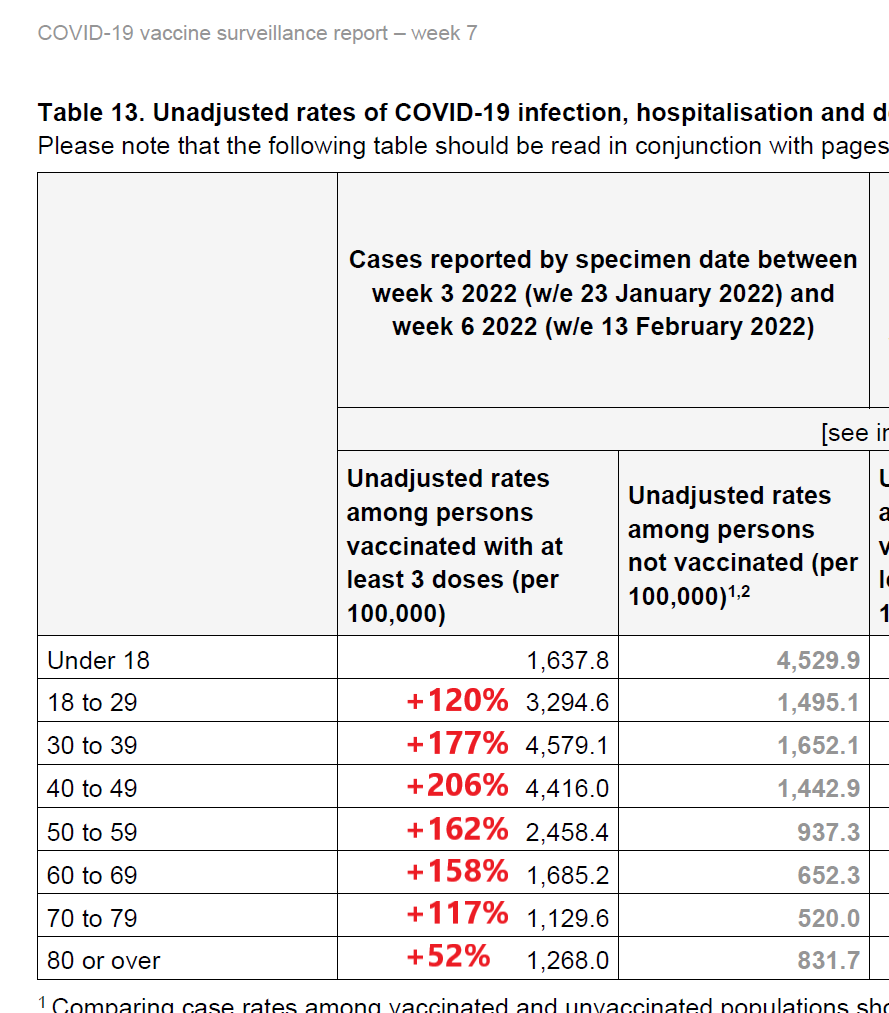
If vaccines work, then why are they bending the curves in the wrong direction?
el gato malo – bad cattitude – february 27, 2022
israel has been a good laboratory for covid intervention assessment. they are a small nation in one climate zone with a small population, good record keeping, a pretty honest set of health agencies, and modern healthcare system. they did lots of testing and they also pursued damn near every mitigation in the book from lockdowns to masking to mandating vaccines and vaccine passports. and unlike many places, they were extremely serious about compliance. they even have an very useful control group in palestine that did almost none of these things.
this provides an interesting opportunity to measure the efficacy of such interventions. at this point, it’s so well established that masking and distancing have no effect that we can more or less drop them from consideration and focus solely on vaccines. (to the extent they worked, they would drive apparent vaccine efficacy in israel anyhow).
and the two states have had remarkably similar overall outcomes and had near identical cumulative deaths per capita through 2021. however, it looks like this might be starting to diverge and this creates a useful comparison.
about three weeks ago, i left THIS POST with some questions:
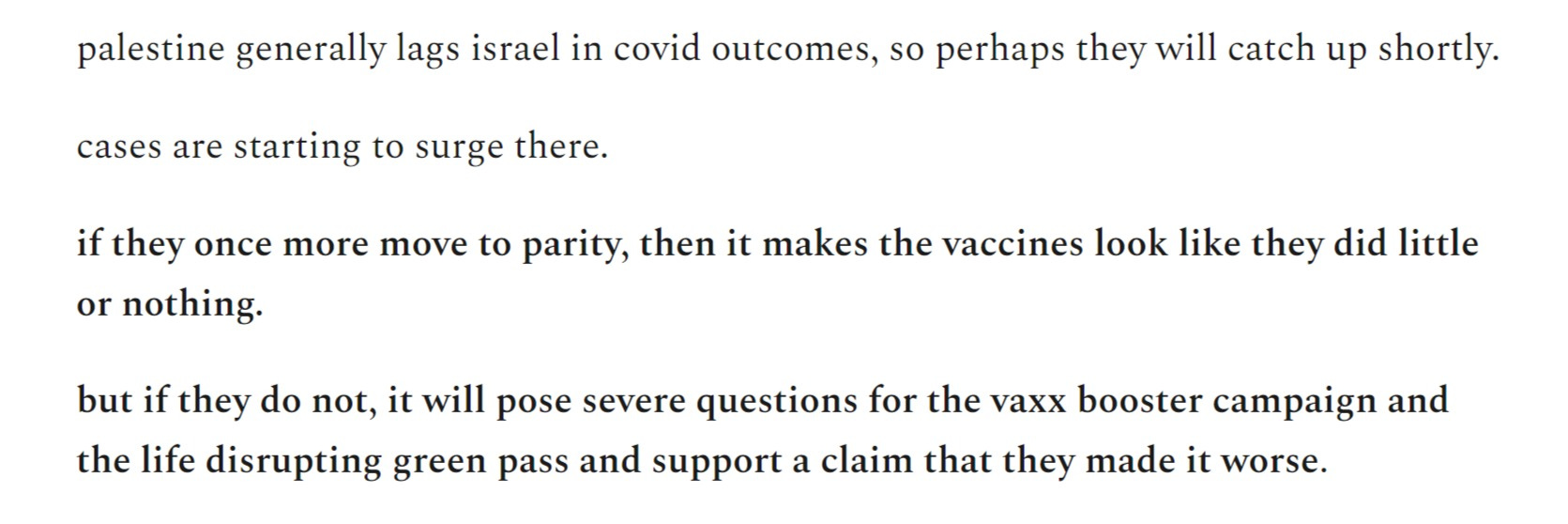
we now have enough data to start to answer this.
the relative vaxx rates are very different and israel is over 50% boosted vs ~0 in palestine. so, if boosters are working, this is about as good a natural experiment setup as you could ask for.
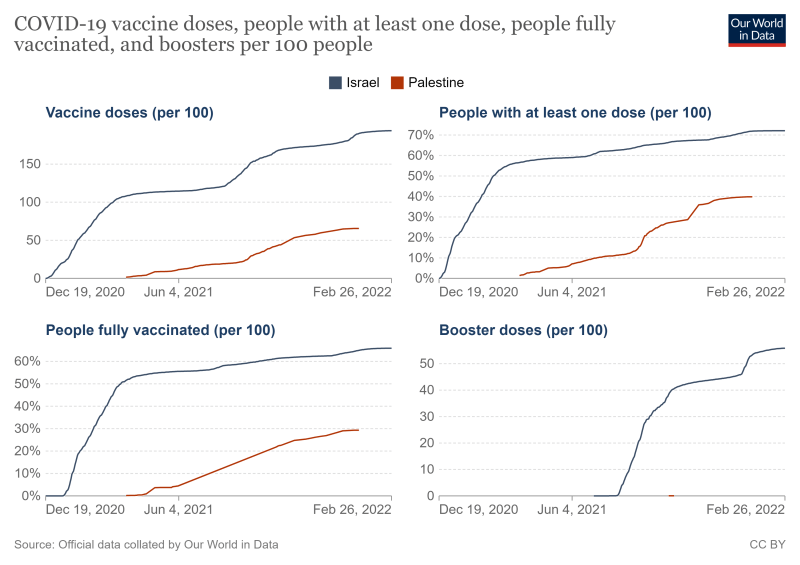
cases are a problematic metric due to variance in testing rates (and we know vaccines do not stop cases) and palestine does not report hospital data. but we can compare deaths, so this is the figure i used.
OWID is the source for all data.
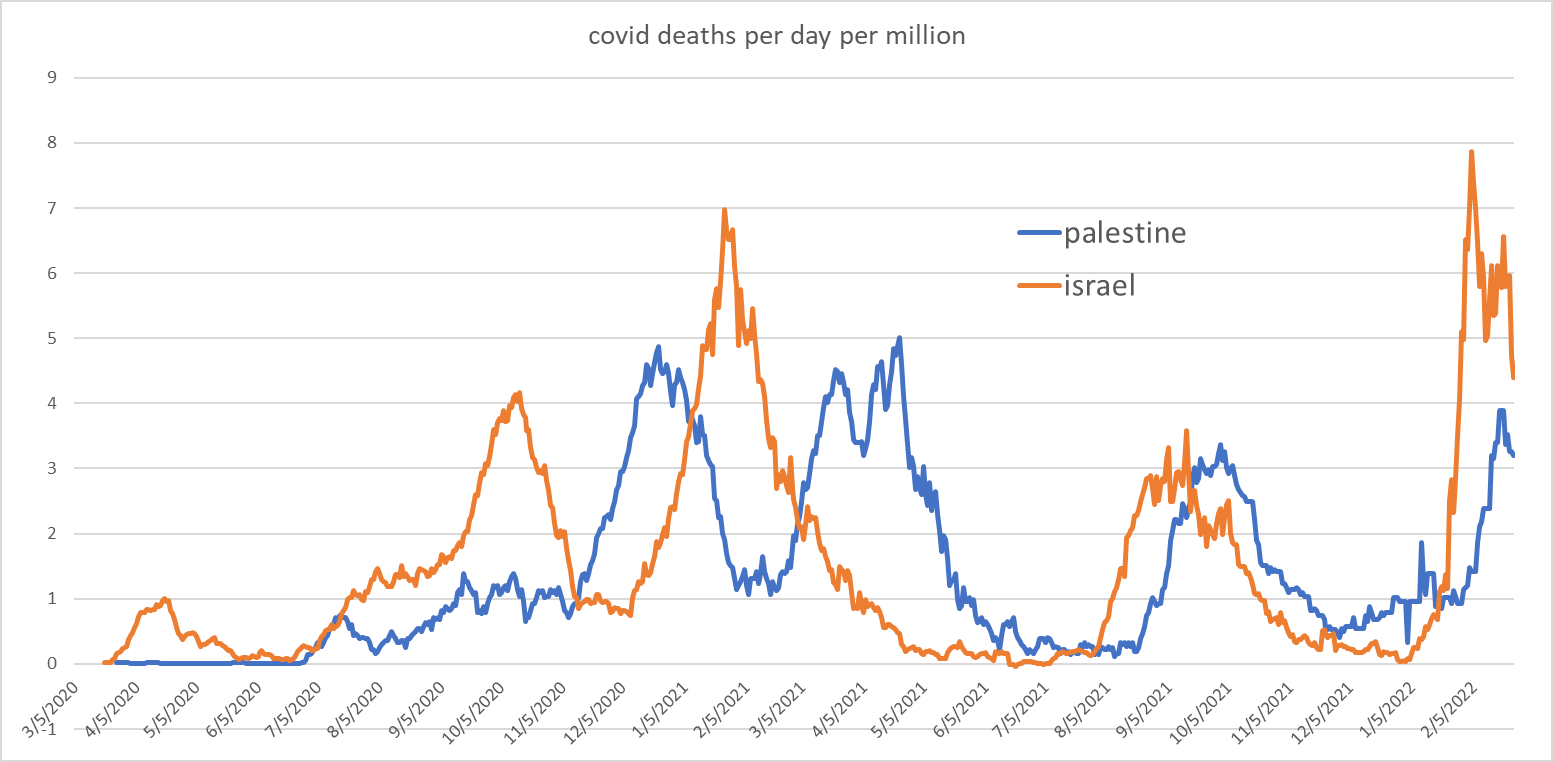
this series is striking. as has commonly been the case, palestine lagged israel by a couple weeks. (i suspect this is reporting lag, this data is day of report, not day of incidence).
assuming this peak holds, the palestine peak was 21% below winter seasonal peak last year. israel was up 13%. that’s a meaningful divergence and the israeli figure is deeply unexpected given a milder variant and 18 months of vulnerable cohort depletion.
this starts to hint at something being quite wrong and also starts to rule out “variant” as the source, because it did not drive that outcome in palestine.
it can be notoriously difficult to eyeball area under curve, so i have plotted cumulative deaths here:
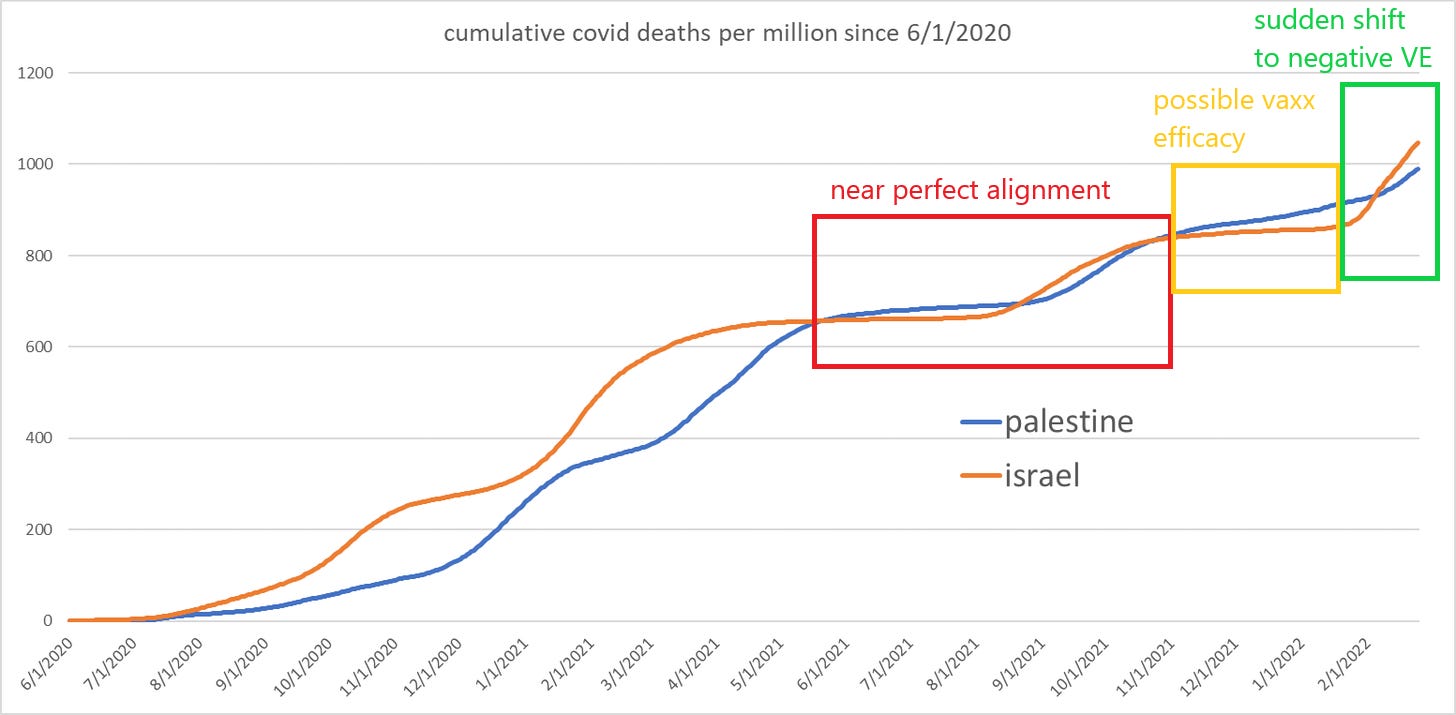
as can be seen, israel had gone pancake flat in november 2021 through jan 2022. then it inflected severely. this is omicron which hit the levant in the second half of december 2021. clinically, you’d expect about a 24 day log to show up in deaths and this tends to jibe with the data i’ve seen all over the world.
it’s possible that boosters were having some effect in bending the curve, but to the extent that they did, it was either fleeting or rapidly inverted in the face of a new variant. (or both)
this becomes extremely easy to see when we zoom into 2022 and start a cumulative count from 1/1/2022.
there is a powerful inflection in israel that does not exist in palestine and israel has seen roughly twice the cumulative per capital death rate of palestine so far this year.
if boosters are effective in preventing deaths from omicron, it sure does not show up here.
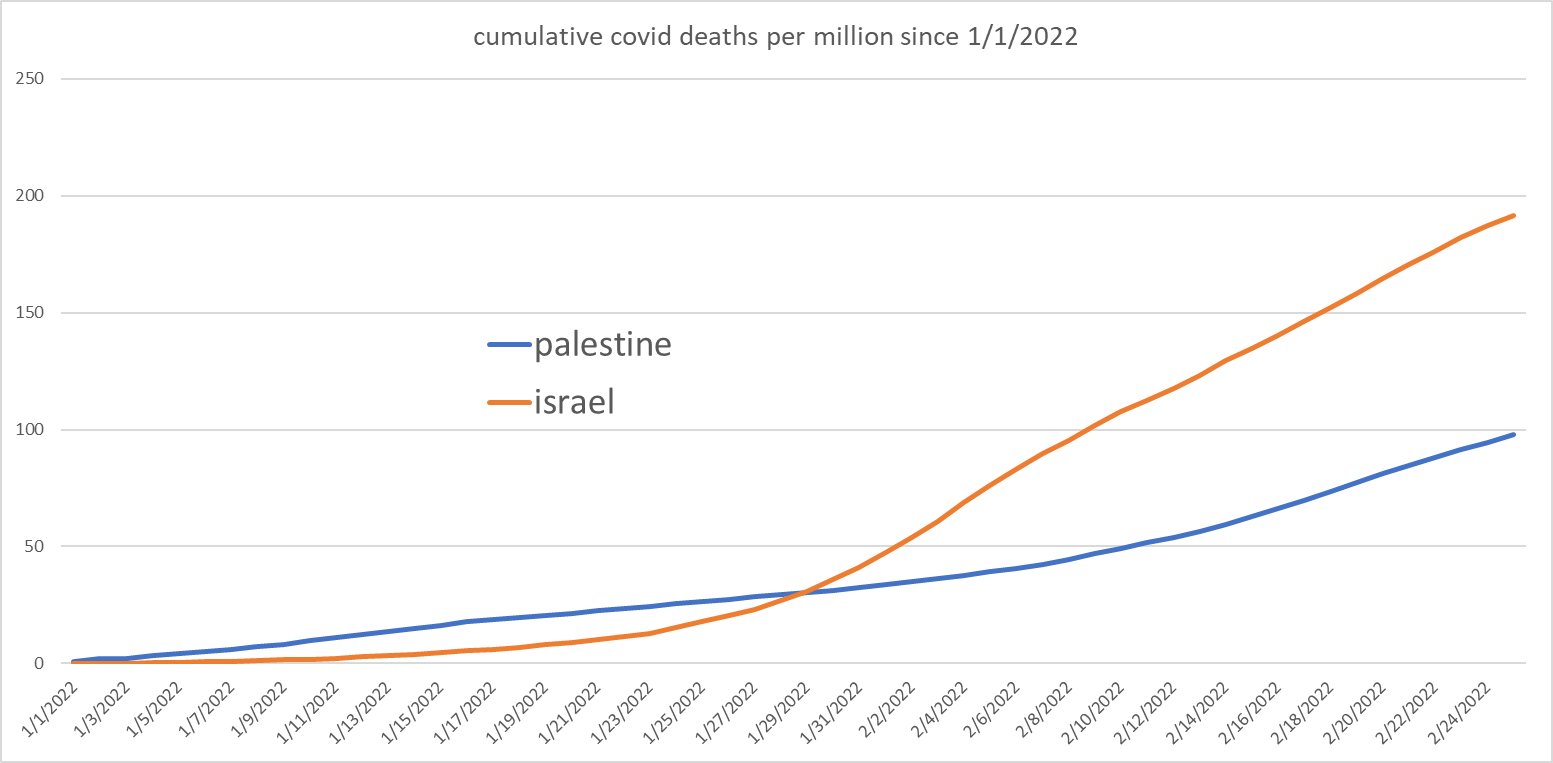
this also lets us rule out “omicron” as a source of greater underlying virulence/fatality. if this were so, it would be manifest in both places. the fact that it is not doing so supports the idea that omicron is an OAS/hoskins effect evolution taking advantage of the narrow antigenic fixation generated by mRNA and adenovirus vaccines. it also seems to show that this advantage is NOT, as many claim, limited to cases. it seems to carry through to deaths as well.
we can also compare israel to itself and see how this highly vaccinated and boosted period compares to the prior year when vaccination was zero. from this data as well, we see strong support for the OAS hypothesis.
israel had been doing better. then omi came and everything changed.
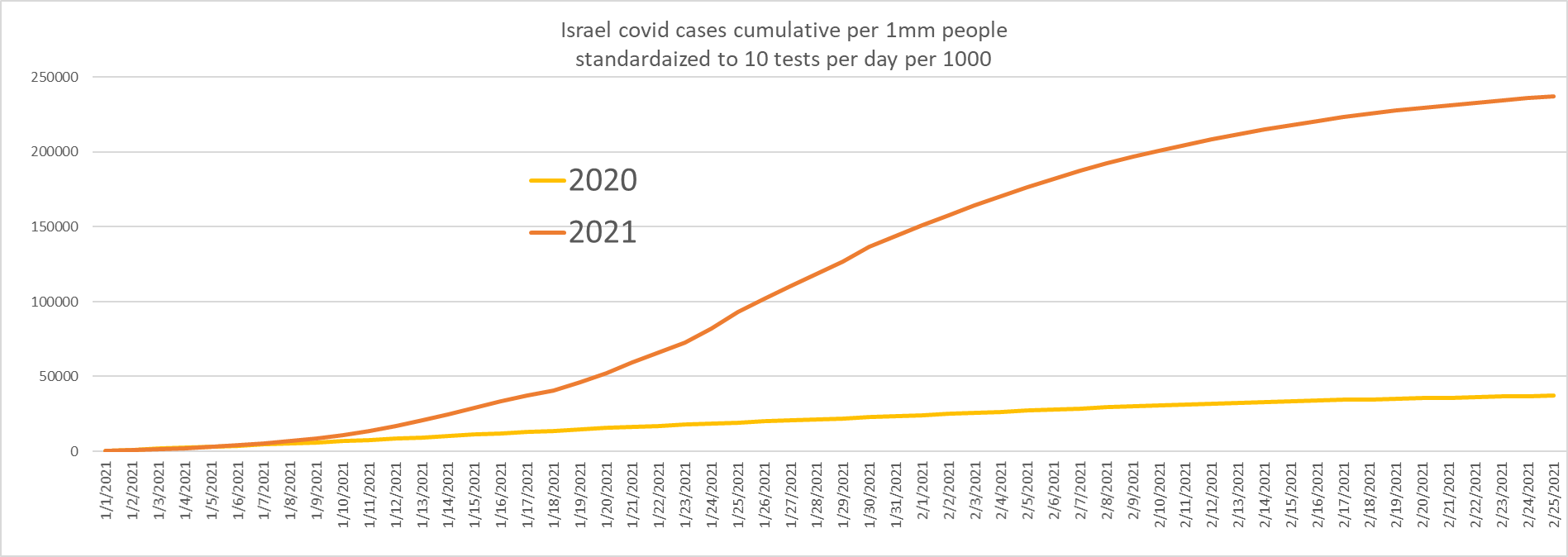
(to remove the skew from widely varying sample rate driven by big shifts in testing levels, i have normalized all cases data to 10 tests per day per 1000 population though given the absurdity of calling a high Ct PCR+ a “case” even lacking symptoms, all case data is troublesome to assess, but we work with what we have, not with what we wish we had)
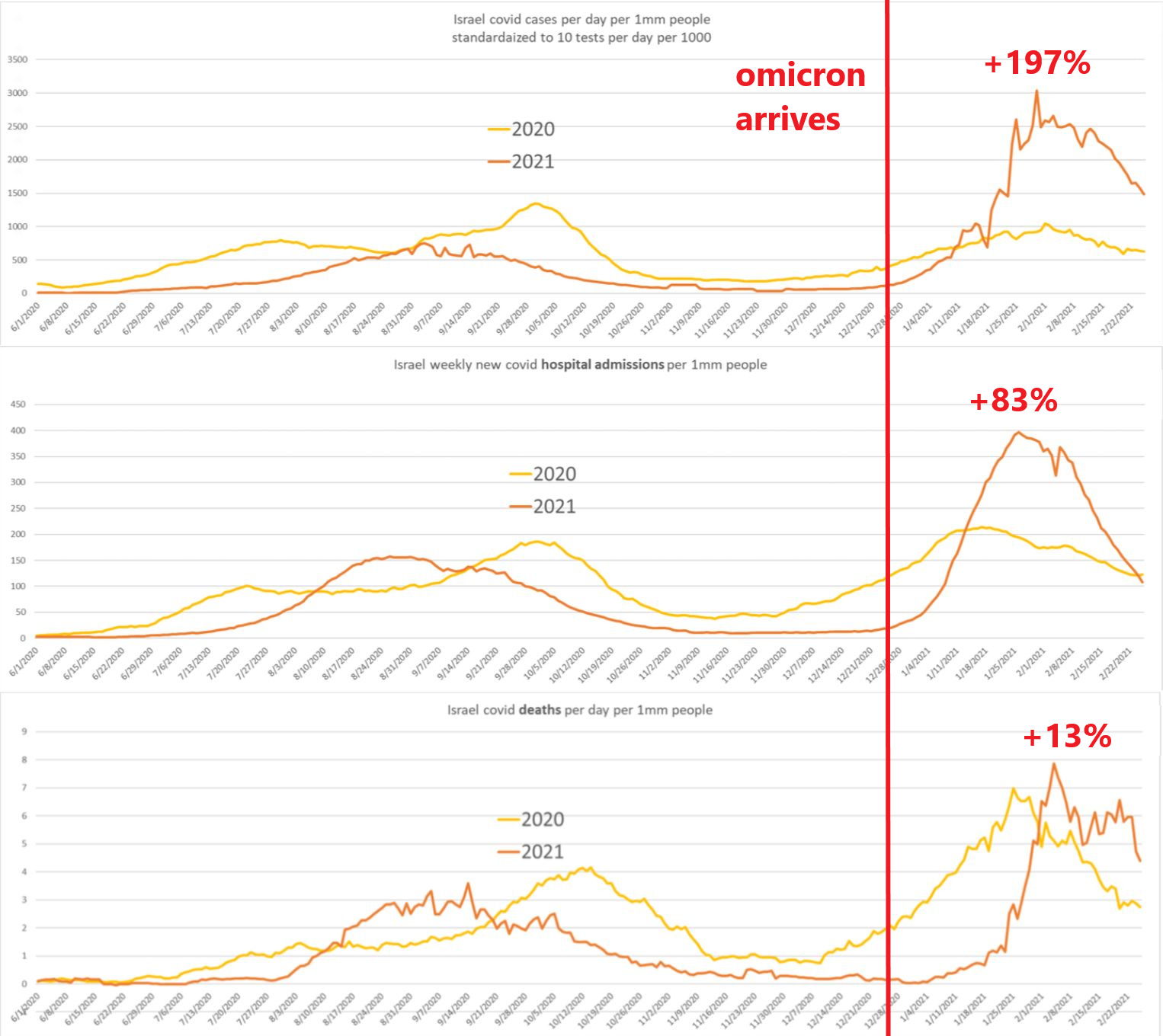
cases nearly tripled and hospitalizations nearly doubled. deaths rose 13%.
according to israeli authorities and hospitals, this was not driven by “the unvaxxed” but rather by the vaccinated. they seem to make up more than their share of severe outcomes though one must we wary of simpson’s paradoxes. (more HERE)
it might be possible to construct an argument whereby vaccine efficacy is claimed on any given infection (once you are sick, better to be vaxxed) but if that is, in aggregate, swamped by a rise in cases (and we know vaccines lead to more cases, not fewer) then this is still not much of an argument. having vaccines reduce risk of hospitalization per case by 50% but tripling case risk is still a 50% rise in overall hospitalization.
the aggregate data is possibly supportive of this claim outcome, but it’s far from certain either way.
but still, if the overall outcomes are worse post vaxx in the active arm but not in control, from a public health perspective do we really care why?
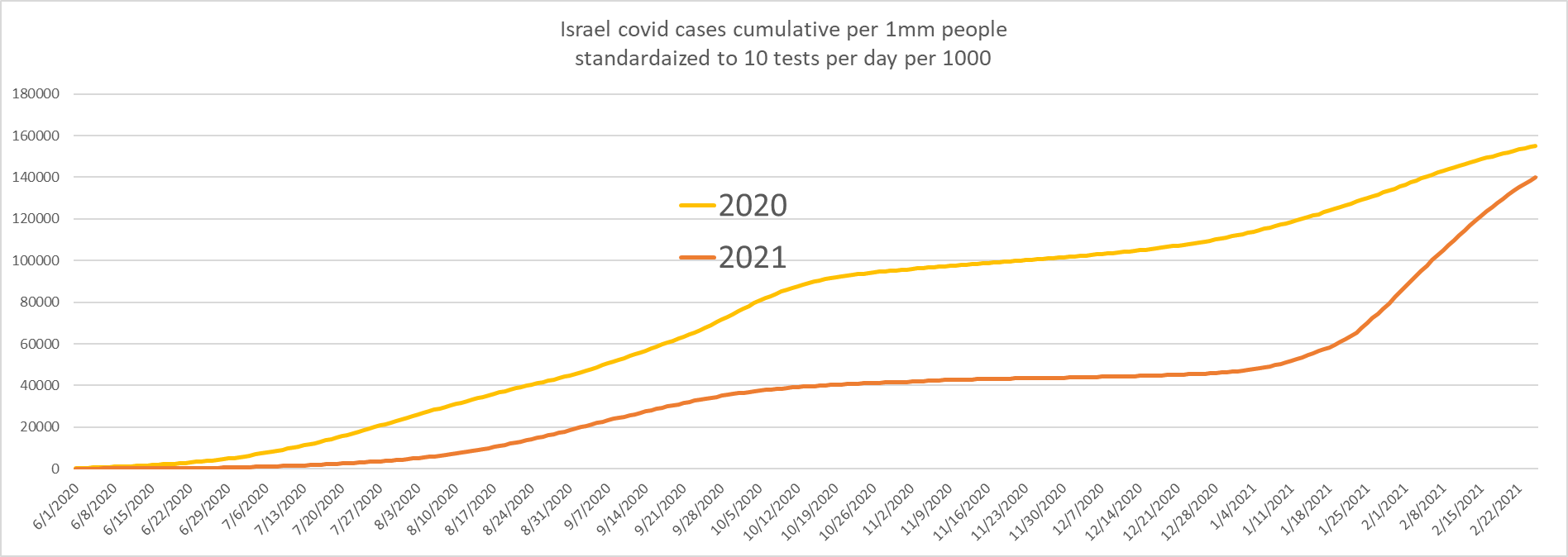
cases were trending MUCH lower. then that changed in a hurry.
zooming in makes it all the more clear.
even adjusted for testing, this is a massive surge in cases.
we see the same in hospitalization.
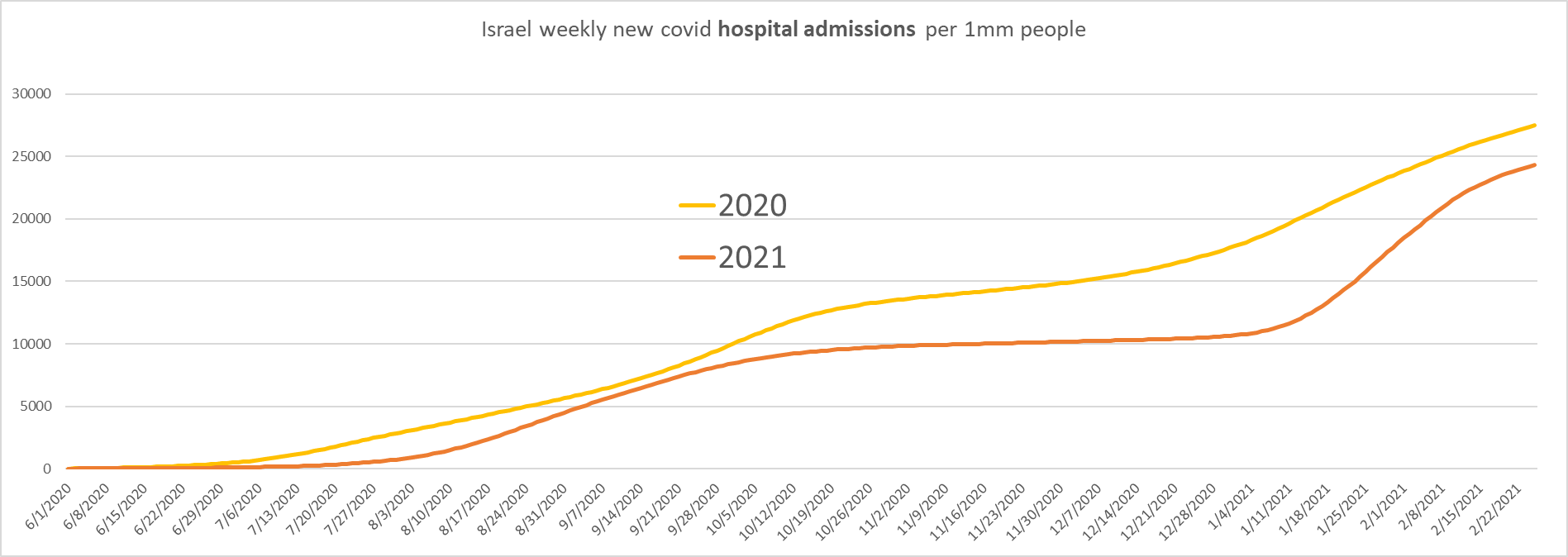
and see the crossover to worse outcomes in 2022 when we zoom in.
overall, they are 39% higher in aggregate YTD vs prior yr.
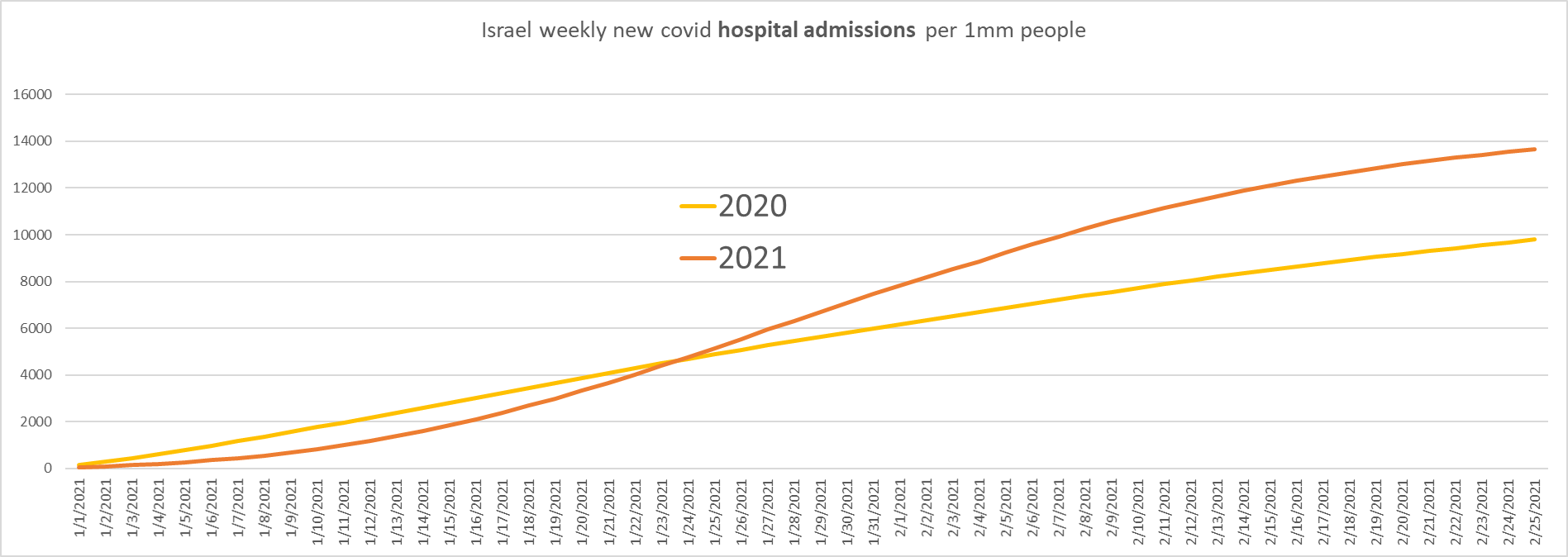
deaths have not yet caught up, but appear likely to do so.
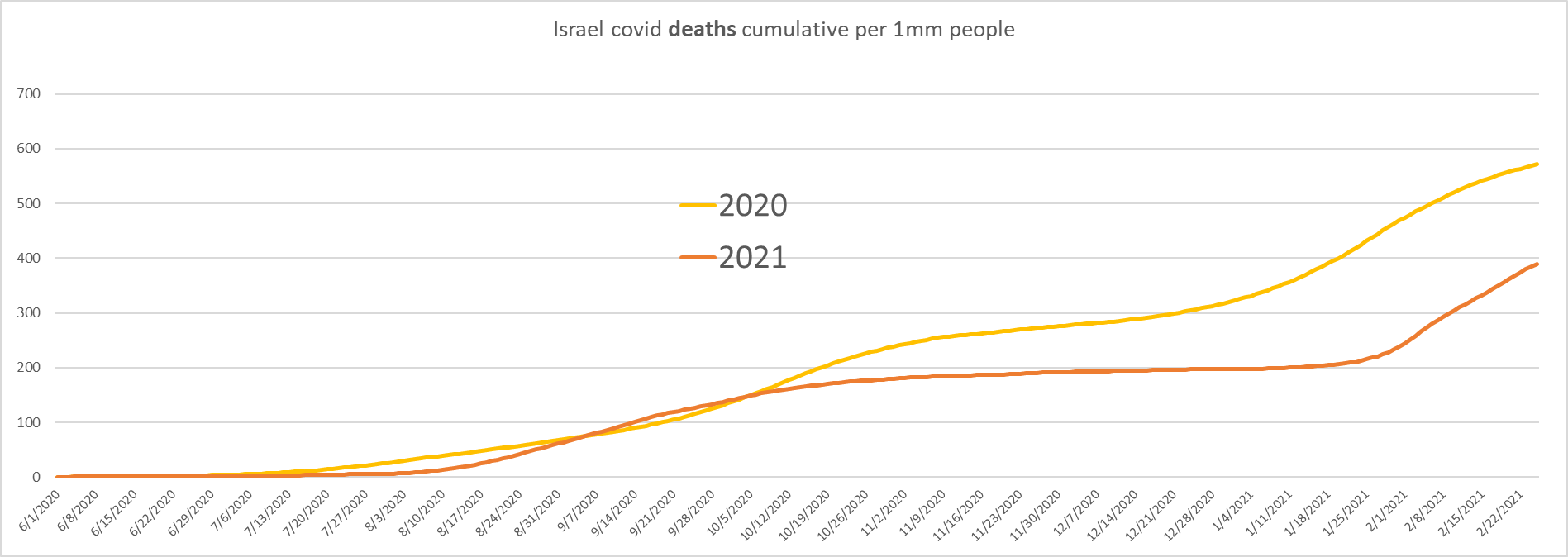
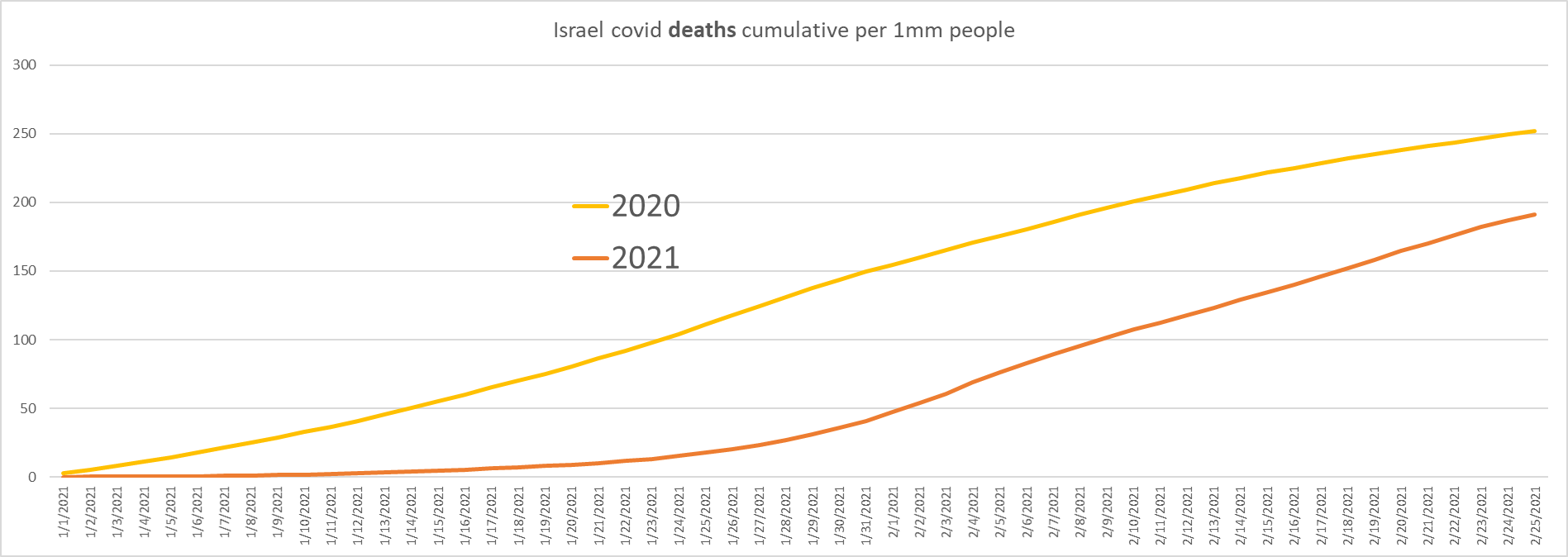
taken as a whole, this is pretty damning of the booster programs.
israel saw a big spike in deaths that was not present in the palestine control group.
it saw a massive jump in cases, a big jump in hospitalizations, and is rapidly converging on deaths (which will lag the others by ~3-4 weeks).
there is just no way to spin this as a win. it looks like an own goal.
this was the known and knowable outcome of widespread inoculation with a leaky vaccine. it is, in fact, WHY we do not use leaky vaccines.
they will rapidly and inevitably select for escape or vaccine enhanced variants. and now it makes you worse and worst of all, locks you into a suboptimal antigenic response pattern that may keep you from EVER generating real sterilizing immunity. the truly nasty part of this may take years to really see.
omicron was not “bad luck” it was invoked consequence of ill conceived intervention. even assuming they ever worked as claimed (dubious) these vaccines were always going to fail because that’s what leaky vaccines do.
this was known and knowable. the drug companies that made them knew it. the regulatory agencies that approved them knew it. and many, many doctors, researchers and public health officials all over the world knew it. they were silenced, threatened, and attacked for it. and this is the bitter fruit of that harvest.
in the US, the data has been manipulated and misused so badly as to render it outright fraud. it becomes obvious when one compares the US data (which calls all “unknown or undetermined” patients “unvaxxed” and used the fact that the EPIC system is awful to create a false sense of VE) with a system that keeps good records as longtime gatopal™ HOLD2, newly on substack, has done here.
like so much of the rest of the covid response, we knew better than to do this, but it was done anyway.
and now, the US is lying about it while others are, at least, coming clean.
but this truth will be too vast to hide much longer, even behind these big lies.
and american health and regulatory agencies are going to have a great deal to answer for.
dr atlas (with whom many at rational ground, including even notorious internet felines, had the pleasure to collaborate) is correct in everything he says here except in his use of the world “almost.”
The ‘Constructive Destruction’ of Russia’s Model of Relations with the West
By Alastair Crooke | Strategic Culture Foundation | February 27, 2022
The collective West was already angry. And it is apoplectic after President Putin shocked western leaders by ordering a special military operation in Ukraine, which is being widely described (and perceived in the West) as a declaration of war: ‘a shock and awe assault affecting cities widely across Ukraine’. So angry in fact is the West that the information space has literally bifurcated into two: It is all black and white, with no greys. For the West, Putin has comprehensively defied Biden; he has unilaterally and illegally ‘changed the borders’ of Europe and acted as a ‘revisionist power’, attempting to change not just the borders of Ukraine, but the current world order. “Thirty years after the end of the Cold War, we are facing a determined effort to redefine the multilateral order,” the EU High Representative, Josep Borell, warned. “It’s an act of defiance. It’s a revisionist manifesto, the manifesto to review the world order”.
Putin is characterised as a new Hitler, and his acts asserted to be ‘illegal’. It is claimed that it was he who tore up the Minsk II Accord (yet the Republics declared their independence in 2014, signed Minsk in 2015, and it was Russia who never signed the accord – and therefore cannot be in breach of it). Indeed, it is the US effectively that has vetoed the Minsk process since 2014, and Russia’s publication of diplomatic correspondence in November 2021 exposed that France and Germany too, had little intention of pressurising Kiev on any meaningful implementation. And so, having concluded that a negotiated settlement – as stipulated in the Minsk Accords – would simply not happen, Putin determined that there was no point in waiting any longer before implementing Russia’s red line.
The late Stephen Cohen wrote of the dangers of such unqualified Manichanaeism — how the spectre of an evil-doing Putin had so overwhelmed and toxified the US image of him that Washington has been unable to think straight – not just about Putin – but about Russia per se. Cohen’s point was that such utter demonisation undercuts diplomacy. How does one split the difference with evil? Cohen asks, how did this happen? He suggests that in 2004, the NY Times columnist, Nicholas Kristof, inadvertently explained, at least partially, Putin’s demonisation. Kristof complained bitterly of having been “suckered by Mr. Putin. He is not a sober version of Boris Yeltsin”.
Most Russians however, are behind Putin with the recognition of the Donbas Republics, which he then followed up by obtaining the authorisation of Russia’s upper parliament house for the use of armed forces outside Russia (as required under the constitution). The resolution by the Federation Council was unanimously supported by all the 153 senators at an extraordinary session on Tuesday.
In his national address, Putin spoke with a bitterness that is reflected by many Russians. He views the post-2014 political developments in Ukraine as having been engineered to create an anti-Russian regime in Kiev nurtured by the West, and with hostile intentions towards Russia. Putin illustrated this point by explaining that “The Ukrainian troop control system has already been integrated into NATO. This means that NATO headquarters can issue direct commands to the Ukrainian armed forces, even to their separate units and squads”. Putin also noted that the Russian constitution stipulates the borders of Donetsk and Lugansk regions to be as they were “at the time when they were part of Ukraine”. This is a carefully worded formulation — the borders of the two republics underwent significant changes in the aftermath of the Maidan coup. (At issue here is Donetsk’s historic claim to coastal Mariupol).
Putin’s recognition statement was accompanied by an ultimatum to the Kiev forces to cease their artillery bombardment across the Line of Control or face military consequences. Throughout Wednesday evening however, the situation on the Contact Line was heating up, with heavy artillery fire; but early Thursday morning, for the first time, multiple rocket-fire was used by the Kiev forces across the Control Line. (Someone from the Kiev side clearly wanted escalation – perhaps to put pressure on Washington). Putin immediately ordered what was evidently a pre-prepared Special Operation ‘to de-militarise and de-nazify Ukraine’. Russia’s military announced within a couple hours of the offensive that all of Ukraine’s air defense systems had been taken out. A massive Russian aerial presence, including fighter jets and helicopters, has been confirmed over much of the country.
Possibly this operation (which Putin said is not about occupying Ukraine), will follow the pattern of Georgia in 2018, when Russian forces withdrew after a few days. This was the pattern too, in Kazakhstan. We simply do not know whether this will be the case in Ukraine — very possibly not. When Putin spoke of ‘de-nazification’ he was referring to the US co-option of a neo-Nazi formation in Ukraine’s armed forces to help mount the 2014 Maidan coup. The so-called Azov Brigade of neo-Nazis had proved to be the most effective fighting force in pushing back the DLR militia in the Donbass region. (Ukraine is the world’s only nation to have a neo-Nazi formation in its armed forces and there will be scores to be settled).
Nonetheless, Putin’s Special Order has, as no doubt he foresaw, shocked the West deeply with its decisive military reaction. It has set the world – and its financial and energy markets – on edge.
Indeed, the latter aspect may become the more salient. In 1979, upheavals in the Middle East sent energy prices soaring (just as is occurring today), and western economies tumbling. Whatever the next days bring, it must be plain that Putin’s short press conference on 22 February is acting as intended, as a powerful accelerant. The “constructive destruction” of the old Global Order will proceed faster than many of us had imagined. It marks an End to Illusions — an end to the notion that the US imposed, rules-based order remains an option.
How then to interpret the extreme anger in the West? Simply this: In the end, there is reality. And that reality – i.e. what the West can do about it – is all that matters — which is … little.
The brutal first realisation underlying the anger is that the West has no intention – and critically, no ability – to counter Russia’s moves militarily. Biden has repeated the ‘no boots on the ground mantra’ again in the wake of Russian military operations. And for Europe, the imposition of a sanctions regime on Russia could not have come at a worse moment. Europe is facing recession and a pre-existing energy crisis (which will be hugely aggravated by Germany’s offering up Nordstream 2 to the hungry gods of vengeance). And spiking inflation (worsened with oil at $100) is causing interest rate and sovereign bond nerves to rattle. Now the pressure will be on Europe to find additional sanctions.
Sanctions there will be – and they will hurt Europeans directly in their pockets. Some European states are putting up a rear-guard action to limit sanctions that might worsen the coming European recession. However, in a very real sense, the fact is that Europe is effectively sanctioning itself (it will sustain the bigger hurt from its own sanctions), and Moscow has promised to reciprocate any sanctions in a way that will hurt the US and Europe. We are in a new era. This prospect and impotence in the face of it, must account for a large portion of European frustration and anger.
Washington professes to have a ‘killer weapon’ targeted at Moscow: sanctioning semi-conductor chips. “This would be the modern equivalent of a 20th century oil embargo, since chips are the critical fuel of the electronic economy”, Ambrose Evans Pritchard argues in the Telegraph: “But this too, is a dangerous game. Putin has the means to cut off critical minerals and gases needed to sustain the West’s supply chain for semiconductor chips”. In short, Moscow’s control over key strategic minerals could give Russia leverage, akin to Opec’s energy stranglehold in 1973.
Here lies the second strand to Europe’s outpouring of frustration: the unspoken recognition that Biden’s Ukraine policy; the west’s failure of diplomacy (all process and no substantive addressing of the underlying issues); plus Germany’s cack-handed handling of the Nordstream 2 question, have doomed the EU to years of economic decline and suffering.
The third strand is more complex and is reflected in Josep Borell’s indignant cry that Russia and China are two “revisionist” powers attempting to change the current world order. The European ‘fear’ is grounded not only in the content of the Beijing joint declaration, but likely also that not in his entire life has President Putin before made a speech like Monday’s address to the Russian people. Nor has he ever named the Americans to be Russia’s national enemy in such unequivocal Russian terms – American promises: worthless; American intentions: deadly; American speeches: lies; American actions: intimidation, extortion and blackmail.
Putin’s speech portends a great fracture. It seems to be just dawning on Europeans (such as Borrell) just how much of an inflection point Putin’s address represents. It was framed around Ukraine, yet the latter issue – though compelling – is incidental to the decision by Russia and China to change forever the geo-political balance and the security architecture of the globe.
What the recognition of the Donbas republics represented was the manifestation of this earlier geo-strategic decision. It is the first practical unfolding of that break with the West (never absolute, of course), and the unveiling of Russia’s compilation of ‘technical-military’ measures designed to force a separation of the globe into two distinct spheres. The first was the republics’ recognition; the second military-technical measure was Putin’s address; and the third, his subsequent ‘Special Operations’ order.
They – the Russia-China Axis – want separation. This is to come about either through dialogue, (which is unlikely, since the core principle of today’s geo-politics is defined by the deliberate non-comprehending of ‘otherness’), or it must be achieved by a contest of escalating pain (defined in terms of red lines) until one side, or the other, buckles. Of course, Washington does not believe Presidents’ Xi and Putin possibly can mean what they say – and they believe that, anyway, the West has escalatory dominance in the field of imposing pain.
Less diplomatically put, Russia and China have concluded that sharing a global society with an America set on enforcing a hegemonic global order crafted to ‘resemble Arizona’ is no longer possible. Putin means what he says: Russia’s back is to the wall, and there is nowhere to which Russia can now retreat — for them it is existential.
The West’s denial that Putin ‘means it’ (thus ensuring the consequent failure of diplomacy) suggests that this crisis will be with us for at least the next two years. It is the start a drawn-out, high-stakes phase of a Russian-led effort to change the European security architecture into a new form, which the West presently rejects. The Russian aim will be to keep the pressures – and even the latency of war ever-present – in order to harass war-averse Western leaders to make the necessary shift.
Ultimately – after a painful struggle – Europe will seek reconciliation. America will be slower: the Beltway hawks will try to double-down. And it will be the western economic and market situation that may ultimately determine the ‘when’.
The CDC Discovers Actual Public Health, Just in Time
BY JEFFREY A. TUCKER | BROWNSTONE INSTITUTE | FEBRUARY 26, 2022
One day I’m reading an internal memo commissioned by the Democratic Party to provide advice to dealing with Covid policy. The next day I’m reading headlines about how the CDC has drastically altered its advice on how to deal with Covid.
Is there a relationship? At this point, only the hopelessly naive would think otherwise.
Let’s look at the memo produced by Impact Research. Some excerpts:
- Democrats have a tremendous opportunity to claim an incredible, historic success – they vaccinated hundreds of millions of people, prevented the economy from going into freefall, kept small businesses from going under, and got people back to work safely. Because of President Biden and Democrats, we CAN safely return to life feeling much more normal – and they should claim that proudly.
- Six in ten Americans describe themselves as “worn out” by the pandemic. The more we talk about the threat of COVID and onerously restrict people’s lives because of it, the more we turn them against us and show them we’re out of touch with their daily realities.
- [I]t means recognizing that the threat of COVID is no longer what it was even a year ago and therefore should not be treated as such – shutdowns, masks, and lockdowns were meant to save lives when there was not yet a vaccine that could do that. Voters know we now have the tools in the toolkit to be responsible in combatting and living with COVID – vaccines and boosters to minimize illness, and masks and social distancing around vulnerable groups.
- They think the virus is here to stay, and 83% say the pandemic will be over when it’s a mild illness like the flu rather than COVID being completely gone, and 55% prefer that COVID should be treated as an endemic disease. And that’s what most Americans are dealing with—a disease with fatality rates like the flu—because most of us took the personal responsibility to protect ourselves and our families by getting vaccinated.
- Stop talking about restrictions and the unknown future ahead. If we focus on how bad things still are and how much worse they could get, we set Democrats up as failures unable to navigate us through this. When 99% of Americans can get vaccinated, we cause more harm than we prevent with voters by going into our third year talking about restrictions. And, if Democrats continue to hold a posture that prioritizes COVID precautions over learning how to live in a world where COVID exists, but does not dominate, they risk paying dearly for it in November.
A few points.
This memo is not epidemiology but politics, most strongly illustrated by the idea that polling should make the difference as to whether a pathogen is pandemic or endemic. The constant incantation of “vaccines” here has nothing to do with the known data: they have nowhere stopped infection or spread, a point which the memo obscures with the line about how they “minimize illness.” They minimize serious outcomes for some strains so long as they last.
From a policy point of view, there are two main features that stand out: Covid is here to stay and “most people in the US will eventually get COVID-19” (thereby hinting at the reality that vaccines are not effective in the way that Biden/Fauci/Walensky promised) and therefore the focus should be on protecting the vulnerable.
There is nothing new about this. It was always true! You can shout “Omicron” all day but it was also true with Alpha and Delta as well. The virus should have been treated rationally the entire time and policies that have wrecked public health should have been off the table from 2020. The memo writers did not cite the Great Barrington Declaration but they might as well have.
As for how the Democrats somehow prevented an economic freefall, the worst economic outcomes are very clearly in Democratic-controlled states that retained restrictions for nearly two years in some places, including keeping schools closed. There is a reason for the mass migration that this has inspired.
If we are looking for thriving economies, look to the states that never closed up or opened earliest: South Dakota, Florida, Texas, Georgia, and so on. So none of this is remotely true but, hey, this is politics, right?, so it doesn’t have to be true.
The real problem that the Democrats need to solve is revealed in this chart:

Now, let us consider the dramatic turnaround at the CDC that came out the very next day. The full PDF is embedded below.
Here are the talking points handed to the director. It’s not just about masking, which is being relaxed. The CDC says there needs to be a dramatic shift away from endless monitoring of cases that are overwhelmingly mild and instead focus only on actual sickness that lands people in the hospital and threatens life. We need to stop obsessing about cases and start looking mainly at “medically significant disease.” The focus should be on “protecting the most vulnerable.”
This makes all of us want to say, shout, scream: THANK YOU!
In order to justify this change, the CDC posts four sets of charts on Covid prevalence during episodes of the pandemic. The last chart illustrates the point that an exclusive focus on controlling the spread is utterly preposterous at this point. Under the old protocols, the whole country should be back in lockdown. It’s unimaginable what attempting this now would cause.
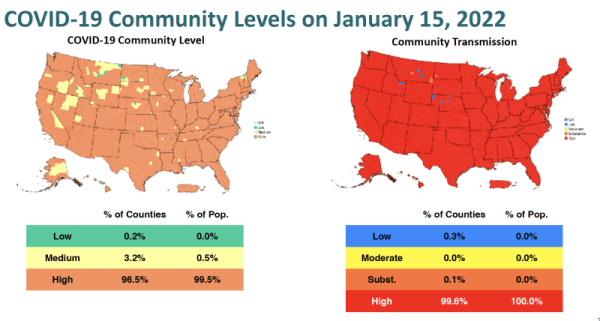
To be sure, all of this is enormously frustrating for those of us engaged in this battle for two years. Instead of focusing on getting sick people well, the CDC experimented with wild guidelines that imagined some kind of society-wide solution that seemed designed to crush the virus while vast amounts of social and economic activity were shut down by law. This necessitated a crushing of freedoms, including of travel, association, commerce, religion, and, eventually even speech.
The CDC nowhere admits this much less apologizes for it. Two years in, the CDC seems to have rediscovered the traditional practice of public health, and has justified this new wisdom based on changed conditions, while never even bothering to claim that its previous measures and guidelines achieved anything along the way.
We’ve seen a massive collapse in public health, economic vitality, and essential rights, while closing schools and wrecking education and so much more, all in the name of virus control, even as the evidence is now overwhelming that the entire enterprise was not only a distraction from what should have happened (therapeutics and protecting the vulnerable) but also an astonishing failure.
Why the change? It had to happen at some point. The entire machinery of lockdowns and mandates were destined to fail. As to the timing of the reversal, it’s hard to resist the speculation that it is entirely political. See the memo above.
Still, there is a worrisome aspect to the CDC’s announcement. They reserve the right to do it all over again. “We want to give people a break from things like mask-wearing, when these metrics are better, and then have the ability to reach for them again should things worsen,” she said.
No one should be satisfied with a politically motivated change in the messaging. We need fundamental regime change to make sure that nothing like this can ever happen again.
Jeffrey A. Tucker is Founder and President of the Brownstone Institute and the author of many thousands of articles in the scholarly and popular press and ten books in 5 languages, most recently Liberty or Lockdown.
Featured Video

Trump asks Iran not to retaliate after he strikes Pickaxe Mountain
or go to
Aletho News Archives – Video-Images
Book Review
‘Why Fauci Must Rot in Prison’: A Tale of Two Diaries
By Jill Erzen | The Defender | October 13, 2026
Dr. Anthony Fauci’s private diary reveals a “mind-numbing” contradiction between what the former top U.S. infectious disease official knew about COVID-19 and what he told the public, senior White House adviser Peter Navarro, Ph.D., said last week on “American Thought Leaders.”
In his new book, “Why Fauci Must Rot in Prison,” due out Oct. 20, Navarro compares Fauci’s private entries to his own pandemic-era diary, and uses what he calls “a tale of two diaries” to argue that Fauci should face criminal prosecution.
“I show, actually, how a prosecution can and should happen … at the state level, most likely,” Navarro said. “He should wind up in prison, and we’ve got the receipts in this book to put him there.”
Navarro said Fauci repeatedly acknowledged important facts in private, then publicly pursued policies that contradicted those facts — with devastating consequences.
“What he says many times privately in his diary is so at odds with both his public behavior and public statements that it’s mind-numbing,” Navarro said.
Navarro examines the lasting damage caused by lockdowns and other pandemic policies, and the ongoing toll of long COVID.
His book also addresses questions about vaccine safety, including why healthy young people faced COVID-19 vaccination mandates despite concerns about myocarditis, and why women were not warned about miscarriage risks linked to the shots. … continue
Blog Roll
 Aletho News
- Yemen denounces international community’s silence on Saudi aggression, siege
- UAE and Saudi Arabia move toward renewed coordination against Sanaa
- How Iran’s two-week retaliatory strikes exposed cracks in US military architecture in Persian Gulf
- The mother of all propaganda: Why the hype over US MOAB strike against Iran is nothing but theater
- Iran says it possesses technology behind US 14-ton GBU bunker-buster
- Trump asks Iran not to retaliate after he strikes Pickaxe Mountain – w/ Prof. Marandi
- Vice President J.D. Vance’s Deceptive ‘Antiwar’ Campaign Speech
- Iran: Palestinians’ rights must not be compromised in Gaza’s future; US, Israel to blame for Hormuz situation
- Ongoing tales of Syrian chemical weapons
- Moscow blasts UN for ignoring torture of Russian POWs
- If Americans Knew
- Netanyahu’s spin on latest settler attack is laughable – Daily Update
- Israeli soldiers debunk Israel’s talking points
- In West Bank, Israeli settlers are totally out of control – Daily Update
- NPR investigation finds evidence of widespread fraud at mall kiosks tied to Israeli skincare brand
- Tucker Carlson exposes Israeli Lies about the Oct 7th attack, Charlie Kirk, and the U.S.
- Israel has detained thousands of Palestinian children since Oct 7th – over half spent time in solitary, many uncharged
- Israeli Analysis: Is Netanyahu Planning an ‘October Surprise’ Attack Before Israel’s Election?
- Israeli settlers brutally attack Palestinians and Washington Post female photographer, 65
- Words Have Changed, Occupation Continues: The Reality of the Gaza Ceasefire
- Gaza’s child amputees are growing faster than their prosthetics allow
- No Tricks Zone
- Predictions Made By Renowned Climate Proifessor Over Past Decades Have Been Proven To Be Poor
- New Study Suggests Large Regions Of The Pacific Ocean Have Been Cooling For The Last 80 Years
- Germany’s Green Energy Debacle: High Energy Costs Force Kahla Porzellan to Close After 182 Years!
- New Study: 50 Years Of The Most Aggressive ‘Net Zero’ Policies Can Only Affect The Global Climate By 0.03°C
- US September “Heat” Was No Record…Many Records Set Decades Ago
- Latest European Green Energy Debacle; Portugal’s Largest Flagship Solar Park Insolvent!
- Green Energy Debacle: German Expert Professor Fritz Vahrenholt Warns Of Severe Economic And Social Consequences
- Two More Paleo Reconstructions Affirm Meters-Higher Sea Levels Across Ireland, Brazil 7000-6000 Years Ago
- New Study: Earth And Venus Surface Warmth Largely Explained By Convection And Lapse Rate, Not CO2 Or Radiation
- 2025 Nature Paper Claiming Worsening Global Drought Gets RETRACTED …Heavily Flawed