How Billions in COVID Stimulus Funds Led to Dangerous, Tyrannical Policies in U.S. Schools
The Defender | January 20, 2022
In a January interview on Del Bigtree’s “The Highwire” —“COVID-19: Following the Money” — policy analyst A.J. DePriest, a member of the grassroots Tennessee Liberty Network, shared the group’s jaw-dropping findings about the undue influence of federal relief monies on school and hospital policies.
In this article, The Defender covers how federal money affected schools. We will cover the impact of federal money on hospitals in a separate article to follow.
In 2020 and 2021, Congress passed trillions in COVID-related stimulus through the Coronavirus Aid, Relief and Economic Security (CARES) Act, the Coronavirus Response and Relief Supplemental Appropriations (CRRSA) Act and the American Rescue Plan (ARP) Act.
Sizeable portions of those funds went to schools.
Digging into the education allotment, the Tennessee network discovered public, charter and nonprofit private schools in the U.S. received nearly $190.5 billion during three rounds of Elementary and Secondary School Emergency Relief (ESSER) funding (called ESSER I, II and III).
One of DePriest’s disquieting take-home messages is that this education lucre came with major strings attached — federal strings that are persuading ignominious school board members to adopt policies unfavorable and even dangerous to student health and well-being.
While DePriest characterized the stimulus bonanza as a “BIG carrot” for cash-strapped schools, that assessment may be too generous. If one examines the disturbing conditions attached to the U.S. Department of Education’s (DOE’s) dazzling largesse, the government billions seem closer to a godfather-like “offer they can’t refuse.”
The $190 billion ‘carrot’
The size of the federal “carrot” increased with each ESSER iteration. The $1.9 trillion ARP package alone assigned state educational agencies and school districts a whopping $122 billion (ESSER III).
On Jan. 18, the U.S. Department of Education (DOE) crowed about its disbursement of the final chunk of ESSER III monies, claiming the funds were “critical” for addressing “recent challenges” such as the putative and much-ballyhooed Omicron variant.
In Tennessee, the state’s initial take from ESSER I was nearly $260 million, but ESSER II quadrupled that amount to over $1.1 billion. By ESSER III, Tennessee’s educational haul had reached almost $2.5 billion.
The school district encompassing Memphis received roughly three-quarters of a billion dollars, DePriest noted, while Nashville schools pocketed a cool half a billion.
Schools and COVID vaccines
In DePriest’s view, there’s a catch that explains why school boards in every state have been so coldly unresponsive to parental pleas to unmask their children and abandon other COVID restrictions.
The catch is that federal generosity for state educational agencies is contingent on states proving to DOE (in reports submitted twice a year through fall 2023) they are meeting requirements synced with the Centers for Disease Control and Prevention’s (CDC’s) “safety recommendations.”
The CDC’s aggressive “recommendations” include:
- Enforcing “universal and correct wearing of masks”
- Physically modifying schools to facilitate “distancing”
- Ensuring “respiratory etiquette” and handwashing (likely with carcinogenic sanitizers)
- Implementing strenuous cleaning protocols to maintain “healthy facilities”
- Facilitating contact tracing, “in combination with isolation and quarantine”
- Conducting testing (both screening and diagnosis), helped along by additional resources from a federal-CDC-Rockefeller Foundation partnership to “ensure that all schools can access and set up screening testing programs as quickly as possible”
- Coordinating with state and local health officials
- Engaging in “efforts to provide vaccinations to school communities”
In its Jan. 18 press release, DOE took pains to emphasize that expanding access to vaccinations is “critical” for “safely reopening schools and sustaining safe operations.” And it furnished two ominous illustrations of how its stimulus monies are supporting vaccination efforts on the ground.
First, DOE noted, the Vermont Agency of Education is partnering with other statewide agencies “to vaccinate all Vermonters, including eligible students.” DOE approvingly stated that three-fourths of 12- to 17-year-olds in Vermont already received at least one dose.
DOE also considered the Hawaii Department of Education’s hosting of dozens of vaccination clinics for students, staff and “school communities” to be exemplary.
Further evidence of the feds’ hold over schools comes from the fact that some school districts have already taken steps to mandate COVID shots for some or all K-12 students, even in advance of formal U.S. Food and Drug Administration (FDA) approval.
Weaponizing HVAC systems?
More than 40% of school districts plan to spend some of their ESSER funds on “improvements” to heating, ventilation and air conditioning (HVAC) systems.
This raises a potential red flag in light of the Environmental Protection Agency’s (EPA) authorization in February 2021 — through a slippery “Public Health Emergency Exemption” — of a potentially hazardous, nanoparticle-based “air treatment” called Grignard Pure.
Dispersal of the chemical, authorized for indoor use in public spaces, occurs primarily “in-duct” via HVAC systems.
EPA’s authorization allows for Grignard Pure’s use in indoor spaces “when adherence to current public health guidelines … is impractical or difficult to maintain.”
As examples of spaces where the chemical’s use is permitted, the agency lists government facilities, healthcare facilities, food processing facilities and public transit.
EPA’s definition of “government facilities” does not appear to include schools, but the agency does admit to studying use of “air treatment technologies” on school buses.
A senior EPA scientist conceded last August, “how safe [the technologies] are, particularly for sensitive populations such as children, is not fully understood.” Given the experimental use of “air treatments” on school buses, it would behoove parents to query schools’ motives for upgrading their HVAC systems.
Moreover, though EPA initially green-lighted Grignard Pure in just two states (Georgia and Tennessee), it added four more states — Maryland, Nevada, Pennsylvania and Texas — last July.
The manufacturer’s website indicates that applications for Public Health Emergency Exemption are pending in another 15 states.
Nor does EPA’s vaguely worded list of indoor spaces seem to preclude use of the chemical in facilities not on that list. For example, Grignard Pure’s CEO is openly publicizing his product’s use in religious spaces, and a member of the company’s engineering steering committee elatedly stated last year, “There’s no limit to where we can use it!”
St. Simons Presbyterian Church in Georgia paved the way for church use, with the facility’s HVAC vents, which “run the length of both sides of the sanctuary’s ceiling,” apparently having been deemed ideal for spritzing congregants during services. This generates “a light haze [that] comes from the air vents and settles over the sanctuary.”
According to news accounts, the Georgia church’s pastor views Grignard Pure as “an added layer of safety,” a fact that the church emphasizes in its weekly bulletins. The pastor also is considering using the chemical-dispensing system during flu season.
Health risks associated with triethylene glycol
As The Defender previously reported, Grignard Pure’s supposedly virus-killing active ingredient is triethylene glycol (TEG), a chemical whose prior claim to fame was its use in theatrical fog machines.
Shortly before EPA reached its upbeat decision to approve TEG, the UK’s Scientific Advisory Group for Emergencies (SAGE) recommended against TEG’s use as a virucide due to its limited effectiveness and “potential health effects for those exposed over a long period of time.”
After WWII and in the early 1950s, there was an attempt to deploy TEG for “air disinfection” purposes in school settings. However, “wartime and post-war authors would not have had access to much of the toxicological and health data now available for this chemical,” said the UK SAGE group.
These data show “a number of potential acute health effects,” including respiratory tract irritation in case of inhalation.
A Berkeley, California lab — the Indoor Air Quality Scientific Findings Resource Bank — recently expressed multiple concerns about TEG in relation to air disinfection.
The indoor air quality experts cautioned, “careful attention should be given to dosage of triethylene glycol in indoor settings in order to minimize potential health effects caused by chemical exposure,” particularly in light of evidence of health effects with repeated exposure.
The Berkeley group also warned “TEG could react with other indoor chemicals” — including common disinfectants — “leading to additional and perhaps unexpected adverse health effects,” including toxic effects on human airway epithelial cells.
In light of these “uncertainties about TEG dosing, chemical mixtures, and health risks,” they suggested TEG should be viewed as a “lower priority” option.
In similar comments about the use of TEG “or other similar chemicals” for air disinfection (p. 23), SAGE wrote in November 2020:
“There is currently no strong evidence that using a continuous spray chemical in the air will be an effective control against SARS-CoV-2 transmission. … [T]here is no precedent for such an approach to be used as a continuous spray in an occupied space for infection control. Cleaning the air by spraying it with a chemical is a misnomer – it is simply swapping one contaminant for another.”
TEG’s cousin polyethylene glycol (PEG)
As The Defender reported a year ago, TEG is a chemical cousin to and sometime-component of polyethylene glycol (PEG), a synthetic, nondegradable polymer of questionable biocompatibility.
PEG is known to be associated with adverse immune responses, including anaphylaxis.
Both the Pfizer and Moderna COVID jabs use PEG to make their mRNA “carrier systems” work, and the compound is also present in numerous other drugs and consumer products.
Up to 72% of the U.S. population may have anti-PEG antibodies — including an estimated 8% with highly elevated levels — that could lead to life-threatening anaphylactic reactions. Research is needed to assess potential TEG-PEG cross-reactivity.
Children’s Health Defense (CHD) in August 2020 first sounded the alarm about the risks of PEG in COVID shots, pointing out that well before COVID, PEG had already been flagged, including by Moderna itself, for its potential to trigger immediate hypersensitivity reactions.
CHD was so concerned about the potential for anaphylaxis that it followed up with a letter to the FDA on Sept. 25, 2020, outlining the need for critical safeguards for Moderna clinical trial participants.
Those concerns have since been borne out by repeated reports of PEG-linked anaphylaxis that began surfacing concurrent with the two mRNA vaccines’ rollout.
Resistance is NOT futile
In mid-August, Tennessee’s governor issued an executive order giving parents ultimate decision-making authority over their children’s masking behavior at school.
U.S. Secretary of Education Miguel Cardona evinced no compunction about immediately chastising the governor and his education commissioner for taking matters into their own hands.
In a letter dated two days later, Cardona wrote that the Tennessee governor’s action was “at odds with the school district planning process embodied in the U.S. Department of Education’s. . . interim final requirements,” pointedly adding that CDC safety recommendations include “universal and correct wearing of masks.”
Meanwhile, Treasury Secretary Janet Yellen warned Arizona Gov. Doug Ducey on Jan. 14 that the Biden administration is prepared to take back Arizona’s relief funds — and also withhold future federal aid — due to the state’s active discouragement of school mask mandates.
Yellen offered no explanation as to why the Treasury Department, rather than DOE, was issuing the warning.
In response, Ducey emphasized Arizona’s focus on “things that matter” — math, not masks. Attorney General Mark Brnovich urged Yellen to rescind the threat, arguing that Treasury is “trying to overstep its constitutional bounds” by dictating how the state should run and fund its schools.
These types of intimidation tactics are also evident at the school-district level, prompting parents’ growing frustration.
Rather than continue to beg for mask lenience, DePriest reminds parents they have every right to confront school board members about the feds’ cash-in-exchange-for-obedience arrangements.
“They’re getting the money to mask your kids. It has nothing to do with health and safety,” DePriest said.
As evidenced by the quadrupling of homeschooling since the beginning of COVID, many families have simply had it. However, for parents for whom homeschooling is not an option, there is every reason to push local school boards to address their student-unfriendly behavior more transparently.
Here are a handful of possible questions and actions:
- Borrowing DePriest’s no-nonsense wording, a first step is to ask, “How much money are you taking from the federal government to commit this egregious, tyrannical behavior on our kids?” If school board members profess not to know, prepared citizens can easily present them with the financial information listed here.
- As one state describes it, “The governance of local school boards by democratically-elected individuals remains at the heart of two vital United States structures: the public education system and democracy itself.” Remind school board members that when they put politics and financial arm-twisting ahead of their relationship with the public and the students they are supposed to serve, they are engaging in a fundamental betrayal of trust and ethics.
- Emphasize to school board members that the damage caused by COVID restrictions has far outweighed any threat from the illness, turning schools into “a physically, spiritually, and emotionally unsafe place” for children. Moreover, none of the restrictions are genuinely evidence-based.
- Continue to present school board members with evidence about the experimental COVID injections’ dangers (see sample talking points here).
- Ask schools whether they are planning for or engaging in HVAC “improvements.” If yes, ask them to describe the purpose of the “improvements” and whether schools intend to use HVAC systems to disseminate unsafe chemicals. Tell them EPA is doing research on “air treatments” in school buses, and let them know about the risks — both known and hypothesized — of chemicals like TEG.
- Finally, for officials who claim that their hands are tied, A.J. DePriest has a ready solution: Tell them to “give the money back”!
© 2022 Children’s Health Defense, Inc. This work is reproduced and distributed with the permission of Children’s Health Defense, Inc. Want to learn more from Children’s Health Defense? Sign up for free news and updates from Robert F. Kennedy, Jr. and the Children’s Health Defense. Your donation will help to support us in our efforts.
SCOTUS failed to debate the key Constitutional issues raised by the OSHA and CMS cases
Decided on narrow technical grounds to appease certain powerful institutions
By Toby Rogers | January 18, 2022
I am grateful to the U.S. Supreme Court for granting a stay that blocks enforcement of the OSHA vaccine mandate and disappointed that they split the baby in half by allowing the vaccine mandate to continue for healthcare workers in facilities that receive funding from the Centers for Medicare and Medicaid Services (CMS). As the Babylon Bee noted, now “healthcare workers are the only people who can’t make decisions about their own health.”
What initially seemed like a heavyweight boxing match between two radically different worldviews was decided on narrow technical grounds and the larger Constitutional issues were mostly avoided.
I understand why the Supreme Court wanted to make the narrowest possible ruling — they do not want to be seen as making law and they do not want to get too far out front on any issue lest they risk the credibility of the court. The problem with this approach is that if we are not going to debate the big issues at the Supreme Court, then where exactly are these debates going to take place? They are not happening in the media (completely captured), nor Congress (completely captured), nor within medical societies (completely captured). So how, as a society, are we supposed to come to clarity about a new and novel virus and how best to respond to it if we are never allowed to have a robust public debate about it in any venue?
In this article I want to try to walk through some of the big issues left unaddressed by the Supreme Court’s narrow rulings in these cases.
No findings of fact and no Jacobson
Jeff Childers at Covid & Coffee wrote the best initial take on the U.S. Supreme Court’s decisions in the OSHA and CMS mandate cases.
Childers notes that there were no real findings of fact — the three Democratic appointees gestured toward the claims submitted by OSHA and HHS and left it at that and the six Republican appointees did not make any attempt at determining the facts at all. This is very strange. Findings of fact are a standard part of any trial. And here we have a new, novel, and likely man-made virus; several vaccines that have never worked in humans before; and unprecedented vaccine failure and yet neither side wanted to discuss the facts!? In the highest court in the country? Even though one cannot make rational decisions about these matters in the absence of facts? We’ll return to this issue below.
Childers also points out that there is no mention of Jacobson v. Massachusetts in either decision. Jacobson is the 1905 case regarding a state vaccine mandate that has been used incorrectly ever since to justify all sorts of heinous state actions including forced sterilization of poor women. See analysis from former NYU law professor and current President of Children’s Health Defense Mary Holland, Esq. (here) and (here) for further explanations of why Jacobson was wrongly decided and how it has been misinterpreted.
Childers seems to suggest that the Democratic appointees did not want to cite Jacobson because that would acknowledge that this power rests with the states (not the federal government). Republican appointees may not have wanted to mention Jacobson because, well it’s not quite clear. Perhaps they think it was wrongly decided and want to overturn it but the court is hesitant to overturn precedent too often lest they be seen as activist and illegitimate — and they are likely to overturn precedent in the pending abortion decisions (Texas and Mississippi) so perhaps they are saving their powder for that battle.
I want to add three important issues to the conversation:
A product under Emergency Use Authorization cannot be mandated
In the U.S., the FDA has granted Emergency Use Authorization for three coronavirus vaccines.
21 U.S. Code § 360bbb–3 clearly states that medical products under Emergency Use Authorization cannot be mandated and a federal district court has confirmed this.
The FDA has only given so-called “full approval” to Pfizer’s Comirnaty coronavirus vaccine which is used in Europe and is not available in the U.S.
Pfizer claims that the European and U.S. formulations of their coronavirus vaccines can be used interchangeably but the courts have rejected this assertion.
If the Supreme Court wanted to rule on narrow technical grounds, it should have rejected the mandates because they clearly violate the rules in connection with Emergency Use Authorization of medical products.
However, as I explain below, all vaccine mandates are unconstitutional, regardless of their FDA status.
The Constitutional rights of the individual
Across two majority opinions, one concurring opinion, and three dissents (44 pages in all) there is no mention of the Constitutional rights of individuals. This is very strange. The question at hand was whether the federal government, acting through unelected bureaucratic agencies can force 84 million private sector workers and 10 million healthcare workers to have a sharp metal object plunged into their body that will inject a genetically modified substance that hijacks the RNA inside individual cells for an uncertain period of time with unknown short- and long-term health impacts. And not a single member of the Supreme Court had anything to say about the Constitutional rights of individuals? In a country built on the notion of individual freedoms? Really? What’s going on!?
It appears that the Democratic appointees to the court (Kagan, Sotomayor, and Breyer) did not want to acknowledge a constitutional right to privacy and bodily sovereignty because then they would have had to reject both mandates. As Naomi Wolf points out a Constitutional right to privacy and bodily autonomy has been the bedrock principle of liberal jurisprudence for the last 50 years and so it is more than a little odd that the three liberal justices suddenly pretended that they had never heard of this idea. But worshipping the golden calf of vaccines has become the only issue in the Democratic imagination and so apparently all other principles be damned. When it comes to injecting toxic substances into the peasants, Democrats want the federal government to be all-powerful, never mind what they said before about “My body, my choice.”
Republican appointees to the court (Roberts, Alito, Thomas, Gorsuch, Kavanaugh, and Barrett) however do not want to acknowledge a Constitutional right to bodily sovereignty or privacy because they are likely to curtail such rights in their upcoming decisions in the two abortion cases (regarding Texas Senate Bill 8 and the Mississippi law that blocks abortions after 15 weeks of pregnancy). Said differently, regardless of how they might feel about individual rights in this case, when it comes to abortion, Republicans want the state to have the power to make these decisions rather than individuals.
It is not my intention here to weigh in on the abortion debate but rather to point out that no one on the court is looking out for our rights as individuals. I suppose one could argue that Thomas, Alito, and Gorsuch are at least aware of the fact that vaccines involve some risks and that individuals have rights — but their reasoning was indirect and between the lines (writing that one could not remove a vaccine at the end of the workday or that vaccination could not be undone rather than saying that individuals have sovereignty over their own bodies). In these rulings none of the nine justices are being consistent in their judicial philosophy.
This glaring omission of any discussion of individual liberties is apparent in the concurring opinion from Justice Gorsuch in the OSHA case (that was joined by Justices Thomas and Alito). He writes:
The central question we face today is: Who decides?… The only question is whether an administrative agency in Washington, one charged with overseeing workplace safety, may mandate the vaccination or regular testing of 84 million people. Or whether, as 27 states before us submit, that work belongs to state and local governments across the country and the people’s elected representatives in Congress.
Given this menu of options, I’m glad that Gorsuch (and 5 other justices) came down on the side of the states and Congress. But this is the wrong menu. Neither an administrative agency in Washington nor state and local governments and Congress should decide this matter. Vaccination is a matter that can only be decided by individuals weighing their potential individual risks and benefits. Mandatory one-size-fits-all medicine is, by definition, tyranny and savage barbarism because every individual body is unique. And no level of government has the right to trespass my body. This is not complicated and it is strange that no one on the court stood up for these fundamental individual rights.
Arguments from authority and so-called experts are a logical fallacy. SCOTUS wants to sidestep this thorny problem but they should not
This is a return to the issue mentioned above about the absence of any real findings of fact in this case. It is very important and I have not heard others comments on it thus far. My argument has two steps to it:
1. The problem of deferring to institutions. It appears that the Supreme Court decided this case based on the institutions involved, not the Constitutional principles. In the OSHA case the majority noted that 27 states and a majority of the U.S. Senate were on record as opposing this workplace mandate. And in the CMS case, the majority (Roberts and Kavanaugh were in the majority on both cases) noted that the American Medical Association and the American Public Health Association were on record as supporting the mandate for healthcare workers and the plaintiffs were not a well-recognized institutional body. So it seems that they just weighed up the power of the various institutions in each case and gave the victory to the more powerful institutions. That is politics — not justice — and it is the wrong way to decide the case.
2. The problem of deferring to experts. In their dissent in the OSHA case, Justices Breyer, Sotomayor, and Kagan speak to the question of “Who decides?” Writing about the Supreme Court they argue:
Its Members are elected by, and accountable to, no one. And we “lack[] the background, competence, and expertise to assess” workplace health and safety issues. South Bay United Pentecostal Church, 590 U. S., at ___ (opinion of ROBERTS, C. J.) (slip op., at 2). When we are wise, we know enough to defer on matters like this one. When we are wise, we know not to displace the judgments of experts, acting within the sphere Congress marked out and under Presidential control, to deal with emergency conditions.
It is preposterous to claim that anyone at OSHA or CMS are “experts” on these matters because this is a new and novel virus (so it is unclear who has the correct answers at this point) and these agencies, like all bureaucracies in D.C., are captured by industry.
But I want to make a larger point. It is not just Democrats who do this. Oh heavens me, I could not possibly decide such weighty scientific matters, let’s leave it to the experts is a standard flex by politicians of both political parties and judges across the country — and it is entirely wrong.
Nothing in the Constitution supports this approach. The Seventh Amendment to the Constitution articulates the right to trial by jury. The founders of this country wanted legal matters decided by everyday citizens — as a check against corruption. The Constitution did not envision a society of technocrats making decisions on behalf of society. The founders were well aware of the fact that power corrupts everyone and so they returned decision-making on matters of fact to ordinary citizens. In a democracy, no one can side-step their individual responsibility to evaluate the evidence for themselves. If the matter is over the heads of U.S. Supreme Court Justices then it must be left to individuals to decide — rather than giving totalitarian powers to bureaucrats.
But it’s more than that. From a scientific and medical perspective, institutions and “experts” tell you nothing about the data. It’s the wrong epistemology. Institutions and “experts” tell you about the politics surrounding the data, they do not necessarily tell you if the data is more likely to be correct than not.
Respondents should have to make their case publicly in ways that everyone can understand and they should have to present their data for the entire society to comb through if they wish. The notion that we are going to contract out the findings of fact to unelected bureaucrats who are almost always captured by the pharmaceutical industry is an affront to democracy and entirely unscientific. It would be extremely beneficial for society for us to have these scientific debates out in the open — in the courtroom, in the digital public square, and in our living rooms — so that as a society we can grow, learn, and sort out fact from fiction. The idea of leaving these matters to captured technocrats has been catastrophic for public health and it must stop.
Furthermore, it’s not like these justices even believe this flex themselves. The so-called Special Masters on the vaccine court include a former tax specialist, a military judge, and a sex crimes prosecutor — these people are not scientific experts — and yet they decide thousands of vaccine injury cases involving intricate matters of science and medicine. So on the one hand, the Supreme Court (and lots of elected officials) claim that they could not possibly decide weighty scientific matters and then they punt to people who know even less than them (corrupt bureaucrats or Special Masters) — entirely bypassing the system set up by our founders — ordinary citizens, on juries, using common sense and reason.
It is time for the U.S. to return to the founding principles of individual liberty and trust in the common sense and reason of individual citizens. If you don’t believe in that then you don’t believe in democracy.
Conclusion
The OSHA case now returns to the U.S. Court of Appeals for the Sixth Circuit. Some legal analysts think OSHA may withdraw the rule rather than continue with a case that it is expected to lose.
The CMS case returns to the Fifth and Eighth Circuit courts where legal analysts believe that the challenges to the CMS mandate will be dismissed.
But the enormous Constitutional issues remain. I think there is ample opportunity for the Fifth and/or Eighth Circuit courts to re-examine the government’s shoddy reasoning in the CMS case. I also think citizens should come together to fund new litigation to defend the Constitutional right to bodily autonomy for all Americans, including the healthcare workers who are under assault by the CMS rule right now.
Both the OSHA and the CMS mandates are clearly unconstitutional. The First (freedom of speech), Fourth (freedom to be secure in my person…), Seventh (right to trial by jury), and Fourteenth (equal protection under the law) Amendments to the Constitution can all be used to strike down this totalitarian government overreach. Any honest examination of the scientific evidence will reveal that coronavirus shots do not work as claimed and the risks outweigh the benefits. If the courts are wise, they will leave these decisions up to individuals acting within their conscience as sovereign citizens.
Congress’s 1/6 Committee Claims Absolute Power as it Investigates Citizens With No Judicial Limits
By Glenn Greenwald | January 20, 2022
In its ongoing attempt to investigate and gather information about private U.S. citizens, the Congressional 1/6 Committee is claiming virtually absolute powers that not even the FBI or other law enforcement agencies enjoy. Indeed, lawyers for the committee have been explicitly arguing that nothing proscribes or limits their authority to obtain data regarding whichever citizens they target and, even more radically, that the checks imposed on the FBI (such as the requirement to obtain judicial authorization for secret subpoenas) do not apply to the committee.
As we have previously reported and as civil liberties groups have warned, there are serious constitutional doubts about the existence of the committee itself. Under the Constitution and McCarthy-era Supreme Court cases interpreting it, the power to investigate crimes lies with the executive branch, supervised by the judiciary, and not with Congress. Congress does have the power to conduct investigations, but that power is limited to two narrow categories: 1) when doing so is designed to assist in its law-making duties (e.g., directing executives of oil companies to testify when considering new environmental laws) and 2) in order to exert oversight over the executive branch.
What Congress is barred from doing, as two McCarthy-era Supreme Court cases ruled, is exactly what the 1/6 committee is now doing: conducting a separate, parallel criminal investigation in order to uncover political crimes committed by private citizens. Such powers are dangerous precisely because Congress’s investigative powers are not subject to the same safeguards as the FBI and other law enforcement agencies. And just as was true of the 1950s House Un-American Activities Committee (HUAC) that prompted those Supreme Court rulings, the 1/6 committee is not confining its invasive investigative activities to executive branch officials or even citizens who engaged in violence or other illegality on January 6, but instead is investigating anyone and everyone who exercised their Constitutional rights to express views about and organize protests over their belief that the 2020 presidential election contained fraud. Indeed, the committee’s initial targets appear to be taken from the list of those who applied for protest permits in Washington: a perfectly legal, indeed constitutionally protected, act.
This abuse of power is not merely abstract. The Congressional 1/6 Committee has been secretly obtaining private information about American citizens en masse: telephone records, email logs, internet and browsing history, and banking transactions. And it has done so without any limitations or safeguards: no judicial oversight, no need for warrants, no legal limitations of any kind.
Indeed, the committee has been purposely attempting to prevent citizens who are the targets of their investigative orders to have any opportunity to contest the legality of this behavior in court. As we reported in October, the committee sent dozens if not hundreds of subpoenas to telecom companies demanding a wide range of email and other internet records, and — without any legal basis — requested that those companies not only turn over those documents but refrain from notifying their own customers of the request. If the companies were unwilling to comply with this “request,” then the committee requested that they either contact the committee directly or just disregard the request — in other words, the last thing they wanted was to enable one of their targets to learn that they were being investigated because that would enable them to seek a judicial ruling about the legality of the committee’s actions.
But now the committee is escalating its aggressive investigative actions. They have begun sending subpoenas to private banks, demanding the banking records of private citizens, and doing so such that either the person never finds out or finds out too late to obtain a judicial order about the legality of the committee’s behavior. In one case, they targeted JP Morgan with these subpoenas while knowing that that bank is being represented by former Obama Attorney General Loretta Lynch; Lynch — unsurprisingly — then directed her client not to accommodate any requests from its own customers to ensure they can seek judicial review.
On November 22, the 1/6 Committee served a subpoena on Taylor Budowich — a former spokesman for the Trump campaign who never worked for the U.S. Government — that requested a wide range of documents as well as his deposition testimony. On December 14, Budowich voluntarily complied by handing over a large amount of his personal records, and then, on December 22, he flew to Washington at his own expense and submitted to questioning. There is no suggestion that Budowich was engaged in any violence or other illegal acts at the Capitol on January 6. Their only interest in this private citizen is his connection to the Trump campaign and his stated view that he believed the 2020 election was marred by fraud.
After he furnished the committee with those documents and then testified, Budowich learned from others that the committee was issuing subpoenas directly to the banks used by other individuals for their personal accounts. He thus requested that his lawyer notify his own bank, JPMorgan Chase, that he would object to their cooperation with any subpoena without first providing notice to him so that he can have time to seek a legal ruling in court.
Typically, citizens learn when law enforcement agencies such as the FBI serve subpoenas to third-party providers such as banks or internet companies. That allows a crucial right: to contest the legality of the action in court before the documents are supplied. But when such a subpoena is concealed from the person, it prevents them from obtaining judicial review. In general, citizens learn of FBI subpoenas, and the FBI (with rare exceptions) has the power to impose a “gag order” or otherwise prevent the person from learning about it only if they first persuade a court that such an extreme measure is warranted (by arguing, for instance, that a terror suspect will flee or destroy evidence if they learn they are being investigated). That safeguard ensures that in most cases, a citizen has the right to seek judicial protection from an illegal act by an investigative body.
But the 1/6 Committee recognizes no right of any kind and no limits on its power. On November 23 — the day after it served a subpoena on Budowich himself — it served a subpoena on Budowich’s bank, JPMorgan. The original date for the bank to produce the records was December 7, but JPMorgan — advised by Loretta Lynch as its legal counsel — bizarrely requested that the deadline be extended until December 24: the day before Christmas, knowing that courts would be closed that day and the next. It was only on December 21 — when Budowich was in Washington for his testimony before the committee — did JPMorgan send him notice at his home that it had received a subpoena and intended to produce the requested documents on December 24: just three days later. As JPMorgan and Lynch knew would happen, Budowich did not see the letter until he arrived home on the evening of December 22: less than forty-eight hours before the bank told him they were going to give up all of his financial records to the committee.
Upon discovering that the committee had subpoenaed his bank, Budowich’s lawyers immediately advised JPMorgan that they had legal objections to the subpoena, and requested that — given it was about to be Christmas Eve and the courts would be closed — the bank seek an extension from the committee to enable Budowich to seek a judicial ruling. But the bank, advised by Loretta Lynch, refused — and told him they intended to turn the documents over on Christmas regardless of whether that gave him time to request judicial intervention. The bank even refused to provide a copy of the subpoena they received from the committee, which Budowich, to this very day, has not seen.
Budowich’s lawyers did everything possible to seek judicial intervention before JPMorgan gave all his financial documents to the committee, but the timing agreed to by the committee, Lynch and the bank — documents produced on Christmas Eve, with notice to him arriving just a couple days before when he was testifying in Washington — made it impossible, by design. As a result, JPMorgan gave all of his banking records to the committee without even seeking an extension.
Budowich was therefore left with no alternative but to file an after-the-fact lawsuit against House Speaker Nancy Pelosi and the committee members, seeking an emergency injunction against the committee’s use of his banking records. In response, both the committee and JPMorgan argued that the entire question was “moot” given that they already handed over the documents.
In other words, lawyers for the committee and Loretta Lynch created a plot whereby JPMorgan would notify Budowich of its intent to hand over the documents right before Christmas, so as to purposely deny him time to seek a court ruling, and then used the fact that he was “too late” in filing as a ground for arguing that the court should shut its doors to him and refuse to even give him a hearing. The court agreed that Budowich’s request for an emergency injunction was “moot” given that the bank already supplied the documents, but agreed to rule on the merits of the arguments about whether the subpoena was legal.
The parties’ briefs on this question were submitted to an Obama-appointed federal judge, James Boasberg, in Washington. The oral argument on Budowich’s request to enjoin the use of his banking records by the committee was held earlier on Thursday, and Judge Boasberg quickly rejected Budowich’s objections to the subpoena. It will now be appealed to the Court of Appeals, but the issues presented by the committee’s arguments are chilling.
At the hearing, the committee’s lawyers essentially repeated the same argument they advanced in their legal brief: namely, that none of the legal safeguards imposed on the FBI and other law enforcement agencies to guard against abuse of power apply to this Congressional committee, which therefore enjoys virtually absolute power to do what it wants.
That is not an exaggerated summary of the committee’s argument. The primary law on which Budowich is relying is The Right to Financial Privacy Act (“RFPA”), which prohibits any “financial institution, or officers, employees or agent of the financial institution” from “provid[ing] to any Government authority access to or copies of, or the information contained in, the financial records of any customer” unless they have first complied with the requirement of that law. Among the key requirements is that a “financial institution shall not release the financial records of a customer until the Government authority seeking such records certifies in writing to the financial institution that it has complied with the applicable provisions of this chapter.” As Budowich’s lawyers argued, the key to the law is that a person whose financial records are sought must receive notice of that attempt and be given sufficient time to challenge it in court:
Both 12 U.S.C. §§ 3405 (administrative subpoena or summons) and 3408 (formal written request) require that a copy of the subpoena or request “have been served upon the customer or mailed to his last known address on or before the date on which the subpoena or summons was served on the financial institution” together with a formal statutory notice allowing ten (10) days from the date or service or fourteen (14) days from the date of mailing the required notice. See 12 U.S.C. §§ 3405, 3408. Additional provisions of RFPA establish the right of a financial institution customer to challenge a request for their financial records in an appropriate United States District Court, and that proceedings involving such challenges should be completed or decided within seven (7) calendar days of the filing of any Government response. See 12 U.S.C. § 3410(a)-(b).
The committee did not deny that it failed to meet these requirements. Obviously, they could not argue that, given that the plan they created with JPMorgan and its lawyer, Loretta Lynch, was designed to ensure that Budowich have no time to obtain a judicial ruling before his bank records were handed over. Instead, the committee’s response is they do not have to comply with this law. “The Act restricts only agencies and departments of the United States, and the Select Committee is neither,” the committee’s lawyer contended. In fact, they explicitly argued that these safeguards were meant to be imposed only on the FBI and other law enforcement agencies, but were intended to exempt Congress even when, as here, they are clearly engaged in investigating private citizens for potential crimes. “Multiple provisions of the statute underscore that Congress intended ‘Government authority’ to mean an executive branch agency or department,” the committee’s lawyers wrote in an assertion of power breathtaking in its scope and limitlessness.
All of the other committee’s arguments are similarly designed to bestow on itself absolute and unlimited power in how it investigates private citizens, and to insist that the judiciary is without power to impose limits on it. The committee insists, for instance, that it can investigate anyone it wants in connection with 1/6 even if its motive is not to enact new laws and even if the documents it seeks (Budowich’s financial records) have no relationship to any proposed new laws. That is because, it says, “Congressional committees are not required to identify a specific piece of legislation in advance of conducting an investigation of the pertinent facts. It is sufficient that a committee’s investigation concerns a subject on which legislation ‘could be had.'”
Such a principle, if accepted, would destroy any limits on Congress’s ability to investigate citizens (clearly, it was possible for the McCarthy-era Congressional investigations to lead to new laws even though, as the Supreme Court twice ruled when striking them down, that was clearly not its primary purpose). But Judge Boasberg nonetheless accepted the committee’s argument on the ground that an appellate court had already ruled that the 1/6 Committee had a valid legislative purpose and he was therefore bound by that decision.
The committee’s other arguments are even more extreme: namely, that “the Constitution’s Speech or Debate Clause provides absolute immunity to Members and committees when performing legislative acts” and that “sovereign immunity prohibits litigation against Congress to which it has not consented, and no such consent has been.” That would mean that the 1/6 Committee could literally do whatever it wanted to citizens, and no court would have the right even to review the legality or constitutionality of what it is doing let alone put a stop to it.
What happened during the first War on Terror — and so many other events that were perceived as traumatic — is instructive here. So many Americans were so horrified by the carnage of that day that, for years, many did not care or want to hear about legal niceties, constitutional limits or civil liberties regarding the government’s actions. Anything the government did in the name of responding to or retaliating for 9/11 became inherently justified, and anyone who objected — no matter the principles cited — was deemed to be on the side of the terrorists.
The same dynamic is prevailing here. There are serious constitutional limits on the ability of Congress to investigate private citizens. It is blatantly abusive to scheme with JPMorgan and its counsel Loretta Lynch to ensure that a citizen has no time to seek judicial relief regarding the committee’s attempt to obtain mounds of his personal and financial records. And, in general, the committee has been on a rampage targeting not only Trump officials or people who engaged in criminal behavior at the Capitol on January 6 but a wide group of citizens whose only crime appears to be their political beliefs and associations — exactly what the Supreme Court cited when striking down the excesses of Congress’s McCarthy-era probes of citizens.
But with the media overwhelmingly cheering anything done in the name of stopping the Trump movement and those who supported 1/6 in any way, all of these civil liberties concerns and constitutional protections are run roughshod over in the name of safety. The latest arguments from the Congressional 1/6 Committee amount to little more than an assertion of unfettered power for Adam Schiff, Liz Cheney and the rest of the committee members to dig into the lives of anyone they want without limits.
YouTube puts bogus age restriction on Andrew Napolitano and James Bovard discussion challenging ‘insurrection’ narrative
By Adam Dick | Ron Paul Institute | January 20, 2022
YouTube or its owner Google sure seems keen on preventing people from learning about holes in the “insurrection” narrative being pushed by big money media and many politicians from President Joe Biden on down regarding protest and riot activity at the United States Capitol on January 6, 2021.
Legal commentator Andrew Napolitano, who is an Advisory Board member for the Ron Paul Institute, posted Tuesday at YouTube an episode of his show Judging Freedom titled “The FBI’s possible role in the Jan. 6 Capitol riot.” In the episode, Napolitano and journalist James Bovard discuss many apparent problems with the heavily pushed January 6 insurrection narrative. But, when you try on Thursday to watch the video at YouTube, you cannot just push play and watch as you can with most videos at YouTube. Instead, you are presented with a warning.
Where normally an image from the video with a play video button in the center would appear, the video screen is all black with over it at its center a circled exclamation point followed by this message:
Sign in to confirm your age
This video may be inappropriate for some users.
Click on the “SIGN IN” button below that message and you are taken to a page to sign in to your Google account, or to create a Google account if you do not have one, in order to watch the discussion.
Once you have done all this and YouTube seemingly has been satisfied that you are old enough, you are still not presented with the video ready to play. Instead, you encounter another all black video screen with a warning on it — again the circled exclamation point followed by “This video may be inappropriate for some users.” Below the warning is a button labeled “I UNDERSTAND AND WISH TO PROCEED.” Only after clicking on this button can you finally watch the video of Napolitano and Bovard’s discussion.
Of course, all the warnings, button clicks, age verification, and account sign in or creation requirements create a major impediment to people watching the video. Google and YouTube can say that they did not censor the video (at least for adults), but their imposing of special hurdles people must jump over to watch can be expected to much reduce viewership. Many adults will not trudge through all this. Children are barred from watching the video.
Should you go through all this and finally watch the video, you will see that the warnings and the action requirements that precede the video are without any justification, especially considering YouTube’s rather lenient approach generally to placing age restrictions on videos. So why all the effort to discourage people from watching? It sure looks like YouTube, or its owner Google, instead of trying to protect children from harm, is trying to protect the January 6 insurrection narrative from criticism.
Copyright © 2022 by RonPaul Institute.
Was Peter Daszak Working For The Central Intelligence Agency?
An EcoHealth Alliance whistleblower steps forward

Dr. Shi Zhengli, Dr. Peter Daszak, and the Wuhan Institute of Virology
Kanekoa TheGreat | January 18, 2022
“We found other coronaviruses in bats, a whole host of them, some of them looked very similar to SARS. So we sequenced the spike protein: the protein that attaches to cells. Then we… Well, I didn’t do this work, but my colleagues in China did the work. You create pseudo particles, you insert the spike proteins from those viruses, see if they bind to human cells. At each step of this, you move closer and closer to this virus could really become pathogenic in people. You end up with a small number of viruses that really do look like killers.”
This statement was said by EcoHealth Alliance President Peter Daszak at a 2016 forum discussing “emerging infectious diseases and the next pandemic”. Daszak, who received more than $118 million in grants and contracts from federal agencies, including $53 million from USAID, $42 million from DOD, and $15 million from HHS, appeared to boast about the manipulation of “killer” SARS-like coronaviruses carried out by his “colleagues in China” at the now infamous Wuhan Institute of Virology.
According to investigative research done by independent-journalist Sam Husseini and The Intercept, much of the money awarded to EcoHealth Alliance did not focus on health or ecology, but rather on biowarfare, bioterrorism, and other dangerous uses of deadly pathogens.
EcoHealth Alliance received the majority of its funding from the United States Agency for International Development (USAID), a State Department subsidiary that serves as a frequent cover for the Central Intelligence Agency (CIA). Their second largest source of funding was from the Defense Threat Reduction Agency (DTRA), which is a branch of the Department of Defense (DOD) which states it is tasked to “counter and deter weapons of mass destruction and improvised threat networks.”
The United States Agency for International Development (USAID) has a long history of acting as a contract vehicle for various CIA covert activities. With an annual budget of over $27 billion and operations in over 100 countries, one former USAID director, John Gilligan, once admitted it was “infiltrated from top to bottom with CIA people.” Gilligan explained that “the idea was to plant operatives in every kind of activity we had overseas; government, volunteer, religious, every kind.”
In 2013, a US cable published by WikiLeaks outlined the U.S. strategy to undermine Venezuela’s government through USAID by “penetrating Chavez’s political base”, “dividing Chavismo”, and “isolating Chavez internationally.” In 2014, the Associated Press disclosed that USAID contracted out a project to develop a rival to Twitter in order to foment a rebellion in Cuba.
From 2009 to 2019, USAID partnered with EcoHealth Alliance on their PREDICT program which identified over 1,200 new viruses, including over 160 coronavirus strains; trained roughly 5,000 people around the world to identify new diseases; and improved or developed 60 research laboratories.
What better way for the CIA to collect intelligence on the world’s biological warfare capabilities?
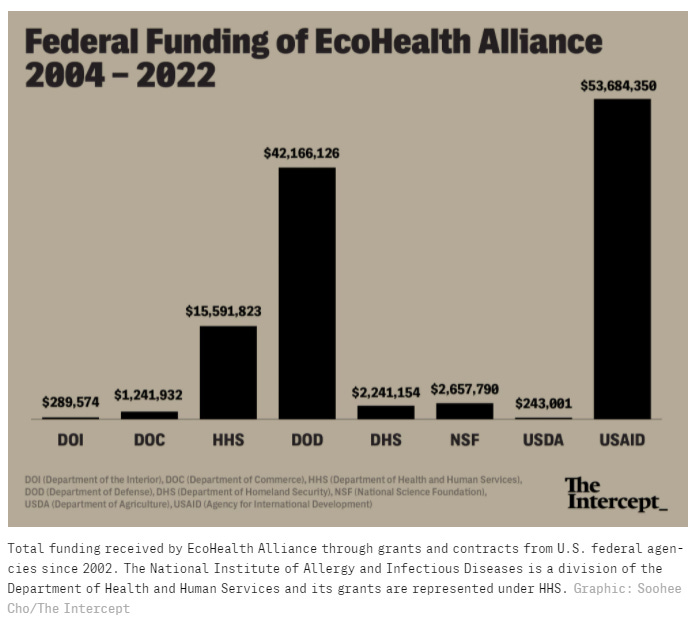
Source: The Intercept
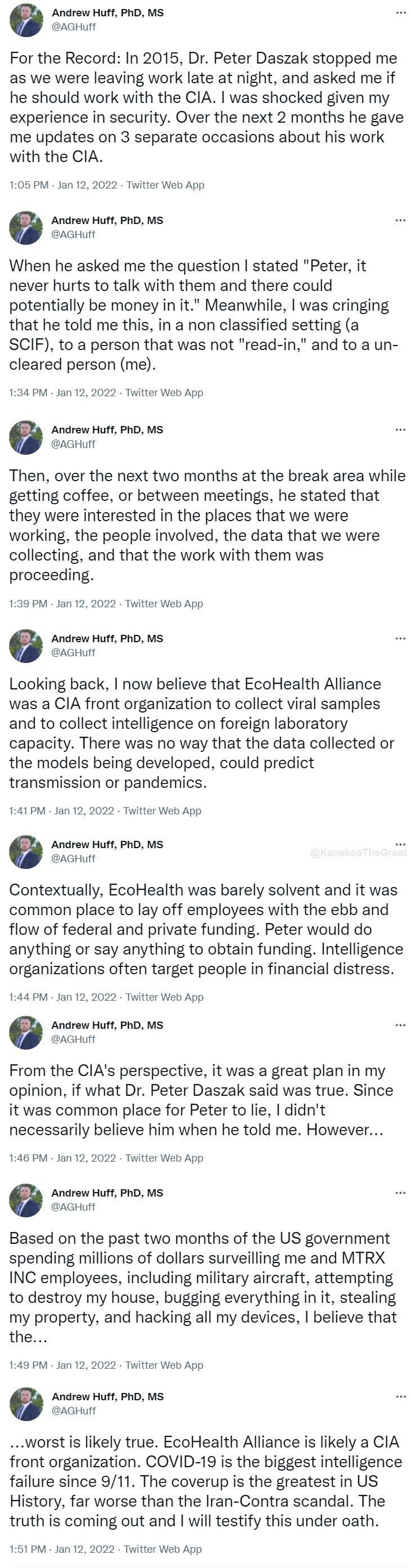
Dr. Andrew Huff received his Ph.D. in Environmental Health specializing in emerging diseases before becoming an Associate Vice President at EcoHealth Alliance, where he developed novel methods of bio-surveillance, data analytics, and visualization for disease detection.
On January 12, 2022, Dr. Andrew Huff issued a public statement (on Twitter) in which he claimed, Peter Daszak, the President of EcoHealth Alliance, told him that he was working for the CIA.
Dr. Andrew Huff’s full statement below:
Source: Dr. Andrew Huff
Dr. Huff continued, “… I wouldn’t be surprised if the CIA / IC community orchestrated the COVID coverup acting as an intermediary between Fauci, Collins, Daszak, Baric, and many others. At best, it was the biggest criminal conspiracy in US history by bureaucrats or political appointees.”
What exactly did they cover-up?
Peter Daszak’s EcoHealth Alliance—financed by USAID, DOD, and other U.S. Government agencies—partnered with Dr. Ralph Baric of the University of North Carolina and Dr. Shi Zhengli of the Wuhan Institute of Virology to conduct gain-of-function research on bat-borne coronaviruses.
Baric successfully created a “chimeric” coronavirus in 2015. There is a well-documented scientific paper trail that details how Dr. Baric and Dr. Zhengli continued to collaborate on gain-of-function research together to create what went on to be a potential precursor to the SARS-CoV-2 virus.
Dr. Anthony Fauci, Dr. Francis Collins, and Dr. Peter Daszak, who were proponents of this type of international collaboration on gain-of-function research were heavily incentivized to cover up the possibility of a lab origin because they previously had funneled U.S. taxpayer money to the Chinese lab.
At the start of 2020, there was a lot of chatter about where the virus SARS-CoV-2 actually originated from. Two papers published in March 2020—one in Nature Medicine and one in The Lancet—controlled the direction of the dialogue on the origin of the virus.
Both papers were repeatedly cited by Fauci, Collins, Daszak, the corporate media, and big tech as evidence to shut down and even censor any discussion of the possibility that the virus originated at the Wuhan Institute of Virology.
Only later through redacted emails released by FOIA did we learn that Fauci, Collins, and Daszak were intimately involved in crafting the two papers which dismissed the lab origin hypotheses as “conspiracy theory.”
In February 2020, Daszak told University of North Carolina coronavirus researcher Dr. Ralph Baric that they should not sign the statement condemning the lab-leak theory so that it seems more independent and credible. “You, me and him should not sign this statement, so it has some distance from us and therefore doesn’t work in a counterproductive way,” Daszak wrote.
More unredacted emails have revealed that while these scientists held the private belief that the lab release was the most likely scenario, they still worked to seed the natural origin narrative for the public through the papers published in Nature Medicine and The Lancet.
In April 2020, Daszak opposed the public release of Covid-19-related virus sequence data that has been gathered from China, as part of the U.S. Agency for International Development (USAID) PREDICT program because he said it would bring “very unwelcome attention” to the aforementioned “PREDICT and USAID” programs.

Source: U.S. Right To Know FOIA
In September 2020, scientists were outraged when Daszak was chosen to lead the World Health Organization task force examining the possibility that Covid-19 leaked from the Wuhan Institute of Virology.
Despite many clear attempts to cut off a legitimate scientific inquiry into the Wuhan lab origin hypothesis, the theory continued to persist predominantly due to the fact that the Chinese government was unable to provide a single shred of evidence in support of the natural origin theory.
In May 2021, the narrative turned when, Nicholas Wade, a former science reporter at the New York Times published his seminal column outlining the case for the Covid lab-leak theory.
For SARS1, an intermediary host species was identified within four months of the epidemic’s outbreak and the host of MERS was identified within nine months. Yet some 15 months after the SARS2 outbreak began, and a presumably intensive search, Chinese researchers had failed to find either the original bat population, or the intermediate species to which SARS2 might have jumped, or any serological evidence of a natural origin.
Every step of the way, Fauci, Collins, and Daszak have done everything in their power to obfuscate, mislead, and misinform the world about the possibility of SARS-CoV-2 originating at the Wuhan Institute of Virology.
If Dr. Andrew Huff is telling the truth, Fauci, Collins, and Daszak are not covering up the lab origin only for themselves, but also for the Central Intelligence Agency, the Department of Defense, and the U.S. Government.
Test, Jab, Boost, Repeat

By Jane M. Orient, M.D. – Association of American Physicians and Surgeons – January 13, 2022
Joe Biden introduced his “new” plan to save us from the dread coronavirus. He will provide 500 million “free” tests (paid for by taxpayers or with borrowed money); 1,000 National Guard troops to overstressed hospitals; and more pressure to get vaccinated and boosted.
According to the Kaiser Family Foundation, we would need 2.3 billion tests per month to test every person over age 12 twice per week at the recommended frequency of twice per week. What type of test, and where would we get them? Pharmacies are running out of home antigen tests. We have no data on the likelihood of false negative or false positive tests, but we do know that with any test, even very good ones, the vast majority of positive tests will be false positives if only a small percentage of the tested group is diseased. Also, tests may remain positive long after a person has recovered and is no longer infectious.
Can the tests harm? False positives lead to isolation with destruction of livelihoods and educational opportunities. We may be having an epidemic of false positive PCR tests. Using too high a cycle threshold, as some labs have routinely done, gives a meaningless result. And from your lab report, you cannot tell what cycle threshold was used.
It is possible that doing the test itself could be fatal. A few military members reportedly had infections with flesh-eating bacteria after getting swabbed, and some of the swabs were found to be contaminated. At least one patient got meningitis when a nasal swab was inserted too far.
Hospitals are indeed overstressed. According to a talk radio host, patients are dying in the halls and waiting room of a local hospital because of short staffing. Will 1,000 troops help? Mayo alone just fired 700 unvaccinated workers. An Ohio physician reported that the troops were causing chaos. They didn’t even know where supplies were kept, and after a 12-hour shift might be dispatched to another state before they had time to learn the local system. Under CMS waivers covering the declared emergency, minimally qualified personnel may be used. And now the most experienced and dedicated workers, the very ones most likely to exercise independent judgment and stand up for patients, are being culled.
Will more vaccines and boosters help? Biden asserts that it’s a “patriotic duty” to get jabbed, and more jabs are the only way to end the disaster. No matter how much respect you have for his mental abilities, he is likely quoting the American Medical Association. The jabs do not appear to be effective against the new variants, and might even be creating them. There is talk of a fourth shot—but apparently no stopping point for adverse effects such as myocarditis in children.
The U.S. has one of the worst records in the world for controlling COVID-19. Moreover, the most reliable source of statistics, insurance actuaries, shows that deaths in the prime working age group are up 40 percent, and disability claims are also up. A 10 percent increase would be the equivalent of a 200-year flood. The claims are not citing COVID-19 as a cause of death. They could be collateral damage from government policy, including poor medical care for virtually everything, or they could be from vaccination.
States are pushing back against the mandates, which are being imposed by executive order through unaccountable administrative agencies. The U.S. Supreme Court should be considering whether the administrative state has the constitutional or statutory authority to impose a medical dictatorship that overrides the states’ authority and citizens’ basic rights. Some Justices, however, seem to be taking the-end-justifies-the-means approach—and that based on egregiously erroneous information. For example, Justice Breyer asserted that there were 750 million cases (in a population of about 330 million) and Justice Sotomayor asserted that there were 100,000 hospitalized children (instead of fewer than 4,000, mostly not for COVID-19). The harms from the mandated vaccines were simply ignored.
Even if the “experts” Biden is relying upon, under the titular leadership of Anthony Fauci, were right this time, the precedent could grant unlimited power to a medical dictatorship to force disastrous policy on all Americans.
Instead of endlessly repeating failed policy, how about firing the generals who are in charge of the losing war?
Is The TAPI Pipeline Finally Ready To Go?
Zero Hedge | January 19, 2022
Submitted by James Durso, Managing Director of Corsair LLC, a supply chain consultancy.
The Turkmenistan–Afghanistan–Pakistan–India (TAPI) natural gas pipeline has been long aborning, but its prospects recently got a shot in the arm.
The 1100-mile, $10 billion project has seen numerous delays since the pipeline consortium was announced in late 2014, though the project was first mooted in 1991. Construction started in early 2018 with a projected in-service date of 2021, but halted later that year after workers clearing the route were killed by unknown assailants. Also, the project’s $10 billion cost estimate is a decade old, and an update may cause further delay to the Asian Development Bank-funded effort that is now slated to resume work in September 2022. Turkmenistan will loan Afghanistan the funds for its share of the project, to be repaid from gas transit revenues.
Representatives of the government of Tajikistan recently met officials in Afghanistan, and the Taliban announcement that it will dedicate 30,000 troops to pipeline security may motivate the parties to start construction.
The completed pipeline will allow Turkmenistan to reduce its reliance on its biggest gas customer, China, which has recently taken most of Turkmenistan’s gas exports, though in 2021 the country doubled its gas exports to Russia, which used to be the biggest importer of Turkmen gas until it was displaced by China in 2010. The pipeline will generate additional income that Ashgabat can use to improve services to citizens, a priority after the recent unrest in neighboring Kazakhstan.
But there may be competing opportunities. For example, Iran, Azerbaijan, and Turkmenistan recently signed a trilateral gas swap deal for up to 2 billion cubic meters (bcm) per year. It’s not a large amount – Turkmenistan exports about 40bcm to China every year – but it’s another income stream that should be managed with an eye to future growth. Then there’s the possibility of a connection to the proposed Trans-Caspian Pipeline (TCP) to supply Europe via the Southern Gas Corridor (SGC). Connecting to the SGC would require a 200-mile subsea pipe between Baku and Türkmenba?y, but may face opposition from Iran and Russia on (probably spurious) environmental grounds. Once the politics are resolved, the project would likely be cheaper and carry less of a security burden than the overland TAPI route, and build on the January 2021 agreement between Baku and Ashgabat to jointly develop the Dostluq (“friendship”) oil and natural gas field in the Caspian Sea.
For Afghanistan, the project would provide transit fees of about $500 million per year, along with an annual share of 500 million cubic meters of gas for the first ten years, ultimately increasing to 1.5 bcm per year.
For the Taliban government, a successful project would: demonstrate it can be a reliable partner in a major infrastructure project, employ demobilized Taliban troops so they don’t defect to the Islamic State or Al-Qaeda, earn revenue to pay for electricity imports (the country relies on imports for 78% of its power), demonstrate to China it is safe to invest in Afghanistan, and be an opportunity for cooperation with Pakistan despite the dispute over their shared border.
Of course, Kabul will have to figure out what to do with that natural gas, in addition to its one trillion cubic feet of reserves. The U.S.-driven development plan for the country emphasized renewables, like solar and wind, and the U.S.-funded $335 million Tarakhil Power Plant near Kabul, which relied on expensive, imported diesel fuel, is now used as a back-up facility when hydropower and imported power aren’t available. An International Finance Corporation-sponsored 59-megawatt gas-to-power plant in Mazar-i-Sharif would have boosted the country’s current total domestic generation by up to 30 percent, but can it be revived under the Taliban?
And time is of the essence as Uzbekistan recently reduced its power exports by 60%, possibly due to increased domestic demand as winter sets in, possibly to nudge Kabul (or the UN) to start paying the $90 million owed to power suppliers in Uzbekistan, Tajikistan, Turkmenistan, and Iran.
For Pakistan, the pipeline would help solve the country’s persistent energy shortfalls, such as the deficit between current gas production of 4 Billion Cubic Feet per Day (BCFD) against demand of 6 BCFD. By 2025, gas production is expected to fall to less 1 BCFD due to depletion of gas reserves while demand increases to 8 BCFD.
And Pakistan won’t have to wait to 2025 for an economic impact: Between 2008 and 2012, 40 percent of Pakistan’s textile sector moved to Bangladesh, one reason being the uneven supply of gas and electricity.
Then there’s Pakistan’s view of its regional interests and its endless search for “strategic depth.” The pipeline would be an independent source of revenue for Afghanistan, just when Pakistan feels the Taliban government should be beholden to it. And India would be able to increase the share of gas in its energy mix from 6.5% to 15%, possibly encouraging more trade between Kabul and New Delhi. To Islamabad, it will add to an already bad outcome: the ungrateful Taliban still aren’t helping Pakistan isolate the Tehreek-e-Taliban Pakistan, while India is expected to be the world’s fastest growing economy in 2022, according to the World Bank.
They say “all politics is local” and that may be the case here. One Pakistani observer, Hina Mahar Nadeem, noted the country’s gas shortfalls have a silver lining – for the interests that control the import of expensive liquefied natural gas (LNG). Accordingly, TAPI and the much-delayed (mostly by U.S. sanctions on Iran) Iran-Pakistan gas pipeline are a threat to their economic and political power.
In late 2020, Pakistan and Russia signed a deal to complete the 700-mile Pakistan Stream Gas Pipeline, to move LNG from Port Qasim (Karachi) to Kasur, in the Punjab. Pakistan may be treating with Russia to balance against China, or maybe the deal was decided on strictly dollars-and-cents terms. Regardless, this project may crowd out attention and funding for Pakistan’s phase of TAPI.
A richer energy mix and pipeline transit revenues would strengthen Pakistan as it negotiates new efforts with China under the umbrella of the China–Pakistan Economic Corridor. Pakistan’s leaders will need to strengthen their position vis-à-vis China while demonstrating to Beijing they are a reliable partner that will develop energy resources that can accommodate China’s projects. But first, those leaders must take on entrenched business and national security interests to successfully support TAPI, despite the economic benefits to its neighbors. But this assumes the country’s leaders aren’t captive (willing or otherwise) to their business confederates and the securicrats.
For India, TAPI would add to the country’s energy mix, propelling its impressive economic growth. India is the world’s third-largest energy consuming country, and has doubled energy use since 2000, with 80% of demand still being met by coal, oil and solid biomass. TAPI gas would allow India to use less coal, helping it meet its COP26 carbon emission goal, and satisfy increased energy demand by 2030 of 25% to 35% according to the International Energy Agency.
India has built a connection for TAPI at Fazilka at the Indo-Pakistan border in the Punjab region, a location on the border with Pakistan that may be subject to cross-border attacks by Pakistan-affiliated groups. Will Pakistan or its proxies be able to resist attacking such a key piece of infrastructure if India-Pakistan relations fail to improve?
For India, the best approach may be “wait and see” if the U.S. threatens sanctions against TAPI partners, whether the Taliban can prove they know how to govern and secure the country against the Islamic State and Al-Qaeda, and how serious is the announced Russia-Pakistan pipeline deal.
Where does this leave Turkmenistan?
It, too, should take it slow. It is no longer 2014, and it now has opportunities for increased swaps with Iran and Azerbaijan, and further opportunities with Iran may blossom if Tehran and Washington can secure a nuclear deal. The opportunity to connect to Europe via the TCP/SGC may present more revenue with fewer security concerns, or iffy partners like Pakistan and Afghanistan. Also, Washington needs to clear the way regarding sanctioned officials in Kabul, though the acting minister of defense, Mullah Muhammad Yaqub, who declared “I am directly responsible for and overseeing the security of the TAPI project” hasn’t been sanctioned by Washington… yet.
Washington might get behind TAPI in the wake of the recent deployment of Collective Security Treaty Organization peacekeeping troops to Kazakhstan, which has increased Russia’s clout in Central Asia. Increased revenue for Ashgabat that can be directed to services for its citizens may prevent the public unrest that gave Moscow an opening to intervene, and Turkmen leader Gurbanguly Berdimuhamedow may not need much convincing in this regard.
But it may serve Ashgabat well to ask Washington for a blanket sanctions exemption for all project principals and suppliers, and any government officials in the mix, to make it clear who bears responsibility if the project again fails to launch. If this happens, it will be a shabby way to treat ally India, and in Pakistan it will be interpreted as U.S. revenge against the country for supporting the Taliban.
The “push” of increased regional influence for Moscow and the “pull” of clean energy for ally India will hopefully make Washington green-light (or get out of the way of) the long-delayed project.
Fauci reports back to Davos that the US has a Covid “disinformation” problem

By Didi Rankovic | Reclaim The Net | January 18, 2022
The annual “globalization ball” in Davos is upon us once again and this year the virtual event has brought together figures such as Chinese President Xi Jinping and Dr. Anthony Fauci, the White House chief medical adviser, among others.
Xi opened the World Economic Forum (WEF) gathering with his address, while Fauci spoke later to focus on what he sees as “entirely destructive” Covid misinformation raging in the US.
A comprehensive public health endeavor is made impossible by this kind of misinformation, Fauci said. He should feel right at home at the Davos summit given his previous remarks about the need for radical changes in rebuilding the infrastructure of human existence – something reports see as close to the thinking of WEF’s own Klaus Schwab and his controversial musings found in the “Great Reset” initiative presented last year.
Fauci made those comments in 2020, in a paper he co-authored, titled, “Emerging Pandemic Diseases: How We Got to COVID-19,” calling for changes in human behavior and “other radical changes” in order to live “in greater harmony with nature,” which he appears to believe would stand in the way of future pandemics such as the never-ending one we are experiencing now.
He at the time proposed focusing on “a transformation” that will change human behavior by reducing crowding at home, work, and in public places, among other things.
But just as Fauci now once again insists that a dangerous online misinformation campaign is hampering efforts to combat the pandemic, more and more scientists and health officials are reversing course on policies, like lockdowns, vaccination, masking, and coronavirus origin. Until recently, skepticism of those would have been immediately branded as misinformation or worse still, a conspiracy theory.
Florida: Highest Rates of Infection Occurring in Counties with Highest Vaccination Rates
By Bill Rice | Uncover DC | January 17, 2022
The COVID infection rate for residents of Dade County, Florida Dec. 31 – Jan. 6 was 3,796 new “cases per 100,000 population”—a rate far higher than any other county in Florida, according to the Florida Department of Public Health. This is an eye-opening statistic as 94 percent of Dade County residents age five and over have now received at least one dose of the vaccine—a vaccination rate among the highest in the country and by far the highest rate in Florida.
If vaccines are indeed “effective” at preventing infection, one might expect residents of this county to have among the LOWEST rates of infection in the nation. Instead, the infection rate in Dade County was more than twice as high as the state average of 1,807.1 cases per 100,000 residents. In data updated this week (See pages 5-7), Dade County continued to lead the state by a wide margin with 3,217 cases per 100,000 compared to the new state average of 1,958/100k.
Indeed, an analysis of the past two weeks’ data shows that residents who live in Florida’s least vaccinated counties typically have the lowest rates of COVID infection. Among Florida counties that reported the lowest infection rates two weeks ago, the average vaccination rate was 48.6 percent compared to the state average of all Florida counties of 72 percent.
In general, Florida counties with the lowest vaccination rates had the lowest infection rates. The opposite was also true. The counties with the highest vaccination rates have recently experienced the highest infection rates.
While proponents of mandatory vaccines emphasize that vaccines are “effective” at preventing “severe cases and deaths,” months after “breakthrough cases” became omnipresent, the CDC website remains replete with references stating that vaccines are effective at preventing “cases” and “infections.” For example, language at CDC sites tells us…
“ … COVID-19 vaccines are effective at preventing most infections.”
“… The risk of infection remains much higher for unvaccinated than vaccinated people.”
“ … High vaccination coverage in a population reduces the spread of the virus and helps prevent new variants from emerging.”
The following analysis presents the rates of recent COVID infection in one American state on a county-by-county basis with vaccination rates included. Readers can make their own judgments as to why the most heavily vaccinated counties are having the largest rates of outbreaks or why counties with the lowest-vaccination rates are NOT leading the state in “new cases.”
Highest Rates of Infection in Florida per County Jan. 6 – 13th
The following data shows the Florida counties that had an infection rate of 2,000 or more cases per 100,000 population in the past week. Note: State-wide, 72 percent of Floridians age five and older have been vaccinated. The “infection rate” for the entire state this past week was 1958 cases/100k population.
County (Percent Vaccinated 5+): Cases per 100,000 population
Dade (94 percent): 3,217/100k
Broward (82 percent): 2,453/100k
Alachua (69 percent): 2,392/100k
Madison (51 percent): 2,239/100k
Osceola (80 percent): 2222/100k
Monroe (82 percent): 2,154/100k
Orange: (75 percent): 2,114/100k
Polk (65 percent): 2064/100k
Hendry (58 percent): 2060/100k
Jefferson (56 percent): 2029/100k
Highest Infection Rates by County Dec. 31 – Jan. 6
The NEGATIVE correlation between vaccination rates and “cases per 100,000” was even more striking the prior week (Dec. 31 – Jan. 6 report*). Note: The “Cases per 100,000” average for the week of Dec. 31 – Jan. 6 was 1807/100k.
County (Percent vaccinated 5+): Cases per 100,000
Dade (93 percent): 3,797/100k
Broward (82 percent): 2,560/100k
Monroe (82 perent): 2,272/100k
Osceola (80 percent): 2014/100k
Palm Beach (74 percent): 1,963/100k
Orange: (74 percent): 1,917/100k
Counties Under 50 Percent Vaccination in Florida—Recent Infection Rates…
Florida has 14 counties where fewer than 50 percent of the county’s population (age 5+) is vaccinated. Here are those counties with their infection rates per 100,000 population this past week (Jan. 7 – Jan. 13).
No Florida county with a vaccination rate under 50 percent experienced “case rates” equal to or above the state average for the week (1,958 cases per 100,000 population):
County (Percent vaccinated 5+): Cases per 100,000 population
Holmes (32 percent): 1677/100k
Liberty (37 percent): 1731/100k
Calhoun (38 percent): 973/100k
Hamilton (38 percent): 1509/100k
Suwanee (40 percent): 1357/100k
Washington (40 percent): 1720/100k
Dixie (41 percent): 1081/100k
Gilchrist (43 percent): 1103/100k
Lafayette (44 percent): 966/100k
Taylor (45 percent): 1586/100k
Jackson (46 percent): 1551/100k
Hardee (47 percent): 1940/100k
Columbia (47 percent): 1647/100k
Bradford (48 percent): 1353/100k
Florida Counties with Lowest Infection Rates
Of the 18 counties with the lowest infection rates in Florida last week, 14 had lower vaccination rates than the state average of 72 percent. The average infection rate (“cases per 100,000 population”) for all Florida residents was 1,958.1/100,000 of the population.
County (Percent vaccinated 5+): Infection rate per 100,000
Glades (53 percent): 790/100k
Sumter (76 percent): 913/100k
Lafayette (44 percent): 966/100k
Calhoun (38 percent): 973/100k
Lafayette (44 percent): 966/100k
Dixie (41 percent): 1081/100k.
Charlotte (74 percent): 1101/100k
Gilchrist (43 percent): 1103/100k
Walton (58 percent): 1200/100k
Flagler (69 percent): 1259/100k
St. Johns (73 percent): 1274/100k
Nassau (63 percent): 1337/100k
Manatee (68 percent): 1337/100k
Hernando (60 percent): 1339/100k
Bradford (48 percent): 1353/100k
Suwanee (40 percent): 1357/100k
Collier (76 percent): 1369/100k
Desota (58 percent): 1384/100k
The data was even more striking the previous week (Dec. 31 – Jan. 6). The 16 counties listed below, which had the lowest infection rates in the state during this week, averaged 607 “cases per 100,000 population”—which is 66 percent lower than the state average of 1807 cases per 100,000 population.
The average vaccination rate for these 16 counties is 48.6 percent—23.4 percent lower than the state average of 72 percent. Nine of the 16 counties below have vaccination rates below 50 percent. Three counties have vaccination rates below 40 percent.
The Florida Department of Health data from Dec. 31 – Jan. 6 also shows the “new case positivity’ rates per county. Of the 16 counties below, the average “new case positivity’ percentage was 23.95 percent. The state average for all Florida residents for this same week was 31.2 percent.
Lowest Infection Rates per County Dec. 31 – Jan. 6, 2022
County (Percent vaccinated 5+): Cases per 100,000 population
Lafayette (44 percent): 295.5/100k
Dixie (41 percent): 489.9/100k
Glades (52 percent): 534.2/100k
Putnam (49 percent): 540.9/100k
Gilchrist (43 percent): 543.4/100k
Sumter (76 percent): 599.3/100k
Liberty (37 percent): 633.7/100k
Union (54 percent): 644.7/100k
Levy (53 percent): 649.8/100k
Holmes (31 percent): 653.1/100k
Desoto (57 percent): 680.1/100k
Washington (39 percent): 708.7/100k
Franklin (53 percent): 715.7/100k
Taylor (45 percent): 720.5/100k
Walton (58 percent): 768.5/100k
Columbia (46 percent): 778.5/100k
*Numbers for Dec. 31 – Jan. 6 have now been replaced with more recent data. The author believes the information he presents above is accurate as of the date it was published.
Bill Rice, Jr. is a freelance journalist in Troy, Alabama. He can be reached by email at wjricejunior@gmail.com
Opposing Booster Shot Mandates and the Rest of the Coronavirus Crackdown at Universities
By Adam Dick | Ron Paul Institute | January 18, 2022
Across America in 2020, draconian restrictions were imposed in the name of countering coronavirus at just about every university, even though most college students, being relatively young and healthy, have been at very little risk of serious sickness or death from coronavirus.
Some people said “no thanks” to paying universities to harass and demean them with such restrictions, choosing, instead, to withdraw from or not enter college. Indeed, college enrollment in America is down over six percent — a loss of nearly a million students — since the Fall of 2019 semester that preceded the coronavirus scare. Other people grudgingly put up with the situation and tried to take advantage of opportunities they could find to experience some of the freedom universities were working hard to deny.
In the spring of 2021, many universities began announcing their plans to mandate students take experimental coronavirus “vaccine” shots. Some people hoped that the shots mandates would come with the permanent lifting of restrictions. But, at many universities it turned out to be just another requirement added on the pile.
Those shots mandates implemented by the fall of 2021 semester have been followed up at some of these universities with new mandates that the students take booster shots as well — booster shots that even European Union regulators and the World Health Organization are now advising against. The initial shots have proven ineffective and dangerous contrary to the insistence of politicians, big money media, and college administrators. The case for boosters of more of the same has become ludicrous.
Even if the shots were the miracle drug that was promised, in a free society the choice to take or not take this or other medical treatments would be left to individuals, not mandated. Over the last nearly two years of coronavirus crackdown, however, America has transitioned substantially farther from that free society ideal. Fortunately, some state and local governments have resisted this movement, and others that went along with it early on have reversed course, at least in part. This has led to the lifting of many restrictions, and the blocking of others including shots mandates, at some government-controlled universities. But, for many college students the coronavirus crackdown remains intense and threatens to grow with the addition of new mandates such as the mandate to take booster shots of the experimental coronavirus vaccines.
Students, as well as professors and other employees, at universities across America who want to challenge one of the latest additions to the coronavirus crackdown in higher education would do well to consider the strong arguments presented in a January 11 editorial by the editorial board of Chicago Thinker. The editorial presents a case against the University of Chicago’s recently announced mandate that students and employees, already required to have taken the initial coronavirus shots, take booster shots as well. The editorial board, comprised of University of Chicago students, presents in the editorial many well-reasoned arguments against the new mandate.
The editorial begins with the following statement before proceeding into detailed argument against the new mandate:
Per the University of Chicago’s newly announced booster mandate, all students and employees must obtain a booster shot by January 24. Those who do not comply will be barred from campus and restricted from attending in-person classes, among other activities.
This booster mandate is demonstrably unsafe, ineffective, unnecessary, inconsistent, and unethical. We’ve struggled beneath UChicago’s draconian COVID decrees for years, but the university’s booster mandate reaches a new height of absurdity.
UChicago Demands We Submit to Experimental Shots
UChicago claims to rely upon “expert” opinion in structuring its COVID regime. Yet, even advisory committees at the FDA and CDC initially declined to recommend the COVID booster for those under the age of 65.
The FDA’s Vaccines and Related Biological Products Advisory Committee made an official recommendation to approve Pfizer’s application for boosters only for those 65 and older and certain high-risk populations after rejecting, in a 16-2 vote, Pfizer’s application for broader approval for the general population. The committee cited a lack of data on potential adverse effects, particularly the risks of developing myocarditis and pericarditis.
However, the FDA chose to cast aside this concern and granted “approval” anyways. But even this “approval” is itself questionable. The FDA only granted approval to Comirnaty, a legally distinct version of the Pfizer-BioNtech vaccine that isn’t actually available in the United States. The version of the vaccine currently available in the US remains under Emergency Use Authorization, not formal approval.
Similarly, the CDC’s initial recommendation that Americans under the age of 65 receive boosters was made against the counsel of its own Advisory Committee on Immunization Practices, which voted to recommend boosters only for those over the age of 65 or who have underlying conditions. Director Rochelle Walensky overruled this vote in an unusual departure from agency protocol. The committee later reversed course, recommending a booster for 12-17 year olds. But the calculus behind its sudden 180-degree turn remains unclear, given that the initial concerns regarding myocarditis and pericarditis remain unresolved.
You can continue reading the Chicago Thinker editorial here.
Featured Video

Why the U.S. Should Pull Back From the First Island Chain
or go to
Aletho News Archives – Video-Images
Book Review
‘Why Fauci Must Rot in Prison’: A Tale of Two Diaries
By Jill Erzen | The Defender | October 13, 2026
Dr. Anthony Fauci’s private diary reveals a “mind-numbing” contradiction between what the former top U.S. infectious disease official knew about COVID-19 and what he told the public, senior White House adviser Peter Navarro, Ph.D., said last week on “American Thought Leaders.”
In his new book, “Why Fauci Must Rot in Prison,” due out Oct. 20, Navarro compares Fauci’s private entries to his own pandemic-era diary, and uses what he calls “a tale of two diaries” to argue that Fauci should face criminal prosecution.
“I show, actually, how a prosecution can and should happen … at the state level, most likely,” Navarro said. “He should wind up in prison, and we’ve got the receipts in this book to put him there.”
Navarro said Fauci repeatedly acknowledged important facts in private, then publicly pursued policies that contradicted those facts — with devastating consequences.
“What he says many times privately in his diary is so at odds with both his public behavior and public statements that it’s mind-numbing,” Navarro said.
Navarro examines the lasting damage caused by lockdowns and other pandemic policies, and the ongoing toll of long COVID.
His book also addresses questions about vaccine safety, including why healthy young people faced COVID-19 vaccination mandates despite concerns about myocarditis, and why women were not warned about miscarriage risks linked to the shots. … continue
Blog Roll
 Aletho News
- Jennifer Kavanagh: Why the U.S. Should Pull Back From the First Island Chain
- Yemen denounces international community’s silence on Saudi aggression, siege
- UAE and Saudi Arabia move toward renewed coordination against Sanaa
- How Iran’s two-week retaliatory strikes exposed cracks in US military architecture in Persian Gulf
- The mother of all propaganda: Why the hype over US MOAB strike against Iran is nothing but theater
- Iran says it possesses technology behind US 14-ton GBU bunker-buster
- Trump asks Iran not to retaliate after he strikes Pickaxe Mountain – w/ Prof. Marandi
- Vice President J.D. Vance’s Deceptive ‘Antiwar’ Campaign Speech
- Iran: Palestinians’ rights must not be compromised in Gaza’s future; US, Israel to blame for Hormuz situation
- Ongoing tales of Syrian chemical weapons
- If Americans Knew
- Israeli rabbi permits occupiers to steal Palestinian olive harvest in West Bank
- Netanyahu’s spin on latest settler attack is laughable – Daily Update
- Israeli soldiers debunk Israel’s talking points
- In West Bank, Israeli settlers are totally out of control – Daily Update
- NPR investigation finds evidence of widespread fraud at mall kiosks tied to Israeli skincare brand
- Tucker Carlson exposes Israeli Lies about the Oct 7th attack, Charlie Kirk, and the U.S.
- Israel has detained thousands of Palestinian children since Oct 7th – over half spent time in solitary, many uncharged
- Israeli Analysis: Is Netanyahu Planning an ‘October Surprise’ Attack Before Israel’s Election?
- Israeli settlers brutally attack Palestinians and Washington Post female photographer, 65
- Words Have Changed, Occupation Continues: The Reality of the Gaza Ceasefire
- No Tricks Zone
- Predictions Made By Renowned Climate Proifessor Over Past Decades Have Been Proven To Be Poor
- New Study Suggests Large Regions Of The Pacific Ocean Have Been Cooling For The Last 80 Years
- Germany’s Green Energy Debacle: High Energy Costs Force Kahla Porzellan to Close After 182 Years!
- New Study: 50 Years Of The Most Aggressive ‘Net Zero’ Policies Can Only Affect The Global Climate By 0.03°C
- US September “Heat” Was No Record…Many Records Set Decades Ago
- Latest European Green Energy Debacle; Portugal’s Largest Flagship Solar Park Insolvent!
- Green Energy Debacle: German Expert Professor Fritz Vahrenholt Warns Of Severe Economic And Social Consequences
- Two More Paleo Reconstructions Affirm Meters-Higher Sea Levels Across Ireland, Brazil 7000-6000 Years Ago
- New Study: Earth And Venus Surface Warmth Largely Explained By Convection And Lapse Rate, Not CO2 Or Radiation
- 2025 Nature Paper Claiming Worsening Global Drought Gets RETRACTED …Heavily Flawed

