Putin Has Biden’s Attention, Now What?

By Marko Marjanović | Anti-Empire | December 7, 2021
With the US raising alarm about a supposed Russian military buildup opposite of Ukraine, and the Russians denying anything out of the ordinary is taking place it is tempting to conclude that this is just more of the typical NATO scaremongering about Russia. Trouble is that I don’t believe that. On the contrary, I believe that something very serious is afoot.
The reason I think so isn’t that I have been listening to the Americans, but that I have been listening to the Russians. For years and years, the Russians have been complaining about the march of American & vassal missiles, training programs, weapon stockpiles, and units eastward. They have been complaining for so long that the picture of Russia as being all talk and never following up with real-world measures has become a meme among the more cynical Russia watchers.
Then, all of a sudden two things happened:
A.) Any and all talk of taking Donbass by force suddenly stopped in Ukraine. Instead, Kiev seems genuinely terrified it will be routed by the Russian military and is promising numerous Russian casualties (but tellingly not defeat) in a high-stakes attempt to deter the Russians.
B.) Biden initiated security talks with Vladimir Putin days after regime press revealed that something about the Russian military posture sent Washington into panic mode.
That tells me that the Russians finally did something that got Washington’s full attention. I don’t know what they did. Maybe it was the buildup opposite of Ukraine, maybe it was something else that we’re not being told about. Maybe it doesn’t even matter that much.
What does matter is that the Russian expectations of anything coming out of the initial Biden-Putin talk are nil. That means the Russian pressure — whatever it is — will continue.
The Russians aren’t going to be bought out by talks. They held talks with Biden in the Spring, and these were followed up by more provocations in the Summer. Now they want real, tangible appeasement. They have spelled out as much.
Trouble is, between the characteristic fecklessness and cowardice of the White House (whoever it is occupied by), and the vested Cold War interests I have no idea how they get that.
Any American president who works out a deal with the Russians and removes a missile or two will be denounced as “weak” by all the other institutions of the American Empire which stand to lose from peace, and which together are more powerful than a weak-willed presidency.
In reality, it is just the opposite, it is precisely the weakness of American presidents which makes a good deal with Russia impossible. What is better for the American and, say, the Romanian people, having some US missiles in the land of Dracula, or peace in Europe? Obviously the latter. But any president who concedes as much will face resistance and sabotage by the Pentagon, the CIA, NATO, the posturing Congress, the liberal-interventionist State Department, the think tanks, and the media.
Honestly, I have no idea how Putin, Shoigu, and Lavrov get the security guarantees that they want out of this one. If they succeed they are infinitely better strategists than I.
Let’s say it has indeed been a buildup opposite of Ukraine that forced the Americans to the table, now what?
There is no doubt that if Moscow is willing to sustain the cost in lives and in sanctions (and in Ukrainian bitterness and enmity) that the Russian military can take most of Ukraine.
The Russian military is larger than the Ukrainian one and has more firepower per pound, The two also share a long flat border — there are no convenient bottlenecks. The Russians can force the Ukrainian military to stretch out over a long frontline, pin it down in place, then apply defeat in detail to sectors with maneuver and firepower one by one.
Kiev is just 400 kilometers from the Russian border, and the Americans have already said — in so many words — that direct US military intervention almost certainly isn’t on the cards.
Trouble is this. If the DC Empire and the Ukraine were one organic being then guaranteeing the Russians a missile status quo in return for the Russians not overruning Kiev would be an absolute bargain. Problem is that, not only are the Empire and the Ukraine not a single entity, but the American Empire itself is a hydra with many heads, most of which stand only to gain from a Russian war in the Ukraine.
The White House is the only imperial institution that stands something to lose, namely prestige for having failed to deter the Russians. However, it also stands to lose by being painted as appeasing Moscow so it’s something of a moot point.
In all other respects, the Empire and its institutions stand only to gain. NATO can get a huge lease on life, Pentagon could be looking at the return of full US divisions to Europe, and the European vassals would be more regimented behind the US than ever before. As the cherry on top Russia would be left with the odd problem of policing and rebuilding Ukraine — while under a total Western economic embargo. Perhaps the biggest “win” of all would be the endless opportunity for moral condemnation of Russia over its treatment of “subjugated” Malaya Rus’.
So again, I think Russia can relatively easily occupy land in Ukraine, I just don’t know how it can trade pieces of that land in return for NATO guarantees to stop carrying out provocations that are in its self-interest.
The problem is that Russia enjoying peace and stability on its borders is in Russia’s interest but it is not in NATO’s interest. Why do you think that Russia was willing to strong-arm Donbass into abiding by the Minsk Agreement but the West never applied pressure on Kiev to do the same? Because ultimately fighting Russia to the last Ukrainian and seeing the Russian-Ukrainian enmity deepen is the stuff of dreams for NATO.
Putin to Biden: Finlandize Ukraine, or We Will
By Patrick J. Buchanan | December 7, 2021
Neocons and Republican hawks such as the late John McCain sought to bring Ukraine and two other ex-Soviet republics, Georgia and Moldova, into NATO. Putin, who served in the KGB in the late Soviet era and calls the breakup of the USSR the “greatest geopolitical catastrophe” of the 20th century, is now saying: Enough is enough.
Either the U.S. and NATO provide us with “legal guarantees” that Ukraine will never join NATO or become a base for weapons that can threaten Russia — or we will go in and guarantee it ourselves.
This is the message Russian President Vladimir Putin is sending, backed by the 100,000 troops Russia has amassed on Ukraine’s borders.
At the Kremlin last week, Putin drew his red line:
“The threat on our western borders is … rising, as we have said multiple times. … In our dialogue with the United States and its allies, we will insist on developing concrete agreements prohibiting any further eastward expansion of NATO and the placement there of weapons systems in the immediate vicinity of Russian territory.”
That comes close to an ultimatum. And NATO Secretary General Jens Stoltenberg backhanded the President of Russia for issuing it:
“It’s only Ukraine and 30 NATO allies that decide when Ukraine is ready to join NATO. … Russia has no veto, Russia has no say, and Russia has no right to establish a sphere of influence trying to control their neighbors.”
Yet, great powers have always established spheres of influence. Chinese President Xi Jinping claims virtually the entire South China Sea that is bordered by half a dozen nations. For 200 years, the United States has declared a Monroe Doctrine that puts our hemisphere off-limits to new colonizations.
Moreover, Putin wants to speak to the real decider of the question as to whether Ukraine joins NATO or receives weapons that can threaten Russia. And the decider is not Jens Stoltenberg but President Joe Biden.
In the missile crisis of 60 years ago, the U.S., with its “quarantine” of Cuba and strategic and tactical superiority in the Caribbean, forced Nikita Khrushchev to pull his intermediate-range ballistic missiles, which could reach Washington, off of Fidel Castro’s island.
If it did not do so, Moscow was led to understand, we would use our air and naval supremacy to destroy his missiles and send in the Marines to finish the job.
Accepting a counteroffer for the U.S. withdrawal of Jupiter missiles from Turkey, Khrushchev complied with President John F. Kennedy’s demand. Russia’s missiles came out. And Kennedy was seen as having won a Cold War victory.
Now it is we who are being told to comply with Russia’s demands in Ukraine, or Russia will go in to Ukraine and neutralize the threat itself.
The history?
When the Warsaw Pact collapsed and the USSR came apart three decades ago, Russia withdrew all of its military forces from Central and Eastern Europe. Moscow believed it had an agreed-upon understanding with the Americans.
Under the deal, the two Germanys would be reunited. Russian troops would be removed from East Germany, Poland, Czechoslovakia, Hungary, Bulgaria and Romania. And there would be no NATO expansion into Eastern Europe.
If America made that commitment, it was a promise broken. For, within 20 years, NATO had brought every Warsaw Pact nation into the alliance along with the former Soviet republics of Lithuania, Latvia and Estonia.
Neocons and Republican hawks such as the late John McCain sought to bring Ukraine and two other ex-Soviet republics, Georgia and Moldova, into NATO.
Putin, who served in the KGB in the late Soviet era and calls the breakup of the USSR the “greatest geopolitical catastrophe” of the 20th century, is now saying: Enough is enough.
Translation: “Thus far and no further! Ukraine is not going to be a member of NATO or a military ally and partner of the United States, nor a base for weapons that can strike Russia in minutes. For us, that crosses a red line. And if NATO proceeds with arming Ukraine for conflict with Russia, we reserve the right to act first. Finlandize Ukraine, or we will!”
The problem for Biden?
In Ukraine and in Georgia, as we saw in the 2008 war, Russia has the tactical and strategic superiority we had in 1962 in Cuba. Moreover, while Ukraine is vital to Russia, it has never been vital to us.
When President Franklin D. Roosevelt recognized Joseph Stalin’s USSR in 1933, Moscow was engaged in the forced collectivization of the farms of Ukraine, which had caused a famine and the deaths of millions. We Americans did nothing to stop it.
During the Cold War, America never insisted on the independence of Ukraine. Though we celebrated when the Baltic states and Ukraine broke free of Moscow, we never regarded their independence as vital interests for which America should be willing to go to war.
A U.S. war with Russia over Ukraine would be a disaster for all three nations. Nor could the U.S. indefinitely guarantee the independence of a country 5,000 miles away that shares not only a lengthy border with Mother Russia but also a history, language, religion, ethnicity and culture.
Forced to choose between accepting Russia’s demand that NATO stay out of Ukraine and Russia going in, the U.S. is not going to war.
Biden should tell Putin: The U.S. will not be issuing any NATO war guarantees to fight for Ukraine.
Russia reveals what Putin asked of Biden
RT | December 7, 2021
In a “frank and businesslike” conversation Russian President Vladimir Putin asked his US counterpart Joe Biden for guarantees that NATO won’t expand further east or deploy offensive weapons to countries like Ukraine.
Moscow is “seriously interested” in obtaining “reliable and firm legal guarantees” excluding NATO’s further expansion eastward and deployment of “offensive strike weapons systems in countries adjacent to Russia,” the Kremlin said in a readout of Tuesday’s call between the two leaders.
Putin’s proposal came in response to Biden’s “concerns” about Russian troops allegedly threatening Ukraine and threats of US and allied sanctions against Russia, a subject that arose during the two-hour call. The Russian leader responded that it was NATO “making dangerous attempts to conquer Ukrainian territory” and “building up its military potential at our borders.”
When asked about this, Biden’s national security adviser Jake Sullivan said that the US has made “no such commitments or concessions.”
Putin used specific examples to illustrate the “destructive” policy of Kiev, which he said was aimed at completely dismantling the Minsk agreements and the ‘Normandy format’ talks. He also expressed Moscow’s serious concerns about “provocative actions” by the government in Kiev against the residents of Donetsk and Lugansk, two breakaway regions in eastern Ukraine.
Last week, before the date of the meeting was announced, Deputy Foreign Minister Sergey Ryabkov said that the situation in Europe would be at the top of the agenda for the two leaders to discuss. The diplomat stressed that “contact is badly needed; we have multiplying problems. There is no progression on bilateral affairs, which are more and more spiraling into a phase of acute crisis.”
The talks come amid heightened tensions between Washington and Moscow over the situation on the Russian-Ukrainian border, which the White House has signaled as a key area on which bilateral negotiations are needed.
American and Ukrainian officials have repeatedly accused Russia of plotting to invade its neighbor in recent weeks. Earlier this month, US Secretary of State, Antony Blinken implored Moscow to de-escalate its purported aggressions against Kiev, or face “severe consequences.”
Russia has repeatedly denied allegations put forward by Western officials and outlets that it will launch an offensive against Ukraine. Kremlin press secretary Dmitry Peskov has blasted the accusations as groundless, dubbing them as “hysteria” whipped up in the Anglophone and Ukrainian media.
Meanwhile, Ukraine’s hopes to be admitted to NATO and the potential eastwards expansion of the US-led military bloc have been a point of contention for Moscow. Ahead of the video conference, the Russian president announced that he will request discussions with NATO to ensure the US-led military bloc does not edge closer to his country’s frontiers. Speaking last week, Putin said that he will “insist on guarantees being set out to exclude the possibility of NATO moving any further to the east, and deploying threatening weapons close to Russian territory.”
Foreign Minister Sergey Lavrov noted the day before that “significant units and armaments from NATO countries, including American and British, are being moved closer to our borders.”
The pair last met in the Swiss city of Geneva in June. The meeting was hailed as productive by the two heads of state, covering topics such as nuclear proliferation and managing the Covid-19 pandemic. However, the Kremlin said that it will take a long time for constructive engagement to return and the two sides have recently accused each other of escalating military tensions in Eastern Europe.
Fossil Fuel Restriction Dam Starting To Break
By Francis Menton | Manhattan Contrarian | December 4, 2021
Somewhere a couple of decades or so ago, the rich parts of the world embarked on a program of replacing energy from fossil fuels (coal, oil, natural gas) with energy from intermittent “renewables” (mainly wind and solar). In trendy academic, journalistic, and otherwise progressive circles, the idea took hold that this was the way to “save the planet.” This program was undertaken without any detailed engineering study of how or whether it might actually work, or how much it might cost to fully implement. In the trendy circles, there took hold a blind faith in the complete ability of the government, by dispensing taxpayer funds, to order up whatever innovation might be needed to move us forward to this energy utopia.
The latest UN-orchestrated effort to implement the renewable energy program, known as COP 26, has just broken up. To read the verbiage emanating from the affair, all is on track, if a bit slower than one might have hoped.
But I have long predicted that this program would come to an end when (absent some miraculous innovation that nobody has yet conceived) the usage of the renewables got to a sufficient level that their costs and unworkability could not be covered up any longer. Until very recently the pressure of elite groupthink has been able to maintain a united front of lip service to the cause. But consider a few developments from the past few weeks, just since the end of COP 26:
Japan
Japan tends to keep its head down in international affairs, and at COP 26 signed on to the happy talk group communiqués without raising any particular issues. But there is no getting around that Japan has the third largest economy in the world — after the U.S. and China, and larger than any European country — so its actions in energy policy are inherently significant. Also, Japan has relatively little energy production of its own, is heavily dependent on imports, has harsh winters, and has a growing Chinese military and economic threat right on its doorstep. Is Japan really going to trust its fate to intermittent wind and solar energy?
On December 1 Bloomberg reported: “Japan Is Backing Oil and Gas Even After COP26 Climate Talks.” It seems that this rather significant country may be seriously re-thinking the move away from fossil fuels. Excerpt:
Government officials have been quietly urging trading houses, refiners and utilities to slow down their move away from fossil fuels, and even encouraging new investments in oil-and-gas projects, according to people within the Japanese government and industry, who requested anonymity as the talks are private.
What is motivating Japan to break from the world groupthink? According to the Bloomberg piece, the main motivator is security of energy supply — which wind and solar obviously cannot provide:
The officials are concerned about the long-term supply of traditional fuels as the world doubles down on renewable energy, the people said. The import-dependent nation wants to avoid a potential shortage of fuel this winter, as well as during future cold spells, after a deficit last year sparked fears of nationwide blackouts. . . . Japan’s Ministry of Economy, Trade and Industry declined to comment directly on whether it is encouraging industries to boost investment in upstream energy supply, and instead pointed to a strategic energy plan approved by Prime Minister Fumio Kishida’s cabinet on October 22. That plan says “no compromise is acceptable to ensure energy security, and it is the obligation of a nation to continue securing necessary resources.”
(Emphasis added.). Well, if “no compromise is acceptable” on “energy security,” that pretty much rules out principal reliance on wind and solar for powering the Japanese economy, at least until some magical new inventions come along.
United States
In the U.S., Republicans have only very gradually caught on to the idea that fossil fuel restrictions in the name of “climate” are becoming a political liability for the Democrats. Up to now, there have been some politicians willing to speak out in opposition to such restrictions, but little in the way of concrete steps taken in opposition. Meanwhile, the Biden administration continues to move forward with initiatives at the SEC, Treasury Department and Federal Reserve to pressure banks and other financial institutions to reduce their participation in the fossil fuel industries.
So this is a big development: On November 22, a coalition of state treasurers sent a letter to large financial institutions threatening to end relationships, including the deposit of state and pension funds, with institutions that cut off financing for the coal, oil and natural gas industries. National Review reports in a November 22 piece headlined “Fifteen States Respond to ‘Woke Capitalism,’ Threaten to Cut Off Banks That Refuse to Service Coal, Oil Industries.” Excerpt:
A coalition of financial officers from 15 states sent a letter to the U.S. banking industry on Monday warning they plan to take “collective action” against banks that adopt corporate policies to cut off financing for the coal, oil, and natural gas industries. . . . The letter puts the financial institutions that have “adopted policies aimed at diminishing a large portion of our states’ revenue” on notice, saying the banks have “a major conflict of interest against holding, maintaining, or managing those funds.”
According to the NR piece, the state treasurers signing on to the letter include those from West Virginia, Arizona, Arkansas, Idaho, Louisiana, Missouri, Nebraska, North Dakota, South Carolina, South Dakota, Utah, Wyoming, Alabama, Texas and Kentucky. Recipients of the letter included JPMorgan Chase, Bank of America, Wells Fargo, Citigroup, and Goldman Sachs. Between the states’ own accounts and their pension funds, the amounts at issue would be well into the multiple hundreds of billions of dollars, if not approaching a trillion.
Meanwhile, over in Europe . . .
Another Bloomberg piece, this one from November 28, describes the sense of impending doom hanging over Europe with the combination of low natural gas supplies, price spikes, and complete inability to coax more production out of proliferating and essentially useless wind and solar generators. The headline is “Europe’s energy crisis is about to get worse as winter arrives.” Excerpt:
The situation is already so dire this early in the winter season because of a blistering rally in natural gas prices. Stores of the fuel, used to heat homes and to generate electricity, are lower than usual and are being depleted quickly. Analysts have warned that gas stores could drop to zero this winter if cold weather boosts demand. Rolling blackouts are a possibility, warned Jeremy Weir, chief executive officer of Trafigura Group, a Swiss commodity trading house on Nov. 16.
And then there’s this comment:
“If the weather gets cold in Europe there’s not going to be an easy supply solution, it’s going to need a demand solution,” said Adam Lewis, partner at trading house Hartree Partners LP.
I think that a “demand solution” means some combination of either blackouts or intentionally cutting people off and, I guess, leaving them to freeze. The “supply solution” mentioned by Lewis would be allowing fracking in the extensive shale formations underlying Western Europe. Such fracking is currently banned. Even if those bans were lifted today, it would be way too late for this winter. … Full article
The last time tony fauci was pushing masks for disease mitigation he was making up his facts and scare mongering too
el gato malo – bad cattitude – december 6, 2021
many of you are probably too young to remember the AIDS panic of the 80’s.
but when it came out, the NIH, with tony fauci leading the charge, was getting literally everything wrong.
they pushed a narrative of fear, vilified the infected, interfered with the development and adoption of effective treatments, and completely misrepresented spread and mitigation.
it’s how we wound up with absolute garbage like this ad:

it’s probably pretty jarring to see, but this is because you now have perspective. at the time, A LOT of people believed this. fear of getting AIDS from public toilet seats was a very real thing. fear of getting AIDS from casual contact or sharing dining or cooking facilities was a very real thing. people worried they might be sitting near a gay person on a bus. the “moral majority” of dingbat tele-evangelists thundered about it daily.
and then, as now, one jumped up bureaucrat with no idea what he was talking about was running around like chicken little screaming of falling skies and grandstanding about non-existent risks to children.
the fact that it was literally the same guy who is still at it should deeply embarrass us all.
i urge you to watch the video and hear him, in his own words. because this is who tony fauci was, and he has not gotten better. he’s just become more powerful and more nastily manipulative and narcissistic.

the appalling inaccuracy and vicious othering of the AIDS campaign is still his bread and butter play. it’s what tony does. only the scale and scope of power has changed.
one day, 20 years from now, people will look back on these rushed and slipshod vaccine approvals and mandates for products that are not at all suited to task and claims about masks and lockdowns and feel sick to their stomachs.
they will not be able to believe how such pseudoscience and rapacious world wrecking doctrine not only got foisted upon the world, but accepted and cheer led by it.
they will, in the light of perspective, marvel that the same man who convinced us that our kids would get AIDS from being near a gay teacher was allowed to generate pretext to close the schools to “protect” children from a disease that poses them almost no risk, a disease they do not contract nor spread serious cases of.
they will be appalled by the suggestion that a non-sterilizing vaccine was forced on them even after the fact that the vaccine does not mitigate spread was known and despite a towering and dangerous adverse events profile that rendered it a clearly of negative benefit to cost proposition to the young and healthy.
in short, they’ll feel just like you probably did looking at that AIDS ad.
think very carefully about just who you are choosing to trust here.
these “experts” do not have track records of being correct or even of being honest.
check the date on this:

they told you not only that these vaccines would stop spread, but that they literally changed the definition of “herd immunity” so that it could ONLY be achieved by vaccines.
then the vaccines failed to stop spread, likely made it worse, and they doubled down on “you need to get vaxxed” in spite of this, pivoting to this bizarre new take of “you need to get vaxxed to save hospital space” which, of course, is ALSO not working. now they want boosters. soon it will be “variant boosters.” if you don’t think annual covid shots are coming, you probably fell for the “did you know the word gullible is not in the dictionary?” trick. twice.
this is not “changing your views when new facts arise” this is “finding new justifications for doing the same thing despite the facts being 180 degrees opposite to what you claimed.”
this is not science, it’s scientology.
it’s the same people making the same mess.
isn’t it about time we broke this cycle?
food for thought.
What’s Left? How Greenwald, Covid and Rittenhouse Exposed a Plague Among Progressives
By Riva Enteen | MintPress News | December 1, 2021
Caitlin Johnstone asserts that “[t]he most significant political moment in the U.S. since 9/11 and its aftermath was when liberal institutions decided that Trump’s 2016 election wasn’t a failure of status quo politics but a failure of information control.” Since Trump’s election, information control contributes to why those critical of Democrats are called Trump sympathizers. Journalist Paul Street epitomizes this tendency, seeming to speak for many who equate any criticism of Democrats with support for Trump and his policies. To the extent that this attitude serves to obstruct political dialogue and struggle, it does not serve us well — especially in these dark times, when we must pull our forces together to overcome the challenges we face.
Street’s CounterPunch article, “Glenn Greenwald is Not Your Misunderstood Left Comrade,” obstructs political dialogue and struggle. He gives no substantive rebuttal to a Greenwald article that declares “grotesque” the sight of “masked servants and unmasked elite at the New York Met Gala.” In a classic ad hominem attack, since Street couldn’t summon up an intelligent response, he just hurled insults. Sadly, this is what currently passes for political debate.
Compasses, nautical and political, are known to stop working in the vicinity of a strong electro-magnet. What has happened to our political compass? Street declares, “Glenn Greenwald is not a man of ‘the Left’ (or whatever’s left of ‘the Left’).” What does “Left” mean, post-Trump? The once-reliable compass seems now to be spinning wildly, as the political magnetic field does a headstand.
Street asserts that “Greenwald broke on through to the wrong side during the Trump years, so clouded by his understandable contempt for liberal and Democratic hypocrisy, corporatism, and imperialism as to become a willing accomplice of the white nationalist right.” Greenwald’s tireless and meticulous debunking of Russiagate has cast him as a Trump sympathizer to people like Street. Remarkably, many on “the Left,” still believe Russia did it, though the recent indictment of Hilary Clinton’s lawyer and arrest of the principal source of the bogus Steele dossier should put any such notion to rest.
Street snidely discounts Greenwald’s stated reason for leaving The Intercept — that “The Intercept’s editors, in violation of my contractual right of editorial freedom, censored an article I wrote this week, refusing to publish it unless I remove all sections critical of Democratic presidential candidate Joe Biden, the candidate vehemently supported by all New York-based [Intercept] editors involved in this effort at suppression.” Instead he claims that Greenwald, having submitted “a piece that tried to advance Trump campaign propaganda against Joe Biden on the eve of the 2020 presidential election,” regarded himself as “too good to be edited.” He lambasts Greenwald for being, as he put it, “all over the Hunter Biden-New York Post-deep state laptop story, even after CNN published an article titled “New Proof Emerges of the Biden Family Emails: a Definitive Account of the CIA/Media/BigTech Fraud.” Yet, even CNN recognized the bombshell.
Smelling (and finding) the rat
The World Socialist Website, in sync with Street’s “analysis,” calls Greenwald a “sly fascism-denier” who, Street says, “has creepily thrown in with the white nationalist right.” Why? Because in his impeccably documented piece, “FBI Using the Same Fear Tactic From the First War on Terror: Orchestrating its Own Terrorism Plots,” Greenwald discussed the plot to kidnap Michigan Governor Whitmer. He concludes:
There was no way to avoid suspicions about the FBI’s crucial role in a plot like this absent extreme ignorance about the bureau’s behavior over the last two decades, or an intentional desire to sow fear about right-wing extremists attacking Democratic Party officials one month before the 2020 presidential election.
Greenwald was one of the few who smelled a rat in the Michigan kidnapping story and, after serious investigative journalism, he found the rat.
In sum, the FBI devised this plot, was the primary organizer of it, funded it, purposely directed their targets to pose for incriminating pictures that they then released to the press, and then heaped praise on themselves for stopping what they themselves had created. The Wall Street Journal’s headline declares “In Michigan Plot to Kidnap Governor, Informants Were Key,” yet Jan 6 is declared an attempted coup.
In spite of such headlines from the Wall Street Journal, Street says Greenwald “downplays the seriousness of the fascist-putschist Capitol Riot of January 6, 2021.” This doesn’t sound like downplaying to me: “Of course the FBI was infiltrating the groups they claim were behind these attacks,” Greenwald reported, concluding, “yet the suggestion that FBI informants may have played some role in the planning of the January 6 riot was instantly depicted as something akin to, say, 9/11 truth theories or questions about the CIA’s role in JFK’s assassination.”
Street claims Greenwald has a “curious alignment with the white-nationalist neofascist Donald Trump and the January 6 marauders in their purported struggle with ‘the deep state.’” Marauders or the FBI? Does Street not believe that a “Deep State” exists? Greenwald’s article “Questions About the FBI’s Role in 1/6 Are Mocked Because the FBI Shapes Liberal Corporate Media” is subtitled “The FBI has been manufacturing and directing terror plots and criminal rings for decades. But now, reverence for security state agencies reigns.”
In a widely praised TED Talk, Trevor Aaronson states: “There’s an organization responsible for more terrorism plots in the United States than al-Qaeda, al-Shabaab and ISIS combined: The FBI.” So why are Street, the World Socialist Website, Counterpunch, and many others well-versed in COINTELPRO tactics, now swallowing FBI words whole and calling people Trump fascists for raising the issue of possible FBI involvement in the January 6 riot?
Street claims that Greenwald “defends Trump and other Amerikaner neofascists against the ‘censorship’ of their supposed free speech right to spew sexist, nativist, and white power hatred on Twitter and Facebook.” An article I wrote about the new reality police revealed that Media Alliance, a San Francisco organization founded in 1976 to be mainstream media watchdogs, circulated a petition after Jan. 6 that says: “Facebook should create a circuit breaker to help prevent dangerous disinformation and incitements to violence from ever reaching a mass audience…”
That good minds sincerely believe Silicon Valley executives should be the gods of truth in today’s world makes Orwell look cheerily optimistic. Yet shockingly, many people agree with the unprecedented censorship of a former president. Nixon, even after his impeachment and resignation, was never gagged as Trump is. As a former constitutional lawyer, Greenwald addressed concerns of Silicon Valley censorship in his article “Congress Escalates Pressure on Tech Giants to Censor More, Threatening the First Amendment.” Greenwald believes House Democrats are getting closer to the constitutional line, if they have not already crossed it.
Visceral hatred and rational discourse
Greenwald recently wrote several pieces on COVID as well, one announcing that he was eagerly vaccinated. However, his questions about the cost-benefit analysis missing from the COVID debate and his support of the position taken by NBA star Jonathan Isaac have Street condemning him for “failing to mention the horrific, anti-science, COVID-fueling and pandemo-fascist anti-masking and anti-vax practices, policies, and politics of the Amerikaner Party of Trump (the Republicans).”
An article titled “Forced Vaccination Was Always the End Game” — from the non-profit National Vaccine Information Center, which advocates for informed consent protections in medical policies and public health laws — reports that breakthrough COVID infections, hospitalizations, and deaths in fully vaccinated people are on the rise; individuals who have recovered from the infection have stronger natural immunity than those who have been vaccinated; and officials at the World Health Organization now say that the SARS-COV-2 virus is mutating like influenza and is likely to become prevalent in every country, no matter how high the vaccination rate. Yet, in spite of such growing perspective, Greenwald’s piece supporting the NBA’s Isaac is subtitled, “It is virtually a religious belief in the dominant liberal culture that people who do not want the COVID vaccine are stupid, ignorant, immoral and dangerous.”
In a separate article, titled “The ACLU, Prior to COVID, Denounced Mandates and Coercive Measures to Fight Pandemics,” Greenwald writes that the “ACLU prior to its Trump-era transformation” had one primary purpose: to denounce as dangerous and unnecessary attempts by the state to mandate, coerce, and control in the name of protecting the public from pandemics. The ACLU report cites important lessons from American history:
… vivid reminders that grafting the values of law enforcement and national security onto public health is both ineffective and dangerous. Too often, fears aroused by disease and epidemics have justified abuses of state power. Highly discriminatory and forcible vaccination and quarantine measures adopted in response to outbreaks of the plague and smallpox over the past century have consistently accelerated, rather than slowed, the spread of disease, while fomenting public distrust and, in some cases, riots.
Greenwald legitimately questioned the ACLU’s about-face from the pre-Trump era to its current position, pointing out how the ACLU tweeted that “[f]ar from compromising them, vaccine mandates actually further civil liberties.” Yet Street lauds the ACLU’s current position.
Many ask, as one article puts it, “Why Does Glenn Greenwald Keep Appearing on Tucker Carlson’s Show?” The question I keep asking, but get no answer to, is why Greenwald, Tulsi Gabbard, Aaron Maté, Matt Taibbi, Max Blumenthal, and Jimmy Dore can appear only on Fox. Why are they not invited onto “liberal” MSNBC or CNN, let alone Democracy Now? The apparent answer is that the dominant, ubiquitous paradigm, which cannot be challenged, is “don’t go after the Democrats.”
Much like Julian Assange, Greenwald began to be condemned by liberals only post-Trump. The liberal visceral hatred of Donald Trump has trumped rational discourse. If there were true rational discourse, Julian Assange would not be suffering in Belmarsh Prison as a consequence of his cardinal sin — publishing emails harmful to Democrats.
Facts and the distorting ideological lens
Following the Kyle Rittenhouse verdict, Greenwald again went out on a limb in what a revolutionary comrade called a “rant,” but Greenwald’s message was essentially the same as that conveyed by Caitlin Johnstone:
If your opinion about a legal case would be different if the political ideologies of those involved were reversed and all other facts and evidence remained the same, then it’s probably best not to pretend your position on the case has anything to do with facts or evidence.
Yet Greenwald, once again, has found himself in the crosshairs of “progressives.”
I agree with Street that he and Greenwald are not “on the same side.” If Street, and countless others like him, engaged in true political debate and struggle rather than calling people “facetious,” “stupid,” and “snotty,” we might be closer to the revolution that Street claims to hunger for.
Riva Enteen, former Program Director of the San Francisco National Lawyers Guild, is a lifelong peace and justice activist, retired social worker, lawyer, and editor of “Follow the Money,” a collection of Pacifica Radio’s Flashpoints interviews. She can be reached at rivaenteen@gmail.com
Democrats receive pushback over social media censorship bill proposals
The bill would make social platforms liable for user “harm”
By Dan Frieth | Reclaim The Net | December 4, 2021
House Democrats called for the introduction of legislation that would allow users to sue platforms for “emotional injury.” Critics warned that such a law would result in more censorship.
On Wednesday, the House Energy and Commerce Committee discussed several pieces of legislation that would result in amendments to Section 230 (the law that protects online platforms from liability for content posted by users).
One of the proposals was the “Justice Against Malicious Algorithm Act.” The law would enable social media users to sue companies for causing “severe emotional injury.” However, the law does not define so-called emotional injury.
Rashad Robinson, the head of an advocacy group, was one of the people who testified in the hearing. He said free speech should be restricted to fight “misinformation.”
Robinson said that Congress should put legislative limits on the First Amendment rights, arguing that: “I understand that we have these conversations about the First Amendment, but there are limitations to what you can and cannot say.”
Democratic representatives agreed with the idea of limiting free speech to fight misinformation. Most of them said that online platforms should be forced to “deamplify” objectionable content.
One Democratic panelist said that free speech does not translate to “freedom of reach.” Another said that “lies are not free speech.”
Rep. Cathy McMorris Rodgers warned that the “Justice Against Malicious Algorithm Act” was a “a thinly veiled attempt to pressure companies to censor more speech.”
She added that if “companies will have to decide between leaving up content that may offend someone and fight it in court, or censor content that reaches a user—which do you think they’ll choose?”
NATO’s Jens Stoltenberg needs to calm it down
By Daniel Larison | Responsible Statecraft | December 3, 2021
Twice in the last two weeks, NATO Secretary-General Jens Stoltenberg has made public comments that threaten to worsen already strained relations between Russia and the alliance.
Instead of calming things down, Stoltenberg has been carelessly ratcheting up tensions over nuclear weapons in Europe and the conflict in Ukraine. At exactly the moment when the U.S. and NATO need to be working to deescalate the situation with Russia over Ukraine, the top official in NATO has been throwing kerosene on the flames.
While he was urging the new German coalition government to continue hosting U.S. tactical nuclear weapons, Stoltenberg made the dangerous suggestion that the weapons could end up with NATO members to the east of Germany: “So, of course, Germany can, of course, decide whether there will be nuclear weapons in your country, but the alternative is that we easily end up with nuclear weapons in other countries in Europe, also to the east of Germany.” Raising the possibility of moving these weapons closer to Russia was bound to elicit a sharply negative reaction, and that is what happened.
Stoltenberg’s remarks prompted immediate outrage in Moscow, and it led the Belarusian leader Alexander Lukashenko to announce this week that Belarus would welcome Russian nuclear weapons to its territory in response to any NATO redeployment to the east. Stoltenberg’s warning may have been intended for Berlin, but it had its greatest and most destabilizing impact in Moscow and Minsk. At a time when the Russian government already perceives a growing threat coming from the West, talking about moving nuclear weapons into eastern Europe was a serious mistake.
It is worth noting that the continued presence of U.S. nuclear weapons in Europe serves no real purpose. As Global Zero’s Derek Johnson has pointed out, these weapons are a relic of the Cold War and they were originally deployed to be used against countries that are now members of NATO. In any event, the new German government still supports nuclear sharing, so the weapons stored in Germany won’t be going anywhere in the near future. Nonetheless, conjuring up the specter of American nuclear weapons moving closer to Russia was enough to further sour relations. Coming on the heels of the breakdown in NATO-Russian relations that began with the expulsion of Russian diplomats in October, this could only serve to deepen mistrust between Russia and the alliance.
Stoltenberg also repeated the standard NATO line that Russia has no part in decisions about alliance expansion: “Russia has no veto, Russia has no say, and Russia has no right to establish a sphere of influence trying to control their neighbors.” Since Russia has already demonstrated its ability to thwart at least one aspirant state’s ambitions to join the alliance, the Secretary-General’s platitudes seemed almost as if he were trying to dare Moscow into taking more aggressive action. The U.S. and NATO may not like it, and it may not be the way that we want things to be, but the fact is that Russia absolutely does have a veto in practice over which of its neighbors become members of an anti-Russian military alliance. We already know that the Russian government will exercise that veto. The Secretary-General’s saying that Russia has no say is practically an invitation to Putin to prove him wrong.
Whether NATO officials agree with the assessment or not, the Russian government views NATO as the principal military threat to their country. Given the Russian experience of suffering devastating attacks from the west several times over the last two hundred years, their leaders have naturally been wary of the eastward expansion of the alliance, and they have made it very clear that they consider further advances to be intolerable. NATO’s “open door” to Ukraine and Georgia may seem like so much boilerplate rhetoric to Western officials, but it needlessly antagonizes Russia while offering these countries false hope of alliance membership that will likely never materialize. Stoltenberg’s latest remarks will likely have the same effect of angering Russia while giving the Ukrainian government the mistaken impression that their future entry into the alliance is guaranteed. One could hardly ask for a message more likely to promote misunderstanding and miscalculation.
It is not a coincidence that heightened tensions between Russia and Ukraine have been preceded by Kyiv’s frequent agitation for a Membership Action Plan over the last year and the Biden administration’s endorsement of Ukraine and Georgia’s future alliance membership in recent months. The Biden administration’s professions of “ironclad” and “unwavering” commitment to Ukraine have similarly been as unhelpful as they are hard to believe. While these statements of support are meant to discourage Russia from taking aggressive actions, it is the close military relationship between Ukraine and Western governments that so alarms Russia and provokes the behavior that these statements are supposed to deter. The more that the U.S. and its allies emphasize their commitment to Ukraine, the more that Moscow is liable to perceive Ukraine’s cooperation with Western governments as a threat.
Stoltenberg’s statement that Russia “has no right to establish a sphere of influence” is true but also irrelevant to the issues at hand. No state has ever had a “right” to establish a sphere of influence, but many states, including the United States, have had them all the same. All states in theory have the right to conduct their foreign policy however they see fit, but if a country chooses to align itself with its neighbor’s major power rival then that neighbor is bound to view this choice as a potential threat to its own security. When that country then builds up a military relationship with that rival and its allies, that will seem to be an even greater threat. That is how the Russian government views the intensifying military cooperation between Ukraine and Western governments.
The way out of this deteriorating situation is to scale back the confrontational rhetoric, rescind the empty promises of future NATO membership, and recognize how U.S. and NATO actions have fed into Russian threat perceptions. Secretary-General Stoltenberg has chosen to go in the opposite direction. That will make it more difficult to defuse tensions with Russia.
Putin has called for “legal guarantees” that there will be no further eastward expansion of NATO, and this is a demand that the alliance could agree to without much difficulty. Closing the door to further NATO expansion would not resolve all problems with Russia, but it would remove a significant irritant from the relationship. It would also stop stringing the Ukrainian government along with a promise that was never going to be honored. Since NATO made that promise in Bucharest in 2008, it has been the cause of nothing but instability and trouble, and the alliance, the U.S., and all of Europe would be better off without it.
2,809 Dead Babies in VAERS Following COVID Shots as New Documents Prove Pfizer, the FDA, and the CDC Knew the Shots Were Not Safe for Pregnant Women
By Brian Shilhavy | Health Impact News | December 4, 2021
The latest data dump into the U.S. Government’s Vaccine Adverse Events Reporting System (VAERS) happened yesterday (12/3/21) and covers data through 11/26/2021.
There are now 927,740 cases reported to VAERS following COVID-19 shots for the past 11 months, out of the total of 1,782,453 cases in the entire VAERS database filed for the past 30+ years.

Left image source, Right image source.
That means that 52% off ALL vaccine adverse reaction cases in VAERS for the past 30+ years have been reported in the last 11 months following the COVID-19 shots.
In addition, 68% of all deaths following vaccines reported in VAERS for the past 30+ years have been reported in the last 11 months following the COVID-19 shots.
We are on pace to see 21,307 deaths reported in the first year following the experimental COVID-19 shots, while the average yearly deaths reported after FDA-approved vaccines for the past 30+ years is 305 deaths.
That is an astounding 86% increase in reported deaths following the COVID-19 shots, a 70X increase over the average reported deaths following vaccinations for the past 30+ years!
- FDA-approved vaccines: 305 deaths per year
- COVID-19 EUA shots: 21,307 deaths per year
And as Dr. Jessica Rose has previously reported, the under-reporting factor in VAERS for the COVID-19 shots is 41X, as a conservative number, which means that at least 800,812 people have now died following COVID-19 shots based on the VAERS data.
Most, if not all, of those deaths are being reported in the pharma-owned corporate media as “COVID” deaths, as there are now more recorded “COVID deaths” for the first 11 months of 2021 than there were for the entire year in 2020, when there were no COVID vaccines until December. (Source.)
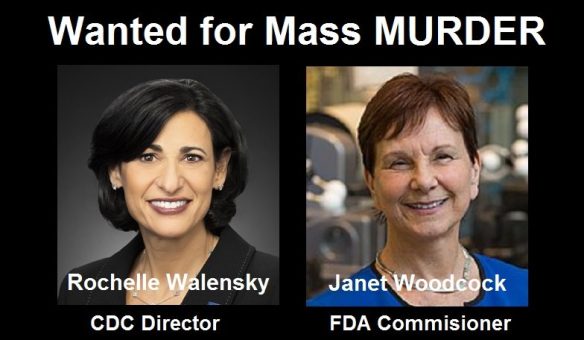
Record Number of Fetal Deaths Following COVID-19 Shots
As of this most recent update in VAERS, we have now found 2,809 fetal deaths following COVID-19 shots injected into pregnant and child-bearing women for the past 11 months. (Source.)
By way of contrast, using the exact same search parameters in VAERS, but excluding the COVID-19 shots, we found 2,168 fetal deaths following all FDA-approved vaccines for the past 30+ years. (Source.)
That’s an average of 72 fetal deaths per year following all FDA-approved vaccines for the past 30+ years, compared to what is on pace to be 3064 fetal deaths in 1 year following COVID-19 shots.
- FDA-approved vaccines: 72 fetal deaths per year
- COVID-19 EUA shots: 3064 fetal deaths per year
That is an 80% increase in fetal deaths recorded in VAERS following the COVID-19 shots. And yet, the CDC and FDA continue to recommend these EUA shots for pregnant women and nursing mothers.
Not only do they recommend these shots for pregnant women, we now have ample evidence that they have known since earlier this year that these shots are dangerous to pregnant women, and causing fetal deaths.
In a March 4, 2021 Advisory Commission on Childhood Vaccines (ACCV) meeting, the CDC submitted a report that contained a section titled: Maternal vaccination safety summary (starting on p. 39).
They stated (emphasis mine – my comments in red):
* Pregnant women were not specifically included in pre-authorization clinical trials of COVID-19 vaccines
– Post-authorization safety monitoring and research are the primary ways to obtain safety data on COVID-19 vaccination during pregnancy
* Larger than expected numbers of self-reported pregnant women have registered in v-safe
* The reactogenicity profile and adverse events observed among pregnant women in v-safe did not indicate any safety problems (based on what criteria???)
* Most reports to VAERS among pregnant women (73%) involved non-pregnancy specific adverse events (e.g., local and systemic reactions)
* Miscarriage was the most frequently reported pregnancy-specific adverse event to VAERS; numbers are within the known background rates based on presumed COVID-19 vaccine doses administered to pregnant women (no supporting evidence to backup these claims)
It is important to note through all of this reporting by the CDC that these are based on self-reporting data from pregnant women.
We know that it is politically incorrect to blame any health issue on a COVID-19 “vaccine,” and that doctors and nurses are pressured to NOT report these, so how many pregnant women had an adverse reaction, like a miscarriage, and never even thought to link it to their COVID-19 shot?
So back in March of this year (2021), there were already major concerns about the effects of the shots on pregnant women, as “larger than expected” pregnant women were reporting adverse reactions, and “the most frequently reported pregnancy-specific adverse event to VAERS” was “miscarriage.”
Then in August of this year (2021), the CDC presented a “new study” with “new data.”
Again, this “data” is dependent on pregnant women “self-reporting” adverse reactions, so we know these reports will be well below what was actually happening in the population, as it is politically incorrect to report any adverse reactions related to the experimental COVID-19 shots. To do so is to be branded an “anti-vaxxer” and shame you for life.
The August update admitted that 13% of the pregnant women who had received a COVID-19 shot reported a miscarriage. The CDC brushed this aside by stating “miscarriage typically occurs in about 11-16% of pregnancies.”
But of course ALL miscarriages are reported somewhere in the medical files, which is why they can even come up with a number range like this. So this figure is based on 100% of the reported data, while the COVID-19 related miscarriages are only based on what was self-reported, and we have no idea how many women never reported their miscarriages because they never related it to their COVID-19 shot.
One the main studies the CDC allegedly relied upon to declare that COVID-19 shots were safe for pregnant women, was a study published in the New England Journal of Medicine on June 17, 2021.
But on October 14, 2021, they issued a statement stating that some of their data was wrong in the June 17th study. (Source.) It dealt specifically with pregnancies in their 20th week or earlier.
“No denominator was available to calculate a risk estimate for spontaneous abortions, because at the time of this report, follow-up through 20 weeks was not yet available for 905 of the 1224 participants vaccinated within 30 days before the first day of the last menstrual period or in the first trimester. Furthermore, any risk estimate would need to account for gestational week–specific risk of spontaneous abortion.” (Source.)
Should employers require vaccination without any other option? Comments to OSHA close on Dec 6.
By Steve Kirsch | December 3, 2021
ICYMI, here’s the URL to file your comments before the comment period closes on December 6, 2021.
In a nutshell, OSHA believes that:
- Face coverings work and should be used.
- COVID recovered people who have not been fully vaccinated still face a grave danger from workplace exposure to SARS-CoV-2.
- They should impose a strict vaccination mandate ( i.e., all employers required to implement mandatory vaccination policies as defined in this ETS) with no alternative compliance option.
I believe:
- The scientific evidence (Danish mask study, Bangladesh mask study) shows that face coverings are completely ineffective.
- COVID recovered people should be exempt from all rules. If COVID recovered people are re-infected, they don’t get hospitalized, don’t die, and don’t spread the virus to others. The CDC has no counter-examples.
- The vaccines kill more people than they save for all age groups according to the VAERS data. And even in Pfizer’s own study, there were significantly more deaths in the vaccine group than then in the placebo group. There is ZERO scientific evidence the vaccines save lives when you are looking for a reduction in all cause mortality. Businesses should BE PROHIBITED from requiring vaccination.
One of us is wrong. If you agree with me, please consider taking a few minutes to file a comment.
It’s not surprising that the FDA wants to slow-walk the release of COVID jab reaction data
By Dr. Joseph Mercola | December 2, 2021
It took the U.S. Food and Drug Administration 108 days to review all the data Pfizer/BioNTech submitted in order to gain FDA approval for its Comirnaty COVID shot, which was licensed August 3, 2021.
Considering the agency claims there are 329,000 pages of data, the fact that they were able to read, analyze and draw conclusions about its safety and effectiveness in just 108 days — about 80,000 pages a month — is no small miracle. They must employ some very efficient speed readers.
And that is why the FDA’s claim that it now needs half a century to review the documents before they can release them to the public doesn’t seem very credible. Even Reuters has expressed shock, and its former CEO is on the board of Pfizer.1
Expedited FOIA Request for Comirnaty Data
In September 2021, a group called Public Health and Medical Professionals for Transparency (PHMPT) filed a Freedom of Information Act (FOIA) request with the FDA to obtain the documentation used to approve Comirnaty.
This includes safety and effectiveness data, adverse reaction reports and lists of active and inactive ingredients. Approximately 400 additional FOIA requests by other individuals for all or part of this information have also been filed.2
In their FOIA application, the PHMPT asked the agency to expedite release of the documents — a reasonable request, considering we have no raw data and the shots are being pushed on children as young as 5.
FOIA guidelines include two conditions upon which a request may be expedited. One is “if the lack of expedited treatment could reasonably be expected to pose a threat to someone’s life or physical safety,” which one could easily argue is the case here.
The second condition is “if there is an urgency to inform the public about an actual or alleged federal government activity, if made by a person who is primarily engaged in disseminating information.” This too is clearly applicable.
“During a time when COVID-19 vaccine mandates are being implemented over the objection of those that have questions about the data and information supporting the safety and efficacy of the Pfizer Vaccine, and individuals with these questions are being expelled from employment, school, transportation, and the military, the public has an urgent and immediate need to have access to this data,” the PHMPT said in its request.3
FDA Now Wants 55 Years to Release COVID Jab Data
When, after a month, the FDA still had not responded to the FOIA request, the PHMPT sued.4 The FDA is now asking a federal judge to allow them to delay the full release of all documents until 2076 — 55 years from now.
According to the U.S. Department of Justice (DOJ) attorney who represents the FDA in this case, the agency will be able to “provide more pages to more requesters” if allowed to stick to a rolling schedule of 500 pages per month, “thus avoiding a system where a few large requests monopolize finite processing resources.”
They claim they only have 10 employees assigned to FOIA releases, and before material can be released, an FDA official has to go through them and redact any information that might reveal personal information about clinical trial participants and any confidential business or trade secret information.
The 1967 FOIA law requires federal agencies to respond to FOIAs within 20 days unless “unusual circumstances” exist that prevent a timely release. Circumstances that might warrant an extended release schedule include:
- Instances where response records must be searched for and collected from an entity other than the office processing the request
- Situations involving “voluminous” amounts of records that must be compiled, and
- Instances requiring consultation with another federal agency that has a substantial interest in the information
The DOJ attorney points out that the court has allowed for a 500-page maximum per month release schedule in other cases, and should allow the FDA the same leeway here.
Plaintiffs, on the other hand, argue the agency should be able to release everything by early March 2022, noting the FDA employs 18,000 people and has an annual budget of $6 billion. Between 2008 and 2017, the agency processed 114,938 FOIA requests, of which it granted 72.4%, either fully or partially.
Of those, 39.8% were designated as “complex,” and 81.5% of these complex FOIA requests were granted in 61 days or more. Considering these historical statistics, a backlog of 400 FOIA requests doesn’t appear excessively burdensome.
FDA’s Foot-Dragging Is Suspicious
Then there’s the sticky issue that it has already proven its capacity for rapid review. Aaron Siri of the law firm Siri & Glimstad wrote in the PHMPT’s court filing:5,6,7,8
“This 108-day period is the same amount of time it took the FDA to review the responsive documents for the far more intricate task of licensing Pfizer’s COVID-19 vaccine …
It took the FDA precisely 108 days from when Pfizer started producing the records for licensure to when the FDA licensed the Pfizer vaccine. Taking the FDA at its word, it conducted an intense, robust, thorough, and complete review and analysis of those documents in order to assure that the Pfizer vaccine was safe and effective for licensure.
While it can conduct that intense review of Pfizer’s documents in 108 days, it now asks for over 20,000 days to make these documents available to the public …
The entire purpose of the FOIA is to assure government transparency. It is difficult to imagine a greater need for transparency than immediate disclosure of the documents relied upon by the FDA to license a product that is now being mandated to over 100 million Americans under penalty of losing their careers, their income, their military service status, and far worse.”
Shocking Revelations in First Batch of FOIA Docs
Two months after the lawsuit against it was filed, the FDA released a batch of 91 pages,9 and if this batch is any indication, it’s not surprising that the FDA wants to slow-walk the release of the rest. In a November 21, 2021, substack article, Kyle Becker cites directly from the released documents:10
“’It is estimated that approximately [REDACTED] doses of BNT162b2 were shipped worldwide from the receipt of the first temporary authorization for emergency supply on 01 December 2020 through 28 February 2021,’ the document states. ‘Cumulatively, through 28 February 2021, there was a total of 42,086 case reports (25,379 medically confirmed and 16,707 non-medically confirmed) containing 158,893 events …
Most cases (34,762) were received from United States (13,739), United Kingdom (13,404) Italy (2,578), Germany (1913), France (1506), Portugal (866).’ Below is a General Overview of the reported outcomes to the Adverse Events:

The chart lists 1,223 fatal outcomes in the Relevant Cases. Interestingly, the age range with the most relevant cases was 31-50 years old, which is not the age group considered to be at high risk from COVID-19.”
It’s worth noting that by redacting the specified number of doses shipped, it becomes more difficult to assess the potential ratio of injury. Still, even without that, 42,086 reports of injury, including 1,223 fatalities, are a significant signal in and of itself, especially when you consider that the 1976 swine flu vaccine was pulled after 25 deaths.
Glaring Disregard for Life
It’s even more disturbing when you consider that those 42,086 reports were received by Pfizer in just the first 2.5 months of the shot being rolled out. Pfizer even acknowledges the abnormal rate of injuries, but then sweeps it aside as being of no consequence. As noted by Siri, in a November 19, 2021 substack article, in which he discusses this first batch of documents:11
“Pfizer explains, on page 6, that ‘Due to the large numbers of spontaneous adverse event reports received for the product, [Pfizer] has prioritized the processing of serious cases…’
Pfizer ‘has also taken a [sic] multiple actions to help alleviate the large increase of adverse event reports’ including ‘increasing the number of data entry and case processing colleagues’ and ‘has onboarded approximately [REDACTED] additional fulltime employees (FTEs).’
Query why it is proprietary to share how many people Pfizer had to hire to track all of the adverse events being reported shortly after launching its product …
But no cause for alarm since Pfizer explains to the FDA: ‘The findings of these signal detection analyses are consistent with the known safety profile of the vaccine.’ So, if they knew these issues were going to arise, then why didn’t they appear to have enough staff to process this expected volume of reports?
The grand conclusion by Pfizer to the FDA: ‘The data do not reveal any novel safety concerns or risks requiring label changes and support a favorable benefit risk profile of to the BNT162b2 vaccine.’ Nothing to see here.”
Clearly, there’s plenty to be seen in the hundreds of thousands of documents Pfizer/BioNTech submitted to the FDA. The fact that the FDA is stonewalling and wants 55 years to redact them before they’re fit for public view is telling in and of itself.
You don’t need a fanciful imagination to comprehend what they might be hiding. It almost seems they want to make sure the responsible parties are all dead by the time the full data set is out in the open and people can be held to account for their decisions. Let’s hope the judge is more interested in public health than protecting the FDA’s dirty secrets.
Sources and References
- 1 ZeroHedge November 23, 2021
- 2, 7 Daily Mail November 19, 2021, Updated November 20, 2021
- 3, 4 The Defender November 19, 2021
- 5 US District Court Northern District of Texas Case 4:21-cv-01058-P
- 6 US District Court Northern District of Texas Case 4:21-cv-01058-P Second Joint Report
- 8 The Vaccine Reaction November 21, 2021
- 9 PHMPT.org Pfizer documents
- 10 thekylebecker.substack.com November 21, 2021
- 11 aaronsiri.substack.com November 19, 2021
Featured Video

Why the U.S. Should Pull Back From the First Island Chain
or go to
Aletho News Archives – Video-Images
From the Archives
Only 19.7% of Americans agree with US State Dept on Israeli settlements
… Most American adults of voting age don’t appear willing to reject the applicability of international law to Israel’s ongoing colonization of occupied territories in East Jerusalem, the West Bank and Golan Heights. … Full article
Blog Roll
 Aletho News
- Egypt collaborates with Israel to build ‘Green Rafah’ project over erased Palestinian city
- Rising fuel prices and shortages have helped drive ongoing protests and rioting in France
- Tokyo protests demand Takaichi’s resignation over support for ‘Israel’
- Jennifer Kavanagh: Why the U.S. Should Pull Back From the First Island Chain
- Yemen denounces international community’s silence on Saudi aggression, siege
- UAE and Saudi Arabia move toward renewed coordination against Sanaa
- How Iran’s two-week retaliatory strikes exposed cracks in US military architecture in Persian Gulf
- The mother of all propaganda: Why the hype over US MOAB strike against Iran is nothing but theater
- Iran says it possesses technology behind US 14-ton GBU bunker-buster
- Trump asks Iran not to retaliate after he strikes Pickaxe Mountain – w/ Prof. Marandi
- If Americans Knew
- Israeli Strike Burns Gaza Mother Alive in Front of Toddler, ‘Without Generating Any Headlines’
- ‘The Israel Experience with Mike Huckabee’: The Ambassador’s Family Sells Trips to Israel
- As Gazans carry out mass burial, food insecurity is getting worse – Daily Update
- Israeli rabbi permits occupiers to steal Palestinian olive harvest in West Bank
- Netanyahu’s spin on latest settler attack is laughable – Daily Update
- Israeli soldiers debunk Israel’s talking points
- In West Bank, Israeli settlers are totally out of control – Daily Update
- NPR investigation finds evidence of widespread fraud at mall kiosks tied to Israeli skincare brand
- Tucker Carlson exposes Israeli Lies about the Oct 7th attack, Charlie Kirk, and the U.S.
- Israel has detained thousands of Palestinian children since Oct 7th – over half spent time in solitary, many uncharged
- No Tricks Zone
- Predictions Made By Renowned Climate Proifessor Over Past Decades Have Been Proven To Be Poor
- New Study Suggests Large Regions Of The Pacific Ocean Have Been Cooling For The Last 80 Years
- Germany’s Green Energy Debacle: High Energy Costs Force Kahla Porzellan to Close After 182 Years!
- New Study: 50 Years Of The Most Aggressive ‘Net Zero’ Policies Can Only Affect The Global Climate By 0.03°C
- US September “Heat” Was No Record…Many Records Set Decades Ago
- Latest European Green Energy Debacle; Portugal’s Largest Flagship Solar Park Insolvent!
- Green Energy Debacle: German Expert Professor Fritz Vahrenholt Warns Of Severe Economic And Social Consequences
- Two More Paleo Reconstructions Affirm Meters-Higher Sea Levels Across Ireland, Brazil 7000-6000 Years Ago
- New Study: Earth And Venus Surface Warmth Largely Explained By Convection And Lapse Rate, Not CO2 Or Radiation
- 2025 Nature Paper Claiming Worsening Global Drought Gets RETRACTED …Heavily Flawed

