The Great Betrayal

By Will Jones • Daily Sceptic • July 21, 2021
Destroy their education. Destroy their jobs and their job prospects. Destroy their social life, their friendships, their mental health. Force them to work long hours at school or in physically demanding jobs in uncomfortable and breath-inhibiting face masks. This is what our country has done to our young people in the past 16 months.
Why? In an attempt (and not a very successful one) to protect a small minority of mostly elderly folk who are particularly vulnerable to one disease while we wait in limbo to develop a vaccine and roll it out to the vulnerable population.
Then do we give them back their freedom? Not at all. Then we move the goalposts, making freedom conditional on more and more people getting the vaccine. Until we make it to so-called ‘Freedom Day’, a month later than originally planned, and Boris Johnson chooses then to tell young people that their freedom to do the things they enjoy will be dependent on receiving a vaccine.
A vaccine that uses experimental technology and was rushed through trials without waiting for the full safety data (trials which will never now conclude as the control groups have been vaccinated). A vaccine, or rather vaccines, which the authorities now acknowledge increase the risk of dangerous blood clotting and heart conditions, particularly in younger people. Vaccines for which there are now more reports of fatalities in the U.S. than all other vaccines put together for the past 30 years.
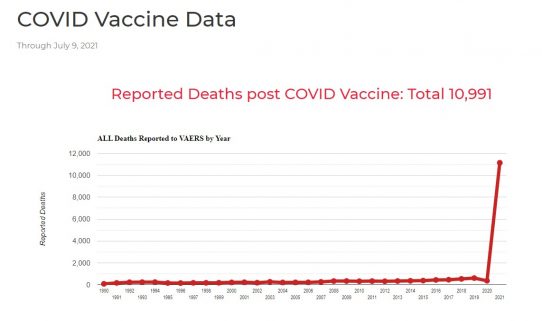
OpenVAERS
The E.U.’s own infectious disease journal Eurosurveillance has just published a study concluding that, when it comes to the AstraZeneca vaccine and blood clots, “in young adults, the risks were similar or higher than the benefits”.
Bear in mind this is just considering one side effect based on the reported incidence. It doesn’t take into account other side effects and under-reporting.
That’s the AstraZeneca vaccine, which is now discouraged for under 40s in the U.K. Are Pfizer and Moderna vaccines much better? Warnings have recently been added to them that they cause serious heart conditions in some cases. What else might emerge as the data is properly analysed?
The decision whether to take a particular vaccine, given the risk and potential benefit, is a personal one, and we can hardly blame the minority of young adults who appear to be concluding they’d rather take their chances with the virus, from which they’re also likely to get better immunity.
Any kind of threat of withdrawal of benefits for failure to take a medicine, let alone an experimental medicine, undermines informed consent. For that matter, the paucity of information provided on the real risk of side effects and the real age-specific level of benefit undermines informed consent.
Our young people have been betrayed again and again by this Government, which seems to have reached a place where it regards them primarily as vectors of disease who must be coerced into taking the prescribed medicine to make them clean enough to allow out and about. Yet the evidence that the vaccines are particularly good at preventing the spread of infection is patchy at best.
Our leaders should be ashamed of themselves for how they have abused young people and their trust, jeopardised their health and strangled their aspirations.
Sadly, I don’t think enough of them are sufficiently alive yet to the full horror of what has been pointlessly done to them in the last year and a bit to realise how angry they should be. But if they ever do wake up to it, there will be a terrible political reckoning.
All Americans must leave Afghanistan except diplomats: Top Taliban official
Press TV – July 21, 2021
All foreign forces in Afghanistan are considered occupiers, a top Taliban official tells Press TV, stressing that the United States should pull out all its military and civilian personnel from the country except its diplomats.
Mullah Khairullah Khairkhwa made the remarks in an interview with Press TV on Wednesday, alleging that the militant group and the United States had agreed on the matter.
“They have accepted that all Americans except their diplomats should leave Afghanistan and this issue is clearly written,” he said in an interview with Press TV’s Face to Face program.
“All NATO forces and their allies in Afghanistan must leave Afghanistan, and even those who were nominated to protect their embassies were rejected by us, because if we come to the government of Afghanistan, we are responsible for protecting their embassies and diplomats,” added the official.
‘US, NATO can’t provide security’
The US and the Western military alliance of NATO, Khairkhwa said, were incapable of providing Afghanistan with security.
Had the Americans been capable of securing Afghanistan, they would have done so over their 20-year-long occupation of the country, which saw some 150,000 foreign forces entering the Central Asian territory, he said.
“How can they bring us security?” he asked, and warned that if given the chance, Washington would always try to find a pretext to bring in troops, whether it was training the Afghan forces or providing security for the American interests in Afghanistan.
‘No use for Americans to return’
Khairkhwa also said the history of foreign military interventions in Afghanistan, as was the case with the British and Russian invasions, showed that such militarism was doomed to fail.
He, therefore, predicted that if the United States sought to re-enter Afghanistan following its current troop pullout, it would end up suffering the same fate as it has over the past 20 years.
“Because when someone enters someone’s house and fights there, the owner of the house will fight back as long as he lives. And if the Americans want to return, the same process of 20 years ago will be repeated. It is no use for them, nor is it of any use for us…,” the official noted.
Taliban after formation of ‘common govt.’
The official was also asked about the May-present escalation in the Taliban’s aggression and the goals that the group could be seeking by ramping up the violence.
Khairkhwa claimed that the group prioritized “political solutions” and “negotiation” over the armed offensive.
“We are trying to find solutions that are a good way for the people to elect a government, whether it is in the form of a council and a settlement, or in some other way, is now on the table for negotiation,” he said.
The group, he alleged, would close the door to all negotiation if it were completely against it.
‘Taliban advance, govt. fall inevitable’
The Taliban official, however, stressed that neither the group’s advances nor the incumbent government’s fall were to be helped.
“You see, the districts are very easily conquered” by the Taliban, which “have the ability to conquer the big cities” too.
He cited the example of the government that was propped up by the Soviets, but “could not survive and finally fell.”
“As for the current government, the people know that it will not last. That is why the fall is underway,” he said.
Khairkhwa claimed that the “elders” had not yet ordered any offensive against large cities, including the capital Kabul, and that the group would prioritize negotiation and political agreement concerning the manner of their control in the future.
The official, nevertheless, appeared not to be ruling out armed action targeting the cities by saying, “We use precaution so that, God forbid, it does not cause massive casualties.”
Why hasn’t the Taliban been fighting Daesh?
Khairkhwa was asked about the reason why the Taliban had not been fighting the foreign-backed Takfiri terrorist group of Daesh, which it considers another occupying entity, for some time.
The official said the hiatus had been brought about as a result of the sporadic nature of Daesh’s presence in Afghanistan, adding that the group would have kept up its fight if the Takfiris “had a headquarters.”
He also described Daesh’s ideology as “deviant” and claimed that the Taliban’s mindset differed from that of the terrorist outfit.
‘Taliban, Saudi Arabia not as close as before’
The Taliban official also said the group and Saudi Arabia’s relations did not have their former quality.
“We do not have the same connection we had before… We haven’t had any public trips to Saudi Arabia,” he said.
He also said if the Saudi regime sought to fund so-called “religious schools” in Afghanistan, the funding had to go through the government and the ministry of education instead of going straight to the schools.
What becomes of Afghanistan’s foreign policy if Taliban triumph?
Meanwhile, the Taliban official claimed that the group would try to maintain relations with Muslim countries, including the neighboring ones such as Iran, if it rose to power in Afghanistan.
He alleged, though, that Afghanistan would not be allowed to lean extensively in any direction if the group assumed power.
Where’s the Rage for Israel and NSO’s Pegasus the West Had for China’s Huawei?
By Morgan Artyukhina – Sputnik – 21.07.2021
Anger has swirled around the globe over revelations that Pegasus spyware created by Israeli software firm NSO Group has been used by governments to wiretap journalists and public figures. However, the fury is mild when compared to claims Beijing compelled Huawei to put a “backdoor” into its phones, which has never been proven.
Earlier this week, a group of news outlets including the Washington Post and Forbidden Stories, along with human rights group Amnesty International, revealed disturbing findings: governments around the globe have been buying up Pegasus spyware from NSO Group and using it to spy on journalists, public figures, and even other world leaders.
50,000 Phones Targeted
Thousands of phone numbers are on the list, with some of the biggest names including French President Emmanuel Macron and Moroccan journalists Omar Radi, both allegedly wiretapped by Morocco, and journalist Jamal Khashoggi, allegedly wiretapped by his native Saudi Arabia prior to being killed by a Saudi hit squad at the Saudi consulate in October 2019.
In all, 180 journalists were targeted in 20 countries, including Kazakhstan, India, the United Arab Emirates, Qatar, Azerbaijan, Hungary, Morocco, Rwanda, Democratic Republic of the Congo, Mexico, Egypt, Algeria, Togo, Turkey, France, Spain and the United Kingdom. They also targeted at least 65 business executives, 85 human rights activists, 189 journalists, and more than 600 politicians and government officials, including high-level officials like cabinet ministers, diplomats, and military officers, according to The Washington Post.
Also on the list were 10 prime ministers, three presidents, and one king, including Iraqi President Barham Salih, South African President Cyril Ramaphosa, the prime ministers of Pakistan, Egypt, and Morocco, and seven former heads of government from Lebanon, Uganda, and Belgium, and several other countries.
Shalev Hulio, NSO’s chief executive and co-founder, has cast the story as flimsy, but said the company is “investigating every allegation … and if we find that it is true, we will take strong action.”
“NSO Group’s technologies have helped prevent terror attacks, gun violence, car explosions and suicide bombings. NSO Group is on a lifesaving mission and the company will faithfully execute this mission undeterred, despite any and all continued attempts to discredit it on false grounds,” the company told the US Public Broadcasting Service.
On Wednesday, the firm put out a press release saying “enough is enough,” announcing it would cease responding to media inquiries about what it called a “vicious and slanderous campaign.”
“NSO is a technology company. We do not operate the system, nor do we have access to the data of our customers, yet they are obligated to provide us with such information under investigations,” the company added.
The Israeli government has confirmed it “approves the export of cyber products exclusively to governmental entities, for lawful use, and only for the purpose of preventing and investigating crime and counterterrorism, under end use /end user certificates provided by the acquiring government. In cases where exported items are used in violation of export licenses or end use certificates, appropriate measures are taken.”
However, it denied having any knowledge of the use of Pegasus to spy on other targets, and noted to the Post that “Israel does not have access to the information gathered by NSO’s clients.”
That said, a former senior US national security official who has worked closely with the Israeli security services also told the outlet “It’s crazy to think that NSO wouldn’t share sensitive national security information with the government of Israel. That doesn’t mean they’re a front for the Israeli security agencies, but governments around the world assume that NSO is working with Israel.”
How Have Nations Reacted?
Representatives from many of the nations implicated in the investigation have unanimously denied the reports they spied on journalists, dissidents, and world figures, insisting their governments are based on the rule of law. However, it’s notable that not all of the countries where journalists were targeted have been asked for comment, with France, Spain, and the UK being notable exceptions.
Asked by The Hindu, a White House spokesperson said on Wednesday that “The United States condemns the harassment or extrajudicial surveillance of journalists, human rights activists, or other perceived regime critics.”
However, despite the admission by NSO that it sells such software and by Israel that it, at the very least, approved of each sale, and in light of comments by foreign intelligence officials that Israel likely materially benefitted from the affair by gleaning information from the group, it seems that a bigger scandal would be expected. But not a single government has demanded punishment for either NSO or Israel, or decried even the possibility that Israel helped countries wiretap people not suspected of criminal actions, or raised fears that a country’s government likely got ahold of classified information from them via illegal means.
There have been no calls for sanctions against Israel or NSO or any senior figures at NSO, or prosecutions, or frankly even acknowledgements that the affair is even happening outside of dry-mouthed condemnations. In fact, the only calls for sanctions have been by journalists themselves, such as the Intercept’s Ryan Grim and Electronic Intifada’s Ali Abuminah.
The reactions – and lack thereof – stand in stark comparison to how Chinese tech giant Huawei has been treated.
Huawei Crucified Without Evidence
Shenzhen-based Huawei is the world’s largest manufacturer of both telecommunications equipment and smartphones and a major supplier of 5G internet service. The company was started in 1987 by Ren Zhangfei, a former Chinese military engineer, although he owns less than 2% of its shares, which are owned by Huawei employees.
The US has claimed for years that Ren’s military experience and membership in the Communist Party of China make Huawei a security liability, but in 2018 a more concerted effort began aimed at forcing US military and government agencies from using products by Huawei and another Chinese phone maker, ZTE, claiming that the CPC had forced Huawei to insert a secret “back door” into its phones and networks, enabling the Chinese government to spy on users if so desired.
The company and the Chinese government have both denied that such a backdoor does or even could exist or that they would pursue one if it were possible.
“If they believe there’s a backdoor, they should offer evidence to prove it,” Huawei chairman Liang Hua challenged US intelligence in January 2019. At the time, Washington said it didn’t need to, citing Huawei’s alleged proximity to the Chinese government as sufficient proof.
However, as the US began hounding allies in Germany and the “Five Eyes” nations to drop Huawei’s technologies, it did begin providing them with evidence to support its claims – evidence London, Berlin, and Paris all said wasn’t very convincing. Still, within months each of them had either rejected bids by Huawei or suddenly found new evidence to justify falling into line with US demands.
The firm was placed on a US blacklist in 2019, requiring Americans to obtain a special license from the US Department of Commerce before doing business with Huawei, effectively banning Americans from buying Huawei’s phones, and several nations have now sanctioned Huawei as well. The company’s CFO, Meng Wanzhou, was also arrested in Canada in connection with charges in a US court that aren’t related to the espionage allegations but which are widely seen as further persecution of the company.
The sanctions had their effect, too: in March, a first-quarter earnings report showed its sales down 16.5% year-on, part of a trend that caused it to sell its Honor smartphone marquee last year.
Legacy of Israeli Spying on Allies
In September 2019, Politico reported that US government officials had concluded Israel was responsible for placing cell phone surveillance devices called “Stingrays” around Washington, DC, and had even used them to spy on White House communications. A former senior official used as a source for the article said the devices were likely intended to spy specifically on then-US President Donald Trump, a known lover of his iPhone.
Then-Israeli Prime Minister Benjamin Netanyahu dismissed the report, saying, “Israel doesn’t conduct espionage operations in the United States, period.”
However, the claims go back much further. In 1985, US intelligence analyst Jonathan Pollard was arrested, charged, and later convicted of espionage after he passed classified US Navy documents to Israel, including dirt on Israel’s Arab neighbors, for $1,500 a month.

Jonathan Pollard, U.S. Navy ID picture
Israel also spied on then-US Secretary of State John Kerry in 2014 and 2015 during negotiations for what became the Joint Comprehensive Plan of Action, according to reports by Der Spiegel and the Wall Street Journal.
In 2017, Le Monde revealed that Israel’s Mossad had penetrated the French intelligence directorate in what it called Operation Ratafia, with the goal of developing close relationships with fellow spies “to the point of crossing the line of turning them into double agents.”
None of these brought calls for sanctions, either, revealing how politically motivated the attacks on Huawei and other Chinese tech firms really are. Why does the West continue to tolerate the Israeli government spying on them and their citizens?
FBI informants played key role in plot to kidnap Michigan governor, government accused of entrapment
RT | July 21, 2021
Several of the men accused of planning to kidnap Michigan Governor Gretchen Whitmer say they were entrapped by the FBI, with government documents suggesting that at least 12 undercover informants played major roles in the scheme.
A lengthy investigation by BuzzFeed News – published on Tuesday and based on court filings, text and audio transcripts, and more than two dozen interviews with sources close to the case – claimed that the 12 informants and undercover agents “played a far larger role” in the kidnapping plot than was previously known.
“Working in secret, they did more than just passively observe and report on the actions of the suspects. Instead, they had a hand in nearly every aspect of the alleged plot, starting with its inception,” the outlet reported, noting that the scope of their involvement “raises questions as to whether there would have even been a conspiracy without them.”
So far, one of the 14 suspects in the case has formally accused the government of entrapment, saying the FBI actively drove the plot forward and helped to assemble its key planners, while lawyers for two others say they plan to raise similar claims in the future.
All but one of the 14 defendants – six of whom were slapped with federal counts, while eight others were charged under Michigan’s terrorism laws – have pleaded not guilty, insisting there was no serious plan to kidnap Whitmer. One defense attorney deemed the plot “big talk” between “crackpots” and “military wannabes.”
In the FBI’s original criminal complaint issued on October 6, 2020, the bureau acknowledged that it “relied on information provided by Confidential Human Sources (CHS) and Undercover Employees (UCE) over several months,” saying that, while all the informants were not present with the plotters at all times, “at least one … was usually present during the group meetings.”
The bureau mentioned only four undercover sources, however, including two actual agents, in its initial complaint – far fewer than the 12 ultimately revealed in later filings. The FBI also did not disclose the full extent of their involvement in the plot, though did note that some informants were paid for their work.
One of them, named as ‘CHS-2’ in the complaint, was paid at least $14,800, which the FBI says included “reporting and expenses,” while a source labeled ‘CHS-1’ was paid $8,600. It did not specify a reason for that payment.
Though not included in the initial affidavit, it was later revealed that another informant, identified only as ‘Dan’ in government documents, was paid around $6,000 for “reimbursement for expenses” and another $24,000 for his “services” as a source. The bureau also purchased him a new car, deeming it a “witness protection expense.”
An Iraq War veteran, ‘Dan’ would become so deeply involved with the group of alleged kidnappers that he eventually rose to be its “second-in-command,” according to BuzzFeed. For around six months, he collected hundreds of hours of recordings of the group using a wire, encouraging suspects to collaborate with one another and “prodding” the ringleader to “advance his plan.” At times, he even paid to transport group members to meetings, as did another Wisconsin-based informant.
Last week, an attorney for one defendant filed a motion citing texts from an FBI agent to ‘Dan,’ saying they showed the bureau directed him to recruit specific people into the kidnapping conspiracy. The lawyer is now requesting all messages exchanged between the two, suggesting they could bolster an entrapment defense.
The group also arranged plans to purchase bomb-making materials from an undercover agent, as the FBI affidavit notes that four suspects planned to “meet with a UCE on October 7, 2020, to make payment on explosives and exchange tactical gear.” They were arrested before that meeting could happen, and the full extent of the agent’s involvement in the plot remains unclear.
While the US Department of Justice declined BuzzFeed’s requests for comment, the Michigan attorney general’s office downplayed the defendants’ claims, saying they were “not indisputable facts,” and that officials would “counter and correct these issues in court.”
The alleged plotters were arrested in October 2020, with many held without bail ever since. Authorities claim the group began preparing for the kidnapping in June of last year after months of discussions online, in which members frequently criticized Whitmer’s policies, namely Michigan’s draconian Covid-19 lockdowns. The group was said to have held several military-style training sessions and gathered thousands of dollars in weapons and gear for Whitmer’s abduction.
Though the government is likely to challenge the entrapment allegations, the FBI has come under fire for its questionable use of confidential informants in the past, particularly in cases linked to terrorism. In one high-profile case that culminated in 2012, members of another Michigan militia group accused of planning to kill a police officer were acquitted after the defense successfully argued the conspiracy was instigated by embedded FBI informants.
National Park Service To Spy On Picnics, Family Gatherings, Weddings And Much More

credit: Wikimedia
Massprivatei – July 20, 2021
According to a notice published in the Federal Register, the Department of the Interior (DOI) is turning the National Park Service (NPS) into a mirror image of the NSA, FBI, DHS and every other three-letter spy agency you can think of.
“Pursuant to the provisions of the Privacy Act of 1974, as amended, the Interior DOI is issuing a public notice of its intent to modify the National Park Service (NPS) Privacy Act system of records, INTERIOR/NPS-1, Special Use Permits.”
This so-called modification of special records permits will allow law enforcement to collect a disturbing amount of personal information on national park visitors.
As Nextgov points out, anyone wishing to get a permit to use one of America’s 423 national parks will have all their personal information sent to the White House.
“The NPS is making it easier to share more data with the White House and other federal agencies on applications and approvals of special use permits for parks spaces.”
America’s absurd War on Terror is now targeting picnics, family gatherings, weddings etc.
“People interested in using a park for a specific purpose at a specific time generally have to obtain a special use permit. NPS issues permits for three types of uses: standard events like weddings, sports, picnics and family gatherings; special events like demonstrations, races, tournaments and the like; and construction, research and utility work.”
When park users apply for such permits, the system collects a wealth of data needed to process the application, including:
- Name, organization, Social Security number, Tax Identification Number, date of birth, address, telephone number, fax number, email address, person’s position title.
- Information of proposed activity including park alpha code, permit number, date, location, number of participants and vehicles, type of use, equipment, support personnel for the activity, company, project name and type, fees, liability insurance information.
- Payment information including amounts paid, credit card number, credit card expiration date, check number, money order number, bank or financial institution, account number, payment reference number and tracking ID number.
- Information on special activities including number of minors, livestock, aircraft type, special effects, special effect technician’s license and permit number, stunts, unusual or hazardous activities.
- Information on driver’s license including number, state and expiration date.
- Vehicle information including year, make, color, weight, plate number and insurance information.
According to the notice in the Federal Register, the purpose in collecting everyone’s personal information is “to provide park superintendents with information to approve or deny requests for activities on NPS managed park lands.”
Does anyone really believe that park rangers or campground hosts need visitors SSN’s, DOBs, bank account numbers etc., so they can approve or deny a person’s request to use our national park[s]?
Nextgov does a great job of describing the NPS collecting park visitors personal information as being an innocuous “update”; it is not.
Page 7 of the notice reveals that the NPS will routinely send everyone’s personal information to numerous federal agencies.
“In addition to those disclosures generally permitted under 5 U.S.C. 552a(b) of the Privacy Act, all or a portion of the records or information contained in this system may be disclosed outside DOI as a routine use pursuant to 5 U.S.C. 552a(b)(3).”
Below is an abbreviated description of the federal agencies that will routinely have access to permit application park visitors personal information:
A. The Department of Justice (DOJ), including Offices of the U.S. Attorneys, or other Federal agency. Any other Federal agency appearing before the Office of Hearings and Appeals.
B. A congressional office when requesting information on behalf of, and at the request of, the individual who is the subject of the record.
C. The Executive Office of the President.
D. Any criminal, civil, or regulatory law enforcement authority (whether Federal, state, territorial, local, tribal or foreign) when a record, either alone or in conjunction with other information, indicates a violation or potential violation of law – criminal, civil, or regulatory in nature, and the disclosure is compatible with the purpose for which the records were compiled.
E. An official of another Federal agency.
F. Federal, state, territorial, local, tribal, or foreign agencies that have requested information relevant or necessary to the hiring, firing or retention of an employee or contractor, or the issuance of a security clearance, license, contract, grant or other benefit, when the disclosure is compatible with the purpose for which the records were compiled.
G. Representatives of the National Archives and Records Administration.
H. State, territorial and local governments and tribal organizations to provide information needed in response to a court order.
I. An expert, consultant, grantee, or contractor (including employees of the contractor) of DOI that performs services requiring access to these records on DOI’s behalf to carry out the purposes of the system.
J. Appropriate agencies, entities of the Federal Government.
K. To another Federal agency or Federal entity, when DOI determines that information from this system of records is reasonably necessary to assist the recipient agency.
L. The Office of Management and Budget.
N. The news media and the public, with the approval of the Public Affairs Officer in consultation with counsel and the Senior Agency Official for Privacy.
According to the memo, the NPS and will keep everyone’s personal information for 15 years at which time they promise to delete or shred it.
“Retention of records with short-term operational value and not considered essential for the ongoing management of land and cultural and natural resources are destroyed 15 years after closure. Paper records are disposed of by shredding or pulping, and records contained on electronic media are degaussed or erased in accordance with 384 Departmental Manual 1.”
Does anyone really think that picnics, family gatherings and weddings pose a threat to our Homeland?
There is one bit of good news to come out of turning the NPS into a spy agency: national park visitors can request a copy of what records the Feds have on them if they include the specific bureau or office that keeps those records in an information request.
“An individual requesting records on himself or herself should send a signed, written inquiry to the applicable System Manager identified above. The request must include the specific bureau or office that maintains the record to facilitate location of the applicable records. The request envelope and letter should both be clearly marked “PRIVACY ACT REQUEST FOR ACCESS.”
And as you can see from the list above, it is going to be a crapshoot to guess which specific federal agency or which branch of law enforcement was spying on your picnic, family gathering or wedding.
It is hard to imagine that when Congress created the National Park Service in 1872 they would have envisioned that the White House would turn it into a spy agency.
As Americans everywhere rush to visit our national parks how many of them will care that the Feds are collecting vast amounts of personal information about them and storing it for 15 years?
Do Americans care enough to stop DHS from turning formerly benign government institutions like the U.S. Postal Service and the National Park Service into federal spying agencies? Only time will tell.
California utility PG&E admits it probably started yet ANOTHER devastating wildfire
RT | July 20, 2021
Pacific Gas & Electric (PG&E) seems to have once again helped ignite a deadly wildfire in California, contributing to the carnage in the most populous US state for the fourth year in a row, according to a report on its website.
Documents posted to the utility’s website on Monday and filed with the California Public Utilities Commission indicate that a PG&E employee saw “blown fuses in a conductor on top of a pole, a tree leaning into the conductor, and a fire at the base of the tree” when he responded to a reported circuit outage around 7am local time last Tuesday. The equipment problem is believed to have helped contribute to the start of the Dixie Fire in Feather River Canyon, a devastating blaze that is still just 15% contained.
Unable to access the pole until nearly 12 hours after first taking note of the fire, due to “challenging terrain and road work resulting in a bridge closure,” the employee reported that upon returning to the site around 4:40pm local time, he encountered “a fire on the ground near the base of the tree” plus “two of three fuses blown and what appeared to him to be a healthy green tree leaning into the Bucks Creek 1101 12 kV conductor, which was still intact and suspended on the poles,” according to the report.
Only then did the worker call his supervisor – who subsequently called 911. Given PG&E’s abysmal track record of responding to wildfires (especially those linked to its equipment), it is perhaps unsurprising that the utility reportedly waited five days – rather than the required two to four hours – to report the nascent blaze to the state regulatory agency.
The Dixie Fire has already consumed more than 30,000 acres as of Monday, and continues to force evacuations in Plumas and Butte counties. PG&E’s systems reportedly showed an outage near Cresta Dam in the area of Feather River Canyon where the fire began. Mandatory evacuation orders remain in force in High Lakes, Bucks Lake, and Meadow Valley in Plumas County; Jonesville and Philbrook in Butte County are also under evacuation order. Cal Fire reported on Monday that 800 structures remain under threat.
PG&E has become notorious for its dysfunctional equipment’s apparent contributions to the increasingly devastating wildfires plaguing the region. PG&E equipment has been connected to at least one wildfire every year for the past four years, starting with the deadly 2018 Camp Fire.
The utility pleaded guilty last year to 84 counts of manslaughter, each count representing one life lost in the Camp Fire. The deadly blaze began in October in the town of Pulga, eventually engulfing 140,000 acres aided by high winds and low humidity. Some 8,700 homes were destroyed and tens of thousands of people forced to evacuate, while even those whose homes were spared the destruction were unable to go outside due to the extremely unhealthy air quality. The worst wildfire in California history, the Camp Fire killed 85 people and all but wiped out the town of Paradise.
The judgment pitched PG&E into a bankruptcy from which it finally emerged last year, with a promise to compensate fire victims for whatever damages had not been covered by their insurance – a sum of $13.5 billion that will be partially paid in company stock.
Last year, PG&E equipment was found to be partially responsible for the Zogg Fire in Shasta County. The company is still facing a criminal investigation over that blaze and was forced to pay out $43 million to local governments for that fire and the previous year’s Kincade Fire in Sonoma County. The utility still faces prosecution in Sonoma County over the 2019 fire.
Should PG&E continue to perform not just poorly but criminally, the utility could ultimately be taken over by the state, though California’s Public Utilities Commission requires the firm to progress through six ‘tiers’ of its so-called enhanced oversight program first. PG&E is already on the first tier, having been nailed for the shoddy job it did clearing out tree limbs and other kindling from its riskiest lines since November, and has pledged to spend $4.9 billion on “wildfire safety” this year.
Its promise to “do better” after four years of contributing to the devastating losses experienced by California residents was made as a condition for exiting bankruptcy. Meanwhile, company officials have attempted to blame drought and climate change, instead of taking responsibility.
PG&E has also outraged and alienated customers by shutting off the power supply during peak usage hours for hundreds of thousands of people, hoping to prevent the sparking that has been known to cause wildfires out of fear that high winds could topple the power lines altogether.
An investigation by the CPUC accused the utility of lacking even a rudimentary safety strategy, noting it only makes “positive changes” when forced to do so by dire accidents like fires and explosions. The CPUC report itself was issued seven years after the explosion of a gas pipeline in 2010, which killed eight people and uncovered poor if not criminal business practices such as overcharging customers, underspending on maintenance, and in general placing profit over everything – including but not limited to safety.
This year’s fire season is already predicted to be especially devastating, with expectations it will be longer, drier, and riskier than previous years’ even as PG&E struggles to fix its decaying infrastructure.
Over 158,000 acres of Northern California forest have burned so far this season, including the Tamarack Fire, which grew to 23,000 acres as of Monday morning and remains entirely uncontained. It was reportedly ignited by a lightning strike earlier this month, and local firefighters made the questionable decision not to dispatch fire crews “because of safety concerns,” leaving Alpine County Sheriff Rick Stephens to explain the bizarre response to local residents who now face losing their homes to the inferno. The Beckwourth Complex Fire has burned over 105,000 acres as of Monday and is 82% contained.
China: US-led hacking allegations fabricated out of nothing
Press TV – July 20, 2021
China has roundly rejected the “groundless” and “irresponsible” hacking allegations made by the United States and its allies, saying they are “fabricated out of nothing.”
Chinese Foreign Ministry spokesman Zhao Lijian hit back at Washington on Tuesday, calling the US the “world champion” of cyber-attacks.
“The US has mustered its allies to carry out unreasonable criticisms against China on the issue of cybersecurity,” he said. “This move is fabricated out of nothing.”
In a coordinated move, Washington and several allies in Europe and Asia publicly accused Beijing of hacking the Microsoft Exchange Server software in March. Microsoft Exchange is an email platform used by corporations around the world.
Senior US officials claimed that hackers tied to China’s Ministry of State Security carried out the unusually indiscriminate hacking. Secretary of State Antony Blinken said on Monday that Washington and “countries around the world” are holding China “accountable for its pattern of irresponsible, disruptive, and destabilizing behavior in cyberspace, which poses a major threat to our economic and national security.”
Japanese government spokesperson Katsunobu Kato followed suit on Tuesday, saying that Japanese companies had been targeted by a hacking group called APT40. He alleged that “the Chinese government is highly likely” behind the attack.
Earlier, China’s diplomatic missions around the world reacted to the charges.
The Chinese Embassy in New Zealand’s capital, Wellington, said the accusations were “totally groundless and irresponsible” and a “malicious smear.”
“Given the virtual nature of cyberspace, one must have clear evidence when investigating and identifying cyber-related incidents,” said the embassy.
The Chinese mission in Canberra said Australia was “parroting” US rhetoric. It also described the US as “the world champion of malicious cyber-attacks.”
The United Kingdom (UK) and European Union (EU) also joined the others in accusing China of carrying out hacking attacks, which they alleged to have targeted an estimated hundreds of thousands of mostly small businesses and organizations.
The Chinese Embassy in Norway also reacted to the allegations made by Oslo, saying that Beijing was a staunch defender of cyber security and was resolutely opposed to any form of cyberattacks.
“It is reasonable to question and doubt whether this is a collusively political manipulation,” it said, demanding that Oslo provide evidence for the claims. The embassy said that Beijing was “willing to cooperate with all relevant parties, based on facts and evidence, to jointly combat illegal activities in cyber space.”
The US-led global campaign against China is an apparent move to open a new front in cyber offensive following years of blaming Russia for cyberattacks against American organizations. Moscow time and again denied involvement.
Biden Doubles Down on Voters
Fraud in 2020 election is only a preview of what is coming
BY PHILIP GIRALDI • UNZ REVIEW • JULY 20, 2021
President Joe Biden has now declared that the United States is facing an existential crisis comparable to what it experienced during the Civil War, a struggle that will produce a truly democratic form of government with universal franchise or which will result in the denial of basic rights to many citizens. And he is quite willing to address the issue employing a maximum of emotion and fear mongering unmitigated by a minimum of reasonable suasion, saying “We’re facing the most significant test of our democracy since the Civil War. That’s not hyperbole. Since the Civil War — the Confederates back then never breached the Capitol as insurrectionists did on January the 6th. I’m not saying this to alarm you. I’m saying this because you should be alarmed.”
Of course, what may have occurred on January 6th has nothing to do with the issue currently in play, which is voting rights, though it is only one aspect of what is essentially a revolution sponsored by the Democratic Party to reorder the American political system in such a fashion as to guarantee its dominance for decades to come. Other steps will include greatly increased immigration, a war on so-called domestic terrorists and decriminalizing or choosing not to prosecute many felonies committed by party constituencies.
The voting rights legislation currently before Congress includes the interestingly named For the People Act and its successor the John Lewis Voting Rights Advancement Act, both of which would seek to restore certain unconstitutional aspects of the Voting Rights Act of 1965. Most important, they would eliminate the ability of the states to pass legislation that creates conditions on registering and voting. The text of the John Lewis Act now before Congress refers to these steps as “discriminatory laws, needless barriers, and partisan dirty tricks.”
At the heart of the push by the Democrats is the creation of a uniform national electoral system which will essentially make it much easier for people to vote, permitting block voting, ballot harvesting and both registration and voting itself by mail. If passed, the new legislation will compel each state to adopt “automatic and same-day voter registration, voting rights for felons, no-excuse absentee balloting, mandatory early voting, and taxpayer funding for political campaigns.”
The key objections to the new voting procedure being promoted by Biden are several, largely related to its lack of any requirement for potential voters to provide information or show documentation confirming citizenship and residency or even one’s identity. The Democrats are denouncing their Republican opponents who are raising these issues as guilty of “voter suppression.” If the Democrats win the debate, it will be possible for anyone to vote in elections without having any human contact whatsoever using the mail-in ballots which are potentially susceptible to large scale fraud.
Another problem with the Biden program to nationalize voting procedures is that the there are four amendments to the United States Constitution that make it clear that it is left to the states to determine the modalities of voting. That means that even if the new voting act passes through Congress and is signed by the president there still would certainly be challenges based on its unconstitutionality. While Blue states will presumably go along with the guidance from Washington, those states still leaning Red will undoubtedly resist any nationalization of voting procedures.
It is not as if the current voting system is fraud-resistant. All too often it is not, which is why state legislatures in Georgia, Texas and several other Republican controlled states have passed new voting laws that actually require in many cases one’s physical presence to vote as well as production of documentation or information confirming citizenship and residency. They also include the purging of electoral rolls of voters who have died or moved. The new laws come as close as is reasonably possible to creating a system where voting security and integrity will be greatly enhanced, but the fact is that the Democrats are not at all interested in reducing criminal voting. They are interested in creating a permissive environment where all their presumed supporters will be able to vote without having to make any effort to do so or even be compelled to demonstrate who they really are and that they are citizens.
Prior to the recent national election, I examined the procedures to register and vote in my home state of Virginia and determined that one could both register and vote without any human contact at all. The registration process can be accomplished by filling out an online form, which is linked here. Note particularly the following: the form requires one to check the box indicating US citizenship. It then asks for name and address as well as social security number, date of birth and whether one has a criminal record or is otherwise disqualified to vote. You then have to sign and date the document and mail it off. Within ten days, you should receive a voter’s registration card for Virginia which you can present if you vote in person, though even that is not required.
It is important to realize that no documents have to actually be presented to support the application, which means that all the information can be false. You can even opt out of providing a social security number by checking the box indicating that you have never been issued one, even though the form indicates that you must have one to be registered, and you can also submit a temporary address by claiming you are “homeless.” Even date of birth information is useless as the form does not ask where you were born, which is how birth records are filed by state and local governments. Ultimately, it is only the social security number that validates the document and that is what also appears on the Voter’s ID Card, but even that can be false or completely fabricated, as many illegal immigrant workers in the US have discovered.
Prior to the November election my wife and I received unsolicited four mail-in ballots, all of which were sent to us anonymously. I examined the ballots carefully and noted that they bore no serial numbers or other forms of validation that could conceivably be used to limit the potential for fraud. In a state like Virginia, the actual mail-in ballot only requires your signature and that of a witness, who can be anyone. That is also true in six other states. Thirty-one states require only your own signature on the ballot while just three states require that the document be notarized, a good safeguard since it requires the voter to actually produce some documentation and identification. Seven states require your additional signature on the ballot envelope and two states require that a photocopy of the voter ID accompany the ballot. Some of these procedures may have been changed since the November allegation but it appears that only the handful of Republican states that are in the process of passing new voting laws are taking the problem seriously. In other words, the safeguards in the system continue at this time to vary from state to state but in most cases, fraud would be relatively easy if one is using mail-in voting. In fact, former President Jimmy Carter’s headed a bipartisan commission in 2005 that concluded that mail-in ballots constitute the “largest source of potential voter fraud” of any voting system.
Joe Biden is of course right about a crisis developing comparable to the Civil War, but what he is choosing to ignore is that his White House is carelessly feeding into what has become a growing chorus of dissent. He and his colleagues in Congress are deliberately and with malice pushing an agenda that, if successful, will lead to something like one party rule in the United States. Combine that with impending legislation and executive action to pursue “domestic extremists,” whom the Administration has also defined as “white supremacists,” it is not hard to imagine what kind of trouble is brewing.
Philip M. Giraldi, Ph.D., is Executive Director of the Council for the National Interest, a 501(c)3 tax deductible educational foundation (Federal ID Number #52-1739023) that seeks a more interests-based U.S. foreign policy in the Middle East. Website is https://councilforthenationalinterest.org address is P.O. Box 2157, Purcellville VA 20134 and its email is inform@cnionline.org
RUSSIAGATE: Luke Harding’s Hard Sell
By Joe Lauria | Consortium News | July 17, 2021
Luke Harding of The Guardian on Thursday came out with a new story that looks at first glance like an attempt to rescue the Russiagate story and the reputations of Harding and U.S. intelligence.
The headline reads, “Kremlin papers appear to show Putin’s plot to put Trump in White House” with the subhead: “Exclusive: Documents suggest Russia launched secret multi-agency effort to interfere in US democracy.”
Harding’s report says that during a Jan. 22, 2016 closed session of the Russian national security council, President Vladimir Putin ordered Russian spies to back a “mentally unstable” Donald Trump for the White House to “help secure Moscow’s strategic objectives, among them ‘social turmoil’ in the US.”
“Russia’s three spy agencies were ordered to find practical ways to support Trump, in a decree appearing to bear Putin’s signature,” Harding writes. “A report prepared by Putin’s expert department recommended Moscow use ‘all possible force’ to ensure a Trump victory.”
The article, starting with the headline, is littered with the use of qualifiers such as “appears,” “suggests,” “apparent,” and “seems.” Such qualifiers tell the reader that even the newspaper is not sure whether to believe its own story.
Quoting from what he says is an authentic document marked “secret,” Harding writes that there is “apparent confirmation” that the Kremlin had dirt on Trump it could use to blackmail him, gathered during earlier Trump “‘non-official visits to Russian Federation territory.’”
This would seem to confirm a central part of the so-called Steele dossier, which Harding hawked in his bestselling book Collusion.
Harding’s newest story though says nothing about the involvement of Trump operatives with this Kremlin plot, as that was unfounded by Special Counsel Robert Mueller’s report.
Harding also suggests that the documents that came into his possession provides evidence of a Russian hack of Democratic National Committee computers.

Harding at the Nordic Media Festival, 2018. (Thor Brødreskift / Nordiske Mediedager/ Wikimedia Commons)
He writes:
“After the meeting, according to a separate leaked document, Putin issued a decree setting up a new and secret interdepartmental commission. Its urgent task was to realise the goals set out in the ‘special part’ of document No 32-04 \ vd. …
The defence minister was instructed to coordinate the work of subdivisions and services. [Sergei] Shoigu was also responsible for collecting and systematising necessary information and for “preparing measures to act on the information environment of the object” – a command, it seems, to hack sensitive American cyber-targets identified by the SVR. …
The papers appear to set out a route map for what actually happened in 2016.
A matter of weeks after the security council meeting, GRU hackers raided the servers of the Democratic National Committee (DNC) and subsequently released thousands of private emails in an attempt to hurt Clinton’s election campaign.”
These documents would perfectly confirm the story put out by U.S. intelligence and an eager Democratic media: that Russia’s defense intelligence agency GRU hacked the DNC and Russia leaked DNC emails to damage Hillary Clinton.
Except that Shawn Henry, the head of the company CrowdStrike hired by the Democratic Party and the Clinton campaign (while keeping the FBI away) to examine the DNC servers declared under oath to the House Intelligence Committee that no evidence of a hack was discovered. “It appears it was set up to be exfiltrated, but we just don’t have the evidence that says it actually left,” Henry told the committee.
WikiLeaks, which Harding doesn’t mention, has also denied getting the DNC material from Russia that Harding says was released by Moscow. And Harding ignores the true contents of the emails.
Dmitri Peskov, Putin’s spokesman, told The Guardian the story was “great pulp fiction.”
Let’s look at the motives of the players involved in this story.
Harding’s Motives
Henry’s denial of a hack and Mueller’s inability to prove Collusion, embarrassed Harding after he staked his reputation on his bestseller of that name. The book is essentially the story of Christopher Steele, the ex-MI6 agent, who was paid by the DNC and the Clinton campaign to come up with opposition research against Trump.
Harding, like the Democratic media establishment, mistook opposition research, a mix of fact and fiction to smear a political opponent, for an intelligence document paid for by taxpayers, presumably in the interests of protecting the country rather than a political candidate. Of course, the FBI and the CIA sold it to the media as such to undermine the other candidate.
Harding has had a major omelet on his face after the Russiagate tale was ultimately exposed as opposition research paid for by the Democrats, who elevated it to a new Pearl Harbor.
Now I will engage in qualifiers here but it seems Harding is desperate to find anything that might rescue the story and his reputation. That’s a vulnerable position to be in, easily exploited by intelligence operatives, the way he was exploited with the original story.
An earlier attempt by Harding at rescuing himself was the disastrous piece he wrote for The Guardian that Paul Manafort, briefly Trump’s 2016 campaign manager, had visited Julian Assange at the Ecuador Embassy in London. It blew up in Harding’s face though his paper has never pulled the story.
U.S. Intelligence Motives
Members of the U.S. intelligence community were staring at possible prosecution in the investigation run by U.S. Attorney John Durham for their role in pushing the opposition research as truth, leading, among other things, to a doctored FBI report to the Foreign Intelligence Surveillance Court to monitor a Trump campaign worker.
The Steele dossier became the basis for other shenanigans by U.S. intelligence. Though in the end there were no indictments, the reputation of especially the FBI took a hit.
Leaking a story now that it was all true, after all, might do wonders to restore its standing among wide sections of the U.S. public who lost faith in the bureau over Russiagate.
A Kremlin Leakers’ Motives
Harding writes in a cryptic way about how he got hold of these materials. He says the story is based on “what are assessed to be leaked Kremlin documents.” As they were marked “secret,” and supposedly came from Putin’s innermost circle, as Harding says, it stands to reason that few people in the Russian government would have had access to them outside of that circle.
We are being asked to believe that someone closest to Putin leaked these documents either directly to Harding or to U.S. or British intelligence who then passed it on to Harding. (Harding calling it a leak would rule out that they were obtained through a Western intelligence hack.)
It can’t be dismissed that U.S. intelligence may have an active mole inside the Kremlin. But one must ask would that mole — if he or she exists — risk their freedom by leaking documents that have absolutely no current strategic or even political significance, rather than, say, classified information about Russian troop movements and military intentions?
The only interests this leak serves — if it was a leak — are those of Harding and U.S. intelligence, who were hung out to dry by the collapse of the Russiagate narrative.
Evaluating the Story
Harding is clearly reporting from Russian-language documents, snapshots of which are reproduced in The Guardian article. He writes that these documents were shown to “independent experts” who said they “appear” to be “genuine.” Harding does not reveal who these experts are.
To evaluate the credibility of Harding’s story would require knowing how he got the documents, not the names of the person or persons who gave them to him, but the interests they represent. He is especially vague about this.
Harding writes:
“Western intelligence agencies are understood to have been aware of the documents for some months and to have carefully examined them. The papers, seen by the Guardian, seem to represent a serious and highly unusual leak from within the Kremlin.”
If they were handed to Harding by U.S. or British intelligence who had them for months, the idea that these are the products of spycraft cannot be dismissed. Crafting what looks like classified evidence from an adversarial power and then leaking it to friendly press has long been in the arsenal of intelligence agencies the world over.
It is unlikely we will ever know how Harding came into possession of these documents or who the experts are who said they “seem” genuine.
But the purpose of this piece may have already been achieved.
Joe Lauria is editor-in-chief of Consortium News and a former UN correspondent for The Wall Street Journal, Boston Globe, and numerous other newspapers. He was an investigative reporter for the Sunday Times of London and began his professional career as a stringer for The New York Times. He can be reached at joelauria@consortiumnews.com
Russia’s about-face on Syria’s Idlib is the opening gambit of a larger diplomatic chess game
By Scott Ritter | RT | July 17, 2021
The Russian vote at the UN Security Council in favor of extending a humanitarian air corridor into Syria has been touted by the US government as a victory of American diplomacy. Moscow might have other ideas.
In a rare display of diplomatic cooperation, the US and Russia agreed last week on a one-year extension of the UN Security Council authorization for humanitarian aid supplies to reach northern Syria through the Bab al-Hawa crossing on the border with Turkey.
The Biden administration had made the extension of this authorization its highest priority when it came to US-Syrian policy. For its part, Russia had long been hesitant to allow such an extension, insisting it should be replaced by cross-line humanitarian deliveries.
It’s been alleged that the Bab al-Hawa crossing point was being used to resupply Islamic militant groups opposed to the Syrian government of President Bashar Assad that are operating inside Idlib province, which borders Turkey.
Russia’s vote in favor of the extension for up to 12 months took many observers by surprise, given Moscow’s past objections.
The US media called it a victory for the Biden administration, underscoring the importance of the June summit meeting between the US president and his Russian counterpart, Vladimir Putin, in Geneva, Switzerland. The US made Syria, and in particular the issue of continued access by humanitarian organizations to refugee camps located in Idlib, a high priority at that meeting. The fact that Moscow and Washington have reached a compromise on the operation of the Bab al-Hawa crossing, from the perspective of Russia, was a clear sign regarding the efficacy of the Geneva process.
“We hope that it might be a turning point that is indeed in line with what Putin and Biden discussed in Geneva,” Russia’s UN Ambassador Vassily Nebenzia told reporters after the vote.
The situation, however, is far more complicated than the zero-sum diplomatic game being promoted in the US mainstream media. Idlib isn’t just a repository of internal refugees from the decade-long civil conflict that has wracked Syria since 2011 – it is the final redoubt of foreign-backed Islamic militants who have been waging a bloody fight against the Russian-backed Syrian government. The Islamic militant groups, many of which are allied with Al-Qaeda, once controlled much of the Syrian countryside and were operating in the suburbs of the Syrian capital of Damascus.
The decision by the Russian government to intervene militarily on the side of Assad in September 2015 helped turn the tide against the Islamic militant forces. Over the course of the next three years, the Syrian army, backed on the ground by Hezbollah and pro-Iranian militias, and in the air by the Russian Air Force, was able to recapture all of the militant-held territory save for the last remaining bastion in Idlib.
The situation inside Idlib is complex, with the various factions among the Islamic militants fighting among themselves to establish primacy. Many of these groups, including Al-Qaeda affiliate Hayat Tahrir al-Sham (HTS), are reportedly reliant upon foreign support for their survival and have been linked to both Turkey and the US in terms of serving as an anti-Assad proxy force. Recent claims by the exiled Turkish mafia leader Sedat Peker regarding the alleged shipment of “billions of dollars” worth of military equipment disguised as humanitarian aid to HTS and other anti-Assad groups operating inside Idlib only reinforced the concerns of the opponents to keeping the Bab al-Hawa crossing open.
There is a real humanitarian crisis ongoing inside Idlib, where millions of Syrian citizens remain housed in refugee camps that are little more than tent cities erected in open fields. The refugees are totally dependent upon international aid groups for the essentials of life, including food, water, shelter and medicine. With the restoration of central government control over much of Syria, however, and the willingness on the part of the Syrian government to resettle these refugees back in their original homes without any threat of retribution or retaliation, there is a growing sentiment among the Russian and Syrian government that the refugees have become little more than political pawns used by Syria’s many enemies, including Turkey and the US, to create the perception of a despotic regime while fostering continued instability inside Idlib that serves as an engine to motivate and recruit new anti-Assad fighters.
This reality served as the core argument underpinning the Russian objection to keeping the Bab al-Hawa crossing open. There is another reality, however, which also guided the Russian decision, namely the lack of a viable military solution to the problem of Idlib. Russia and the Syrian government are committed to a course of action that has the Syrian government asserting control over the totality of Syrian sovereign territory – including Idlib.
While Russia and Syria continue to conduct airstrikes against Islamic militant positions inside Idlib, and the Syrian army and its allies likewise exert pressure on Islamic militant forces on the ground, the feeling in both Moscow and Damascus is that the problem of Idlib cannot be resolved through force of arms unless one is willing to unleash a bloodbath that would cause more problems than it would solve.
The key to a solution in Idlib is for both Turkey and the US to recognize the futility of continuing to use it as a base of anti-Assad activity, and to finally give up on their dreams of regime change in Damascus. Such a policy change, however, will not happen overnight and will require considerable diplomatic cooperation on the part of all parties involved – including Russia. The Russian agreement to keep the Bab al-Hawa crossing open for another year, when seen in this light, represents the opening round of a lengthy diplomatic battle over the future of Idlib, Syria and the Middle East as a whole.
Scott Ritter is a former US Marine Corps intelligence officer and author of ‘SCORPION KING: America’s Suicidal Embrace of Nuclear Weapons from FDR to Trump.’ He served in the Soviet Union as an inspector implementing the INF Treaty, in General Schwarzkopf’s staff during the Gulf War, and from 1991-1998 as a UN weapons inspector.
Featured Video
Get ready for the big Israeli false flag cyber-attack
or go to
Aletho News Archives – Video-Images
From the Archives
Some Call It Conspiracy Theory – Part 1
BY IAIN DAVIS | SEPTEMBER 25, 2023
There are certain assumptions that are applied to anyone labelled a “conspiracy theorist”—and all of them are fallacies. Indeed, the term “conspiracy theory” is nothing more than a propaganda construct designed to silence debate and censor opinion on a range of subjects. Most particularly, it is used as a pejorative to marginalise and discredit whoever challenge the pronouncements and edicts of the State and of the Establishment—that is, the public and private entities that control the State and that profit from the State.
Those of us who have legitimate criticisms of government and its institutions and representatives, who are therefore labelled “conspiracy theorists,” face a dilemma. We can embrace the term and attempt to redefine it or we can reject it outright. Either way, it is evident that the people who weaponise the “conspiracy theory” label will continue to use it as long as it serves their propaganda purposes.
One of the most insidious aspects of the “conspiracy theory” fabrication is that the falsehoods associated with the term have been successfully seeded into the public’s consciousness. Often, propagandists need do no more than slap this label on the targeted opinion and the audience will immediately dismiss that viewpoint as a “lunatic conspiracy theory.” Sadly, this knee-jerk reaction is usually made absent any consideration or even familiarity with the evidence presented by that so-called “lunatic conspiracy theorist.”
This was the reason why “conspiracy theorist” label was created. The State and its propagandists do not want the public to even be aware of inconvenient evidence, let alone to examine it. The challenging evidence is buried under the “wild conspiracy theory” label, thereby signalling to the unsuspecting public that they should automatically reject all of the offered facts and evidence.
There are a number of components that collectively form the conspiracy theory canard. Let’s break them down. … continue
Blog Roll
 Aletho News
- ‘Stop Putting Drugs in Our Food’: Scientists Link Folic Acid in Food to Rising Rates of Colorectal Cancer
- The 14 Things That Happen to Your Newborn in the First 48 Hours
- JFK’s Forgotten Confrontation with Israel
- Trump’s Cyber Director Pick Has Deep Ties To Israeli Intelligence
- Get ready for the big Israeli false flag cyber-attack
- The Ukrainian Reset experiment: A war and surveillance state blueprint for the EU
- Pentagon fails ninth financial audit in a row, unable to account for trillions in assets
- Russia rejects Danish plot claims, vows response to expulsion
- Study of 14,000 Children Links Vaccination to Higher Rates of Chronic Illness
- Strike Iran Again, Open Pandora’s Box | Brian McGlinchey
- If Americans Knew
- An error has occurred; the feed is probably down. Try again later.
- No Tricks Zone
- New Study: Modern Temps Are Among The Coldest Of The Last 10,000 Years In East Central Europe
- Germany’s Renewable Energies Lead to 1.4 Billion Euro Electric Power Trade Deficit
- Argentina’s Perito Moreno Glacier Joins Antarctica and Arctic In Defying Doomsday Melt Claims
- New Study: Barents Sea Temperatures Were Warmer And Sea Ice Less Extensive In The 1700s Than Today
- German Authorities Start Initiative To Evaluate Public Register For Climate “Disinformation” Spreaders!
- Zonal Asymmetry of Temperature Change in the Antarctic Circumpolar Current
- New Study: The Net Fossil Fuel Contribution To Rising Atmospheric CO2 Has Been Zero For 500 Years
- Germany’s Green Energy Transition Becoming Increasingly Expensive…Another 6 Trillion Euros!
- Sudden Stratospheric Warming, Powerful El Niño Combination May Lead To Extreme Europe Cold, Energy Crisis!
- Two New Studies Find Thwaites Glacier Melt Cannot Be Driven By Human Activity Or A Warming Ocean


