The age of disputed presidencies – is democracy in crisis?
By Uriel Araujo | August 27, 2020
In 1378, it was not clear who the true Pope was. Depending on whom one asked, it was either Clement VII, nowadays listed as an Antipope in the Catholic Encyclopedia, or Urban VI. This was a time of crisis in Western Europe, often referred to as the “Western Schism”.
Likewise today, in the realm of secular politics, we currently have or recently had disputed or contested presidencies – in varying degrees – in many countries. In fact, Venezuela – where Guaidó and the country’s president Maduro are each recognized by a number of countries – is far from the being the only such case in Latin America.
For instance, in Peru, on October 2019, both Vizcarra and Araós claimed to be the legitimate president. In Honduras, Hernández election was contested, amid allegations of narco connections. Even in Colombia, Petro (2018 election runner up) and his party no longer recognize Duque’s presidency, who has also been accused of narco links and of tampering with ballots. In Brazil, Ms. Roussef’s 2016 deposition was perceived by many as an “institutional coup”. The current Brazilian president Bolsonaro, in his turn, also faces accusations of vote fraud through the use of Whatsapp “fake news”.
There are disputed presidencies or leaderships right now in Belarus, Guinea-Bissau, Malawi, Mali (which is under a military coup) and other countries. In the US, Trump’s 2016 election was also hotly contested (there were even wild accusations of “Russian interference”) and many journalists and experts are now writing that the new US election – amid the coronavirus outbreak and other crisis – may not be “swiftly accepted”. Antifa demonstrations are spreading across the country and are becoming increasingly violent.
All such legitimacy disputes are not just narrative wars amongst political rivals – it rather seems that in many parts of the world, the election process itself and democracy are losing credibility. It could turn into a war of models. If the contemporary and rather globalized democratic model is in crisis – and it would appear so – then, what are the alternatives?
The very specific notion of “Democracy” as necessarily including free speech, a multi-party system, alternance in power, a secular state and a Montesquieu’s trias politica separation of powers – with an often bicameral legislature – is of course quite Western in terms of its history and the values underlying it. In Western discourse today, the notion of democracy sometimes gets even more exclusive, sometimes including only societies which recognize gay marriage and do not criminalize abortion.
The United States is often taken as an (unexamined) “standard-bearer” for the entire world. The truth is that political forms and models are not so clearly differentiable but actually are rather intermingled. Thus, the current British monarch, for example, is officially the Defender of the Church of England and, as such, appoints Bishops and Archbishops – and no one dares to call it a “theocracy”. The US president, in his turn, in his authority to conduct war, has the power to maintain anyone under indefinite detention (without due process of law) according to attorney John Yoo (of so called Torture Memos) – and no one calls it a dictatorship. Clearly, labeling one as “non-democratic” is also a weapon of political discourse.
As for alternative models, a few years ago, notions of “Bolivarian” direct democracy were on the rise in South America. Furthermore, Bolivia’s 2010 law acknowledged the rights of Pachamama (Mother Earth) as a collective subject of public interest. The current Bolivian de facto president, Ms. Jeanine Áñez (President Morales was deposed in what many described as a coup), is currently working to undermine such notions as well as the notion of Bolivia as a Plurinational State – as defined by its 2009 Constitution.
So, right now, the left too (and its Bolivarian and indigenist alternatives) has been largely discredited amongst a large part of the population in South America. This has opened the door for the rise of a new kind of right-wing “populism” – which has little regard for current institutions. For instance, according to recent polls, 34% of the Brazilian population would support closing down (abolishing) the Parliament and 32% support doing the same to the Supreme Court. The COVID-19 pandemic could also be paving the way for “authoritarianism” in Europe and the US, according to several political scientists. The new populism is on the rise in Europe too.
In many parts of the world, a large part of society seems to care more about employment and security than abstract notions of the rule of law. If current political regimes fail to provide safety and to economically include the people they rule, dissatisfaction is sure to follow. And in the economically fragile post-COVID-19 world, this could get ugly.
Is it about time to reinvent democracy? Some new forms of it could arise, better suited for their cultural and regional contexts. In the meantime, a lot of instability may ensue (with economic and security consequences), especially in Latin America but in other parts of the world too – perhaps in Europe and the US as well.
Uriel Araujo is a researcher with a focus on international and ethnic conflicts.
Turkey reboots Arab Spring with Palestinian resistance
By M. K. BHADRAKUMAR | Indian Punchline | August 26, 2020
Turkey has made its first move on the regional chessboard after the recent deal between the UAE and Israel, when on August 22, President Recep Erdogan received in Istanbul a high-level delegation of the Palestinian resistance group Hamas, including its leader Ismail Haniyeh and deputy leader Saleh al-Arouri.
Also present at the meeting held behind closed doors at Istanbul’s Vahdettin Palace were the head of Turkey’s intelligence service, Hakan Fidan and two key aides of Erdogan — the communications director Fahrettin Altun and the presidential spokesman, Ibrahim Kalin.
The symbolism of the event is profound. The US state department has designated Ismail Haniyeh and Saleh al-Arouri as terrorists and has placed a $5 million bounty on their heads. And, of course, Turkey’s links with Hamas has been a sore point with Israel and it strained the traditionally close relations between the two countries to near breaking point in the recent decade.
Meanwhile, Hamas is an offshoot of the Muslim Brotherhood with which Turkey’s ruling Islamist party has ideological affinity but which the Emirati regime regards as existential enemy.
To be sure, Erdogan has made a calculated move after reading the tea leaves that one of the objectives behind the US-sponsored deal between the UAE and Israel is the creation of a new regional order even as American retrenchment from the region may have already begun in the Middle East.
Erdogan estimates that the main target of the UAE-Israel deal is Turkey. He had spotted the UAE as an active participant in the US-led failed coup attempt in 2016 aimed at overthrowing his government. He is also acutely conscious that the US, Israel and the UAE are aligned with the separatist Kurdish groups.
Turkey and the UAE are promoting opposite sides in the Libyan conflict and recently, the UAE has begun cozying up to Greece against the backdrop of rising tensions between Greece and Turkey in the Eastern Mediterranean. (UAE fighter jets are currently participating in a training exercise in Greece.)
The US State Department has lashed out at Erdogan for his meeting with Hamas leaders. But within hours, Ankara hit back. In a furious rejoinder, the Turkish Foreign Ministry rebuked Washington for questioning the legitimacy of Hamas, “which has come to power in Gaza through democratic elections and which constitutes an important reality of the region.”
Alluding to the US policies, the Turkish statement went on to say, “Moreover, a country which openly supports the PKK, that features on their list of terrorist organisations and hosts the ringleader of the FETO (group led by Islamist preacher Fetullah Gulen) has no right whatsoever to say anything to third countries on this subject.”
Lamenting that the US “has isolated itself from the realities of our region,” the Turkish statement urged the US to change course and “sincerely work towards the resolution of the Israeli-Palestinian conflict on the basis of international law, justice and equity by pursuing balanced policies, instead of using its power and influence in the region to serve the interests of Israel rather exclusively.”
To be sure, Erdogan has a game plan in defiantly flaunting his relationship with Hamas at this juncture. In the Turkish reckoning, the UAE-Israel agreement, with US backing, aims to create new facts on the ground in the Middle East, which takes the form of unimpeded telecoms, travel and recognition between Israel and its richest Gulf neighbours, but completely bypassing the Palestinian problem and blithely assuming that it is a matter of time before the Palestinian leadership would wave the white flag of surrender.
On the contrary, Turkey shares the assessment of most independent regional observers (and perceptive western analysts) that the Palestinians who have held out for seven decades are in no mood to surrender abandoning their political rights. Indeed, the Palestinian popular resistance is showing no signs of fatigue. The Palestinian leaders have used very strong language to condemn the UAE regime. The wave of anger is fuelled by a deep sense of betrayal by prince Mohammed bin Zayed.
This anger is prompting Fatah and Hamas, who have been bitter rivals since the 2007 civil war in Gaza, to close ranks and discuss the need for joint political action. Mahmud Abbas who was unwilling to accept any partners in the governance of Palestine is today open to working with Hamas. Last week, Jibril Rajoub, general secretary of Fatah, shared a platform with Saleh Arouri, deputy head of Hamas, signalling that the rapprochement is gaining momentum.
If the Emirati calculation was to promote exiled Palestinian leader Mohammed Dahlan (who lives in Abu Dhabi) as the next Palestinian President in a near future with the backing of Arab states and Israel, that project has crash-landed. Dahlan can no longer exploit the rivalry between Fatah and Hamas. The effigies of Dahlan and Emirati crown prince bin Zayed were burned side by side in Ramallah last week.
Turkey senses a potential breakthrough in regional politics insofar as the Arab population at large shares the anger and resentment of the Palestinian people at the betrayal by bin Zayed. According to the Arab Opinion Index conducted by the Arab Center for Research and Policy Studies in Doha, if 84 percent of Arab opinion had opposed any diplomatic recognition of Israel in 2011, that has since increased to 87 percent by 2018.
In this turbulent regional milieu, Erdogan hopes to bring about a fusion between the Arab world’s sympathy and support for the demands of the Palestinians for sovereignty and their own search for democracy and liberation from their autocratic rulers. This has been his dream project all along — creation of a New Middle East that gets rid of the medieval oligarchies and replaces them with representative rule based on democratic principles and empowerment of the people.
In the downstream of the Emirati ruler’s deal with Israel, Erdogan strides like a Colossus on the Arab street and his meeting with the leadership of Hamas in Istanbul proclaims a common struggle against the despots and oligarchs who suppress democracy and have exercised cruel tyranny over their people across the region. In Erdogan’s calculus, bin Zayed’s contempt for Arab democracy and Netanyahu’s trampling of Palestinian rights are two sides of the same coin.
Erdogan visualises that the UAE-Israel agreement is built on sand and it is bound to crumble under the weight of the latent contradictions that are bound to surge in the wake of the expected decline in the US’ regional influence and prestige and amidst the birth pangs of the new-post-oil economy in the regional states.
Has Israel bitten off more than it could chew? David Hearst, editor-in-chief of the Middle East Eye wrote last week, “Whereas before, Israeli leaders could pretend to be bystanders to the turmoil of dictatorship in the Arab world, this (accord with UAE) now ties the Jewish state to maintaining the autocracy and repression around it. They cannot pretend to be the victims of a “tough neighbourhood”. They are its main pillar. This accord is virtual reality. It will be blown away by a new popular revolt not just in Palestine but across the Arab world. This revolt may already have started.”
CNN & Fox cut Rand Paul’s anti-war speech at RNC as he calls out Biden for backing wars in M. East, Serbia
RT | August 26, 2020
Senator Rand Paul’s (R-Kentucky) speech at the Republican National Convention was butchered by major cable networks, with CNN cutting it completely and Fox replacing the anti-war part with an interview.
Senator Paul, who frequently crossed swords with Donald Trump when both were vying to become the Republican presidential candidate in the 2016 race, admitted during his speech that he did not always agree with the president, but said that Trump’s desire to put an end to the “endless wars” far outweighs their differences.
“I’m supporting President Trump because he believes as I do, that a strong America cannot fight endless wars, we must not leave our blood and treasure in the Middle East quagmire,” Paul said.
Calling Trump “the first president in a generation to seek to end war rather than to start one,” Paul went on to attack what he called the “disastrous record of Joe Biden,” pointing out that as a senator, Biden voted to give then-President George W. Bush the authority to use force in Iraq.
“I fear Biden will choose war again. He supported the war in Serbia, Syria, Libya. Joe Biden will continue to spill our blood and treasure.”
Paul’s anti-war message, however, did not reach CNN viewers, with the cable network instead airing an interview with CNN political contributor and host Van Jones.
Fox News, which snubbed most of the first night of the convention, opting for its usual programming instead, replaced parts of Paul’s speech with host Tucker Carlson interviewing Donald Trump Jr. live on air.
MSNBC also interspersed Paul’s speech with insights from host Rachel Maddow, who attempted to fact-check Paul on his claim that Trump was “bringing our heroes home.”
Maddow claimed that the total number of personnel deployed overseas has even grown under Trump’s watch, although Paul appeared to refer primarily to deployments in hot spots in the conflict-ridden Middle East.
After he became the Democratic presidential candidate, Biden called his Iraq vote in October 2002 a “mistake,” arguing that by siding with the hawks, he wanted, not to launch a war, but rather “to prevent the war from happening.” Biden insists that, by untying Bush’s hands, he believed the administration would have been able to put more pressure on the UN Security Council and late Iraqi leader Saddam Hussein.
Despite being a strong advocate for the US bombing campaign in Yugoslavia in 1999, Biden also extended his condolences to the victims of the raids while visiting Belgrade, Serbia in August 2016.
US Sanctions Russian Defence Ministry Research Institute That Worked on COVID-19 Vaccine
Sputnik – 26.08.2020
The United States has added five Russian research institutes to its sanctions lists, including the Defence Ministry’s Research Institute, which was involved in work on the COVID-19 vaccine, the United States Department of Commerce statement says.
The US has gone as far as to claim that the listed institutions are working on chemical and biological weapons.
Listing by the US Department of Commerce means that the US authorities impose restrictions on the export, re-export and transfer of goods in accordance with the existing regulations to individuals and organisations that are deemed to pose risks to US national security and foreign policy interests.
Besides the 48th Central Scientific Research Institute, the US has sanctioned the Russian Defence Ministry’s 33rd Central Research and Testing Institute and the State Research Institute of Organic Chemistry and Technology.
According to official information, the 33rd Central Research and Testing Institute is a leading institution in the field of radiation, chemical and biological protection.
The Russian COVID-19 vaccine, dubbed Sputnik V, was developed by the Moscow-based Gamaleya Research Institute and the Russian Defence Ministry and officially registered by the Russian government on 11 August.
The Russian Ministry of Health said that Sputnik V had undergone all the necessary checks and had been proven to be capable of building immunity against the virus.
Despite the fact that the Russian Ministry of Health claimed that Sputnik V had undergone all the necessary checks and had been proven to be capable of building immunity against the virus, Western countries and mainstream media rushed to claim that the vaccine was unsafe and ineffective.
Russian Health Minister Mikhail Murashko stated that all the foreign criticism was provoked by the fear of fair competition and slammed the accusations as unfounded.
Last week, the Gamaleya Institute and the Russian Direct Investment Fund (RDIF), which has donated over $54 million towards coronavirus research, released information about the methodology of the vaccine. The data includes scientific publications on the history of vaccines based on the approach used in Sputnik V, clinical trials, the technological platform and the proven safety of this method.
Sudan PM to Pompeo: Government has no mandate to normalize with Israel
Press TV – August 26, 2020
Sudan’s Prime Minister Abdalla Hamdok has dashed America’s hopes for quick normalization with Israel, saying his government has no mandate to establish ties with Tel Aviv and any such a decision should wait until after the transitional period ends in the African country.
During talks in the capital Khartoum on Tuesday, Hamdok “clarified” to US Secretary of State Mike Pompeo that the country’s transitional period “is being led by a wide alliance with a specific agenda — to complete the transition, achieve peace and stability in the country and hold free elections,” Sudanese government spokesman Faisal Saleh said in a statement.
It “does not have a mandate beyond these tasks or to decide on normalization with Israel,” Hamdok was quoted as saying.
The Sudanese prime minister also reaffirmed the importance of separating normalization of ties from a US decision to remove Sudan’s designation as a state sponsor of terrorism, Saleh pointed out.
Sudan’s interim government took power last year after longtime leader Omar al-Bashir was overthrown by the army following mass popular protests. It is set to remain in office until elections in 2022.
Pompeo arrived in Khartoum on Tuesday to push for Sudan’s normalization with Israel, two weeks after the US brokered a highly contentious peace deal between the regime and the United Arab Emirates (UAE).
Following the talks, the US State Department said in a statement that Pompeo and Hamdok discussed “positive developments in the Sudan-Israel relationship.”
Sudan which has no formal relations with Israel has been cozying up to the regime over the past year.
In February, Sudan’s leader, General Abdel Fattah al-Burhan, the chairman of the ruling council in the country, met with Israeli Prime Minister Netanyahu in Uganda, sparking anger among politicians and the public at home, where anti-Israel and pro-Palestine sentiments run high.
After the US announced the UAE-Israel deal, Sudanese Foreign Ministry spokesperson Haidar Badawi Sadiq said in an interview with Sky News Arabic that “there is no reason for the hostility to continue between Sudan and Israel,” in comments that drew Netanyahu’s praise and raised speculation that Khartoum may be the next in line to normalize with Tel Aviv.
The Sudanese official was, however, sacked shortly afterwards over “unauthorized” comments, with Sudanese Foreign Minister Omer Ismail saying that his ministry “didn’t discuss the possibility of relations with Israel in any way.”
Palestinians have derided the UAE’s decision to normalize with Israel as “backstabbing,” with President Mahmoud Abbas warning other Arab countries against following Abu Dhabi’s lead.
Pompeo in Bahrain to talk normalization
Pompeo visited the Israeli-occupied territories before arrival in Sudan.
Later on Tuesday, Pompeo left Sudan for Bahrain as part of a tour aimed at getting more Arab countries to follow in the UAE’s footsteps.
Palestinians have denounced the agreement as a “betrayal” of their cause.
Meanwhile, there are reports that an Israeli delegation and top aides to US President Donald Trump will fly together on board an Israeli airliner directly from Tel Aviv to Abu Dhabi on Monday for talks on cementing UAE-Israel normalization deal.
Netanyahu said in a video statement that White House senior adviser Jared Kushner, national security adviser Robert O’Brien, US Middle East envoy Avi Berkowitz and other US officials will escort the Israeli delegation led by national security adviser Meir Ben-Shabbat.
A high-ranking US administration official confirmed the participation of Kushner, O’Brien and Berkowitz, and said former US Special Representative for Iran Brian Hook would also be on the flight.
Talks will focus on ways to promote Israeli-UAE cooperation in various sectors, Netanyahu added.
Pompeo Lands in Sudan to Push Normalization with Israel
Palestine Chronicle | August 25, 2020
US Secretary of State Mike Pompeo landed in Sudan on Tuesday on a tour urging more Arab countries to normalize ties with Israel, following the US-brokered Israel-UAE agreement.
Pompeo, the first American top diplomat to visit Sudan since 2005, arrived on a historic “first official non-stop flight” from Tel Aviv, he tweeted from the plane.
Israel remains technically at war and has no formal diplomatic relations with Sudan, which for years supported hardline Islamist forces under its former strongman Omar al-Bashir.
But its new transitional government has vowed to break with the Bashir era following his ouster last year amid popular pro-democracy protests.
Pompeo was to meet Prime Minister Abdalla Hamdok and Sovereign Council Chair General Abdel Fattah al-Burhan to discuss continued US support for the civilian-led transitional government “and express support for deepening the Sudan-Israel relationship”, the State Department said.
Sudan, which has launched sweeping social and political reforms, now hopes Washington will soon take it off its blacklist of state sponsors of terrorism as it seeks to fully re-integrate into the international community.
Closer ties with US ally Israel would help, and both sides have already taken a series of steps, muddied however by mixed messaging from Sudan.
The Pompeo visit comes as Sudan is in deep economic crisis — having suffered decades-long US sanctions and the 2011 secession of the country’s oil-rich south.
Grappling with high inflation and the coronavirus pandemic, the country badly needs to attract more foreign aid and investment.
US Benefits From Terrorist Efforts to Disrupt Syria’s Reconstruction, Russian MoD Says
By Ilya Tsukanov – Sputnik – 25.08.2020
The Russian military has repeatedly accused the Pentagon of training ‘former’ terrorist militants to continue the fight against Damascus at the at-Tanf base in southern Syria, and has cited intelligence reports on US forces’ evacuation of Daesh (ISIS) commanders from the country. Washington has strongly denied the allegations.
Terrorists operating in the vast desert area of central Syria continue to disrupt the region’s reconstruction, and the US is the primary beneficiary of this state of affairs, as it allows Washington to justify its continued illegal military deployment in the country’s northeast, a spokesman for the Russian military grouping in Syria announced in a briefing Tuesday.
“Through their actions, the terrorists disrupt the process of socio-economic reconstruction of Syria and the establishment of relations between local Arab tribes and Damscus. Such a situation primarily benefits the United States, and allows them to justify their presence in the country’s east,” the spokesman said.
Pointing to a recent uptick in terrorist activity in the Syrian Desert, a vast region accounting for about 55 percent of the Arab Republic’s total area, the spokesman said it could be attributed to an ‘amnesty’ program for former militants by Washington’s Kurdish allies.
“Over the past month, the Syrian Desert area has seen a significant increase in the activity of militants consisting of former Daesh terrorists. Most of these militants appeared in this area following the ‘amnesty’ conducted by so-called ‘Autonomous Administration of North and East Syria’,” the spokesman said.
The spokesman also pointed to efforts by the militants to commit acts of sabotage. Earlier this month, a Russian major general was killed after an improvised explosive device (IED) laid by militants went off, he recalled.
“By sabotaging transport communications and carrying out acts of sabotage against Syrian oil and gas industry facilities, by attacking patrols and the posts of Syrian Army units, militants are destabilizing the situation in the region. On August 18, an explosion of an IED planted by terrorists in Deir ez-Zor province killed senior Russian military advisor Maj. Gen. Vyacheslav Gladkikh,” the spokesman said.
Gladkikh was killed and two other servicemen were injured after the vehicles they were traveling in were hit by an IED near the At-Taim oil field, about 15 km outside the city of Deir ez-Zor.
Combined Russian-Syrian Operation to Clear Desert of Terrorists
The spokesman said that Russian forces and their Syrian allies conducted an operation to clear the Syrian Desert region of the terrorist remnants in a major operation conducted between August 18 and 24, and promised that the operation would continue until the complete destruction of all US-controlled armed groups in the area.
According to the official, the operation by Russian and Syrian air power, combined with artillery and work by reconnaisance and special operations forces, has led to the elimination of 327 militants, 134 of their hiding places, 17 observation posts, 7 warehouses and 5 underground weapons and ammunition storage facilities.
Russian Military’s Allegations of US Support for Terrorists
The Russian military and media have repeatedly accused the US of training as many as 1,200 former terrorist militants at the at-Tanf garisson in the southern Syrian province of Homs, with Moscow alleging that the US intended to use these fores to create a so-called ‘New Syrian Army’ to continue to destabilize the war-torn country after Daesh was defeated. The Pentagon has dismissed the allegations as “false and absurd.”
In 2018, Gen. Valery Gerasimov, the Chief of Staff of the Russian Armed Forces, pointed to at-Tanf as being one of two staging areas for the continuation of an armed struggle against Damascus by the jihadists, with the other said to be located at Camp Shaddadi, under the control of US-allied Kurdish forces operating in the northeast.
In addition to these training facilities, the Russian, Syrian and Iranian militaries have accused the US anti-Daesh coalition of evacuating Daesh commanders and members of their families by helicopter. In March 2018, late Quds Force Commander Qasem Soleimani urged Iranian officials to ‘slap the West in the face’ with Iranian intelligence on alleged US cooperation with the terrorists, and to inform Washington that Tehran knows what the US is up to in Syria and Iraq. Soleimani, who assisted both Syrian and Iraqi forces in their battle against Daesh, was killed in a US drone strike in Baghdad in January 2020.
UAE snubs three-way meeting with US, Israel over F-35 spat
Press TV – August 25, 2020
The Emirati envoy to the UN has reportedly snubbed a meeting with his Israeli and American counterparts after Tel Aviv spoke out against Abu Dhabi’s potential acquisition of American F-35 warplanes despite a normalization deal between the two sides.
The meeting had been scheduled for Friday at the UN headquarters in New York among Lana Nusseibeh, Gilad Ardan, and Kelly Kraft as a means of celebrating the August 13 deal that enabled “full normalization” of relations between the United Arab Emirates (UAE) and the occupying regime.
Israel’s Walla news site, however, reported on Monday that the Emirati official had opted out of the meeting a week after Israeli Prime Minister Benjamin Netanyahu’s office said he had opposed the sale of F-35s and other advanced weapons to any country in the Middle East, including Arab countries that have peace agreements with Israel.
Netanyahu also rejected earlier reports that he had given the green light to such sales to the UAE as part of the normalization deal.
Walla further said Emirati officials would refrain from holding any such high-level meetings with Israeli officials until Netanyahu “clarifies” his position on potential sales of the F-35s to Abu Dhabi.
Tel Aviv claims to have a “military edge” in the region and invariably pressures Washington into helping it retain the self-proclaimed primacy.
The UAE says the peace agreement with Israel should remove “any hurdle” for Abu Dhabi to purchase the advanced jets.
“We have legitimate requests that are there. We ought to get them,” said Emirati Minister of State for Foreign Affairs Anwar Gargashin an interview with the Atlantic Council on Thursday. “The whole idea of a state of belligerency or war with Israel no longer exists” following normalization.
Observers say the complications that have followed the UAE-Israel normalization agreement point to the flimsy nature of their relations, which have been received with uniform opposition from all Palestinian factions and many other countries.
Speaking alongside Netanyahu during a trip to the occupied city of Jerusalem al-Quds, US Secretary of State, reiterated America’s commitment to protecting Israel, while suggesting that Washington could rethink selling the warplanes to the UAE.
“The United States has a legal requirement with respect to [Israel’s alleged] qualitative military edge, and we will continue to honor that,” Pompeo said, adding the US “will now continue to review” its military ties with the UAE.
As per America’s Israel policy, Washington has to take protecting Israel’s security into consideration before selling any weapons to countries in the Middle East region.
With that in mind, the US has so far sold 16 of the warplanes to the occupying regime and plans to add dozens more to the fleet.
Reports say the explosion at Iranian nuclear plant had a criminal cause
By Lucas Leiroz | August 25, 2020
A new focus of tensions and uncertainties appears to be emerging in Iran. Recent reports from the Iranian authorities have concluded that the explosion at the Natanz nuclear plant had a criminal cause, most likely caused by a sabotage operation. Not many details have yet been provided about the completion of the investigations. The Iranian government has announced that more information about the case will be released soon but made clear the authorities’ certainty about the criminal nature of the plant’s fire.
In July, a major explosion hit the Iranian nuclear power plant at Natanz, used especially for enriching uranium – an essential activity for the development of nuclear technology. The explosion sparked a huge fire that caught the attention of the media around the world at the time. After the incident, no fatalities or leaks of radioactive materials were reported in the region, so the damage was considered low.
Immediately after the explosion, several rumors were spread about the real nature of the event, as it is common on such occasions. Some of the rumors claimed that Israel had triggered the explosion with the intention of damaging Iran in its nuclear development plans. At the time, all rumors were denied and no “conspiracy theory” was highlighted. Now, after the result of the investigations, such rumors have surfaced, but the Iranian government remains silent about them, stating that the investigations’ data will be revealed later.
Despite the uncertainties surrounding the case, the proximity of the date of the explosion in Natanz with other similar events in Iran brings us intriguing reflections and leaves many questions unanswered. In fact, since June, a series of repeated explosions at Iranian plants has been reported. In June, there was a major explosion at the nuclear power plant at Parchin’s military base in Tehran. This plant is the largest explosive factory for Iranian forces and is therefore a place of great strategic value for the country. Shortly thereafter, there was the event in Natanz, after which, in July, another major explosion occurred at the Isfahan power plant in central Iran. Still, not only plants have been victimized by mysterious explosions in Iran, but also several other facilities: on June 30, an explosion at a clinic in Tehran left 19 dead; in July, two people died in an explosion at a factory also in Tehran; also in July, a major fire in the port of Bouchehr destroyed several vessels, but left no victims. All these incidents have had no well-defined explanation and are therefore the subject of rumors.
The most curious thing is to note that the explosions occurred shortly after Iran intensified its uranium enrichment project. The withdrawal of the US from the 2015 nuclear agreement led Tehran to reconsider the national nuclear plan and to announce the resumption of the uranium enrichment program in the first half of June, on a date coincidentally close to the beginning of the series of explosions. Whether or not there is a causal relationship between both facts, the proximity of the dates is minimally interesting and justifies the suspicions and hypotheses raised by several experts. This is not a mere “conspiracy theory”: the possibility that foreign powers are sabotaging Iran’s nuclear program through some secret operations is quite plausible, regardless of whether it is factual or not.
Since the resumption of the uranium enrichment program, Iran has received several accusations from other countries, mainly from Israel, that it is planning to acquire an atomic bomb. Tehran vehemently denies such accusation, as it has done on many other occasions – according to various statements by Shiite religious leaders, the building of a nuclear bomb is condemnable according to the Islamic religion, so Iran, as an Islamic Republic, could not undertake such project. However, Iranian military progress remains intense and the results are visible. The country recently announced the development of a new long-range ballistic missile, causing even more negative reactions in the West and Israel, where the speech about a possible Iranian nuclear bomb is gaining strength.
In fact, we should expect the Iranian authorities to provide more information about the case and only then express opinions about it. For the time being, the most interesting thing to note is the war of narratives around Iran: even with several pronouncements denying the accusations, the United States and Israel maintain the claim that Tehran is building an atomic bomb as an official state discourse; on the other hand, the opinion of experts on possible sabotage against strategic installations of the Iranian government is classified as a “conspiracy theory” or “false rumor” and is immediately rejected.
There is, of course, an information war around the case. We do not know if it was foreign sabotage – and we may never know – but we do know that such subversive activities really exist and often happen.
Lucas Leiroz is a research fellow in international law at the Federal University of Rio de Janeiro.
A high-flying US senator warns Modi against Putin
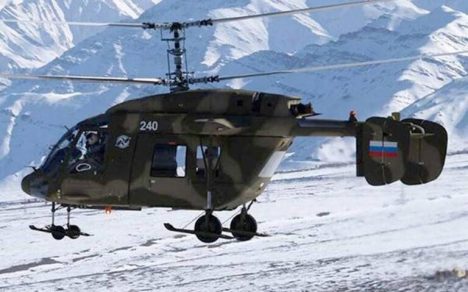
Russian Ka-226T helicopter to be produced under ‘Make in India’ is advantageous in high-altitude environments
By M. K. BHADRAKUMAR | Indian Punchline | August 24, 2020
The Nikkei Asian Review, well-known for its anti-China reportage, featured an article over the weekend titled India should ignore Putin’s offer to broker accord with China. The author is none other than Marco Rubio, the high-flying Republican senator from Florida and the Acting Chairman of the US Senate Intelligence Committee, Co-Chair of the Congressional Executive Commission on China and a ranking member of the Senate Committee on Foreign Relations.
Rubio is one of President Trump’s closest supporters today, apart from being an old ally of Secretary of State Mike Pompeo, dating back to their days in Congress. Pompeo had endorsed Rubio against Trump during his run for president in 2016. Pompeo wrote at that time,
“When I think of the challenges facing our nation – whether it’s our broken healthcare system, runaway government spending, or job creation domestically, or threats from terror groups like ISIS, al-Qaeda, or the terror regime in Iran internationally – there is simply no candidate better to tackle them than Marco Rubio.”
The Rubio piece is dripping with Russophobia and reminds one of Pompeo’s trademark style. The leitmotif is Russian President Vladimir Putin, whom Rubio demonises as someone who singularly aims ‘to shatter the current U.S.-led international system’ with tools he perfected in Russian domestic politics — ‘supporting thugs, undermining democracy, and stealing everything that isn’t nailed to the wall.’
Rubio draws illustrative examples from Putin’s ‘exploitative playbook’ in Venezuela, Syria, Turkey, Libya and Belarus. And he spotlights India for special attention. Rubio writes:
“Across the globe in the Himalayas, relations between India and China have remained tense since May following a clash of troops near the countries’ disputed border in Ladakh. The violent clashes, as well as domestic moves such as India’s decision to ban over a hundred Chinese electronic apps, has stoked fears of further escalatory action between the two nuclear-armed nations. Sensing an opportunity to prove itself as an important global power, Moscow has attempted to act as a mediator in the conflict.
“But even a cursory look at Moscow’s motivations makes clear that Putin’s interests are that of his own. Russia considers China to be its most important strategic partner. Having antagonized many nations to its west and finding itself diplomatically isolated as a result, Moscow has in recent years looked to a fellow authoritarian regime in Beijing to develop a rapport. This relationship has continued in the form of enhanced cooperation in digital infrastructure, military exercises, as well as growing trade relations.
“But Moscow is also amid a major effort to cultivate relations with New Delhi, as well. India is crucial for economic and geopolitical reasons, its government is a longtime purchaser of Russian military equipment. But India is a vibrant democracy and is moving decisively toward other liberal democracies to confront authoritarian states. Putin shouldn’t count on helicopter purchases to maintain friendly relations with India as he blatantly cozies up to China.”
Succinctly put, Rubio warns Prime Minister Modi to be wary of Putin and Russia, which is a friend of China, who is India’s enemy. It is a familiar theme lately that American think tankers have been plugging, ably supported by the US lobbyists in India.
Rubio must be standing in for Pompeo. The article alludes to India’s helicopter deal with Russia, which apparently annoys Washington. Reports say that India and Russia have agreed to resolve issues around the production of Ka-226T helicopters and fast track it. This was discussed during Defence Minister Rajnath Singh’s visit to Moscow in June.
The project is on ‘Make in India’ mode. India will be able to receive some crucial helicopter technologies from Russia as well. This is known to be a project that Putin personally promoted with Modi. Rubio appears to sound a warning to Modi who is known to enjoy close personal rapport with Putin.

Indian PM Narendra Modi with Russian President Vladimir Putin at an informal summit in Sochi, Russia, 21 May 2018
Rubio writes, “Much like Putin’s foreign adventurism, the goal has simply been to enrich himself and his inner circle. Those considering relying on the Kremlin should realize that they will have no long-term stable partner in Russia while he remains in power.” Without doubt, this is Pompeo speaking even as New Delhi and Moscow are discussing high-level visits in a near future.
Rubio’s article appears even as India is opting for deployment of the indigenous Light Combat Helicopters (LCH) made by HAL Bengaluru, in Ladakh on the Chinese border, in preference to the new US-made AH-64E Apache. Compared to the LCH, the Apache is faster, has more engine power, and carries far more weapons, but LCH has a longer range. The Indian experts evaluate that the LCH has an edge over Apache due to its ability to perform at high altitudes in the upper reaches of the Himalayas.
The Trump administration has been hoping for some big helicopter deals and has been pulling strings in Delhi but to its dismay finds that Russia has stolen a march. The rancour shows in Rubio’s venomous attack on Putin.
From the geopolitical perspective, Rubio finds it unacceptable that a ‘Quad’ member country — “India is a vibrant democracy and is moving decisively toward other liberal democracies to confront authoritarian states” — should be having a dalliance with Russia at all. Of course, there is a body of opinion in India too that an alliance with the US is what the country should prioritise in the backdrop of its face-off with China in Ladakh. They blithely assume that the US is raring to go to wage a joint war against China.
Rubio’s piece should be an eyeopener for such people besotted with the superpower as to what in reality an alliance with the US entails — a demanding partnership that locks in India. Rubio wrote in anticipation of likely initiatives by Putin to ease India-China tensions. Putin is expected to visit India in October. And a spate of summit meetings can also be expected in the coming months under the rubric of BRICS, SCO, G20 that would bring together the Russian, Indian and Chinese leaderships.
The US is panicking that India might bolt away just as a window of opportunity opened to tether it to the Quad stable (thanks to the standoff in Ladakh), which has been a key objective of the US regional strategies against China in the Asia-Pacific. Rubio’s vituperative attack on Putin highlights the depth of anxiety in the American mind that the Kremlin leader may breathe fresh life into the Russia-India-China triangle.
Indeed, it is in Russia’s self-interests to tamp down Sino-Indian tensions. But what unnerves Washington most is that any easing of India-China tensions will knock the bottom out of its containment strategy against Beijing. With a likely transition in the Japanese leadership, and taking into account China’s close ties with ASEAN countries as well as the European allies’ disinterest in joining the US bandwagon against China, Washington is practically being left with a solitary ally in the Asia-Pacific — Australia.
Facing such stark isolation, the stakes have never been so high for the US to shackle India to its regional strategy in the Asia-Pacific. Washington senses that the anchor sheet of India’s strategic autonomy lies in its longstanding partnership with Russia, which remains firm and immutable despite the changes in world politics in the post-cold war era.
The partnership has gained in verve and swagger given the high importance Modi personally attaches to it. Hence this assault on the Russian-Indian strategic understanding. Thus, a huge propaganda campaign is under way portraying Russia as an ally of China whom India can longer trust. Rubio has lent his name to dignify the US propaganda and draw the attention of Indian policymakers.
In Blow to US Efforts, Morocco Says No to Normalization with Israel
Palestine Chronicle | August 24, 2020
Morocco will not follow the lead of the United Arab Emirates and normalize with Israel, the country’s Prime Minister Saad-Eddine El-Othmani said during a high-level political meeting late on Sunday.
El-Othmani told members of his Justice and Development Party that Morocco “refuses to normalize relations with the Zionist entity (referring to Israel) because this will embolden it to further breach the rights of the Palestinian people.”
The top Moroccan official reiterated that the country’s King, government and people will remain steadfast in defense of the rights of the Palestinian people and Al-Aqsa Mosque, located in occupied Palestinian East Jerusalem (Al-Quds).
“In 1993, Morocco and Israel had low-level diplomatic ties following the signing of the Oslo Accords between the Palestinians and Israel,” Anadolu news agency reported on Monday.
“However, Rabat suspended the relations with Israel following the outbreak of the Palestinian uprising in 2000,” Anadolu added.
On August 13, Israel and the UAE have reached a deal that is expected to lead to “full normalization of relations” between the small Arab nation and Israel in an agreement that US President Donald Trump brokered.
Featured Video
John Mearsheimer: Why Russia Gains By Hitting Ukraine Harder
or go to
Aletho News Archives – Video-Images
Book Excerpt
Measles and Mortality
Informed with Aaron Siri| November 19, 2026
Given the news coverage around measles and mortality, I decided to share the section of my book, Vaccines, Amen, that covers precisely this topic. Help me spread a bit of reality into the media hysteria around this issue. Here is that section of the book… continue
Blog Roll
 Aletho News
- A Climate Scientist Who Engages Skeptics
- John Mearsheimer: Why Russia Gains By Hitting Ukraine Harder
- Argentina’s Perito Moreno Glacier Joins Antarctica and Arctic In Defying Doomsday Melt Claims
- ‘Chinagate’ Is Here
- Iran, four other countries condemn US plans to deploy weapons in outer space
- US media brings back the Iraq war playbook and why it won’t work
- Zakharova schools German FM on history basics
- Germany to produce drones for Ukraine
- Merz takes a swipe at Merkel over Ukraine’s NATO bid
- Measles and Mortality
- If Americans Knew
- An error has occurred; the feed is probably down. Try again later.
- No Tricks Zone
- Alarmist Climatologists In Shock! 2026 Atlantic Hurricane Season Sees Lowest Count In 101 Years
- New Study: Modern Temps Are Among The Coldest Of The Last 10,000 Years In East Central Europe
- Germany’s Renewable Energies Lead to 1.4 Billion Euro Electric Power Trade Deficit
- Argentina’s Perito Moreno Glacier Joins Antarctica and Arctic In Defying Doomsday Melt Claims
- New Study: Barents Sea Temperatures Were Warmer And Sea Ice Less Extensive In The 1700s Than Today
- German Authorities Start Initiative To Evaluate Public Register For Climate “Disinformation” Spreaders!
- Zonal Asymmetry of Temperature Change in the Antarctic Circumpolar Current
- New Study: The Net Fossil Fuel Contribution To Rising Atmospheric CO2 Has Been Zero For 500 Years
- Germany’s Green Energy Transition Becoming Increasingly Expensive…Another 6 Trillion Euros!
- Sudden Stratospheric Warming, Powerful El Niño Combination May Lead To Extreme Europe Cold, Energy Crisis!

