Hebron Plan is Israel’s Reminder to Palestinians that Settler Power knows no Limits
Proposed destruction of Hebron’s market to make way for a new settlement is Israeli government’s route to refashion its apartheid system as the rule of law
By Jonathon Cook | The National | December 10, 2019
US President Donald Trump told thousands of Israel’s supporters at a rally in Florida at the weekend that some American Jews “don’t love Israel enough”. It is certainly troubling that a US president insists a section of his country’s citizens – the Jewish population – be required to love a foreign state. But then Trump went further, muddying the waters about what constitutes “Israel”.
Echoing remarks made last month by Mike Pompeo, his secretary of state, he described the Jewish settlements in the West Bank as legal – thereby subverting a long-established principle of international law.
US Jews – and the rest of us, it seems – are expected not only to love Israel inside its internationally recognised borders but also to love the Jewish settlements that international law designates as a war crime. Those are the same settlements eating up ever more of the territory supposed to form the basis of a Palestinian state.
When Trump, like his predecessors, told his weekend audience that the US shared an “unbreakable” bond with Israel, what exactly was the “Israel” he referred to? Both the US and Israel have implied in recent declarations and actions that a central plank of the long-delayed Trump peace plan will be Israel’s annexation of the settlements – and with them most of the West Bank.
“Loving Israel” now is meant to include abandoning any hope of Palestinian statehood and accepting that Palestinians will live permanently under an Israeli version of apartheid, with inferior rights to Jews.
The Trump administration seems keen to press ahead with the peace plan – and annexation – but is being hampered by political chaos in Israel.
Mired in corruption scandals and having staged two inconclusive elections this year, Benjamin Netanyahu, the caretaker prime minister, is unable to cobble together a coalition to keep himself in power. The impasse is not over the occupation or the settlements but about who gets to dominate the next government: far-right religious settlers led by Netanyahu or right-wing, secular former army generals?
Nonetheless, Netanyahu is behaving as if Washington has given its blessing to annexation – even without a US peace plan.
That was what Pompeo’s statement last month backing the settlements amounted to. He offered one paltry safeguard, investing responsibility for monitoring and limiting settlement expansion in Israel’s supreme court. But this is the same court that has consistently failed to block settlement growth over five decades. It now includes two judges who actually live in settlements, as well as others who sympathise politically with the settlement project.
Meanwhile, in preparation for a likely third election campaign, the interim Netanyahu government has announced a splurge of new settlement building and boosted settler budgets.
In another fillip for the settlers last month, Netanyahu appointed one of their leaders, Naftali Bennett, to the sensitive role of defence minister. Bennett lost no time in unveiling his latest settlement plan last week, selecting an incendiary spot greatly prized by the settlers: the middle of Hebron, the West Bank’s largest Palestinian city.
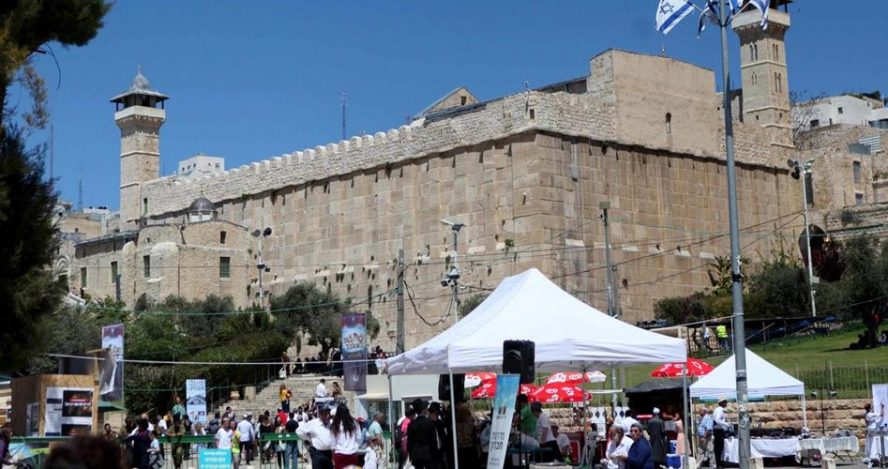
For decades, life for Hebron’s 230,000 Palestinians has been forced to a virtual standstill by a few hundred Jewish religious extremists who have taken over the city centre, backed by more than 1,000 Israeli soldiers. Their ultimate goal is to wrestle away the city’s Ibrahimi mosque, the reputed burial site of Abraham, father of the world’s three main monotheistic religions.
After Baruch Goldstein, a settler, shot dead and wounded some 150 Muslim worshippers in 1994, Israel rewarded the settlers twice over.
First, it segregated the mosque site, splitting it into two. Half is now the Jewish Tomb of the Patriarchs. But in practice the Israeli army enjoys absolute control over who can pray there.
And next, Israel declared the surrounding area, including Hebron’s main commercial market, a closed military zone, thereby forcing the Palestinian merchants out. It has been a ghost town ever since, serving as a passageway between the settlement enclaves and the mosque.
For years, the closed market has stood as a potent, silent symbol of the way Israel has been tearing the city apart.
In February, Netanyahu gave the settlers another boost. He shuttered the international observer mission in Hebron, there to witness and record the abuse of Palestinians, especially at the checkpoints that litter the city centre. But still the settlers were not satisfied. They have long wanted to take over the Hebron market for themselves, to expand their enclaves.
So last week, Bennett granted their wish. He announced plans to destroy the market to make way for a settlement serving effectively as a bridge between the existing enclaves and the mosque site. The plan will double the number of settlers in Hebron and complete a wall of Jewish settlement dividing the city in two. This week Palestinian leaders called a citywide strike in protest.
As ever, the Israeli government has tried to put a surreal legal gloss on its criminality, apparently to spare the blushes of its US and European allies. Bennett’s advisers have insisted that Israel has legal title to the air above the roofs of the empty shops. This is where the settlers will supposedly be housed, after the shops have been demolished and rebuilt to support the new apartment blocks.
It emerged this week that Bennett had threatened Hebron’s municipality, warning it would lose property rights to the shops area too if it did not consent to the settler homes above.
Israel is reminding Palestinians that there are now no limits – military, legal, moral or diplomatic – to the settlers’ power. Israel will annex land where it chooses and deceptively refashion the resulting apartheid system as the rule of law.
The material losses to the Palestinians from Israel’s ever-growing settlement enterprise are devastating enough. This month, the United Nations Conference on Trade and Development issued a report estimating conservatively that the past 17 years of occupation alone had cost the Palestinians a whopping $48 billion – three times the current size of its economy.
That income would have generated two million job opportunities, freeing Palestinians from a miserable choice between life without work and, if they are issued a permit by Israel, precarious, exploitative casual labour in Israel or the settlements.
Equally significantly, the ever-expanding settlements have stripped Palestinians of their most basic freedoms, such as movement, and undermined their security and right to be treated with dignity.
And no one ought to love that.
When holidays bring hate: Sarah’s Day in Occupied Hebron
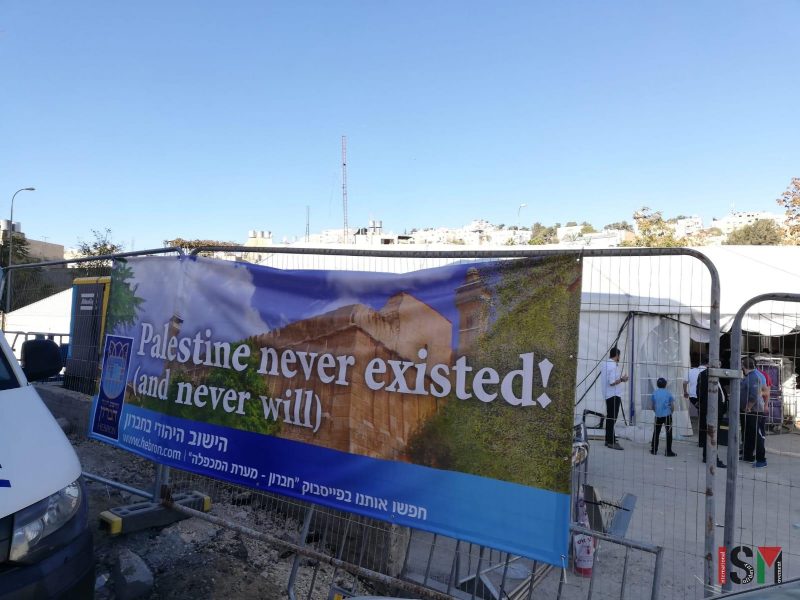
Extremist and racist propaganda placed around Hebron (H2) ahead of Sarah’s Day, a major Jewish holiday.
International Solidarity Movement | November 28, 2019
Hebron, occupied Palestine – The Jewish holiday of Shabbat Chayei Sarah (Sarah’s day’) took place in Al Khalil (also known as Hebron) over the weekend of 22-23 November. Over the two days around 50,000 Israeli settlers flocked to the city, to celebrate the festival in the place that Zionists believe is their religious right (despite the fact that it is historically Palestinian and is clearly within the demarcation of Palestinian Territories).
For weeks the area was being adapted and prepared to accommodate the thousands of visitors. Israeli settlers from nearby illegal settlement Kiryat Arba were to be joined by other observant Jews from across Israel, as well as from countries abroad such as France, the UK, and the USA. The mood was set by blatant Zionist propaganda adorning the streets, such as a banner proclaiming “Palestine never existed – and never will”. Whole areas of the old city and surrounding areas were taken over by gazebos, tents and caravans for the weekend. Exclusive and expensive VIP tickets to celebrate ‘Sarah’s day’ were available for hundreds of US dollars, enabling attendees to meet and dine with religious leaders, alongside Knesset members, and IDF commanders.
By Friday afternoon, thousands of celebrants had arrived in the city and the already extensive Israeli Occupation Force (IOF) presence (normally 4000 IOF soldiers guard the 400 Israeli settlers) was even greater than usual. Enhanced security measures were in place and major roads were blocked off, obstructing Palestinian movement around the city, and forcing Arab shops to close for business in an already suffocated economic environment (due to businesses and areas being closed by military order, and commerce/tourism heavily suppressed by restrictions on movement through checkpoints).
Many of the visiting settlers were visibly armed, with handguns or automated weapons, in stark contrast to Palestinians for whom it is illegal to carry a weapon, tightly enforced at all of the numerous checkpoints.
Each day International Solidarity Movement (ISM) received reports of serious, violent attacks on Palestinians living in or passing through vulnerable areas where settlers filled the streets.
On Friday evening, on the ‘Prayer Road’, leading up to the large settlement of Kiryat Arba, a group of 8 Palestinians were attacked in a barber shop. ISM spoke to one of the victims, Fayed, who reported a large group of settlers forcing entry to his father’s shop. Despite attempts to persuade the settlers to leave, more arrived to join the attack. Up to 100 settlers sprayed pepper spray, threw stones, chairs and pieces of wood, damaging property and injuring Fayed, his brother, his uncle and father. Fayed’s 21 year old cousin suffered a broken hand, whilst he and his uncle and father sustained injuries to the head and arms, resulting in hospitalization. The police eventually moved the settlers on however no arrests were made. Only basic details of the attack were taken down and there has been no further investigation of the crime.
Later that night there were further reports of violent attacks by groups of settlers in the same area, including an assault on a young old child, who was kicked and sprayed with pepper spray, requiring him to be taken to hospital. A Palestinian bride was also harassed and attacked by settlers as she celebrated her wedding day.
Despite the heaviness of occupation pressing down on them, the brutal and unprovoked attacks from the settlers, and frustration at the lack of protection from the authorities, Fayed and his family are quietly resistant. “Our life here is hard, but we have to resist. We try to be nice to everyone… to treat them nice, we don’t want any violence. Violence is not the solution…. the settlers carry M16 guns. It’s normal for us and our situation here – to be attacked, arrested, killed. We grew up like this. What can we do? We don’t have a lot of power or support. We can’t fight with guns or knives, this is not the solution. How many Palestinians have been killed? Guns and knives are not free, they do not make Palestine free. We are not against Jews, we are against Zionists and settlers, and those that occupy our houses. ”
The following day, the entire old city plus large swathes of the normally unrestricted area (known as ‘H1’) was locked down, making way for thousands of settlers to be given religious tours of the city. Many were intoxicated, chanting provocative anti-Palestinian songs, shouting abuse, and urinating on Palestinian property. As the day progressed, their behavior became increasingly violent, with numerous incidents of settlers throwing rocks, bottles and other items at Palestinian people and homes, as well as unlawfully entering or climbing on Palestinian property. IOF remained passive, merely supervising the passage of the crowds through Palestinian areas.
In one shocking incident, a group of settlers attacked the home of a known Palestinian activist, Imad, who has been frequently targeted since speaking out against the murder of a Palestinian by the IOF several years ago.
Imad and his family are some of the few Palestinians brave enough to continue living in Tel Rumeida, part of an area in the heart of the old city which has been designated a restricted military zone (known as ‘H2’). Since 1968 Al Khalil has been subject to the establishment of illegal Jewish settlements, and over the last 20 years, the area has seen a huge influx of hardcore settlers who believe for religious reasons they have a right to occupy the land. These are some of the most extreme settlers in Israel, who routinely perpetrate abuse and violence against Palestinian residents, including children going to school. Many Palestinians have been forced out of their homes and for those who remain, living in this area is extremely dangerous for Palestinians. There is a daily threat to life and limb.
On Saturday, as the streets of Tel Rumeida were inundated with thousands more armed settlers, the violence and intimidation escalated. There were multiple reports of attacks on Palestinian people and property. Footage was recorded of large groups of drunk settlers climbing on the roofs of Palestinian homes, and abusing and intimidating residents.
On Saturday Imad remained confined at home with his grandchildren, due to the large numbers of settlers who had been marching and congregating in the streets outside, making it unsafe for Palestinians to leave the house. Imad heard settlers climbing on his roof, and trying to enter his home through the entrance way. He called friends to come and help. and unsuccessfully tried to convince the settlers to leave. The large group were shouting abuse, spitting and throwing stones at bottles. Moments later Imad heard crying from where his 18 month old grandson was sleeping. As he ran into the room he discovered that a settler had thrown a stone through the open window, striking the child on the head and wounding him.
Due to the closed and restricted nature of this part of the city, an ambulance was unable to reach the house to attend to the child. The child had to be carried through the streets, protected by a circle of local people from the settlers who continued to try to attack the group as they tried to reach the ambulance.
Imad explains that the IOF soldiers arrived at the house during the attack, however they only stood watching, and failed to intervene to stop the violence. When local Palestinian’s arrived to provide support, the soldiers pushed and held them back, threatening to arrest them. The IOF also failed to provide any first aid or show concern for the injured child.
Despite the heavy IOF and Israeli police presence throughout the city during this weekend, it was abundantly clear that they were there to protect the settlers, and not the Palestinian residents. There was a complete failure to protect the Palestinians under attack. Police also failed to undertake any investigation into the various incidents, or attempt to bring to justice those settlers engaging in violence against Palestinians.
This raises concerns that the IOF are turning a blind eye to the violence, sanctioning and enabling it to occur, or alternatively that they simply have no power or authority to control the settlers’ violence. The risk for Palestinians trying to resist the occupation and violence, such as Imad, is to be punished, singly or collectively, for their defiance in the face of the creeping genocide of the Palestinian land and people.
Whilst trying to document and observe violence and abuse, ISM experienced hostility and aggression from both settlers and the IOF, including physical and verbal threats, restriction of movement as well as having our passports photographed by police and threatened arrest, in a clear attempt to deter us from our work. Pro-Palestinian activists in Israel risk deportation, including a 10 year ban from the country, serving to silence and prevent the documenting of human rights violations in Palestine.
Only 19.7% of Americans agree with US State Dept on Israeli settlements
IRmep Poll: “International law SHOULD APPLY to Israel’s military occupation & colonization of the West Bank, Golan Heights, E. Jerusalem and displacement of their indigenous populations. Do you Disagree or Agree?”
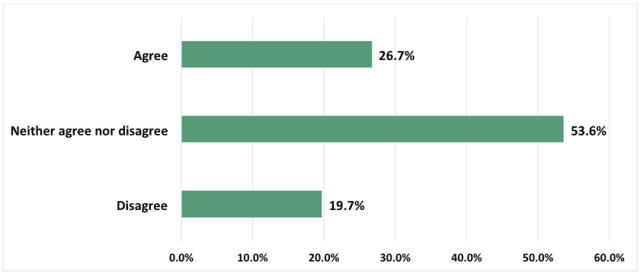
More than 80 percent of Americans seem unwilling to let Israel reinterpret international law to suit its colonialist agenda.
By Grant F. Smith | IRmep Polls
IRmep representative public opinion poll of 2,034 American adults through Google Surveys on November 20-22. Answer order randomly reversed.
Most American adults of voting age don’t appear willing to reject the applicability of international law to Israel’s ongoing colonization of occupied territories in East Jerusalem, the West Bank and Golan Heights.
On Monday, November 18, U.S. Secretary of State Mike Pompeo reversed a 1978 State Department legal opinion stating that Israeli settlements were “inconsistent with international law.” Citing President Ronald Reagan’s 1981 assessment that the settlements were not “inherently illegal,” Pompeo stated that, “After carefully studying all sides of the legal debate… the establishment of Israeli civilian settlements in the West Bank is not, per se, inconsistent with international law.”
The Trump administration relocated the U.S. Embassy from Tel Aviv to Jerusalem in 2018 and recognized the city as the capital of Israel. This most recent announcement is yet another blow to rule of law and international consensus. However, when polled, 53.6 percent of Americans don’t yet appear ready to register any concrete view on the matter. This may be due to the longstanding absence of serious U.S. mass media coverage of historical and legal issues. In other countries, informed and ongoing international legal analysis is the norm. Given that reality, it is surprising that 26.7 percent of Americans believe international law still applies, while only 19.7 percent believe it does not.
In a Nov. 21 letter sent to Pompeo, 107 House Democrats condemned the State Department’s recent decision on settlements.
Grant F. Smith is the director of the Institute for Research: Middle Eastern Policy in Washington, DC. For more IRmep polls, visit https://IRmep.org/Polls.
UN Security Council members strongly condemn Trump’s support for Israeli settlements
Press TV – November 21, 2019
The European Union, Russia, China and other members of the UN Security Council on Wednesday strongly opposed the US announcement that it no longer considers Israeli settlements in the occupied West Bank to be a violation of international law.
Nickolay Mladenov, the UN special coordinator for the Middle East peace process, opened the Security Council meeting, expressing “regret” at the US action and reiterating the UN position that settlements under a December 2016 council resolution “are a flagrant violation under international law.”
Indonesian Ambassador Dian Triansyah Djani, whose country has the world’s largest Muslim population, called the US announcement “irresponsible and provocative,” saying it “incontrovertibly constitutes a de facto annexation and is a barrier to peace efforts based on the two-state solution.”
Following the Security Council meeting, ambassadors from the 10 non-permanent council members who serve two-year terms stood before reporters while Deputy German Ambassador Jurgen Shultz read a critical joint statement.
“Israeli settlement activities are illegal, erode the viability of the two-state solution and undermine the prospect for a just, lasting and comprehensive peace” as affirmed by the 2016 council resolution, the statement said.
It also called on Israel to end all settlement activity and expressed concern at calls for possible annexation of areas in the West Bank.
Kuwaiti Ambassador Mansour al-Otaibi, the Arab representative on the council, then told reporters that 14 countries agreed in the private session on the press statement.
Palestinian Ambassador Riyad Mansour also said he was grateful to the 14 council nations and their commitment to international law, saying that all 193 UN member nations are required to implement all Security Council resolutions, including on the illegality of all settlements.
“The US administration once again makes another illegal announcement on Israeli settlements in order to sabotage any chance to achieve peace, security and stability in our region and for our people,” Mansour said.
“We strongly reject and condemn this unlawful and irresponsible declaration; we consider it to be null legally, politically, historically and morally.”
Before the meeting, British Ambassador to the UN Karen Pierce had told reporters that “all settlement activity is illegal under international law and it erodes the viability of the two-state solution and the prospects for a lasting peace.”
She was speaking on behalf of Germany, France, Poland, Belgium and Britain, the EU’s current Security Council members.
The meeting was held two days after an announcement by Secretary of State Mike Pompeo reversed a four-decade-old US position on illegal settlements in the occupied Palestinian territories. The move was welcomed by Israel but drew condemnation from Palestinians and Arab leaders.
The shift has been widely interpreted as a green light for Israeli settlement building in the occupied West Bank.
Israel has cracked down on Palestinian education, criminalising hundreds of students
By Megan Giovannetti | MEMO | November 15, 2019
Khaleel Shaheen is a senior at Birzeit University in Ramallah. When he heard that four close friends and fellow students were arrested by the Israeli authorities, he didn’t go to the campus for five days.
As a volunteer with Birzeit’s Right to Education Campaign — a student-led group which monitors Israeli violations against students — Shaheen is finding it difficult to continue his work as normally as possible while this latest crackdown against students unfolds.
“I feel so angry,” he told me. “I feel so helpless. “I cannot just go to school. I cannot focus. I cannot function to go to class.”
According to the Right to Education Campaign, 20 students have been detained by the Israeli authorities since the beginning of the current academic year. This is nothing new. Since 2004, more than 1,000 students enrolled at Birzeit have been arrested, 80 of whom are still in Israeli prisons. Seventeen of these are currently held under administrative detention, a process which Israel uses systematically to hold Palestinians indefinitely with neither charge nor trial.
Students are often denied access to a lawyer for up to 60 days and subjected to harsh interrogation and treatment in Israeli custody. Most are taken from their homes in the middle of the night or even kidnapped directly from campus.
Addameer, a Palestinian prisoner support and human rights association, told me that a total of 250 students across various Palestinian universities are currently in Israeli prisons. “There are also around 190 Palestinian children detained and imprisoned in Israeli jails, of whom 20 are under 16 years old,” Addameer’s advocacy officer pointed out. “Those children are all students in primary or secondary schools.”
In an exclusive statement to MEMO, Birzeit University described this escalation of arrests as an ongoing Israeli policy targeting students who have political affiliations and activism. “They are targeting students who are very active in the student movement in the university,” Shaheen explained. “They are not just going after people at random.”
Birzeit University is the only West Bank higher education institution which holds student body elections, with representation from all Palestinian political parties. In a society that has not held a General Election since 2007 — hence the deadlocked political system and a president whose own term ended 10 years ago — Birzeit University’s elections are one of the only ways to gauge public opinion.
“These elections are very, very important for both the [Palestinian] government and the [Israeli] occupation [because] it depicts the streets… and what the new generations are voting for,” said Shaheen. He confirmed that no particular political party’s members appear to be targeted; arrests occur across the spectrum of political affiliation.
Birzeit seems to be targeted because of its reputation for producing politically active students. “The students care so much about politics,” added Shaheen. “They care about what is happening on the streets.” He told me about the weekly demonstrations that students arrange in support of prisoners, refugees and martyrs; or simply demanding their right to education.
The student body council has the power to gather students together and give them a voice. “For the Israelis, this is dangerous. It’s dangerous for them [to have] active students who have a voice and opinions, and influence the opinions of others.”
Last year, a video went viral of undercover Israeli forces kidnapping the president of the student body council, Omar Kiswani, directly from Birzeit’s campus. The video and various reports show six plain-clothed officers beating Kiswani and firing their guns in broad daylight.
Birzeit University faculty member and Professor of Media Dr Widad Bargouthi was swept up in the latest round of Israeli arrests based on a military law of “incitement”. According to Addameer, the indictment was based on social media posts made by Dr Bargouthi, despite them being a part of a class regarding the basic journalistic principles of freedom of expression.
“I believe that most of those arrests [are carried out] to create an atmosphere of fear inside the university,” Shaheen said. This has drawn students away from making social media posts or even simply attending classes. “They want to make students fearful of everything.”
When asked for a comment, the office of the Israel Defence Forces spokesperson indicated that the cases are under investigation by Shin Bet, the internal security agency, and no information could be shared. “The students that are in custody have been suspected of terrorist attacks in which Israeli citizens were killed,” is all that the spokesperson would say. No details of the specific “terrorist attacks” in question were provided.
A public gag order on all student cases was issued on 10 September and has been renewed twice. The current order will expire on 7 December. This limits Addameer’s ability for advocacy. The order — requested by Shin Bet — was not issued by a military court, but a civil court in Jerusalem. “The session was one-sided, without the prisoners or their lawyers [present],” said Addameer’s advocacy officer.
Birzeit University told MEMO that Israel’s policy of arresting students and teachers is a “grave violation” of basic rights to education and academic freedom. “The reality now is turning higher education in Palestine from safe spaces where students can grow, excel and express themselves freely, into zones where students are in grave danger both on and off campus.”
Israel’s crackdown on Palestinian education is criminalising hundreds of young people. This is not the act of a genuine democracy.
READ ALSO:
Jewish Nation-State Law added to Israel high school curriculum
Israel students forced to pass government propaganda course before overseas school trips
Soldiers Force Palestinians Out Of Their Olive Orchards In Nablus
IMEMC | November 2, 2019
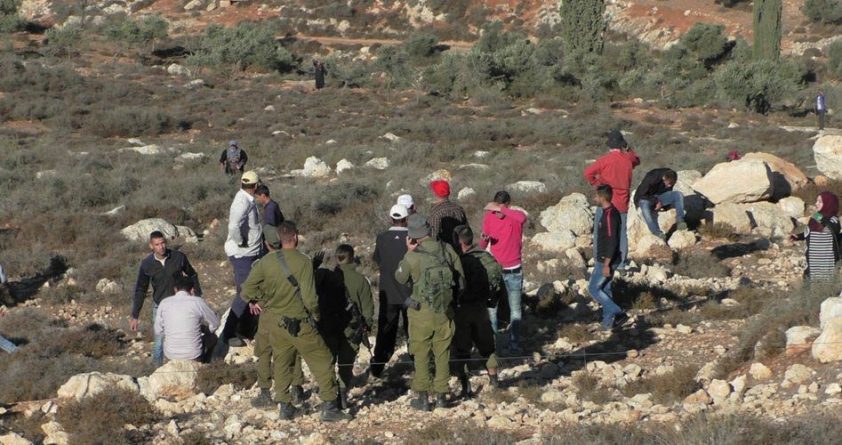
Israeli soldiers invaded Palestinian olive orchards between Burin and Huwwara towns, south of the northern West Bank city of Nablus, and forced the Palestinians out on Saturday, in addition to threatening them with “bringing the settlers to attack them.”
Eyewitnesses said the soldiers invaded the orchards near the illegal Yitzhar colony, which was built on private Palestinian lands, and attacked the families.
The soldiers even told the families that if they do not leave, they will bring the colonists from Yitzhar, known for constantly attacking the Palestinians and their lands, to assault them.
Olive harvest season in the occupied West Bank is always accompanied by dozens of Israeli violations by both the soldiers and the illegal colonists.
There have been numerous violations this olive harvest season alone, including twelve just recently in Qaryout village, south of Nablus.
The attacks include assaulting Palestinians, uprooting their trees, burning their lands and orchards, in addition to the military’s refusal in many cases to allow the Palestinians into their lands, isolated behind the illegal Annexation Wall.
It is worth mentioning that the Palestinians in Nablus governorate are not allowed to enter more than 3,500 Dunams of their olive orchards, except for a few days a year, after prior coordination and approval from the military.
Even when they receive the permits, the Palestinians and are forced to wait until the soldiers open the gate for them, and sometimes the soldiers do not open it at all or force them to wait for long periods.
On Friday morning, several colonists invaded a Palestinian orchard in Yasuf village, east of the central West Bank city of Salfit, and stole a donkey, blankets and olive picking tools.
Such attacks against Palestinian lands, especially olive orchards, including those carried out by soldiers, take place in various areas across the West Bank, always escalate during the olive harvest season, and include cutting, burning and uprooting trees, picking olive trees and stealing the produce, in addition to assaulting the Palestinians and forcing them out of their orchards.
Israel re-arrests prominent Palestinian legislator Khalida Jarrar
Press TV – October 31, 2019
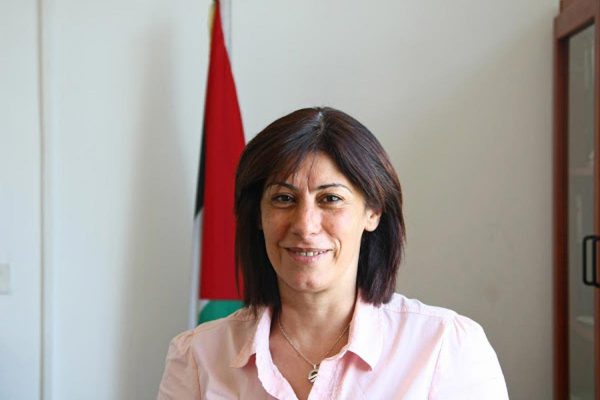
Israeli forces have re-arrested a prominent Palestinian legislator and senior member of the Popular Front for the Liberation of Palestine (PFLP) in an overnight raid into her home.
Khalida Jarrar, a 56-year-old member of the Palestinian Legislative Council, was arrested at 3 am local time (00:00 GMT) at her home in the central occupied West Bank city of Ramallah, located 10 kilometers north of Jerusalem al-Quds, and taken to an unknown area, local media reported on Thursday.
Her daughter Yara Jarrar said in a post on Twitter that the house was surrounded by more than 70 Israeli soldiers who arrived in 12 military vehicles.
“Mom and sister were asleep when they approached,” Yara said.
The Palestinian lawmaker has been jailed multiple times. She was released last February after spending 20 months in “administrative detention” — an illegal practice under which an individual is held without a trail.
Jarrar, a staunch advocate of Palestinian prisoners’ rights, said after her release that she would continue to campaign for the release of all Palestinian prisoners held in Israeli prisons and detention centers.
According to Samidoun, a Palestinian prisoner solidarity network, she played a leading role in supporting the education of the minor girls held there, organizing classes on human rights and in review for mandatory high school examinations when the prison authority denied the girls a teacher.
Jarrar was last arrested in July 2017, when a large number of Israeli troopers raided her home. Her husband, Ghassan, said Israeli forces also seized her computers during the raid.
Israel’s internal spy agency, Shin Bet, later announced in a statement that Jarrar was arrested along with a Palestinian activist for “promoting terror activities,” without providing any further information.
Jarrar is one of the most outspoken critics of the Israeli occupation and has repeatedly slammed the Tel Aviv regime’s atrocities against Palestinians.
The Israeli regime has been denying the lawmaker the right to travel outside the occupied Palestinian territories since 1988. She campaigned for months in 2010 before receiving the permission to travel to Jordan for medical treatment.
In August 2014, Jarrar received a “special supervision order” from the Israeli military, which ordered her to leave Ramallah to live in the West Bank city of Ariha, also known as Jericho.
However, Jarrar set up a protest tent outside the Palestinian Legislative Council in Ramallah, where she lived and worked, until the controversial order was overturned later in September that year.
According to reports, a total of 13 Palestinian lawmakers are currently held in Israeli detention facilities without any trial under the so-called administrative detention, which is a policy according to which Palestinian inmates are kept in Israeli detention facilities without trial or charge.
Some Palestinian prisoners have been held in administrative detention for up to 11 years.
Israel currently holds 495 Palestinian prisoners in administrative detention, according to ADDAMEER Prisoner Support and Human Rights Association, an NGO that works to support Palestinian political prisoners.
The Ethnic Cleansing of Palestinian Christians that nobody is talking about

Side view of the Church of the Holy Sepulcher which is opened to worship after the restoration in Jerusalem on 24 March 2017
MEMO | October 29, 2019
Palestine’s Christian population is dwindling at an alarming rate. The world’s most ancient Christian community is moving elsewhere. And the reason for this is Israel.
Christian leaders from Palestine and South Africa sounded the alarm at a conference in Johannesburg on October 15. Their gathering was titled: “The Holy Land: A Palestinian Christian Perspective”.
One major issue that highlighted itself at the meetings is the rapidly declining number of Palestinian Christians in Palestine.
There are various estimates on how many Palestinian Christians are still living in Palestine today, compared with the period before 1948 when the state of Israel was established atop Palestinian towns and villages. Regardless of the source of the various studies, there is a near consensus that the number of Christian inhabitants of Palestine has dropped by nearly ten-fold in the last 70 years.
A population census carried out by the Palestinian Central Bureau of Statistics in 2017 concluded that 47,000 Palestinian Christians are living in Palestine – with reference to the Occupied West Bank, East Jerusalem and the Gaza Strip. Ninety-eight per cent of Palestine’s Christians live in the West Bank – concentrated mostly in the cities of Ramallah, Bethlehem and Jerusalem – while the remainder, a tiny Christian community of merely 1,100 people, lives in the besieged Gaza Strip.
The demographic crisis that had afflicted the Christian community decades ago is now brewing.
For example, 70 years ago, Bethlehem, the birthplace of Jesus Christ, was 86 per cent Christian. The demographics of the city, however, have fundamentally shifted, especially after the Israeli occupation of the West Bank in June 1967, and the construction of the illegal Israeli apartheid wall, starting in 2002. Parts of the wall were meant to cut off Bethlehem from Jerusalem and to isolate the former from the rest of the West Bank.
“The Wall encircles Bethlehem by continuing south of East Jerusalem in both the east and west,” the ‘Open Bethlehem’ organisation said, describing the devastating impact of the wall on the Palestinian city. “With the land isolated by the Wall, annexed for settlements, and closed under various pretexts, only 13% of the Bethlehem district is available for Palestinian use.”
Increasingly beleaguered, Palestinian Christians in Bethlehem have been driven out from their historic city in large numbers. According to the city’s mayor, Vera Baboun, as of 2016, the Christian population of Bethlehem has dropped to 12 per cent, merely 11,000 people.
The most optimistic estimates place the overall number of Palestinian Christians in the whole of Occupied Palestine at less than two per cent.
The correlation between the shrinking Christian population in Palestine, and the Israeli occupation and apartheid should be unmistakable, as it is evident to Palestine’s Christian and Muslim community alike.
A study conducted by Dar al-Kalima University in the West Bank town of Beit Jala and published in December 2017, interviewed nearly 1,000 Palestinians, half of them Christian and the other half Muslim. One of the main goals of the research was to understand the reason behind the depleting Christian population in Palestine.
The study concluded that “the pressure of Israeli occupation, ongoing constraints, discriminatory policies, arbitrary arrests, confiscation of lands added to the general sense of hopelessness among Palestinian Christians,” who are finding themselves in “a despairing situation where they can no longer perceive a future for their offspring or for themselves”.
Unfounded claims that Palestinian Christians are leaving because of religious tensions between them and their Muslim brethren are, therefore, irrelevant.
Gaza is another case in point. Only 2 per cent of Palestine’s Christians live in the impoverished and besieged Gaza Strip. When Israel occupied Gaza along with the rest of historic Palestine in 1967, an estimated 2,300 Christians lived in the Strip. However, merely 1,100 Christians still live in Gaza today. Years of occupation, horrific wars and an unforgiving siege can do that to a community, whose historical roots date back to two millennia.
Like Gaza’s Muslims, these Christians are cut off from the rest of the world, including the holy sites in the West Bank. Every year, Gaza’s Christians apply for permits from the Israeli military to join Easter services in Jerusalem and Bethlehem. Last April, only 200 Christians were granted permits, but on the condition that they must be 55 years of age or older and that they are not allowed to visit Jerusalem.
The Israeli rights group, Gisha, described the Israeli army decision as “a further violation of Palestinians’ fundamental rights to freedom of movement, religious freedom and family life”, and, rightly, accused Israel of attempting to “deepen the separation” between Gaza and the West Bank.
Israel aims at doing more than that. Separating Palestinian Christians from one another, and from their holy sites (as is the case for Muslims, as well), the Israeli government hopes to weaken the socio-cultural and spiritual connections that give Palestinians their collective identity.
Israel’s strategy is predicated on the idea that a combination of factors – immense economic hardships, permanent siege and apartheid, the severing of communal and spiritual bonds – will eventually drive all Christians out of their Palestinian homeland.
Read: Morocco insists that Palestine is one of its core principles
Israel is keen to present the ‘conflict’ in Palestine as a religious one so that it could, in turn, brand itself as a beleaguered Jewish state amid a massive Muslim population in the Middle East. The continued existence of Palestinian Christians does not factor nicely into this Israeli agenda.
Sadly, however, Israel has succeeded in misrepresenting the struggle in Palestine – from that of political and human rights struggle against settler colonialism – into a religious one. Equally disturbing, Israel’s most ardent supporters in the United States and elsewhere are devout Christians.
It must be understood that Palestinian Christians are neither aliens nor bystanders in Palestine. They have been victimised equally as their Muslim brethren. They have also played a significant role in defining the modern Palestinian identity, through their resistance, spirituality, deep connection to the land, artistic contributions and burgeoning scholarship.
Israel must not be allowed to ostracise the world’s most ancient Christian community from their ancestral land so that it may score a few points in its fierce drive for racial supremacy.
Equally important, our understanding of the legendary Palestinian ‘soumoud’ – steadfastness – and solidarity cannot be complete without fully appreciating the centrality of Palestinian Christians to the modern Palestinian narrative and identity.
Israel’s New Moves to airbrush the Occupation
By Jonathan Cook – The National – October 28, 2019
The United Nations’ independent expert on human rights in the Palestinian territories issued a damning verdict last week on what he termed “the longest belligerent occupation in the modern world”.
Michael Lynk, a Canadian law professor, told the UN’s human rights council that only urgent international action could prevent Israel’s 52-year occupation of the West Bank transforming into de facto annexation.
He warned of a recent surge in violence against Palestinians from settlers, assisted by the Israeli army, and a record number of demolitions this year of Palestinian homes in East Jerusalem – evidence of the ways Israel is further pressuring Palestinians to leave their lands.
He urged an international boycott of all settlement products as a necessary step to put pressure on Israel to change course. He also called on the UN itself to finally publish – as long promised – a database that it has been compiling since 2016 of Israeli and international companies doing business in the illegal settlements and normalising the occupation.
Israel and its supporters have stymied the release, fearing that such a database would bolster the Boycott, Divestment and Sanctions (BDS) campaign that seeks to end Israel’s impunity.
Lynk sounded the alarm days after Israel’s most venerated judge, Meir Shamgar, died aged 94.
Shamgar was a reminder that the settlers have always been able to rely on the support of public figures from across Israel’s political spectrum. The settlements have always been viewed as a weapon to foil the emergence of a Palestinian state.
Perhaps not surprisingly, most obituaries overlooked the chicanery of Shamgar in building the legal architecture needed to establish the settlements after Israel occupied the Palestinian territories in 1967.
But in a tweeted tribute, Benjamin Netanyahu, the interim prime minister, noted Shamgar’s contribution to “legislation policy in Judea and Samaria”, using the Israeli government’s term for the West Bank.
It was Shamgar who swept aside the prohibition in international law on Israel as an occupying state, transferring its population into the territories. He thereby created a system of apartheid: illegal Jewish settlers enjoyed privileges under Israeli law while the local Palestinian population had to endure oppressive military orders.
Then, by a legal sleight of hand, Shamgar obscured the ugly reality he had inaugurated. He offered all those residing in the West Bank – Jews and Palestinians alike – access to arbitration from Israel’s supreme court.
It was, of course, an occupier’s form of justice – and a policy that treated the occupied territories as ultimately part of Israel, erasing any border. Ever since, the court has been deeply implicated in every war crime associated with the settlement enterprise.
As Israeli lawyer Michael Sfard noted, Shamgar “legalised almost every draconian measure taken by the defence establishment to crush Palestinian political and military organisations”, including detention without trial, house demolitions, land thefts, curfews and much more. All were needed to preserve the settlements.
Shamgar’s legal innovations – endorsing the systematic abuse of Palestinians and the entrenchment of the occupation – are now being expanded by a new generation of jurists.
Their latest proposal has been described as engineering a “revolution” in the occupation regime. It would let the settlers buy as private property the plots of occupied land their illegal homes currently stand on.
Disingenuously, Israeli officials argue that the policy would end “discrimination” against the settlers. An army legal adviser, Tzvi Mintz, noted recently: “A ban on making real-estate deals based on national origin raises a certain discomfort.”
Approving the privatisation of the settlements is a far more significant move than it might sound.
International law states that an occupier can take action in territories under occupation on only two possible grounds: out of military necessity or to benefit the local population. With the settlements obviously harming local Palestinians by depriving them of land and free movement, Israel disguised its first colonies as military installations.
It went on to seize huge swathes of the West Bank as “state lands” – meaning for Jews only – on the pretext of military needs. Civilians were transferred there with the claim that they bolstered Israel’s national security.
That is why no one has contemplated allowing the settlers to own the land they live on – until now. Instead it is awarded by military authorities, who administer the land on behalf of the Israeli state.
That is bad enough. But now defence ministry officials want to upend the definition in international law of the settlements as a war crime. Israel’s thinking is that, once the settlers become the formal owners of the land they were given illegally, they can be treated as the “local population”.
Israel will argue that the settlers are protected under international law just like the Palestinians. That would provide Israel with a legal pretext to annex the West Bank, saying it benefits the “local” settler population.
And by turning more than 600,000 illegal settlers into landowners, Israel can reinvent the occupation as an insoluble puzzle. Palestinians seeking redress from Israel for the settlements will instead have to fight an endless array of separate claims against individual settlers.
This proposal follows recent moves by Israel to legalise many dozens of so-called outposts, built by existing settlements to steal yet more Palestinian land. As well as violating international law, the outposts fall foul of Israeli law and undertakings made under the Oslo accords not to expand the settlements.
All of this is being done in the context of a highly sympathetic administration in Washington that, it is widely assumed, is preparing to approve annexation of the West Bank as part of a long-postponed peace plan.
The current delay has been caused by Netanyahu’s failure narrowly in two general elections this year to win enough seats to form a settler-led government. Israel might now be heading to a third election.
Officials and the settlers are itching to press ahead with formal annexation of nearly two-thirds of the West Bank. Netanyahu promised annexation in the run-up to both elections. Settler leaders, meanwhile, have praised the new army chief of staff, Aviv Kochavi, as sympathetic to their cause.
Expectations have soared among the settlers as a result. Their impatience has fuelled a spike in violence, including a spate of recent attacks on Israeli soldiers sent to protect them as the settlers confront and assault Palestinians beginning the annual olive harvest.
Lynk, the UN’s expert, has warned that the international community needs to act swiftly to stop the occupied territories becoming a permanent Israeli settler state. Sadly, there are few signs that foreign governments are listening.
Israeli occupation forces raid office of Prisoner Support and Human Rights Association
Samidoun Palestinian Prisoner Solidarity Network | September 19, 2019
Israeli occupation forces raided today, Thursday, 19 September 2019 at around 2:00am the office of Addameer Prisoners Support and Human Rights Association in Ramallah.
The Israeli forces stole five laptops, memory cards, three laptop memories, one laptop card, several books and additionally searching through the belongings of the office.
This is the third incident where the Israeli soldiers have raided the office, the first was in 2002 and the second incident was in 2012.
Addameer reassures that those constant raids will not stand in the face of any duties the organization has for Palestinian political prisoners. The organization will continue to support Palestinian prisoners to flight all human rights violations they suffer from including torture, arbitrary detention and unfair trails.
Addameer sees this raid as a part of ongoing and systematic attacks against the Palestinian civil society organization. Those attacks are targeting the organizations that have a role in facing the occupation’s violations and claiming accountability for those violations. This is additionally a part of the occupation’s campaign to shrink space, delegitimize and de-fund those human rights and civil society organizations.
Apartheid Made Official: Deal of the Century is a Ploy and Annexation is the New Reality
By Ramzy Baroud | Palestine Chronicle | September 17, 2019
Israeli Prime Minister Benjamin Netanyahu is moving quickly to alter the political reality in Palestine, and facing little or no resistance.
On September 10, Netanyahu declared his intentions to annex swathes of Palestinian land adjacent to the Jordan River, an area that covers 2,400 square kilometers, or nearly a third of the Occupied West Bank. That region, which extends from Bisan in the north to Jericho in the south, is considered to be Palestine’s food basket, as it accounts for an estimated 60 percent of vegetables that are produced in the West Bank.
While Israel has already colonized nearly 88 percent of the entire Palestinian Ghoor (or Jordan Valley), dividing it between illegal agricultural settlements and military zones, it was always assumed that the militarily occupied region will be included within the border of a future Palestinian state.
Netanyahu’s announcement has been linked to Israel’s general elections of September 17. The Israeli leader is desperate, as he is facing “unprecedented alliances” that are all closing in to unseat him from his political throne. But this cannot be all. Not even power-hungry Netanyahu would alter the political and territorial landscape of Israel and Palestine indefinitely in exchange for a few votes.
Indeed, talks of annexation have been afoot for years and have long preceded the September elections or the previous ones in April.
A sense of euphoria has been felt among Israel’s rightwing officials since the advent of Donald Trump to the White House. The excitement was not directly linked to Trump but to his Middle East team, like-minded pro-Israel US officials whose support for Israel is predicated on more than personal interests, but religious and ideological beliefs as well.
White House senior adviser, Jared Kushner, selected his team very carefully: Jason Greenblatt as special envoy for Middle East peace, David Friedman as United States Ambassador to Israel, and layers of other second-tier officials whose mission was never aimed at resolving conflict or brokering peace, but supervising a process in which Israel finalizes its colonization of Palestine unhindered.
Kushner’s masterstroke is epitomized in the way he presented his objectives as part of a political process, later named “Deal of the Century”.
In all fairness, Kushner’s team hardly labored or even pretended to be, peacemakers, especially as they oversaw the US recognition of Jerusalem as Israel’s capital and of the occupied Golan Heights as Israeli territories. Indeed, none of these officials tried to hide their true motives. Just examine statements made by the just-resigned Greenblatt where he refused to name illegal Jewish settlements as such, but as “neighborhoods and cities”; and Friedman’s outright support for the annexation of parts of the Occupied West Bank, and much more.
The US political discourse seemed in complete alignment with that of Israel’s right-wing parties. When right-wing extremist politicians, the likes of Naftali Bennett and Ayelet Shaked, began floating the idea of annexing most or all of the Occupied West Bank, they no longer sounded like marginal and opportunistic voices vying for attention. They were at the center of Israeli politics, knowing full well that Washington no longer had a problem with Israel’s unilateral action.
It could be argued, then, that Netanyahu was merely catching up, as the center of gravity within his right-wing coalition was slipping away to younger, more daring politicians. In fact, Israel, as a whole, was changing. With the Labor Party becoming almost entirely irrelevant, the Center’s political ideology moved further to the right, simply because supporting an independent Palestinian state in Israel has become a form of political suicide.
Therefore, Netanyahu’s call for the annexation of Palestinian land east of the Jordan River must not be understood in isolation and only within the limited context of the Israeli elections. Israel is now set to annex large parts of the West Bank that it deems strategic. This is most likely to include all illegal settlement blocs and the Jordan Valley as well.
In fact, Netanyahu said on September 11 that he was ready to annex the Jordan Valley region even before the election date, but was blocked by the Attorney General’s office. Netanyahu would not have taken such a decision if it represented a political risk or if it faced pushback from Washington. It is, then, sadly, a matter of time.
Suspiciously absent in all of this are the Palestinian Authority (PA), the Arab League, the European Union and, of course, the United Nations and its many outlets and courts. Aside from a few shy statements – like that of the spokesperson of the UN, Stéphane Dujarric, decrying that “unilateral actions are not helpful in the peace process” – Israeli leaders are facing little or no hindrance whatsoever as they finalize their complete colonization of all Palestinian land.
Unable to stage any kind of meaningful resistance against Israel, the Palestinian leadership is so pathetically insisting on utilizing old terminologies. The official Palestinian response to Netanyahu’s annexation pledge, as communicated by Prime Minister Mohammed Shtayyeh, came only to underscore the PA’s political bankruptcy.
“Netanyahu is the chief destroyer of the peace process,” Shtayyeh said, warning that annexing parts of the West Bank would have negative consequences.
For his part, the PA leader Mahmoud Abbas resorted, once more, to empty threats. Abbas said in a statement, “All agreements and their resulting obligations would end if the Israeli side annexes the Jordan Valley, the northern Dead Sea, and any part of the Palestinian territories occupied in 1967.”
Neither Abbas nor Shtayyeh seem troubled by the fact that a “peace process” does not exist, and that Israel has already violated all agreements.
While the PA is desperately hanging on to any reason to justify its continued existence, Netanyahu, with the full support of Washington, is moving forward in annexing the West Bank, thus making apartheid an official and undisputed reality.
The Palestinian leadership must understand that the nature of the conflict is now changing. Conventional methods and empty statements will not slow down the Israeli push for annexation nor Tel Aviv’s determination to expand its apartheid to all of Palestine. If Palestinians continue to ignore this reality altogether, Israel will continue to single-handedly shape the destiny of Palestine and its people.
– Ramzy Baroud is a journalist, author and editor of The Palestine Chronicle. His last book is ‘The Last Earth: A Palestinian Story’, and his forthcoming book is ‘These Chains Will Be Broken: Palestinian Stories of Struggle and Defiance in Israeli Prisons’. Baroud has a Ph.D. in Palestine Studies from the University of Exeter and is a non-resident research fellow at the Center for Islam and Global Affairs (CIGA) at Zaim University in Istanbul. His website is www.ramzybaroud.net.
Moscow condemns Netanyahu’s annexation bid on eve of his visit to Russia
Press TV – September 11, 2019
Russia has strongly condemned Israeli Prime Minister Benjamin Netanyahu’s election pledge to annex north of the Dead Sea and Jordan Valley in the occupied West Bank on the eve of his visit to the Russian city of Sochi.
In a statement on Wednesday, the Russian Foreign Ministry warned that the implementation of Netanyahu’s plan may result in a “sharp escalation of tension in the region”.
It may also “undermine hopes for a long-awaited peace” in the region, the statement added, urging Tel Aviv to return to direct negotiations based on “relevant UN Security Council resolutions, the Madrid Principle and the Arab Peace Initiative.”
The condemnation came on the eve of Netanyahu’s visit to the Black Sea resort city of Sochi, where he is scheduled to hold talks with Russian President Vladimir Putin on Thursday.
The visit, announced on Tuesday, will be held just five days before the Israeli snap legislative elections. The last time Putin and Netanyahu met was in Moscow on April 4, again five days before the last Israeli election.
Netanyahu has promised to go ahead with the annexation plan in case he emerges victorious in the forthcoming votes.
“Today I announce my intention to apply with the formation of the next government Israeli sovereignty over the Jordan Valley and northern Dead Sea,” Netanyahu said in a speech broadcast live on Israeli TV channels on Tuesday evening.
The 69-year-old Chairman of the Likud-National Liberal Movement also reiterated his intention to annex Israeli settlements throughout the occupied West Bank if re-elected, and in coordination with US President Donald Trump.
The plan has drawn sharp criticism from countries in the Middle East, including Jordan and Turkey, and international bodies like the UN and the Arab League.
Iran on Wednesday said the Israeli prime minister seeks to stay in power through annexations and anti-Iran accusations.
“Netanyahu is after votes to stay in power and continue with expansionist policies and aggression one day through making accusations against the Islamic Republic of Iran and one day by announcing his malicious intention to annex certain parts of Palestine,” Iranian Foreign Ministry Spokesman Abbas Mousavi said.
Ironically enough, Saudi Arabia that has been seeking to normalize ties with Israel also criticized Netanyahu for this “dangerous escalation against the Palestinian people” and called for an emergency meeting of the Organization of Islamic Cooperation (OIC).
The OIC later announced on Wednesday it will call an emergency meeting soon at the level of foreign ministers to review the Israeli premier’s plan.
The OIC Secretary General Yousef bin Al-Othaimeen strongly condemned Netanyahu’s intention, emphasizing that the “dangerous announcement is another aggression against the Palestinian people’s rights.”
He said the OIC meeting will discuss the possible political and legal measures that could be taken to confront Israel’s new aggression.
Featured Video
Iran spent $1 million to wipe out $30 billion in data center plans, and take down Amazon in the ME
or go to
Aletho News Archives – Video-Images
From the Archives
A short history of British torture
ICC | December 2005
When the House of Commons was debating how much to increase the time limit for detention without trial the question of torture came up. Officially this was limited to the nice considerations of whether it was all right to send people to places where torture is used and whether Britain can use information collected by the use of torture in other countries. This discussion gave an impression of democratic Britain as the home of civilised behaviour where the very idea of torture is repugnant to our legislators – unlike, say, the US with its secret CIA jails… In reality, the British state has a long history of using and developing a whole range of torture techniques. … continue
Blog Roll
 Aletho News
- Iran spent $1 million to wipe out $30 billion in data center plans, and take down Amazon in the ME
- Zionist billionaire pressure to silence Macklemore sparks exodus from Ed Sheeran tour
- House Votes to End Iran War for Third Time
- North Korea Slams US Plan for ‘AUKUS 2.0’ with South Korea and Japan
- Prolonging US-Iran Conflict Not Meeting Interests of Int’l Community – China’s Wang Yi
- EU bans former Zelensky aide from parliament
- NATO-backed Kosovo separatist ‘responsible for war crimes’
- US destroying international space law
- SCO Calls for Binding Global Deal to Prevent Arms Race in Space
- Iran & Its Allies Are Threatening Every Route for Saudi Oil
- If Americans Knew
- Groups urge Americans to support Van Hollen legislation on Israel’s killing of Americans & Palestinians
- Trump administration plans to send 40,000 tons of bombs to Israel: report
- Sanctions Target Iran’s Government, But Kill Hospitalized 23-Year-Old Woman
- An alternative view on the book “Israel’s Lobby: America in the Grip of a Foreign Power”
- Ed Sheeran’s band Beoga, other opening acts quit tour after Macklemore was dropped over his pro-Palestinian comments
- The assassination attempt on President Trump in Butler and the various Israeli connections to it
- “We Want That the Whole Land Be Jewish”
- BREAKING: Building collapse in Gaza kills at least 20 as they sleep – Daily Update
- ‘School is Life’: 1.5 Million Palestinian Children Face Fourth Year of Shattered Education
- Pentagon admits Iran war caused ammunition shortages, cost US $33.4bn
- No Tricks Zone
- Economic Masterminds: German Socialists Suggest Taxing Productivity Gains Stemming From Using AI
- The South China Sea Has Not Been Cooperating With The Climate Change Narrative
- Energy Crisis: Germany Enters Heating Season With Historically Low Gas Reserve Fill Levels
- New Study: The Antarctic Ice Sheet Gained Mass From 2020-2024 Due To Staggering Snow And Ice Accumulation
- Study: Ocean Heating Rates From Thousands Of Years Ago ‘Dwarf’ Modern Ocean Heating Rates
- Climate Extremists Target, Attack Large-Scale Power Grid Infrastructure In Germany!
- New Study: Antarctic Ice Melt Has Contributed Less Than 1 Centimeter To Sea Level Rise In The Last 30 Years
- Fear Of Debate: Alarmist German Climate Scientist Calls On Mainstream Media To Discredit Skeptic Voices
- End-Of-August Arctic Sea Ice Extent Hasn’t Fallen In 20 Years, Official Data Show!
- News-Making Nepal Region Has Had As-Warm Or Warmer Periods Than The 2000s In The 1600s, 1700s, 1800s
 Aletho News