Hamas calls for ‘impartial international probe’ into Al-Aqsa Flood operation
The Cradle | December 26, 2025
Hamas has released a 42-page document titled “Our Narrative,” calling for an “impartial” international probe into the Operation Al-Aqsa Flood, which took place on 7 October 2023.
The document also reiterates Hamas’s position on the false claims made by western and Israeli media in the aftermath of the attack.
“We challenge the Israelis to allow for an impartial international investigation into the claims of Israeli civilian deaths on 7 October, just as we challenge them to agree for an impartial, neutral international investigation into the crimes they have committed against the Palestinian people, particularly during their recent war on Gaza,” the document states.
“From the very first moment of the 7 October attack, the Israeli entity attempted to distort the truth. It launched a global disinformation machine, involving western media and Zionist lobby groups, to transform the legitimate military operation – which targeted the Israeli army’s Gaza Division, a military unit that had perpetuated killing and siege against Gaza – into claims about targeting civilians and children,” it added.
“We have previously discussed the Israeli allegations and lies propagated against the resistance, and there is no need to repeat them here, especially after their falsehood was proven by independent international investigations. However, because the Israeli entity´s leaders continue to brazenly repeat their lies, we affirm the following: Killing civilians is not part of our religion, morality, or education; and we avoid it whenever we can,” it went on to say.
In the first days after Operation Al-Aqsa Flood, Israeli media reported that Palestinian resistance fighters beheaded 40 babies. Former US president Joe Biden claimed he had seen pictures of “terrorists” beheading babies, and Israeli officials repeatedly made the accusation in interviews and public remarks.
The claims were picked up by major British news outlets and international media, but were quickly proven false – with even prominent Israeli journalists confirming that no evidence for beheaded babies existed.
Hebrew media also heavily focused on the narrative that Hamas fighters committed sexual assault against Israelis.
By January 2025, Israeli police were still unable to verify any accounts of rape on 7 October. The UN Special Rapporteur on Violence against Women and Girls, Reem al-Salem, said in November this year that “No independent investigation found that rape took place on the 7th of October.”
“For those who naively believe that Israeli perpetrators of sexual violence against Palestinians will ever be investigated and prosecuted, think again,” she added.
Since Operation Al-Aqsa Flood took place, Israel’s own media has disproven many of the initial claims made following the attack.
Significant amounts of evidence have emerged on Israel’s implementation of the ‘Hannibal Directive’ – a measure taken to prevent the capture of Israelis.
Israeli helicopters and tanks indiscriminately opened fire at the settlements that were stormed by Hamas fighters that Saturday, causing mass destruction and Israeli casualties, testimonies in Hebrew media have confirmed.
Just days after Operation Al-Aqsa Flood, a survivor told Israel’s public broadcaster KAN that “They eliminated everyone, including the hostages.”
When the interviewer asked if Israeli troops were responsible for civilian deaths, she responded: “Undoubtedly.”
Many Israeli captives were also killed by airstrikes while being held in Gaza.
The architecture of extermination: Why the Gaza genocide is premeditated and repeatable
By Ramzy Baroud | MEMO | December 26, 2025
Suppose we accept the fiction that none of us expected Israel to launch a full-scale genocide in Gaza—a premeditated campaign to erase the Strip and exterminate a significant portion of its inhabitants. Let us pretend that nearly eighty years of relentless massacres were not a prelude to this moment, and that Israel had never before sought the physical destruction of the Palestinian people as outlined by the 1948 Genocide Convention.
If we go so far as to accept the sterile, ahistoric claim that the Nakba of 1948 was “merely” ethnic cleansing rather than genocide—ignoring the mass graves and the forced erasure of a civilisation—we are still left with a terrifying reality. Having witnessed the unmasked extermination that began on 7 October 2023, who can dare to argue that its perpetrators lack the intent to repeat it?
The question itself is an act of charity, as it assumes the genocide has actually stopped. In reality, the carnage has merely shifted tactics. Since the implementation of the fragile ceasefire on 10 October, Israel has killed over 400 Palestinians and wounded hundreds more. Others have perished in the frozen mud of their tents. They include infants like eight-month-old Fahar Abu Jazar, who, like others, froze to death. These are not mere tragedies; they are the inevitable results of a calculated Israeli policy of destruction targeting the most vulnerable.
During this two-year campaign of extermination, more than 20,000 Palestinian children were murdered, accounting for a staggering 30 per cent of the total victims. This blood-soaked tally ignores the thousands of souls entrapped beneath the concrete wasteland of Gaza, and those currently being consumed by the silent killers of famine and engineered epidemics.
The horrifying statistics aside, we bear witness to the final agonies of a people. We have watched their extermination in real-time, broadcast to every handheld screen on earth. No one can claim ignorance; no one can claim innocence. Even now, we watch as 1.3 million Palestinians endure a precarious existence in tents ravaged by winter floods. We share the screams of mothers, the hollowed-out faces of broken fathers, and the haunted stares of children, and yet, the world’s political and moral institutions remain paralyzed.
If Israel resumes the full, unrestrained intensity of this genocide, will we stop it? I fear the answer is no, because the world refuses to dismantle the circumstances that permitted this slaughter in the first place. Israeli officials never bothered to hide their intent. The systematic dehumanisation of Palestinians was a primary export of Israeli media, even as Western corporate outlets worked tirelessly to sanitise this criminal discourse.
The record of intent is undeniable. National Security Minister Itamar Ben-Gvir openly championed the “encouragement of migration” and demanded that “not an ounce of humanitarian aid” reach Gaza. Finance Minister Bezalel Smotrich argued that the starvation of two million people could be “just and moral” in the pursuit of military aims. From the halls of the Knesset to the pop charts, the refrain was the same: “erase Gaza,” “leave no one there.” When military leaders refer to an entire population as “human animals,” they are not using metaphors; they are issuing a license for extermination.
This was preceded by the hermetic siege — a decades-long experiment in human misery that began in 2006. Despite every Palestinian plea for the world to break this death grip, the blockade was allowed to persist. This was followed by successive wars targeting a besieged, impoverished population under the banner of ‘security,’ always shielded by the Western mantra of Israel’s ‘right to defend itself.’
In the dominant Western narrative, the Palestinian is the eternal aggressor. They are the occupied, the besieged, the dispossessed, and the stateless; yet they are expected to die quietly in the world’s ‘largest open-air prison‘. Whether they utilised armed resistance, threw rocks at tanks, or marched unarmed toward snipers, they were branded ‘terrorists’ and ‘militants’ whose very existence was framed as a threat to their occupier.
Years before the first bomb of this genocide fell, the United Nations declared Gaza “uninhabitable.” Its water was a toxin, its land a graveyard, and its people were dying of curable diseases. Yet, aside from the typical ritual of humanitarian reports, the international community did nothing to offer a political horizon, a just peace.
This criminal neglect provided the vacuum for the events of 7 October, allowing Israel to weaponize its victimhood to execute a genocide of sadistic proportions. Former Defence Minister Yoav Gallant explicitly stripped Palestinians of their humanity, launching a collective slaughter directed by Prime Minister Benjamin Netanyahu.
The stage is being set for the next phase of extermination. The siege is now absolute, the violence more concentrated, and the dehumanisation of Palestinians more widespread than ever. As the international media drifts toward other distractions, Israel’s image is being rehabilitated as if the genocide never happened.
Tragically, the conditions that fueled the first wave of genocide are being meticulously reconstructed. Indeed, another Israeli genocide is not a distant threat; it is an encroaching reality that will be finalised unless it is stopped.
The 1948 Convention on the Prevention and Punishment of the Crime of Genocide was a legal vow to “liberate mankind from such an odious scourge.” If those words possess a shred of integrity, the world must act now to abort the next phase of extermination. This requires absolute accountability and a political process that finally severs the grip of Israeli colonialism and violence. The clock is ticking, and our collective voice—or our silence—will make the difference.
Israeli-UAE Aggression In Yemen Could Backfire Enormously
By Robert Inlakesh | The Palestine Chronicle |December 26, 2025
Although the Yemeni Armed Forces have halted their ballistic missile and drone attacks against Israel, adhering to the Gaza ceasefire, officials in Tel Aviv are continuing to insist that their front against Sana’a is not over.
Meanwhile, the United Arab Emirates (UAE) backed Southern Transitional Council (STC) has been busy seizing territory from Saudi-backed forces and signalling an intent to declare southern Yemen’s independence. Far from simply domestic disputes between armed groups, these developments will have major regional implications.
On December 3, the STC seized Hadramout province from forces aligned with Saudi Arabia, followed by a takeover of al-Mahra province. The UAE-backed separatists even went a step further, with a number of officials declaring their intent to break away and declare southern Yemen an independent state.
For context here, the UAE and Saudi proxies in Yemen were operating a joint governing body out of southern Yemen’s port city of Aden. For years, the Saudi-led coalition had attempted to prop up deposed Yemeni President, Abdrabbuh Mansur Hadi, with the backing of the US, UK, and Israel. Hadi was therefore referred to as the “internationally recognised” leader of the Yemeni State, when in reality he had no such power.
Despite the glaringly obvious fact that Ansarallah had set up and was operating a government in the nation’s capital, enjoying a lot of popular support, the United Nations continued to play along with the West’s demands to recognise Saudi’s puppet proxy regime. In 2022, Riyadh then created what is known as the Presidential Leadership Council (PLC), which was endowed with the powers of the Presidency and serves as the “internationally recognised government”.
The head of the PLC is a man named Rashad al-Alimi, who is an unelected leader and is part of the eight-member body. As of May 2023, three of the eight seats in the PLC were handed to officials belonging to the UAE-backed STC, which recently ran Saudi-backed officials out of Aden.
The STC’s recent territorial gains have posed an active security threat to Saudi Arabia and Oman, deepening the ongoing feud between Abu Dhabi and Riyadh. The UAE, for its part, also appears to have been sizing up an offensive campaign against Ansarallah at some stage, as it acts in coordination with the Israelis.
The recent developments in Yemen have triggered anxiety amongst Zionist analysts in Washington, as they see a UAE-Saudi conflict in Yemen between their proxies as detrimental to the fight against Ansarallah in Sana’a. In line with this way of thinking, the Washington Institute for Near East Policy (WINEP) recently published a Policy Analysis piece arguing that such a UAE-Saudi conflict should be avoided and instead both should focus on Ansarallah.
It is clear that the primary goal of the Israelis is to see their Emirati allies use the STC to try and seize the port city of Hodeidah, thus securing dominance over the Red Sea. This is important to Tel Aviv as it means weakening the Yemeni Armed Forces and preventing them from being able to effectively impose a blockade on their ships. Israel even pushed the Trump administration to launch a war in Yemen for over a month in an attempt to break the blockade in the Red Sea, which resulted in resounding failure.
The Zionist think-tank WINEP has warned that any conflict between Saudi proxies and Emirati proxies could open the door for Ansarallah’s forces to seize the oil-rich region of Marib, a major catastrophe for the Israelis and Americans. Yet, so far, no UAE-Saudi understandings appear to have come about to find any solution to their competition in Yemen.
Instead, the major agreement that was just brokered came between the Yemeni government in Sana’a and Saudi Arabia, the largest prisoner exchange deal since the beginning of the war. This meant agreeing upon the release of 1,700 Ansarallah detainees in exchange for 1,200 opposition prisoners.
Another important clarification is that the Ansarallah government is often labelled “the Houthis” in the Western media, and the Saudi proxy opposition is called the “Yemeni government”. This can sometimes get confusing, but it is important to point out that this propagandistic rhetoric is used to shape the conflict in a way that reflects Western bias, not the objective reality on the ground.
Some will try to argue that the Saudi proxy opposition is the “internationally recognised government” according to the United Nations, which is true, but again, this has little bearing on the reality on the ground. There simply aren’t enough powerful States or even smaller nations that are willing to bat for recognising the government in Sana’a, therefore the West and their Arab allies have managed to prevent any reflection of reality reaching the United Nations or even the international media.
At this phase, the UAE’s STC appears to be in control of the majority of opposition-held territory in Yemen, greatly undermining Saudi Arabia’s role. However, the STC is not exactly a movement with the popular support to sustain and operate a lasting, or stable, southern Yemeni State. The STC has faced countless protests against their rule, after failing to deliver even basic services to the people living under its control. Blatant corruption, combined with criminal activities and a lack of basic governing skills, has left people with very little. Even in the Hadramout and al-Mahra provinces, there is significant opposition that could lead to their swift overthrow.
Amidst this, if the STC decides to commit to offensives against the Yemeni Armed Forces of Ansarallah, the strategy to defeat the UAE-proxy forces is rather simple. Ansarallah will not only most likely batter these armed militants on the ground, but need only direct drone and missile fire towards the real headquarters of the STC, Dubai. If ballistic and cruise missiles, along with drones, flood Dubai and Abu Dhabi, the Emirati plot will quickly collapse.
When it comes to Saudi Arabia, it is a much larger nation and has the capacity to endure a lot more than the much smaller Emirates, making Riyadh a more formidable foe than Abu Dhabi. If the STC proxy forces become the main opposition and Saudi Arabia can no longer maintain any significant foothold in Yemen, the recipe for Yemeni unification becomes much simpler.
A war between Ansarallah and the STC has a very easy solution: flooding the UAE with missiles and drones for a sustained period, which will force them to give up and depart from Yemen. If this happens, Riyadh will have no choice but to reach a broader agreement with Sana’a, effectively ending the war altogether.
In the eyes of the Israelis and the United States, this outcome would be a catastrophe. If Ansarallah, even under a power-sharing styled agreement, reigned supreme over all of Yemen and became its officially recognised leadership, it would significantly increase its power and pose an even greater threat to Israel. In Tel Aviv’s eyes, this would be Iran 2.0 in the Arab World, an Islamic government that is openly hostile to Israel and a staunch supporter of the Palestinian resistance.
No matter which way you slice it, the US and Israel have no answer for the predicament they face in Yemen. The only option is to try and keep the nation in perpetual war, tightening the sanctions and ensuring immense suffering amongst its civilian population, all to avoid the inevitable rise of an Ansarallah-controlled Yemeni State, equipped with a military arsenal that will continue to develop.
German journalist says she was sexually assaulted in Israeli custody
ILKA | December 26, 2025
A German journalist detained by Israeli forces following the interception of a Gaza-bound aid vessel has accused Israeli prison authorities of sexually assaulting her while in custody, triggering renewed outrage over Israel’s treatment of international activists and detainees.
Anna Liedtke, who was aboard the humanitarian ship Conscience as part of the Freedom Flotilla initiative, said she was raped during a strip search while being transferred between Israeli detention facilities. The flotilla was attempting to challenge Israel’s naval blockade of the Gaza Strip, which human rights groups have long described as illegal and collectively punitive.
Liedtke was held for five days after Israeli forces seized the vessel in late 2025. In her first public testimony, she said the alleged assault did not occur in isolation but was part of repeated abuses during multiple prison transfers.
“We were transferred from one prison to another, and during the strip searches I was raped,” Liedtke said, describing the experience as deeply traumatic and humiliating.
Her account has sparked condemnation from prisoner rights organisations and human rights advocates, who say the allegations fit a long-established pattern of abuse, sexual violence, and mistreatment within Israel’s detention system. Advocacy groups argue that such practices have been systematically used to intimidate, degrade, and silence Palestinians and international solidarity activists alike.
Rights organisations stressed that while Palestinians have for years reported sexual violence, invasive searches, and torture in Israeli prisons, cases involving foreign nationals underscore that Israel’s abusive detention practices extend beyond occupied populations to anyone who challenges its policies.
“The testimony of Anna Liedtke reinforces what Palestinian prisoners, especially women, have been saying for decades,” one rights advocate said. “Israeli detention facilities operate with near-total impunity.”
Calls are now growing for an independent international investigation into the allegations, with activists urging the United Nations and international human rights bodies to intervene. They argue that Israel’s internal investigative mechanisms lack credibility and routinely fail to hold perpetrators accountable.
The Freedom Flotilla coalition said the assault allegation highlights the risks faced by activists attempting to break the siege on Gaza and accused Israel of using violence and sexual abuse as tools of repression. The coalition renewed its demand for an end to the blockade, which has devastated Gaza’s civilian population for more than a decade.
Human rights groups say the case exposes the broader reality of Israel’s detention regime, where activists, journalists, and Palestinians are subjected to violence with little oversight. They warn that without sustained international pressure, such abuses will continue unchecked, further eroding international law and basic human dignity.
The Rebirth of ISIS, Israel and the Continuation of Syria’s Civil War
By Robert Inlakesh | Palestine Chronicle | December 25, 2025
The chaotic predicament in which Syria now finds itself was, in many ways, predictable, yet this makes it nonetheless tragic. Despite the recent removal of the US’s crushing Caesar Act sanctions, the challenges ahead are so numerous as to render this a minor victory for the country.
In order to begin to understand what is happening inside Syria, we first have to begin to comprehend what happened following the fall of Bashar al-Assad. Although the moment that Hayat Tahrir al-Sham (HTS) entered Damascus, and Ahmed al-Shara’a declared himself leader, was dubbed a liberation of the country, thus interpreted as the end to the nation’s civil war, what had really happened was the birth of a new chapter in the Syrian war.
On December 8, 2024, the Israeli air force saw its opportunity and hatched a long-planned strategy to destroy Syria’s strategic arsenal and occupy key portions of territory in the south of the nation. That day, however, much of the Arabic language world’s media completely ignored the historic event and refused to cover its ramifications.
Another key point was that, beyond Israel’s land grab, the country’s territory still remained divided, as the US-backed Kurdish-led Syrian Democratic Forces (SDF) maintained its control over the northeast of the country. This movement believes that the territory it controls, with Washington’s backing, is called Rojava and is part of the land of Kurdistan.
Türkiye, to the north, views the Kurdish movement as a strategic threat and treats the SDF as an extension of other Kurdish organizations it deems terrorist groups. The majority of the people living inside SDF-controlled territory are Arabs, an issue that can also not be overlooked.
HTS Ascendant and the Collapse of the State
Then we have the HTS government that took over Damascus, which originally pledged to rule for all Syrians and not just the Sunni majority. However, HTS is a rebranding of Jabhat al-Nusra, al-Qaeda’s Syrian offshoot. Understanding this fact is key, because HTS was the de facto government in the territory called Idlib, in northwestern Syria; although a secular leadership was on paper, supposed to be the ruling authority.
In 2018, when Bashar al-Assad’s forces halted their offensive and sent all the armed groups opposing them on “Green Buses” to the Idlib enclave, Ahmed al-Shara’a, who called himself Abu Mohammed al-Jolani at the time, had started to consolidate power. This led to HTS establishing its own prisons and undergoing a process whereby it managed to control various al-Qaeda-affiliated Salafist armed groups inside the territory.
When HTS took Damascus, it did so with a ragtag army composed of militants from dozens of armed groups from inside Idlib, including many former ISIS fighters and others from different groups that were given the options to join forces with HTS, lay down their weapons, or face fierce crackdowns.
The way these crackdowns on dissidents were carried out, along with corruption in the governance of Idlib, even led to protests inside the province against HTS. Many hardline militants had also accused al-Shara’a of providing the US with details on the whereabouts of former ISIS leader Abu Bakr al-Baghdadi.
Keep in mind now that when HTS took over Damascus, they did so without a fight and the former regime simply collapsed in on itself. So here was HTS, now tasked with managing the majority of Syria and had to do so without any army, because the Syrian Arab Army (SAA) had been disbanded.
Many elements of the former government, intelligence, and military under Bashar al-Assad were told they had been granted amnesty, yet forces aligned with HTS, and in some cases those within it, decided to take the law into their own hands through brutal field executions.
This eventually led to a group of former SAA fighters in the coastal region taking up arms against the new HTS security forces, triggering a response from a broad range of sectarian groups and others who were seeking “revenge” in blood feuds. The result was the mass murder of Alawite civilians across the coast.
Israel, the Druze File, and Syria’s External Fronts
Earlier this year, Israel also took advantage of tensions between Syria’s Druze community and sectarian militants aligned with Damascus, backing Druze separatist militias. This had been a strategy that Tel Aviv attempted to implement all the way back in 2013, when Israel began backing some dozen opposition groups, including al-Qaeda- and ISIS-linked militants that were committing massacres against the Druze.
The Syrian Druze population is primarily situated in the Sweida province in southern Syria. Israel long sought to create a Druze rump state there, which would serve as a land bridge to the Euphrates and allow for the total Israeli domination of the south. The Israelis are also allied with the SDF, although not as overtly as the Americans are, meaning that if their strategy works, then they have secured their domination all the way through to the Iraqi border.
This Monday, tensions again flared up between the Syrian forces aligned with Damascus and HTS in eastern Aleppo, with both sides blaming each other for the violence. Periodically, tensions continue to escalate in Sweida, yet come short of the large-scale sectarian battles we saw earlier this year.
Meanwhile, US forces have now expanded their footprint throughout Syria and have taken over more military air bases, even working alongside Damascus as a partner in the “fight against ISIS,” or “Operation Inherent Resolve.”
On December 13, an attack that killed three US servicemembers was blamed on a lone-wolf ISIS fighter. In response, the US then declared it was launching a retaliatory bombing campaign across the country.
The narratives of both Washington and Damascus make little sense, regarding this being a lone-wolf ISIS attack. Instead, the evidence suggests that the attack was carried out by a member of the HTS security forces, but this is perhaps a story for another day.
Now we hear report after report about the rise of ISIS. And while it is certainly true that ISIS is on its way back, even if in a weaker state, the context is never mentioned.
Internal Fractures, ISIS, and an Unstable Future
Not only has the current Syrian administration managed to play right into Israel’s hands with the management of the situation in Sweida, set up a shadow governance model that is even more corrupt than the previous regime, while isolating all of Syria’s minority communities in one way or another, but it has also effectively turned many of its own allies against it.
There is no actual “Syrian Army” to be spoken of right now, at least there isn’t one that is professionally trained or big enough to handle any major war. Instead, the Syrian state will rely on its allies, like major tribes and a range of militant groups. However, as time goes on, more and more of HTS’s allies and even many who now fill the ranks of its own security forces are growing tired of the government’s antics.
A large component of their anger comes from issues concerning tight Syrian relations with the US, leading to the hunting down of Sunni militants across the country, but particularly in and around Idlib. As mentioned above, HTS had integrated many ISIS fighters and those belonging to other hardline Salafist Takfiri fighting groups, but many of these militants have never been willing to sacrifice their core beliefs for a secular state.
For years, the man they knew as Jolani had preached against the United States and Israel, yet, after taking power, he began cozying up with them and targeting Sunni militants alongside the US military. In addition to this, the large number of foreign fighters inside the country have not been granted citizenship and feel as if their futures are threatened.
In other words, the conditions are ripe for some kind of revolt, and Ahmed al-Shara’a is surrounded by countless threats. If ISIS were to begin gaining traction, there is a good chance many of these fighters, currently allying themselves with the Damascus government, will switch sides. In fact, this is something that has already been happening, although in small numbers and isolated cases.
What we see is a recipe for disaster, one which could explode in any direction, triggering a much larger chain of events in its wake. So far, it appears as if there are four primary threats to the stability of the HTS government. These are the Sweida front, the Israel front, the SDF front, and the potential for an internal insurgency.
Mike Huckabee, the US ambassador to Israel, recently gave an interview during which he commented that Ahmed al-Shara’a “does know that any pathway for stability in Syria, his pathway for survival, is that he has to be able to have peace with Israel.”
It is important to understand that the two most powerful influences on Damascus are Washington and Ankara, yet it is clear that the US has the edge and could quickly overthrow the HTS regime at any time of its choosing.
Türkiye now has enormous influence inside Syria, where it is competing with the Israelis and attempting to set red lines, yet has failed to impose any equations as of yet. Perhaps the only way that the Turkish state could deter the Israelis is through backing a resistance front in the south of the country, yet it is clear that the US will not allow such a scenario to develop.
Even if a rather weak resistance group, or collection of groups, were to be formed and pose little strategic threat to Israel, this could also end up presenting a challenge to the rule of HTS in the long run. This is because such a resistance organization would enjoy enormous popular support and likely encourage other armed actors inside the country to join forces, creating a Lebanon-style system, whereby the forces of the state are incapable of confronting the occupier, and instead a resistance group would handle security.
The United States and Israel would never permit something like this to evolve, likely moving to commit regime change before such a plot is even conceived.
This leaves Ahmed al-Shara’a in an impossible position. He has no confidence in him as a ruler from the country’s minorities, growing anguish amongst the majority Sunni population, and no real army to be spoken of. Instead of resisting the Israelis, as his men and population at large seek, he sends his officials to sit around the table with them, while Syria’s official social media pages publish images of Syria without including the occupied Golan Heights.
Since 1967, most of the Syrian Druze living in the occupied Golan Heights had refused to take Israeli citizenship. After the sectarian bloodshed that occurred earlier this year, these Syrian Druze began applying for Israeli citizenship en masse. This is the impact that the rulers in Damascus have had on their own people; they have pushed Syrians who resisted Israeli citizenship for decades to switch sides, playing right into Tel Aviv’s hands.
Meanwhile, little is being done to reassure the disillusioned militants who had fought alongside HTS and believed they were fighting for a liberation cause and/or Islamic Caliphate, only to realize that they fought for a regime that negotiates with Israel and bows to the White House. Therefore, it is no wonder that when a group like ISIS appeals to them through its propaganda, it manages to convince them to join the organization’s fight.
What’s more is that this outcome was barely difficult to predict; only days after the fall of Bashar al-Assad, militants from Idlib were posting photos on Facebook of themselves holding up pictures of Abu Bakr al-Baghdadi in the Umayyad Mosque, the most important mosque to Sunni Muslims in Syria.
Not only this, while ISIS networks on social media were, in the past, blocked almost instantly, they began popping up in the open on places like Facebook again. This begs the question as to why such obvious ISIS glorification and supporters were permitted to begin operating so openly online during this period.
When it comes to Takfiri Salafist doctrine, whether someone is affiliated with ISIS or al-Qaeda offshoots, they do not simply abandon this ideology overnight because of changing political circumstances.
Now, Takfiri militants idolize a man named Mohammed ibn Abd al-Wahhab, which is why these Salafi groups are often referred to as Wahhabis. Historically speaking, this ideology was the bedrock on which the Saudi family launched their offensives to conquer Arabia, declaring the Ottomans kafir (disbelievers) and justifying their alliance with Britain, against other Muslims, on this basis. Therefore, some may justify the actions of al-Shara’a on the basis of their doctrine, but only to a certain extent.
When HTS began killing fellow Sunni Muslims, alongside the United States and cozying up to individuals responsible for the mass murder of their co-religionists, this started to become a major problem. It could no longer be branded an “alliance with the people of the book,” especially when fellow Salafists were kidnapped and killed by HTS government forces.
Some attention has recently been placed on the comments of the US envoy to Syria, Tom Barrack, who remarked that Syria should not be a democracy and instead a monarchy, even explicitly stating that this plan could include merging Syria with Lebanon. Such a system would certainly please many allies of al-Shara’a, and comments like these could be made in the interest of restoring faith in the leader.
Nonetheless, the current system is still operating on a knife-edge and is far from achieving a monarchy that rules the northern Sham region. In the distance, the Israelis are watching on and simply waiting for the next opportunity to achieve even more of their goals.
This is all because the war in Syria never truly ended; the only thing that changed is that Bashar al-Assad’s government fell, and perhaps if that had occurred during the first years of the war, there wouldn’t have been so many issues.
As is normally the case with human psychology, we seek to frame things in a favorable way to our worldview, meaning that we simply ignore evidence to the contrary. Yet, the case of Syria is really not all that dissimilar from the post-US-backed regime change realities currently existing in Libya, although there are key differences, of course.
So long as Syria remains without an effective resistance front against the Israelis, it will never recover and remain trapped. In Lebanon, it took years before such a resistance force truly took off in the south, and even then, it took decades to expel and then deter the Israelis. Syria is a much more complex picture, which makes predicting outcomes even more difficult.
– Robert Inlakesh is a journalist, writer, and documentary filmmaker. He focuses on the Middle East, specializing in Palestine.
Iran says no basis for inspection of bombed nuclear sites
Press TV – December 24, 2025
Head of the Atomic Energy Organization of Iran (AEOI) says that political and psychological pressure over inspection of damaged nuclear facilities will have no effect, calling for clear procedures to be established for such occasions.
Speaking to reporters on the sidelines of a cabinet meeting on Wednesday, Mohammad Eslami said there is currently no codified instruction for inspecting nuclear facilities that have been damaged by military attacks.
“Until this issue is clarified, political and psychological pressure and irrelevant follow-ups aimed at re-inspecting bombed facilities and completing the enemy’s operations are unacceptable and will not be responded to,” he said.
Back in June, during the US-Israeli aggression against Iran, the US bombed three Iranian nuclear facilities in Fordow, Natanz, and Isfahan, in a clear violation of international law and the Nuclear Non-Proliferation Treaty (NPT).
Eslami noted that Article 68 of the Safeguards Agreement refers only to natural accidents and damage, not military attacks or war.
“If the IAEA considers military attacks on safeguarded nuclear facilities acceptable, it must explicitly approve and declare that,” he said. “But if such attacks are illegal, they must be condemned, and the post-war procedures must be clearly defined.”
He added that until such conditions are formally defined by the agency, Iran will not accept demands for renewed inspections of damaged sites.
On Iran’s cooperation with the International Atomic Energy Agency (IAEA), Eslami said no country in history has cooperated with the agency to the extent Iran has.
“The most extensive and intensive inspections ever conducted have been imposed on Iran’s nuclear industry, and there is not a single report indicating non-compliance or diversion from safeguards,” he said.
He characterized current pressure as politically motivated and aimed at harming and weakening the Iranian people, stressing that Iran’s nuclear activities remain entirely peaceful.
Referring to the UN Security Council meeting held on Tuesday, Eslami said the discussions no longer merely warranted regret but instead exposed the reality of long-standing US pressure on Iran’s nuclear industry.
He noted that Washington has openly stated in its national security strategy that it does not pursue its interests through international organizations and, instead, relies on “the law of the jungle and the use of force.”
Eslami described the report, statements, and references made during the Security Council session as “completely unprofessional and non-legal.”
He emphasized that UN Security Council Resolution 2231 has expired, and even if it were to be cited, its procedural requirements were not followed.
Claims that Iran’s alleged non-compliance with the JCPOA justifies the reinstatement of previous UN sanctions, he said, are “entirely rejected and unacceptable.”
He added that China and Russia, both permanent members of the Security Council with veto power, have explicitly rejected these claims, stating that the push by the three European countries and the United States—backed by Israeli lobbying—has no legal standing and is not enforceable.
Elsewhere in his remarks, Eslami announced the launch of a nationwide multimedia festival titled “Nuclear Technology for Life,” organized jointly with Iran’s national broadcaster.
He said the initiative aims to counter misinformation and distorted narratives about Iran’s nuclear program by presenting multi-layered accounts through public and media participation.
How reporting facts can now land you in jail for 14 years as a terrorist
By Jonathan Cook – December 22, 2025
Starmer’s government has set the most dangerous of precedents: it can now outlaw any political group it chooses as a terrorist organisation – and thereby make it impossible to defend it.
The moment the British government began proscribing political movements as terrorist organisations, rather than just militant groups, it was inevitable that saying factual things, making truthful statements, would become a crime.
And lo behold, here we are.
The Terrorism Act 2000 has a series of provisions that make it difficult to voice or show any kind of support for an organisation proscribed under the legislation, whether it is writing an article or wearing a T-shirt.
Recent attention has focused on Section 13, which is being used to hound thousands of mostly elderly people who have held signs saying: “I oppose genocide, I support Palestine Action.” They now face a terrorism conviction and up to six months in jail.
But an amendment introduced in 2019 to Section 12 of the Act has been largely overlooked, even though it is even more repressive. It makes it a terrorism offence for a person to express “an opinion or belief that is supportive of a proscribed organisation” and in doing so be “reckless” about whether anyone else might be “encouraged to support” the organisation.
It is hard to believe this clause was not inserted specifically to target the watchdog professions: journalists, human rights groups and lawyers. They now face up to 14 years in jail for contravening this provision.
When it was introduced, six years ago, Section 12 made it impossible to write or speak in ways that might encourage support for groups whose central aim was using violence against people to achieve their aims.
The law effectively required journalists and others to adopt a blanket condemnatory approach to proscribed militant groups. That had its own drawbacks. It made it difficult, and possibly a terrorist offence, to discuss or analyse these organisations and their goals in relation to international law, which, for example, allows armed resistance – violence – against an occupying army.
But these problems have grown exponentially since the Conservatives proscribed Hamas’ political wing in 2021 and the government of Keir Starmer proscribed Palestine Action in 2025, the first time in British history a direction-action group targeting property had been declared a terrorist group.
Now journalists, human rights activists and lawyers face a legal minefield every time they try to talk about the Gaza genocide, the trials of people accused of belonging to Palestine Action, or the hunger strikes of those on remand over attacks on weapons factories supplying killer drones to Israel.
Why? Because saying truthful things about any of these matters – if they could lead a reader or listener to take a more favourable view of Palestine Action or the political wing of Hamas – are now a terrorist offence. Any journalist, human rights activist or lawyer making factual observations risks 14 years behind bars.
Few seem to have understood quite what impact this is having on public coverage of these major issues.
A month and a half into the hunger strike by eight members of Palestine Action – the point at which people are likely to start dying – the BBC News at Ten finally broke its silence on the matter. That was despite the hunger strike being the largest in UK history in nearly half a century.
There are clear political reasons why the BBC had avoided this topic for so long. It prefers not to deal with matters that directly confront the legitimacy of the government, which funds it. The BBC is effectively the British state broadcaster.
But in a naturally spineless organisation like the BBC, the legal consequences have clearly weighed heavily too. In a recent short segment on the hunger strike, BBC correspondent Dominic Casciani carefully hedged his words and admitted to facing legal difficulties reporting on the strike.
In these circumstances, news organisations make one of two choices. They simply ignore factual things because it is legally too dangerous to speak truthfully about them. Or they lie about factual things because it is legally safe – and politically opportune – to speak untruthfully about them.
The so-called “liberal” parts of the media, including the BBC, tend to opt for the former; the red-tops usually opt for the latter.
The government itself is taking full advantage of this lacuna in reporting, injecting its own self-serving deceptions into the coverage, knowing that there will be – can be – no meaningful pushback.
Take just one example. The government has proscribed Palestine Action on the grounds that it is a terrorist organisation. It has justified its decision by implying, without producing a shred of evidence, that the group is funded by Iran, and that its real agenda is not just criminal damage against arms factories but against individuals.
Any effort to counter this government disinformation, by definition, violates Section 12 of the Terrorism Act and risks 14 years’ imprisonment.
Were I to conduct an investigation, for example, definitively showing that Palestine Action was not funded by Iran – proving that the government was lying – it would be a terror offence to publish that truthful information. Why? Because it would almost certainly “encourage support” for Palestine Action. There is no fact or truth exemption in the legislation.
Similarly, the government has suggested that the current “Filton Trial” – which includes discussions of events in which a police officer was injured during a struggle over the sledgehammers being used to destroy the Elbit factory’s weapons-producing machinery – demonstrates that Palestine Action was not just targeting property but individuals too.
Were I to try to make the case that the alleged actions of one individual – only one person is charged with assault – prove nothing about the aims of the organisation as a whole, I would be risking a terrorism conviction and 14 years’ imprisonment. Which is one, very strong reason not to make such an argument.
But in the absence of such arguments, the reality is that social media is awash with posts from people echoing outrageous official disinformation. This spreads unchallenged because to challenge it is now cast as a terrorism offence.
In truth, since proscription, any statements about the political aims of a deeply political organisation like Palestine Action occupy a grey area of the law.
Is it a terrorism offence to point out the fact, as I have done above, that Palestine Action targeted Elbit factories that send killer drones to Israel for use in Gaza. In doing so, may I have “recklessly” encouraged you to support Palestine Action?
Can I express any kind of positive view about the hunger strikers or their actions without violating the law?
The truth is that the law’s greyness is its very point. It maximises the chilling effect on those who are supposed to serve as the public’s watchdogs on power: journalists, human rights groups, lawyers.
It allows the government – through compliant police forces – to selectively pick off those dissenting individuals it doesn’t like, those without institutional backing, to make examples of them. This is not conjecture. It is already happening.
The abuse of the Terrorism Act discourages research, analysis and critical thinking. It forces all journalists, human rights activists and lawyers to become lapdogs of the government. It creates a void into which the government can spin events to its own advantage, in which it can avoid accountability and in which it can punish those who dissent. It is the very antithesis of democratic behaviour.
This ought to appall anyone who cares about the truth, about public debate, about scrutiny. Because they have all been thrown out of the window.
And in proscribing Palestine Action, the government has set the most dangerous of precedents: it can outlaw any political group it chooses as a terrorist organisation and thereby make it impossible to defend that group.
That is what authoritarian governments do. That is exactly where Britain is now.
Victoria Moves to Force Online Platforms to ID Users and Expand State Powers to Curb “Hate Speech”
Victoria’s push to unmask online users marks a turning point where the rhetoric of safety begins to eclipse the right to speak without fear
By Cindy Harper | Reclaim The Net | December 23, 2025
Victoria is preparing to introduce some of the most far-reaching online censorship and surveillance powers ever proposed in an Australian state, following the Bondi Beach terror attack.
Premier Jacinta Allan’s new five-point plan, presented as a response to antisemitism, includes measures that would compel social media platforms to identify users accused of “hate speech” and make companies legally liable if they cannot.
Presented as a defense against hate, the plan’s mechanisms cut directly into long-standing principles of privacy and freedom of expression. It positions anonymity online as a form of protection for “cowards,” creating a precedent for government-mandated identity disclosure that could chill lawful speech and dissent.
During her announcement, Premier Allan said:
“That’s why Victoria will spearhead new laws to hold social media companies and their anonymous users to account – and we’ll commission a respected jurist to unlock the legislative path forward.”
Under the proposal, if a user accused of “vilification” cannot be identified, the platform itself could be held responsible for damages. This effectively converts private platforms into instruments of state enforcement, obligating them to expose user data or face financial risk.
The Premier also announced plans to accelerate the introduction of the Justice Legislation Amendment (Anti-vilification and Social Cohesion) Act 2024, which had been due to take effect in mid-2026. It will now be brought forward to April 2026.
The law allows individuals to sue others for public conduct, including online speech, that a “reasonable person” might find “hateful, contemptuous, reviling or severely ridiculing” toward someone with a protected attribute. These protected categories include religion, race, sex, gender identity, sexual orientation, and disability, among others.
This framework gives the state and private citizens broad interpretive power to determine what speech is “hateful.” As many civil liberties experts note, such wording opens the door to legal action based on subjective offense rather than clear, objective harm.
Weakening Oversight of Speech Prosecutions
Premier Allan also intends to remove a major procedural safeguard from Victoria’s criminal vilification laws: the requirement that the Director of Public Prosecutions (DPP) consent to police prosecutions. Without that check, police could independently pursue speech-based offenses, bypassing higher legal oversight.
This change would hand significant discretion to law enforcement in determining which speech crosses into criminality. Once enacted, it would mean that a person’s online comments could be prosecuted directly, without review from the state’s top legal office.
The “anti-hate” package extends beyond censorship. It proposes new powers for police to shut down protests in the aftermath of “designated terrorist events” and establishes a Commissioner for Preventing and Countering Violent Political Extremism to coordinate programs across schools, clubs, and religious institutions.
These measures, combined with the online anonymity restrictions, represent a substantial consolidation of state power over communication, movement, and association, all justified in the name of combating hate and maintaining safety.
Requiring companies to unmask users fundamentally undermines the principle of anonymous participation, a cornerstone of free expression, whistleblowing, and political organizing. Anonymity has historically protected vulnerable groups, dissidents, and small voices from retaliation.
Under Victoria’s proposal, those protections could erode rapidly as platforms are pressured to reveal identities or face litigation.
Laws targeting “hate speech” often extend far beyond their original purpose, evolving into broad speech controls that deter public criticism, satire, and unpopular opinions. Once enacted, such powers rarely contract.
More: Chris Minns Defends NSW “Hate Speech” Laws Linking Censorship to Terror Prevention
Who is the Pro-Israel Clique behind TikTok’s US Takeover?
By Romana Rubeo – The Palestine Chronicle – December 20, 2025
The short-form video social media platform TikTok, which has more than 170 million users in the United States and has become a central space for political discourse, journalism, and youth activism, finalized an agreement on Thursday to transfer control of its US operations to a newly created joint venture dominated by American and allied investors.
The deal, reported by multiple US media outlets including CNBC, Reuters, and the Associated Press, follows years of bipartisan efforts to force ByteDance, TikTok’s Chinese parent company, to divest from the app or face an outright ban under US national security legislation. The agreement is expected to close in January 2026.
Under the terms of the deal, TikTok’s US business will be placed under a new entity, commonly referred to as TikTok USDS, with majority ownership held by a consortium led by Oracle Corporation and the private equity firm Silver Lake, alongside MGX, an investment vehicle based in Abu Dhabi. ByteDance will retain a minority stake of just under 20 percent, the maximum allowed under US law, while existing ByteDance-linked investors will collectively hold a further share of the company.
Oracle will play a central role not only as an investor but also as TikTok’s so-called “trusted technology partner.” US officials have stated that Oracle will be responsible for hosting American user data and overseeing key aspects of the platform’s algorithm, an arrangement presented by the administration as a safeguard against foreign influence.
Is Israel Involved?
While no Israeli company or state-linked entity is formally involved in the ownership structure of the new TikTok US venture, the deal has sparked debate over the political affiliations and ideological positions of some of the corporate figures associated with the transaction.
Oracle, one of the principal investors, has long-standing ties to Israel through its leadership. The company’s chief executive, Safra Catz, is Israeli-American and has previously made public statements expressing strong support for Israel.
According to TRT, an email sent by former Oracle CEO Safra Catz to former Israeli Prime Minister Ehud Barak was disclosed following a hack of Barak’s email account.
“We have all been horrified by the growth of the BDS movement in college campuses and have concluded that we have to fight this battle before the kids even get to college. We believe that we have to embed the love and respect for Israel in the American culture. That means getting the message to the American people in a way they can consume it,” Catz reportedly wrote in February 2015.
Oracle co-founder Larry Ellison has also been widely reported to have close political and personal relationships with Israeli leaders and to have donated to pro-Israel causes over many years.
According to the Jewish Telegraphic Agency, Ellison is among the largest private donors to the Israeli army. Reporting on a Beverly Hills gala organized by The Friends of the Israel Defense Forces in 2017, the JTA wrote: “Larry Ellison, the co-founder of Oracle and its executive chairman, gave $16.6 million — the largest single gift in FIDF history.”
Ellison has also publicly described Israel as his own state.
According to Responsible Statecraft, the online magazine of the Quincy Institute, Ellison holds extensive interests across major news, television, and Hollywood media companies, largely through the recent takeover of Paramount by Skydance Media, a group now led by his son, David Ellison. The report also noted that David Ellison is considering appointing openly pro-Israel journalist Bari Weiss to a senior executive role at the newly acquired CBS network.
The report also mentioned that David Ellison is considering appointing openly pro-Israel journalist Bari Weiss to a senior executive role at the newly acquired CBS network.
Limitations on Freedom of Expression
Civil liberties groups and pro-Palestinian advocates have repeatedly warned that the restructuring of TikTok’s ownership could have consequences for freedom of expression, particularly regarding content related to Palestine and Israel.
These concerns come against the backdrop of repeated complaints from activists and journalists about the suppression or downranking of pro-Palestinian content across major social media platforms since the start of Israel’s war on Gaza.
Pro-Israel Organizations Welcome the Deal
At the same time, pro-Israel organizations in the US have publicly welcomed the sale, framing it as an opportunity to address what they describe as antisemitism and hostile narratives on TikTok.
For example, leaders of the Jewish Federations of North America (JFNA), one of the largest umbrella groups representing Jewish communities in the US, issued a public statement framing the proposed TikTok deal as an opportunity to tackle what they described as the “antisemitism” on the platform.
Israeli officials and commentators have also emphasized the strategic importance of social media platforms in shaping public opinion, particularly among younger audiences.
Even former US Secretary of State Hillary Clinton has recently claimed that young Americans, including young Jewish Americans, hold increasingly critical views of Israel because they are being misled by “pure propaganda” and “totally made up” videos on TikTok and other social media platforms.
Speaking at a summit in New York hosted by Israel Hayom on December 2, Clinton repeatedly suggested that widely documented information circulating online about Israel’s genocidal actions in Gaza is fabricated, and expressed concern that students “don’t know the history and don’t understand.”
Clinton described it as “a serious problem” that young people rely heavily on social media for their information, despite the fact that the videos, documentation, and reporting she dismissed have been independently verified by journalists, human rights organizations, UN bodies, and legal experts investigating Israeli war crimes and genocide.
Romana Rubeo is an Italian writer and the managing editor of The Palestine Chronicle. Her articles appeared in many online newspapers and academic journals.
German politicians and police on lobby trips to Israel
By Leon Wystrychowski | MEMO | December 23, 2025
Several recent investigative reports in Germany’s alternative media have revealed that Israel has been stepping up efforts to invite German decision-makers in order to exert influence and initiate business deals. The focus is primarily on senior politicians and high-ranking officials within Germany’s security apparatus.
Propaganda trips for politicians
Mondoweiss and Declassified UK recently highlighted that trips to Israel are among the “less well-known” yet widely used tools of the Israel lobby to influence senior politicians. The same appears to be true of Germany, as the left-wing daily Neues Deutschland has now exposed. According to the paper, as recently as last November some 160 politicians from across Germany and from a wide range of parties were invited to Israel as part of what was described as an “influence operation”, where they took part in a five-day programme.
The trip was so clearly a propaganda exercise that even hardline Zionists among the hand-picked guests later complained to the Israeli daily Haaretz that it had amounted to a “one-sided PR operation”. The itinerary included sites where fighting with the Palestinian resistance had taken place on 7 October 2023, the Holocaust memorial Yad Vashem, a guided tour of a factory belonging to the Israeli arms manufacturer Rafael, and the Old City of occupied East Jerusalem, under illegal Israeli control since 1967. Representatives of the Israeli government also reportedly made use of the opportunity to rail against the establishment of a Palestinian state and against a “two-state solution”.
As the authors point out, although the November delegation was the largest of its kind to date, it was by no means the first. Since 2014, politicians from all German parties – with the exception of the far-right AfD – have regularly been invited on similar trips. While such visits in the United States are organised by AIPAC and its affiliates, in the UK and Germany they are handled by organisations such as the European Leadership Network (ELNET) or the so-called Nahost Friedensforum (Middle East Peace Forum). In all three countries, these trips and their funding are frequently obscured, using a mix of legal and legally questionable methods. In 2024, for example, a senior Green Party politician in Germany resigned after it emerged that he had failed to declare such a trip as a donation.
German police on a “study visit” to an apartheid state
These trips are by no means limited to politicians. As reported by the German online outlet Itidal, Berlin’s police chief and newly appointed head of the “Association of Police Presidents in Germany”, Barbara Slowik Meisel, recently travelled to Tel Aviv at the invitation of the Israeli police. She was accompanied by senior officials from across Germany and from various police institutions. The Israeli side covered accommodation and meals, while the travel costs themselves were paid by German taxpayers.
The occasion was reportedly a “Multidisciplinary Emergency Management Commissioner’s Conference”. The visit had been preceded by a trip to Berlin in October by Israel’s police chief, Daniel Levi, during which he extended the invitation. According to Itidal, the conference featured extensive propaganda against the Palestine solidarity movement, which was portrayed as an extension of Hamas. There were also calls for increased repression of dissenting views and information online. In addition, no fewer than twelve arms manufacturers presented their products.
In this case too, the trip was not made public. As Itidal explains, this is not illegal, but it is highly unusual. Despite the frequently proclaimed “German Staatsräson” (reason of state), under which Berlin declares its firm and unconditional support for Israel, there appears to be a clear awareness of the moral and legal problems this entails. There is endless rhetoric about “Israel-related antisemitism” and “solidarity with Israel”; weapons are supplied for a genocide; the illegal occupation and apartheid condemned by the International Court of Justice are financially supported; Israeli expertise in surveillance, crowd control and warfare is utilised; and lobby trips are eagerly undertaken. Yet speaking about all this openly and transparently is something Germany’s political and security elites evidently prefer to avoid.
Israeli military superiority undermines US interests: Report
Al Mayadeen | December 23, 2025
When US President Donald Trump announced in November 2025 that he would approve selling advanced F-35 fighter jets to Saudi Arabia, Israeli Prime Minister Benjamin Netanyahu immediately sought assurances from US Secretary of State Marco Rubio. The US was quick to affirm an unwavering commitment to preserving “Israel’s qualitative military edge” over all countries in West Asia.
And this commitment is not merely political; it’s the law. According to an analysis by Josh Paul, a former State Department director who spent over 11 years in the Bureau of Political-Military Affairs before resigning over Gaza policy in 2023, this legal requirement is producing outcomes that directly contradict US strategic interests in the region.
Writing in Responsible Statecraft, Paul draws on his insider experience to argue that what was intended as a tool for maintaining regional order aligned with American interests may now be fueling instability.
Cold war era policy
The concept of “Israel’s” “qualitative military edge” (QME) emerged in the 1970s as a mechanism to ensure a regional balance of power favorable to US interests by guaranteeing Israeli military superiority. Paul traces how this informal policy became codified in 2008 legislation that defines QME as “Israel’s” ability to “counter and defeat any credible conventional military threat from any individual state or possible coalition of states or from non-state actors, while sustaining minimal damages and casualties.”
The law requires the State Department to assess every major US arms transfer to West Asian and North African countries, from Morocco to Iran, to ensure it doesn’t threaten “Israel’s” military dominance. In practice, since Iran has not purchased US weapons since 1979, this applies exclusively to Arab states, effectively institutionalizing a regional hierarchy with “Israel” at its apex.
Paul describes a classified process involving multiple agencies and Israeli input: “At the annual Department of Defense Joint Political Military Group meeting, the Israelis typically make a presentation that includes a list of systems they deem threatening to their QME.”
Three options, three problems
When Arab countries seek advanced US weapons, Paul explains, the US government is faced with three choices, each with significant drawbacks.
The first is compensating “Israel” with superior technology. When the Obama administration proposed selling F-16s to the UAE in 2013, it had to simultaneously offer “Israel” advanced radars to detect those very aircraft. But this approach, Paul argues, directly fuels regional arms races, potentially violating other US laws that explicitly aim to “discourage arms races.”
The second option involves limiting sales through quantity restrictions, geographical constraints, or technological downgrades. But these limitations, Paul notes, can strain relationships with Arab partners who face genuine security threats.
The third option, denying sales outright to preserve “Israel’s” edge, may produce what Paul calls “perverse incentives.” Arab governments denied US weapons often turn to China, Russia, or France instead, reducing US influence over their defense capabilities and potentially introducing systems Washington cannot monitor or constrain.
This shift threatens the very regional order the QME policy was designed to maintain, as it allows competing powers to establish military footholds in West Asia.
The diplomatic cost of military dominance
Beyond arms sales logistics, Paul identifies a more fundamental problem: guaranteed military superiority may discourage Israeli affairs. “Because Israel remains assured that the United States will help it retain military superiority over the entire region, Tel Aviv may feel able to rely on such superiority rather than engaging in diplomacy,” he writes.
He argues that “Israel’s” recurring reliance on military force “arguably contributes to instability across the Middle East as a whole,” creating a paradox where the policy designed to enhance Israeli security and maintain a “stable” regional order may actually generate the very threats it aims to prevent.
An outdated framework?
Paul questions whether the QME framework still makes sense given recent diplomatic developments. Israeli officials themselves argued during the 2020 F-35 sale to the UAE that the country had become “an ally in confronting Iran” and the sale wouldn’t violate US commitments. Yet Paul notes from his government experience that pro-“Israel” advocacy groups like AIPAC continued opposing such sales “behind closed doors,” regardless of intensifying normalization efforts between Arab states and the entity.
More fundamentally, Paul argues that military technology is evolving in ways that may make the QME unsustainable. Military analysts increasingly suggest the world faces a revolution characterized by “low-cost weapons systems capable of overcoming high-tech capabilities,” a shift that could render “Israel’s” technological edge less decisive and the entire framework obsolete.
Paul concludes that US and Israeli policymakers should explore alternatives to what he calls “Israeli military hegemony and the inherent fragility that it brings to the region.” He argues that “diplomacy and compromise, including the need for real progress on Palestinian self-determination, promises the only real exit from the isolation that the QME has allowed Israel to impose on itself.”
For Paul, who left his State Department career over these very contradictions, the message is clear: a policy conceived to ensure a regional order favorable to US interests through military dominance may now be achieving the opposite, undermining both regional peace and American strategic influence in the process.
Honduras: The Making of a Controlled Democracy

Zionist Organisation of America (ZOA) Praises Honduras’ Opening Diplomatic Mission In Jerusalem & Later Its Embassy. (Source: Zionist Organisation of America | ZOA)
21st Century Wire | December 22, 2025
Tegucigalpa — The streets of Honduras’ capital were tense as the results of the 2025 elections unfolded, a nation holding its breath amid suspicion, polarisation, and uncertainty. Beneath the visible turmoil lies a deeper story: for over a century, foreign powers have shaped Honduran politics, society, and culture, deliberately fracturing communities and weakening democratic institutions. Once a predominantly Catholic country with a cohesive social fabric, Honduras now grapples with divisions along religious, social, and racial lines, leaving its citizens vulnerable to manipulation and its democracy under strain.
Israel’s influence in Honduras extends far beyond diplomacy or military cooperation. Historical ties, dating back to the early 20th century with figures like Samuel Zemurray, established patterns of economic and political leverage to control Honduran leadership while advancing pro-Zionist objectives. In modern times, presidents, including Juan Orlando Hernández, have strengthened these ties through military cooperation, arms purchases, and symbolic gestures, such as relocating the Honduran embassy to Jerusalem in 2021. Israeli influence also penetrates civil society, promoting Zionist ideology, synagogue expansion, and religious conversion programs, including Protestant-to-Judaism conversions, that embed loyalty to Israeli interests within key segments of society. Four figures who held or effectively controlled the Honduran presidency, Juan Lindo, Ricardo Maduro, Juan Orlando Hernández, and Samuel Zemurray, have been Jewish or closely aligned with pro-Zionist interests, highlighting the deep historical roots of Israel’s influence in the country. These interventions reinforced a pro-Israel political bloc, cultivated an environment where dissent is socially penalised, and subtly shaped political allegiances, a dynamic clearly evident in the 2025 elections.
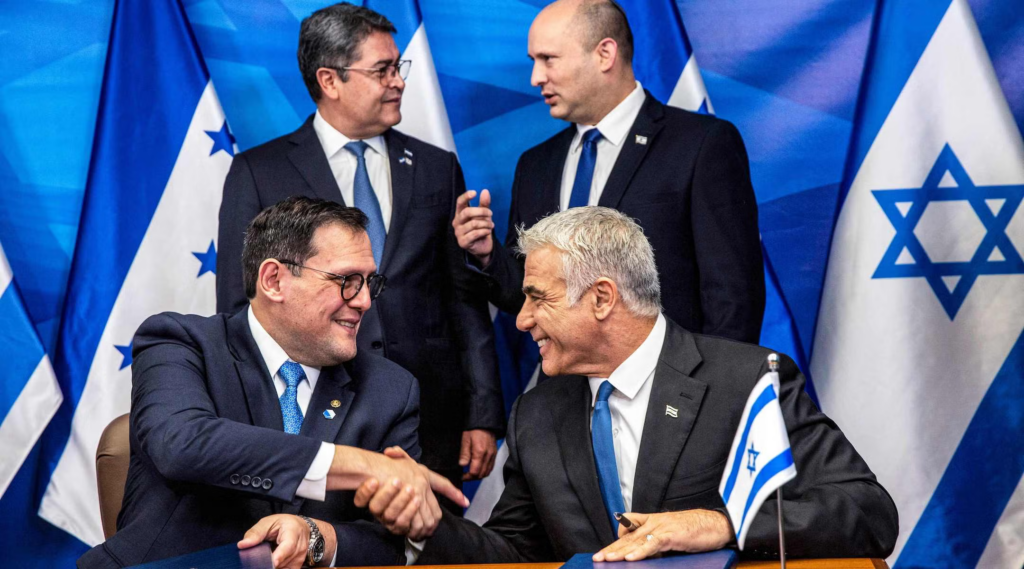
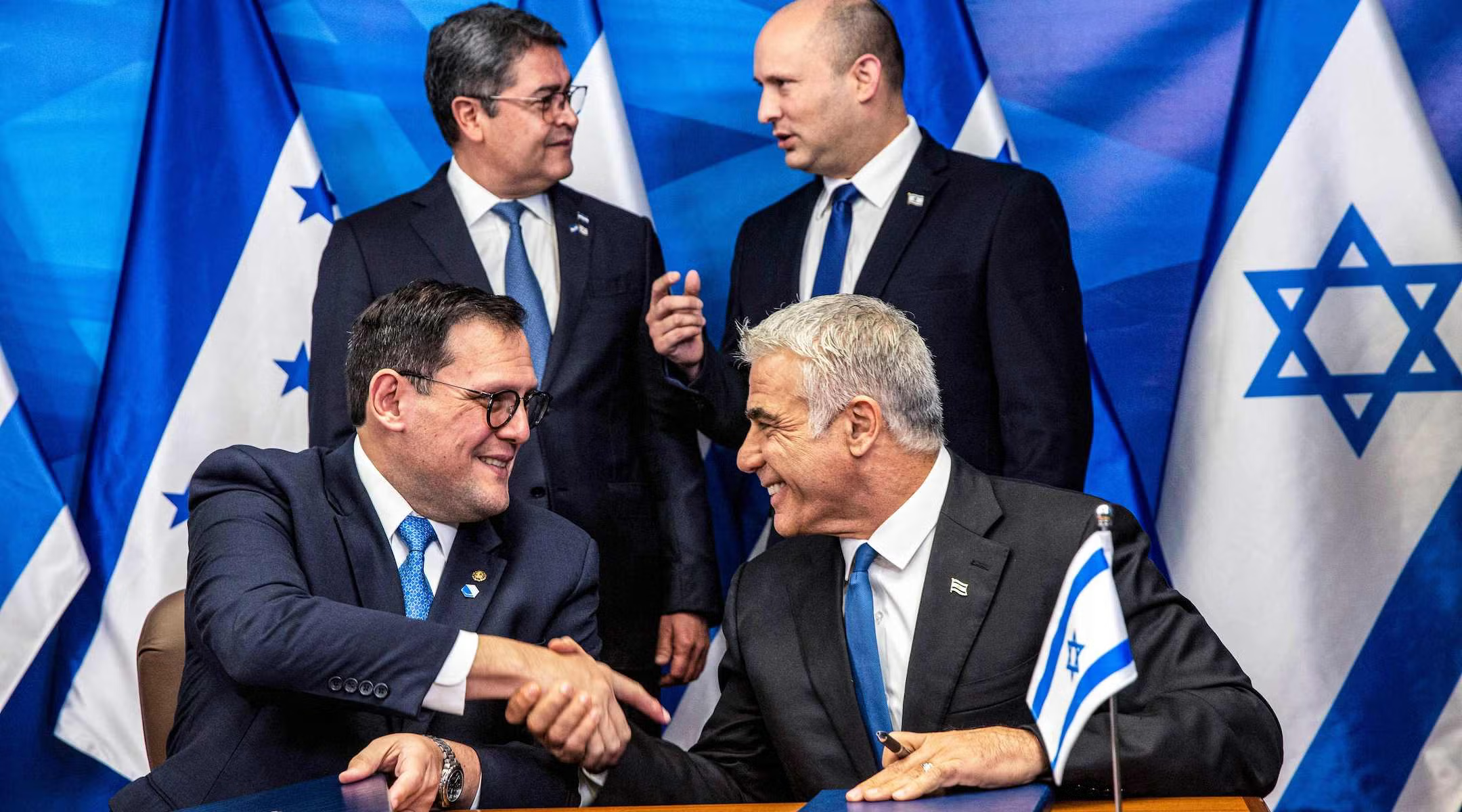
Israeli Foreign Minister Yair Lapid, right, shakes hands with his Honduran counterpart, Lisandro Rosales as Israeli Prime Minister Naftali Bennett, top right, speaks with Honduran President Juan Orlando Hernandez during the signing of bilateral agreements at the prime minister’s office in Jerusalem, June 24, 2021. (Source: Heidi Levine/AFP via Getty Images)
The CIA has complemented Israel’s long-term strategy by employing ostensibly humanitarian or religious NGOs, such as USAID, World Vision, and Church World Service (CWS), to fracture Honduran civil society. By promoting Protestantism over the historically cohesive Catholic majority and supporting programs that exploit divisions along religious, racial, and social lines, including tensions within the Garifuna community influenced by organisations such as OFRANEH, the CIA created fertile ground for ideological manipulation and elite control. Together, the actions of Israel and the CIA have destabilised Honduran society, skewed politics in favour of external interests, and amplified societal divisions. The 2025 elections starkly revealed these dynamics, exposing a democracy heavily shaped by decades of foreign intervention and manipulation.
While Honduras showed some symbolic independence, such as recalling its ambassador from Israel in November 2023, there is a strong case to argue that the deep structural influence of Israel and the U.S, reinforced over decades through military, economic, religious, and civil society channels, created a 2025 electoral landscape strongly favourable to a pro-Israel government, as confirmed by The Times of Israel. Nasry Asfura, promoted by President Trump, embodied this alignment, openly supporting Israeli interests and continuing policies that reinforced the country’s pro-Zionist orientation, making the elections less a contest of domestic politics and more a predictable outcome of long-term foreign influence.
Honduras is a nation under the shadow of powerful foreign influences, where politics, religion, and society have been quietly shaped for decades. The following article investigates how Israeli interests, CIA-backed NGOs, and elite manoeuvring have fractured communities, manipulated loyalties, and set the stage for the tensions that exploded during the 2025 elections…
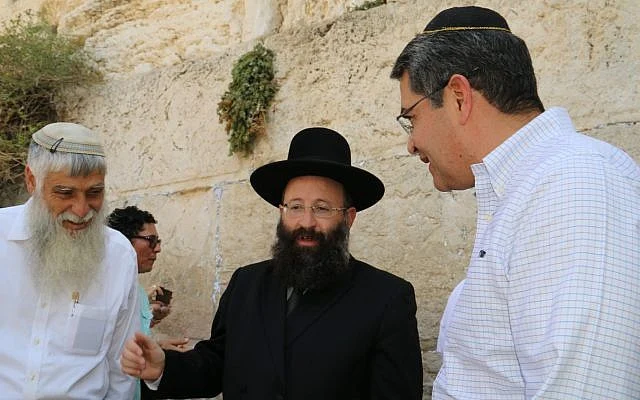
Honduran President Juan Orlando Hernandez visits the Western Wall in Jerusalem, September 1, 2019 (courtesy Western Wall Heritage Foundation)
Hondurans Curiously Ambivalent On Palestinian Genocide
Thomas Tomczyk writes for PÄYÄ Magazine…
Hondurans have been mostly silent regarding the reported genocide taking place in Gaza over the past two years. The question is: Why such silence? Are Hondurans unaware of the massacres and starvation used against Palestinians in the occupied territories? Do they not care, or are they perhaps afraid of something? “To learn who rules over you, simply find out whom you are not allowed to criticise,” the saying goes.
There was one example of Hondurans protesting Israeli crimes against Palestinians during the Gaza war after the Hamas attack and Israeli stand-down operation of October 7. On October 23, 2023, dozens of Honduran Palestinians demonstrated in front of the Israeli Embassy in Tegucigalpa. Since then, the long-established and influential Arab Palestinian community has been mostly silent about the plight of their Palestinian relatives amid Israel’s escalating atrocities in Gaza and the West Bank.
There is certainly a disconnect, as the 300,000 members of Honduras’ Christian Palestinian community are the third and fourth generations to be born outside of Palestine. Their ancestors began arriving in Honduras from Palestine in the 1890s, and today their connection to and knowledge of Palestine and Israel is mostly superficial. Most Honduran Palestinians don’t know the full scale or nature of the barbarism inflicted on their compatriots who stayed behind and continue to face Israeli oppression, violence, discrimination and now genocide. A Honduran Palestinian businessman told me that many in his community are afraid of being accused of anti-Semitism and facing potential consequences. Simply acknowledging that a systematic genocide may be occurring in Gaza is viewed by some as anti-Semitic.
It is hard not to notice. Since October 2023, Israeli military actions have resulted in the deaths of many Christian civilians in Gaza who have nothing to do with Hamas. In October 2023 Israeli military bombed a Christian orthodox church and murdered 18 Christians. In December 2023, Israeli snipers executed two Palestinian women on the Gaza Holy Family Catholic church property. In July 2025, Israeli soldiers fired a tank shell at a cross of the same church, killing three and wounding a catholic priest. While this all fell on deaf ears in Honduras, it does seem that the Israelis don’t like Christians very much.
One person who spoke with concern about the plight of Palestinians was President Xiomara Castro. In November 2023, the Honduran government recalled its ambassador to Israel for consultations due to escalating massacres of Palestinian civilians in Gaza. President Castro described Israel’s actions in Gaza as genocide during a U.N. speech in September 2024. Still, words have not turned into actions. Honduras is nowhere near recognising Palestine as an independent state or moving its embassy from Jerusalem back to Tel Aviv. In fact, Honduras remains firmly in the pro-Zionist camp as it continues to support Israel’s military by purchasing 15 Black Mamba military vehicles. Pro-Zionist sentiment is strong in Honduras. Israeli flags are flown throughout the country. Hondurans increasingly wear the Star of David around their necks, and taxi drivers display the Israeli emblem on their vehicles. Honduran roots of Zionism and Judeophilia run deep, well over a century.
The country now counts three of its presidents to be Jewish: Juan Lindo, Ricardo Maduro and Juan Orlando Hernández. In fact, you could argue that there was a fourth Jewish president of Honduras who ruled the country from 1911 well into the 1950s. Samuel Zemurray, the Banana King, was responsible for the 1911 Honduran presidential coup that secured land and concessions for his United Fruit banana company. American mercenaries hired by Zemurray deposed President Miguel Dávila and made Honduras his “banana republic.” Zemurray installed his puppet, Manuel Bonilla, as president and received 20,000 acres of land in return. After President Bonilla’s death in 1913, Zemurray continued to be a virtual puppet master of several other Honduran presidents.
In 1947, the World Zionist Organisation tasked Zemurray with delivering Honduras’ U.N. vote in support of the creation of the state of Israel. Reportedly, in a personal phone call, Zemurray tried to bribe then-Honduran President Tiburcio Carías Andino. Because of pressure from the Honduran Palestinian community, Honduras abstained from voting for Israel. Since then, and with plenty of CIA help, Christian Zionism has made many inroads in Honduras. CIA fronts such as World Vision, USAID and Protestant Church World Service for many decades worked to undermine the cohesiveness of Honduran society.
Since the 1950s, the CIA, which some critics considered an Israeli-captured agency, promoted the establishment and expansion of Protestant churches in Latin America. The excuse given was that Protestants were more anti communist and a good alternative to the Liberation Theology preached in many Catholic parishes.
The percentage of Catholics in the country fell from 97% in the 1960s to 47% today. Protestant denominations undermined the Catholic cohesion of Honduran society. Religiously divided Honduras is much easier to manipulate, with one denomination pitted against another. Sixty years later, those Catholic-to-Protestant converts have not only become Zionists, but they are also actually converting to Judaism. According to El Heraldo, 37 families converted to Judaism and, in 2022, established Honduras’ first synagogue. The San Pedro Sula Mishkan Shlomo synagogue members advertise their plans to Judaise and convert thousands of Hondurans.
“The plan is for the expanded synagogue to be a six-story, shaped like a Star of David building and be able to accommodate 456 people. This would make it the biggest synagogue in Latin America.”
Ex-President Juan Orlando Hernández was key in the expansion of Judeophilia and Zionism in Honduras. Just in terms of economy, according School of the Americas, between 2013 and 2019, Honduras purchased $342 million in military and surveillance equipment from Israel. Basically, Honduras has been supporting Israel to the tune of around $5 million a month for that period. Road to conversion of Juan Orlando Hernández began in the early 1990s when he completed a one-year Mashav leaders course in Israel. Israel’s investment in JOH obviously paid off as he learned Hebrew, moved Honduras’ embassy to Jerusalem in 2021, and converted to Judaism with his entire family in 2021. The last one, right before going to a US jail for 45 years, was convicted of decade’s long drug and arms smuggling operation.
Honduras is likely getting set up for a rough ride. Israel funded military dictatorships where even the CIA would not venture. Israel trained and supplied arms to many bad actors that destabilised the region: the genocidal regime in Guatemala in the 1980s, Colombian drug smuggling death squads, Los Zetas drug lord Heriberto Lazcano. “Israel has given its soldiers practical training in the art of oppression and in methods of collective punishment. Some of those officers choose to make use of their knowledge in the service of dictators,” said Israeli general Mattityahu Peled.
“Honduras will likely become an increasingly polarized and violent society.”
There is also a growing Israeli pressure on the Honduran public by co-opting its anti-Gaza genocide sentiment into nebulous movements. The normally restrained Honduran Ministry of Foreign Affairs complained that Israeli Ambassador Nadav Goren meddled in internal Honduran affairs by meeting with Protestant church leaders preparing for the August 16 March for Peace and Democracy. “We express to the Honduran people our deep discomfort at their participation in said public event. The involvement of a diplomat not only ignores his limitations,” stated the Honduran ministry. There are plenty of other players seeking discord. Until its recent defunding by the Trump administration, San Pedro Sula was also home to the Hebrew Immigrant Aid Society (HIAS). The worldwide HIAS organisation does not assist Palestinians, Arabs or Christians in moving to Israel, but uses U.S. tax dollars to help move undocumented migrants through Honduras to the United States.
For decades, certain interest groups have promoted racial resentment —particularly among Black communities— while fostering a sense of guilt among white, European and Christian populations. In Honduras, this strategy is reflected in the 23-year-old movement known as the Fraternal Organisation of Honduran Blacks (OFRANEH), which has received funding from organisations such as American Jewish World Service and the Open Society Foundations, founded by George Soros. These groups have been involved in fermenting revolutions, protests and underhanded political activism around the world. Just as with organisations such as Black Lives Matter and ANTIFA, which were recently designated by the U.S. as a terrorist organisation, OFRANEH fosters division, racial tension, grievances and expectations of compensation in the historically well-integrated Garifuna community. Honduras, in the second quarter of the 21st century, will likely become an increasingly polarised and violent society. Powerful interest groups are working hard to implement this, and Roatan is increasingly a party to those tensions. In September 2025, OFRANEH conducted demonstrations in Cayos Cochinos, and in March 2025, there were protests in Diamond Rock. Tensions on Roatan are just starting to heat up.
Featured Video
BRITAIN’S WARNING: PREPARE FOR WAR
or go to
Aletho News Archives – Video-Images
From the Archive
How Ukraine Tortured and Slaughtered Donbass
By Kit Klarenberg | Al Mayadeen | July 11, 2024
Almost immediately after the proxy war erupted, ISIS-tier footage of the torture and murder of Russians in Ukrainian custody emerged.
On July 6th, the New York Times published an astonishing investigation: In Ukraine, Killings of Surrendering Russians Divide an American-Led Unit. The article documents in grim detail how Chosen Company, an international volunteer battalion for Kiev, routinely executes Russian prisoners of war. It is the very first mainstream admission that this practice – a brazen breach of the Geneva Conventions, and a grave war crime – is widespread among Ukraine’s fighters, both foreign and homegrown. … continue
Blog Roll
 Aletho News
- Pentagon designates Chinese cultural centers national security threat
- Israel Demolishes Home Of Lebanese Journalist Whose Viral Film Exposed Pager Attack
- Record Oil, Empty Tanks: The UAE’s Miracle Recovery
- Burnham tackles Britain’s poverty with aggression in Yemen
- Peace in Ukraine: the easy way – or the hard way
- Trump & the Rrrrussians
- US taxpayer money laundered back through Ukraine – Musk
- Before COVID, an NIH lab chief proposed making a SARS-like bat virus more infectious
- Gates, Bourla on Trial in Netherlands Accused of ‘Great Reset’ Scheme at Vaccine Injury Hearing
- BRITAIN’S WARNING: PREPARE FOR WAR
- If Americans Knew
- An error has occurred; the feed is probably down. Try again later.
- No Tricks Zone
- Two New Studies Find Thwaites Glacier Melt Cannot Be Driven By Human Activity Or A Warming Ocean
- E-Cars Reduce CO2 Emissions By Only 41% Compared To Internal Combustion Engine Vehicles
- Predictions Made By Renowned Climate Professor Over Past Decades Have Been Proven To Be Poor
- New Study Suggests Large Regions Of The Pacific Ocean Have Been Cooling For The Last 80 Years
- Germany’s Green Energy Debacle: High Energy Costs Force Kahla Porzellan to Close After 182 Years!
- New Study: 50 Years Of The Most Aggressive ‘Net Zero’ Policies Can Only Affect The Global Climate By 0.03°C
- US September “Heat” Was No Record…Many Records Set Decades Ago
- Latest European Green Energy Debacle; Portugal’s Largest Flagship Solar Park Insolvent!
- Green Energy Debacle: German Expert Professor Fritz Vahrenholt Warns Of Severe Economic And Social Consequences
- Two More Paleo Reconstructions Affirm Meters-Higher Sea Levels Across Ireland, Brazil 7000-6000 Years Ago

