Do You Believe in Coincidence… Was the CIA Involved in Operation Spiderweb and Israel’s June 12 Attack on Iran?
By Larry C. Johnson | December 9, 2025
With the benefit of hindsight, we’re all geniuses. The Wall Street Journal article, Inside Ukraine’s Daring Operation Spiderweb Attack on Russia (published December 8, 2025) details the operation’s planning as a 18-month effort starting in late 2023, with significant activities ramping up in 2024. While the piece emphasizes the full timeline’s secrecy and oversight by President Zelenskyy and SBU chief Vasyl Maliuk, it highlights 2024 as a pivotal year for infiltration, testing, and logistics preparation. I am more interested in what it does not state outright — i.e., that Ukraine relied heavily on Western intelligence, meaning the CIA and British MI-6, in planning this operation.
The attack took place on June 1st, 2025 and, despite a flood of Western propaganda touting it as a tremendous success, it was a tactical and strategic failure — i.e., it did not damage Russia’s ability to continue its offense in Ukraine. But here is the question of coincidence… Two weeks later, Israel launched the decapitation attack on Iran, which also failed to topple the Iranian government and cripple the Iranian military, who promptly retaliated. Do you think it is just a coincidence that Israel and Ukraine used similar tactics — i.e., launching drones from within Russia and Iran to attack strategic targets? I do not.
Let’s take a look at the timeline of Operation Spiderweb as laid out in the WSJ article.
December 2023: Planning begins under direct oversight of Ukrainian President Volodymyr Zelensky and the Security Service of Ukraine (SBU). Initial focus: Smuggling disassembled drones, batteries, and explosives into Russia via borders (e.g., Belarus, Black Sea routes) and commercial trucking networks. Goal: Target Russia’s strategic bomber fleet to disrupt missile launches on Ukrainian cities. Hmmm… If the SBU was involved then so was foreign intelligence.
Early 2024 (January–March): Initial scouting and prototype testing. Ukrainian operatives conducted reconnaissance of target airbases (e.g., Olenya, Dyagilevo) using commercial satellite imagery and smuggled spotters, according to the WSJ. In my opinion, an audacious operation like this would also require imagery from Western intelligence. The WSJ is mute on that point. The article notes that early experiments with “spider nest” launch mechanisms—disassembled FPV drones (Osa quadcopters) hidden in truck roofs— were tested in simulated Russian environments near the border. This phase reportedly involved ~20 commandos refining smuggling routes via Belarus and the Black Sea, with failures (e.g., a test drone malfunction) leading to redesigns. The WSJ article conveniently ignores the likely role that the territories other than Ukraine, such as Khazakstan, Armenia and Azerbaijan also were used as infiltration points for this operation.
Mid-2024 (April–July): Infiltration buildup. The WSJ describes “web-like” networks expanding, with agents embedding in Russian trucking firms to map logistics. Over 100 drones were smuggled in parts during this period, reassembled in hidden workshops (e.g., Bryansk region sheds). A key activity was recruiting unwitting Russian truckers (e.g., via bribes or coercion) for transport, with the article citing intercepted FSB chatter revealing early suspicions but no disruptions. Zelenskyy approved budget reallocations (~$50M) for Western tech integration (e.g., Starlink relays). What do you think are the chances that some of this money was siphoned off by Zelensky and his intel bubbas and sent to their overseas retirement accounts?
Late 2024 (August–December): Final rehearsals and positioning. Intensive dry runs simulated the June 1 strike, focusing on simultaneous launches across time zones. The piece highlights a December 2024 “dress rehearsal” near Ivanovo, where signal jamming countermeasures (AI autopilots) were validated. By year-end, all 117 drones were prepositioned, with operatives establishing safe houses. The article quotes an anonymous SBU officer: “2024 was the spider spinning its web—silent, patient, invisible.”
January–May 2025 Infiltration phase: Ukrainian agents (150+ operatives, including commandos and drone technicians) establish “spider nests” (hidden launch sites) across five Russian oblasts spanning three time zones. Drones (117 total, FPV models with Western tech like Starlink) are reassembled in disguised cargo (e.g., wooden sheds on trucks). Scouting identifies four primary airbases: Olenya (Murmansk), Dyagilevo (Ryazan), Ivanovo Severny (Ivanovo), and Belaya (Irkutsk/Siberia, 4,300 km from Ukraine). A fifth target (Ukrainka in Amur) is aborted due to a truck fire.
June 1, 2025 Execution: Coordinated strikes unfold over ~72 hours starting ~1 p.m. local time. Remotely activated truck roofs release drones, hitting ~40–50 aircraft (15–20 destroyed, including Tu-95MS, Tu-22M3 bombers, and A-50 radar planes; ~$2–7B in damage). Fires reported at all sites; Russia confirms attacks but claims minimal losses. Ukrainian operators control from Kyiv; no SBU fatalities, though two teams captured.
There is no denying that this was a sophisticated operation and, in my judgment, depended heavily on intelligence support from the US and the UK and, possibly, Israel. Why Israel? Because of the similarity of the tactics used in the attacks on Russia and Iran within a span of two weeks. Both were deep-penetration operations targeting high-value, hardened assets far from the front lines. Both required extensive intelligence support.
I also believe that the US played a significant role in coordinating the two attacks as part of a broader strategy to weaken both Russia and Iran. The planning for these operations were carried out in separate channels, but there was someone, or a group of someones, overseeing the broader strategic goals.
The publication of this article comes at a time when the Trump administration’s support for Ukraine is weakening. I don’t rule out the possibility that the CIA, who has an enormous investment in Ukraine, is working to undermine Trump’s efforts to secure a peace that will come at Ukraine’s expense. I do not believe that some intrepid reporter thought that this would be a swell story to tell and that it was published now just because the WSJ had nothing better to report. I believe this is part of a unending effort by the Deep State to try to pump life into Project Ukraine, which is now on life support and fading fast, by pushing a narrative that Ukraine is far from defeat.
Will Europe heed America’s warnings over ‘civilizational erasure’?
By George Samuelson | Strategic Culture Foundation | December 10, 2025
A new national security document released by the Trump administration last week warned that Europe is facing civilizational suicide and will be “unrecognizable in 20 years or less” due to illegal immigration that has made European powers militarily vulnerable.
The 33-page document, titled National Security Strategy, lays out President Donald Trump’s “America First” foreign policy agenda and argues the United States should focus its efforts on securing the Western Hemisphere.
The document’s section on Europe begins with a brief mention of some of the continent’s best-known perennial problems, including “insufficient military spending” and “economic stagnation” before saying that Europe’s real problems “are even deeper.”
Europe’s economic decline takes a backseat to the real prospect of what DC policymakers refer to as “civilizational erasure,” caused in part by “migration policies that are transforming the continent and creating strife,” it said.
The document also mentioned the censorship of free speech and suppression of political opposition, cratering birthrates, and loss of national identities and self-confidence that are happening across the 27-member bloc.
Just last week, the European Commission slapped a massive fine against X (formerly known as Twitter) in a ham-fisted effort to censor Elon Musk’s social media platform, while exactly one year ago the eastern European nation of Romania was thrown into chaos after the far-right pro-Russian populist Călin Georgescu had his presidential victory annulled due to – yes, you guessed it – ‘Russian interference’ and other supposed electoral irregularities.
Just before the Romanian elections, Telegram co-founder Pavel Durov made a startling claim that the head of France’s foreign intelligence agency Nicolas Lerner asked him to ban far-right conservatives on his platform ahead of the country’s elections, a request he says he flatly refused.
The conclusion the document makes in light of these and other dangerous developments was straightforward: if present trends continue, “the continent will be unrecognizable in 20 years or less.”
This is a serious concern for the United States, of course, plagued as it also is with rampant illegal migration. How can the United States and the European Union remain reliable allies when there could eventually be a yawning chasm separating the two powers? After all, in just a few decades the European Union may be comprised of majority non-European civilians who may be tempted to question whether they view their friendship with Washington in the same way as those who signed the NATO Charter.
Looked at from such a perspective, it is obvious why the Trump administration is adamant that ‘Europe remain European,’ despite the fact that the chances for that happening are about zero.
Critics responded to the document’s central thesis by saying it is espousing “anti-Semitic” conspiracy theories, such as the “Great Replacement Theory” that says White people are being deliberately replaced in the Western hemisphere by immigrants from majority non-White nations, particularly from Africa and the Middle East.
White House spokesperson Anna Kelly slammed the comparison, calling it “total nonsense.”
The devastating impacts of unchecked migration, and those migrants’ inability to assimilate, are not just a concern for President Trump, but for Europeans themselves, who have increasingly noted immigration as one of their top concerns. These open border policies have led to widespread examples of violence, spikes in crime, and more, with detrimental impacts on the fiscal sustainability of social safety net programs.
Such a grim reality comes as no surprise to many people, least of all former German Chancellor Angela Merkel, Europe’s primary architect of mass migration who admitted one decade ago that multiculturalism was a “sham” that does nothing to improve a society.
“Multiculturalism leads to parallel societies and therefore remains a ‘life lie,’ or a sham,” she said, before making the empty promise that Germany “will reduce the number of refugees noticeably.”
Although those remarks may seem uncharacteristic of Merkel, she was only repeating a sentiment she first voiced five years earlier when she said multiculturalism in Germany had “utterly failed.”
“Of course the tendency had been to say, ‘Let’s adopt the multicultural concept and live happily side by side, and be happy to be living with each other.’ But this concept has failed, and failed utterly,” she said in 2010. Why Merkel ever imagined that things would not turn out exactly as they did remains one of the great mysteries of modern European politics. Or perhaps she did know, but completely lacked the political will to resist the insurmountable pressure she was facing at the time. It is no surprise that the EU elite were very much in favor of open borders, as many remain so today.
Whatever the case may be, one other thing is worth noting about this document – Moscow has expressed favor with its provisions.
Kremlin spokesperson Dmitry Peskov said on Sunday that the changes “correspond in many ways to our vision”.
He also welcomed language about ending “the perception and reality of the NATO military alliance as a perpetually expanding alliance”. Moscow has long voiced its opposition to NATO expansion, citing its national security concerns.
At the same time, Peskov cautioned that the position of what he called the U.S. “deep state” – a term Donald Trump has used to accuse officials who he believes are working to undermine his political agenda – may differ from Trump’s new security strategy. Time will tell.
Epstein, Dershowitz, and the secret war to discredit Mearsheimer-Walt Israel lobby study
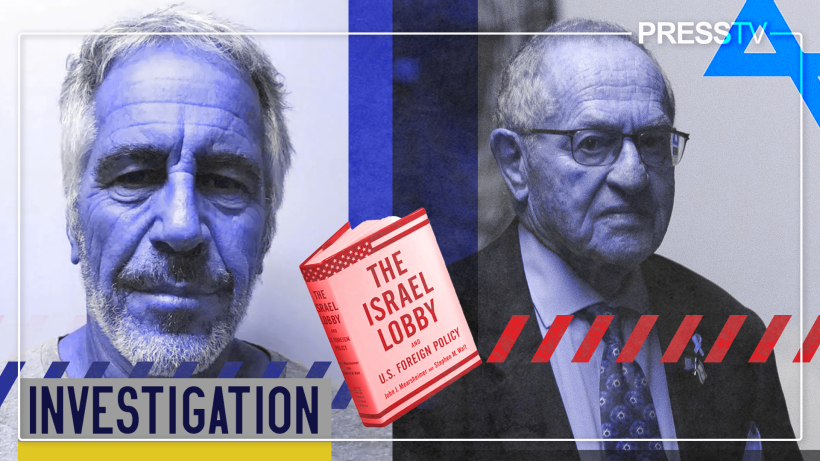
By David Miller | Press TV | December 9, 2025
In 2006, Jeffrey Epstein exchanged emails with his lawyer, Harvard Law professor Alan Dershowitz, in an attempt to support Dershowitz’s criticism of John Mearsheimer and Stephen Walt, who had just published a groundbreaking essay on the Israel lobby.
Some commentators argue that this incident ironically confirms the Israel lobby thesis by revealing the lobby’s backlash against the essay. But does it really?
Recently released emails reveal that convicted sex offender and Israeli intelligence agent Jeffrey Epstein collaborated with Dershowitz to discredit the landmark 2006 study by Mearsheimer and Walt titled ‘The Israel Lobby’, which was later published as a book the following year.
In early April 2006, Epstein received multiple early drafts of an article by Dershowitz titled “Debunking the Newest — and Oldest — Jewish Conspiracy.” In this piece, Dershowitz, who also served as Epstein’s lawyer, accused Mearsheimer and Walt of recycling “discredited trash” from neo-Nazi and so-called “Islamist” websites, alleging they authored a modern counterpart to the ‘Protocols of the Elders of Zionists’.
Epstein responded enthusiastically to Dershowitz’s email, writing, “terrific… congratulations.”

Part of the email exchange between Epstein and Dershowitz
Later, Epstein received another message from Dershowitz’s email address asking him to help circulate copies of the attack article. Epstein replied affirmatively: “Yes, I’ve started.”
While Mearsheimer has spent his entire career at the University of Chicago, his co-author Stephen Walt has been a professor of international relations at the Harvard Kennedy School since 1999.
Epstein and Harvard
Epstein was a powerful figure at Harvard, having spent years cultivating relationships at the university and donating over $9 million between 1998 and 2008.
Despite being convicted on sex charges involving a minor in Florida, Epstein visited Harvard more than 40 times afterward. The New York Times reported in 2020 that, although Epstein had no official affiliation with the university, he maintained his own office, key card, and Harvard phone line.
Following an internal investigation, Harvard placed Professor Martin A. Nowak on paid administrative leave due to findings related to Epstein. Nowak had received significant donations from Epstein and had provided him with office space and access.
His suspension was lifted in March 2021, and he remains in his position today.
Epstein positioned himself as a fixer and patron for prominent academics, including Dershowitz and economist Larry Summers, who was then Harvard’s president.
Summers recently apologized for his connections to Epstein and announced he would “stop teaching and step back as director of the Mossavar-Rahmani Center for Business and Government at the Harvard Kennedy School.”
At the time, Epstein also served as trustee and president of the family financial office of Jewish billionaire Leslie Wexner, whose foundation donated nearly $20 million to the Kennedy School between 2000 and 2006. The Wexner Foundation’s contributions supported core operating expenses and funded a visiting scholar program that allowed ten officials from the Zionist regime to attend the Kennedy School annually for a one-year master’s degree.
Leslie Wexner is one of the most influential supporters of the Zionist colony. In 1991, he co-founded the Mega Group, a philanthropic organization of Jewish billionaires that channels significant resources to support the colony’s agenda.
The group reportedly maintained contacts with the Israeli spy agency Mossad and was described by Israeli intelligence officials as a vehicle for influence operations in the United States.
Among its initiatives, the Mega Group supported the creation of the racist Birthright Israel program, a radicalization effort targeting Jewish schools, and the revitalization of Hillel International, a Zionist student organization that now operates over 1,000 branches worldwide, including 50 outside the US.
According to a 1998 Wall Street Journal report, when Hillel needed refinancing in 1994, a small group of members committed to a combined $1.3 million annual donation over five years. Later, six members contributed $1.5 million each to help launch the $18 million Partnership for Jewish Education, funding matching grants for Jewish day schools.
Charles Bronfman and Michael Steinhardt, a former hedge fund manager and Mega Group member, also worked on the Birthright Project, which aims to send any young Jew born worldwide to Israel if they wish.
In this context, Epstein’s collaboration with Dershowitz appears to link key figures in the ‘Israel lobby’ to efforts aimed at discrediting the very idea of a powerful Israel lobby. Stephen Walt, who remains at Harvard, declined to comment on it.
Mearsheimer remarked, “I’m not surprised to see these emails, because Dershowitz and Epstein were close and both have a passionate attachment to Israel.”
Many have noted the irony of these emails’ emergence, as they seem to confirm the central thesis of the 2006 Israel Lobby study. In their later book, the lobby was described as “a loose coalition of individuals and organizations that actively work to shape foreign policy.”
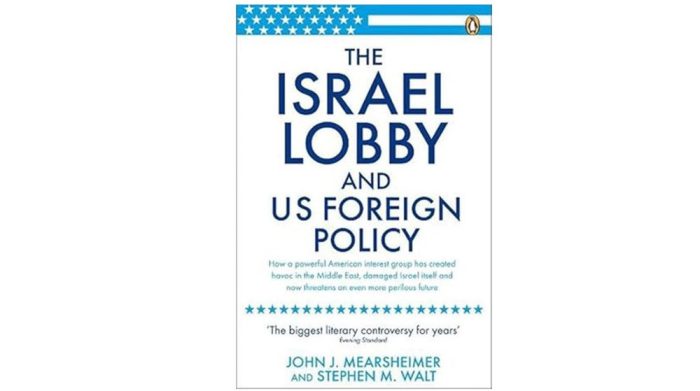
The landmark study by Mearsheimer and Walt published in 2007.
But does the book’s definition truly match the reality described above? The Mega Group, founded in 1991 by Les Wexner, former CEO of the lingerie chain Victoria’s Secret, and publicly revealed in 1998, reportedly includes around 50 billionaires and influential Zionist figures such as Les Wexner, Charles and Edgar Bronfman, Charles Schusterman, Ronald Lauder, and Laurence Tisch.
These oligarchs, along with Epstein’s involvement as part of the Mega Group, suggest layers of Zionist manipulation and intrigue.
However, these particular elements are not central to Mearsheimer and Walt’s book. Among the oligarchs mentioned, only the Bronfmans receive fleeting mention in the book’s index. The bulk of the book focuses on a narrowly defined Israel lobby that exerts political influence.
Notably, the top ten most cited organizations in the book, with one exception, are all Israel lobby groups rather than formal components of the broader Zionist movement.
This distinction highlights a more focused analysis in the book, which does not fully encompass the wider network of Zionist power and influence exemplified by groups like the Mega Group.
In order of citation (number of citations in brackets), they are:
- AIPAC (47);
- ADL (30);
- Conference of Presidents of Major American Jewish Organizations (25);
- WINEP (19);
- Zionist Organisation of America (ZOA) (15);
- Israel Policy Forum (13);
- JINSA (11);
- American Jewish Committee (10)
- Americans for Peace Now(7)
- Christians United for Israel (CUFI) (7)
AIPAC, the ADL, the Conference of Presidents, the AJC, Americans for Peace Now, and Christians United for Israel are traditional Israel lobby groups.
Others like WINEP, IPF, and JINSA also engage in lobbying but are more commonly considered think tanks. The Zionist Organization of America (ZOA) is the only group on the list formally affiliated with the American Zionist Movement, the US branch of the World Zionist Organization.
Notably, two of the four major pillars of the Zionist movement are entirely absent from the book’s index: the American Zionist Movement itself and the Jewish National Fund, the US affiliate of the agency responsible for Zionist land appropriation.
The other two pillars, the Jewish Agency for Israel, which organizes settlers to occupy stolen land, and the Jewish Federations of North America, which raises funds to support settlers and land acquisition, appear only three times and once, respectively.
It’s important to emphasize that, beyond the ZOA, the American Zionist Movement includes around 45 other member organizations, only a handful of which are mentioned in the book’s index.
This suggests a narrower focus in the book that does not fully address the broader institutional structure of the Zionist movement.
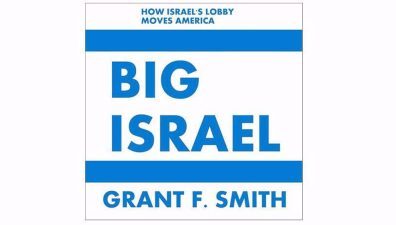
Grant Smith’s partial corrective – Big Israel, 2016.
In a partial corrective to the narrow focus of Mearsheimer and Walt, Grant F. Smith’s Big Israel: How Israel’s Lobby Moves America, published in 2016, takes a much broader approach.
Smith argues, “Some identify only one organization, the American Israel Public Affairs Committee (AIPAC), as ‘the lobby’ citing its influence on Capitol Hill. This is wrong. Many interconnected organizations channel their power and influence through AIPAC in Congress.”
“Hundreds more ‘mini-AIPACs’ coordinate with AIPAC and their own national offices to lobby state legislatures to pass model legislation and spending authorizations benefiting Israel—without publicly disclosing most of their lobbying activities. Others operate quietly, policing what is allowed to appear in mainstream news media and channeling ‘hush money’ to civil rights organizations to keep them out of grassroots pro-Palestinian movements,” he adds.
This represents a significant advance over the more limited Mearsheimer and Walt thesis, as it casts a much wider net, encompassing a full range of Israel lobby groups.
Smith’s analysis extends beyond lobbying efforts to include organizations that police public discourse and manipulate civil society.
However, even Smith’s work shows some myopia. While he analyzes an impressive 674 separate organizations, far more than Mearsheimer and Walt, the scope still doesn’t fully capture the entire network.
Smith’s data reveal an eye-popping estimated budget of over $6.7 billion in 2020, supported by more than 14,000 staff and over 350,000 volunteers, underscoring the vast scale of these interconnected groups.
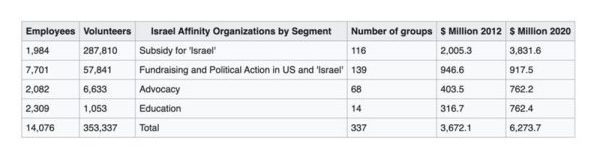
Data from Smith, 2016, reproduced on Powerbase.
The impressive number of groups documented in Big Israel still represents only a small fraction of the broader Zionist movement, which includes the Israel lobby and many additional organizations not captured in the data. Here’s a brief overview of some major omissions:
1. Many formal Zionist groups engaged in education, indoctrination, and radicalization are missing. For example, the American Zionist Movement (AZM), the official US affiliate of the World Zionist Organization, has 46 member organizations, only 13 of which appear in Big Israel’s data, leaving 33 unaccounted for.
2. None of the Israeli firms that disclose lobbying expenditures in the US are included. Between 2000 and 2023, 18 such firms reported spending over £30 million.
3. Eleven organizations—including the Jewish Agency, the World Zionist Organization (WZO), and the NSO Group (makers of Pegasus spyware)—have registered as Foreign Agents between 2016 and 2023, disclosing spending over £161 million in that period.
4. Although two Chabad-Lubavitch foundations are included, official figures show around 1,274 Chabad-Lubavitch groups in the US (IRS data lists 1,313), many of which likely have ultra-Zionist agendas. Despite not being formally affiliated with the WZO, Chabad’s influence is significant and cannot be overlooked.
5. B’nai B’rith International, one of the oldest Zionist groups in the US and a former AZM member, is included in the data, but its youth wing, B’nai B’rith Youth Organization (BBYO), is not. Together, the IRS data lists over 1,500 branches for these two groups across the US.
6. Hillel, the Zionist student organization, appears only once in Smith’s data and not at all in the index of The Israel Lobby, despite now having over a thousand branches.
7. Lastly, numerous Zionist family foundations that fund many groups in the wider movement,l likely numbering in the hundreds or thousands, are excluded. Some notable examples include Adelson Family Foundation, Allegheny Foundation, Anchorage Charitable Fund, Castle Rock Foundation, Earhart Foundation, John M. Olin Foundation, Klarman Family Foundation, Paul E. Singer Foundation, Smith Richardson Foundation, Sarah Scaife Foundation, Scaife Family Foundation, The Lynde and Harry Bradley Foundation, and William Rosenwald Family Fund.
Given these seven brief examples, which are in no way exhaustive, it is likely that there are in excess of 10,000 Zionist organisations in the US in total. It would not be surprising to learn that this was a very conservative figure. Therefore, a full analysis of the US Zionist movement needs to do a lot more to explore even the formal and informal elements of the movement.
Missing oligarchs, family foundations, spooks and infiltrators
Taking both The Israel Lobby and Big Israel together, they largely overlook the critical role of oligarchs, foundations, and intelligence-linked operatives who use blackmail and threats to exert influence.
They omit the involvement of Zionist intelligence agencies themselves, including the extensive network of Sayanim (Mossad’s “little helpers”), and make no mention of Unit 8200, Israel’s signals intelligence agency that has deeply penetrated the tech and media industries.
Ultimately, The Israel Lobby focuses almost exclusively on the most visible elements of Zionist infiltration, ignoring the movement’s powerful engines of radicalization—responsible for producing thousands of radicalized genocidaires each generation.
These engines include organizations like the Mega Group (through Jewish education initiatives shown to increase support for the Zionist colony), Hillel, and Birthright Israel.
The books also fail to address the massive infiltration of Zionists throughout the US government apparatus, a process ongoing since at least the Reagan administration in the 1980s.
The involvement of Laurence Tisch in the Mega Group further illustrates the close ties between Zionist oligarchs and infiltration efforts. His granddaughter, Jessica Tisch, is a noted Zionist extremist and the current Commissioner of the NYPD.
The NYPD notably opened an office in the Zionist colony in 2012 and collaborates with Zionist entities, as do many other US police departments, some of which receive training both in the US and in Israel.
Lessons from the Epstein/Dershowitz affair?
The affair reveals that Zionist radicalization and infiltration are far more serious and organized than the “informal” and “loose” coalition described by the Israel Lobby thesis.
Just because coordination is covert or hidden does not mean it doesn’t exist. This is evident in the evolving stories about coordination efforts led by Israel’s Ministry of Strategic Affairs and its network of front groups and private companies, including the recent campaign coordinated by Voices of Israel through its proxy, the Combat Antisemitism Movement, funded partly by a US Zionist foundation.
We also see this in the revelations about the Sayanim, Mossad’s global network of helpers, and Unit 8200’s infiltration of technology firms. Above all, the infiltration of governmental institutions across the US, UK, and numerous other countries underscores the deep and systematic nature of this network.
The Deep State Targets Thomas Massie
By Matt Wolfson | The Libertarian Institute | December 9, 2025
With the retirement next month of Rep. Marjorie Taylor Greene (R-GA) in the face of vociferous attacks from President Donald Trump, Rep. Thomas Massie (R-KY) is the only member of any of the three branches of our government who consistently and on principle opposes American empire—and who also opposes the taxes, debt, and interventions that come with it. In a little over a year, he may not be.
For the first time in his seven-term congressional career, Massie is being challenged by a formidable primary opponent. That opponent is Ed Gallrein, a former Navy Seal who during his thirty years of meritorious service earned four Bronze Stars and whose extended family of small business owners is a multi-generational staple of Kentucky’s 4th District. As the last line in Gallrein’s X bio has it, he is “Trump-endorsed to defeat Thomas Massie and Deliver America First for Kentucky”—and, given the popularity Trump still enjoys among Republican voters as well as Gallrein’s sterling military reputation, and despite Massie’s strong endurability, Gallrein may succeed in realizing his goal.
Whether Gallrein’s election would actually mean delivering America first is a very different question. Putting America first presumably means putting the soldiers sworn to protect Americans, those individuals with whom Gallrein so valorously served, first as well. But a closer examination of the agenda Gallrein is running on makes clear that, unlike Massie’s prudent America first constitutionalism, it does not accomplish that goal. Instead it is the latest iteration, this time under Donald Trump, of a long-running play where small networks of ideologues ensconced in Washington’s military-corporate complex use America’s armed forces to run imperial plays for profit and power. The people running this version—connected Zionists tied to Trump’s re-election bid and now to his White House—are using Gallrein’s military service, which one might think would end up aiding our men and women in uniform, as an excuse to do the opposite. They are funding a decorated veteran to act as a front for imperial plays that mis-serve our armed forces and the Americans they’re sworn to protect.
Understanding the conditions that allowed this operation to happen and their consequences means going back to the creation of the current armed forces at the hands of the military-corporate complex after 1945—and tracing its abuses and misuses at the hands of a small number of players whose inheritors are now backing Trump and targeting Massie.
Americans’ rightful and deep respect for the men and women of our armed forces obscures an essential fact about the organization they serve: in its current form, it was never intended to exist. From Thomas Jefferson and James Madison to Dwight Eisenhower, people concerned for our liberties saw a large and expanding standing army and its support systems as inherent threats to our constitutional republic. These men were not unrealistic about the need for an armed forces—Jefferson founded West Point, and Eisenhower commanded D-Day—but they knew that an essentially defensive army equipped for a republic was very different than an aggressive army serving empire. In their view, this latter type of army would become a version of the British Army which Jefferson’s revolutionaries had fought against: an aggressive tool of imperial operators to use for power and profit.
With the start of the Cold War and the beginning of an arms race with the Soviet Union, Jefferson’s and Madison’s and Eisenhower’s fears came true, giving an enormous opportunity to a network that did not share them. Namely, old Northeastern WASPs and their allies who by 1945 had spent 150 years eschewing America’s constitutional politics in favor of building institutions and corporations in and around Washington DC. The Henry Cabot Lodges and the Brothers Harriman, the Rockefellers and the DuPonts and the Bushes, John Foster and Allen Dulles and John Jesus Angleton—these were the financial and corporate and military players who used the Cold War as an opportunity to make themselves into runners of American empire, for their own power and profit.
At their hands, the American Army became the British Army of a later age, with its own public-debt-fueled corporate outgrowths which purport to be serving our soldiers. In reality, as Dwight Eisenhower said publicly in his presidential farewell address of 1961, the new weapons-for-profit system made its minders into what Eisenhower called in his notes for the speech “merchants of death”: “flag and general officers retiring at an early age take positions in war based industrial complex shaping its decisions and guiding the direction of its tremendous thrust.” And these civilians running the weapons contractors were rotating not just through Pentagon and CIA consultancies and administrative agencies but through America’s new civilian intelligence service, the CIA. There, the profit motive—combined with a high level of ideological zeal—also distorted policy.
By 1961, Allen Dulles, John Jesus Angleton, and the lineup of other old-line WASPs running the CIA outside of meaningful oversight had put America into the Congo, Iran, Guatemala, Cuba, and the beginnings of Vietnam. After these came interventions in El Salvador, Lebanon, Nicaragua, Kuwait, Panama, Grenada, Somalia, Kosovo, Bosnia, Afghanistan, Iraq, Libya, Syria, Ukraine, Yemen, Venezuela, Palestine, and (again, this year) Iran. These were plays executed with input from McKinsey and Raytheon to Langley and the Pentagon via the Situation Room. They were increasingly run by new networks: once disproportionally WASP, these new networks were disproportionally made up of Jewish Zionists bent on using American empire to protect Israel. Among these were early operators like Henry Morgenthau and Theodore Kollek; and their later inheritors like Martin Peretz and William Kristol, Elliott Abrams and Paul Wolfowitz, Michael Ledeen and Thomas Pritzker, people who in many ways shaped the policies of the Bill Clinton, George W. Bush, Barack Obama, and Joe Biden administrations. At their hands, accelerated military corporate cronyism has been the order of the day starting in 1993, when the Clinton administration, which assumed power thanks in part to Zionist backing, pressured the fifty major weapons contractors active during the Cold War to consolidate in the nominal name of cutting costs. The ensuing distortion of our military has occurred via multiple forms, which I reported on for the Libertarian Institute in July.
One distortion has been cost overruns on weapons systems, which contractors feel free to allow or even encourage since no competition exists for their product. This has also allowed errors in construction which diminishes the equipment that’s supposed to serve our troops. Then, as I have reported elsewhere, in response to the overruns came budget cuts and the “fix” of “sequestration,” which reduced these cost overruns by cutting expenditures on the troops, further under-equipping and overstretching personnel. Exacerbating the problem, as I have also reported, were Pentagon-and-contractor funded think tanks, which covered the problem with “social initiatives” via mental health, climate, and DEI, further distracting the Pentagon from the imperatives of readiness and training. All the while, interventions urged by the same financial-military-intelligence networks attenuating the capacity of our armed forces also overstretched them: in Somalia and Bosnia and Kosovo, Afghanistan and Iraq and Libya, and (in an “advisory” capacity) Syria and Israel and Ukraine.
The result has not just been surging deficit spending that mortgages the future of Americans; nor backlash from affected populations to our imperial arrangements abroad. It has also, even more dramatically, been a spate of military embarrassments since 2018, most notably crashes of planes at the hands of overcommitted and demoralized troops and their commanders. These have racked up losses to the tune of nearly $500 million per crash and cost the lives of servicepeople. As I reported in January of this year, in an investigation of these crashes and their causes:
“For the Army, [the shrinking of budgets and personnel since the 2010s] meant “cut[ting] 40,000 active-duty soldiers, shrinking [the Armed Forces] to 450,000 by 2017.” For the Air Force, this meant a reduction of active-duty airmen from 333,370 to 310,000.”
“An Air Force report to Congress in 2018 said that, thanks to sequestration, the Air Force was ‘the smallest… it has ever been.’ Active-duty aircrew flying hours had been slashed from 17.7 to 13.2 hours per month. 31 squadrons, including 13 coded for combat, had stood down because of funding pressures. Plans had been announced to eliminate 500 planes, and, according to a Military.com report cited by The American Legion, the Air Force was ‘making do with ‘half-size squadrons.’’ The common refrain today is that hours in the air are even shorter—4.1 hours a month, by one estimate—and that efforts to replace real flying with “on-the-ground simulators” are dismal failures.”
“These shortages of manpower and training had immediate effects that took time to tally… 2018, the year after the sequester was complete, saw a spate of plane crashes. In late 2020, Congress found that, in just six years since the sequester began, ‘‘mishaps’ in training flights or routine missions killed 198 service members and civilians, destroyed 157 aircraft, and cost taxpayers $9.41 billion.’ Two weeks alone in 2022 saw three crashes on routine training missions in Alabama and California, costing at least five lives and two injuries. The last few months of 2023 saw four crashes. On December 22, 2024, a navy jet was shot down by friendly fire, and another narrowly avoided being shot down by the same barrage, in the Mediterranean.”
A year ago, given the stakes Donald Trump himself articulated for his re-election (a run against the “deep state”), it seemed unthinkable that Trump would adopt military corporatist priorities wholesale almost immediately on assuming office. But, influenced in part by Zionist operators who swung to support his re-election campaign in the summer of 2024 after pro-Palestinian protests on college campuses, he has done exactly that. As I reported for the Libertarian Institute in July, Trump has forgone actually reforming aspects of the military corporate complex to aid our soldiers. Instead he has committed to a “Big Beautiful Bill” that inflates ICE’s budget but does not direct military funding away from corporate cronyism; a surface-level crusade against “wokeness” and “DEI”; a military parade; superficial demonstrations of force in Yemen and Iran and Venezuela; the militarization of law enforcement via ICE recruiting; and the placement of American troops in American cities. He claims to be standing above all for our troops—but in reality he is standing for the military corporate complex that mis-serves them, to the demonstrable detriment of our men and women in uniform.
The most recent example of Trump’s demonstrably detrimental effect on our troops comes from The Washington Post, in a story published December 4, 2025. The subject was a deployment to the Middle East for the benefit of Israel and its Saudi and Emirati allies against Yemen; a campaign prosecuted in the Biden administration and before with the encouragement of Zionists but decisively and unprecedentedly accelerated by Trump in his second term:
“The U.S. Navy on Thursday released its findings from four investigations scrutinizing the significant challenges encountered by one of its aircraft carrier groups over nine months in the Middle East, where several major accidents occurred as the ships battled Yemeni militants.”
“The Truman carrier group departed its home port in Norfolk in September 2024 — and by the time it returned in May, the carrier itself had collided with a merchant vessel; its cruiser had shot down one of its fighter jets, another warplane was lost when it slid overboard as the carrier performed an evasive maneuver to dodge an incoming missile; and a third jet was lost when an arresting cable failed as the pilot attempted to land.”
“In three of the four incidents, investigators determined, either poor training, improper procedures or crew fatigue played significant roles. And while no service members died, those incidents could have led to multiple fatalities, the Navy found.”
All of which raises with some immediacy the question of Ed Gallrein, who was selected to run against Massie after the congressman repeatedly voted, along Jeffersonian constitutionalist lines, against using taxpayer money and deficit spending to benefit Israel. Gallrein’s selector was Chris LaCivita, Trump’s co-campaign manager in 2024 and Trump’s pick to spearhead the anti-Massie campaign, who is working with at least $2 million from an anti-Massie PAC funded by the Jewish Zionist billionaires Paul Singer, John Paulson, and Miriam Adelson. These three operators owe their easy entrée into Washington in part to the military-intelligence Zionist operators linked to the money and power at the origins of the CIA and of the host systems for the merchants of death 80 years ago—just as the decisive momentum was building for the creation of Israel.
And the $2 million they have committed so far on behalf of Israel’s interests has had its effect. At a recent gathering of campaign donors, Massie informed the group that before this primary campaign his approval/disapproval rating in polls was 62-12 (adding together very approved, somewhat approved, etc.) But, he went on to say, after $2 million in negative ads spent in his district, it’s now 51-37. He said hthat he personally expects $20 million to be spent against him, but will feel comfortable in his odds if he raises $5 million.
Gallrein was endorsed preemptively by Trump, which is to say before he entered the race, and he is by any measure a shrewd choice for Trump and Trump’s Zionist allies to back. He is not just a decorated veteran with thirty years of valorous service, he is also a fifth generation farmer and the scion of a Kentucky family with deep roots in the 4th District. The Gallrein Family Farm, founded in 1929, became the largest dairy producer in the state; expanded aggressively into tobacco and vegetables and grain along with a subset of trucking; and has now expanded into “agritourism” with weddings and a farmers market, along with a store and lunch counter which sells the farm’s “produce and product lines.” According to his LinkedIn CV, Gallrein worked at the farm from 1962, when he was four, to 1982, when he was 24, rising to vice president; then in 1984 he joined the U.S. Army, where “he served for 30 years and became a Navy SEAL officer… rose to the rank of captain and served in Panama, Afghanistan and Iraq.” Since retiring in 2014, Gallrein has experimented with careers: opening a farm and stables as well as two “leadership” and “startup” consultancy businesses, and running in the Republican primary for the District 7 state senate seat, going on to lose the race by 118 votes. He speaks, repeatedly, of his intention to bring the skills he learned during his military service to serve the 4th District.
Gallrein, having never served in office, has no voting record, and his policy platform amounts to loyalty to President Trump’s agenda, which now includes supporting interventions or operations abroad in Yemen, Palestine, Venezuela, Iran, and possibly Nigeria. In public statements this year, Gallrein has doubled down on interventionism, specifically defended our engagements in the Middle East, especially against Iran, as “leveraging” our “power” there and (echoing a favorite line from Trump-supporting media) “playing chess” against our enemies. He uses the authority of his service to help make the case—even to the extent of arguing that what may seem to be the Trump administration’s irresponsible ventures abroad and at home with authoritarian surveillance regimes like the Saudis and Emiratis via the ministrations of Israel are in fact necessary complements to our national security. (“Economic is the centerpiece of national power. [That concept is] called ‘Dime’ as we studied it in the War College.”)
What Gallrein doesn’t emphasize in his interviews is as telling as what he does. What he under-emphasizes is not just questions of taxes and debt and cost of living, which is not a surprise considering that he has said publicly that he “believes it’s his stance on foreign policy that put him on Trump’s radar.” What he under-emphasizes also relates to crucial questions when it comes to his nominal area of expertise, our military. He does not speak about meaningfully reforming our weapons contracting systems or their think tank outgrowths; or about the influence of money on the interventions we make in other sovereign nations. In other words, he does not speak about any actual structural problem in the military corporate complex that hurts the men and women with whom he once valorously served—or about any actual structural reform that would help them. And why would he? His financial and political backers are tied, directly, to those very structures—the military corporate systems and their financial supporters and their think tanks and advocacy groups and the state, Israel, that is their main priority and beneficiary and the beneficiary of our endless interventions.
Not just our sovereignty, but the safety of the people pledged to protect us, are under clear threat when they’re presided over by politicos like Gallrein run by networks, and operators, like these.
Florida blacklists CAIR, Muslim Brotherhood as ‘foreign terrorist organizations’
The Cradle | December 9, 2025
Florida Governor Ron DeSantis issued an order on 9 December naming the Muslim Brotherhood and the Council on American-Islamic Relations (CAIR) as “foreign terrorist organizations,” following in the steps of Texas.
Florida’s designation makes it the second Republican-led state in as many months to target the two groups.
DeSantis said the move was “EFFECTIVE IMMEDIATELY” and instructed state agencies to deny employment, contracts, funding, or any state-provided resources to the organizations and to individuals providing them with “material support.”
His executive order repeats claims that the Muslim Brotherhood supports “political entities and front organizations that engage in terrorism and funnel money to finance terrorist activities.”
It also alleges that CAIR “was founded by persons connected to the Muslim Brotherhood” and ties both groups to Hamas.
The order further directs agencies to take “all lawful measures to prevent unlawful activities” by the two groups. DeSantis framed the action as part of broader legislative efforts, saying lawmakers were “crafting legislation to stop the creep of sharia law.”
He added that he hopes legislators “codify these protections for Floridians against CAIR and the Muslim Brotherhood.”
CAIR, founded in 1994 and a leading US Muslim civil rights group, rejected the designation as “defamatory and unconstitutional.”
The group said it will sue the state, as it is already doing in Texas over a similar proclamation issued by Governor Greg Abbott.
In joint statements from its national office and Florida chapter, CAIR accused DeSantis of prioritizing “the Israeli government over the people of Florida” and targeting the organization because of “decades advancing free speech, religious freedom and justice for all, including for the Palestinian people.”
“We look forward to defeating Gov. DeSantis’s latest Israel First stunt in a court of law, where facts matter and conspiracy theories have no weight,” the statement added.
Neither the Muslim Brotherhood nor CAIR is designated as a terrorist organization by the US government, and so their restrictions remain at the state level.
The designations come as Trump reviews whether any US-based chapter of the Muslim Brotherhood should be blacklisted.
Federal agencies under Trump have also taken actions against individuals and organizations critical of Israel, including student visa cancellations, university fines, and the detention of British commentator Sami Hamdi during a CAIR speaking tour.
Tony Blair ‘dropped’ from Gaza ‘Board of Peace’ shortlist; Hamas welcomes move as ‘step in right direction’

MEMO | December 9, 2025
A senior figure in the Islamic Resistance Movement, Hamas, Taher al-Nunu, said on Monday that reports about removing former UK prime minister Tony Blair from the “Gaza Peace Council” is “a step in the right direction”.
He said the movement had repeatedly urged mediators to exclude Blair because of what he described as his clear bias towards Israel.
In comments reported by Al Jazeera, al-Nunu confirmed that Hamas is ready to agree to a long-term truce, provided that Israel fully commits to a complete ceasefire.
He explained that the resistance’s weapons would form part of the defence system of a future Palestinian state, stressing that the movement firmly rejects any proposal for an international force to seize these weapons by force. “This proposal is rejected and has never been discussed,” he said.
Al-Nunu added that the movement has not yet received any clear plan regarding the structure of the proposed international force for Gaza, its duties, or the areas where it would be deployed.
He expressed his belief that “no state will agree to join a force tasked with forcibly disarming Gaza”.
He also said that “Benjamin Netanyahu’s ambitions go beyond the borders of Palestine and pose a threat to all countries in the region”.
In a separate remark, al-Nunu announced that Hamas is ready to hand over the administration of the Gaza Strip immediately to an independent national committee of technocrats, noting that this idea was proposed by Egypt after the Palestinian Authority refused to take on the role.
Russia’s Return to Syria Changes Everything
TMJ News Network | December 8, 2025
A year after the fall of Bashar al-Assad and Abu Mohammad al-Jolani’s rise to power, Syria remains a politically volatile state. West Asian geopolitical analyst and Cradle columnist Sharmine Narwani joins TMJ News to reveal the power plays unfolding behind the scenes: Russia’s sudden return near the Golan, Israel expanding its reach in the south, Gulf and Turkish maneuvering, U.S. calculations, and the IMF positioning itself for influence. What does the future of Syria look like as foreign powers get involved?
Israel Plans to Spend $740 Million on Propaganda in 2026
By Kyle Anzalone | The Libertarian Institute | December 8, 2025
A proposal calls for nearly quintupling Israel’s public diplomacy – or hasbara – budget.
The plan calls for increasing the propaganda budget to $729 million in 2026, up from $150 million this year. The significant boost to the public diplomacy fund comes as Israel’s image is plummeting in the US.
Over the past years, polls have found that a decreasing number of Americans support Israel and approve of Tel Aviv’s onslaught in Gaza. A New York Times survey in September found more Americans sympathize with Palestinians than Israelis. Additionally, 40% of Americans believe Israel is intentionally killing Palestinians in Gaza.
Earlier this year, public filings showed that the Israeli Foreign Ministry is spending $4.1 million to target American Evangelical Christians. The campaign will involve creating a mobile “October 7 experience” that will visit Christian colleges, churches, and events.
Another FARA filing revealed that Tel Aviv is paying some influencers up to $7,000 per post that promotes Israeli narratives. Israel is also planning to spend $145 million to influence popular AI chatbots.
Tel Aviv’s public relations push also involves bringing Americans to Israel. Earlier this year, the Israeli Foreign Minister gathered 250 state-level American lawmakers for a conference on passing laws that target the Boycott Divestment and Sanctions (BDS) movement in the US.
Israeli police swap UN flag for Israeli flag during raid on UNRWA compound in East Jerusalem
MEMO | December 8, 2025
Israeli police removed the United Nations flag from the compound of the UN agency for Palestinian refugees (UNRWA) in occupied East Jerusalem and raised the Israeli flag in its place, the agency’s commissioner-general said Monday, Anadolu reports.
“Today in the early morning, Israeli police accompanied by municipal officials forcibly entered the UNRWA compound in East Jerusalem,” Philippe Lazzarini said on US social media company X.
“Police motorcycles, as well as trucks & forklifts, were brought in & all communications were cut. Furniture, IT equipment & other property was seized,” he added.
Lazzarini continued that the UN flag “was pulled down & replaced with an Israeli flag.”
The agency’s headquarters, located in the Sheikh Jarrah neighborhood of East Jerusalem, had been vacated earlier this year following an Israeli decision.
The UNRWA chief described the Israeli action as “a blatant disregard of Israel’s obligation as a United Nations Member State to protect & respect the inviolability of UN premises.”
Lazzarini noted that the UNRWA personnel were forced to vacate the compound “following months of harassment that included arson attacks in 2024, hateful demonstrations & intimidation, supported by a large-scale disinformation campaign, as well as anti-UNRWA legislation passed by the Israeli parliament in breach of its international obligations.”
“Whatever action taken domestically, the compound retains its status as a UN premises, immune from any form of interference,” he stressed.
Israel “is party to the Convention on the Privileges & Immunities of the UN. The Convention makes UN premises inviolable – in other words, immune from search and/or seizure – and makes UN property and assets immune from legal process.”
“There can be no exceptions. To allow this represents a new challenge to international law, one that creates a dangerous precedent anywhere else the UN is present across the world,” Lazzarini warned.
UNRWA was established by the UN General Assembly more than 70 years ago to assist Palestinians who were forcibly displaced from their land.
The UN agency has been facing severe financial difficulties since Israel launched a defamation campaign against UNRWA, claiming that staff members were involved in the Oct. 7 attacks.
Despite UNRWA’s requests that the Israeli government provide information and evidence to back up the allegations, the agency has received no response. Following Israel’s accusations, several key donor nations, including the US, suspended or paused funding.
Israel conducts ‘widespread surveillance’ of US troops in Gaza coordination base: Report
The Cradle | December 8, 2025
Israeli intelligence is conducting widespread surveillance of US forces and allies stationed at a new US base in southern Israel tasked with overseeing aid distribution to Gaza, The Guardian reported on 8 December, citing sources briefed on the matter.
According to the sources, Israel has been recording meetings between US military officials and humanitarian aid groups at the Civil-Military Coordination Center (CMCC), located in the industrial zone of Kiryat Gat, 12 kilometers from the border with Gaza.
The spying prompted the US commander of the base, Lieutenant General Patrick Frank, to summon his Israeli counterpart and demand that “recording has to stop here.”
“Staff and visitors from other countries have also raised concerns about Israel recording inside the CMCC,” The Guardian wrote. “Some have been told to avoid sharing sensitive information because of the risk it could be collected and exploited.”
In response, the Israeli military claimed the allegations were “absurd.”
The CMCC was set up in October to monitor the 20-point ceasefire plan for Gaza proposed by US President Donald Trump.
Staffed by US and Israeli military officials, the CMCC was tasked to coordinate aid deliveries to the strip, which Israel had largely halted in previous months, causing famine to take hold in parts of the strip.
However, Israel has continued to regularly restrict or prevent shipments of food, medicine, and other humanitarian goods into Gaza despite the CMCC’s establishment.
US military logistics experts were assigned to the CMCC to ensure aid would flow. However, they soon discovered that “Israeli controls on goods entering Gaza were a bigger obstacle than engineering challenges. Within weeks, several dozen had left,” The Guardian reported.
Israel has banned the entry of essential items on the grounds that they are “dual-use” and could be utilized by Hamas for military purposes. They include basics such as tent poles and chemicals needed for water purification, as well as pencils and paper required to restart schools.
While the CMCC brings together military planners from the US, Israel, and other allied countries, including the UK and the UAE, Palestinians are comprehensively excluded.
“There are no representatives of Palestinian civilian or humanitarian organisations, or the Palestinian Authority, stationed there invited to join discussions,” The Guardian noted.
The British newspaper added that Israeli officials cut off video calls with Palestinians when US military officials sought to include them in discussions, while CMCC planning documents omit the words Palestine or Palestinian, instead referring to the residents of the territory as “Gazans.”
Israel launched its genocide of Palestinians in Gaza in 2023 after Hamas’s Operation Al-Aqsa Flood – in which Israeli settlements and military bases were stormed and attacked by the resistance – helping enforce a blockade on the strip.
Israeli officials have said they wish to wipe out Palestinians’ existence in Gaza, comparing them to the Biblical people known as Amalek, who were exterminated by the ancient Israelites.
Israeli officials have also expressed their desire to replace Palestinians in Gaza with Jewish settlers once the strip is rebuilt as a high-tech smart city, which Trump has dubbed the “Riviera of the Middle East.”
James Angleton: JFK Assassination Architect?
By Kit Klarenberg | Global Delinquents | December 7, 2025
Newly-declassified files show President John F Kennedy’s alleged assassin Lee Harvey Oswald was monitored for years by James Angleton, the CIA’s infamous veteran counterintelligence chief, right up until the President’s death. In this context, freshly-released FBI documents indicating Oswald was removed from Bureau watchlists six weeks before Kennedy’s assassination, despite being judged a high security risk, at the express direction of Angleton’s staff, take on a distinctly disquieting character. Was Oswald a target of, or participant in, Angleton’s illegal domestic spying operations?
In June 1953, a memo was circulated among senior FBI officials, its subject line: “Central Intelligence Agency – information received from James Angleton”. It documents how the CIA’s counterintelligence chief had over the past year “been very cooperative and… volunteered voluminous information of interest to Bureau.” Such was the vast and sensitive intelligence yield, it was considered necessary to establish dedicated, strict internal protocols for handling and storing material provided by Angleton to the FBI.
This was “particularly” vital in respect of information Angleton received and passed on to the Bureau from Mossad, his “primary source” of intelligence among “numerous foreign sources and channels” he maintained worldwide. The memo went on to outline how Angleton handled “special cases of a various nature”, and was “usually given considerable freedom and leeway in directing the operations of his unit.” Angleton was “responsible only” to the CIA’s Director, and his staff were “responsible only to him.”
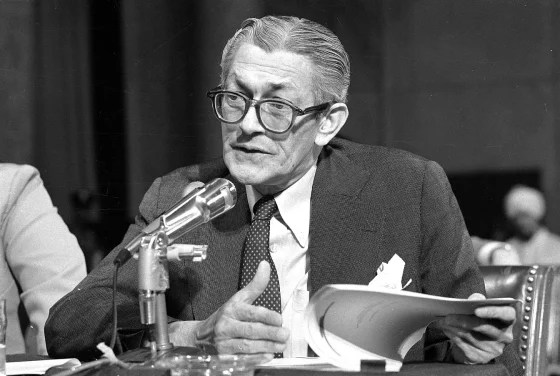
James Angleton testifies to the Senate Intelligence Committee
The memo noted approvingly how “much of the information” provided by Angleton “consists of the actual reports” he received from his sources. This was of significant advantage to the FBI, as the agency was able to “better evaluate the information instead of waiting for the delay and processing through normal channels in the CIA.” Angleton also “frequently” kept the Bureau apprised of Agency activities overseas, “which the CIA sometimes camouflages with some of its cloak and dagger techniques.”
Angleton’s extensive cooperation bought him enormous goodwill within the FBI. He successfully leveraged this in January 1958, when the Bureau serendipitously “flushed out” a scandalous, illegal spying operation targeting US citizens conducted by the CIA’s counterintelligence unit. A memo that month shared between senior FBI officials records how the Bureau was seeking to establish a program to monitor all mail being sent to and from the Soviet Union by American citizens, only to discover Angleton was already doing precisely the same thing.
Angleton in turn learned his scheme had been busted, so approached the Agency’s FBI liaison agent on a “personal basis” to outline the program. He claimed he would be fired if Langley caught wind of his disclosures to the Bureau. Angleton explained how the interception program was “one of the biggest and most secret operations being conducted by CIA,” and “extensive and expensive”. An “elaborate array of IBM machines” catalogued and conducted “complex scientific examinations” of all mail gathered.
In all, “two or three hundred CIA employees” were “exclusively engaged on various facets” of the operation, which cost “well over a million dollars a year” – roughly $11 million today. Angleton said the effort’s “sole purpose…was to identify persons behind the Iron Curtain who might have some ties in the US and who could be approached… as contacts and sources for CIA.” The operation was purportedly a “success”, with numerous valuable assets cultivated.
While FBI higherups questioned whether the effort “invaded our jurisdiction”, it was concluded Angleton’s unit had a “legitimate right” to conduct the mission. Moreover, the Bureau could avoid “the inherent dangers” of conducting a parallel mail intercept program – including “the sensitive nature of it, its complexity, size and expense” – by simply demanding the CIA counterintelligence unit hand over their operation’s vast intelligence yield to them.
Lee Harvey Oswald first came to Angleton’s attention in November 1959, due to news reports of his defection to the Soviet Union the previous month. Thereafter, all mail Oswald sent to and received from the US was opened and read by the CIA, until he returned home in May 1962 with his Russian wife Marina. Angleton’s monitoring of the minutiae of Oswald’s life persisted until Kennedy was killed. Multiple separate CIA operations collected intelligence on the President’s alleged assassin throughout.
‘CIA Project’
The CIA counterintelligence officer who monitored Oswald’s mail was Reuben Efron, part of a personal spying network constructed by Angleton from Jewish émigres from the Soviet Union, outside of formal Agency structures. Eerily, Efron attended a February 1964 hearing of the Warren Commission – officially charged with investigating JFK’s assassination – at which Marina Oswald testified. His presence was noted in an official volume of the investigation’s proceedings, but his employment by the Agency was unmentioned. Was he there on Angleton’s behalf?
This is but one of many mysteries related to Oswald that Angleton’s closed-door testimony to Senate investigators in June 1975 failed to resolve. During his grilling, Angleton had little to say about Kennedy’s assassination, despite being repeatedly probed about “the Oswald situation”. Questioned whether the CIA kept records on Oswald, Angleton prevaricated, “they have a file… I think more than one.” He offered scant further information, beyond claiming the supposed lone nut shooter was likely a Soviet operative.
When asked if there was a “connection between Oswald and the FBI”, Angleton elliptically acknowledged “there was a tremendous flap in the Bureau” following Kennedy’s assassination, and “confusion” the FBI “had not turned over, or had not taken enough initiative in turning over, all the information on Oswald to the local police” in Dallas. Angleton neglected to mention the FBI informed his counterintelligence unit one week prior to November 22nd 1963 Oswald was living and working in the city. By this time, the file collated by Angleton on Oswald ran to 180 pages.
Angleton was even more dishonest when testifying to the House Select Committee on Assassinations in October 1978. Asked point blank by a senior investigator if, to his knowledge, “Oswald [was] ever the subject of any CIA project,” Angleton lied, “no”. Coincidentally or not, he was then asked whether he knew Reuben Efron, and his responsibilities. Angleton responded in the affirmative, explaining Efron’s duties related to mail interception. Angleton was uniquely well-placed to elaborate that Efron was monitoring Oswald’s mail, in an operation he personally oversaw.
Angleton was grilled about his counterintelligence unit providing Israel with technical support for constructing nuclear weapons. He denied the charges, but under questioning admitted Tel Aviv may have conducted clandestine operations to source nuclear material in the US. Asked if he possessed “certain knowledge” of Israeli efforts “to acquire nuclear secrets in the US,” Angleton pleaded, “Do I have to respond to that?”
Kennedy entered office in January 1961 deeply concerned about Tel Aviv’s nuclear ambitions. A CIA assessment the previous month concluded a “major purpose” of Israel’s Dimona nuclear plant was “plutonium production for weapons.” The assessment outlined numerous grave outcomes of Tel Aviv acquiring nukes. Chief among them, exposure of the program would inevitably cause “consternation” in North Africa and West Asia, potentially prompting “threatened” Arab and Muslim states to turn to the Soviet Union for military assistance.
Perhaps spurred by this prospect, from day one of his Presidency, Kennedy made harmonious relations between Washington and Israel contingent on regular U.S. inspections of Dimona. Under intense pressure, Tel Aviv’s then-Prime Minister David Ben-Gurion finally allowed inspections in May 1961. Extensive efforts were conducted to camouflage areas of Dimona dedicated to research and development of nukes. Resultant assessments concluded the facility was solely concerned with nuclear power generation. Kennedy was unconvinced, however. In May 1963, he dispatched an ominous private telegram to Ben-Gurion:
“The dangers in the proliferation of national nuclear weapons systems are so obvious that I am sure I need not repeat them here… We are concerned with the disturbing effects on world stability which would accompany the development of a nuclear weapons capability by Israel… Development of a nuclear weapons capability by Israel would almost certainly lead other larger countries, that have so far refrained from such development, to feel that they must follow suit.”
‘Intelligence Operation’
The House Select Committee on Assassinations’ (HSCA) failure to interrogate Angleton over Israel’s nuke ambitions is all the more inexcusable given the contents of an April 1978 interview, conducted by Committee researcher Gaeton Fonzi with journeyman CIA officer Joseph Burkhalter Smith. Declassified records show Smith made a number of striking disclosures about Angleton’s role and influence within the Agency, and relationship with Tel Aviv. He suggested there was suspicion at the CIA’s highest levels Angleton may have been involved in Kennedy’s assassination, or at least concealed shadowy counterintelligence operations related to the world-changing event.
Smith enjoyed a close relationship with William Colby, who headed the CIA September 1973 – January 1976. A relative dove, Colby was forced out and replaced by George H. W. Bush, due to his candid public criticisms of the Agency’s record, and drive to break open the US intelligence community to greater scrutiny. Henry Kissinger aggressively pressed for his removal, fulminating how every time Colby “gets near Capitol Hill, the damn fool feels an irresistible urge to confess to some horrible crime.”
It is uncertain whether Angleton, Colby’s avowed nemesis, also played any role in Colby’s ouster. Smith claimed “Colby’s problems within the Agency stemmed largely from the conflict he had” with the CIA’s obsessively secretive counterintelligence supremo. Colby was totally in the dark as to what Angleton and his team were doing at any given time. Smith relayed how Colby had said of Kennedy’s assassination, “there could have been operations that Angleton’s staff was running that he wouldn’t even tell the Director.”
Smith went on to record how Angleton’s staff did “strange things”, and “handled all Israeli operations,” despite this not falling under their official purview. This “had a strange effect” on CIA operations in West Asia, “because unlike in other divisions where station chiefs kept each other informed, Angleton wouldn’t pass information to other stations in the Arab countries unless ‘he felt like it’.” It was also a mystery to Smith how Angleton “got all his power”.
Nonetheless, Smith testified Angleton had a “special relationship” with Allen Dulles, the longtime CIA director fired by Kennedy over the 1961 Bay of Pigs fiasco, subsequently appointed to the Warren Commission. Smith also described an “incredible” cult-like ethos among Angleton’s Agency adherents. Universally convinced the CIA had been heavily penetrated by the KGB, they were “confirmed believers in the world Communist conspiracy theory” – to the extent of suspecting the Sino-Soviet split was “a great deceptive operation.”
Asked by Fonzi “to be speculative” as to whether Lee Harvey Oswald could’ve been “a deep cover agent for the Agency,” Smith suggested Oswald may have “worked either for the Soviet Division, which ran operations in the Soviet Union, or the Counter Intelligence staff.” Angleton’s team was furthermore “very interested in the Fair Play for Cuba Committee”, a longstanding target of the CIA and FBI, to the extent “getting a penetration into it would have been a high priority effort.”
After moving to New Orleans in April 1963, Oswald set up a one-man chapter of the FPCC. In an apparent attempt to attract new members to the group in the virulently anti-Castro city, which was heaving with Cuban exiles, Oswald publicly distributed leaflets promoting the group. He hired random members of the public to assist with the effort, which lasted only 15 minutes, but just so happened to be captured on camera by a local TV station.
Oddly, when testifying to the Warren Commission, Oswald’s half-brother John Pic was “unable to recognize him” in pictures of the leafleting event, raising the prospect Oswald was being impersonated. Even more curiously, as Fonzi noted in his discussion with Smith, some of the leaflets listed the address of Oswald’s FPCC chapter as 544 Camp Street, which housed “some kind of intelligence operation run by Guy Banister, a former FBI agent.” Smith responded, “there were a lot of former FBI men on Angleton’s staff.”

Today, journalists, researchers, and concerned citizens have no choice but “to be speculative” about how and why John F Kennedy was killed, and by whom. The newly-declassified documents offer only further questions – but they all unambiguously point in James Angleton’s direction. His multifaceted role as master of the CIA’s vast Oswald file, chief of Agency relations with Israel, and potential enabler of Tel Aviv’s nuclear weapons program all appear interlinked. And these operations in tandem may account for what occurred on November 22nd 1963.
Mi5 and CIA Whistleblowers Expose Israel’s Deadly Tactics in Western Countries
The CJ Werleman Show | October 10, 2025
 / cjwerleman
 Featured Video
BRITAIN’S WARNING: PREPARE FOR WAR
or go to
Aletho News Archives – Video-Images
From the Archives
British weapons and personnel doing much of the killing in Yemen
Press TV – June 18, 2019
A detailed report published by the Guardian newspaper has shown how Britain is massively contributing to Saudi Arabia’s devastating war on Yemen as it suggests that London is not only supplying the bombs that fall on Yemenis, but it provides the personnel and expertise that keep the war going.
The comprehensive report by Arron Merat published on Tuesday showed that Britain was doing much of the killing in Yemen as the country continues to provide Saudi Arabia with everything it needs to turn its southern impoverished neighbor into a graveyard.
“Every day Yemen is hit by British bombs – dropped by British planes that are flown by British-trained pilots and maintained and prepared inside Saudi Arabia by thousands of British contractors,” said Merat in the report. … continue
Blog Roll
 Aletho News
- Pentagon designates Chinese cultural centers national security threat
- Israel Demolishes Home Of Lebanese Journalist Whose Viral Film Exposed Pager Attack
- Record Oil, Empty Tanks: The UAE’s Miracle Recovery
- Burnham tackles Britain’s poverty with aggression in Yemen
- Peace in Ukraine: the easy way – or the hard way
- Trump & the Rrrrussians
- US taxpayer money laundered back through Ukraine – Musk
- Before COVID, an NIH lab chief proposed making a SARS-like bat virus more infectious
- Gates, Bourla on Trial in Netherlands Accused of ‘Great Reset’ Scheme at Vaccine Injury Hearing
- BRITAIN’S WARNING: PREPARE FOR WAR
- If Americans Knew
- An error has occurred; the feed is probably down. Try again later.
- No Tricks Zone
- Two New Studies Find Thwaites Glacier Melt Cannot Be Driven By Human Activity Or A Warming Ocean
- E-Cars Reduce CO2 Emissions By Only 41% Compared To Internal Combustion Engine Vehicles
- Predictions Made By Renowned Climate Professor Over Past Decades Have Been Proven To Be Poor
- New Study Suggests Large Regions Of The Pacific Ocean Have Been Cooling For The Last 80 Years
- Germany’s Green Energy Debacle: High Energy Costs Force Kahla Porzellan to Close After 182 Years!
- New Study: 50 Years Of The Most Aggressive ‘Net Zero’ Policies Can Only Affect The Global Climate By 0.03°C
- US September “Heat” Was No Record…Many Records Set Decades Ago
- Latest European Green Energy Debacle; Portugal’s Largest Flagship Solar Park Insolvent!
- Green Energy Debacle: German Expert Professor Fritz Vahrenholt Warns Of Severe Economic And Social Consequences
- Two More Paleo Reconstructions Affirm Meters-Higher Sea Levels Across Ireland, Brazil 7000-6000 Years Ago


