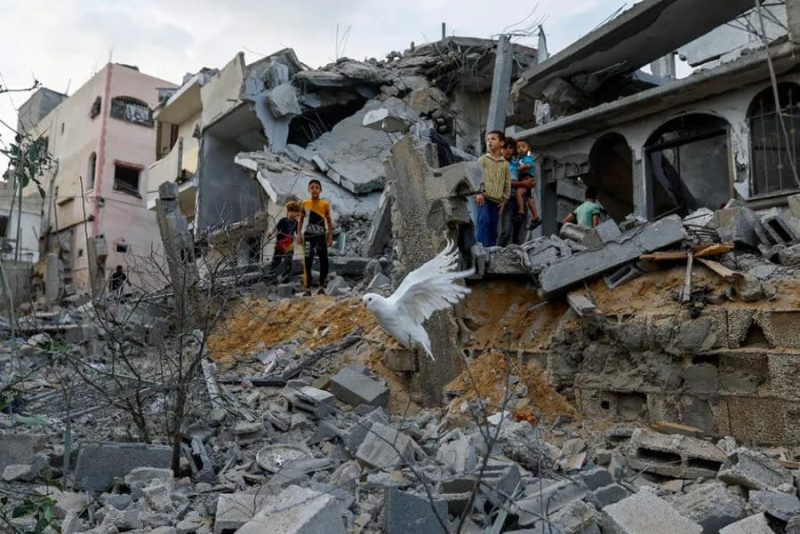
After seven weeks of relentless Israeli bombing throughout Gaza, according to the modest estimates of the UN as of November 23 (right before a humanitarian ceasefire came into effect), more than 14,800 people have been killed in the enclave, including about 6,000 children and 4,000 women.
While these Israeli attacks on Gaza are by far the worst yet, with Israel dropping a reported 40,000 tons of explosives in less than two months, it is worth recalling that Israel has repeatedly waged assaults against the Palestinians of Gaza over the past 15 years.
Living in Gaza for years between late 2008 to March 2013, I was witness to two major Israeli assaults (and countless smaller ones over the years). Here, I will highlight what I saw and documented, to show that the horrific Israeli war crimes we are seeing coming out of Gaza are not new, even if they are exponentially worse this time around.
On December 27, 2008, Israel unloaded 100 bombs on Gaza within the first minutes of its Operation Cast Lead. The Shifa Hospital (Gaza’s main), was receiving the dead and the injured non-stop. The ICU beds were filled, and doctors told me that as soon as one patient died another took their place.
Together with a handful of international activists in Gaza I made the decision to ride in ambulances with Palestinian medics as they searched for the wounded and took them to hospitals. We did so aware that Israel barred journalists from Gaza, and knowing that, in the past, medics and ambulances had been targets for the Israeli army.
I would see this first-hand soon after first joining the medics, when an Israeli sniper targeted the ambulance I rode in, injuring one medic in the leg when one of at least 14 bullets hit the rear of the car as we sped away.
This was during the January 7, 2009 “humanitarian cease-fire” hours. The Geneva Conventions explicitly state that “medical personnel searching, collecting, transporting or treating the wounded should be protected and respected in all circumstances.”
Some days prior, Israeli shelling had killed Arafa abd al-Dayem, a medic I knew and had accompanied. He was rescuing injured Palestinians, standing at the rear of the ambulance when it was hit with a shell containing flechettes. Flechette munitions are designed to spray thousands of small metal darts in a wide arc, increasing the chance of injuries and death. The dart’s sharp head is designed to break away, increasing the amount of internal damage done. Another 21-year-old medic, a volunteer, was injured, his legs lacerated.
The day after Arafa was killed, the Israeli army fired three times within two minutes on the neighborhood where family and neighbors had gathered to pay their respects. The shelling, again with flechettes, killed six more civilians, including a young pregnant mother, and injured 25 more.
The night the Israeli land invasion began, on January 3, shells flew dangerously close to the Red Crescent station in the district east of Jabaliya I was then based in, when not in one of the ambulances. By morning it was impossible to access, and by the end of the war, we returned to find it riddled with bullet holes from machine-gun fire and blasted by shelling.
The ambulances and their medical equipment were some of the most bare-bone I’ve seen, supplies depleted by the long Israeli siege and blockade of Gaza. The medics drove quickly over bumpy roads to get to the people in need, wasted little time collecting them, and bolted away, trying to avoid being targeted by the Israeli army.
After invading the Tel al-Hawa district in the third week of its war on Gaza, the Israeli army repeatedly bombed the Quds hospital, while Israeli snipers targeted Palestinians fleeing residential areas. I was with an ambulance that went to evacuate civilians from the hospital and take them to the Shifa hospital (which had no space), going back repeatedly to save Palestinian civilians, each time at risk of being shot by Israeli soldiers.
By the end of the 2009 war, the Israeli army had killed 23 medics, and injured 57 more, destroying at least nine ambulances and damaging 16 more. None of the journalists or medics that I knew had protective body armor – including me. Given the massive bombs which Israel was dropping on us, it would’ve made little difference.
One evening, after giving an interview to RT about what I’d seen while riding in ambulances in the extremely dangerous areas of Gaza’s north, just after finishing the interview, Israel shelled the building at least seven times. We scrambled down ten flights of stairs, thankfully intact. Incidentally, in 2021, Israeli airstrikes destroyed the same building as well as another, collectively housing 20 media outlets.
During and after the 2008-2009 war, I took countless testimonies of Palestinian parents who said their children were deliberately murdered by Israeli soldiers: shot point blank, drone struck during ceasefire hours, shot by a sniper. In Shifa hospital, I met the mutilated survivors whose home had been shelled with white phosphorus munitions, killing six family members, including an infant burned alive. I followed up on their story afterwards, learning more chilling details and seeing their bombed-out home with my own eyes. Graffiti, apparently left on the walls by Israeli soldiers, included hate messages and threats, like “it will hurt more next time.” (Warning: disturbing images)
In the last two months, Israel has repeatedly bombed schools, including UN-affiliated ones that housed displaced Palestinians seeking safe shelter. It did the same back in January 2009, bombing numerous UN schools, including the Fakhoura school that has suffered in the current war as well.
I could, unfortunately, write pages more on what I saw and heard in those three weeks of Israeli bombing, and also during the November 2012 Israeli campaign (when I was based at a hospital in Deir al-Balah, central Gaza), but for the sake of some brevity will stop. What did not stop were the Israeli bombings and shooting immediately post ceasefire, both in 2009 and in 2012.
But almost as brutal as the Israeli bombing campaigns has been the over-16-year-long strangling siege on Gaza. I’ve written about it at length, but which in summary it has caused a vast increase in poverty, food insecurity, malnutrition, anemia, stunted growth, diabetes, treatable illnesses going untreated, water that was 95% undrinkable (already back in 2014).
On November 24 of this year, a four-day ceasefire was implemented, to allow for exchange of Hamas hostages for Palestinians imprisoned by Israel, as well as for deliveries of desperately needed food, water, fuel and medical aid, of which the 2.4-million population of Gaza had been deprived for weeks. Unsurprisingly, there were reports of the truce being violated, including snipers firing on Palestinian civilians.
In the first day after the ceasefire expired, over 100 Palestinians were killed, according to the Gaza Health Ministry, as Israel started to deliver the promised “mother of all thumpings,” ostensibly to Hamas militants.
There is no space for me here to outline all the horrors inflicted upon Gaza in the past two months, nor do I need to: social media and Telegram channels are filled with horrific scenes of schools housing displaced civilians getting bombarded again, entire blocks of refugee camps bombed, hospitals and churches housing tens of thousands of displaced civilians bombed, white phosphorous again rained down on densely inhabited residential areas, and on, and on.
What I do want to highlight is that there is no doubt in my mind, or in the minds of numerous other international reporters and observers who have seen the situation on the ground first-hand, that Israel has committed war crimes in Gaza, and the intent, if not the reality, is genocidal.
We have globally watched as Israel commits the definition of genocide: “The intent to destroy, in whole or in part, a national, ethnical, racial or religious group, as such.” Raz Segal, a genocide expert, wrote of this after only one week of Israel’s bombardment, since which Israel has committed uncountable heinous crimes.
In late October, former Director of the UN’s New York (OHCHR) office, Craig Mokhiber, resigned from his position in protest and disgust, stating, “Once again, we are seeing a genocide unfolding before our eyes, and the organization that we serve appears powerless to stop it. As someone who has investigated human rights in Palestine since the 1980s, lived in Gaza as a UN human rights advisor in the 1990s, and carried out several human rights missions to the country before and since, this is deeply personal to me.”
He explicitly stated that Israel’s “wholesale slaughter of the Palestinian people… coupled with explicit statements of intent by leaders in the Israeli government and military, leaves no room for doubt, this is a textbook case of genocide.”
Eva Bartlett is a Canadian independent journalist. She has spent years on the ground covering conflict zones in the Middle East, especially in Syria and Palestine (where she lived for nearly four years).
December 3, 2023
Posted by aletho |
Ethnic Cleansing, Racism, Zionism, Timeless or most popular, War Crimes | Gaza, Human rights, Israel, Palestine, Zionism |
Leave a comment
Canada’s top politicians were recently served a notice of intention to seek prosecution for aiding and abetting Israel’s war crimes in Gaza. Prime Minister Justin Trudeau, Foreign Affairs Minister Mélanie Joly, National Revenue Minister Marie-Claude Bibeau and Justice Minister Arif Virani were warned they could be liable and face charges before the International Criminal Court for aiding and abetting Israeli war crimes.
During the past six weeks Israeli ministers have repeatedly expressed their genocidal intent towards what they’ve called “human animals” in Gaza. Israel has cut off water, food, fuel and electricity to the open-air prison and one minister even declared a desire to “eliminate everything” in the coastal strip of 2.2 million. Tens of thousands of houses, hospitals, Mosques, schools and other buildings have been destroyed. So far over 30,000 Palestinians have been injured and 14,000 killed, including 6,000 children. As the notice to Canadian ministers’ highlights, a director at the United Nations, Craig Mokhiber, called Israeli policy a “text-book case of genocide.”
Ottawa has enabled Israel’s bid to ethnically cleanse Palestinians from a small part of what’s left of their historic homeland. During a visit foreign minister Melanie Joly offered Canada’s approval for Israel’s genocidal siege and violence. In describing the meeting a week into its onslaught, Israel’s foreign minister Eli Cohen boasted, “We continue to mobilize the world for the fight against Hamas! I met today with Canada’s Foreign Minister Melanie Joly, who also came to support Israel.”
At a rhetorical level Trudeau has repeatedly supported Israel’s “right to defend itself” while defence minister Bill Blair declared that “Hamas has to be eliminated.” At the same time Canadian officials have largely refused to condemn Israel’s war crimes and have rebuffed calls for a ceasefire.
At the United Nations Canada abstained on a General Assembly resolution calling for “protection of civilians and upholding legal and humanitarian obligations.” It was backed by 120 countries.
Beyond the diplomatic sphere, Canada has offered more concrete assistance. After Hamas’ October 7 attack the Canadian Air Force flew 30 Israeli reservists back into the country. With flights evacuating Canadians from Tel Aviv to Athens, military aircraft transported Israeli reservists in the other direction.
Alongside assisting Israeli reservists to return, Canadian special forces were dispatched to Israel. The stated reason for the deployment of these soldiers is to assist the embassy with security and evacuations. That may be true. But the Canadians may have a more direct role in Gaza and — at a minimum — the deployment reflects Canada-Israel military co-operation.
Through the Five Eyes and NATO the Canadian military has significant ties with its Israeli counterparts. Bilaterally, Canada and Israel both have military attachés in each other’s countries and top military officials regularly visit each other. The Israeli Air Force trains in Canada and for 15 years Canadian troops training Palestinian Authority security forces in the West Bank have coordinated with their Israeli counterparts. Canada also has a “border management and security” agreement with Israel, even though the two countries do not share a border.
The Canada-Israel Industrial Research and Development Fund has pumped tens of millions of dollars into joint research ventures between the countries’ military companies. In recent years Canada has exported a little more than $20 million worth of arms to Israel annually (Canadian weapons makers sell many millions of dollars more in components to US firms that arm Israel.) But Canada is a signatory to the UN Arms Trade Treaty, which is designed to limit weapons from entering conflict zones and preventing their use by human rights violators.
As detailed in the notice of intention to prosecute, the Trudeau government has failed to fulfill its obligations under the Arms Trade Treaty and Canada’s Export and Import Permits Act despite repeated calls by the opposition NDP to end arms sales to Israel. The intention to prosecute also cites the government’s failure to stop illegal recruitment for the IDF or Canadian charities from unlawfully assisting Israel’s military.
Private organizations and Israeli officials have long recruited in Canada. Three years ago, a multi-faceted campaign was launched calling on the federal government to apply charges under the Foreign Enlistment Act against those “recruiting” or “inducing” Canadians to assist the Israeli military.
The government immediately sought to downplay the issue after they were delivered a formal complaint and an open letter signed by Noam Chomsky, Roger Waters, filmmaker Ken Loach, author Yann Martel and 150 others. Responding to a Le Devoir reporter’s question on the matter then Justice Minister David Lametti simply said, “it’s up to the police to investigate” any violation of an act that states “any person who, within Canada, recruits or otherwise induces any person or body of persons to enlist or to accept any commission or engagement in the armed forces of any foreign state or other armed forces operating in that state is guilty of an offence.”
The Trudeau government hasn’t simply downplayed illegal IDF recruitment. They’ve boosted it. In January 2020 the Canadian embassy in Tel Aviv hosted a pizza party to celebrate the 78 Canadians fighting in the Israeli military.
The government has also been indifferent to other illegal forms of support for the Israeli military. Many of the 200+ Canadian-based Israel-focused registered charities assist the Israeli military in contravention of Canada Revenue Agency (CRA) rules, which state that “increasing the effectiveness and efficiency of Canada’s armed forces is charitable, but supporting the armed forces of another country is not.”
The HESEG Foundation, Canadian Zionist Cultural Association (CZCA) and many other registered charities assist the IDF. But the CRA has been slow to apply its rules to Israel-focused charities.
The Trudeau government’s indifference to Canadian law has enabled Israeli impunity. Ditto for Ottawa’s indifference to international law. In 2020 Ottawa pressed the International Criminal Court to stop investigating Israeli war crimes. Their letter said it didn’t believe the ICC had jurisdiction over Palestine and implied Canada could sever its funding if the ICC pursued an investigation of Israeli crimes. In a similar move, three months ago Ottawa sought to block a World Court opinion on Palestine. Canada submitted a statement opposing an International Court of Justice advisory opinion called for by a UN General Assembly resolution titled “Israeli Practices Affecting the Human Rights of the Palestinian People in the Occupied Palestinian Territory, including East Jerusalem”.
To protect Israel from criticism the Trudeau government created a special envoy to combat antisemitism and formally adopted the International Holocaust Remembrance Alliance’s (IHRA) definition of antisemitism, which is designed to marginalize those criticizing Palestinian dispossession. The Trudeau government also sued to block proper labels on wines from illegal settlements while expanding the Canada-Israel free trade agreement that grants duty free status to products produced in illegal West Bank settlements.
Since taking office in 2015 the Trudeau government has voted against nearly 100 UN resolutions, often supported by most of the world, upholding Palestinian rights. They’ve also repeatedly justified Israeli violence against Palestinians while mostly ignoring its brutal blockade of Gaza, demolition of Palestinian homes in the West Bank and growing Jewish supremacy inside its 1948 borders.
The notice to prosecute was delivered by activists to the ministers’ offices in Toronto, Ottawa, Sherbrooke and Montreal. Subsequently the lawyers driving the initiative held a press conference to explain the legal process behind the notice of intention to seek prosecution. A few Canadian media reported on it, but it was widely covered in international pro-Palestinian outlets.
The notice of intention to seek prosecution concludes:
“In order to reduce the risk of further complicity, the Government of Canada must immediately take the following diplomatic and economic measures:
1. Call for a ceasefire to prevent further loss of life in Gaza;
2. Call for secure provision of meaningful humanitarian aid to Gaza;
3. Issue a public statement condemning Israel’s breaches of international law;
4. Insist that Israel fully comply with international law;
5. Cancel all Canadian permits for arms exports to Israel;
6. Prosecute those recruiting Canadian volunteers for Israel’s armed forces; and
7. Prevent Canadian charities from using donations to benefit Israel’s armed forces.”
The least Canadians should be able to expect of their government is adherence to international law.
December 3, 2023
Posted by aletho |
Ethnic Cleansing, Racism, Zionism, Timeless or most popular, War Crimes | Canada, Israel, Palestine, Zionism |
Leave a comment
DOHA – Member of Hamas’s political bureau Ezzat al-Resheq has described the Israeli occupation’s claims made recently against his Movement following seven days of humanitarian ceasefire as “intended to justify its resumption of the genocidal war on the civilians in the Gaza Strip.”
“The occupation is still repeating its false claims regarding its justifications for resuming its aggressive war against our people,” Resheq said in press remarks on Saturday.
“The occupation is spreading false and baseless stories, including claims of a missile being launched from the Gaza Strip,” the Hamas official added, stressing that all these false claims and stories were “aimed at covering up its premeditated intent to resume its brutal bombardments and barbaric raids and commit horrific massacres against defenseless civilians.”
“We showed responsiveness to the mediators in the negotiations over extending the temporary truce, but we like to affirm that the occupation is fully responsible for the failure to extend the humanitarian ceasefire after it refused to deal positively with offers it had received through the mediators,” he underlined.
December 3, 2023
Posted by aletho |
Ethnic Cleansing, Racism, Zionism, Militarism | Israel, Palestine, Zionism |
Leave a comment
Washington is run by Israel’s proxies
Americans remain largely ignorant about the extent to which foreign influence pervades the United States government, and I am not referring to the fraudulent claims made by Hillary Clinton that Russian has interfered materially in US elections. The real threat comes from elsewhere. Few outside the government itself are likely to be aware of the extent to which the state of Israel and its domestic affiliate-lobby operating out of Washington and New York have corrupted the United States political system, to the point where nurturing and enabling the Jewish state in its ambitions to dominate much of the Middle East has become effectively US policy. As the exchanges surrounding the recent fighting in Gaza, rightly referred to as a war crime and ethnic cleansing, perhaps even the first steps in a planned genocide, demonstrate that even when the US has genuine interests at stake Israel believes itself empowered to say “no” to the president of the United States. The assault on Gaza and the ongoing killing of tens of thousands of Palestinians started again on Friday after a week long pause for hostage/prisoner exchanges. It will continue and Washington is complicit in the deaths as it has politically shielded Prime Minister Benjamin Netanyahu’s government no matter what it does while also arming and funding the Israeli actions.
Former Israeli Prime Minister Ariel Sharon once said that “We the Jewish people control America.” Indeed, the Israeli dominance of the “fools on the hill” in DC has been carefully contrived, cultivated and sustained. One prime example is the regular rush to the Israeli door whenever Congress is in recess. It is not widely reported how large gaggles of congressmen usually drawn in separate groups from each major party travel to Israel on all expenses paid trips where they are wined and dined and subjected to round after round of presentations that drill into their otherwise empty heads all the virtues of Israel and what it represents. This is propaganda combined with indoctrination at its finest with many “facts” presented by the speakers conveniently fabricated to support Israel’s perpetual victimhood and to hide the fact that Israel is a strategic liability for the US rather than an actual ally or asset. Nor is it a democracy. It is a formula for dissimulation and lying that worked with the Jewish officials in the Pentagon under George W. Bush to provoke a war against Saddam Hussein that killed one million Iraqis and cost the US taxpayer nearly $2 trillion.
The trips to Israel are funded by the “educational” affiliate of the American-Israel Public Affairs Committee (AIPAC) called the American Israel Education Foundation (AIEF). One might reasonably ask why an organization connected to AIPAC, which describes itself on its website as having the “mission” to “…strengthen, protect and promote the US-Israel relationship in ways that enhance the security of the United States and Israel,” should be able to fund the annual mass migration of congress-critters to promote Israeli interests without having to register under the Foreign Agents Registration Act (FARA) as an agent of the Jewish state’s government? The answer is actually quite simple. Congress and the Justice Department have been so corrupted by pro-Israel money and other manifestations of Jewish power that they do not enforce the law when it comes to Israel. The venal creatures in Congress are a large part of why that is so.
And the trips are structured in a way that discourages any actual discussions of real issues affecting the two countries. The payoff is exceptional from Israel’s point of view, with the United States serving as, in Netanyahu’s own words, a near unlimited source of money and weapons from a country in thrall, an “America [that] is a thing you can move very easily, move it in the right direction” possessing “an inherently dupable people.”
One particularly tone-deaf recent trip to Israel occurred in 2019. In the wake of two heavily reported mass killings in Dayton and El Paso that were attributed both by the media and the Democrats to “racism” a senior US Congressman led a delegation of 41 of his Democratic Party colleagues plus spouses on a week-long luxury all-expenses-paid trip to Israel, which is one of the few countries in the world that defines its full citizenship as a matter of race and religion and which was at that time as now widely criticized for its human rights record. House Majority Leader Steny Hoyer of Maryland led the annual excursion, having made the pilgrimage to Israel more than fifteen times. “I am pleased to join so many House Democrats in traveling to Israel to reaffirm our support for a critical US ally and to continue learning about the opportunities and the challenges facing Israel and the Middle East,” he said shortly before departing for Tel Aviv.
Other politicians at state levels have followed the federal government lead by making their way to Israel to kiss Benjamin Netanyahu’s ring. Governor Ron DeSantis of Florida, who is a presidential aspirant, has gone way overboard in expressing his love for the Jewish state. He transported his whole cabinet to Jerusalem to publicize his legislation to combat what he views as antisemitism and has followed through on that by banning Palestinian student groups at the state universities. He also opposes allowing Palestinian immigrants into the US because they are “antisemites.”
More recently, California governor Gavin Newsom has made the pilgrimage trip and his office has released his comments on just how wonderful Israel is. He wrote his heart out, meaning that the memo is totally phony and contrived bullshit which demonstrates no sympathy at all for the tens of thousands of Palestinian victims: “As I reflect back on the extraordinary people I just met today in Israel, I am reminded of the deep connections between my home state and this country. A country that has faced many dark times before, and certainly is in one now. But amid this present struggle against terrorists are stories of unimaginable heroism — and unspeakable tragedy. I grieved with families in mourning, I met with young soldiers fresh from bomb shelters and battlefields, and I sat with leaders who bear the responsibility of response to it all. Despite the horror, what I saw and heard from the people of Israel was a profound sense of resilience. A commitment to community and common purpose, especially in these most difficult of times. That’s the Israeli spirit. And it’s also the California spirit…”
Republican presidential wannabe Chris Christie has also recently shown up in the Jewish state to kiss the ring and we expect that Nikki Haley will soon arrive bowing and scraping, particularly as it is Jewish money honoring her passion for Israel that is floating her campaign. And there is lots of love even at the bureaucratic level in a number of states to make sure Israel is getting enough American money. In some states including Virginia Israel trade commissions have been funded which have benefited Israeli businesses and investors much more than local workers or companies. In Virginia the commission is staffed by American Jews and Israelis even though it is funded by the state.
The Israeli power over Congress is also reflected in billions of tax dollars that flow from the US Treasury to the Jewish state each year in spite of the fact that Israel is a wealthy country. Also one might consider the White House’s supine behavior vis-a-vis Netanyahu and its large percentage of senior level staff appointments that are given to Jews. Donald Trump gave away the house to Netanyahu by moving the US Embassy to Jerusalem, approving the annexation of the Golan Heights, and giving the Israeli government a free hand to “deal with” the illegally occupied Palestinian areas on the West Bank and Gaza, which has produced thousands of Arab arrests without trial. Trump’s Ambassador to Israel was his lawyer David Friedman, who spent four years covering for Israel and represented its interests rather than those of the United States. Biden arguably has done even worse by becoming complicit in war crimes by enabling Netanyahu and his band of criminals to perform a developing genocide in Gaza.
One must look at how the power of the Lobby has influenced senior staffing decisions coming from the White House in Israel’s favor because that is where foreign policy is made. President Joe Biden personally considers himself to be a “Zionist.” The president’s Chief of Staff and the State Department’s top three officials have been Zionist Jews. Jews also head Treasury, Homeland Security, the Office of National Intelligence, the Justice Department, the National Security Council and the deputy director slot at CIA.
Regarding some other appointments that smell very bad, two recent stories stand out. The first, entitled “Tel Aviv’s Man in Washington”, comes from journalist James Carden. It concerns Amos Hochstein who, has been reportedly tapped as President Joe Biden senior adviser for consultations with top Israeli officials in order to mediate between Israel and Lebanon. Hochstein is an odd choice as he was born and raised in Jerusalem and is a Jewish Israeli-US dual national who served in the Israeli Defense Forces in the early 1990s and who still has a mother and father living in Israel. He moved to Washington after military service and began his unusually rapid ascent to the highest levels of the US government, beginning with a staff position for Jewish Congressman Sam Gejdenson and then as Staff Director of the House Foreign Affairs Committee. It is not clear how he obtained a security clearance given his background, but he obviously was given highly sensitive assignments. Carden cites the Lebanese news source L’Orient which reported that Hochstein, as a congressional staffer in the 1990s,” met with an Iraqi Foreign Ministry official to discuss a plan to resettle Palestinians in Iraq in return for sanctions relief.” This background suggests that Hochstein is a bit of a specialist in removing Palestinians from Israel.
After that job, Hochstein joined the Obama administration, eventually being placed in charge of the energy portfolio at the State Department, an astonishing leap in status for a man billed as “Biden’s favorite energy guy” who appears to have no college degree. And what about a biographical sketch that mentions Hochstein’s ownership interests in two Washington restaurants and a movie theater? And then there is his obtaining a well remunerated board seat on the Ukrainian state oil and gas giant Naftogaz, which positively exudes a Hunter Biden odor? And it was reported that early in the Biden administration, Hochstein was the president’s choice to lead efforts to block or destroy the Nord Stream 2 pipeline, which presumably would have inter alia enhanced his own likely financial interests in Ukrainian energy companies.
Carden also poses the big question, which is “How could someone of Hochstein’s (opaque) background possibly be viewed as an honest broker in the Middle East?” He responds to that himself with “He isn’t” and then goes on to explain “The practice of appointing foreign nationals in sensitive positions of public trust are wildly inappropriate and lead, inevitably, to a subversion of US national interests. As Biden and his staff of bought and paid for political appointees drag us deeper and deeper into two wars 5,000 miles from our shores, the pernicious influence of foreign nationals at the highest levels of the US government is a danger the American people need to awaken to.”
To that expert analysis I would add that naming an Israeli as US-envoy for dealing with a highly manipulative Israel is completely delusional. Hochstein will lean strongly towards benefitting his country, which is Israel, and when it comes to energy there are large gas and oil fields just off the Gazan coast, which would fall into Israeli hands if the Gazans were completely eliminated. The fields are worth many billions of dollars. It will be interesting to watch the development of what Hochstein will contrive to hand them over to his Jewish countrymen while also benefitting his own interests.
The other story is similar in that it illustrates why you should not send Israelis or even American Jews who feel very strongly about Israel to deal with the Israeli government or even anywhere near the Middle East. I say this not to punish them for being Jewish but rather to avoid placing them in situations where there would be a presumption of serious potential conflict of interest. A former senior US official fitting that profile is facing a backlash after being caught on video included on the link repeatedly harassing a halal food vendor in New York and aggressively calling for the deaths of more Gazan children. Stuart Seldowitz previously served as deputy director of the United States Department of State’s Office of Israel and Palestinian Affairs where he must have been quite a lot of fun to be around. How does a man like that get a senior diplomatic post dealing with the Middle East? Well, the only answer must be that he is given the job precisely because he is Jewish and will do the “right thing” for the state of Israel. And you wonder why US foreign policy might be politely described as “completely screwed up”? It did not happen by accident!
Philip M. Giraldi, Ph.D., is Executive Director of the Council for the National Interest, a 501(c)3 tax deductible educational foundation (Federal ID Number #52-1739023) that seeks a more interests-based U.S. foreign policy in the Middle East. Website is councilforthenationalinterest.org, address is P.O. Box 2157, Purcellville VA 20134 and its email is inform@cnionline.org.
December 2, 2023
Posted by aletho |
Corruption, Timeless or most popular, Wars for Israel | Israel, Palestine, United States, Zionism |
Leave a comment
And when will its political and media leaders be tried, condemned, and executed?
Even Israeli experts call it “a textbook case of genocide.” Those are the exact words of Raz Siegal, an Israeli historian and professor of Holocaust and genocide studies at Stockton University. On October 16, Siegal told Democracy Now:
We have to understand that the U.N. Convention on the Prevention and Punishment of the Crime of Genocide from 1948 requires that we see special intent for genocide to happen. And to quote the convention, intent to destroy a group is defined as racial, ethnic, religious or national as such that is collectively, not just individuals. And this intent, as we just heard, is on full display by Israeli politicians and army officers since October 7th. We heard Israel’s president. It’s well-known what Defense Minister Yoav Gallant said on October 9th declaring a complete siege on Gaza, cutting off water, food, fuel, stating that “We’re fighting human animals,” and we will react “accordingly.” He also said that “We will eliminate everything.” We know that Israeli army spokesperson Daniel Hagari, for example, acknowledged wanton destruction and said explicitly, “The emphasis is on damage and not on accuracy.” So we’re seeing the special intent on full display.
And it isn’t just Israelis who are guilty. Leaders of Western countries have given the Gaza Holocaust their full backing. On Saturday, October 7, even as Israeli tanks, rockets, and helicopter gunships were mass-murdering hundreds of Israeli civilian prisoners alongside dozens of their Hamas captors, US President Joe Biden condemned as “unconscionable” the “appalling terrorist attacks” and encouraged what would become genocidal Israeli “retaliation.”
In reality, the Israelis, not Hamas, were the terrorists of October 7. The only mass slaughters of civilians that day were carried out by the Israeli Defense Forces. Hamas’s brave soldiers were under strict orders to attack Israeli military targets and try to capture military hostages, with the taking of civilian hostages being a secondary option or last resort. There were no Hamas orders to kill unarmed civilians, and surviving Israeli hostages speak of the kindness and generosity of their Hamas captors.
Zionist-owned Western media immediately began broadcasting outrageous lies deliberately designed to incite genocide. (Every media person responsible for those lies must some day be tried, convicted and executed.)
Zionist genocide propagandists raved deliriously about Hamas supposedly beheading 40 babies, baking babies in ovens, gouging eyes, mutilating breasts, cutting open naked women, raping women, mutilating dead bodies, spreading cyanide, and on and on. All lies. When Joe Biden endorsed the beheaded babies canard, claiming that he had seen the bodies, he sealed his fate as a self-incriminated genocide inciter who will be executed in the unlikely event that he lives long enough to face trial.
What really happened on October 7 was reasonably clear even then, and has since become undeniable. Hamas scored what Scott Ritter has called “the most successful military raid of this century:”
Hamas effectively neutralized Israel’s vaunted intelligence services, blinding them to the possibility of an attack of this scope and scale…(then) Hamas defeated those Israeli soldiers stationed along the barrier wall in a stand-up fight. Two battalions of the Golani Brigade were routed, as were elements of other vaunted IDF units.
Hamas struck the Headquarters of the Gaza Division, the local intelligence hub, and other major command and control facilities with brutal precision, turning what should have been a five-minute response time into many hours—more than enough time for Hamas to carry out one of its primary objectives—the taking of hostages. This they did with extreme proficiency, returning to Gaza with more than 230 Israeli soldiers and civilians.
Hamas fighters killed about 600 Israeli soldiers during the first 24 hours, a total that “included many of Israel’s most elite officers, including dozens of colonels and majors.” After Hamas repeatedly defeated the Israeli military in stand-up fights, and captured hundreds of Israeli prisoners, the Zionists panicked and invoked the Hannibal Directive, according to which heavy weaponry is used to eliminate both hostage takers and hostages. According to an Israeli Air Force officer who participated in the mass murder of hundreds of Israeli civilians along with their Hamas captors, top-level Zionist commanders ordered “mass Hannibal.” In other words, they deliberately ordered the mass slaughter of their own civilians by the hundreds in order to prevent them from becoming hostages and adding to Israel’s political problems. Had they not done so, Hamas would have returned to Gaza with as many as 700 prisoners, rather than the 250 that they actually got.
Israel then used photos of the carnage that they themselves had inflicted—using helicopter gunships, tanks, and rockets—and blamed it on Hamas. Even a cursory look at the photos of the devastated kibbutz buildings, the blown-up buildings at the music festival, and the vast array of shredded automobiles makes it clear that most of the damage was done not by Hamas’s small arms fire, but by Israel’s heavy weaponry. Yet the shameless Zionists, mass-murderers of their own people, had the chutzpah to blame the courageous and ethical soldiers of Hamas for their own crimes!
The West Sparks the Genocide
By October 8 I could see, as could anyone else with eyes, that the images out of Israel showed that the Israelis, not Hamas, were responsible for hundreds of civilian deaths. The Biden Administration, and its CIA daily briefer, must have known the same thing, with even greater certainty and in greater detail. Yet instead of using its knowledge of the truth to restrain Israel’s murderous impulse towards Biblical-scale vengeance, Joe Biden went on television and bloviated about supposedly seeing 40 Israeli babies beheaded by Hamas.
Everything the almost-entirely-Jewish Biden Administration did was calculated to encourage Israel to launch a genocide. And every other Western leader went along, actively or passively, with the genocide plan.
Once the exterminationist carpet-bombing of Gaza was underway, and thousands of women and children murdered, did those Western leaders reverse course and demand that Israel stop? Of course not.
Anthony Blinken, who flew to Tel Aviv first, in the midst of the carpet-bombing, let slip that his pre-eminent loyalty was to the genocidal entity, announcing that he flew to Tel Aviv “not only as the United States Secretary of State but also as a Jew.” (Remove the words only and also from that sentence to understand its real meaning.)
Joe Biden flew to Tel Aviv to put his stamp of approval on the genocide. So did UK Prime Minister Rishi Sunak, French President Emmanuel Macron, and German Chancellor Olaf Scholz, who described Hamas as “the new Nazis” according to Netanyahu. Second-tier Western powers like Austria and Czechoslovakia also sent their leaders to kiss Netanyahu’s reeking rump and endorse the Gaza Holocaust.
Why has the West’s entire leadership class been falling all over itself competing to see who can move to the head of the line of genocidal war criminals? Can’t they see that the global majority is appalled by the wholesale Zionist atrocities and sides with Palestine? Don’t they realize that the West is hastening its own demise, and ensuring the rise of a non-Western-led world order, by undermining its pretense of concern for international law and human rights?
Several possible reasons for the West’s unanimously-pro-genocide position have been proposed. Some say the West is incorrigibly racist and just doesn’t care about the deaths of brown people, especially Muslims. They add that the West’s undisputed hegemon, the USA, was founded on Old Testament style genocide, and that the formerly Protestant and now Jewish Bible-thumpers of Washington DC share Netanyahu’s vengeful lust for Biblical extermination of “Amalek” (meaning the designated racial enemies of the Jews and/or Americans).
Another potential explanation invokes realpolitik. The US imperial center increasingly dominates the West (the Ukraine war destruction of Nordstream emasculated Europe) but is losing ground elsewhere. Hamas’s crushing defeat of Israel on October 7 struck a powerful blow not only against Zionism, but against the whole Anglo-Zionist Empire. The Biden “minyan” (Jewish-Zionist cabinet) panicked and scrambled to endorse Israeli genocide, not out of sober calculation, but for the same reason that a rabid rat, when cornered, mindlessly lashes out. These people know that the days of the US empire, and the Zionist entity, are numbered, and it drives them crazy. They see that every day the rising countries, led by China, Russia, and Iran, become stronger, and the US and its European vassals grow weaker. Terrified, they realize that if war is to come, the sooner the better, because every day the West’s chances of winning recede. And then, even more terrified, they grasp that it is already too late. So they take out their frustration on the women and children of Gaza.
Another realpolitik-based explanation involves the possibility that US leaders, or at least the most extreme neocon faction, would welcome an all-out war with Iran and the Axis of Resistance—a war which every additional day of genocide brings closer. Even though such a war risks a civilization-imploding World War III, and would at minimum result in tens or hundreds of thousands of Israeli and American casualties, it might at least offer a distraction from looming US defeat in Ukraine. Additionally, a massive war in West Asia would reduce the region to chaos and set back China’s Belt-and-Road plan by a decade or two, thereby prolonging the US imperial illusion by maintaining it on life support for another few years. (China builds, the US destroys, so maximizing destruction prolongs the US imperial agony.)
But in the end, the best explanation for Western leaders’ pro-genocide position involves the role of the media. Allan Thompson’s (ed.) The Media and the Rwanda Genocide shows that more than half a million Rwandans were butchered in 1994, most hacked to death with machetes, primarily due to media incitement. By dominating the formation of public opinion, the Rwandan media, especially radio, created a pro-genocide bubble that took on a life of its own. Specifically, by spreading outrageous lies that dehumanized the target group, both broadcast and print media deliberately orchestrated the mass murder of as many as 700,000 people.
This is exactly what mainstream Western media have done in their incitement of the Gaza genocide. The aforementioned lies about beheaded and roasted babies, gouged eyeballs and broken pelvises, and other gory inventions from the fecund sado-masochistic Zionist imagination were deliberately deployed to provoke real mass murders and maimings of Palestinians.
By enthusiastically participating in the Gaza genocide, the West, starting with its media and political elites, has completely discredited itself in the eyes of the world. The era of Western hegemony is coming to an end. The majority of the Earth’s population can now see that anything, absolutely anything, would be better than allowing these genocidal monsters to continue to dominate this planet.
The war criminals have sealed their own so-called civilization’s fate, and condemned their own souls to eternal hellfire. I hope to live long enough, insha’allah, to see them all, every last one of them, dragged to Beijing or Moscow or Tehran and tried for their crimes against humanity and led to the gallows.
Crescent International © 1438 AH. All Rights Reserved.
December 2, 2023
Posted by aletho |
Ethnic Cleansing, Racism, Zionism, War Crimes | Israel, Palestine, United States, Zionism |
Leave a comment
The Mossad is preparing to assassinate Hamas leaders around the world once the war between Palestinian resistance forces in Gaza and Israel winds down, the Wall Street Journal (WSJ) reported on 1 December.
“With orders from Prime Minister Benjamin Netanyahu, Israel’s top spy agencies are working on plans to hunt down Hamas leaders living in Lebanon, Turkiye, and Qatar,” the report reads.
“I have instructed the Mossad to act against the heads of Hamas wherever they are,” Israeli Prime Minister Benjamin Netanyahu said in a nationwide address on 22 November.
In the same address, Defense Minister Yoav Gallant said that the Hamas leaders are living on “borrowed time.”
“They are marked for death,” Gallant continued. “The struggle is worldwide, both the terrorists in Gaza and those who fly in expensive planes.”
Usually, Tel Aviv keeps talks of these assassination attempts secret. However, since 7 October, Tel Aviv has thrown caution to the wind in most cases and voiced its view of taking out resistance leaders openly.
“Israel is already working to kill or capture Hamas leaders inside Gaza,” officials told the WSJ. “The question now for Israeli leaders isn’t about whether to try to kill Hamas leaders elsewhere in the world, but where—and how.”
Some Israeli officials wanted to launch an immediate hunt on Khaled Mashaal and other Hamas leaders who live abroad, citing anger over footage of Mashaal and other Hamas officials, including political chief Ismail Haniyeh, celebrating the start of the Al-Aqsa Flood operation.
Former Mossad director Efraim Halevy said that the plan to pursue Hamas officials internationally is “a desire to exact revenge, not a desire to achieve a strategic aim,” adding that such a plan is “far-fetched.”
Amos Yadlin, a retired Israeli general, said, “All the Hamas leaders, all those who participated in the attack, who planned the attack, who ordered the attack, should be brought to justice or eliminated […] It’s the right policy.”
The Mossad has a legacy of international assassinations, dating back to the 1950s with the assassination of the head of Egypt’s Military Intelligence on Israel, Mustafa Hafez, who urged then-President Gamal Abdel Nasser to form a commando brigade that would conduct cross-border attacks on Israel.
On 12 July 1956, Israel assassinated Hafez with an explosive device hidden in an envelope.
The intelligence agency also murdered Iranian nuclear scientist Mohsen Fakhrizadeh on 28 November 2020, who had been on Mossad’s hit list since 2009.
According to Ronen Bergman’s Rise and Kill First, Israel has conducted more than 2,700 targeted assassinations since the second World War.
December 2, 2023
Posted by aletho |
Ethnic Cleansing, Racism, Zionism, Timeless or most popular, War Crimes | Hamas, Israel, Palestine, Zionism |
Leave a comment
GAZA – The Gaza Media Office (GMO) called, in a press conference held on Friday, on Arab and Muslim states to urgently establish field hospitals in the Gaza Strip to save “tens of thousands of injured people”.
The GMO also renewed calls to the UN refugee agency (UNRWA) to resume operations in the central and northern Gaza governorates.
Assistance that reached the Gaza Strip during the ceasefire does not exceed one percent of its needs, the GMO pointed out.
The GMO held the international community, especially Washington, fully responsible for the war.
The Israeli army intensively resumed its attacks across the Gaza Strip early on Friday after the end of the humanitarian pause, causing hundreds of causalities among the Palestinians.
At least 109 Palestinians were killed and many others injured as Israel resumed striking various areas in the Gaza Strip following the end of the pause, said the Health Ministry in Gaza.
December 2, 2023
Posted by aletho |
Ethnic Cleansing, Racism, Zionism, War Crimes | Gaza, Human rights, Israel, Palestine, Zionism |
Leave a comment
Palestinian doctors in the Gaza Strip have said in a report that they were detained, interrogated and used as “human shields” during Israel’s violent raids on hospitals and medical facilities in the besieged territory.
Several doctors and surgeons were cited in a report by the UK-based news website Middle East Eye on Friday that the occupying regime’s forces used them as “hostages” when they invaded the al-Shifa Hospital during the weeks-long Israeli siege and bombardment of the largest medical complex in Gaza.
The doctors said the Israeli troops detained Mohammed Abu Silmiya, head of al-Shifa Hospital, along with more than 20 other medical personnel from Gaza.
Silmiya was reported to have been in custody and interrogated twice by Israeli officers inside the al-Shifa Hospital.
Marwan Abu Saada, head of the surgery department at al-Shifa Hospital, said, “For several days, Israeli aircraft kept bombing different buildings and departments of the hospital. Quadcopters were shooting directly at people, including patients and displaced persons. People were killed inside the hospital.”
“They besieged the hospital for five days before they stormed its departments. They kept us [in certain areas] and threatened us [with being targeted]. When they stormed the ground stores, they used us [doctors] as human shields to enter and search them. They found the technical maintenance employees there and interrogated them, before they detained them.”
He added that the Israeli forces took several doctors with them while moving from one department to another and searching the different offices and rooms of al-Shifa Hospital.
“We felt that we were hostages, used to [protect] Israeli soldiers. They took me and Dr Abu Silmiya and interrogated us. They did not use violence with me or Dr. Abu Silmiya. But they interrogated Dr. Abu Silmiya twice,” Abu Saada continued.
The doctor said Israeli forces questioned him and Abu Silmiya about the presence of any members of the Palestinian resistance movement Hamas or hostages in the hospital’s offices or if there was any activity being conducted by Hamas in al-Shifa.
“We said no because we have never seen any Hamas members there. They besieged us in the hospital for five days, and on the eve of the truce, I returned home, and patients and some medical staff members were evacuated to the south,” Abu Saada said.
Fadel Naim, a doctor who had witnessed the Israeli attacks, was cited by the Middle East Eye as saying that Israeli forces interrogated the doctors to gain information about the Palestinian resistance groups.
“Many doctors and healthcare professionals have been interrogated and detained,” Naim said.
“Every Palestinian is subject to detention, but they detain doctors in particular thinking that they would get information that might prove their allegations about the resistance. They interrogate them to get information and details about other people.”
Naim added that since the beginning of the Israeli attacks on Gaza, he had witnessed or heard of many doctors getting killed or wounded.
“Many of our colleagues were directly killed. Every day, we hear the name of another doctor who was killed. Many of the doctors who were once our students were also killed or detained,” he said.
Israel waged its war on Gaza on October 7 after Hamas launched an operation against the occupied territories on that day in response to the Israeli regime’s decades-long campaign of bloodletting and devastation against Palestinians.
Tel Aviv also blocked water, food, and electricity to Gaza, plunging the coastal strip into a humanitarian crisis.
More than 15,000 Palestinians, most of them women and children, have been killed in the Israeli strikes.
December 2, 2023
Posted by aletho |
Ethnic Cleansing, Racism, Zionism, Timeless or most popular, War Crimes | Gaza, Israel, Palestine, Zionism |
Leave a comment
Make no mistake. Israel has committed massive crimes in Gaza and in the West Bank against the Palestinians. When will the thousands killed get justice? Or are we all supposed to just go on with our lives and pretend that it’s all the pursuit of “the right of self-defense?” Who are these IDF snipers who anonymously shoot children, and no one is even curious to know who these killers are? Is this the way of war now, according to the “international rules based order” that we should be so proud of in the West, which is supposedly the hallmark of our “civilization?”
A day of reckoning will come. There are good men and women who are wokring to make that a reality.
And what are we to make of our politcal class that utters not a peep about the slaughter that Netanyahu is doing, but who earlier could not get the ICC to issue an arrest warrant for President Putin fast enough, because Putin was assumed to have “kidnapped” Ukrainian orphans that they might have a decent life in Russia. But Netanyahu can kill as many children as he wants, since that is not a crime according to the “rule of law,” so the “jurists” at the ICC stay busy identifying “Russian crimes” that might be spotted at the backs of their cereal boxes.
Kurt Tucholsky was paraphrasing a French joke when he observed that “the death of one person: that’s a catastrophe. One hundred thousand dead: that’s a statistic!”
What Israel has done for over a month in Gaza is now a matter of statistics, for they have killed over 15,000 so far, more than 4000 of them children. It is the Palestinian Holocaust, because there are many more thousands buried under all those pancaked buildings where people once lived. And now that the Israeli assault continues, many thousands more will die.
Given these grim statistics, it becomes more and more important to remember the one person, rather than mention in passing the vast number of the now faceless thousands dead.
One such person was Elham Farah, a Christian Palestinian, living in Gaza, where she had taught music all her life. She was 84 years old and was the daughter of the Palestinian poet, Hannah Farah.
On November 12, 2023, an Israeli sniper shot her in the leg, as she came out of the Holy Family Church in Gaza City, where she had been sheltering to escape the bombing. She wanted to make sure that her home had not been hit. A sniper was waiting who are trained to shoot in the leg.
Those inside the church tried to rescue her, as she cried out for help, but people were afraid of Israeli snipers who long have had a reputation for being merciless. Elham Farah bled to death over several days. No one came to help her because of the sniping. She had just survived the bombing of Saint Porphyrios, the 850-year-old church in Gaza, which took the lives of 18 other Christians. Is such a death for a gentle old lady acceptable to those who see themselves as “civilized?” And why no one even knows about the crimes of Israeli snipers is unimaginable.
The hell unleashed by the Herod of our time in the Holy Land escapes the mind’s ability to describe horror—to see little children torn apart by bombs, dropped by pilots in their sophisticated flying machines is beyond the reach of words…
Then Herod perceiving that he was deluded by the wise men, was exceeding angry: and sending killed all the menchildren that were in Bethlehem, and in all the borders thereof, from two years old and under, according to the time which he had diligently inquired of the wise men.
Then was fulfilled that which was spoken by Jeremias the prophet, saying:
A voice in Rama was heard, lamentation and great mourning; Rachel bewailing her children, and would not be comforted, because they are not (Matthew 2:16-18).
“Rama” or “Ramah” is the name of several Palestinian towns, and “Rachel” stands in for all mothers whose children have been slaughtered by the powerful. Such killing was “righteous revenge” because the Hamas razzia of October 7th was fabricated as brutal, with beheaded babies and babies in ovens, when it was the IDF that did most of the slaughter of Israelis that day. Why the need to lie by Israel? The full truth about what really happened on October 7th is now coming out: Hamas killed IDF soldiers in combat. It was not a “terrorist” attack:
Thus on October 7th:
- The IDF killed anything that moved;
- Many Israeli captives were still alive, two days after October 7;
- Israelis were killed by the IDF with heavy shelling of houses and cars;
- Most of the civilian deaths happened because of the IDF;
- It was a razzia by Hamas because most of the captives taken were IDF officers.
And in the West, we have the war enthusiasts, eagerly cheering on Netanyahu and his ilk to kill more, to kill without compunction, for there will be no red lines drawn, because Israel is for “civilization,” because that is how you fight wars, by killing as many babies as you can with bombs.
Perhaps in the months or even years ahead, there will come a time for a “Nuremberg Trial” for the murderers that are now in power in Israel—and for the IDF soldiers snipers who shot down Elham Farah and the two liitle Christian Palestinian boys, and also for the many “journalists” and “scholars” who justified and whitewashed the crimes against humnaity now permanently recorded for the world to see. Remember, they did hang Julius Streicher, even though he perosnally had killed no one.
December 2, 2023
Posted by aletho |
Ethnic Cleansing, Racism, Zionism, Timeless or most popular, War Crimes | Human rights, Israel, Palestine, Zionism |
Leave a comment

GAZA – The Hamas Movement said in a statement issued Friday that the Israeli occupation bore responsibility for the end of the truce for rejecting terms to free more hostages and extend it.
The Movement pointed out that Israel refused an offer to release more captives and the dead bodies of an Israeli family killed in Israeli air strikes.
“We offered to hand over the bodies of the Bibas family, release their father so that he can participate in their burial, and hand over two Israeli captives,” the group said in a statement.
Israel refused “all these offers because it had made a prior decision to resume its criminal aggression against the Gaza Strip,” it added.
Hamas held the US administration and its president, Biden, fully responsible for the continuation of Israeli war crimes in the Gaza Strip after its absolute support and the green light it gave it following its Secretary of State Anthony Blinken’s visit to Israel.
The group also stressed that the Palestinian people and resistance led by Al-Qassam Brigades are steadfast.
December 1, 2023
Posted by aletho |
Militarism, War Crimes | Gaza, Hamas, Israel, Palestine, United States, Zionism |
Leave a comment
By Lucas Leiroz | December 1, 2023
The collective West seems increasingly interested in worsening the crisis in the Middle East. Now, the United Kingdom is sending a new combat ship to the Persian Gulf region with the aim of deterring Iranian and pro-Palestinian forces. Amid growing tensions in the maritime zone of the Middle East, the British measure tends to escalate the crisis significantly.
According to Defense Secretary Grant Shapps, the destroyer HMS Diamond is heading to the Persian Gulf to “strengthen the United Kingdom’s presence” in the Middle East. The ship will join the frigate HMS Lancaster, which has been stationed in the region since last year. For Shapps, improving the UK’s defense capacity in that area is essential to guarantee British interests amid the current conflict situation.
“HMS Diamond is en route to join Operation Kipion, the UK’s maritime presence in the Gulf and the Indian Ocean (…) Recent events have proven how critical the Middle East remains to global security and stability,” he added in a statement (…) From joint efforts to deter escalation, following the onset of the renewed conflict in Israel and Gaza, to now the unlawful and brazen seizure of MV Galaxy Leader by the Houthis in the Red Sea – it is critical that the UK bolsters our presence in the region, to keep Britain and our interests safe from a more volatile and contested world,” he said.
More than that, Shapps also added that the destroyer will help deter regional actors, mainly “Iran and its proxies.” With these words, Shapps clearly refers to Hezbollah and mainly to the Yemeni Houthis, who recently launched a series of naval assaults, making the Israeli maritime presence in the Red Sea unworkable. Furthermore, it has also been stated that sending the ship will contribute to ensuring “freedom of navigation”, which is a common rhetoric of British and American strategists.
“Freedom of navigation” operations are naval military mobilizations carried out in disputed or conflict regions with the excuse of guaranteeing freedom of passage for civilian and merchant ships. Among Western navies, these operations have become commonplace to provoke enemy countries in a “disguised” way. The US constantly promotes such incursions into maritime zones claimed by China in Asia, for example. Now, the UK wants to do something similar in the Middle Eastern region, where military tensions are growing rapidly.
Around fifty large merchant ships pass through the Bab-el-Mandeb Strait daily, while one hundred pass through the Strait of Hormuz. These are extremely busy maritime areas that facilitate the commercial flows of local countries. The problem is that the sea is one of the first areas affected in a war scenario. Pro-Palestinian forces are intercepting Israeli ships reaching the Red Sea through the straits. Soon, it is possible that ships from Western countries will also begin to be attacked, as these states are giving full and unrestricted support to Israel’s military campaign in Gaza.
The UK uses this scenario as a justification for sending warships to the region, but this does not seem to be the correct way to deal with the situation. Instead of “deterring” the Palestinian and Iranian allies, the UK will be provoking them further and contributing to the deterioration of the crisis. The more Western interventionism is being conducted in the Middle Eastern situation, the more tensions will escalate, which is why London is making a serious mistake.
However, it is noteworthy that the British maneuver is inserted in a context of increased naval interventionism by London in several “tense” regions.
For example, in addition to the ship heading to the Gulf, the deployment of an international task force led by the British was also announced. The aim is allegedly to launch patrols from the English Channel to the Baltic Sea. In addition to the UK, countries such as Denmark, Finland, Iceland, the Baltic states, Norway and Sweden are participating in the project. The group is being called the Joint Expeditionary Force (JEF) and, according to Shapps, will “defend our shared critical infrastructure against potential threats”.
As we can see, once again the irresponsible maneuvers of Western countries can lead to serious consequences. In order to supposedly “protect their interests”, these countries implement dangerous escalatory measures that tend to create real problems. Maritime tensions in the Middle East will grow as there is more Western participation in favor of Israel – in the same sense that maritime tensions in Europe will begin to emerge from the moment that the maneuvers of Western countries began to generate security problems for Russia.
Instead of creating false enemies and launching bellicose measures, the best thing for the West to do is to calm tensions and reestablish dialogue for a peaceful solution. But unfortunately this strategic sense no longer seems to exist among Western decision makers.
Lucas Leiroz, journalist, researcher at the Center for Geostrategic Studies, geopolitical consultant.
You can follow Lucas on X (former Twitter) and Telegram.
December 1, 2023
Posted by aletho |
Ethnic Cleansing, Racism, Zionism, Militarism, Wars for Israel | Middle East, UK, Zionism |
Leave a comment

Tom Hurndall was volunteering at a refugee camp in Gaza when he was shot by an Israeli sniper in the Gaza Strip in 2003.
Father of a British student killed by Israeli soldiers has urged the occupying regime to change its “unethical and inhuman” military tactics, warning Tel Aviv that it will lose support from the West by continuing such policies.
Anthony Hurndall, whose 22-year-old son was killed by Israeli snipers in 2004, denounced Israel’s “fundamentally unethical and inhuman attitudes,” in an interview with The Times published on Wednesday.
Tom Hurndall, who was a photography student, a volunteer for the International Solidarity Movement (ISM), and an activist against the Israeli occupation of the Palestinian territories, was shot in the head by an Israeli sniper in the Gaza Strip in April 2003 and lost his life in January 2004 after spending some nine months in a coma.
He was shot when he was assisting Palestinian children caught in the crossfire in the impoverished Palestinian enclave.
Soroka Hospital’s medical staff initially claimed that the critical injuries to his head were caused by a baseball bat but an investigation later revealed that the staff had removed bullet fragments from Tom’s brain before making up the baseball bat story.
When the fabricated account was refuted, Tel Aviv claimed that the young photographer was allegedly carrying a weapon and was a gunman.
“The investigation further revealed that, as standard practice,” the Israeli military “routinely falsely misrepresent civilians and children as militants, or as armed, and fabricate accounts of events as a pretext for their killing,” Hurndall, who is director of the Center for Justice, told The Times.
“These claims appear similar to the claims that” the Israeli military is “currently making to justify their bombing, missile and other attacks on civilian targets and hospitals in Gaza. It was the view of those in diplomatic circles, expressed to us at the time, that” the Israeli military “appeared to consider themselves immune from accountability and free to misrepresent innocent civilians as legitimate military targets and to target them, as a form of intimidation or collective punishment,” he added.
Hurndall denounced the narrative portrayed by the media and the governments in the West as “one-sided” that ignores the facts.
“If Israel does not change fundamentally unethical and inhuman attitudes and policies and stop committing war crimes, it will build up even greater resistance from the Palestinian people and lose the sympathy and support of the West,” he stressed.
Israel launched the war on Gaza on October 7 after the Palestinian resistance movement Hamas waged the surprise Operation Al-Aqsa Storm against the occupying entity in response to the Israeli regime’s decades-long campaign of bloodletting and devastation against Palestinians.
According to the Gaza-based health ministry, over 15,000 Palestinians, including more than 6,000 children, were killed in Israeli strikes, during the 49 days of war. Many more dead are feared to be under the rubble.
November 30, 2023
Posted by aletho |
Ethnic Cleansing, Racism, Zionism, Timeless or most popular, War Crimes | Gaza, Human rights, Israel, Palestine, UK, Zionism |
Leave a comment

 Aletho News
