Israel reportedly planning to use banned chemical weapons in Gaza
By Lucas Leiroz | October 27, 2023
There seems to be no ethical limits to the IDF’s anti-humanitarian practices against the Palestinian people in the Gaza Strip. According to local sources, the Israeli military is planning a chemical attack against Hamas’ underground tunnels. In addition to being illegal, the practice seems anti-strategic because with this maneuver the IDF could also kill Israeli citizens kept as prisoners of war by Hamas in the bunkers.
Rumors began to spread by local Palestinian correspondents, citing intelligence sources. According to the report, Israeli and American forces were working together to flood the bunkers with chemical weapons, mainly nerve gases. The objective would be to cause severe symptoms in Palestinian soldiers, facilitating an IDF invasion.
“The plan hinges on the element of surprise so as to decisively win the battle, using internationally forbidden gases, particularly nerve gas, and chemical weapons. Large quantities of nerve gas would be pumped into the tunnels (…) Inhaled or absorbed through the skin, most nerve gases can kill in anywhere between one to 10 minutes by crippling the respiratory centre of the central nervous system and paralysing the muscles around the lungs”, source said.
The sources also claim that Israel is postponing its incursion into the field to try to provoke an element of surprise when the invasion finally takes place. The objective is to deceive the enemy, in accordance with the elementary principles of military science, inducing the Palestinians to believe that the invasion will not occur at any time. So, when it happens, it will be something unexpected and capable of causing severe damage to the enemy.
Obviously, Israel and the US deny the accusations and claim that they are nothing more than unsubstantiated rumors. However, no solid argument is given to actually deny the “rumors”. On the contrary, Israeli military even used racist rhetoric to delegitimize the reports, stating that believing in an Arab official would be a sign of “ignorance.”
“It is utmost ignorance and naivety to rely on a chatter by some Arab official with regard to this matter and to take it seriously (…) Usually there should be logic [behind any military action]. What’s the point of releasing gas into these underground tunnels?”, Yaakov Kedmi, an Israeli military expert said. In the same sense, Sabrina Singh, a spokesperson for the US Department of Defense commented on the case stating: “This is not true and this reporting is inaccurate.”
However, it is important to emphasize that this is not the first time that journalistic reports citing sources familiar with Israeli military have suggested that Israel will use anti-humanitarian methods to attack Hamas’ tunnels. For example, a few days ago, US investigative journalist Seymour Hersh stated that occupation forces plan to use seawater to flood bunkers in order to kill Hamas members. In this type of operation, as well as in the use of gas, there would be many risks to hostages and prisoners of war, but, according to Hersh and his sources, Israel’s only real objective is to kill Hamas soldiers, with little concern for hostages.
“A well-informed American official told me that the Israeli leadership is known to be considering flooding Hamas’s vast tunnel system before sending in its troops, many of whom have had only a few weeks of training in the maneuvers and coordination required for the invasion (…) Where the estimated 200-plus hostages are is an open question. Israel is only talking about the end of the Hamas regime”, Hersh said.
In fact, these rumors and reports suggest that something serious is probably actually being planned by the IDF. There does not yet appear to be a consensus among Israeli officials on what techniques should be used against Hamas, but they are evidently thinking about different strategies to overcome the challenge of confronting Hamas’ complex system of tunnels. Israel wants to prevent Gaza from becoming its “Vietnam” but cannot find an efficient combat strategy to achieve this goal.
It is necessary to remember that Israel has been spreading accusations against Hamas recently, alleging that the Palestinian organization plans to use chemical weapons. It is unlikely that Hamas has this type of weapon, as the group’s capabilities do not allow for the manufacture of sophisticated equipment. Furthermore, the only country that publicly has stocks of chemical weapons is precisely the US, which is Israel’s biggest ally. It is possible then that Tel Aviv will use these illegal weapons in Gaza, not only to launch them in the tunnels, but also to carry out a false flag operation against Hamas and legitimize further escalations.
The only thing that seems clear so far is that the Zionist government remains convinced in its objective of carrying out a process of ethnic cleansing, collective punishment and actual massacre in Gaza. The possible use of chemical weapons will only worsen the international image of the Israeli regime, as this type of equipment is banned by international law.
Lucas Leiroz, journalist, researcher at the Center for Geostrategic Studies, geopolitical consultant.
Biden Inches Towards Military Disaster in Middle East
By Ilya Tsukanov – Sputnik – 27.10.2023
The US has dramatically beefed up its presence in the Middle East, sending two carrier strike groups, thousands of Marines, multiple THAAD and Patriot missile batteries, and more warplanes to the region amid the Palestinian-Israeli flare-up. But these forces can’t guarantee victory in case of a shooting war, says military observer Andrei Martyanov.
Tehran issued its strongest warning to Washington to date over the Palestinian-Israeli crisis on Thursday, cautioning that the US wouldn’t be able to escape if the conflict continues unabated.
“I say frankly to the American statesmen, who are now managing the genocide in Palestine that we do not welcome [an] expansion of the war in the region,” Iranian Foreign Minister Hossein Amir-Abdollahian said in New York during an emergency United Nations General Assembly session. America “will not be spared from this fire” if the crisis endures, Amir-Abdollahian emphasized. “It is our home, and West Asia is our region. We do not compromise with any party and any side, and we have no reservation when it comes to our home’s security.”
Tehran has so far moderated its response to US and Israeli actions during the Palestinian-Israeli conflict, ignoring efforts by Tel Aviv to goad the country into a military response by attacking Iranian allies in Syria and Lebanon, and snubbing threats by loudmouth officials and lawmakers to bring the war home to “Iran’s backyard.” Instead, Tehran has joined countries including Russia, China, Brazil and Turkiye in calling for an immediate ceasefire.
Netanyahu cabinet minister Nir Barakat threatened last week to cut off the Iranian “head of the snake” and launch attacks against the Islamic Republic if Hezbollah tried to open a second front against Israel from the north. Meanwhile, President Biden on Wednesday said he had issued a “warning” to Iran’s supreme leader that if Iran “continue[s] to move against” American troops in the Middle East, the US “will respond, and he should be prepared.”
But as observers with an understanding of Iran’s military capabilities observe, tackling Iran would be unlike anything either Israel or the US have ever attempted, with the Islamic Republic’s combination of natural defensive geography, powerful indigenous military-industrial complex, advanced missile and drone programs, and readiness to defend its interests even against much more powerful foes, making it an extremely difficult target.
US Carriers in Eastern Med ‘Sitting Ducks’ for Missiles
The centerpiece of the US forces deployed to the Middle East amid the Palestinian-Israeli crisis are the USS Gerald Ford and USS Dwight D. Eisenhower carrier strike groups. Each armada theoretically has enough firepower to level a small country, with each carrier carrying a complement of up to 90 combat aircraft, and the giant warships themselves flanked by between four to six cruise missile-equipped destroyers.
The armadas are certainly no threat to be taken lightly, but do have important weaknesses when stacked up against countries with modern missile capabilities, transforming into “white elephants” from a bygone era, says veteran military analyst and best-selling author Andrei Martyanov.
“In terms of their real power projection,” carriers “are big fat sitting targets against modern weaponry such as anti-ship missiles and hypersonic missiles,” Martyanov told Sputnik’s New Rules podcast.
“In this respect, they are not a real asset, but rather a liability against any major power such as Russia or China,” the observer explained. “In this particular case, those aircraft carriers and their battle groups, which usually comprise two or three ‘Aegis’-carrying destroyers – they are not really any more a serious military asset except for their ‘fear factor’…They could be sunk or basically disabled, and that’s pretty much it,” he said.
Israel-Palestine War: Is the US Preparing to Attack Iran?
The same can be said even for a mid-tier military power like Iran, given its vast arsenal of thousands of medium and long-range ballistic and cruise missiles, and recent development of a hypersonic missile known as the Fatah. Many of these weapons are theoretically in range of US warships, plus dozens of US bases dotting the Middle East – some of them conveniently just across the Persian Gulf separating Iran from the Arab Gulf oil states.
“Iran will be able to deliver both an asymmetric and a very symmetrical” response, Martyanov observed. “Iran has a vast number of highly sophisticated, highly developed ballistic missiles… And they have a vast number of cruise missiles. [The response] can be very symmetrical. And every single air base, military base of the United States will be under attack.”
Combined with carriers’ vulnerabilities is their massive cost, Martyanov said, pointing out that the new Ford-class carrier alone costs some $13 billion, plus $5-6 billion for its complement of aircraft.
“So you have a single weapon, a single carrier, a single ship, which carries on itself almost $20 billion worth of military assets and could be taken out by two or three missiles such as Zircon or Kinzhal. Can you imagine the impact, apart from fact of them having a very serious cultural and mental influence within the United States? The loss of a single ship can escalate…to the nuclear threshold because of the political, emotional, cultural and of course military impact of such a loss. Don’t forget, you also have more than 6,000 people onboard this carrier,” the observer stressed.
Even the Russian-made Yakhont anti-ship missile possessed by Syria – which can reach up to Mach 3 at the terminal stage of flight and has a range of some 300 km, can pose a serious challenge to the American carrier groups, Martyanov said, not to mention the various missiles possessed by Hezbollah – which together force the US to stay further away the region’s coasts.
Israeli or US attack on Iran Would Result in Massive Retaliation
Asked to comment specifically on Lindsey Graham’s threats against Iran, Martyanov emphasized that the “blowhard,” “certified war criminal” lawmaker “doesn’t know what he’s talking about” when it comes to the consequences of the actions he’s proposing.
For one thing, Martyanov said, Graham “doesn’t understand that the United States is not capable” of mounting “any kind of serious ground operation at all” against Iran.
“They know if they go in” that they “can send some Tomahawks there. Well, guess what? Iran is not even Syria. Iran is a serious regional power with actually quite significant military potential. And it has some high-tech weapons, including extremely advanced air defense. So in the United States, obviously, those statements are primarily made for public and for the benefit of Israel, too,” the observer said.
The same is the case for Israel, Martyanov noted, with Tel Aviv’s spate of anti-Iranian rhetoric constituting “empty threats,” since the Jewish State lacks the resources to mount a ground operation against Iran even if it were technically feasible.
“It would be decimated, but don’t forget, there are 1,200 kilometers separating Israel and Iran. Neither side can actually provide serious deployment of forces to fight a real war,” the observer said, pointing out that neither country would be able take advantage of combined arms multipliers fighting at such great distances.
“So what’s left is primarily air operations. And even this, on the part of Israel, will require direct interference and support from the United States because, as already stated, it’s 1,200 kilometers and they would have to fly over the territory of Jordan, Saudi Arabia. Good luck getting permission to do that. Or you can try to circumnavigate them, but then you have to refuel them nonstop. And that’s where the United States comes in,” Martyanov said.
“People forget that Iran has not only good air defense – they have a pretty outstanding variety of all kinds of operational tactical and operational ballistic missiles. And those are not Katyusha [rockets]; they are very serious, highly sophisticated missiles with great targeting. As the United States experienced in 2020, when Donald Trump ordered the absolutely irresponsible assassination of [IRGC Quds Force Commander Qasem] Soleimani,” the military analyst noted, recalling Iran’s bombardment of a pair of US bases in Iraq using precision missiles.
“Iran can literally blow up every single American base in the Middle East as a retaliation. So we have these dynamics there. And that’s why, for the most part, these are pathos statements or chest thumping,” Martyanov summed up.
Aces and Eights
By William Schryver – imetatronink – October 26, 2023
It now appears certain the United States is concentrating a huge naval force in the eastern Mediterranean, Red, and Arabian seas.
Several NATO nations are also sending warships to join this growing fleet.
Unknown numbers of US and NATO submarines are also certainly lurking in these regions.
There is already substantial US air power presence in the Persian Gulf region.
Israel is clearly working in concert with the US/NATO in whatever is brewing.
And make no mistake, something big IS brewing.
It is something I have written about for several years now, but consistently believed the Pentagon was not stupid enough to actually attempt.
As I view it, there can be only one primary target that would warrant such a large projection of military power as is underway: Iran and its allies in Iraq, Syria, and Lebanon.
And, as I have repeatedly argued over the years, I am convinced making war against Iran is a recipe for unforeseen disaster.
Iran wields much more military capability than is generally understood and appreciated both by western military analysts and the western populace.
There is no doubt the US/NATO/Israel, in tandem, can inflict severe damage against Iranian targets. But I am convinced they cannot do so without also incurring severe damage themselves.
Let’s also not forget there is a wildcard in this game: Russia and its strategically imperative bases in Syria.
As I see it, there are two realities at work here that will necessarily come into conflict:
1) The Pentagon is almost certain to regard the Russian bases in Syria as unacceptable threats to their objectives in the region. And therefore they will seek to neutralize them.
2) The Russians will fight to retain their Syrian bases.
Having now been compelled to abandon their designs to use the #MotherOfAllProxyArmies in Ukraine to weaken Russia, the Masters of Empire would no doubt love to “change the narrative” by defeating the Russians in Syria.
I believe Russian recognition of this likely move by the Americans is why Russian President Vladimir Putin — in China, no less — publicly announced 24/7 patrols of Kinzhal-armed Russian aircraft within range of the eastern half of the Mediterranean and much of the Red and Arabian seas.
The #EmpireAtAllCosts cult must have convinced themselves the Russians are bluffing, or that their capabilities are much weaker than claimed.
I am convinced both ideas are mistaken.
If the US itself is not merely bluffing, then this whole thing could get out of hand really fast.
Spanish minister calls on Europe to sever ties with Israel
MEMO | October 26, 2023
Spain’s acting Minister of Social Rights, Ione Belarra, called on European countries to sever diplomatic relations with Israel and impose an arms embargo and economic sanctions.
Belarra said in a post on X yesterday, that it is still possible to stop the “genocide” and also called for Israeli Prime Minister Benjamin Netanyahu and all other political leaders, who bombed civilians in the Gaza Strip, to be brought before the International Criminal Court.
In a previous statement, Belarra confirmed that “Israel has left hundreds of thousands of people without electricity, food, or water, and is bombing civilians, which constitutes collective punishment, serious violation of international humanitarian law and can be considered a war crime.”
She also accused the EU and US of encouraging Israel to practice a policy of discrimination, racism and aggression that – according to the Spanish minister – seriously violates human rights.
For the 19th consecutive day, the Israeli occupation army continues to target the Gaza Strip with intense air strikes that destroyed entire neighbourhoods and left thousands of Palestinian civilians martyred and wounded.
Biden makes light of soaring Gaza death toll, calls deaths of innocents ‘price to pay’
The Cradle | October 26, 2023
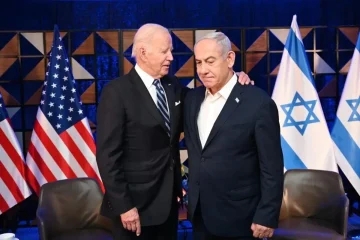 US President Joe Biden on 25 October said that he has “no notion” that the Health Ministry in Gaza, journalists, and humanitarian groups are telling the truth about the soaring number of civilian deaths in the Gaza Strip 18 days into Israel’s indiscriminate carpet bombing campaign.
“What they say to me is I have no notion that the Palestinians are telling the truth about how many people are killed. I’m sure innocents have been killed, and it’s the price of waging a war,” Biden said Wednesday during a joint press conference with Australia’s Prime Minister Anthony Albanese.
“I have no confidence in the number that the Palestinians are using,” the US president added. However, he did not explain why he believes Palestinians lie about the genocide unfolding in Gaza.
Despite Biden’s alleged apprehensions, as of 26 October, the death toll in the Gaza Strip stands at over 6,500 – including at least 2,704 children.
“Everyone uses the figures from the Gaza Health Ministry because those are generally proven to be reliable,” Omar Shakir, Israel and Palestine director at Human Rights Watch (HRW), told the Washington Post on 24 October. “In the times in which we have done our own verification of numbers for particular strikes, I’m not aware of any time which there’s been some major discrepancy.”
“We know that a health ministry is going to base [death tolls] on assessments coming from hospitals, morgues, etc.,” he added. “They have an ability to collect that in a way that other sources not there can’t do.”
Biden’s inflammatory statement coincided with a televised address by Israeli Prime Minister Benjamin Netanyahu, in which he said that the war on Gaza is a battle between the “axis of evil” and the “axis of progress.”
“We are the people of light, they are the people of darkness — and light shall triumph over darkness,” Netanyahu stressed in the latest attempt by a senior Israeli official to dehumanize the Palestinian population.
Since the start of the Gaza-Israel war on 7 October, Israel and its western allies have been working overtime to discredit, censor, and obscure the reality faced by 2.3 million Palestinians in Gaza, who have been subjected to enough explosives over the past two weeks to equal the size of the nuclear bomb dropped in Hiroshima.
Moreover, Israel has completely cut off Gaza from access to humanitarian aid as well as electricity, water, fuel, food, and medicine for over two weeks, exacerbating an already dire humanitarian crisis.
Algeria and Tunisia condemn Macron’s call for coalition against Palestinian resistance
MEMO | October 26, 2023
Algeria and Tunisia condemned on Wednesday evening French President Emmanuel Macron’s call for an international coalition against the Palestinian resistance. Their joint statement also stressed the legitimacy of resistance against the Israeli occupation of Palestine.
The statement on the situation in Palestine was issued by the People’s National Assembly (the lower house of the Algerian Parliament) and Tunisia’s Assembly of the People’s Representatives during the visit of its head, Ibrahim Bouderbala, to Algeria.
“We condemn the calls to form an international coalition to eliminate the Palestinian resistance. The Palestinian struggle to resist the occupation is legitimate, as is the right of the Palestinian people to establish their independent state with Jerusalem as its capital,” they said. “We also strongly denounce the positions of countries and bodies that support the Israeli war government and deplore the double standards being applied in clear violation of international law and human rights, especially with regard to the rights of civilians during war.”
The Algerians and Tunisians also rejected Israeli immunity from accountability, monitoring or sanctions. “This gives it the green light to target innocent and defenceless Palestinians, including women and children, and to carry out its crimes against humanity.”
The Zionist occupation state bears “full responsibility” for this escalation, the two sides announced. “This has arisen as a result of its continued crimes against the Palestinian people and its policies aimed at displacing them from their land, in light of the international disregard for UN Security Council resolutions related to the Palestinian issue and the rights of the Palestinian people in accordance with UN resolutions.”
The two parties called for an immediate ceasefire and efforts to produce a “just and comprehensive” solution to the Palestinian issue.
Israel’s ground invasion of Gaza: not if, but when
By Hasan Illaik | The Cradle | October 23, 2023
The “Al-Aqsa Flood” battle launched by the Palestinian resistance on 7 October dealt Israel an unprecedented blow – in terms of human loss and its impact on the country’s military, intelligence, psychology, and deterrence.
In exchange for the blow it received, Israel set itself a goal of eliminating the Hamas movement. This goal was announced by Israeli Prime Minister Benjamin Netanyahu, his Defense Minister Yoav Galant, and the majority of Israeli officials.
Hence, any ceasefire without achieving the full elimination of Hamas means a pure Israeli loss.
And while the Israeli military has killed about 5,000 Palestinian civilians and caused massive damage to housing and infrastructure in its 17-day air assault on the Gaza Strip, it has neither restored the pre-7 October deterrence it enjoyed, nor is it capable of emerging victorious.
To date, Israel has not been able to seriously harm Hamas’ military structure, say Gaza sources who spoke to The Cradle. Any ceasefire today would therefore mean that Tel Aviv has publicly swallowed the losses it incurred in Operation Al-Aqsa flood: at least 1,400 dead Israelis, the destruction of its army’s Gaza division, and 250 captives held by its enemy inside Gaza. Together, these will deliver a massive blow to Israel’s hard-fought deterrence capacity.
These prisoners will be used by the resistance to negotiate the release of more than 6,000 Palestinian prisoners in Israeli detention centers, in addition to lifting the siege on the Gaza Strip. Unless Tel Aviv is willing to sacrifice all these prisoners in its Gaza air blitz, the captives will play a big role in any settlement. Consider, for instance, that in 2011, Israel exchanged a single captured soldier for 1,027 Palestinian detainees.
Israel cannot exit this battle without fighting a ground war. Its army spokesman, Jonathan Conricus, told the Australian ABC that a ground war will occur unless Hamas complies with two conditions: surrendering without conditions, and releasing all Israeli prisoners. The Palestinian resistance outright rejects these conditions, and will continue to use its captives to pressure Israel to stop the war.
What’s taking so long?
Israel believes it needs a ground war to restore its deterrence with not only Gaza’s resistance factions, but also with adversaries in Lebanon, Iran, and the rest of the region. This ground war will focus on the northern Gaza Strip, including Gaza City and its environs, where the military and heart of the resistance is based. Eliminating Hamas in the northern Gaza Strip will inflict a defeat on the resistance that will take years, and perhaps decades, to recover from.
So then, why hasn’t the ground war begun yet? Eighteen days have already elapsed since Israel’s declaration of war, when it began to mobilize its 300,000 soldiers and reserve officers.
First, the occupation army knows well that the goal of “eliminating Hamas” is no easy feat. Former Israeli Prime Minister Ehud Barak has said that “eliminating Hamas is not possible” because it is an expression of an ideology and exists “in people’s hearts and minds.” Barak’s analysis is important – he isn’t just a former head of state, but importantly, a former Israeli army chief of staff and a former defense minister who led two battles in the Gaza Strip in 2008 and 2012.
Second, the Palestinian resistance in Gaza has prepared itself well for the ground war. The last such operation conducted by the Israelis in 2014, in which 60 troops were killed and two went missing, ended in failure by not achieving any of its goals. At that time, the Hamas and Palestinian Islamic Jihad (PIJ) forces had nowhere near the quality of armaments, training, and numbers that they have today.
Furthermore, the network of strategic underground tunnels allegedly built by the Gaza resistance also developed significantly after 2014, allowing Hamas, PIJ, and others to move troops, weapons, and supplies around the territory unseen.
While the Israeli army seems prepared to bear greater human losses than it did in any previous war, largely because of Al-Aqsa Flood’s huge death toll, this does not mean that Tel Aviv can bear the cost of thousands more deaths, hundreds of destroyed armored vehicles, and the economic fallout of war.
The Israelis usually also try to avoid lengthy battles at all cost. In the case of a ground war, Tel Aviv recognizes that it may need to occupy the northern Gaza Strip for months, which will place severe hardship and pressure on Israel’s settlement community who will effectively become refugees.
Third, is Israel’s fear that its regional adversaries will open other battle fronts to relieve pressure on the resistance in Gaza. Both Washington and Tel Aviv are most wary of this development unfolding on the border with Lebanon.
But even the introduction of two US aircraft carriers into the East Mediterranean was unable to deter the Lebanese resistance, Hezbollah, from continuing its attacks on Israeli military positions along the Lebanese-Palestinian border. Since October 8, these borders have turned into daily clashes that have only escalated on both sides.
So far, the Israeli army has lost most of the surveillance equipment that it amassed over years on that critical border. Hezbollah has also destroyed more than 15 tanks and 20 armored vehicles, in addition to the killing and wounding of dozens of Israeli troops. In turn, the resistance has lost 28 of its soldiers, along with four Lebanese civilians.
Palestinian resistance factions (Hamas and Islamic Jihad, which had 5 casualties) have also participated in these Lebanese border operations, in addition to the “Islamic Group,” the Lebanese branch of the Muslim Brotherhood, and the “Lebanese Brigades for Resisting the Occupation,” which lost two fighters.
The situation on the Lebanese-Palestinian border is still being classified as “clashes,” despite the intensity of confrontations escalating each day. Tel Aviv expects the pace of these clashes to spike after the start of its ground operation in Gaza, which it fears will prevent the achievement of its goals in Gaza.
While the Resistance Axis refuses to divulge any of its plans, its sources indicate that escalation against the Israeli military will increase in correlation with developments in the Gaza war.
US presence & the Axis of Resistance
The fourth factor delaying the onset of Israel’s ground war is Washington’s need to secure its own regional military bases, assets, and interests, in advance of any regional escalation.
In recent days, US bases in Iraq and Syria have been bombed by Iraqi resistance factions, as Yemen’s resistance movement, Ansarallah, launched missiles and drones in the direction of Israel. When some of these projectiles were shot down by US defense systems, Ansarallah threatened to target Israeli ships in the Red Sea.
On the Iraqi-Jordanian border, Iraqi resistance factions are mobilizing thousands of supporters who have declared their intention to head to the occupied West Bank, via Jordan, if the aggression against Gaza continues.
To date, Israel’s western allies have amassed aircraft carriers and battleships; 2,000 American soldiers have landed in occupied Palestine; about 1,000 tons of western military aid has been airlifted to Israel; tens of thousands of munitions intended for Ukraine have been diverted to the occupation army; the Biden administration has announced the allocation of $14 billion in urgent aid to replenish Israel’s war coffers; the US has issued threats to the entire regional Axis of Resistance in Lebanon, Syria, Iraq, Yemen, and Iran that it will enter the war if those forces attacked the Israeli army.
Together, all these factors have delayed the start of Israel’s ground war in Gaza, as Tel Aviv awaits the arrival of even more US and western forces into West Asia and the eastern Mediterranean – both to bolster Israeli military forces and to fortify US bases in the region.
The fifth and final reason for postponing Tel Aviv’s ground invasion, is to provide a short window for Qatari-led negotiations to gain the release of further captives held in Gaza, as revealed by Israeli Army Radio on 23 October. The news leak coincides with fears expressed by the Washington establishment that the region could catch fire, to the detriment of American interests, if Israel insists on pursuing its Gaza ground war until the very end.
Delaying the ground war does not, however, mean canceling it. In 2014, Israel’s ground attack began two weeks after the war’s onset, although the number of Israeli reservists called up was no more than 40,000 – one-seventh of the 300,000 troops mobilized today.
Israel also faces another problem that it cannot solve: the presence of hundreds of thousands of Palestinian civilians in the northern Gaza Strip who refuse to comply with Israeli orders to abandon their homes.
All these factors pose a potentially insurmountable challenge for Tel Aviv. They each conspire to thwart Israel’s plan to destroy Hamas and re-establish the deterrence capacity it lost on 7 October. While the occupation state may win many battles ahead, it cannot win the war with so many uncontrolled variables in the air.
Russia, China veto US-drafted resolution backing Israeli offensive
Press TV – October 25, 2023
Russia and China have prevented the passage of a US-drafted UN Security Council (UNSC) resolution that had said Israel, which has killed more than 6,500 people as part of its underway war on Gaza, has been acting in “self-defense.”
The draft was put to vote on Wednesday. The United Arab Emirates also voted no, while 10 members voted in favor and Brazil and Mozambique abstained.
Israel launched the devastating war on October 7 after the Gaza Strip-based Palestinian resistance groups staged Operation al-Aqsa Storm, a surprise attack on the occupied territories, in response to the Israeli regime’s intensified crimes against the Palestinian people. The war has killed 6,546 Palestinians, including 2,704 children, according to the Palestinian health ministry.
The Council then voted on a Russian-drafted resolution that had called for a humanitarian ceasefire and urged Tel Aviv to immediately cancel its orders on Palestinian civilians to head into southern Gaza.
Only Russia, China, the UAE, and Gabon voted in favor of the draft, while nine members abstained and the United States and Britain voted no.
A resolution needs at least nine votes and no vetoes by the US, France, Britain, Russia or China to be adopted.
Also on Wednesday, Russia’s foreign ministry spokeswoman Maria Zakharova said the death of thousands of children in the Gaza Strip had not been enough to get the West behind a resolution demanding a ceasefire in the besieged coastal territory.
“This is the most obvious and rather simple thing to do in this situation: Simply to produce a statement, a resolution, a document with a unified call for a ceasefire, settling the situation and so on,” she said in an interview with Sputnik Radio.
“Even these numbers (the fatality count among the Palestinian minors) cannot compel certain political forces in the West to come to their senses and realize what is going on,” Zakharova regretted.
Campaign against US, UK arms sale to Israel gains further steam across world
Press TV – October 25, 2023
A new campaign to shut down weapons companies in the US and UK over providing arms to the Israeli regime has gained further momentum, expanding across northern America, Europe and Australia.
The campaign, titled Palestine Action, was launched days after Israel waged a large-scale war on Gaza on October 7, which has claimed the lives of thousands of innocent Palestinians, including women and children.
On October 12, the organizers of Palestine Action US took direct action against Israel’s largest weapons manufacturer, Elbit Systems at its so-called “Innovation Center” in the US city of Cambridge, Massachusetts.
Activists blockaded Elbit’s main entrance and defaced the building with red paint and graffiti, rebuking Elbit for profiteering from Israeli war crimes against Palestinians.
“Elbit Systems will not conduct business as usual in our city, while their weapons are mass murdering the Palestinian people right now,” the activists said. “What Israel is doing to Palestine is nothing short of a genocide and Elbit has blood on their hands.”
Elbit’s Cambridge office has since then been targeted multiple times, with activists spraying the building with upper-case slogans that read, “ELBIT PROFITS FROM GENOCIDE,” and “WAR CRIMINALS WORK HERE.”
Data in media reports show Elbit supplies 85% of Israel’s military drone fleet, along with bullets, tear gas, land-based equipment, and internationally banned weapons.
“A child is being murdered every 15 minutes in Palestine,” Palestine Action US said on its website. “These bombing attacks not only serve to ethnically cleanse Gaza but will be used by Elbit to market their arms to repressive regimes around the world. By striking Elbit, we disrupt a crucial link in the military apparatus of Western imperialism.”
In a new development on Wednesday, Palestine Action US said the activists protested against Elbit Systems at Wentworth Institute of Technology in Boston and disrupted the Israeli firm’s recruitment process.
“Elbit Systems, you will not find peace ANYWHERE in Boston. We will keep confronting you wherever you show up. Genocide profiteers are not welcome in our city. We will shut you down,” Palestine Action US said in a post on its X social media account.
Palestine Action US also announced in other posts the expansion of the anti-Israel campaign in other countries.
Palestine Action US has called on the international community to recognize the profound terror and grief Palestinians have been experiencing for generations, and move to put an end to the 75-year-long Israeli genocide “still unfolding before our eyes.”
“As long as we allow Elbit to operate in our communities, every one of us has blood on our hands,” it added.
Israel waged war on Gaza on October 7 after Palestinian resistance groups launched Operation Al-Aqsa Storm, a surprise attack into the occupied territories in response to the occupying regime’s intensified crimes against the Palestinian people.
The Israeli attacks on Gaza have targeted places of gathering, including hospitals, schools, mosques and churches, displacing more than one million in the densely-populated region, which is home to more than 2 million people.
According to the Palestinian health ministry, the Israeli aggression against the Gaza Strip has so far killed more than 6,000 people and left over 18,000 others wounded.
Featured Video

Anthrax War – CBC The Passionate Eye
or go to
Aletho News Archives – Video-Images
Book Review
Shattered Dreams: The HPV Vaccine Exposed (2019)
By Christina England – 30 Q&As – Book Review & Summary
Lies are Unbekoming | September 4, 2026
… Gardasil received FDA fast-track approval in 2006, Cervarix followed in 2009, and Gardasil 9 was approved in December 2014 with more than double the aluminium adjuvant content of the original. The commercial context is specific. Merck was about to lose patent protection on Zocor and faced $18 billion in Vioxx injury claims from a cardiovascular drug the company had marketed while suppressing its own data showing a five-times increase in heart attacks. Analysts projected the global HPV vaccine market at $4 billion by 2011, contingent on government-funded national programs for teenage girls. The 1986 National Childhood Vaccine Injury Act had already granted manufacturers complete liability immunity. By 2013, Japan had withdrawn its HPV vaccine recommendation after cataloguing severe adverse reactions in hundreds of girls. No Western government followed. The establishment position across the UK, US, Australia, and most of Europe held, and still holds, that the vaccines are safe and effective, that reported injuries are coincidental, and that cervical cancer prevention justifies the program. The book was published into this position, not against a vacuum.
Shattered Dreams sits alongside Mary Holland’s The HPV Vaccine On Trial and Viera Scheibner’s foundational vaccination work as part of the documented record on what has been done to a generation of teenage girls under the banner of cancer prevention. The full summary unpacks three specific findings: that Merck used the aluminium adjuvant itself as the “placebo” control in 92.5% of trial subjects, making it structurally impossible to detect excess reactions from the adjuvant; that Dr. Sin Hang Lee found HPV DNA fragments bound to aluminium in every one of sixteen Gardasil samples tested, and in the blood and spleen of a New Zealand girl six months after her third dose; and that in every country with high vaccination coverage, including Australia, the UK, Norway, and Sweden, cervical cancer rates have stopped declining and started rising specifically in the vaccinated cohort. Martínez-Lavín’s 2017 calculation puts the number needed to seriously harm with Gardasil 9 at 140, and the number needed to vaccinate to prevent one case at 1,757. Thirteen young women are seriously harmed for every one who benefits. The vaccine was approved on the basis of trials that could not detect what the trials were supposed to detect, and it is still being given to twelve-year-olds today. … Read full review
Blog Roll
 Aletho News
- The Five-Year Fuel Crisis: Why the World Economy Is Paying for a War It Thinks Is Ending
- Trump’s Big Bluff on Iran
- Swiss scammed out of millions by Ukraine-linked call centers – media
- Germany facing potential ‘violent conflict’ with Russia – spy chief
- Ukraine’s EU neighbors reject new plea from Kiev – Politico
- British Transport Police Facial Recognition Trial Scanned 926,912 People With Zero Arrests
- House Bill Would Ban Federal Use of Flock ALPR Data
- Can a Spice Rival a Drug? 10 Head-to-Head Trials Put It to the Test.
- The oil routes around Hormuz face their own chokepoints
- The Saudi-Israeli war on Yemen’s resistance: Intelligence sharing, civilian targets & sectarian propaganda
- If Americans Knew
- New IDF Website Frames Slain Gaza Journalists as Terrorists
- Israeli media: After settlers beat him mercilessly, they stuffed dirt into his mouth
- Americans Are Paying the Price to Preserve Israel’s Nuclear Hegemony
- A U.S. Jewish Fund’s Ambitious Bid to Put a Settler Elite in Control of Israel’s Security
- As genocide drags on, “Zionism is racism” becomes official policy in one UK party – Daily Update
- Targeting the rescuers: Inside Israel’s war on paramedics in Lebanon
- No big deal: Israel to halt humanitarian aid to Gaza for 2 days – Daily Update
- Israel is squeezing the life out of Palestinians – Daily Update
- The Israeli Right Portrays Islam as Murderous. It Serves a Political Purpose
- Jordan Has Had Enough: King Abdullah’s Scathing Warning to Israel
- No Tricks Zone
- Latest European Green Energy Debacle; Portugal’s Largest Flagship Solar Park Insolvent!
- Green Energy Debacle: German Expert Professor Fritz Vahrenholt Warns Of Severe Economic And Social Consequences
- Two More Paleo Reconstructions Affirm Meters-Higher Sea Levels Across Ireland, Brazil 7000-6000 Years Ago
- New Study: Earth And Venus Surface Warmth Largely Explained By Convection And Lapse Rate, Not CO2 Or Radiation
- 2025 Nature Paper Claiming Worsening Global Drought Gets RETRACTED …Heavily Flawed
- New Study: ‘Global Drought Shows No Detectable Recent Acceleration Under Climate Warming’
- Economic Masterminds: German Socialists Suggest Taxing Productivity Gains Stemming From Using AI
- The South China Sea Has Not Been Cooperating With The Climate Change Narrative
- Energy Crisis: Germany Enters Heating Season With Historically Low Gas Reserve Fill Levels
- New Study: The Antarctic Ice Sheet Gained Mass From 2020-2024 Due To Staggering Snow And Ice Accumulation