Culture of hope: 2022 and the margins of victory in Palestine
By Ramzy Baroud | MEMO | January 1, 2023
Another critical year for Palestine has folded. While 2022 has wrought much of the same in terms of Israeli military occupation and increasing violence, it also introduced new variables to the Palestinian struggle – nationally, regionally and internationally.
Palestine, the War and the Arabs
The Russia-Ukraine War starting in February pressured many political entities, including Palestinians, to take sides or, at least, to declare a position. Though the Palestinian Authority (PA) and various Palestinian political parties insisted on their neutrality, Russia’s deviation from the US-led political paradigm in the Middle East opened up new margins for Palestinians to explore.
On 4 May, a delegation of Hamas leaders met Russian officials in Moscow, and, a few months later, PA leader Mahmoud Abbas defied Washington by holding a meeting with Russian President Vladmir Putin in Astana, Kazakhstan. Despite US anger at Abbas, Washington could do little to retaliate against the Palestinian leadership, considering the delicate geopolitical balances in the Middle East and around the world.
The new political spaces created by global conflict also brought greater cohesion to the Arab position on Palestine, as articulated in a statement by the pan-Arab organization, the Arab League, in Cairo on 29 November. Ahmed Aboul Gheit insisted on the Arab quest for a just peace and praised the ‘Algiers Declaration’ of the previous month. On 12-14 October Palestinian political groups met in Algeria, signed a reconciliation agreement based on ending division through presidential and parliamentary elections.
This was part of a year-long momentum where Arab governments revitalized their position in support of the Palestinians, both financially and politically through funding the Palestinian refugees agency, UNRWA, or supporting Palestine at the United Nations.
On 3 October, Arab representatives at the UN introduced Resolution A/C 1/77 L.2, urging Israel to get rid of its nuclear weapons and to put “all its nuclear facilities under comprehensive International Atomic Energy Agency safeguards.” The Resolution was overwhelmingly approved by the United Nations General Assembly on 28 October.
UN: ‘Deadliest Year’
Though no real action was taken by the UN to punish Israel for its ongoing military occupation and violations of Palestinian rights, several UN initiatives and resolutions continued to demonstrate the centrality of Palestine to the international agenda.
Last August, the ‘UN Experts’ condemned “Israel’s escalating attacks against Palestinian civil society in the occupied West Bank”, stating that these actions amount to severe suppression of human rights defenders and are illegal and unacceptable.”
In October, Francesca Albanese, the UN Special Rapporteur on the Situation of Human Rights in the Palestinian Territory occupied since 1967, submitted a report to the UNGA, where she concluded that the realization of the inalienable right of the Palestinian people to self-determination requires dismantling the Israeli settler-colonialism and apartheid regime.
On 30 November, the UNGA also adopted a resolution to mark Nakba Day, which commemorates the forced expulsion of hundreds of thousands of Palestinians from their lands in 1948.
Alas, none of these statements altered the violent nature of Israel’s attitude towards Palestinians. On 29 October, the UN Mideast envoy, Tor Wennesland, said that 2022 is on course to be the ‘deadliest year’ for Palestinians in the occupied West Bank since the UN started tracking fatalities in 2005.
Israeli Violence and the Lions’ Den
Israel has killed over 200 Palestinians in the occupied West Bank and Gaza throughout 2022, including 47 children. Only a few of them made headlines in mainstream media. However, the world still showed outrage following the cold blooded murder of famed Palestinian American journalist Shireen Abu Akleh on 11 May, while she was covering the tragic events in Jenin. Widespread calls for an impartial investigation finally convinced the FBI to open a criminal probe into Abu Akleh’s killing.
The Israeli killing spree was motivated by two reasons: first, the rise of armed resistance in the northern West Bank, and second, Israel’s chaotic political scene.
Continued Israeli attacks on Jenin, Nablus and other West Bank towns and refugee camps resulted in the formation of a new Palestinian armed group known as the Lions’ Den. Unlike other groups, the Nablus-based movement was non-factional, which created new spaces for national unity among all Palestinians, regardless of their political or ideological backgrounds.
The Israeli government quickly retaliated against the Lions’ Den. Israeli Defense Minister Benny Gantz belittled the group’s appeal on 13 October, announcing “Eventually, we will lay our hands on the terrorists”, estimating their number to be 30 fighters. “We will work out how to reach them and we will eliminate them,” Gantz said. The Israeli assessment has proven untrue as the brigade continued to grow, morphing into other brigades in Jenin, Al-Khalil (Hebron) and other West Bank regions.
The killing of Palestinian fighter Oday Tamimi in a clash near the illegal Jewish settlement of Maale Adumim on 19 October further accentuated the boldness of the new Palestinian generation of resisters. Moreover, the televised execution of Ammar Mufleh in the town of Huwara on 2 December also illustrated Israel’s willingness to flout international law to end the ongoing armed rebellion in occupied Palestine.
The Israeli violence is also directly linked to Tel Aviv’s own political crisis. Though Benjamin Netanyahu was ousted through an unlikely alliance among various Israeli political forces, which was led by former Prime Minister Naftali Bennett in June 2021, Israel’s longest-serving prime minister is slated for a comeback.
Bennett resigned from his post on 20 June, leaving the leadership to his coalition partner, Yair Lapid. New elections, the fifth in three years, were held on 1 November. This time around, Netanyahu’s rightwing coalition won by a comfortable margin, introducing to Israel’s already extremist government such notorious personalities as Bezalel Smotrich and Itamar Ben-Gvir, known for their violent action and rhetoric against Palestinians.
Though Washington had indicated on 2 November, that it will not be working directly with Ben-Gvir, the US Ambassador to Israel, Thomas Nides, seemed to reverse that position by declaring that “no one hurts the unbreakable ties between Israel and the United States.”
Keeping in mind that the increased violence in the West Bank was a direct result of the militant nature of the Bennet-Lapid government as it laboured to demonstrate its toughness against Palestinian Resistance, the new government is expected to be even more violent, setting the stage for a wider confrontation in both the West Bank and Gaza.
The brief but deadly Israeli war on the besieged Gaza Strip on 5 August resulted in the killing of at least 46 Palestinians and the injuring of at least 360, according to UN estimates. Despite the devastation resulting from the war, it could have been much worse, as not all Palestinian groups took part in the fighting and Israel seemed keen on ending its hostilities before a prolonged conflict resulted in a heavy political price. Netanyahu, too, is likely to resort to war on Gaza, should he need to create a distraction from future political difficulties or to keep his rightwing partners in line.
Culture of Hope
Despite the violence of the Israeli occupation and the hardship of isolation and siege, Palestinian culture continued to flourish with Palestinian artists, filmmakers, athletes, intellectuals and teachers continuing to leave their mark on the cultural scene in Palestine, in the Middle East and worldwide.
In May, Mohammed Hamada, a 20-year-old weightlifter from the Gaza Strip, became the first Palestinian athlete to win gold and bronze medals at the weightlifting world championships held in Heraklion, Greece.
In September, Palestinian-American systems engineer Nujoud Fahoum Merancy was appointed as one of the leaders of the Artemis missions, a program by NASA that aims to fly astronauts to the Moon.
Palestinian Resistance and cultural achievements are constantly boosted by growing international solidarity with Palestine. Thanks to the American Friends Service Committee (AFSC), multinational company General Mills announced in June that it is divesting entirely from Israel. This was one of many other achievements credited to the Palestine-led boycott movement, which included other companies, universities and churches.
However, nothing compares to the endless stream of solidarity exhibited by Arab and international football fans in the Qatar World Cup 2022, which started on 30 November. Although the Palestine national football team has not qualified for the world’s most important sports event, the flag of Palestine was the most visible among all other international flags. The iconic Palestinian Kufiyeh was also adorned by thousands of fans including world leaders, dignitaries and celebrities.
2022 was another year of tragedy and hope for the Palestinians. It is this hope, buoyed by numerous little victories, that makes the struggle for Palestinian freedom possible. One wishes that 2023 will be a better year.
2022 deadliest year for Palestinians in West Bank since Second Intifada in 2005: Report
Press TV – December 31, 2022
New data has revealed that 2022 has been the deadliest year for Palestinians in the West Bank since the Second Intifada which ended in 2005, with at least 220 people being killed at the hands of Israeli forces across the occupied territories.
According to figures published by the Middle East Eye, Israeli forces shot dead 167 people in the West Bank and East al-Quds, and 53 people in the besieged Gaza Strip, with 48 children being among the total casualties.
The report further noted that in at least five cases, Israeli settlers were suspected of killing Palestinians while the regime’s military is responsible for the overwhelming majority of deaths.
The London-based news website also said the majority of Palestinian casualties were likely unarmed at the time of their death.
In at least 95 cases, Palestinians were shot by Israeli soldiers as bystanders during military raids or while participating in anti-occupation demonstrations.
At least 22 Palestinians were killed after alleged car ramming, shooting or stabbing attacks against Israelis and security forces. In some cases, Palestinians were fatally shot for allegedly “attempting” to carry out such attacks.
Tensions have been running high across the occupied Palestinian territories over the past months.
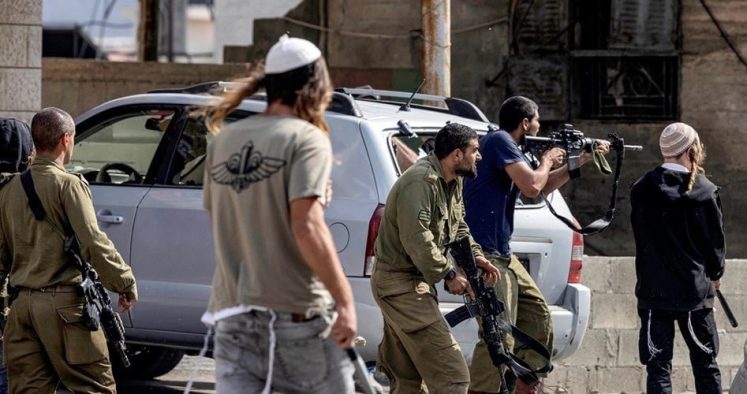
Incidents of sabotage and violence by settlers against Palestinians and their property have become a daily occurrence throughout the occupied territories, particularly in the West Bank.
However, Israeli authorities rarely prosecute settlers, and the vast majority of the files are closed due to deliberate police failure to investigate them properly.
Moreover, Israeli forces have recently been conducting overnight raids and killings in the northern occupied West Bank, mainly in the cities of Jenin and Nablus, where new groups of Palestinian resistance fighters have been formed.
Meanwhile, the United Nations says Israeli forces killed more Palestinians in the West Bank in 2022 than in any year since the world body began systematically recording fatalities in 2005.
UN experts have held Israel responsible for the recent surge of violence in the occupied Palestinians territories, warning that the brutality could further escalate with the new far-right Israeli cabinet.
According to the United Nations Office for the Coordination of Humanitarian Affairs (OCHA), Israeli security forces have killed 146 Palestinians in the West Bank and mainly East al-Quds through December 19 of this year, compared with 75 in 2021.
Four more Palestinians were killed by Israeli settlers in the West Bank, OCHA added.
Most of the Palestinians were killed during Israeli military raids and clashes in the West Bank cities of Jenin and Nablus, the UN said, adding that more than half were under the age of 25.
Earlier this month, UN experts condemned Israeli settler violence and excessive use of force by the Israeli military in the West Bank.
“Unless Israeli forces abandon this dominant settler mindset and rightfully treat Palestinians in the occupied territory as protected persons, Israel’s deplorable record in the occupied West Bank will likely deteriorate further in 2023,” they said.
Israeli occupation soldiers and Israeli settlers have noticeably been escalating their attacks against Palestinian civilians in the West Bank and other areas, in an attempt to forcibly expel Palestinians from their lands and make way for expanding illegal Jewish-only settlements.
Between 600,000 and 750,000 Israelis occupy over 250 illegal settlements that have been built across the West Bank since the 1967 occupation.
The UN Security Council has in several resolutions condemned the Tel Aviv regime’s settlement projects in the occupied Palestinian lands.
‘Türkiye agrees to withdraw troops from Syria following Moscow talks’
RT | December 31, 2022
Türkiye has agreed to fully withdraw its troops from northern Syria following tripartite talks involving Moscow, Ankara and Damascus earlier this week, Syrian newspaper Al-Watan has reported.
The three countries’ defense ministers – Hulusi Akar, Ali Mahmoud Abbas and Sergey Shoigu – met in Moscow on Wednesday for the first meeting of its kind since the outbreak of the Syrian conflict in 2011.
According to the paper’s source in Damascus, the negotiations resulted in “Türkiye’s consent to completely withdraw its troops from the Syrian territories that it occupies in the north of the country.”
Ankara and Damascus also expressed a common view that the Syrian-based Kurdish YPG militia, which Turkey associates with the outlawed Kurdistan Workers’ Party (PKK), “are agents of Israel and the US, and pose a grave threat to both Türkiye and Syria.”
Türkiye considers the separatist PKK and allied Kurdish groups to be “terrorist organizations” that threaten its national security. The Turkish military carried out airstrikes against YPG targets in northern Syria in November, with Ankara saying a ground operation in the area was also on the cards.
A special trilateral commission will be created by Russia, Türkiye and Syria to ensure that the agreements reached in Moscow are honored, Al-Watan reported.
Turkish Defense Minister Hulusi Akar told local media on Saturday that “one shouldn’t expect that everything will be solved at once in a single meeting.”
In Moscow, Türkiye “emphasized that we respect Syria’s territorial integrity and sovereign rights, and that our only goal is the fight against terrorism” including the PKK/YPG and Islamic State (IS, formerly ISIS), he said.
Ankara and Damascus have agreed to continue talks to deepen reconciliation, Akar added. He also suggested that those negotiations could even result in a joint anti-terrorist operation involving the two countries, which would happen “if we can solve our problems related to defense and security, if we can meet our needs.”
The Syrian side had earlier described the meeting in the Russian capital as “positive,” while Russia’s Defense Ministry said the talks had been conducted in a constructive manner and stressed the need for the continuation of such engagement.
Report: Israel demolished 950 Palestinian homes in 2022

MEMO | December 29, 2022
Israeli occupation forces demolished 950 Palestinian homes and confiscated more than 113,000 dunams (113 square kilometres) of land in 2022 in an effort to expand illegal Jewish-only settlements in the occupied West Bank and East Jerusalem, a Palestinian research centre said.
The Land Research Centre, operating in Palestine, said in its annual report on “Israeli Violations Against Palestinian Land and Housing Rights for 2022” that the Israeli forces have also torched, ravaged, or attacked 18,900 trees, most of them olive trees.
The report noted that 65 of the homes were demolished by their owners under the orders of Israeli occupation forces.
Some 66 wells were also razed in addition to 3,707 dunums (3.7 square kilometres) of land and pastures.
“The Israeli occupation issued 114 new settlement plans on Palestinian lands, and began construction on more than half of them and built about 2,220 new housing units for the settlers,” it added.
The Palestinian centre warned that all these measures confirm that the Israeli government has decided to destroy all agreements and impose new realities on the ground, making the two-state solution impossible to achieve.
Hamas criticises ‘biased’, ‘contradictory’ EU resolution on two-state solution
MEMO | December 29, 2022
The Palestinian resistance movement Hamas issued a statement yesterday criticising the EU over Resolution no. 2949/2022 (RSP), on the prospects for a two-state solution for Israel and Palestine.
In a political memorandum, Hamas said the resolution “contained several inaccuracies and contradictions about the Palestinian issue”, noting that it “is heavily biased against the Palestinians’ inherent and legitimate rights to freedom, return and self-determination.”
Among the issues raised with the resolution, the movement said it has sided with the Israeli occupation’s narrative, while ignoring the Palestinian people’s legitimate right to resistance and self-defence.
“Voting against this right is considered a great sin that Europeans have committed, once again. This vote also reflects the double standards with which the European Union deals with issues of peoples and freedoms around the world.”
“In recent months, we have seen the European position on the crisis in Ukraine, and how the Ukrainian resistance was considered legitimate and supported with money and weapons,” the statement said. The resolution, Hamas insists, has disregarded terrorism practised by the Israeli occupation on a daily basis.
The EU resolution was called out over its double standards in regards to its advocating “customised” democracy for the Palestinians and the issue of the participation of resistance factions in free and fair elections, “despite the fact that most of the candidates for the Israeli Knesset have criminal records and terrorist practices and are labeled on terrorist lists in many countries, including Israel itself.”
Hamas acknowledged the resolution’s demand to end the Israeli blockade, imposed on the people of Gaza since 2006 but concluded that the resolution is further proof of “the European bias towards the Israeli occupation and its racist policies” and the EU’s lack of seriousness in pursuing a just and fair solution to the Palestinian cause.
The movement urged the European Parliament to reconsider Resolution 2949 and to correct its position in order to achieve a just solution for the Palestinian people.
Earlier this month, a senior member of Hamas denounced the EU over its silence concerning the complicity of over 700 European financial institutions in supporting illegal Israeli settlements on Palestinian lands.
Christmas in Palestine: Then and Now
By James J. Zogby | The Jordan Times | December 28, 2021
The Christmas story as it is told in the West contains timeless elements that have shaped our culture in significant ways. As we tell it, year in and year out, the story conveys to those who listen powerful themes evoking deep feelings.
It is, at its core, the tale of a helpless child born as an outcast whose role became transformative in human history.
Unrecognised at first, the importance of this birth was initially only understood by the lowly of the earth — “the shepherds of the field”. Later “kings from the East” came to pay homage bringing gifts. Their appearance raised the ire of local rulers forcing the baby’s parents to flee in order to save the life of their newborn child.
I want to take a moment to reflect on this story, seeing contemporary realities through its prism.
Two thousand years ago, Palestine was subject to a harsh occupation, much as it is today. In some ways, though, the conditions back then allowed the residents of occupied Palestine greater mobility than the current inhabitants of that land.
As we are told in the bible story, Joseph had to take his expectant wife from Nazareth, where they were living, to Bethlehem, their ancestral village, in order to fulfill a requirement imposed by the authorities to register as part of a nationwide census. Today, of course, all of that would be impossible.
In the first place, no Palestinian originally from Bethlehem could ever have moved to Nazareth. The occupation and closure of the West Bank makes that sort of movement impossible. Furthermore, Israeli law prohibits an Arab from Nazareth from marrying a Bethlehemite and bringing their spouse across the Green Line to live with them in Israel.
Additionally, while thousands of Palestinians in Bethlehem, both Muslim and Christian, can see Jerusalem from their homes, they cannot go to the Holy City to pray. And Arab Christians from Jerusalem, likewise, cannot easily go the Christmas services in Bethlehem to pray alongside their co-religionists at the seasonal event.
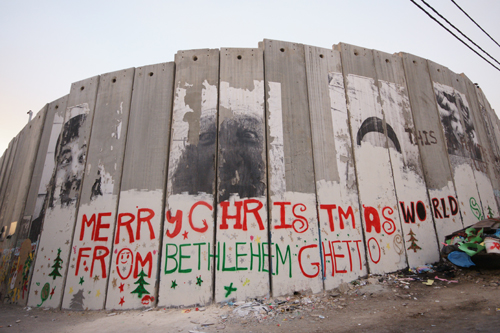
Bethlehem of old was overcrowded and under siege. Today, as well, the city itself is being strangled, hemmed in by settlements that have confiscated the town’s ancestral lands to make way for a 30-foot barrier wall and massive Jewish-only housing colonies that cut the Arab residents off from nearby Jerusalem. The constriction of growth and the lack of economic opportunity have forced Bethlehemites to flee in search of jobs and freedom, with tens of thousands of them and their descendants now living in the US and the Americas. They can return to visit Bethlehem with difficulty but are not permitted by the occupation authorities to take up permanent residency in the town of their origins.
While the kings of old, we are told, were able to travel from afar bearing gifts to honour the newborn child, one can only imagine the difficulties they would encounter today dealing with Israeli soldiers at the Allenby Bridge. Having personally endured their interrogations, I can hear the kings answering hours of questions, such as “Where are you from?” “Who are your parents, grandparents?” “Why are you here?” Who are you visiting?” “What are these gifts for?” The questioning is reminiscent of Herod’s interrogation of the biblical visitors. In today’s Israel/Palestine, it is doubtful whether those hapless “kings from the East” would have gained entry.
That Joseph, Mary and Jesus were able to flee to Egypt to escape Herod’s vengeful wrath was possible back then. Today, that option is unlikely. The barrier/wall that encapsulates the West Bank, the hundreds of checkpoints, and the closure of Gaza would make such a life-saving flight impossible.
Finally, as I reflect on the birth of Jesus, I cannot help but think of the almost 400 babies who will be born, this very day, to Palestinian parents in the West Bank and Gaza. I think as well of the number of those who will perish at birth because of inadequate medical services. (Some babies have been put at fatal risk at checkpoints, because Israeli soldiers would not permit their delivering mothers to pass.) And I think of Mary, 2000 years ago, and am grateful that, despite all she endured, there were no checkpoints blocking her way to Bethlehem.
Our traditions tell us that Mary’s joy at the birth of her son was tempered by foresight. She knew her child would grow and endure great suffering. Likewise, the joy that Palestinian parents experience when greeting new life these days must, no doubt, be accompanied by similar concerns. Not only must they question how they will provide for their new child, but they must face down their fears of bringing up a son or daughter under occupation, with its dangers and hardships. From the violence, pressures and humiliation encountered daily by Palestinians in the West Bank at the hands of the Israeli military and settlers, to the grinding poverty and despair facing those trapped in Gaza, life under hostile foreign rule can drain joy out of even the most blessed events.
There is a traditional Christmas carol that asks the question “What child is this?” — the answer, of course, being “Jesus, the son of Mary”. But given the universal message conveyed by the Christmas story we also understand that the child is for us, a reminder of our responsibility to care for the helpless and the unrecognised. And so, when we think of the vulnerable children born today not only in Palestine, but those born anywhere where life is at risk (including here at home), we are not to ask: “What child is this?” — because we know that they are ours — to acknowledge and protect, like the shepherds and kings, enabling all of these children to grow, receive health care, and be educated so that they can grow and help change our world. Because all these children are ours, we have a responsibility to protect and care for them.
James J. Zogby is a president of Arab American Institute.
Copyright © James J. Zogby, The Jordan Times, 2022
As usual, defense bill gives millions of dollars to Israel, but no one tells Americans
By Alison Weir | If Americans Knew | December 23, 2022
Unlike U.S. media, Israeli media announce that the new spending bill contains many millions of dollars for Israel, which is a tiny foreign country known for its human rights abuses and spying on the U.S.
Israel National News reports that the Fiscal 2023 National Defense Authorization Act signed into law today “includes significant pro-Israel provisions, and the pro-Israel lobby AIPAC commended Congress for the approval.” The report specified:
The bipartisan defense measure authorizes $500 million in FY 2023 for US-Israel missile defense cooperation. This includes funds for Israeli procurement of Iron Dome, David’s Sling, and Arrow and for bilateral [sic] research, development, test, and evaluation.
Other important provisions include, as noted in the AIPAC statement:
- The DEFEND Act, which specifically authorizes the US to cooperate with allies & partners in the Middle East–including those who signed the Abraham Accords–to develop & implement an air & missile defense architecture to defend against Iran.
- Increases in the authorization for the US-Israel Counter Unmanned Aerial Systems (C-UAS) program from $25 to $40 million per year.
- The Iran Nuclear Weapons Capability Monitoring Act, which establishes a joint task force led by the U.S. Department of State to monitor and regularly report to the appropriate congressional committees on Iran’s nuclear weapons and missile activities.
The US has continuously provided Israel with defense aid, including in the 2016 memorandum of understanding signed during the Obama administration that guarantees Israel $38 billion in security assistance over 10 years, protecting the assistance from the whims of any current or future president.
This past March, the US Senate approved by a majority of 68 to 31 an omnibus spending package which includes defense aid for Israel. The legislation includes more than $4.8 million in aid for Israel and $1 billion in additional funding for Iron Dome.
Related articles:
This is just the tip of the iceberg of the cost of Israel to Americans.
Various U.S. bills provide a combined annual total of U.S. tax money to – and on behalf of – Israel of over $7 billion per year, or approximately $20 million per day.
On top of that are the continuing costs to Americans of the Iraq War (at least $2 trillion), which was promoted by Israel and embedded Israel advocates on behalf of Israel.
More on Anti-Antisemitism
BY PHILIP GIRALDI • UNZ REVIEW • DECEMBER 20, 2022
It seems that if there is one thing that those at the top of the United States government and the national media really want for the holidays it is to be able to accuse someone new of being an antisemite. Since the Kanye West story exploded, anti-antisemitism has suddenly become big business in America with the White House hosting a December 7th conference on that theme featuring the media and the usual agitprop suspects and groups proclaiming from on high how hatred of the Jewish people is surging. Of course, it is those very groups that compile the numbers on the alleged surge to benefit their argument and one sometimes wonders if a poster on a college campus wall announcing a meeting to support Palestine that annoys a Jewish student is really antisemitism.
One of the loudest voices calling for a crack-down on the alleged hate criminals, the Anti-Defamation League’s (ADL) Executive Director Jonathan Greenblatt, calls the latest developments a “national crisis.” He has been particularly vocal in demanding strong hate crime type countermeasures to deal with those who dare to challenge the reality of Jewish power in the United States and has inter alia been successful in helping to convince the federal government to define criticism of Israel as ipso facto antisemitism. That leaves many of us wondering what happened to the First Amendment right to free speech, particularly as Israel is a foreign country with a dubious human rights and foreign relations history that merits considerable criticism.
The posing by Israel and its supporting cast of characters as perpetual victims is somewhat ironic, as Jews are the wealthiest, best educated and most politically powerful demographic in the United States. Joe Biden’s special envoy to monitor antisemitism worldwide Deborah Lipstadt oddly disagrees, saying that “For too long, Jew-hatred has been belittled or discounted because Jews have erroneously been considered white and privileged. This is a very real threat to Jews…” but who is she trying to kid? Jews dominate and control the entertainment and news reporting sectors of the economy and are way over represented in many high profile, highly paid and high prestige professions, including medicine, law, financial services, government and academia. Beyond that, more than 90% of the discretionary spending by the Department of Homeland Security goes to Jewish groups and organizations to provide them with “security.”
Much of the Jewish success is due to persistent and successful networking within their ethnicity to advance themselves even when it is achieved at the expense of the common good. When necessary, both antisemitism and the so-called holocaust are cited to silence critics and justify the murderous and genocidal excesses committed by a succession of Israeli governments, likely reaching its peak when the new ultra-conservative government of Benjamin Netanyahu is formed in the next few days.
Politicians, understanding that being perceived as anti-Israel or opposed to the corruption of the political system itself wrought by Jewish money, quickly learn to avoid antagonizing the Tribe. Those who do not, are removed from the system as soon as possible, frequently when they find themselves running for their next office against an exceptionally well-funded and media endorsed opponent.
The recent White House sponsored closed-door meeting bringing together Jewish leaders to discuss what to do about the antisemitism problem was addressed by no less than Doug Emhoff, the Hollywood lawyer described as the “Second Gentleman” by virtue of his marriage to the woman who currently pretends to be the Vice President of the United States. He is the first Jewish spouse of a president or vice president.
Emhoff described his boyhood growing up Jewish in New Jersey and New York and lamented the developing “epidemic of hate” directed against Jews by certain entertainers and public figures. He elaborated ““Let me be clear — words matter. People are no longer saying the quiet parts out loud, they are screaming them,” Emhoff said. “We cannot normalize this. We all have an obligation to condemn these vile acts. We must not stay silent. There is no either or. There are no two sides. Everyone must be against this.”
The meeting, held in the in the Indian Treaty Room in the Eisenhower Executive Office Building on the White House Campus in Washington, also featured State Department anti-Semitism envoy Lipstadt and White House domestic policy adviser Susan Rice. There were representatives from a dozen Jewish organizations, including the United Synagogue of Conservative Judaism, Agudath, Conference of Presidents of Major Jewish Organizations, American Jewish Committee, Orthodox Union, Jewish on Campus, National Council of Jewish Women, Hillel, Secure Community Network, Religious Action Center, Anti-Defamation League, Integrity First for America and American Friends of Lubavitch.
Many of those present urged a major federal government effort to address the developing antisemitism problem, as they see it. Some stressed the importance of improving education on Jews and anti-Semitism in schools where such issues are not taught, which would mean wholesale adoption of the acceptable narrative on both Jewish issues and on what is increasingly referred to as holocaust denial.
The antisemitism meeting was preceded by a December 5th letter to the White House that was originated by Senator Jackie Rosen of Nevada and signed by 124 other Congressmen identifying themselves as the House and Senate Bipartisan Task Forces for Combating Antisemitism. The letter called on the White House to take action against the antisemites through a “unified national strategy.” President Joe Biden responded by setting up an interagency task force to focus on the antisemitism problem, directed by the National Security Council. The group’s first task is coming up with a strategy to tackle the problem. Presidential spokeswoman Karine Jean-Pierre elaborated how “This strategy will raise understanding about antisemitism and the threat it poses to the Jewish community and all Americans, address antisemitic harassment and abuse both online and offline, seek to prevent antisemitic attacks and incidents, and encourage whole-of-society efforts to counter antisemitism and build a more inclusive nation.”
So the United States government and the so-called Justice Department will soon likely be going to war against alleged antisemites. Like all of America’s pointless wars, this war will be expensive and fundamental liberties will be sacrificed as the government intrudes in the daily lives of its citizens to enforce complete conformity. There are perhaps other signs that the war has already begun, at least for some public figures. One of the most astonishing stories to appear recently concerns how the Democratic Party majority on the House Foreign Affairs committee by a 26 to 22 vote margin rejected a resolution presented by a group of Republican lawmakers that would initiate auditing of the money going to Ukrainian President Volodymyr Zelensky in an effort to determine how it is being spent (or wasted).
The bill had been introduced by controversial Representative Marjorie Taylor Greene (R-GA) and a small group of mostly conservative Republicans who either oppose or seek restraint on US aid to Ukraine, but it also received some strong support including from more hawkish Republicans who generally back the war. Republican congressmen Thomas Massie (KY), Matt Gaetz (FL), Barry Moore (AL), and Andrew Clyde (GA) cosponsored Greene’s bill.
Several Democratic congressmen alleged that the legislation to set up the audit was due to the sponsors having been taken in by Russian propaganda, but the prize for Democratic Party response must go to Congresswoman Susan Wild of Pennsylvania, who opined that the bill was “a political stunt designed to tie up and slow down our critical efforts to help Ukrainian forces.” But that was preceded by a personal rant attacking Marjorie Taylor Greene. Wild told her colleagues that “I want to begin on a personal note. As a Jewish American at a time when powerful public figures, including several celebrities with global platforms are putting Jewish communities across our country at risk of violent attacks by engaging in vicious antisemitism and holocaust denial […] it is beyond shameful to see support for a measure like this one introduced by representative Greene. I am not going to attempt to recite even a fraction of the patently false, bigoted, and hateful statements and actions that have characterized Representative Greene’s time as a member of this body. I will just say that her antisemitic conspiracy theories and trivializations of Nazism stand out as particularly reprehensible reflections of her ideology and approach to holding public office. I cannot in good conscience remain silent about any of this. I find the idea of Rep. Greene — the legitimacy that comes with elevating one of her pieces of legislation to be profoundly offensive.”
So, for someone in Congress the fate of a reasonable and much needed bill to audit the billions of dollars going to Ukraine turns out to be all about the alleged antisemitism of the legislation’s sponsor, which is not true in any event unless one defines criticizing the Rothschilds and globalist demon George Soros as antisemitism. Unfortunately, Susan Wild is far from unique.
Another antisemitism event heavily promoted in the media recently concerns Francesca Albanese, an Italian lawyer-diplomat who is currently the United Nations human rights special rapporteur in charge of monitoring the situation in the Palestinian territories. American officials sharply criticized several social media messages that Albanese wrote in 2014, which seemed to them to confirm charges of anti-Israel bias in the UN’s Human Rights Council (UNHRC), where Albanese’s office is located. Michele Taylor, the US Ambassador to the UNHRC exploded, saying “We are appalled. This is outrageous, inappropriate, corrosive, and degrades the value of the UN.”
So, what was among the Albanese messages, which appeared on Facebook? She opined that “America and Europe, one of them subjugated by the Jewish lobby, and the other by the sense of guilt about the Holocaust, remain on the sidelines and continue to condemn the oppressed — the Palestinians — who defend themselves with the only means they have (deranged missiles), instead of making Israel face its international law responsibilities.” In another message she described Israeli behavior as “greedy.”
After the wave of attacks on her Francesca Albanese maintained that the observations were made long ago and that she had failed to contextualize them properly. I will leave it up to the reader to judge the comments, but I find them perfectly acceptable given the reality of what is going on in Israel-Palestine as well as the de facto domination of the process and narrative by Israel and its powerful lobbies in both the anglophone world and Europe. In fact, I would go farther and suggest that the essentially contrived anti-antisemitism campaign that seems to be gaining momentum in both Europe and the US indicates that, if anything, Albanese has understated her case.
Philip M. Giraldi, Ph.D., is Executive Director of the Council for the National Interest, a 501(c)3 tax deductible educational foundation (Federal ID Number #52-1739023) that seeks a more interests-based U.S. foreign policy in the Middle East. Website is councilforthenationalinterest.org, address is P.O. Box 2157, Purcellville VA 20134 and its email is inform@cnionline.org.
Israel’s opposition to criticism exposes its colonial violence

By Ramona Wadi | MEMO | December 15, 2022
The Times of Israel ran a lengthy article this week pinpointing the United Nations (UN) Special Rapporteur Francesca Albanese’s criticisms of Israel, notably her use of the term “Jewish lobby” – a reference from 2014, years prior to her appointment by the UN. Yet, what stands out in the article is that Israel resents being called out for its colonial existence and violence, which have been extensively documented, even though the UN is too entrenched in its complicity with Israel to call for the decolonisation of Palestine.
For example, one criticism directed against Albanese is her refusal to normalise Israeli colonialism as a “conflict”. Undoubtedly, normalising decades of Israel’s colonial enterprise as a conflict has been profitable not only for Israel, but also for the UN. The imaginary equivalence between the coloniser and the colonised does not lend itself to Palestinian rights as an emphasis on decolonisation would. Each time Israel is faced with a prominent figure calling out its inherent violence, suddenly diplomatic endeavours weave their way into opposing the individual, despite the fact that Israel’s only concern with diplomacy is maintaining its security narrative and impunity.
As the article portrayed, any criticism of Israel is considered unsuitable, whether it pertains to the Israeli presence in the occupied West Bank, Zionist colonial expansion, mentioning Israel’s war crimes, which have also been considered as such by the International Criminal Court (ICC) and disputing Israel’s security narrative within the wider colonial framework of violence and Palestinian legitimate armed resistance. The UN itself recognises the right of the colonised to resistance by all means, even if in practice the UN has supported Israel against the Palestinians. Yet, the clause exists, and Palestinians are within their rights to anti-colonial resistance. It is the UN that is in the wrong by denying Palestinians the political support they need.
Another contention the article raised is Albanese’s disagreement with the International Holocaust Remembrance Alliance’s (IHRA) non-legally binding definition of anti-Semitism, which has been exploited by Israel and pro-Israeli entities to stifle criticism of Israel and silence the Palestinian narrative. One such instance is the IHRA’s description of: “Denying the Jewish people their right to self-determination, e.g., by claiming that the existence of a State of Israel is a racist endeavour” as anti-Semitism. If Israel practices apartheid based on its colonial origins and expansion, why would such criticism be classified as anti-Semitism? Why not turn attention towards Israel’s colonial enterprise and manipulation of the Jewish religion to sustain its settler-colonial existence?
If Israel continues to express outrage or irritation at criticism of its colonial violence, it must look at itself, not its critics. How much of its historical colonial violence has Israel concealed within its archives? How much of it has been exposed, documented and proven? While on opposite ends of the spectrum, both that which is known and hidden testify to the brutality unleashed upon Palestinians through the Zionist paramilitary organisations prior to Israel’s establishment. Palestinians were ethnically cleansed from their land, their villages destroyed and their people massacred. The means have changed, but the intent to expand across all of historical Palestine has not. In light of Israel’s historical and current violations, what security concerns would the settler-colonial state be facing if it made more of its archives accessible?
Featured Video

Anthrax War – CBC The Passionate Eye
or go to
Aletho News Archives – Video-Images
Book Review
Shattered Dreams: The HPV Vaccine Exposed (2019)
By Christina England – 30 Q&As – Book Review & Summary
Lies are Unbekoming | September 4, 2026
… Gardasil received FDA fast-track approval in 2006, Cervarix followed in 2009, and Gardasil 9 was approved in December 2014 with more than double the aluminium adjuvant content of the original. The commercial context is specific. Merck was about to lose patent protection on Zocor and faced $18 billion in Vioxx injury claims from a cardiovascular drug the company had marketed while suppressing its own data showing a five-times increase in heart attacks. Analysts projected the global HPV vaccine market at $4 billion by 2011, contingent on government-funded national programs for teenage girls. The 1986 National Childhood Vaccine Injury Act had already granted manufacturers complete liability immunity. By 2013, Japan had withdrawn its HPV vaccine recommendation after cataloguing severe adverse reactions in hundreds of girls. No Western government followed. The establishment position across the UK, US, Australia, and most of Europe held, and still holds, that the vaccines are safe and effective, that reported injuries are coincidental, and that cervical cancer prevention justifies the program. The book was published into this position, not against a vacuum.
Shattered Dreams sits alongside Mary Holland’s The HPV Vaccine On Trial and Viera Scheibner’s foundational vaccination work as part of the documented record on what has been done to a generation of teenage girls under the banner of cancer prevention. The full summary unpacks three specific findings: that Merck used the aluminium adjuvant itself as the “placebo” control in 92.5% of trial subjects, making it structurally impossible to detect excess reactions from the adjuvant; that Dr. Sin Hang Lee found HPV DNA fragments bound to aluminium in every one of sixteen Gardasil samples tested, and in the blood and spleen of a New Zealand girl six months after her third dose; and that in every country with high vaccination coverage, including Australia, the UK, Norway, and Sweden, cervical cancer rates have stopped declining and started rising specifically in the vaccinated cohort. Martínez-Lavín’s 2017 calculation puts the number needed to seriously harm with Gardasil 9 at 140, and the number needed to vaccinate to prevent one case at 1,757. Thirteen young women are seriously harmed for every one who benefits. The vaccine was approved on the basis of trials that could not detect what the trials were supposed to detect, and it is still being given to twelve-year-olds today. … Read full review
Blog Roll
 Aletho News
- The Maidan Killings and the False-Flag Case
- Georgia’s Largest Healthcare System Will Fire Employees Who Refuse Flu Vaccine
- The Five-Year Fuel Crisis: Why the World Economy Is Paying for a War It Thinks Is Ending
- Trump’s Big Bluff on Iran
- Swiss scammed out of millions by Ukraine-linked call centers – media
- Germany facing potential ‘violent conflict’ with Russia – spy chief
- Ukraine’s EU neighbors reject new plea from Kiev – Politico
- British Transport Police Facial Recognition Trial Scanned 926,912 People With Zero Arrests
- House Bill Would Ban Federal Use of Flock ALPR Data
- Can a Spice Rival a Drug? 10 Head-to-Head Trials Put It to the Test.
- If Americans Knew
- “We See Our Homes Now From A Satellite, Like Strangers”
- Watch “Gaza: Doctors Under Attack”, originally censored by BBC
- NAZA: Israeli embassies in UK and US promote rival documentary to challenge Gaza genocide allegations
- David Ellison appoints Israeli to lead merged Paramount-Warner studios
- Turkish Red Crescent helps elderly Gaza man walk again after Israel confiscates his prosthetic limb
- Four Palestinians Killed in Israeli Attacks in Gaza
- Two Palestinian youths killed and village razed as Israeli attacks on West Bank continue
- Two more Christian women victims of Israeli raids on Gaza
- Cruelty, Deprivation, Indignity: A Journalist’s 22 Months in Israeli Prison
- New IDF Website Frames Slain Gaza Journalists as Terrorists
- No Tricks Zone
- Latest European Green Energy Debacle; Portugal’s Largest Flagship Solar Park Insolvent!
- Green Energy Debacle: German Expert Professor Fritz Vahrenholt Warns Of Severe Economic And Social Consequences
- Two More Paleo Reconstructions Affirm Meters-Higher Sea Levels Across Ireland, Brazil 7000-6000 Years Ago
- New Study: Earth And Venus Surface Warmth Largely Explained By Convection And Lapse Rate, Not CO2 Or Radiation
- 2025 Nature Paper Claiming Worsening Global Drought Gets RETRACTED …Heavily Flawed
- New Study: ‘Global Drought Shows No Detectable Recent Acceleration Under Climate Warming’
- Economic Masterminds: German Socialists Suggest Taxing Productivity Gains Stemming From Using AI
- The South China Sea Has Not Been Cooperating With The Climate Change Narrative
- Energy Crisis: Germany Enters Heating Season With Historically Low Gas Reserve Fill Levels
- New Study: The Antarctic Ice Sheet Gained Mass From 2020-2024 Due To Staggering Snow And Ice Accumulation

