Russia warns about threats of Israeli settlement plans in Syrian Golan
Press TV – April 26, 2022
Russia’s Permanent Representative to the United Nations Vasily Nebenzya has once again denounced Israel’s occupation of the Golan Heights, stating that the regime’s plans for the expansion of its illegal settlements in the strategic region undermine regional stability.
He made the remarks during a UN Security Council session on the situation in the Middle East, including the Palestinian question in New York on Monday.
“Israel’s settlement plans in the occupied Syrian Golan threaten to undermine regional stability,” Nebenzya said.
In 1967, Israel waged a full-scale war against Arab territories, during which it occupied a large area of the Golan and annexed it fourteen years later – a move never recognized by the international community.
In 1973, another war broke out, and a year later, a UN-brokered ceasefire came into force, according to which Tel Aviv and Damascus agreed to separate their troops and create a buffer zone in the Heights. However, Israel has over the past several decades built dozens of illegal settlements in the Golan in defiance of international calls for the regime to stop its illegal construction activities there.
In a unilateral move rejected by the international community in 2019, former US president Donald Trump signed a decree recognizing Israeli “sovereignty” over the Golan.
Nevertheless, Syria has repeatedly reaffirmed its sovereignty over the Golan, saying the territory must be completely restored to its control.
The United Nations has also time and again emphasized Syria’s sovereignty over the territory.
Earlier this year, Deputy Russian Ambassador to the UN Dmitry Polyanskiy said Russia is concerned over Tel Aviv’s announced plans for expanding settlement activity in the occupied Golan Heights.
He said the move directly contradicts the provisions of the 1949 Geneva Convention.
“We stress Russia’s unchanging position, according to which we do not recognize Israeli sovereignty over the Golan Heights that are an inalienable part of Syria,” Polyanskiy said on February 23.
Last December, Israel announced that it intends to double the number of its illegal settlements in the Golan, despite an earlier resolution adopted by the UN General Assembly demanding the regime’s full withdrawal from the occupied territory.
Israeli-Russian relations have soured since the beginning of Moscow’s military operation in Ukraine. Observers had already predicted that the Russia-Ukraine crisis could put Israel in a difficult position, as the Tel Aviv regime has good relations with both Moscow and Kiev.
Earlier this month, the Israeli regime voted in favor of a United Nations General Assembly resolution suspending the Russian Federation’s membership in the UN Human Rights Council.
Reacting to the vote, the Russian foreign ministry called the resolution “unlawful and politically motivated.”
It also called the Israeli regime’s support for it “a thinly veiled attempt to take advantage of the situation around Ukraine in order to divert the attention of the international community from one of the oldest unresolved conflicts — the Palestinian-Israeli one.”
Russian President Vladimir Putin announced a “special military operation” in Ukraine on February 24, following Moscow’s recognition of self-declared Lugansk and Donetsk republics, collectively known as the Donbass. The two breakaway regions, located in eastern Ukraine, are largely populated by ethnic Russians.
Over 150 Palestinians injured as Israeli police storm Al-Aqsa

MEMO | April 15, 2022
More than 150 Palestinians were injured at dawn on Friday as the Israeli police stormed the courtyards of Al-Aqsa Mosque, Anadolu Agency reports.
The Palestinian Red Crescent said that 152 Palestinians were injured by Israeli police in the courtyards of the mosque.
The Palestinians were injured by rubber bullets, tear gas, and beaten by the Israeli police which also fired a barrage of stun grenades.
In a statement, the Islamic Endowment Department in Jerusalem, said that one of the mosque’s guards was hit in the eye by a rubber-coated metal bullet.
Eyewitnesses told Anadolu Agency that the Israeli police pursued the worshipers and beat them in the mosque’s courtyards.
For its part, the Israeli police announced in a statement that three of its members were slightly injured by stones thrown at them.
The police also noted in another statement that its forces removed the “rioters” in Al-Aqsa Mosque and arrested about 300 of them.
Thousands of worshipers were in the mosque where they were performing the morning prayer.
Palestine’s widening geography of resistance: Why Israel cannot defeat the Palestinians
By Ramzy Baroud | MEMO | April 12, 2022
There is a reason why Israel is insistent on linking the series of attacks carried out by Palestinians recently to a specific location, namely the Jenin refugee camp in the northern West Bank. By doing so, the embattled Naftali Bennett’s government can simply order another deadly military operation in Jenin to reassure its citizens that the situation is under control.
Indeed, on 9 April, the Israeli army had stormed the Jenin refugee camp, killing a Palestinian and wounding ten others. However, Israel’s problem is much bigger than Jenin.
If we examine the events starting with the 22 March stabbing attack in the southern city of Beersheba (Bir Al Saba’) – which resulted in the death of four – and ending with the killing of three Israelis in Tel Aviv – including two army officers – we will reach an obvious conclusion: these attacks must have been, to some extent, coordinated.
Spontaneous Palestinian retaliation to the violence of the Israeli occupation rarely follows this pattern in terms of timing or style. All the attacks, with the exception of Beersheba, were carried out using firearms. The shooters, as indicated by the amateur videos of some of the events and statements by Israeli eyewitnesses, were well-trained and were acting with great composure.
An example was the 27 March Hadera event, carried out by two cousins, Ayman and Ibrahim Ighbariah, from the Arab town of Umm Al-Fahm, inside Israel. Israeli media reported of the unmistakable skills of the attackers, armed with weapons that, according to the Israeli news agency, Tazpit Press Service, cost more than $30,000.
Unlike Palestinian attacks carried out during the Second Palestinian Intifada (2000-05) in response to Israeli violence in the occupied territories, the latest attacks are generally more pinpointed, seek police and military personnel and clearly aimed at shaking Israel’s false sense of security and undermining the country’s intelligence services. In the Bnei Brak attack, on 29 March, for example, an Israeli woman who was at the scene told reporters that “the militant asked us to move away from the place because he did not want to target women or children.”
While Israeli intelligence reports have recently warned of a “wave of terrorism” ahead of the holy month of Ramadan, they clearly had little conception of what type of violence, or where and how Palestinians would strike.
Following the Beersheba attack, Israeli officials referred to Daesh’s responsibility, a convenient claim considering that Daesh had also claimed responsibility. This theory was quickly marginalised, as it became obvious that the other Palestinian attackers had other political affiliations or, as in the Bnei Brak case, no known affiliation at all.
The confusion and misinformation continued for days. Shortly after the Tel Aviv attack, Israeli media, citing official sources, spoke of two attackers, alleging that one was trapped in a nearby building. This was untrue as there was only one attacker and he was killed, though hours later in a different city.
A number of Palestinian workers were quickly rounded up in Tel Aviv on suspicion of being the attackers simply because they looked Arab, evidence of the chaotic Israeli approach. Indeed, following each event, total mayhem ensued, with large mobs of armed Israelis taking to the streets looking for anyone with Arab features to apprehend or to beat senseless.
Israeli officials contributed to the frenzy, with far-right politicians, such as the extremist, Itamar Ben Gvir, leading hordes of other extremists in rampages in occupied Jerusalem.
Instead of urging calm and displaying confidence, the country’s own Prime Minister called, on 30 March, on ordinary Israelis to arm themselves. “Whoever has a gun license, this is the time to carry it,” he said in a video statement. However, if Israel’s solution to any form of Palestinian resistance was more guns, Palestinians would have been pacified long ago.
To placate angry Israelis, the Israeli military raided the city and refugee camp of Jenin on many occasions, each time leaving several dead and wounded Palestinians behind, including many civilians. They include the child, Imad Hashash, 15, killed on 24 August while filming the invasion on his mobile phone. The exact same scenario played out on 9 April.
However, it was an exercise in futility, as it was Israeli violence in Jenin throughout the years that led to the armed resistance that continues to emanate from the camp. Palestinians, whether in Jenin or elsewhere, fight back because they are denied basic human rights, have no political horizon, live in extreme poverty, have no true leadership and feel abandoned by the so-called international community.
The Palestinian Authority of Mahmoud Abbas seems to be entirely removed from the masses. Statements by Abbas reflect his detachment from the reality of Israeli violence, military occupation and apartheid throughout Palestine. True to form, Abbas quickly condemned the Tel Aviv attack, as he did the previous ones, making the same reference every time regarding the need to maintain “stability” and to prevent “further deterioration of the situation”, according to the official Wafa news agency.
What stability is Abbas referring to, when Palestinian suffering has been compounded by growing settler violence, illegal settlement expansion, land theft, and, thanks to recent international events, food insecurity as well?
Israeli officials and media are, once again, conveniently placing the blame largely on Jenin, a tiny stretch of an overpopulated area. By doing so, Israel wants to give the impression that the new phenomenon of Palestinian retaliatory attacks is confined to a single place, one that is adjacent to the Israeli border and can be easily ‘dealt with’.
An Israeli military operation in the camp may serve Bennett’s political agenda, convey a sense of strength, and win back some in his disenchanted political constituency. But it is all a temporary fix. Attacking Jenin now will make no difference in the long run. After all, the camp rose from the ashes of its near-total destruction by the Israeli military in April 2002.
The renewed Palestinian attacks speak of a much wider geography: Naqab, Umm Al Fahm, the West Bank. The seeds of this territorial connectivity are linked to the Israeli war of last May and the subsequent Palestinian rebellion, which erupted in every part of Palestine, including Palestinian communities inside Israel.
Israel’s problem is its insistence on providing short-term military solutions to a long-term problem, itself resulting from these very ‘military solutions’. If Israel continues to subjugate the Palestinian people under the current system of military occupation and deepening apartheid, Palestinians will surely continue to respond until their oppressive reality is changed. No amount of Israeli violence can alter this truth.
Biden, Zelensky and the Neocons

BY PHILIP GIRALDI • UNZ REVIEW • APRIL 5, 2022
There are many backstories surfacing from what is going on in Ukraine and Washington that have been largely ignored amid the drumbeat of casualty counts combined with claims and counter-claims from the two sides. Two stories that I believe have received insufficient attention are the US government’s three decades long obsession with weakening and de facto destroying the Russian state and the dominant neocon plus associate liberal democracy promoter role in what has become American foreign policy.
To be sure, anyone who doubts that the US is currently on a course to not only replace President Vladimir Putin but also to crash the Russian economy is delusional. Washington has been trying to deconstruct the former Soviet Union ever since 1991, beginning with President Bill Clinton’s expansion of NATO into Eastern Europe in spite of a pledge not to do so and his unleashing the oligarchs who looted the country’s natural resources under President Boris Yeltsin. The pressure continued under the beatified President Barack Obama, who appointed as Ambassador Michael McFaul, who saw his mission as connecting with dissidents and opposition forces inside Russia, a role incompatible with his promotion of US interests and protecting US persons.
And then we had the redoubtable President Donald Trump undoing confidence building agreements with Russia followed by the current disaster that is unfolding before our very eyes. One should not ignore the fact that the fighting in Ukraine came about largely because the Biden Administration refused to negotiate seriously regarding the mostly reasonable demands that the Kremlin was making to enhance its own security. Former US arms inspector Scott Ritter cites a reported comment by a senior Biden Administration official which sums up the current policy, such as it is: “The only end game now is the end of Putin regime. Until then, all the time Putin stays, [Russia] will be a pariah state that will never be welcomed back into the community of nations.”
Indeed, President Joe Biden’s recent disastrous trip to Europe can likely be characterized as one wishes to see it and the media has certainly done considerable spinning, but Biden left behind a legacy of various gaffes and lapsus linguae that made clear that the US is in the game to defeat Russia however long it will take to play out. And Biden has considerable support from brain dead congressmen like Republican Senator Lindsey Graham who has called for someone to murder Putin, lamenting “Is there a Brutus in Russia?”
On his trip, Biden revealed that he expects US combat troops to go to Ukraine’s assistance and he has also taken delight in denouncing Putin as a “killer,” a “thug,” a “murderous dictator” and a “man who cannot remain in power.” In so doing, he has openly called for Putin’s removal from office, i.e. regime change, while also opening the door to an obvious false flag operation in his unwillingness to reveal when questioned by a reporter how the US might respond if Russia were to use chemical weapons in Ukraine. That he has taken those positions means that it will be impossible to restore manageable relations with Moscow post Ukraine. It is a heavy price to pay for something that is little more than posturing.
The chemical weapon issue is particularly important as President Donald Trump bombed Syria with cruise missiles in the wake of a fabricated report that Bashar al-Assad had used such weapons in an attack on Khan Shaykhun in 2017. It turned out that the anti-regime terrorists who were occupying the city at the time had themselves staged the attack and deliberately blamed it on the Syrian government to produce an expected US response.
Based on what I am seeing and hearing, I would conclude that the neoconservatives and their liberal democracy promoting friends are working hard from the inside to make something like a war with Russia happen. Note in particular that we are talking about war with shooting and deaths, not just a reincarnation or extension of the Cold War of yore. News on April 1st, admittedly April Fools’ Day, suggests that Ukraine has staged helicopter launched missile attacks on a fuel storage depot inside Russia, which, if true, could produce a massive escalation from the Kremlin. It would be a typical neocon maneuver to dramatically increase the level of the fighting and draw the United States into the conflict.
In addition to that, I know I am not the only one who has noticed the pace and focus of Ukrainian President Volodymyr Zelenskys’ widely promoted appeals to groups and world governments to come to his country’s aid, to include establishment of a no-fly zone. The appeals are slick, convincing and carefully focused, with Zelensky being framed as a “hero” fighting valiantly against savage invaders. To put it mildly they are way beyond the capabilities and experience level of a former comedian, whose performances featured erotic dancing and playing a piano with his penis, corruptly placed on the presidential hotseat by a billionaire oligarch Israeli citizen.
The US media is, of course, lavishly praising Zelensky, but I would bet that he has a cadre of American and possibly Israeli neoconservatives working diligently behind him to get it right, coaching him on what to say and do. There might be US government players also in on the act, to include NED (National Endowment for Democracy), CIA information specialists, State Department media consultants and observers from the National Security Council. Indeed, there is as much a war going on over the airwaves and internet to influence thinking internationally as there is fighting taking place on the ground.
One should conclude that the CIA is playing the central role in the “Russia Project” because of its ability to shield what it is doing from scrutiny. Based on previous operations to overthrow governments in various places, one might assume that the so-called covert action approach is multi-level. It consists of media placements that are intended to sway opinion both inside and outside Russia and produce unrest, the identification and recruitment of Russian government officials when they travel overseas, and the support of dissidents both internally and externally who share a negative view of Moscow and its policies. A major component in the approach is to obtain Western liberal support for harsh sanctions and other repressive measures against the Kremlin based on the fraudulent proposition that Putin and his associates are out to destroy “democracy” and “freedom.” Ironically, Americans are less “free” and also poorer because of the actions of their own government since 2001, not because of Vladimir Putin.
As was the case with Iraq, Afghanistan and the long list of American interventions, it is the neocons who are in front demanding a powerful military response, both to Russia and, inevitably, to Iran. What is particularly noticeable is how the neocons and their liberal democracy promoting counterparts have in several areas dominated the foreign policies of both parties. Leading neocon Bill Kristol, who called the Biden speech “a historic call to action on par with Ronald Reagan[‘s] ‘Mr. Gorbachev, tear down this wall speech,’” recently also contributed “There would be no real prospect of an awakening in the United States and Europe were it not for the stand the Ukrainians have made. We would still be denying the threats we face. We would still be turning away from the urgency of the task we face. We would even, I daresay, still fail to appreciate the preciousness of the freedom and decency we have the obligation—and the honor—to defend. It is the Ukrainians who have shown us what free men and women can do, and what they are sometimes required to do, in defense of that freedom. It is the Ukrainians who have shown the world that we are in a new period of consequences. It is the Ukrainians who have given us the example of what it means today to fight back against brutality, and to fight for freedom.”
Kristol is, as so often, full of flag waving, chest puffing nonsense, peddling the notion that the United States has an obligation to police the world. Another leading neocon and regular Washington Post and The Atlantic contributor Anne Applebaum puts it this way and in so doing expands the playing field to include much of the world: “Unless democracies defend themselves together, the forces of autocracy will destroy them. I am using the word forces, in the plural, deliberately. Many American politicians would understandably prefer to focus on the long-term competition with China. But as long as Russia is ruled by Putin, then Russia is at war with us too. So are Belarus, North Korea, Venezuela, Iran, Nicaragua, Hungary, and potentially many others.”
It would be nice, for a change, to end an article on a high note, but high notes are hard to find these days. If there is anything beyond Ukraine to demonstrate the insanity of US foreign policy it would have to be, inevitably, recent news out of Israel. US Secretary of State Tony Blinken was recently in Israel trying in part to sell the possibility that the Biden Administration might actually come to a non-proliferation agreement with Iran over its nuclear program. Israel strongly opposes any such move and its lobby in the US led by various neocon think tanks has been working hard to kill any deal. So, what did Blinken do? He asked Israeli Prime Minister Naftali Bennett for suggestions of what might be done in lieu of an actual agreement. Naftali reportedly suggested harsher sanctions on Iran. Cut it any way you want, but the renewal of 2015’s Joint Comprehensive Plan of Action (JCPOA) is beneficial for both the United States and all of Iran’s neighbors, and here the US senior-most representative involved in the negotiations is asking the head of a foreign government to tell him what to do. Something is very wrong in Washington.
Philip M. Giraldi, Ph.D., is Executive Director of the Council for the National Interest, a 501(c)3 tax deductible educational foundation (Federal ID Number #52-1739023) that seeks a more interests-based U.S. foreign policy in the Middle East. Website is councilforthenationalinterest.org, address is P.O. Box 2157, Purcellville VA 20134 and its email is inform@cnionline.org.
UN Human Rights Council adopts resolutions against Israel’s human rights violations in Syria’s Golan
Press TV – April 2, 2022
The United Nations Human Rights Council has adopted a resolution denouncing Israel’s human rights violations against the people in Syria’s occupied Golan Heights, calling on the Tel Aviv regime to stop its repressive measures.
The Geneva-based council endorsed the resolution at its 49th regular session on Friday,urging Israel to comply with the relevant UN resolutions.
In a separate resolution, the council renewed its condemnation of illegal Israeli settlements in the occupied Palestinian territories, including East al-Quds, and Syria’s Golan Heights.
The UN body also called for an immediate end to Israel’s continued occupation and illegal settlement activities in the occupied Arab territories.
In another resolution on the right of the Palestinian people to self-determination, the council “reaffirmed the Palestinian people’s right to live in freedom, justice, and dignity and the right to their independent State of Palestine.”
During the session, Hussam Edin Aala, Syria’s permanent envoy to the UN in Geneva, said Israel continues its violations of international law and human rights with the full support of the United States.
He further called on the Human Rights Council to hold Israel responsible for these violations.
In 1967, Israel waged a full-scale war against Arab territories, during which it occupied a large swathe of Golan and annexed it four years later – a move never recognized by the international community.
In 1973, another war broke out; and a year later a UN-brokered ceasefire came into force, according to which Tel Aviv and Damascus agreed to separate their troops and create a buffer zone in the Heights. However, Israel has over the past several decades built dozens of illegal settlements in Golan in defiance of international calls for the regime to stop its illegal construction activities.
In a unilateral move rejected by the international community in 2019, former US president Donald Trump signed a decree recognizing Israeli “sovereignty” over Golan.
Last December, Israel announced that it intends to double the number of its illegal settlements in the Golan, despite an earlier resolution adopted by the UN General Assembly demanding the regime’s full withdrawal from the occupied territory.
Nevertheless, Syria has repeatedly reaffirmed its sovereignty over Golan, saying the territory must be completely restored to its control.
The United Nations has also time and again emphasized Syria’s sovereignty over the territory.
Israel also occupied East al-Quds, the West Bank and the Gaza Strip during the Six-Day Arab-Israeli War in 1967. It later had to withdraw from Gaza.
Nearly 700,000 Israelis live in illegal settlements built since the 1967 occupation of the Palestinian territories of the West Bank and East al-Quds.
All the settlements are illegal under international law. The United Nations Security Council has condemned the settlement activities in several resolutions.
Palestinians want the West Bank as part of a future independent state with East al-Quds as its capital.
Israeli forces shoot, kill 16-year-old Palestinian boy in Jenin

Sanad Mohammad Khalil Abu Atiya (Photo courtesy of the Abu Atiya family)
Defense for Children Palestine | March 31, 2022
Ramallah – Israeli forces shot and killed a 16-year-old boy with live ammunition in the northern occupied West Bank this morning.
Sanad Mohammad Khalil Abu Atiya, 16, was shot and killed with live ammunition by Israeli forces around 8:15 a.m. on March 31 in Jenin in the northern occupied West Bank, according to documentation collected by Defense for Children International – Palestine. An Israeli soldier shot Sanad as he approached Yazeed al-Saadi, 22, moments after al-Saadi was shot in the back of the head. The bullet struck Sanad in the right side of his chest and exited out his back, according to documentation collected by DCIP.
“Israeli forces frequently use live ammunition in unjustified circumstances, ignoring their obligation under international law to only resort to intentional lethal force when a direct, mortal threat to life or of serious injury exists,” said Ayed Abu Eqtaish, accountability program director at DCIP. “Systemic impunity has fostered an environment where Israeli forces know no bounds.”
Sanad was killed as Israeli forces were leaving the area after conducting a search and arrest operation in nearby Jenin refugee camp, Haaretz reported. Palestinian residents reportedly threw stones at the armored Israeli military vehicles as they withdrew from Jenin refugee camp towards Jenin’s Al-Zahra neighborhood, according to information gathered by DCIP.
An eyewitness reported that gunshots were fired from the refugee camp as the Israeli vehicles left the area. Palestinian residents who were throwing stones began to flee, as one of the armored Israeli military vehicles drove in reverse pursuing those who were fleeing, an eyewitness told DCIP.
An Israeli soldier exited the passenger side of the jeep, took a shooting position, and fired around 15 live ammunition rounds in quick succession, the eyewitness told DCIP. The soldier shot al-Saadi in the back of the head, and al-Saadi fell to the ground about two meters (six feet) from a car that Sanad and the eyewitness were hiding behind. Sanad was shot as he approached al-Saadi in an attempt to render aid, the eyewitness told DCIP.
Ambulances were able to reach Sanad a few minutes later, and he and al-Saadi were both transported to Ibn Sina hospital where they were pronounced dead, according to documentation collected by DCIP.
Under international law, intentional lethal force is only justified in circumstances where a direct threat to life or of serious injury is present. However, investigations and evidence collected by DCIP regularly suggest that Israeli forces use lethal force against Palestinian children in circumstances that may amount to extrajudicial or wilful killings.
Sanad is the fifth Palestinian child shot and killed by Israeli forces in 2022, according to documentation collected by DCIP. Nader Haitham Fathi Rayyan, 16, was killed by Israeli forces on March 15 outside the entrance of Balata refugee camp located southeast of Nablus on March 15. Israeli forces shot and killed Yamen Nafez Mahmoud Khanafseh in Abu Dis, east of Jerusalem on March 6. Israeli forces shot and killed 13-year-old Mohammad Rezq Shehadeh Salah on February 22 in Al-Khader, southwest of Bethlehem. An Israeli sniper shot and killed 16-year-old Mohammad Akram Ali Taher Abu Salah with live ammunition on February 13 while Israeli forces deployed in the village of Silat Al-Harithiya near Jenin in the northern occupied West Bank, according to documentation collected by DCIP.
2021 was the deadliest year for Palestinian children since 2014. Israeli forces and armed civilians killed 78 Palestinian children, according evidence collected by DCIP.
© 2022 Defense for Children Palestine
Israel to send military attache to Bahrain soon, says envoy after Negev summit with Arab states
Press TV – March 29, 2022
Israel will “soon” appoint a military attache to the US Navy’s Fifth Fleet headquarters in Bahrain, says the Israeli ambassador to Manama, as diplomats from the Persian Gulf country and three other Arab states attend a meeting in the Negev desert in occupied Palestine.
“This will happen soon – an attache to the fleet,” Eitan Naeh told Israel’s Army Radio. “It is in the midst of various bureaucratic processes. I reckon that, by the summer, we will have a fuller staff, along with other officials who will join the embassy.”
Last month, the Israeli minister of military affairs, Benny Gantz, visited the US fleet in Bahrain and met with its commander, Vice Admiral Brad Cooper, and Bahraini naval commanders.
Bahrain, a tiny island in the Persian Gulf and a former Iranian province, is some 300 kilometers to the south of the coastal Iranian province of Bushehr, which hosts a key nuclear power plant.
In Tehran, an Israeli presence so close to the Bushehr nuclear site is deemed a threat to the country’s national security, as the regime in Tel Aviv has in the past covertly carried out acts of sabotage against Iran’s nuclear facilities and assassinated Iranian scientists while overtly threatening to launch attacks on Iran’s nuclear program.
On Sunday, top diplomats from the United Arab Emirates (UAE), Morocco, Bahrain, Egypt, the United States, and Israel met in the Negev desert to press ahead with a US-brokered normalization of relations between the Arab states and the Israeli regime.
Egypt was the first Arab country to have diplomatic ties with Tel Aviv, while the UAE and Bahrain reached normalization agreements with Israel in 2020 through the mediation of former US President Donald Trump’s administration.
Morocco and Sudan later reached similar US-brokered deals, which have been roundly condemned by Palestinians as a brazen betrayal of their cause.
US, Israel launch naval exercise
Also on Sunday, the US Navy’s Fifth Fleet and the Israeli Navy launched a 10-day maritime exercise in the Red Sea.
The drill, dubbed Intrinsic Defender, focuses on maritime security operations, explosive ordnance disposal, health topics, and unmanned systems integration.
Over 300 American personnel as well as US Navy guided-missile destroyer USS Cole (DDG 67), dry cargo ship USNS Wally Schirra (T-AKE 8), and various unmanned vessels are also scheduled to participate in the exercise.
The drill comes amid Washington’s diminishing role in the region, including its withdrawal from Afghanistan and a change in its role in Iraq from military to advisory under the pressure of Iraqi resistance groups.
The US military is also expected to be expelled from Syria, where it has retained an illegal military presence throughout a foreign-sponsored conflict that began in 2011.
Observers believe Washington is scaling down its presence in the Middle East to focus on a large-scale confrontation with China, which is poised to soon overtake the US economically.
Israel’s balancing act in Ukraine is likely to backfire
By Ramzy Baroud | MEMO | March 24, 2022
Israel’s balancing act in the Russia-Ukraine war is likely to falter soon, simply because the resulting NATO-Russia conflict is expected to last for years, not weeks or months. Eventually, Israel would have to make a choice. Alas, whatever that choice may be, Israel will stand to lose.
From the first day of the war, Israel somehow became involved. Top Israeli officials, including the country’s Prime Minister Naftali Bennett, began calling their Ukrainian and Russian counterparts. Initially, some in the media surmised that Israel is concerned because of the large Jewish populations in both Ukraine and Russia.
However, the headlines quickly moved on, with terms such as ‘Israeli oligarchs‘, ‘Jewish oligarchs‘, and other combinations of Israel-friendly oligarchs dominating the news. Business interests quickly began replacing the supposed concern over the safety and welfare of ordinary Ukrainians.
The latter fact was demonstrated in a most tragic way when Israeli Channel 12 reported, on 10 March, that many Ukrainian refugees were “stuck at Ben Gurion Airport, facing cold and callous treatment”.
Israeli hypocrisy reared its ugly head once more on 26 February, when Israeli Minister of Aliyah and Integration, Pnina Tamano-Shata, said in a statement, “We call on the Jews of Ukraine to immigrate to Israel – your home.”
It is obvious that Israel does not care about the welfare of Ukrainians or, frankly, Ukrainian Jews either. After all, these newcomers to Israel would eventually be incorporated into the country’s illegal settlement enterprises. We know this from history and particularly from the history of the migration of Russian Jews to Israel, who arrived in their hundreds of thousands in the early 1990s. Not only do many of them now reside in illegal Jewish settlements, but to some extent, they also represent the backbone of some of Israel’s far-right political parties, the likes of Avigdor Lieberman‘s Yisrael Beiteinu.
Aside from the fact that a country moving its residents to an occupied territory is a stark violation of international law, it is also a violation of the rights of these vulnerable refugees, who will be expected to live in another war zone in the service of Israel’s Zionist ideology.
It is unfortunate, but typical that Israel finds opportunities to bolster its settler colonial model in occupied Palestine by exploiting the tragedies of other societies to its advantage. It has done so many times in the past: in Ethiopia, following the famine in 1984, in Russia, following the collapse of the Soviet Union, and in France, following the Paris terrorist attacks in 2015.
While France was still trying to fathom the enormity of its tragedy when 130 people were killed in broad daylight on 13 November, 2015, then Israeli Prime Minister Benjamin Netanyahu called on French Jews to move to Israel. “Of course, Jews deserve protection in every country, but we say to Jews, to our brothers and sisters: Israel is your home,” he said.
Shamelessly, Israel finds tragedies as political opportunities worth exploiting. While this quality is not unique to Israel – the Russia-Ukraine war has also exposed the opportunism of other countries around the world – Israel’s exploitation is doubly shameful as it hopes that war-torn Ukraine would help it sustain its own war waged against the Palestinian people.
However, serious cracks in the Israeli balancing acts are already on display. On 11 March, US Under-Secretary of State for Political Affairs, Victoria Nuland called on Israel to join sanctions against Russia. “We’re asking as many countries as we can to join us. We’re asking that of Israel as well,” she said.
Understandably, much of that pressure is coming from the Ukrainian government itself. Volodymyr Zelensky has repeatedly called on Israel to reciprocate for the Ukrainian support of Israel during its genocidal wars on the Palestinians. Indeed, Zelensky has taken every opportunity to express his solidarity with Israel in the past, even though Palestinians were the ones dying in their thousands.
“The sky of Israel is strewn with missiles. Some cities are on fire. There are victims. Many wounded. Many human tragedies,” the Ukrainian President tweeted on 12 May, 2021. Even during his inauguration speech in May 2019, Zelensky did not forget to bring Israel into his budding political discourse. “We must become Icelanders in soccer, Israelis in defending our land, Japanese in technology,” he said.
Still, aside from the occasional lip service, Israel insisted on remaining largely neutral. Analysts have explained the Israeli position in terms of Israel’s concern over Russia’s possible retaliation in Syria, for example, by allowing Iran greater geopolitical access to Syria that may compromise Israel’s ‘security.’ Others cited Israel’s deep financial interests, especially through the aforementioned oligarchs. Whatever the reasons may be, pressure is mounting on Israel to completely abandon its interests in Russia in favour of fully supporting Ukraine.
On 20 March, Zelensky upped the ante when he gave a speech at the Israeli Knesset. Not only did the Ukrainian President ask for Israel to provide Ukraine with an Iron Dome similar to the one that Tel Aviv uses to intercept Palestinian resistance rockets, he went much further, by infusing the Holocaust, an extremely sensitive discourse that only Israeli officials are allowed to use – and, indeed, manipulate – to silence any criticism of Israel internationally.
“The Nazis called this ‘the final solution to the Jewish question,'” Zelensky said. “And now, in Moscow, (…) they’re using those words, ‘the final solution’. But now, it’s directed against us and the Ukrainian question.”
For the Ukrainian President, although himself Jewish, to dare strike such a historical parallel to serve his country’s interests outraged many Israelis. “I admire the Ukraine president and support the Ukrainian people in heart and deed, but the terrible history of the Holocaust cannot be rewritten,” Israeli Communications Minister, Yoaz Hendel, tweeted. Many others joined in, in Israel and the US, attacking Zelenky’s supposed audacity.
Aside from its fear that injecting the Holocuast as part of Ukraine’s anti-Russian discourse could deprive Israel from its monopoly over the use and misuse of that historic tragedy, the Israeli official response to Zelensky also further exposed Israel’s stance on the war as defensive, suspicious and uncertain.
As the war rages on, Israel’s balancing act is becoming increasingly unsustainable. By allying fully with Ukraine, Israel could find itself at risk of losing Russia’s somewhat tolerant position pertaining to Israel’s ‘security’ in Syria and throughout the Middle East. Israel could also likely find itself at odds with Russia’s allies and semi-allies in China, India and other Asian countries. However, taking Russia’s side, a less likely scenario, means a break up of Israel’s historic alliance with its main benefactors in Washington and other European capitals.
As the world is likely to splinter among various power camps, Israel will find itself torn between its interests in the West, on the one hand, and the massive, emerging markets in the East, on the other. Though the West’s margin for tolerance when it comes to Israel by far exceeds its patience with other countries, it is only a matter of time before Israel will be expected to make a clean break from Russia and its economic, political and military interests that are tied to Moscow. When that happens, the geopolitical balance of power in the Middle East will likely shift against Israel, a scenario that would become even more difficult for Tel Aviv, if Iran manages to negotiate a return to the nuclear deal with the US and its western allies.
Though from the onset, Israel attempted to exploit the Russia-Ukraine war to its advantage, future scenarios are quite bleak for Tel Aviv.
Israel advocates pass new definition of antisemitism at 15 more U.S. colleges
By Alison Weir | If Americans Knew | March 22, 2022
In a triumph of Orwellian newspeak, over the past academic year Israel advocates at 15 American colleges succeeded in pushing through a newly created definition of ‘antisemitism’ that focuses on Israel. The formulation for the new definition – known as the IHRA definition – originated with an Israeli official in 2004 and has been promoted worldwide ever since.
As an Israel advocate writes, the IHRA definition is “the only definition which includes anti-Zionism within it.” Anti-Zionism is a highly diverse movement that supports Palestinian rights and opposes Israel’s ethno-religious discriminatory system, which is widely considered a form of apartheid.
The normal, traditional definition of antisemitism is simply “hostility to or prejudice against Jewish people.”
According to the American Jewish Committee,* the definition has now been endorsed by at least 30 American colleges and universities:
- Arizona State University, Tempe, AZ (September 2020)
- Brooklyn College, New York, NY (November 2020)
- California Polytechnic State University, San Luis Obispo, CA (April 2021)
- California State University, Northridge (CSUN), Los Angeles, CA (December 2020)
- Chapman University, Orange, CA (May 2017)
- City College of New York, New York, NY (November 2020)
- East Carolina University, Greenville, NC (February 2017)
- Florida State University, Tallahassee, FL (July 2020)
- Foothill College, Los Altos Hills, CA (October 2020)
- Indiana University, Bloomington, IN (December 2018)
- Kennesaw State University, Kennesaw, GA (March 2021)
- Northeastern University, Boston, MA (November 2020)
- Pace University, New York, NY (October 2020)
- Pennsylvania State University, State College, PA (April 2021)
- San Diego State University, San Diego, CA (April 2017)
- St. Lawrence University, Canton, NY (November 2020)
- Stanford University, Palo Alto, CA (February 2019)
- Syracuse University, Syracuse, NY (March 2021)
- Texas A & M University, College Station, TX (September 2020)
- University of California, Los Angeles, Los Angeles, CA (March 2015)
- University of California, San Diego, San Diego, CA (February 2021)
- University of California, Santa Barbara, Santa Barbara, CA (February 2021)
- University of Georgia, Athens, GA (January 2021)
- University of Iowa, Iowa City, IA (May 2021)
- University of Minnesota, Minneapolis, MN (March 2021)
- University of Notre Dame, South Bend, IN (April 2021)
- University of Texas at Austin, Austin, TX (March 2021)
- University of Texas at San Antonio, San Antonio, TX (April 2021)
- University of Wisconsin, Madison, Madison, WI (September 2017)
- Wake Forest University, Winston-Salem, NC (December 2018)
While adoption of the new definition for antisemitism may seem symbolic, pro-Israel groups have a reason for promoting it: under Trump’s 2018 executive order on antisemitism it can potentially be used to censor information about Israel-Palestine on the campuses.
*Although it is named “the American Jewish Committee,” the AJC is actually an international Israel advocacy organization with offices throughout the world.
11,000 Americans call for boycott of General Mills over its East Jerusalem factory
MEMO | March 21, 2022
Over 11,000 Americans signed a petition demanding General Mills shut down its Pillsbury factory in the illegal Atarot settlement, which is built on occupied Palestinian land.
The petition said, “The U.N. has named General Mills as one of the 112 businesses violating international humanitarian and human rights law by operating in occupied Palestinian territories.”
“It’s Pillsbury factory in the Atarot Industrial Zone, an illegal Israeli settlement in East Jerusalem, has displaced, exploited, stifled, and otherwise harmed local Palestinian lives, livelihoods, and land,” added the petition.
The petition said that General Mills “profits off of apartheid and is complicit in Israel’s occupation and annexation of the West Bank.”
The signatories demanded that General Mills shut down its factory in occupied East Jerusalem, stressing their commitment to boycotting Pillsbury products until this demand is met.
News of this comes as at least seven Palestinians were arrested by Israeli occupation forces in the West Bank today, including a 62-year-old.
Local sources said occupation forces arrested at least seven Palestinians, including 62-year-old Hamas official Shaker Amara from the Aqabat Jabr camp in Jericho, as well as released prisoners and other citizens.
The sources noted that the occupation forces also arrested municipal elections candidate from Al-Bireh, Islam Al-Taweel, head of the Al-Bireh Brings us Together list, researcher and released prisoner Emad Abu Awwad from Al-Bireh, released prisoner Nael Abu Asal, Omar Abu Jenadi from Jericho, Muath Abu Tarboush from Al-Ezza camp north of Bethlehem, and Mahdi Zakarneh and Rami Yaseen from Jenin.
Hamas leader Amara is a former prisoner, arrested more than 13 times by the occupation, and each time held under administrative detention – without charge or trial.
US to remove IRGC from terror blacklist
BY M. K. BHADRAKUMAR | INDIAN PUNCHLINE | MARCH 19, 2022
Axios reported earlier this week citing Israeli officials and US sources that the Biden administration is considering the removal of Iran’s Islamic Revolutionary Guard Corps [IRGC] from its terror blacklist, in return for a ‘public commitment from Tehran to de-escalation in the region.’
It is improbable that Tehran will give any such ‘public commitment’. But, a ‘private commitment’? Well, that may be possible. Indeed, the Axios report acknowledged that ‘The IRGC designation is not directly related to the nuclear deal, and any decision would take the form of a separate bilateral understanding between the US and Iran.’
No doubt, the lifting of the US sanctions is incompatible with the ban on the IRGC. The IRGC is deeply incorporated into the country’s economy and business. According to some estimates, up to 60% of Iran’s economy — including both state and private companies — is controlled by individuals and entities linked to the IRGC.
And the IRGC is well represented in the organs of the state. Executing a nuclear deal at Vienna while excluding the IRGC elites from plucking its low-hanging fruits is simply unrealistic. Arguably, even Americans wouldn’t want that to happen.
It is entirely conceivable that they too are eagerly looking forward to doing business with the IRGC top brass. After all, it’s best to do business with those who matter most in Tehran.
On balance, therefore, the Biden administration will concede Iran’s demand to drop the designation of the IRGC as a terrorist organisation. The crux of the matter is that the US is desperate to normalise with Iran since they also see potential to erode Iran’s friendly ties with Russia. The immediate goal of the Biden administration is to release Iran’s oil reserves. The amount of Iranian oil that may enter the market once sanctions are lifted is estimated at over two million barrels a day!
That said, even a US-Iran ‘bilateral understanding’ over the activities of the IRGC is not easy to achieve. The IRGC functions directly under the Supreme Leader’s supervision. Clearly, while from the American side, it is rather a formality requiring an executive order by the state department to legitimise IRGC, from the Iranian part, there is an ‘operational angle’ to it — namely, a commitment to end Iran’s expansion in the so-called Shiite Crescent of Syria, Lebanon and Iraq.
That involves the jettisoning of Quds Force’s ‘resistance’ and settling for peaceful co-existence with Israel. Does that look simple?
But then, when it comes to Iran, nothing is simple, because nothing is iron-cast. Didn’t Iran help in the US invasion of Afghanistan and the creation of a puppet government in Kabul? Resistance politics too was the child of difficult times when the country was besieged. With the lifting of sanctions, Iran is unbound for the first time after the 1979 revolution.
To be sure, there is a growing uneasiness among regional states — and, possibly, even in Moscow — about Iran’s future trajectory. The Raisi government now proclaims a ‘balanced foreign policy’ — ‘neither with the West nor the East.’ The framing of the paradigm in this suggests that Tehran anticipates the world community to queue up on the road to Tehran.
Iran’s few steadfast friends in the region may begin to wonder what lies in the womb of time. Syrian President Assad’s visit to the UAE on Friday hints at realignments. Assad hopes to create more space for himself by rejoining the Arab family. Now, he has never been an acolyte of ‘resistance’ and is well aware that the UAE is Israel’s closest regional ally in West Asia.
The bottom line is that Iran will certainly seek integration with the industrial world, which will help it get the best that money can buy in technology or goods and services. But Iran also harbours ambitions that it will not be a junior partner of the West.
This is going to be a trapeze act. Integration into the world economy will require the freeing of market forces, which, in turn, carries attendant risks, as the pent-up social and economic discontent within the country seeks political expression and the genie gets out of the bottle. Colour revolution can take many forms, as current history shows. When George Soros and company move in, nothing is impossible!
Iran, of course, will be in doubts about the US’ intentions, too. Presently, Washington needs an accommodation with Iran devolving upon its capacity to pump more oil. But the US’ male-fide intentions are yet to be exorcised. And the crimes it has committed to the Iranian nation are no secret, either.
Above all, there is never any consistency in the US policies. Its self-interests come first and last. Iran doesn’t have to look far to see in the next-door Gulf region the debris of the US’ discarded Arab alliances once their purpose was served.
Meet Ghislaine: Heiress to an Espionage Empire
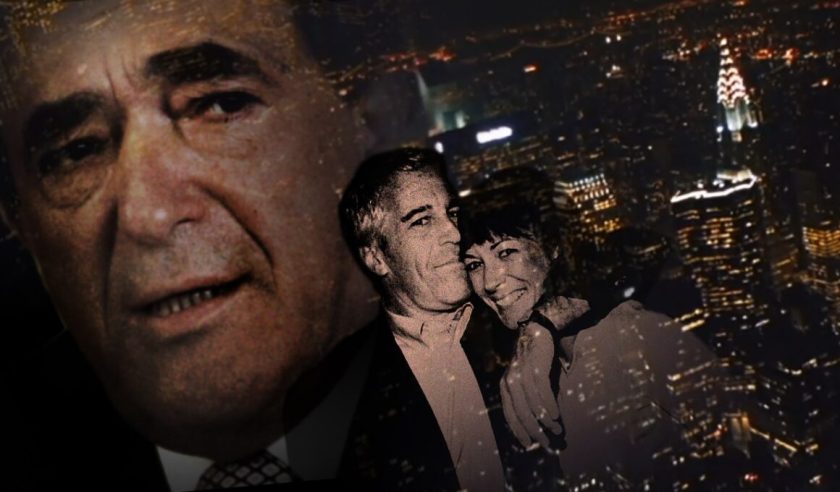
BY WHITNEY WEBB |
UNLIMITED HANGOUT| MARCH 17, 2022
Despite being found guilty late last year for her role in sex crimes against minors, Ghislaine Maxwell, the “madam” and chief accomplice of the intelligence-linked pedophile and sex trafficker, Jeffrey Epstein, may soon walk free. A juror in the case, Scotty David, subsequently took credit for the jury’s decision to find Ghislaine Maxwell guilty and “inadvertently” revealed that he had incorrectly answered a pre-trial questionnaire. As a result, the possibility of a mistrial, and Ghislaine walking free, now looms large.
David has some interesting connections, as he currently works for the Carlyle Group – the global investment firm whose ties to the bin Laden family during the early 2000s have come under scrutiny. Carlyle’s executives often have ties to intelligence, with one example being its former chairman and then chairman emeritus, Frank Carlucci, who had been deputy director of the CIA and, later, Reagan’s Secretary of Defense. Carlyle’s current co-founder and co-chairman David Rubenstein, as noted in this article from Free Press Report, served on the board of the influential Trilateral Commission during the same time as Jeffrey Epstein, while his ex-wife Alice Rogoff (divorced in 2017) had a very close working relationship with Ghislaine Maxwell, including with her now defunct “charity” the TerraMar Project. Given the fact that there are known ties between David’s employer and Ghislaine Maxwell, why has this potential conflict of interest gone unmentioned by mainstream media?
Not only that, but – according to a family member of one of the women who testified against Maxwell during her trial – David was connected with the journalist who would publish the now infamous, post-verdict report via Vicky Ward. Ward has been denounced by Epstein victims and others close to the case for having had a past “chummy” relationship with Ghislaine Maxwell she declined to disclose for years and for subsequently telling Ghislaine that Epstein victim Maria Farmer had been the person who had first reported Maxwell and Epstein to the FBI back in 1996. Farmer later claims that Ward’s lack of journalistic integrity, after promising to keep Farmer’s identity secret, had put her life in danger and forced her into hiding.
It seems that there is, yet again, a major cover-up in the works, one which involves major centers of financial and political power in New York City and beyond. In order to fully understand the sexual trafficking and blackmail operation that Maxwell and Epstein oversaw, and why powerful forces apparently continue to intervene in the case, one must first understand its genesis, particularly how and why Ghislaine Maxwell arrived in New York City. In this second installment of “Meet Ghislaine” (read Part 1 here), the beginnings of Ghislaine’s career – closely controlled by her father, Robert Maxwell, until his 1991 death – are followed in detail.
The Young Ghislaine
Early on in life, Ghislaine Maxwell was surrounded by the rich and powerful figures who frequented her father’s offices as his publishing empire and political connections grew both in the UK and abroad. Her father, Robert Maxwell, was a dominant force in her life as he was for her siblings as well, though Ghislaine gained a reputation as his favorite child, despite having been neglected in the earliest years of her life.
However, Ghislaine did not escape the abuse that was known to befall Robert Maxwell’s other children. While brothers Kevin and Ian were well known to regularly receive tongue lashings from their father in full view of friends and business associates, Ghislaine received “prearranged hidings [beatings]” from her father, with a nine-year-old Ghislaine telling author Eleanor Berry, a friend and confidant of her father’s, that “Daddy has a series of things lined up in a row. There’s a riding crop with a swish to it, another straight riding crop and a few shoehorns. He always asks me to choose which one I want.”
By all accounts, Robert Maxwell had firm control over Ghislaine’s young life. This was particularly true when it came to her love life through her teens and into her time at university, when he reportedly would ban her boyfriends from the family home and try to keep her from being seen with them publicly. It appears that Robert Maxwell applied this rule uniquely to Ghislaine and not to his three older daughters. Though such behavior could be attributed merely to his being a protective father, he later went to great lengths—even involving his publishing empire—to promote Ghislaine’s affairs with certain individuals, particularly those who inhabited elite circles (explored in more depth later in this article). This behavior suggests that Robert Maxwell may have seen Ghislaine’s sexuality as a useful tool in growing his influence empire, beginning when she was quite young. It also may have contributed to Ghislaine’s willingness, years later, to sexually exploit and abuse the young women targeted by herself and Jeffrey Epstein.
In much the same way as Ghislaine’s young personal life was controlled by her father, her entry into the working world after her graduation from Oxford was directly facilitated and managed by her father, with Robert Maxwell setting her up “with a string of jobs across his business empire.” By 1984, at age twenty-two, she was serving as a director of the British football club Oxford United alongside her brother Kevin. At the time, Robert Maxwell held shares in the club through a company created explicitly for that purpose. He served as the club’s chairman beginning in 1982.
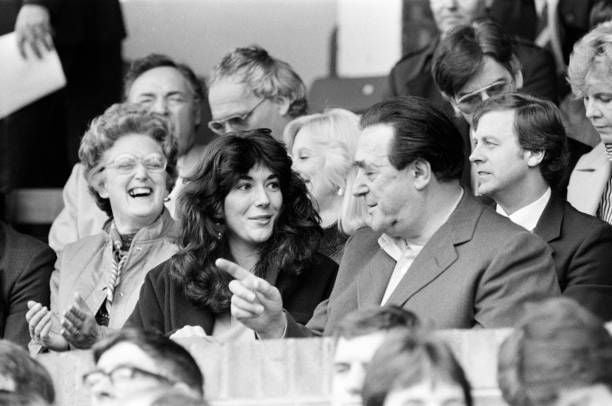
Ghislaine and her father at an Oxford United football match
Prior to and during this same period, Ghislaine worked in various roles at her father’s companies Pergamon Press and the Mirror Group, with British media later describing her early career as “entirely dependent on her father’s patronage.” She was working for the Mirror Group by 1984 and possibly earlier. During this period, Robert often used Ghislaine to market and generally represent his newspapers publicly.
In 1985, and with Robert Maxwell’s full approval, The People — the Sunday edition of the Daily Mirror— ran a story claiming that efforts were being made to blackmail the paper’s publisher, Robert Maxwell himself. The blackmailer had reportedly threatened Maxwell with information regarding Ghislaine’s alleged relationship with David Manners, then-Marquis of Granby and the future Duke of Rutland. The article sought to paint Robert Maxwell as bravely resisting the “blackmailer,” but there is more to the story.
This astonishing article claimed that people connected with the British MP Harvey Proctor had tried to blackmail Maxwell via The People. The article claimed that a “sinister phonecaller” had warned that, if the newspaper continued its campaign to expose Harvey Proctor, they would “produce a story about Ghislaine and Lord Granby at Belvoir Castle with incriminating pictures of them in compromising positions.” Manners denied the claim, stating that he and Ghislaine were merely friends.
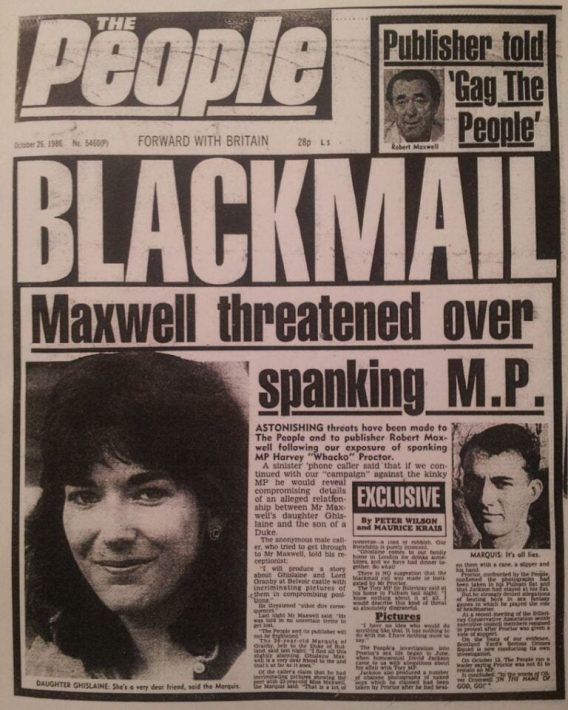 The bizarre decision to publish a front-page story exploiting his own daughter’s alleged sexual relationship because of an anonymous phone call was especially odd given that Robert Maxwell was known for his tight control over his youngest daughter’s love life. As previously mentioned, he had banned her boyfriends from visiting the family house and had gone to great lengths to prevent her from being seen in public with them. Yet, for whatever reason, Robert Maxwell clearly wanted information linking Ghislaine to the future duke put out into the public sphere. Though it is difficult to know exactly what was behind this odd episode in Ghislaine’s past, the situation suggests that Robert Maxwell saw Ghislaine’s young sexuality as a useful tool in building his influence empire.
The story is also odd for other reasons. The motive of the blackmailer was ostensibly to prevent Maxwell-owned papers from covering the Harvey Proctor scandal. But Manners (Lord Granby in the article), who was allegedly involved with Ghislaine, was also a close friend and later the employer of Harvey Proctor. Why would someone close to Proctor seek to blackmail Maxwell by putting the reputation of his own friend on the line?
In addition, the appearance of Harvey Proctor, a Conservative member of Parliament, in this tabloid spectacle is interesting for a few reasons. In 1987, Proctor pleaded guilty to sexual indecency with two young men, who were sixteen and nineteen at the time, and several witnesses interviewed in that investigation described him as having a sexual interest in “young boys.” Later, a controversial court case saw Proctor accused of having been involved with well-connected British pedophile and procurer of children Jimmy Savile; he was alleged to have been part of a child sex-abuse ring that was said to include former UK prime minister Ted Heath.
Of course, the Maxwell-owned newspapers, in covering the alleged effort to blackmail Robert Maxwell, did not mention the “young boys” angle at all, instead focusing on claims that distracted from the then-credible accusations of pedophilia by claiming that Proctor was merely into “spanking” and was “whacky,” among other things.
As was mentioned in Part 1 of this series, Ghislaine had also become involved with “philanthropy” tied to her father’s media empire during this period, which included hosting a “Disney day out for kids” and benefit dinner on behalf of the Mirror Group for the Save the Children NGO. Part of the event took place at the home of the Marquess and Lady of Bath, with the former known being for his strange obsession with Adolf Hitler. The gala was attended by members of the British royal family. The same evening that the Ghislaine-hosted bash concluded, the Marquess of Bath’s son was found hanging from a bedspread tied to an oak beam at the Bath Arms bar in what was labeled a suicide.
The attendance of royals at this Ghislaine-hosted gala was not some lucky break for Ghislaine or her “philanthropic” efforts, given that Ghislaine had been close to the royals for years, as some of her later employees and victims attested to having personally seen pictures of her “growing up” with the royals, a relationship allegedly facilitated by the Maxwell family’s ties to the Rothschild banking family. Ghislaine was heard on more than one occasion describing the wealthy and influential Rothschilds as her family’s “greatest protectors,” and they were also among Robert Maxwell’s most important bankers, who helped him finance the construction of his vast media empire and web of companies and untraceable trusts.
While Ghislaine was working in these capacities for her father’s business empire, there are indications that she had also, to some extent, begun to become involved in his espionage-related activities. According to former Israeli intelligence operative and associate of Maxwell in his dealings with Mossad, Ari Ben-Menashe, Ghislaine accompanied her father to events frequently, including the now-infamous 1989 party on Maxwell’s yacht where several key figures in the intelligence-related PROMIS software scandal were in attendance.
Ben-Menashe has also claimed that Jeffrey Epstein was brought into the group of Israeli spies that included himself and Robert Maxwell during this period in the mid-1980s and that Epstein had been introduced to Robert Maxwell after having been romantically involved with Ghislaine.
In 2019, Ben-Menashe told former CBS News producer Zev Shalev that “he [Maxwell] wanted us to accept him [Epstein] as part of our group. . . . I’m not denying that we were at the time a group that it was Nick Davies [foreign editor of the Maxwell-owned Daily Mirror], it was Maxwell, it was myself and our team from Israel, we were doing what we were doing.” He then added that Maxwell had stated during the introduction that “your Israeli bosses have already approved” of Epstein. Shalev later corroborated Epstein’s affiliation with Israeli military intelligence during this period with another former Israeli intelligence official. Epstein’s former business associate Steve Hoffenberg, who worked with Epstein from the late 1980s until 1993, has also stated that Epstein had boasted of his work for Israeli intelligence during that period and “rumors” of Epstein’s affiliation with both Israeli and US intelligence appeared in media reports as early as 1992.
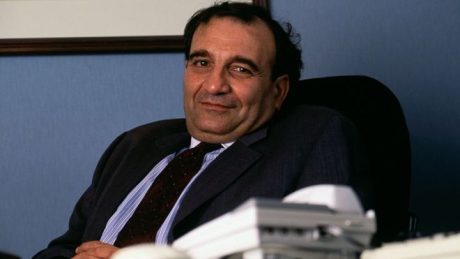
Ari Ben Menashe in his office. He now runs a consultancy firm.
Past reporting by Seymour Hersh and others revealed that Maxwell, Davies, and Ben-Menashe were involved in the transfer and sale of military equipment and weapons from Israel to Iran on behalf of Israeli intelligence during this period. Epstein is also known to have been involved with arms dealers at this time, including with UK’s Douglas Leese and the Iran-Contra–linked Adnan Khashoggi. Ben-Menashe went on to tell Shalev that he had “met him [Epstein] a few times in Maxwell’s office, that was it.” He also said he was not aware of Epstein being involved in arms deals for anyone else he knew at the time but that Maxwell wanted to involve Epstein in the arms transfer in which he, Davies, and Ben-Menashe were engaged on Israel’s behalf. He later clarified that he had seen Epstein on several occasions after his initial recruitment, as Epstein “used to be in [Robert Maxwell’s] office [in London] quite often” and would arrive there between trips to and from Israel.
Moving On Up
Beginning roughly during this same period, in 1986, Ghislaine began dating an Italian aristocrat named Count Gianfranco Cicogna, whose grandfather was Mussolini’s finance minister and the last doge of Venice. Cicogna also had ties to both covert and overt power structures in Italy, particularly to the Vatican, to the CIA in Italy, and to the Italian side of the National Crime Syndicate. The other half of that syndicate, of course, was the Jewish American mob with its modern-day ties to the informal Mega Group, which itself was deeply connected to the Epstein scandal and whose members included business partners of Robert Maxwell.
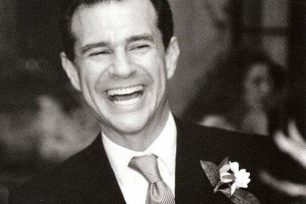
Gianfranco Cicogna in an undated photo
Cicogna’s relationship with Ghislaine lasted throughout the 1990s, though numerous media outlets have misreported their relationship as having taken place only during the early 1990s. It was reported in the British media in 1992 that Cicogna had been Ghislaine’s “great love” and that he had “moulded the Ghislaine we now see. He told her where to get her hair cut, and what to wear.” It’s worth noting that Gianfranco Cicogna met a grisly end in 2012 when the plane he was flying exploded in a giant fireball during an air show, a morbid spectacle that can surprisingly still be viewed on YouTube.
Toward the end of her relationship with Cicogna, Ghislaine is said to have founded the Kit Kat Club, which she depicted as a feminist endeavor. Why Ghislaine chose the name “Kit Kat Club” is something of a mystery. The original Kit Kat Club was set up by a renowned pie maker named Christopher Catling in London during the eighteenth century to promote the freedoms obtained during the 1688 Glorious Revolution. Until the late 1800s, Catling’s organization was the only entity to use the name. Then, in the 1900s, various wealthy private clubs, music venues, and public houses adopted the name for establishments all around the UK. The original name of the club created by Catling was also the inspiration behind the naming of the famous KitKat chocolate bar produced by Nestlé. The name caught on, with independent music venues bearing the name in Wales, Northern Ireland, and the North of England; there was even a Kit Kat Club band in Scotland. Then came the 1966 musical Cabaret, which was set in the Kit Kat Club in Berlin. Cabaret had been turned into a movie around the time Ghislaine Maxwell supposedly founded and named her own Kit Kat organization, but her true reasons for choosing this name may never be known.
An article in the Sydney Morning Herald later described Maxwell’s Kit Kat Club as “a salon held in a variety of locations, designed to bring together women from the arts, politics and society.” The article goes on to quote an attendee of the events, author Anna Pasternak, who stated, “It was bright, wealthy and society women. Nowadays, it seems quite normal to be going to a meeting just for women, but 30 years ago it seemed exciting.” Of Ghislaine, Pasternak stated that she was “very mindful of who you were, your status, your importance. I think it was more a way of advancing herself, making contacts that could be useful to her.”
The Kit Kat Club, despite being described by other outlets as “an all-female debating society” and group meant to “help women in commerce and industry,” held functions that were hosted by Maxwell that often had many men in attendance. One apparently frequent attendee of the Kit Kat Club was Jeffrey Archer. Archer is a former Tory MP turned novelist who has been the recipient of various accusations of financial fraud over the years and who has served time in prison for perjury. He was another close colleague of Harvey Proctor and helped finance his business ventures following the latter’s conviction for acts of “gross indecency” with two teenage boys. In a 1996 article published by the Daily News, Archer said of his experience at the Kit Kat Club: “I had the time of my life, surrounded by women under 40. I had orgasm after orgasm just talking to them!”
Archer can also be seen in images taken at a Kit Kat Club event in 2004. Pictures from that same event show other attendees, including Stanley and Rachel Johnson, the father and sister of current UK prime minister Boris Johnson. Also seen at this 2004 Kit Kat function was former Tory MP Jonathan Aitken, who went to jail for perjury and is known for his close ties to Saudi royalty; former key figure in the Rupert Murdoch media empire, Andrew Neil; and Anton Mosimann, who has been called the “chef to royalty.”
There has since been speculation that Ghislaine’s Kit Kat Club is where Donald Trump met his future wife Melania. Although the New York Times and other outlets reported that, at Fashion Week 1998, Donald Trump first met Melania at the Kit Kat Club in New York, this locale was not related to Maxwell’s Kit Kat Club and is instead a famous club in New York that also got its name from Catling’s original Kit Kat Club. However, these same outlets also reported that Epstein and Maxwell claimed to have been the ones who introduced the Trumps to each other.
Soon after her “painful” split from Gianfranco Cicogna, Ghislaine was seen skiing in Aspen, Colorado—“where the rich and famous mix” during the winter season—with American actor George Hamilton, who was also seen escorting Ghislaine to the Epsom races in 1991. Hamilton, twenty-two years Ghislaine’s senior, is apparently much more than just an actor, as he allegedly played a major role in aiding Ferdinand Marcos, the former dictator of the Philippines, and his wife Imelda move billions of public funds out of the country and convert them into private wealth for themselves and their accomplices abroad. Marcos originally rose to power with the help of the CIA.
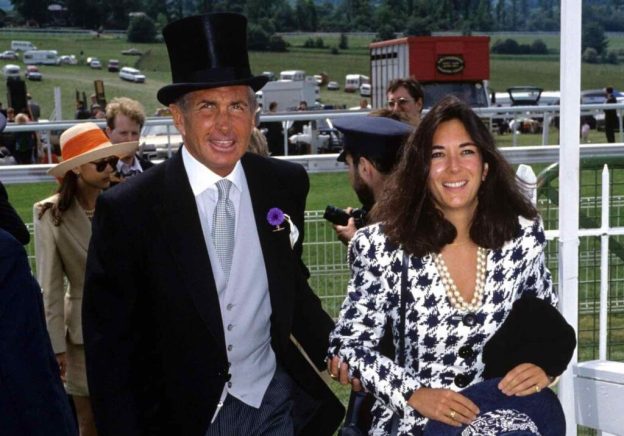
George Hamilton and Ghislaine Maxwell attend the Epsom races in 1991
A NY prosecutor referred to Hamilton as a “front” for Marcos, and media reports at the time claimed he had also acted as Imelda Marcos’s financial adviser. The Associated Press reported that Hamilton had been an unindicted co-conspirator in the fraud and racketeering cases brought against Imelda Marcos after she and her husband fled their country in 1986. The congressional committee tasked with investigating the flight of billions from the Philippines just prior to Marcos’s ouster declined to investigate the financial transactions surrounding Hamilton, which were alleged to have been connected to that very crime. Notably, at the same time, the CIA refused to disclose what it knew about the capital flight. As mentioned later in this article, the private investigator hired by this congressional committee to track down the Marcos’s money was Jules Kroll.
In 1990, Ghislaine was added to the payroll of another of her father’s newspapers, the European, which had launched that same year. It’s not exactly clear, however, at what point she joined the company or in what role(s) she served. A website recently set up by Ghislaine’s siblings following her July 2020 arrest for sexual crimes related to minors states that she developed and created “advertising opportunities” in the newspaper’s supplement during her time there. This same year, she moved to the United States, first to Los Angeles after being “offered a small part in a movie” that was being filmed there.
Coming to America
During the late 1980s, Robert Maxwell’s media empire began to falter as he had overextended his finances by making massive purchases, including Macmillan publishing among many others. Part of the reason behind his rapid, and arguably hasty, expansion was related to his rivalry with fellow media baron Rupert Murdoch. Another factor was his desire to become ever more wealthy and powerful. Former British ambassador to the US Peter Jay, who had also served as Maxwell’s chief of staff, later said that these purchases were partially motivated by Maxwell being “offended and upset that he was seen as merely a printer. . . . He was determined to go and demonstrate to the world that he was a publisher as well.”
Given Robert Maxwell’s ties to intelligence and the role some of his media assets played in espionage-related affairs, such as the arrest of Israeli nuclear whistleblower Mordechai Vanunu, it is possible if not likely that some of these acquisitions during this period were motivated by more than just his ego. Indeed, some of the companies Maxwell purchased or created during this period played a role in his sale of the bugged PROMIS software, acting as fronts for Israeli intelligence in the process.
In the lead-up to the 1990s, some of Maxwell’s companies became increasingly linked to organized criminal activities, such as those of Russian mobster Semion Mogilevich, and to the effort of Bulgarian intelligence to plunder Western technology known as Neva. Some of the companies Maxwell created to operate the Neva program were also used as cover for Israeli intelligence. The ties between this Maxwell-operated web of companies to the interconnected worlds of intelligence and organized crime grew under the umbrella corporation known as Multi-Group. The FBI later referred to Multi-Group, cofounded by Maxwell, as giving rise to a global criminal syndicate that came to control a large percentage of the profits from major industries, including oil, telecommunications, and natural gas. The Maxwell model for moving and laundering money between a web of Eastern and Western banks was at the core of the criminal enterprise that lurked within the Multi-Group web of companies.
Years later, the FBI’s foremost counterintelligence expert, John Patrick O’Neill, described Robert Maxwell as being “at the heart of the global criminal network” and that his lasting contribution to the world was having been “the man who set in motion a true coalition of global criminals” through the creation of Multi-Group. O’Neill died in the attacks of September 11, 2001. His death was not only convenient for those constructing the official narrative of the attacks, as he had been the top expert in the FBI on Al-Qaeda and Osama bin Laden, but it was also convenient for those who took the reins of Maxwell’s criminal enterprises in New York after Maxwell’s 1991 demise. Indeed, in the late 1990s, O’Neill had told author Gordon Thomas that he “had staff still trying to unravel the links from Maxwell’s legacy,” particularly his organized crime links and their operation in New York.
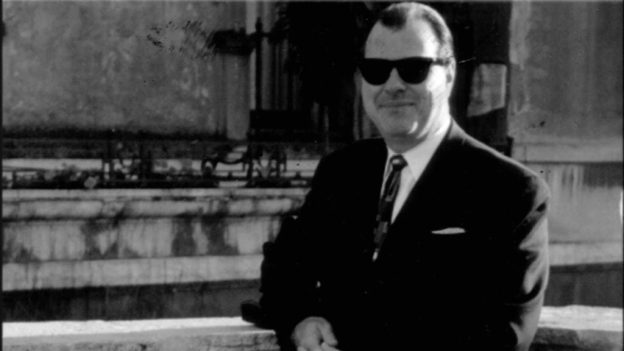
John P. O’Neill, the FBI counterintelligence expert, was the Bureau’s top expert on Osama bin Laden and was also attempting to track down the vestiges Robert Maxwell’s crime-linked enterprises in New York City before his death on September 11, 2001.
Robert Maxwell’s foothold in New York, which led to his establishing links to the city’s criminal underworld, appear to have gotten underway when he purchased Macmillan. He had little trouble raising money for a grander entry into New York business and society, despite his well-known past financial chicanery that had earned him the nickname “the bouncing Czech.” Investment banks such as Lehman Brothers, Rothschild Inc., Salomon Brothers, and Goldman Sachs lined up to represent and help finance Maxwell and his ever-growing web of businesses and corporate entities. Some speculated at the time that some of the funds Maxwell raised during this period and for this purpose had originated in the Soviet Union, where he had considerable connections, including to the KGB. There is also the possibility that some of the funds included proceeds from Maxwell’s sale of bugged PROMIS software to governments around the world.
Despite having opened a considerable new stream of revenue through Multi-Group and its legitimate and illegitimate businesses, years of financial fraud and stock-buying schemes caught up with Robert Maxwell’s empire, which began rapidly imploding in early 1991. In what is often considered a bizarre move by observers, given Maxwell’s dire financial situation and the poor state of the newspaper, Maxwell decided to expand his presence in New York by buying the New York Daily News in March 1991. However, Gordon Thomas later reported that the paper’s previous owners, the Chicago Tribune Group, had offered Maxwell $60 million to take over the floundering paper. Regardless of the true story behind his acquisition of the paper, he chose to put his daughter Ghislaine in charge of “special projects” shortly after becoming its owner. That position, per London’s Sunday Times, “provided her with her entree to the power base of the city.”
In addition to her new role in charge of “special projects” for the paper, Ghislaine was also made managing director of a “ready-made” company based in New York and created by her father, Maxwell Corporate Gifts. The New York Post later described the company as Ghislaine’s “own fiefdom.” Little is otherwise known about Maxwell Corporate Gifts, with the Maxwell family subsequently describing the company as “a business that supplied long-term service awards for companies.” In 2021, Ghislaine’s siblings published a short biography of their sister that asserted that Ghislaine had founded Maxwell Corporate Gifts in the mid-1980s after her graduation from Oxford and before her move to the US. Their claim is at odds with past media reports that predate Ghislaine’s infamy by several years and even decades. It is also possible, however, that the entity’s creation preceded by several years its use by Ghislaine and her father in New York.
Because few or no public records remain accessible regarding the company’s activities, we can only speculate about its activities. Given that the creation of the company coincided with the Maxwells’ entry into New York as well as the fact that Robert Maxwell’s ambition to expand his influence throughout the city was quite clear at the time, it was most likely a part of the growing Maxwell influence network in the city. New York media outlets subsequently claimed that Robert Maxwell saw himself as “the patriarch of a dynasty that would wield financial and political power on a global scale” and that he additionally saw New York as where they would truly make their mark.
After buying the New York Daily News, and despite his mounting financial problems, Maxwell received such positive attention in New York City that it surprised even him. According to an anecdote from Robert Pirie, investment banker and the then-president of Rothschild Inc.:
After he bought the Daily News, I picked him up at his boat. He liked Chinese food, so I decided to take him to Fu’s, which is the best Chinese restaurant in the city. As we drove up First Avenue, people would recognize him, and open their car doors and come out and shake his hand. At Fu’s, the entire restaurant got up on its feet and started clapping. He was overwhelmed. He told me, “In my whole life in London, no one’s ever acted like this. I’m here a month and look what’s happening.”
This type of reception throughout the city led Maxwell to become even more determined to expand his presence there. He hired a “group of prominent consultants and lawyers to help him make his way in America.” These included former senator Howard Baker and former senator John Tower as well as Republican Party consultant and high-profile public relations executive Robert Keith Gray. The inclusion of these three men in advising Maxwell on his entry into the United States is highly significant, but each is important for a different reason.
Tennessee senator Howard Baker, best known for being the vice-chairman of the Senate Watergate Committee and subsequently Reagan’s chief of staff after the Iran-Contra scandal, had become Robert Maxwell’s business partner in 1991 in a venture called Newstar. Newstar focused on expanding investment opportunities for Americans in the former Soviet Union and was described by Richard Jacobs, who cofounded the company with Baker, as “an international merchant banking, investment and advisory company.” Jacobs also stated that Robert Maxwell was one of the major shareholders in the company. Newstar was just one of several companies that Maxwell used to enrich himself through privatizing assets of the former Soviet Union. Baker also attempted to recruit other respected public figures into Maxwell’s empire.
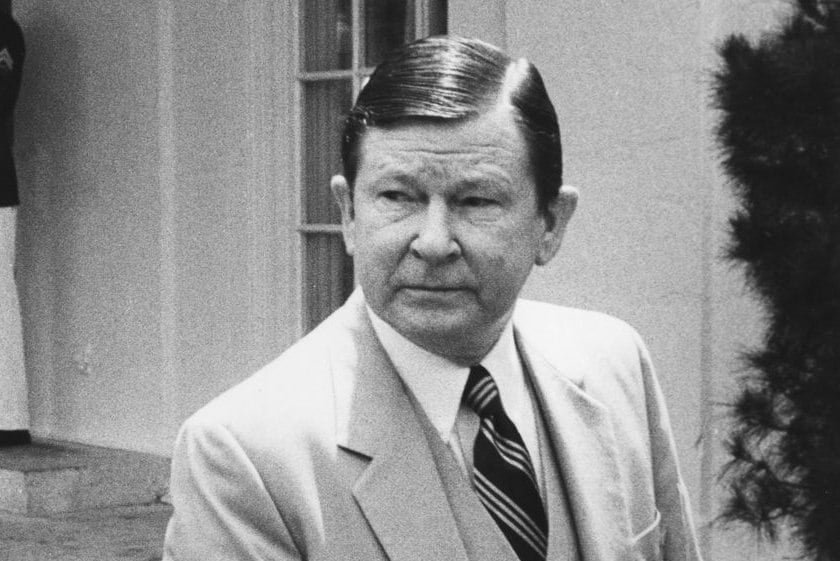
It appears that Maxwell first encountered Baker through his years-long relationship with Senator Tower, with whom Baker had had a decades-long partnership in the Senate. Maxwell had first gotten close to Tower years earlier, at Henry Kissinger’s behest, with the intention of advancing the Mossad goal of installing PROMIS software on the computers of top-secret US laboratories tied to the nuclear weapons program. It was Maxwell who placed Tower on the Mossad payroll, prompted his involvement in the Iran-Contra deal, and later added him to his own payroll via the company Pergamon-Brassey, which appears to have been strongly related to both the PROMIS scandal and the Bulgarian-led Neva program. Tower died just months before Maxwell, in early 1991, as the result of a suspicious plane crash, which at the time reportedly made Robert Maxwell fear for his own life.
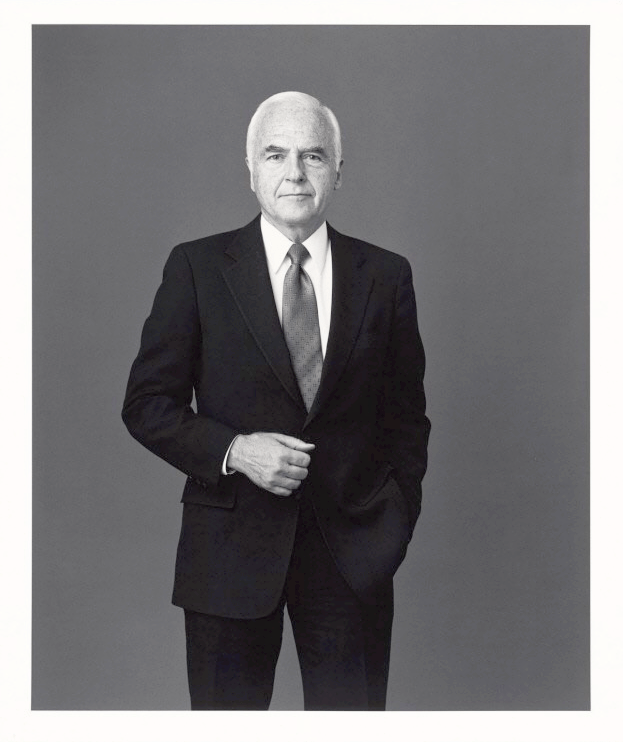
Robert Keith Gray is perhaps the key to unlocking the truth about Robert Maxwell’s plans and ambitions for his future in New York City. Gray was a smooth operator, having worked on major presidential campaigns and as the top executive at the public relations firm Hill and Knowlton. Less known is the fact that Gray had extensive ties to US intelligence and also to a handful of call girl and sexual-blackmail rings that encircled the Watergate scandal of the Nixon presidency and the more obscure Koreagate scandal of the same era. He was also tied, through connections in his home state of Nebraska, to figures involved in the Franklin Scandal. One common thread throughout the sexual blackmail scandals that were linked in some way to Gray was the Georgetown Club, owned by South Korean intelligence asset Tongsun Park and whose president was Robert Keith Gray at the time when it was used by CIA and other intelligence-linked figures to acquire sexual blackmail. John Tower was a member of the Georgetown Club during this period, as were many other prominent politicians and power brokers in Washington, DC.
During the period where he sought these men’s advice about how to grow his influence in New York, Robert Maxwell was also eager to get closer to George H. W. Bush—then the US president—with whom he had cultivated a relationship decades earlier. The Bush White House later became embroiled in the pedophile, blackmail, and sex-trafficking scandal that enveloped former Washington lobbyist Craig Spence, a network later shown by journalist Nick Bryant to have been at the core of the Franklin Scandal network. The alleged contact Spence had at the Bush White House was former National Security Advisor Donald Gregg. Gregg denied these reports, and the story was quickly memory holed. In 1989 Spence was found dead in a Boston hotel room and his death was quickly ruled a “suicide.”
Soon after Robert Maxwell’s effort to expand his footprint in New York, which author Gordon Thomas alleges involved Maxwell’s desire to become “king” of the city, he was being “courted” by Edgar Bronfman, Laurence Tisch, and other “luminaries of the New York Jewish community.” Bronfman and Tisch were among the founding members of the informal Mega Group, founded that same year by Leslie Wexner and Edgar Bronfman’s brother Charles. Charles Bronfman had previously teamed up with Maxwell in 1989 in an ill-fated attempt to purchase the Jerusalem Post. In a previous report that I wrote for MintPress News, I noted how many Mega Group members, including Wexner and the Bronfmans, had clear ties to organized crime networks and/or intelligence (as was the case for Tisch). Maxwell himself, as explored in this article and Part 1 of this series, checked these boxes as well.
The Mega Group’s existence was not revealed to the public until seven years later, in 1998. At that time, it underwent a very public reveal in the Wall Street Journal, and the names of its most prominent members were disclosed. Given that Robert Maxwell was cozy with this network and was being “courted” by them the year of its founding and that he had died long before the publication of the Wall Street Journal article, it is worth considering the possibility that Maxwell himself was a Mega Group member and that the only reason his name was not included in the WSJ’s disclosure of the group is because he was no longer alive. Support for this thesis can be adduced in the subsequent team-up of sexual-blackmail influence operator Jeffrey Epstein, who had been a financial adviser to Wexner since 1987 and his money manager since 1990, and Ghislaine Maxwell, Robert Maxwell’s favorite daughter.
While Wexner is often considered to be an Ohio business mogul, he had become increasingly active in New York in the 1980s, particularly its real estate market, especially following his involvement with Epstein. For over a decade and up until the early 2000s, Epstein was frequently referred to in the press as a real estate mogul or “property developer,” and some of these early articles, including one that named Ghislaine as the “mysterious business queen” of social circles that spanned New York and London, also discussed allegations that Epstein was involved with both the CIA and Israel’s Mossad.
Rising from the Ashes
At the end of October 1991, Robert Maxwell contacted private investigator Jules Kroll and arranged a meeting to see if he could hire Kroll to investigate a “conspiracy” to ruin him financially and destroy his empire. Kroll told Maxwell he would take the case.
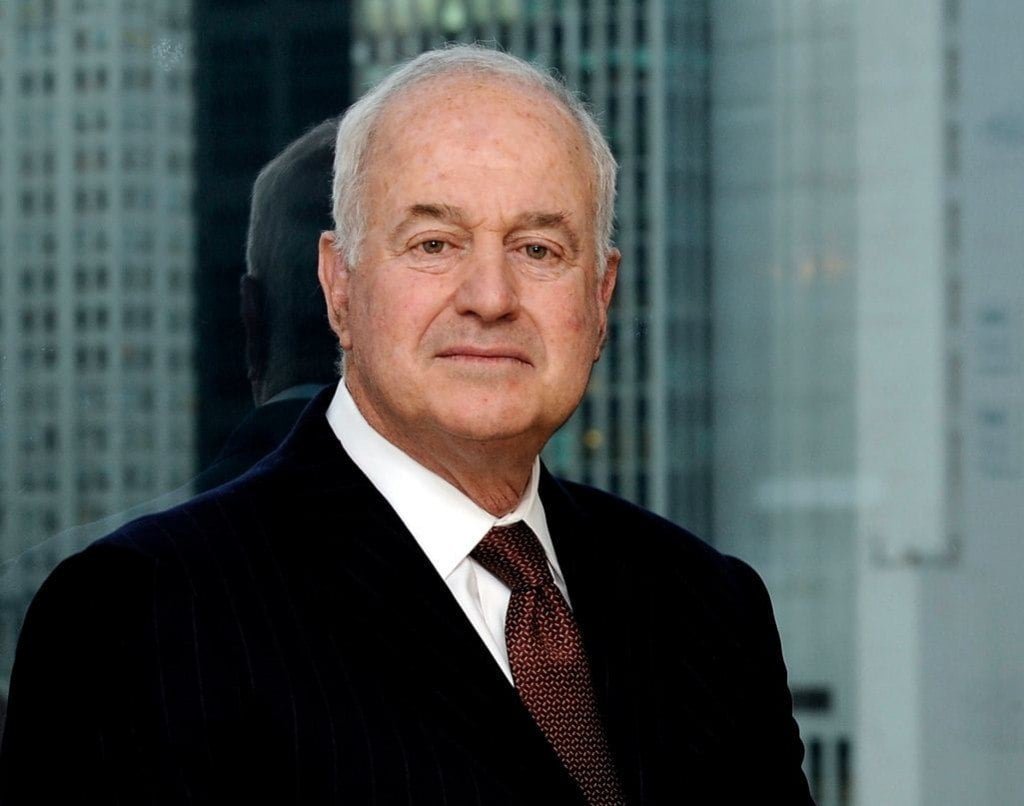
Jules Kroll’s involvement in this matter is significant for several reasons but chiefly because of the ties of his firms to US and Israeli intelligence. Kroll Associates, founded by Jules Kroll in 1972, became known as “the CIA of Wall Street” and was later alleged by French intelligence to have been used as an actual front for the CIA. The reasoning behind this nickname and such claims is partially related to the company’s penchant for hiring former CIA and FBI officers as well as former operatives of Britain’s MI6 and Israel’s Mossad. The successor company to Kroll Associates, K2 Intelligence, has similar hiring practices. In 2020, former Kroll Associates employee Roy Den Hollander was accused of murdering the son of New York judge Esther Salas at their family home just as Salas was due to preside over a case involving ties between Jeffrey Epstein and Deutsche Bank.
At the time that Robert Maxwell hired Kroll, the brother of then US president and former CIA director George H. W. Bush—Johnathan Bush—was on its corporate advisory board. Soon afterward, Kroll became employed by Bill Clinton in his first presidential campaign and later was hired to manage security for the World Trade Center in New York after the 1993 bombing. In addition, Kroll had been hired to investigate how money had been spirited out of the Philippines by the Marcos family. As previously mentioned, Ghislaine’s friend George Hamilton had played a significant role in that affair.
Furthermore, just weeks before 9/11, Kroll hired John P. O’Neill, with the involvement of Jerome Hauer—also a Kroll employee at the time, who would be one of the few, and possibly the only, high-ranking Kroll employee to die in the attacks. As previously noted, O’Neill was seeking to unravel “Maxwell’s legacy” in New York criminal networks at the time of his death on September 11, 2001. A report from January of that year noted that federal investigators were still trying to determine “how much of her [Ghislaine’s] father’s fortune is buried in the offshore trusts he used so freely for the benefit of his family.”
Kroll was unable to give Robert Maxwell the information he had wanted before Maxwell died under suspicious circumstances on his yacht in November 1991. Though media reports often say that his death was most likely a suicide, many biographers, investigators, and even Maxwell’s own family assert that he was murdered, having hit the end of the line in terms of his usefulness to those who had empowered his legal and illegal activities over the years. Ghislaine herself claims it was a group of “Mossad renegades” who took her father’s life.
Soon after news of Robert Maxwell’s death spread, his wife Betty Maxwell, accompanied by Ghislaine, headed to his place of death—his yacht, then located near the Canary Islands. As mentioned in Part 1, journalist John Jackson, who was present when Ghislaine and Betty boarded the yacht shortly after Robert’s death, claims that it was Ghislaine who “coolly walked into her late father’s office and shredded all incriminating documents on board.” Ghislaine denies the incident, though Jackson has never retracted his claim, which was reported in a 2007 article published in the Daily Mail. If Jackson is to believed, it was Ghislaine—out of all of Robert Maxwell’s children—who was most intimately aware of the incriminating secrets of her father’s financial empire and espionage activities. Betty Maxwell subsequently claimed that Ghislaine had been the child she chose to accompany her because she spoke Spanish and could help more than her other children in communicating with local authorities.
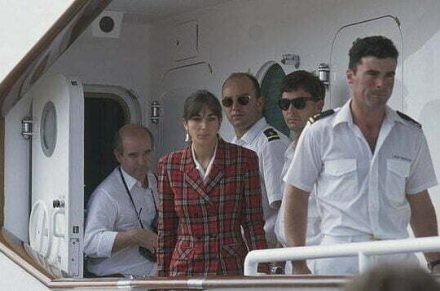
Ghislaine aboard the Lady Ghislaine shortly after her father’s death
Following her father’s death, Ghislaine publicly claimed to know next to nothing of his affairs and to have no money herself, despite it being well known that her father had created numerous trusts in the Lichtenstein tax haven that were meant to fund the Maxwell family for “generations.” A New York detective who interviewed Ghislaine in Manhattan while trying to trace her father’s assets later stated:
She came in dressed in sackcloth and ashes. It was pathetic. She said she had no money. Yet here was this expensive lawyer arguing with us in a room so air conditioned we couldn’t hear what he said. In between claiming she had no money, you couldn’t but help warming to her, she was so solicitous. We hadn’t had any lunch and she was recommending restaurants here and there and where to stay and go shopping, and slipping in from time to time how she never had anything to do with her father’s affairs.
Another investigator said that “It is entirely possible, and we didn’t have the resources to check, that Maxwell could have siphoned off money from some of his 400 companies in America to her. She was living on something.”
In 1992, Ghislaine repeated the claims that she was destitute but promised her family would soon make a comeback. That year, she told Vanity Fair, “I’m surviving—just. But I can’t just die quietly in a corner. . . . I would say we’ll be back. Watch this space.” As I previously reported, it was during this same period that the Maxwell siblings were openly attempting to rebuild their father’s empire and legacy, which potentially included his intelligence activities.
It later emerged that during this period and the years that followed, Ghislaine had shifted from being dependent on her father to being “entirely dependent” on Jeffrey Epstein for her “lavish lifestyle.” Some acquaintances of Ghislaine have since claimed that “she started working for him [Epstein] immediately after her father died.”
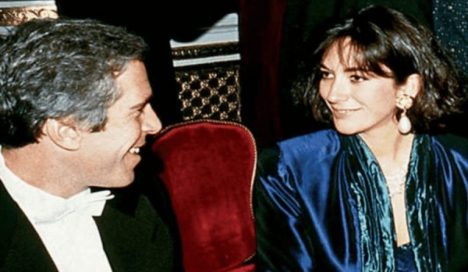
Ghislaine and Jeffrey Epstein at a 1991 memorial event for her father at the Plaza Hotel
Ghislaine and Jeffrey Epstein’s public relationship began in 1991 during a tribute dinner at the Plaza Hotel held in Robert Maxwell’s honor, where Epstein sat at the same table with Ghislaine and Betty. According to media reports, this was Ghislaine’s “first step in publicly announcing her deep affection for him [Epstein].” The choice of the Plaza would prove to be ironic given that Ghislaine and Epstein were launching an extensive sexual-blackmail operation that would go on for well over a decade. The hotel had previously been the site of a sexual-blackmail operation involving the infamous lawyer Roy Cohn and his mentor, the liquor magnate Lewis Rosenstiel.
The Plaza Hotel was purchased in 1988, not long after Cohn’s death, by Cohn’s protégé, Donald Trump, who had become close to Jeffrey Epstein beginning in 1987, when the two men, along with Tom Barrack, used to frequent New York nightlife hotspots together. The Plaza subsequently became the site of numerous parties attended by underage girls hoping to become “models.” Both Epstein and Trump, during this period and beyond, were known for their efforts to purchase, control, or have significant access to a variety of modeling agencies. Epstein was known to use the promise of modeling opportunities to either recruit or lure in young victims to his and Maxwell’s sexual-trafficking enterprise. Regarding Epstein, Trump stated in 2002: “I’ve known Jeff for 15 years. Terrific guy. He’s a lot of fun to be with. It is even said that he likes beautiful women as much as I do, and many of them are on the younger side.” Years later, Trump claimed to have had a falling out with Epstein over the latter’s behavior at Trump’s Mar-a-Lago resort in Florida.
In the year that followed his first public appearance with Ghislaine, Epstein was treated by both the press and those close to Ghislaine as her father reincorporated, with various media reports stating and/or quoting their associates comparing Epstein directly to Robert Maxwell. Some of these reports, as early as 1992, also openly discussed the possibility that Epstein, like Robert Maxwell, was working for Israeli intelligence as well as the CIA.
Reports throughout the 1990s would say that Ghislaine’s role in Epstein’s businesses was “nebulous” yet central, and she would later be described as having the role of “consultant.” Her own web of businesses was described “as opaque as her father’s,” and one described her as an “internet operator.” When asked about her work by reporters, she would refuse to confirm the nature of her businesses or even their names. The “internet operator” claim seems to be related to the “substantial interest” she possessed in the tech company founded in the 1990s by her twin sisters, Christine and Isabel, which produced the Magellan search engine. During this same period, Ghislaine and Epstein courted Microsoft executives, including Bill Gates, which led to a close relationship between Microsoft and Magellan and Isabel Maxwell’s subsequent business, CommTouch, which had deep ties to Israel’s national-security and intelligence apparatus.
Ghislaine and Epstein, as most now know, were also operating a sexual-trafficking and sexual-blackmail operation that involved the sexual abuse of minors, who were used to seduce and entrap powerful individuals, particularly Democratic politicians. Furthermore, the pair’s ties to intelligence have subsequently emerged and are alleged, including by eyewitnesses, to have begun in the 1980s with the direct involvement of Robert Maxwell. As noted in this article, Robert Maxwell at the time of his death was attempting to become “king” of New York high society.
Given the context surrounding the circumstances during which the Ghislaine-Epstein sexual-blackmail operation developed and launched, as detailed here, it appears more than plausible that this operation not only benefited certain intelligence agencies but also the organized crime–linked Mega Group and the Maxwell family itself. Ultimately, the activities that Ghislaine undertook alongside Epstein, as well as those of her siblings, fulfilled Robert Maxwell’s reported desire to become “the patriarch of a dynasty that would wield financial and political power on a global scale.” However, like the rise and fall of her father, Ghislaine’s power and influence was not meant to last.
In this light, it appears that the sexual-blackmail activities of these two individuals was an operation seeking to not only influence US policy on behalf of a foreign entity (as well as domestic entities such as the CIA) but to influence powerful individuals for the benefit of the Maxwell family itself as well as the organized crime web in which Robert Maxwell enmeshed his business interests in the latter years of his life.
To continue to claim that Ghislaine Maxwell’s activities were only performed to please Jeffrey Epstein who only sought to financially extort certain individuals for his personal gain is dishonest when faced with the facts of the matter and the context in which their operations took place. It also belittles the experiences of those who survived sexual abuse at the hands of both Ghislaine Maxwell and Jeffrey Epstein, as the continued cover-up of their complex dealings means that justice will never be served for their enablers, while the names of those they unduly influenced will never become public. It is a revelation that those in power must prevent the public from understanding at all costs, lest Americans realize that the United States has long been a country ruled by backdoor dealings, illicit intelligence operations, and blackmail.
Whitney Webb has been a professional writer, researcher and journalist since 2016. She has written for several websites and, from 2017 to 2020, was a staff writer and senior investigative reporter for Mint Press News. She currently writes for The Last American Vagabond.
Featured Video

or go to
Aletho News Archives – Video-Images
From the Archives
How the CIA Spawned Google
By Svetlana Ekimenko – Sputnik – 05.02.2025
American tech giant Google has faced regulatory scrutiny on numerous occasions amid accusations of antitrust violations. Google’s relationship with the CIA, ranging from early financial support to collaborative efforts have been decried as undermining privacy rights and free speech in the digital landscape.
Google’s creation played a crucial role in the US intelligence community’s scheme to attain global dominance by controlling information. … continue
Blog Roll
 Aletho News
- Would President Vance really ditch Israel?
- LAPD Pilot Will Track Vehicles In San Fernando Valley
- Britain’s Online Censorship Law Now Comes With a Crisis Plan for Your Posts
- NATO’s “Nordic model” brings Arctic confrontation closer to Russia’s nuclear bases
- Using nuclear weapons, the US-Israeli alliance still can’t beat Iran
- Sunset on the Quality of Western Propaganda: Arrival of the Dr Strangelove Moment
- Ukrainian general accused of protecting crime bosses
- US-‘Israel’ alliance faces growing rupture after midterms
- GOP’s Crushing Midterm Loss Could Reshape US Political Landscape – Analyst
- Midterm loss gives Congress power to rein in US war on Iran
- If Americans Knew
- An error has occurred; the feed is probably down. Try again later.
- No Tricks Zone
- New Study: The Net Fossil Fuel Contribution To Rising Atmospheric CO2 Has Been Zero For 500 Years
- Germany’s Green Energy Transition Becoming Increasingly Expensive…Another 6 Trillion Euros!
- Sudden Stratospheric Warming, Powerful El Niño Combination May Lead To Extreme Europe Cold, Energy Crisis!
- Two New Studies Find Thwaites Glacier Melt Cannot Be Driven By Human Activity Or A Warming Ocean
- E-Cars Reduce CO2 Emissions By Only 41% Compared To Internal Combustion Engine Vehicles
- Predictions Made By Renowned Climate Professor Over Past Decades Have Been Proven To Be Poor
- New Study Suggests Large Regions Of The Pacific Ocean Have Been Cooling For The Last 80 Years
- Germany’s Green Energy Debacle: High Energy Costs Force Kahla Porzellan to Close After 182 Years!
- New Study: 50 Years Of The Most Aggressive ‘Net Zero’ Policies Can Only Affect The Global Climate By 0.03°C
- US September “Heat” Was No Record…Many Records Set Decades Ago


