The PA is a willing accomplice in the international subjugation of Palestine
By Ramona Wadi | MEMO | July 7, 2020
From seemingly defiant rhetoric to the expected capitulation, Palestinian Authority President Mahmoud Abbas has offered nothing in terms of a unified Palestinian stance against US President Donald Trump’s deal of the century. Going back to a compromised international community, ready to negotiate additional losses for Palestinians which will ultimately fail to prevent Israel’s annexation of their land, is not a counter-proposal, as the PA wishes us to believe. A more honest approach would have been a clear statement that the PA’s role is dependent upon donor funding and hence only capable of delivering upon compromised political agendas.
In a call with German Chancellor Angela Merkel on Sunday, Abbas announced his willingness to restart negotiations based upon UN resolutions and the Middle East Quartet demands. In light of Israeli Prime Minister Benjamin Netanyahu’s decision to postpone — not abandon — the annexation of large swathes of the occupied West Bank, the two-state paradigm will once again be touted as “the only solution”. The reality is that the only solution is to dismantle the Zionist colonial enterprise in its entirety.
While it was expected that Abbas would renege on his rhetorical threats, his approach towards the international community, which also appeases Israel, confirms the political game that pitted the two-state hypothesis against the deal of the century; in other words, the international community against Trump. This was a shallow, despicable manoeuvre that ties Palestinian politics perpetually to international demands, because the PA functions as a security apparatus for Israel and a hierarchy presiding over a symbolically recognised, yet non-existent, state.
With Abbas’s decision, Israel boosts its upper hand. The settler-colonial entity considers itself above international law and, in fact, holds it in contempt. Diplomatic negotiations, therefore, present no obstacle to its annexation plans. It is highly likely that if annexation takes place, the international community will take its time but will, inevitably, normalise the violation of international law, while setting the scene to negotiate a non-existent two-state travesty, this being nothing less than legitimising the deal of the century.
International donors fund the illusion of Palestinian state building; they also fund the PA’s security coordination with Israel because, ultimately, the PA does not relish the possibility of Palestinians rising up against the imposed status quo which elevates its status, albeit only within the parameters decided upon by the international community and Israel. Abbas also knows that stopping security coordination will contribute to a complete collapse of its institutions.
As for international opposition to Israel’s annexation, which is already weak and not intended to seek a confrontation with the Zionist state, a scenario can unfold in which not even the most cosmetic of stances opposing annexation will be followed through. The international community’s diplomacy, after all, is based entirely upon the two-state compromise. Abbas may have no choice indeed, unless he is ready to base his politics upon Palestinian demands, which would trigger a complete change in terms of diplomacy.
However, the PA’s repeated excuse that the Palestinian cause has been marginalised by the international community only tells one part of the story. The PA has supported this marginalisation, but it just prefers not to speak about its role in altering the Palestinian political demands of land and refugees’ legitimate right of return, into a global project supporting Israel’s colonial demands. It is a willing accomplice in the international subjugation of the Palestinians.
Reparations and Other Scams: Israeli Survivors Live in Poverty and Are Starving?
By Philip Giraldi | American Herald Tribune | July 5, 2020
The issue of reparations and other compensation has been much in the news of late, most particularly in relationship to possible payments to descendants of slaves in the United States to compensate them for their disadvantages brought about by what is claimed to be a persisting racist culture in the country. There is, of course, considerable resistance on the part of millions of non-black citizens who will have to foot the enormous bill even though they were not involved in slavery in any way, having arrived in the U.S. long after 1865, when involuntary servitude was abolished by the Thirteenth Amendment to the Constitution.
Reparations have been around for a long time, normally being exacted by the winners in a war against the losers, who automatically are blamed as the aggressors and therefore liable for the damages. Often the compensation comes in the form of territory, witness for example the German acquisition of Alsace-Lorraine from the French after the Franco-Prussian war followed by its return to France after the First World War. The Germans also were made to endure considerable cash and in-kind payments, primarily to France, after losing the First World War. The terms of the Treaty of Versailles were so onerous that they were subsequently blamed for perpetuating Franco-German hostility, leading inevitably to the Second World War.
Israel and Jewish groups were major beneficiaries of the reparations and restitution programs that were created as a result of World War Two. The Luxembourg Agreement signed in 1952 committed West Germany to pay Israel a sum of 3 billion Deutsche Marks over the next fourteen years, which was at the time an enormous sum. An additional 450 million marks were paid to the World Jewish Congress. The payments that were made to the State of Israel regarded the government as the de facto heir to war victims who had no surviving family or who could not otherwise be identified. The money was mostly invested in the Israeli infrastructure and was significant in aiding in the initial development of the economy of the new state, but there were also considerable barter arrangements whereby Israel purchasing agents obtained German manufactured goods and raw materials.
The reparations program was modified at various points to expand those eligible for benefits and continued to operate long after the fourteen-year term initially envisioned had expired. As of 2012, when the program was 60 years old, it was still fully operational and Germany had paid the Jewish state an estimated $89 billion.
In the 1990s, Israel and Jewish groups began to go after other property that they claimed had either been sold at below market prices as Jews began to flee Germany or otherwise lost. Money trails in Swiss banks were investigated to chart the movement of funds that had originally been derived from Jewish owned property. Individual companies, mostly in Germany, were pressured by survivor groups to provide reparations to former forced laborers, leading the Berlin government in 1999 to establish a separate fund to assist survivors of the so-called holocaust. The Swiss and Hungarians set up similar funds and The World Jewish Restitution Organization was established to organize these efforts. In America, the U.S. Foreign Claims Settlement Commission pressured Germany in 1998-9 to compensate Jewish survivors who had arrived in the United States after the war.
Israel, of course, has a vested interest in continuing the flow of Euros by making Germans and other Europeans continue to feel guilty over the war. In 2007 the Israelis pressured the German government to expand the pension program for Jewish survivors of 1939-1945 who had wound up in Israel. In 2009 Israel demanded compensation of between 450 million and 1 billion Euros ($1,120,000,000 currently) for 30,000 claimed former slave laborer-survivors. And the requirements for eligibility for a payment or pension continue to become more permissive. A Jewish survivor qualifies if he lived in “a ghetto” for 12 months as will anyone who can demonstrate that he “hid from” the Nazis for at least six months. One acceptable “ghetto” is in Shanghai China. And given the destruction of many public records, there has been considerable fraud. In 2010 auditors found evidence of a scheme to use fake identification documents to defraud the German government of more than $42 million.
And new and innovative sources of money are constantly being developed. The United States and Israel are currently pressuring Poland, which was occupied by the Germans, to compensate Jewish property owners. It is particularly difficult to do as much of Warsaw and nearly all its public records were destroyed in 1944. In August 2019, no less than 88 U.S. Senators signed a letter urging Secretary of State Mike Pompeo to “act boldly and with urgency” to compel Poland to resolve the property issue. The Poles have argued that the proceedings would be subject to massive fraud and “frivolous lawsuits” while the demands could bankrupt the country.
Meanwhile the French and Dutch rail systems, also under German control, have been forced to pay compensation to survivors because their trains were used to transport Jewish prisoners to camps.
The story of reparations and compensation is of particular interest, not only because the Second World War ended 75 years ago last month, but also because of attempts by Israel and Jewish groups to squeeze some final payments out of the remaining survivors. Quite astonishing is a “campaign” email currently being circulated by an organization calling itself LATET – Israeli Humanitarian Aid. It promotes itself as a charitable foundation with “All donations…tax-deductible in Israel, the U.S., Canada, Australia, France and the U.K.” It describes its activity as:
“Due to Covid-19, many impoverished Holocaust survivors experience an extended stay in deficient and insecure homes. MORE THAN EVER, SUPPORT URGENT HOME REPAIRS THE SURVIVORS CAN’T AFFORD. 1 in 4 Holocaust survivors in Israel lives in poverty. As a result of the COVID-19 outbreak, our elders spend all their time at home, mostly alone, in run-down apartments and they have nobody to turn to. The need to eliminate all safety hazards and obstacles relating to mobility, safety and comfort has grown and dozens of survivors are waiting for urgent assistance. Latet is the only organization in Israel providing Holocaust survivors in need with a complete aid package, including monthly food boxes, social support and an Emergency Fund for crucial needs. Since 2013, Latet has carried out more than 1,200 home repairs to increase the survivors’ quality of life, at no cost to them. Everyday, 40 Holocaust survivors die. Let’s make sure they spend their last days in decent conditions.
“Donate now. Latet was founded in 1996 and is the largest Israeli NGO combating poverty. Acting as an umbrella organization, Latet provides for the basic needs of populations living in poverty and food insecurity, giving ongoing food assistance to over 200,000 people in Israel. The organization operates the leading national food bank and runs impactful aid programs. For the last 10 years it has been the only organization in Israel providing a comprehensive aid package to Holocaust survivors in need, including a monthly food box, emergency fund for medical and paramedical needs, home restorations as well as ongoing social support in the form of personal volunteers and social events throughout the year. For more information about Latet: www.latet.org.il/en/”
One should not necessarily doubt the fundamental decency of LATET and what they are seeking to do, but their solicitation raises some serious questions about the Israeli government and Jewish charities that have been the recipients of more than $100 billion obtained as “reparations” from various foreigners, mostly Germans, specifically to address the needs of the so-called “Holocaust survivors.” How can the survivors be living in terrible conditions and even starving in a socialist country with a formidable safety net, one might ask Prime Minister Benjamin Netanyahu, when they have been granted pensions and other compensation since 1952?
The answer would appear to be pretty simple, that the money has gone directly to the Israeli government and to major Jewish private organizations which have engaged in the extortion racket and have proceeded to divert the flow from the “cash cow” for their own purposes. Soon there will be few survivors of the war left and the scam will presumably end, or maybe not, as there have been claims that the terror of the German camps can be passed on genetically and is inheritable?
Unfortunately, compensating for claims of Jewish suffering is a big business. The regular annual scandalous multi-billion dollar cash flow out of the United States Treasury to fill the Israeli coffers will continue seemingly forever. American taxpayers might be delighted to learn that during the past week Congress, beset by plague, civil unrest and a crumbling infrastructure, found time to move to approve an additional $500 million to Israel for its “defense.”
Israel Conducts Gas-Field Exploration on Lebanon Border: New Negotiations or Attempt to Start a War?
Sputnik – 04.07.2020
The Israeli government has approved gas exploration in the Alon D block, located along block 9 of the Mediterranean shelf – a disputed maritime area. Lebanon and Israel contest that area of the shelf, while both sides consider it a part of their exclusive economic zone.
Lebanese President Michel Aoun previously stated that such actions by Tel Aviv could be very dangerous, and Lebanon will not allow encroachment on its own economic zone in the Mediterranean.
Experts claimed to Sputnik that Israel is trying to get Lebanon back to the negotiating table, especially in light of Beirut’s ongoing economic and domestic political weakness.
Lebanese political science expert Faisal Abdel Sattar sees the Israeli actions as an attempt to escalate relations with an obviously weak side that is experiencing a serious crisis.
“It was precisely at a time of internal chaos and unrest, when US policy was pushing Lebanon, when the lyre was falling unprecedentedly, that Israel announced the start of gas exploration right near the disputed waters. This is clearly an attempt to exacerbate the situation. Let me remind you that Lebanon and Israel have not demarcated their maritime borders”, he said.
The Lebanese expert stressed that Lebanon’s position on the issue remains unchanged.
“Israel seems to be just seeking to further mess things up in the Lebanese crisis. But Lebanon will not allow anyone to take advantage of the situation, and will respond accordingly to Israeli provocations”, he stated.
Attempt to Impose Negotiations
Lebanese political analyst Usamah Wahby sees Tel Aviv’s steps as an attempt to bring Beirut to the negotiating table, although the latter side is the least prepared.
“Israel is trying to galvanize the Lebanese authorities, shake them up and thus bring them into dialogue. This is what the US has wanted for a long time and was even ready to mediate. However, the problem is that Lebanon is now the least willing to negotiate with anyone due to the domestic political and economic crises. It seems that Tel Aviv could not care less about this situation. It is always easier to force a feeble opponent to dialogue on your terms than to conduct dialogue on equal terms”, he said.
Lebanon rejected the US proposal to demarcate its maritime border with Israel, which dates back to 2017.
UK Government Evasive About Sanctions If Israel Annexes West Bank
Ministers insist on being ‘friends and allies’ of the racist regime regardless of its horrendous crimes
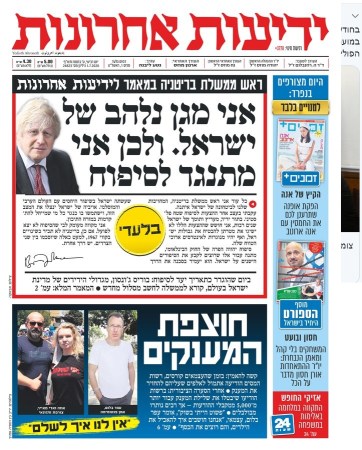
UK prime minister Boris Johnson’s article in the Israeli paper Yedioth Ahronoth
By Stuart Littlewood | American Herald Tribune | July 1, 2020
Writing in the Israeli paper Yedioth Ahronoth today – the very day Netanyahu threatened to commence extending Israeli sovereignty to illegal Jewish squatter communities and the Jordan Valley in a blatant bid to thieve more Palestinian land – UK prime minister Boris Johnson makes this disgraceful claim:
“I am a passionate defender of Israel…. a life-long friend, admirer and supporter.” On other occasions he has declared himself “a passionate Zionist”, an equally tasteless thing to be. “Few causes are closer to my heart than ensuring its people are protected from the menace of terrorism and anti-Semitic incitement. The UK has always stood by Israel and its right to live as any nation should be able to, in peace and security. Our commitment to Israel’s security will be unshakable while I am Prime Minister of the United Kingdom.”
The trouble, dear Boris, is that the Israelis, who are violent intruders, won’t let their neighbours live in peace and security and cry blue murder whenever they put up resistance which they have every right to do. Your brilliant solution to the Holy Land problem is to force the Palestinians and Israelis back to the negotiating table and never mind implementing international law and scores of UN resolutions. Will you never learn?
Yesterday, at Westminster, the scene was Questions to the Foreign Secretary, the subject ‘Planned Annexation of the West Bank.
– Tonia Antoniazzi: What recent representations he has made to the Israeli Government on their planned annexation of parts of the west bank.
– Julie Elliott: What assessment he has made of the effect of Israel’s plan to annex parts of the west bank on human rights in that region.
– James Cleverly (Minister of State for Middle East & North Africa): The UK’s position is clear: we oppose any unilateral annexation. It would be a breach of international law and risk undermining peace efforts. The Prime Minister has conveyed our position to Prime Minister Netanyahu on multiple occasions, including in a phone call in February and a letter last month. The UK’s position remains the same: we support a negotiated two-state solution based on 1967 borders, with agreed land swaps, Jerusalem as a shared capital and a pragmatic, agreed settlement for refugees.
– Tonia Antoniazzi: Current sanctions are clearly not working as a deterrent for Israel’s plan to annex the west bank illegally. Strong words at this point are a betrayal of the Palestinian people—they need actions. Can the Minister outline what action the Government will take against annexation?
– James Cleverly: The Government have maintained a dialogue with Israel. We are attempting to dissuade it from taking this course of action, which we believe to be not in its national interest and not compliant with international law.
– Julie Elliott: In 1980, the UN Security Council condemned Israel’s illegal annexation of East Jerusalem and, in ’81, its illegal annexation of the Golan Heights. What lesson does the Minister think the Israeli Government took from the failure to see those Security Council resolutions adhered to? Are the UK Government abandoning the Palestinian people, as suggested in a recent open letter by UK charities?
– James Cleverly: The UK Government remain a friend of Israel and also a friend of the Palestinian people. We have continued to have dialogue both with the leaders of the Palestinian Authority and with the Government of Israel, and we encourage them to work together to come towards an agreed settlement that will see a safe, secure state of Israel alongside a safe, secure and viable Palestinian state. There is still the opportunity for that negotiated settlement to be the outcome, and we will continue working with both the Israelis and the Palestinians to facilitate that.
– Lisa Nandy: World leaders are warning of consequences should annexation go ahead, but the silence from this Government has been deafening, so much so that the Israeli newspaper Haaretz says that France is now the world’s “last, best hope” to stop annexation. This really is shameful. I raised my concerns with the US ambassador—has the Minister? Will he commit to a ban on settlement imports and recognise Palestine, as this House voted to do? Forgive me, I may have missed it. If he will not do those things, can he tell us what exactly he is proposing to do?
– James Cleverly: The UK remains a friend and ally to the state of Israel and a good friend to the Palestinian people. It is tempting—and I am sure it will placate certain voices on the left of the political spectrum—to stamp our feet and bang the table, but we will continue to dissuade a friend and ally in the state of Israel from taking a course of action that we believe will be against its own interests, and we will do so through the most effective means available.
– Alyn Smith: I listened carefully to the previous exchange, and I have much respect for the Minister, but I am not asking him to stamp his feet or bang the table—I am asking him to match the sensible position that he has outlined today on the illegal annexation of the already illegally claimed settlements with some actual action. No amount of warm words and sympathy are going to cut it in this discussion. My party, likewise, is a friend of the two-state solution. We are a friend of the Israeli state, and we are a friend of the Palestinians as well. We want to see a viable solution, but there is a lively debate that we can influence right now within Israel, and we need to put action on the table, not warm words and sympathy. Settlement goods should at the very least be labelled as illegal, and targeted sanctions need to be put on the table to focus the minds of the coalition. I urge him to act, not just talk.
– James Cleverly: My right hon. Friend the Foreign Secretary has spoken with his opposite number and other members of the Israeli Government, as have I and indeed our Prime Minister. We are working to dissuade Israel from taking this course of action. There will always be voices in British politics that would jump at any opportunity to bring in sanctions and disinvestment. We do not agree with those voices, and we will continue to work towards a negotiated two-state solution, using the diplomatic means we have at our disposal.
– Alyn Smith: I appreciate that answer, and I would urge more. When Russia illegally occupied Crimea, the UK Government, with our support, implemented sanctions with the international community. We need that sort of action now, and I would urge the Minister to greater efforts than we have heard today.
– James Cleverly: I reiterated the UK’s position at the UN Security Council on 24 June. I made it clear that annexation would not go unanswered. However, I will not stand at this Dispatch Box in order, as I say, to placate some of the traditional voices in criticism of Israel when the best way forward is to negotiate and speak with a friend and ally, in the Government of Israel, to dissuade them from taking a course of action that we believe is not in their own best interests.
Well, you get the picture…… a bizarre piece of parliamentary theatre in which a British minister of the Crown plays chief pimp for a foreign racist entity. What a pathetic performance by Mr Cleverly. He mouths the same tired and obsolete excuses for inaction as his predecessors and cannot bring himself to show principle or backbone. Perhaps that’s because Her Majesty’s Government simply hasn’t any.
So here is a question of my own. Why would anyone want to be “a friend and ally to the state of Israel”, as Government ministers like to describe themselves, when outside the Westminster bubble of Zionist stooges the racist regime has no friends? And for the simple reason that being a Friend of Israel means embracing the terror on which the state of Israel was built, approving the dispossession of the innocent and oppression of the powerless and applauding the discriminatory laws against indigenous non-Jews who inconveniently remain in their homeland.
It means aligning oneself with the horrific mindset that abducts civilians — including children — and imprisons and tortures them without trial, imposes hundreds of military checkpoints, severely restricts the movement of people and goods, and interferes with Palestinian life at every level.
And never mind the shooting up by Israeli gunboats of Palestinian fishermen in their own territorial waters, the strangulation of the West Bank’s economy, the cruel 14-year blockade on Gaza and the bloodbaths inflicted on the tiny enclave’s packed population. And don’t let’s even think about the religious war that humiliates the Holy Land’s Muslims and Christians and prevents them visiting their holy places.
If, after all that, you are still Israel’s special friend, where is your self-respect?
Will annexation happen? As I write this the news agencies remain silent and the world holds its breath. If Israel goes ahead it will be another step in the fulfilment of Plan Dalet, the Zionists’ dirty ploy to take over the Palestinian homeland as a prelude to declaring Israeli statehood. Its intention was, and still is, to gain control of all areas of Jewish presence and strategic and economic importance and keep expanding Israel’s (deliberately fluid) borders in order to satisfy their insatiable greed.
Don’t you think Netanyahu and his loathsome crew make superb recruiting sergeants for the BDS (Boycott, Divestment, Sanctions) movement? I now expect BDS to expand dramatically and hit the rogue state where it hurts if it doesn’t get civilised.
An obvious response from even the most retarded Western politicians would be to suspend the EU-Israel Association Agreement and the new UK-Israel Trade and Partnership Agreement. To enjoy the Association’s privileges Israel promised the EU to show “respect for human rights and democratic principles” as set out in Article 2, an essential and enforceable element of the Agreement. But Israel, as usual, shows contempt for these principles and its membership ought to have been terminated long ago.
To its shame the go-it-alone UK Government remains committed to rewarding its evil creature’s most obscene crimes, having announced that it is “working closely with the Israeli government to implement the UK-Israel trade and partnership agreement.… and to host a bilateral trade and investment summit in London.” This suggests that the provisions of Article 2 were not carried over from the EU to the new UK-Israel Agreement. However, exactly a year ago Lisa Nandy put this question:
“To ask the Secretary of State for International Trade, if he will seek the inclusion of a binding human rights clause in a future free trade agreement with Israel to establish that the (a) relations between the parties and (b) provisions of the agreement shall be based on respect for human rights and democratic principles as is provided for in Article 2 of the EU-Israel Association Agreement.”
The answer from the Minister of State for Trade Policy was: “The UK-Israel Agreement incorporates human rights provisions of the EU-Israel Trade Agreements, without modification.”
Let’s see if they really mean it and suit action to their words.
Black Voices also Matter

By Gilad Atzmon | July 1, 2020
That we are proceeding rapidly into an authoritarian reality is hardly a news item: it is impossible not to identify the institutions at the centre of this unfortunate transition. Every day one Jewish organization or another brags about its success in defeating our most precious Western values: political freedom and intellectual tolerance.
At the moment it seems as if silencing authentic Black voices is the Zionists’ prime objective. This morning we learned that Black Voices do not matter at all: in a total capitulation to the French Zionist Lobby group CRIF, the great Black French comedian Dieudonné’s YouTube channel was deleted by Google. CRIF tweeted:
“A month ago, the CRIF filed a complaint against Dieudonné after the broadcasting of anti-Semitic videos. Yesterday, his chain @YouTube has been deleted. CRIF welcomes this decision and encourages other platforms to take responsibility and close all of its accounts.”
In the late 18th century the Anglo Irish statesman and philosopher Edmund Burke realised that “all that is necessary for evil to succeed is that good men do nothing.” I guess that in 2020 for evil to prevail all that is needed is for an internet company to become an extension of Zion.
Neither Dieudonne nor anyone else needs my ‘kosher’ certificate, although I have no doubt that the French artist is an exemplary anti racist. What I will say is that if Zion doesn’t want you to listen to someone, there is nothing better you could do for yourself than defy their wishes. Dieudonne, France’s most popular comedian, is a brilliant Black man. He was brave enough to stand up and declare that he had enough of the holocaust indoctrination, what he wants to discuss is the holocaust of his people, an ongoing century of discrimination and racist abuse. Within only a matter of hours, Dieudonne was targeted by French Jewish organizations and was portrayed as a racist and an anti Semite .
I am looking forward to see what Black Lives Matter is going to do for one of Europe’s most authentic and profound Black voices. Just an idea, maybe instead of pulling down bronze statues, BLM should consider calling for every Black artist to close their Youtube channels until Google comes to its senses. This would be a nice proper attempt at a Black power exercise, but as you can imagine, I do not hold my breath.
Unfortunately, Zionist destruction of the little that is left out of the Western spirit has become a daily spectacle. Yesterday we saw the Jewish press bragging that Fox Soul — a new Fox channel geared toward African Americans scheduled live broadcast of a speech by Louis Farrakhan. The Jewish Algemeiner was kind enough to reveal that the Simon Wiesenthal Center had called for the broadcast to be scrapped.
Zionist organisations never march alone. They are effective in identifying the odd Sabbos Goy who stands ready to lend his or her ‘credibility’ to the ‘cause.’ This time it was CNN anchor Jake Tapper who tweeted, “Farrakhan is a vile anti-LGBTQ anti-Semitic misogynist. Why is a Fox channel airing his propaganda?”
As we all know, Jews often claim to be there for Blacks. Jewish outlets often brag about the significant Jewish contribution to the Civil Rights Movement. According to some Jewish historians, a large amount of the funds for the NAACP came from Jewish sources – some experts estimate as much as 80%. Howard Sachar begins his article Jews in the Civil Rights Movement, by claiming that “nowhere did Jews identify themselves more forthrightly with the liberal avant-garde than in the Civil Rights movement of the 1960s.” This would seem a positive moment in Jewish history until we remember that Judaism has, throughout its entire history as we know it, sustained uncompromised ‘segregation bills’. What are kosher dietary rules if not a ‘segregation bill?’ What is the rationale behind the Zionist attitude toward mixed marriage other than a segregation bill? Even within the Palestinian solidarity movement, many Jews choose to march within racially segregated political cells (JVP, IJAN, JVL etc.) rather than voluntarily strip themselves of their Jewish privilege.
It is true that some of the greatest voices of the Civil Rights Movement were Jews. But I am afraid that this is where the good part of the story ends. Historically the Jewish attitude towards Blacks has been nothing short of a disaster. It is difficult to decide how to enter this colossal minefield without getting oneself into serious trouble.
In European Jewish culture the word shvartze (Black, Yiddish) is an offensive term referring to a low being, specifically a Black person (“She’s dating a shvartze. Her grandmother is probably rolling over in her grave”). Zein Shver, a Jewish Black American, points out that “Shvartze isn’t Yiddish for Black. Shvartze is Yiddish for Nigger!”
The reference to ‘shvartze chaya’ is a direct reference to ‘black beast,’ meaning the lowest of the low. Shvartze chaya is also how Ashkenazi Jews often refer to Arabs, Sephardi Arab and Falasha Jews. I guess that, at least culturally, some Ashkenazi Jews find it hard to deal with the colour black, especially when it comes on people. It is therefore slightly peculiar to witness white Ashkenazi Jews complain endlessly about ‘white supremacy.’ It is, in fact, hard to imagine any contemporary cultural code more racially oriented than the Ashkenazi ethos. I would suggest that if Jews are genuinely interested in combating white exceptionalism, that maybe they should first uproot those symptoms from their own culture.
This is an anomaly — the same people who played a fundamental role in the civil rights movement, are themselves instrumental in an historic racist segregation project. In my work on Jewish Identity politics I have noticed that Jewish organisations dictating the boundaries of Black liberation discourse is hardly a new symptom. This political exercise is a fundamental feature and symptomatic of the entire Jewish solidarity project. It is the ‘pro’ Palestinian Jews who make sure that the discourse of the oppressed (Palestinians) will fit nicely with the sensitivities of the oppressor (The Jewish State for that matter). It seems as if it is down to Jews to decide whether or not the civil rights activist and scholar Angela Davis is worthy of an award for her lifetime of activity for her community.
A review of the ADL’s attitude to the Nation of Islam (NOI) in general and its leader, Louis Farrakhan, provides a spectacular glimpse into this attempt to police the dissent.
NOI according to the ADL, has “maintained a consistent record of anti-Semitism and racism since its founding in the 1930s.” The ADL’s site states that “under Louis Farrakhan, who has espoused and promoted anti-Semitism and racism throughout his 30-year tenure as NOI leader, the organization has used its programs, institutions, and media to disseminate its message of hate.”
“He (Farakhan) has repeatedly alleged that the Jewish people were responsible for the slave trade as well as the 9/11 attacks, and that they continue to conspire to control the government, the media, Hollywood, and various Black individuals and organizations.”
The real question we need to ask is whether Farakhan’s criticism is ‘racist.’ Does he target ‘The Jews’ as a people, as a race or as an ethnicity or does he actually target specific elements, segments or sectors within the Jewish universe? A quick study of Farakhan’s cherry picked quotes provided by the ADL reveals that Farakhan doesn’t really refer to ‘the Jews’ as a people, a race, a nation or even as a religious community. In most cases he refers specifically and precisely to segments within the Jewish elite that are indeed politically dominant and deserve our scrutiny.
Let us examine some of Farakhan’s most problematic quotes as selected by the ADL: “During a speech at Washington, D.C.’s Watergate Hotel in November 2017, Farrakhan told his audience that the Jews who ‘owned a lot of plantations’ were responsible for undermining black emancipation after the Civil War. He also endorsed the second volume of the anti-Semitic book, ‘The Secret Relationship Between Blacks and Jews,’ which blames Jews for promoting a myth of black racial inferiority and makes conspiratorial accusations about Jewish involvement in slave trade and the cotton, textiles, and banking industries. Farrakhan believes this book should be taught in schools.”
It is obvious in the quote above that Farakhan refers to a segment within the Jewish elite. Those who “owned plantations,” those who were specifically involved in the Atlantic slave trade, those who were and still are involved in banking and so on. And the next question is; does the ADL suggest that Jewish slave owners are beyond criticism? Is the Jewish State axiomatically on the right side of history so neither Farakhan nor the rest of us is entitled to criticise it? And what about Jewish bankers, do they also enjoy a unique immunity? I am sorry to point out, such views only confirm the supremacist and privileged attitude that Farahkan, amongst very few others, is brave enough to point at.
The question goes further. If Jews do empathise with Blacks and their suffering as we often hear from Jewish leaders, can’t they take a bit of criticism from the likes of Farakhan, Angela Davis or Dieudonne? If Jews care so much about the Other, as many well meaning Jews insist upon telling us, how come all this caring disappears once Farakhan, Davis or Dieudonne appear on the scene?
Jewish solidarity is a peculiar concept. It is a self-centred project. Jewish New Yorker Philip Weiss expressed this sentiment brilliantly in an interview with me a few years back. “I believe all people act out of self-interest. And Jews who define themselves at some level as Jews — like myself for instance — are concerned with a Jewish self-interest. Which in my case is: an end to Zionism.” Weiss supports Palestine because he believes it is good for the Jews. For him the Palestinians are natural allies. I believe that if Blacks and Palestinians or anyone else wants to liberate themselves and to obtain the equality they deserve, they can actually learn from Zionism. Rather than counting on solidarity, they have to shape their own fate by defining their priorities. In fact this is exactly what is so unique about Farakhan and Dieudonne. This is probably why Jewish organisations see them as prime enemies and invest so highly in their destruction.
Lebanon warns Israel over ‘dangerous’ gas exploration bid
Press TV – June 30, 2020
This file photo shows Israel’s Tamar natural gas production platform some 25 kilometers west of the Ashkelon shore in February 2013 in the Mediterranean Sea.
President Michel Aoun has warned Israel against its “extremely dangerous” bid to explore oil and gas on Lebanon’s maritime border, parts of which are claimed by the regime, saying the Arab country will not allow any violation of its territorial waters.
Aoun’s warning came a day after Israel approved a license for oil and gas exploration in “Block 72,” located close to the Block 9 gas fields, where Beirut is set to begin explorations for natural gas and oil soon.
“Block 72” sits along the disputed 860-kilometer line of waters that separate the Lebanese from Israeli-held territories.
“This will complicate the situation further as Lebanon will not allow any violations of its internationally-recognized territorial waters, especially in the Exclusive Economic Zone where Block 9 — which will be explored by Lebanon within a month — is located,” Aoun said Monday.
The Lebanese president further called for the country’s Supreme Defense Council to meet on Tuesday to discuss the development at the southern border.
Lebanese lawmaker Kassem Hachem described the Israeli decision as “piracy” and a “declaration of war” on Lebanon, calling for action at “all levels” to “put an end to these aggressive intentions on our homeland.”
Israel relies heavily on gas and has long been developing a number of offshore gas deposits in the Mediterranean Sea.
Reportedly, Israel had been avoiding granting licenses for the exploration of Block 72, fearing it could lead to a new conflict with Lebanon.
In February 2018, Lebanon said it had signed gas exploration and production contracts for two energy blocks, including Block 9, with a consortium of France’s Total, Italian Eni and Russia’s Novatek oil and gas companies.
The two sides nearly came to blows over Beirut’s offshore oil and gas exploration projects.
Back in December 2017, Beirut had granted licenses to a consortium of three international companies to carry out exploratory drilling in Lebanon’s Block 4 and Block 9 and determine whether they contain oil and gas reserves.
Israeli authorities, who claim sovereignty over Block 9, reacted angrily to the announcement.
In January, Israel signed a deal with Greece and Cyprus to build a pipeline channeling natural gas from the eastern Mediterranean to Europe, despite objections from Turkey.
Israel and Lebanon have further been engaged in a rift over Israel’s occupation of Shebaa Farms, a small strip of land at the intersection of the Lebanese-Syrian border and the Golan Heights.
Israel’s ambitions in south Yemen increase risk of conflict with Houthis
By Omar Ahmed | MEMO | June 29, 2020
Israel’s involvement in the Yemen war throughout its five year duration is an open secret. In 2015, when the Saudi Arabian Embassy in the capital Sanaa was seized by the Houthi forces in retaliation for the Saudi-led coalition’s aggression, a large cache of Israeli-made weapons and ammunition was discovered, in addition to documents detailing intentions by the US to establish a military base on Perim Island near the Bab Al-Mandab Strait, “to protect [America’s] interests and ensure the security of Israel”. The island has been under the coalition’s control since it was wrested from the Houthis in the same year. Foreign mercenaries fighting on behalf of coalition-partner the UAE were also said to have been trained by the Israeli military at camps in the Negev Desert.
Amid the ever-growing normalisation of relations between Israel and Gulf states, it should come as no surprise that it was reported last week that Israel and the Emirati-backed separatist Southern Transitional Council (STC) are “secret friends” with meetings facilitated by the UAE.
The STC’s vice-chairman, Hani Bin Briek, confirmed that relations with Israel are “very good” while Tel Aviv reacted positively to the prospects of a “new autonomous state in Yemen”. The fragmentation of Arab states is, of course, consistent with Zionist strategies in the region; support for separatism in the south of Yemen echoes Israel’s decades-old policy of backing Kurdish statehood.
Covert Israeli interventions in Yemen are not without precedent. During the 1962-1970 civil war Israel airlifted arms and money in support of the royalist Mutawakkilite dynasty — ironically the predecessors of the Houthis — against the Nasserite republicans. The Saudis also supported the Zaydi monarchs who ultimately lost out in the war.
Securing Israel’s southern port of Eilat and a shipping lane which grants access not only to the Suez Canal but also the Red Sea and through Bab Al-Mandab to the Indian Ocean and beyond is of vital interest to Tel Aviv, especially as a gateway to the Far East and China, which is a major trading partner. The wars with Arab neighbours in 1956, 1967 and 1973 all involved blocking Israeli shipping. In the latter, Yemen closed off the Bab Al-Mandab Strait and blockaded the Red Sea. Ever since, Israel has viewed any attempt to block access to the Red Sea as an act of war and has threatened to deploy all branches of its military in the event of Iran doing so.
As with every other party involved in the current conflict in Yemen, access to all seaways leading to the Gulf of Aden, Arabian Sea and the Indian Ocean play a significant part in the underlying agendas. It is certainly one of the charges levied against the UAE over its involvement in the recent STC “coup” of Socotra Island.
However, the revelation of Israeli support for the STC is a worrying development for the prospects of maintaining a unified Yemen, however elusive that appears to be. Any attempts by Tel Aviv to back the emergence of a break-away “independent” state in the region should be treated with suspicion. The STC has made it clear that it intends to expand further beyond its current control of Aden and parts of the Dale and Lahj provinces. Clashes continue in the Abyan province with the Saudi-backed militia and there have been calls for solidarity with the STC in Hadhramout.
The Houthi-aligned government in Sanaa is committed to the territorial integrity of Yemen and is well-aware of Israel’s destructive ambitions. “The Israeli enemy sees Yemen as a threat to it, explained Information Minister Dhaifalla Al-Shami, “especially in its strategic location, so it has worked to find a foothold in Yemen through the UAE’s role.”
Earlier this month, the leader of the Houthi movement, Sayyid Abdul-Malik Al-Houthi, criticised Saudi Arabia and the UAE for siding with “the chief enemy of the Muslim world,” Israel.
“The US and Israel seek to enslave Yemeni people,” Al-Houthi said in a televised speech. “Their plots target the entire Muslim community, and are meant to disintegrate Islamic nations from within through sowing the seeds of discord and division.” He has stated previously that the Houthis are ready to support the resistance factions in Lebanon and Palestine against Israel.
Moreover, the Houthis, who are supported by most of the Yemeni armed forces, have threatened Israel once before with “revenge” over its known involvement in the Yemen war of aggression. The Defence Minister in the National Salvation Government (NSG), General Mohammed Al-Atefi, said late last year that a “bank of military and maritime targets” have already been identified and that they will not hesitate to attack them when the leadership decides to do so.
These are security challenges that Israel takes seriously, especially with the long-range ballistic missiles and armed drones in the Yemeni army’s arsenal, which cross-border offensives against Saudi have shown to be very accurate. Israel has also expressed a willingness to attack Houthi targets near Bab Al-Mandab.
The Houthis also have a consistent stance on supporting the Palestinian cause. Al-Houthi even went as far as to offer to exchange captured Saudi pilots for the release of prominent Hamas members imprisoned in the Kingdom.
Direct military confrontation between Israel and the Houthis is unlikely and unrealistic for the time being, although both sides have voiced a willingness to take action if necessary. However, Israel is playing a dangerous game; should it become more embedded in the war in Yemen it runs the risk of conflict with the Houthis. Just as Israel has securitised its access to the Bab Al-Mandab Strait, it should not be surprised if the Houthi authorities decide to react to Israeli attempts to sow further discord and break up the already fragile Yemeni state. The chief-backer of the STC, the UAE, has also been threatened by the Houthis. “Abu Dhabi can be attacked at any time,” claimed a pro-Houthi military spokesperson.
At the moment, the main focus of the Houthis is to take control of Marib city from the Saudi-backed militia fighting on behalf of the internationally-recognised government-in-exile, which is increasingly proving to be an irrelevant mouthpiece of Riyadh. The NSG, which controls most of Yemen in terms of population density, will turn its attention to the south once Marib has been secured. When the inevitable clash with the STC comes, we will see the indirect confrontation with Israel come out into the open.
Will the ICC Investigation Bring Justice for Palestine?
By Ramzy Baroud & Romana Rubeo | Palestine Chronicle | June 29, 2020
In the past, there have been many attempts at holding accused Israeli war criminals accountable. Particularly memorable is the case of the late Israeli Prime Minister, Ariel Sharon, (known, among other nicknames, as the ‘Butcher of Sabra and Shatila’) whose victims attempted to try him in a Belgian Court in 2002.
Like all other efforts, the Belgian case was dropped under American pressure. History seems to be repeating itself.
On December 20, the International Court of Justice (ICC) Chief Prosecutor, Fatou Bensouda, resolved that she had sufficient evidence to investigate alleged war crimes committed in the occupied West Bank, East Jerusalem, and the Gaza Strip. The ICC’s unprecedented decision concluded that there were “no substantial reasons to believe that an investigation would not serve the interests of justice”.
As soon as Bensouda made her decision, although after much delay, the US administration swiftly moved to block the Court’s attempt at holding Israeli officials accountable. On June 11, US President Donald Trump signed an executive order slapping sanctions on members of the global judicial body, citing the ICC’s investigations of US war crimes in Afghanistan and Israeli war crimes in Palestine.
Will the US succeed, once more, in blocking another international investigation?
On June 19, we spoke to Dr. Triestino Mariniello, a member of the legal team representing the Gaza victims before the ICC. Mariniello is also a Senior Lecturer at the John Moore University in Liverpool, UK.
There has been much doubt about whether the ICC was serious, willing or capable of pushing this case forward. Later, technical questions arose regarding the ICC’s jurisdiction over occupied Palestine. Have we moved beyond these doubts?
Last December, the Prosecutor decided to ask the Pre-Trial Chamber the following question: “Does the ICC have jurisdiction, that is to say, is Palestine a State under the Rome Statute – not, in general, under international law, but at least under the founding Statute of the ICC? And, if yes, what is the territorial jurisdiction of the Court?”
The Prosecutor argued that the Court has jurisdiction over crimes committed in the West Bank, including East Jerusalem, and Gaza. This request to the Pre-Trial Chamber was not necessary, for a very simple reason: because the situation is being referred by the State of Palestine. So, when a State party refers a situation to the Prosecutor, the Prosecutor does not need authorization by the Pre-Trial Chamber. But let us analyze things within a wider context.
The formal engagement of the State of Palestine with the ICC began in 2009, following the Gaza war (“Operation Cast Lead”). At the time, Palestine had already accepted the jurisdiction of the ICC. It took more than two years for the former Prosecutor to decide whether Palestine was a State or not. After three years, he said: We don’t know if Palestine is a State, so we don’t know if we can accept the jurisdiction of the ICC. Thereafter, this question was raised before the UN General Assembly and the Assembly of State Parties. In other words, they delegated the answer to political bodies, and not to the Pre-Trial Chamber.
That investigation was never conducted and we never had justice for the victims of that war.
In 2015, Palestine accepted the jurisdiction of the Court, and it also became a State Party. Still, the Pre-Trial Chamber decided to involve a number of states, civil society organizations, NGOs, scholars and experts to ask them the question: Is Palestine a State under the Rome Statute? The response was, The Pre-Trial Chamber will decide on this, after it receives the views of the victims, of states, of civil society organizations … and it will decide in the next few weeks or months.
Aside from the Trump Administration, other Western countries, such as Germany and Australia, are lobbying at the ICC to drop the investigation altogether. Will they succeed?
There are at least eight countries that are openly against an investigation of the Palestinian situation. Germany is one. Some of the others came as a surprise, to be honest, for at least four other countries, Uganda, Brazil, Czech Republic, and Hungary had explicitly recognized that Palestine is a State under international law, yet are now submitting statements before the ICC Pre-Trial Chamber saying that this is not true anymore.
Of course, the issue is a little bit more complex, but the substance is, these countries are raising political arguments before the ICC which have no legal basis. It is surprising that these states, on the one hand, claim to be supportive of an independent International Criminal Court, but on the other hand, are trying to exercise political pressure (on that very legal body).
On June 11, Trump signed an executive order in which he imposed sanctions on individuals associated with the ICC. Can the US and its allies block the ICC investigation?
The answer is “no”. Trump’s administration is putting pressure on the ICC. By pressure, we mainly refer to the Afghanistan situation, and also to the Israeli-Palestinian situation. So, every time there is a statement by Trump or Secretary of State, Mike Pompeo in relation to the ICC, they never forget to mention the Afghanistan case.
In fact, the Prosecutor is also investigating alleged war crimes committed by CIA members and US soldiers. So far, this pressure has not been particularly effective. In the case of Afghanistan, the Appeal Chamber has directly authorized the Prosecutor to start an investigation, amending a decision taken by the Pre-Trial Chamber.
Successive US administrations have never been very supportive of the ICC, and the major problem in Rome when the Statute was drafted in 1998 was specifically regarding the role of the Prosecutor. The US opposed, from the beginning, an independent role of the Prosecutor, where the Prosecutor could start an investigation without the authorization of the UN Security Council. This opposition goes back to the Clinton, Bush, Obama, and Trump administrations.
Now, though, we are witnessing an unprecedented situation, with the US administration willing to issue economic sanctions and visa restrictions to individuals associated with the ICC and, perhaps, to other organizations as well.
Article 5 of the Rome Statute – the founding document of the ICC – has an extended definition of what constitutes ‘serious crimes’, that being the crime of genocide, crimes against humanity, war crimes, and the crime of aggression. It could be argued, then, that Israel should be held accountable for all of these ‘serious crimes’. Yet, the ICC opted for what is known as the ‘narrow scope’, thus the investigation will only be looking at the single component of war crimes. Why is that?
If we look at the request by the Prosecutor to the Pre-Trial Chamber, particularly paragraph 94, surprisingly, the scope of the investigation is quite narrow, and the victims know that. It only includes (as part of its investigation into war crimes) some incidents related to the Gaza war of 2014, crimes committed within the context of the ‘Great March of Return’, and the (illegal) Jewish settlements.
It is surprising not to see any reference to the alleged committing of ‘crimes against humanity’, which, as victims say, is widely documented. There is no reference to the systematic attacks put in place by Israeli authorities against the civilian population in the West Bank, including East Jerusalem or in Gaza. The ‘narrow scope’, which excludes crimes against humanity, is something the Prosecutor should look back into. The overall situation in Gaza is largely ignored; there is no reference to the 14-year long siege; there is no reference to the overall victims of the Gaza war in 2014.
That said, the scope of the investigation is not binding for the future. The Prosecutor can decide, at any moment, to include other crimes. We hope it will happen because, otherwise, many victims will never get justice.
But why is Gaza being excluded? Is it because of the way that the Palestinians presented the case or the way the ICC has interpreted the Palestinian case?
I do not think that the blame should be placed on the Palestinians, because the Palestinian organizations submitted (a massive amount of) evidence. I think it is a prosecutorial strategy at this stage, and we hope this will change in the future, particularly with reference to the situation in Gaza, where even the overall number of victims has been overlooked. More than 1,600 civilians were killed, including women and children.
In my personal opinion, there are several references to the concept of conflict itself. The word ‘conflict’ relies on the presumption that there are two parties that are fighting each other on the same level and there is not enough attention given to the Israeli occupation itself.
Additionally, all the crimes committed against Palestinian prisoners have not been included, such as torture and inhumane and degrading treatment. Also not included is Apartheid as a crime against humanity. Again, there is massive evidence that these crimes are committed against Palestinians. We hope that there will be a different approach in the future.
Walk us through the various scenarios and timelines that could result from the ICC investigation. What should we expect?
I think if we look at the possible scenarios from the perspective of the Rome Statute, of the law which is binding, I do not think that the judges have any other option but to confirm to the Prosecutor that Palestine is a State under the Rome Statute and that the territorial jurisdiction includes the West Bank, East Jerusalem and Gaza.
I would find it very surprising if the judges reach any other conclusion. The Palestinian State was ratified in 2015, so you cannot go back to the Palestinians and say: No, you are not a member anymore. Meanwhile, Palestine has taken part in the Assembly of State Parties, is a member of the Supervisory Committee of the ICC, and has participated in important decisions.
The likelihood is that the Prosecutor will receive a green light by the Pre-Trial Chamber. If this does not happen, the Prosecutor can (still) move forward with the investigation.
Other possible scenarios can only be negative ones because they would prevent the victims from getting any justice. The reason that the case is at the ICC is because these victims have never received any justice before domestic courts: the State of Palestine is unable to try Israeli nationals, while Israeli authorities are unwilling to try individuals who have committed international crimes.
If the ICC judges decide not to accept the jurisdiction over war crimes committed in Palestine, this would prevent victims from having access to the only possibility of getting justice.
A particularly dangerous scenario would be the decision by the judges to confirm the ICC jurisdiction over some parts of the Palestinian territory while excluding others, which has no legal ground under international law. It would be very dangerous, because it would give international legitimacy to all the unlawful measures that Israeli authorities – and now even the Trump Administration – are putting in place, including the (illegal) annexation plan.
– Ramzy Baroud is a journalist and the Editor of The Palestine Chronicle. He is the author of five books. His latest is “These Chains Will Be Broken: Palestinian Stories of Struggle and Defiance in Israeli Prisons” (Clarity Press, Atlanta). Dr. Baroud is a Non-resident Senior Research Fellow at the Center for Islam and Global Affairs (CIGA), Istanbul Zaim University (IZU). His website is www.ramzybaroud.net
– Romana Rubeo is an Italian writer and the managing editor of The Palestine Chronicle. Her articles appeared in many online newspapers and academic journals. She holds a Master’s Degree in Foreign Languages and Literature, and specializes in audio-visual and journalism translation.
Nasrallah: Syria triumphs, Israel is waging an imaginary war
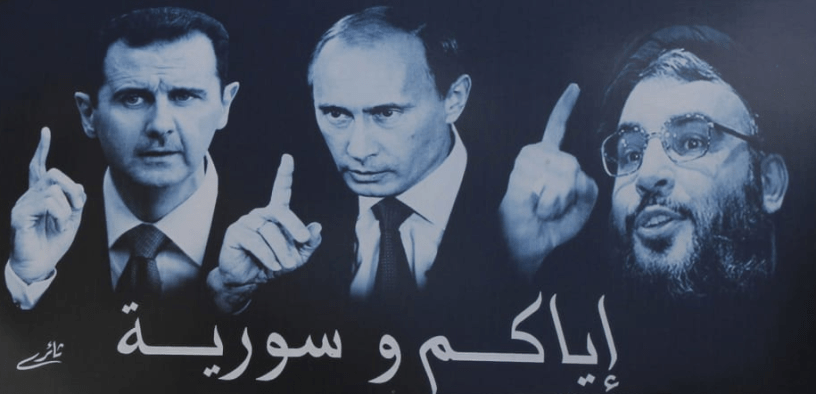
Speech by Hezbollah Secretary General Sayed Hassan Nasrallah on May 13, 2020, in commemoration of the martyrdom of Hezbollah Commander Mostapha Badreddine, killed in Syria in May 2016.
Summary:
- Syria has already won the war, even if there are still some minor battles to be fought
- Having failed militarily, the enemies of Syria strive doubly hard in their diplomatic, economic and psychological warfare
- There is no dissension between the allies of Damascus, nor a struggle for influence between Iran and Russia
- News of Bashar al-Assad being sidelined is just propaganda
- There are no Iranian armed forces in Syria, just military cadres and advisers
- Having bet everything on the terrorists, Israel sees its defeat and fears the recovery of Syria and the threat it will pose to the occupation of the Golan and the very existence of the Zionist entity
- The so-called Israeli campaign against the Iranian presence in Syria is nothing but window dressing aimed at reassuring Israeli opinion and providing cover for attacks on the Syrian ballistic power
- Israel presents as a victory a simple redeployment of forces due to successive victories over almost the entire Syrian territory, and a reduction in air movements between Iran and Syria due to the coronavirus
- Iran, Hezbollah and other Resistance movements will never leave Syria
- Israeli incursions into Syria are caused by worry, fear and adventurism, but can lead to uncontrolled escalation and regional war
This video only subtitles the last section of the transcript below, ‘Israel in Syria‘
Transcript:
Syria won the world war against it
[…] Today we can say that Syria won this war. In previous battles, when great achievements were made, such as after the liberation of Homs, Damascus, the South and even Aleppo, it was said that Syria had won the war, and analysts and specialists in strategic issues said no: Syria had won one (or more) battles, but had not (yet) won the war. Because a war is made of many battles: you can win a battle, lose another, win a third, lose the fourth, but all that does not (necessarily) mean that the whole war is won, or that the whole war is lost.
Today, in all simplicity, and via an objective and genuine assessment (of the situation), whoever goes to Syria and travels there —except for the politicized Arab (and Western) media—, whoever goes to Syria, in its provinces, in its cities, in its villages and boroughs, in all the regions currently in the hands of the State, anyone who observes the overall situation in Syria can easily affirm that Syria won the war, although there are still some battles going on. It should not be said that Syria has won one, two or three battles, and has lost one or two others, and that the war is still going on, without it being clear whether Syria will win it or not, no. The fair and accurate strategic assessment is that the Syrian leaders, the Syrian army, the Syrian State and the great majority of the Syrian people who stood firm in this struggle won this war.
Of course, there are still a few battles left, military or political, which require persistence and continuity of action, whether in Idlib, East of the Euphrates or certain areas North of Syria, but this is only a partial, limited and circumscribed part (of Syria). Syria has triumphed over partition projects, Syria has won this war, and suffice it to say that the objectives of this world war (against Syria) for which, according to their own admission, hundreds of billions of Arabian dollars have been spent —the dollar is American, but it is the Arab (countries) that have paid the bills; if this money had been spent for the good of the Arab peoples of our region, they would have extricated them from ignorance, poverty, misery, illiteracy, diseases, and the said funding countries (Saudi Arabia, etc. ) would not face financial incapacity in the face of the economic consequences of the Covid-19 pandemic as they do now—, thousands of tons of weapons and ammunition, tens of thousands of terrorists and takfiris who were brought from all over the world, dozens of international conferences, etc., etc., etc. They have deployed everything, done everything, absolutely everything, to achieve their objective in Syria: sectarian or political slogans, incitement (to racial or religious hatred), everything that the front of Arrogance (imperialism) and its instruments were able to mobilize in terms of resources and ideology, everything they could do against Syria, they did. And Syria, through the perseverance of its leaders, its army, its people and the State, and thanks to the presence and perseverance of its allies by its side, managed to win this war.
And that is why today, when we talk about our martyr leader, Sayed Mustapha Badreddine, and our other martyrs in Syria, we feel, in addition to the consequences for their afterlife and their (eminent) position close to God the Most High and the Exalted as martyrs, we have the feeling that their blood has borne fruit and enabled these results to be achieved, and that the objective for which they went to fight and for which they sacrificed their blood, their peace and their life, and for which they made unremitting efforts night and day, this goal was achieved and it is before our eyes today.
Economic, diplomatic & psychological warfare
I will now raise some points (concerning Syria). The first point is that naturally, what (the enemies of Syria) have been unable to achieve militarily, they have been trying for the past few years to obtain it politically, through political pressure on the Syrian leaders, on the allies of Syria, on Iran, on Russia, on those who stand alongside Syria, through international relations, through the UN Security Council, through intimidation, threats and tempting promises, so that the allies of Damascus will abandon Syria. But all of this has failed so far. And we know that sometimes the political battle is just as intense as the armed struggle. And sometimes its dangers are even greater, and require all of our vigilance and attention. Syria is still plunged into political war and is facing political pressures which, so far, have failed to achieve any of their goals.
Naturally, and I come to the second point, after the failure of the military war and the impotence and the ineffectiveness of the political war and the political pressures in achieving any objective at all, the front of Arrogance (imperialism), the American despots and their Allies resorted to other means, namely psychological warfare on the one hand, and sanctions and blockade on the other. With regard to psychological warfare, a very broad front has been open for years against Syria, and lately there has been an intensification of psychological warfare, some aspects of which I will touch on in a moment. Likewise, the sanctions and the state of siege against Syria are increasing, and they are betting on the economic consequences (which they hope will become unbearable for Syria and its allies). The coronavirus has added to these pressures, but this pandemic is not specific to Syria: the pressures of the coronavirus are weighing on the whole world. Today, those who besiege Iran, Syria, Venezuela and other countries, Gaza, Yemen, etc., are starting to suffer the economic consequences of the coronavirus themselves. We have all seen the catastrophe hitting the United States, the countries of Western Europe, as well as certain countries in our region (Saudi Arabia, etc.). In any event, it is also a means of attacking Syria, namely economic pressures, sanctions, the state of siege against Syria.
With regard to the sanctions and the blockade, we place our hopes on the endurance of the Syrian leaders, the Syrian State and the Syrian people, just as they persevered in the face of the military and political war. What gives us hope is that Syria is a country endowed with human capital and colossal possibilities; the Syrian people are full of liveliness, the wealth and innate means of Syria are many and huge. Before the crisis, Syria was not a debt-ridden or weak country, nor was it a country brimming with wealth, but its economy was entirely viable. In some Arab countries, millions of people live in cemeteries, but no family lived in a cemetery in Syria. Anyway, in the economic battle, the livelihood battle, the financial battle, we have good hope in the endurance and initiative of Syria, just as we trust Syria to succeed against the psychological battle.
Tensions between Syria’s allies ?
With regard to the psychological battle, I would like to give an example, before addressing my last point concerning Syria. Part of the psychological battle concerns the situation of the allies, and we often hear that the allies of Damascus have started to abandon Syria. (According to these rumors), Iran would be entangled in its internal situation and would prepare to abandon Syria. Russia, because of the pressures, its internal situation, such pressures or such problems or I don’t know what other rubbish, would abandon Syria. All these words express only dreams and hopes that we have been hearing for years, and some have been disseminated as if they were information, etc., but they were only aspirations (US / Israeli / Saudi wishful thinking).
Among the talking points of the current psychological warfare, let us quote again the recurrent remarks that we find in the media of the Gulf and certain Western media —the Western media are more reluctant to diffuse these reports, because they try to preserve the (little) credibility they still have— about an Iranian-Russian power struggle in Syria. There is no hint of truth in it. I said at the beginning of my speech that I was going to talk about Iran again. In the two points that remain for me to address (on Syria), I will clearly point out certain sensitive points which concern the Islamic Republic of Iran.
Neither the Islamic Republic of Iran, nor Hezbollah, nor the Resistance factions from different countries —Iraq, Afghanistan, Pakistan, etc. ; yes, Resistance movements came from these countries and fought in Syria alongside the Syrian Arab Army, the Syrian people and the Syrian popular forces, and are still present there… The Islamic Republic of Iran is not fighting for influence against anyone in Syria. Neither against Russia —regardless of what Russia is doing— nor against anyone. The position of the Islamic Republic in Syria was clear from the beginning: its (only) goal was to prevent the fall of Syria under American-Israeli control, and under the control of the instruments of Arrogance (imperialism), our common enemy. This was Iran’s goal, and nothing else. The Islamic Republic does not seek any influence in Syria, it has no aims and no greed in Syria, and has no desire to interfere in the internal affairs of Syria. Iranian interference in Syria has never existed, does not exist and will never exist with regard to internal Syrian issues, whether in the form of the regime, government, laws, the State… Iran will never do anything that some other States (especially the imperialist and neo-colonialist West) do, in any case. All that mattered and still matters for the Islamic Republic of Iran is that Syria remains in its (pro-) Arab, (pro-) Islamic, (pro-) Resistance position, that it preserves its identity, its independence, its sovereignty, its unity, that Syria remains a noble and dignified, persevering fortress, does not submit to American and Zionist hegemony, and does not compromise on its rights (over the Golan). This is all that Iran wants in Syria, no more no less. And that does not enter into any struggle for influence with anyone.
Certainly, to be completely frank and sincere, there may be differences between the allies as regards the definition of certain military or ground priorities, political questions, at the level of negotiations, etc. But this in no way leads to a struggle for influence, because the decisions of the Islamic Republic are categorical as regards the position alongside the Syrian leaders (who have the final say on all matters), Iran complying with what they determine and accept. The Islamic Republic has a position of support towards the endurance, the persistence, the maintenance and the independence of Syria, and its resilience in the face of projects of hegemony and control over it, and of liquidation of the Axis of Resistance in the region. In this regard, I would therefore like to reassure the masses & supporters of the Resistance in the Arab-Islamic world: in Syria, there is no struggle for influence between Iran and Russia. So could we say that the front of the allies and supporters of Damascus is plagued by internal strife or is in withdrawal? This is absolutely not true.
Israel in Syria
The other point I also wanted to talk about concerning Syria and Iran in Syria, and the Israeli enemy in Syria, is the Israeli aggression and the Israeli project in Syria. Especially in the past few weeks, the Zionist Israeli Minister of War (Naftali Bennett) is trying to brag and present (false victories) to the Israeli masses, lying to them and misleading them, and also to the public opinion in the Arab-Muslim world —and there are also Arab media that spread these lies and falsifications—, in order to highlight the imaginary victories and achievements of Israel in Syria at the expense of Syria, the Islamic Republic of Iran and the Axis of Resistance. I want to talk about it a bit, and it may be the first time that I do it in such a frank and detailed way, even if it will be synthetic.
During the first years (of the war in Syria), from 2011, Israel bet on the (terrorist) armed groups. The relations of the armed groups —especially in the south of Syria— with Israel are absolutely undeniable: exchange of information, financing, supplies, medical care, aid and support of all kinds, up to transit, all this is well known and obvious. Israel has been active in the war in Syria since 2011, and has counted & invested heavily on those who fight the regime in Syria. Israel had a whole set of objectives, the highest of which was the fall of the regime and the liquidation of the current administration (of Bashar al-Assad). But there were several other lesser goals.
When this war against Syria failed, and the Zionists understood that their instruments and the horse on which they had bet had failed in Syria, and that they had lost the war… They are still fighting in Syria, but they lost the war, as I just explained. The proof is that all of southern Syria, the vast majority of which was under the control of armed groups, which cooperated with Israel, was assisted by Israel and were Israel’s allies both openly and secretly, they all left, and some left Syria via the Zionist entity. We don’t forget their buses at night.
The Israelis therefore understood that their objective (to bring down the regime) had failed. They therefore aimed at a new objective, namely to fight against a new danger which appears to them, new dangers which will emanate from the situation and the victory in Syria. What are these new dangers? Some reside in the Syrian Arab forces themselves, in the Syrian army and in the Syrian military capabilities, especially with regard to ballistic capability and the manufacture of precision missiles. And that’s why we see that Israel is attacking everything related to the production of missiles in Syria, because he considers that the ballistic capacity and the manufacture of missiles constitute a (enormous) force for Syria, and obviously also for the Axis of Resistance.
Israel therefore considers Syria as a future threat, Syria which has stood firm during all these years in the face of a universal war waged against it: if Damascus regains its strength and regains its health, and develops its military, human and material capabilities, this will give Syria prevalence in the region and in the Arab-Israeli struggle. Therefore, Israel considers Syria as a threat, a future threat: Syria may not be a current threat, because it remains entangled in its internal situation and the few battles that remain to be fought. Likewise, Israel views the presence of Iran and Resistance factions in Syria as a threat. Israel is worried about Syria, Israel is afraid. Israel is terrified of what the future holds for it in Syria. This is the true description of the situation.
So look at the way Israeli officials express themselves about the Golan Heights, claiming that in southern Syria, for example, Hezbollah has a certain presence and a certain activity, and is trying to create a structure (of Resistance), with the help, silence or complicity of the Syrian authorities, cooperating with young Syrians (combatants) in order to recover the Golan and attack the Israeli occupation in the Golan. And all this while nothing important has happened yet. But this simple assumption, this simple fact created an atmosphere of terror within the Zionist entity, and sometimes pushes it to escalation measures which can lead to unforeseen and dramatic consequences (an open regional war). This indicates that Israel behaves towards Syria from a position of worry, fear and terror in the face of the consequences of the great victory in Syria. You have to keep that in mind in the first place.
Israel has therefore announced a goal in Syria. He cannot declare that he strikes Syria and the Syrian army, even if that is what he is doing concretely. Israel has therefore announced a goal linked to the Iranian presence in Syria, and the presence of Hezbollah, even if he insists above all on the Iranian presence. So they launched a campaign under the slogan “We want to expel Iran from Syria.” And their stupidity is such that it prompted the Israeli Minister of War, Naftali Bennett, to go so far as to set a timetable, promising that before the end of 2020, he would have ended the Iranian presence in Syria. So remember this deadline and count the months that we have before the end of the year to see what will happen to the promise of this stupid minister.
Israel has therefore worked to achieve this goal. What did they do, apart from the international, regional and domestic incitement, and the attempt to present the Iranian presence in Syria —which I will describe in detail— as having gone from a factor of assistance to a burden for Syria, which is a gross lie? They began with airstrikes and air operations which occasionally hit means of transport, warehouses or certain locations in Syria. This has been happening for years, and I never talked about it (in detail).
What is new? The new thing is that Israel goes astray, tricks its people and deceives the opinion in our region (and in the world) —and we are always fighting this battle to raise public awareness by revealing the truth—, trying to present certain details like the proofs of his victory in Syria and the beginning of the defeat of the Axis of Resistance or the Islamic Republic of Iran, the beginning of our exit and withdrawal (from Syria).
What are the clues and evidence that Israel puts forward? For several weeks, certain Israeli officials, media and analysts have been propagating these statements, even if other Israeli analysts say that these statements are inaccurate and just for show —and the latter are the ones who are right. Israel has spoken of several points (put forward as evidence of an Iranian withdrawal from Syria):
1/ the number of troops: the “Iranian (armed) forces”, to use their expression, would have greatly decreased in Syria;
2/ certain bases that have been evacuated, returned (to the Syrian authorities) or abandoned;
3/ the concentration of efforts on eastern Syria and the presence in the region of al-Boukamal, Deir Ezzor, etc.
The conclusion of all of this, (if we are to believe the Zionist enemy), is that the result of intelligence operations, military actions and aerial bombardments carried out by Israel, have largely fulfilled their objectives: Iran would leave Syria, the Iranians would be in full withdrawal, Hezbollah would retreat, and this moron (Bennett) believes he achieved an historic exploit which he trumpets at every occasion, predicting the full achievement of this objective before the end of 2020. Just see how he spreads these lies and fools public opinion.
Let me show you the real situation. First, regarding the situation on the ground, Israel keeps talking about the presence of “Iranian (armed) forces”, but in Syria there have only been Iranian military advisers and experts since 2011. I would like to say that they were present even before 2011 alongside the Syrian Arab Army and alongside the Resistance in Lebanon (Hezbollah), and after 2011, they remained, and due to the events, their number increased. But there are no Iranian military forces in Syria. When we talk about Iranian military forces, we mean one or more battalions, one or more units, legions, etc. That is what we are referring to when we talk about the armed forces.
There are a number of military advisers and experts in Syria, the number of which has increased with the events (since 2011). They had and still have a very important role:
1/ providing support and advice to the Syrian armed forces;
2/ managing groups of Syrian, Arab and Islamic popular forces which they train, arm and lead in the various battles in progress;
3/ coordinating operations with Resistance movements, including Hezbollah;
4/ coordinating the logistical support operations provided by the Iranian defense ministry to the Syrian defense ministry.
These Iranian advisers are not Iranian (armed) forces. It is not an Iranian armed presence.
You see, the Israelis announced a nonexistent, illusory, imaginary goal, similar to the objective of successive American administrations to prevent Iran from manufacturing nuclear weapons, while the Iranians do not have nuclear weapons and do not want to obtain nuclear weapons. In Syria, Israel is waging an imaginary battle to prevent Iranian forces from being present in Syria. While in Syria there are only Iranian military advisers and military experts. Despite all the difficulties, the situation in Syria in no way requires the arrival of Iranian (armed) forces in Syria.
To be frank and honest, at one point, a real discussion took place on this subject with the Iranian leaders, and at one point, for a few months, certain Iranian armed forces came to Aleppo, for 2 or 3 months. But apart from this exceptional case, there have never been Iranian forces in Syria, and I say and repeat that there are only advisers, in the number required by the situation: there may be more or less according to the needs of the field, and many of them fell martyrs —some could put forward this argument as proof of an armed presence; but it’s because these advisers were on the front lines alongside the Syrian Arab Army and Resistance factions, fighting and participating in battles, in the manner of the school of their commander of the al-Quds Forces, the martyr Qassem Soleimani, may God the Most High be pleased with him. This is therefore the real and precise description of the situation.
Secondly, naturally, as the battles were won, whether for the Iranians or the factions of the Resistance, and sometimes even for the Syrian army, when the battle or the threat ended in a region, there was no longer any reason to maintain a presence of combatants or military bases, nor our positions on combat axes and front lines. At one time, the fighting was taking place (simultaneously) in Homs, in the rif of Damascus, in Damascus, in the East of Homs, in the suburbs of Aleppo and in Aleppo itself, in Idlib, in the south of Syria, Badiya, al-Boukamal, Deir Ezzor, etc. It was therefore natural to have a presence (of the armed forces) in all these regions. While on the coast, there were no battles, and there was therefore no reason to have this presence.
When the province of Homs was liberated, this presence ceased. Same thing when the battles in Damascus and in the rif of Hama ended, as well as in southern Syria, in Palmyra and in the Badiya. If the Syrian army, of which it is the country, wanted to maintain a certain presence in certain barracks, to take the necessary precautions (to face a possible resurgence of the terrorists), that made sense; but as for the auxiliary forces, whether Iranians, Hezbollah or other factions of the Resistance, it is quite natural that they left this region, maintaining only the minimum of personnel, of combatants and of material there as a precaution. There would have been no reason to maintain the same number of forces, the same bases, etc.
For about two years, when this victory became clear, especially after the liberation of the Badiya and the opening of the highway to Aleppo, and the end of the battle in Damascus, in the rif of Damascus and in the south, the (Syrian & allied) forces gathered (in the last places of activity of the terrorists). The presence of many Iranian advisers was no longer required, and so they returned to Iran. Likewise for a number of Hezbollah fighters and cadres in Syria, whose presence was no longer useful, so they returned to Lebanon. Many of our Iraqi brothers and other nationalities were no longer required, so they returned home.
The situation in Syria having become very good, (what would have been the point of maintaining all this presence)? Some bases and barracks have always remained empty, and had been prepared in case there was a need for additional manpower. Many bases and barracks were no longer useful because there were no more fights, and were therefore abandoned. It all started two years ago or more, and has nothing to do with Israeli operations and attacks in Syria. It has nothing to do with the Israeli strikes in Syria. And that has nothing to do with the martyrdom of brother commander Hajj Qassem Soleimani. It started under his leadership, and the current leadership of the Al-Quds Forces (IRGC) continues the same program it began operating over two years ago.
Likewise, Hezbollah and the rest of the factions of the Resistance have started to do the same for more than two years, namely to decrease the troops, decrease the number of (active) bases, decrease the presence, because Syria begins to recover, Syria has won, the Syrian Arab Army has won, many frontlines no longer exist, the battles having been definitively won there. This is the truth.
Today, when anyone talks about a downsizing of foreign forces in Syria… Let me give you an example for Lebanon. At some point I announced that on the whole axis of Qalamoun, we ended our presence (that used to be massive), keeping only one or two positions. Same thing for the whole axis of Zabadani. All was done in coordination with the Syrian army. Is this an Israeli success? Or is this fact explained because the Syrian army and the Resistance won all the battles in these regions, as well as in the rif of Damascus, in the rif of Homs, etc. What would be the point, once the fighting is over, of staying on the mountains, in the cold, in the heat, what good is it to mobilize and use resources, etc. All that would be useless, it would be a waste of material and human resources. When the fighting is over, all we have to do is pack up and return to our main front, namely southern Lebanon (facing Israel).
The pseudo-evidence put forward by Israel today, namely the issue of the reduction of troops in Syria, the total or partial evacuation of certain places, bases or positions, this is only due to the fact that the presence there would no longer make any sense, as for example in Damascus or around Damascus, where the fighting has stopped. It is quite natural that the military presence should go to al-Boukamal, Deir Ezzor, Aleppo, Idlib, because the front lines are there, and there is no more fighting elsewhere. The remaining battles are there, so those who want to help must go there and not sit (arms crossed) in Damascus.
The pseudo-evidence advanced by Israel in no way proves Israeli successes, but proves the victory of Syria, the victory of the Islamic Republic of Iran, the victory of Hezbollah, the victory of the Axis of Resistance in Syria. This victory in the war involves, as with any army and any military force in the world, a redeployment of forces in accordance with new responsibilities and new challenges, in the light of our achievements and victories.
More so, a sign of the imbecility and lies of the Israeli media is that they have tried to explain the fact that for example, lately, the movements between Syria and Iran have decreased somewhat —air freight, the movement of airplanes—, and this has also been put forward as evidence of the Israeli military successes in Syria, while these claims are nothing but lies and falsifications. The cause is the coronavirus. The covid-19 which impacted the US military, European armies, and even the army of the Israeli enemy itself, which canceled maneuvers, training, and large military parades planned to celebrate the anniversary of the victory of 1945, and it is only natural that the pandemic also affects Syria, the Islamic Republic, ourselves and everyone.
To summarize this point, by way of synthesis before evoking the internal situation in Lebanon in the minutes that I have left, I would like to address the Israeli public to invite them to check their information and not to believe the lies of their leaders, who put forward imaginary victories in Syria, whether against Syria or against Iran. Admittedly, Syria suffers prejudice, just as Iranian advisers, Hezbollah and the Resistance in Syria are affected by the Israeli aggressions, which the Syrian, Iranian and Resistance leaders consider as they should —I don’t have time to speak in detail about our point of view on the issue, I will do it another time if necessary—, but the Israelis need to know that what their leaders are saying is only lies, deception and illusions, purely imaginary achievements. And if Israel continues on this path, they can make a mistake or a blunder that would blow up the whole region.
As for the announced objective, namely to expel the Iranian presence —the military advisers, and not the pseudo Iranian forces, as I explained— or even to expel Hezbollah and the Resistance from Syria, this objective will never be achieved, o Zionists. This objective will never be achieved. These advisers are present following a joint decision by Syria and Iran, and the Resistance movements are present at the request of the Syrian leaders and in accordance with the will of the Resistance movements themselves, and all those who, since 2011 to date, have sacrificed thousands of martyrs and suffered thousands of injuries, will not be defeated or deterred by an air strike or an assassination here and there. They will remain firmly on their positions, and will not abandon the battlefield or the place under any circumstances. This goal is unachievable.
These are just illusions that you live in your imagination; you are engaging in sheer adventurism, and at any moment, you can make a serious error in Syria that you will regret bitterly. […]
Source: https://video.moqawama.org/details.php?cid=1&linkid=2112
Translation: resistancenews.org
Belgium Urges Sanctions against Israel if it Annexes West Bank
Palestine Chronicle | June 27, 2020
The Belgian parliament on Friday passed a resolution urging the government to call on the European Union to impose sanctions against Israel if it proceeds with its plan to annex large swaths of the occupied West Bank.
The measure “concerning Israel’s annexation of occupied territories in Palestine”, passed in the 150-member House of Representatives with 101 affirmative votes, 39 abstentions and zero votes against it.
The body was also due to vote on a motion calling for the recognition of a Palestinian state but this was delayed after it was sent back to the foreign affairs committee for further debate.
MPs from left-wing parties, including the Socialist Party and members of the French and Green parties, proposed the resolutions.
“It is a matter of defending international law. There is no equidistance to be respected in this fight,” said MP Ecolo Simon Moutquin who authored the resolution.
The resolution has two objectives, he said: “On the one hand, send a message to the Israeli government ‘Don’t cross that red line’. On the other hand, give some hope to the Palestinians who have suffered injustice for decades.”
More than 1,000 European lawmakers across the political spectrum issued a letter earlier this week warning Israel against annexing parts of the occupied West Bank.
Legislators said they “share serious concerns about [US] President Trump’s plan for the Israeli-Palestinian conflict and the imminent prospect of Israeli annexation of West Bank territory.”
Featured Video

The Search for Truth: Charlie Kirk’s Assassination One Year Later
or go to
Aletho News Archives – Video-Images
From the Archives
US murdering 1 million Iraqis is democracy, Iran giving yogurt to Iraq is “domination”
By Ali Salaam | American Herald Tribune | July 31, 2017
The New York Times, owned by the Zionist Jewish supremacist Ochs-Sulzberger family, has no problem with Iraqi suffering as long as Iran is not the one behind it.
The Iraq War was a genocide of the Iraqi people by Zionist supremacists in the Bush administration. Over 1 million innocent people were killed based on a lie. American soldiers died in an Israeli war and now an average of 22 soldiers commit suicide every day because their consciences cannot cope with the fact they committed crimes in an illegal war that served no purpose other than to benefit Israel, not America.
Benjamin Netanyahu, Prime Minister of the Zionist regime, once said “We are benefiting from one thing, and that is the attack on the Twin Towers and Pentagon, and the American struggle in Iraq.”
Paul Wolfowitz had his sights on Iraq since his time in the first Bush administration. Former Israeli official and Bush administration official Richard Perle had his eyes on Iraq since at least his authorship of the Clean Break white paper. The Zionist regime had their eyes on Iraq since the 1980s when strategist Oded Yinon wrote his white paper in support of dividing the Arab-Muslim world along ethnic and sectarian lines. The global Zionist lobby has had their eyes on Iraq since Theodor Herzl stated that Eretz Israel’s true borders go from the Nile River in Egypt to the Euphrates River in Iraq. … continue
Blog Roll
 Aletho News
- The Search for Truth: Charlie Kirk’s Assassination One Year Later
- ‘Harsh reality’: Iran says France seeks monopoly on power and intimidation, not peace for all
- When Will This White House Madness End?
- Huckabee aide goes to ‘unusual lengths’ to portray ‘Israel’ positively
- Trump Announces Diesel Supply Deal With Putin Following Phone Call
- MEP blasts ‘Euro-Gestapo’ for lecturing Russia on democracy
- Syria May Send Troops to Saudi Arabia Amid War with Ansar Allah
- UK whines about losing billions to ‘Putin tax’
- Baghaei to Rubio: Distorted narratives cannot erase US record of broken commitments
- Houthis Don’t Have to Conquer Saudi Arabia to Make It Pay
- If Americans Knew
- Gaza ceasefire exists in name only, say more than 100 organizations
- Nearly 2 Million in Gaza Need Urgent Shelter Assistance as Winter Looms: IOM Chief Warns
- Suppressing Palestinian resistance: US charity under fire for AI monitoring of Gaza classrooms
- Thousands Are Held in Israeli Torture Camps. This Is What Happens Inside
- Israel puts Gaza’s sick, injured, newborn in peril – Daily Update
- Report claimed Mark Levin used by Israeli government to influence Trump
- Over 2,000 Gazans have died awaiting medical evacuation amid Israel’s continued siege
- How a U.S. Diplomat Suppressed and Altered Reports Critical of Israel
- 5 Palestinians Die from Israeli Strikes in Gaza as Relentless Attacks Continue
- Report: Ceasefire Slows Killing but Leaves Devastation Intact
- No Tricks Zone
- New Study: 50 Years Of The Most Aggressive ‘Net Zero’ Policies Can Only Affect The Global Climate By 0.03°C
- US September “Heat” Was No Record…Many Records Set Decades Ago
- Latest European Green Energy Debacle; Portugal’s Largest Flagship Solar Park Insolvent!
- Green Energy Debacle: German Expert Professor Fritz Vahrenholt Warns Of Severe Economic And Social Consequences
- Two More Paleo Reconstructions Affirm Meters-Higher Sea Levels Across Ireland, Brazil 7000-6000 Years Ago
- New Study: Earth And Venus Surface Warmth Largely Explained By Convection And Lapse Rate, Not CO2 Or Radiation
- 2025 Nature Paper Claiming Worsening Global Drought Gets RETRACTED …Heavily Flawed
- New Study: ‘Global Drought Shows No Detectable Recent Acceleration Under Climate Warming’
- Economic Masterminds: German Socialists Suggest Taxing Productivity Gains Stemming From Using AI
- The South China Sea Has Not Been Cooperating With The Climate Change Narrative

